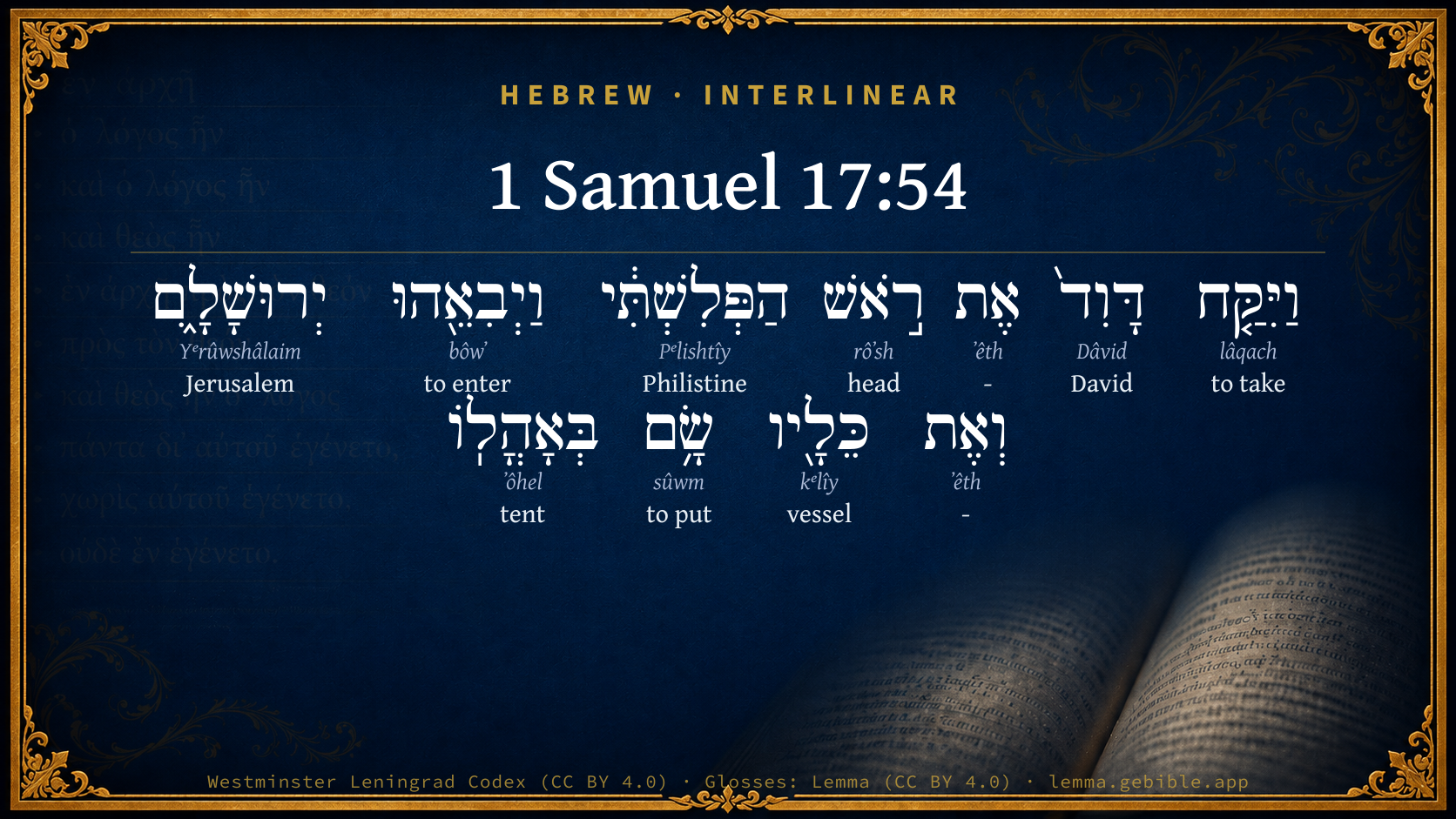
1 Samuel 17:54

Hebrew (Westminster Leningrad Codex) 1 Samuel 17:54 appears in the Hebrew Old Testament. The text above is from the Westminster Leningrad Codex. Each word links to its Strong’s number, a concise gloss, and parsing drawn from the Open Scriptures Hebrew Bible morphology. Click any word for its full Brown-Driver-Briggs (BDB) entry.
Download image
Cite this verse

1 Samuel 17:54 (World English Bible). Public Domain. Lemma interlinear Bible study tool, https://lemma.gebible.app/v/1-samuel/17/54.

Show BibTeX & RIS
BibTeX
RIS
English Translation
David took the head of the Philistine, and brought it to Jerusalem; but he put his armor in his tent.
World English Bible · Public Domain
Download a study sheet

One document with this verse’s original text, its word-by-word gloss line, the meaning frame, cross-references with their text, attributed commentary, and full source and license credits — printable, and it pastes into notes with its structure intact.

This verse Autodidact and up

Study sheet (.html) Plain text (.txt)

A passage Seminary Student

Up to 50 verses in one chapter. A passage sheet keeps up to 6 commentary sources and 12 cross-references per verse, in the order this page ranks them, and says so on the sheet whenever that leaves anything out. Ask for a single verse and you get the Autodidact verse sheet above.

Everything on this page stays free to read, with no account — the sheet is a download of what is already on screen, not access to it.

Want to remove ads? Support Godless Engineer
Compare translations 3

The same verse in 3 English versions, stacked beneath the original-language interlinear above. Click any original word for its lexicon entry.

Each is an independent rendering of the whole verse — the interlinear is not word-aligned to these translations.

Highlighted words mark where these versions differ — a whole-verse word diff, not a word-by-word alignment.

  • World English Bible Public Domain
    David took the head of the Philistine, and brought it to Jerusalem; but he put his armor in his tent.
  • King James Version Public Domain
    And David took the head of the Philistine, and brought it to Jerusalem; but he put his armor in his tent.
  • unfoldingWord Literal Text CC BY-SA 4.0
    And David took the head of the Philistine, and he brought it Jerusalem, and he put his equipment in his tent.

unfoldingWord Literal Text — © unfoldingWord, licensed CC BY-SA 4.0. Word-aligned USFM3 via Door43 (git.door43.org/unfoldingWord/en_ult).

Versions to compare (up to 4)

3 of 4 selected

Show all 18 translations

Every available English version of this verse, each an independent rendering of the whole verse.

  • World English Bible Public Domain
    David took the head of the Philistine, and brought it to Jerusalem; but he put his armor in his tent.
  • Berean Standard Bible Public Domain
    David took the head of the Philistine and brought it to Jerusalem, and he put Goliath’s weapons in his own tent.
  • Majority Standard Bible Public Domain
    David took the head of the Philistine and brought it to Jerusalem, and he put Goliath’s weapons in his own tent.
  • King James Version Public Domain
    And David took the head of the Philistine, and brought it to Jerusalem; but he put his armor in his tent.
  • American Standard Version (1901) Public Domain
    And David took the head of the Philistine, and brought it to Jerusalem; but he put his armor in his tent.
  • Revised Version (1885) Public Domain
    And David took the head of the Philistine, and brought it to Jerusalem; but he put his armour in his tent.
  • Geneva Bible (1599) Public Domain
    And Dauid tooke the head of ye Philistim, and brought it to Ierusalem, and put his armour in his tent.
  • Douay-Rheims (1899) Public Domain
    And David taking the head of the Philistine brought it to Jerusalem: but his armour he put in his tent.
  • Young's Literal Translation Public Domain
    And David taketh the head of the Philistine, and bringeth it in to Jerusalem, and his weapons he hath put in his own tent.
  • Literal Standard Version CC BY-SA 4.0
    And David takes the head of the Philistine, and brings it to Jerusalem, and he has put his weapons in his own tent.
  • Unlocked Literal Bible CC BY-SA 4.0
    David took the head of the Philistine and brought it to Jerusalem, but he put his armor in his tent.
  • unfoldingWord Literal Text CC BY-SA 4.0
    And David took the head of the Philistine, and he brought it Jerusalem, and he put his equipment in his tent.
  • Darby Bible Public Domain
    And David took the head of the Philistine and brought it to Jerusalem; but he put his armour in his tent.
  • World Messianic Bible Public Domain
    David took the head of the Philistine and brought it to Jerusalem, but he put his armor in his tent.
  • Webster's Bible Public Domain
    And David took the head of the Philistine, and brought it to Jerusalem; but he put his armor in his tent.
  • Free Bible Version CC BY-SA 4.0
    David took the Philistine's head and brought it to Jerusalem, but he put the Philistine's weapons in his own tent.
  • Bible in Basic English Public Domain
    And David took the head of the Philistine to Jerusalem, but the metal war-dress and the arms he put in his tent.
  • JPS Tanakh (1917) Public Domain
    And David took the head of the philistine, and brought it to Jerusalem; but he put his armour in his tent.

Literal Standard Version (2020), Covenant Press — licensed CC BY-SA 4.0. Text via the HelloAO Bible API (eBible.org). Unlocked Literal Bible (unfoldingWord) — licensed CC BY-SA 4.0. Text via the HelloAO Bible API (eBible.org). unfoldingWord Literal Text — © unfoldingWord, licensed CC BY-SA 4.0. Word-aligned USFM3 via Door43 (git.door43.org/unfoldingWord/en_ult). Free Bible Version, Dr. Jonathan Gallagher — licensed CC BY-SA 4.0. Text via the HelloAO Bible API (eBible.org).

Word by word

More ways to search: Search by grammar → Find every occurrence → Compare this word →

Practice this passage: Drill this verse → Learn its vocabulary →

הַפְּלִשְׁתִּ֔י
Pᵉlishtîy
H6430
“the · Philistine”
Particle, Definite Article + Noun, Gentilic, Masculine, Singular, Absolute
Part of Speech
Particle + Noun
Type
Gentilic
Gender
Masculine
Number
Singular
State
Absolute
Full BDB Definition

Origin: patrial from H6429

TWOT: None

Philistine = "immigrants" - an inhabitant of Philistia; descendants of Mizraim who immigrated from Caphtor (Crete?) to the western seacoast of Canaan
  1. וַיִּקַּ֤ח lâqach H3947 “and · to take” Conjunction + Verb, Qal, Sequential Imperfect, 3rd Person, Masculine, Singular
  2. דָּוִד֙ Dâvid H1732 “David” Noun, Proper
  3. אֶת ʼêth H853 “-” Particle, Direct Object
  4. רֹ֣אשׁ rôʼsh H7218 “head of” Noun, Common, Masculine, Singular, Construct
  5. וַיְבִאֵ֖הוּ bôwʼ H935 “and · to enter · him” Conjunction + Verb, Hiphil, Sequential Imperfect, 3rd Person, Masculine, Singular + Suffix, Personal, 3rd Person, Masculine, Singular
  6. יְרוּשָׁלִָ֑ם Yᵉrûwshâlaim H3389 “Jerusalem” Noun, Proper
  7. וְאֶת ʼêth H853 “and · -” Conjunction + Particle, Direct Object
  8. כֵּלָ֖יו kᵉlîy H3627 “vessels · his” Noun, Common, Masculine, Plural, Construct + Suffix, Personal, 3rd Person, Masculine, Singular
  9. שָׂ֥ם sûwm H7760 “to put” Verb, Qal, Perfect, 3rd Person, Masculine, Singular
  10. בְּאָהֳלֽוֹ ʼôhel H168 “in/at · tent · his” Preposition + Noun, Common, Masculine, Singular, Construct + Suffix, Personal, 3rd Person, Masculine, Singular

About this verse

These counts appear in no published source. They are computed here, from the morphology-tagged text and Lemma’s own curated glosses. What Lemma adds →

11
words
10
distinct lemmas
Historical
section

Grammatical profile

  • 3 verbs
  • 6 nouns
  • 2 particles

Verb forms

  • וַיִּקַּ֤ח Qal · Sequential Imperfect
  • וַיְבִאֵ֖הוּ Hiphil · Sequential Imperfect
  • שָׂ֥ם Qal · Perfect

Hebrew & Septuagint length

In English translation the verse runs 20 words from the Hebrew and 21 from the Septuagint (LXX English) — closely comparable.

A rough comparison of the two English renderings, which tokenize alike — not a word-level alignment.

Word counts can differ between the Hebrew and the Greek without any difference in meaning — e.g. the Hebrew direct-object marker אֵת has no separate Greek word, and Greek often adds the article ὁ.

Cross-references

3

Topical passages linked to 1 Samuel 17:54 in the Treasury of Scripture Knowledge — connected by theme and wording, ordered by reader-vote popularity; previews shown in the World English Bible.

  • Exodus 16:33 Moses said to Aaron, "Take a pot, and put an omer-full of manna in it, and lay it up before Yahweh, to be kept throughout your generations."
  • Joshua 4:7–8 then you shall tell them, Because the waters of the Jordan were cut off before the ark of the covenant of Yahweh; when it passed over the Jordan, the waters of the Jordan were cut off: and these stones shall be for a memorial to the children of Israel forever.
  • 1 Samuel 21:9 The priest said, The sword of Goliath the Philistine, whom you killed in the valley of Elah, behold, it is here wrapped in a cloth behind the ephod: if you will take that, take it; for there is no other except that here. David said, There is none like that; give it me.

Cross-references courtesy of OpenBible.info (CC BY 4.0).

Hebrew and Greek witnesses Masoretic Hebrew ↔ Greek Septuagint

The same verse in the two great witnesses to the Old Testament, shown verse-for-verse.

These are two independent witnesses, not word-aligned to each other, and the Septuagint is shown in lemma (dictionary) form.

Hebrew 1 Samuel 17:54 Masoretic · Westminster Leningrad Codex

וַיִּקַּ֤ח דָּוִד֙ אֶת רֹ֣אשׁ הַפְּלִשְׁתִּ֔י וַיְבִאֵ֖הוּ יְרוּשָׁלִָ֑ם וְאֶת כֵּלָ֖יו שָׂ֥ם בְּאָהֳלֽוֹ

David took the head of the Philistine, and brought it to Jerusalem; but he put his armor in his tent.

World English Bible · Public Domain

Greek LXX 1 Samuel 17:54 Septuagint · lemma form
And David took the head of the Philistine, and brought it to Jerusalem; but he put his armor in his tent.

LXX2012 (modern English Septuagint) · Public Domain

On this verse, Adam Clarke's Commentary discusses the Septuagint’s reading. Read the note in Commentary ↓

Hebrew: Westminster Leningrad Codex (CC BY 4.0). Greek: Septuagint (public domain); English from LXX2012 (modern English Septuagint) (Public Domain). How the Septuagint differs from the Hebrew →

Targum (Aramaic paraphrase)

1

The Targum is the ancient Jewish Aramaic paraphrase of the Hebrew Scriptures — an interpretive translation, not the Hebrew text itself. Onkelos (literal) and Pseudo-Jonathan (expansive) render the Torah, and Jonathan the Prophets. Coverage is partial: where no permissively-licensed English translation exists for a verse, only the Aramaic is shown. This is verse-level text, not a word-by-word alignment to the Hebrew.

  1. Targum Jonathan Prophets (Joshua–Malachi)
    וּנְסִיב דָוִד יַת רֵישָׁא דִפְלִשְׁתָּאָה וְאַיְתֵיהּ לִירוּשְׁלֵם וְיַת זְיָנֵיהּ שַׁוִי בְמַשְׁכְּנֵיהּ:

    (no public-domain English translation for this verse)

    Targum Jonathan — Aramaic: “Mikraot Gedolot” (public domain). English: “Sefaria Community Translation” (CC0 1.0 (public-domain dedication)); “London "Chaldee Paraphrase," 1871” (public domain). Text via Sefaria.

Commentary

Notes on 1 Samuel 17:54 from classic Christian and Jewish commentators (each source and its license shown beneath its notes). The classic Christian expositions comment on the surrounding passage and are grouped to its opening verse, so a note may address several verses; the Jewish commentaries on the Tanakh (Rashi and others) are per-verse, so they appear only where the commentator wrote on this verse.

Lemma curates 59 commentaries, every one of them public domain or Creative Commons licensed, each selected and text-cleaned for this edition rather than reprinted as found. About our sources →

Trapp's Complete Commentary

John Trapp

1Sa 17:54 And David took the head of the Philistine, and brought it to Jerusalem; but he put his armour in his tent.

Ver. 54. And brought it to Jerusalem.] Setting it up for a trophy of his victory, and for a terror to those sturdy Jebusites there, which still held the fort.

But he put his armour in his tent.] Either at his father Jesse’s house, or that tent in the camp which he had in common with his brethren. Some think he made the 144th Psalm upon this occasion. That in the tenth verse, "Who delivereth David his servant from the hurtful sword," the Chaldee rendereth, From Goliath’s sword.

John Trapp, A Commentary or Exposition upon All the Books of the Old and New Testament (1647–1656) — public domain. Text from a community e-Sword module.

Joseph Benson's Commentary

1Sa 17:54. And brought it to Jerusalem — After he had shown it to Saul, 1Sa 17:57, and exposed it to all the people, chap. 1Sa 18:6. Jerusalem was now become a noted city, which was the reason why he brought his head thither. Some think, however, that this is spoken of a future action, namely, that when David was come to the kingdom, and had made Jerusalem his royal seat, he ordered the scull of Goliath to be fixed up in some public place there, as a monument of this most signal victory. But he put his armour in his tent — A tent which probably was set up for David on this occasion. The sword was afterward placed behind the ephod in the tabernacle, being consecrated to God, and preserved as a memorial of the victory to his honour, 1Sa 21:9.

Joseph Benson's Commentary on the Old and New Testaments (1811–1818) — public domain. Text from a community e-Sword module.

Tyndale Open Study Notes

Tyndale Open Resources

17:54 Jerusalem became an Israelite city later, when David captured it from the Jebusites (2 Sam 5:6-7). Jerusalem was probably the final destination of Goliath’s head, after David had become king. But David might have taken it to Jerusalem earlier to intimidate the non-Israelite occupants.

Tyndale Open Study Notes — © Tyndale Open Resources, licensed CC BY-SA 4.0. Text via the HelloAO Bible API.

Geneva Bible (1599)

Geneva Bible translators

Or house at Bethlehem.

Geneva Bible (1599) marginal notes — public domain. Text via Bolls.life.

Jamieson, Fausset & Brown

Robert Jamieson, A. R. Fausset & David Brown

tent--the sacred tabernacle. David dedicated the sword of Goliath as a votive offering to the Lord.

Jamieson, Fausset & Brown — Commentary Critical and Explanatory on the Whole Bible (1871) — public domain (CC PDM 1.0). Text via the HelloAO Bible API.

Adam Clarke's Commentary

Verse 54. David took the head of the Philistine] It has been already remarked that this, with the following verses, and the five first verses of the eighteenth chapter, are omitted by the Septuagint. See the observations at the end. 1Sa 17:58.

Adam Clarke's Commentary on the Bible (1810–1826) — public domain. Text from a community e-Sword/MySword module.

Ellicott's Commentary for English Readers

(54) The head of the Philistine.—There is no real difficulty here, for although the fortress of Jebus, on Mount Zion, was in the hands of the Jebusites, and continued to be so until David captured the stronghold, many years later, the city of Jerusalem already belonged to the Israelites. (See Jos_15:63; Jdg_1:21.) This “place of arms” was naturally selected for the home of the famous trophy, being the nearest stronghold to the scene of the victory.

But he put his armour in his tent.—Ohel, the Hebrew word rendered here “tent,” is the ancient word for “dwelling.” If we understand that David kept for the present the armour of his mighty adversary, we must suppose he took it to his dwelling at Bethlehem, and after a time presented it to the sanctuary at Nob. In 1Sa_21:9 we read of the “sword of Goliath wrapped in a cloth behind the ephod.” Abarbanel, however, with great probability, believes that by the expression “in his tent” the “tabernacle of Jehovah” is meant—“His tabernacle,” so termed pointedly by the compiler of the history, because David, in later days, with great ceremony, “pitched it” in his own city (2Sa_6:17). In Act_15:16 the writer of this New Testament Book expressly calls the sacred tent “the Tabernacle of David.”

A Bible Commentary for English Readers, edited by Charles John Ellicott (1878–1897) — public domain. Text from a community e-Sword module.

The Cambridge Bible for Schools and Colleges

gen. ed. J. J. S. Perowne

54. to Jerusalem] There are no indications that Jerusalem had yet attained any importance either as a political or religious centre. The citadel still remained in the hands of the Jebusites, though the lower city had been captured (Jos_15:63). It seems best therefore to suppose that David deposited the head as a votive offering in the Tabernacle at Nob which was close to Jerusalem. We know that he afterwards placed Goliath’s sword there, and possibly the rest of his armour along with it. This is preferable to the conjecture that the historian here relates by anticipation what David did eventually when he occupied Jerusalem.

in his tent] So long as the army remained in the field he kept it as a trophy of his victory.

We might naturally expect that David would celebrate his victory by a Psalm of thanksgiving. No extant Psalm however can with certainty be referred to this occasion. The Sept. adds “against Goliath” to the title of Psalms 144 (Sept. 143), but without any sufficient probability; and the Psalm appended to the Psalter in the Sept., which professes to belong to this period, is certainly not authentic. A translation of it may be found in Smith’s Dict. of the Bible, I. 403.

The Cambridge Bible for Schools and Colleges (gen. ed. J. J. S. Perowne; Cambridge University Press, 1878–1918) — public domain. Text from a community e-Sword module.

John Gill's Exposition

And David took the head of the Philistine, and brought it to Jerusalem,.... After he had been introduced with it to Saul, and when he had passed through various cities in Israel, carrying the head in triumph; where he was congratulated by the women, who came out singing and dancing, and speaking highly in his commendation and praise: why he carried it to Jerusalem is not easy to say, this not being a royal city, nor was it wholly in the hands of the Israelites; part of it indeed was in the possession of Judah and Benjamin, but the stronghold of Zion was possessed by the Jebusites; and it is generally thought that it was to the terror of them that the head of Goliath was carried there. R. Joseph Kimchi thinks, that Nob, where the tabernacle was at this time, was surnamed Jerusalem, but for what reason cannot be said:

but he put his armour in his tent; not where the army was encamped before the engagement; for David had not his tent there, and beside the camp broke up upon this victory obtained; but rather in his tent or apartment at Bethlehem, when he returned thither, and where he laid up the armour he took from Goliath; though Abarbinel thinks, and so other Jews (q), that by his tent is meant the tabernacle of the Lord, called David's, because of his attachment to it; and certain it is that the sword of Goliath was either now, or at least hereafter, laid up there, see Sa1 21:9; where all that went to sacrifice might see it, and call to mind this wonderful instance of the power and goodness of God, and praise him for it.

(q) Hieron. Trad. Heb. in lib. Reg. fol. 76. E.

John Gill's Exposition of the Whole Bible (1746–1763) — public domain (CC PDM 1.0). Text via the HelloAO Bible API.

Albert Barnes' Notes on the Bible

Jerusalem - See Jdg 1:8 note.

His tent - Perhaps the tabernacle. David had neither tent nor house of his own. It would be quite in accordance with David’s piety that he should immediately dedicate to God the arms taken from the Philistine, in acknowledgment that the victory was not his own but the Lord’s (compare 1Sa 21:9). His tabernacle, meaning the tabernacle which he had pitched (2Sa 6:17; compare Act 15:16).

Albert Barnes' Notes on the Bible (1834–1885) — public domain. Text from a community e-Sword/MySword module.

Haydock's Catholic Bible Commentary

Tent, or tabernacle of the Lord, which David erected in his honour, at Jerusalem, many years afterwards. (Jun. Piscator, &c.) The lower part of Jerusalem was already in the hands of the Israelites. He might place the armour for the present in the tent of his brethren. We find that the sword was deposited in the tabernacle, at Nobe. (Calmet) See ver. 12. (Haydock) --- The head was carried about to various cities. It would serve to strike terror into the Jebusites, at Jerusalem, and others. (Menochius) --- The Vatican Septuagint, &c., immediately subjoin, chap. xviii. 6. Now, &c. Literally, "And the women dancing, came to meet David." (Haydock) --- These three last verses occur only in the Alexandrian manuscript, though Theodoret (q. 43,) seems to have read them. In some other Greek copies, there is a long addition respecting David’s combat. See the New Hexapla. These verses are found, however, in Hebrew, Chaldean, &c. It is astonishing that Saul should not have known David. He was now more interested to be acquainted with his family, as he had engaged to give him his daughter in marriage. We must reflect that his malady might have impaired his memory, and David was still growing, so that a few months absence might produce a wonderful alteration, &c. (Calmet) --- Know not. Literally, "if I know." The different dress, in which David now appeared, gave rise to this ignorance. (Menochius) --- Abner was not surely affected with the same malady as the king, who was obliged to ask David who was his father. But courtiers easily forget those from whom they have no expectations. (Haydock) --- These strange proceedings make others conclude that this history is interpolated. (Kennicott) --- Huet maintains the contrary. (Du Hamel) --- Saul only enquires about David’s parentage. (Mariana; Tirinus)

George Leo Haydock (1774–1849), Haydock's Catholic Family Bible and Commentary, 1859 edition — public domain. Excludes Psalms (Douay-Rheims chapter numbering differs from Protestant) and Deuterocanonical books (Catholic canon only).

Matthew Poole's English Annotations

Brought it to Jerusalem; either to terrify the Jebusites, who yet held the fort of Zion, 2Sa 5:7; or for some other reason not recorded, nor now known.

In his tent, i.e. in the tent which was erected for him in the camp, upon this occasion. There it was kept for the present, though afterwards it seems to have been translated to the tabernacle, where we find his sword, 1Sa 21, and it is not unlikely the rest of his armour was there also.

Matthew Poole's English Annotations on the Holy Bible (1683–1685) — public domain. Text from a community e-Sword/MySword module.

Whedon's Commentary on the Bible

Daniel D. Whedon

54. David took the head… and brought it to Jerusalem; but he put his armour in his tent — According to some critics this verse is utterly irreconcilable with the context, and is, therefore, to be regarded as the interpolation of a later hand. But what are the difficulties? (1.) Jerusalem was then in the hands of the Jebusites, and remained so until a much later day, when David himself conquered them. 2Sa_5:7. But this is no good reason why the head of the Philistine might not have been taken there; for, according to Jdg_1:21, the Benjamites occupied Jerusalem in common with the Jebusites. But if this were not now the case, and the Jebusites were in possession of the whole city, David, passing by Jerusalem on his return from the battle, might have thought to awe the Jebusite stronghold by placing Goliath’s ghastly head in sight of them. (2.) Another difficulty is that David could have had no tent in the camp. The tent his brothers occupied, however, may not improperly have been spoken of as his tent. But his tent, in which he put the giant’s armour, more probably refers to David’s home in Beth-lehem, not to an army tent. That this is a common meaning of the word tent a reference to 1Sa_4:10; 1Sa_13:2; Jos_22:7, and 1Ki_12:16, will abundantly show. This verse simply informs the reader what became of Goliath’s head and armour; but we are not necessarily to suppose that the facts recorded took place immediately after the battle, or even that David did these things in his own person. Various displays may have been made of the head before it was brought to Jerusalem, and also of the armour before it was taken to David’s home. From chap. 1Sa_21:9, we learn that at a later day Goliath’s sword was kept at Nob in care of the priests.

Daniel D. Whedon (gen. ed.), Commentary on the Old and New Testaments (1874–1909) — public domain. Text from a community e-Sword module.

The Pulpit Commentary

David...brought it to Jerusalem. This is an anticipation of later history. The Jebusites at this time held Jerusalem; but when David had taken it from them, he removed the head of Goliath thither, and the narrator, following the usual custom of Hebrew historians, mentions the ultimate fate of this trophy here. (see on 1Sa_16:21) He put his armour in his tent. Ie. he carried it to his home, (see on 1Sa_2:35 1Sa_4:10 1Sa_13:2, etc.) where it became his private property. The mistranslation of camp by tents in ver. 53 might lead an English reader to suppose that it meant a tent in the camp of Israel; but most probably the men all slept under their wagons. Abravanel supposes that by David"s tent was meant the tabernacle of Jehovah, but this would surely have been stated more fully. Either, however, now, or at some later period, David must have presented the sword as an offering to the tabernacle, as it was laid up at Nob, whence he took it with him in his flight. (see 1Sa_21:9)

The Pulpit Commentary (1880–1919), ed. H.D.M. Spence-Jones & Joseph S. Exell — public domain. Text from a community e-Sword module.

Lesson kit

Teaching starters — assembled from the data on this page, not authored interpretation. Every prompt links to the verse data it draws on. Edit before teaching.

1 Samuel, in the Historical, opens this verse with 11 words (10 distinct Hebrew lemmas). Its most distinctive word is Pᵉlishtîy (“Philistine”). A historical commentator’s framing appears above. Read the whole chapter for the surrounding context.

Discussion questions

  1. The word Pᵉlishtîy carries the sense “Philistine.” How does it shape the verse?
  2. How does Exodus 16:33, which shares this passage’s theme, read alongside this verse?
  3. The translations on this page render this verse differently — a whole-verse word diff, not a word-by-word alignment. What might account for the different wordings?
  4. «וַיִּקַּ֤ח» is a Qal Sequential Imperfect verb. How does that grammatical form shape the action described?
  5. Compare how Trapp's Complete Commentary and Joseph Benson's Commentary read this verse. Where do they agree or differ?

Things to notice

Reading settings

Reading text

Shown beneath each verse's original-language words.

Old Testament
Old Testament edition

Read the OT as the Masoretic Hebrew (MT) or the Greek Septuagint (LXX).

English shown for the Greek Septuagint (in the Hebrew ↔ Greek comparison).

Comparing translations? Open the Compare panel on any verse page to stack up to four side by side.