Numbers 18:31

Hebrew (Westminster Leningrad Codex) Numbers 18:31 appears in the Hebrew Old Testament. The text above is from the Westminster Leningrad Codex. Each word links to its Strong’s number, a concise gloss, and parsing drawn from the Open Scriptures Hebrew Bible morphology. Click any word for its full Brown-Driver-Briggs (BDB) entry.
Download image
Cite this verse

Numbers 18:31 (World English Bible). Public Domain. Lemma interlinear Bible study tool, https://lemma.gebible.app/v/numbers/18/31.

Show BibTeX & RIS
BibTeX
RIS
English Translation
You shall eat it in every place, you and your households: for it is your reward in return for your service in the tent of meeting.
World English Bible · Public Domain
Download a study sheet

One document with this verse’s original text, its word-by-word gloss line, the meaning frame, cross-references with their text, attributed commentary, and full source and license credits — printable, and it pastes into notes with its structure intact.

This verse Autodidact and up

Study sheet (.html) Plain text (.txt)

A passage Seminary Student

Up to 50 verses in one chapter. A passage sheet keeps up to 6 commentary sources and 12 cross-references per verse, in the order this page ranks them, and says so on the sheet whenever that leaves anything out. Ask for a single verse and you get the Autodidact verse sheet above.

Everything on this page stays free to read, with no account — the sheet is a download of what is already on screen, not access to it.

Want to remove ads? Support Godless Engineer
Compare translations 3

The same verse in 3 English versions, stacked beneath the original-language interlinear above. Click any original word for its lexicon entry.

Each is an independent rendering of the whole verse — the interlinear is not word-aligned to these translations.

Highlighted words mark where these versions differ — a whole-verse word diff, not a word-by-word alignment.

  • World English Bible Public Domain
    You shall eat it in every place, you and your households: for it is your reward in return for your service in the tent of meeting.
  • King James Version Public Domain
    And ye shall eat it in every place, ye and your households: for it is your reward for your service in the tabernacle of the congregation.
  • unfoldingWord Literal Text CC BY-SA 4.0
    And you shall eat it in every place, you and your house, for it a wage for you in exchange for your service in the tent of meeting.

unfoldingWord Literal Text — © unfoldingWord, licensed CC BY-SA 4.0. Word-aligned USFM3 via Door43 (git.door43.org/unfoldingWord/en_ult).

Versions to compare (up to 4)

3 of 4 selected

Show all 18 translations

Every available English version of this verse, each an independent rendering of the whole verse.

  • World English Bible Public Domain
    You shall eat it in every place, you and your households: for it is your reward in return for your service in the tent of meeting.
  • Berean Standard Bible Public Domain
    And you and your households may eat the rest of it anywhere; it is the compensation for your work at the Tent of Meeting.
  • Majority Standard Bible Public Domain
    And you and your households may eat the rest of it anywhere; it is the compensation for your work at the Tent of Meeting.
  • King James Version Public Domain
    And ye shall eat it in every place, ye and your households: for it is your reward for your service in the tabernacle of the congregation.
  • American Standard Version (1901) Public Domain
    And ye shall eat it in every place, ye and your households: for it is your reward in return for your service in the tent of meeting.
  • Revised Version (1885) Public Domain
    And ye shall eat it in every place, ye and your households: for it is your reward in return for your service in the tent of meeting.
  • Geneva Bible (1599) Public Domain
    And ye shall eate it in al places, ye, and your housholdes: for it is your wages for your seruice in the Tabernacle of the Congregation.
  • Douay-Rheims (1899) Public Domain
    And you shall eat them in all your places, both you and your families: because it is your reward for the ministry, wherewith you serve in the tabernacle of the testimony.
  • Young's Literal Translation Public Domain
    and ye have eaten it in every place, ye and your households, for it `is' your hire in exchange for your service in the tent of meeting;
  • Literal Standard Version CC BY-SA 4.0
    and you have eaten it in every place, you and your households, for it [is] your hire in exchange for your service in the Tent of Meeting;
  • Unlocked Literal Bible CC BY-SA 4.0
    You may eat the rest of your gifts in any place, you and your families, because it is your pay in return for your work in the tent of meeting.
  • unfoldingWord Literal Text CC BY-SA 4.0
    And you shall eat it in every place, you and your house, for it a wage for you in exchange for your service in the tent of meeting.
  • Darby Bible Public Domain
    And ye shall eat it in every place, ye and your households; for it is your reward for your service in the tent of meeting.
  • World Messianic Bible Public Domain
    You may eat it anywhere, you and your households, for it is your reward in return for your service in the Tent of Meeting.
  • Webster's Bible Public Domain
    And ye shall eat it in every place, ye and your households: for it is your reward for your service in the tabernacle of the congregation.
  • Free Bible Version CC BY-SA 4.0
    You and your families may eat it anywhere because it's compensation for your service in the Tent of Meeting.
  • Bible in Basic English Public Domain
    It is to be your food, for you and your families in every place: it is your reward for your work in the Tent of meeting.
  • JPS Tanakh (1917) Public Domain
    And ye may eat it in every place, ye and your households; for it is your reward in return for your service in the tent of meeting.

Literal Standard Version (2020), Covenant Press — licensed CC BY-SA 4.0. Text via the HelloAO Bible API (eBible.org). Unlocked Literal Bible (unfoldingWord) — licensed CC BY-SA 4.0. Text via the HelloAO Bible API (eBible.org). unfoldingWord Literal Text — © unfoldingWord, licensed CC BY-SA 4.0. Word-aligned USFM3 via Door43 (git.door43.org/unfoldingWord/en_ult). Free Bible Version, Dr. Jonathan Gallagher — licensed CC BY-SA 4.0. Text via the HelloAO Bible API (eBible.org).

Word by word

More ways to search: Search by grammar → Find every occurrence → Compare this word →

Practice this passage: Drill this verse → Learn its vocabulary →

חֵ֥לֶף
chêleph
H2500
“in exchange for”
Preposition
Part of Speech
Preposition
Full BDB Definition

Origin: from H2498

TWOT: 666a

in exchange for (only construct) (noun masculine) - in return for (preposition)
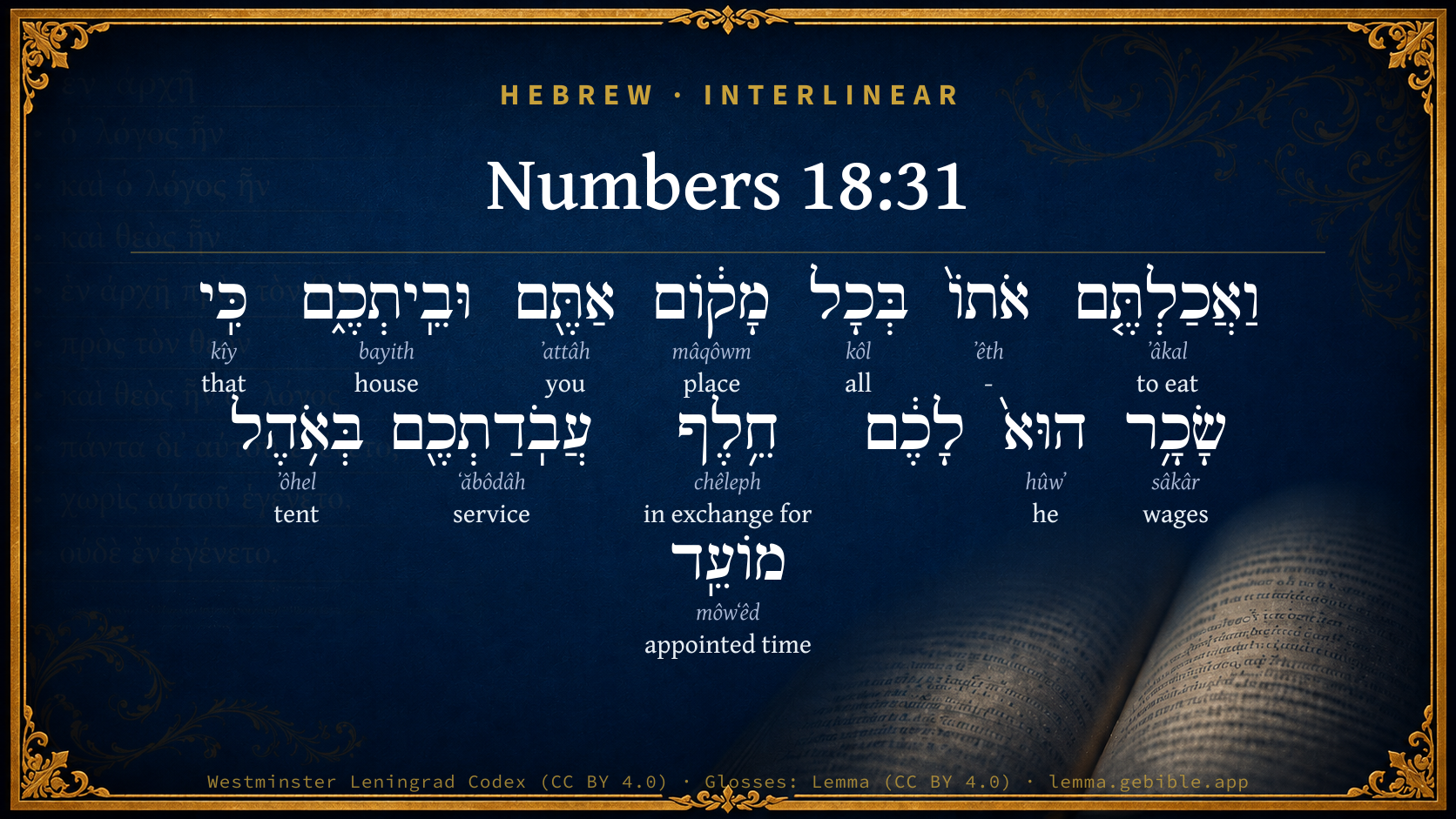
  1. וַאֲכַלְתֶּ֤ם ʼâkal H398 “and · to eat” Conjunction + Verb, Qal, Sequential Perfect, 2nd Person, Masculine, Plural
  2. אֹתוֹ֙ ʼêth H853 “- · him” Particle, Direct Object + Suffix, Personal, 3rd Person, Masculine, Singular
  3. בְּכָל kôl H3605 “in/at · all of” Preposition + Noun, Common, Masculine, Singular, Construct
  4. מָק֔וֹם mâqôwm H4725 “place” Noun, Common, Masculine, Singular, Absolute
  5. אַתֶּ֖ם ʼattâh H859 “you” Pronoun, Personal, 2nd Person, Masculine, Plural
  6. וּבֵֽיתְכֶ֑ם bayith H1004 “and · house · your” Conjunction + Noun, Common, Masculine, Singular, Construct + Suffix, Personal, 2nd Person, Masculine, Plural
  7. כִּֽי kîy H3588 “that” Conjunction
  8. שָׂכָ֥ר sâkâr H7939 “wages” Noun, Common, Masculine, Singular, Absolute
  9. הוּא֙ hûwʼ H1931 “he” Pronoun, Personal, 3rd Person, Masculine, Singular
  10. עֲבֹֽדַתְכֶ֖ם ʻăbôdâh H5656 “service · your” Noun, Common, Feminine, Singular, Construct + Suffix, Personal, 2nd Person, Masculine, Plural
  11. בְּאֹ֥הֶל ʼôhel H168 “in/at · tent of” Preposition + Noun, Common, Masculine, Singular, Construct
  12. מוֹעֵֽד môwʻêd H4150 “appointed time” Noun, Common, Masculine, Singular, Absolute

About this verse

These counts appear in no published source. They are computed here, from the morphology-tagged text and Lemma’s own curated glosses. What Lemma adds →

14
words
13
distinct lemmas
Pentateuch
section

Notable vocabulary

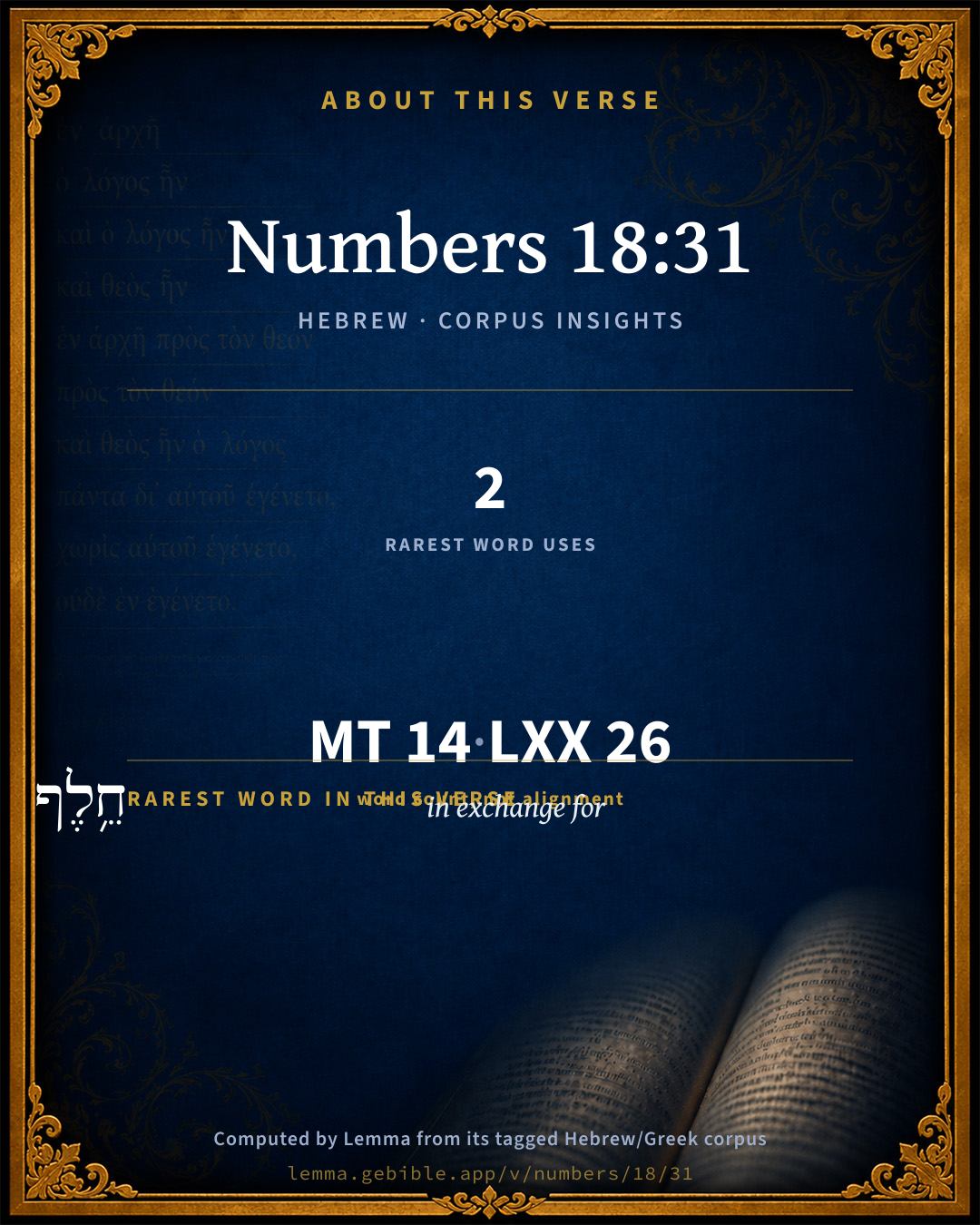
The rarest word here is חֵ֥לֶף in exchange for H2500 — appearing just 2 times in the whole Hebrew Bible.

Shared distinctive vocabulary

חֵ֥לֶף in exchange for H2500 occurs in 2 verses of the Hebrew Bible. Also found in:

Grammatical profile

  • 1 verb
  • 7 nouns
  • 2 pronouns
  • 2 prepositions
  • 1 conjunction
  • 1 particle

Verb forms

  • וַאֲכַלְתֶּ֤ם Qal · Sequential Perfect

Hebrew & Septuagint length

In English translation the verse runs 26 words from the Hebrew and 25 from the Septuagint (LXX English) — closely comparable.

A rough comparison of the two English renderings, which tokenize alike — not a word-level alignment.

Word counts can differ between the Hebrew and the Greek without any difference in meaning — e.g. the Hebrew direct-object marker אֵת has no separate Greek word, and Greek often adds the article ὁ.

In the original languages it is 14 Hebrew tokens and 26 Greek tokens — but the two are counted differently (Hebrew bundles its prefixes and suffixes into one token; the Greek is in lemma form), so that isn’t a like-for-like length.

Cross-references

7

Topical passages linked to Numbers 18:31 in the Treasury of Scripture Knowledge — connected by theme and wording, ordered by reader-vote popularity; previews shown in the World English Bible.

  • Matthew 10:10 Take no bag for your journey, neither two coats, nor shoes, nor staff: for the laborer is worthy of his food.
  • Luke 10:7 Remain in that same house, eating and drinking the things they give, for the laborer is worthy of his wages. Don't go from house to house.
  • 1 Corinthians 9:10–14 or does he say it assuredly for our sake? Yes, it was written for our sake, because he who plows ought to plow in hope, and he who threshes in hope should partake of his hope.
  • 1 Timothy 5:17–18 Let the elders who rule well be counted worthy of double honor, especially those who labor in the word and in teaching.
  • Deuteronomy 14:22–23 You shall surely tithe all the increase of your seed, that which comes forth from the field year by year.
  • 2 Corinthians 12:13 For what is there in which you were made inferior to the rest of the assemblies, unless it is that I myself was not a burden to you? Forgive me this wrong.
  • Galatians 6:6 But let him who is taught in the word share all good things with him who teaches.

Cross-references courtesy of OpenBible.info (CC BY 4.0).

Hebrew and Greek witnesses Masoretic Hebrew ↔ Greek Septuagint

The same verse in the two great witnesses to the Old Testament, shown verse-for-verse.

These are two independent witnesses, not word-aligned to each other, and the Septuagint is shown in lemma (dictionary) form.

Hebrew Numbers 18:31 Masoretic · Westminster Leningrad Codex

וַאֲכַלְתֶּ֤ם אֹתוֹ֙ בְּכָל מָק֔וֹם אַתֶּ֖ם וּבֵֽיתְכֶ֑ם כִּֽי שָׂכָ֥ר הוּא֙ לָכֶ֔ם חֵ֥לֶף עֲבֹֽדַתְכֶ֖ם בְּאֹ֥הֶל מוֹעֵֽד

You shall eat it in every place, you and your households: for it is your reward in return for your service in the tent of meeting.

World English Bible · Public Domain

Greek LXX Numbers 18:31 Septuagint · lemma form

καί ἐσθίω αὐτός ἐν πᾶς τόπος σύ καί ὁ οἶκος σύ ὅτι μισθός οὗτος σύ εἰμί ἀντί ὁ λειτουργία σύ ὁ ἐν ὁ σκηνή ὁ μαρτύριον

And you⌃ shall eat it in any place, you⌃ and your families; for this is your reward for your services in the tabernacle of witness.

LXX2012 (modern English Septuagint) · Public Domain

Hebrew: Westminster Leningrad Codex (CC BY 4.0). Greek: Septuagint (public domain); English from LXX2012 (modern English Septuagint) (Public Domain). How the Septuagint differs from the Hebrew →

Targum (Aramaic paraphrase)

2

The Targum is the ancient Jewish Aramaic paraphrase of the Hebrew Scriptures — an interpretive translation, not the Hebrew text itself. Onkelos (literal) and Pseudo-Jonathan (expansive) render the Torah, and Jonathan the Prophets. Coverage is partial: where no permissively-licensed English translation exists for a verse, only the Aramaic is shown. This is verse-level text, not a word-by-word alignment to the Hebrew.

  1. Targum Onkelos Torah (Genesis–Deuteronomy)
    וְתֵיכְלוּן יָתֵיהּ בְּכָל אֲתַר אַתּוּן וֶאֱנַשׁ בָּתֵּיכוֹן אֲרֵי אַגְרָא הוּא לְכוֹן חֲלַף פָּלְחַנְכוֹן בְּמַשְׁכַּן זִמְנָא

    (no public-domain English translation for this verse)

    Targum Onkelos — Aramaic: “Onkelos Genesis” (public domain); “Onkelos Exodus” (public domain); “Onkelos Leviticus” (public domain); “Onkelos Numbers” (public domain); “Onkelos Deuteronomy” (public domain). English: “Sefaria Community Translation” (CC0 1.0 (public-domain dedication)); “J.W. Etheridge. The Targums of Onkelos and Jonathan Ben Uzziel on the Pentateuch. London: Longmans, Green, 1862” (public domain). Text via Sefaria.

  2. Targum Pseudo-Jonathan Torah (Genesis–Deuteronomy)
    וְתֵיכְלוּן יָתֵיהּ אַתּוּן כַּהֲנַיָא בְּכָל אֲתַר אַתּוּן וְאֵינַשׁ בָּתֵּיכוֹן אֲרוּם אַגְרָא הוּא לְכוֹן חִילוּפֵי פּוּלְחַנְכוֹן בְּמַשְׁכַּן זִמְנָא

    And you may eat it, you, the priests, in any place, you and the men of your house; for it is your remuneration for your service in the tabernacle of ordinance.

    Targum Pseudo-Jonathan — Aramaic: “Targum Jonathan on Genesis” (public domain); “Targum Jonathan on Exodus” (public domain); “Targum Jonathan on Leviticus” (public domain); “Targum Jonathan on Numbers” (public domain); “Targum Jonathan on Deuteronomy” (public domain). English: “The Targum of Jonathan ben Uzziel, trans. J. W. Etheridge, London, 1862” (public domain). Text via Sefaria.

Commentary

Notes on Numbers 18:31 from classic Christian and Jewish commentators (each source and its license shown beneath its notes). The classic Christian expositions comment on the surrounding passage and are grouped to its opening verse, so a note may address several verses; the Jewish commentaries on the Tanakh (Rashi and others) are per-verse, so they appear only where the commentator wrote on this verse.

Lemma curates 59 commentaries, every one of them public domain or Creative Commons licensed, each selected and text-cleaned for this edition rather than reprinted as found. About our sources →

Trapp's Complete Commentary

John Trapp

Num 18:31 And ye shall eat it in every place, ye and your households: for it [is] your reward for your service in the tabernacle of the congregation.

Ver. 31. For it is your reward.] Or, wages, which you dearly earn, and may justly call for. So Luk 10:7.

John Trapp, A Commentary or Exposition upon All the Books of the Old and New Testament (1647–1656) — public domain. Text from a community e-Sword module.

Tyndale Open Study Notes

Tyndale Open Resources

18:31 Any food received in tithes could be consumed by Levites and their families. That food was compensation (i.e., a salary) for Tabernacle service.

Tyndale Open Study Notes — © Tyndale Open Resources, licensed CC BY-SA 4.0. Text via the HelloAO Bible API.

Geneva Bible (1599)

Geneva Bible translators

As in verse 11.

Geneva Bible (1599) marginal notes — public domain. Text via Bolls.life.

Ellicott's Commentary for English Readers

(31) And ye shall eat it in every place.—When the tenth which was due to the priests had been duly paid, the remainder of the tithe received from the people became the rightful portion of the Levites, as their ordinary means of subsistence, and might be eaten by them in every place, not being subject to the restrictions laid upon the priests in regard to the place in which the holy things were to be eaten. (See 5:10.)

A Bible Commentary for English Readers, edited by Charles John Ellicott (1878–1897) — public domain. Text from a community e-Sword module.

The Cambridge Bible for Schools and Colleges

gen. ed. J. J. S. Perowne

31. in every place] Not in a holy place, but anywhere, as ordinary food for your households.

The Cambridge Bible for Schools and Colleges (gen. ed. J. J. S. Perowne; Cambridge University Press, 1878–1918) — public domain. Text from a community e-Sword module.

John Gill's Exposition

And ye shall bear no sin by reason of it,.... Shall have no blame laid upon them, or guilt imputed to them, or punishment inflicted on them, on account of their having and enjoying their tithes and gifts:

when ye have heaved from it the best of it; took out the tenth, and that the best, and given it to the priests; or otherwise they would be blameworthy, guilty, and liable to punishment:

neither shall ye pollute the holy things of the children of Israel; the gifts they have given for holy uses, and so are holy; which would be the case if they ate of them, or enjoyed them, without giving the priests the tenth part of them:

lest ye die; for it seems such a neglect was punishable with death.

Next: Numbers Chapter 19

John Gill's Exposition of the Whole Bible (1746–1763) — public domain (CC PDM 1.0). Text via the HelloAO Bible API.

Matthew Poole's English Annotations

In every place, i.e. in every clean place, and not in the holy place only.

Matthew Poole's English Annotations on the Holy Bible (1683–1685) — public domain. Text from a community e-Sword/MySword module.

Whedon's Commentary on the Bible

Daniel D. Whedon

31. Ye shall eat it in every place — The Levites might have as great freedom from ceremonial restrictions in the enjoyment of the tithe, after paying over a tithe of it to the priests, as the other tribes had in the enjoyment of their corn and wine and oil. The tithe, though a sacred obligation, had not the sacredness of the altar offerings, which must be eaten in a holy place.

Daniel D. Whedon (gen. ed.), Commentary on the Old and New Testaments (1874–1909) — public domain. Text from a community e-Sword module.

John Wesley's Explanatory Notes

Every place - In every clean place, and not in the holy place only.

John Wesley, Explanatory Notes Upon the Whole Bible (1754–1765) — public domain. Text via the GEBible commentary corpus.

Rashi

Rabbi Shlomo Yitzchaki (Rashi)

בכל מקום AND YE MAY EAT IN EVERY PLACE — even in a cemetery (Sifrei Bamidbar 122).

Rashi on the Tanakh — English translations: “The Judaica Press complete Tanach with Rashi, translated by A. J. Rosenberg” (CC BY 4.0); “Pentateuch with Rashi's commentary by M. Rosenbaum and A.M. Silbermann, 1929-1934” (public domain); “The Metsudah Tanach series, Lakewood, N.J” (CC BY 4.0); and “The Book of Joshua, Metsudah Publications, 1997” (CC BY 4.0). Text via Sefaria.

Lesson kit

Teaching starters — assembled from the data on this page, not authored interpretation. Every prompt links to the verse data it draws on. Edit before teaching.

Numbers, in the Pentateuch, opens this verse with 14 words (13 distinct Hebrew lemmas). Its most distinctive word is chêleph (“in exchange for”). A historical commentator’s framing appears above. Read the whole chapter for the surrounding context.

Discussion questions

  1. What does “in exchange for” (chêleph) contribute to the verse as a whole?
  2. How does Numbers 18:21, which shares the word «in exchange for», read alongside this verse?
  3. These translations render this verse differently; the difference is in the English rendering, not the original. What questions does that raise?
  4. «וַאֲכַלְתֶּ֤ם» is a Qal Sequential Perfect verb. How does that grammatical form shape the action described?
  5. Compare how Trapp's Complete Commentary and Tyndale Open Study Notes read this verse. Where do they agree or differ?

Things to notice

Reading settings

Reading text

Shown beneath each verse's original-language words.

Old Testament
Old Testament edition

Read the OT as the Masoretic Hebrew (MT) or the Greek Septuagint (LXX).

English shown for the Greek Septuagint (in the Hebrew ↔ Greek comparison).

Comparing translations? Open the Compare panel on any verse page to stack up to four side by side.