Genesis 31:34

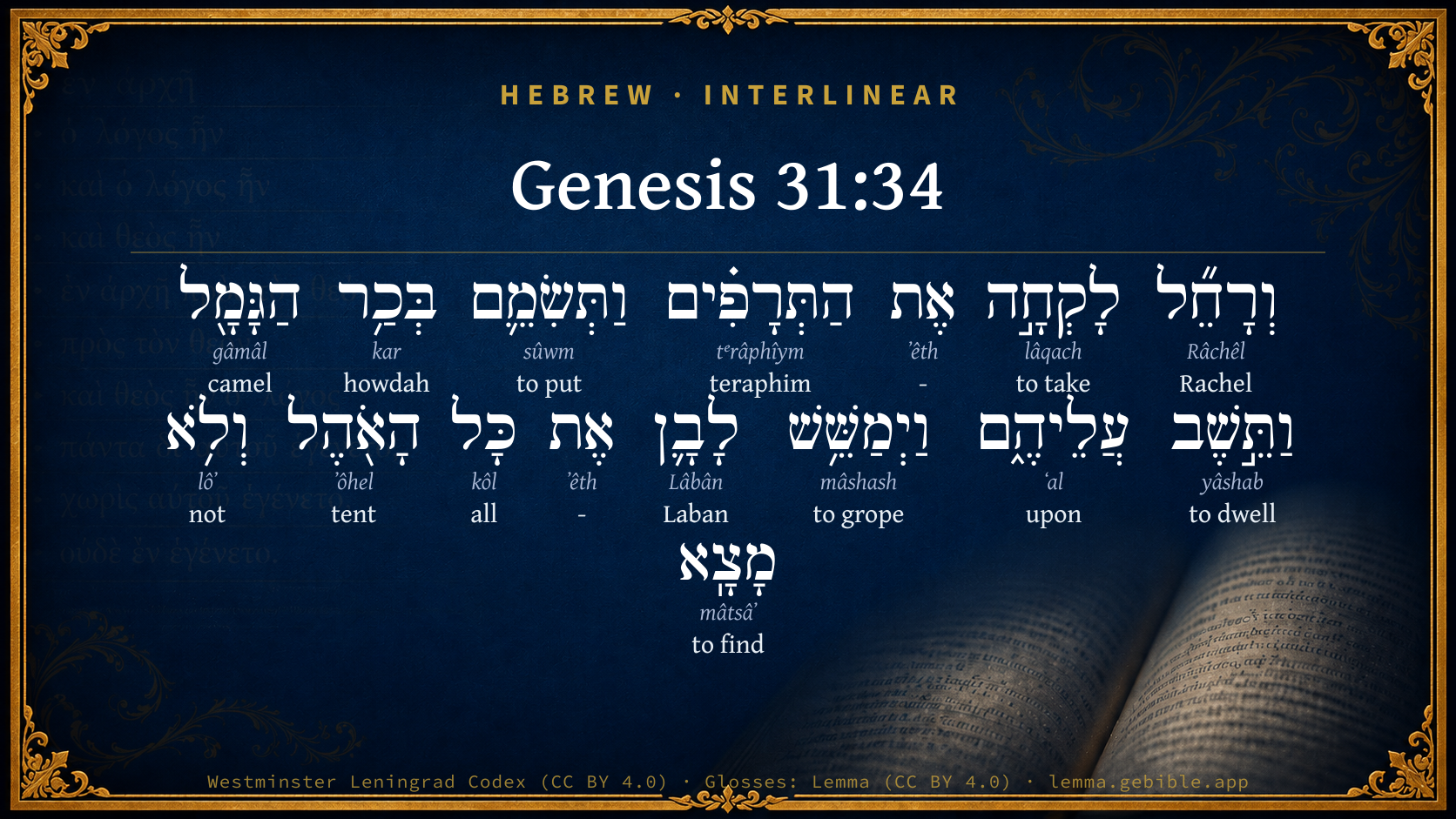
Hebrew (Westminster Leningrad Codex) Genesis 31:34 appears in the Hebrew Old Testament. The text above is from the Westminster Leningrad Codex. Each word links to its Strong’s number, a concise gloss, and parsing drawn from the Open Scriptures Hebrew Bible morphology. Click any word for its full Brown-Driver-Briggs (BDB) entry.
Download image
Cite this verse

Genesis 31:34 (World English Bible). Public Domain. Lemma interlinear Bible study tool, https://lemma.gebible.app/v/genesis/31/34.

Show BibTeX & RIS
BibTeX
RIS
English Translation
Now Rachel had taken the teraphim, put them in the camel's saddle, and sat on them. Laban felt about all the tent, but didn't find them.
World English Bible · Public Domain
Highlights Full analysis ↓
Download a study sheet

One document with this verse’s original text, its word-by-word gloss line, the meaning frame, cross-references with their text, attributed commentary, and full source and license credits — printable, and it pastes into notes with its structure intact.

This verse Autodidact and up

Study sheet (.html) Plain text (.txt)

A passage Seminary Student

Up to 50 verses in one chapter. A passage sheet keeps up to 6 commentary sources and 12 cross-references per verse, in the order this page ranks them, and says so on the sheet whenever that leaves anything out. Ask for a single verse and you get the Autodidact verse sheet above.

Everything on this page stays free to read, with no account — the sheet is a download of what is already on screen, not access to it.

Want to remove ads? Support Godless Engineer
Compare translations 3

The same verse in 3 English versions, stacked beneath the original-language interlinear above. Click any original word for its lexicon entry.

Each is an independent rendering of the whole verse — the interlinear is not word-aligned to these translations.

Highlighted words mark where these versions differ — a whole-verse word diff, not a word-by-word alignment.

  • World English Bible Public Domain
    Now Rachel had taken the teraphim, put them in the camel's saddle, and sat on them. Laban felt about all the tent, but didn't find them.
  • King James Version Public Domain
    Now Rachel had taken the images, and put them in the camel's furniture, and sat upon them. And Laban searched all the tent, but found them not.
  • unfoldingWord Literal Text CC BY-SA 4.0
    Now Rachel had taken the idols and put them inside the camel’s saddle and was sitting on them. And Laban felt throughout the entire tent, but he did not find.

unfoldingWord Literal Text — © unfoldingWord, licensed CC BY-SA 4.0. Word-aligned USFM3 via Door43 (git.door43.org/unfoldingWord/en_ult).

Versions to compare (up to 4)

3 of 4 selected

Show all 18 translations

Every available English version of this verse, each an independent rendering of the whole verse.

  • World English Bible Public Domain
    Now Rachel had taken the teraphim, put them in the camel's saddle, and sat on them. Laban felt about all the tent, but didn't find them.
  • Berean Standard Bible Public Domain
    Now Rachel had taken Laban’s household idols, put them in the saddlebag of her camel, and was sitting on them. And Laban searched everything in the tent but found nothing.
  • Majority Standard Bible Public Domain
    Now Rachel had taken Laban’s household idols, put them in the saddlebag of her camel, and was sitting on them. And Laban searched everything in the tent but found nothing.
  • King James Version Public Domain
    Now Rachel had taken the images, and put them in the camel's furniture, and sat upon them. And Laban searched all the tent, but found them not.
  • American Standard Version (1901) Public Domain
    Now Rachel had taken the teraphim, and put them in the camel's saddle, and sat upon them. And Laban felt about all the tent, but found them not.
  • Revised Version (1885) Public Domain
    Now Rachel had taken the teraphim, and put them in the camel’s furniture, and sat upon them. And Laban felt about all the tent, but found them not.
  • Geneva Bible (1599) Public Domain
    (Nowe Rahel had taken the idoles, and put them in the camels litter and sate downe vpon them) and Laban searched al the tent, but found them not.
  • Douay-Rheims (1899) Public Domain
    She in haste hid the idols under the camel's furniture, and sat upon them: and when he had searched all the tent, and found nothing,
  • Young's Literal Translation Public Domain
    And Rachel hath taken the teraphim, and putteth them in the furniture of the camel, and sitteth upon them; and Laban feeleth all the tent, and hath not found;
  • Literal Standard Version CC BY-SA 4.0
    And Rachel has taken the teraphim, and puts them in the furniture of the camel, and sits on them; and Laban feels all the tent, and has not found;
  • Unlocked Literal Bible CC BY-SA 4.0
    Now Rachel had taken the household gods, put them in a camel's saddle, and sat upon them. Laban searched the whole tent, but did not find them.
  • unfoldingWord Literal Text CC BY-SA 4.0
    Now Rachel had taken the idols and put them inside the camel’s saddle and was sitting on them. And Laban felt throughout the entire tent, but he did not find.
  • Darby Bible Public Domain
    Now Rachel had taken the teraphim and put them under the camel's saddle; and she sat upon them. And Laban explored all the tent, but found nothing.
  • World Messianic Bible Public Domain
    Now Rachel had taken the teraphim, put them in the camel’s saddle, and sat on them. Laban felt around all the tent, but didn’t find them.
  • Webster's Bible Public Domain
    Now Rachel had taken the images, and put them in the camel's furniture, and sat upon them. And Laban searched all the tent, but found them not.
  • Free Bible Version CC BY-SA 4.0
    Rachel had put the household idols in a camel's saddlebag and was sitting on it. Laban carefully searched the whole tent but couldn't find them.
  • Bible in Basic English Public Domain
    Now Rachel had taken the images, and had put them in the camels' basket, and was seated on them. And Laban, searching through all the tent, did not come across them.
  • JPS Tanakh (1917) Public Domain
    Now Rachel had taken the teraphim, and put them in the saddle of the camel, and sat upon them. And Laban felt about all the tent, but found them not.

Literal Standard Version (2020), Covenant Press — licensed CC BY-SA 4.0. Text via the HelloAO Bible API (eBible.org). Unlocked Literal Bible (unfoldingWord) — licensed CC BY-SA 4.0. Text via the HelloAO Bible API (eBible.org). unfoldingWord Literal Text — © unfoldingWord, licensed CC BY-SA 4.0. Word-aligned USFM3 via Door43 (git.door43.org/unfoldingWord/en_ult). Free Bible Version, Dr. Jonathan Gallagher — licensed CC BY-SA 4.0. Text via the HelloAO Bible API (eBible.org).

Word by word

More ways to search: Search by grammar → Find every occurrence → Compare this word →

Practice this passage: Drill this verse → Learn its vocabulary →

וַיְמַשֵּׁ֥שׁ
mâshash
H4959
“and · to grope”
Conjunction + Verb, Piel, Sequential Imperfect, 3rd Person, Masculine, Singular
Part of Speech
Conjunction + Verb
Stem
Piel
Form
Sequential Imperfect
Person
3rd Person
Gender
Masculine
Number
Singular
Full BDB Definition

Origin: a primitive root

TWOT: 1262

to feel, grope - (Qal) to feel, grope - (Piel) to feel over or through, grope - to feel through - to grope - (Hiphil) to feel
  1. וְרָחֵ֞ל Râchêl H7354 “and · Rachel” Conjunction + Noun, Proper
  2. לָקְחָ֣ה lâqach H3947 “to take” Verb, Qal, Perfect, 3rd Person, Feminine, Singular
  3. אֶת ʼêth H853 “-” Particle, Direct Object
  4. הַתְּרָפִ֗ים tᵉrâphîym H8655 “the · teraphim” Particle, Definite Article + Noun, Common, Masculine, Plural, Absolute
  5. וַתְּשִׂמֵ֛ם sûwm H7760 “and · to put · them” Conjunction + Verb, Qal, Sequential Imperfect, 3rd Person, Feminine, Singular + Suffix, Personal, 3rd Person, Masculine, Plural
  6. בְּכַ֥ר kar H3733 “in/at · howdah of” Preposition + Noun, Common, Masculine, Singular, Construct
  7. הַגָּמָ֖ל gâmâl H1581 “the · camel” Particle, Definite Article + Noun, Common, Masculine, Singular, Absolute
  8. וַתֵּ֣שֶׁב yâshab H3427 “and · to dwell” Conjunction + Verb, Qal, Sequential Imperfect, 3rd Person, Feminine, Singular
  9. עֲלֵיהֶ֑ם ʻal H5921 “upon · them” Preposition + Suffix, Personal, 3rd Person, Masculine, Plural
  10. לָבָ֛ן Lâbân H3837 “Laban” Noun, Proper
  11. אֶת ʼêth H853 “-” Particle, Direct Object
  12. כָּל kôl H3605 “all of” Noun, Common, Masculine, Singular, Construct
  13. הָאֹ֖הֶל ʼôhel H168 “the · tent” Particle, Definite Article + Noun, Common, Masculine, Singular, Absolute
  14. וְלֹ֥א lôʼ H3808 “and · not” Conjunction + Particle, Negative
  15. מָצָֽא mâtsâʼ H4672 “to find” Verb, Qal, Perfect, 3rd Person, Masculine, Singular

About this verse

These counts appear in no published source. They are computed here, from the morphology-tagged text and Lemma’s own curated glosses. What Lemma adds →

16
words
15
distinct lemmas
Pentateuch
section

Notable vocabulary

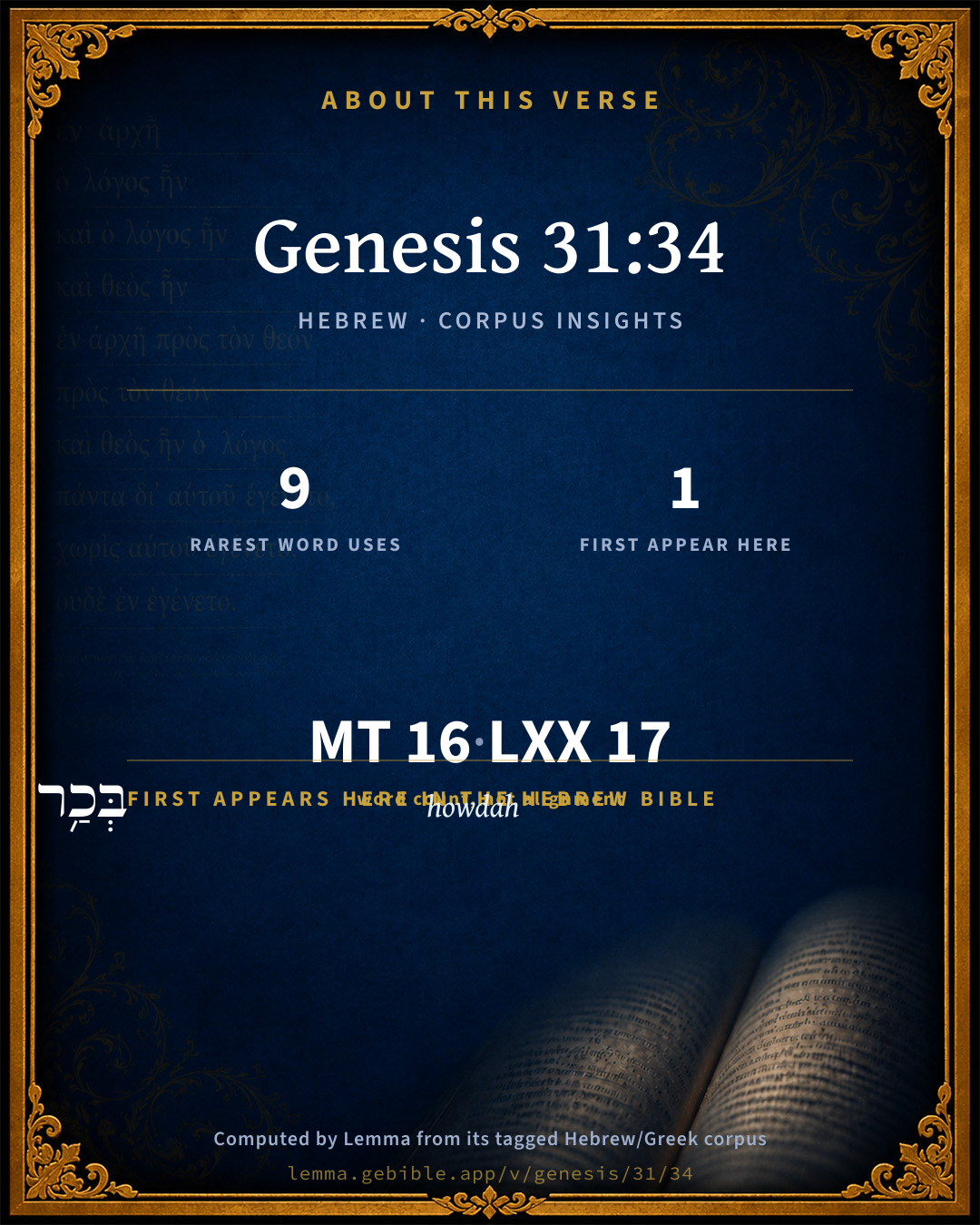
The rarest word here is וַיְמַשֵּׁ֥שׁ to grope H4959 — appearing just 9 times in the whole Hebrew Bible.

First appearance in Scripture

This word makes its first canonical appearance in the Hebrew Bible here:

  • בְּכַ֥ר howdah H3733

Shared distinctive vocabulary

וַיְמַשֵּׁ֥שׁ to grope H4959 occurs in 8 verses of the Hebrew Bible. Also found in:

Grammatical profile

  • 5 verbs
  • 7 nouns
  • 1 preposition
  • 3 particles

Verb forms

  • לָקְחָ֣ה Qal · Perfect
  • וַתְּשִׂמֵ֛ם Qal · Sequential Imperfect
  • וַתֵּ֣שֶׁב Qal · Sequential Imperfect
  • וַיְמַשֵּׁ֥שׁ Piel · Sequential Imperfect
  • מָצָֽא Qal · Perfect

Hebrew & Septuagint length

In English translation the verse runs 26 words from the Hebrew and 16 from the Septuagint (LXX English) — the Septuagint runs noticeably shorter here. See the side-by-side →

A rough comparison of the two English renderings, which tokenize alike — not a word-level alignment.

Word counts can differ between the Hebrew and the Greek without any difference in meaning — e.g. the Hebrew direct-object marker אֵת has no separate Greek word, and Greek often adds the article ὁ.

In the original languages it is 16 Hebrew tokens and 17 Greek tokens — but the two are counted differently (Hebrew bundles its prefixes and suffixes into one token; the Greek is in lemma form), so that isn’t a like-for-like length.

Cross-references

2

Topical passages linked to Genesis 31:34 in the Treasury of Scripture Knowledge — connected by theme and wording, ordered by reader-vote popularity; previews shown in the World English Bible.

  • Genesis 31:19 Now Laban had gone to shear his sheep: and Rachel stole the teraphim that were her father's.
  • Genesis 31:17 Then Jacob rose up, and set his sons and his wives on the camels,

Cross-references courtesy of OpenBible.info (CC BY 4.0).

Hebrew and Greek witnesses Masoretic Hebrew ↔ Greek Septuagint

The same verse in the two great witnesses to the Old Testament, shown verse-for-verse.

Here the Septuagint runs noticeably shorter than the Hebrew — LXX2012 (modern English Septuagint) 16 words vs World English Bible 26. A rough length comparison of the two English translations, not a word-level alignment — read both below.

These are two independent witnesses, not word-aligned to each other, and the Septuagint is shown in lemma (dictionary) form.

Hebrew Genesis 31:34 Masoretic · Westminster Leningrad Codex

וְרָחֵ֞ל לָקְחָ֣ה אֶת הַתְּרָפִ֗ים וַתְּשִׂמֵ֛ם בְּכַ֥ר הַגָּמָ֖ל וַתֵּ֣שֶׁב עֲלֵיהֶ֑ם וַיְמַשֵּׁ֥שׁ לָבָ֛ן אֶת כָּל הָאֹ֖הֶל וְלֹ֥א מָצָֽא

Now Rachel had taken the teraphim, put them in the camel's saddle, and sat on them. Laban felt about all the tent, but didn't find them.

World English Bible · Public Domain

Greek LXX Genesis 31:34 Septuagint · lemma form

ραχηλ δέ λαμβάνω ὁ εἴδωλον καί ἐνβάλλω αὐτός εἰς ὁ σάγμα ὁ κάμηλος καί ἐπι καταἵζω αὐτός

And Rachel took the idols, and cast them among the camel's packs, and sat upon them.

LXX2012 (modern English Septuagint) · Public Domain

On this verse, The Cambridge Bible for Schools and Colleges discusses the Septuagint’s reading. Read the note in Commentary ↓

Hebrew: Westminster Leningrad Codex (CC BY 4.0). Greek: Septuagint (public domain); English from LXX2012 (modern English Septuagint) (Public Domain). How the Septuagint differs from the Hebrew →

Targum (Aramaic paraphrase)

2

The Targum is the ancient Jewish Aramaic paraphrase of the Hebrew Scriptures — an interpretive translation, not the Hebrew text itself. Onkelos (literal) and Pseudo-Jonathan (expansive) render the Torah, and Jonathan the Prophets. Coverage is partial: where no permissively-licensed English translation exists for a verse, only the Aramaic is shown. This is verse-level text, not a word-by-word alignment to the Hebrew.

  1. Targum Onkelos Torah (Genesis–Deuteronomy)
    וְרָחֵל נְסִיבַת יָת צַלְמָנַיָּא וְשַׁוִּתִּנּוּן בַּעֲבִיטָא דְגַמְלָא וִיתִיבַת עֲלֵיהוֹן וּמַשִּׁישׁ לָבָן יָת כָּל מַשְׁכְּנָא וְלָא אַשְׁכָּח

    (no public-domain English translation for this verse)

    Targum Onkelos — Aramaic: “Onkelos Genesis” (public domain); “Onkelos Exodus” (public domain); “Onkelos Leviticus” (public domain); “Onkelos Numbers” (public domain); “Onkelos Deuteronomy” (public domain). English: “Sefaria Community Translation” (CC0 1.0 (public-domain dedication)); “J.W. Etheridge. The Targums of Onkelos and Jonathan Ben Uzziel on the Pentateuch. London: Longmans, Green, 1862” (public domain). Text via Sefaria.

  2. Targum Pseudo-Jonathan Torah (Genesis–Deuteronomy)
    וְרָחֵל נְסֵיבַת יַת צַלְמָנַיָא וְשַׁוְתִינוּן בַּעֲבִיטָא דְגַמְלָא וִיתֵיבַת עֲלַוֵיהוֹם וּפִשְׁפַּשׁ יַת כָּל מַשְׁכְּנָא וְלָא אַשְׁכַּח

    But Rahel had taken the images, and laid them in the paniers of the camels, and sat upon them. And he searched all the tent, but found not.

    Targum Pseudo-Jonathan — Aramaic: “Targum Jonathan on Genesis” (public domain); “Targum Jonathan on Exodus” (public domain); “Targum Jonathan on Leviticus” (public domain); “Targum Jonathan on Numbers” (public domain); “Targum Jonathan on Deuteronomy” (public domain). English: “The Targum of Jonathan ben Uzziel, trans. J. W. Etheridge, London, 1862” (public domain). Text via Sefaria.

Commentary

Notes on Genesis 31:34 from classic Christian and Jewish commentators (each source and its license shown beneath its notes). The classic Christian expositions comment on the surrounding passage and are grouped to its opening verse, so a note may address several verses; the Jewish commentaries on the Tanakh (Rashi and others) are per-verse, so they appear only where the commentator wrote on this verse.

Lemma curates 59 commentaries, every one of them public domain or Creative Commons licensed, each selected and text-cleaned for this edition rather than reprinted as found. About our sources →

Trapp's Complete Commentary

John Trapp

Gen 31:34 Now Rachel had taken the images, and put them in the camel’s furniture, and sat upon them. And Laban searched all the tent, but found [them] not.

Ver. 34. Put them in the camel’s furniture, and sat upon them.] Presumptuous sinners deal as homely with the dear mercies of Almighty God, pleading and pretending them to their wicked courses; and so kicking against his heart; which are therefore fast closed against them.

John Trapp, A Commentary or Exposition upon All the Books of the Old and New Testament (1647–1656) — public domain. Text from a community e-Sword module.

Geneva Bible (1599)

Geneva Bible translators

Or, straw, or saddle.

Geneva Bible (1599) marginal notes — public domain. Text via Bolls.life.

Jamieson, Fausset & Brown

Robert Jamieson, A. R. Fausset & David Brown

Rachel had taken the images, and put them in the camel's furniture, and sat upon them--The common pack saddle is often used as a seat or a cushion, against which a person squatted on the floor may lean.

Jamieson, Fausset & Brown — Commentary Critical and Explanatory on the Whole Bible (1871) — public domain (CC PDM 1.0). Text via the HelloAO Bible API.

Ellicott's Commentary for English Readers

(34) The camel’s furniture.—That is, the camel’s saddle. It is now made of wicker-work, and is protected by curtains and a canopy. Probably Rachel’s was far simpler; and as the teraphim seem to have had heads shaped like those of a man, and dwarf bodies, they would easily be crammed under it.

A Bible Commentary for English Readers, edited by Charles John Ellicott (1878–1897) — public domain. Text from a community e-Sword module.

The Cambridge Bible for Schools and Colleges

gen. ed. J. J. S. Perowne

34. the camel’s furniture] By this is probably meant the wicker framework of the camel’s saddle, with its trappings and hangings, LXX τὰ σάγματα, Lat. stramenta.

The Cambridge Bible for Schools and Colleges (gen. ed. J. J. S. Perowne; Cambridge University Press, 1878–1918) — public domain. Text from a community e-Sword module.

John Gill's Exposition

And Jacob was wroth, and chode with Laban,.... Having answered Laban's questions to the silencing of him, and nothing of his upon search, being found with him, Jacob took heart, and was of good courage and in high spirits, and in his turn was heated also; and perhaps might carry his passion a little too far, and is not to be excused from some degree of sin and weakness; however, his reasoning is strong and nervous, and his expostulations very just and pathetic; whatever may be said for the temper he was in, and the wrath and resentment he showed:

and Jacob answered and said to Laban; that whereas he had suggested that he had done a very bad thing, he asks him:

what is my trespass? what is my sin? what heinous offence have I committed? what law of God or man have I broke?

that thou hast so hotly pursued after me? with so much haste and swiftness, and with such a number of men, as if he came to take a thief, a robber, or a murderer.

John Gill's Exposition of the Whole Bible (1746–1763) — public domain (CC PDM 1.0). Text via the HelloAO Bible API.

Whedon's Commentary on the Bible

Daniel D. Whedon

34. Camel’s furniture — The car, כר, or palanquin of the camel, “a covered vehicle which is secured on the back of the camel, and answers the purpose of a small house. It is often divided into two apartments, and the traveller, who can sit in either of them, is enabled also to carry some little furniture with him. These conveyances are protected by veils, which are not rolled up, except in front, so that the person within has the privilege of looking out while he is himself concealed. They are used chiefly by the women, rarely by the men.” — JAHN’S Biblical Archaeology, § 49.

Daniel D. Whedon (gen. ed.), Commentary on the Old and New Testaments (1874–1909) — public domain. Text from a community e-Sword module.

The Pulpit Commentary

Now Rachel had taken the images (teraphim), and put them in the camel"s furniture, the camel"s furniture was not stramenta cameli (Vulgate), "the camel"s straw" (Luther), but the camel"s saddle (LXX, Onkelos, Syriac, Calvin, Rosenm Keil, and others), here called rK, from rrK; an unused root signifying either to go round in a circle, hence to run (Gesenius), or to be firmly wound together, hence to be puffed up as a bolster (Furst). The woman"s riding-saddle was commonly made of wicker-work and had the appearance of a basket or cradle. It was usually covered with carpet, and protected against wind, rain, and sun by means of a canopy and curtains, while light was admitted by openings in the side (cf. Gesenius, sub voce; Kalisch in loco). "That which is now customary among the Arabs consists of a large closed basketwork, with a place for sitting and reclining, and a window at the side; one of this kind hangs on each side of the camel" (Gerlach)and sat upon them. "To us the picture of Rachel seated upon the camel furniture is true to life, for we have often seen its counterpart. The saddle-bags and cushions which were to be set upon the camel lay piled on the floor, while she sat upon them (Van Lennep, quoted by Inglis, p. 254). And Laban searched the word means to feel out or explore with the hands (cf. Gen_27:12; Job_12:25) all the tent, but found them not.

The Pulpit Commentary (1880–1919), ed. H.D.M. Spence-Jones & Joseph S. Exell — public domain. Text from a community e-Sword module.

unfoldingWord translationNotes

Door43 World Missions Community

Now Rachel ... upon them

The word "now" is used here to mark a change from the story to background information about Rachel. (See: Background Information)

saddle

a seat placed on the back of an animal so a person can ride on it

my master

Calling someone "my master" is a way of honoring them.

that I cannot stand up before you

"because I am unable to stand up in your presence"

for I am having my period

This refers to the time of the month when a woman bleeds from her womb. (See: Euphemism)

translationWords

household

false god

camel

anger

lord

unfoldingWord translationNotes — © Distant Shores Media and the Door43 World Missions Community, licensed CC BY-SA 4.0. Source: git.door43.org/Door43/en_tn.

Rashi

Rabbi Shlomo Yitzchaki (Rashi)

בכר הגמל IN THE CAMEL’S SADDLE-PILLOW — כר has the same meaning as in the Talmudic phrase "pillows (כרים) and bolsters”. Explain it as the Targum renders it: “in the עביטא of the camel”. This is a packsaddle made like a pillow. In Erubin (Eruvin 16a) we find, "they enclosed it with עביטין” by which is meant the saddles of camels. old French bast, bat; English packsaddle.

Rashi on the Tanakh — English translations: “The Judaica Press complete Tanach with Rashi, translated by A. J. Rosenberg” (CC BY 4.0); “Pentateuch with Rashi's commentary by M. Rosenbaum and A.M. Silbermann, 1929-1934” (public domain); “The Metsudah Tanach series, Lakewood, N.J” (CC BY 4.0); and “The Book of Joshua, Metsudah Publications, 1997” (CC BY 4.0). Text via Sefaria.

Radak

Rabbi David Kimhi (Radak)

ורחל...בכר הגמל, in the saddle of the camel.

Radak on the Tanakh — English translations: “Sefaria Community Translation” (CC0 1.0 (public-domain dedication)); “Eliyahu Munk, HaChut Hameshulash” (CC BY 4.0); “Rabbi Mike Feuer, Jerusalem Anthology” (CC BY 4.0); and “R. David Kimhi on the first book of Psalms, Translated by R.G. Finch, London, 1919” (public domain). Text via Sefaria.

Lesson kit

Teaching starters — assembled from the data on this page, not authored interpretation. Every prompt links to the verse data it draws on. Edit before teaching.

Genesis, in the Pentateuch, opens this verse with 16 words (15 distinct Hebrew lemmas). Its most distinctive word is mâshash (“to grope”). The Greek Septuagint runs shorter here. A historical commentator’s framing appears above. Read the whole chapter for the surrounding context.

Discussion questions

  1. What does “to grope” (mâshash) contribute to the verse as a whole?
  2. This is the first place “howdah” appears in Scripture (first appears here). What does its debut here establish?
  3. How does Genesis 27:12, which shares the word «to grope», read alongside this verse?
  4. The Septuagint runs shorter here than the Hebrew. What might account for the difference?
  5. These translations render this verse differently. What is at stake in choosing one wording over another?
  6. «לָקְחָ֣ה» is a Qal Perfect verb. How does that grammatical form shape the action described?
  7. Compare how Trapp's Complete Commentary and Geneva Bible (1599) read this verse. Where do they agree or differ?

Things to notice

Reading settings

Reading text

Shown beneath each verse's original-language words.

Old Testament
Old Testament edition

Read the OT as the Masoretic Hebrew (MT) or the Greek Septuagint (LXX).

English shown for the Greek Septuagint (in the Hebrew ↔ Greek comparison).

Comparing translations? Open the Compare panel on any verse page to stack up to four side by side.