Exodus 33:9

Hebrew (Westminster Leningrad Codex) Exodus 33:9 appears in the Hebrew Old Testament. The text above is from the Westminster Leningrad Codex. Each word links to its Strong’s number, a concise gloss, and parsing drawn from the Open Scriptures Hebrew Bible morphology. Click any word for its full Brown-Driver-Briggs (BDB) entry.
Download image
Cite this verse

Exodus 33:9 (World English Bible). Public Domain. Lemma interlinear Bible study tool, https://lemma.gebible.app/v/exodus/33/9.

Show BibTeX & RIS
BibTeX
RIS
English Translation
It happened, when Moses entered into the Tent, that the pillar of cloud descended, stood at the door of the Tent, and spoke with Moses.
World English Bible · Public Domain
Download a study sheet

One document with this verse’s original text, its word-by-word gloss line, the meaning frame, cross-references with their text, attributed commentary, and full source and license credits — printable, and it pastes into notes with its structure intact.

This verse Autodidact and up

Study sheet (.html) Plain text (.txt)

A passage Seminary Student

Up to 50 verses in one chapter. A passage sheet keeps up to 6 commentary sources and 12 cross-references per verse, in the order this page ranks them, and says so on the sheet whenever that leaves anything out. Ask for a single verse and you get the Autodidact verse sheet above.

Everything on this page stays free to read, with no account — the sheet is a download of what is already on screen, not access to it.

Want to remove ads? Support Godless Engineer
Compare translations 3

The same verse in 3 English versions, stacked beneath the original-language interlinear above. Click any original word for its lexicon entry.

Each is an independent rendering of the whole verse — the interlinear is not word-aligned to these translations.

Highlighted words mark where these versions differ — a whole-verse word diff, not a word-by-word alignment.

  • World English Bible Public Domain
    It happened, when Moses entered into the Tent, that the pillar of cloud descended, stood at the door of the Tent, and spoke with Moses.
  • King James Version Public Domain
    And it came to pass, as Moses entered into the tabernacle, the cloudy pillar descended, and stood at the door of the tabernacle, and the Lord talked with Moses.
  • unfoldingWord Literal Text CC BY-SA 4.0
    And it happened, as Moses entered the tent, the pillar of cloud would come down and stand the entrance of the tent, and he would speak with Moses.

unfoldingWord Literal Text — © unfoldingWord, licensed CC BY-SA 4.0. Word-aligned USFM3 via Door43 (git.door43.org/unfoldingWord/en_ult).

Versions to compare (up to 4)

3 of 4 selected

Show all 18 translations

Every available English version of this verse, each an independent rendering of the whole verse.

  • World English Bible Public Domain
    It happened, when Moses entered into the Tent, that the pillar of cloud descended, stood at the door of the Tent, and spoke with Moses.
  • Berean Standard Bible Public Domain
    As Moses entered the tent, the pillar of cloud would come down and remain at the entrance, and the LORD would speak with Moses.
  • Majority Standard Bible Public Domain
    As Moses entered the tent, the pillar of cloud would come down and remain at the entrance, and the LORD would speak with Moses.
  • King James Version Public Domain
    And it came to pass, as Moses entered into the tabernacle, the cloudy pillar descended, and stood at the door of the tabernacle, and the Lord talked with Moses.
  • American Standard Version (1901) Public Domain
    And it came to pass, when Moses entered into the Tent, the pillar of cloud descended, and stood at the door of the Tent: and `Jehovah' spake with Moses.
  • Revised Version (1885) Public Domain
    And it came to pass, when Moses entered into the Tent, the pillar of cloud descended, and stood at the door of the Tent: and the LORD spake with Moses.
  • Geneva Bible (1599) Public Domain
    And assoone as Moses was entred into the Tabernacle, the cloudie pillar descended and stood at the doore of the Tabernacle, and the Lord talked with Moses.
  • Douay-Rheims (1899) Public Domain
    And when he was gone into the tabernacle of the covenant, the pillar of the cloud came down, and stood at the door, and he spoke with Moses.
  • Young's Literal Translation Public Domain
    And it hath come to pass, at the going in of Moses to the tent, the pillar of the cloud cometh down, and hath stood at the opening of the tent, and He hath spoken with Moses;
  • Literal Standard Version CC BY-SA 4.0
    And it has come to pass, at the going in of Moses to the tent, the pillar of the cloud comes down, and has stood at the opening of the tent, and He has spoken with Moses;
  • Unlocked Literal Bible CC BY-SA 4.0
    Whenever Moses entered the tent, the pillar of cloud would come down and stand at the tent entrance, and Yahweh would speak with Moses.
  • unfoldingWord Literal Text CC BY-SA 4.0
    And it happened, as Moses entered the tent, the pillar of cloud would come down and stand the entrance of the tent, and he would speak with Moses.
  • Darby Bible Public Domain
    And it came to pass when Moses entered into the tent, the pillar of cloud descended, and stood at the entrance of the tent, and [Jehovah] talked with Moses.
  • World Messianic Bible Public Domain
    When Moses entered into the Tent, the pillar of cloud descended, stood at the door of the Tent, and the LORD spoke with Moses.
  • Webster's Bible Public Domain
    And it came to pass, as Moses entered into the tabernacle, the cloudy pillar descended, and stood at the door of the tabernacle, and the LORD talked with Moses.
  • Free Bible Version CC BY-SA 4.0
    As soon as Moses went into the Tent, the cloud column would descend and stand in the doorway as the Lord spoke with Moses.
  • Bible in Basic English Public Domain
    And whenever Moses went into the Tent, the pillar of cloud came down, and took its place by the door of the Tent, as long as the Lord was talking with Moses.
  • JPS Tanakh (1917) Public Domain
    And it came to pass, when Moses entered into the Tent, the pillar of cloud descended, and stood at the door of the Tent; and the LORD spoke with Moses.

Literal Standard Version (2020), Covenant Press — licensed CC BY-SA 4.0. Text via the HelloAO Bible API (eBible.org). Unlocked Literal Bible (unfoldingWord) — licensed CC BY-SA 4.0. Text via the HelloAO Bible API (eBible.org). unfoldingWord Literal Text — © unfoldingWord, licensed CC BY-SA 4.0. Word-aligned USFM3 via Door43 (git.door43.org/unfoldingWord/en_ult). Free Bible Version, Dr. Jonathan Gallagher — licensed CC BY-SA 4.0. Text via the HelloAO Bible API (eBible.org).

Word by word

More ways to search: Search by grammar → Find every occurrence → Compare this word →

Practice this passage: Drill this verse → Learn its vocabulary →

הֶֽעָנָ֔ן
ʻânân
H6051
“the · cloud”
Particle, Definite Article + Noun, Common, Masculine, Singular, Absolute
Part of Speech
Particle + Noun
Type
Common
Gender
Masculine
Number
Singular
State
Absolute
Full BDB Definition

Origin: from H6049

TWOT: 1655a

cloud, cloudy, cloud-mass - cloud-mass (of theophanic cloud) - cloud
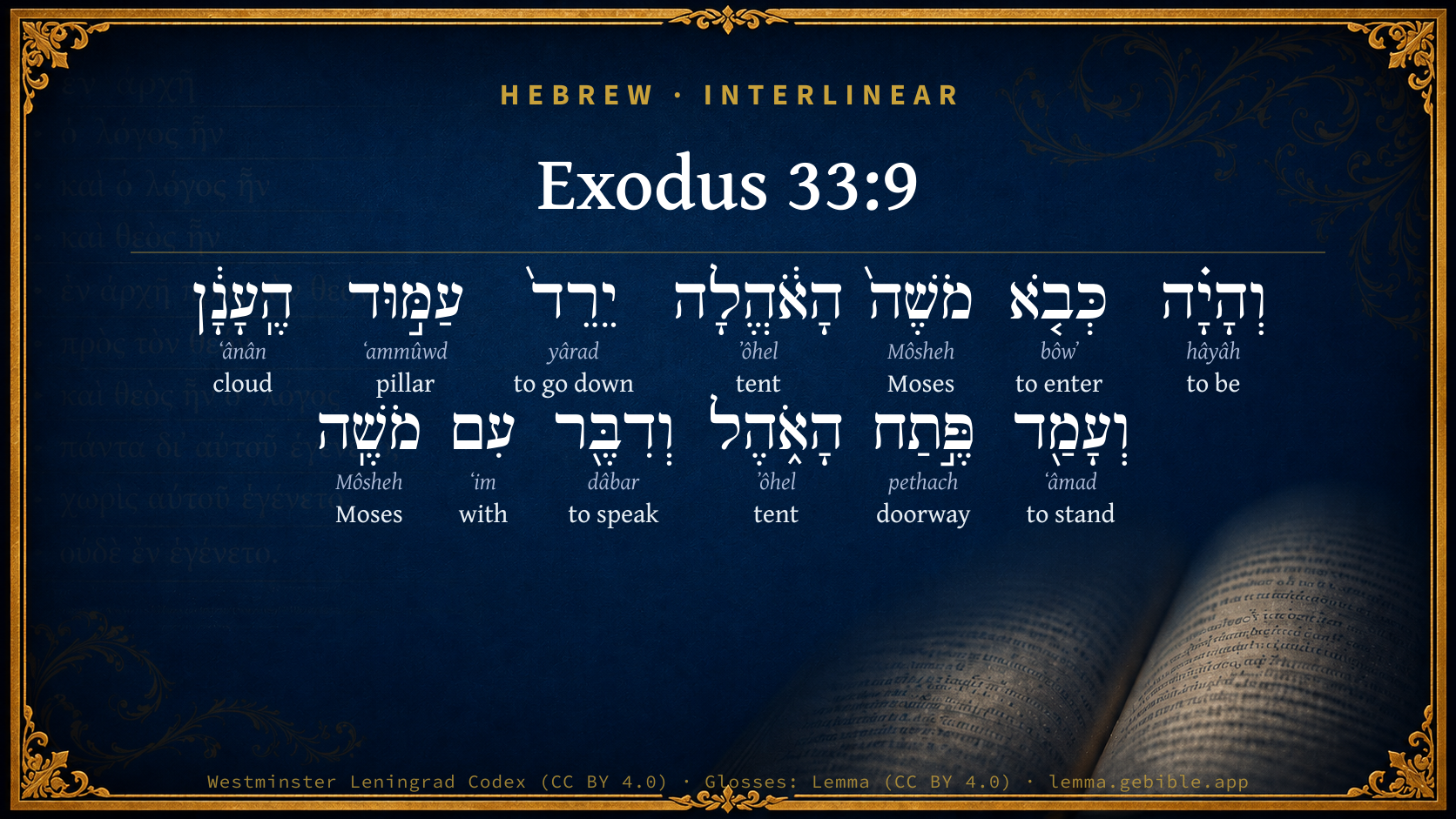
  1. וְהָיָ֗ה hâyâh H1961 “and · to be” Conjunction + Verb, Qal, Sequential Perfect, 3rd Person, Masculine, Singular
  2. כְּבֹ֤א bôwʼ H935 “like/as · to enter” Preposition + Verb, Qal, Infinitive Construct
  3. מֹשֶׁה֙ Môsheh H4872 “Moses” Noun, Proper
  4. הָאֹ֔הֱלָה ʼôhel H168 “the · tent · toward” Particle, Definite Article + Noun, Common, Masculine, Singular, Absolute + Suffix, Demonstrative
  5. יֵרֵד֙ yârad H3381 “to go down” Verb, Qal, Imperfect, 3rd Person, Masculine, Singular
  6. עַמּ֣וּד ʻammûwd H5982 “pillar of” Noun, Common, Masculine, Singular, Construct
  7. וְעָמַ֖ד ʻâmad H5975 “and · to stand” Conjunction + Verb, Qal, Sequential Perfect, 3rd Person, Masculine, Singular
  8. פֶּ֣תַח pethach H6607 “doorway of” Noun, Common, Masculine, Singular, Construct
  9. הָאֹ֑הֶל ʼôhel H168 “the · tent” Particle, Definite Article + Noun, Common, Masculine, Singular, Absolute
  10. וְדִבֶּ֖ר dâbar H1696 “and · to speak” Conjunction + Verb, Piel, Sequential Perfect, 3rd Person, Masculine, Singular
  11. עִם ʻim H5973 “with” Preposition
  12. מֹשֶֽׁה Môsheh H4872 “Moses” Noun, Proper

About this verse

These counts appear in no published source. They are computed here, from the morphology-tagged text and Lemma’s own curated glosses. What Lemma adds →

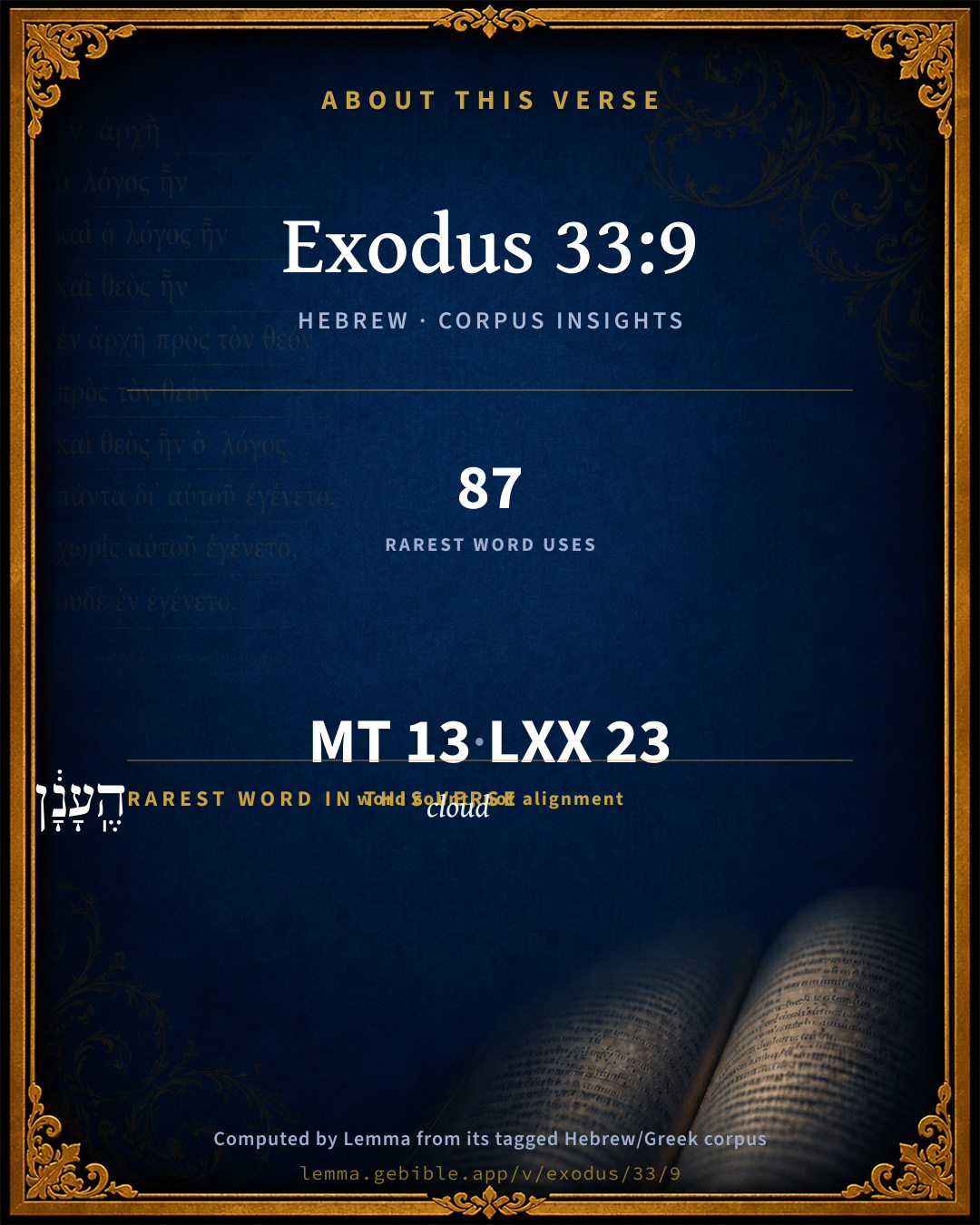
13
words
11
distinct lemmas
Pentateuch
section

Grammatical profile

  • 5 verbs
  • 7 nouns
  • 1 preposition

Verb forms

  • וְהָיָ֗ה Qal · Sequential Perfect
  • כְּבֹ֤א Qal · Infinitive Construct
  • יֵרֵד֙ Qal · Imperfect
  • וְעָמַ֖ד Qal · Sequential Perfect
  • וְדִבֶּ֖ר Piel · Sequential Perfect

Repetition

Words recur within this verse — often emphatic in Hebrew:

  • מֹשֶׁה֙ Moses H4872 ×2
  • הָאֹ֔הֱלָה tent H168 ×2

Hebrew & Septuagint length

In English translation the verse runs 25 words from the Hebrew and 26 from the Septuagint (LXX English) — closely comparable.

A rough comparison of the two English renderings, which tokenize alike — not a word-level alignment.

Word counts can differ between the Hebrew and the Greek without any difference in meaning — e.g. the Hebrew direct-object marker אֵת has no separate Greek word, and Greek often adds the article ὁ.

In the original languages it is 13 Hebrew tokens and 23 Greek tokens — but the two are counted differently (Hebrew bundles its prefixes and suffixes into one token; the Greek is in lemma form), so that isn’t a like-for-like length.

Cross-references

11

Topical passages linked to Exodus 33:9 in the Treasury of Scripture Knowledge — connected by theme and wording, ordered by reader-vote popularity; previews shown in the World English Bible.

  • Psalms 99:7 He spoke to them in the pillar of cloud. They kept his testimonies, The statute that he gave them.
  • Genesis 18:33 Yahweh went his way, as soon as he had finished communing with Abraham, and Abraham returned to his place.
  • Exodus 31:18 He gave to Moses, when he finished speaking with him on Mount Sinai, the two tablets of the testimony, stone tablets, written with God's finger.
  • Ezekiel 3:22 The hand of Yahweh was there on me; and he said to me, Arise, go forth into the plain, and I will there talk with you.
  • Genesis 17:22 When he finished talking with him, God went up from Abraham.
  • Exodus 13:21–22 Yahweh went before them by day in a pillar of cloud, to lead them on their way, and by night in a pillar of fire, to give them light, that they might go by day and by night:
  • Exodus 25:22 There I will meet with you, and I will tell you from above the mercy seat, from between the two cherubim which are on the ark of the testimony, all that I command you for the children of Israel.
  • Exodus 33:11 Yahweh spoke to Moses face to face, as a man speaks to his friend. He turned again into the camp, but his servant Joshua, the son of Nun, a young man, didn't depart out of the Tent.
  • Exodus 34:3 No one shall come up with you; neither let anyone be seen throughout all the mountain; neither let the flocks nor herds feed before that mountain."
  • Exodus 34:9 He said, "If now I have found favor in your sight, Lord, please let the Lord go in the midst of us; although this is a stiff-necked people; pardon our iniquity and our sin, and take us for your inheritance."
  • Numbers 11:17 I will come down and talk with you there: and I will take of the Spirit which is on you, and will put it on them; and they shall bear the burden of the people with you, that you not bear it yourself alone.

Cross-references courtesy of OpenBible.info (CC BY 4.0).

Hebrew and Greek witnesses Masoretic Hebrew ↔ Greek Septuagint

The same verse in the two great witnesses to the Old Testament, shown verse-for-verse.

These are two independent witnesses, not word-aligned to each other, and the Septuagint is shown in lemma (dictionary) form.

Hebrew Exodus 33:9 Masoretic · Westminster Leningrad Codex

וְהָיָ֗ה כְּבֹ֤א מֹשֶׁה֙ הָאֹ֔הֱלָה יֵרֵד֙ עַמּ֣וּד הֶֽעָנָ֔ן וְעָמַ֖ד פֶּ֣תַח הָאֹ֑הֶל וְדִבֶּ֖ר עִם מֹשֶֽׁה

It happened, when Moses entered into the Tent, that the pillar of cloud descended, stood at the door of the Tent, and spoke with Moses.

World English Bible · Public Domain

Greek LXX Exodus 33:9 Septuagint · lemma form

ὡς δέ ἄν εἰςἔρχομαι μωυσῆς εἰς ὁ σκηνή καταβαίνω ὁ στῦλος ὁ νεφέλη καί ἵστημι ἐπί ὁ θύρα ὁ σκηνή καί λαλέω μωυσῆς

And when Moses entered into the tabernacle, the pillar of the cloud descended, and stood at the door of the tabernacle, and God talked to Moses.

LXX2012 (modern English Septuagint) · Public Domain

Hebrew: Westminster Leningrad Codex (CC BY 4.0). Greek: Septuagint (public domain); English from LXX2012 (modern English Septuagint) (Public Domain). How the Septuagint differs from the Hebrew →

Targum (Aramaic paraphrase)

2

The Targum is the ancient Jewish Aramaic paraphrase of the Hebrew Scriptures — an interpretive translation, not the Hebrew text itself. Onkelos (literal) and Pseudo-Jonathan (expansive) render the Torah, and Jonathan the Prophets. Coverage is partial: where no permissively-licensed English translation exists for a verse, only the Aramaic is shown. This is verse-level text, not a word-by-word alignment to the Hebrew.

  1. Targum Onkelos Torah (Genesis–Deuteronomy)
    וַהֲוָה כַּד עָלֵל משֶׁה לְמַשְׁכְּנָא נָחִית עַמוּדָא דַעֲנָנָא וְקָאִים בִּתְרַע מַשְׁכְּנָא וּמִתְמַלֵל עִם משֶׁה:

    (no public-domain English translation for this verse)

    Targum Onkelos — Aramaic: “Onkelos Genesis” (public domain); “Onkelos Exodus” (public domain); “Onkelos Leviticus” (public domain); “Onkelos Numbers” (public domain); “Onkelos Deuteronomy” (public domain). English: “Sefaria Community Translation” (CC0 1.0 (public-domain dedication)); “J.W. Etheridge. The Targums of Onkelos and Jonathan Ben Uzziel on the Pentateuch. London: Longmans, Green, 1862” (public domain). Text via Sefaria.

  2. Targum Pseudo-Jonathan Torah (Genesis–Deuteronomy)
    וַהֲוָה כַּד אָעֵיל משֶׁה לְמַשְׁכְּנָא נָחִית עַמּוּדָא דַּעֲנָן יְקָרָא וְקָאֵי בִּתְרַע מַשְׁכְּנָא וּמִתְמַלֵּיל מֵימְרָא דַיְיָ עִם משֶׁה

    And it came to pass when Mosheh had gone into the tabernacle, the column of the glorious Cloud descended and stood at the door of the tabernacle; and the Word of the Lord spake with Mosheh.

    Targum Pseudo-Jonathan — Aramaic: “Targum Jonathan on Genesis” (public domain); “Targum Jonathan on Exodus” (public domain); “Targum Jonathan on Leviticus” (public domain); “Targum Jonathan on Numbers” (public domain); “Targum Jonathan on Deuteronomy” (public domain). English: “The Targum of Jonathan ben Uzziel, trans. J. W. Etheridge, London, 1862” (public domain). Text via Sefaria.

Commentary

Notes on Exodus 33:9 from classic Christian and Jewish commentators (each source and its license shown beneath its notes). The classic Christian expositions comment on the surrounding passage and are grouped to its opening verse, so a note may address several verses; the Jewish commentaries on the Tanakh (Rashi and others) are per-verse, so they appear only where the commentator wrote on this verse.

Lemma curates 59 commentaries, every one of them public domain or Creative Commons licensed, each selected and text-cleaned for this edition rather than reprinted as found. About our sources →

Trapp's Complete Commentary

John Trapp

Exo 33:9 And it came to pass, as Moses entered into the tabernacle, the cloudy pillar descended, and stood [at] the door of the tabernacle, and [the LORD] talked with Moses.

Ver. 9. And the Lord talked with Moses.] Out of the cloudy pillar: which was a sign of favour. {Psa 99:7} The Turks honour Moses, and call him the talker with God.

John Trapp, A Commentary or Exposition upon All the Books of the Old and New Testament (1647–1656) — public domain. Text from a community e-Sword module.

The Biblical Illustrator

Joseph S. Exell

Exo_33:9-11

The Lord talked with Moses.

Speaking to God

In the minds of many prayer seems to differ widely from other forms of communication. Not perceiving any tangible object of address, they feel as if to pray were to talk with nothing. How can you pray with vigour into the empty air? asked a candid doubter. Even Christians sometimes lack the sense of communion, and then prayer is scarcely more than soliloquy in the form of petition. And yet speaking to God is really very much like speaking to men. Since God is a person, address to Him must conform to the general principles of personal address.

I. In speaking to God, as in speaking to men, we must address the invisible. Converse is mental, not physical. The form you see is not the man you talk with. We speak not to the ears which catch the words, but to the mind which perceives the thought. A mere lump of organized clay cannot be a party to conversation. If, then, one asks, How can you pray into empty air? we may reply by asking: How can you talk to a clod of clay? In every case, whatever direction be given to words or other signals of communion, the real address is to mind. One using an acoustic tube apparently speaks to the mouth-piece in the wall. But he really addresses a person in another room. Words are usually directed towards eyes and ears because through these mind is reached. So prayer seems to the prayerless as speech thrown into void space. It is really a direct address to the Infinite Mind which pervades all space.

II. In speaking to God, as in speaking to men, we not only address the invisible, but the presence of a visible form, or symbol of personality, is unnecessary. The blind communicate without seeing a form, and the deaf without hearing a voice. We may speak to a person behind a wall or screen if only assured that he is within call. By letter we address friends hundreds of miles distant. Thus it is evident that prayer to God is only one of many forms of address to mind with no visible form present. We only need to know that the mind addressed is within reach by any means of communication.

III. In speaking to God, as in speaking to men, the enjoyment of communion is variable, and increases with custom and acquaintance. Many people have heard of God, but are not acquainted with Him. They know Him only by reputation. They are not on speaking terms with Him. Hence they have not learned to enjoy His company. They do not love to pray. But let them reverently and sincerely cultivate an acquaintance with God, so as really to know Him, and they will delight in holy communion. (The Study.)

Friendship with God

Mr. Toller, of Kettering, invited a company to meet Robert Hall. Among the guests was Andrew Fuller, who, with Toller, had previously accompanied Hall in a forenoon walk in the country. They returned together at the dinner-hour; and Hall immediately went up alone to his own chamber. The company waited for some time, but he did not appear. At length a messenger was sent to say that dinner was ready. But as the servant approached the chamber, she paused and listened, for Hall was on his knees pleading with God in prayer. When this was repeated to the company, Fuller exclaimed: Dont disturb him; he is with his best Friend.

Friendship with God

Augustine, in his Confessions, tells a story, which he heard from his friend Pontitianus, to the following effect. Two courtiers in attendance on the emperor, who was then witnessing the public games, strolled into some gardens, and entering a neighbouring house, which happened to belong to a Christian, were attracted by a manuscript life of the hermit Anthony. As pastime, one of them began to read it, but his curiosity soon grew into a deep conviction, which made him cry out to his friend: What attainment do we propose to ourselves so great as to be the intimate friends of the emperor? and even when arrived at, how unstable and full of peril is the position? But here, if I wish to be the friend of God, He will receive me immediately!

Communion with God

There was each morning during his first sojourn in the Soudan one half-hour during which there lay outside Charles George Gordons tent a handkerchief, and the whole camp knew the full significance of that small token, and most religiously was it respected by all there, whatever was their colour, creed, or business. No foot dared to enter the tent so guarded. No message, however pressing, was carried in. Whatever it was, of life or death, it had to wait until the guardian signal was removed. Every one knew that God and Gordon were alone in there together.

The Biblical Illustrator, edited by Joseph S. Exell (c. 1880s–1900s) — public domain. Text from a community e-Sword module.

Joseph Benson's Commentary

Exo 33:9-10. As Moses entered the tabernacle, the cloudy pillar descended — This symbol of the divine presence having before gone up, and stood aloof from the camp, which was become unclean through their idolatry, now came down again, upon the removal of the tabernacle. And stood at the door of the tabernacle — Openly to assert the authority of Moses, with whom God showed himself present, though he had withdrawn himself from them; and to signify his approbation of what he had done, however severe and cruel it might appear to some of them. All the people rose up and worshipped — As soon as they saw the cloudy pillar, that sign of God’s presence, gave Moses the meeting; every man at his tent door — Hereby they signified their humble adoration of the Divine Majesty; their thankfulness to God, that he was pleased to show them this token for good, for if he had been pleased to kill them, he would not have showed them such things as these; and their hearty concurrence with Moses, as their advocate, in every thing he should promise for them.

Joseph Benson's Commentary on the Old and New Testaments (1811–1818) — public domain. Text from a community e-Sword module.

Jamieson, Fausset & Brown

Robert Jamieson, A. R. Fausset & David Brown

the cloudy pillar descended, and stood at the door of the tabernacle--How would the downcast hearts of the people revive--how would the tide of joy swell in every bosom, when the symbolic cloud was seen slowly and majestically to descend and stand at the entrance of the tabernacle!

as Moses entered--It was when he appeared as their mediator, when he repaired from day to day to intercede for them, that welcome token of assurance was given that his advocacy prevailed, that Israel's sin was forgiven, and that God would again be gracious.

Jamieson, Fausset & Brown — Commentary Critical and Explanatory on the Whole Bible (1871) — public domain (CC PDM 1.0). Text via the HelloAO Bible API.

Adam Clarke's Commentary

Verse 9. The cloudy pillar descended] This very circumstance precluded the possibility of deception. The cloud descending at these times, and at none others, was a full proof that it was miraculous, and a pledge of the Divine presence. It was beyond the power of human art to counterfeit such an appearance; and let it be observed that all the people saw this, Ex 33:10. How many indubitable and irrefragable proofs of its own authenticity and Divine origin does the Pentateuch contain!

Adam Clarke's Commentary on the Bible (1810–1826) — public domain. Text from a community e-Sword/MySword module.

The Cambridge Bible for Schools and Colleges

gen. ed. J. J. S. Perowne

9, 10. Whenever Moses entered the Tent, the pillar of cloud (Exo_13:21-22), symbolizing Jehovah’s presence, would descend and stand by the entrance of the Tent (cf. Num_11:25; Num_12:5, Deu_31:15), God would speak to him there, and the people, every one at the entrance of his tent—in the East a common place for sitting in (Gen_18:1)—would rise up and worship,—or rather, do obeisance (cf. on Exo_34:14).

The Cambridge Bible for Schools and Colleges (gen. ed. J. J. S. Perowne; Cambridge University Press, 1878–1918) — public domain. Text from a community e-Sword module.

John Gill's Exposition

And it came to pass, as Moses entered into the tabernacle, the cloudy pillar descended,.... From the top of the mount in which Jehovah was:

and stood at the door of the tabernacle; where Moses was just entered, and in sight of the people, which was a token of grace and favour both to him and them:

and the Lord talked with Moses; not the cloudy pillar, but the Lord in it, as we rightly supply it: what he talked with him about is not said, very probably concerning the children of Israel, their conduct and behaviour, and what was his will further concerning them.

John Gill's Exposition of the Whole Bible (1746–1763) — public domain (CC PDM 1.0). Text via the HelloAO Bible API.

Haydock's Catholic Bible Commentary

He spoke. The angel, conducting the pillar, spoke in God’s name. (Menochius)

George Leo Haydock (1774–1849), Haydock's Catholic Family Bible and Commentary, 1859 edition — public domain. Excludes Psalms (Douay-Rheims chapter numbering differs from Protestant) and Deuterocanonical books (Catholic canon only).

Matthew Poole's English Annotations

Whereby God testified his approbation of Moses, and of that which Moses had done, which might seem to some severe and cruel.

Matthew Poole's English Annotations on the Holy Bible (1683–1685) — public domain. Text from a community e-Sword/MySword module.

The Pulpit Commentary

As Moses entered into the tabernacle. Rather, "When Moses was gone into the tent." The cloudy pillar descended. It is not quite clear whether this was done once only, or whether the pillar, during the continuance of this "tent of meeting," alternated between the top of Sinai and the door of the tent, descending when Moses entered the tent and reascending when he quitted it. The latter supposition is most consonant with the previous statement (ver. 7) that "every one which sought the Lord went out unto the tabernacle" (tent), for the people were at no time allowed to approach the cloud. And the Lord talked with Moses. Literally, "And talked with Moses." The cloudy pillar, in and through which God made his presence felt, is here identified with God, and said to have conversed with Moses.

Vers. 9-11. The mode of recovering God"s presence.

Moses felt that he could not rest till he bad obtained for the people the complete return of God"s favour, and the assurance of his perpetual presence. But this was no easy task. The offence given was so grievous that it could not be condoned at once. Even the penitence of the people had produced no more than a promise that God would take the matter into his consideration, and determine later what he would do to the people (ver. 5). Moses sought to hasten a favourable decision. It is well worth noting the means whereto he had recourse. These were

I THE ERECTION OF A HOUSE OF PRAYER. Moses called it "the tent of meeting"; because he hoped that there God would be met with or would suffer himself to be addressed would let his people draw nigh to him. He erected it "without the camp," afar off partly on account of the recent pollution of the camp partly to separate and sunder it from secular sights and sounds. Intolerant of delay, he thought it better to take the best of existing structures, rather than wait till he could erect a new one. As his own tent was the best in the camp, he gave it, not without some self-sacrifice.

II THE RESORT OF THE PEOPLE TO THE HOUSE. "Every one which sought the Lord went out unto the tent" (ver. 7). Doubtless Moses urged the need of all the people"s seeking the Lord, turning to him, besieging him with their prayers, importuning him. There had been, so far as appears, no set times of prayer hitherto, and no set place of prayer. All had been left to individual feeling or conviction. And the people, we may be sure, had for the most part neglected prayer. In their difficulties they had been content that Moses should pray for them. (Exo_14:15 Exo_15:25 Exo_17:4, Exo_17:11, Exo_17:12, etc.) Now at length they had awoke to the need of personal religion; they had "mourned" and "put off their ornaments"; they some of them, at any rate the Lord," and resorted to the "tent of meeting," in the hope of finding him there.

III HIS OWN FREQUENT RESORT TO IT, AND CONSTANT, EARNEST INTERCESSION. The narrative of verses 8-11 describes a continual practice. Moses made it his habit to go forth from the camp to the "tent of meeting" at a fixed hour each day possibly more than once a day; and, when there, no doubt prayed to the Lord with all the fervour that we observe in the recorded prayer of the next section (vers. 12-16). "The effectual fervent prayer of a righteous man availeth much". (Jam_5:16) The daily intercession, recorded in verses 8-11, culminated in the "wrestle with God," which obtained the gracious promise will do this thing that thou hast spoken" (ver. 17). The general lesson taught is the might of prayer

(1) for oneself;

(2) for others.

There is a further particular lesson upon the value of a "house of prayer most appreciated, through the perversity of human nature, where least readily obtainable, least regarded where closest to men"s doors and most accessible.

The Pulpit Commentary (1880–1919), ed. H.D.M. Spence-Jones & Joseph S. Exell — public domain. Text from a community e-Sword module.

Rashi

Rabbi Shlomo Yitzchaki (Rashi)

ודבר עם משה — This means the same as ומדבר עם משה AND HE USED TO SPEAK WITH MOSES (The verb ודבר expresses the idea of an action always going on as Rashi has explained the preceding verbs). The Targum renders it by ומתמלל עם משה (Hithpeal) i. e. He used to speak to Himself with (in the presence of) Moses — which is an expression of respect used with reference to the Shechinah. A similar Hebrew expression is, (Numbers 7:89) “Then he heard the voice מִדַּבֵּר to him” (= מתדבר, with assimilated ת), and it does not read there, מְדַבֵּר, “speaking to him”. Where the reading is מִדַּבֵּר its interpretation is: The voice was speaking by itself (i. e. it was not directed to any particular person) and the ordinary man naturally heard it (because he was there); but where the reading is מְדַבֵּר, it implies that the King was conversing with the ordinary man.

Rashi on the Tanakh — English translations: “The Judaica Press complete Tanach with Rashi, translated by A. J. Rosenberg” (CC BY 4.0); “Pentateuch with Rashi's commentary by M. Rosenbaum and A.M. Silbermann, 1929-1934” (public domain); “The Metsudah Tanach series, Lakewood, N.J” (CC BY 4.0); and “The Book of Joshua, Metsudah Publications, 1997” (CC BY 4.0). Text via Sefaria.

Lesson kit

Teaching starters — assembled from the data on this page, not authored interpretation. Every prompt links to the verse data it draws on. Edit before teaching.

Exodus, in the Pentateuch, opens this verse with 13 words (11 distinct Hebrew lemmas). Its most distinctive word is ʻânân (“cloud”). A historical commentator’s framing appears above. Read the whole chapter for the surrounding context.

Discussion questions

  1. The word ʻânân carries the sense “cloud.” How does it shape the verse?
  2. How does Psalms 99:7, which shares this passage’s theme, read alongside this verse?
  3. What does the repetition of “Moses” (2× in this one verse) do in this verse?
  4. These translations render this verse differently. What is at stake in choosing one wording over another?
  5. «וְהָיָ֗ה» is a Qal Sequential Perfect verb. How does that grammatical form shape the action described?
  6. Compare how Trapp's Complete Commentary and The Biblical Illustrator read this verse. Where do they agree or differ?

Things to notice

Reading settings

Reading text

Shown beneath each verse's original-language words.

Old Testament
Old Testament edition

Read the OT as the Masoretic Hebrew (MT) or the Greek Septuagint (LXX).

English shown for the Greek Septuagint (in the Hebrew ↔ Greek comparison).

Comparing translations? Open the Compare panel on any verse page to stack up to four side by side.