Numbers 12:4

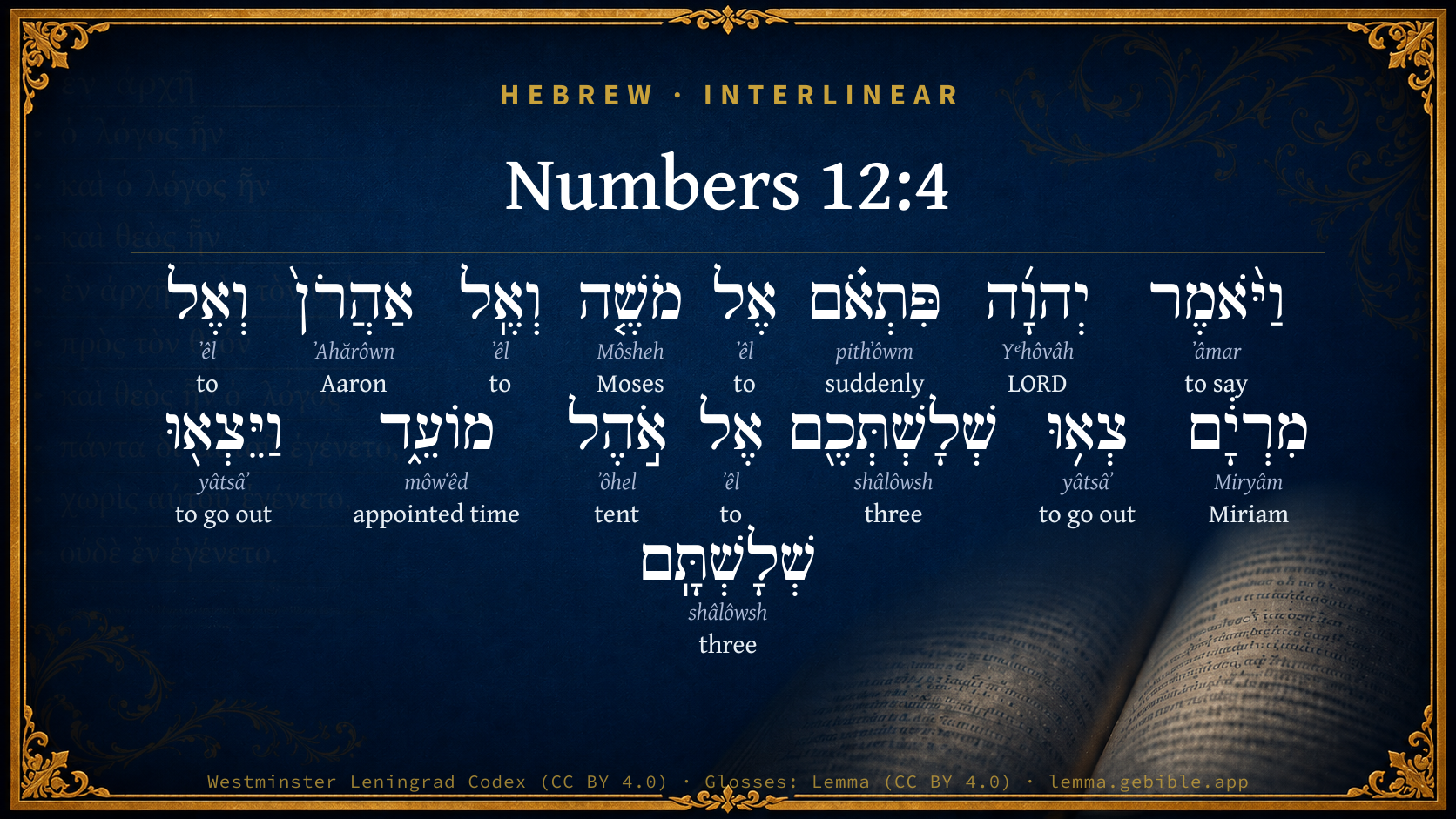
Hebrew (Westminster Leningrad Codex) Numbers 12:4 appears in the Hebrew Old Testament. The text above is from the Westminster Leningrad Codex. Each word links to its Strong’s number, a concise gloss, and parsing drawn from the Open Scriptures Hebrew Bible morphology. Click any word for its full Brown-Driver-Briggs (BDB) entry.
Download image
Cite this verse

Numbers 12:4 (World English Bible). Public Domain. Lemma interlinear Bible study tool, https://lemma.gebible.app/v/numbers/12/4.

Show BibTeX & RIS
BibTeX
RIS
English Translation
Yahweh spoke suddenly to Moses, and to Aaron, and to Miriam, Come out you three to the tent of meeting. They three came out.
World English Bible · Public Domain
Download a study sheet

One document with this verse’s original text, its word-by-word gloss line, the meaning frame, cross-references with their text, attributed commentary, and full source and license credits — printable, and it pastes into notes with its structure intact.

This verse Autodidact and up

Study sheet (.html) Plain text (.txt)

A passage Seminary Student

Up to 50 verses in one chapter. A passage sheet keeps up to 6 commentary sources and 12 cross-references per verse, in the order this page ranks them, and says so on the sheet whenever that leaves anything out. Ask for a single verse and you get the Autodidact verse sheet above.

Everything on this page stays free to read, with no account — the sheet is a download of what is already on screen, not access to it.

Want to remove ads? Support Godless Engineer
Compare translations 3

The same verse in 3 English versions, stacked beneath the original-language interlinear above. Click any original word for its lexicon entry.

Each is an independent rendering of the whole verse — the interlinear is not word-aligned to these translations.

Highlighted words mark where these versions differ — a whole-verse word diff, not a word-by-word alignment.

  • World English Bible Public Domain
    Yahweh spoke suddenly to Moses, and to Aaron, and to Miriam, Come out you three to the tent of meeting. They three came out.
  • King James Version Public Domain
    And the LORD spake suddenly unto Moses, and unto Aaron, and unto Miriam, Come out ye three unto the tabernacle of the congregation. And they three came out.
  • unfoldingWord Literal Text CC BY-SA 4.0
    And Yahweh said suddenly to Moses and to Aaron and to Miriam, “Go out, the three of you, to the tent of meeting.” And the three of them went out.

unfoldingWord Literal Text — © unfoldingWord, licensed CC BY-SA 4.0. Word-aligned USFM3 via Door43 (git.door43.org/unfoldingWord/en_ult).

Versions to compare (up to 4)

3 of 4 selected

Show all 18 translations

Every available English version of this verse, each an independent rendering of the whole verse.

  • World English Bible Public Domain
    Yahweh spoke suddenly to Moses, and to Aaron, and to Miriam, Come out you three to the tent of meeting. They three came out.
  • Berean Standard Bible Public Domain
    And suddenly the LORD said to Moses, Aaron, and Miriam, “You three, come out to the Tent of Meeting.” So the three went out,
  • Majority Standard Bible Public Domain
    And suddenly the LORD said to Moses, Aaron, and Miriam, “You three, come out to the Tent of Meeting.” So the three went out,
  • King James Version Public Domain
    And the LORD spake suddenly unto Moses, and unto Aaron, and unto Miriam, Come out ye three unto the tabernacle of the congregation. And they three came out.
  • American Standard Version (1901) Public Domain
    And Jehovah spake suddenly unto Moses, and unto Aaron, and unto Miriam, Come out ye three unto the tent of meeting. And they three came out.
  • Revised Version (1885) Public Domain
    And the LORD spake suddenly unto Moses, and unto Aaron, and unto Miriam, Come out ye three unto the tent of meeting. And they three came out.
  • Geneva Bible (1599) Public Domain
    And by and by the Lord sayd vnto Moses, and vnto Aaron, and vnto Miriam, come out yee three vnto the Tabernacle of the Congregation: and they three came forth.
  • Douay-Rheims (1899) Public Domain
    Immediately he spoke to him, and to Aaron and Mary: Come out you three only to the tabernacle of the covenant. And when they were come out,
  • Young's Literal Translation Public Domain
    And Jehovah saith suddenly unto Moses, and unto Aaron, and unto Miriam, `Come out ye three unto the tent of meeting;' and they three come out.
  • Literal Standard Version CC BY-SA 4.0
    And YHWH suddenly says to Moses, and to Aaron, and to Miriam, “Come out, you three, to the Tent of Meeting”; and those three come out.
  • Unlocked Literal Bible CC BY-SA 4.0
    Right away Yahweh spoke to Moses, Aaron, and Miriam: “Come out, you three, to the tent of meeting.” So the three of them went out.
  • unfoldingWord Literal Text CC BY-SA 4.0
    And Yahweh said suddenly to Moses and to Aaron and to Miriam, “Go out, the three of you, to the tent of meeting.” And the three of them went out.
  • Darby Bible Public Domain
    Then Jehovah spoke suddenly to Moses, and to Aaron, and to Miriam, Come out ye three unto the tent of meeting. And they went out, they three.
  • World Messianic Bible Public Domain
    The LORD spoke suddenly to Moses, to Aaron, and to Miriam, “You three come out to the Tent of Meeting!” The three of them came out.
  • Webster's Bible Public Domain
    And the LORD spoke suddenly to Moses, and to Aaron, and to Miriam, Come out ye three to the tabernacle of the congregation. And they three came out.
  • Free Bible Version CC BY-SA 4.0
    All of a sudden the Lord called for Moses, Aaron, and Miriam, telling them, “The three of you, come to the Tent of Meeting.” The three of them did so.
  • Bible in Basic English Public Domain
    And suddenly the Lord said to Moses and Aaron and Miriam, Come out, you three, to the Tent of meeting. And the three of them went out.
  • JPS Tanakh (1917) Public Domain
    And the LORD spoke suddenly unto Moses, and unto Aaron, and unto Miriam: 'Come out ye three unto the tent of meeting.' And they three came out.

Literal Standard Version (2020), Covenant Press — licensed CC BY-SA 4.0. Text via the HelloAO Bible API (eBible.org). Unlocked Literal Bible (unfoldingWord) — licensed CC BY-SA 4.0. Text via the HelloAO Bible API (eBible.org). unfoldingWord Literal Text — © unfoldingWord, licensed CC BY-SA 4.0. Word-aligned USFM3 via Door43 (git.door43.org/unfoldingWord/en_ult). Free Bible Version, Dr. Jonathan Gallagher — licensed CC BY-SA 4.0. Text via the HelloAO Bible API (eBible.org).

Word by word

More ways to search: Search by grammar → Find every occurrence → Compare this word →

Practice this passage: Drill this verse → Learn its vocabulary →

מִרְיָ֔ם
Miryâm
H4813
“Miriam”
Noun, Proper
Part of Speech
Noun
Type
Proper
Full BDB Definition

Origin: from H4805

TWOT: None

Miriam = "rebellion" - elder sister of Moses and Aaron - a woman of Judah
  1. וַיֹּ֨אמֶר ʼâmar H559 “and · to say” Conjunction + Verb, Qal, Sequential Imperfect, 3rd Person, Masculine, Singular
  2. יְהוָ֜ה Yᵉhôvâh H3068 “LORD” Noun, Proper
  3. פִּתְאֹ֗ם pithʼôwm H6597 “suddenly” Adverb
  4. אֶל ʼêl H413 “to” Preposition
  5. מֹשֶׁ֤ה Môsheh H4872 “Moses” Noun, Proper
  6. וְאֶֽל ʼêl H413 “and · to” Conjunction + Preposition
  7. אַהֲרֹן֙ ʼAhărôwn H175 “Aaron” Noun, Proper
  8. וְאֶל ʼêl H413 “and · to” Conjunction + Preposition
  9. צְא֥וּ yâtsâʼ H3318 “go out” Verb, Qal, Imperative, 2nd Person, Masculine, Plural
  10. שְׁלָשְׁתְּכֶ֖ם shâlôwsh H7969 “three · your” Adjective, Cardinal number, Masculine, Singular, Construct + Suffix, Personal, 2nd Person, Masculine, Plural
  11. אֶל ʼêl H413 “to” Preposition
  12. אֹ֣הֶל ʼôhel H168 “tent of” Noun, Common, Masculine, Singular, Construct
  13. מוֹעֵ֑ד môwʻêd H4150 “appointed time” Noun, Common, Masculine, Singular, Absolute
  14. וַיֵּצְא֖וּ yâtsâʼ H3318 “and · to go out” Conjunction + Verb, Qal, Sequential Imperfect, 3rd Person, Masculine, Plural
  15. שְׁלָשְׁתָּֽם shâlôwsh H7969 “three · their” Adjective, Cardinal number, Masculine, Singular, Construct + Suffix, Personal, 3rd Person, Masculine, Plural

About this verse

These counts appear in no published source. They are computed here, from the morphology-tagged text and Lemma’s own curated glosses. What Lemma adds →

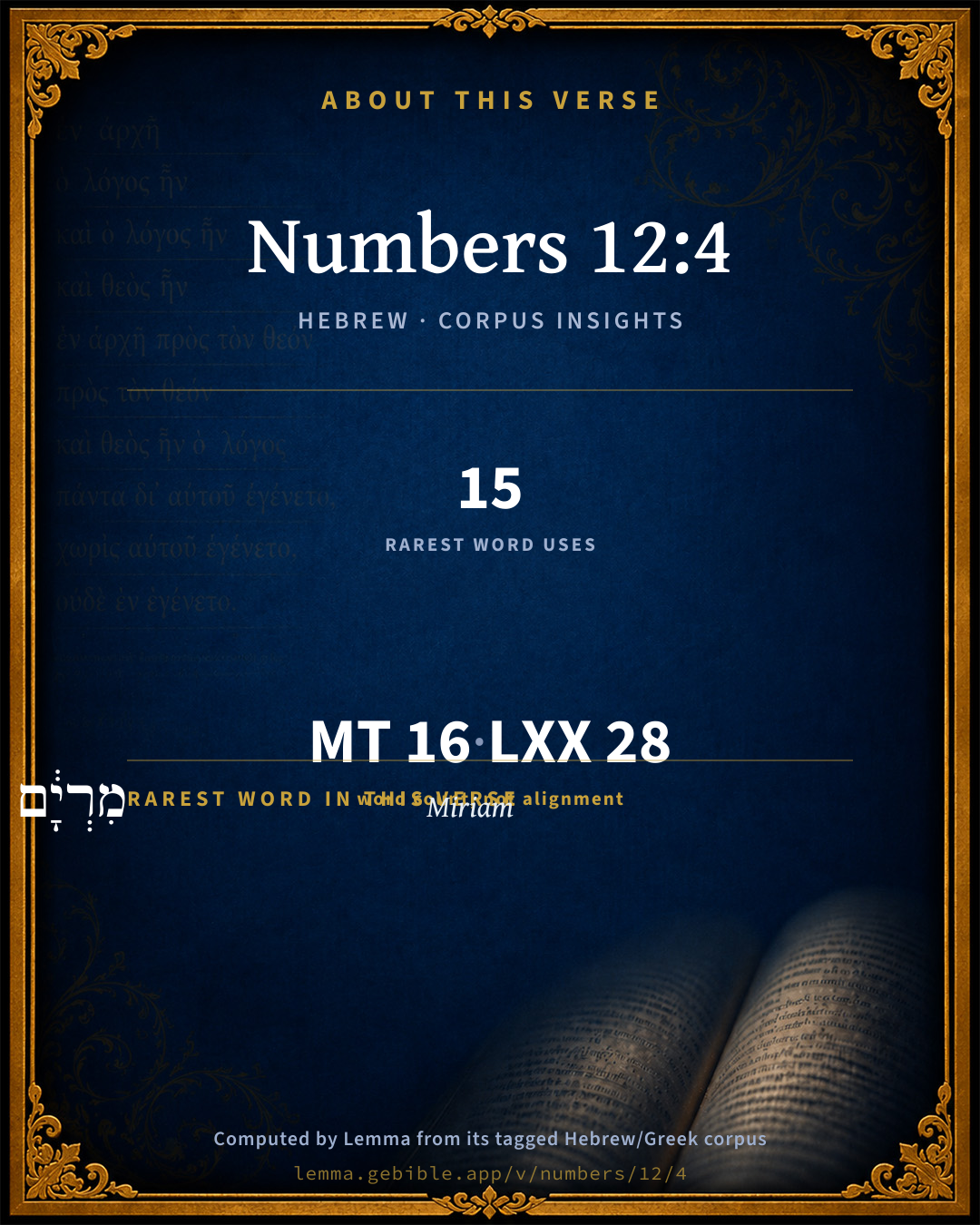
16
words
11
distinct lemmas
Pentateuch
section

Notable vocabulary

The rarest word here is מִרְיָ֔ם Miriam H4813 — appearing just 15 times in the whole Hebrew Bible.

Shared distinctive vocabulary

מִרְיָ֔ם Miriam H4813 occurs in 13 verses of the Hebrew Bible. Also found in:

Grammatical profile

  • 3 verbs
  • 6 nouns
  • 2 adjectives
  • 4 prepositions
  • 1 adverb

Verb forms

  • וַיֹּ֨אמֶר Qal · Sequential Imperfect
  • צְא֥וּ Qal · Imperative
  • וַיֵּצְא֖וּ Qal · Sequential Imperfect

Repetition

Words recur within this verse — often emphatic in Hebrew:

  • צְא֥וּ to go out H3318 ×2
  • שְׁלָשְׁתְּכֶ֖ם three H7969 ×2
  • אֶל to H413 ×4

Hebrew & Septuagint length

In English translation the verse runs 24 words from the Hebrew and 22 from the Septuagint (LXX English) — closely comparable.

A rough comparison of the two English renderings, which tokenize alike — not a word-level alignment.

Word counts can differ between the Hebrew and the Greek without any difference in meaning — e.g. the Hebrew direct-object marker אֵת has no separate Greek word, and Greek often adds the article ὁ.

In the original languages it is 16 Hebrew tokens and 28 Greek tokens — but the two are counted differently (Hebrew bundles its prefixes and suffixes into one token; the Greek is in lemma form), so that isn’t a like-for-like length.

Cross-references

2

Topical passages linked to Numbers 12:4 in the Treasury of Scripture Knowledge — connected by theme and wording, ordered by reader-vote popularity; previews shown in the World English Bible.

  • Psalms 76:9 When God arose to judgment, To save all the afflicted ones of the earth. Selah.
  • Numbers 16:16–21 Moses said to Korah, You and all your company go before Yahweh, you, and they, and Aaron, tomorrow:

Cross-references courtesy of OpenBible.info (CC BY 4.0).

Hebrew and Greek witnesses Masoretic Hebrew ↔ Greek Septuagint

The same verse in the two great witnesses to the Old Testament, shown verse-for-verse.

These are two independent witnesses, not word-aligned to each other, and the Septuagint is shown in lemma (dictionary) form.

Hebrew Numbers 12:4 Masoretic · Westminster Leningrad Codex

וַיֹּ֨אמֶר יְהוָ֜ה פִּתְאֹ֗ם אֶל מֹשֶׁ֤ה וְאֶֽל אַהֲרֹן֙ וְאֶל מִרְיָ֔ם צְא֥וּ שְׁלָשְׁתְּכֶ֖ם אֶל אֹ֣הֶל מוֹעֵ֑ד וַיֵּצְא֖וּ שְׁלָשְׁתָּֽם

Yahweh spoke suddenly to Moses, and to Aaron, and to Miriam, Come out you three to the tent of meeting. They three came out.

World English Bible · Public Domain

Greek LXX Numbers 12:4 Septuagint · lemma form

καί εἶπον κύριος παραχρῆμα πρός μωυσῆς καί μαριαμ καί ἀαρών ἐκἔρχομαι σύ ὁ τρεῖς εἰς ὁ σκηνή ὁ μαρτύριον καί ἐκἔρχομαι ὁ τρεῖς εἰς ὁ σκηνή ὁ μαρτύριον

And the Lord said immediately to Moses and Aaron and Mariam, Come forth all three of you to the tabernacle of witness.

LXX2012 (modern English Septuagint) · Public Domain

On this verse, The Pulpit Commentary discusses the Septuagint’s reading. Read the note in Commentary ↓

Hebrew: Westminster Leningrad Codex (CC BY 4.0). Greek: Septuagint (public domain); English from LXX2012 (modern English Septuagint) (Public Domain). How the Septuagint differs from the Hebrew →

Targum (Aramaic paraphrase)

2

The Targum is the ancient Jewish Aramaic paraphrase of the Hebrew Scriptures — an interpretive translation, not the Hebrew text itself. Onkelos (literal) and Pseudo-Jonathan (expansive) render the Torah, and Jonathan the Prophets. Coverage is partial: where no permissively-licensed English translation exists for a verse, only the Aramaic is shown. This is verse-level text, not a word-by-word alignment to the Hebrew.

  1. Targum Onkelos Torah (Genesis–Deuteronomy)
    וַאֲמַר יְיָ בִּתְכֵּף לְמשֶׁה וּלְאַהֲרֹן וּלְמִרְיָם פּוּקוּ תְלָתֵיכוֹן לְמַשְׁכַּן זִמְנָא וּנְפָקוּ תְּלָתֵיהוֹן

    (no public-domain English translation for this verse)

    Targum Onkelos — Aramaic: “Onkelos Genesis” (public domain); “Onkelos Exodus” (public domain); “Onkelos Leviticus” (public domain); “Onkelos Numbers” (public domain); “Onkelos Deuteronomy” (public domain). English: “Sefaria Community Translation” (CC0 1.0 (public-domain dedication)); “J.W. Etheridge. The Targums of Onkelos and Jonathan Ben Uzziel on the Pentateuch. London: Longmans, Green, 1862” (public domain). Text via Sefaria.

  2. Targum Pseudo-Jonathan Torah (Genesis–Deuteronomy)
    וַאֲמַר יְיָ לְמשֶׁה וּלְאַהֲרן וּלְמִרְיָם פּוּקוּ תְּלָתֵיכוֹן לְמַשְׁכַּן זִמְנָא וּנְפָקוּ תְּלָתֵיהוֹן

    And the Lord said to Mosheh, to Aharon, and to Miriam, Come forth, you three, to the tabernacle. And those three went forth.

    Targum Pseudo-Jonathan — Aramaic: “Targum Jonathan on Genesis” (public domain); “Targum Jonathan on Exodus” (public domain); “Targum Jonathan on Leviticus” (public domain); “Targum Jonathan on Numbers” (public domain); “Targum Jonathan on Deuteronomy” (public domain). English: “The Targum of Jonathan ben Uzziel, trans. J. W. Etheridge, London, 1862” (public domain). Text via Sefaria.

Commentary

Notes on Numbers 12:4 from classic Christian and Jewish commentators (each source and its license shown beneath its notes). The classic Christian expositions comment on the surrounding passage and are grouped to its opening verse, so a note may address several verses; the Jewish commentaries on the Tanakh (Rashi and others) are per-verse, so they appear only where the commentator wrote on this verse.

Lemma curates 59 commentaries, every one of them public domain or Creative Commons licensed, each selected and text-cleaned for this edition rather than reprinted as found. About our sources →

Matthew Henry's Commentary

Moses did not resent the injury done him, nor complain of it to God, nor make any appeal to him; but God resented it. He hears all we say in our passion, and is a swift witness of our hasty speeches, which is a reason why we should resolutely bridle our tongues, that we speak not ill of others, and why we should patiently stop our ears, and not take notice of it, if others speak ill of us. I heard not, for thou wilt hear, Psa 38:13-15. The more silent we are in our own cause the more is God engaged to plead it. The accused innocent needs to say little if he knows the judge himself will be his advocate.

I. The cause is called, and the parties are summoned forthwith to attend at the door of the tabernacle, Num 12:4, Num 12:5. Moses had often shown himself jealous for God's honour, and now God showed himself jealous for his reputation; for those that honour God he will honour, nor will he ever be behind-hand with any that appear for him. Judges of old sat in the gate of the city to try causes, and so on this occasion the shechinah in the cloud of glory stood at the door of the tabernacle, and Aaron and Miriam, as delinquents, were called to the bar.

II. Aaron and Miriam were made to know that great as they were they must not pretend to be equal to Moses, nor set up as rivals with him, v. 6-8. Were they prophets of the Lord? Of Moses it might be truly said, He more. 1. It was true that God put a great deal of honour upon the prophets. However men mocked them and misused them, they were the favourites and intimates of heaven. God made himself known to them, either by dreams when they were asleep or by visions when they were awake, and by them made himself known to others. And those are happy, those are great, truly great, truly happy, to whom God makes himself known, Now he does it not by dreams and visions, as of old, but by the Spirit of wisdom and revelation, who makes known those things to babes which prophets and kings desired to see and might not. Hence in the last days, the days of the Messiah, the sons and daughters are said to prophesy (Joe 2:28), because they shall be better acquainted with the mysteries of the kingdom of grace than even the prophets themselves were; see Heb 1:1, Heb 1:2. 2. Yet the honour put upon Moses was far greater (Num 12:7): My servant Moses is not so, he excels them all. To recompense Moses for his meekly and patiently bearing the affronts which Miriam and Aaron gave him, God not only cleared him, but praised him; and took that occasion to give him an encomium which remains upon record to his immortal honour; and thus shall those that are reviled and persecuted for righteousness' sake have a great reward in heaven, Christ will confess them before his Father and the holy angels. (1.) Moses was a man of great integrity and tried fidelity. He is faithful in all my house. This is put first in his character, because grace excels gifts, love excels knowledge, and sincerity in the service of God puts a greater honour upon a man and recommends him to the divine favour more than learning, abstruse speculations, and an ability to speak with tongues. This is that part of Moses's character which the apostle quotes when he would show that Christ was greater than Moses, making it out that he was so in this chief instance of his greatness; for Moses was faithful only as a servant, but Christ as a son, Heb 3:2, Heb 3:5, Heb 3:6. God entrusted Moses to deliver his mind in all things to Israel; Israel entrusted him to treat for them with God; and he was faithful to both. He said and did every thing in the management of that great affair as became an honest good man, that aimed at nothing else but the honour of God and the welfare of Israel. (2.) Moses was therefore honoured with clearer discoveries of God's mind, and a more intimate communion with God, than any other prophet whatsoever. He shall, [1.] Hear more from God than any other prophet, more clearly and distinctly: With him will I speak mouth to mouth, or face to face (Exo 30:11), as a man speaks to his friend, whom he discourses with freely and familiarly, and without any confusion or consternation, such as sometimes other prophets were under; as Ezekiel, and John himself, when God spoke to them. By other prophets God sent to his people reproofs, and predictions of good or evil, which were properly enough delivered in dark speeches, figures, types, and parables; but by Moses he gave laws to his people, and the institution of holy ordinances, which could by no means be delivered by dark speeches, but must be expressed in the plainest and most intelligible manner. [2.] He shall see more of God than any other prophet: The similitude of the Lord shall behold, as he hath seen it in Horeb, when God proclaimed his name before him. Yet he saw only the similitude of the Lord, angels and glorified saints always behold the face of our Father. Moses had the spirit of prophecy in a way peculiar to himself, and which set him far above all other prophets; yet he that is least in the kingdom of heaven is greater than he, much more does our Lord Jesus infinitely excel him, Heb 3:1, etc.

Now let Miriam and Aaron consider who it was that they insulted: Were you not afraid to speak against my servant Moses? Against my servant, against Moses? so it runs in the original. "How dare you abuse any servant of mine, especially such a servant as Moses, who is a friend, a confidant, and steward of the house?" How durst they speak to the grief and reproach of one whom God had so much to say in commendation of? Might they not expect that God would resent it, and take it as an affront to himself? Note, We have reason to be afraid of saying or doing any thing against the servants of God; it is at our peril if we do, for God will plead their cause, and reckon that what touches them touches the apple of his eye. It is a dangerous thing to offend Christ's little ones, Mat 18:6. Those are presumptuous indeed that are not afraid to speak evil of dignities, Pe2 2:10.

III. God, having thus shown them their fault and folly, next shows them his displeasure (Num 12:9): The anger of the Lord was kindled against them, of which perhaps some sensible indications were given in the change of the colour of the cloud, or some flashes of lightning from it. But indeed it was indication enough of his displeasure that he departed, and would not so much as hear their excuse, for he needed not, understanding their thoughts afar off; and thus he would show that he was displeased. Note, The removal of God's presence from us is the surest and saddest token of God's displeasure against us. Woe unto us if he depart; and he never departs till we by our sin and folly drive him from us.

Matthew Henry's Commentary on the Whole Bible (1708–1710) — public domain (CC PDM 1.0). Text via the HelloAO Bible API.

Trapp's Complete Commentary

John Trapp

Num 12:4 And the LORD spake suddenly unto Moses, and unto Aaron, and unto Miriam, Come out ye three unto the tabernacle of the congregation. And they three came out.

Ver. 4. And the Lord spake suddenly.] God takes his part ever that fights not for himself. Christ that said, "I seek not mine own glory," adds, "But there is one that seeks it, and judgeth." Here he appears as "a swift witness," {Mal 3:5, &c.} a sharp revenger of his servant’s injuries. The rule is, Iniuria illata legato redundat in legantem, Wrong done to a messenger reflects on him that sent him.

John Trapp, A Commentary or Exposition upon All the Books of the Old and New Testament (1647–1656) — public domain. Text from a community e-Sword module.

Joseph Benson's Commentary

Num 12:4-5. The Lord spake suddenly — To stifle the beginnings of the sedition, that this example might not spread among the people, the divine voice from the Shechinah interrupts them in the midst of their dispute, commanding Aaron and his sister to come forth from their tents to meet Moses immediately at the door of the tabernacle, which they did accordingly. The Lord stood in the door — While they stood without, Aaron not being admitted into the tabernacle as he used to be, a sign of God’s displeasure.

Joseph Benson's Commentary on the Old and New Testaments (1811–1818) — public domain. Text from a community e-Sword module.

Tyndale Open Study Notes

Tyndale Open Resources

12:4-8 In response, the Lord reconfirmed Moses’ special status and authority.

Tyndale Open Study Notes — © Tyndale Open Resources, licensed CC BY-SA 4.0. Text via the HelloAO Bible API.

Jamieson, Fausset & Brown

Robert Jamieson, A. R. Fausset & David Brown

the Lord spake suddenly unto Moses, and unto Aaron, and unto Miriam--The divine interposition was made thus openly and immediately, in order to suppress the sedition and prevent its spreading among the people.

Jamieson, Fausset & Brown — Commentary Critical and Explanatory on the Whole Bible (1871) — public domain (CC PDM 1.0). Text via the HelloAO Bible API.

Adam Clarke's Commentary

Verse 4. And the Lord spake suddenly] The sudden interference of God in this business shows at once the importance of the case and his displeasure.

Adam Clarke's Commentary on the Bible (1810–1826) — public domain. Text from a community e-Sword/MySword module.

Ellicott's Commentary for English Readers

(4) Come out ye three . . . —There is nothing in these words which implies that Miriam entered into the Tabernacle itself. Moses, Aaron, and Miriam were summoned to go out of the camp (comp. Num_11:30), and to come to the entrance of the Tabernacle, or rather of the court, inasmuch as the command to come as far as the entrance into the Sanctuary appears to have been given afterwards (Num_12:5). It must be remembered that there was but one court at this time.

A Bible Commentary for English Readers, edited by Charles John Ellicott (1878–1897) — public domain. Text from a community e-Sword module.

The Cambridge Bible for Schools and Colleges

gen. ed. J. J. S. Perowne

4. the tent of meeting] The narrative affords an instance of the way in which the tent was used. It was not intended for congregational purposes (see on Num_1:1), but for obtaining an oracular answer from God. And it is possible that this use explains the original meaning of its name, ’ôhel mô‛çd. The word mô‛çd denotes ‘a fixed time,’ ‘sacred season.’ The Assyr. word âdânu, from the same root, described one of the functions of Babylonian priests, i.e. that of determining the right or auspicious time for an undertaking. And it has been suggested, though it cannot at present be regarded as more than a guess, that the Heb. expression may originally have denoted ‘the tent where the proper time for an undertaking was determined,’ and hence, more generally, the ‘oracletent.’

The Cambridge Bible for Schools and Colleges (gen. ed. J. J. S. Perowne; Cambridge University Press, 1878–1918) — public domain. Text from a community e-Sword module.

John Gill's Exposition

And the Lord spake suddenly unto Moses, and unto Aaron, and unto Miriam,.... As one greatly provoked, and highly displeased, and which was shown at once; and in order to prevent the complaint getting among the people, and spreading, which might have been of bad consequence, as they were pretty much disposed to murmur and mutiny; as also to show that it was not through any solicitation of Moses that the Lord took this matter in hand, time not being allowed to him to make any application to him; for, as soon as ever Miriam and Aaron had uttered their speech against him, the Lord spake to them:

come out ye three unto the tabernacle of the congregation; everyone out of his tent, as Aben Ezra; though it is not improbable that they were all together in the tent of Moses, whither Aaron and Miriam were come to contend with him; the words seem to be spoken quick, and in haste, as being angry:

and they three came out: of the place where they were, to the tabernacle of the congregation, that so the people might not hear what was said unto them, and what was the occasion of it.

John Gill's Exposition of the Whole Bible (1746–1763) — public domain (CC PDM 1.0). Text via the HelloAO Bible API.

Matthew Poole's English Annotations

Suddenly; partly to show his great respect unto Moses, and unto the grace of meekness; and partly to stifle the beginnings of the sedition, that this example might not spread amongst the people, who had too much of that leaven among them.

Come out, to wit, out of your private dwellings, and from amongst the people, both that you may not infect them by such scandalous words, and partly that you may know my pleasure and your own doom.

Matthew Poole's English Annotations on the Holy Bible (1683–1685) — public domain. Text from a community e-Sword/MySword module.

Whedon's Commentary on the Bible

Daniel D. Whedon

4. Spake suddenly — Indicating the fierceness of Jehovah’s displeasure.

Come out — Of the camp.

Unto the tabernacle — Not into the tabernacle, into which only the priests were permitted to enter. Hence Knobel’s fancied discrepancy between the so-called Elohist writer in Num_18:7, and the Jehovist here and in Exo_33:11, vanishes.

Daniel D. Whedon (gen. ed.), Commentary on the Old and New Testaments (1874–1909) — public domain. Text from a community e-Sword module.

The Pulpit Commentary

The Lord spake suddenly. How he spoke we cannot tell, but the word "suddenly" (Septuagint, paracrhma ) points to something unexpected and unusual. The voice seems to have come to the three in their tents before there was any thought in their minds of such an intervention. Come out ye three, i.e., out of the camp probably the camp of Moses and Aaron, on the east of the tabernacle court. (see Num_3:38)

Vers. 4-15. The humbling of the proud and the exaltation of the meek. The humbling was evidently by the action of God himself.

The Lord heard Miriam and Aaron in the words of their pride, and even though Moses might bear these words in the silent composure of his magnanimity and meekness, it nevertheless became God to justify his servant, as God alone could effectually and signally justify. God notes all unjust and slanderous doings with respect to his people. He hears, even though the reviled ones themselves be ignorant. God then proceeds by one course of action to produce a double result to humble Miriam and Aaron, Miriam in particular, and to exalt Moses. In what he did, notice that with all his anger and severity he yet mingled much consideration for the transgressors. We need not suppose that their words had been spoken to any considerable audience. More likely they were confined to the limits of the domestic circle. And so the Lord spake suddenly to the three persons concerned. Probably none but themselves knew why they were summoned. There was no reason for exposing a family quarrel to the gossip of the whole comp. The sin of Miriam need not be published abroad, though it was necessary, in order to teach her a lesson, that it should be condignly punished. So they were called to the door of the tabernacle, and there God addressed them from the pillar of cloud, with all its solemn associations. This word suddenly also suggests that when God does not visit immediately the iniquity of the transgressor upon him, it is from considerations of what we may call Divine expediency. He can come at once or later, but, at whatever time, he certainly will come. Consider now

I THE HUMBLING OF THE PROUD. This was done in two ways.

1. By the plain distinction which God made between them and Moses. It was perfectly true that, as they claimed, God had spoken by them, but he calls attention to the fact that it was his custom to speak to prophets by vision and by dream. There was no mouth to mouth conversation, no beholding of the similitude of the Lord. God can use all sorts of agencies for his communications to men. It needs not even a Miriam; i.e., can speak warning from the mouth of an ass. But Moses was more than a prophet; prophet was only the part of which steward and general, visible representative of God, was the whole. What a humbling hour for this proud woman to find that Jehovah himself had taken up the cause of her despised brother! It is probable that Moses himself had mentioned little of the details of his experiences of God; they were not things to talk much about; perhaps he could not have found the fit audience, even though few. Upon Miriam it would come like a thunderbolt to know how God esteemed the man whom she had allowed herself to scorn. So God will ever abase the proud by glorifying his own pious children whom they despise. Satan despises Job, says he is a mere lip worshipper, a man whose professions will not bear trial; he gets him down into the dust of bereavement, poverty, and disease; but in the end he has to see him a holier man, a more trustful and prosperous one than before. Miriam meant the downfall of Moses; she only helped to establish him more firmly on the rock.

2. By the personal visitation, on Miriam. She became a leper. As her pride was hideous in the manifestation of it, so her punishment was hideous a leprosy, loathsome and frightful beyond the common. We might expect this. A malignant outbreak in her bodily life corresponded with the malignity of the defilement in her spirit. As to Aaron, we may presume that his sacred office, and to some extent the fact that he was a tool, secured him from leprosy, but the visitation on his sister was punishment in itself. He felt the wind of the blow which struck her down. Proud souls, take warning by Miriam; you will at last become abhorrent to yourselves. Remember Herod. (Act_12:21-23)

II THE EXALTATION OF THE MEEK. This is a more inward and spiritual thing, and therefore not conspicuous in the same way as the humbling. It is something to be appreciated by spiritual discernment rather than natural. Besides, the full exaltation of the meek is not yet come. The resurrection and ascension of the Lord Jesus himself were arranged very quietly. But we cannot help noticing that from this sharp and trying scene Moses emerges with his character shining more beautifully than ever. He does nothing to forfeit the reputation with which he was credited, and everything to increase it. He acted like a man who had beheld the similitude of the Lord. Notice particularly the way in which he joins in with Aaron, interceding for his afflicted sister. This is the true exaltation: to be better and better in oneself, shining more because there is more light within to cast its mild radiance, as God would have it cast, alike upon the evil and the good, the just and the unjust. Y. (Psa_25:9 Psa_59:12 Pro_13:10 Pro_16:18 Pro_29:23 Dan_4:37 Mat_23:12 Gal_6:1-5 2Ti_2:24-26 1Pe_3:4 1Pe_5:6)

The Pulpit Commentary (1880–1919), ed. H.D.M. Spence-Jones & Joseph S. Exell — public domain. Text from a community e-Sword module.

John Wesley's Explanatory Notes

Suddenly - To stifle the beginnings of the sedition, that this example might not spread amongst the people. Come out - Out of your private dwellings, that you may know my pleasure and your own doom.

John Wesley, Explanatory Notes Upon the Whole Bible (1754–1765) — public domain. Text via the GEBible commentary corpus.

Keil & Delitzsch

C. F. Keil & F. Delitzsch

Jehovah summoned the opponents of His servant to come at once before His judgment-seat. He commanded Moses, Aaron, and Miriam suddenly to come out of the camp (see at Num 11:30) to the tabernacle. Then He Himself came down in a pillar of cloud to the door of the tabernacle, i.e., to the entrance to the court, not to the dwelling itself, and called Aaron and Miriam out, i.e., commanded them to come out of the court,

(Note: The discrepancy discovered by Knobel, in the fact that, according to the so-called Elohist, no one but Moses, Aaron, and the sons of Aaron were allowed to enter the sanctuary, whereas, according to the Jehovist, others did so, - e.g., Miriam here, and Joshua in Exo 33:11, - rests entirely upon a groundless fancy, arising from a misinterpretation, as there is not a word about entering the sanctuary, i.e., the dwelling itself, either in the verse before us or in Exo 33:11.)

and said to them (Num 12:6.): "If there is a prophet of Jehovah to you (i.e., if you have one), I make Myself known to him in a vision; I speak to him in a dream (בּו, lit., "in him," inasmuch as a revelation in a dream fell within the inner sphere of the soul-life). Not so My servant Moses: he is approved in My whole house; mouth to mouth I speak to him, and as an appearance, and that not in enigmas; and he sees the form of Jehovah. Why are ye not afraid to speak against My servant, against Moses?" נביאכם = לכם נביא, the suffix used with the noun instead of the separate pronoun in the dative, as in Gen 39:21; Lev 15:3, etc. The noun Jehovah is in all probability to be taken as a genitive, in connection with the word נביאכם ("a prophet to you"), as it is in the lxx and Vulg., and not to be construed with the words which follow ("I Jehovah will make Myself known"). The position of Jehovah at the head of the clause without a preceding אנכי (I) would be much more remarkable than the separation of the dependent noun from the governing noun by the suffix, which occurs in other cases also (e.g., Lev 6:3; Lev 26:42, etc.); moreover, it would be by no means suited to the sense, as no such emphasis is laid upon the fact that it was Jehovah who made Himself known, as to require or even justify such a construction. The "whole house of Jehovah" (Num 12:7) is not "primarily His dwelling, the holy tent" (Baumgarten), - for, in that case, the word "whole" would be quite superfluous, - but the whole house of Israel, or the covenant nation regarded as a kingdom, to the administration and government of which Moses had been called: as a matter of fact, therefore, the whole economy of the Old Testament, having its central point in the holy tent, which Jehovah had caused to be built as the dwelling-place of His name. It did not terminate, however, in the service of the sanctuary, as we may see from the fact that god did not make the priests who were entrusted with the duties of the sanctuary the organs of His saving revelation, but raised up and called prophets after Moses for that purpose. Compare the expression in Heb 3:6, "Whose house we are." נאמן with בּ does not mean to be, or become, entrusted with anything (Baumgarten, Knobel), but simply to be lasting, firm, constant, in a local or temporal sense (Deu 28:59; Sa1 2:35; Sa2 7:16, etc.); in a historical sense, to prove or attest one's self (Gen 42:20); and in an ethical sense, to be found proof, trustworthy, true (Psa 78:8; Sa1 3:20; Sa1 22:14 : see Delitzsch on Heb 3:2). In the participle, therefore, it signifies proved, faithful, πιστός (lxx). "Mouth to mouth" answers to the "face to face" in Exo 33:11 (cf. Deu 34:10), i.e., without any mediation or reserve, but with the same closeness and freedom with which friends converse together (Exo 33:11). This is still further strengthened and elucidated by the words in apposition, "in the form of seeing (appearance), and not in riddles," i.e., visibly, and not in a dark, hidden, enigmatical way. מראה is an accusative defining the mode, and signifies here not vision, as in Num 12:6, but adspectus, view, sight; for it forms an antithesis to בּמּראה in Num 12:6. "The form (Eng. similitude) of Jehovah" was not the essential nature of God, His unveiled glory, - for this no mortal man can see (vid., Exo 33:18.), - but a form which manifested the invisible God to the eye of man in a clearly discernible mode, and which was essentially different, not only from the visionary sight of God in the form of a man (Eze 1:26; Dan 7:9 and Dan 7:13), but also from the appearances of God in the outward world of the senses, in the person and form of the angel of Jehovah, and stood in the same relation to these two forms of revelation, so far as directness and clearness were concerned, as the sight of a person in a dream to that of the actual figure of the person himself. God talked with Moses without figure, in the clear distinctness of a spiritual communication, whereas to the prophets He only revealed Himself through the medium of ecstasy or dream.

Through this utterance on the part of Jehovah, Moses is placed above all the prophets, in relation to God and also to the whole nation. The divine revelation to the prophets is thereby restricted to the two forms of inward intuition (vision and dream). It follows from this, that it had always a visionary character, though it might vary in intensity; and therefore that it had always more or less obscurity about it, because the clearness of self-consciousness and the distinct perception of an external world, both receded before the inward intuition, in a dream as well as in a vision. The prophets were consequently simply organs, through whom Jehovah made known His counsel and will at certain times, and in relation to special circumstances and features in the development of His kingdom. It was not so with Moses. Jehovah had placed him over all His house, had called him to be the founder and organizer of the kingdom established in Israel through his mediatorial service, and had found him faithful in His service. With this servant (θεράπων, lxx) of His, He spake mouth to mouth, without a figure or figurative cloak, with the distinctness of a human interchange of thought; so that at any time he could inquire of God and wait for the divine reply. Hence Moses was not a prophet of Jehovah, like many others, not even merely the first and highest prophet, primus inter pares, but stood above all the prophets, as the founder of the theocracy, and mediator of the Old Covenant. Upon this unparalleled relation of Moses to God and the theocracy, so clearly expressed in the verses before us, the Rabbins have justly founded their view as to the higher grade of inspiration in the Thorah. This view is fully confirmed through the history of the Old Testament kingdom of God, and the relation in which the writings of the prophets stand to those of Moses. The prophets subsequent to Moses simply continued to build upon the foundation which Moses laid. And if Moses stood in this unparalleled relation to the Lord, Miriam and Aaron sinned grievously against him, when speaking as they did. Num 12:9. After this address, "the wrath of Jehovah burned against them, and He went." As a judge, withdrawing from the judgment-seat when he has pronounced his sentence, so Jehovah went, by the cloud in which He had come down withdrawing from the tabernacle, and ascending up on high. And at the same moment, Miriam, the instigator of the rebellion against her brother Moses, was covered with leprosy, and became white as snow.

Keil & Delitzsch — Biblical Commentary on the Old Testament (1861–1891) — public domain (CC PDM 1.0). Text via the HelloAO Bible API. (Old Testament only.)

unfoldingWord translationNotes

Door43 World Missions Community

a pillar of cloud

The shape of the cloud is spoken of as if it were a pillar. AT: "a cloud shaped like a pillar" or "a tall cloud" (See: Metaphor)

translationWords

tent of meeting

column

tent

call

unfoldingWord translationNotes — © Distant Shores Media and the Door43 World Missions Community, licensed CC BY-SA 4.0. Source: git.door43.org/Door43/en_tn.

Rashi

Rabbi Shlomo Yitzchaki (Rashi)

פתאם SUDDENLY — He revealed himself to them suddenly just when they were unclean as a result of marital intercourse, so that they cried; “Water, water!” (for purification). He did this to give them to understand that Moses had acted rightly in that he had separated from his wife, since the Shechinah used to reveal Itself to him at all times and there was no definite time fixed for the Divine communication (Midrash Tanchuma, Tzav 13).

צאו שלשתכם GO OUT YOU THREE [UNTO THE APPOINTED TENT] — This tells us that the names of all three of them were mentioned as one utterance, something that is impossible for a human mouth to articulate and a human ear to catch (Sifrei Bamidbar 102).

Rashi on the Tanakh — English translations: “The Judaica Press complete Tanach with Rashi, translated by A. J. Rosenberg” (CC BY 4.0); “Pentateuch with Rashi's commentary by M. Rosenbaum and A.M. Silbermann, 1929-1934” (public domain); “The Metsudah Tanach series, Lakewood, N.J” (CC BY 4.0); and “The Book of Joshua, Metsudah Publications, 1997” (CC BY 4.0). Text via Sefaria.

Ramban (Nachmanides)

Rabbi Moshe ben Nachman (Ramban / Nachmanides)

AND THE ETERNAL SPOKE ‘PITH’OM’ (SUDDENLY) UNTO MOSES, AND UNTO AARON, AND UNTO MIRIAM. Now Moses was not with them, but [they are mentioned together because] the Divine communication came to the three of them simultaneously. The sense of the word “suddenly” is that they did not direct their minds towards or intend to receive a Divine communication at that time, it being in honor of Moses that it came to them without any preparation for it; for the word pith’om (suddenly) in the opinion of the commentators [as explained in Ibn Ezra] applies to something which one did not think of, from the root pethi (simple-minded). Therefore Scripture uses the term pith’om [only] on account of Aaron and Miriam, for Moses our teacher was fit for a Divine communication at any time, and his mind was prepared to cleave to the Glorious Name at every moment, as our Rabbis have explained in connection with the reason why he [Moses] separated himself from his wife. Onkelos, however, rendered [the word pith’om] as bithkeiph (in a hurry), the sense being that whilst Miriam and Aaron were still speaking about Moses, and the words were still in their mouths, they were told: Come out ye three unto the Tent of Meeting, and He did not delay [the rebuke] to them at all. The word pith’om is thus a term indicating hurry. Similarly, And I beheld his habitation cursed ‘pith’om’ (suddenly); whose breaking cometh ‘pith’om ‘l’pheta’ (suddenly at an instant); ‘b’pheta’ pith’om’ (very suddenly), the double expressions being for emphasis, just like: ‘kim’at kot’ (a very little while); ‘harbei m’od’ (exceedingly great). So also: ‘bi’m'od m’od’ (very much), 17:2. and similar cases. And pethaim (simple-minded ones) are those who are very impetuous, who do not have any deep grasp of a matter and do not reflect on it at all, the usage being similar to the expression and the counsel of the wily is hurried. So also: ‘petha’ (on a sudden) shall he be broken; and if ‘b’phetha’ (suddenly) without enmity, [which Onkelos renders] bithkeiph, which is like pethi (simple), of the expression pith’om (hurriedly).The reason [why He said at first] Come out ye three and [then in the following verse it says] and He called Aaron and Miriam [excluding Moses] is that G-d wanted him to be present [in the Tent of Meeting] and to see how He is zealous for Moses’ honor; and so that he would be available [to forgive them], for G-d would not forgive them unless he did, after they would beg him and he agrees to [forgive] them. And He called Aaron and Miriam, in order to tell Moses’ praise when he was not present.

Ramban (Nachmanides) on the Tanakh — English translation: “Commentary on the Torah by Ramban (Nachmanides). Translated and annotated by Charles B. Chavel. New York, Shilo Pub. House, 1971-1976” (CC BY 4.0). Text via Sefaria.

Lesson kit

Teaching starters — assembled from the data on this page, not authored interpretation. Every prompt links to the verse data it draws on. Edit before teaching.

Numbers, in the Pentateuch, opens this verse with 16 words (11 distinct Hebrew lemmas). Its most distinctive word is Miryâm (“Miriam”). A historical commentator’s framing appears above. Read the whole chapter for the surrounding context.

Discussion questions

  1. The word Miryâm carries the sense “Miriam.” How does it shape the verse?
  2. How does Exodus 15:20, which shares the word «Miriam», read alongside this verse?
  3. What does the repetition of “to go out” (2× in this one verse) do in this verse?
  4. These translations render this verse differently. What is at stake in choosing one wording over another?
  5. «וַיֹּ֨אמֶר» is a Qal Sequential Imperfect verb. How does that grammatical form shape the action described?
  6. Compare how Matthew Henry's Commentary and Trapp's Complete Commentary read this verse. Where do they agree or differ?

Things to notice

Reading settings

Reading text

Shown beneath each verse's original-language words.

Old Testament
Old Testament edition

Read the OT as the Masoretic Hebrew (MT) or the Greek Septuagint (LXX).

English shown for the Greek Septuagint (in the Hebrew ↔ Greek comparison).

Comparing translations? Open the Compare panel on any verse page to stack up to four side by side.