Numbers 10:3

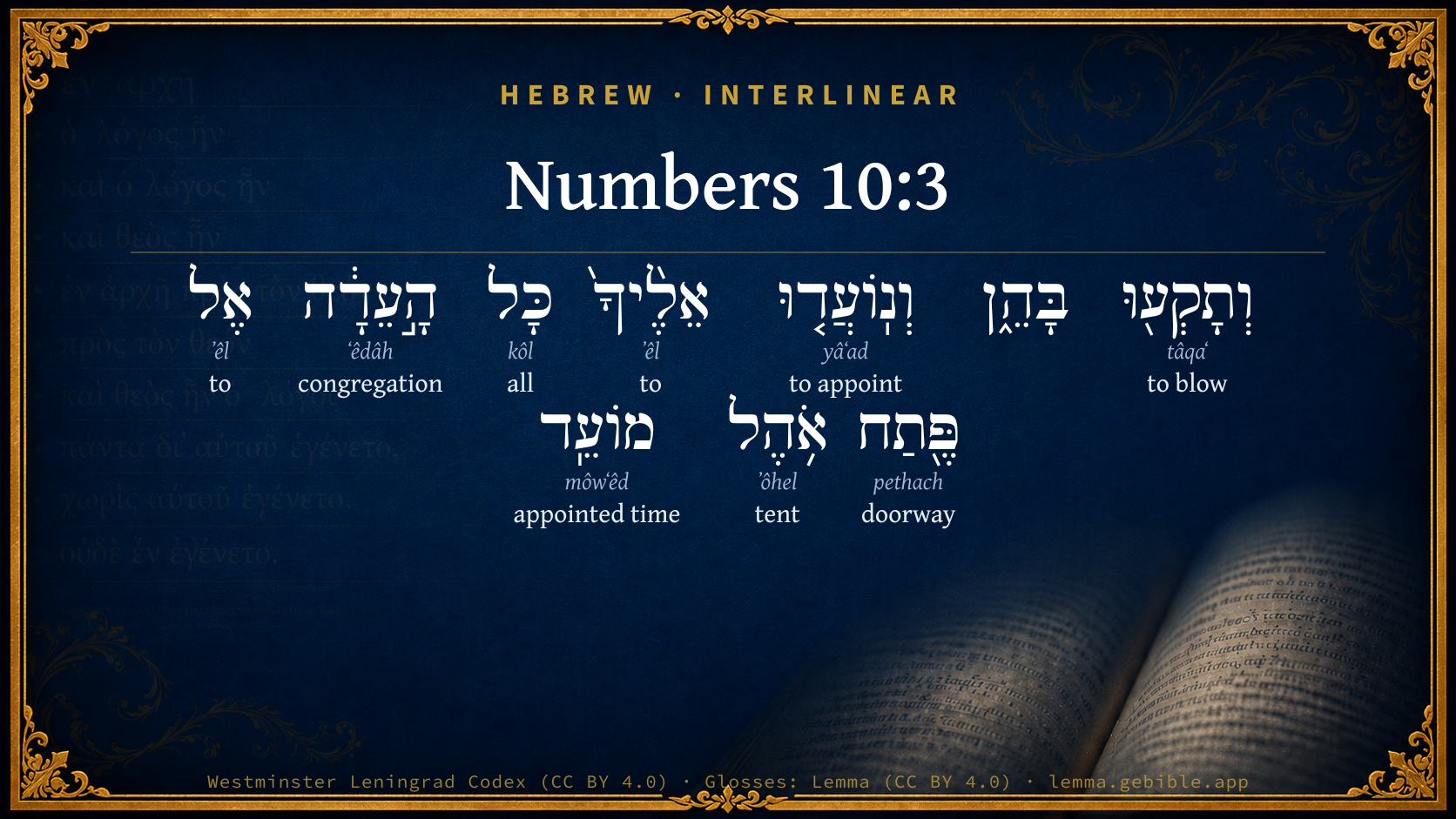
Hebrew (Westminster Leningrad Codex) Numbers 10:3 appears in the Hebrew Old Testament. The text above is from the Westminster Leningrad Codex. Each word links to its Strong’s number, a concise gloss, and parsing drawn from the Open Scriptures Hebrew Bible morphology. Click any word for its full Brown-Driver-Briggs (BDB) entry.
Download image
Cite this verse

Numbers 10:3 (World English Bible). Public Domain. Lemma interlinear Bible study tool, https://lemma.gebible.app/v/numbers/10/3.

Show BibTeX & RIS
BibTeX
RIS
English Translation
When they shall blow them, all the congregation shall gather themselves to you at the door of the tent of meeting.
World English Bible · Public Domain
Download a study sheet

One document with this verse’s original text, its word-by-word gloss line, the meaning frame, cross-references with their text, attributed commentary, and full source and license credits — printable, and it pastes into notes with its structure intact.

This verse Autodidact and up

Study sheet (.html) Plain text (.txt)

A passage Seminary Student

Up to 50 verses in one chapter. A passage sheet keeps up to 6 commentary sources and 12 cross-references per verse, in the order this page ranks them, and says so on the sheet whenever that leaves anything out. Ask for a single verse and you get the Autodidact verse sheet above.

Everything on this page stays free to read, with no account — the sheet is a download of what is already on screen, not access to it.

Want to remove ads? Support Godless Engineer
Compare translations 3

The same verse in 3 English versions, stacked beneath the original-language interlinear above. Click any original word for its lexicon entry.

Each is an independent rendering of the whole verse — the interlinear is not word-aligned to these translations.

Highlighted words mark where these versions differ — a whole-verse word diff, not a word-by-word alignment.

  • World English Bible Public Domain
    When they shall blow them, all the congregation shall gather themselves to you at the door of the tent of meeting.
  • King James Version Public Domain
    And when they shall blow with them, all the assembly shall assemble themselves to thee at the door of the tabernacle of the congregation.
  • unfoldingWord Literal Text CC BY-SA 4.0
    and they shall blow them, and all the congregation shall congregate to you to the opening of the tent of meeting.

unfoldingWord Literal Text — © unfoldingWord, licensed CC BY-SA 4.0. Word-aligned USFM3 via Door43 (git.door43.org/unfoldingWord/en_ult).

Versions to compare (up to 4)

3 of 4 selected

Show all 18 translations

Every available English version of this verse, each an independent rendering of the whole verse.

  • World English Bible Public Domain
    When they shall blow them, all the congregation shall gather themselves to you at the door of the tent of meeting.
  • Berean Standard Bible Public Domain
    When both are sounded, the whole congregation is to assemble before you at the entrance to the Tent of Meeting.
  • Majority Standard Bible Public Domain
    When both are sounded, the whole congregation is to assemble before you at the entrance to the Tent of Meeting.
  • King James Version Public Domain
    And when they shall blow with them, all the assembly shall assemble themselves to thee at the door of the tabernacle of the congregation.
  • American Standard Version (1901) Public Domain
    And when they shall blow them, all the congregation shall gather themselves unto thee at the door of the tent of meeting.
  • Revised Version (1885) Public Domain
    And when they shall blow with them, all the congregation shall gather themselves unto thee at the door of the tent of meeting.
  • Geneva Bible (1599) Public Domain
    And when they shall blowe with them, all the Congregation shall assemble to thee before the doore of the Tabernacle of the Cogregation.
  • Douay-Rheims (1899) Public Domain
    And when thou shalt sound the trumpets, all the multitude shall gather unto thee to the door of the tabernacle of the covenant.
  • Young's Literal Translation Public Domain
    and they have blown with them, and all the company have met together unto thee, unto the opening of the tent of meeting.
  • Literal Standard Version CC BY-SA 4.0
    and they have blown with them, and all the congregation has assembled to you at the opening of the Tent of Meeting.
  • Unlocked Literal Bible CC BY-SA 4.0
    The priests must blow the trumpets to call all the community together in front of you at the entrance to the tent of meeting.
  • unfoldingWord Literal Text CC BY-SA 4.0
    and they shall blow them, and all the congregation shall congregate to you to the opening of the tent of meeting.
  • Darby Bible Public Domain
    And when they shall blow with them, the whole assembly shall gather to thee at the entrance of the tent of meeting.
  • World Messianic Bible Public Domain
    When they blow them, all the congregation shall gather themselves to you at the door of the Tent of Meeting.
  • Webster's Bible Public Domain
    And when they shall blow with them, all the assembly shall assemble themselves to thee at the door of the tabernacle of the congregation.
  • Free Bible Version CC BY-SA 4.0
    When both trumpets are blown, all the Israelites are to gather before you at the entrance to the Tent of Meeting.
  • Bible in Basic English Public Domain
    When they are sounded, all the people are to come together to you at the door of the Tent of meeting.
  • JPS Tanakh (1917) Public Domain
    And when they shall blow with them, all the congregation shall gather themselves unto thee at the door of the tent of meeting.

Literal Standard Version (2020), Covenant Press — licensed CC BY-SA 4.0. Text via the HelloAO Bible API (eBible.org). Unlocked Literal Bible (unfoldingWord) — licensed CC BY-SA 4.0. Text via the HelloAO Bible API (eBible.org). unfoldingWord Literal Text — © unfoldingWord, licensed CC BY-SA 4.0. Word-aligned USFM3 via Door43 (git.door43.org/unfoldingWord/en_ult). Free Bible Version, Dr. Jonathan Gallagher — licensed CC BY-SA 4.0. Text via the HelloAO Bible API (eBible.org).

Word by word

More ways to search: Search by grammar → Find every occurrence → Compare this word →

Practice this passage: Drill this verse → Learn its vocabulary →

וְנֽוֹעֲד֤וּ
yâʻad
H3259
“and · to appoint”
Conjunction + Verb, Niphal, Sequential Perfect, 3rd Person, Common, Plural
Part of Speech
Conjunction + Verb
Stem
Niphal
Form
Sequential Perfect
Person
3rd Person
Gender
Common
Number
Plural
Full BDB Definition

Origin: a primitive root

TWOT: 878

to fix, appoint, assemble, meet, set, betroth - (Qal) to appoint, assign, designate - (Niphal) - to meet - to meet by appointment - to gather, assemble by appointment - (Hiphil) to cause to meet - (Hophal) to be set, be placed before, be fixed
  1. וְתָקְע֖וּ tâqaʻ H8628 “and · to blow” Conjunction + Verb, Qal, Sequential Perfect, 3rd Person, Common, Plural
  2. אֵלֶ֨יךָ֙ ʼêl H413 “to · you” Preposition + Suffix, Personal, 2nd Person, Masculine, Singular
  3. כָּל kôl H3605 “all of” Noun, Common, Masculine, Singular, Construct
  4. הָ֣עֵדָ֔ה ʻêdâh H5712 “the · congregation” Particle, Definite Article + Noun, Common, Feminine, Singular, Absolute
  5. אֶל ʼêl H413 “to” Preposition
  6. פֶּ֖תַח pethach H6607 “doorway of” Noun, Common, Masculine, Singular, Construct
  7. אֹ֥הֶל ʼôhel H168 “tent of” Noun, Common, Masculine, Singular, Construct
  8. מוֹעֵֽד môwʻêd H4150 “appointed time” Noun, Common, Masculine, Singular, Absolute

About this verse

These counts appear in no published source. They are computed here, from the morphology-tagged text and Lemma’s own curated glosses. What Lemma adds →

10
words
8
distinct lemmas
Pentateuch
section

Shared distinctive vocabulary

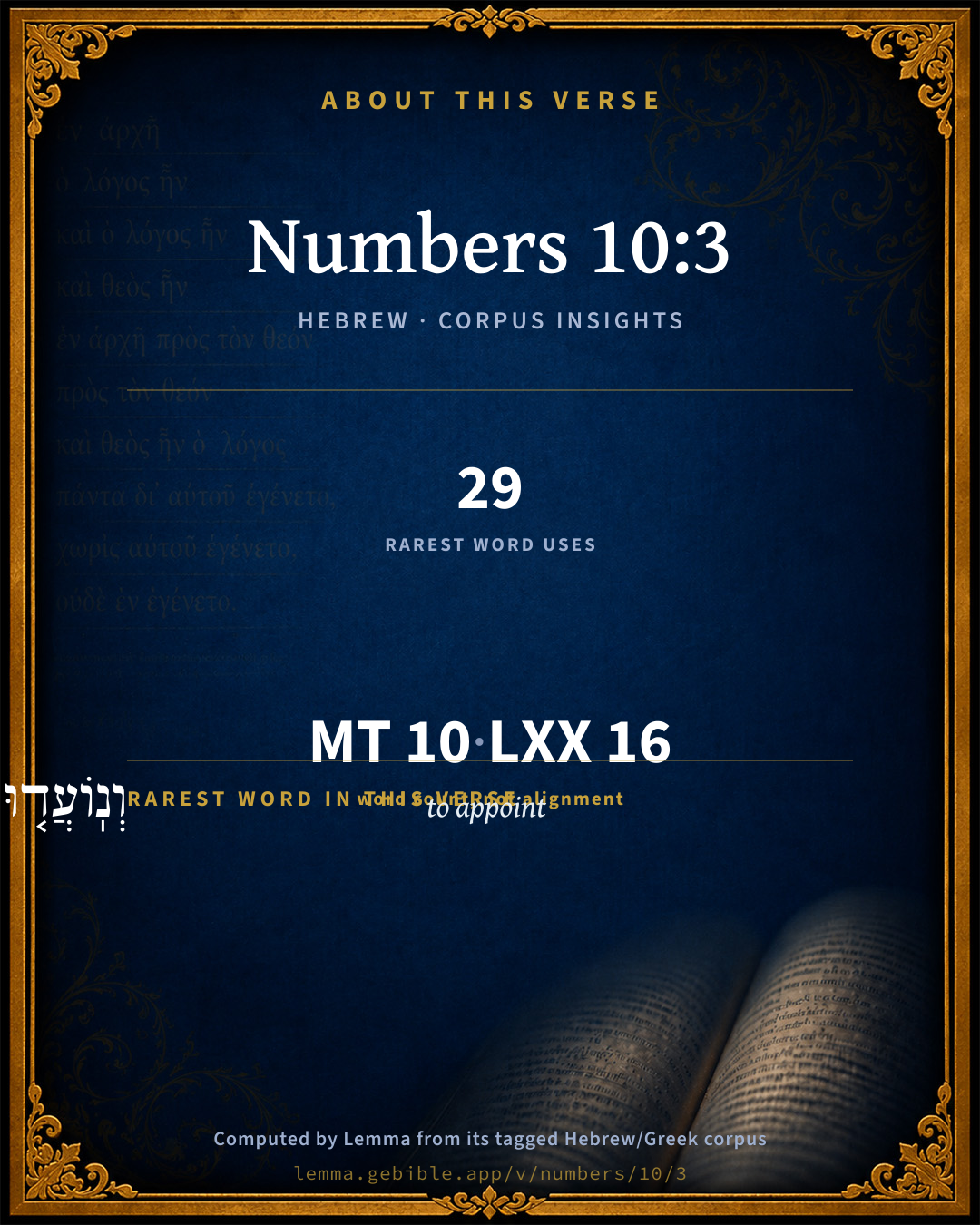
וְנֽוֹעֲד֤וּ to appoint H3259 occurs in 29 verses of the Hebrew Bible. Also found in:

Grammatical profile

  • 2 verbs
  • 5 nouns
  • 3 prepositions

Verb forms

  • וְתָקְע֖וּ Qal · Sequential Perfect
  • וְנֽוֹעֲד֤וּ Niphal · Sequential Perfect

Repetition

A word recurs within this verse — often emphatic in Hebrew:

  • אֵלֶ֨יךָ֙ to H413 ×2

Hebrew & Septuagint length

In English translation the verse runs 21 words from the Hebrew and 21 from the Septuagint (LXX English) — the same length.

A rough comparison of the two English renderings, which tokenize alike — not a word-level alignment.

Word counts can differ between the Hebrew and the Greek without any difference in meaning — e.g. the Hebrew direct-object marker אֵת has no separate Greek word, and Greek often adds the article ὁ.

In the original languages it is 10 Hebrew tokens and 16 Greek tokens — but the two are counted differently (Hebrew bundles its prefixes and suffixes into one token; the Greek is in lemma form), so that isn’t a like-for-like length.

Cross-references

2

Topical passages linked to Numbers 10:3 in the Treasury of Scripture Knowledge — connected by theme and wording, ordered by reader-vote popularity; previews shown in the World English Bible.

  • Jeremiah 4:5 Declare you in Judah, and publish in Jerusalem; and say, Blow you the trumpet in the land: cry aloud and say, Assemble yourselves, and let us go into the fortified cities.
  • Joel 2:15–16 Blow the trumpet in Zion! Sanctify a fast. Call a solemn assembly.

Cross-references courtesy of OpenBible.info (CC BY 4.0).

Hebrew and Greek witnesses Masoretic Hebrew ↔ Greek Septuagint

The same verse in the two great witnesses to the Old Testament, shown verse-for-verse.

These are two independent witnesses, not word-aligned to each other, and the Septuagint is shown in lemma (dictionary) form.

Hebrew Numbers 10:3 Masoretic · Westminster Leningrad Codex

וְתָקְע֖וּ בָּהֵ֑ן וְנֽוֹעֲד֤וּ אֵלֶ֨יךָ֙ כָּל הָ֣עֵדָ֔ה אֶל פֶּ֖תַח אֹ֥הֶל מוֹעֵֽד

When they shall blow them, all the congregation shall gather themselves to you at the door of the tent of meeting.

World English Bible · Public Domain

Greek LXX Numbers 10:3 Septuagint · lemma form

καί σαλπίζω ἐν αὐτός καί συνἄγω πᾶς ὁ συναγωγή ἐπί ὁ θύρα ὁ σκηνή ὁ μαρτύριον

And you shall sound with them, and all the congregation shall be gathered to the door of the tabernacle of witness.

LXX2012 (modern English Septuagint) · Public Domain

On this verse, Jamieson, Fausset & Brown discusses the Septuagint’s reading. Read the note in Commentary ↓

Hebrew: Westminster Leningrad Codex (CC BY 4.0). Greek: Septuagint (public domain); English from LXX2012 (modern English Septuagint) (Public Domain). How the Septuagint differs from the Hebrew →

Targum (Aramaic paraphrase)

2

The Targum is the ancient Jewish Aramaic paraphrase of the Hebrew Scriptures — an interpretive translation, not the Hebrew text itself. Onkelos (literal) and Pseudo-Jonathan (expansive) render the Torah, and Jonathan the Prophets. Coverage is partial: where no permissively-licensed English translation exists for a verse, only the Aramaic is shown. This is verse-level text, not a word-by-word alignment to the Hebrew.

  1. Targum Onkelos Torah (Genesis–Deuteronomy)
    וְיִתְקְעוּן בְּהוֹן וְיִזְדַמְנוּן לְוָתָךְ כָּל כְּנִשְׁתָּא לִתְרַע מַשְׁכַּן זִמְנָא

    (no public-domain English translation for this verse)

    Targum Onkelos — Aramaic: “Onkelos Genesis” (public domain); “Onkelos Exodus” (public domain); “Onkelos Leviticus” (public domain); “Onkelos Numbers” (public domain); “Onkelos Deuteronomy” (public domain). English: “Sefaria Community Translation” (CC0 1.0 (public-domain dedication)); “J.W. Etheridge. The Targums of Onkelos and Jonathan Ben Uzziel on the Pentateuch. London: Longmans, Green, 1862” (public domain). Text via Sefaria.

  2. Targum Pseudo-Jonathan Torah (Genesis–Deuteronomy)
    וְיִתְקְעוּן בְּהוֹן וְיִזְדַמְנוּן לְוָתָךְ כָּל כְּנִישְׁתָּא לִתְרַע מַשְׁכַּן זִמְנָא

    And thou shalt blow upon them, and bring together to thee all the congregation at the door of the tabernacle of ordinance.

    Targum Pseudo-Jonathan — Aramaic: “Targum Jonathan on Genesis” (public domain); “Targum Jonathan on Exodus” (public domain); “Targum Jonathan on Leviticus” (public domain); “Targum Jonathan on Numbers” (public domain); “Targum Jonathan on Deuteronomy” (public domain). English: “The Targum of Jonathan ben Uzziel, trans. J. W. Etheridge, London, 1862” (public domain). Text via Sefaria.

Commentary

Notes on Numbers 10:3 from classic Christian and Jewish commentators (each source and its license shown beneath its notes). The classic Christian expositions comment on the surrounding passage and are grouped to its opening verse, so a note may address several verses; the Jewish commentaries on the Tanakh (Rashi and others) are per-verse, so they appear only where the commentator wrote on this verse.

Lemma curates 59 commentaries, every one of them public domain or Creative Commons licensed, each selected and text-cleaned for this edition rather than reprinted as found. About our sources →

Jamieson, Fausset & Brown

Robert Jamieson, A. R. Fausset & David Brown

when they shall blow with them--There seem to have been signals made by a difference in the loudness and variety in the notes, suited for different occasions, and which the Israelites learned to distinguish. A simple uniform sound by both trumpets summoned a general assembly of the people; the blast of a single trumpet convoked the princes to consult on public affairs; notes of some other kind were made to sound an alarm, whether for journeying or for war. One alarm was the recognized signal for the eastern division of the camp (the tribes of Judah, Issachar, and Zebulun) to march; two alarms gave the signal for the southern to move; and, though it is not in our present Hebrew text, the Septuagint has, that on three alarms being sounded, those on the west; while on four blasts, those on the north decamped. Thus the greatest order and discipline were established in the Israelitish camp--no military march could be better regulated.

Jamieson, Fausset & Brown — Commentary Critical and Explanatory on the Whole Bible (1871) — public domain (CC PDM 1.0). Text via the HelloAO Bible API.

The Cambridge Bible for Schools and Colleges

gen. ed. J. J. S. Perowne

3. when they shall blow] See on Num_10:5.

with them] i.e. with both of them together, in contrast with the use of one alone in Num_10:4.

The Cambridge Bible for Schools and Colleges (gen. ed. J. J. S. Perowne; Cambridge University Press, 1878–1918) — public domain. Text from a community e-Sword module.

John Gill's Exposition

And when they shall blow with them,.... With both the trumpets, in an even and continued sound, that is, the sons of Aaron:

all the assembly shall assemble themselves to thee at the door of the tabernacle of the congregation; to hear what was to be said unto them: blowing both the trumpets together was a token that the whole congregation was called to meet together at the tabernacle, the door of which was the usual place of assembling, especially on religious counts, for there also the Lord met them, Exo 29:42.

John Gill's Exposition of the Whole Bible (1746–1763) — public domain (CC PDM 1.0). Text via the HelloAO Bible API.

Matthew Poole's English Annotations

When they, i.e. the priests, by comparing this with Num 10:8,

shall blow with them, i.e. with both of them, by comparing this with the next verse.

Matthew Poole's English Annotations on the Holy Bible (1683–1685) — public domain. Text from a community e-Sword/MySword module.

Whedon's Commentary on the Bible

Daniel D. Whedon

3. When they shall blow with them — That is, with both.

All the assembly — They were to send representatives to the door of the tabernacle who would constitute a larger assembly than that of the princes. The gathering of more than 600,000, the enrolled army of Israel, at the narrow space in front of the tabernacle is not demanded by these words. See notes on Num_1:18; Num_14:2; Num_14:7.

Daniel D. Whedon (gen. ed.), Commentary on the Old and New Testaments (1874–1909) — public domain. Text from a community e-Sword module.

The Pulpit Commentary

When they shall blow with them, i.e., with both of them. All the assembly, i.e., by their natural or customary representatives.

The Pulpit Commentary (1880–1919), ed. H.D.M. Spence-Jones & Joseph S. Exell — public domain. Text from a community e-Sword module.

unfoldingWord translationNotes

Door43 World Missions Community

in front of you

"while you are present." This means that Moses was to be there with the priest when he blew the trumpets.

the leaders, the heads of the clans of Israel

These two phrases refer to the same group of people. Here the second phrase is used to describe the first phrase. AT: "the leaders, who are the heads of the clans of Israel" (See: Parallelism)

When you blow a loud signal

Here the word "you" is plural. Yahweh is speaking to Moses, but he his referring to the priests. The priests will blow the trumpets, Moses will not. AT: "When they blow a loud signal" (See: Forms of You and Metonymy)

translationWords

priest

tent of meeting

head

clan

Israel

unfoldingWord translationNotes — © Distant Shores Media and the Door43 World Missions Community, licensed CC BY-SA 4.0. Source: git.door43.org/Door43/en_tn.

Rashi

Rabbi Shlomo Yitzchaki (Rashi)

ותקעו בהן WHEN THEY BLOW WITH THEM — with both of them; and this (protracted sound, a “Tekiah” on both trumpets) is the signal for summoning the congregation, as it is said here, “then all the congregation shall assemble unto thee at the entrance of the tent of meeting”.

Rashi on the Tanakh — English translations: “The Judaica Press complete Tanach with Rashi, translated by A. J. Rosenberg” (CC BY 4.0); “Pentateuch with Rashi's commentary by M. Rosenbaum and A.M. Silbermann, 1929-1934” (public domain); “The Metsudah Tanach series, Lakewood, N.J” (CC BY 4.0); and “The Book of Joshua, Metsudah Publications, 1997” (CC BY 4.0). Text via Sefaria.

Lesson kit

Teaching starters — assembled from the data on this page, not authored interpretation. Every prompt links to the verse data it draws on. Edit before teaching.

Numbers, in the Pentateuch, opens this verse with 10 words (8 distinct Hebrew lemmas). Its most distinctive word is yâʻad (“to appoint”). A historical commentator’s framing appears above. Read the whole chapter for the surrounding context.

Discussion questions

  1. The word yâʻad carries the sense “to appoint.” How does it shape the verse?
  2. Exodus 21:8 shares the word «to appoint» with this verse. How do the two illuminate each other?
  3. “to” occurs 2× in this one verse. What is the effect of the repetition?
  4. These translations render this verse differently. What is at stake in choosing one wording over another?
  5. The verb «וְתָקְע֖וּ» is Qal Sequential Perfect. How does its form color the action?
  6. Reading how Jamieson, Fausset & Brown and The Cambridge Bible for Schools and Colleges read this verse, where do the two commentators agree and where do they part?

Things to notice

Reading settings

Reading text

Shown beneath each verse's original-language words.

Old Testament
Old Testament edition

Read the OT as the Masoretic Hebrew (MT) or the Greek Septuagint (LXX).

English shown for the Greek Septuagint (in the Hebrew ↔ Greek comparison).

Comparing translations? Open the Compare panel on any verse page to stack up to four side by side.