Exodus 40:12

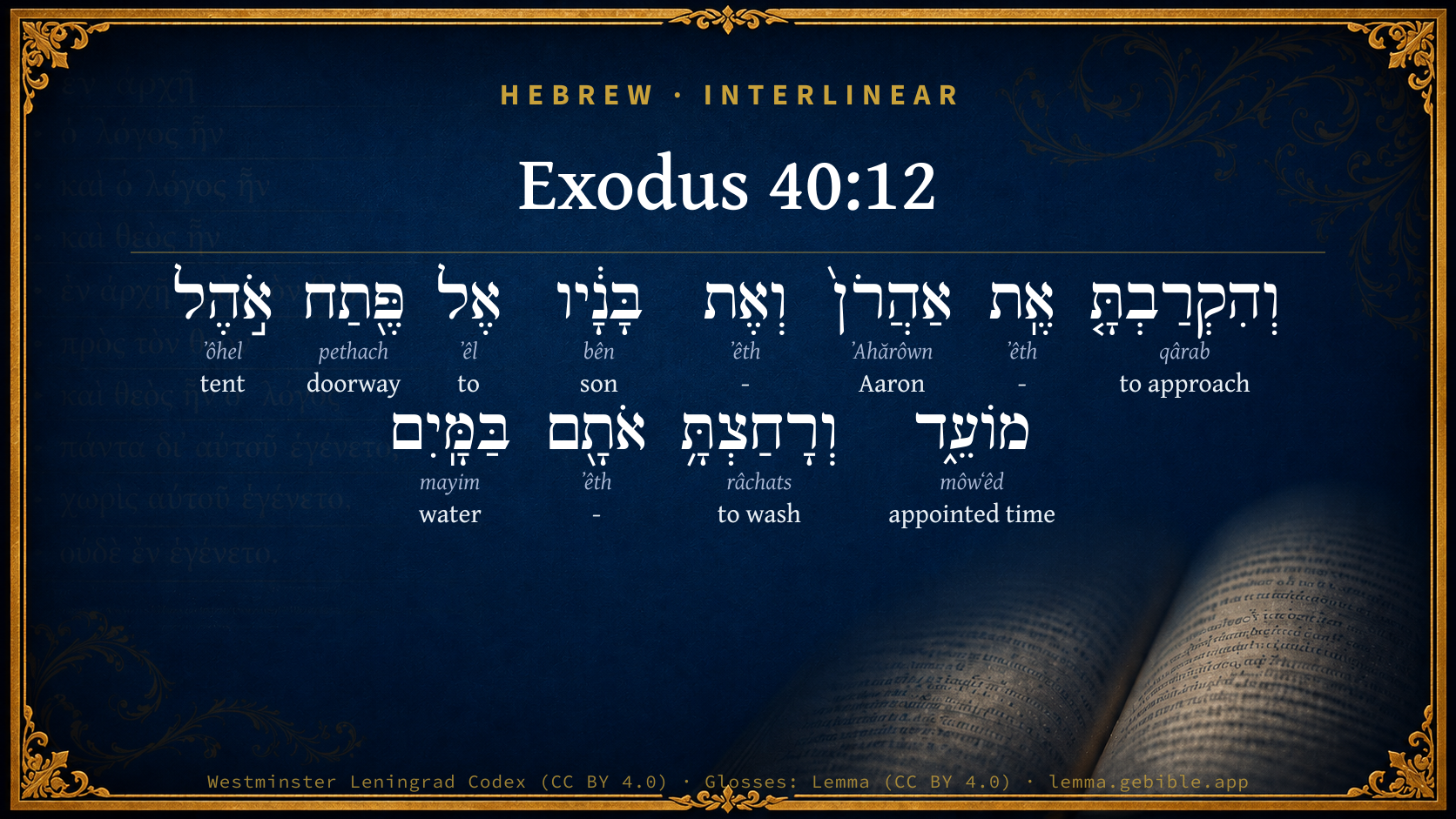
Hebrew (Westminster Leningrad Codex) Exodus 40:12 appears in the Hebrew Old Testament. The text above is from the Westminster Leningrad Codex. Each word links to its Strong’s number, a concise gloss, and parsing drawn from the Open Scriptures Hebrew Bible morphology. Click any word for its full Brown-Driver-Briggs (BDB) entry.
Download image
Cite this verse

Exodus 40:12 (World English Bible). Public Domain. Lemma interlinear Bible study tool, https://lemma.gebible.app/v/exodus/40/12.

Show BibTeX & RIS
BibTeX
RIS
English Translation
You shall bring Aaron and his sons to the door of the tent of meeting, and shall wash them with water.
World English Bible · Public Domain
Download a study sheet

One document with this verse’s original text, its word-by-word gloss line, the meaning frame, cross-references with their text, attributed commentary, and full source and license credits — printable, and it pastes into notes with its structure intact.

This verse Autodidact and up

Study sheet (.html) Plain text (.txt)

A passage Seminary Student

Up to 50 verses in one chapter. A passage sheet keeps up to 6 commentary sources and 12 cross-references per verse, in the order this page ranks them, and says so on the sheet whenever that leaves anything out. Ask for a single verse and you get the Autodidact verse sheet above.

Everything on this page stays free to read, with no account — the sheet is a download of what is already on screen, not access to it.

Want to remove ads? Support Godless Engineer
Compare translations 3

The same verse in 3 English versions, stacked beneath the original-language interlinear above. Click any original word for its lexicon entry.

Each is an independent rendering of the whole verse — the interlinear is not word-aligned to these translations.

Highlighted words mark where these versions differ — a whole-verse word diff, not a word-by-word alignment.

  • World English Bible Public Domain
    You shall bring Aaron and his sons to the door of the tent of meeting, and shall wash them with water.
  • King James Version Public Domain
    And thou shalt bring Aaron and his sons unto the door of the tabernacle of the congregation, and wash them with water.
  • unfoldingWord Literal Text CC BY-SA 4.0
    And you shall bring Aaron and his sons to the gate of the tent of meeting and wash them with water.

unfoldingWord Literal Text — © unfoldingWord, licensed CC BY-SA 4.0. Word-aligned USFM3 via Door43 (git.door43.org/unfoldingWord/en_ult).

Versions to compare (up to 4)

3 of 4 selected

Show all 18 translations

Every available English version of this verse, each an independent rendering of the whole verse.

  • World English Bible Public Domain
    You shall bring Aaron and his sons to the door of the tent of meeting, and shall wash them with water.
  • Berean Standard Bible Public Domain
    Then bring Aaron and his sons to the entrance to the Tent of Meeting and wash them with water.
  • Majority Standard Bible Public Domain
    Then bring Aaron and his sons to the entrance to the Tent of Meeting and wash them with water.
  • King James Version Public Domain
    And thou shalt bring Aaron and his sons unto the door of the tabernacle of the congregation, and wash them with water.
  • American Standard Version (1901) Public Domain
    And thou shalt bring Aaron and his sons unto the door of the tent of meeting, and shalt wash them with water.
  • Revised Version (1885) Public Domain
    And thou shalt bring Aaron and his sons unto the door of the tent of meeting, and shalt wash them with water.
  • Geneva Bible (1599) Public Domain
    Then thou shalt bring Aaron and his sonnes vnto the doore of the Tabernacle of the Congregation, and wash them with water.
  • Douay-Rheims (1899) Public Domain
    And thou shalt bring Aaron and his sons to the door of the tabernacle of the testimony, and having washed them with water,
  • Young's Literal Translation Public Domain
    `And thou hast brought near Aaron and his sons unto the opening of the tent of meeting, and hast bathed them with water;
  • Literal Standard Version CC BY-SA 4.0
    And you have brought Aaron and his sons near to the opening of the Tent of Meeting, and have bathed them with water;
  • Unlocked Literal Bible CC BY-SA 4.0
    You are to bring Aaron and his sons to the entrance of the tent of meeting and you must wash them with water.
  • unfoldingWord Literal Text CC BY-SA 4.0
    And you shall bring Aaron and his sons to the gate of the tent of meeting and wash them with water.
  • Darby Bible Public Domain
    And thou shalt bring Aaron and his sons near, at the entrance of the tent of meeting, and bathe them with water.
  • World Messianic Bible Public Domain
    “You shall bring Aaron and his sons to the door of the Tent of Meeting, and shall wash them with water.
  • Webster's Bible Public Domain
    And thou shalt bring Aaron and his sons to the door of the tabernacle of the congregation, and wash them with water.
  • Free Bible Version CC BY-SA 4.0
    Take Aaron and his sons to the entrance of the Tent of Meeting and wash them there with water.
  • Bible in Basic English Public Domain
    Then let Aaron and his sons come to the door of the Tent of meeting; and after washing them with water,
  • JPS Tanakh (1917) Public Domain
    And thou shalt bring Aaron and his sons unto the door of the tent of meeting, and shalt wash them with water.

Literal Standard Version (2020), Covenant Press — licensed CC BY-SA 4.0. Text via the HelloAO Bible API (eBible.org). Unlocked Literal Bible (unfoldingWord) — licensed CC BY-SA 4.0. Text via the HelloAO Bible API (eBible.org). unfoldingWord Literal Text — © unfoldingWord, licensed CC BY-SA 4.0. Word-aligned USFM3 via Door43 (git.door43.org/unfoldingWord/en_ult). Free Bible Version, Dr. Jonathan Gallagher — licensed CC BY-SA 4.0. Text via the HelloAO Bible API (eBible.org).

Word by word

More ways to search: Search by grammar → Find every occurrence → Compare this word →

Practice this passage: Drill this verse → Learn its vocabulary →

וְרָחַצְתָּ֥
râchats
H7364
“and · to wash”
Conjunction + Verb, Qal, Sequential Perfect, 2nd Person, Masculine, Singular
Part of Speech
Conjunction + Verb
Stem
Qal
Form
Sequential Perfect
Person
2nd Person
Gender
Masculine
Number
Singular
Full BDB Definition

Origin: a primitive root

TWOT: 2150

to wash, wash off, wash away, bathe - (Qal) - to wash, wash off, wash away - to wash, bathe (oneself) - (Pual) to be washed - (Hithpael) to wash oneself
  1. וְהִקְרַבְתָּ֤ qârab H7126 “and · to approach” Conjunction + Verb, Hiphil, Sequential Perfect, 2nd Person, Masculine, Singular
  2. אֶֽת ʼêth H853 “-” Particle, Direct Object
  3. אַהֲרֹן֙ ʼAhărôwn H175 “Aaron” Noun, Proper
  4. וְאֶת ʼêth H853 “and · -” Conjunction + Particle, Direct Object
  5. בָּנָ֔יו bên H1121 “sons · his” Noun, Common, Masculine, Plural, Construct + Suffix, Personal, 3rd Person, Masculine, Singular
  6. אֶל ʼêl H413 “to” Preposition
  7. פֶּ֖תַח pethach H6607 “doorway of” Noun, Common, Masculine, Singular, Construct
  8. אֹ֣הֶל ʼôhel H168 “tent of” Noun, Common, Masculine, Singular, Construct
  9. מוֹעֵ֑ד môwʻêd H4150 “appointed time” Noun, Common, Masculine, Singular, Absolute
  10. אֹתָ֖ם ʼêth H853 “- · them” Particle, Direct Object + Suffix, Personal, 3rd Person, Masculine, Plural
  11. בַּמָּֽיִם mayim H4325 “in/at the · water(s)” Preposition, Determined + Noun, Common, Masculine, Plural, Absolute

About this verse

These counts appear in no published source. They are computed here, from the morphology-tagged text and Lemma’s own curated glosses. What Lemma adds →

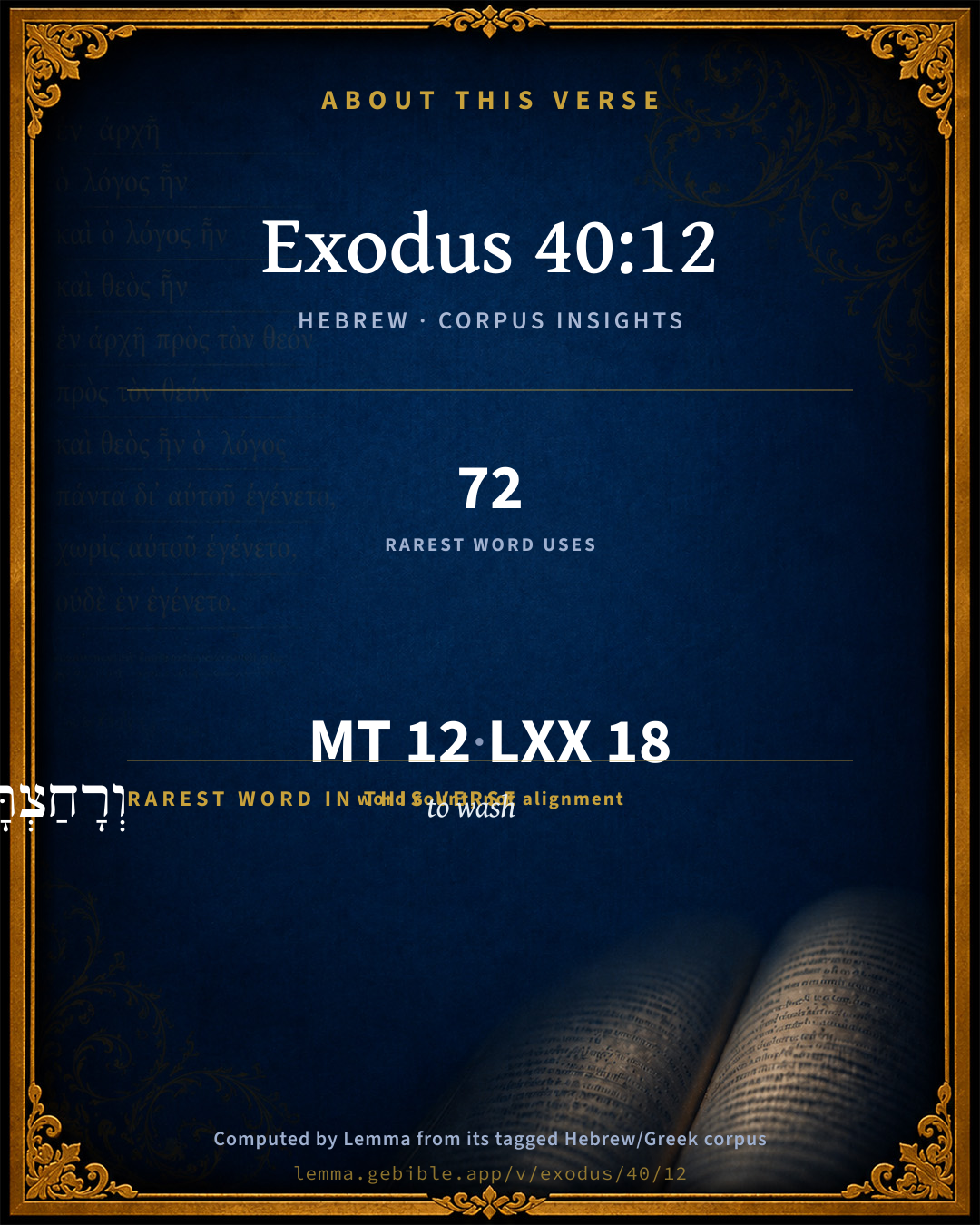
12
words
10
distinct lemmas
Pentateuch
section

Grammatical profile

  • 2 verbs
  • 6 nouns
  • 1 preposition
  • 3 particles

Verb forms

  • וְהִקְרַבְתָּ֤ Hiphil · Sequential Perfect
  • וְרָחַצְתָּ֥ Qal · Sequential Perfect

Hebrew & Septuagint length

In English translation the verse runs 21 words from the Hebrew and 23 from the Septuagint (LXX English) — closely comparable.

A rough comparison of the two English renderings, which tokenize alike — not a word-level alignment.

Word counts can differ between the Hebrew and the Greek without any difference in meaning — e.g. the Hebrew direct-object marker אֵת has no separate Greek word, and Greek often adds the article ὁ.

In the original languages it is 12 Hebrew tokens and 18 Greek tokens — but the two are counted differently (Hebrew bundles its prefixes and suffixes into one token; the Greek is in lemma form), so that isn’t a like-for-like length.

Cross-references

10

Topical passages linked to Exodus 40:12 in the Treasury of Scripture Knowledge — connected by theme and wording, ordered by reader-vote popularity; previews shown in the World English Bible.

  • Leviticus 8:1–13 Yahweh spoke to Moses, saying,
  • Exodus 29:1–35 "This is the thing that you shall do to them to make them holy, to minister to me in the priest's office: take one young bull and two rams without blemish,
  • Leviticus 9:1–24 It happened on the eighth day, that Moses called Aaron and his sons, and the elders of Israel;
  • Isaiah 11:1–5 There shall come forth a shoot out of the stock of Jesse, and a branch out of his roots shall bear fruit.
  • Isaiah 61:1–3 The Spirit of the Lord Yahweh is on me; because Yahweh has anointed me to preach good news to the humble; he has sent me to bind up the broken-hearted, to proclaim liberty to the captives, and the opening [of the prison] to those who are bound;
  • Matthew 3:16 Jesus, when he was baptized, went up directly from the water: and behold, the heavens were opened to him. He saw the Spirit of God descending as a dove, and coming on him.
  • Luke 1:35 The angel answered her, "The Holy Spirit will come on you, and the power of the Most High will overshadow you. Therefore also the holy one who is born from you will be called the Son of God.
  • John 3:34 For he whom God has sent speaks the words of God; for God gives the Spirit without measure.
  • Romans 8:3 For what the law couldn't do, in that it was weak through the flesh, God did, sending his own Son in the likeness of sinful flesh and for sin, he condemned sin in the flesh;
  • Galatians 4:4 But when the fullness of the time came, God sent out his Son, born to a woman, born under the law,

Cross-references courtesy of OpenBible.info (CC BY 4.0).

Hebrew and Greek witnesses Masoretic Hebrew ↔ Greek Septuagint

The same verse in the two great witnesses to the Old Testament, shown verse-for-verse.

These are two independent witnesses, not word-aligned to each other, and the Septuagint is shown in lemma (dictionary) form.

Hebrew Exodus 40:12 Masoretic · Westminster Leningrad Codex

וְהִקְרַבְתָּ֤ אֶֽת אַהֲרֹן֙ וְאֶת בָּנָ֔יו אֶל פֶּ֖תַח אֹ֣הֶל מוֹעֵ֑ד וְרָחַצְתָּ֥ אֹתָ֖ם בַּמָּֽיִם

You shall bring Aaron and his sons to the door of the tent of meeting, and shall wash them with water.

World English Bible · Public Domain

Greek LXX Exodus 40:12 Septuagint · lemma form

καί προςἄγω ἀαρών καί ὁ υἱός αὐτός ἐπί ὁ θύρα ὁ σκηνή ὁ μαρτύριον καί λούω αὐτός ὕδωρ

And you shall bring Aaron and his sons to the doors of the tabernacle of witness, and you shall wash them with water.

LXX2012 (modern English Septuagint) · Public Domain

Hebrew: Westminster Leningrad Codex (CC BY 4.0). Greek: Septuagint (public domain); English from LXX2012 (modern English Septuagint) (Public Domain). How the Septuagint differs from the Hebrew →

Targum (Aramaic paraphrase)

2

The Targum is the ancient Jewish Aramaic paraphrase of the Hebrew Scriptures — an interpretive translation, not the Hebrew text itself. Onkelos (literal) and Pseudo-Jonathan (expansive) render the Torah, and Jonathan the Prophets. Coverage is partial: where no permissively-licensed English translation exists for a verse, only the Aramaic is shown. This is verse-level text, not a word-by-word alignment to the Hebrew.

  1. Targum Onkelos Torah (Genesis–Deuteronomy)
    וּתְקָרֵב יָת אַהֲרֹן וְיָת בְּנוֹהִי לִתְרַע מַשְׁכַּן זִמְנָא וְתַסְחֵי יָתְהוֹן בְּמַיָא:

    (no public-domain English translation for this verse)

    Targum Onkelos — Aramaic: “Onkelos Genesis” (public domain); “Onkelos Exodus” (public domain); “Onkelos Leviticus” (public domain); “Onkelos Numbers” (public domain); “Onkelos Deuteronomy” (public domain). English: “Sefaria Community Translation” (CC0 1.0 (public-domain dedication)); “J.W. Etheridge. The Targums of Onkelos and Jonathan Ben Uzziel on the Pentateuch. London: Longmans, Green, 1862” (public domain). Text via Sefaria.

  2. Targum Pseudo-Jonathan Torah (Genesis–Deuteronomy)
    וּתְקָרֵיב יַת אַהֲרן וְיַת בְּנוֹי לִתְרַע מַשְׁכַּן זִמְנָא וְתַסְחֵי יַתְהוֹן בְּמַיָא

    And thou shalt bring Aharon and his sons to the door of the tabernacle of ordinance, and wash them with water,

    Targum Pseudo-Jonathan — Aramaic: “Targum Jonathan on Genesis” (public domain); “Targum Jonathan on Exodus” (public domain); “Targum Jonathan on Leviticus” (public domain); “Targum Jonathan on Numbers” (public domain); “Targum Jonathan on Deuteronomy” (public domain). English: “The Targum of Jonathan ben Uzziel, trans. J. W. Etheridge, London, 1862” (public domain). Text via Sefaria.

Commentary

Notes on Exodus 40:12 from classic Christian and Jewish commentators (each source and its license shown beneath its notes). The classic Christian expositions comment on the surrounding passage and are grouped to its opening verse, so a note may address several verses; the Jewish commentaries on the Tanakh (Rashi and others) are per-verse, so they appear only where the commentator wrote on this verse.

Lemma curates 59 commentaries, every one of them public domain or Creative Commons licensed, each selected and text-cleaned for this edition rather than reprinted as found. About our sources →

Ellicott's Commentary for English Readers

(12) Thou shalt bring Aaron and his sons . . . and wash them.—See Note on Exo_29:4. Ablution, investiture, and anointing had all of them been previously appointed to be parts of the consecration service (Exo_29:4-5; Exo_29:7, &c.).

A Bible Commentary for English Readers, edited by Charles John Ellicott (1878–1897) — public domain. Text from a community e-Sword module.

The Cambridge Bible for Schools and Colleges

gen. ed. J. J. S. Perowne

12–15. Aaron and his sons (i.e. the high-priest and the ordinary priests) to be washed, clothed in their sacred vestments, and anointed. See Exo_29:4-6 (much abridged here), 7–9; and Exo_30:30.

The Cambridge Bible for Schools and Colleges (gen. ed. J. J. S. Perowne; Cambridge University Press, 1878–1918) — public domain. Text from a community e-Sword module.

John Gill's Exposition

Thus did Moses,.... He set up the tabernacle, and every thing in its place, and anointed them, and Aaron and his sons:

according to all that the Lord commanded him, so did he; by which he approved himself to be a faithful servant in the house of God.

John Gill's Exposition of the Whole Bible (1746–1763) — public domain (CC PDM 1.0). Text via the HelloAO Bible API.

The Pulpit Commentary

Unto the door of the tabernaclei.e. , to the place where the laver was situated (ver. 7).

The Pulpit Commentary (1880–1919), ed. H.D.M. Spence-Jones & Joseph S. Exell — public domain. Text from a community e-Sword module.

unfoldingWord translationNotes

Door43 World Missions Community

General Information:

Yahweh continues speaking to Moses.

You are to bring

Moses will do these things himself.

that are set apart to me

This can be stated in active form. AT: "that you have set apart to me" (See: Active or Passive)

translationWords

Aaron

tent of meeting

clothe

set apart

anoint

servant

priest

unfoldingWord translationNotes — © Distant Shores Media and the Door43 World Missions Community, licensed CC BY-SA 4.0. Source: git.door43.org/Door43/en_tn.

Lesson kit

Teaching starters — assembled from the data on this page, not authored interpretation. Every prompt links to the verse data it draws on. Edit before teaching.

Exodus, in the Pentateuch, opens this verse with 12 words (10 distinct Hebrew lemmas). Its most distinctive word is râchats (“to wash”). A historical commentator’s framing appears above. Read the whole chapter for the surrounding context.

Discussion questions

  1. The word râchats carries the sense “to wash.” How does it shape the verse?
  2. How does Leviticus 8:1–13, which shares this passage’s theme, read alongside this verse?
  3. The translations on this page render this verse differently — a whole-verse word diff, not a word-by-word alignment. What might account for the different wordings?
  4. «וְהִקְרַבְתָּ֤» is a Hiphil Sequential Perfect verb. How does that grammatical form shape the action described?
  5. Compare how Ellicott's Commentary for English Readers and The Cambridge Bible for Schools and Colleges read this verse. Where do they agree or differ?

Things to notice

Reading settings

Reading text

Shown beneath each verse's original-language words.

Old Testament
Old Testament edition

Read the OT as the Masoretic Hebrew (MT) or the Greek Septuagint (LXX).

English shown for the Greek Septuagint (in the Hebrew ↔ Greek comparison).

Comparing translations? Open the Compare panel on any verse page to stack up to four side by side.