
Exodus 26:13

Hebrew (Westminster Leningrad Codex) Exodus 26:13 appears in the Hebrew Old Testament. The text above is from the Westminster Leningrad Codex. Each word links to its Strong’s number, a concise gloss, and parsing drawn from the Open Scriptures Hebrew Bible morphology. Click any word for its full Brown-Driver-Briggs (BDB) entry.
Download image
Cite this verse

Exodus 26:13 (World English Bible). Public Domain. Lemma interlinear Bible study tool, https://lemma.gebible.app/v/exodus/26/13.

Show BibTeX & RIS
BibTeX
RIS
English Translation
The cubit on the one side, and the cubit on the other side, of that which remains in the length of the curtains of the tent, shall hang over the sides of the tent on this side and on that side, to cover it.
World English Bible · Public Domain
Download a study sheet

One document with this verse’s original text, its word-by-word gloss line, the meaning frame, cross-references with their text, attributed commentary, and full source and license credits — printable, and it pastes into notes with its structure intact.

This verse Autodidact and up

Study sheet (.html) Plain text (.txt)

A passage Seminary Student

Up to 50 verses in one chapter. A passage sheet keeps up to 6 commentary sources and 12 cross-references per verse, in the order this page ranks them, and says so on the sheet whenever that leaves anything out. Ask for a single verse and you get the Autodidact verse sheet above.

Everything on this page stays free to read, with no account — the sheet is a download of what is already on screen, not access to it.

Want to remove ads? Support Godless Engineer
Compare translations 3

The same verse in 3 English versions, stacked beneath the original-language interlinear above. Click any original word for its lexicon entry.

Each is an independent rendering of the whole verse — the interlinear is not word-aligned to these translations.

Highlighted words mark where these versions differ — a whole-verse word diff, not a word-by-word alignment.

  • World English Bible Public Domain
    The cubit on the one side, and the cubit on the other side, of that which remains in the length of the curtains of the tent, shall hang over the sides of the tent on this side and on that side, to cover it.
  • King James Version Public Domain
    And a cubit on the one side, and a cubit on the other side of that which remaineth in the length of the curtains of the tent, it shall hang over the sides of the tabernacle on this side and on that side, to cover it.
  • unfoldingWord Literal Text CC BY-SA 4.0
    And a cubit from this side and a cubit from that side, the excess of the length of the curtains of the tent shall hang over the sides of the Dwelling from this side and from that side, to cover it.

unfoldingWord Literal Text — © unfoldingWord, licensed CC BY-SA 4.0. Word-aligned USFM3 via Door43 (git.door43.org/unfoldingWord/en_ult).

Versions to compare (up to 4)

3 of 4 selected

Show all 18 translations

Every available English version of this verse, each an independent rendering of the whole verse.

  • World English Bible Public Domain
    The cubit on the one side, and the cubit on the other side, of that which remains in the length of the curtains of the tent, shall hang over the sides of the tent on this side and on that side, to cover it.
  • Berean Standard Bible Public Domain
    And the tent curtains will be a cubit longer on either side, and the excess will hang over the sides of the tabernacle to cover it.
  • Majority Standard Bible Public Domain
    And the tent curtains will be a cubit longer on either side, and the excess will hang over the sides of the tabernacle to cover it.
  • King James Version Public Domain
    And a cubit on the one side, and a cubit on the other side of that which remaineth in the length of the curtains of the tent, it shall hang over the sides of the tabernacle on this side and on that side, to cover it.
  • American Standard Version (1901) Public Domain
    And the cubit on the one side, and the cubit on the other side, of that which remaineth in the length of the curtains of the tent, shall hang over the sides of the tabernacle on this side and on that side, to cover it.
  • Revised Version (1885) Public Domain
    And the cubit on the one side, and the cubit on the other side, of that which remaineth in the length of the curtains of the tent, shall hang over the sides of the tabernacle on this side and on that side, to cover it.
  • Geneva Bible (1599) Public Domain
    That the cubite on the one side, and the cubite on the other side of that which is left in the legth of the curtaines of ye couering, may remaine on either side of the Tabernacle to couer it.
  • Douay-Rheims (1899) Public Domain
    And there shall hang down a cubit on the one side, and another on the other side, which is over and above in the length of the curtains, fencing both sides of the tabernacle.
  • Young's Literal Translation Public Domain
    and the cubit on this side, and the cubit on that, in the superfluity in the length of the curtains of the tent, is spread out over the sides of the tabernacle, on this and on that, to cover it;
  • Literal Standard Version CC BY-SA 4.0
    and the cubit on this [side], and the cubit on that [side], in the remaining [part] of the length of the curtains of the tent, is spread out over the sides of the Dwelling Place, on this [side] and on that [side], to cover it;
  • Unlocked Literal Bible CC BY-SA 4.0
    There must be one cubit of curtain on one side, and one cubit of curtain on the other side—that which is left over of the length of the tent's curtains must hang over the sides of the tabernacle on one side and on the other side, to cover it.
  • unfoldingWord Literal Text CC BY-SA 4.0
    And a cubit from this side and a cubit from that side, the excess of the length of the curtains of the tent shall hang over the sides of the Dwelling from this side and from that side, to cover it.
  • Darby Bible Public Domain
    And the cubit on the one side, and the cubit on the other side of that which remaineth in the length of the curtains of the tent, shall hang over the sides of the tabernacle on this side and on that side, to cover it.
  • World Messianic Bible Public Domain
    The cubit on the one side and the cubit on the other side, of that which remains in the length of the curtains of the tent, shall hang over the sides of the tabernacle on this side and on that side, to cover it.
  • Webster's Bible Public Domain
    And a cubit on the one side, and a cubit on the other side of that which remaineth in the length of the curtains of the tent, shall hang over the sides of the tabernacle on this side and on that side, to cover it.
  • Free Bible Version CC BY-SA 4.0
    The tent curtains will be a cubit longer on every side, and the extra length will hang over the sides of the Tabernacle so it is all covered.
  • Bible in Basic English Public Domain
    And the cubit which is over of the ten curtains at the sides will be hanging over the two sides of the House as a cover.
  • JPS Tanakh (1917) Public Domain
    And the cubit on the one side, and the cubit on the other side, of that which remaineth over in the length of the curtains of the tent, shall hang over the sides of the tabernacle on this side and on that side, to cover it.

Literal Standard Version (2020), Covenant Press — licensed CC BY-SA 4.0. Text via the HelloAO Bible API (eBible.org). Unlocked Literal Bible (unfoldingWord) — licensed CC BY-SA 4.0. Text via the HelloAO Bible API (eBible.org). unfoldingWord Literal Text — © unfoldingWord, licensed CC BY-SA 4.0. Word-aligned USFM3 via Door43 (git.door43.org/unfoldingWord/en_ult). Free Bible Version, Dr. Jonathan Gallagher — licensed CC BY-SA 4.0. Text via the HelloAO Bible API (eBible.org).

Word by word

More ways to search: Search by grammar → Find every occurrence → Compare this word →

Practice this passage: Drill this verse → Learn its vocabulary →

סָר֜וּחַ
çârach
H5628
“gone free”
Verb, Qal, Participle Passive, Masculine, Singular, Absolute
Part of Speech
Verb
Stem
Qal
Form
Participle Passive
Gender
Masculine
Number
Singular
State
Absolute
Full BDB Definition

Origin: a primitive root

TWOT: 1543

to go free, be unrestrained, be overrun, exceed, overhang, grow luxuriously - (Qal) - to go free, be unrestrained, sprawl - overrunning, spreading (participle) - to overhang - (Niphal) to be let loose or dismissed or gone
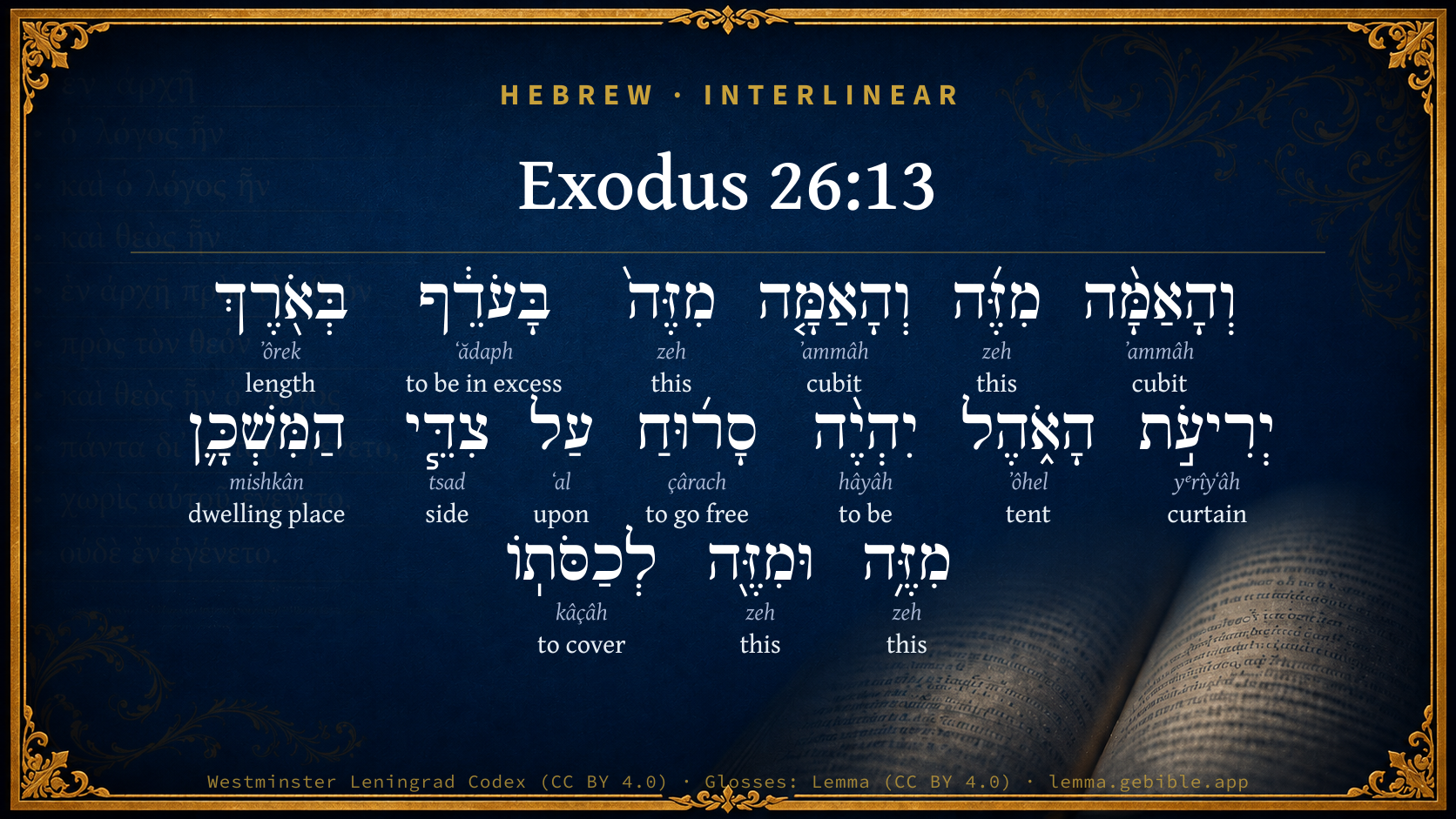
  1. וְהָאַמָּ֨ה ʼammâh H520 “and · the · cubit” Conjunction + Particle, Definite Article + Noun, Common, Feminine, Singular, Absolute
  2. מִזֶּ֜ה zeh H2088 “from · this” Preposition + Pronoun, Demonstrative, Masculine, Singular
  3. וְהָאַמָּ֤ה ʼammâh H520 “and · the · cubit” Conjunction + Particle, Definite Article + Noun, Common, Feminine, Singular, Absolute
  4. מִזֶּה֙ zeh H2088 “from · this” Preposition + Pronoun, Demonstrative, Masculine, Singular
  5. בָּעֹדֵ֔ף ʻădaph H5736 “in/at the · being in excess” Preposition, Determined + Verb, Qal, Participle Active, Masculine, Singular, Absolute
  6. בְּאֹ֖רֶךְ ʼôrek H753 “in/at · length of” Preposition + Noun, Common, Masculine, Singular, Construct
  7. יְרִיעֹ֣ת yᵉrîyʻâh H3407 “curtains of” Noun, Common, Feminine, Plural, Construct
  8. הָאֹ֑הֶל ʼôhel H168 “the · tent” Particle, Definite Article + Noun, Common, Masculine, Singular, Absolute
  9. יִהְיֶ֨ה hâyâh H1961 “to be” Verb, Qal, Imperfect, 3rd Person, Masculine, Singular
  10. עַל ʻal H5921 “upon” Preposition
  11. צִדֵּ֧י tsad H6654 “sides of” Noun, Common, Masculine, Plural, Construct
  12. הַמִּשְׁכָּ֛ן mishkân H4908 “the · dwelling place” Particle, Definite Article + Noun, Common, Masculine, Singular, Absolute
  13. מִזֶּ֥ה zeh H2088 “from · this” Preposition + Pronoun, Demonstrative, Masculine, Singular
  14. וּמִזֶּ֖ה zeh H2088 “and · from · this” Conjunction + Preposition + Pronoun, Demonstrative, Masculine, Singular
  15. לְכַסֹּתֽוֹ kâçâh H3680 “to cover · him” Preposition + Verb, Piel, Infinitive Construct + Suffix, Personal, 3rd Person, Masculine, Singular

About this verse

These counts appear in no published source. They are computed here, from the morphology-tagged text and Lemma’s own curated glosses. What Lemma adds →

16
words
12
distinct lemmas
Pentateuch
section

Notable vocabulary

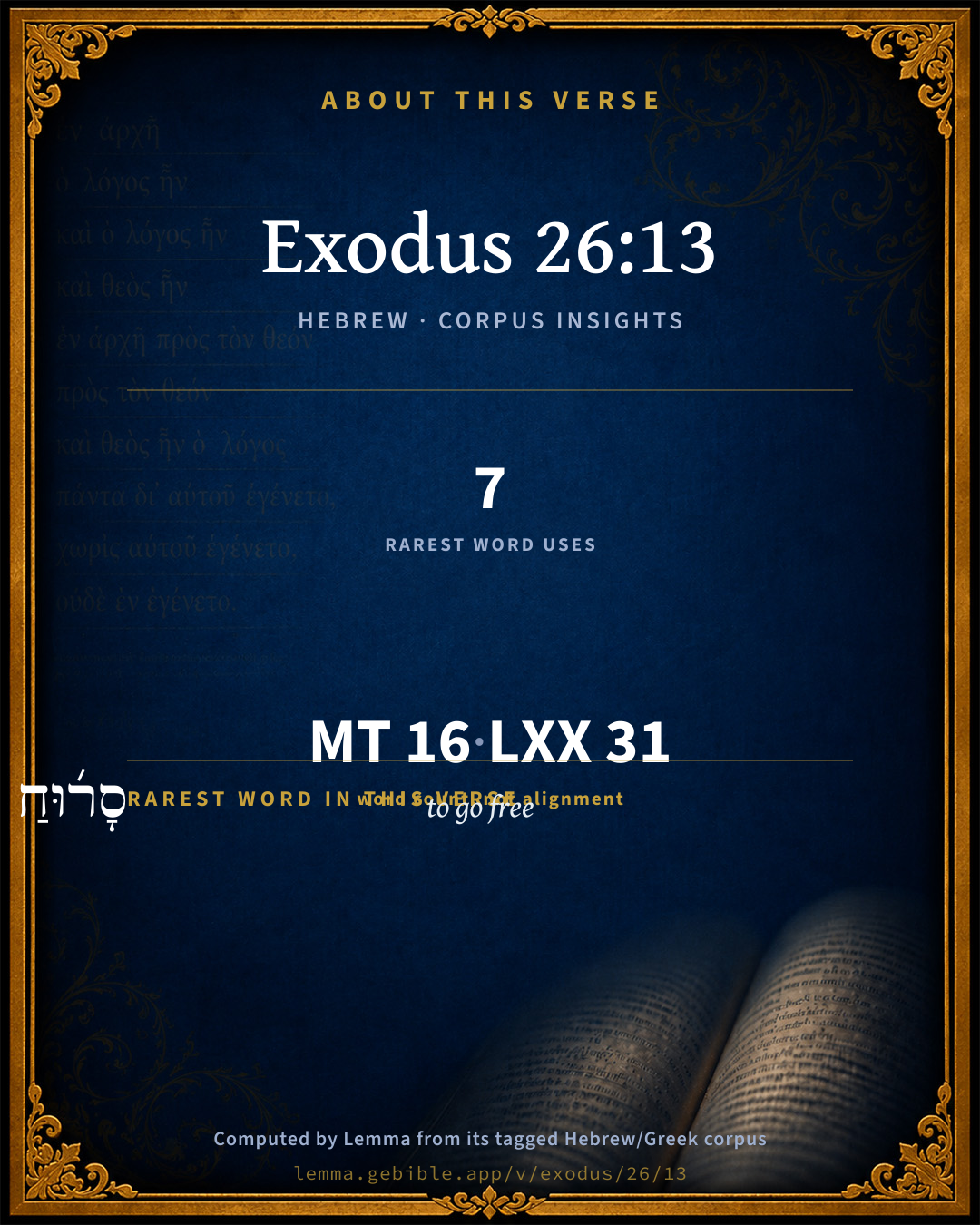
The rarest word here is סָר֜וּחַ to go free H5628 — appearing just 7 times in the whole Hebrew Bible.

Shared distinctive vocabulary

סָר֜וּחַ to go free H5628 occurs in 7 verses of the Hebrew Bible. Also found in:

Grammatical profile

  • 4 verbs
  • 7 nouns
  • 4 pronouns
  • 1 preposition

Verb forms

  • בָּעֹדֵ֔ף Qal · Participle Active
  • יִהְיֶ֨ה Qal · Imperfect
  • סָר֜וּחַ Qal · Participle Passive
  • לְכַסֹּתֽוֹ Piel · Infinitive Construct

Repetition

Words recur within this verse — often emphatic in Hebrew:

  • וְהָאַמָּ֨ה cubit H520 ×2
  • מִזֶּ֜ה this H2088 ×4

Hebrew & Septuagint length

In English translation the verse runs 44 words from the Hebrew and 48 from the Septuagint (LXX English) — closely comparable.

A rough comparison of the two English renderings, which tokenize alike — not a word-level alignment.

Word counts can differ between the Hebrew and the Greek without any difference in meaning — e.g. the Hebrew direct-object marker אֵת has no separate Greek word, and Greek often adds the article ὁ.

In the original languages it is 16 Hebrew tokens and 31 Greek tokens — but the two are counted differently (Hebrew bundles its prefixes and suffixes into one token; the Greek is in lemma form), so that isn’t a like-for-like length.

Cross-references

2

Topical passages linked to Exodus 26:13 in the Treasury of Scripture Knowledge — connected by theme and wording, ordered by reader-vote popularity; previews shown in the World English Bible.

  • Exodus 26:2 The length of each curtain shall be twenty-eight cubits, and the breadth of each curtain four cubits: all the curtains shall have one measure.
  • Exodus 26:8 The length of each curtain shall be thirty cubits, and the breadth of each curtain four cubits: the eleven curtains shall have one measure.

Cross-references courtesy of OpenBible.info (CC BY 4.0).

Hebrew and Greek witnesses Masoretic Hebrew ↔ Greek Septuagint

The same verse in the two great witnesses to the Old Testament, shown verse-for-verse.

These are two independent witnesses, not word-aligned to each other, and the Septuagint is shown in lemma (dictionary) form.

Hebrew Exodus 26:13 Masoretic · Westminster Leningrad Codex

וְהָאַמָּ֨ה מִזֶּ֜ה וְהָאַמָּ֤ה מִזֶּה֙ בָּעֹדֵ֔ף בְּאֹ֖רֶךְ יְרִיעֹ֣ת הָאֹ֑הֶל יִהְיֶ֨ה סָר֜וּחַ עַל צִדֵּ֧י הַמִּשְׁכָּ֛ן מִזֶּ֥ה וּמִזֶּ֖ה לְכַסֹּתֽוֹ

The cubit on the one side, and the cubit on the other side, of that which remains in the length of the curtains of the tent, shall hang over the sides of the tent on this side and on that side, to cover it.

World English Bible · Public Domain

Greek LXX Exodus 26:13 Septuagint · lemma form

πῆχυς ἐκ οὗτος καί πῆχυς ἐκ οὗτος ἐκ ὁ ὑπερἔχω ὁ δέρρις ἐκ ὁ μῆκος ὁ δέρρις ὁ σκηνή εἰμί συνκαλύπτω ἐπί ὁ πλάγιος ὁ σκηνή ἔνθεν καί ἔνθεν ἵνα καλύπτω

A cubit on this side, and a cubit on that side of that which remains of the skins, of the length of the skins of the tabernacle: it shall be folding over the sides of the tabernacle on this side and that side, that it may cover it.

LXX2012 (modern English Septuagint) · Public Domain

Hebrew: Westminster Leningrad Codex (CC BY 4.0). Greek: Septuagint (public domain); English from LXX2012 (modern English Septuagint) (Public Domain). How the Septuagint differs from the Hebrew →

Targum (Aramaic paraphrase)

2

The Targum is the ancient Jewish Aramaic paraphrase of the Hebrew Scriptures — an interpretive translation, not the Hebrew text itself. Onkelos (literal) and Pseudo-Jonathan (expansive) render the Torah, and Jonathan the Prophets. Coverage is partial: where no permissively-licensed English translation exists for a verse, only the Aramaic is shown. This is verse-level text, not a word-by-word alignment to the Hebrew.

  1. Targum Onkelos Torah (Genesis–Deuteronomy)
    וְאַמְתָא מִכָּא וְאַמְתָא מִכָּא בִּדְיַתִּירָא בְּאֻרְכָּא יְרִיעֲתָא דְמַשְׁכְּנָא יְהֵי סְרִיחַ עַל סִטְרֵי מַשְׁכְּנָא מִכָּא וּמִכָּא לְכַסָיוּתֵהּ:

    (no public-domain English translation for this verse)

    Targum Onkelos — Aramaic: “Onkelos Genesis” (public domain); “Onkelos Exodus” (public domain); “Onkelos Leviticus” (public domain); “Onkelos Numbers” (public domain); “Onkelos Deuteronomy” (public domain). English: “Sefaria Community Translation” (CC0 1.0 (public-domain dedication)); “J.W. Etheridge. The Targums of Onkelos and Jonathan Ben Uzziel on the Pentateuch. London: Longmans, Green, 1862” (public domain). Text via Sefaria.

  2. Targum Pseudo-Jonathan Torah (Genesis–Deuteronomy)
    וְאַמְתָא מִיכָּא וְאַמְתָא מִיכָּא בִּדְיַתִּיר בְּאוֹרֶךְ יְרִיעֲתָא דְמַשְׁכְּנָא יְהֵי מְשֻׁפַּע עַל צִיטְרֵי מַשְׁכְּנָא מִיכָּא וּמִיכָּא לְכַסִּיּוּתֵיהּ

    And the cubit here and the cubit there, of that which remaineth in the curtains of the tabernacle, shall hang over the sides of the tabernacle here and there, to cover it.

    Targum Pseudo-Jonathan — Aramaic: “Targum Jonathan on Genesis” (public domain); “Targum Jonathan on Exodus” (public domain); “Targum Jonathan on Leviticus” (public domain); “Targum Jonathan on Numbers” (public domain); “Targum Jonathan on Deuteronomy” (public domain). English: “The Targum of Jonathan ben Uzziel, trans. J. W. Etheridge, London, 1862” (public domain). Text via Sefaria.

Commentary

Notes on Exodus 26:13 from classic Christian and Jewish commentators (each source and its license shown beneath its notes). The classic Christian expositions comment on the surrounding passage and are grouped to its opening verse, so a note may address several verses; the Jewish commentaries on the Tanakh (Rashi and others) are per-verse, so they appear only where the commentator wrote on this verse.

Lemma curates 59 commentaries, every one of them public domain or Creative Commons licensed, each selected and text-cleaned for this edition rather than reprinted as found. About our sources →

The Cambridge Bible for Schools and Colleges

gen. ed. J. J. S. Perowne

13. On the two sides of the Dwelling, the curtain of goats’ hair being 30 cubits broad, while the inner tapestry curtain was 28 cubits broad, the former would of course reach a cubit lower than the latter, and touch the ground.

The Cambridge Bible for Schools and Colleges (gen. ed. J. J. S. Perowne; Cambridge University Press, 1878–1918) — public domain. Text from a community e-Sword module.

John Gill's Exposition

And thou shalt make a covering for the tent of rams' skins dyed red,.... This was a covering that was put over the curtains of goats' skin; but whether it went all over them, or only upon the roof of the tabernacle they covered, to keep out the rains from soaking through, is not certain, nor very evident; Jarchi thinks the roof was only covered with this covering of rams' skins; but others think it more reasonable that the whole was covered with them to preserve from dust and rain:

and a covering above of badgers' skins; of these skins See Gill on Exo 25:5, this was a fourth covering of the tabernacle; the first was of linen curtains, the second of goats' hair, the third of rams' skins, and the fourth of badgers' skins, which seems to have been thicker and courser, since shoes were made of them, Eze 16:10, R. Judah, as quoted by Jarchi, thinks the two last were but one covering, half of it consisting of rams' skins and half of it of badgers' skins; but the text is express that the latter was a covering above and over the former: these several coverings of the tabernacle show the care that God takes of his church and people, and how sufficiently they are provided for, that they may be in safety from all their enemies, being clothed with Christ's righteousness, and under the purple covering of his blood, and surrounded by his almighty power, see Isa 4:5.

John Gill's Exposition of the Whole Bible (1746–1763) — public domain (CC PDM 1.0). Text via the HelloAO Bible API.

Haydock's Catholic Bible Commentary

A cubit. As these curtains were two cubits longer, and four broader, than those more precious ones below, they hung down to the ground. Josephus, [Antiquities?] iii. 5.

George Leo Haydock (1774–1849), Haydock's Catholic Family Bible and Commentary, 1859 edition — public domain. Excludes Psalms (Douay-Rheims chapter numbering differs from Protestant) and Deuterocanonical books (Catholic canon only).

Whedon's Commentary on the Bible

Daniel D. Whedon

13. A cubit — The length of these curtains being thirty instead of twenty-eight cubits, like the former, (Exo_26:2,) provision was thus made for their extending one cubit on each side of the tabernacle beyond the tabernacle cloth.

Daniel D. Whedon (gen. ed.), Commentary on the Old and New Testaments (1874–1909) — public domain. Text from a community e-Sword module.

The Pulpit Commentary

And a cubit. Rather, "And the cubit." The cubit by which the goats" hair tent-cloth, which was thirty cubits across (ver. 8), would exceed the linen covering, which was twenty-eight cubits (ver. 2), on either side of the tabernacle, was to be allowed to hang down, like a valance, hiding so far the golden boards of the tabernacle.

The Pulpit Commentary (1880–1919), ed. H.D.M. Spence-Jones & Joseph S. Exell — public domain. Text from a community e-Sword module.

Rashi

Rabbi Shlomo Yitzchaki (Rashi)

והאמה מזה והאמה מזה AND A CUBIT ON THE ONE SIDE AND A CUBIT ON THE OTHER SIDE — i. e. on the north and on the south,

בעדף בארך יריעת האהל OF THE SURPLUS OF THE LENGTH OF THE CURTAINS OF THE TABERNACLE — i. e. which were in excess over the curtains of “the Tabernacle” (the woollen ones) by two cubits,

יהיה מרוח על צדי המשכן SHALL HANG OVER THE SIDES OF THE TABERNACLE — on the north and on the south as I have explained above. The Torah here teaches you a rule of life — that a man should take care of his artistic objects (this the Torah does by commanding that the beautiful lower curtains should be protected by coarse upper ones) (Yalkut Shimoni on Torah 422).

Rashi on the Tanakh — English translations: “The Judaica Press complete Tanach with Rashi, translated by A. J. Rosenberg” (CC BY 4.0); “Pentateuch with Rashi's commentary by M. Rosenbaum and A.M. Silbermann, 1929-1934” (public domain); “The Metsudah Tanach series, Lakewood, N.J” (CC BY 4.0); and “The Book of Joshua, Metsudah Publications, 1997” (CC BY 4.0). Text via Sefaria.

Lesson kit

Teaching starters — assembled from the data on this page, not authored interpretation. Every prompt links to the verse data it draws on. Edit before teaching.

Exodus, in the Pentateuch, opens this verse with 16 words (12 distinct Hebrew lemmas). Its most distinctive word is çârach (“to go free”). A historical commentator’s framing appears above. Read the whole chapter for the surrounding context.

Discussion questions

  1. What does “to go free” (çârach) contribute to the verse as a whole?
  2. Exodus 26:12 shares the word «to go free» with this verse. How do the two illuminate each other?
  3. “cubit” occurs 2× in this one verse. What is the effect of the repetition?
  4. These translations render this verse differently. What is at stake in choosing one wording over another?
  5. The verb «בָּעֹדֵ֔ף» is Qal Participle Active. How does its form color the action?
  6. Reading how The Cambridge Bible for Schools and Colleges and John Gill's Exposition read this verse, where do the two commentators agree and where do they part?

Things to notice

Reading settings

Reading text

Shown beneath each verse's original-language words.

Old Testament
Old Testament edition

Read the OT as the Masoretic Hebrew (MT) or the Greek Septuagint (LXX).

English shown for the Greek Septuagint (in the Hebrew ↔ Greek comparison).

Comparing translations? Open the Compare panel on any verse page to stack up to four side by side.