Exodus 38:8

Hebrew (Westminster Leningrad Codex) Exodus 38:8 appears in the Hebrew Old Testament. The text above is from the Westminster Leningrad Codex. Each word links to its Strong’s number, a concise gloss, and parsing drawn from the Open Scriptures Hebrew Bible morphology. Click any word for its full Brown-Driver-Briggs (BDB) entry.
Download image
Cite this verse

Exodus 38:8 (World English Bible). Public Domain. Lemma interlinear Bible study tool, https://lemma.gebible.app/v/exodus/38/8.

Show BibTeX & RIS
BibTeX
RIS
English Translation
He made the basin of brass, and its base of brass, out of the mirrors of the ministering women who ministered at the door of the tent of meeting.
World English Bible · Public Domain
Highlights Full analysis ↓
Download a study sheet

One document with this verse’s original text, its word-by-word gloss line, the meaning frame, cross-references with their text, attributed commentary, and full source and license credits — printable, and it pastes into notes with its structure intact.

This verse Autodidact and up

Study sheet (.html) Plain text (.txt)

A passage Seminary Student

Up to 50 verses in one chapter. A passage sheet keeps up to 6 commentary sources and 12 cross-references per verse, in the order this page ranks them, and says so on the sheet whenever that leaves anything out. Ask for a single verse and you get the Autodidact verse sheet above.

Everything on this page stays free to read, with no account — the sheet is a download of what is already on screen, not access to it.

Want to remove ads? Support Godless Engineer
Compare translations 3

The same verse in 3 English versions, stacked beneath the original-language interlinear above. Click any original word for its lexicon entry.

Each is an independent rendering of the whole verse — the interlinear is not word-aligned to these translations.

Highlighted words mark where these versions differ — a whole-verse word diff, not a word-by-word alignment.

  • World English Bible Public Domain
    He made the basin of brass, and its base of brass, out of the mirrors of the ministering women who ministered at the door of the tent of meeting.
  • King James Version Public Domain
    And he made the laver of brass, and the foot of it of brass, of the lookingglasses of the women assembling, which assembled at the door of the tabernacle of the congregation.
  • unfoldingWord Literal Text CC BY-SA 4.0
    And he made a basin of bronze and its base of bronze with the mirrors of the serving who served at the entrance of the tent of meeting.

unfoldingWord Literal Text — © unfoldingWord, licensed CC BY-SA 4.0. Word-aligned USFM3 via Door43 (git.door43.org/unfoldingWord/en_ult).

Versions to compare (up to 4)

3 of 4 selected

Show all 18 translations

Every available English version of this verse, each an independent rendering of the whole verse.

  • World English Bible Public Domain
    He made the basin of brass, and its base of brass, out of the mirrors of the ministering women who ministered at the door of the tent of meeting.
  • Berean Standard Bible Public Domain
    Next he made the bronze basin and its stand from the mirrors of the women who served at the entrance to the Tent of Meeting.
  • Majority Standard Bible Public Domain
    Next he made the bronze basin and its stand from the mirrors of the women who served at the entrance to the Tent of Meeting.
  • King James Version Public Domain
    And he made the laver of brass, and the foot of it of brass, of the lookingglasses of the women assembling, which assembled at the door of the tabernacle of the congregation.
  • American Standard Version (1901) Public Domain
    And he made the laver of brass, and the base thereof of brass, of the mirrors of the ministering women that ministered at the door of the tent of meeting.
  • Revised Version (1885) Public Domain
    And he made the laver of brass, and the base thereof of brass, of the mirrors of the serving women which served at the door of the tent of meeting.
  • Geneva Bible (1599) Public Domain
    Also he made the Lauer of brasse, and the foote of it of brasse of the glasses of the women that did assemble and came together at the doore of the Tabernacle of the Congregation.
  • Douay-Rheims (1899) Public Domain
    He made also the laver of brass, with the foot thereof, of the mirrors of the women that watch at the door of the tabernacle.
  • Young's Literal Translation Public Domain
    And he maketh the laver of brass, and its base of brass, with the looking-glasses of the women assembling, who have assembled at the opening of the tent of meeting.
  • Literal Standard Version CC BY-SA 4.0
    And he makes the laver of bronze, and its base of bronze, with the mirrors of the women assembling, who have assembled at the opening of the Tent of Meeting.
  • Unlocked Literal Bible CC BY-SA 4.0
    Bezalel made the large bronze basin with a bronze stand. He made the basin out of mirrors belonging to the women who served at the entrance to the tent of meeting.
  • unfoldingWord Literal Text CC BY-SA 4.0
    And he made a basin of bronze and its base of bronze with the mirrors of the serving who served at the entrance of the tent of meeting.
  • Darby Bible Public Domain
    And he made the laver of copper, and its stand of copper, of the mirrors of the crowds of women who crowded before the entrance of the tent of meeting.
  • World Messianic Bible Public Domain
    He made the basin of bronze, and its base of bronze, out of the mirrors of the ministering women who ministered at the door of the Tent of Meeting.
  • Webster's Bible Public Domain
    And he made the laver of brass, and the foot of it of brass, of the looking-glasses of the women assembling, who assembled at the door of the tabernacle of the congregation.
  • Free Bible Version CC BY-SA 4.0
    He made the bronze basin with its stand with bronze from the mirrors of the women who served at the entrance to the Tent of Meeting.
  • Bible in Basic English Public Domain
    And he made the washing-vessel of brass on a brass base, using the polished brass looking-glasses given by the women who did work at the doors of the Tent of meeting.
  • JPS Tanakh (1917) Public Domain
    And he made the laver of brass, and the base thereof of brass, of the mirrors of the serving women that did service at the door of the tent of meeting.

Literal Standard Version (2020), Covenant Press — licensed CC BY-SA 4.0. Text via the HelloAO Bible API (eBible.org). Unlocked Literal Bible (unfoldingWord) — licensed CC BY-SA 4.0. Text via the HelloAO Bible API (eBible.org). unfoldingWord Literal Text — © unfoldingWord, licensed CC BY-SA 4.0. Word-aligned USFM3 via Door43 (git.door43.org/unfoldingWord/en_ult). Free Bible Version, Dr. Jonathan Gallagher — licensed CC BY-SA 4.0. Text via the HelloAO Bible API (eBible.org).

Word by word

More ways to search: Search by grammar → Find every occurrence → Compare this word →

Practice this passage: Drill this verse → Learn its vocabulary →

בְּמַרְאֹת֙
marʼâh
H4759
“in/at · visions of”
Preposition + Noun, Common, Feminine, Plural, Construct
Part of Speech
Preposition + Noun
Type
Common
Gender
Feminine
Number
Plural
State
Construct
Full BDB Definition

Origin: from H4758

TWOT: 2095g , 2095h

vision - mode of revelation - mirror
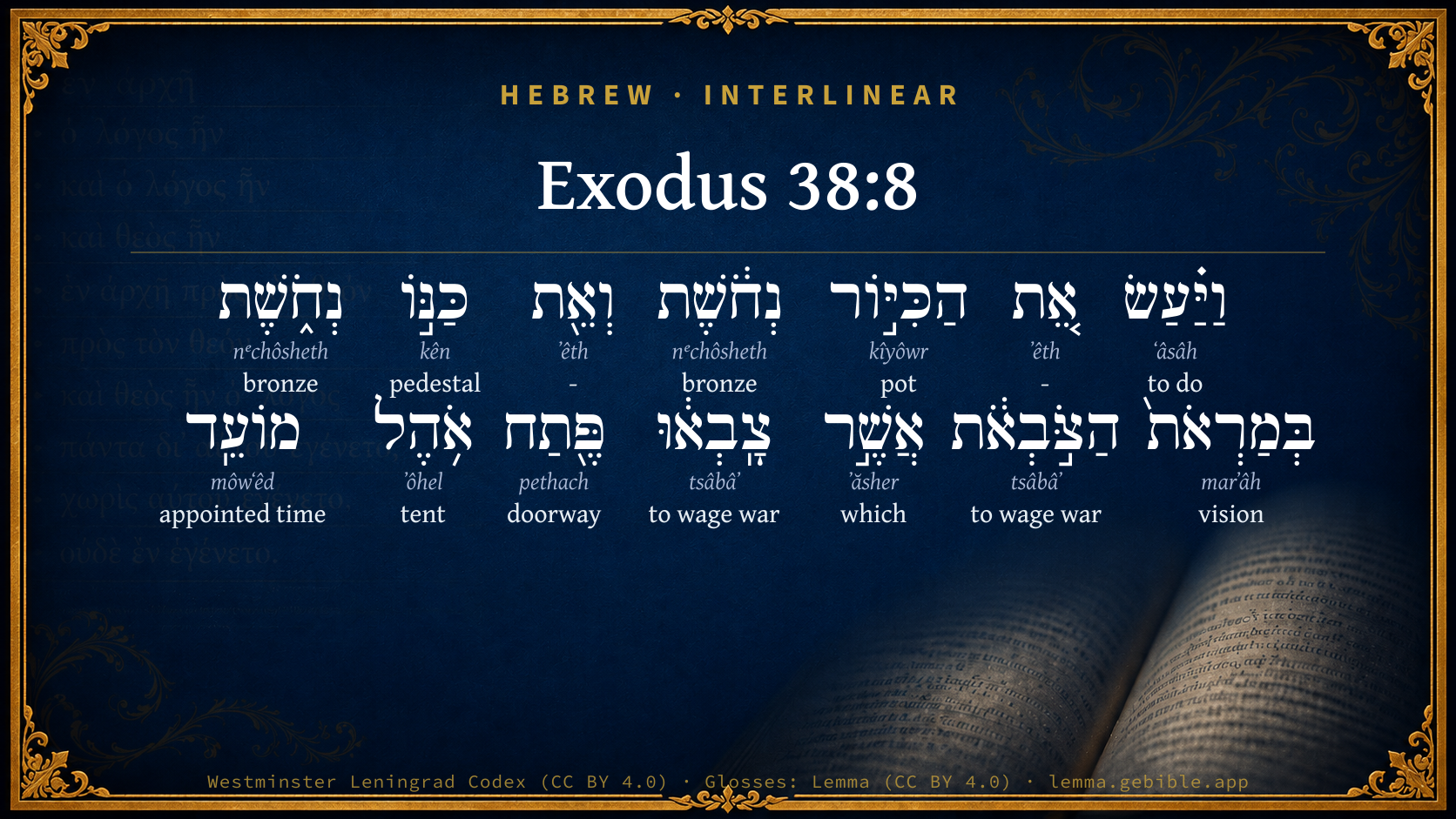
  1. וַיַּ֗עַשׂ ʻâsâh H6213 “and · to do” Conjunction + Verb, Qal, Sequential Imperfect, 3rd Person, Masculine, Singular
  2. אֵ֚ת ʼêth H853 “-” Particle, Direct Object
  3. הַכִּיּ֣וֹר kîyôwr H3595 “the · pot” Particle, Definite Article + Noun, Common, Masculine, Singular, Absolute
  4. נְחֹ֔שֶׁת nᵉchôsheth H5178 “bronze” Noun, Common, Feminine, Singular, Absolute
  5. וְאֵ֖ת ʼêth H853 “and · -” Conjunction + Particle, Direct Object
  6. כַּנּ֣וֹ kên H3653 “pedestal · his” Noun, Common, Masculine, Singular, Construct + Suffix, Personal, 3rd Person, Masculine, Singular
  7. נְחֹ֑שֶׁת nᵉchôsheth H5178 “bronze” Noun, Common, Feminine, Singular, Absolute
  8. הַצֹּ֣בְאֹ֔ת tsâbâʼ H6633 “the · waging war” Particle, Definite Article + Verb, Qal, Participle Active, Feminine, Plural, Absolute
  9. אֲשֶׁ֣ר ʼăsher H834 “which” Particle, Relative
  10. צָֽבְא֔וּ tsâbâʼ H6633 “to wage war” Verb, Qal, Perfect, 3rd Person, Common, Plural
  11. פֶּ֖תַח pethach H6607 “doorway of” Noun, Common, Masculine, Singular, Construct
  12. אֹ֥הֶל ʼôhel H168 “tent of” Noun, Common, Masculine, Singular, Construct
  13. מוֹעֵֽד môwʻêd H4150 “appointed time” Noun, Common, Masculine, Singular, Absolute

About this verse

These counts appear in no published source. They are computed here, from the morphology-tagged text and Lemma’s own curated glosses. What Lemma adds →

14
words
11
distinct lemmas
Pentateuch
section

Notable vocabulary

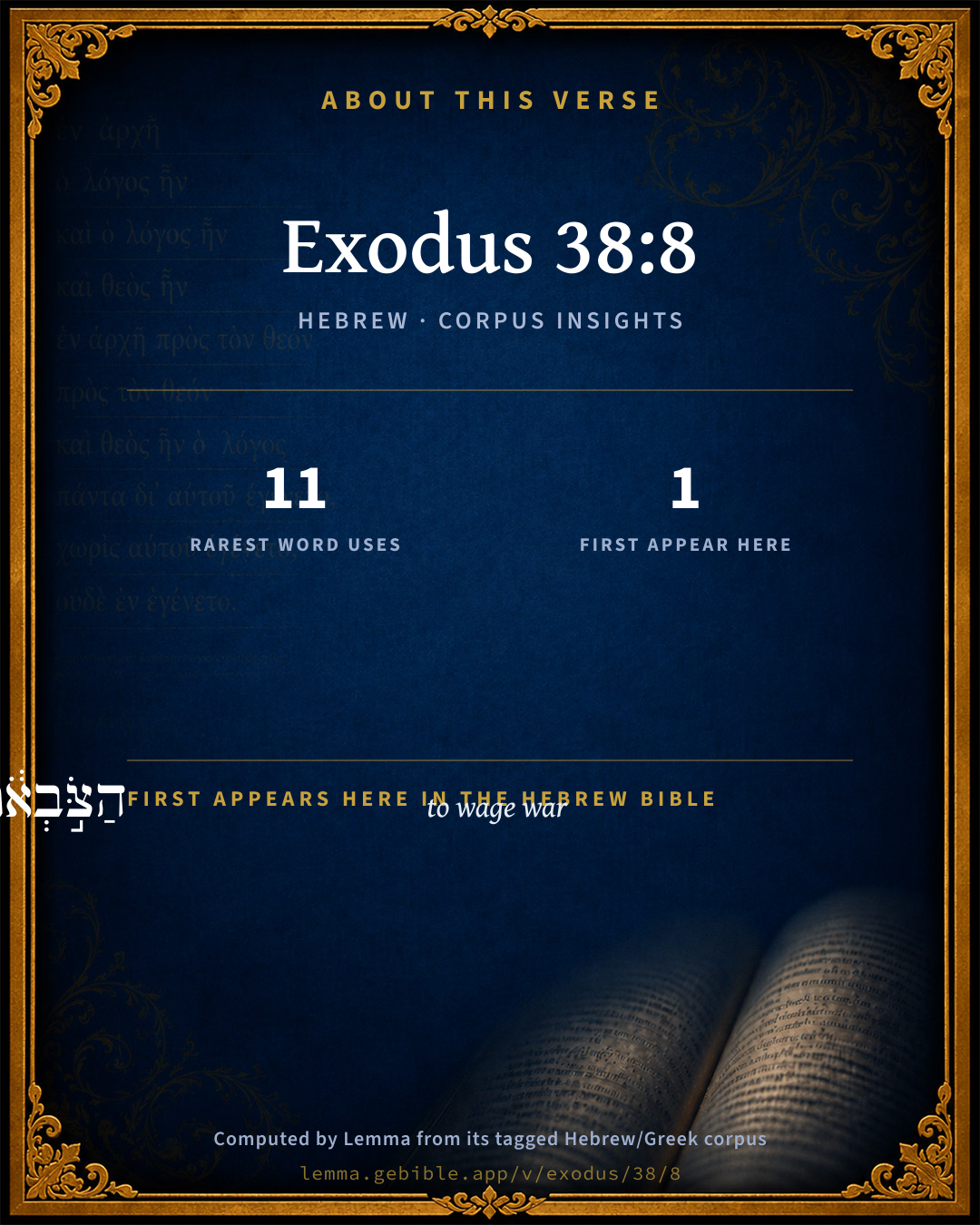
The rarest word here is בְּמַרְאֹת֙ vision H4759 — appearing just 11 times in the whole Hebrew Bible.

First appearance in Scripture

This word makes its first canonical appearance in the Hebrew Bible here:

  • הַצֹּ֣בְאֹ֔ת to wage war H6633

Shared distinctive vocabulary

בְּמַרְאֹת֙ vision H4759 occurs in 10 verses of the Hebrew Bible. Also found in:

Grammatical profile

  • 3 verbs
  • 8 nouns
  • 3 particles

Verb forms

  • וַיַּ֗עַשׂ Qal · Sequential Imperfect
  • הַצֹּ֣בְאֹ֔ת Qal · Participle Active
  • צָֽבְא֔וּ Qal · Perfect

Repetition

Words recur within this verse — often emphatic in Hebrew:

  • נְחֹ֔שֶׁת bronze H5178 ×2
  • הַצֹּ֣בְאֹ֔ת to wage war H6633 ×2

Hebrew & Septuagint length

In English translation the verse runs 29 words from the Hebrew and 6 from the Septuagint (LXX English) — the Septuagint runs noticeably shorter here. See the side-by-side →

A rough comparison of the two English renderings, which tokenize alike — not a word-level alignment.

Word counts can differ between the Hebrew and the Greek without any difference in meaning — e.g. the Hebrew direct-object marker אֵת has no separate Greek word, and Greek often adds the article ὁ.

Cross-references

18

Topical passages linked to Exodus 38:8 in the Treasury of Scripture Knowledge — connected by theme and wording, ordered by reader-vote popularity; previews shown in the World English Bible.

  • 1 Samuel 2:22 Now Eli was very old; and he heard all that his sons did to all Israel, and how that they lay with the women who served at the door of the tent of meeting.
  • Luke 2:37 and she had been a widow for about eighty-four years), who didn't depart from the temple, worshipping with fastings and petitions night and day.
  • Exodus 40:7 You shall set the basin between the tent of meeting and the altar, and shall put water therein.
  • 1 Timothy 5:5 Now she who is a widow indeed, and desolate, has her hope set on God, and continues in petitions and prayers night and day.
  • Titus 3:5–6 not by works of righteousness, which we did ourselves, but according to his mercy, he saved us, through the washing of regeneration and renewing by the Holy Spirit,
  • Psalms 26:6 I will wash my hands in innocence, So I will go about your altar, Yahweh;
  • Zechariah 13:1 "In that day there will be a spring opened to the house of David and to the inhabitants of Jerusalem, for sin and for uncleanness.
  • John 13:10 Jesus said to him, "Someone who has bathed only needs to have his feet washed, but is completely clean. You are clean, but not all of you."
  • Exodus 30:18–21 "You shall also make a basin of brass, and the base of it of brass, in which to wash. You shall put it between the tent of meeting and the altar, and you shall put water in it.
  • Exodus 40:30–32 He set the basin between the tent of meeting and the altar, and put water therein, with which to wash.
  • 1 Kings 7:23–26 He made the molten sea of ten cubits from brim to brim, round in compass, and the height of it was five cubits; and a line of thirty cubits compassed it round about.
  • 1 Kings 7:38 He made ten basins of brass: one basin contained forty baths; and every basin was four cubits; and on very one of the ten bases one basin.
  • Proverbs 8:34 Blessed is the man who hears me, Watching daily at my gates, Waiting at my door posts.
  • Matthew 26:69 Now Peter was sitting outside in the court, and a maid came to him, saying, "You were also with Jesus, the Galilean!"
  • John 18:16 but Peter was standing at the door outside. So the other disciple, who was known to the high priest, went out and spoke to her who kept the door, and brought in Peter.
  • Hebrews 9:10 being only (with meats and drinks and various washings) fleshly ordinances, imposed until a time of reformation.
  • 1 John 3:7 Little children, let no one lead you astray. He who does righteousness is righteous, even as he is righteous.
  • Revelation 1:5 and from Jesus Christ, the faithful witness, the firstborn of the dead, and the ruler of the kings of the earth. To him who loves us, and washed us from our sins by his blood;

Cross-references courtesy of OpenBible.info (CC BY 4.0).

Hebrew and Greek witnesses Masoretic Hebrew ↔ Greek Septuagint

The same verse in the two great witnesses to the Old Testament, shown verse-for-verse.

Here the Septuagint runs noticeably shorter than the Hebrew — LXX2012 (modern English Septuagint) 6 words vs World English Bible 29. A rough length comparison of the two English translations, not a word-level alignment — read both below.

These are two independent witnesses, not word-aligned to each other, and the Septuagint is shown in lemma (dictionary) form.

Hebrew Exodus 38:8 Masoretic · Westminster Leningrad Codex

וַיַּ֗עַשׂ אֵ֚ת הַכִּיּ֣וֹר נְחֹ֔שֶׁת וְאֵ֖ת כַּנּ֣וֹ נְחֹ֑שֶׁת בְּמַרְאֹת֙ הַצֹּ֣בְאֹ֔ת אֲשֶׁ֣ר צָֽבְא֔וּ פֶּ֖תַח אֹ֥הֶל מוֹעֵֽד

He made the basin of brass, and its base of brass, out of the mirrors of the ministering women who ministered at the door of the tent of meeting.

World English Bible · Public Domain

Greek LXX Exodus 38:8 Septuagint · lemma form

σκιάζω ὁ πτέρυξ αὐτός ἐπί ὁ ἱλαστήριον

overshadowing the propitiatory with their wings.

LXX2012 (modern English Septuagint) · Public Domain

On this verse, Adam Clarke's Commentary discusses the Septuagint’s reading. Read the note in Commentary ↓

Hebrew: Westminster Leningrad Codex (CC BY 4.0). Greek: Septuagint (public domain); English from LXX2012 (modern English Septuagint) (Public Domain). How the Septuagint differs from the Hebrew →

Targum (Aramaic paraphrase)

2

The Targum is the ancient Jewish Aramaic paraphrase of the Hebrew Scriptures — an interpretive translation, not the Hebrew text itself. Onkelos (literal) and Pseudo-Jonathan (expansive) render the Torah, and Jonathan the Prophets. Coverage is partial: where no permissively-licensed English translation exists for a verse, only the Aramaic is shown. This is verse-level text, not a word-by-word alignment to the Hebrew.

  1. Targum Onkelos Torah (Genesis–Deuteronomy)
    וַעֲבַד יָת כִּיוֹרָא נְחָשָׁא וְיָת בְּסִיסֵהּ נְחָשָׁא בְּמֶחְזְיַן נְשַׁיָא דְאָתְיָן לְצַלָאָה בִּתְרַע מַשְׁכַּן זִמְנָא:

    (no public-domain English translation for this verse)

    Targum Onkelos — Aramaic: “Onkelos Genesis” (public domain); “Onkelos Exodus” (public domain); “Onkelos Leviticus” (public domain); “Onkelos Numbers” (public domain); “Onkelos Deuteronomy” (public domain). English: “Sefaria Community Translation” (CC0 1.0 (public-domain dedication)); “J.W. Etheridge. The Targums of Onkelos and Jonathan Ben Uzziel on the Pentateuch. London: Longmans, Green, 1862” (public domain). Text via Sefaria.

  2. Targum Pseudo-Jonathan Torah (Genesis–Deuteronomy)
    וַעֲבַד יַת כִּיּוֹרָא דִנְחָשָׁא וְיַת בְּסִיסֵיהּ דִּנְחָשָׁא מִן אַסְפַּקְלִירֵי נְחָשָׁא נְשַׁיָא צְנִיעוּתָא וּבְעִידַן דְּאָתוּן לְצַלָּאָה בִּתְרַע מַשְׁכַּן זִמְנָא הֲוָאָן קַיְימִין עַל קָרְבַּן אַדְמוּתְהוֹן וּמְשַׁבְּחָן וּמוֹדָן וְתַיְיבִין לְגוּבְרֵיהוֹן וְיָלְדַן בְּנִין צַדִּיקִין בִּזְמַן דְּמִדְכַן מִן סוֹאָבוֹת דִּמְהוֹן

    And he made the brasen Laver, and its foundation of brass, from the brasen mirrors of the pious women, who, at the season, came to pray at the door of the tabernacle of appointment, standing with their oblations, giving thanks and confession, and returning to their husbands, the mothers of righteous children, who had been purified from the uncleanness of their blood.

    Targum Pseudo-Jonathan — Aramaic: “Targum Jonathan on Genesis” (public domain); “Targum Jonathan on Exodus” (public domain); “Targum Jonathan on Leviticus” (public domain); “Targum Jonathan on Numbers” (public domain); “Targum Jonathan on Deuteronomy” (public domain). English: “The Targum of Jonathan ben Uzziel, trans. J. W. Etheridge, London, 1862” (public domain). Text via Sefaria.

Commentary

Notes on Exodus 38:8 from classic Christian and Jewish commentators (each source and its license shown beneath its notes). The classic Christian expositions comment on the surrounding passage and are grouped to its opening verse, so a note may address several verses; the Jewish commentaries on the Tanakh (Rashi and others) are per-verse, so they appear only where the commentator wrote on this verse.

Lemma curates 59 commentaries, every one of them public domain or Creative Commons licensed, each selected and text-cleaned for this edition rather than reprinted as found. About our sources →

Trapp's Complete Commentary

John Trapp

Exo 38:8 And he made the laver [of] brass, and the foot of it [of] brass, of the lookingglasses of [the women] assembling, which assembled [at] the door of the tabernacle of the congregation.

Ver. 8. Looking glasses.] Or, Brazen-glasses. These devout women that used to assemble by troops at the door of the tabernacle to pray and serve God, - see Luk 2:37 1Ti 5:5, - frankly gave the instruments whereby they dressed their bodies, to make the instrument whereby, through faith, they might sanctify their souls. Let those who view themselves oft in their looking glasses take his counsel who said, "Art thou fair? be not like an Egyptian temple, varnish without and vermin within. Art thou foul? let thy soul be like a rich pearl in a rude shell." Some such advice as this Pythagoras gave his scholars. St James would have men "look" often "into the perfect law of liberty," that crystal glass, "and continue therein." {Jas 1:25} David did so, and got much good by it. {Psa 119:59} I considered my ways: Heb., I viewed my ways on both sides. The curious works of the sanctuary were wrought on both sides, therefore called works with two faces. Common works are wrought only on one side, on the other full of ends and shreds. The prophet here strives to walk curiously, precisely, accurately, to turn his feet to God’s testimonies: and hence he is so exact in his self-searching.

John Trapp, A Commentary or Exposition upon All the Books of the Old and New Testament (1647–1656) — public domain. Text from a community e-Sword module.

The Biblical Illustrator

Joseph S. Exell

Exo_38:8

The looking-glasses of the women.

The looking-glass and the laver

Unlike our looking-glasses made of silvered glass, which did not come into use till the thirteenth century, these primitive looking-glasses were made chiefly of an alloy of copper, tin, and lead, wrought with such admirable skill that it was capable of receiving the highest and most enduring polish. The mirror itself was a round or pear-shaped plate, often encircled with a wreath of leaves, or adorned with figures engraved upon the rim; and it was attached to a handle often carved with some elegant form of life. Numerous specehi of this kind have been found in Etruscan tombs, retaining their polish so brightly as sometimes to fit them for their original purpose; and having on their disks scenes of Etruscan life and manners, and representations or symbols of the national faith, illustrated by inscriptions in the native character, they have been well called by Bunsen a figurative dictionary, eminently useful to the archseologist for the light they throw upon the creed and history of this ancient and most mysterious race. In Japan certain metal mirrors have acquired a magic fame, and are brought to this country as curiosities, on account of the figures which shine through them when seen in a certain light, while directly viewed they reflect only on their polished surface the face that looks into them. The specula of the Hebrew women were brought with them from Egypt, and doubtless formed part of the spoil which the Israelites took from the Egyptians at the time of the Exodus. In that country they were used not only in domestic economy, but also in the idolatrous worship of the temples; and probably the Hebrew women who assembled at the door of the Tabernacle of the congregation had adopted this custom, and worshipped the God of Israel as the Egyptian women worshipped Isis or Anubis, dressed in linen garments, holding a sistrum in their right hand and a mirror in their left. It is not without deep significance that this holy vessel, typical of spiritual cleansing, should have been formed of such materials. The whole transaction is a most beautiful and expressive symbol of the vast difference between the beauty which man sees in himself, and the beauty which God induces in him by the means of grace. In fact, the whole gospel scheme might be represented to the eye pictorially by these two emblematical objects--the looking-glass and the laver; for it shows us to ourselves, and it cleanses us from our impurity.

1. Let us look, in the first place, at the gospel as a mirror showing us to ourselves. Contemplating the features of our character in our own natural looking-glass, we are satisfied with the image that is reflected there. Comparing ourselves with ourselves we have no sense of contrast; we come up to our own ideal; we realize our own standard of goodness. Comparing ourselves with others we are raised in our own estimation; we see many guilty of meannesses and follies which we should scorn. We feel like the self-righteous Pharisee in the temple, and thank God that we are not as other men, or as the publican beside us. But the gospel is the true mirror in which we see our true image reflected. The holiness of God, as it is revealed to us in the face of His Son Jesus Christ, is the best mirror in which to see reflected our own sinful image. That holiness is the part of the Divine image which we have completely lost in our fallen state. When the pure searching light of His law shines into our hearts, how defiled and unworthy do many things appear which before were regarded as clean and good! What secret unsuspected sins are made manifest like the myriad motes which float in the sunbeams that enter a dark room! How true it is, that those who are ignorant of God are ignorant of them-selves! The mirror must lead to the laver. Having learned what our true condition is, we must cease to look at ourselves, and have recourse to the cleansing bath which God has provided in the gospel for the sinner conscious of his sin. The fact that the laver was made of the looking-glasses teaches this practical lesson to us. We see our impurity in order that we may apply for cleansing. Our uncomeliness is revealed to us for the very purpose of causing us to seek for the beauty of holiness.

2. The laver made of the looking-glasses of the women stood in the court of the Tabernacle between the altar of burnt-offering and the door of the holy place. As the altar removed the legal obstacle that lay in the way of a sinners access to God, so the laver removed the moral. The one by the atonement which it presented opened up the way to God; the other by the purification which it effected qualified the believer for coming into Gods presence. And viewed in this light, what an expressive symbol is it of the spiritual fountain opened in the house of David for sin and uncleanness! The laver in which we are washed becomes the mirror in which we see our own reflection; and the mirror of self-complacency, in which hitherto we sought to see visions of our own comeliness whereof to glory in the flesh, is converted into the fountain of life in which the discovery of our own vileness is overborne by the discovery of the surpassing, all-compensating loveliness of Him in whom God sees no iniquity in Jacob, and no perverseness in Israel. (H. Macmillan, D. D.)

The laver and looking-glasses

I shall take that laver of looking-glasses, spoken of in the text, as all-suggestive of the gospel, which first shows us our sins as in a mirror, and then washes them away by Divine ablution.

1. Now, I have to say that this is the only looking-glass in which a man can see himself as he is. There are some mirrors that flatter the features, and make you look better than you are. Then there are other mirrors that distort your features, and make you look worse than you are; but I want to tell you that this looking-glass of the gospel shows a man just as he is. When the priests entered the ancient Tabernacle, one glance at the burnished side of this laver showed them their need of cleansing. So this gospel shows the soul its need of Divine washing. All have sinned, and come short of the glory of God. That is one showing. All we, like sheep, have gone astray. That is another showing. In Hampton Court I saw a room where the four walls were covered with looking-glasses, and it made no difference which way you looked, you saw yourself. And so it is in this gospel of Christ. If you once step within its full precincts you will find your whole character reflected--every feature of moral deformity--every spot of moral taint.

2. I want you to notice that this laver in which the priests washed was filled with fresh water every morning. So it is with the gospel of Jesus Christ; it has a fresh salvation every day. Come this morning and take the glittering robe of Christs righteousness from the Saviours hand. You were plunged in the fountain of the Saviours mercy a quarter of a century ago. That is nothing to me; I tell you to wash now in this laver of looking-glasses, and have your soul made clean.

3. I notice, also, in regard to this laver of looking-glasses spoken of in the text, that the priests always washed both hands and feet. The water came down in spouts, so that without leaving any filth in the basin, the priests washed both hands and feet. So the gospel of Jesus Christ must touch the very extremities of our moral nature.

4. I remark, further, that the laver of looking-glasses spoken of in the text, was a very large laver. I always thought from the fact that so many washed there, and also from the fact that Solomon afterwards, when he copied that laver in the temple, built it on a very large scale, that it was large, and so suggestive of the gospel of Jesus Christ and salvation by Him--vast in its provisions. The whole world may come and wash in this laver and be clean.

5. But I notice, also, in regard to this laver of looking-glasses spoken of in the text, that the washing in it was imperative and not optional. When the priests came into the Tabernacle (you will find this in the 30th chapter of Exodus), God tells them they must wash in that laver or die. The priests might have said: Cant I wash elsewhere? I washed in the laver at home, and now you want me to wash here. God says, No matter whether you have washed before. Wash in this laver or die. But, says the priest, there is water just as clean as this, why wont that do? . . . Wash here, says God, or die. So it is with the gospel of Christ--it is imperative. There is only this alternative: keep our sins and perish, or wash them away and live. (Dr. Talmage.)

Old things turned to new uses

In many ancient religions women took a leading part in some of the ceremonies. This was so in Egypt. Each woman had a looking-glass made of polished brass, and that mirror was used in some way in connection with idolatrous practices. When the Tabernacle was being built the women gave up their mirrors and so contributed to the formation of the laver, which was made of brass, and the foot of it of brass. Thus we have old things turned to new uses, and it is for us to say whether we shall regard this incident as a piece of ancient history, or whether we shall enter into the spirit of it and realize the action in our own day and on a broader scale. How came the women to give up their looking-glasses to assist in constructing the laver? Because a superior spirit had taken possession of them. That is the philosophy and that the explanation of the case. What then is the spirit that is to enter into us? None other than the spirit of Christ. We might use many words in describing the spirit, but all the words would focalize themselves at last in this sublime expression--For Christs sake. The highest personality is Christ. We follow Him, and in proportion as we follow Him all things we possess are His. There is room in the sanctuary for everything. This is the point we have so often missed in our Christian teaching. No punishment is burning enough for the men who would belittle Gods house. What have you? You have nothing that cannot be used in the building of Gods house and kingdom. Have you nothing but the little looking-glass? It can be used. Is yours, on the other hand, but one small flower which a child could pluck? It was Gods flower before it was yours, and He will never consent to lose a flower; it cost Him thought and care and love; He dressed the flower as Solomon never could dress himself. Blessed will be the day when the breweries of the country are turned into mechanics institutes, great sanitary establishments for the washing and cleansing of the people. Blessed will be the day when the rich mans saloons shall be thrown open to the poorest neighbours he has who will come to look at his articles of vertu,--who will turn over his curiosities and examine them with honest fingers, and so admire them as to be touched into desire for broader life. Blessed--bright will be the day when in that sense we shall have all things common; when the strong mans strength shall be the weak mans refuge; when the homeless shall have a large home in the charity and love of his richer brother; when the one object of every heart will be to extend the happiness of mankind--the one question in the morning being, What good can be done to-day? and the one question at eventide, What good has been accomplished? My persuasion is that if ever that time is to be brought about, it can only be by the extension of the spirit of Jesus Christ. Taking the Christian view, all becomes larger still and brighter, and the hope is given that one day everybody will be in the kingdom, and every man, woman, and child, wilt be doing their very best to make that kingdom what God means it to be. The great men, by heroic strength, by dauntless valour, will carry on their sublime occupation; the patient women--gentle souls, having the genius of sympathy and the faculty of interpreting by suffering--will contribute their important, their ineffably valuable share; and little children will make up the sum total of the consecration. (J. Parker, D. D.)

.

The Biblical Illustrator, edited by Joseph S. Exell (c. 1880s–1900s) — public domain. Text from a community e-Sword module.

Joseph Benson's Commentary

Exo 38:8. He made the laver of brass — The brass font for the priests to wash in before service, Exo 30:18. This laver signified the provision that is made in the gospel for cleansing our souls from the pollution of sin by the atoning blood of Christ and the regenerating Spirit of God, that we may be fit to serve God in holy duties. That is here said to be made of the looking-glasses, (or mirrors rather, for they were not glasses,) of the women that assembled at the door of the tabernacle — Mirrors, before the invention of glass, were made of polished brass. Pliny says those of brass and tin mixed together were esteemed the best, before those of silver came to be in use. These here mentioned, no doubt, were of the finest kind of brass, and the women who gave them seem to have been eminent for devotion, attending more constantly than others at the place of public worship, which, is here taken notice of to their honour. In the laver these mirrors were either artfully joined together, or else molten down and cast anew; but it is probable the laver was so brightly burnished that the sides of it still served for mirrors, that the priests, when they came to wash, might there see their faces, and so discover the spots to wash them clean.

Joseph Benson's Commentary on the Old and New Testaments (1811–1818) — public domain. Text from a community e-Sword module.

Tyndale Open Study Notes

Tyndale Open Resources

38:8 While the plans for the washbasin (30:17-21) were included in the instructions to the priests (29:38–30:38), here its construction is reported in logical sequence. • This bronze, which could be polished to a mirror-like finish, was probably of especially high quality, as was fitting for use in God’s Tabernacle.

Tyndale Open Study Notes — © Tyndale Open Resources, licensed CC BY-SA 4.0. Text via the HelloAO Bible API.

Geneva Bible (1599)

Geneva Bible translators

R. Kimbi saith, that the women brought their looking glasses, which were of brass or fine metal, and offered them freely unto the use of the Tabernacle: which was a bright thing and of great majesty.

Geneva Bible (1599) marginal notes — public domain. Text via Bolls.life.

Jamieson, Fausset & Brown

Robert Jamieson, A. R. Fausset & David Brown

laver of brass . . . of the looking glasses of the women--The word mirrors should have been used, as those implements, usually round, inserted into a handle of wood, stone, or metal, were made of brass, silver, or bronze, highly polished [WILKINSON]. It was customary for the Egyptian women to carry mirrors with them to the temples; and whether by taking the looking glasses of the Hebrew women Moses designed to put it out of their power to follow a similar practice at the tabernacle, or whether the supply of brass from other sources in the camp was exhausted, it is interesting to learn how zealously and to a vast extent they surrendered those valued accompaniments of the female toilet.

of the women assembling . . . at the door--not priestesses but women of pious character and influence, who frequented the courts of the sacred building (Luk 2:37), and whose parting with their mirrors, like the cutting the hair of the Nazarites, was their renouncing the world for a season [HENGSTENBERG].

Jamieson, Fausset & Brown — Commentary Critical and Explanatory on the Whole Bible (1871) — public domain (CC PDM 1.0). Text via the HelloAO Bible API.

Adam Clarke's Commentary

Verse 8. He made the laver] See Clarke on Ex 30:18, c.

The looking-glasses] The word מראת maroth, from ראה raah, he saw, signifies reflectors or mirrors of any kind. Here metal, highly polished, must certainly be meant, as glass was not yet in use and had it even been in use, we are sure that looking-GLASSES could not make a BRAZEN laver. The word therefore should be rendered mirrors, not looking-glasses, which in the above verse is perfectly absurd, because from those maroth the brazen laver was made. The first mirrors known among men were the clear, still, fountain, and unruffled lake; and probably the mineral called mica, which is a very general substance through all parts of the earth. Plates of it have been found of three feet square, and it is so extremely divisible into laminae, that it has been divided into plates so thin as to be only the three hundred thousandth part of an inch. A plate of this forms an excellent mirror when any thing black is attached to the opposite side. A plate of this mineral, nine inches by eight, now lies before me; a piece of black cloth, or any other black substance, at the back, converts it into a good mirror; or it would serve as it is for a square of glass, as every object is clearly perceivable through it. It is used in Russian ships of war, instead of glass, for windows. The first artificial mirrors were apparently made of brass, afterwards of polished steel, and when luxury increased they were made of silver; but they were made at a very early period of mixed metal, particularly of tin and copper, the best of which, as Pliny tells us, were formerly manufactured at Brundusium: Optima apud majores fuerant Brundisina, stanno et aere mixtis. - Hist. Nat. lib. xxxiii., cap. 9. But, according to him, the most esteemed were those made of tin; and he says that silver mirrors became so common that even the servant girls used them: Specula (ex stanno) laudatissima Brundisii temperabantur; donec argenteis uti caepere et ancillae; lib. xxxiv., cap. 17. When the Egyptian women went to the temples, they always carried their mirrors with them. The Israelitish women probably did the same, and Dr. Shaw states that the Arabian women carry them constantly hung at their breasts. It is worthy of remark, that at first these women freely gave up their ornaments for this important service, and now give their very mirrors, probably as being of little farther service, seeing they had already given up the principal decorations of their persons. Woman has been invidiously defined by Aristotle, an animal fond of dress, (though this belongs to the whole human race, and not exclusively to woman.) Had this been true of the Israelitish women, in the present case we must say they nobly sacrificed their incentives to pride to the service of their God. Woman, go thou and do likewise.

Of the women - which assembled at the door] What the employment of these women was at the door of the tabernacle, is not easily known. Some think they assembled there for purposes of devotion. Others, that they kept watch there during the night; and this is the most probable opinion, for they appear to have been in the same employment as those who assembled at the door of the tabernacle of the congregation in the days of Samuel, who were abused by the sons of the high priest Eli, 1Sa 2:22. Among the ancients women were generally employed in the office of porters or doorkeepers. Such were employed about the house of the high priest in our Lord's time; for a woman is actually represented as keeping the door of the palace of the high priest, Joh 18:17: Then saith the DAMSEL that KEPT THE DOOR unto Peter; see also Mt 26:69. In 2Sa 4:6, both the Septuagint and Vulgate make a woman porter or doorkeeper to Ishbosheth. Aristophanes mentions them in the same office, and calls them Σηκις, Sekis, which seems to signify a common maid-servant. Aristoph, in Vespis, ver. 768: -

Ὁτι την θυραν ανεῳξεν ἡ Σηκις λαθρα.

Homer, Odyss., ψ, ver. 225-229, mentions Actoris, Penelope's maid, whose office it was to keep the door of her chamber: -

Ακτορις - - -

Ἡ νωΐν ειρυτο θυρας πυκινου θαλαμοιο.

And Euripides, in Troad., ver. 197, brings in Hecuba, complaining that she who was wont to sit upon a throne is now reduced to the miserable necessity of becoming a doorkeeper or a nurse, in order to get a morsel of bread.

- - - η ταν

Παρα προθυροις φυλακαν κατεχουσα,

Η παιδων θρεπτειρα.

Sir John Chardin observes, that women are employed to keep the gate of the palace of the Persian kings. Plautus, Curcul., act 1., scene 1, mentions an old woman, who was keeper of the gate.

Anus hic solet cubitare, custos janitrix.

Many other examples might be produced. It is therefore very likely that the persons mentioned here, and in 1Sa 2:22, were the women who guarded the tabernacle; and that they regularly relieved each other, a troop or company regularly keeping watch: and indeed this seems to be implied in the original, צבאו tsabeu, they came by troops; and these troops successively consecrated their mirrors to the service of the tabernacle. See Calmet on Joh 18:16.

Adam Clarke's Commentary on the Bible (1810–1826) — public domain. Text from a community e-Sword/MySword module.

Ellicott's Commentary for English Readers

(8) He made the laver of brass.—Comp. Exo_30:18-21, where the laver is commanded, and the uses whereto it was to be applied are laid down. By “brass” we must understand “bronze” in this place, as in others.

Of the lookingglasses.—Rather, mirrors. The mirrors used in ancient times were not of glass, but of burnished metal. Bronze was the metal ordinarily employed for the purpose, and was in common use in Egypt, where mirrors were bronze plates, round or oval, with a handle, like our fire-screens. The Etruscan women employed similar articles in their toilets, and had them often delicately chased with engravings.

Of the women assembling.—It would seem that these women—the women wont to frequent the “tent of meeting” which Moses had recently set up (Exo_33:7), and to flock thither in troops—offered voluntarily for the service of God the mirrors, which were among the most highly prized of their possessions. Moses, to mark his approval of their devotion, formed their offerings into the most honourable of all the brazen vessels, and recorded the fact to the women’s credit.

A Bible Commentary for English Readers, edited by Charles John Ellicott (1878–1897) — public domain. Text from a community e-Sword module.

The Cambridge Bible for Schools and Colleges

gen. ed. J. J. S. Perowne

8. The Bronze Laver (Exo_30:18-21). V. 8a as Exo_30:18 a; v. 8b is new. Exo_30:18 b–21 is not repeated here (see Exo_40:30-32).

8b. the serving women which served] The expression is peculiar, the word used (צבא) being (both times) not the ordinary Heb. for ‘serve,’ but the word which means properly and regularly to serve in a host, to war or fight. The same word is used by P of the service of the Levites in (particularly) the transport of the Tabernacle and its appurtenances (Num_4:1-33), Num_4:23 (RVm.) ‘Heb. to war the warfare’; cf. the cognate subst. warfare (EVV. ‘service’), vv. 3 (see RVm.), 35, 39, 43, Exo_8:24-25 (see RVm.). Either, it seems, the Levites in Nu., and the women here, are pictured as performing their duties in organized bands, like soldiers in an army (cf. Ges. Thes., Di.), or (Gray, Numbers, pp. 32, 36) the word is one of those which in postexilic times, when the nation had become a church, acquired a religious connotation. The women were no doubt thought of as washing, cleaning, repairing, &c. Women ‘doing “warfare” at the entrance to the tent of meeting’ are also mentioned in 1Sa_2:22 b: but the passage is not expressed in the LXX., besides differing in representation from the context (the sanctuary a ‘tent,’ not a hêkâl, or ‘temple’); and is beyond question a late gloss. LXX. render νηστεύσασαι, ‘fasting,’ either paraphrasing, or misreading צבאת as צמות (‘fasting’). Onk. has who prayed. For other haggadic interpretations, see reff. in DI. The clause (8b) must (Di. al.) be a later addition to the original narrative; for it obviously presupposes the erection of the Tent of Meeting, which is not narrated till ch. 40.

The metal mirrors are to be thought of as the terûmâh, or ‘contribution,’ of the women; and the laver and its base, cast from them, as a ‘memorial’ of the gift. Comp. the explanation of the metal casing of the altar in Num_16:37-40.

The Cambridge Bible for Schools and Colleges (gen. ed. J. J. S. Perowne; Cambridge University Press, 1878–1918) — public domain. Text from a community e-Sword module.

John Gill's Exposition

And he made the court,.... The open court of the tabernacle, where the people met, of which, its pillars, sockets, hangings, hooks, and pins, an account is given, to Exo 38:10 of which See Gill on Exo 27:9, Exo 27:10, Exo 27:11, Exo 27:12, Exo 27:13, Exo 27:14, Exo 27:15, Exo 27:16, Exo 27:17, Exo 27:18, Exo 27:19.

.

Exodus 38:21

exo 38:21

exo 38:21

exo 38:21This is the sum of the tabernacle,.... Not of the several parts of the tabernacle, and the several things belonging to it, before enumerated, as made and delivered to the care and custody of the Levites, but of the materials of which they were made, particularly the gold and silver, and the brass; the several sums and weight of which are given in the following verses:

even of the tabernacle of the testimony; in which the law, the testimony of the will of God, was put enclosed in the ark:

as it was counted, according to the commandment of Moses; when it was brought in to him by the people, and delivered by him to Bezaleel, Aholiab, and the artificers:

for the service of the Levites; or by means of their ministry, who were employed in taking this account:

by the hand of Ithamar, son to Aaron the priest; the youngest son of Aaron, who had the direction and oversight of this affair.

John Gill's Exposition of the Whole Bible (1746–1763) — public domain (CC PDM 1.0). Text via the HelloAO Bible API.

Albert Barnes' Notes on the Bible

See the marginal reference. The women who assembled at the entrance of the tent of meeting were most probably devout women who loved the public service of religion. The giving up of their mirrors for the use of the sanctuary was a fit sacrifice for such women to make (compare Exo 35:22 note).

Albert Barnes' Notes on the Bible (1834–1885) — public domain. Text from a community e-Sword/MySword module.

Haydock's Catholic Bible Commentary

Mirrors. Formerly all sorts of metal, silver, copper, tin, &c., were used for mirrors, till the Europeans began to make them of glass. The best were made of a mixture of copper and tin. (Pliny, [Natural History?] xxxiii. 9.) --- Watched. Hebrew, served like soldiers: fasting and praying, according to the Septuagint and Chaldean. These devout women came thither with great alacrity, to shew their affection towards God, and to consecrate to his service what had hitherto served to nourish vanity. Such were the virgins, mentioned 2 Machabees iii. 19, and those who were abused by the sons of Heli, 1 Kings ii. 22. Ann, the prophetess, and our blessed Lady, were thus also employed in the temple, Luke ii. 37. Women kept watch, singing and dancing before the palace of the Persian kings. (Calmet) --- When the tabernacle was fixed at Silo, small apartments were probably built for the convenience of these pious women. (Tirinus)

George Leo Haydock (1774–1849), Haydock's Catholic Family Bible and Commentary, 1859 edition — public domain. Excludes Psalms (Douay-Rheims chapter numbering differs from Protestant) and Deuterocanonical books (Catholic canon only).

Matthew Poole's English Annotations

Looking-glasses, as now they are sometimes made of polished steel, so anciently were made of polished brass, as appears both from sacred and from profane writers. See Job 37:18; Phi 3:9, &c. The words following seem to note a company of religious women, who in a more peculiar manner devoted themselves to the service of God in or about his tabernacle, by fasting, prayer, &c. See 1Sa 2:22; Luk 2:37. And whereas some object that the tabernacle was not yet built, it may be replied, either that this is to be understood of the tabernacle spoken of Exo 33:7, which might serve for that purpose till this was built; or that here is a prolepsis or anticipation, and that he speaks not of what the women now did, but of what they did after the tabernacle was built, which was before Moses writ these words.

Matthew Poole's English Annotations on the Holy Bible (1683–1685) — public domain. Text from a community e-Sword/MySword module.

The Pulpit Commentary

Of the looking-glasses of the women. This interesting fact has not been previously mentioned. Bronze plates, circular or oval, admitting of a high polish, were used by the Egyptian women as mirrors from a very early date, and may be seen in the Egyptian collection of the British Museum. They have handles like those of our fire-screens, generally also of bronze. It was natural that the Hebrew women should possess similar articles, and should have taken care to bring them with them out of Egypt. The sacrifice of them for a sacred purpose is rather to be ascribed to their own serf-denying piety than to any command issued by Moses (Spencer). Which assembled. Literally, "who came by troops." Women assembled themselves by troops at the entrance of the "tent of meeting" set up lay, (Exo_33:7) as at a later date we find Hannah. (1Sa_1:9-12) and other women who were less worthy (1Sa_2:22) doing. The women who showed this zeal were those that made the sacrifice of their mirrors for God"s service. There is no reason to suppose (with Hengstenberg and others) that they constituted a regular "order.

Ver. 8. The triumph of female piety over female vanity.

Hebrew women were, it must be presumed, much like other women in their natural dispositions, and therefore not without their share of personal vanity. The fact, that in all the haste of their sudden departure from Egypt they had not omitted to carry with them their metal mirrors, is indicative of this. The mirror was the most valued of toilet articles, and the most indispensable for effecting that end, at which almost all women aim the making the best of those advantages of personal appearance which nature has vouchsafed to them. It is difficult to imagine any material sacrifice to which a woman would not more readily have consented than the loss of her mirror. Yet we know that the sacrifice was made by large numbers; for the laver was a vessel of considerable size. Let us consider then,

1. The motive of the act;

2. the antecedent conduct which led up to it;

3. the reward which it obtained.

I THE MOTIVE OF THE ACT. No other motive can be conceived of than true piety. Piety loves to make offerings to God. Piety does not count the cost. Piety, the gift of grace, can triumph over nature; transform a poor vain worldling into a saint; make no sacrifice seem a hard one. It must have been piety which made these women give their mirrors, either,

1. In addition to their personal ornaments, (Exo_35:22) or

2. In default of them.

Some after offering their ear-rings, rings, necklaces, bracelets, and the like, may have desired, from pure love of God, to give more, and casting about to consider what more they could give, may have bethought them of their mirrors. Others may have had no personal ornaments to give; and if unable to spin, may have had nothing else but their mirrors which they could contribute. In either case, piety was at the root of their giving.

II THE ANTECEDENT CONDUCT WHICH LED UP TO IT, They who contributed their mirrors were women wont to "assemble at the door of the tabernacle of the congregation." In other words, they were such as had previously made all the use they could of their religious opportunities. We see that God does not shower down his precious gifts of grace at random but "helps such as help themselves." He granted the priceless grace of self-denying love to those who were constant in serving him at the place where he had "set his name," and was to be found of them that sought him. Much prayer, much waiting upon God, had gone to form the character of those who now found themselves able to make a willing sacrifice of their vanity.

III THE REWARD WHICH THEIR ACT OF SACRIFICE OBTAINED FOR THEM. It obtained for them the high reward of special mention in God"s holy word a place in his "Valhalla a record in his "Roll of worthies." Of the other offerings we know not, for the most part, whether they were made by men or women much less by what class of men, or what class of women. Only here, and in Exo_35:25, Exo_35:26, is the sex specified, and only here the class. Let women take this to heart. Let them be ready to sacrifice to him all their adornments hair and gold and pearls, and costly array" (1Ti_2:9) let them be ready to sacrifice even, if need be, their personal charms (as many do in fever or small-pox hospitals), and they will not be forgotten by him they will not go without a recompense. If their act be not recorded in any other book it will be written in that heavenly record, out of which all will be judged at the last day. (Rev_20:12)

For other Homiletics on the subjects of this chapter, see those on ch. 27.

The mirrors of the women.

The women assembling at the door of the tabernacle (see Hengstenberg"s "Egypt and the Books of Moses, Institution of Holy Women ") gave up their mirrors for the making of the laver. Learn

1. Peculiar devotion to God expresses itself in acts of sacrifice cf. Mary of Bethany. (Mat_26:6-14)

2. Religion gives power to make sacrifices.

3. It weans the affections from the world.

4. It gives superiority to the motives of personal vanity. The mirror ispeculiarly a woman"s instrument of self-pleasing. It is her means of pleasing the world.

5. Religion teaches godly women to study simplicity in personal adornment. (1Pe_3:1-5)

6. Self-denial in outward adornment is valueless, unless" in the hidden manof the heart," there be the positive inward adornment of holiness. (1Pe_3:4) This was taught by the use to which Moses put the offerings the making of the "laver." Regeneration is the true beautifier. J.O.

The Pulpit Commentary (1880–1919), ed. H.D.M. Spence-Jones & Joseph S. Exell — public domain. Text from a community e-Sword module.

John Wesley's Explanatory Notes

This laver signified the provision that is made in the gospel for cleansing our souls from the pollution of sin by the merit of Christ, that we may be fit to serve the holy God in holy duties. This is here said to be made of the looking-glasses of the women that assembled at the door of the tabernacle. It should seem these women were eminent for devotion, attending more constantly at the place of public worship than others, and notice is here taken of it to their honour. These looking-glasses were of the finest brass, burnished for that purpose. In the laver, either they were artfully joined together, or else molten down and cast anew; but it is probable the laver was so brightly burnished that the sides of it still served for looking-glasses, that the priests when they came to wash might there see their faces, and so discover the spots to wash them clean.

John Wesley, Explanatory Notes Upon the Whole Bible (1754–1765) — public domain. Text via the GEBible commentary corpus.

unfoldingWord translationNotes

Door43 World Missions Community

General Information:

Bezalel's work crew continues to build the tabernacle and furniture.

large bronze basin with a bronze stand

The stand supported the bronze basin. See how you translated this in Exodus 30:18.

He made the basin out of mirrors

The bronze came from the mirrors. This can be stated clearly in the translation. AT: "The bronze for the basin came from the mirrors" (See: Assumed Knowledge and Implicit Information)

mirrors

A mirror is a piece of polished metal or glass that reflects an image.

translationWords

bronze

servant

tent of meeting

unfoldingWord translationNotes — © Distant Shores Media and the Door43 World Missions Community, licensed CC BY-SA 4.0. Source: git.door43.org/Door43/en_tn.

Rashi

Rabbi Shlomo Yitzchaki (Rashi)

במראת הצבאת OF THE MIRRORS OF THE WOMEN CROWDING — The Israelitish women possessed mirrors of copper into which they used to look when they adorned themselves. Even these did they not hesitate to bring as a contribution towards the Tabernacle. Now Moses was about to reject them since they were made to pander to their vanity, but the Holy One, blessed be He, said to him, “Accept them; these are dearer to Me than all the other contributions, because through them the women reared those huge hosts in Egypt!” For when their husbands were tired through the crushing labour they used to bring them food and drink and induced them to eat. Then they would take the mirrors, and each gazed at herself in her mirror together with her husband, saying endearingly to him, “See, I am handsomer than you!” Thus they awakened their husbands’ affection and subsequently became the mothers of many children, at it is said, (Song 8:5) “I awakened thy love under the apple-tree”, (referring to the fields where the men worked). This is what it refers to when it states, מראות הצבאת “the mirrors of the women who reared the hosts (צבאות)” (Midrash Tanchuma, Pekudei 9). And it was for this reason that the laver was made of them (the mirrors) — because it served the purpose of promoting peace between man and wife viz., by giving of its waters to be drunk by a woman whose husband had shown himself jealous of her and who nevertheless had associated with another (cf. Numbers ch. V) thus affording her an opportunity to prove her innocence (cf. Sotah 15b). You may know that the מראות mentioned in the text were really mirrors (and that the word does not mean visions, or appearance, etc.), for it is said, (v. 29) “And the copper of the wave-offering was seventy talents etc. … and therewith he made [the sockets etc.]” — the laver, however, and its base are not mentioned there amongst the articles made from that copper; hence you may learn that the copper of which the laver was made was not a part of the copper of the weave-offering, which is the only copper mentioned as having been contributed by the people. Thus did R. Tanchuma 2:11:9 explain the term מראת הצבאת. And so does Onkelos also render it: במחזית נשיא, and this first word is the Targum translation of מראות, in the sense of mireors in old French, for we find that for the word (Isaiah 3:23) “And the גליונים”, which are mirrors, we have in the Targum the same word מחזיתא.

אשר צבאו [THE WOMEN] WHO CAME IN CROWDS to bring their contribution.

Rashi on the Tanakh — English translations: “The Judaica Press complete Tanach with Rashi, translated by A. J. Rosenberg” (CC BY 4.0); “Pentateuch with Rashi's commentary by M. Rosenbaum and A.M. Silbermann, 1929-1934” (public domain); “The Metsudah Tanach series, Lakewood, N.J” (CC BY 4.0); and “The Book of Joshua, Metsudah Publications, 1997” (CC BY 4.0). Text via Sefaria.

Ramban (Nachmanides)

Rabbi Moshe ben Nachman (Ramban / Nachmanides)

OF THE MIRRORS ‘HATZOVOTH’ (OF THE SERVING WOMEN). “The women of Israel possessed mirrors of brass which they used to look into when they adorned themselves, and even these they did not withhold [from donating to the Tabernacle]. But Moses was reluctant to accept them because they were made to arouse sensual desires. Said the Holy One, blessed be He, to Moses: ‘These are dearer to Me than all [other donations], for by means of them the women raised many hosts in Egypt, etc. For this reason the laver was made from these mirrors, because it was used in order to bring peace between husband and wife; for it was out of this laver that they took the water which they give to drink to a woman who was warned by her husband not to meet a certain man privately and who had nevertheless associated with him.” This is Rashi’s language.The meaning of this Midrash is that in the whole work of the Tabernacle they accepted ornaments from women, as it is written, And they came, both men and women… and brought nose-rings, and ear-rings, and signet-rings ‘v’chumaz’ — the chumaz, according to its Midrashic interpretation, being even more undesirable. is explained as an ornament worn by women on their pudendum. There, however, all the donations became mixed together, whereas here they were to make one specific vessel purely from ornaments [i.e., the mirrors] which were made to arouse sensual desire. Therefore Moses did not consent at first [to accept them] until he was told to do so by the Almighty.But I do not know how to explain according to this Midrash the phrase — that did service at the door of the Tent of Meeting — [since the Tent of Meeting had not yet been put up]. Perhaps it can be said that the women brought this donation to Moses’ tent, which he called the Tent of Meeting, and he himself received it from them by word of G-d, since the tent of the Tabernacle had not yet been made. Onkelos’ translation, “women that came to pray at the door of the Tent of Meeting,” accords approximately to the words of Rabbi Abraham ibn Ezra, who said that these women worshipped G-d, and turned away from the desires of this world and gave their mirrors as a donation, coming each day to the door of the Tent of Meeting to pray and to hear instruction about the commandments.In line with the plain meaning of Scripture, it is also possible to say that Moses made the laver and its base for the mirrors of the women who came in a great crowd, as being from the root tzava (a host). Of the mirrors ‘hatzovoth’ would thus mean “of the mirrors of the hosts of women” who assembled at the door of the Tent of Meeting. and assembled at the door of the Tent of Meeting in order to give their mirrors in the generosity of their hearts. Now the brass of the mirrors was burnished brass, resplendent and very beautiful. It is for this reason that he set aside this brass from the beginning for the making of this vessel. Upon seeing this [that Moses accepted it from them], the women gathered and came in many hosts, all of them wanting to give their mirrors for the making of the whole laver and its base. It is also correct to explain that they had in mind right at the start to offer them for the laver because of its use in connection with the suspected adulteress [as explained above], and they accepted the law [of the suspected adulteress] upon themselves with joy, and offered to give all their mirrors.Pekudei

Ramban (Nachmanides) on the Tanakh — English translation: “Commentary on the Torah by Ramban (Nachmanides). Translated and annotated by Charles B. Chavel. New York, Shilo Pub. House, 1971-1976” (CC BY 4.0). Text via Sefaria.

Ibn Ezra

Rabbi Abraham ibn Ezra

From the mirrors of the women who gathered. It was usual for women then as now to beautify themselves in front of a mirror in the morning. But there were some pious women who renounced worldly vanities and donated their copper mirrors for the making of the holy vessels. These women would gather every day near the entrance to the Tent of Meeting to pray and receive instruction in the commandments.

Ibn Ezra on the Tanakh — English translations: “Sefaria Community Translation” (CC0 1.0 (public-domain dedication)); “Yalkut, Sifsei Chachomim Chumash, Metsudah Publications, 2009” (CC BY 4.0); and “Commentary of Ibn Ezra on Isaiah - trans. by M. Friedlander, 1873” (public domain). Text via Sefaria.

Lesson kit

Teaching starters — assembled from the data on this page, not authored interpretation. Every prompt links to the verse data it draws on. Edit before teaching.

Exodus, in the Pentateuch, opens this verse with 14 words (11 distinct Hebrew lemmas). Its most distinctive word is marʼâh (“vision”). The Greek Septuagint runs shorter here. A historical commentator’s framing appears above. Read the whole chapter for the surrounding context.

Discussion questions

  1. How does “vision” (marʼâh) shape what this verse is saying?
  2. This is the first place “to wage war” appears in Scripture (first appears here). What does its debut here establish?
  3. How does Genesis 46:2, which shares the word «vision», read alongside this verse?
  4. What does the repetition of “bronze” (2× in this one verse) do in this verse?
  5. The Septuagint runs shorter here than the Hebrew. What might account for the difference?
  6. These translations render this verse differently; the difference is in the English rendering, not the original. What questions does that raise?
  7. «וַיַּ֗עַשׂ» is a Qal Sequential Imperfect verb. How does that grammatical form shape the action described?
  8. Compare how Trapp's Complete Commentary and The Biblical Illustrator read this verse. Where do they agree or differ?

Things to notice

  • 1 word makes its first canonical appearance in Scripture here.
  • These translations choose different wording for 24 words in this verse.
  • “bronze” occurs 2× in this single verse.
  • 11 distinct Hebrew lemmas span 14 words in this verse.

Reading settings

Reading text

Shown beneath each verse's original-language words.

Old Testament
Old Testament edition

Read the OT as the Masoretic Hebrew (MT) or the Greek Septuagint (LXX).

English shown for the Greek Septuagint (in the Hebrew ↔ Greek comparison).

Comparing translations? Open the Compare panel on any verse page to stack up to four side by side.