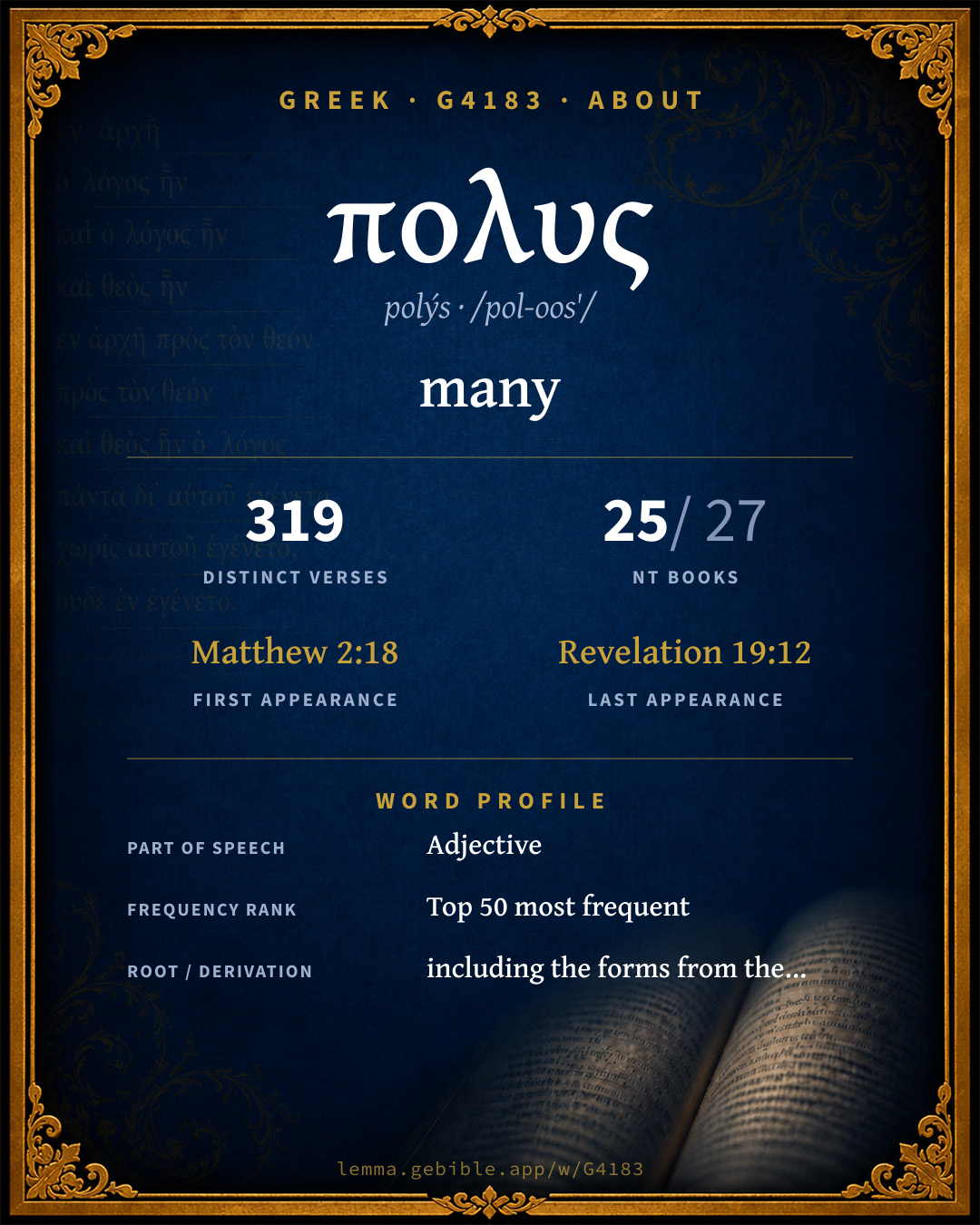
πολυς
many
Full lexicon entry — Thayer's Greek Lexicon
From Thayer's Greek Lexicon
Where this word appears
See every Nominative-case word in the Greek New Testament →
Grammar key — what these labels mean
Part of speech
- Adjective
- A word that describes or qualifies a noun.
Case
- Nominative
- The case of the subject (and the predicate nominative).
- Accusative
- The case of the direct object and of extent.
- Genitive
- The case of source, possession, or “of” — answers “whose / from what.”
- Dative
- The case of the indirect object, means, or location — “to / for / with / in.”
Gender
- Masculine
- Grammatically masculine.
- Neuter
- Grammatically neuter.
- Feminine
- Grammatically feminine.
Number
- Plural
- More than one.
- Singular
- One.
Grammatical forms 24 distinct
- Adjective, Nominative, Plural, Masculine 83 times (23%)
- Adjective, Accusative, Plural, Neuter 48 times (14%)
- Adjective, Nominative, Singular, Masculine 26 times (7%)
- Adjective, Accusative, Plural, Masculine 23 times (6%)
- Adjective, Genitive, Plural, Masculine 19 times (5%)
- Adjective, Genitive, Plural, Neuter 17 times (5%)
- Adjective, Accusative, Singular, Neuter 15 times (4%)
- Adjective, Dative, Singular, Neuter 14 times (4%)
+16 more forms (109 occurrences)
Parsed forms decoded from the imported morphology (Robinson–Tischendorf, public domain), counted across 354 parsed occurrences — not distinct verses.
Page 1 of 2 — showing verses 1–200 of 319 distinct verses where G4183 appears, across 25 books. Click any verse to open its interlinear word-by-word view. Verse text shown in the World English Bible for context — . Each verse’s Greek form is shown with its reference; the English is not keyword-highlighted, since the data carries no word-level English alignment. Use “Compare translations” on any verse to read it across multiple English versions. This concordance covers the Greek New Testament; Septuagint (Greek Old Testament) occurrences of this word are not indexed here.
Matthew 46 verses
- Matthew 2:18 πολύς adj nom sg masc "A voice was heard in Ramah, Lamentation, weeping and great mourning, Rachel weeping for her children; She wouldn't be comforted, Because they are no more."
- Matthew 3:7 πολλοὺς adj acc pl masc But when he saw many of the Pharisees and Sadducees coming for his baptism, he said to them, "You offspring of vipers, who warned you to flee from the wrath to come?
- Matthew 4:25 πολλοὶ adj nom pl masc Great multitudes from Galilee, Decapolis, Jerusalem, Judea and from beyond the Jordan followed him.
- Matthew 5:12 πολὺς adj nom sg masc Rejoice, and be exceedingly glad, for great is your reward in heaven. For that is how they persecuted the prophets who were before you.
- Matthew 6:30 πολλῷ adj dat sg neut But if God so clothes the grass of the field, which today exists, and tomorrow is thrown into the oven, won't he much more clothe you, you of little faith?
- Matthew 7:13 πολλοί adj nom pl masc "Enter in by the narrow gate; for wide is the gate and broad is the way that leads to destruction, and many are those who enter in by it.
- Matthew 7:22 πολλοὶ πολλὰς adj nom pl masc adj acc pl fem Many will tell me in that day, 'Lord, Lord, didn't we prophesy in your name, in your name cast out demons, and in your name do many mighty works?'
- Matthew 8:1 πολλοί adj nom pl masc When he came down from the mountain, great multitudes followed him.
- Matthew 8:11 πολλοὶ adj nom pl masc I tell you that many will come from the east and the west, and will sit down with Abraham, Isaac, and Jacob in the Kingdom of Heaven,
- Matthew 8:16 πολλούς adj acc pl masc When evening came, they brought to him many possessed with demons. He cast out the spirits with a word, and healed all who were sick;
- Matthew 8:18 πολλοὺς adj acc pl masc Now when Jesus saw great multitudes around him, he gave the order to depart to the other side.
- Matthew 8:30 πολλῶν adj gen pl masc Now there was a herd of many pigs feeding far away from them.
- Matthew 9:10 πολλοὶ adj nom pl masc It happened as he sat in the house, behold, many tax collectors and sinners came and sat down with Jesus and his disciples.
- Matthew 9:37 πολύς adj nom sg masc Then he said to his disciples, "The harvest indeed is plentiful, but the laborers are few.
- Matthew 10:31 πολλῶν adj gen pl neut Therefore don't be afraid. You are of more value than many sparrows.
- Matthew 12:15 πολλοί adj nom pl masc Jesus, perceiving that, withdrew from there. Great multitudes followed him; and he healed them all,
- Matthew 13:2 πολλοί adj nom pl masc Great multitudes gathered to him, so that he entered into a boat, and sat, and all the multitude stood on the beach.
- Matthew 13:3 πολλὰ adj acc pl neut He spoke to them many things in parables, saying, "Behold, a farmer went out to sow.
- Matthew 13:5 πολλήν adj acc sg fem Others fell on rocky ground, where they didn't have much soil, and immediately they sprang up, because they had no depth of earth.
- Matthew 13:17 πολλοὶ adj nom pl masc For most assuredly I tell you that many prophets and righteous men desired to see the things which you see, and didn't see them; and to hear the things which you hear, and didn't hear them.
- Matthew 13:58 πολλὰς adj acc pl fem He didn't do many mighty works there because of their unbelief.
- Matthew 14:14 πολὺν adj acc sg masc Jesus went out, and he saw a great multitude. He had compassion on them, and healed their sick.
- Matthew 15:30 πολλοὶ πολλούς adj nom pl masc adj acc pl masc Great multitudes came to him, having with them the lame, blind, mute, maimed, and many others, and they put them down at his feet. He healed them,
- Matthew 16:21 πολλὰ adj acc pl neut From that time, Jesus began to show his disciples that he must go to Jerusalem and suffer many things from the elders, chief priests, and scribes, and be killed, and the third day be raised up.
- Matthew 19:2 πολλοί adj nom pl masc Great multitudes followed him, and he healed them there.
- Matthew 19:22 πολλά adj acc pl neut But when the young man heard the saying, he went away sad, for he was one who had great possessions.
- Matthew 19:30 πολλοὶ adj nom pl masc But many will be last who are first; and first who are last.
- Matthew 20:28 πολλῶν adj gen pl masc even as the Son of Man came not to be served, but to serve, and to give his life as a ransom for many."
- Matthew 20:29 πολύς adj nom sg masc As they went out from Jericho, a great multitude followed him.
- Matthew 22:14 πολλοὶ adj nom pl masc For many are called, but few chosen."
- Matthew 24:5 πολλοὶ πολλοὺς adj nom pl masc adj acc pl masc For many will come in my name, saying, 'I am the Christ,' and will lead many astray.
- Matthew 24:10 πολλοὶ adj nom pl masc Then many will stumble, and will deliver up one another, and will hate one another.
- Matthew 24:11 πολλοὶ πολλούς adj nom pl masc adj acc pl masc Many false prophets will arise, and will lead many astray.
- Matthew 24:12 πολλῶν adj gen pl masc Because iniquity will be multiplied, the love of many will grow cold.
- Matthew 24:30 πολλῆς adj gen sg fem and then the sign of the Son of Man will appear in the sky. Then all the tribes of the earth will mourn, and they will see the Son of Man coming on the clouds of the sky with power and great glory.
- Matthew 25:19 πολὺν adj acc sg masc "Now after a long time the lord of those servants came, and reconciled accounts with them.
- Matthew 25:21 πολλῶν adj gen pl neut "His lord said to him, 'Well done, good and faithful servant. You have been faithful over a few things, I will set you over many things. Enter into the joy of your lord.'
- Matthew 25:23 πολλῶν adj gen pl neut "His lord said to him, 'Well done, good and faithful servant. You have been faithful over a few things, I will set you over many things. Enter into the joy of your lord.'
- Matthew 26:9 πολλοῦ adj gen sg neut For this ointment might have been sold for much, and given to the poor."
- Matthew 26:28 πολλῶν adj gen pl masc for this is my blood of the new covenant, which is poured out for many for the remission of sins.
- Matthew 26:47 πολὺς adj nom sg masc While he was still speaking, behold, Judas, one of the twelve, came, and with him a great multitude with swords and clubs, from the chief priest and elders of the people.
- Matthew 26:60 πολλῶν adj gen pl masc and they found none. Even though many false witnesses came forward, they found none. But at last two false witnesses came forward,
- Matthew 27:19 πολλὰ adj acc pl neut While he was sitting on the judgment seat, his wife sent to him, saying, "Have nothing to do with that righteous man, for I have suffered many things this day in a dream because of him."
- Matthew 27:52 πολλὰ adj nom pl neut The tombs were opened, and many bodies of the saints who had fallen asleep were raised;
- Matthew 27:53 πολλοῖς adj dat pl masc and coming out of the tombs after his resurrection, they entered into the holy city and appeared to many.
- Matthew 27:55 πολλαὶ adj nom pl fem Many women were there watching from afar, who had followed Jesus from Galilee, serving him.
Mark 48 verses
- Mark 1:34 πολλοὺς πολλὰ adj acc pl masc adj acc pl neut He healed many who were sick with various diseases, and cast out many demons. He didn't allow the demons to speak, because they knew him.
- Mark 1:45 πολλὰ adj acc pl neut But he went out, and began to proclaim it much, and to spread about the matter, so that Jesus could no more openly enter into a city, but was outside in desert places: and they came to him from everywhere.
- Mark 2:2 πολλοὶ adj nom pl masc Immediately many were gathered together, so that there was no more room, not even around the door; and he spoke the word to them.
- Mark 2:15 πολλοὶ πολλοὶ adj nom pl masc adj nom pl masc It happened, that he was reclining at the table in his house, and many tax collectors and sinners sat down with Jesus and his disciples, for there were many, and they followed him.
- Mark 3:7 πολὺ adj nom sg neut Jesus withdrew to the sea with his disciples, and a great multitude followed him from Galilee, from Judea,
- Mark 3:8 πολύ adj nom sg neut from Jerusalem, from Idumaea, beyond the Jordan, and those from around Tyre and Sidon. A great multitude, hearing what great things he did, came to him.
- Mark 3:10 πολλοὺς adj acc pl masc For he had healed many, so that as many as had diseases pressed on him that they might touch him.
- Mark 3:12 πολλὰ adj acc pl neut He sternly warned them that they should not make him known.
- Mark 4:2 πολλά adj acc pl neut He taught them many things in parables, and told them in his teaching,
- Mark 4:5 πολλήν adj acc sg fem Others fell on the rocky ground, where it had little soil, and immediately it sprang up, because it had no depth of soil.
- Mark 4:33 πολλαῖς adj dat pl fem With many such parables he spoke the word to them, as they were able to hear it.
- Mark 5:9 πολλοί adj nom pl masc He asked him, "What is your name?" He said to him, "My name is Legion, for we are many."
- Mark 5:10 πολλὰ adj acc pl neut He begged him much that he would not send them away out of the country.
- Mark 5:21 πολὺς adj nom sg masc When Jesus had crossed back over in the boat to the other side, a great multitude was gathered to him; and he was by the sea.
- Mark 5:23 πολλὰ adj acc pl neut and begged him much, saying, "My little daughter is at the point of death. Please come and lay your hands on her, that she may be made healthy, and live."
- Mark 5:24 πολύς adj nom sg masc He went with him, and a great multitude followed him, and they pressed upon him on all sides.
- Mark 5:26 πολλὰ πολλῶν adj acc pl neut adj gen pl masc and had suffered many things by many physicians, and had spent all that she had, and was no better, but rather grew worse,
- Mark 5:38 πολλά adj acc pl neut He came to the synagogue ruler's house, and he saw an uproar, weeping, and great wailing.
- Mark 5:43 πολλὰ adj acc pl neut He strictly ordered them that no one should know this, and commanded that something should be given to her to eat.
- Mark 6:2 πολλοὶ adj nom pl masc When the Sabbath had come, he began to teach in the synagogue, and many hearing him were astonished, saying, "Where did this man get these things?" and, "What is the wisdom that is given to this man, that such mighty works come about by his hands?
- Mark 6:13 πολλὰ πολλοὺς adj acc pl neut adj acc pl masc They cast out many demons, and anointed many with oil who were sick, and healed them.
- Mark 6:20 πολλὰ adj acc pl neut for Herod feared John, knowing that he was a righteous and holy man, and kept him safe. When he heard him, he did many things, and he heard him gladly.
- Mark 6:31 πολλοί adj nom pl masc He said to them, "You come apart into a deserted place, and rest awhile." For there were many coming and going, and they had no leisure so much as to eat.
- Mark 6:33 πολλοί adj nom pl masc They saw them going, and many recognized him and ran there on foot from all the cities. They arrived before them and came together to him.
- Mark 6:34 πολὺν πολλά adj acc sg masc adj acc pl neut Jesus came out, saw a great multitude, and he had compassion on them, because they were like sheep without a shepherd, and he began to teach them many things.
- Mark 6:35 πολλῆς πολλή adj gen sg fem adj nom sg fem When it was late in the day, his disciples came to him, and said, "This place is deserted, and it is late in the day.
- Mark 7:4 πολλά adj nom pl neut They don't eat when they come from the marketplace, unless they bathe themselves, and there are many other things, which they have received to hold to: washings of cups, pitchers, bronze vessels, and couches.)
- Mark 7:13 πολλὰ adj acc pl neut making void the word of God by your tradition, which you have handed down. You do many things like this."
- Mark 8:1 πόλλου adj gen sg masc In those days, when there was a very great multitude, and they had nothing to eat, Jesus called his disciples to himself, and said to them,
- Mark 8:31 πολλὰ adj acc pl neut He began to teach them that the Son of Man must suffer many things, and be rejected by the elders, the chief priests, and the scribes, and be killed, and after three days rise again.
- Mark 9:12 πολλὰ adj acc pl neut He said to them, "Elijah indeed comes first, and restores all things. How is it written about the Son of Man, that he should suffer many things and be despised?
- Mark 9:14 πολὺν adj acc sg masc Coming to the disciples, he saw a great multitude around them, and scribes questioning them.
- Mark 9:26 πολλὰ πολλοὺς adj nom pl neut adj acc pl masc Having cried out, and convulsed greatly, it came out of him. The boy became like one dead; so much that most of them said, "He is dead."
- Mark 10:22 πολλά adj acc pl neut But his face fell at that saying, and he went away sorrowful, for he was one who had great possessions.
- Mark 10:31 πολλοὶ adj nom pl masc But many who are first will be last; and the last first."
- Mark 10:45 πολλῶν adj gen pl masc For the Son of Man also came not to be served, but to serve, and to give his life as a ransom for many."
- Mark 10:48 πολλοὶ πολλῷ adj nom pl masc adj dat sg neut Many rebuked him, that he should be quiet, but he cried out much more, "You son of David, have mercy on me!"
- Mark 11:8 πολλοὶ adj nom pl masc Many spread their garments on the way, and others were cutting down branches from the trees, and spreading them on the road.
- Mark 12:5 πολλοὺς adj acc pl masc Again he sent another; and they killed him; and many others, beating some, and killing some.
- Mark 12:27 πολὺ adj acc sg neut He is not the God of the dead, but of the living. You are therefore badly mistaken."
- Mark 12:37 πολὺς adj nom sg masc Therefore David himself calls him Lord, so how can he be his son?" The common people heard him gladly.
- Mark 12:41 πολλοὶ πολλά adj nom pl masc adj acc pl neut Jesus sat down opposite the treasury, and saw how the multitude cast money into the treasury. Many who were rich cast in much.
- Mark 13:6 πολλοὶ πολλοὺς adj nom pl masc adj acc pl masc For many will come in my name, saying, 'I am he!' and will lead many astray.
- Mark 13:26 πολλῆς adj gen sg fem Then they will see the Son of Man coming in clouds with great power and glory.
- Mark 14:24 πολλῶν adj gen pl masc He said to them, "This is my blood of the new covenant, which is poured out for many.
- Mark 14:56 πολλοὶ adj nom pl masc For many gave false testimony against him, and their testimony didn't agree with each other.
- Mark 15:3 πολλά adj acc pl neut The chief priests accused him of many things.
- Mark 15:41 πολλαὶ adj nom pl fem who, when he was in Galilee, followed him, and served him; and many other women who came up with him to Jerusalem.
Luke 44 verses
- Luke 1:1 πολλοὶ adj nom pl masc Since many have undertaken to set in order a narrative concerning those matters which have been fulfilled among us,
- Luke 1:14 πολλοὶ adj nom pl masc You will have joy and gladness; and many will rejoice at his birth.
- Luke 1:16 πολλοὺς adj acc pl masc He will turn many of the children of Israel to the Lord, their God.
- Luke 2:34 πολλῶν adj gen pl masc and Simeon blessed them, and said to Mary, his mother, "Behold, this child is set for the falling and the rising of many in Israel, and for a sign which is spoken against.
- Luke 2:35 πολλῶν adj gen pl fem Yes, a sword will pierce through your own soul, that the thoughts of many hearts may be revealed."
- Luke 2:36 πολλαῖς adj dat pl fem There was one Anna, a prophetess, the daughter of Phanuel, of the tribe of Asher (she was of a great age, having lived with a husband seven years from her virginity,
- Luke 3:18 Πολλὰ adj acc pl neut Then with many other exhortations he preached good news to the people,
- Luke 4:25 πολλαὶ adj nom pl fem But truly I tell you, there were many widows in Israel in the days of Elijah, when the sky was shut up three years and six months, when a great famine came over all the land.
- Luke 4:27 πολλοὶ adj nom pl masc There were many lepers in Israel in the time of Elisha the prophet, yet not one of them was cleansed, except Naaman, the Syrian."
- Luke 4:41 πολλῶν adj gen pl masc Demons also came out from many, crying out, and saying, "You are the Christ, the Son of God!" Rebuking them, he didn't allow them to speak, because they knew that he was the Christ.
- Luke 5:6 πολύ adj acc sg neut When they had done this, they caught a great multitude of fish, and their net was breaking.
- Luke 5:15 πολλοὶ adj nom pl masc But the report concerning him spread much more, and great multitudes came together to hear, and to be healed by him of their infirmities.
- Luke 5:29 πολὺς adj nom sg masc Levi made a great feast for him in his house. There was a great crowd of tax collectors and others who were reclining with them.
- Luke 6:17 πολὺς πολὺ adj nom sg masc adj nom sg neut He came down with them, and stood on a level place, with a crowd of his disciples, and a great number of the people from all Judea and Jerusalem, and the sea coast of Tyre and Sidon, who came to hear him and to be healed of their diseases;
- Luke 6:23 πολὺς adj nom sg masc Rejoice in that day, and leap for joy, for behold, your reward is great in heaven, for their fathers did the same thing to the prophets.
- Luke 6:35 πολύς adj nom sg masc But love your enemies, and do good, and lend, expecting nothing back; and your reward will be great, and you will be children of the Most High; for he is kind toward the unthankful and evil.
- Luke 7:11 πολύς adj nom sg masc It happened soon afterwards, that he went to a city called Nain. Many of his disciples, along with a great multitude, went with him.
- Luke 7:21 πολλοὺς πολλοῖς adj acc pl masc adj dat pl masc In that hour he cured many of diseases and plagues and evil spirits; and to many who were blind he gave sight.
- Luke 7:47 πολλαί πολύ adj nom pl fem adj acc sg neut Therefore I tell you, her sins, which are many, are forgiven, for she loved much. But to whom little is forgiven, the same loves little."
- Luke 8:3 πολλαί adj nom pl fem and Joanna, the wife of Chuzas, Herod's steward; Susanna; and many others; who ministered to them from their possessions.
- Luke 8:4 πολλοῦ adj gen sg masc When a great multitude came together, and people from every city were coming to him, he spoke by a parable.
- Luke 8:29 πολλοῖς adj dat pl masc For Jesus was commanding the unclean spirit to come out of the man. For the unclean spirit had often seized the man. He was kept under guard, and bound with chains and fetters. Breaking the bands apart, he was driven by the demon into the desert.
- Luke 8:30 πολλὰ adj nom pl neut Jesus asked him, "What is your name?" He said, "Legion," for many demons had entered into him.
- Luke 9:22 πολλὰ adj acc pl neut saying, "The Son of Man must suffer many things, and be rejected by the elders, chief priests, and scribes, and be killed, and the third day be raised up."
- Luke 9:37 πολύς adj nom sg masc It happened on the next day, when they had come down from the mountain, that a great multitude met him.
- Luke 10:2 πολύς adj nom sg masc Then he said to them, "The harvest is indeed plentiful, but the laborers are few. Pray therefore to the Lord of the harvest, that he may send out laborers into his harvest.
- Luke 10:24 πολλοὶ adj nom pl masc for I tell you that many prophets and kings desired to see the things which you see, and didn't see them, and to hear the things which you hear, and didn't hear them."
- Luke 10:40 πολλὴν adj acc sg fem But Martha was distracted with much serving, and she came up to him, and said, "Lord, don't you care that my sister left me to serve alone? Ask her therefore to help me."
- Luke 10:41 πολλά adj acc pl neut Jesus answered her, "Martha, Martha, you are anxious and troubled about many things,
- Luke 12:7 πολλῶν adj gen pl neut But the very hairs of your head are all numbered. Therefore don't be afraid. You are of more value than many sparrows.
- Luke 12:19 πολλὰ πολλά adj acc pl neut adj acc pl neut I will tell my soul, "Soul, you have many goods laid up for many years. Take your ease, eat, drink, be merry."'
- Luke 12:47 πολλάς adj acc pl fem That servant, who knew his lord's will, and didn't prepare, nor do what he wanted, will be beaten with many stripes,
- Luke 12:48 πολύ πολὺ πολύ adj nom sg neut adj nom sg neut adj acc sg neut but he who didn't know, and did things worthy of stripes, will be beaten with few stripes. To whoever much is given, of him will much be required; and to whom much was entrusted, of him more will be asked.
- Luke 13:24 πολλοί adj nom pl masc "Strive to enter in by the narrow door, for many, I tell you, will seek to enter in, and will not be able.
- Luke 14:16 πολλούς adj acc pl masc But he said to him, "A certain man made a great supper, and he invited many people.
- Luke 14:25 πολλοί adj nom pl masc Now great multitudes were going with him. He turned and said to them,
- Luke 15:13 πολλὰς adj acc pl fem Not many days after, the younger son gathered all of this together and traveled into a far country. There he wasted his property with riotous living.
- Luke 16:10 πολλῷ πολλῷ adj dat sg neut adj dat sg neut He who is faithful in a very little is faithful also in much. He who is dishonest in a very little is also dishonest in much.
- Luke 17:25 πολλὰ adj acc pl neut But first, he must suffer many things and be rejected by this generation.
- Luke 18:39 πολλῷ adj dat sg neut Those who led the way rebuked him, that he should be quiet; but he cried out all the more, "You son of David, have mercy on me!"
- Luke 21:8 πολλοὶ adj nom pl masc He said, "Watch out that you don't get led astray, for many will come in my name, saying, 'I AM,' and, 'The time is at hand.' Therefore don't follow them.
- Luke 21:27 πολλῆς adj gen sg fem Then they will see the Son of Man coming in a cloud with power and great glory.
- Luke 22:65 πολλὰ adj acc pl neut They spoke many other things against him, insulting him.
- Luke 23:27 πολὺ adj nom sg neut A great multitude of the people followed him, including women who also mourned and lamented him.
John 35 verses
- John 2:12 πολλὰς adj acc pl fem After this, he went down to Capernaum, he, and his mother, his brothers, and his disciples; and they stayed there a few days.
- John 2:23 πολλοὶ adj nom pl masc Now when he was in Jerusalem at the Passover, during the feast, many believed in his name, observing his signs which he did.
- John 3:23 πολλὰ adj nom pl neut John also was baptizing in Enon near Salim, because there was much water there. They came, and were baptized.
- John 4:39 πολλοὶ adj nom pl masc From that city many of the Samaritans believed in him because of the word of the woman, who testified, "He told me everything that I did."
- John 4:41 πολλῷ adj dat sg masc Many more believed because of his word.
- John 5:6 πολὺν adj acc sg masc When Jesus saw him lying there, and knew that he had been sick for a long time, he asked him, "Do you want to be made well?"
- John 6:2 πολύς adj nom sg masc A great multitude followed him, because they saw his signs which he did on those who were sick.
- John 6:5 πολὺς adj nom sg masc Jesus therefore lifting up his eyes, and seeing that a great multitude was coming to him, said to Philip, "Where are we to buy bread, that these may eat?"
- John 6:10 πολὺς adj nom sg masc Jesus said, "Have the people sit down." Now there was much grass in that place. So the men sat down, in number about five thousand.
- John 6:60 Πολλοὶ adj nom pl masc Therefore many of his disciples, when they heard this, said, "This is a hard saying! Who can listen to it?"
- John 6:66 πολλοὶ adj nom pl masc At this, many of his disciples went back, and walked no more with him.
- John 7:12 πολὺς adj nom sg masc There was much murmuring among the multitudes concerning him. Some said, "He is a good man." Others said, "Not so, but he leads the multitude astray."
- John 7:31 Πολλοὶ adj nom pl masc But of the multitude, many believed in him. They said, "When the Christ comes, he won't do more signs than those which this man has done, will he?"
- John 8:26 πολλὰ adj acc pl neut I have many things to speak and to judge concerning you. However he who sent me is true; and the things which I heard from him, these I say to the world."
- John 8:30 πολλοὶ adj nom pl masc As he spoke these things, many believed in him.
- John 10:20 πολλοὶ adj nom pl masc Many of them said, "He has a demon, and is insane! Why do you listen to him?"
- John 10:32 πολλὰ adj acc pl neut Jesus answered them, "I have shown you many good works from my Father. For which of those works do you stone me?"
- John 10:41 πολλοὶ adj nom pl masc Many came to him. They said, "John indeed did no sign, but everything that John said about this man is true."
- John 10:42 πολλοὶ adj nom pl masc Many believed in him there.
- John 11:19 πολλοὶ adj nom pl masc Many of the Jews had joined the women around Martha and Mary, to console them concerning their brother.
- John 11:45 Πολλοὶ adj nom pl masc Therefore many of the Jews, who came to Mary and saw what Jesus did, believed in him.
- John 11:47 πολλὰ adj acc pl neut The chief priests therefore and the Pharisees gathered a council, and said, "What are we doing? For this man does many signs.
- John 11:55 πολλοὶ adj nom pl masc Now the Passover of the Jews was at hand. Many went up from the country to Jerusalem before the Passover, to purify themselves.
- John 12:9 πολὺς adj nom sg masc A large crowd therefore of the Jews learned that he was there, and they came, not for Jesus' sake only, but that they might see Lazarus also, whom he had raised from the dead.
- John 12:11 πολλοὶ adj nom pl masc because on account of him many of the Jews went away and believed in Jesus.
- John 12:12 πολὺς adj nom sg masc On the next day a great multitude had come to the feast. When they heard that Jesus was coming to Jerusalem,
- John 12:24 πολὺν adj acc sg masc Most assuredly I tell you, unless a grain of wheat falls into the earth and dies, it remains by itself alone. But if it dies, it bears much fruit.
- John 12:42 πολλοὶ adj nom pl masc Nevertheless even of the rulers many believed in him, but because of the Pharisees they didn't confess it, so that they wouldn't be put out of the synagogue,
- John 14:2 πολλαί adj nom pl fem In my Father's house are many mansions. If it weren't so, I would have told you. I am going to prepare a place for you.
- John 14:30 πολλὰ adj acc pl neut I will no more speak much with you, for the prince of the world comes, and he has nothing in me.
- John 15:5 πολύν adj acc sg masc I am the vine. You are the branches. He who remains in me, and I in him, the same bears much fruit, for apart from me you can do nothing.
- John 15:8 πολὺν adj acc sg masc "In this is my Father glorified, that you bear much fruit; and so you will be my disciples.
- John 16:12 πολλὰ adj acc pl neut "I have yet many things to tell you, but you can't bear them now.
- John 19:20 πολλοὶ adj nom pl masc Therefore many of the Jews read this title, for the place where Jesus was crucified was near the city; and it was written in Hebrew, in Latin, and in Greek.
- John 20:30 Πολλὰ adj acc pl neut Therefore Jesus did many other signs in the presence of his disciples, which are not written in this book;
Acts 45 verses
- Acts 1:3 πολλοῖς adj dat pl neut To these he also showed himself alive after he suffered, by many proofs, appearing to them over a period of forty days, and speaking about God's Kingdom.
- Acts 1:5 πολλὰς adj acc pl fem For John indeed baptized in water, but you will be baptized in the Holy Spirit not many days from now."
- Acts 2:43 πολλά adj nom pl neut Fear came on every soul, and many wonders and signs were done through the apostles.
- Acts 4:4 πολλοὶ adj nom pl masc But many of those who heard the word believed, and the number of the men came to be about five thousand.
- Acts 5:12 πολλὰ adj nom pl neut By the hands of the apostles many signs and wonders were done among the people. They were all with one accord in Solomon's porch.
- Acts 6:7 πολύς adj nom sg masc The word of God increased and the number of the disciples multiplied in Jerusalem exceedingly. A great company of the priests were obedient to the faith.
- Acts 8:7 πολλοὶ πολλοὶ adj nom pl masc adj nom pl masc For unclean spirits came out of many of those who had them. They came out, crying with a loud voice. Many who had been paralyzed and lame were healed.
- Acts 8:8 πολλὴ adj nom sg fem There was great joy in that city.
- Acts 8:25 πολλάς adj acc pl fem They therefore, when they had testified and spoken the word of the Lord, returned to Jerusalem, and preached the Gospel to many villages of the Samaritans.
- Acts 9:13 πολλῶν adj gen pl masc But Ananias answered, "Lord, I have heard from many about this man, how much evil he did to your saints at Jerusalem.
- Acts 9:42 πολλοὶ adj nom pl masc And it became known throughout all Joppa, and many believed in the Lord.
- Acts 10:2 πολλὰς adj acc pl fem a devout man, and one who feared God with all his house, who gave gifts for the needy generously to the people, and always prayed to God.
- Acts 10:27 πολλούς adj acc pl masc As he talked with him, he went in and found many gathered together.
- Acts 11:21 πολύς adj nom sg masc The hand of the Lord was with them, and a great number believed and turned to the Lord.
- Acts 13:43 πολλοὶ adj nom pl masc Now when the synagogue broke up, many of the Jews and of the devout proselytes followed Paul and Barnabas; who, speaking to them, urged them to continue in the grace of God.
- Acts 14:1 πολὺ adj acc sg neut It happened in Iconium that they entered together into the synagogue of the Jews, and so spoke that a great multitude both of Jews and of Greeks believed.
- Acts 14:22 πολλῶν adj gen pl fem confirming the souls of the disciples, exhorting them to continue in the faith, and that through many afflictions we must enter into the Kingdom of God.
- Acts 15:7 πολλῆς adj gen sg fem When there had been much discussion, Peter rose up and said to them, "Brothers, you know that a good while ago God made choice among you, that by my mouth the Gentiles should hear the word of the Gospel, and believe.
- Acts 15:32 πολλοῦ adj gen sg masc Judas and Silas, also being prophets themselves, encouraged the brothers with many words, and strengthened them.
- Acts 15:35 πολλῶν adj gen pl masc But Paul and Barnabas stayed in Antioch, teaching and preaching the word of the Lord, with many others also.
- Acts 16:16 πολλὴν adj acc sg fem It happened, as we were going to prayer, that a certain girl having a spirit of divination met us, who brought her masters much gain by fortune telling.
- Acts 16:18 πολλὰς adj acc pl fem She was doing this for many days. But Paul, becoming greatly annoyed, turned and said to the spirit, "I charge you in the name of Jesus Christ to come out of her!" It came out that very hour.
- Acts 16:23 πολλάς adj acc pl fem When they had laid many stripes on them, they threw them into prison, charging the jailer to keep them safely,
- Acts 17:4 πολὺ adj nom sg neut Some of them were persuaded, and joined Paul and Silas, of the devout Greeks a great multitude, and not a few of the chief women.
- Acts 17:12 πολλοὶ adj nom pl masc Many of them therefore believed; also of the prominent Greek women, and not a few men.
- Acts 18:8 πολλοὶ adj nom pl masc Crispus, the ruler of the synagogue, believed in the Lord with all his house. Many of the Corinthians, when they heard, believed and were baptized.
- Acts 18:10 πολὺς adj nom sg masc for I am with you, and no one will attack you to harm you, for I have many people in this city."
About this entry
At a glance — auto-summarized from this page’s data, not written by a person. Every figure links to its source below. This summary describes the numbers; it doesn’t interpret them.
The Greek adjective πολυς centers on the idea of “many.” Debuting at Matthew 2:18, it then recurs through the corpus. Spanning 319 verses in 25 books, it ranks among the common words of the Greek New Testament. Sharing its root, it stands alongside πλειστος, πλειων and πολλακις. For the data behind this summary, explore the sense tree and the renderings breakdown below.
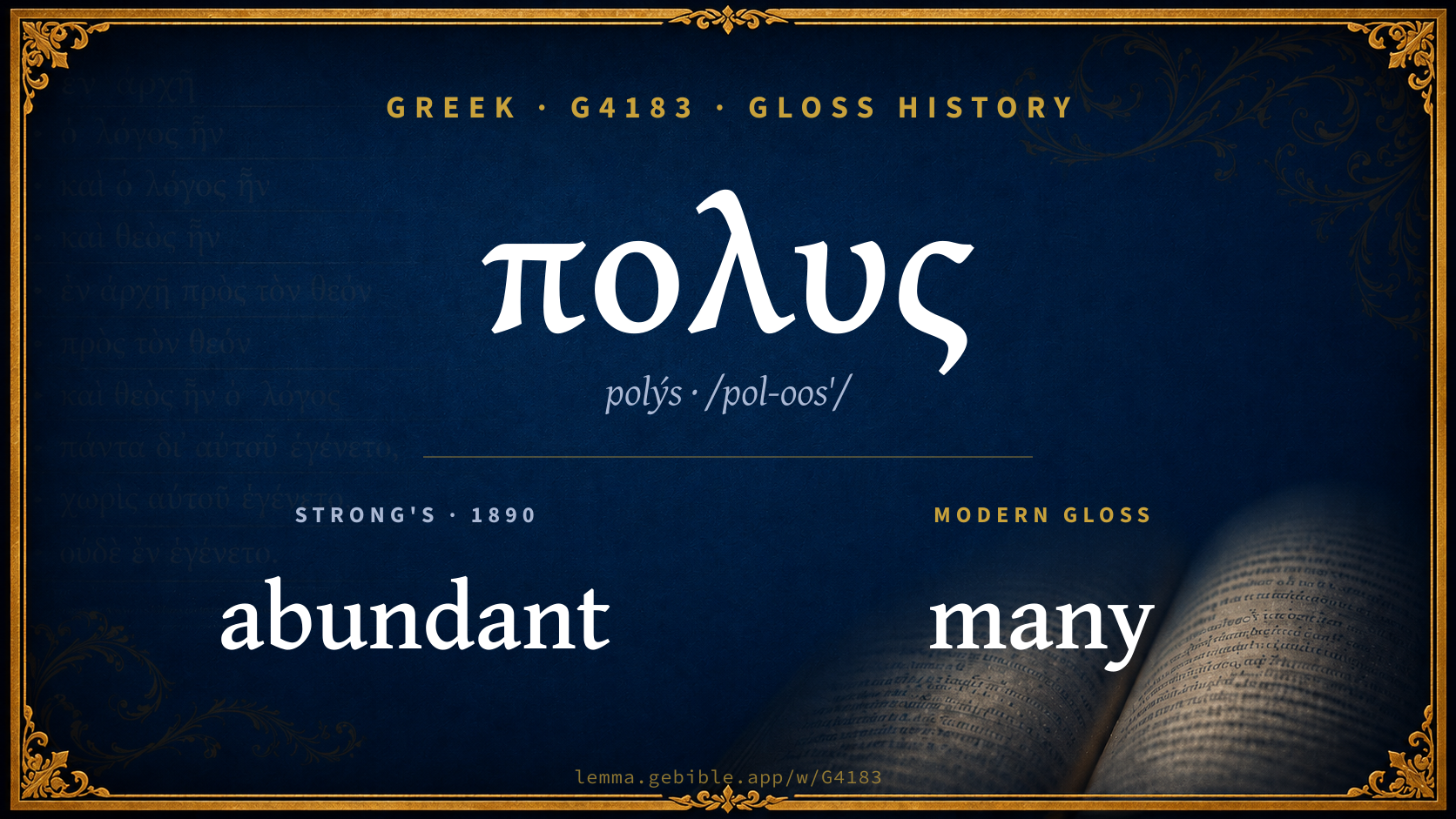
Gloss history
Strong's 1890 vs modern scholarship
About this word
Strong's G4183 catalogs a Greek word from the Greek New Testament.
These counts are not copied from any lexicon or concordance. They are computed here, from the morphology-tagged Greek New Testament. What Lemma adds →
- 319
- distinct verses
- The word appears in 319 distinct verses.
- 25 / 27
- NT books
- The word appears in 25 of 27 New Testament books.
- #50
- by frequency
- Top 50 most frequent Greek words (rank 50 of 5,347 Greek words by occurrence).
View all 319 occurrences in the concordance →
By section of the New Testament
By traditional corpus
Conventional, traditional groupings — biblical authorship is debated, so this is a traditional corpus grouping, not an authorship claim. Some books belong to more than one corpus (Luke is in both the Gospels and the Lukan corpus, and so on), so these shares overlap and need not total 100%. Each figure is a share of the word’s 319 distinct verses.
- Gospels 173 verses · 54%
- Lukan (Luke–Acts) 89 verses · 28%
- Pauline corpus 71 verses · 22%
- Johannine 53 verses · 17%
- Revelation 13 verses · 4%
- General (Catholic) Epistles 10 verses · 3%
- Hebrews 7 verses · 2%
How translations render this word
Counts come from each version’s own published word-to-Strong’s tagging or interlinear alignment — an approximate guide to how each version renders this word, not a word-level alignment the data otherwise carries. Because each total is that version’s own tagged count, the per-version totals vary from one another and need not match the appearance or distinct-verse counts above. These counts may also differ from a printed concordance because Lemma counts each distinctly tagged rendering and does not collapse phrase taggings into a single head-word total. This is a fixed set of word-tagged versions (KJV, ASV, BSB, ULT) and does not change with the reading translation you choose elsewhere. Each version’s license is shown beside its name below (and on Sources).
- King James Version: Many 172×, Much 72×, Great 56×
- American Standard Version: Many 170×, Much 63×, Great 53×
- Berean Standard Bible: Many 167×, Great 37×, Large 30×
- unfoldingWord Literal Text: Many 189×, Much 63×, Great 31×
King James Version Public Domain
Renders G4183 across 364 tagged occurrences — most commonly:
Plus 24 renderings that appear only once — usually multi-word phrases or single function words the recovered tagging swept in, not distinct renderings. Not rendered by a distinct English word in 3 further occurrences.
American Standard Version Public Domain
Renders G4183 across 354 tagged occurrences — most commonly:
Plus other, less common renderings. Plus 28 renderings that appear only once — usually multi-word phrases or single function words the recovered tagging swept in, not distinct renderings.
Berean Standard Bible Public Domain
Renders G4183 across 338 tagged occurrences — most commonly:
Plus other, less common renderings. Plus 33 renderings that appear only once — usually multi-word phrases or single function words the recovered tagging swept in, not distinct renderings. Not rendered by a distinct English word in 14 further occurrences.
unfoldingWord Literal Text CC BY-SA 4.0
Renders G4183 across 343 tagged occurrences — most commonly:
Plus other, less common renderings. Plus 7 renderings that appear only once — usually multi-word phrases or single function words the recovered tagging swept in, not distinct renderings.
Senses in Thayer's
The 1 sense Thayer's distinguishes for this word, in lexicon order (not ranked by frequency or importance). The full entry — with sub-senses — is in the Lexicon Entry tab.
- many, much, large
Word origin
Origin: including the forms from the alternate pollos
Including the forms from the alternate pollos; (singular) much (in any respect) or (plural) many ; neuter (singular) as adverb largely ; neuter (plural) as adverb or noun often mostly largely : - abundant + altogether common + far (passed spent) (+ be of a) great (age deal -ly while) long many much oft (-en [-times]) plenteous sore straitly. Compare G4118 G4119 .
— Strong’s Exhaustive Concordance (1890), public domain.
Forms in the corpus
The 30 distinct written forms G4183 takes in the Greek New Testament, most frequent first — each parse links to that case’s occurrences in the concordance.
Same root — word family
Other Thayer's entries built from the same root as G4183, grouped by Strong’s listed origin. These share a root / origin per the lexicon — not necessarily a shared meaning. Each links to that word’s own entry.
Derived from this word
- πλειστος pleîstos G4118 most
- πλειων pleíōn G4119 greater
- πολλακις pollákis G4178 often
- πολλαπλασιων pollaplasíōn G4179 manifold
- πολυλογια polylogía G4180 much speaking
- πολυμερως polymerōs G4181 by many times
- πολυποικιλος polypoíkilos G4182 much variegated
- πολυσπλαγχνος polýsplanchnos G4184 compassionate
- πολυτελης polytelḗs G4185 precious
- πολυτιμος polýtimos G4186 very valuable
- πολυτροπως polytrópōs G4187 in many ways
Compare all same-root words → Showing 4 of 12 — not the complete family. They share a root, not necessarily a meaning.
Septuagint usage
The same Greek word πολυς appears 543 times in the Greek Old Testament (Septuagint), across 509 verses in 35 books.
- 543
- LXX occurrences
- Tagged occurrences of this Greek word in the Septuagint.
- 509
- verses
- Distinct Septuagint verses containing this word.
- 35 / 39
- OT books
- The word appears in 35 of the 39 Old Testament books.
Sample Septuagint occurrences
- Genesis 6:1 πολύς
- Exodus 1:12 πολύς
- Leviticus 15:25 πολύς
- Numbers 9:19 πολύς
- Deuteronomy 1:28 πολύς
- Joshua 5:6 πολύς
- Judges 7:2 πολύς
- 1 Samuel 2:5 πολύς
- 2 Samuel 1:4 πολύς
- 1 Kings 2:35 πολύς
- 2 Kings 6:16 πολύς
- 1 Chronicles 4:27 πολύς
Septuagint occurrences (same lexeme)
Every verse where the same Strong’s number (G4183) appears in the Greek Septuagint — showing the first 50 of 509. Verse text shown in the World English Bible for context; the Greek form is the matched word — the English is not keyword-highlighted.
- Genesis 6:1 πολύς It happened, when men began to multiply on the surface of the ground, and daughters were born to them,
- Genesis 13:6 πολύς The land was not able to bear them, that they might live together: for their substance was great, so that they could not live together.
- Genesis 15:1 πολύς After these things the word of Yahweh came to Abram in a vision, saying, "Don't be afraid, Abram. I am your shield, your exceedingly great reward."
- Genesis 15:14 πολύς I will also judge that nation, whom they will serve. Afterward they will come out with great substance.
- Genesis 17:5 πολύς Neither will your name any more be called Abram, but your name will be Abraham; for the father of a multitude of nations have I made you.
- Genesis 18:18 πολύς seeing that Abraham has surely become a great and mighty nation, and all the nations of the earth will be blessed in him?
- Genesis 21:34 πολύς Abraham lived as a foreigner in the land of the Philistines many days.
- Genesis 24:25 πολύς She said moreover to him, "We have both straw and provender enough, and room to lodge in."
- Genesis 26:14 πολύς He had possessions of flocks, possessions of herds, and a great household. The Philistines envied him.
- Genesis 29:7 πολύς He said, "Behold, it is still the middle of the day, not time to gather the cattle together. Water the sheep, and go and feed them."
- Genesis 30:43 πολύς The man increased exceedingly, and had large flocks, maid-servants and men-servants, and camels and donkeys.
- Genesis 33:9 πολύς Esau said, "I have enough, my brother; let that which you have be yours."
- Genesis 36:7 πολύς For their substance was too great for them to dwell together, and the land of their travels couldn't bear them because of their cattle.
- Genesis 37:34 πολύς Jacob tore his clothes, and put sackcloth on his loins, and mourned for his son many days.
- Genesis 41:29 πολύς Behold, there come seven years of great plenty throughout all the land of Egypt.
- Genesis 41:49 πολύς Joseph laid up grain as the sand of the sea, very much, until he stopped counting, for it was without number.
- Genesis 46:29 πολύς Joseph made ready his chariot, and went up to meet Israel, his father, in Goshen. He presented himself to him, and fell on his neck, and wept on his neck a good while.
- Genesis 48:16 πολύς the angel who has redeemed me from all evil, bless the lads, and let my name be named on them, and the name of my fathers Abraham and Isaac. Let them grow into a multitude in the midst of the earth."
- Genesis 50:20 πολύς As for you, you meant evil against me, but God meant it for good, to bring to pass, as it is this day, to save many people alive.
- Exodus 1:12 πολύς But the more they afflicted them, the more they multiplied and the more they spread out. They were grieved because of the children of Israel.
- Exodus 2:11 πολύς It happened in those days, when Moses had grown up, that he went out to his brothers, and looked at their burdens. He saw an Egyptian striking a Hebrew, one of his brothers.
- Exodus 2:23 πολύς It happened in the course of those many days, that the king of Egypt died, and the children of Israel sighed because of the bondage, and they cried, and their cry came up to God because of the bondage.
- Exodus 3:8 πολύς I have come down to deliver them out of the hand of the Egyptians, and to bring them up out of that land to a good and large land, to a land flowing with milk and honey; to the place of the Canaanite, the Hittite, the Amorite, the Perizzite, the Hivite, and the Jebusite.
- Exodus 4:19 πολύς Yahweh said to Moses in Midian, "Go, return into Egypt; for all the men who sought your life are dead."
- Exodus 9:18 πολύς Behold, tomorrow about this time I will cause it to rain a very grievous hail, such as has not been in Egypt since the day it was founded even until now.
- Exodus 9:24 πολύς So there was very severe hail, and lightning mixed with the hail, such as had not been in all the land of Egypt since it became a nation.
- Exodus 10:4 πολύς Or else, if you refuse to let my people go, behold, tomorrow I will bring locusts into your country,
- Exodus 10:14 πολύς The locusts went up over all the land of Egypt, and rested in all the borders of Egypt. They were very grievous. Before them there were no such locusts as they, neither after them shall be such.
- Exodus 12:38 πολύς A mixed multitude went up also with them, with flocks, herds, and even very much cattle.
- Exodus 16:17 πολύς The children of Israel did so, and gathered some more, some less.
- Exodus 16:18 πολύς When they measured it with an omer, he who gathered much had nothing over, and he who gathered little had no lack. They gathered every man according to his eating.
- Exodus 23:2 πολύς You shall not follow a crowd to do evil; neither shall you testify in court to side with a multitude to pervert justice;
- Exodus 23:29 πολύς I will not drive them out from before you in one year, lest the land become desolate, and the animals of the field multiply against you.
- Leviticus 15:25 πολύς "'If a woman has a discharge of her blood many days not in the time of her period, or if she has a discharge beyond the time of her period; all the days of the discharge of her uncleanness shall be as in the days of her period: she is unclean.
- Leviticus 25:16 πολύς According to the length of the years you shall increase the price of it, and according to the shortness of the years you shall diminish the price of it; for he is selling the number of the crops to you.
- Leviticus 25:51 πολύς If there are yet many years, according to them he shall give back the price of his redemption out of the money that he was bought for.
- Numbers 9:19 πολύς When the cloud stayed on the tabernacle many days, then the children of Israel kept the charge of Yahweh, and didn't travel.
- Numbers 13:18 πολύς and see the land, what it is; and the people who dwell therein, whether they are strong or weak, whether they are few or many;
- Numbers 14:12 πολύς I will strike them with the pestilence, and disinherit them, and will make of you a nation greater and mightier than they.
- Numbers 20:11 πολύς Moses lifted up his hand, and struck the rock with his rod twice: and water came forth abundantly, and the congregation drank, and their cattle.
- Numbers 20:15 πολύς how our fathers went down into Egypt, and we lived in Egypt a long time; and the Egyptians dealt ill with us, and our fathers:
- Numbers 21:6 πολύς Yahweh sent fiery serpents among the people, and they bit the people; and much people of Israel died.
- Numbers 22:3 πολύς Moab was sore afraid of the people, because they were many: and Moab was distressed because of the children of Israel.
- Numbers 22:15 πολύς Balak sent yet again princes, more, and more honorable than they.
- Numbers 24:7 πολύς Water shall flow from his buckets, His seed shall be in many waters, His king shall be higher than Agag, His kingdom shall be exalted.
- Numbers 26:54 πολύς To the more you shall give the more inheritance, and to the fewer you shall give the less inheritance: to everyone according to those who were numbered of him shall his inheritance be given.
- Numbers 26:56 πολύς According to the lot shall their inheritance be divided between the more and the fewer.
- Numbers 33:54 πολύς You shall inherit the land by lot according to your families; to the more you shall give the more inheritance, and to the fewer you shall give the less inheritance: wherever the lot falls to any man, that shall be his; according to the tribes of your fathers shall you inherit.
- Numbers 35:8 πολύς Concerning the cities which you shall give of the possession of the children of Israel, from the many you shall take many; and from the few you shall take few: everyone according to his inheritance which he inherits shall give of his cities to the Levites.
- Deuteronomy 1:28 πολύς Where are we going up? our brothers have made our heart to melt, saying, The people are greater and taller than we; the cities are great and fortified up to the sky; and moreover we have seen the sons of the Anakim there.
These are occurrences of the same Greek lexeme (G4183) in the Septuagint — not a translation of any one Hebrew word. The store carries no word-level Hebrew↔Greek alignment, so no Hebrew original is asserted here. Counts come from the recovered LXX Strong's tagging — high-frequency vocabulary is well covered, while rare or late forms may be untagged — so they reflect tagged occurrences and may slightly undercount.