
John 3:23

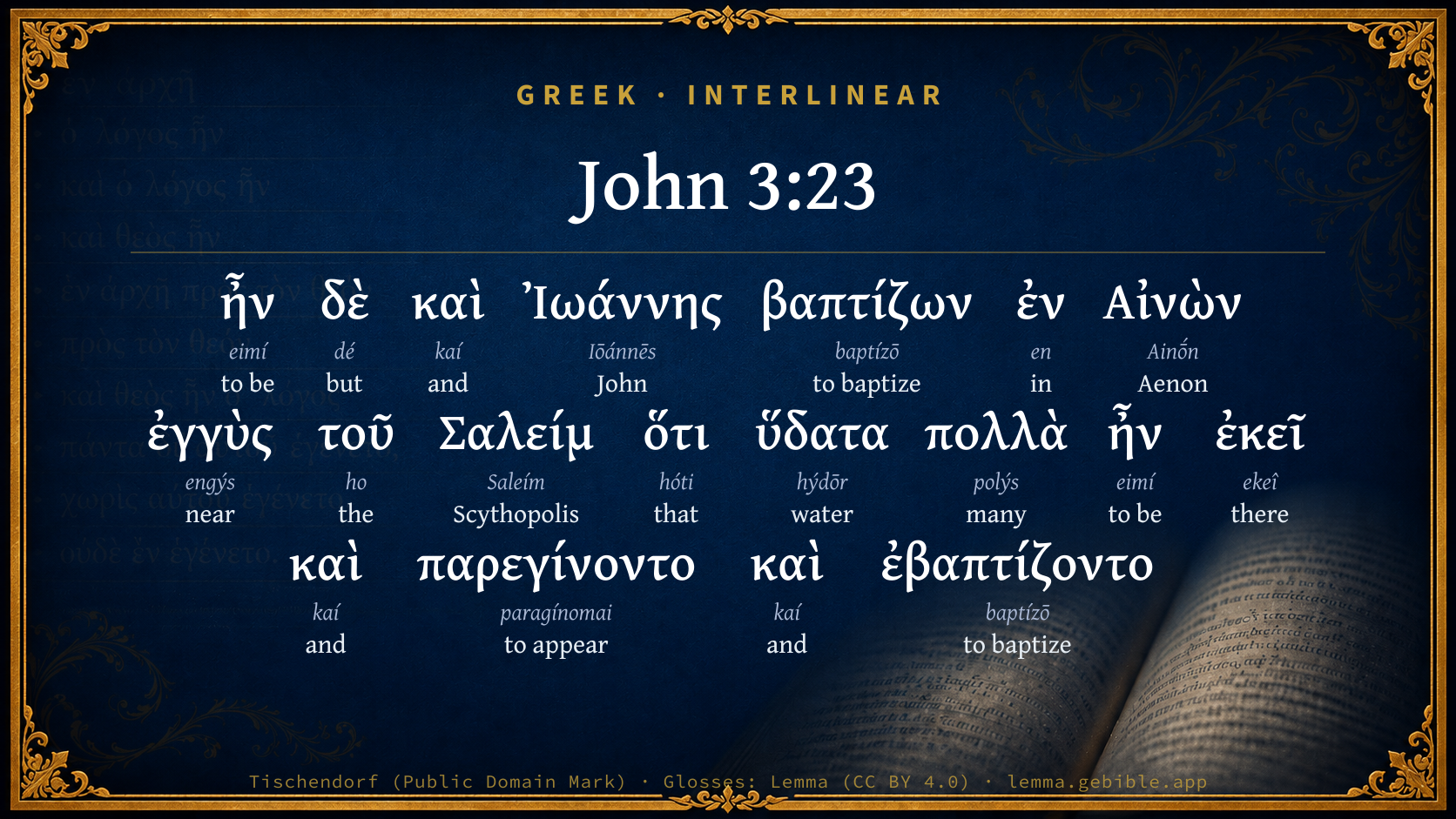
Greek (Tischendorf 8th ed.) John 3:23 appears in the Greek New Testament. The text above is from the Tischendorf 8th edition. Each word links to its Strong’s number and a concise gloss. Click any word for its full Thayer’s Greek Lexicon entry.
Download image
Cite this verse

John 3:23 (World English Bible). Public Domain. Lemma interlinear Bible study tool, https://lemma.gebible.app/v/john/3/23.

Show BibTeX & RIS
BibTeX
RIS
English Translation
John also was baptizing in Enon near Salim, because there was much water there. They came, and were baptized.
World English Bible · Public Domain
Highlights
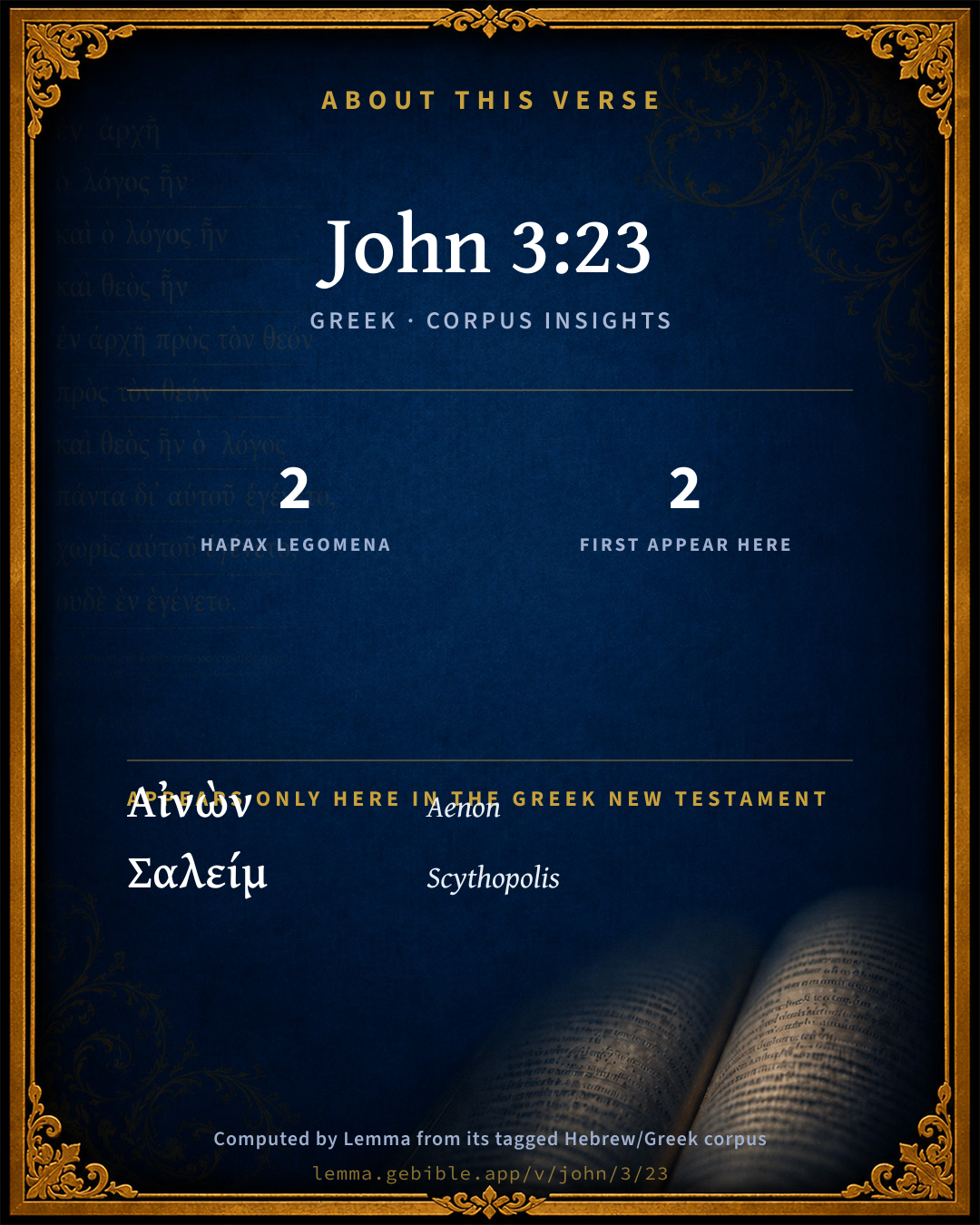
  • 2 hapax legomena — only here in the Greek New Testament
  • 2 first appearances in the Greek New Testament
Full analysis ↓
Download a study sheet

One document with this verse’s original text, its word-by-word gloss line, the meaning frame, cross-references with their text, attributed commentary, and full source and license credits — printable, and it pastes into notes with its structure intact.

This verse Autodidact and up

Study sheet (.html) Plain text (.txt)

A passage Seminary Student

Up to 50 verses in one chapter. A passage sheet keeps up to 6 commentary sources and 12 cross-references per verse, in the order this page ranks them, and says so on the sheet whenever that leaves anything out. Ask for a single verse and you get the Autodidact verse sheet above.

Everything on this page stays free to read, with no account — the sheet is a download of what is already on screen, not access to it.

Want to remove ads? Support Godless Engineer
Compare translations 3

The same verse in 3 English versions, stacked beneath the original-language interlinear above. Click any original word for its lexicon entry.

Each is an independent rendering of the whole verse — the interlinear is not word-aligned to these translations.

Highlighted words mark where these versions differ — a whole-verse word diff, not a word-by-word alignment.

  • World English Bible Public Domain
    John also was baptizing in Enon near Salim, because there was much water there. They came, and were baptized.
  • King James Version Public Domain
    And John also was baptizing in Aenon near to Salim, because there was much water there: and they came, and were baptized.
  • unfoldingWord Literal Text CC BY-SA 4.0
    Now John was also baptizing in Aenon near Salim, because much water was there, and they were coming and were being baptized—

unfoldingWord Literal Text — © unfoldingWord, licensed CC BY-SA 4.0. Word-aligned USFM3 via Door43 (git.door43.org/unfoldingWord/en_ult).

Versions to compare (up to 4)

3 of 4 selected

Show all 19 translations

Every available English version of this verse, each an independent rendering of the whole verse.

  • World English Bible Public Domain
    John also was baptizing in Enon near Salim, because there was much water there. They came, and were baptized.
  • Berean Standard Bible Public Domain
    Now John was also baptizing at Aenon near Salim, because the water was plentiful there, and people kept coming to be baptized.
  • Majority Standard Bible Public Domain
    Now John was also baptizing at Aenon near Salem, because the water was plentiful there, and people kept coming to be baptized.
  • King James Version Public Domain
    And John also was baptizing in Aenon near to Salim, because there was much water there: and they came, and were baptized.
  • American Standard Version (1901) Public Domain
    And John also was baptizing in Enon near to Salim, because there was much water there: and they came, and were baptized.
  • Revised Version (1885) Public Domain
    And John also was baptizing in AEnon near to Salim, because there was much water there: and they came, and were baptized.
  • Geneva Bible (1599) Public Domain
    And Iohn also baptized in Enon besides Salim, because there was much water there: and they came, and were baptized.
  • Douay-Rheims (1899) Public Domain
    And John also was baptizing in Ennon near Salim; because there was much water there; and they came and were baptized.
  • Young's Literal Translation Public Domain
    and John was also baptizing in Aenon, nigh to Salem, because there were many waters there, and they were coming and were being baptized --
  • Literal Standard Version CC BY-SA 4.0
    and John was also immersing in Aenon, near to Salem, because there were many waters there, and they were coming and were being immersed—
  • Unlocked Literal Bible CC BY-SA 4.0
    Now John was also baptizing in Aenon near to Salim because there was much water there. People were coming to him and were being baptized,
  • unfoldingWord Literal Text CC BY-SA 4.0
    Now John was also baptizing in Aenon near Salim, because much water was there, and they were coming and were being baptized—
  • Darby Bible Public Domain
    And John also was baptising in Aenon, near Salim, because there was a great deal of water there; and they came to [him] and were baptised:
  • World Messianic Bible Public Domain
    Yochanan also was immersing in Enon near Salim, because there was much water there. They came and were immersed;
  • Webster's Bible Public Domain
    And John also was baptizing in Enon, near to Salim, because there was much water there: and they came, and were baptized.
  • Free Bible Version CC BY-SA 4.0
    John was also baptizing at Aenon near Salim, because there was plenty of water there and people kept coming to be baptized.
  • Bible in Basic English Public Domain
    Now John was then giving baptism at Aenon near Salim, because there was much water there; and people came and were given baptism.
  • Text-Critical English NT CC BY 4.0
    Now John was also baptizing people in Aenon near Salem, because there was plenty of water there, and people were coming to him and being baptized.
  • Tyndale New Testament (1534) Public Domain
    And Iohn also baptised in Enon besydes Salim because ther was moche water there and they came and were baptised.

Literal Standard Version (2020), Covenant Press — licensed CC BY-SA 4.0. Text via the HelloAO Bible API (eBible.org). Unlocked Literal Bible (unfoldingWord) — licensed CC BY-SA 4.0. Text via the HelloAO Bible API (eBible.org). unfoldingWord Literal Text — © unfoldingWord, licensed CC BY-SA 4.0. Word-aligned USFM3 via Door43 (git.door43.org/unfoldingWord/en_ult). Free Bible Version, Dr. Jonathan Gallagher — licensed CC BY-SA 4.0. Text via the HelloAO Bible API (eBible.org).

Word by word

More ways to search: Search by grammar → Find every occurrence → Compare this word →

Practice this passage: Drill this verse → Learn its vocabulary →

Αἰνὼν
Ainṓn
G137
“Aenon”
Noun, Proper, indeclinable
Part of Speech
Noun · Proper, indeclinable
Full Thayer's Definition

Origin: of hebrew origin, a derivative of G5869

TDNT: None

Aenon meaning "springs" 1. the name of a place "near to Salim" at which John baptised
  1. ἦν eimí G1510 “to be” Verb, Imperfect, Active, Indicative, 3rd person, Singular
  2. δὲ dé G1161 “but” Conjunction
  3. καὶ kaí G2532 “and” Conjunction
  4. Ἰωάννης Iōánnēs G2491 “John” Noun, Nominative, Singular, Masculine
  5. βαπτίζων baptízō G907 “to baptize” Verb, Present, Active, Participle, Nominative, Singular, Masculine
  6. ἐν en G1722 “in” Preposition
  7. ἐγγὺς engýs G1451 “near” Adverb
  8. τοῦ ho G3588 “the” Article, Genitive, Singular, Neuter
  9. Σαλείμ Saleím G4530 “Scythopolis” Noun, Proper, indeclinable
  10. ὅτι hóti G3754 “that” Conjunction
  11. ὕδατα hýdōr G5204 “water” Noun, Nominative, Plural, Neuter
  12. πολλὰ polýs G4183 “many” Adjective, Nominative, Plural, Neuter
  13. ἦν eimí G1510 “to be” Verb, Imperfect, Active, Indicative, 3rd person, Singular
  14. ἐκεῖ ekeî G1563 “there” Adverb
  15. καὶ kaí G2532 “and” Conjunction
  16. παρεγίνοντο paragínomai G3854 “to appear” Verb, Imperfect, Middle deponent, Indicative, 3rd person, Plural
  17. καὶ kaí G2532 “and” Conjunction
  18. ἐβαπτίζοντο baptízō G907 “to baptize” Verb, Imperfect, Passive, Indicative, 3rd person, Plural

About this verse

These counts appear in no published source. They are computed here, from the morphology-tagged text and Lemma’s own curated glosses. What Lemma adds →

19
words
15
distinct lemmas
Gospels
section

Notable vocabulary

2 hapax legomena — words that appear only here in the entire Greek New Testament:

  • Αἰνὼν Aenon G137
  • Σαλείμ Scythopolis G4530

First appearance in Scripture

These words make their first canonical appearance in the Greek New Testament here:

  • Αἰνὼν Aenon G137
  • Σαλείμ Scythopolis G4530

Shared distinctive vocabulary

ἐγγὺς near G1451 occurs in 30 verses of the Greek New Testament. Also found in:
Repetition

Words recur within this verse:

  • ἦν to be G1510 ×2
  • βαπτίζων to baptize G907 ×2
  • καὶ and G2532 ×3

Cross-references

11

Topical passages linked to John 3:23 in the Treasury of Scripture Knowledge — connected by theme and wording, ordered by reader-vote popularity; previews shown in the World English Bible.

  • Mark 1:4–5 John came baptizing in the wilderness and preaching the baptism of repentance for forgiveness of sins.
  • 1 Samuel 9:4 He passed through the hill-country of Ephraim, and passed through the land of Shalishah, but they didn't find them: then they passed through the land of Shaalim, and there they weren't there: and he passed through the land of the Benjamites, but they didn't find them.
  • Ezekiel 43:2 Behold, the glory of the God of Israel came from the way of the east: and his voice was like the sound of many waters; and the earth shined with his glory.
  • Matthew 3:5–6 Then people from Jerusalem, all of Judea, and all the region around the Jordan went out to him.
  • Luke 3:7 He said therefore to the multitudes who went out to be baptized by him, "You offspring of vipers, who warned you to flee from the wrath to come?
  • Genesis 33:18 Jacob came in peace to the city of Shechem, which is in the land of Canaan, when he came from Paddan Aram; and encamped before the city.
  • Jeremiah 51:13 You who dwell on many waters, abundant in treasures, your end is come, the measure of your covetousness.
  • Ezekiel 19:10 Your mother was like a vine, in your blood, planted by the waters: it was fruitful and full of branches by reason of many waters.
  • Revelation 1:15 His feet were like burnished brass, as if it had been refined in a furnace. His voice was like the voice of many waters.
  • Revelation 14:2 I heard a sound from heaven, like the sound of many waters, and like the sound of a great thunder. The sound which I heard was like that of harpists playing on their harps.
  • Revelation 19:6 I heard something like the voice of a great multitude, and like the voice of many waters, and like the voice of mighty thunders, saying, "Hallelujah! For the Lord our God, the Almighty, reigns!

Cross-references courtesy of OpenBible.info (CC BY 4.0).

Commentary

Notes on John 3:23 from classic Christian and Jewish commentators (each source and its license shown beneath its notes). The classic Christian expositions comment on the surrounding passage and are grouped to its opening verse, so a note may address several verses; the Jewish commentaries on the Tanakh (Rashi and others) are per-verse, so they appear only where the commentator wrote on this verse.

Lemma curates 59 commentaries, every one of them public domain or Creative Commons licensed, each selected and text-cleaned for this edition rather than reprinted as found. About our sources →

The Preacher's Complete Homiletical Commentary

Joseph S. Exell (gen. ed.)

EXPLANATORY AND CRITICAL NOTES

Joh_3:23. Ænon near to Salim (Αἰνών, from עַין, Arab. םה, a spring).—Salim was long supposed to have been situated about eight miles from Beth-Shean, i.e. in the north of Samaria. But this would discord with Joh_3:22. Recent research has, however, discovered a site more in consonance with the narrative. “Dr, Barclay (City of the Great King) found both names in a place answering the description … at Wady Farah, about five miles from Jerusalem” (Watkins).

Joh_3:24. For John had not yet been, etc.—I.e. the events here related are prior to those of Mat_4:12; Mar_1:14. Thus the Synoptists Matthew and Mark omit all mention of the Galilean ministry recorded in Joh_1:43 to Joh_2:13.

Joh_3:25-26. There arose therefore a questioning on the part of John’s disciples with a Jew, etc.—The reading Ιουδαίου, = a Jew, rests on all the best MSS. (א excepted). The proximity of Jesus, whose disciples also baptised, to John, gave an appearance of rivalry The question about purification apparently had reference to that needed for entrance into the Messianic kingdom. John’s disciples evidently claimed pre-eminence for their master’s baptism; but this Jew would probably point to the fact that John himself had pointed out the higher position of Jesus, to whom now crowds of disciples were flocking. John’s disciples therefore came to him for enlightenment on the subject.

Joh_3:27-36. John answered, etc.—The Baptist in his reply to his disciples points out Christ’s relation to Himself, and then (Joh_3:31-36) the true position of Christ as “above all.”

Joh_3:27-28.—He gives the statement of a general principle which applies both to himself and to Christ in His mediatorial capacity. He then proceeds to apply this principle first to his own relation to Christ, showing that it is one of subordination. I am not the Christ, etc.—The disciples themselves remembered that this was so (Joh_3:26 : comp. Joh_1:7; Joh_1:26; Joh_1:34).

Joh_3:29. He that hath the bride, etc.—This comparison of the Church to a bride, and the typical use of the marriage tie as emblematic of the relation of Jehovah to His people, is taken over from the Old Testament (comp. Isa_54:5; Hos_2:19). The imagery continued to be used by the writers of the New Testament as peculiarly suitable to describe the relation between Christ and His Church (Eph_5:32; Rev_19:7; Rev_21:2; Rev_21:9; Mat_9:15; Mat_21:1; Mat_25:1, etc.). Friend of the bridegroom, etc.—The παρανύμφιος of the Greeks, the שׁוֹשְׁבֶן of the Jews, who arranged for all the preliminaries of the marriage, and presided at the betrothal and the wedding feast; in fact, whose special duties as “friend of the bridegroom” did not cease until bridegroom and bride were brought together. And this, the culmination of his special duty, was the cause of his greatest joy. The representatives and the firstfruits of the New Testament Church were now flocking to Christ.

Joh_3:30. He must increase, etc.—“The office of the Paranymph ceases to exist when the marriage is accomplished” (Watkins).

Joh_3:31-36.—Here the Baptist sets forth the true position of Christ as “above all,” and His relation to the world. This paragraph is held by many to represent the reflections of the Evangelist (Bengel, De Wette, Westcott, etc.). The chief argument is that the style is more Johannine than that of the preceding verses (27–30). But as Godet points out (vol. ii., 90), our Lord and the Baptist spoke the same Aramaic tongue. This of itself would produce a general likeness in the translation. But more than that, these concluding verses contain part of the answer of the Baptist to his disciples, which would otherwise be incomplete. It therefore seems better to hold with Hengsten berg, Godet, Alford, etc., that these are the Baptist’s words.

Joh_3:31-32. From above, etc. (comp. Joh_3:13; Joh_1:15-18; Joh_1:34).—He that is of the earth is of the earth, etc. (ἐκ τῆς γῆς). “The earthly teacher, and such were all who came before Christ, is contrasted with the One Teacher from heaven:

(1) in origin (of the earth, from above, of heaven);

(2) in being (of the earth, above all);

(3) in teaching (of the earth, what He hath seen and heard in the kingdom of truth)” (Westcott). No man receiveth, etc.—“Over against the exaggeration of envy he sets that of zeal: ‘Where ye say all, I for my part say no man.’ He would not be satisfied unless he saw the Sanhedrin as a body, followed by the whole people, coming to pay homage to the bridegroom of the Messianic community” (Godet). But perhaps John’s meaning is: “None of those people now crowding to Him receive Him as the Son of God, the Messiah, come from heaven to save men from their sins” (Joh_1:29; Joh_1:36).

Joh_3:33-34. Set to his seal (ἐσφράγισεν).—Attested by this very fact his belief in the words of Christ as the truth of God. For God giveth not the Spirit by measure, etc—Even if Θεὸς is omitted, with א B, etc., God will still be understood and supplied (Joh_1:32-33). If, however, (Messiah) giveth not the Spirit by measure be maintained as the reading, then the meaning will be, “He shows His origin by giving the gifts of the Spirit to His people” (Joh_1:33).

Joh_3:36. The wrath of God abideth.—It is not specially meted out; it is there already, and simply remains for all who remain in their sins (Eph_2:3).

MAIN HOMILETICS OF THE PARAGRAPH.—Joh_3:23-36

The Prince appears, the herald, withdraws.—When the Lord comes, the servant withdraws; when the sun arises the twilight vanishes, and the stars fade and disappear. So necessarily must John the Baptist lay down his office when Jesus began His ministry. The baptism of repentance must give place to the baptism with the Holy Ghost and with fire. John could not now be the leader; he must be content to be led; in place of now drawing disciples to himself, he must direct his own disciples and all others to Jesus. Recognising, therefore, the limits of his mission and work, John stepped aside, so that there might be but one centre—Christ. Therefore:—

I. The herald withdraws.—

1. The circumstance which led to this ‘final testimony of the Baptist to the greatness of Jesus and His work was a “dispute between some of his own disciples and the Jews (or a Jew) about purifying” (Joh_3:25). John was baptising at Ænon, near to Salim, not having been cast in prison as yet by Herod. The dispute was concerning some ritual observance, a subject fruitful of dissensions in every age of the Church; and it was evolved in some manner from the fact that Jesus and His disciples were also baptising near the same place—with the result that many were drawn to the Saviour.

2. What the actual point in dispute was is not mentioned. Indeed, the incident is recorded only for the purpose of introducing the conversation between the Baptist and his disciples, during which John declared to them the relationship in which he stood to Jesus. His disciples were naturally jealous of their master’s honour. Was the work of Jesus antagonistic to that of John? What was the meaning of this seeming rivalry?

3. The reply of John reveals the true greatness of his character. There was nothing small or petty about this man, than whom greater hath not been born of woman. He realised and rejoiced in the greatness of his work and the nobility of his office as forerunner of the Messiah. But was there not a lofty place for him in the kingdom now to be established? Was he not to shine in the reflected glory of that kingdom in the presence and service of its King? We may believe, indeed, that John was to no little extent influenced by the popular ideas regarding the Messiah, as the Lord’s disciples were until the descent of the Spirit. And it was probably in part disappointed hope in the non-realisation of his idea that led to the question he sent his disciples from the prison to put to Jesus: “Art thou He that should come?” etc. He understood fully, however, that his work must now cease. He had prepared the way; he had preached righteousness, but he could not give man power to become righteous. The Prince whose way he had prepared, the Lord Our Righteousness, alone could do this; and therefore John humbly recognises that now he must step aside and let the Prince be all in all. “He must increase, but I must decrease.” John had, moreover, laid hold of a principle which banishes all jealousy and self-seeking from the human heart, and leads men in humility to accept God’s gifts with thankfulness in whatever station in life they may be placed. “A man can receive nothing except it be given him from heaven.” This is the fixed rule and order of the heavenly kingdom. And all that had been seen of Jesus—His beautiful, holy character, His wonderful works, the direct testimony of heaven, and the divine wisdom of His teaching—pointed to this, that He was thus bountifully endowed from heaven (Joh_3:34). Therefore did the Baptist realise that his star must fade before the rising Sun; and, faithful to his trust, pointed the thronging disciples to the supreme Master as he said, “He must increase,” etc. The herald withdraws, because—

II. The Prince appears.—

1. John recognised that now the activity of Jesus in His kingdom had begun. The heavenly Bridegroom had appeared to claim His bride, the Church of the Messiah; and the “friend of the bridegroom,” who had made all the preparations for the union, now saw his work accomplished. He lays down his office with joy, as he hears the Bridegroom’s voice. Messiah has come, and His kingdom which cannot be moved; and therefore “He must increase.”

2. In what follows the Baptist gives his reasons for the supremacy of Christ in a full and pregnant testimony as to our Lord’s divine origin. “He that is of the earth is earthly.” The Baptist had his origin on earth, and his activity had reference to what might be called the lower ranges of the spiritual life—the call to repentance and amendment, to the preparation of heart and life for the reception of the coming spiritual King. But of the higher realities of the kingdom he knew but dimly and imperfectly; he saw them from below, not from above. His origin, activity, and teaching were bounded and limited by the earth. Indeed in reference to higher knowledge, etc., “the least in the kingdom of heaven is greater than he” (Mat_11:11). On the other hand, “He that cometh from heaven is above all.” In His divine origin “He is the Son of the Eternal,” and is therefore “above all”; not alone above me, but above all teachers that have gone before. Heaven is his seat, and He has but for a time come to earth to make known God’s will. “What He has seen and heard, that He testifies” from immediate knowledge. And therefore when He speaks it is God’s words that are spoken, “for God giveth not the Spirit by measure unto Him.”

3. And all this flows from the eternal love of the Father towards the Son, into whose hand all things have been given. All things! Yes (Heb_2:8). And does not His wonderful life declare this to be true? His teaching, the words of heavenly wisdom, His miracles, evidences of His creative power; His spotless, flawless life, image of divine perfection; the working of His Spirit and the power of His grace as evidenced in the history of His Church—all this testifies to the Father’s love to Him, etc.

4. And the Baptist’s testimony to Jesus as the Messiah fitly closes with words of mingled promise and warning. “No man receives His testimony.” You, my disciples, say, “All men come to Him.” Yes: but do they receive Him, obey Him? Do not the rulers and people as a whole refuse to receive Him? (Joh_3:11). But some have received Him, and thus have become witnesses to the truth of God as revealed in His Son. And this rejection and reception carry with them momentous consequences. Those who receive the testimony of Jesus become witnesses to the truth of God and possessors of eternal life, whilst those who withstand and reject it inherit the wrath of God, the reverse of the divine love. “If any man serve Me, him will My Father honour” (Joh_12:26; Mat_10:32-33, etc.). “He must increase.”

Joh_3:22-36. The setting star and rising Sun.—The old and the new are frequently in conflict. Many hold by the old, as if it should remain eternally. Others range themselves with the new, as if never before had there been anything good in the world. Our Saviour did not despise what was before Him. He came not to destroy but to fulfil the law and the prophets. He at all times referred His disciples to the Word, and this Word was the Old Testament. But when the Master comes the servant must stand aside. Only One can enlighten the heart. In One name only are the promises realised. This was Christ, whom John proclaimed to be the “Lamb of God,” etc.

Consider then prayerfully—

I. The setting star and the rising Sun.—

1. In our Gospel we behold a star that is nigh its setting. It had for a time shone with a great, beautiful radiance. But its time was come to pale and vanish. “For he was not that light,” etc. (Joh_1:8). He was not the Christ, but the bridegroom’s friend (Joh_3:29). He knew his duty and his power. He had awakened Israel and prepared men for Christ. In this preparation work he shone as a star in the eternal morning.

2. The law was a heavenly light in the midst of the darkness of a fallen and sinful world. None can destroy it. It is not only written on tables of stone, but in the hearts of men. It shows us God’s will and way (Psa_19:7). And as the law is a light from heaven, so is a preacher of repentance like a bright star—a man of God. The more earnestly He deals with us, the more we recognise our own littleness. And we should be thankful to such as awaken in us the sense of sin and lead us to repentance.

3. But John is nevertheless a setting star. When in your heart this light shines, when you realise your sinfulness, the light of this star will not suffice. It does not bring full day. At one time you were in darkness—seeing neither heaven, the world, nor your own self. Then God permitted this light to shine in the darkness—revealed His law, called to remembrance His commands, His word, etc. Then you found all was other than it ought to be. God’s commands you had not fully obeyed, nor believed His promises, etc. You had prayed, but were cold and languid. When you made inquisition you found your life failed to attain to God’s righteousness. Still it was well to have been brought to this hour of self-realisation, when your heart was laid bare before the Omniscient.

4. But can you remain in this state? Is the sick man contented when he knows merely what ails him? This is like John’s light. We cannot be satisfied with “possessing nothing” merely; but only when, though we have nothing, yet we possess all things (2Co_6:10). To cast away our own righteousness is a great step; but we must also have another righteousness in place of it. Therefore is the star of John a setting star. After it is said, “I count all things but loss,” there must follow “to win Christ,” etc. (Php_3:8). With John there is no abiding—with Christ an eternal abiding.

II. Christ is the rising Sun.—

1. This truth John expresses with the most beautiful of figures—that of the bridegroom and the bride. Christ is the bridegroom; His people, His Church—the bride. John did not desire that Israel should follow him. He desired them to lean on Christ. He desired simply that they should follow Jesus. “There John must decrease,” etc. The Christian world moves around Christ, not round John or any servant. The question is not one of honour, piety, virtue, so much as of love to Christ. That is chief. We cannot sufficiently proclaim His name. In Him is peace and rest—in Him we attain to righteousness and the heavenly walk—to forsaking of sin, renunciation of the world, and victory over the flesh.

2. In the Gospel Christ is the rising Sun.—Now He has arisen. Then He was at the dawning—now He shines in meridian splendour. He it is, without doubt, who brings the light of heavenly day into the souls of men, and all who are not enlightened by Him are still in darkness. For the Father has given all things into His land; so that they who do not believe on Him do not believe in God; and they that do not believe in God and Christ are children of death.

3. The world will not acquiesce in the testimony of the Baptist. One section has cast away all belief; another desires to have a Christianity without Christ—without a Saviour. But there is no choice in the matter. Just as day cannot exist without the sun, so Christianity cannot be, or life, or righteousness, or peace, without Jesus. He is “the light of the world,” of those who trust Him.

4. Let Him enlighten you—let Him be your heart’s true sun, and rise upon you every day. Every day, with its failures and falls, threatens night for the soul, and the sun of your life must disperse the darkness. Let Jesus go forth to you as a bridegroom who comes out of his chamber, and let Him rejoice as a strong man to run a race—through your heart from one end to the other, and to enlighten you entirely. Then the wrath of God passes away afar, and you need not wait for life eternal, for it is yours already in Christ the Saviour (1Jn_5:13).—After Karl Lecher.

Joh_3:32-33. The import of the testimony of Jesus.—It ever was so, and will ever remain so. The gospel and the world do not agree together. So long as the world is in the height of its pride the gospel will be despised. When the world comes to be despised then the gospel appears in honour, and Jesus is borne witness to. This has been only fulfilled in part. The time will come when that which is in part shall be done away, when that which is perfect is come.

The import of the testimony of Jesus in the world.

I. The rejection of His testimony.—

1. How small was the following of Jesus! “No man receiveth His testimony.” But this does not detract from Jesus. It was the blind who did not regard Him. If the world did not love Him the Father did, and gave all things into His hand; so that according to the faith or unbelief of men in regard to Jesus will they be judged.

2. But the sad thing is that it should have been the case that so few received His testimony. The world will believe readily enough if what you ask it to believe is clad in a suitable garb. If someone comes and tells of new gold reefs, of new methods by which great interest on capital may be gained, then men believe and rush eagerly to take advantage of the boon. When a master in science rises and declares that he can tell how the world was evolved, etc., what a string of followers he draws after him. If one preaches there will be no more war, or famine, etc., how many will hang eagerly on his words! How will they crowd to a discerner of times, a fortune-teller, quacks, and the like!

3. But the witness of the Son of God many will not receive—that He is over all; that through Him we have eternal life; and on those not in Him the wrath of God abides. Many think not to thank Him for this life, and have given up all thought, as their lives seem to show, of an eternal life. That He is the Bridegroom of humanity—has purchased us with His blood; that He gives costly and precious raiment to those who come to the marriage supper of the Lamb—all this the world mocks at. Oh the blindness of men! with many nothing is of less import to-day than the Word of the Lord.

II. Therefore be not as the world,—“be transformed by the renewing of your mind” (Rom_12:2). Receive the testimony of Jesus.—

1. Set to your seal that God’s Word is true. The wrath of God is not all at once felt, for men’s hearts are hard, they do not at once realise the sentence which has gone forth in heaven. The careless sinner is like one who lies down to sleep in a thick wood, unmindful of the nearing thunderstorm, until he awakes with the crash and sees death streaming around as he flies in terror. Happy those who have been awakened from this numbing sleep, by the Spirit, in time to realise their danger. Happy he who believes that Jesus is the world’s Saviour—that He has come to earth to seek and save.

2. He who has never tasted the power of the gospel knows nothing of it. He can speak of it only as a blind man can speak of colour. But he who has tasted it, i.e. has felt the power of conscience, and has been led to turn to Christ, he can say that Jesus alone can heal a wounded conscience.

3. Or has he felt the power of temptation and been driven into the arms of the Good Shepherd? Then he can say, In Christ is my refuge. Or has one lain in fear of death for himself, or those dear to him, and has sought and found comfort at Jesus’ cross and grave? Then he can testify that men may be more than conquerors in Jesus.

4. Let the world laugh, mock, criticise, doubt, chide, curse, or rage in regard to what a Christian believes and confesses—still the believer will remain firm and say: I know whom I have believed. What I have seen and known cannot be contradicted. What I daily experience admits of no doubt; and from Him in whom I live I will not be separated.—Karl Lecher.

The Preacher's Complete Homiletical Commentary (gen. ed. Joseph S. Exell; Funk & Wagnalls, c. 1892) — public domain (pre-1929). A full-Bible homiletical/sermon-outline anthology covering 65 of 66 books (2 John is absent from the source module). Text from a community e-Sword module.

Bengel's Gnomon

Johann Albrecht Bengel

Joh 3:23. Αἰνών, Ænon) from עין, a fountain.—τοῦ) The article in the masculine gender points to some[57] region.—πολλά, many [waters]) So the rite of immersion required.

[57] Particular, well-known.—E. and T.

Bengel's Gnomon of the New Testament — English translation (T&T Clark, Edinburgh, 1860) — public domain. Text from a community e-Sword module.

Expositor's Greek Testament

ed. W. Robertson Nicoll

Joh 3:23 . ἦν δὲ καὶ … ἐκεῖ . And John also was baptising, although he had said that he was sent to baptise in order that the Messiah might be identified; which had already been done. But John saw that men might still be prepared for the reception of the Messiah by his preaching and baptism. Hence, however, the questioning which arose, Joh 3:25 . The locality is described as Αἰνὼν ἐγγὺς τοῦ Σαλείμ . “The Salim of this place is no doubt the Shalem of Gen 33:18 , and some seven miles north is ’Ainûn [= Springs], at the head of the Wâdy Fâr’ah, which is the great highway up from the Damieh ford for those coming from the east by the way of Peniel and Succoth” (Henderson’s Palestine , p. 154). The reason for choosing this locality was ὅτι ὕδατα πολλὰ ἦν ἐκεῖ , “because many waters were there,’ or much water; and therefore even in summer baptism by immersion could be continued. It is not “the people’s refreshment” that is in view. Why mention this any more than where they got their food? καὶ παρεγίνοντο , the indefinite third plural, as frequently in N.T. and regularly in English, “they continued coming”.

The Expositor's Greek Testament, edited by W. Robertson Nicoll (1897–1910) — public domain. Text from a community e-Sword module.

Jamieson, Fausset & Brown

Robert Jamieson, A. R. Fausset & David Brown

Ænon . . . Salim--on the west of Jordan. (Compare Joh 3:26 with Joh 1:28).

Jamieson, Fausset & Brown — Commentary Critical and Explanatory on the Whole Bible (1871) — public domain (CC PDM 1.0). Text via the HelloAO Bible API.

Adam Clarke's Commentary

Verse 23. In AEnon] This place was eight miles southward from Scythopolis, between Salim and Jordan.

There was much water] And this was equally necessary, where such multitudes were baptized, whether the ceremony were performed either by dipping or sprinkling. But as the Jewish custom required the persons to stand in the water, and, having been instructed, and entered into a covenant to renounce all idolatry, and take the God of Israel for their God, then plunge themselves under the water, it is probable that the rite was thus performed at AEnon. The consideration that they dipped themselves, tends to remove the difficulty expressed in Clarke's note on "Mt 3:6". See the observations at the end of Mark.

Adam Clarke's Commentary on the Bible (1810–1826) — public domain. Text from a community e-Sword/MySword module.

Ellicott's Commentary for English Readers

(23) Ænon near to Salim.—The latter place was clearly well known at the time, and regarded as fixing the locality of the former. It has been usual to follow Jerome and Eusebius, who fix the place in the valley of the Jordan, eight miles south from Bethshan, or Scythopolis. (See quotation from the Onomasticon, in Caspari, Chron. and Geogr. Introd., Eng. Trans., p. 122.) The objection to this is, that the text seems to limit us to Judæa (comp. Joh_4:3-4), whereas this Salim is more than thirty miles from it. The word Ænon means “springs,” and probably belonged to more than one place where “there was much water.” The mention of this is opposed to the locality of the Jordan valley, where it would not be necessary to choose a place for this reason. Dr. Barclay (City of the Great Xing, 1858, pp. 558-570) found both names in a place answering the description, and certainly answering the narrative better than other identifications, at Wady Farah, about five miles from Jerusalem.

They came—i.e., the people.

A Bible Commentary for English Readers, edited by Charles John Ellicott (1878–1897) — public domain. Text from a community e-Sword module.

The Cambridge Bible for Schools and Colleges

gen. ed. J. J. S. Perowne

23. John also was baptizing] Not as a rival to the Messiah, but still in preparation for Him. Although John knew that the Messiah had come, yet He had not yet taken the public position which John had expected Him to take, and hence John was by no means led to suppose that his own office in preaching repentance was at an end. There is no improbability in Jesus and John baptizing side by side. But with this difference; Jesus seldom, if ever, administered His own baptism; John apparently always did administer his.

Aenon] The name means ‘springs.’ The identifications of both Aenon and Salim remain uncertain. The most probable conjecture is the Wâdy Fâr’ah, running from Mount Ebal to Jordan, an open vale, full of springs. There is a Salim three miles south of the valley, and the name of Aenon survives in ’Ainûn, a village four miles north of the waters.

much water] For immersion; the Greek means literally many waters. The remark shews that these places were not on the Jordan. It would be gratuitous to say of the Jordan that ‘there was much water there.’

The Cambridge Bible for Schools and Colleges (gen. ed. J. J. S. Perowne; Cambridge University Press, 1878–1918) — public domain. Text from a community e-Sword module.

Trapp's Complete Commentary

John Trapp

23 And John also was baptizing in Aenon near to Salim, because there was much water there: and they came, and were baptized.

Ver. 23. And John also was baptizing] Here ministers may learn not to be wanting to their duties, though God stir up others about them of greater parts and better success to obscure them. Verbi minister es, hoc age, was Mr Perkins’ motto. Summum culmen affectantes, satis honeste vel in secundo fastigio conspiciemur, saith Columella. And, prima sequentem, honestum est in secundis, tertiisve consistere, saith Cicero. Every man cannot excel, nor is it expected.

John Trapp, A Commentary or Exposition upon All the Books of the Old and New Testament (1647–1656) — public domain. Text from a community e-Sword module.

Albert Barnes' Notes on the Bible

In Enon - The word “Enon,” or “Aenon,” means “a fountain,” and was doubtless given to this place because of the fountains there. On the situation of the place nothing certain has been determined. Eusebius places it eight Roman miles south of Scythopolis or Bethshan, and 53 miles northeast of Jerusalem.

Near to Salim - It would seem from this that Salim was better known then than Enon, but nothing can be determined now respecting its site. These places are believed to have been on the west side of the Jordan.

Because there was much water there - John’s preaching attracted great multitudes. It appears that they remained with him probably many days. In many parts of that country, particularly in the hilly region near where John preached, it was difficult to find water to accommodate the necessities of the people, and perhaps, also, of the camels with which those from a distance would come. To meet their necessities, as well as for the purpose of baptizing, he selected a spot that was well watered, probably, with springs and rivulets. Whether the ordinance of baptism was performed by immersion or in any other mode, the selection of a place well watered was proper and necessary. The mention of the fact that there was much water there, and that John selected that as a convenient place to perform his office as a baptizer, proves nothing in regard to the mode in which the ordinance was administered, since he would naturally select such a place, whatever was the mode.

Where numbers of people came together to remain any time, it is necessary to select such a place, whatever their employment. An encampment of soldiers is made on the same principles, and in every camp-meeting that I have ever seen, a place is selected where there is a good supply of water, though not one person should be immersed during the whole services. As all the facts in the case are fully met by the supposition that John might have baptized in some other way besides immersion, and as it is easy to conceive another reason that is sufficient to account for the fact that such a place was selected, this passage certainly should not be adduced to prove that he performed baptism only in that manner.

Albert Barnes' Notes on the Bible (1834–1885) — public domain. Text from a community e-Sword/MySword module.

Haydock's Catholic Bible Commentary

Salem. A town situated upon the river Jordan, where formerly Melchisedech reigned. (Ven. Bede)

George Leo Haydock (1774–1849), Haydock's Catholic Family Bible and Commentary, 1859 edition — public domain. Excludes Psalms (Douay-Rheims chapter numbering differs from Protestant) and Deuterocanonical books (Catholic canon only).

Matthew Poole's English Annotations

Aenon is here said to be

near Salim: it was the name of a city, as some think; others say, a river or brook near that city: neither the river nor the city are elsewhere mentioned in Scripture; but topographers place it on the eastern part of the lot of Manasseh, not far from Bethshan or Scythopolis. There John was baptizing; because this Aenon was a brook or river that had much water, which in Judea was rare. There is no water more holy than the other. John baptized in Jordan, and in Bethabara, and in Aenon. The ordinance sanctified the water, but did not require consecrated water for the due administration of it. It is from this apparent that both Christ and John baptized by dipping the body in the water, else they need not have sought places where had been a great plenty of water; yet it is probable that they did not constantly dip, from what we read of the apostles baptizing in houses, Act 9:17,18; 10:47,48. The people came to John and were baptized, that is, great numbers of them did so.

Matthew Poole's English Annotations on the Holy Bible (1683–1685) — public domain. Text from a community e-Sword/MySword module.

Whedon's Commentary on the Bible

Daniel D. Whedon

23. John also was baptizing—The two great masters, the stern and sorrowful John, and the serene and winning Jesus, are neighbouring baptizers, but silent apparently (as in nearly all their previous lives) towards each other. This, as their language of each other shows, arises from no uncongenial feeling between them.

But why did Jesus commence baptizing, and so soon cease? Why did John continue baptizing after Jesus commenced? The answers to both questions are the same. Both these baptisms were initiatory; being an intended ceremonial purifying of Israel for her Messiah, a consecration of her body and spirit to him. Of the same import was the cleansing of the temple. But the hierarchy of Israel, the representatives of the nation and Church, rejected both, and the solemn rite ceased until renewed, and extended to embrace the world, at the ascension of Jesus. The baptism of Jesus and of John, having the same object, could be properly continued and terminate together.

In Enon—That is, a place of fountains. In Palestine the same word Ain, is the ordinary term for a spring or a watering place. In that dry country, travelling companies find it very important to make their stoppages at some Ain. Hence John would find a place well watered absolutely necessary for the immense numbers of people, with their animals, who attended his baptism,

Near to Salim—The best tradition decides this place to have been eight Roman miles south of Scythopolis or Bethshan. The only objection to admitting this to be the locality, is the fact that it is within the boundaries of Samaria. But we have elsewhere remarked that John is at this time at the zenith of his prophetic inspiration, a true successor of the Isaiah who could see in the Messiah a Light to lighten the Gentiles; a fit harbinger to the Jesus whose very next bright spot would be in that very Samaria. Joh_4:4.

Much water—Greek, many waters, that is, many springs and rivulets. Whatever the mode of the baptism, or whether there was any baptism at all, these water conveniences would be very essential for the assembled multitudes.

Daniel D. Whedon (gen. ed.), Commentary on the Old and New Testaments (1874–1909) — public domain. Text from a community e-Sword module.

The Pulpit Commentary

And John also was baptizing in Aenon, near to Salim, because there were many waters there; and they came, and were baptized. There is much difficulty in determining the site of Aenon, near Saleim. Eusebius and Jerome (in "Onomasticon") place it in the northern part of Samaria, about eight miles south of Scythopolis (Jerome, "Ad Evagrium," Ep. 126; Epiph., "Haer.," 55:2; Winer, "Real Wort.," 1:33; Lucke, in loc. ; Thomson, "The Land and the Book," 2:176). This does not well accord with the statement that Jesus was "in Judaea," and proposed to "pass through Samaria". (cf. ver. 22; Joh_4:1-4) It may be observed,however, that our narrative does not limit the scene of our Lord"s Judaean ministry to any one place, nor does it assert that the Baptist and Jesus were in near proximity, but rather the reverse. There is a Shilhim mentioned in Jos_15:32, with which is associated an ain (or fountain) a word closely resembling AEnon." This would seem to have been in the south of Judaea. Godet thinks that, since Ain and Rimmon are associated with each other in Jos_19:7 and 1Ch_4:32, and an En-Remmon is spoken of in Neh_11:29, that we have in this blending the origin of the word AEnon." He thinks that the presence of waters is more likely to be specified in a dry region like that of the border of Edom than in a fertile district like Samaria; and he goes on to argue that Jesus may therefore have travelled south between Hebron and Beersheba, even as, in the synoptics, we find him in Caesarea Philippi, the northernmost portion of the Holy Land. Certainly he may have tarried there during the eight months, but we have no right to establish it from this passage. It is not said that Jesus was at Aenon. Dr. Barclay (1858) reports the discovery of Aenon at Wady Far"ah, a secluded valley five miles northeast of Jerusalem (Grove, Smith"s "Dict. Bible"). The recent discoveries of the Palestine Exploration Society find this Enun (Aynun) and Saleim not far from the Askar, or Sychar, where Jesus rested when John"s ministry had been suddenly arrested. (Edersheim thinks that this Enon and Salim in Wady Far"ah leading from Samaria to the Jordan, are too far apart; but see "Pal. Exp. Fund Report," 1874, p. 141; "Pict. Palestine," 2:237; "Tent-Work in Palestine," 1:91-93.) Allegory reaches the point of absurdity when we are told by Theme that neither place nor time are historic. The Salem is (says he), according to Psa_76:2, the tabernacle or place of God, and therefore, according to Philo, indicates the Logos, who thenceforth becomes the Illuminator and Ruler. "The multitude of waters" would be suitable, necessary, to any great gatherings such as those which had followed the Baptist to the banks of the Jordan, as well as for baptismal processes. Such a site for Aenon is far more probable, on historical grounds, than is the southern extremity of Judaea; for Herod would have had no jurisdiction there, and would not have been tempted to arrest John"s ministrations, nor would he or Herodias have suffered from the Baptist"s rebuke of their adultery, if such reproaches had been spoken so far away from the centre of his tetrarchy. If, however, John had made no secret of his disapproval in regions so near to Galilee and Peraea, over which he presided, the consequent irritation of the voluptuous prince may have been more easily aroused, and his vengeance more legitimately taken. But how came John to be still administering baptism with a group of disciples of his own, and doing this long after the amazing announcements he had made in the spring of the year with reference to the rank and functions of the Lord Jesus? This narrative is the true key to the otherwise inexplicable contrariety between the Johannine testimonies to Christ and the message from the prison as described by the synoptists. It is the solution of the mystery that one who hailed Jesus as the Son of God and the Lamb of God and Baptizer with the Holy Spirit, and who was declared by Christ himself to be the greatest of woman born, was, notwithstanding, "less than the least in the kingdom of heaven." John is here shown by the fourth evangelist to have been still taking an independent position. He pointed others to Jesus, but he did not enroll himself among his followers. John was at last "offended" more than he knew at the humility of Jesus. He still waited for the coming of the Conqueror and the Wielder of the axe; he was looking for the manifested King, for the hour which had not yet come. He is a remarkable specimen of the energy with which a great purpose is embraced by those who are pledged to make it accomplish its end. The preparatory work of John could not, any more than the Hebraism of which it was the highest type, come to an abrupt end voluntarily; hence he continued it even to the peril of sacrificing all its value. They came, and were baptized; as "they" had done at Bethabara. There was some splitting up of the Messianic movement (Keim), and we see the effect of it upon his disciples and him self. Even in the midst of the labours of Paul, (Act_19:1-4) we find that Johannine baptism was still practised, and traces of the custom may still be observed in Oriental sects even to the present day.

Vers. 23-30. The relation between our Lord and his forerunner.

Jesus seems to have followed in the footsteps of John, who was still at large, baptizing disciples in the southern borders of Judaea.

I THE CONTROVERSY BETWEEN THE JEWS AND JOHN"S DISCIPLES. The subject of dispute. "About purifying." It was caused by the competition of the two baptisms, and turned upon the best mode of true purification.

1. The Jews might ascribe greater efficacy to Jesus" baptism than to John"s.

2. John"s disciples might claim the honour of superiority, because their master"s baptism was the first in point of time.

3. The Jews might argue that John"s was unnecessary now that Christ had come.

4. Johns disciples might argue that their master"s baptism was still necessary as a preparation for the Messiah.

II CONSIDER HOW JOHN SETTLES THE CONTROVERSY.

1. The Baptist does not resolve it directly at all, for he makes no allusion to the question of baptism.

2. He resolves it by pointing out, with a noble and touching humility, the exact rotation existing between himself and our Lord, as one not of opposition or comparison at all.

(1) He represents the greater success of Jesus as due to God. "A man can receive nothing, except it be given him from heaven." It is God"s will, not man"s energy or zeal, that secures success.

(2) He reminds his disciples that he had all along consistently represented his mission as purely provisional. "Ye yourselves bear me witness that I said, I am not the Christ, but that I am sent before him.

(3) He distinctly marks the inferior place assigned to himself. "He that hath the bride is the bridegroom." He is himself not the Bridegroom, but his friend.

(a) The bride is the Messianic community;

(b) Christ is the Bridegroom;

(c) John is "the friend of the Bridegroom," whose office it was to bring them together.

(4) He is perfectly satisfied with this position. "This my joy therefore is fulfilled." He is delighted to bear the Bridegroom"s voice, and to be the agent of bringing the Jews to recognize his Messiahship.

3. He regards his own importance as destined to diminish from day to day before the increasing acceptance of the Messiah. "He must increase, but I must decrease.

(1) It is a great trial to human pride to efface one"s self in the midst of a career of extraordinary popularity, while the energies of life are still unbroken, and the hopes of expanding usefulness are strong in the heart.

(2) As a test of character, this declaration marks the true greatness of the Baptist. There is something sublime as well as touching in his humility.

The Pulpit Commentary (1880–1919), ed. H.D.M. Spence-Jones & Joseph S. Exell — public domain. Text from a community e-Sword module.

John Wesley's Explanatory Notes

John also was baptizing - He did not repel them that offered, but he more willingly referred them to Jesus.

John Wesley, Explanatory Notes Upon the Whole Bible (1754–1765) — public domain. Text via the GEBible commentary corpus.

The People's New Testament

B. W. Johnson

23. And John was baptizing in Ænon near Salim. The site was first identified by Lieut. Conder, of the British Palestine Exploration. He found a village of Ainun near another named Salim, not far from the Jordan, northeast of Samaria, with, as he says (Tent Work, p. 92), “the two requisites for the scene of baptism of a large multitude;—an open space and abundance of water.” Prof. McGarvey, who visited it, says: “Pools, well suited for baptizing are abundant.” Because there was much water there. This explains, not why John preached at Ænon, but why he baptized there. “Much water” was essential to baptism in New Testament times.

B. W. Johnson's The People's New Testament with Notes (1889–1891) — public domain. Electronic text from the Christian Classics Ethereal Library (CCEL) ThML edition.

Cambridge Greek Testament for Schools and Colleges

23. ἦν … βαπτίζων. Not as rival to the Messiah but still in preparation for Him, as Samuel continued to be Judge after the King was appointed. John knew that the Messiah had come; but He had not taken the public position which John expected Him to take, and hence John was not led to suppose that his own office in preaching repentance was at an end. John still went on; Jesus, owing to His rejection in Jerusalem, seems to go back, “becoming in a way His own fore-runner” (Godet). Thus they appear for a moment baptizing side by side. But the Baptist has reached his zenith; whereas the Messiah’s career has scarcely begun.

Αἰνών. ‘Springs.’ The identifications of Aenon and Salim remain uncertain. The Wâdy Fâr’ah, an open vale full of springs, running from Ebal to Jordan, is a tempting conjecture. There is a Salim three miles south, and the name Aenon survives in ’Ainûn, four miles north of the waters.

ὕδατα πολλά. For immersion: the expression points to springs or streams rather than a single river like the Jordan.

Cambridge Greek Testament for Schools and Colleges (Cambridge University Press, 1896; 21 vols, various authors incl. Carr, Maclear, Plummer, Farrar, Lumby, Moule, M. R. James, Simcox) — public domain. Text from a community e-Sword module.

Alford’s Greek Testament

Henry Alford

23.] The situation of these places is uncertain. Eusebius and Jerome place Salim eight Roman miles south of Scythopolis, and Ænon at the same distance, on the Jordan. If Scythopolis was the ancient Bethshan, both places were in Samaria: and to this agree Epiphanius and the Samaritan chronicle called Abul Phatach. In Judith 4:4, we find mention of ὁ αὐλὼν Σαλήμ in Samaria (see note on Heb 7:1). An Ænon in the wilderness of Judah is mentioned Jos 15:61 [(56) ], and ib. ver. 32, שִׁלְחִים and עַיִן, Σελεεὶμ κ. Ἀίν (., κ. Ἀίν B), both in Judah, where it is certainly more probable, both from the text here and from à priori considerations, that John would have been baptizing, than in Samaria. The name עַינָן, is an intensive form of עַיִן, a fountain, which answers to the description here given. Both places were West of the Jordan: see ver. 26, and compare ch. 1:28.

παρεγ. κ. ἐβ., i.e. the multitudes.

Henry Alford, The Greek Testament (1849–1861) — public domain. Text from a community e-Sword module.

International Critical Commentary

23. For the constr. ἦν … Ἰω. βαπτίζων, where we would expect ἐβάπτιζεν (as in the preceding verse), see on 1:28. παραγίγνομαι does not occur again in Jn.

John also was carrying on his ministry of baptism in the same neighbourhood, viz. at Aenon.

Αἰνὼν ἐγγὺς τοῦ Σαλείμ. These places cannot be identified with certainty. There is a Salim to the E. of Shechem, and a village called ˒Ainun to the N.E.; but (1) there is no water at ˒Ainun, and Αἰνών was a place of ὕδατα πολλά; (2) ˒Ainun Isa_7 miles from Salim, and this could hardly be described as “near” (cf. 11:18, 19:20, 42); and (3) it is not likely that John the Baptist was labouring among the Samaritans (cf. 4:9). The site assigned by Eusebius and Jerome (and shown to the pilgrim Aetheria in the fourth century) is probably the true site, viz. in the Jordan valley about 7 1/2 miles south of Beisan, the ancient Scythopolis. “Aenon near to Salim” is marked at this point on the mosaic map of Madeba. There is still here “a remarkable group of seven springs, all lying within a radius of a quarter of a mile, which answers well to the description ὕδατα πολλά”1 It is on the W. bank of the Jordan, and this is confirmed by v. 26. Cheyne would read “Jerusalem” for “Salim,” and finds Aenon in ˒Ain Karim, which is near Jerusalem on the W. side.2 But this is merely guess-work.

Those who find allegory in Jn.’s place-names, interpret “Aenon near to Salim” as indicating “fountains near to peace,” the Baptist preparing for the higher purification by Christ the King of peace (Melchi-zedek).1

International Critical Commentary — older volumes (1896–1929), various authors — public domain. Text from a community e-Sword module.

Vincent's Word Studies in the New Testament

Marvin R. Vincent

Was baptizing [ην βαπτιζων] . The substantive verb with the participle also indicating continuous or habitual action; was engaged in baptizing.

Aenon, near to Salim. The situation is a matter of conjecture. The word, Aenon is probably akin to the Hebrew ayin, an eye, a spring. See on Jas 3:11.

Much water [υδατα πολλα] . Literally, many waters. Probably referring to a number of pools or springs.

Came - were baptized. Imperfects. They kept coming.

Marvin R. Vincent, Word Studies in the New Testament (1887–1900) — public domain. Text from a community e-Sword/MySword module.

Godet's Commentaries

Frédéric Louis Godet

Ver. 23. “Now John also was baptizing in AEnon, near to Salim, because there was abundance of water there; and they came and were baptized.”

AEn, from which AEnon, denotes a fountain. We may also, withMeyer, make of the termination on an abridgment of the word jona, dove; this word would thus signify the fountain of the dove. This locality was in the vicinity of a town called Salim. The situation of these two places is uncertain. Eusebius and Jerome, in the Onomasticon, place AEnon eight thousand paces south of Bethsean or Scythopolis, in the valley of the Jordan, on the borders of Samaria and Galilee, and Salim, a little further to the west. And indeed there has recently been found in these localities a ruin bearing the name of Aynu=n (Palestine Exploration Report, 1874).

From this, therefore, it would be necessary to conclude that these two localities were in Samaria. But this result is incompatible with the words of Joh 3:22 : in the country of Judea (on the supposition, at least, that the two baptisms were near each other). And, above all, how should John have settled among the Samaritans? How could he have expected that the multitudes would follow him into the midst of this hostile people? Ewald, Wieseler, Hengstenberg, and Muhlau, because of these reasons, suppose an altogether different locality. In Jos 15:32 three towns are spoken of: Shilhim, Ain, and Rimmon, situated towards the southern frontier of the tribe of Judah, on the borders of Edom (comp. Joh 15:21). In Jos 19:7 and 1Ch 4:32, Ain and Rimmon again appear together.

Finally, in Neh 11:29 these two names are blended in one: En-Rimmon. Might not AEnon be a still more complete contraction? This supposition would do away with the difficulty of the baptism in Samaria, and would give a very appropriate sense to the reason: because there was abundance of water there. Indeed, as applied to a region generally destitute of water and almost desert, like the southern extremity of Judah, this reason has greater force than if the question were of a country rich in water, like Samaria.

Jesus would thus have gone over all the territory of the tribe of Judah, seeing once in His life Bethlehem, His native town, Hebron, the city of Abraham and David, and all southern Judea even as far as Beersheba. This remark has excited the derisive humor of Reuss; we do not at all understand the reason of it. In the Synoptical Gospels, we see Jesus making a series of excursions as far as the northern limits of the Holy Land, once even to Caesarea Philippi, in the vicinity of the ancient Dan, at the foot of Hermon, at another time as far as into the regions of Tyre and Sidon. He would thus have visited all the countries of the theocratic domain from Dan to Beersheba. Is not this altogether natural? Hengstenberg has taken advantage of this sojourn of Jesus in the vicinity of the desert, to place the temptation at this time. This opinion is chronologically untenable.

Frédéric Louis Godet — Commentaries on Luke, John, Romans, and 1 Corinthians — English translation (T&T Clark, Edinburgh, 1870s–1890s) — public domain. Text from a community e-Sword module.

Lesson kit

Teaching starters — assembled from the data on this page, not authored interpretation. Every prompt links to the verse data it draws on. Edit before teaching.

John, in the Gospels, opens this verse with 19 words (15 distinct Greek lemmas). Its most distinctive word is Ainṓn (“Aenon”). A historical commentator’s framing appears above. Read the whole chapter for the surrounding context.

Discussion questions

  1. What does “Aenon” (Ainṓn) contribute to the verse as a whole?
  2. 2 words here appear nowhere else in the Greek New Testament. Why might the author reach for such rare wording?
  3. 2 words make their first appearance in Scripture here. What does this debut establish?
  4. How does Matthew 24:32, which shares the word «near», read alongside this verse?
  5. What does the repetition of “to be” (2× in this one verse) do in this verse?
  6. These translations render this verse differently. What is at stake in choosing one wording over another?
  7. Compare how The Preacher's Complete Homiletical Commentary and Bengel's Gnomon read this verse. Where do they agree or differ?

Things to notice

  • 2 words in this verse appear nowhere else in the Greek New Testament.
  • 2 words make their first canonical appearance in Scripture here.
  • These translations choose different wording for 6 words in this verse.
  • “to be” occurs 2× in this single verse.
  • 15 distinct Greek lemmas span 19 words in this verse.

Reading settings

Reading text

Shown beneath each verse's original-language words.

Old Testament
Old Testament edition

Read the OT as the Masoretic Hebrew (MT) or the Greek Septuagint (LXX).

English shown for the Greek Septuagint (in the Hebrew ↔ Greek comparison).

Comparing translations? Open the Compare panel on any verse page to stack up to four side by side.