
Matthew 22:14

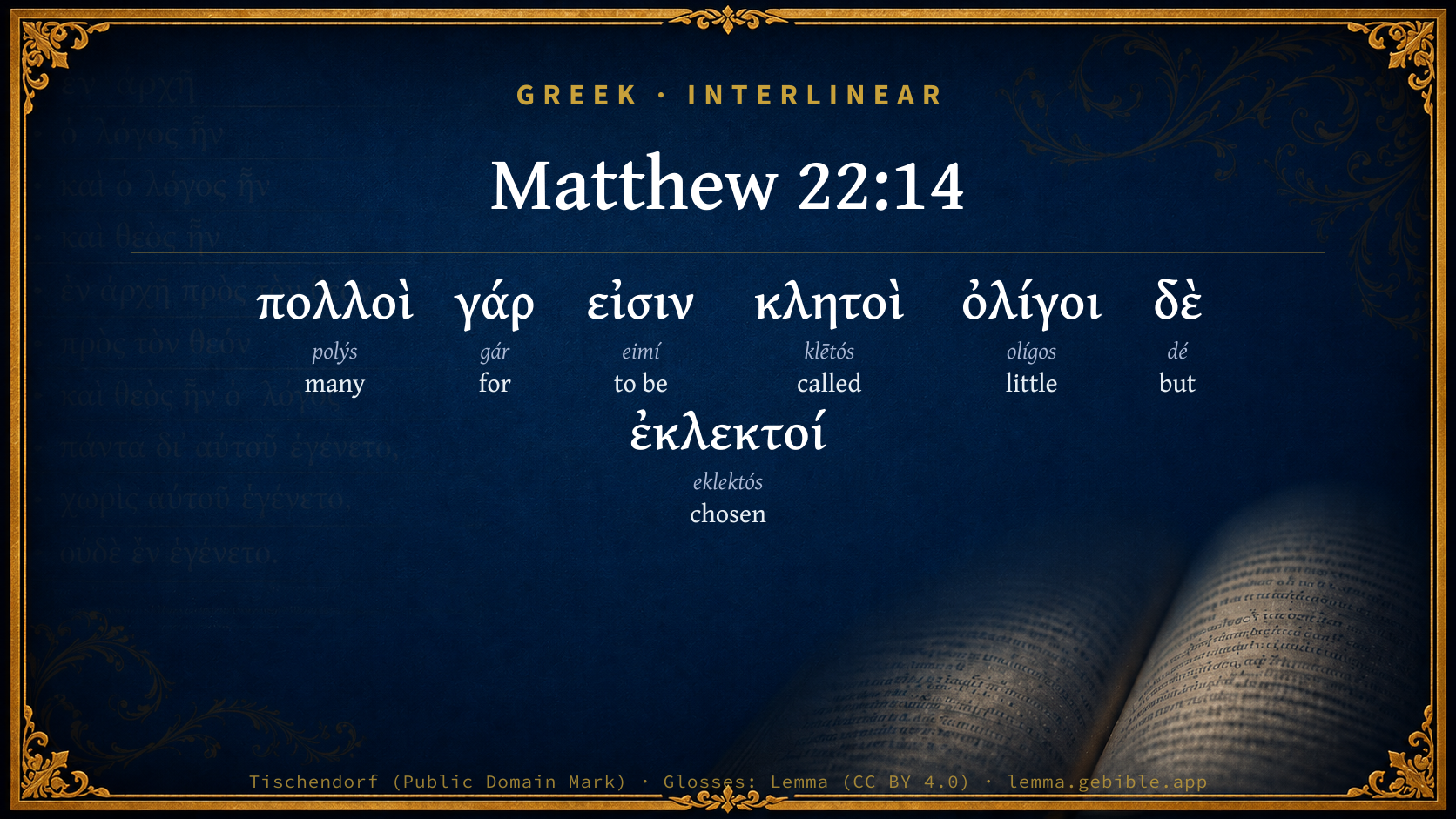
Greek (Tischendorf 8th ed.) Matthew 22:14 appears in the Greek New Testament. The text above is from the Tischendorf 8th edition. Each word links to its Strong’s number and a concise gloss. Click any word for its full Thayer’s Greek Lexicon entry.
Download image
Cite this verse

Matthew 22:14 (World English Bible). Public Domain. Lemma interlinear Bible study tool, https://lemma.gebible.app/v/matthew/22/14.

Show BibTeX & RIS
BibTeX
RIS
English Translation
For many are called, but few chosen."
World English Bible · Public Domain
Highlights
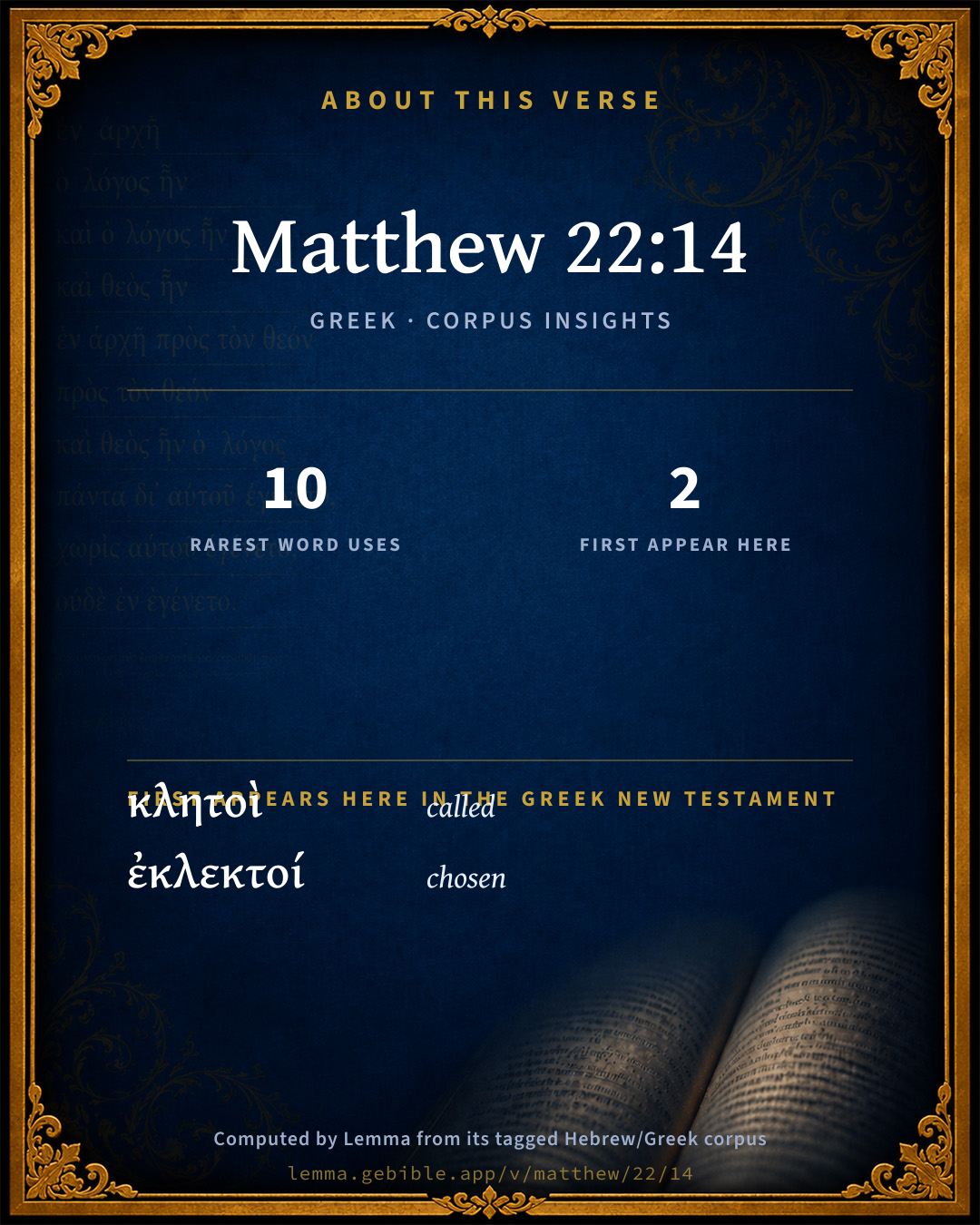
  • 2 first appearances in the Greek New Testament
Full analysis ↓
Download a study sheet

One document with this verse’s original text, its word-by-word gloss line, the meaning frame, cross-references with their text, attributed commentary, and full source and license credits — printable, and it pastes into notes with its structure intact.

This verse Autodidact and up

Study sheet (.html) Plain text (.txt)

A passage Seminary Student

Up to 50 verses in one chapter. A passage sheet keeps up to 6 commentary sources and 12 cross-references per verse, in the order this page ranks them, and says so on the sheet whenever that leaves anything out. Ask for a single verse and you get the Autodidact verse sheet above.

Everything on this page stays free to read, with no account — the sheet is a download of what is already on screen, not access to it.

Want to remove ads? Support Godless Engineer
Compare translations 3

The same verse in 3 English versions, stacked beneath the original-language interlinear above. Click any original word for its lexicon entry.

Each is an independent rendering of the whole verse — the interlinear is not word-aligned to these translations.

Highlighted words mark where these versions differ — a whole-verse word diff, not a word-by-word alignment.

  • World English Bible Public Domain
    For many are called, but few chosen."
  • King James Version Public Domain
    For many are called, but few are chosen.
  • unfoldingWord Literal Text CC BY-SA 4.0
    For many are called, but few chosen.”

unfoldingWord Literal Text — © unfoldingWord, licensed CC BY-SA 4.0. Word-aligned USFM3 via Door43 (git.door43.org/unfoldingWord/en_ult).

Versions to compare (up to 4)

3 of 4 selected

Show all 19 translations

Every available English version of this verse, each an independent rendering of the whole verse.

  • World English Bible Public Domain
    For many are called, but few chosen."
  • Berean Standard Bible Public Domain
    For many are called, but few are chosen.”
  • Majority Standard Bible Public Domain
    For many are called, but few are chosen.”
  • King James Version Public Domain
    For many are called, but few are chosen.
  • American Standard Version (1901) Public Domain
    For many are called, but few chosen.
  • Revised Version (1885) Public Domain
    For many are called, but few chosen.
  • Geneva Bible (1599) Public Domain
    For many are called, but fewe chosen.
  • Douay-Rheims (1899) Public Domain
    For many are called, but few are chosen.
  • Young's Literal Translation Public Domain
    for many are called, and few chosen.'
  • Literal Standard Version CC BY-SA 4.0
    for many are called, and few chosen.”
  • Unlocked Literal Bible CC BY-SA 4.0
    For many people are called, but few are chosen.”
  • unfoldingWord Literal Text CC BY-SA 4.0
    For many are called, but few chosen.”
  • Darby Bible Public Domain
    For many are called ones, but few chosen ones.
  • World Messianic Bible Public Domain
    For many are called, but few chosen.”
  • Webster's Bible Public Domain
    For many are called, but few are chosen.
  • Free Bible Version CC BY-SA 4.0
    For many are invited, but few are chosen.”
  • Bible in Basic English Public Domain
    For out of all to whom the good news has come, only a small number will get salvation.
  • Text-Critical English NT CC BY 4.0
    For many are called, but few are chosen.”
  • Tyndale New Testament (1534) Public Domain
    For many are called and feawe be chosen.

Literal Standard Version (2020), Covenant Press — licensed CC BY-SA 4.0. Text via the HelloAO Bible API (eBible.org). Unlocked Literal Bible (unfoldingWord) — licensed CC BY-SA 4.0. Text via the HelloAO Bible API (eBible.org). unfoldingWord Literal Text — © unfoldingWord, licensed CC BY-SA 4.0. Word-aligned USFM3 via Door43 (git.door43.org/unfoldingWord/en_ult). Free Bible Version, Dr. Jonathan Gallagher — licensed CC BY-SA 4.0. Text via the HelloAO Bible API (eBible.org).

Word by word

More ways to search: Search by grammar → Find every occurrence → Compare this word →

Practice this passage: Drill this verse → Learn its vocabulary →

About this verse

These counts appear in no published source. They are computed here, from the morphology-tagged text and Lemma’s own curated glosses. What Lemma adds →

7
words
7
distinct lemmas
Gospels
section

Notable vocabulary

The rarest word here is κλητοὶ called G2822 — appearing just 10 times in the whole Greek New Testament.

First appearance in Scripture

These words make their first canonical appearance in the Greek New Testament here:

  • κλητοὶ called G2822
  • ἐκλεκτοί chosen G1588

Shared distinctive vocabulary

κλητοὶ called G2822 occurs in 10 verses of the Greek New Testament. Also found in:
Cross-references

6

Topical passages linked to Matthew 22:14 in the Treasury of Scripture Knowledge — connected by theme and wording, ordered by reader-vote popularity; previews shown in the World English Bible.

  • 2 Peter 1:10 Therefore, brothers, be more diligent to make your calling and election sure. For if you do these things, you will never stumble.
  • Luke 13:23–24 One said to him, "Lord, are they few who are saved?" He said to them,
  • Revelation 17:14 These will war against the Lamb, and the Lamb will overcome them, for he is Lord of lords, and King of kings. They also will overcome who are with him, called and chosen and faithful."
  • Matthew 7:13–14 "Enter in by the narrow gate; for wide is the gate and broad is the way that leads to destruction, and many are those who enter in by it.
  • Matthew 20:16 So the last will be first, and the first last. For many are called, but few are chosen."
  • Matthew 24:22 Unless those days had been shortened, no flesh would have been saved. But for the sake of the chosen ones, those days will be shortened.

Cross-references courtesy of OpenBible.info (CC BY 4.0).

Commentary

Notes on Matthew 22:14 from classic Christian and Jewish commentators (each source and its license shown beneath its notes). The classic Christian expositions comment on the surrounding passage and are grouped to its opening verse, so a note may address several verses; the Jewish commentaries on the Tanakh (Rashi and others) are per-verse, so they appear only where the commentator wrote on this verse.

Lemma curates 59 commentaries, every one of them public domain or Creative Commons licensed, each selected and text-cleaned for this edition rather than reprinted as found. About our sources →

Joseph Benson's Commentary

Mat 22:14. For many are called — Nor imagine, (as if our Lord had said,) that this will be the case of one alone; for though it be a dreadful truth, yet I must say, that even the greatest part of those to whom the gospel is offered, will either openly reject or secretly disobey it; and while indeed many are called to the gospel-feast, it will be manifest by their disregarding it, there are but few chosen in such a sense as finally to partake of its blessings. In short, many hear, few believe: many are members of the visible, but few of the invisible church.

Joseph Benson's Commentary on the Old and New Testaments (1811–1818) — public domain. Text from a community e-Sword module.

Tyndale Open Study Notes

Tyndale Open Resources

22:14 While many people are called—they hear the invitation to the Kingdom—few are actually chosen by God and respond in faithful obedience to Jesus.

Tyndale Open Study Notes — © Tyndale Open Resources, licensed CC BY-SA 4.0. Text via the HelloAO Bible API.

Bengel's Gnomon

Johann Albrecht Bengel

Mat 22:14.[959] Πολλοὶ γάρ, κ.τ.λ., for many, etc.) Our Lord adds this remark in His own person to the conclusion of the king’s speech. Cf ὅτι, κ.τ.λ., for, etc., in Luk 16:8.—γὰρ, κ.τ.λ., for, etc.) This general sentiment is a proof, that this man without a wedding garment, and all who are like him, will be cast forth.

[959] ἐκεῖ ἔσται—πολλοὶ γὰρ εἰσι κλητοὶ) Two expressions somewhat frequently repeated by the Saviour, and therefore most worthy of consideration.—Harm., p. 463, 464.

Bengel's Gnomon of the New Testament — English translation (T&T Clark, Edinburgh, 1860) — public domain. Text from a community e-Sword module.

Meyer's Critical & Exegetical Commentary

Heinrich August Wilhelm Meyer

Mat_22:14. Γάρ] introduces the reason of the ἐκεῖ ἔσται, κ.τ.λ. For, so far from the mere calling availing to secure against eternal condemnation, many, on the contrary, are called to the Messiahs kingdom, but comparatively few are chosen by God actually to participate in it. This saying has a somewhat different purport in Mat_20:16; still in both passages the ἐκλογή is not, in the first instance, the judicial sentence, but the eternal decree of God; a decree, however, which has not selected the future subjects of the kingdom in any arbitrary fashion, but has destined for this honour those who, by appropriating and faithfully maintaining the requisite δικαιοσύνη (see on Mat_22:11 f.), will be found to possess the corresponding disposition and character. Comp. Mat_25:34. Similarly, too, in Mat_24:22; Luk_18:7. It was, however, only a legitimate consequence of the contemplation of history from a religious point of view, if the Christian consciousness felt warranted in attributing even this amount of human freedom to the agency of God (Eph_1:4; Php_2:13), and had to be satisfied, while maintaining the human element no less than the divine, with leaving the problem of their unity unsolved (see on Rom_9:33, Remark).

Teaching of the parable: When the Messianic kingdom is about to be established, instead of those who have been invited to enter it, i.e. instead of the people of Israel, who will despise the (according to the plural) repeated invitations, nay, who will show their contempt to some extent by a violent behaviour (for which God will chastise them, and that before the setting up of the kingdom, Mat_22:7), God will order the Gentiles to be called to His kingdom. When, however, it is being established, He will single out from among the Gentiles who have responded to the call such of them as turn out to be morally disqualified for admission, and condemn them to be punished in Gehenna.

The first invitation, and which is referred to in the τοὺς κεκλημένους of Mat_22:3, is conveyed through Christ; the successive invitations which followed were given through the apostles, who, Mat_22:9, likewise invite the Gentiles. Comp. Mat_28:19; Act_1:8; Act_13:46.

Observe in connection with τότε, Mat_22:8, that it is not intended thereby to exclude the calling of the Gentiles before the destruction of Jerusalem; but simultaneously with this event the work of conversion was to be directed in quite a special manner toward the Gentiles. The destruction of Jerusalem was to form the signal for the gathering in of the fulness of the Gentiles (Rom_11:25). Thus the τότε marks a grand epoch in the historical development of events, an epoch already visible to the far-seeing glance of Jesus, though at the same time we are bound to admit the discrepancy that exists between this passage and the very definite statement regarding the date of the second advent contained in Mat_24:29. As is clear from the whole connection, we must not suppose (Weisse) that the man without the wedding garment is intended to represent Judas; but see on Mat_22:12. What is meant is a Christian with the old man still clinging to him. Comp. on Rom_13:14; Gal_3:27; Eph_4:24; Col_3:12.

REMARK.

The part of the parable extending from Mat_22:11 onwards was certainly not spoken, so far as its immediate reference is concerned, with a view to the Pharisees, but was essential to the completeness of the truths that were being set forth, inasmuch as, without that part, there would be no reference to the way in which the holiness of God would assert itself at the setting up of the Messianic kingdom. And the more this latter point is brought out, the more applicable did it become to the case of the Pharisees also, who would be able to infer from it what their fate was to be on that day when, even from among those who will be found to have accepted the invitation, God will single out such as appear without the garment of δικαιοσύνη, and consign them to the punishment of hell

Meyer — Critical and Exegetical Commentary on the New Testament — English translation by Peter Christie, edited by Frederick Crombie (T&T Clark, 1880) — public domain. Text from a community e-Sword module.

Expositor's Greek Testament

ed. W. Robertson Nicoll

Mat 22:14 . πολλοὶ γὰρ : if, as γὰρ might suggest, the concluding aphorism referred exclusively to the fate of the unrobed guest, we should be obliged to conclude that the story did not supply a good illustration of its truth, only one out of many guests called being rejected. But the gnome really expresses the didactic drift of the whole parable. From first to last many were called, but comparatively few took part in the feast, either from lack of will to be there or from coming thither irreverently.

The Expositor's Greek Testament, edited by W. Robertson Nicoll (1897–1910) — public domain. Text from a community e-Sword module.

Jamieson, Fausset & Brown

Robert Jamieson, A. R. Fausset & David Brown

For many are called, but few are chosen--So Mat 19:30. See on Mat 20:16.

Next: Matthew Chapter 23

Jamieson, Fausset & Brown — Commentary Critical and Explanatory on the Whole Bible (1871) — public domain (CC PDM 1.0). Text via the HelloAO Bible API.

Adam Clarke's Commentary

Verse 14. Many are called, c.] This verse is wanting in one of Colbert's MSS., marked 33 in Griesbach. See the note on Mt 20:16. Many are called by the preaching of the Gospel into the outward communion of the Church of Christ but few, comparatively, are chosen to dwell with God In glory, because they do not come to the master of the feast for a marriage garment-for that holiness without which none can see the Lord. This is an allusion to the Roman custom of raising their militia; all were mustered, but only those were chosen to serve, who were found proper. See the note on Mt 20:16. Reader! examine thy soul, and make sure work for eternity!

Adam Clarke's Commentary on the Bible (1810–1826) — public domain. Text from a community e-Sword/MySword module.

Ellicott's Commentary for English Readers

(14) Many are called.—(See Note on Mat_20:16.) The “calling” answers, both verbally and in substance, to the “bidding” or invitation of the parable. The “chosen” are those who both accept the invitation and comply with its condition; those who, in the one parable, work in the vineyard, and in the other, array themselves with the wedding garment of holiness. The “choice,” as far as the parable is concerned, appears as dependent upon the answer given to the calling. The further truth of an election “according to the foreknowledge of God the Father” (1Pe_1:2) is not here within view, but it follows necessarily on the assumption of that foreknowledge. The “choice,” which in the parable comes as the close of all, must be thought of as having been present to the mind of the All-knowing from all eternity. No one can fix time limits for the thoughts of God, and say that at such a time a purpose came into His mind as it comes into the minds of men. We are compelled in such matters to use anthropomorphic language, but we should remember, as we do so, its necessary limitations.

A Bible Commentary for English Readers, edited by Charles John Ellicott (1878–1897) — public domain. Text from a community e-Sword module.

John Gill's Exposition

For many are called, but few chosen. See Gill on Mat 20:16

Matthew 22:15

mat 22:15

mat 22:15

mat 22:15Then went the Pharisees,.... After they had heard the parables of the two sons being bid to go into the vineyard, of the vineyard let out to husbandmen, and of the marriage feast; for it is clear from hence, that these stayed and heard the last of these parables, in all which they saw themselves designed; and though they were irritated and provoked to the last degree, they were obliged to hide their resentments, nor durst they use any violence for fear of the people; wherefore they retired to some convenient place, to the council chamber, or to the palace of the high priest, or where the chief priests were gone, who seem to have departed some time before them:

and took counsel; among themselves, and of others, their superiors; not how they should behave more agreeably for the future, and escape due punishment and wrath to the uttermost, which the King of kings would justly inflict on them, very plainly signified in the above parables; but

how they might entangle him in his talk, or "take hold of his words", as in Luke; or "catch him in his words", as in Mark: they consulted to draw him into a conversation, on a dangerous and ensnaring subject; when they hoped a word might drop unwarily from him, which they might catch at, lay hold on, and improve to his disadvantage; either with the common people, or the government, and especially the latter; as is to be learned from Luke, who expressly says their end was,

that so they might deliver him unto the power and authority of the governor; the Roman governor, Pontius Pilate, should he say any thing against Caesar, which they endeavoured to ensnare him into; by which means, they doubted not of setting the populace against him, and of screening themselves from their resentments; and of gaining their main point, the delivery of him up into the hands of the civil government, who, for treason and sedition, would put him to death.

John Gill's Exposition of the Whole Bible (1746–1763) — public domain (CC PDM 1.0). Text via the HelloAO Bible API.

Trapp's Complete Commentary

John Trapp

14 For many are called, but few are chosen.

Ver. 14. For many are called, &c.] With an outward calling; but outward privileges profit not, where the hidden man of the heart is not right, where the power and practice of godliness is wanting. Many a ship hath been called Safeguard and Goodspeed, which yet hath split upon the rocks, or fallen into the hands of pirates.

John Trapp, A Commentary or Exposition upon All the Books of the Old and New Testament (1647–1656) — public domain. Text from a community e-Sword module.

Albert Barnes' Notes on the Bible

Many are called, but few are chosen - Our Saviour often uses this expression. It was probably proverbial. The Jews had been called, but few of them had been chosen to life. The great mass of the nation was wicked, and they showed by their lives that they were not chosen to salvation. The Gentiles also were invited to be saved, Isa 45:22. Nation after nation has been called; but few, few have yet showed that they were real Christians, the elect of God. It is also true that many who are in the church may prove to be without the wedding garment, and show at last that they were not the chosen of God. This remark in the 14th verse is the inference from the “whole parable,” and not of the part about the man without the wedding garment. It does not mean, therefore, that the great mass in the church are simply called and not chosen, or are hypocrites; but the great mass in “the human family,” in the time of Christ, who had been “called,” had rejected the mercy of God.

Albert Barnes' Notes on the Bible (1834–1885) — public domain. Text from a community e-Sword/MySword module.

Whedon's Commentary on the Bible

Daniel D. Whedon

14. For many are called — The high and the low, the good and the bad, were called to come to the marriage feast. Few are chosen — Or elected, as the word means. Myriads are not chosen because they do not come. And we know not how many who come fail of being chosen, because they have not accepted salvation by Christ. The dogma that they are not chosen because they are secretly predestinated by God’s decree not to be chosen, affirms simply what is not said or implied. That dogma would lay the blame on God, and not upon those who are not chosen, and charge insincerity upon the call. It is to be noted that the choosing is after the calling.

Daniel D. Whedon (gen. ed.), Commentary on the Old and New Testaments (1874–1909) — public domain. Text from a community e-Sword module.

The Pulpit Commentary

Many are called...chosen. The rejected guest is a type of a numerous class. (see Mat_20:6) All the Jews had first been called; then all the Gentiles; many were they who obeyed not the call; and of those who did come in, many were not of the inner election, of those, that is, whose life and character were worthy of the Christian name, showing the graces of faith, holiness, and love. Applying the parable generally, Origen (ap. I Williams) says, "If any one will observe the populous congregations, and inquire how many there are who live a better kind of life, and are being transformed in the renewing of their mind; and how many who are careless in their conversation and conformed to this world, he will perceive the use of this voice of our Saviour"s, "Many are called, but few chosen;" and in another place it has been said, "Many will seek to enter in, and shall not be able"; (Luk_13:24) and, "Strive earnestly to enter in by the narrow gate; for few there be that find it"." (Mat_7:13, Mat_7:14)

The Pulpit Commentary (1880–1919), ed. H.D.M. Spence-Jones & Joseph S. Exell — public domain. Text from a community e-Sword module.

John Wesley's Explanatory Notes

Many are called; few chosen - Many hear; few believe. Yea, many are members of the visible, but few of the invisible Church. Matt. xx, 16.

John Wesley, Explanatory Notes Upon the Whole Bible (1754–1765) — public domain. Text via the GEBible commentary corpus.

Burkitt's Expository Notes on the New Testament

William Burkitt

This is our blessed Saviour’s application of the foregoing parable to the Jews; he tells them, that many of them, indeed all of them were called, that is, invited to the gospel-supper; but with few, very few of them, was found that sincere faith, and that sound repentance, which doth accompany salvation.

Learn hence, That amongst the multitude of those that are called by the gospel unto holiness and obedience, few, very few comparatively, do obey that call, and shall be eternally saved.

William Burkitt's Expository Notes on the New Testament (1700–1703) — public domain. Text from a community e-Sword module.

The People's New Testament

B. W. Johnson

14. For many are called, but few are chosen. “The many called” embrace all who hear the gospel; the whole Jewish nation, and the Gentiles of every land where the gospel is preached. The chosen are those who choose to accept.

B. W. Johnson's The People's New Testament with Notes (1889–1891) — public domain. Electronic text from the Christian Classics Ethereal Library (CCEL) ThML edition.

Alford’s Greek Testament

Henry Alford

14.] The διάκονοι are not the same as the δοῦλοι above, but the angels, see ch. 13:41, 49. The ‘binding of his feet and hands’ has been interpreted of his being now in the night, in which no man can work; but I doubt whether this be not too fanciful. Rather should we say, with Meyer, that it is to render his escape from the outer darkness impossible. On τὸ σκ. τὸ ἐξ. see reff.

In ver. 14 our Lord shews us that this guest, thus single in the parable, is, alas, to be the representative of a numerous class in the visible Church, who, although sitting down as guests before His coming, have not on the ἔνδνμα γάμου.

Henry Alford, The Greek Testament (1849–1861) — public domain. Text from a community e-Sword module.

International Critical Commentary

14. For many are called, but few chosen.] Vv. 11-14 do not seem to suit this connection. The editor has added them apparently because of the similarity of subject-matter, a wedding feast 1-10, a wedding garment 11-14. Vv. 1-l0 in this connection seem clearly prophetic of the fate of the Jewish nation. That is to say, this application is given to the parable by the context into which the editor has set it. But vv. 11-14 seem to have no bearing upon this application, unless we suppose that the editor found in the verses some such train of thought as the following. The Jews as a nation would be punished for their rejection of God’s call by the destruction of their national polity, vv. 1-9. Their privileges would be given to other people, v. 10; but though the invitation would be given to all, none would be admitted without the proper qualification, 11-14. It seems clear that the parable from which 11-13 are taken originally had reference not to the Jewish nation at all, but to the Christian society waiting for the coming kingdom. During this period the disciples were to be in a state of readiness, because when the kingdom came all who were not prepared would be rejected. Compare the parable of the Tares, 13:24-30, 36-43, and that of the Virgins, 25:1-13. The wedding garment obviously symbolises a condition of readiness and equipment with the necessary qualification. What this is need not be further defined than by saying that it is the righteousness obtained by obedience to Christ’s teaching, 5:20; or by doing the will of God, 7:21; or the moral qualifications which Christ recommends, 18:3; or confession of Him before men, 10:32. V. 14 seems to express this warning in a proverbial form. Many are called to enter the kingdom, but comparatively few obtain the necessary qualifications, and are ultimately admitted. The words, though they express the same lesson of warning as vv. 11-13, do not seem very harmonious in form with them. They may be a detached saying added here by the editor because of the verbal connection1 between κλητοί and κεκλημένοι, vv. 3, 4. The contrast between the few and the many is found in 2 Est 8:1 “The Most High hath made this world for many, but the world to come for few”; 8 “There be many created, but few shall be saved”; cf. 8:55 “the multitude of them that perish”; 9:15 “there shall be more of them which perish, than of them which shall be saved”; Apoc. Bar 44:15 “the dwelling of the rest who are many will be in the fire.”

International Critical Commentary — older volumes (1896–1929), various authors — public domain. Text from a community e-Sword module.

Lesson kit

Teaching starters — assembled from the data on this page, not authored interpretation. Every prompt links to the verse data it draws on. Edit before teaching.

Matthew, in the Gospels, opens this verse with 7 words (7 distinct Greek lemmas). Its most distinctive word is klētós (“called”). A historical commentator’s framing appears above. Read the whole chapter for the surrounding context.

Discussion questions

  1. How does “called” (klētós) shape what this verse is saying?
  2. 2 words make their first appearance in Scripture here. What does this debut establish?
  3. How does Romans 1:1, which shares the word «called», read alongside this verse?
  4. Compare how Joseph Benson's Commentary and Tyndale Open Study Notes read this verse. Where do they agree or differ?

Things to notice

Reading settings

Reading text

Shown beneath each verse's original-language words.

Old Testament
Old Testament edition

Read the OT as the Masoretic Hebrew (MT) or the Greek Septuagint (LXX).

English shown for the Greek Septuagint (in the Hebrew ↔ Greek comparison).

Comparing translations? Open the Compare panel on any verse page to stack up to four side by side.