
Matthew 24:5

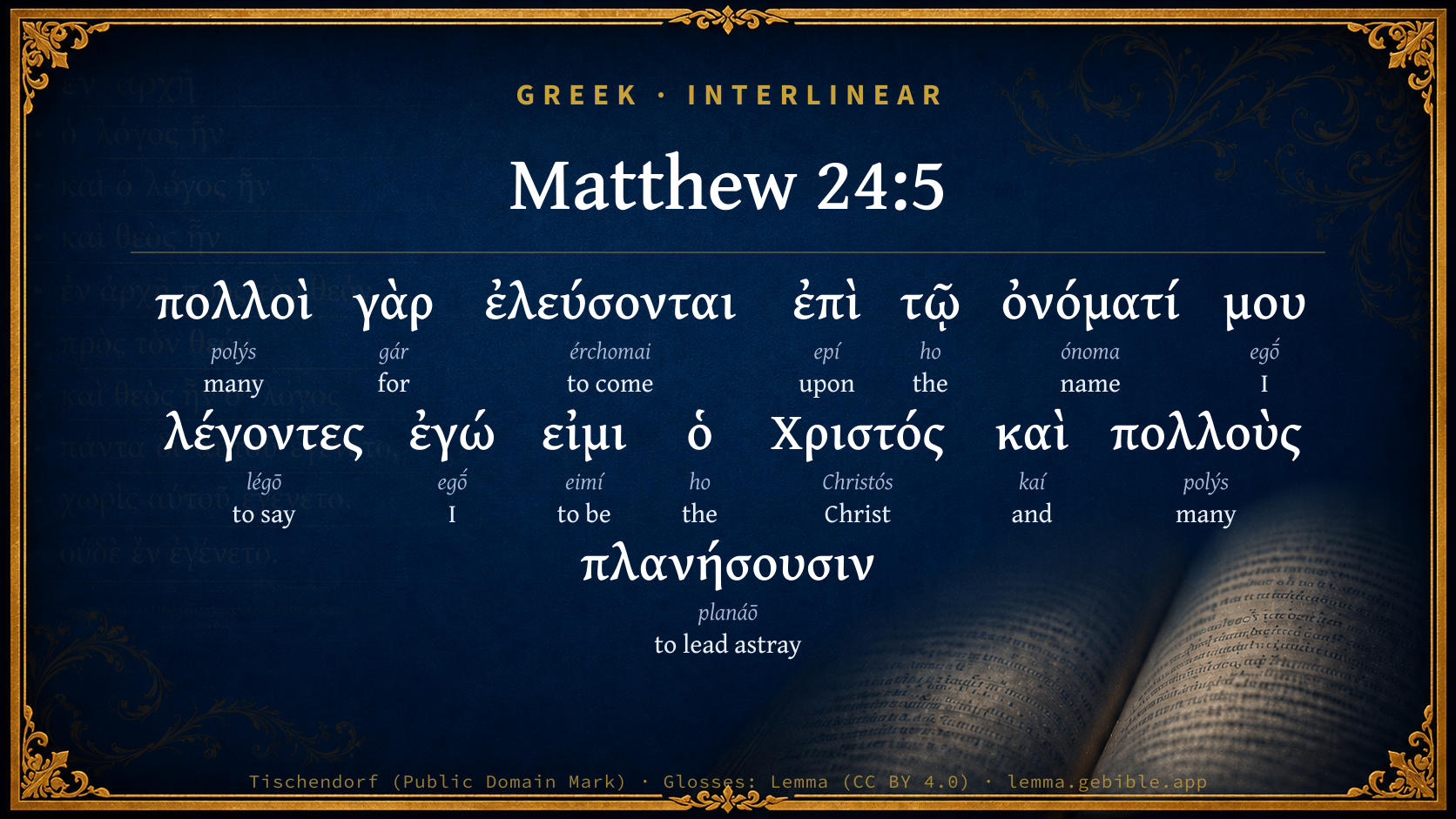
Greek (Tischendorf 8th ed.) Matthew 24:5 appears in the Greek New Testament. The text above is from the Tischendorf 8th edition. Each word links to its Strong’s number and a concise gloss. Click any word for its full Thayer’s Greek Lexicon entry.
Download image
Cite this verse

Matthew 24:5 (World English Bible). Public Domain. Lemma interlinear Bible study tool, https://lemma.gebible.app/v/matthew/24/5.

Show BibTeX & RIS
BibTeX
RIS
English Translation
For many will come in my name, saying, 'I am the Christ,' and will lead many astray.
World English Bible · Public Domain
Download a study sheet

One document with this verse’s original text, its word-by-word gloss line, the meaning frame, cross-references with their text, attributed commentary, and full source and license credits — printable, and it pastes into notes with its structure intact.

This verse Autodidact and up

Study sheet (.html) Plain text (.txt)

A passage Seminary Student

Up to 50 verses in one chapter. A passage sheet keeps up to 6 commentary sources and 12 cross-references per verse, in the order this page ranks them, and says so on the sheet whenever that leaves anything out. Ask for a single verse and you get the Autodidact verse sheet above.

Everything on this page stays free to read, with no account — the sheet is a download of what is already on screen, not access to it.

Want to remove ads? Support Godless Engineer
Compare translations 3

The same verse in 3 English versions, stacked beneath the original-language interlinear above. Click any original word for its lexicon entry.

Each is an independent rendering of the whole verse — the interlinear is not word-aligned to these translations.

Highlighted words mark where these versions differ — a whole-verse word diff, not a word-by-word alignment.

  • World English Bible Public Domain
    For many will come in my name, saying, 'I am the Christ,' and will lead many astray.
  • King James Version Public Domain
    For many shall come in my name, saying, I am Christ; and shall deceive many.
  • unfoldingWord Literal Text CC BY-SA 4.0
    For many will come in my name, saying, ‘I am the Christ,’ and they will lead many astray.

unfoldingWord Literal Text — © unfoldingWord, licensed CC BY-SA 4.0. Word-aligned USFM3 via Door43 (git.door43.org/unfoldingWord/en_ult).

Versions to compare (up to 4)

3 of 4 selected

Show all 19 translations

Every available English version of this verse, each an independent rendering of the whole verse.

  • World English Bible Public Domain
    For many will come in my name, saying, 'I am the Christ,' and will lead many astray.
  • Berean Standard Bible Public Domain
    For many will come in My name, claiming, ‘I am the Christ,’ and will deceive many.
  • Majority Standard Bible Public Domain
    For many will come in My name, claiming, ‘I am the Christ,’ and will deceive many.
  • King James Version Public Domain
    For many shall come in my name, saying, I am Christ; and shall deceive many.
  • American Standard Version (1901) Public Domain
    For many shall come in my name, saying, I am the Christ; and shall lead many astray.
  • Revised Version (1885) Public Domain
    For many shall come in my name, saying, I am the Christ; and shall lead many astray.
  • Geneva Bible (1599) Public Domain
    For many shall come in my name, saying, I am Christ, and shall deceiue many.
  • Douay-Rheims (1899) Public Domain
    For many will come in my name saying, I am Christ: and they will seduce many.
  • Young's Literal Translation Public Domain
    for many shall come in my name, saying, I am the Christ, and they shall lead many astray,
  • Literal Standard Version CC BY-SA 4.0
    for many will come in My Name, saying, I am the Christ, and they will lead many astray,
  • Unlocked Literal Bible CC BY-SA 4.0
    For many will come in my name. They will say, 'I am the Christ,' and will lead many astray.
  • unfoldingWord Literal Text CC BY-SA 4.0
    For many will come in my name, saying, ‘I am the Christ,’ and they will lead many astray.
  • Darby Bible Public Domain
    For many shall come in my name, saying, *I* am the Christ, and they shall mislead many.
  • World Messianic Bible Public Domain
    For many will come in my name, saying, ‘I am the Messiah,’ and will lead many astray.
  • Webster's Bible Public Domain
    For many will come in my name, saying, I am Christ; and will deceive many.
  • Free Bible Version CC BY-SA 4.0
    “Many will come claiming to be me, saying, ‘I'm the Messiah,’ and they will deceive many people.
  • Bible in Basic English Public Domain
    For people will come in my name, saying, I am the Christ; and a number will be turned from the true way through them.
  • Text-Critical English NT CC BY 4.0
    For many will come in my name, saying, ‘I am the Christ,’ and they will lead many astray.
  • Tyndale New Testament (1534) Public Domain
    For many shall come in my name sayinge: I am Christ and shall deceave many.

Literal Standard Version (2020), Covenant Press — licensed CC BY-SA 4.0. Text via the HelloAO Bible API (eBible.org). Unlocked Literal Bible (unfoldingWord) — licensed CC BY-SA 4.0. Text via the HelloAO Bible API (eBible.org). unfoldingWord Literal Text — © unfoldingWord, licensed CC BY-SA 4.0. Word-aligned USFM3 via Door43 (git.door43.org/unfoldingWord/en_ult). Free Bible Version, Dr. Jonathan Gallagher — licensed CC BY-SA 4.0. Text via the HelloAO Bible API (eBible.org).

Word by word

More ways to search: Search by grammar → Find every occurrence → Compare this word →

Practice this passage: Drill this verse → Learn its vocabulary →

πλανήσουσιν
planáō
G4105
“to lead astray”
Verb, Future, Active, Indicative, 3rd person, Plural
Part of Speech
Verb
Tense
Future
Voice
Active
Mood
Indicative
Person
3rd person
Number
Plural
Full Thayer's Definition

Origin: from G4106

TDNT: 09:48,9

1. to cause to stray, to lead astray, lead aside from the right way a. to go astray, wander, roam about 2. metaph. a. to lead away from the truth, to lead into error, to deceive b. to be led into error c. to be led aside from the path of virtue, to go astray, sin d. to sever or fall away from the truth 1. of heretics e. to be led away into error and sin
  1. πολλοὶ polýs G4183 “many” Adjective, Nominative, Plural, Masculine
  2. γὰρ gár G1063 “for” Conjunction
  3. ἐλεύσονται érchomai G2064 “to come” Verb, Future, Middle deponent, Indicative, 3rd person, Plural
  4. ἐπὶ epí G1909 “upon” Preposition
  5. τῷ ho G3588 “the” Article, Dative, Singular, Neuter
  6. ὀνόματί ónoma G3686 “name” Noun, Dative, Singular, Neuter
  7. μου egṓ G1473 “I” Personal pronoun, 1st person, Genitive, Singular
  8. λέγοντες légō G3004 “to say” Verb, Present, Active, Participle, Nominative, Plural, Masculine
  9. ἐγώ egṓ G1473 “I” Personal pronoun, 1st person, Nominative, Singular
  10. εἰμι eimí G1510 “to be” Verb, Present, Active, Indicative, 1st person, Singular
  11. ὁ ho G3588 “the” Article, Nominative, Singular, Masculine
  12. Χριστός Christós G5547 “Christ” Noun, Nominative, Singular, Masculine
  13. καὶ kaí G2532 “and” Conjunction
  14. πολλοὺς polýs G4183 “many” Adjective, Accusative, Plural, Masculine

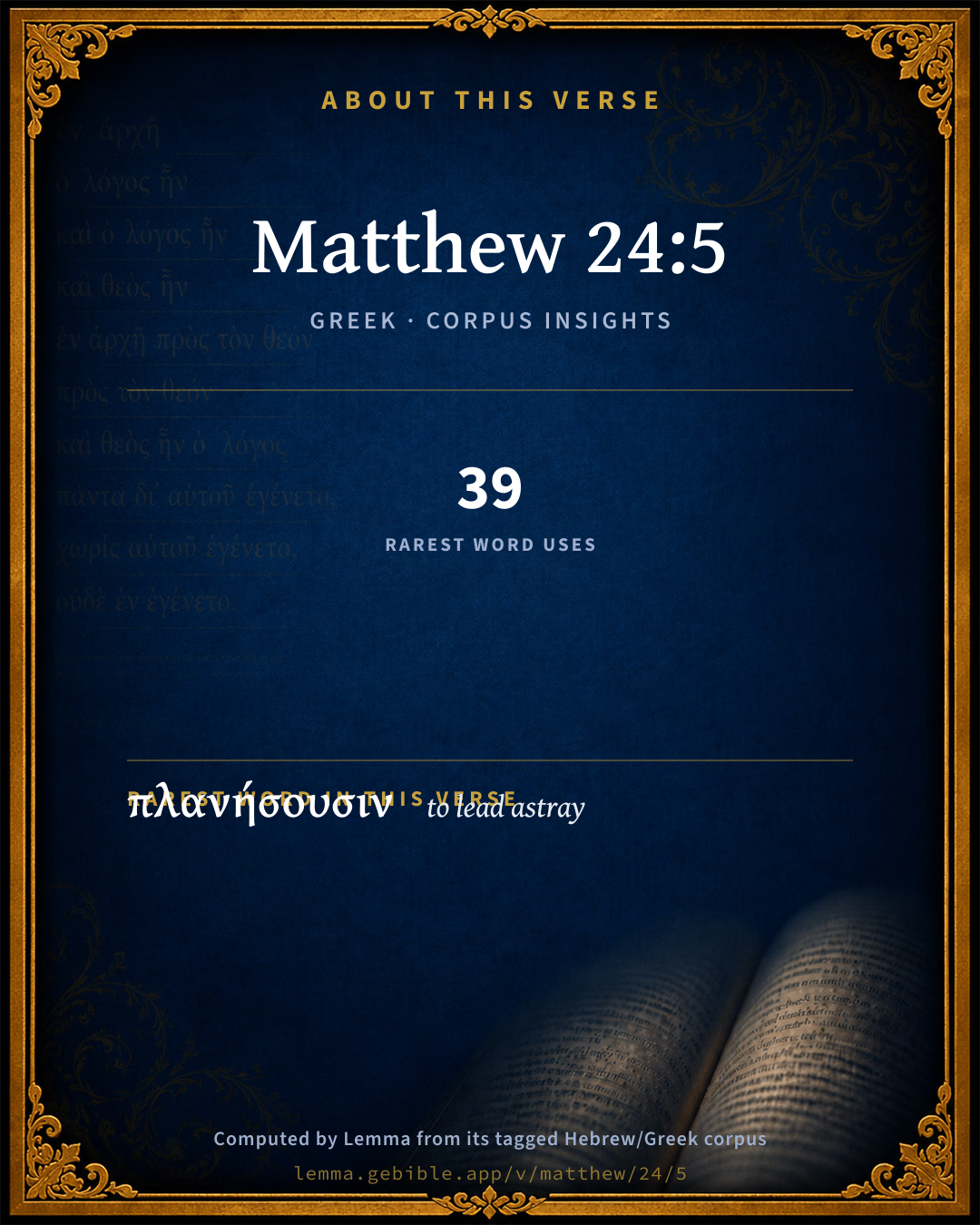
About this verse

These counts appear in no published source. They are computed here, from the morphology-tagged text and Lemma’s own curated glosses. What Lemma adds →

15
words
12
distinct lemmas
Gospels
section

Shared distinctive vocabulary

πλανήσουσιν to lead astray G4105 occurs in 37 verses of the Greek New Testament. Also found in:
Repetition

Words recur within this verse:

Cross-references

10

Topical passages linked to Matthew 24:5 in the Treasury of Scripture Knowledge — connected by theme and wording, ordered by reader-vote popularity; previews shown in the World English Bible.

  • Matthew 24:11 Many false prophets will arise, and will lead many astray.
  • Matthew 24:24 For there will arise false christs, and false prophets, and they will show great signs and wonders, so as to lead astray, if possible, even the chosen ones.
  • Jeremiah 14:14 Then Yahweh said to me, The prophets prophesy lies in my name; I didn't send them, neither have I commanded them, neither spoke I to them: they prophesy to you a lying vision, and divination, and a thing of nothing, and the deceit of their own heart.
  • 1 John 2:18 Little children, these are the end times, and as you heard that the Antichrist is coming, even now many antichrists have arisen. By this we know that it is the end times.
  • Acts 5:36–37 For before these days Theudas rose up, making himself out to be somebody; to whom a number of men, about four hundred, joined themselves: who was slain; and all, as many as obeyed him, were dispersed, and came to nothing.
  • Acts 8:9–10 But there was a certain man, Simon by name, who used to practice sorcery in the city, and amazed the people of Samaria, making himself out to be some great one,
  • Jeremiah 23:25 I have heard what the prophets have said, who prophesy lies in my name, saying, I have dreamed, I have dreamed.
  • John 5:43 I have come in my Father's name, and you don't receive me. If another comes in his own name, you will receive him.
  • Jeremiah 23:21 I sent not these prophets, yet they ran: I didn't speak to them, yet they prophesied.
  • Revelation 13:8 All who dwell on the earth will worship him, everyone whose name has not been written from the foundation of the world in the book of life of the Lamb who has been killed.

Cross-references courtesy of OpenBible.info (CC BY 4.0).

Commentary

Notes on Matthew 24:5 from classic Christian and Jewish commentators (each source and its license shown beneath its notes). The classic Christian expositions comment on the surrounding passage and are grouped to its opening verse, so a note may address several verses; the Jewish commentaries on the Tanakh (Rashi and others) are per-verse, so they appear only where the commentator wrote on this verse.

Lemma curates 59 commentaries, every one of them public domain or Creative Commons licensed, each selected and text-cleaned for this edition rather than reprinted as found. About our sources →

Whedon's Commentary on the Bible

Daniel D. Whedon

5. Saying, I am Christ — In regard to the historical fulfilments of the details, consult our comments on Mark. But this caution clearly shows that it was of a literal coming which the discourse is to treat, and not a figurative.

The caution appears in more expanded form in the closing part of paragraph third, (Mat_24:24-27,) and the same contrast is drawn. Surely no one can compare the two antitheses contained in Mat_24:5-6 and in Mat_24:24-27 without seeing that they contrast the same things, and that, therefore, the end in Mat_24:6 is the coming of Mat_24:27.

Daniel D. Whedon (gen. ed.), Commentary on the Old and New Testaments (1874–1909) — public domain. Text from a community e-Sword module.

Tyndale Open Study Notes

Tyndale Open Resources

24:5 claiming, ‘I am the Messiah’: A series of false prophets and miracle workers evoked messianic images and persuaded the masses to follow them in hope of deliverance during the period between AD 30 and 70 (Josephus, Antiquities 18.4.1; 20.5.1; 20.8.6; War 6.5.2). The earliest recorded instance of an outright claim to be the Messiah was Bar Kochba’s claim in AD 132. It is not clear whether Jesus is referring only to impostors in the period prior to the destruction of the Temple or to false messiahs throughout the church age or perhaps during a future tribulation.

Tyndale Open Study Notes — © Tyndale Open Resources, licensed CC BY-SA 4.0. Text via the HelloAO Bible API.

Bengel's Gnomon

Johann Albrecht Bengel

Mat 24:5. Πολλοὶ γὰρ, κ.τ.λ., for many, etc.) In the beginning will come false Christs; in the middle, false prophets, Mat 24:11; in the end, both (22, 24). A twofold climax.[1031]—ἐπὶ τῷ ὀνόματί Μου, in My name) They will not only say that they have been sent by Me, but that they are He who I am.—λέγοντες, ἐγώ εἰμι ὁ Χριστός, saying, I am Christ) Joachim Camerarius says, “Theophylact has recorded that a certain Samaritan, Dositheus by name, gave out that he was the prophet foretold by Moses; that Simon the Samaritan also (mentioned in the apostolic history of St Luke) called himself the Great Power of God, i.e. ἡ Δύναμις Μεγαλή: the prediction seems also applicable to Theudas,[1032] and “the certain Egyptian,”[1033] and another pretender mentioned by Josephus (who records those matters in the eighteenth book of his Antiquities, and the second of his Conquest of Judea), all claiming the character of prophet, though being in reality seditious impostors. And, in later times, Manes even dared to call himself Christ, and, in imitation of Him, appoint twelve apostles.

[1031] i.e. The presence of the two classes together will be a greater evil than that of either of them alone.—(I. B.)

[1032] See Act 5:36.—(I. B.)

[1033] Act 21:38.—(I. B.)

Bengel's Gnomon of the New Testament — English translation (T&T Clark, Edinburgh, 1860) — public domain. Text from a community e-Sword module.

Expositor's Greek Testament

ed. W. Robertson Nicoll

Mat 24:5 . πολλοὶ γὰρ ἐλεύσονται , etc., the first omen the advent of pseudo-Messiahs . This first mentioned, quite naturally. Ruin of Jerusalem and the nation will come through revolt against Rome, and the deepest cause of revolt will be the Messianic hope as popularly understood. Volcanic outbursts of Messianic fanaticism inevitable, all the more that they have rejected the true spiritual Christ. Josephus testifies that this was the chief incentive to war against Rome (B. J., vi. 54). The aim of the popular Messianic hope was independence, and all leaders of movements having that goal in view came in the name of “Christs,” whether they formally assumed that name or not. It is doubtful if any did before the destruction of Jerusalem, but that does not falsify Christ’s prediction, which is expressed in terms of an idea rather than in technical terms suggested by fact. It is not a vaticinium ex eventu ; yet strictly true, if we understand by one coming in the name of Christ a leader of the fight for liberty ( vindicem libertatis , Grotius). πολλοὺς πλανήσουσιν . The political Christs, leaders of the war against Rome, deceived the bulk of the people. Jesus wished His followers to hold entirely aloof from the movement. To warn them against sympathising with it was by no means superfluous ( vide Luk 24:21 , Act 1:6 ).

The Expositor's Greek Testament, edited by W. Robertson Nicoll (1897–1910) — public domain. Text from a community e-Sword module.

Adam Clarke's Commentary

The FIRST sign is false Christs.

Verse 5. For many shall come in my name]

1. Josephus says, (War, b. ii. c. 13,) that there were many who, pretending to Divine inspiration, deceived the people, leading out numbers of them to the desert, pretending that God would there show them the signs of liberty, meaning redemption from the Roman power: and that an Egyptian false prophet led 30,000 men into the desert, who were almost all cut off by Felix. See Ac 21:38. It was a just judgment for God to deliver up that people into the hands of false Christs who had rejected the true one. Soon after our Lord's crucifixion, Simon Magus appeared, and persuaded the people of Samaria that he was the great power of God, Ac 8:9-10; and boasted among the Jews that he was the son of God.

2. Of the same stamp and character was also Dositheus, the Samaritan, who pretended that he was the Christ foretold by Moses.

3. About twelve years after the death of our Lord, when Cuspius Fadus was procurator of Judea, arose an impostor of the name of Theudas, who said he was a prophet, and persuaded a great multitude to follow him with their best effects to the river Jordan, which he promised to divide for their passage; and saying these things, says Josephus, he deceived many: almost the very words of our Lord.

4. A few years afterwards, under the reign of Nero, while Felix was procurator of Judea, impostors of this stamp were so frequent that some were taken and killed almost every day. Jos. Ant. b. xx. c. 4. and 7.

Adam Clarke's Commentary on the Bible (1810–1826) — public domain. Text from a community e-Sword/MySword module.

Ellicott's Commentary for English Readers

(5) Many shall come in my name, saying, I am Christ.—Better, the Christ. No direct fulfilments of this prediction are recorded, either in the New Testament, or by Josephus, or other historians. Bar-Cochba (the “son of the star”), who claimed to be the “Star” of the prophecy of Balaam (Num_24:17), is often named as a fulfilment; but he did not appear till A.D. 120—nearly 50 years after the destruction of Jerusalem. In the excited fanaticism of the time, however, it was likely enough that such pretenders should arise and disappear, after each had lived out his little day, and fill no place in history. The “many antichrists, i.e., rival Christs, of 1Jn_2:18, may point to such phenomena; possibly, also, the prophecy of 2Th_2:4. Theudas (the last rebel of that name—not the one named in Act_5:36, but by Josephus, Ant. xx. 5), or “the Egyptian” of Act_21:38, may possibly have mingled Messianic claims with their pretensions, but there is no evidence of it.

A Bible Commentary for English Readers, edited by Charles John Ellicott (1878–1897) — public domain. Text from a community e-Sword module.

The Cambridge Bible for Schools and Colleges

gen. ed. J. J. S. Perowne

5. saying, I am Christ] Rather, the Christ, the Messiah. The appearance of false Messiahs shall be the first sign. St John bears witness to the fulfilment of this sign: “Even now are there many antichrists, whereby we know that it is the last time,” 1Jn_2:18.

The Cambridge Bible for Schools and Colleges (gen. ed. J. J. S. Perowne; Cambridge University Press, 1878–1918) — public domain. Text from a community e-Sword module.

John Gill's Exposition

For many shall come in my name,.... by his orders, or with delegated powers and authority from him; but should assume the name of the Messiah, which was peculiarly his, to themselves; and take upon them his office, and challenge the honour and dignity which belonged unto him:

saying, I am Christ, and shall deceive many. This is the first sign, preceding the destruction of the city and temple of Jerusalem; as there was a general expectation among the Jews of a Messiah; that is, of one that should arise and deliver them from the Roman yoke, which was the common idea tacked to that word; in this period of time, many set up themselves to be deliverers and redeemers of the people of Israel: who had each of them their followers in great numbers, whom they imposed upon, and brought to destruction. Of this sort was Theudas, not he that Gamaliel speaks of, Act 5:36 for he was before this time; but one that was in the time of Claudius Caesar, when Cuspius Fadus was governor of Judea; who persuaded a great number to follow him to the river Jordan, which he promised to divide, by a word of command, and give them a passage over; and thereby, as the historian observes (c), , "he deceived many"; which is the very thing that is here predicted: but he and his company were routed Fadus, and his head cut off. There was another called the Egyptian, mentioned in Act 21:38 who made an uproar, and led four thousand cut-throats into the wilderness; and this same man persuaded thirty thousand men to follow him to Mount Olivet, promising a free passage into the city; but he being vanquished by Felix, then governor of Judea; fled, and many of his followers were killed and taken (d): and besides, there were many more magicians and impostors, that pretended to signs and wonders, and promised the people deliverance from their evils, by whom they were imposed upon to their ruin. There were others also besides these, that set up for deliverers, who called themselves by the name of the Messiah. Among these, we may reckon Simon Magus, who gave out that he was some great one; yea, expressly, that he was the word of God, and the Son of God (e), which were known names of the Messiah; and Dositheus the Samaritan, asserted himself to be Christ (f); and also Menander affirmed, that no man could be saved, unless he was baptized in his name (g); these are instances before the destruction of Jerusalem, and confirm the prophecy here delivered.

(c) Joseph. Antiq. l. 20. c. 2. (d) Joseph. Antiq. l. 20. c. 6. (e) Jerom in loc. Iren. adv. Haeres. l. 1. c. 20. (f) Origen contr. Cels. l. 1. p. 44. (g) Tertull. de prescript. Haeret. c. 46.

John Gill's Exposition of the Whole Bible (1746–1763) — public domain (CC PDM 1.0). Text via the HelloAO Bible API.

Trapp's Complete Commentary

John Trapp

5 For many shall come in my name, saying, I am Christ; and shall deceive many.

Ver. 5. Shall come in my name] Or, under my name, saying, I am Christ, as Theudas the Egyptian, Judas the Galilean, Act 5:36-37. Barhocab, and others of old, who were miserably slain by the Romans. (Joseph. Antiq. xvii. 12, xviii. 20; B. J. ii. 12.) So one Moor in King Edward VI’s time, took upon him to be Christ. So did Hacket in Queen Elizabeth’s time; David George likewise and others in Germany. Here in England, at the Convocation held at Oseney under Stephen Langton, 1206, a certain young man professed himself to be Jesus Christ; showing marks of wounds in his hands, feet, and sides. He brought also two women with him, whereof one took upon her to be our Lady, and the other Mary Magdalene. This counterfeit Christ for his labour was worthily crucified. That I say nothing here of Papists, who desperately deny the Lord that bought them, and wickedly set up Antichrist in his stead (as were easy to prove), who opposeth him not so much in his nature or person, as in his unction and function, and thence also hath his name, Αντιχριστος, non Αθεος, non Αντιθεος.

John Trapp, A Commentary or Exposition upon All the Books of the Old and New Testament (1647–1656) — public domain. Text from a community e-Sword module.

Haydock's Catholic Bible Commentary

For many will come. One of these was Simon Magus, who in the Acts (chap. viii. ver. 10.) is mentioned as calling himself the power of God; hence the apostle St. John (1 epistle ii. 18,) says, and as you have heard that Antichrist cometh, even now there are become many Antichrists. By Antichrists I understand heretics, who, under the name of Christ, teach doctrines different from Christ; neither is there any reason for us to be surprised, if many be seduced, since our Lord declares that many will be seduced. (St. Jerome) ... This alone will be sufficient for us to know the false doctrines taught by Antichrist, when they assure us that they are Christ; for we do not read in any part that Christ said so of himself. The miracles he performed, the doctrines he taught, and the virtues he on every occasion exhibited, were proofs sufficient to convince us that he was the Christ. There is need of the assistance of God to overcome the snares laid for us by hypocrisy. (Origen) --- Among these impostors were one Theodas, (Acts v. 36,) the impious Egyptian, (Acts xxi. 38,) Judas of Galilee, Menander, and several others who preceded the destruction of Jerusalem; but many more will precede the destruction of the world. This therefore is the first sign, the seduction of many souls from the true faith by heresies, and is common to both events. (Jansenius) --- See much more in Barradius, tom. iii. lib. 9, chap. 2, where he collects various illustrations from Josephus and profane authors. (Menochius)

George Leo Haydock (1774–1849), Haydock's Catholic Family Bible and Commentary, 1859 edition — public domain. Excludes Psalms (Douay-Rheims chapter numbering differs from Protestant) and Deuterocanonical books (Catholic canon only).

Matthew Poole's English Annotations

Mark hath the same, Mar 13:6 Luke saith, Luk 21:8, Many shall come in my name, saying, I am Christ; and the time draweth near: go ye not after them. Our Saviour seemeth to have given this as a sign common both to the destruction of Jerusalem and the end of the world, though possibly before the destruction of Jerusalem, while the Jews were in expectation of a Messiah as a temporal prince or deliverer, there were more of them than afterward, for every one who could get a party together to colour his sedition and rebellion, gave out himself to be the Christ. Of this number are said to have been Theudas, and Judas of Galilee, mentioned by Gamaliel, Act 5:36,37. Amongst these some also reckon the Egyptian mentioned Act 21:38, and Simon Magus, who gave out himself to be some great one, and the people accounted him the great power of God. Such there have been, and probably may be more toward the end of the world. Many were deceived by the impostors: Christ warns his disciples concerning them.

Matthew Poole's English Annotations on the Holy Bible (1683–1685) — public domain. Text from a community e-Sword/MySword module.

The Pulpit Commentary

Here begins what has been called the first strophe of the oracle (vers. 5-14), which indicates certain prognostics common to the close of the Jewish theocracy and to the end of the world. Many shall come in my Name (epi tw onomati mou), resting on my Name, grounding their pretensions thereon. Saying, I am Christ (the Christ). They who really desired to follow Christ should be tried by the temptation to see in other persons the Messiah. The warning could scarcely have been needed by the apostles themselves; it must have been meant primarily for their converts and the early Christians. And though we have no account in apostolic Church history of any such pretenders, yet in the age succeeding our Lord"s death we read of many impostors who asserted themselves to be inspired prophets, if not the Messiah, and led astray many credulous persons (see Josephus, "Ant.," 20:5. 1; 8. 6, etc.). There were doubtless many false Messiahs whose names are little known, and critics have enumerated twenty-nine such. The pretensions of these persons were not generally admitted, and their adherents were commonly few and uninfluential. Our Lord probably did not allude to these in his monition. But we may observe that the warning may include such deceivers as Simon Magus and those many false teachers who vexed the early Church, and, without assuming the name of Christ, did Satan"s work by undermining the faith. St. John speaks of there being "many antichrists" in his day, (1Jn_2:18) and St. Paul had occasion to warn his converts against "heretical seducers". (see 2Co_11:13 2Th 2 1Ti_6:3, etc.) Since then the prophecy has been fulfilled in the heretics who, professing to come in the Name of Christ and to enunciate his doctrine, or, like Mohammed, to assume his place, have taught lies. These shall abound in the latter days, and shall be a sign of the approaching end.

HOMILIES BY W.F. ADENEY Ver. 5. False Christs.

It is a fact of history that pretenders appeared who claimed to be sent by God for the deliverance of the Jews, and practically usurped to themselves the position of the Christ. But all this belongs to far-distant ages. In a larger application of our Lord"s idea, the world has seen many other false Christs down even to our own time, for whoever or whatever assumes to do the work of Christ or claims his honours is a false Christ. Let us look at some of these usurpers.

I THE PRIEST. Men who come between us and God, so that we are shut off from the privileges of religion, excepting as we submit to their authority, are false Christs. Priests who offer to intercede with peculiar efficacy, claim to sacrifice on the behalf of others, and assert that they are the channels of sacramental grace, take on themselves functions which rightly belong to Christ. At the head of this great assumption is the pope; but the humblest minister who would have us look for salvation through his mystic grace shares in the same offence. In fairness it should be seen that Romanist priests and their imitators do not claim to set aside the work and honour of Jesus Christ, but merely to administer his grace. Yet practically their functions are substituted for Christ"s, and the people are induced to look to them instead of going to Christ, the one High Priest, and to God, as themselves kings and priests.

II THE CREED. Theologians only profess to interpret the mind and will of Christ. Nevertheless, the scholasticism of the Church has led to the exaltation of doctrinal statements into the place which of right belongs to Christ himself. Thus it was once a popular presentation of the gospel to describe it as a group of saving truths which a person was to believe. The great thing was for him to see the way of salvation clearly. The whole idea of salvation by orthodoxy was the substitution of dogma for Christ. It taught that men are saved by believing a Creed; but the New Testament teaches that salvation is dependent on faith in Christ alone.

III THE CHURCH. This is an institution founded by Christ himself. It is his own body, the body of which he is the Head. But there is a great perversion when the body is put in the place of the Head, and is thought to perform its functions. The Churchly notion of religion is that men are saved through their connection with the Church. It is true that all Christians maintain that salvation is in and through Christ alone. There is no formal and confessed substitution of the Church for Christ. But the perversion is not the less real in practice. As a fact, multitudes of people are led to think much more of their inclusion in the Church than of their being in Christ. The assertion that there is no salvation outside the Church is soon twisted into the idea that there is salvation for all in the Church, and that membership therein is the primary condition of salvation. Against these and all other substitutes for Christ we have to be on our guard, that we may look alone to the living personal Saviour for grace and life. W.F.A.

The Pulpit Commentary (1880–1919), ed. H.D.M. Spence-Jones & Joseph S. Exell — public domain. Text from a community e-Sword module.

John Wesley's Explanatory Notes

Many shall come in my name - First, false Christs, next, false prophets, Matt. xxiv, 11. At length, both together, ver. 24. And indeed never did so many impostors appear in the world as a few years before the destruction of Jerusalem; undoubtedly because that was the time wherein the Jews in general expected the Messiah.

John Wesley, Explanatory Notes Upon the Whole Bible (1754–1765) — public domain. Text via the GEBible commentary corpus.

Cambridge Greek Testament for Schools and Colleges

5. ἐγώ εἰμι ὁ Χριστός. The Christ, the Messiah. The appearance of false Messiahs shall be the first sign. St John bears witness to the fulfilment of this sign: ‘Even now are there many antichrists, whereby we know that it is the last time.’ 1Jn 2:18.

Cambridge Greek Testament for Schools and Colleges (Cambridge University Press, 1896; 21 vols, various authors incl. Carr, Maclear, Plummer, Farrar, Lumby, Moule, M. R. James, Simcox) — public domain. Text from a community e-Sword module.

Alford’s Greek Testament

Henry Alford

5.] Our Lord does not answer the πότε but by admonitions not to be deceived. See a question similarly answered, Luk 13:23, Luk 13:24.

πολλ. γάρ] This was the first danger awaiting them: not of being drawn away from Christ, but of imagining that these persons were Himself. Of such persons, before the destruction of Jerusalem, we have no distinct record; doubtless there were such: but (see above) I believe the prophecy and warning to have a further reference to the latter times in which its complete fulfilment must be looked for. The persons usually cited as fulfilling this (Theudas, Simon Magus, Barchochab, &c.) are all too early or too late, and not correspondent to the condition, ἐπὶ τῷ ὀνόμ. μου, ‘with My name as the ground of their pretences.’ See Greswell on the Parables, v. 380 note. Luke gives an addition (ver. 8) to the speech of the false Christs, ͅκαὶ ὁ καιρὸς ἤγγικεν.

Henry Alford, The Greek Testament (1849–1861) — public domain. Text from a community e-Sword module.

International Critical Commentary

(M) 5. For many shall come in My name, saying, I am the Messiah; and shall lead many astray.] Mk. has: “Many shall come in My name, saying, that I am (He), and shall lead many astray.” Mt. inserts a connecting link (γάρ), omits ὅτι, as often, and adds the explanatory ὁ Χριστός.

International Critical Commentary — older volumes (1896–1929), various authors — public domain. Text from a community e-Sword module.

Vincent's Word Studies in the New Testament

Marvin R. Vincent

In my name [επι τω ονοματι μου] . Lit., on my name, i e., on the strength of; resting their claims on the name Messiah.

Marvin R. Vincent, Word Studies in the New Testament (1887–1900) — public domain. Text from a community e-Sword/MySword module.

Lesson kit

Teaching starters — assembled from the data on this page, not authored interpretation. Every prompt links to the verse data it draws on. Edit before teaching.

Matthew, in the Gospels, opens this verse with 15 words (12 distinct Greek lemmas). Its most distinctive word is planáō (“to lead astray”). A historical commentator’s framing appears above. Read the whole chapter for the surrounding context.

Discussion questions

  1. What does “to lead astray” (planáō) contribute to the verse as a whole?
  2. How does Matthew 18:12, which shares the word «to lead astray», read alongside this verse?
  3. What does the repetition of “many” (2× in this one verse) do in this verse?
  4. The translations on this page render this verse differently — a whole-verse word diff, not a word-by-word alignment. What might account for the different wordings?
  5. Compare how Whedon's Commentary on the Bible and Tyndale Open Study Notes read this verse. Where do they agree or differ?

Things to notice

  • These translations choose different wording for 5 words in this verse.
  • “many” occurs 2× in this single verse.
  • 12 distinct Greek lemmas span 15 words in this verse.

Reading settings

Reading text

Shown beneath each verse's original-language words.

Old Testament
Old Testament edition

Read the OT as the Masoretic Hebrew (MT) or the Greek Septuagint (LXX).

English shown for the Greek Septuagint (in the Hebrew ↔ Greek comparison).

Comparing translations? Open the Compare panel on any verse page to stack up to four side by side.