
Luke 6:35

Greek (Tischendorf 8th ed.) Luke 6:35 appears in the Greek New Testament. The text above is from the Tischendorf 8th edition. Each word links to its Strong’s number and a concise gloss. Click any word for its full Thayer’s Greek Lexicon entry.

Download image
Cite this verse

Luke 6:35 (World English Bible). Public Domain. Lemma interlinear Bible study tool, https://lemma.gebible.app/v/luke/6/35.

Show BibTeX & RIS
BibTeX
RIS
English Translation
But love your enemies, and do good, and lend, expecting nothing back; and your reward will be great, and you will be children of the Most High; for he is kind toward the unthankful and evil.
World English Bible · Public Domain
Highlights
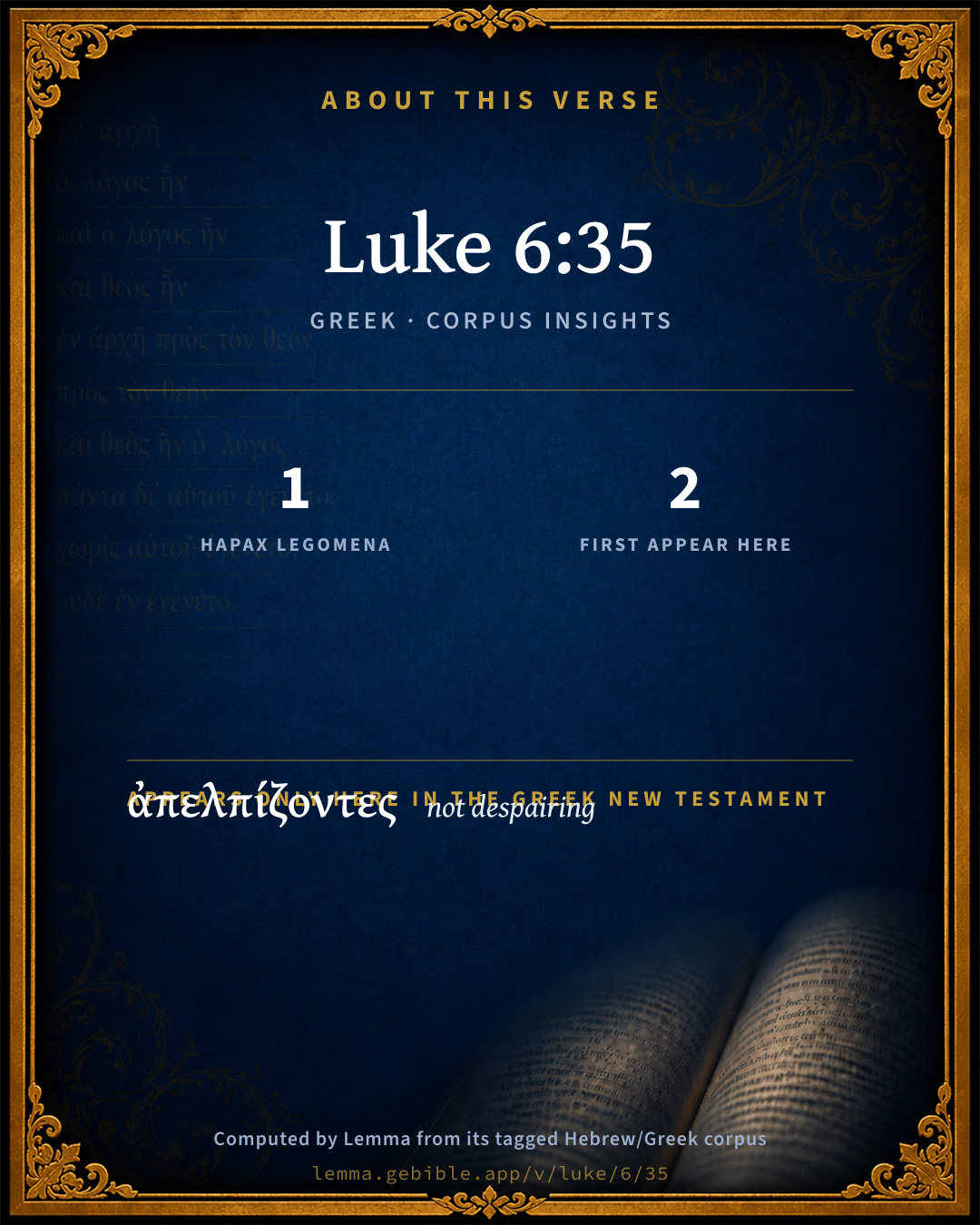
  • 1 hapax legomenon — only here in the Greek New Testament
  • 2 first appearances in the Greek New Testament
Full analysis ↓
Download a study sheet

One document with this verse’s original text, its word-by-word gloss line, the meaning frame, cross-references with their text, attributed commentary, and full source and license credits — printable, and it pastes into notes with its structure intact.

This verse Autodidact and up

Study sheet (.html) Plain text (.txt)

A passage Seminary Student

Up to 50 verses in one chapter. A passage sheet keeps up to 6 commentary sources and 12 cross-references per verse, in the order this page ranks them, and says so on the sheet whenever that leaves anything out. Ask for a single verse and you get the Autodidact verse sheet above.

Everything on this page stays free to read, with no account — the sheet is a download of what is already on screen, not access to it.

Want to remove ads? Support Godless Engineer
Compare translations 3

The same verse in 3 English versions, stacked beneath the original-language interlinear above. Click any original word for its lexicon entry.

Each is an independent rendering of the whole verse — the interlinear is not word-aligned to these translations.

Highlighted words mark where these versions differ — a whole-verse word diff, not a word-by-word alignment.

  • World English Bible Public Domain
    But love your enemies, and do good, and lend, expecting nothing back; and your reward will be great, and you will be children of the Most High; for he is kind toward the unthankful and evil.
  • King James Version Public Domain
    But love ye your enemies, and do good, and lend, hoping for nothing again; and your reward shall be great, and ye shall be the children of the Highest: for he is kind unto the unthankful and to the evil.
  • unfoldingWord Literal Text CC BY-SA 4.0
    But love your enemies and do good to, and lend, expecting nothing in return, and your reward will be great, and you will be sons of the Most High, for he is kind toward the ungrateful and evil.

unfoldingWord Literal Text — © unfoldingWord, licensed CC BY-SA 4.0. Word-aligned USFM3 via Door43 (git.door43.org/unfoldingWord/en_ult).

Versions to compare (up to 4)

3 of 4 selected

Show all 19 translations

Every available English version of this verse, each an independent rendering of the whole verse.

  • World English Bible Public Domain
    But love your enemies, and do good, and lend, expecting nothing back; and your reward will be great, and you will be children of the Most High; for he is kind toward the unthankful and evil.
  • Berean Standard Bible Public Domain
    But love your enemies, do good to them, and lend to them, expecting nothing in return. Then your reward will be great, and you will be sons of the Most High; for He is kind to the ungrateful and wicked.
  • Majority Standard Bible Public Domain
    But love your enemies, do good to them, and lend to them, expecting nothing in return. Then your reward will be great, and you will be sons of the Most High; for He is kind to the ungrateful and wicked.
  • King James Version Public Domain
    But love ye your enemies, and do good, and lend, hoping for nothing again; and your reward shall be great, and ye shall be the children of the Highest: for he is kind unto the unthankful and to the evil.
  • American Standard Version (1901) Public Domain
    But love your enemies, and do `them' good, and lend, never despairing; and your reward shall be great, and ye shall be sons of the Most High: for he is kind toward the unthankful and evil.
  • Revised Version (1885) Public Domain
    But love your enemies, and do them good, and lend, never despairing; and your reward shall be great, and ye shall be sons of the Most High: for he is kind toward the unthankful and evil.
  • Geneva Bible (1599) Public Domain
    Wherefore loue ye your enemies, and doe good, and lend, looking for nothing againe, and your rewarde shalbe great, and ye shalbe the children of the most High: for he is kinde vnto the vnkinde, and to the euill.
  • Douay-Rheims (1899) Public Domain
    But love ye your enemies: do good, and lend, hoping for nothing thereby: and your reward shall be great, and you shall be the sons of the Highest; for he is kind to the unthankful, and to the evil.
  • Young's Literal Translation Public Domain
    `But love your enemies, and do good, and lend, hoping for nothing again, and your reward will be great, and ye shall be sons of the Highest, because He is kind unto the ungracious and evil;
  • Literal Standard Version CC BY-SA 4.0
    But love your enemies, and do good, and lend, hoping for nothing again, and your reward will be great, and you will be sons of the Highest, because He is kind to the ungracious and evil;
  • Unlocked Literal Bible CC BY-SA 4.0
    But love your enemies and do good to them. Lend, expecting nothing in return, and your reward will be great, and you will be sons of the Most High, for he himself is kind toward unthankful and evil people.
  • unfoldingWord Literal Text CC BY-SA 4.0
    But love your enemies and do good to, and lend, expecting nothing in return, and your reward will be great, and you will be sons of the Most High, for he is kind toward the ungrateful and evil.
  • Darby Bible Public Domain
    But love your enemies, and do good, and lend, hoping for nothing in return, and your reward shall be great, and ye shall be sons of [the] Highest; for *he* is good to the unthankful and wicked.
  • World Messianic Bible Public Domain
    But love your enemies, and do good, and lend, expecting nothing back; and your reward will be great, and you will be children of the Most High; for he is kind toward the unthankful and evil.
  • Webster's Bible Public Domain
    But love ye your enemies, and do good, and lend, hoping for nothing again; and your reward shall be great, and ye shall be the children of the Highest: for he is kind to the unthankful and to the evil.
  • Free Bible Version CC BY-SA 4.0
    No: love your enemies, do good to them, and lend without expecting to be repaid anything. Then you will receive a great reward, and you will be children of the Most High God, for he is kind to ungrateful and wicked people.
  • Bible in Basic English Public Domain
    But be loving to those who are against you and do them good, and give them your money, not giving up hope, and your reward will be great and you will be the sons of the Most High: for he is kind to evil men, and to those who have hard hearts.
  • Text-Critical English NT CC BY 4.0
    But love your enemies, do good to them, and lend to them without expecting anything in return. Then your reward will be great, and you will be sons of the Most High, for he is kind to the ungrateful and the evil.
  • Tyndale New Testament (1534) Public Domain
    Wherfore love ye youre enemys do good and lende lokynge for nothinge agayne and youre rewarde shalbe greate and ye shalbe the chyldren of the hyest: for he is kynde vnto the vnkynde and to the evyll.

Literal Standard Version (2020), Covenant Press — licensed CC BY-SA 4.0. Text via the HelloAO Bible API (eBible.org). Unlocked Literal Bible (unfoldingWord) — licensed CC BY-SA 4.0. Text via the HelloAO Bible API (eBible.org). unfoldingWord Literal Text — © unfoldingWord, licensed CC BY-SA 4.0. Word-aligned USFM3 via Door43 (git.door43.org/unfoldingWord/en_ult). Free Bible Version, Dr. Jonathan Gallagher — licensed CC BY-SA 4.0. Text via the HelloAO Bible API (eBible.org).

Word by word

More ways to search: Search by grammar → Find every occurrence → Compare this word →

Practice this passage: Drill this verse → Learn its vocabulary →

ἀπελπίζοντες
apelpízō
G560
“not despairing”
Verb, Present, Active, Participle, Nominative, Plural, Masculine
Part of Speech
Verb
Tense
Present
Voice
Active
Mood
Participle
Case
Nominative
Number
Plural
Gender
Masculine
Full Thayer's Definition

Origin: from G575 and G1679

TDNT: 10:53,2

1. nothing despairing 2. despairing of no one 3. causing no one to despair
  1. Πλὴν plḗn G4133 “moreover” Adverb
  2. ἀγαπᾶτε agapáō G25 “to love” Verb, Present, Active, Imperative, 2nd person, Plural
  3. τοὺς ho G3588 “the” Article, Accusative, Plural, Masculine
  4. ἐχθροὺς echthrós G2190 “enemy” Adjective, Accusative, Plural, Masculine
  5. ὑμῶν hymeîs G5210 “you” Personal pronoun, 2nd person, Genitive, Plural
  6. καὶ kaí G2532 “and” Conjunction
  7. ἀγαθοποιεῖτε agathopoiéō G15 “to do good” Verb, Present, Active, Imperative, 2nd person, Plural
  8. καὶ kaí G2532 “and” Conjunction
  9. δανίζετε daneízō G1155 “to borrow” Verb, Present, Active, Imperative, 2nd person, Plural
  10. μηδένα mēdeís G3367 “no one” Adjective, Accusative, Singular, Masculine, Negative
  11. καὶ kaí G2532 “and” Conjunction
  12. ἔσται eimí G1510 “to be” Verb, Future, Middle deponent, Indicative, 3rd person, Singular
  13. ὁ ho G3588 “the” Article, Nominative, Singular, Masculine
  14. μισθὸς misthós G3408 “wages” Noun, Nominative, Singular, Masculine
  15. ὑμῶν hymeîs G5210 “you” Personal pronoun, 2nd person, Genitive, Plural
  16. πολύς polýs G4183 “many” Adjective, Nominative, Singular, Masculine
  17. καὶ kaí G2532 “and” Conjunction
  18. ἔσεσθε eimí G1510 “to be” Verb, Future, Middle deponent, Indicative, 2nd person, Plural
  19. υἱοὶ huiós G5207 “son” Noun, Nominative, Plural, Masculine
  20. ὑψίστου hýpsistos G5310 “highest” Adjective, Genitive, Singular, Masculine, Superlative
  21. ὅτι hóti G3754 “that” Conjunction
  22. αὐτὸς autós G846 “he” Personal pronoun, Nominative, Singular, Masculine
  23. χρηστός chrēstós G5543 “fit” Adjective, Nominative, Singular, Masculine
  24. ἐστιν eimí G1510 “to be” Verb, Present, Active, Indicative, 3rd person, Singular
  25. ἐπὶ epí G1909 “upon” Preposition
  26. τοὺς ho G3588 “the” Article, Accusative, Plural, Masculine
  27. ἀχαρίστους acháristos G884 “ungracious” Adjective, Accusative, Plural, Masculine
  28. καὶ kaí G2532 “and” Conjunction
  29. πονηρούς ponērós G4190 “evil” Adjective, Accusative, Plural, Masculine

About this verse

These counts appear in no published source. They are computed here, from the morphology-tagged text and Lemma’s own curated glosses. What Lemma adds →

30
words
21
distinct lemmas
Gospels
section

Notable vocabulary

1 hapax legomenon — a word that appears only here in the entire Greek New Testament:

  • ἀπελπίζοντες not despairing G560

First appearance in Scripture

These words make their first canonical appearance in the Greek New Testament here:

  • ἀπελπίζοντες not despairing G560
  • ἀχαρίστους ungracious G884

Shared distinctive vocabulary

ἀχαρίστους ungracious G884 occurs in 2 verses of the Greek New Testament. Also found in:
Repetition

Words recur within this verse:

  • ἔσται to be G1510 ×3
  • καὶ and G2532 ×5
  • τοὺς the G3588 ×3
  • ὑμῶν you G5210 ×2

Cross-references

17

Topical passages linked to Luke 6:35 in the Treasury of Scripture Knowledge — connected by theme and wording, ordered by reader-vote popularity; previews shown in the World English Bible.

  • Matthew 5:44–45 But I tell you, love your enemies, bless those who curse you, do good to those who hate you, and pray for those who mistreat you and persecute you,
  • John 13:35 By this everyone will know that you are my disciples, if you have love for one another."
  • Proverbs 19:17 He who has pity on the poor lends to Yahweh; He will reward him.
  • Romans 5:8–10 But God commends his own love toward us, in that while we were yet sinners, Christ died for us.
  • Psalms 145:9 Yahweh is good to all. His tender mercies are over all his works.
  • Leviticus 25:35–37 "'If your brother has become poor, and his hand can't support him among you; then you shall uphold him. As a stranger and a sojourner he shall live with you.
  • Psalms 112:5 It is well with the man who deals graciously and lends. He will maintain his cause in judgment.
  • Proverbs 22:9 He who has a generous eye will be blessed; For he shares his food with the poor.
  • 2 Corinthians 8:9 For you know the grace of our Lord Jesus Christ, that, though he was rich, yet for your sakes he became poor, that you through his poverty might become rich.
  • 1 John 4:7–11 Beloved, let us love one another, for love is of God; and everyone who loves is born of God, and knows God.
  • Psalms 37:26 All day long he deals graciously, and lends. His seed is blessed.
  • John 15:8 "In this is my Father glorified, that you bear much fruit; and so you will be my disciples.
  • 1 John 3:10–14 In this the children of God are revealed, and the children of the devil. Whoever doesn't do righteousness is not of God, neither is he who doesn't love his brother.
  • Acts 14:17 Yet he didn't leave himself without witness, in that he did good and gave you rains from the sky and fruitful seasons, filling our hearts with food and gladness."
  • Luke 1:32 He will be great, and will be called the Son of the Most High. The Lord God will give him the throne of his father, David,
  • Luke 6:27–31 "But I tell you who hear: love your enemies, do good to those who hate you,
  • Mark 5:7 and crying out with a loud voice, he said, "What have I to do with you, Jesus, you Son of the Most High God? I adjure you by God, don't torment me."

Cross-references courtesy of OpenBible.info (CC BY 4.0).

Commentary

Notes on Luke 6:35 from classic Christian and Jewish commentators (each source and its license shown beneath its notes). The classic Christian expositions comment on the surrounding passage and are grouped to its opening verse, so a note may address several verses; the Jewish commentaries on the Tanakh (Rashi and others) are per-verse, so they appear only where the commentator wrote on this verse.

Lemma curates 59 commentaries, every one of them public domain or Creative Commons licensed, each selected and text-cleaned for this edition rather than reprinted as found. About our sources →

The Biblical Illustrator

Joseph S. Exell

Luk_6:35

And ye shall be the children of the Highest

The Christian aim and motive

1st.

The Christian aim--perfection. 2nd. The Christian motive--because it is right and Godlike to be perfect.

I. THE CHRISTIAN AIM IS THIS--to be perfect. Be ye therefore perfect. Now distinguish this, I pray you, from mere worldly morality. It is not conformity to a creed that is here required, but aspiration after a state. It is not demanded of us to perform a number of duties, but to yield obedience to a certain spiritual law. Will not that inflame our pride, and increase our natural vainglory? Now the nature and possibility of human perfection, what it is and how it is possible, are both contained in one single expression in the text, Even as your father which is in Heaven is perfect. The relationship between father and son implies consanguinity, likeness, similarity of character and nature. God made the insect, the stone, the lily; but God is not the Father of the caterpillar, the lily, or the stone. When, therefore, God is said to be our Father, something more is implied in this than that God created man. And so when the Son of Man came proclaiming the fact that we are the children of God, it was in the truest sense a revelation. He told us that the nature of God resembles the nature of man, that love in God is not a mere figure of speech, but means the same thing as love in us, and that Divine anger is the same thing as human anger divested of its emotions and imperfections. When we are commanded to be like God, it implies that God has that nature of which we have already the germs. And this has been taught by the incarnation of the Redeemer. Things absolutely dissimilar in their nature cannot mingle. Water cannot coalesce with fire--water cannot mix with oil. If, then, Humanity and Divinity were united in the person of the Redeemer, it follows that there must be something kindred between the two, or else the incarnation had been impossible. So that the incarnation is the realization of mans perfection. Here, however, you will observe another difficulty. It will be said at once--there is something in this comparison of man with God which looks like blasphemy, because one is finite and the other infinite. Let us, then, endeavour to find out the evidences of this infinitude in the nature of man. First of all we find it in this--that the desires of man are for something boundless and unattainable. The boundless, endless, infinite void in the soul of man can be satisfied with nothing but God. Satisfaction lies not in having, but in being. There is no satisfaction even in doing. Man cannot be satisfied with his own performances. A second trace of this infinitude in mans nature we find in the infinite capacities of the soul. This is true intellectually and morally. For there is no man, however low his intellectual powers may be, who has not at one time or another felt a rush of thought, a glow of inspiration, which seemed to make all things possible, as if it were merely the effect of some imperfect organization which stood in the way of his doing whatever he desired to do. With respect to our moral and spiritual capacities, we remark that they are not only indefinite, but absolutely infinite. Let that man answer who has ever truly and heartily loved another. Again, we perceive a third trace of this infinitude in man, in the power which he possesses of giving up self. In this, perhaps more than in anything else, man may claim kindred with God. Before passing on let us observe that were it not for this conviction of the Divine origin, and consequent perfectibility of our nature, the very thought of God would be painful to us.

II. We pass on, in the second place, to consider the CHRISTIAN MOTIVE--Even as your Father which is in Heaven is perfect. Brethren, worldly prudence, miscalled morality, say-- Be honest; you will find your gain in being so. Do right; you will be the better for it--even in this world you will not lose by it. The mistaken religionist only magnifies this on a large scale. Your duty, he says, is to save your soul. Give up this world to have the next. Lose here, that you may gain hereafter. In opposition to all such sentiments as these, thus speaks the gospel--Be ye perfect. Why? Because your Father which is in Heaven is perfect. Do right, because it is Godlike and right so to do. In conclusion, we observe, there are two things which are to be learned from this passage. The first is this, that happiness is not our end and aim. The Christians aim is perfection, not happiness. The second thing we have to learn is this, that on this earth there can be no rest for man. The last thing we learn from this is the impossibility of obtaining that of which some men speak--the satisfaction of a good conscience. (F. W. Robertson, M. A.)

Concerning the perfection of God

I. THE ABSOLUTE PERFECTION OF THE DIVINE NATURE SUPPOSED--As your Father which is in Heaven is perfect.

1. I shall consider how we are to conceive of the Divine perfection, these two ways.

(1) By ascribing all imaginable and possible perfection to God; absolute and universal perfection, not limited to a certain kind, or to certain particulars. Some things may seem to be perfection, which in truth are not, because they are plainly impossible, and involve a contradiction. And then there are some things which do argue and suppose imperfections in them; as motion, the quickness and swiftness whereof in creatures is a perfection, but then it supposeth a finite and limited nature. And there are also some imaginable degrees of perfection, which, because they are inconsistent with other perfections, are not to be admitted in the Divine nature. And in the Scripture we do everywhere find perfection ascribed to the nature, and works, and laws of God, to everything that belongs to Him, or proceeds from Him (Job_37:16).

(2) As we are to ascribe all imaginable and possible perfections to God, so we are to separate and remove all manner of imperfection from Him. We must not obscure or blemish the Divine nature with the least shadow or blot of imperfection.

2. To lay down some rules by which we may rectify and govern our opinions concerning the attributes and perfections of God: the best I can think of are these following:

(1) Let us begin with the most natural, and plain, and easy perfections of God, and lay them for a foundation, and rectify all our other apprehensions of God, and reasonings about Him, by these; and these are His power, wisdom, and goodness, to which most of the rest may be reduced. Right apprehensions, and a firm belief of these, will make it easily credible to us, that all things were made, and are governed by Him; for His goodness will dispose and incline Him to communicate being to other things, and to take care of them when they are made.

(2) Let us always consider the perfections of God in conjunction, and so as to reconcile them with one another. Do not consider God as mere power and sovereignty, as mere mercy and goodness, as mere justice and severity; but as all these together, and in such a measure and degree, as may make them consistent with one another. Among men, indeed, an eminent degree of any one excellency does usually shut out some other; and, therefore, it is observed that power and moderation, love and discretion, do not often meet together; that a great memory and a small judgment, a good wit and an ill-nature, are many times found in conjunction. But in infinite perfection all perfections do eminently meet and consist together; and it is not necessary that one excellency should be raised upon the ruins of another.

(3) Among different opinions concerning God (as there always have been and will be in the world) choose those which are farthest from extremity; because truth as well as virtue usually lies between the extremes. And here I will instance in that controversy, which has much disquieted the Church almost in all ages, concerning the decrees of God; about which there are two extremes; the one, that God peremptorily decrees the final condition of every particular person, that is, their everlasting happiness or misery, without any regard or consideration of the good or bad actions of men: the other, that God decrees nothing concerning any particular person, but only in general, that men found under such and such qualifications shall be happy or miserable, and puts it into their own power to qualify themselves.

(4) Entertain no opinion concerning God that doth evidently contradict the practice of religion, and a good life, though never so specious and subtle arguments may be used to persuade it. Let us then look upon all knowledge that contradicts practice as vain and false, because it destroys its end. There are many things that seem probable enough in speculation, which yet we most pertinaciously deny, because they are not practicable; and there are many things which seem doubtful in speculation, and would admit of great dispute, which yet, because they are found true in practice and experience, are to be taken for certain and unquestionable. Zeno pretends to demonstrate there is no motion; and what is the consequence of this speculation, but that men must stand still? but so long as a man finds he can walk, all the sophistry in the world will not persuade him that motion is impossible.

II. THE PERFECTION OF GOD IS PROPOUNDED AS A PATTERN FOR OUR IMITATION. To show how far we are to imitate the perfections of God, and particularly what those Divine qualities are which our Saviour doth here more especially propound to our imitation.

1. That our imitation of God is certainly restrained to the communicable perfections of God, and such as creatures are capable of; as I have shown before. For it is so far from being a duty to affect or attempt to be like God in His peculiar perfections, that it was probably the sin of the apostate angels.

2. Our imitation of the Divine perfections, which are communicable to creatures, is likewise to be restrained to such degrees of these perfections, as creatures are capable of. For no creature can ever be so perfectly good as God is; nor partake of any other excellency, in that transcendant degree, in which the Divine nature is possessed of it.

3. But there is no manner of inconvenience in having a pattern propounded to us of so great perfection, as is above our reach to attain to; and there may be great advantages in it. The way to excel in any kind is to propose the highest and most perfect examples to our imitation. He that aims at the heavens, which yet he is sure to come short of, is like to shoot higher than he that aims at a mark within his reach. Besides that, the excellency of the pattern, as it leaves room for continual improvement, so it kindles ambition, and makes men strain and contend to the utmost to do better. And we may reasonably presume that to do all we can towards the fulfilling of this precept will be as acceptable to God, and as beneficial to ourselves, as if our power had been greater, and we had perfectly fulfilled it.

4. And lastly, Which will fully clear this matter; this precept cloth not oblige us to come up to a perfect equality with the pattern propounded to us, but only imports a vigorous imitation of it; that we be perpetually ascending and climbing up higher, still advancing from one degree of goodness to another, and continually aspiring after a near resemblance to God. And this seems to be no inconsiderable ingredient and enhancement of the happiness of heaven, that the holiness of good men (which is the similitude of God) is never at a stand, nor at its full growth and period; but that the glorified saints (yea, and blessed angels too) may be continually growing and improving, and they themselves still become better and happier to all eternity.

III. All that now remains is to draw some useful INFERENCES from this discourse which I have made; and they shall be these two:

1. That the strongest and surest reasonings in religion are grounded upon the essential perfections of God.

2. That the truest and most substantial practice of religion consists in the imitation of God. (J. Tillotson, D. D.)

The Biblical Illustrator, edited by Joseph S. Exell (c. 1880s–1900s) — public domain. Text from a community e-Sword module.

Bengel's Gnomon

Johann Albrecht Bengel

Luk 6:35. Πλὴν, but however [though others do differently]) These three words, love, do good, lend, refer to the 32d, 33d, and 34th verses, from which reference the appropriateness of the verb δανείζετε is apparent.—ἀγαθοποιεῖτε, do good) Understand, to them who hold you in hatred.—δανείζετε, lend) To give a loan with the hope of receiving it back, is an office of kindness becoming a man; to do so without such hope, is one becoming a Christian: The latter is enjoined, the former is not forbidden, Luk 6:34, even as it [is not forbidden, but] is perfectly lawful to love friends.[63] [Moreover many anxieties besides are brought upon the mind when one gives a loan, with the hope of receiving it back, to many men, who either cannot or will not repay. Thence there springs up a crop of thorns.—V. g.]—μηδὲν) This means nothing, not μηδένʼ, i.e. no person, for ἀπελπίζω nowhere has an Accusative of the person.—ἈΠΕΛΠΊΖΟΝΤΕς) ἈΠΟΛΑΒΕῖΝ ἘΛΠΊΖΟΝΤΕς, expecting to receive as much again: Luk 6:34. We might render it in Latin, resperantes. It is the same form of verb as ἀπογεύσασθαι, ἀπεσθίειν, i.e. ἀπό τινος γεύσασθαι, ἀπό τινος ἐσθίειν, as Casaubon observes, from Athenæus.[64]—ἐπὶ τοὺς ἀχαρίστους καὶ πονηροὺς, to the unthankful and the evil) the vilest of mortals: the evil, πονηροὺς, even though they have not as yet made themselves out to be unthankful.

[63] Whilst we are enjoined to love enemies, this not being natural to us, whereas the former is.—ED.

[64] xiv. c. 17; and ἀπαιτεῖν, i.e. αἰτεῖν ἀπό τινος, Theophrast. Charact. ix. (xii.). But Wahl, Clavis, takes it, by no means despairing, viz. of being rewarded by God. So Diod. Sic. ii. 25; Pol. iii. 63, 13.—ED.

Bengel's Gnomon of the New Testament — English translation (T&T Clark, Edinburgh, 1860) — public domain. Text from a community e-Sword module.

Meyer's Critical & Exegetical Commentary

Heinrich August Wilhelm Meyer

Luk_6:35. Πλήν] but, verumtamen, as at Luk_6:24.

μηδὲν ἀπελπίζοντες] The usual view, nihil inde sperantes (Vulgate; so also Euthymius Zigabenus, Erasmus, Luther, Beza, Calvin, Castalio, Salmasius, Casaubon, Grotius, Wolf, Bengel, Krebs, Valckenaer, Rosenmüller, Kuinoel, de Wette, Ewald, Bleek, and others), is in keeping with the context, Luk_6:34, but is ungrammatical, and therefore decidedly to be given up. The meaning of ὀπελπίζειν is desperare; it belongs to later Greek, and frequently occurs in Diodorus and Polybius, which latter, moreover (xxxi. 8. 11), has ἀπελπισμός, desperatio. Comp. Wetstein. An erroneous use of the word, however, is the less to be attributed to Luke, that it was also familiar to him from the LXX. (Isa_29:19) and the Apocrypha (2Ma_9:18, where also the accusative stands with it, Sir_22:21; Sir_27:21; Jdt_9:11). Hence the true meaning is nihil desperantes (codd. of It.; so also Homberg, Elsner, Wetstein, Bretschneider, Schegg). It qualifies ἀγαθοποιεῖτε κ. δανείζετε, and μηδέν is the accusative of the object: inasmuch as ye consider nothing (nothing which ye give up by the ἀγαθοποιεῖν and δανείζειν) as lost (comp. ἀπελπίζειν τὸ ζῆν, Diod. xvii. 106), bring no offering hopelessly (namely, with respect to the recompense, which ye have not to expect from men),and how will this hope be fulfilled! Your reward will be great, etc. Thus in μηδὲν ἀπελπίζοντες is involved the παρʼ ἐλπίδα ἐπʼ ἐλπίδι πιστεύειν (Rom_4:18) in reference to a higher reward, where the temporal recompense is not to be hoped for, the qui nil potest sperare, desperet nihil (Seneca, Med. 163), in reference to the everlasting recompense.

καὶ ἔσεσθε υἱοὶ ὑψ.] namely, in the Messiahs kingdom. See Luk_20:36, and on Mat_5:9; Mat_5:45. In general, the designation of believers as sons of God in the temporal life is Pauline (in John: τέκνα Θεοῦ), but not often found in the synoptic Gospels. See Kaeuffer in the Sächs. Stud. 1843, p. 197 ff.

ὅτι αὐτὸς κ.τ.λ.] Since He, on His part, etc. The reason here given rests on the ethical presupposition that the divine Sonship in the Messiahs kingdom is destined for those whose dealings with their fellow-men are similar to the dealings of the Father.

Meyer — Critical and Exegetical Commentary on the New Testament — English translation by Peter Christie, edited by Frederick Crombie (T&T Clark, 1880) — public domain. Text from a community e-Sword module.

Expositor's Greek Testament

ed. W. Robertson Nicoll

Luk 6:35 . πλὴν , but , in opposition to all these hypothetical cases. μηδὲν ἀπελπίζοντες , “hoping for nothing again,” A. V [67] , is the meaning the context requires, and accepted by most interpreters, though the verb in later Greek means to despair, hence the rendering “never despairing” in R. V [68] The reading μηδένα ἀπ . would mean: causing no one to despair by refusing aid. υἱοὶ Ὑψίστου , sons of the Highest , a much inferior name to that in Mt. In Lk. to be sons of the Highest is the reward of noble, generous action; in Mt. to be like the Father in heaven is set before disciples as an object of ambition. χρηστός , kind; by generalising Lk. misses the pathos of Mt.’s concrete statement (Luk 6:45 ), which is doubtless nearer the original.

[67] Authorised Version.

[68] Revised Version.

The Expositor's Greek Testament, edited by W. Robertson Nicoll (1897–1910) — public domain. Text from a community e-Sword module.

Godet's Commentaries

Frédéric Louis Godet

4 th. The model and source of the charity which Jesus has just depicted: Luk 6:35 b and 36. “And your reward shall be great, and ye shall be the children of the Highest: for He is kind to the unthankful and to the evil. 36. Be ye therefore merciful, as your Father also is merciful.”

Having referred to the love which His disciples are to surpass, that of man by nature a sinner, Jesus shows them what they must aspire to reach,—that divine love which is the source of all gratuitous and disinterested love. The promise of a reward is no contradiction to the perfect disinterestedness which Jesus has just made the essential characteristic of love. And, in fact, the reward is not a payment of a nature foreign to the feeling rewarded, the prize of merit; it is the feeling itself brought to perfection, the full participation in the life and glory of God, who is love!—Καί, and in fact. This disinterested love, whereby we become like God, raises us to the glorious condition of His sons and heirs, like Jesus Himself. The seventh beatitude in Matthew, “Blessed are the peacemakers, for they shall be called the children of God,” is probably a general maxim taken from this saying.

If the ungrateful and the wicked are the object of divine love, it is because this love is compassionate (οἰκτίρμων, Luk 6:36). In the wicked man God sees the unhappy man. Mat 5:45 gives this same idea in an entirely different form: “For He maketh His sun to rise on the evil and on the good, and sendeth rain on the just and on the unjust.” How could these two forms have been taken from the same document? If Luke had known this fine saying in Matthew, would he have suppressed it? Matthew concludes this train of thought by a general maxim similar to that in Luk 5:36: “Be ye therefore perfect, as your Father in heaven is perfect.” These two different forms correspond exactly with the difference in the body of the discourse in the two evangelists. Matthew speaks of the inward righteousness, the perfection (to which one attains through charity); Luke, of charity (the essential element of perfection; comp. Col 3:14).

Frédéric Louis Godet — Commentaries on Luke, John, Romans, and 1 Corinthians — English translation (T&T Clark, Edinburgh, 1870s–1890s) — public domain. Text from a community e-Sword module.

Geneva Bible (1599)

Geneva Bible translators

When you will lend, do it only to benefit and pleasure withall, and not for hope, to receive the principal again.

Geneva Bible (1599) marginal notes — public domain. Text via Bolls.life.

Adam Clarke's Commentary

Verse 35. Love ye your enemies] This is the most sublime precept ever delivered to man: a false religion durst not give a precept of this nature, because, without supernatural influence, it must be for ever impracticable. In these words of our blessed Lord we see the tenderness, sincerity, extent, disinterestedness, pattern, and issue of the love of God dwelling in man: a religion which has for its foundation the union of God and man in the same person, and the death of this august being for his enemies; which consists on earth in a reconciliation of the Creator with his creatures, and which is to subsist in heaven only in the union of the members with the head: could such a religion as this ever tolerate hatred in the soul of man, even to his most inveterate foe?

Lend, hoping for nothing again] μηδεν απελπιζοντες. The rabbins say, he who lends without usury, God shall consider him as having observed every precept. Bishop Pearce thinks that, instead of μηδεν we should read μηδενα with the Syriac, later Arabic, and later Persic; and as απελπιζειν signifies to despair, or cause to despair, the meaning is, not cutting off the hope (of longer life) of any man, neminis spem amputantes, by denying him those things which he requests now to preserve him from perishing.

Adam Clarke's Commentary on the Bible (1810–1826) — public domain. Text from a community e-Sword/MySword module.

Ellicott's Commentary for English Readers

(35) Love ye your enemies.—The tense of the Greek verb may be noted as implying a perpetual abiding rule of action.

Hoping for nothing again.—Better, in nothing losing hope. It is possible that the Greek verb may have the sense given in the text, but its uniform signification in the LXX. (as in Sir_22:21-24; Sir_27:21), which must be allowed great weight in interpreting a writer like St. Luke, is that of “giving up hope,” despairing. And this gives, it is obvious, a meaning not less admirable than that of the received version, “Give and lend according to the law of Christ, and do not let the absence of immediate profit make you lose heart and hope.” There is a “great reward.” The last words at least remind us of the promise made to Abraham, and may be interpreted by it. God Himself is our “exceeding great reward” (Gen_15:1). One or two MSS. give a masculine instead of a neuter pronoun after the verb, and in that case the verb must be taken as transitive. We have accordingly to choose between in nothing despairing, or driving no man to despair. On the whole, the former seems preferable. So taken, we may compare it with St. Paul’s description of “charity” or “love,” as “hoping all things” (1Co_13:7), and his counsel, “Be not weary in well doing” (Gal_6:9).

The children of the Highest.—Better, for the sake of uniformity with the other passages where the word occurs, sons of the Most High. The passage is noticeable as the only instance in which our Lord Himself applies this name to the Father.

He is kind.—The generalised word takes the place of the more specific reference to the rain and sunshine as God’s gifts to all, in Mat_5:45. The word rendered “kind” is applied to God in the Greek version of Psa_34:8, quoted in 1Pe_2:3, and is there rendered “gracious.”

A Bible Commentary for English Readers, edited by Charles John Ellicott (1878–1897) — public domain. Text from a community e-Sword module.

The Cambridge Bible for Schools and Colleges

gen. ed. J. J. S. Perowne

35. hoping for nothing again] See Psa_15:5, with the Rabbinic comment that God counts it as universal obedience if any one lends without interest. The words may also mean despairing in nothing, or (if μηδέν be read) driving no one to despair.

he is kind unto the unthankful and to the evil] See the exquisite addition in Mat_5:45.

The Cambridge Bible for Schools and Colleges (gen. ed. J. J. S. Perowne; Cambridge University Press, 1878–1918) — public domain. Text from a community e-Sword module.

John Gill's Exposition

Be ye therefore merciful,.... Tenderhearted, kind, beneficent to all men, friends and foes:

as your Father also is merciful; that is your Father which is in heaven; who is good to all, and his tender mercies are over all his works: nothing is more common in Zohar (y), and the Talmud (z) than to express the Divine Being by no other name, than "the Merciful"; "the Merciful said" so, and so; that is, God: and so the Arabians generally begin their books and chapters with these words, "in the name of God, exceeding merciful", or "the merciful commiserator": a saying much like to this in the text, is the Targum of Jonathan, on Lev 22:28.

"O my people, the children of "Israel, as your father", "is merciful" in heaven, so be ye merciful on earth.''

(y) Zohar in Lev. fol. 2. 2. & 9. 4. & 20. 1. & 22. 1. (z) T. Bab. Moed Katon, fol. 15. 2.

John Gill's Exposition of the Whole Bible (1746–1763) — public domain (CC PDM 1.0). Text via the HelloAO Bible API.

Trapp's Complete Commentary

John Trapp

35 But love ye your enemies, and do good, and lend, hoping for nothing again; and your reward shall be great, and ye shall be the children of the Highest: for he is kind unto the unthankful and to the evil.

Ver. 35. Lend, hoping for nothing] No, not the principal, in case thy brother be not able to repay it. Thomas Tomkins, martyr, a weaver, dwelling in Shoreditch, whensoever any had come to borrow money of him, would show them such money as he had in his purse, and bid them take it; and when they came to repay it again, so far was he from usury, that he would bid them keep it longer till they were better able. (Acts and Mon.) The usurer breeding money of money to the third and fourth generation, prove like the butler’s box (saith one), which at length draws all the counters to it. Our Saviour, in the former verse, maketh him worse than other sinners, who lend to receive the like; but he lends to receive the more.

To the unthankful and to the evil] An unthankful man is a naughty man; nay, he is an ugly man, Psa 147:1.

John Trapp, A Commentary or Exposition upon All the Books of the Old and New Testament (1647–1656) — public domain. Text from a community e-Sword module.

Haydock's Catholic Bible Commentary

Hoping for nothing, but merely impelled by a desire of doing good. They who only give when sure of having a greater return, do not give, but traffic with their generosity; in which there is no charity. (Haydock)

George Leo Haydock (1774–1849), Haydock's Catholic Family Bible and Commentary, 1859 edition — public domain. Excludes Psalms (Douay-Rheims chapter numbering differs from Protestant) and Deuterocanonical books (Catholic canon only).

Matthew Poole's English Annotations

I know not how to agree, what I find many interpreters judging, that this text is a prohibition of usury. I should rather interpret it more largely, as a command for acts of mercy, with respect to the circumstances of persons, obliging us not to withhold a charitable hand, from our fear that if we lend we shall lose what we lend, and obliging us, that if we find the circumstances of any that desireth us to lend him for his necessity such a quantity of money or goods as we can spare, and we can well enough bear the loss of, if the providence of God should render the person unable to repay us, we should not be awed by such a fear from acts of charity, but give with a resolution to lose it, if God please to disable the person to whom we lend, so as he cannot repay us. For the question about usury, as to which some conceive this text a prohibition, this is not a place to handle it in the latitude. I do not think it was ever absolutely forbidden to the Jews, they might take it of strangers, and that not only of the Canaanites, whom some say they might kill, (which I doubt after their agreement to a quiet cohabitation), but of other strangers also who came not under the denomination of Canaanites. That argued the taking of usury to be not malum per se, in itself evil, but only malum prohibitum, an evil as forbidden; and not absolutely and universally forbidden, but respectively, only with reference to their brethren of the same church and nation; so rather to be reckoned amongst the municipal laws of the Jews, than the common laws of God for all mankind. Besides that amongst the Jews there was less need of it, partly in respect of their years of jubilee, and partly in regard their employments were chiefly in husbandry, and about cattle, which called not for such sums of money as merchandising doth. Nor is it to be referred to any of the ten commandments, unless the eighth, Thou shalt not steal; which forbidding sins against charity, and such sins against charity being there forbidden as are the taking away the goods of another against his will, and without a just cause, I cannot see how the lending of money for a moderate use, when it is helpful and relieving to our neighbour, should be any kind of stealing, when his good will appeareth in the contract; nor can there be any injustice in it, where there is a quid pro quo, but a proportion for what I am endamaged by the loan; unless any will say it is unjust because against the law of God, which is to beg the question, this argument being brought to prove it is not contrary to the law of God. The exacting of all undue proportion for usury, or a moderate proportion, when we plainly see our brother is fallen into poverty, and cannot pay it, may be forbidden, as a sin against charity, and that love that we ought to show to our neighbours, and the mercifulness here required, Luk 6:36. Yet, admitting the law of God, Deu 23:19,20, to be interpreted of all usury, (which yet seemeth hard, for then the Jews might not sell for any thing more at twelve months’ time, than if they were paid presently, for the words are usury of money, usury of victuals, usury of any thing lent upon usury), it concerned the Jews only between themselves, not in their dealings with any strangers, which is plain, Luk 6:20; so also Exo 22:25, where the term poor is also put in, as it is Lev 25:35-37; by which texts the psalmist must be expounded, Psa 15:5. It may possibly from the equity of that law oblige us to be more kind to those that are of the same nation and church with us, than unto others, especially such as are no Christians; and amongst those that are Christians, to those that are poor, than to those who have better estates. But, as I said in the beginning, I had rather interpret the precept of the text more largely, as a general precept of mercy, from the example of our heavenly Father.

Matthew Poole's English Annotations on the Holy Bible (1683–1685) — public domain. Text from a community e-Sword/MySword module.

The Pulpit Commentary

And your reward shall be great, and ye shall be the children of the Highest. It has been objected by the enemies of Christianity that, after all, Jesus offered his followers a reward by way of payment to them for their self-sacrificing lives on earth. What, however, is this reward? Is it not a share in that Divine and glorious life of God, who is all love; a hope of participation in that eternal work of his which will go from blessing to blessing, from glory to glory; a certain expectation of dying only to wake up in his likeness, satisfied? The Eternal had already made a similar promise to his faithful servant Abraham. when he bade him fear not, because here on earth God was his Shield, and after death would be his exceeding great Reward.

The Pulpit Commentary (1880–1919), ed. H.D.M. Spence-Jones & Joseph S. Exell — public domain. Text from a community e-Sword module.

unfoldingWord translationNotes

Door43 World Missions Community

expecting nothing in return

"not expecting the person to return what you have given him" or "not expecting the person to give you anything"

your reward will be great

"you will receive a great reward" or "you will receive good payment" or "you will get good gifts because of it"

you will be sons of the Most High

It is best to translate "sons" with the same word your language would naturally use to refer to a human son or child.

sons of the Most High

Make sure that the word "sons" is plural so it is not confused with Jesus' title "The Son of the Most High."

unthankful and evil people

"people who do not thank him and who are evil"

your Father

This refers to God. It is best to translate "Father" with the same word your language would naturally use to refer to a human father.

translationWords

love

adversary

good

reward

son

Most High

evil

mercy

God the Father

unfoldingWord translationNotes — © Distant Shores Media and the Door43 World Missions Community, licensed CC BY-SA 4.0. Source: git.door43.org/Door43/en_tn.

Cambridge Greek Testament for Schools and Colleges

35. μηδὲν ἀπελπίζοντες ABD. μηδένα א.

πολύς. A adds the explanatory gloss ἐν οὐρανῷ.

35. πλήν. ‘However.’ This conjunction is used by St Luke much more frequently than by the other N. T. writers. From this passage we see that ‘interest’ and ‘usury’ are not here contemplated at all.

μηδὲν ἀπελπίζοντες. Vulg[138] nihil inde sperantes. See Psa 15:5, with the Rabbinic comment that God counts it as universal obedience if any one lends without interest. The words may also mean ‘despairing in nothing;’ or (if μηδέν’ be read) ‘driving no one to despair.’ The verb only occurs again as the varia lectio of D in Eph 4:19. It is a late Greek word and generally means ‘to despair.’ Hence our R. V[139] renders it “never despairing” with the marginal reading “despairing of no man” (μηδέν’). Comp. Rom 4:18, παρ’ ἐλπίδα ἐπ’ ἐλπίδι ἐπίστευσεν.

[138] Vulg. Vulgate.

[139] R. V. Revised Version.

ἔσεσθε υἱοὶ ὑψίστου. Comp. Sir 4:10.

χρηστός ἐστιν ἐπὶ τοὺς ἀχαρίστους καὶ πονηρούς. See the exquisite addition in Mat 5:45.

Cambridge Greek Testament for Schools and Colleges (Cambridge University Press, 1896; 21 vols, various authors incl. Carr, Maclear, Plummer, Farrar, Lumby, Moule, M. R. James, Simcox) — public domain. Text from a community e-Sword module.

Alford’s Greek Testament

Henry Alford

35. ἀπελπίζοντες] Three renderings have been given—(1) the ordinary one, μηδὲν ἀπʼ αὐτῶν ἐλπίζοντες, Euthym.;—but this meaning of the word is unexampled, though agreeing with the context. (2) ‘causing no one to despair,’ i.e. refusing no one (reading μηδένʼ: cf. [] in various readings);—so the . renders it. (3) ‘not despairing,’ i.e. ‘without anxiety about the result.’ This last sense of the word is best supported by examples, both from Polybius (e.g. ἀπελπ. τὰ πράγματα, i. 19. 12,—τὴν σωτηρίαν, ii. 54. 7, . freq., see Index), and the Apocrypha,—see reff. But as it is an ἅπαξ λεγόμενον in the N.T., perhaps the force of the context should prevail, and the ordinary interpretation be adopted, as there is nothing in analogy (ἀπαιτῶ, ἀπολαμβάνω, …) to forbid the meaning; and so Passow gives it in Lexic.

υἱοὶ ὑψίστου] Meyer maintains that this must mean ‘sons of God’ in the sense of partakers of the glory of the Messiah’s Kingdom, but without reference to the state of believers in this life, which last he says is according to the usage of Paul, not of the three first Evangelists. But surely this is sufficiently answered by ὁ πατὴρ ὑμῶν in the next verse, where the actual present sonship to our heavenly Father is a reason why we should imitate Him.

Henry Alford, The Greek Testament (1849–1861) — public domain. Text from a community e-Sword module.

International Critical Commentary

35. πλήν. See on ver. 24. “But, when this kind of interested affection has been rejected as worthless, what must be aimed at is this.” Note the pres. imperat. throughout: “Habitually love, do good, and lend”; also that Christ does not change the word δανίζετε, nor intimate that it does not here have its usual meaning of lending on interest.

μηδὲν ἀπελπίζοντες. The meaning of this famous sayin depends partly upon the reading, whether we read μηδέν or μηδένα, 1 but mainly upon the interpretation of ἀπελπίζοντες. All English Versions previous to RV. adopt the common view that ἀπελπ. means “hoping for in return,” a meaning which is without example, but which is supposed to be justified by the context, or rather by the corrupted context. Thus Field argues: “No doubt this use of the word is nowhere else to be met with; but the context is here too strong for philological quibbles (!). ‘If ye lend to them παρʼ ὧν ἘΛΠΙΖΕΤΕ ἈΠΟλαεῖν, what thank have ye?’ Then follows the precept: ‘Lend μησὲν ἈΠΕΛΠΙΖΟΝΤΕΣ, ’ which can by no possibility bear any other meaning than μηδὲν ἐλπίζονες ἀπολαβεῖν” (Otium Norv.. 3. p. 40). The argument would be precarious, even if the facts were as stated; but the true reading is παρʼ ὧν ἐλπίζετε λαβεῖν ( א B L X, Justin), and therefore the whole falls to the ground. The usual meaning of ἀπελπίζω, “I give up in despair,” makes excellent sense; either “despairing of nothing,” or “despairing of no one” (μηδένα). “Despairing of nothing” or “never despairing” may mean either “never doubting that God will requite you,” or “never despairing about your money.” The latter meaning is almost identical with “despairing of no one,” i.e. “never doubting that your debtor will pay.” But it has been suggested that μηδένα may be neut. plur., on the authority of Steph. Thesaur. v. col. 962 [3. col. 3645]. If this were correct, the two readings would have the same meaning. On the authority of a single passage in the Anthologia Palatina (ii. 114, p. 325, Brunck), Liddell and Scott give ἀπελπίζω a transitive meaning, “causing to despair”; but there ἄλλον ἀπελπίζων (of an astrologer who said that a person had only nine months to live) may mean “giving him up in despair”: comp. Polyb. ii. 54, 7. Therefore we may safely abandon the common interpretation and render “giving up nothing in despair” or “never despairing.” Comp. ἐπὶ φίλον ἐὰν ἐὰν σπάσῃς π̔ομφαίαν, μὴ ἀπελπίσῃς (Ecclus. 22:21); ὁ δὲ ἀποκαλύφας μυστήρια ἀπήλπισε (27:21); ταὶ κατʼ αὐτὸν ἀπελπίσας (2 Mac. 9:18), of Antiochus when stricken with an incurable disease. Galen often uses the verb of desperate cases in medicine; see Hobart, p. 118, and Wetst.1

D and many early Latin texts have nihil desperantes. See the valuable note in Wordswoth’s Vulgate, p. 344. But he thinks it possible that Lk. may have written ἀπελπίζειν for ἐλπίζειν ἀπό on the analogy of ἀπεσθίειν for ἐσθίειν ἀπό and ἀπολαβεῖν for λαβεῖν ἀπό.

ἔσεσθε υίοὶ ψ̔ίστου. In Mat 5:9 peacemakers are called υἱοὶ Θεοῦ. The moral likeness proves the parentage. Just as in vv. 32, 33 Lk. has the generic ἁμαρτωλοί where Mt. has the specific τελῶναι and ἐθνικοί, so here we have “is kind towards the unthankful and evil” instead of “maketh His sun to rise on” the evil and the good, and sendeth rain on the just and the unjust” (Mat 5:45). For Ὑψίστου comp. 1:32, 35, 76.

International Critical Commentary — older volumes (1896–1929), various authors — public domain. Text from a community e-Sword module.

Vincent's Word Studies in the New Testament

Marvin R. Vincent

Hoping for nothing again [μηδεν απελπιζοντες] . A later Greek word, only here in New Testament, and meaning originally to give up in despair, a sense which is adopted by some high authorities, and by Rev., never despairing. Luke was familiar with this sense in the Septuagint. Thus Isa 29:19, "The poor among men [οι απηλπισμενοι των ανθρωπων] . shall rejoice." So in Apocrypha, 2 Mac 9:18, "despairing of his health;" Judith 9 11, "A savior of them that are without hope [απηλπισμενων] ." According to this, the sense here is, "do good as those who consider nothing as lost." The verb and its kindred adjective are used by medical writers to describe desperate cases of disease.

Children of the Highest [υιοι υψιστου] . Rev., rightly, sons. Compare Mt 5:45, 48.

Kind [χρηστος] See on Mt 11:30.

Marvin R. Vincent, Word Studies in the New Testament (1887–1900) — public domain. Text from a community e-Sword/MySword module.

Lesson kit

Teaching starters — assembled from the data on this page, not authored interpretation. Every prompt links to the verse data it draws on. Edit before teaching.

Luke, in the Gospels, opens this verse with 30 words (21 distinct Greek lemmas). Its most distinctive word is apelpízō (“not despairing”). A historical commentator’s framing appears above. Read the whole chapter for the surrounding context.

Discussion questions

  1. What does “not despairing” (apelpízō) contribute to the verse as a whole?
  2. 1 word here appears nowhere else in the Greek New Testament. Why might the author reach for such rare wording?
  3. 2 words make their first appearance in Scripture here. What does this debut establish?
  4. How does 2 Timothy 3:2, which shares the word «ungracious», read alongside this verse?
  5. What does the repetition of “to be” (3× in this one verse) do in this verse?
  6. These translations render this verse differently; the difference is in the English rendering, not the original. What questions does that raise?
  7. Compare how The Biblical Illustrator and Bengel's Gnomon read this verse. Where do they agree or differ?

Things to notice

  • 1 word in this verse appears nowhere else in the Greek New Testament.
  • 2 words make their first canonical appearance in Scripture here.
  • These translations choose different wording for 16 words in this verse.
  • “to be” occurs 3× in this single verse.
  • 21 distinct Greek lemmas span 30 words in this verse.

Reading settings

Reading text

Shown beneath each verse's original-language words.

Old Testament
Old Testament edition

Read the OT as the Masoretic Hebrew (MT) or the Greek Septuagint (LXX).

English shown for the Greek Septuagint (in the Hebrew ↔ Greek comparison).

Comparing translations? Open the Compare panel on any verse page to stack up to four side by side.