

Mark 10:45
Greek (Tischendorf 8th ed.) Mark 10:45 appears in the Greek New Testament. The text above is from the Tischendorf 8th edition. Each word links to its Strong’s number and a concise gloss. Click any word for its full Thayer’s Greek Lexicon entry.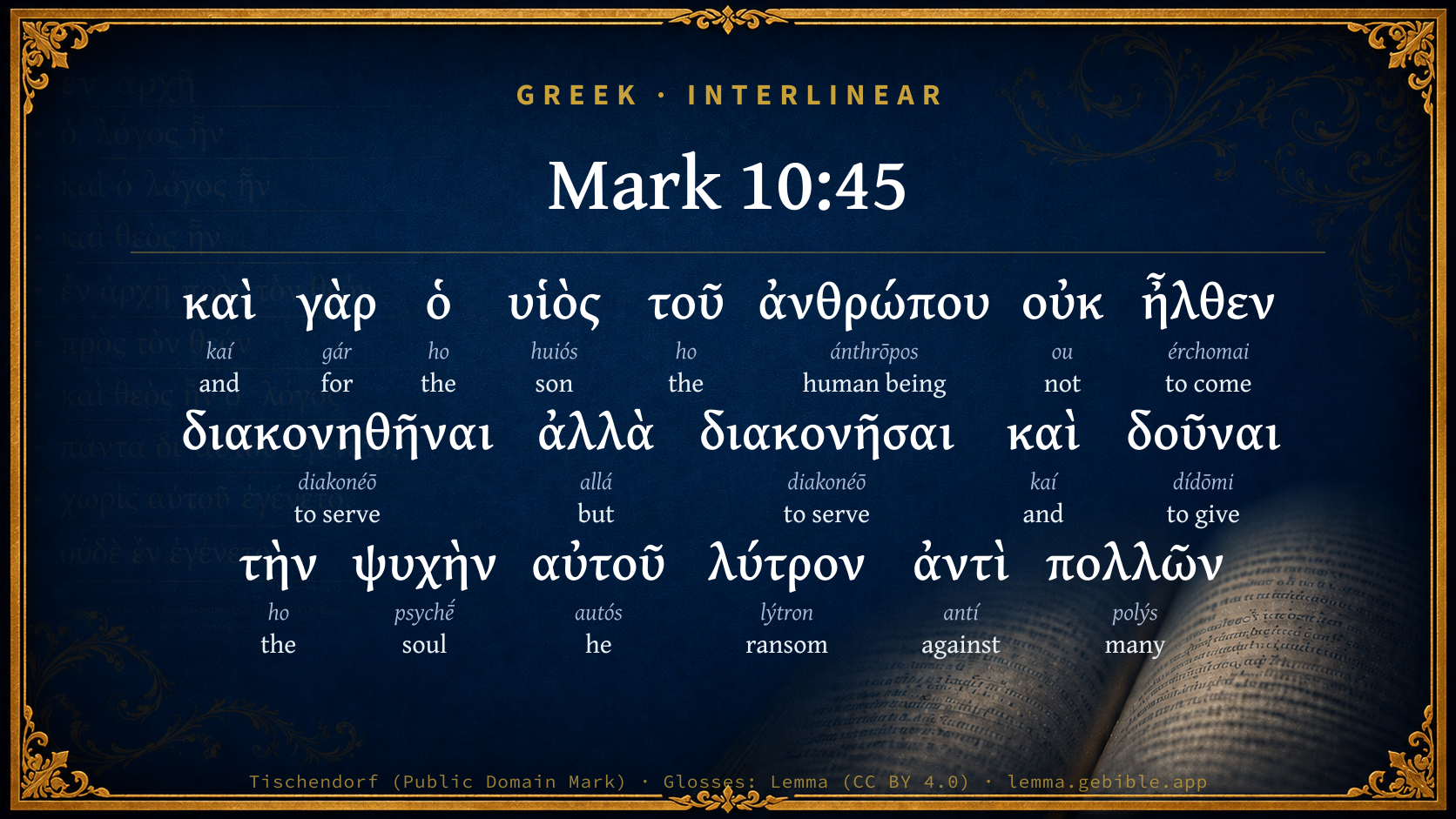
For the Son of Man also came not to be served, but to serve, and to give his life as a ransom for many."
Download a study sheet
One document with this verse’s original text, its word-by-word gloss line, the meaning frame, cross-references with their text, attributed commentary, and full source and license credits — printable, and it pastes into notes with its structure intact.
This verse Autodidact and up
A passage Seminary Student
Up to 50 verses in one chapter. A passage sheet keeps up to 6 commentary sources and 12 cross-references per verse, in the order this page ranks them, and says so on the sheet whenever that leaves anything out. Ask for a single verse and you get the Autodidact verse sheet above.
Everything on this page stays free to read, with no account — the sheet is a download of what is already on screen, not access to it.
Compare translations 3
The same verse in 3 English versions, stacked beneath the original-language interlinear above. Click any original word for its lexicon entry.
Each is an independent rendering of the whole verse — the interlinear is not word-aligned to these translations.
Highlighted words mark where these versions differ — a whole-verse word diff, not a word-by-word alignment.
-
World English Bible Public Domain
For the Son of Man also came not to be served, but to serve, and to give his life as a ransom for many."
-
King James Version Public Domain
For even the Son of man came not to be ministered unto, but to minister, and to give his life a ransom for many.
-
unfoldingWord Literal Text CC BY-SA 4.0
For even the Son of Man did not come to be served, but to serve and to give his life as a ransom in exchange for many.”
unfoldingWord Literal Text — © unfoldingWord, licensed CC BY-SA 4.0. Word-aligned USFM3 via Door43 (git.door43.org/unfoldingWord/en_ult).
Show all 19 translations
Every available English version of this verse, each an independent rendering of the whole verse.
-
World English Bible Public Domain
For the Son of Man also came not to be served, but to serve, and to give his life as a ransom for many."
-
Berean Standard Bible Public Domain
For even the Son of Man did not come to be served, but to serve, and to give His life as a ransom for many.”
-
Majority Standard Bible Public Domain
For even the Son of Man did not come to be served, but to serve, and to give His life as a ransom for many.”
-
King James Version Public Domain
For even the Son of man came not to be ministered unto, but to minister, and to give his life a ransom for many.
-
American Standard Version (1901) Public Domain
For the Son of man also came not to be ministered unto, but to minister, and to give his life a ransom for many.
-
Revised Version (1885) Public Domain
For verily the Son of man came not to be ministered unto, but to minister, and to give his life a ransom for many.
-
Geneva Bible (1599) Public Domain
For euen the Sonne of man came not to be serued, but to serue, and to giue his life for the raunsome of many.
-
Douay-Rheims (1899) Public Domain
For the Son of man also is not come to be ministered unto, but to minister, and to give his life a redemption for many.
-
Young's Literal Translation Public Domain
for even the Son of Man came not to be ministered to, but to minister, and to give his life a ransom for many.'
-
Literal Standard Version CC BY-SA 4.0
for even the Son of Man did not come to be ministered to, but to minister, and to give His life [as] a ransom for many.”
-
Unlocked Literal Bible CC BY-SA 4.0
For the Son of Man did not come to be served, but to serve, and to give his life as a ransom for many.”
-
unfoldingWord Literal Text CC BY-SA 4.0
For even the Son of Man did not come to be served, but to serve and to give his life as a ransom in exchange for many.”
-
Darby Bible Public Domain
For also the Son of man did not come to be ministered to, but to minister, and give his life a ransom for many.
-
World Messianic Bible Public Domain
For the Son of Man also came not to be served but to serve, and to give his life as a ransom for many.”
-
Webster's Bible Public Domain
For even the son of man came not to be ministered to, but to minister, and to give his life a ransom for many.
-
Free Bible Version CC BY-SA 4.0
For even the Son of man did not come to be served but to serve, and to give his life as a ransom for many.”
-
Bible in Basic English Public Domain
For truly the Son of man did not come to have servants, but to be a servant, and to give his life for the salvation of men.
-
Text-Critical English NT CC BY 4.0
For even the Son of Man came not to be served but to serve, and to give his life as a ransom for many.”
-
Tyndale New Testament (1534) Public Domain
For even the sonne of man came not to be ministred vnto: but to minister and to geve his lyfe for the redempcion of many.
Literal Standard Version (2020), Covenant Press — licensed CC BY-SA 4.0. Text via the HelloAO Bible API (eBible.org). Unlocked Literal Bible (unfoldingWord) — licensed CC BY-SA 4.0. Text via the HelloAO Bible API (eBible.org). unfoldingWord Literal Text — © unfoldingWord, licensed CC BY-SA 4.0. Word-aligned USFM3 via Door43 (git.door43.org/unfoldingWord/en_ult). Free Bible Version, Dr. Jonathan Gallagher — licensed CC BY-SA 4.0. Text via the HelloAO Bible API (eBible.org).
Word by word
More ways to search: Search by grammar → Find every occurrence → Compare this word →
Practice this passage: Drill this verse → Learn its vocabulary →
- Appears 2× in the Greek New Testament
- First appears at Matthew 20:28
- Part of Speech
- Noun
- Case
- Accusative
- Number
- Singular
- Gender
- Neuter
Full Thayer's Definition
- καὶ kaí G2532 “and” Conjunction
- γὰρ gár G1063 “for” Conjunction
- ὁ ho G3588 “the” Article, Nominative, Singular, Masculine
- υἱὸς huiós G5207 “son” Noun, Nominative, Singular, Masculine
- τοῦ ho G3588 “the” Article, Genitive, Singular, Masculine
- ἀνθρώπου ánthrōpos G444 “human being” Noun, Genitive, Singular, Masculine
- οὐκ ou G3756 “not” Particle, Negative
- ἦλθεν érchomai G2064 “to come” Verb, Aorist, Active, Indicative, 3rd person, Singular
- διακονηθῆναι diakonéō G1247 “to serve” Verb, Aorist, Passive, Infinitive
- ἀλλὰ allá G235 “but” Conjunction
- διακονῆσαι diakonéō G1247 “to serve” Verb, Aorist, Active, Infinitive
- καὶ kaí G2532 “and” Conjunction
- δοῦναι dídōmi G1325 “to give” Verb, Aorist, Active, Infinitive
- τὴν ho G3588 “the” Article, Accusative, Singular, Feminine
- ψυχὴν psychḗ G5590 “soul” Noun, Accusative, Singular, Feminine
- αὐτοῦ autós G846 “he” Personal pronoun, Genitive, Singular, Masculine
- λύτρον lýtron G3083 “ransom” Noun, Accusative, Singular, Neuter
- ἀντὶ antí G473 “against” Preposition
- πολλῶν polýs G4183 “many” Adjective, Genitive, Plural, Masculine
About this verse
These counts appear in no published source. They are computed here, from the morphology-tagged text and Lemma’s own curated glosses. What Lemma adds →
- 19
- words
- 15
- distinct lemmas
- Gospels
- section
Cross-references
15Topical passages linked to Mark 10:45 in the Treasury of Scripture Knowledge — connected by theme and wording, ordered by reader-vote popularity; previews shown in the World English Bible.
- Matthew 20:28 even as the Son of Man came not to be served, but to serve, and to give his life as a ransom for many."
- Philippians 2:5–8 Have this in your mind, which was also in Christ Jesus,
- 2 Corinthians 8:9 For you know the grace of our Lord Jesus Christ, that, though he was rich, yet for your sakes he became poor, that you through his poverty might become rich.
- Titus 2:14 who gave himself for us, that he might redeem us from all iniquity, and purify for himself a people for his own possession, zealous for good works.
- John 13:14 If I then, the Lord and the Teacher, have washed your feet, you also ought to wash one another's feet.
- John 10:15 even as the Father knows me, and I know the Father. I lay down my life for the sheep.
- Luke 22:26–27 But not so with you. But one who is the greater among you, let him become as the younger, and one who is governing, as one who serves.
- Hebrews 5:8 though he was a Son, yet learned obedience by the things which he suffered.
- Isaiah 53:10–12 Yet it pleased Yahweh to bruise him; he has put him to grief: when you shall make his soul an offering for sin, he shall see [his] seed, he shall prolong his days, and the pleasure of Yahweh shall prosper in his hand.
- 2 Corinthians 5:21 For him who knew no sin he made to be sin on our behalf; so that in him we might become the righteousness of God.
- 1 Peter 1:19 but with precious blood, as of a lamb without spot, the blood of Christ;
- Daniel 9:26 After the sixty-two weeks the Anointed One shall be cut off, and shall have nothing: and the people of the prince who shall come shall destroy the city and the sanctuary; and the end of it shall be with a flood, and even to the end shall be war; desolations are determined.
- Galatians 3:13 Christ redeemed us from the curse of the law, having become a curse for us. For it is written, "Cursed is everyone who hangs on a tree,"
- Daniel 9:24 Seventy weeks are decreed on your people and on your holy city, to finish disobedience, and to make an end of sins, and to make reconciliation for iniquity, and to bring in everlasting righteousness, and to seal up vision and prophecy, and to anoint the most holy.
- 1 Timothy 3:4–6 one who rules his own house well, having children in subjection with all reverence;
Cross-references courtesy of OpenBible.info (CC BY 4.0).
Lesson kit
Teaching starters — assembled from the data on this page, not authored interpretation. Every prompt links to the verse data it draws on. Edit before teaching.
Mark, in the Gospels, opens this verse with 19 words (15 distinct Greek lemmas). Its most distinctive word is lýtron (“ransom”). A historical commentator’s framing appears above. Read the whole chapter for the surrounding context.
Discussion questions
- How does “ransom” (lýtron) shape what this verse is saying?
- How does Matthew 20:28, which shares the word «ransom», read alongside this verse?
- What does the repetition of “to serve” (2× in this one verse) do in this verse?
- The translations on this page render this verse differently — a whole-verse word diff, not a word-by-word alignment. What might account for the different wordings?
- Compare how Tyndale Open Study Notes and Expositor's Greek Testament read this verse. Where do they agree or differ?
Things to notice
- These translations choose different wording for 10 words in this verse.
- “to serve” occurs 2× in this single verse.
- 15 distinct Greek lemmas span 19 words in this verse.
Commentary
Notes on Mark 10:45 from classic Christian and Jewish commentators (each source and its license shown beneath its notes). The classic Christian expositions comment on the surrounding passage and are grouped to its opening verse, so a note may address several verses; the Jewish commentaries on the Tanakh (Rashi and others) are per-verse, so they appear only where the commentator wrote on this verse.
Lemma curates 59 commentaries, every one of them public domain or Creative Commons licensed, each selected and text-cleaned for this edition rather than reprinted as found. About our sources →
Tyndale Open Study Notes
Tyndale Open Resources
Tyndale Open Study Notes — © Tyndale Open Resources, licensed CC BY-SA 4.0. Text via the HelloAO Bible API.
Expositor's Greek Testament
ed. W. Robertson Nicoll
The Expositor's Greek Testament, edited by W. Robertson Nicoll (1897–1910) — public domain. Text from a community e-Sword module.
Cambridge Greek Testament for Schools and Colleges
Cambridge Greek Testament for Schools and Colleges (Cambridge University Press, 1896; 21 vols, various authors incl. Carr, Maclear, Plummer, Farrar, Lumby, Moule, M. R. James, Simcox) — public domain. Text from a community e-Sword module.
The Cambridge Bible for Schools and Colleges
gen. ed. J. J. S. Perowne
The Cambridge Bible for Schools and Colleges (gen. ed. J. J. S. Perowne; Cambridge University Press, 1878–1918) — public domain. Text from a community e-Sword module.
John Gill's Exposition
John Gill's Exposition of the Whole Bible (1746–1763) — public domain (CC PDM 1.0). Text via the HelloAO Bible API.
The Pulpit Commentary
The Pulpit Commentary (1880–1919), ed. H.D.M. Spence-Jones & Joseph S. Exell — public domain. Text from a community e-Sword module.
John Wesley's Explanatory Notes
John Wesley, Explanatory Notes Upon the Whole Bible (1754–1765) — public domain. Text via the GEBible commentary corpus.
Scofield Reference Notes
C. I. Scofield
The Scofield Reference Bible (1917 edition), notes by C. I. Scofield — public domain. Text from a community e-Sword module.
Bengel's Gnomon
Johann Albrecht Bengel
Bengel's Gnomon of the New Testament — English translation (T&T Clark, Edinburgh, 1860) — public domain. Text from a community e-Sword module.
International Critical Commentary
International Critical Commentary — older volumes (1896–1929), various authors — public domain. Text from a community e-Sword module.
Vincent's Word Studies in the New Testament
Marvin R. Vincent
Marvin R. Vincent, Word Studies in the New Testament (1887–1900) — public domain. Text from a community e-Sword/MySword module.