

Acts 8:7
Greek (Tischendorf 8th ed.) Acts 8:7 appears in the Greek New Testament. The text above is from the Tischendorf 8th edition. Each word links to its Strong’s number and a concise gloss. Click any word for its full Thayer’s Greek Lexicon entry.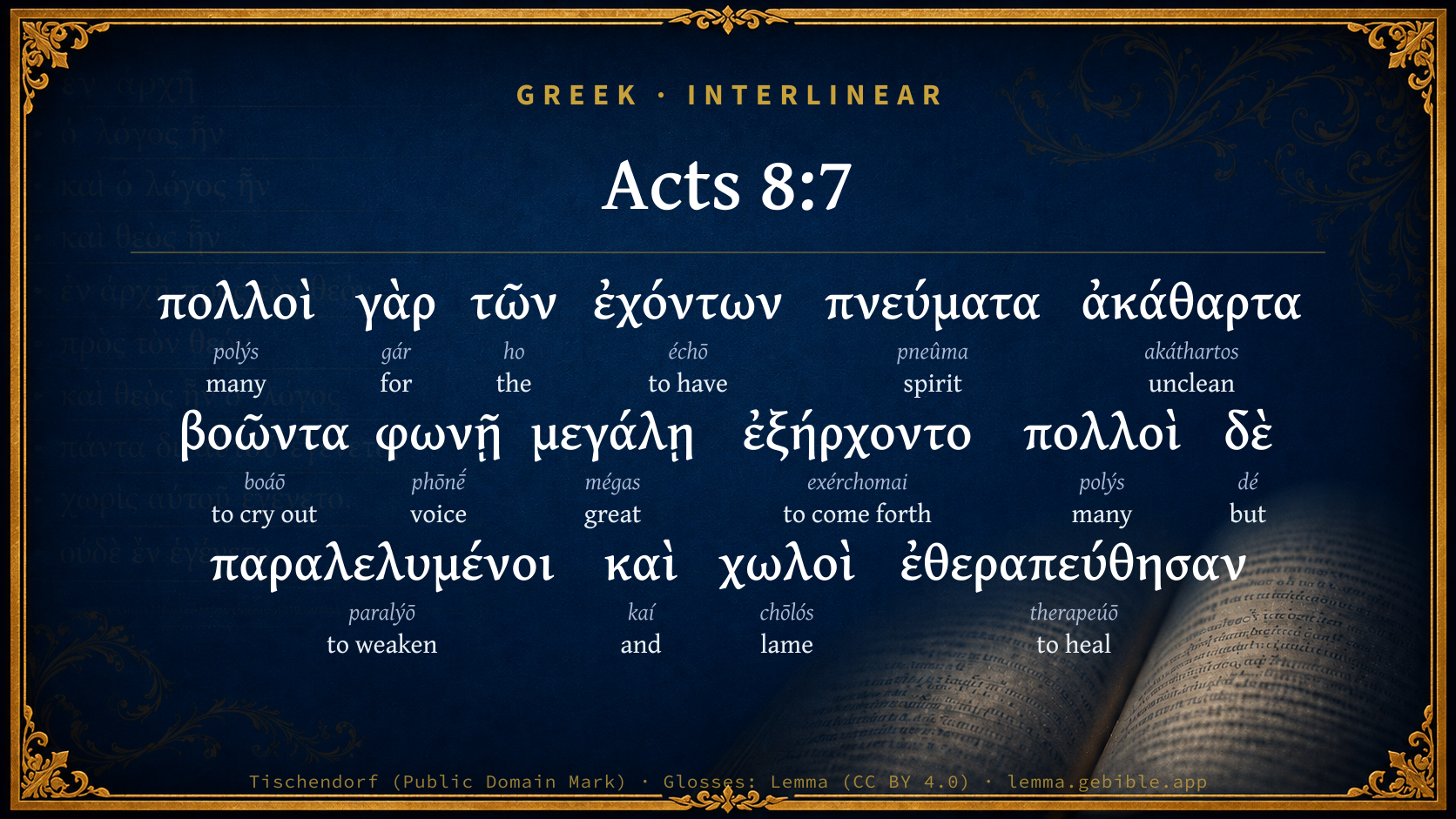
For unclean spirits came out of many of those who had them. They came out, crying with a loud voice. Many who had been paralyzed and lame were healed.
Download a study sheet
One document with this verse’s original text, its word-by-word gloss line, the meaning frame, cross-references with their text, attributed commentary, and full source and license credits — printable, and it pastes into notes with its structure intact.
This verse Autodidact and up
A passage Seminary Student
Up to 50 verses in one chapter. A passage sheet keeps up to 6 commentary sources and 12 cross-references per verse, in the order this page ranks them, and says so on the sheet whenever that leaves anything out. Ask for a single verse and you get the Autodidact verse sheet above.
Everything on this page stays free to read, with no account — the sheet is a download of what is already on screen, not access to it.
Compare translations 3
The same verse in 3 English versions, stacked beneath the original-language interlinear above. Click any original word for its lexicon entry.
Each is an independent rendering of the whole verse — the interlinear is not word-aligned to these translations.
Highlighted words mark where these versions differ — a whole-verse word diff, not a word-by-word alignment.
-
World English Bible Public Domain
For unclean spirits came out of many of those who had them. They came out, crying with a loud voice. Many who had been paralyzed and lame were healed.
-
King James Version Public Domain
For unclean spirits, crying with loud voice, came out of many that were possessed with them: and many taken with palsies, and that were lame, were healed.
-
unfoldingWord Literal Text CC BY-SA 4.0
For many of those having unclean spirits, shouting with a loud voice, they were coming out. And many paralyzed and lame were healed.
unfoldingWord Literal Text — © unfoldingWord, licensed CC BY-SA 4.0. Word-aligned USFM3 via Door43 (git.door43.org/unfoldingWord/en_ult).
Show all 19 translations
Every available English version of this verse, each an independent rendering of the whole verse.
-
World English Bible Public Domain
For unclean spirits came out of many of those who had them. They came out, crying with a loud voice. Many who had been paralyzed and lame were healed.
-
Berean Standard Bible Public Domain
With loud shrieks, unclean spirits came out of many who were possessed, and many of the paralyzed and lame were healed.
-
Majority Standard Bible Public Domain
With loud shrieks, unclean spirits came out of many who were possessed, and many of the paralyzed and lame were healed.
-
King James Version Public Domain
For unclean spirits, crying with loud voice, came out of many that were possessed with them: and many taken with palsies, and that were lame, were healed.
-
American Standard Version (1901) Public Domain
For `from' many of those that had unclean spirits, they came out, crying with a loud voice: and many that were palsied, and that were lame, were healed.
-
Revised Version (1885) Public Domain
For from many of those which had unclean spirits, they came out, crying with a loud voice: and many that were palsied, and that were lame, were healed.
-
Geneva Bible (1599) Public Domain
For vncleane spirits crying with a loud voyce, came out of many that were possessed of them: and many taken with palsies, and that halted, were healed.
-
Douay-Rheims (1899) Public Domain
For many of them who had unclean spirits, crying with a loud voice, went out.
-
Young's Literal Translation Public Domain
for unclean spirits came forth from many who were possessed, crying with a loud voice, and many who have been paralytic and lame were healed,
-
Literal Standard Version CC BY-SA 4.0
for unclean spirits came forth from many who were possessed, crying with a loud voice, and many who have been paralytic and lame were healed,
-
Unlocked Literal Bible CC BY-SA 4.0
Unclean spirits came out of many who were possessed, crying out with a loud voice, and many who were paralyzed and lame were healed.
-
unfoldingWord Literal Text CC BY-SA 4.0
For many of those having unclean spirits, shouting with a loud voice, they were coming out. And many paralyzed and lame were healed.
-
Darby Bible Public Domain
For from many who had unclean spirits they went out, crying with a loud voice; and many that were paralysed and lame were healed.
-
World Messianic Bible Public Domain
For unclean spirits came out of many of those who had them. They came out, crying with a loud voice. Many who had been paralyzed and lame were healed.
-
Webster's Bible Public Domain
For unclean spirits, crying with loud voice, came out of many that were possessed: and many taken with palsies, and that were lame, were healed.
-
Free Bible Version CC BY-SA 4.0
Many were freed from possession by evil spirits that screamed as they came out, and many who were lame or disabled were healed.
-
Bible in Basic English Public Domain
For unclean spirits came out from those who had them, crying with a loud voice; and a number of those who were ill and broken in body were made well.
-
Text-Critical English NT CC BY 4.0
For unclean spirits came out of many who had them, crying out with a loud voice, and many who were paralyzed or lame were healed.
-
Tyndale New Testament (1534) Public Domain
For vnclene spretes cryinge with loude voyce came out of many that were possessed of them. And manye taken with palsies and many that halted were healed
Literal Standard Version (2020), Covenant Press — licensed CC BY-SA 4.0. Text via the HelloAO Bible API (eBible.org). Unlocked Literal Bible (unfoldingWord) — licensed CC BY-SA 4.0. Text via the HelloAO Bible API (eBible.org). unfoldingWord Literal Text — © unfoldingWord, licensed CC BY-SA 4.0. Word-aligned USFM3 via Door43 (git.door43.org/unfoldingWord/en_ult). Free Bible Version, Dr. Jonathan Gallagher — licensed CC BY-SA 4.0. Text via the HelloAO Bible API (eBible.org).
Word by word
More ways to search: Search by grammar → Find every occurrence → Compare this word →
Practice this passage: Drill this verse → Learn its vocabulary →
- Appears 5× in the Greek New Testament
- First appears at Luke 5:18
- Part of Speech
- Verb
- Tense
- Perfect
- Voice
- Passive
- Mood
- Participle
- Case
- Nominative
- Number
- Plural
- Gender
- Masculine
Full Thayer's Definition
- πολλοὶ polýs G4183 “many” Adjective, Nominative, Plural, Masculine
- γὰρ gár G1063 “for” Conjunction
- τῶν ho G3588 “the” Article, Genitive, Plural, Masculine
- ἐχόντων échō G2192 “to have” Verb, Present, Active, Participle, Genitive, Plural, Masculine
- πνεύματα pneûma G4151 “spirit” Noun, Accusative, Plural, Neuter
- ἀκάθαρτα akáthartos G169 “unclean” Adjective, Accusative, Plural, Neuter
- βοῶντα boáō G994 “to cry out” Verb, Present, Active, Participle, Nominative, Plural, Neuter
- φωνῇ phōnḗ G5456 “voice” Noun, Dative, Singular, Feminine
- μεγάλῃ mégas G3173 “great” Adjective, Dative, Singular, Feminine
- ἐξήρχοντο exérchomai G1831 “to come forth” Verb, Imperfect, Middle or Passive deponent, Indicative, 3rd person, Plural
- πολλοὶ polýs G4183 “many” Adjective, Nominative, Plural, Masculine
- δὲ dé G1161 “but” Conjunction
- παραλελυμένοι paralýō G3886 “to weaken” Verb, Perfect, Passive, Participle, Nominative, Plural, Masculine
- καὶ kaí G2532 “and” Conjunction
- χωλοὶ chōlós G5560 “lame” Adjective, Nominative, Plural, Masculine
- ἐθεραπεύθησαν therapeúō G2323 “to heal” Verb, Aorist, Passive, Indicative, 3rd person, Plural
About this verse
These counts appear in no published source. They are computed here, from the morphology-tagged text and Lemma’s own curated glosses. What Lemma adds →
- 16
- words
- 15
- distinct lemmas
- Acts
- section
Notable vocabulary
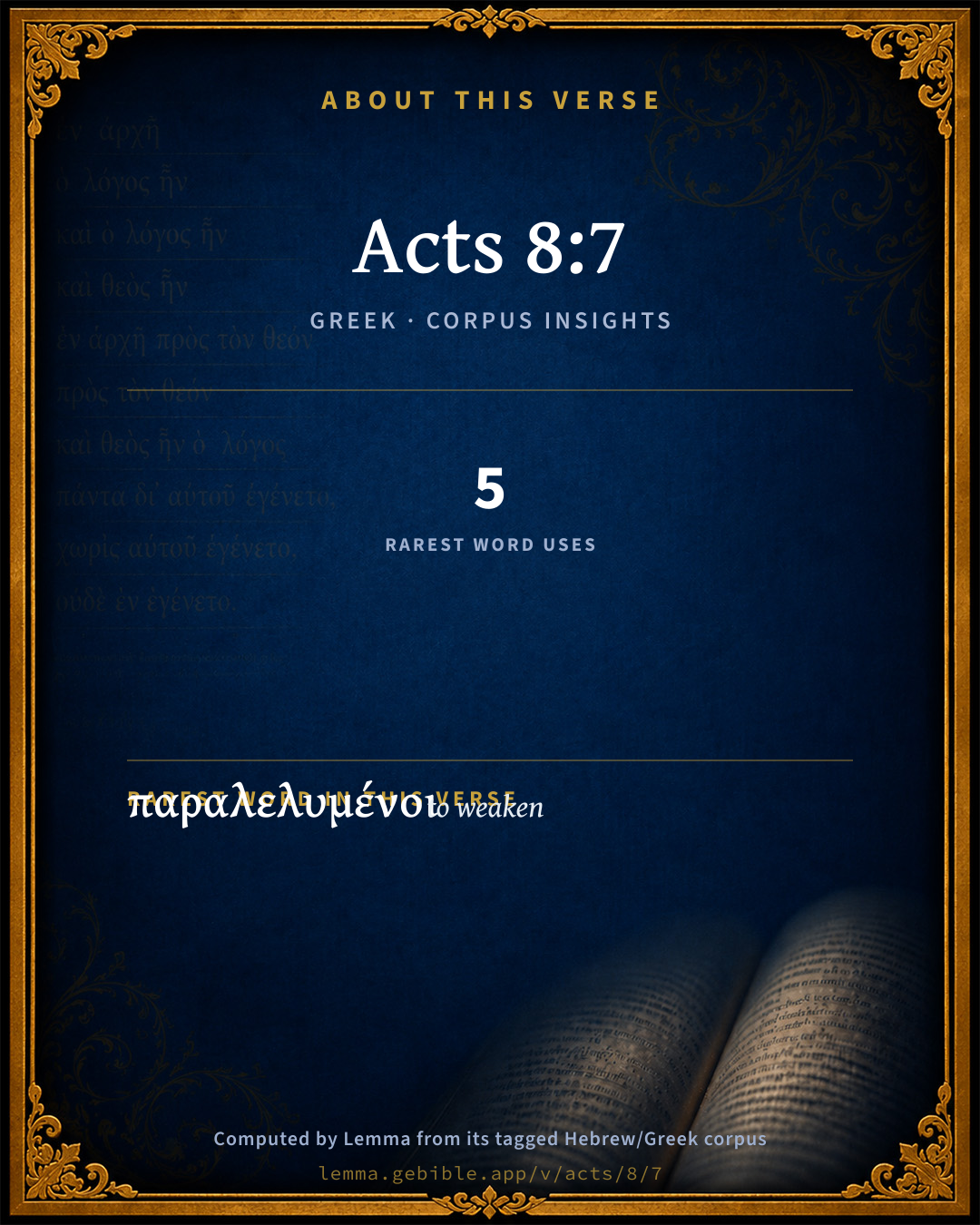
The rarest word here is παραλελυμένοι to weaken G3886 — appearing just 5 times in the whole Greek New Testament.
Shared distinctive vocabulary
παραλελυμένοι to weaken G3886 occurs in 5 verses of the Greek New Testament. Also found in:
Repetition
A word recurs within this verse:
- πολλοὶ many G4183 ×2
Cross-references
15Topical passages linked to Acts 8:7 in the Treasury of Scripture Knowledge — connected by theme and wording, ordered by reader-vote popularity; previews shown in the World English Bible.
- Matthew 10:1 He called to himself his twelve disciples, and gave them authority over unclean spirits, to cast them out, and to heal every disease and every sickness.
- Mark 16:17–18 These signs will accompany those who believe: in my name they will cast out demons; they will speak with new languages;
- Acts 5:16 Multitudes also came together from the cities around Jerusalem, bringing sick people, and those who were tormented by unclean spirits: and they were all healed.
- Acts 14:8–10 At Lystra a certain man sat, impotent in his feet, a cripple from his mother's womb, who never had walked.
- Hebrews 2:4 God also bearing witness with them, both by signs and wonders, and by various works of power, and by gifts of the Holy Spirit, according to his own will?
- Isaiah 35:6 Then shall the lame man leap as a hart, and the tongue of the mute shall sing; for in the wilderness shall waters break out, and streams in the desert.
- Matthew 4:24 The report about him went out into all Syria. They brought to him all who were sick, afflicted with various diseases and torments, possessed with demons, epileptics, and paralytics; and he healed them.
- Matthew 11:5 the blind receive their sight, the lame walk, the lepers are cleansed, the deaf hear, the dead are raised up, and the poor have good news preached to them.
- Matthew 15:30–31 Great multitudes came to him, having with them the lame, blind, mute, maimed, and many others, and they put them down at his feet. He healed them,
- Mark 2:3–11 Four people came, carrying a paralytic to him.
- Mark 9:26 Having cried out, and convulsed greatly, it came out of him. The boy became like one dead; so much that most of them said, "He is dead."
- John 14:12 Most assuredly I tell you, he who believes in me, the works that I do, he will do also; and greater works than these will he do; because I am going to my Father.
- Acts 3:6–7 But Peter said, "Silver and gold have I none, but what I have, that I give you. In the name of Jesus Christ of Nazareth, get up and walk!"
- Acts 9:33–34 There he found a certain man named Aeneas, who had been bedridden for eight years, because he was paralyzed.
- Luke 10:17 The seventy returned with joy, saying, "Lord, even the demons are subject to us in your name!"
Cross-references courtesy of OpenBible.info (CC BY 4.0).
Lesson kit
Teaching starters — assembled from the data on this page, not authored interpretation. Every prompt links to the verse data it draws on. Edit before teaching.
Acts, in the Acts, opens this verse with 16 words (15 distinct Greek lemmas). Its most distinctive word is paralýō (“to weaken”). A historical commentator’s framing appears above. Read the whole chapter for the surrounding context.
Discussion questions
- The word paralýō carries the sense “to weaken.” How does it shape the verse?
- Luke 5:18 shares the word «to weaken» with this verse. How do the two illuminate each other?
- “many” occurs 2× in this one verse. What is the effect of the repetition?
- These translations render this verse differently. What is at stake in choosing one wording over another?
- Reading how Tyndale Open Study Notes and Bengel's Gnomon read this verse, where do the two commentators agree and where do they part?
Things to notice
- These translations choose different wording for 12 words in this verse.
- “many” occurs 2× in this single verse.
- 15 distinct Greek lemmas span 16 words in this verse.
Commentary
Notes on Acts 8:7 from classic Christian and Jewish commentators (each source and its license shown beneath its notes). The classic Christian expositions comment on the surrounding passage and are grouped to its opening verse, so a note may address several verses; the Jewish commentaries on the Tanakh (Rashi and others) are per-verse, so they appear only where the commentator wrote on this verse.
Lemma curates 59 commentaries, every one of them public domain or Creative Commons licensed, each selected and text-cleaned for this edition rather than reprinted as found. About our sources →
Tyndale Open Study Notes
Tyndale Open Resources
Tyndale Open Study Notes — © Tyndale Open Resources, licensed CC BY-SA 4.0. Text via the HelloAO Bible API.
Bengel's Gnomon
Johann Albrecht Bengel
Bengel's Gnomon of the New Testament — English translation (T&T Clark, Edinburgh, 1860) — public domain. Text from a community e-Sword module.
Expositor's Greek Testament
ed. W. Robertson Nicoll
The Expositor's Greek Testament, edited by W. Robertson Nicoll (1897–1910) — public domain. Text from a community e-Sword module.
Adam Clarke's Commentary
Adam Clarke's Commentary on the Bible (1810–1826) — public domain. Text from a community e-Sword/MySword module.
John Calvin's Commentaries
John Calvin's Commentaries (1540-1563) — public domain. Text from the Calvin Translation Society English edition (1840s-50s) via the Christian Classics Ethereal Library (ccel.org). Calvin's coverage is partial (roughly two-thirds of the Bible); uncommented books and verses are honest gaps, never fabricated. The 19th-century editor's footnotes and remarks are omitted so the notes are faithfully Calvin's own voice.
Ellicott's Commentary for English Readers
A Bible Commentary for English Readers, edited by Charles John Ellicott (1878–1897) — public domain. Text from a community e-Sword module.
The Cambridge Bible for Schools and Colleges
gen. ed. J. J. S. Perowne
The Cambridge Bible for Schools and Colleges (gen. ed. J. J. S. Perowne; Cambridge University Press, 1878–1918) — public domain. Text from a community e-Sword module.
John Gill's Exposition
John Gill's Exposition of the Whole Bible (1746–1763) — public domain (CC PDM 1.0). Text via the HelloAO Bible API.
Trapp's Complete Commentary
John Trapp
John Trapp, A Commentary or Exposition upon All the Books of the Old and New Testament (1647–1656) — public domain. Text from a community e-Sword module.
Albert Barnes' Notes on the Bible
Albert Barnes' Notes on the Bible (1834–1885) — public domain. Text from a community e-Sword/MySword module.
Matthew Poole's English Annotations
Matthew Poole's English Annotations on the Holy Bible (1683–1685) — public domain. Text from a community e-Sword/MySword module.
The Pulpit Commentary
The Pulpit Commentary (1880–1919), ed. H.D.M. Spence-Jones & Joseph S. Exell — public domain. Text from a community e-Sword module.
Godbey's Commentary on the New Testament
William B. Godbey
William B. Godbey, Commentary on the New Testament (1896–1900) — public domain. Text from a community e-Sword module.
McGarvey & Pendleton's Commentaries
J. W. McGarvey
J. W. McGarvey (with Philip Y. Pendleton), Commentaries on the New Testament (The Fourfold Gospel, 1914; Acts; and the epistles) — public domain. Text from a community e-Sword/MySword module.
Cambridge Greek Testament for Schools and Colleges
Cambridge Greek Testament for Schools and Colleges (Cambridge University Press, 1896; 21 vols, various authors incl. Carr, Maclear, Plummer, Farrar, Lumby, Moule, M. R. James, Simcox) — public domain. Text from a community e-Sword module.
Alford’s Greek Testament
Henry Alford
Henry Alford, The Greek Testament (1849–1861) — public domain. Text from a community e-Sword module.
Vincent's Word Studies in the New Testament
Marvin R. Vincent
Marvin R. Vincent, Word Studies in the New Testament (1887–1900) — public domain. Text from a community e-Sword/MySword module.