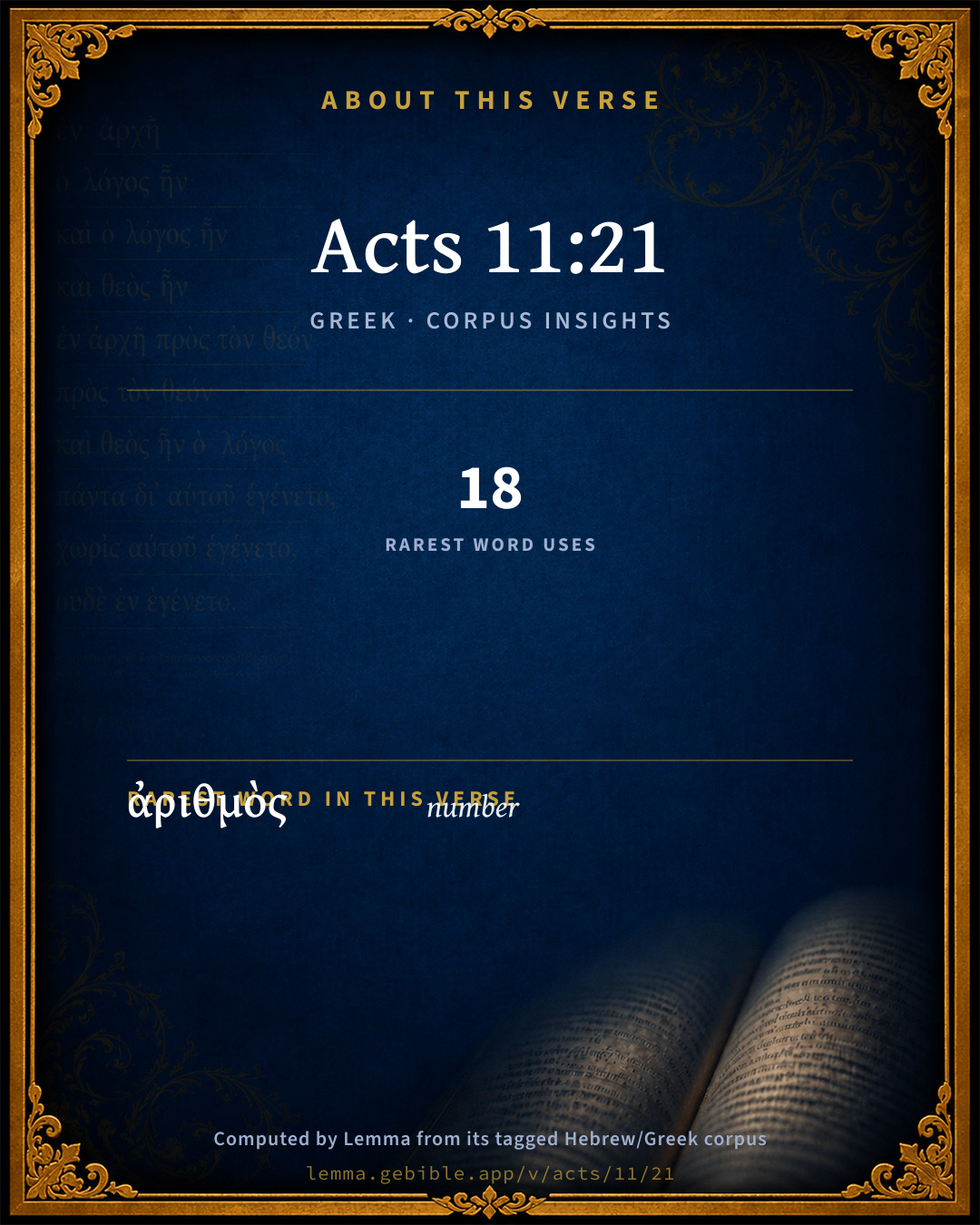
Acts 11:21

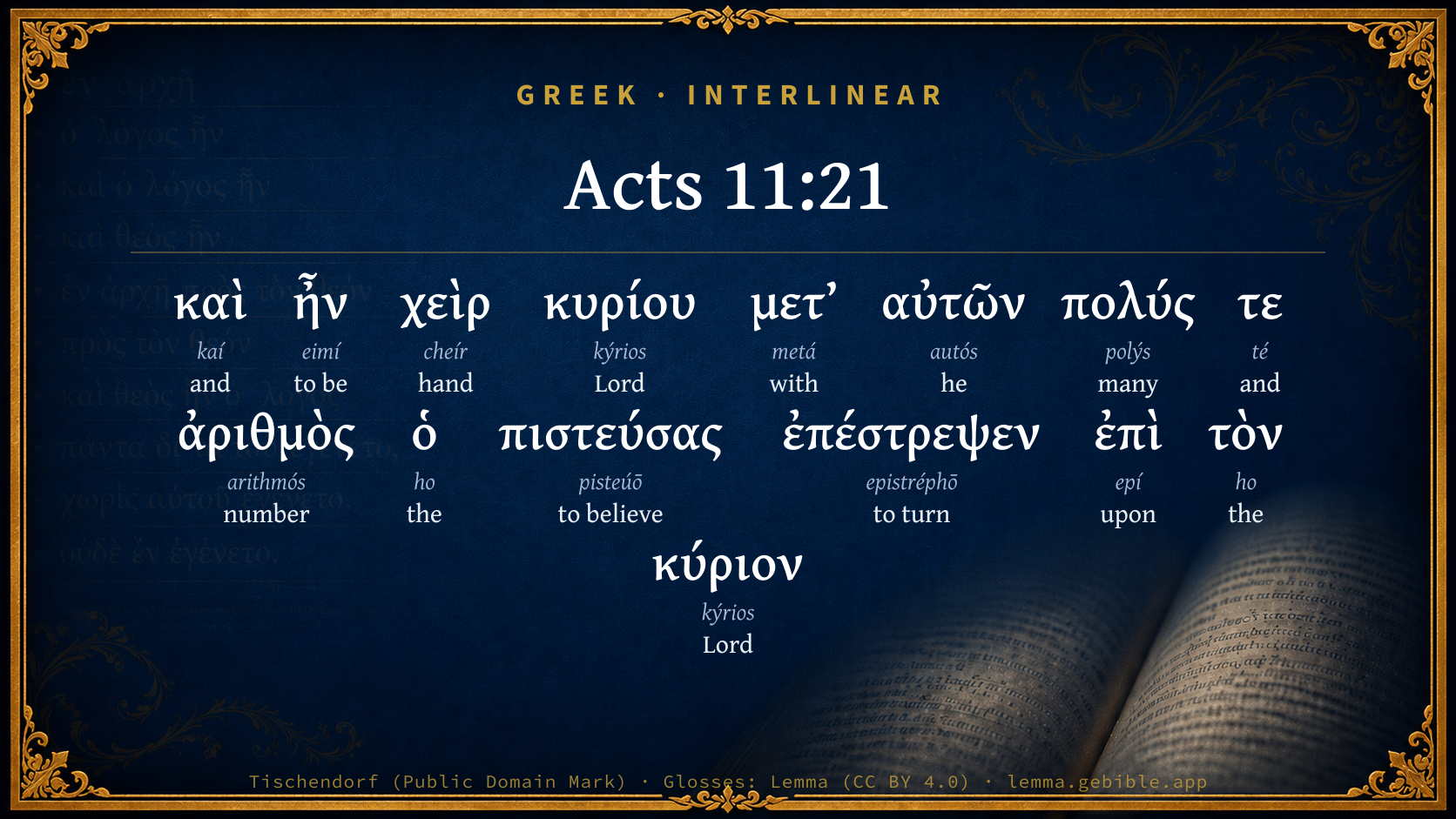
Greek (Tischendorf 8th ed.) Acts 11:21 appears in the Greek New Testament. The text above is from the Tischendorf 8th edition. Each word links to its Strong’s number and a concise gloss. Click any word for its full Thayer’s Greek Lexicon entry.
Download image
Cite this verse

Acts 11:21 (World English Bible). Public Domain. Lemma interlinear Bible study tool, https://lemma.gebible.app/v/acts/11/21.

Show BibTeX & RIS
BibTeX
RIS
English Translation
The hand of the Lord was with them, and a great number believed and turned to the Lord.
World English Bible · Public Domain
Download a study sheet

One document with this verse’s original text, its word-by-word gloss line, the meaning frame, cross-references with their text, attributed commentary, and full source and license credits — printable, and it pastes into notes with its structure intact.

This verse Autodidact and up

Study sheet (.html) Plain text (.txt)

A passage Seminary Student

Up to 50 verses in one chapter. A passage sheet keeps up to 6 commentary sources and 12 cross-references per verse, in the order this page ranks them, and says so on the sheet whenever that leaves anything out. Ask for a single verse and you get the Autodidact verse sheet above.

Everything on this page stays free to read, with no account — the sheet is a download of what is already on screen, not access to it.

Want to remove ads? Support Godless Engineer
Compare translations 3

The same verse in 3 English versions, stacked beneath the original-language interlinear above. Click any original word for its lexicon entry.

Each is an independent rendering of the whole verse — the interlinear is not word-aligned to these translations.

Highlighted words mark where these versions differ — a whole-verse word diff, not a word-by-word alignment.

  • World English Bible Public Domain
    The hand of the Lord was with them, and a great number believed and turned to the Lord.
  • King James Version Public Domain
    And the hand of the Lord was with them: and a great number believed, and turned unto the Lord.
  • unfoldingWord Literal Text CC BY-SA 4.0
    And the hand of the Lord was with them; and a great number, believing, turned to the Lord.

unfoldingWord Literal Text — © unfoldingWord, licensed CC BY-SA 4.0. Word-aligned USFM3 via Door43 (git.door43.org/unfoldingWord/en_ult).

Versions to compare (up to 4)

3 of 4 selected

Show all 19 translations

Every available English version of this verse, each an independent rendering of the whole verse.

  • World English Bible Public Domain
    The hand of the Lord was with them, and a great number believed and turned to the Lord.
  • Berean Standard Bible Public Domain
    The hand of the Lord was with them, and a great number of people believed and turned to the Lord.
  • Majority Standard Bible Public Domain
    The hand of the Lord was with them, and a great number of people believed and turned to the Lord.
  • King James Version Public Domain
    And the hand of the Lord was with them: and a great number believed, and turned unto the Lord.
  • American Standard Version (1901) Public Domain
    And the hand of the Lord was with them: and a great number that believed turned unto the Lord.
  • Revised Version (1885) Public Domain
    And the hand of the Lord was with them: and a great number that believed turned unto the Lord.
  • Geneva Bible (1599) Public Domain
    And the hand of the Lord was with them, so that a great number beleeued and turned vnto the Lord.
  • Douay-Rheims (1899) Public Domain
    And the hand of the Lord was with them: and a great number believing, were converted to the Lord.
  • Young's Literal Translation Public Domain
    and the hand of the Lord was with them, a great number also, having believed, did turn unto the Lord.
  • Literal Standard Version CC BY-SA 4.0
    and the hand of the LORD was with them, a great number also, having believed, turned to the LORD.
  • Unlocked Literal Bible CC BY-SA 4.0
    The hand of the Lord was with them; a great number believed and turned to the Lord.
  • unfoldingWord Literal Text CC BY-SA 4.0
    And the hand of the Lord was with them; and a great number, believing, turned to the Lord.
  • Darby Bible Public Domain
    And [the] Lord's hand was with them, and a great number believed and turned to the Lord.
  • World Messianic Bible Public Domain
    The hand of the Lord was with them, and a great number believed and turned to the Lord.
  • Webster's Bible Public Domain
    And the hand of the Lord was with them: and a great number believed, and turned to the Lord.
  • Free Bible Version CC BY-SA 4.0
    The power of the Lord was with them and a large number trusted in the Lord and turned to him.
  • Bible in Basic English Public Domain
    And the power of the Lord was with them, and a great number had faith and were turned to the Lord.
  • Text-Critical English NT CC BY 4.0
    The hand of the Lord was with them, and a large number of people believed and turned to the Lord.
  • Tyndale New Testament (1534) Public Domain
    And the honde of the Lorde was with them and a greate nombre beleved and turned vnto the Lorde.

Literal Standard Version (2020), Covenant Press — licensed CC BY-SA 4.0. Text via the HelloAO Bible API (eBible.org). Unlocked Literal Bible (unfoldingWord) — licensed CC BY-SA 4.0. Text via the HelloAO Bible API (eBible.org). unfoldingWord Literal Text — © unfoldingWord, licensed CC BY-SA 4.0. Word-aligned USFM3 via Door43 (git.door43.org/unfoldingWord/en_ult). Free Bible Version, Dr. Jonathan Gallagher — licensed CC BY-SA 4.0. Text via the HelloAO Bible API (eBible.org).

Word by word

More ways to search: Search by grammar → Find every occurrence → Compare this word →

Practice this passage: Drill this verse → Learn its vocabulary →

ἀριθμὸς
arithmós
G706
“number”
Noun, Nominative, Singular, Masculine
Part of Speech
Noun
Case
Nominative
Number
Singular
Gender
Masculine
Full Thayer's Definition

Origin: from G142

TDNT: 08:41,8

1. a fixed and definite number 2. an indefinite number, a multitude
  1. καὶ kaí G2532 “and” Conjunction
  2. ἦν eimí G1510 “to be” Verb, Imperfect, Active, Indicative, 3rd person, Singular
  3. χεὶρ cheír G5495 “hand” Noun, Nominative, Singular, Feminine
  4. κυρίου kýrios G2962 “Lord” Noun, Genitive, Singular, Masculine
  5. μετ’ metá G3326 “with” Preposition
  6. αὐτῶν autós G846 “he” Personal pronoun, Genitive, Plural, Masculine
  7. πολύς polýs G4183 “many” Adjective, Nominative, Singular, Masculine
  8. τε té G5037 “and” Particle
  9. ὁ ho G3588 “the” Article, Nominative, Singular, Masculine
  10. πιστεύσας pisteúō G4100 “to believe” Verb, Aorist, Active, Participle, Nominative, Singular, Masculine
  11. ἐπέστρεψεν epistréphō G1994 “to turn” Verb, Aorist, Active, Indicative, 3rd person, Singular
  12. ἐπὶ epí G1909 “upon” Preposition
  13. τὸν ho G3588 “the” Article, Accusative, Singular, Masculine
  14. κύριον kýrios G2962 “Lord” Noun, Accusative, Singular, Masculine

About this verse

These counts appear in no published source. They are computed here, from the morphology-tagged text and Lemma’s own curated glosses. What Lemma adds →

15
words
13
distinct lemmas
Acts
section

Notable vocabulary

The rarest word here is ἀριθμὸς number G706 — appearing just 18 times in the whole Greek New Testament.

Shared distinctive vocabulary

ἀριθμὸς number G706 occurs in 15 verses of the Greek New Testament. Also found in:

Repetition

Words recur within this verse:

Cross-references

18

Topical passages linked to Acts 11:21 in the Treasury of Scripture Knowledge — connected by theme and wording, ordered by reader-vote popularity; previews shown in the World English Bible.

  • Luke 1:66 All who heard them laid them up in their heart, saying, "What then will this child be?" The hand of the Lord was with him.
  • Acts 2:47 praising God, and having favor with all the people. The Lord added to the assembly day by day those who were being saved.
  • Acts 5:14 More believers were added to the Lord, multitudes of both men and women.
  • Isaiah 59:1 Behold, Yahweh's hand is not shortened, that it can't save; neither his ear heavy, that it can't hear:
  • Acts 6:7 The word of God increased and the number of the disciples multiplied in Jerusalem exceedingly. A great company of the priests were obedient to the faith.
  • Acts 9:35 All who lived at Lydda and in Sharon saw him, and they turned to the Lord.
  • 1 Corinthians 3:6–7 I planted. Apollos watered. But God gave the increase.
  • 1 Thessalonians 1:5 and that our Gospel came to you not in word only, but also in power, and in the Holy Spirit, and with much assurance. You know what kind of men we showed ourselves to be among you for your sake.
  • 2 Chronicles 30:12 Also on Judah came the hand of God to give them one heart, to do the commandment of the king and of the princes by the word of Yahweh.
  • Ezra 7:9 For on the first [day] of the first month began he to go up from Babylon; and on the first [day] of the fifth month came he to Jerusalem, according to the good hand of his God on him.
  • Ezra 8:18 According to the good hand of our God on us they brought us a man of discretion, of the sons of Mahli, the son of Levi, the son of Israel; and Sherebiah, with his sons and his brothers, eighteen;
  • Nehemiah 2:8 and a letter to Asaph the keeper of the king's forest, that he may give me timber to make beams for the gates of the castle which appertains to the house, and for the wall of the city, and for the house that I shall enter into. The king granted me, according to the good hand of my God on me.
  • Nehemiah 2:18 I told them of the hand of my God which was good on me, as also of the king's words that he had spoken to me. They said, Let us rise up and build. So they strengthened their hands for the good [work].
  • Isaiah 53:1 Who has believed our message? and to whom has the arm of Yahweh been revealed?
  • Acts 4:4 But many of those who heard the word believed, and the number of the men came to be about five thousand.
  • Acts 11:24 For he was a good man, and full of the Holy Spirit and of faith, and many people were added to the Lord.
  • Acts 26:18–20 to open their eyes, that they may turn from darkness to light and from the power of Satan to God, that they may receive remission of sins and an inheritance among those who are sanctified by faith in me.'
  • 1 Thessalonians 1:9–10 For they themselves report concerning us what kind of a reception we had from you; and how you turned to God from idols, to serve a living and true God,

Cross-references courtesy of OpenBible.info (CC BY 4.0).

Commentary

Notes on Acts 11:21 from classic Christian and Jewish commentators (each source and its license shown beneath its notes). The classic Christian expositions comment on the surrounding passage and are grouped to its opening verse, so a note may address several verses; the Jewish commentaries on the Tanakh (Rashi and others) are per-verse, so they appear only where the commentator wrote on this verse.

Lemma curates 59 commentaries, every one of them public domain or Creative Commons licensed, each selected and text-cleaned for this edition rather than reprinted as found. About our sources →

The Biblical Illustrator

Joseph S. Exell

Act_11:21

The hand of the Lord.

The hand

The word hand occurs in Scripture no fewer than 1,295 times. Man is the only being on earth that is furnished with two hands. Some other creatures have claws, but not hands. They cannot do as you can, make the thumb meet all the four fingers, so as to seize and hold all the most minute objects; nor can they perform one thousandth part of the skilful acts that man can perform with his hand. What other creature, e.g., can make a watch, or a needle? And there is power in mans hand as well as skill; he can apply force in ways which none of them can approach.

I. In relations to God Himself, the word hand is used--

1. To denote His eternal purpose and almighty power (Act_4:28; Act_4:30).

2. To denote His mighty power to keep, defend, preserve (Joh_10:28-29; Isa_49:2).

3. To express His rich, providential provision for the wants of all His creatures (Psa_104:28; 1Ch_29:16).

4. To signify Gods right to be, as He is, the sovereign disposer of all circumstances, persons, and events (Psa_31:15; Job_2:10).

5. When His inflictions and corrections are referred to (Jdg_2:15; Psa_32:4; Heb_10:31).

6. To denote His power to help (Psa_74:11; Ezr_7:6; Ezr_7:9; Ezr_8:18; Ezr_8:22; Neh_2:8; Neh_2:18; Psa_80:17; Luk_1:66). As an expression for Gods Spirit, putting the spirit of power into us, as well as of love and of a sound mind (Eze_1:3; Eze_3:14; Eze_3:22; Eze_8:1; Eze_37:1). We can be strong for any high and arduous duty only in His strength; all power indeed, all energy of purpose, all special skill in any art, cometh of Him. And not only is this spoken of as Gods hand as the mover, but the term is applied to the agent--the doer of the particular thing. The men of the world are spoken of as Gods hand; and His hand is also to be upon all them for good who seek Him. The right hand, as specially denoting power, is an expression that often occurs in Scripture, and is almost always applied to God (Psa_16:11; Psa_17:7; Psa_20:6; Psa_21:8; Psa_44:3; Psa_45:4; Psa_45:9; Psa_48:10; Psa_60:5; Psa_63:8; Psa_74:1; Psa_48:13; Psa_62:8; Mar_16:19; Heb_1:3, etc., etc.).

II. In relation to man the word hand is used--

1. To denote power in all its various applications (Pro_3:27; Ecc_9:10). To give ones hand is an expression which signifies to pledge peace, promise security, swear friendship, make an alliance.

2. To denote help (Psa_16:8; Psa_73:23; Psa_142:4).

3. To indicate possession, as to rend it out of the hand of anyone denotes deprivation (1Ki_11:11-12).

4. For the giving of advice (2Sa_14:19; 2Sa_14:5).

5. For deliverance from the power and oppression of others (Exo_18:9-10).

6. To denote work of any kind (Luk_1:1; Luk_9:62; Act_20:34; Pro_10:4; Pro_12:24). (S. Jenner, M. A.)

A great number believed, and turned, to the Lord.--

Conversions desired

I. The end which we desire.

1. That men may believe the testimony of Christ to be true. There are some who have not reached as far as that: they reject the inspired Word, and to them the incarnation, etc., are so many old wives fables. There are also many who profess to believe these things, but their only reason is that they have been taught so, and it is the current religion of the nation. But we want more than this faith of indifference, which is little more than unbelief; we want men to believe for themselves because they have felt the saving power of Christ. We pray that nominal believers may treat the doctrines of revelation, not as dogmas, but as facts.

2. That men may savingly believe by putting their trust in Christ. A man commits his soul to Christ for safe keeping, and that saves him. He makes the Saviour trustee of his spiritual estates.

3. That men may so believe in Jesus that they may be turned unto the Lord. This means--

(1) To turn from idols to the living and true God. We desire that faith in Jesus may lead you to give up the objects of your idolatrous love, yourselves, your money, your pleasures, the world, the flesh, the devil.

(2) To turn from the love of sin. He who looks sinward has his back to God--he who looks Godward has his back to sin.

(3) That henceforth God shall he sought in prayer. The man who lives without prayer lives without God, but the man who has turned to God is familiar with the mercy seat.

(4) To yield yourself obediently to His sway. Faith is nothing unless it brings with it a willing mind.

II. The power by which this can be attained. The hand of the Lord was with them. Be encouraged; the hand of God--

1. Is upon men before we speak. I am studying a certain subject, and praying for a blessing on it, and in a chamber, which I have never seen, one of my hearers is smitten with a sense of sin, or troubled with uneasy thoughts, or rendered hopeful of better things, and thus he is being made ready to accept the Christ whom I shall preach to him. Sickness and pain, shame and poverty, often produce a condition of mind most hopeful for the reception of the gospel. Sow, brother, for God has ploughed. Go up and build, for God has prepared the stones and made ready the foundation.

2. Upon the teachers and preachers themselves. There are strange impulses which come over us at times, which make us think and say what otherwise had never crossed our minds, and these work with power upon mens minds.

3. Upon the hearts of men when the gospel is preached. Not only is the Spirit in the Word, but over and above that He makes men--

(1) Recollect their sins. Men who have been giddy and careless and forgetful have on a sudden found themselves reviewing the past.

(2) See the beauty of holiness. When the preacher proclaims the way of salvation the Spirit leads men to admire it and to long for a share in it. Yes, it is not the preacher, and it is not altogether what the preacher says, but there is a power abroad as potent as that by which the worlds were made.

III. The desirableness of our object. Because conversions--

1. Promote the extension of truth, godliness, and virtue.

2. Make men happy. If religion be indeed a source of joy to yourself, you are inhuman if you do not wish others to drink of it.

3. Save men from hell.

4. Increase the Church. Self-preservation is a law of nature, and the Church can never preserve herself except by increasing from the world by conversion.

5. Promote the glory of Christ and give Him to see the travail of His soul.

6. Augment personal blessedness.

IV. How we may promote its attainment.

1. We must distinctly aim at it. As a rule, a man does what he tries to do, and not that which is mere by-play. There is the target, and if you continue to shoot into the air long enough an arrow may perhaps strike it; but if you want to win the prize of archery you had better fix your eye upon the white and take your aim distinctly and with skill.

2. We must press upon men the truths which God usually blesses (Act_11:20). If we do not preach Christ we shall not see souls saved. Who ever heard of a Unitarian Whitfield, or a Socinian Moody gathering twenty thousand people to listen to a Christless gospel? We must equally avoid the modern intellectual system in all its phases. How many conversions are wrought by displays of genius, fine rhetoric, etc.? Certain views as to mans future are equally to be kept clear of, if you would be the means of conversion. Diminish your ideas of the wrath of God and the terrors of hell, and in that proportion you will diminish the results of your work. Other crotchets and novelties of doctrine are also to be let alone, for they are not likely to promote your object, and will most probably divert mens attention from the vital point. If you want a harvest, look well to your seed. If I had to sow my fields with wheat I would not take any but the very best.

3. We must feel a solemn alarm about souls. Believe their danger, their helplessness, that only Christ can save them, and talk to them as if you meant it. The Holy Spirit will move them by first moving you.

4. There must be much prayer. In your closets, at your family altars, and in your prayer meetings be importunate, and the hand of the Lord must and will be with you.

5. There must be direct personal effort on the part of all of you. Great numbers may be saved by my preaching if the Holy Spirit blesses it, but I shall expect larger numbers if you all turn witnesses for Christ. We must expect converts. According to your faith so be it unto you. (C. H. Spurgeon.)

The Biblical Illustrator, edited by Joseph S. Exell (c. 1880s–1900s) — public domain. Text from a community e-Sword module.

Tyndale Open Study Notes

Tyndale Open Resources

11:21-24 Once again, as had happened in the household of Cornelius, Gentiles turned to the Lord in considerable numbers. The explosion of Christian faith into the Gentile world had to remain in harmony with the church at Jerusalem, so the Jerusalem church sent Barnabas to Antioch to oversee developments there. He could see that God’s blessing was on what was happening, so he endorsed it with joy.

Tyndale Open Study Notes — © Tyndale Open Resources, licensed CC BY-SA 4.0. Text via the HelloAO Bible API.

Bengel's Gnomon

Johann Albrecht Bengel

Act 11:21. Χεὶρ Κυρίου, the hand of the Lord) His spiritual power, putting itself forth by the Gospel. So the arm of the Lord, Joh 12:38.

Bengel's Gnomon of the New Testament — English translation (T&T Clark, Edinburgh, 1860) — public domain. Text from a community e-Sword module.

Meyer's Critical & Exegetical Commentary

Heinrich August Wilhelm Meyer

Act_11:21-26. Χεὶρ κυρίου] See on Luk_1:66; Act_4:30. Bengel well remarks: potentia spirituals per evangelium se exserens.

αὐτῶν] these preachers to the Gentiles.

Act_11:22. εἰς τὰ ὦτα] Comp. on Luk_4:21.

ὁ λόγος] the word, i.e. the narrative of it; see on Mar_1:45.

Act_11:23. χάριν τ. Θεοῦ] as it was manifested in the converted Gentiles.

τῇ προθέσει τῆς καρδ. προσμέν. τῷ κυρίῳ] with the purpose of their heart to abide by the Lord, i.e. not again to abandon Christ, to whom their hearts had resolved to belong, but to be faithful to Him with this resolution. Comp. 2Ti_3:10.

Act_11:24. ὅτι ἦν … πίστεως] contains the reason, not why Barnabas had been sent to Antioch (Kuinoel), but of the immediately preceding ἐχάρη … κυρίῳ.

ἀνὴρ ἀγαθός] quite generally: an excellent man, a man of worth, whose noble character, and, moreover, whose fulness of the Spirit and of faith completely qualified him to gain and to follow the right point of view, in accordance with the divine counsel, as to the conversion of the Gentiles here beheld. Most arbitrarily Heinrichs holds that it denotes gentleness and mildness, which Baumgarten has also assumed, although such a meaning must have arisen, as in Mat_20:5, from the context (comp. on Rom_5:7), into which Baumgarten imports the idea, that Barnabas had not allowed himself to be stirred to censure by the strangeness of the new phenomenon.

Act_11:25. εἰς Ταρσόν] See Act_9:30.

Act_11:26. According to the corrected reading ἐγένετο δὲ αὐτοῖς καὶ ἐνιαυτὸν κ.τ.λ. (see the critical remarks), it is to be explained: it happened to them (comp. Act_20:16; Gal_6:14), to be associated even yet (καί) a whole year in the church, and to instruct a considerable multitude of people, and that the disciples were called Christians first at Antioch. With χρηματίσαι the construction passes into the accusative with the infinitive, because the subject becomes different (τοὺς μαθητ.). But it is logically correct that χρηματίσαι κ.τ.λ. should still be dependent on ἐγένετο αὐτοῖς, just because the reported appellation, which was first given to the disciples at Antioch, was causally connected with the lengthened and successful labours of the two men in that city. It was their merit, that here the name of Christians first arose.

On the climactic καί, etiam, in the sense of yet, or yet further, comp. Hartung, Partikell. I. p. 133 f.

συναχθῆναι] to be brought together, i.e. to join themselves for common work. They had been since Act_9:26 ff. separated from each other.

χρηματίσαι to bear the name; see on Rom_7:3.

Χριστιανούς] This name decidedly originated not in, but outside of, the church, seeing that the Christians in the N. T. never use it of themselves, but designate themselves by μαθηταί, ἀδελφοί, believers, etc.; and seeing that, in the two other passages where Χριστιανοί occurs, this appellation distinctly appears as extrinsic to the church, Act_26:28; 1Pe_4:16. But it certainly did not proceed from the Jews, because Χριστός was known to them as the interpretation of מָשִׁיחַ, and they would not therefore have transferred so sacred a name to the hated apostates. Hence the origin of the name must be derived from the Gentiles in Antioch.[267] By these the name of the Head of the new religious society, Christ, was not regarded as an official name, which it already was among the Christians themselves ever more and more becoming; and hence they formed according to the wonted mode the party-name: Christiani (Tac. Ann. xv. 44: auctor nominis ejus Christus Tiberio imperitante per procuratorem Pontium Pilatum supplicio affectus erat). At Antioch, the seat of the mother-church of Gentile Christianity, this took place at that time (for this follows from the reading ἐγέν. δὲ αὐτοῖς), because in that year the joint labours of Paul and Barnabas occasioned so considerable an enlargement of the church, and therewith naturally its increase in social and public consideration. And it was at Antioch that this name was borne first, earlier than anywhere else (πρῶτον, or, according to B א, πρώτως, Lobeck, ad Phryn. p. 311 f.), because here the Christians, in consequence of the predominant Gentile-Christian element, asserted themselves for the first time not as a sect of Judaism, but as an independent community. There is nothing to support the view that the name was at first a title of ridicule (de Wette, Baumgarten, after Wetstein and older interpreters). The conjecture of Baur, that the origin of the name was referred to Antioch, because that was the first Gentile city in which there were Christians (Zeller also mistrusts the account before us), cannot be justified by the Latin form of the word (see Wetstein, ad Mat_22:17).

[267] Ewald, p. 441 f., conjectures that it proceeded from the Roman authorities.

Meyer — Critical and Exegetical Commentary on the New Testament — English translation by Peter Christie, edited by Frederick Crombie (T&T Clark, 1880) — public domain. Text from a community e-Sword module.

Expositor's Greek Testament

ed. W. Robertson Nicoll

Act 11:21 . χεὶρ Κ ., cf. Act 4:28 ; Act 4:30 , Act 13:11 , Luk 1:66 ; frequent in O.T. τε closely connects the two clauses, showing that the result of “the hand of the Lord” was that a great number, etc. (Weiss).

The Expositor's Greek Testament, edited by W. Robertson Nicoll (1897–1910) — public domain. Text from a community e-Sword module.

Jamieson, Fausset & Brown

Robert Jamieson, A. R. Fausset & David Brown

a great number believed--Thus the accession of Cornelius and his party was not the first admission of uncircumcised Gentiles into the Church. (See on Act 10:1.) Nay, we read of no influence which the accession of Cornelius and his house had on the further progress of the Gospel among the Gentiles; whereas there here open upon us operations upon the Gentiles from quite a different quarter, and attended with ever growing success. The only great object served by the case of Cornelius was the formal recognition of the principles which that case afterwards secured. (See on Act 15:19-29.)

Jamieson, Fausset & Brown — Commentary Critical and Explanatory on the Whole Bible (1871) — public domain (CC PDM 1.0). Text via the HelloAO Bible API.

Adam Clarke's Commentary

Verse 21. The hand of the Lord was with them] By the hand, arm, and, finger of God, in the Scripture, different displays or exertions of his power are intended. Here it means that the energy of God accompanied them, and applied their preaching to the souls of all attentive hearers. Without this accompanying influence, even an apostle could do no good; and can inferior men hope to be able to convince and convert sinners without this? Ministers of the word of God, so called, who dispute the necessity and deny the being of this influence, show thereby that they are intruders into God's heritage; that they are not sent by him, and shall not profit the people at all.

A great number believed] That Jesus was the Christ; and that he had died for their offenses, and risen again for their justification. Because the apostles preached the truth, and the hand of God was with them, therefore, a great number believed, and turned unto the Lord, becoming his disciples, and taking him for their portion.

Adam Clarke's Commentary on the Bible (1810–1826) — public domain. Text from a community e-Sword/MySword module.

John Calvin's Commentaries

21. The hand of the Lord was. Luke proveth by the success that the gospel was offered unto the Gentiles also by the brethren of Cyprus and Cyrene not rashly nor unadvisedly, because their labor was fruitful and profitable. But such increase should never have followed, unless God had commanded and favored. Therefore, it followeth that it pleased God that the Gentiles should be called. The hand, as it is well known, doth signify power and strength. Therefore, this is Luke’s meaning, that God did testify by his present aid that the Gentiles were called together with the Jews, through his direction, to be made partakers of the grace of Christ. And this blessing of God served not a little to confirm the minds of all men. This place did also teach us, that what pains soever the ministers of God take in teaching, it shall be all vain and void, unless God bless their labors from heaven. For we may plant and water, as Paul teacheth, but the increase cometh from God alone, (1 Corinthians 3,) in whose hand the hearts of men are, that he may bend and frame the same at his pleasure. Therefore, as often as we are to intreat of faith, let us always remember this speech, that God wrought by his ministers, and that he made their doctrine effectual by his hand, that is, by the secret inspiration of the Spirit. Therefore, let the minister attempt nothing trusting to his own wit and industry, but let him commit his labor to the Lord, upon whose grace the whole success dependeth; and where doctrine shall work effectually, let those which shall believe thank God for their faith. Furthermore, we must note that which Luke saith, that many were turned unto God by faith, because he doth very well express the force and nature of faith; that it is not idle and cold, but such as restoreth men (who were before turned away from God) unto his government, and bindeth them unto his righteousness.

John Calvin's Commentaries (1540-1563) — public domain. Text from the Calvin Translation Society English edition (1840s-50s) via the Christian Classics Ethereal Library (ccel.org). Calvin's coverage is partial (roughly two-thirds of the Bible); uncommented books and verses are honest gaps, never fabricated. The 19th-century editor's footnotes and remarks are omitted so the notes are faithfully Calvin's own voice.

The Cambridge Bible for Schools and Colleges

gen. ed. J. J. S. Perowne

21. And the hand of the Lord was with them] The expression is a common one in the O. T. to express the direct interposition of God in the affairs of the world. Cp. Exo_14:31, “And Israel saw that great work [Heb. hand] which the Lord did upon the Egyptians.” So the Egyptian magicians (Exo_8:19), “This is the finger of God.”

The Cambridge Bible for Schools and Colleges (gen. ed. J. J. S. Perowne; Cambridge University Press, 1878–1918) — public domain. Text from a community e-Sword module.

John Gill's Exposition

Then tidings of these things,.... Of the spread of the Gospel in several parts, and the success of it in the conversion of sinners, especially at Antioch:

came unto the ears of the church which was in Jerusalem; these tidings were brought to the apostles and brethren there, by messengers which the ministers of the word sent unto them to let them know what success they met with; notwithstanding the persecution raised against the church of Jerusalem at the death of Stephen, and the havoc that was made of the members of it, and the dispersion of others, yet it still continued a church, and so it did for ages after: there are reckoned fifteen bishops of it unto the times of Trajan, and the destruction of the city by him, when the Jews were no longer suffered to live in it; and they are these, James the brother of our Lord, Simeon, Justus, Zacchaeus, Tobias, Benjamin, John, Matthias, Philip, Seneca, Justus, Levi, Ephres, Joseph, and Judas; and these are said (h) to be all originally Hebrews: but after the destruction of the city by Trajan, and the Jews were forbid inhabiting it, the church consisted of Gentiles only; and of them bishops were constituted over it, and were as follow: Marcus, Cassianus, Publius, Maximus, Julianus, Gaianus, Symmachus, Caius, another Julianus, Capito, another Maximus, Antoninus, Valens, Dolychianus, Narcissus, Aelius, Germanio, Gordius, and another Narcissus; all these governed this church in the "second" century: and in the "third" century, the bishops of this church were Alexander, Mazabanes, Labdas, and Hermon, who was the last before the Dioclesian persecution: in the "fourth" century, Macarins, Maximus, and Cyril, presided over it; and these were succeeded in the "fifth" century by Joannes Nepos, Prayllius, Juvenalis, Anastasius, and Martyrius; in this age also Lucian and Hesychius were presbyters of this church. In the "sixth" century, the names of the bishops of this church were Salustius, Helias, Johannes, Petrus, Macarius, Eustochius, Johannes, Neamus, and Isicius: in the "seventh" century were Thomas, Johannes, Neannus, Isaac, Zacharias, and Sophronius, who was the last bishop of Jerusalem before the utter and last devastation of it by the Saracens (i); since which time the city has underwent various fates, being sometimes in the hands of the Christians, and at other times possessed by the Turks, in whose power it now is.

And they sent forth Barnabas; who was himself an Hellenist, and of the country of Cyprus, and so very fit to be sent to the Grecians or Hellenists at Antioch, who had received the Gospel to confirm them in it: for his orders were,

that he should go as far as Antioch which is said to be about fifteen or sixteen days journey from Jerusalem: the phrase, "that he should go", is not in the Alexandrian copy, nor in the Vulgate Latin, Syriac, and Ethiopic versions.

(h) Euseb. Eccl. Hist. l. 4. c. 5. (i) Magdeburg. Hist. Eccles. cent. 2. c. 2. p. 2. & c. 9. p. 126. cent. 3. c. 10. p. 146. 148. cent. 4. c. 10. p. 503. c. 5. cent. 10. p. 540. cent. 6. c. 10. p. 335. cent. 7. c. 10. p. 251.

John Gill's Exposition of the Whole Bible (1746–1763) — public domain (CC PDM 1.0). Text via the HelloAO Bible API.

Trapp's Complete Commentary

John Trapp

21 And the hand of the Lord was with them: and a great number believed, and turned unto the Lord.

Ver. 21. And a great number believed] God sealing his approval of what they did, by an extraordinary success. He hath a mighty hand, and can fetch in multitudes at his pleasure. We hope he is doing some such great work in New England. He can make a law to bring forth in one day, a "nation to be born at once," Isa 66:8.

John Trapp, A Commentary or Exposition upon All the Books of the Old and New Testament (1647–1656) — public domain. Text from a community e-Sword module.

Albert Barnes' Notes on the Bible

And the hand of the Lord - See the notes on Luk 1:66. Compare Psa 80:17. The meaning is, that God showed them favor, and evinced his power in the conversion of their hearers.

Albert Barnes' Notes on the Bible (1834–1885) — public domain. Text from a community e-Sword/MySword module.

Matthew Poole's English Annotations

The hand of the Lord; the power, assistance, and working of God, expressed by the hand, which is the organ or instrument men use in working. This hand or work of God was manifest, first, In the miracles which they wrought. Secondly, In the conversion of any by these miracles. For these alone cannot soften a heart; as appeared in Pharaoh, whose heart was hardened by them.

A great number believed, and turned unto the Lord; faith and conversion are wrought by the hand of the Lord, and are his work. But in vain is faith pretended unto, when there is no change in heart and life. What God hath put together, none may put asunder.

Matthew Poole's English Annotations on the Holy Bible (1683–1685) — public domain. Text from a community e-Sword/MySword module.

The Pulpit Commentary

That believed turned for believed and turned, A.V. and T.R. The hand of the Lord; i.e. his power working with them and through them. Compare the frequent phrase in the Old Testament, "with a mighty hand and a stretched out arm". (see too Act_4:30; Luk_1:66)

The Pulpit Commentary (1880–1919), ed. H.D.M. Spence-Jones & Joseph S. Exell — public domain. Text from a community e-Sword module.

John Wesley's Explanatory Notes

And the hand of the Lord - That is, the power of his Spirit.

John Wesley, Explanatory Notes Upon the Whole Bible (1754–1765) — public domain. Text via the GEBible commentary corpus.

Godbey's Commentary on the New Testament

William B. Godbey

21. “The hand of the Lord was with them, and a great number, believing, turned to the Lord.” These were Gentiles in the Syrian Empire, some time before Peter, by his apostolical ipse dixit, had unfurled the Gentile banner at Caesarea.

William B. Godbey, Commentary on the New Testament (1896–1900) — public domain. Text from a community e-Sword module.

McGarvey & Pendleton's Commentaries

J. W. McGarvey

See notes one verse 20

J. W. McGarvey (with Philip Y. Pendleton), Commentaries on the New Testament (The Fourfold Gospel, 1914; Acts; and the epistles) — public domain. Text from a community e-Sword/MySword module.

Cambridge Greek Testament for Schools and Colleges

21. καὶ ἦν χεὶρ κυρίου μετ’ αὐτῶν, and the hand of the Lord was with them. The expression is a common one in the O.T. to express the direct interposition of God in the affairs of the world. Cf. 1Sa 5:3, καὶ ἐβαρύνθη χεὶρ κυρίου ἐπὶ τοὺς Ἀζωτίους. So too 1Sa 7:13: and of His interposition for good, see Isa 41:20. Cf. also Exo 8:19; Exo 14:31.

πολύς τε ἀριθμὸς ὁ πιστεύσας ἐπέστρεψεν κ.τ.λ., and a great multitude that believed turned unto the Lord. These probably, like Cornelius had been prepared, by their knowledge of Jehovah through Judaism, to accept the teaching of the Christian missionaries.

Cambridge Greek Testament for Schools and Colleges (Cambridge University Press, 1896; 21 vols, various authors incl. Carr, Maclear, Plummer, Farrar, Lumby, Moule, M. R. James, Simcox) — public domain. Text from a community e-Sword module.

Alford’s Greek Testament

Henry Alford

21. ἦν χεὶρ κυρ. μ. α.] By visible manifestations not to be doubted, the Lord shewed it to be His pleasure that they should go on with such preaching; αὐτῶν being, the preachers to the Gentiles, whose work the narrative now follows.

Henry Alford, The Greek Testament (1849–1861) — public domain. Text from a community e-Sword module.

Lesson kit

Teaching starters — assembled from the data on this page, not authored interpretation. Every prompt links to the verse data it draws on. Edit before teaching.

Acts, in the Acts, opens this verse with 15 words (13 distinct Greek lemmas). Its most distinctive word is arithmós (“number”). A historical commentator’s framing appears above. Read the whole chapter for the surrounding context.

Discussion questions

  1. How does “number” (arithmós) shape what this verse is saying?
  2. Luke 22:3 shares the word «number» with this verse. How do the two illuminate each other?
  3. “Lord” occurs 2× in this one verse. What is the effect of the repetition?
  4. These translations render this verse differently. What is at stake in choosing one wording over another?
  5. Reading how The Biblical Illustrator and Tyndale Open Study Notes read this verse, where do the two commentators agree and where do they part?

Things to notice

  • These translations choose different wording for 2 words in this verse.
  • “Lord” occurs 2× in this single verse.
  • 13 distinct Greek lemmas span 15 words in this verse.

Reading settings

Reading text

Shown beneath each verse's original-language words.

Old Testament
Old Testament edition

Read the OT as the Masoretic Hebrew (MT) or the Greek Septuagint (LXX).

English shown for the Greek Septuagint (in the Hebrew ↔ Greek comparison).

Comparing translations? Open the Compare panel on any verse page to stack up to four side by side.