Acts 16:18

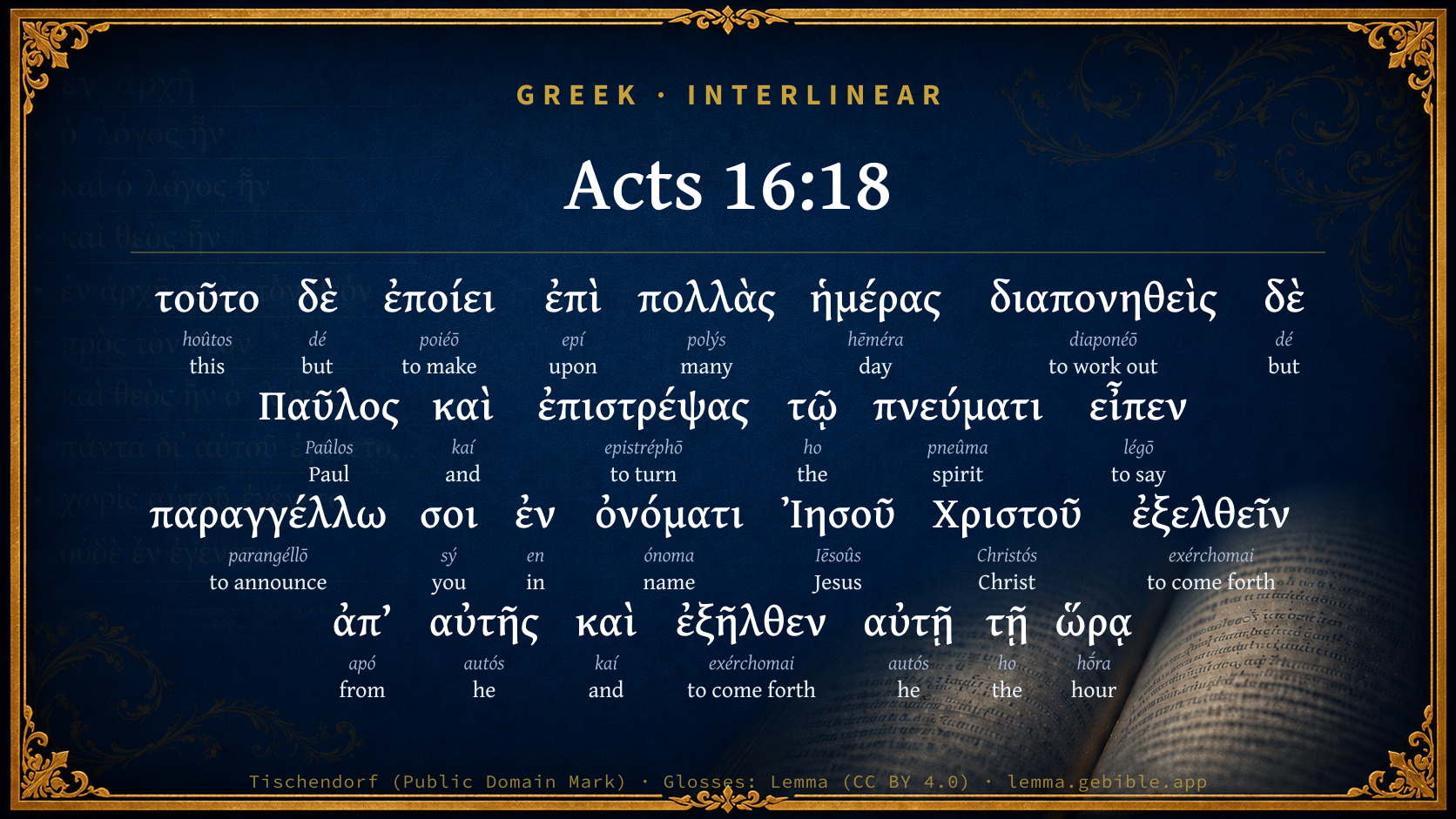
Greek (Tischendorf 8th ed.) Acts 16:18 appears in the Greek New Testament. The text above is from the Tischendorf 8th edition. Each word links to its Strong’s number and a concise gloss. Click any word for its full Thayer’s Greek Lexicon entry.
Download image
Cite this verse

Acts 16:18 (World English Bible). Public Domain. Lemma interlinear Bible study tool, https://lemma.gebible.app/v/acts/16/18.

Show BibTeX & RIS
BibTeX
RIS
English Translation
She was doing this for many days. But Paul, becoming greatly annoyed, turned and said to the spirit, "I charge you in the name of Jesus Christ to come out of her!" It came out that very hour.
World English Bible · Public Domain
Download a study sheet

One document with this verse’s original text, its word-by-word gloss line, the meaning frame, cross-references with their text, attributed commentary, and full source and license credits — printable, and it pastes into notes with its structure intact.

This verse Autodidact and up

Study sheet (.html) Plain text (.txt)

A passage Seminary Student

Up to 50 verses in one chapter. A passage sheet keeps up to 6 commentary sources and 12 cross-references per verse, in the order this page ranks them, and says so on the sheet whenever that leaves anything out. Ask for a single verse and you get the Autodidact verse sheet above.

Everything on this page stays free to read, with no account — the sheet is a download of what is already on screen, not access to it.

Want to remove ads? Support Godless Engineer
Compare translations 3

The same verse in 3 English versions, stacked beneath the original-language interlinear above. Click any original word for its lexicon entry.

Each is an independent rendering of the whole verse — the interlinear is not word-aligned to these translations.

Highlighted words mark where these versions differ — a whole-verse word diff, not a word-by-word alignment.

  • World English Bible Public Domain
    She was doing this for many days. But Paul, becoming greatly annoyed, turned and said to the spirit, "I charge you in the name of Jesus Christ to come out of her!" It came out that very hour.
  • King James Version Public Domain
    And this did she many days. But Paul, being grieved, turned and said to the spirit, I command thee in the name of Jesus Christ to come out of her. And he came out the same hour.
  • unfoldingWord Literal Text CC BY-SA 4.0
    And she was doing this for many days. But Paul, having become annoyed and having turned, said to the spirit, “I command you in the name of Jesus Christ to come out from her.” And it came out in the same hour.

unfoldingWord Literal Text — © unfoldingWord, licensed CC BY-SA 4.0. Word-aligned USFM3 via Door43 (git.door43.org/unfoldingWord/en_ult).

Versions to compare (up to 4)

3 of 4 selected

Show all 19 translations

Every available English version of this verse, each an independent rendering of the whole verse.

  • World English Bible Public Domain
    She was doing this for many days. But Paul, becoming greatly annoyed, turned and said to the spirit, "I charge you in the name of Jesus Christ to come out of her!" It came out that very hour.
  • Berean Standard Bible Public Domain
    She continued this for many days. Eventually Paul grew so aggravated that he turned and said to the spirit, “In the name of Jesus Christ I command you to come out of her!” And the spirit left her at that very moment.
  • Majority Standard Bible Public Domain
    She continued this for many days. Eventually Paul grew so aggravated that he turned and said to the spirit, “In the name of Jesus Christ I command you to come out of her!” And the spirit left her at that very moment.
  • King James Version Public Domain
    And this did she many days. But Paul, being grieved, turned and said to the spirit, I command thee in the name of Jesus Christ to come out of her. And he came out the same hour.
  • American Standard Version (1901) Public Domain
    And this she did for many days. But Paul, being sore troubled, turned and said to the spirit, I charge thee in the name of Jesus Christ to come out of her. And it came out that very hour.
  • Revised Version (1885) Public Domain
    And this she did for many days. But Paul, being sore troubled, turned and said to the spirit, I charge thee in the name of Jesus Christ to come out of her. And it came out that very hour.
  • Geneva Bible (1599) Public Domain
    And this did she many dayes: but Paul being grieued, turned about, and said to the spirit, I commaund thee in the Name of Iesus Christ, that thou come out of her. And he came out the same houre.
  • Douay-Rheims (1899) Public Domain
    And this she did many days. But Paul being grieved, turned, and said to the spirit: I command thee, in the name of Jesus Christ, to go out from her. And he went out the same hour.
  • Young's Literal Translation Public Domain
    and this she was doing for many days, but Paul having been grieved, and having turned, said to the spirit, `I command thee, in the name of Jesus Christ, to come forth from her;' and it came forth the same hour.
  • Literal Standard Version CC BY-SA 4.0
    And this she was doing for many days, but Paul having been grieved, and having turned, said to the spirit, “I command you, in the Name of Jesus Christ, to come forth from her”; and it came forth the same hour.
  • Unlocked Literal Bible CC BY-SA 4.0
    She did this for many days. But Paul, being greatly annoyed by her, turned and said to the spirit, “I command you in the name of Jesus Christ to come out of her.” And it came out right away.
  • unfoldingWord Literal Text CC BY-SA 4.0
    And she was doing this for many days. But Paul, having become annoyed and having turned, said to the spirit, “I command you in the name of Jesus Christ to come out from her.” And it came out in the same hour.
  • Darby Bible Public Domain
    And this she did many days. And Paul, being distressed, turned, and said to the spirit, I enjoin thee in the name of Jesus Christ to come out of her. And it came out the same hour.
  • World Messianic Bible Public Domain
    She was doing this for many days. But Paul, becoming greatly annoyed, turned and said to the spirit, “I command you in the name of Yeshua the Messiah to come out of her!” It came out that very hour.
  • Webster's Bible Public Domain
    And this she did many days. But Paul being grieved, turned and said to the spirit, I command thee in the name of Jesus Christ to come out of her. And he came out the same hour.
  • Free Bible Version CC BY-SA 4.0
    She went on doing this for several days. This bothered Paul so he turned around and told the spirit, “I command you in the name of Jesus Christ to leave her!” The spirit immediately left her.
  • Bible in Basic English Public Domain
    And this she did on a number of days. But Paul was greatly troubled and, turning, said to the spirit, I give you orders in the name of Jesus Christ, to come out of her. And it came out that very hour.
  • Text-Critical English NT CC BY 4.0
    She kept on doing this for many days, and Paul became so annoyed that he turned and said to the spirit, “I command yoʋ in the name of Jesus Christ to come out of her.” And it came out that very hour.
  • Tyndale New Testament (1534) Public Domain
    And this dyd she many dayes. But Paul not content, turned about and sayd to the sprete: I commaunde the in the name of Iesu Christ that thou come out of her. And he came out the same houre.

Literal Standard Version (2020), Covenant Press — licensed CC BY-SA 4.0. Text via the HelloAO Bible API (eBible.org). Unlocked Literal Bible (unfoldingWord) — licensed CC BY-SA 4.0. Text via the HelloAO Bible API (eBible.org). unfoldingWord Literal Text — © unfoldingWord, licensed CC BY-SA 4.0. Word-aligned USFM3 via Door43 (git.door43.org/unfoldingWord/en_ult). Free Bible Version, Dr. Jonathan Gallagher — licensed CC BY-SA 4.0. Text via the HelloAO Bible API (eBible.org).

Word by word

More ways to search: Search by grammar → Find every occurrence → Compare this word →

Practice this passage: Drill this verse → Learn its vocabulary →

διαπονηθεὶς
diaponéō
G1278
“to work out”
Verb, Aorist, Middle deponent, Participle, Nominative, Singular, Masculine
Part of Speech
Verb
Tense
Aorist
Voice
Middle deponent
Mood
Participle
Case
Nominative
Number
Singular
Gender
Masculine
Full Thayer's Definition

Origin: from G1223 and a derivative of G4192

TDNT: None

1. to work out laboriously, make complete by labour a. to exert one's self, strive b. to manage with pains, accomplish with great labour c. to be troubled, displeased, offended, pained, to be worked up
  1. τοῦτο hoûtos G3778 “this” Demonstrative pronoun, Accusative, Singular, Neuter
  2. δὲ dé G1161 “but” Conjunction
  3. ἐποίει poiéō G4160 “to make” Verb, Imperfect, Active, Indicative, 3rd person, Singular
  4. ἐπὶ epí G1909 “upon” Preposition
  5. πολλὰς polýs G4183 “many” Adjective, Accusative, Plural, Feminine
  6. ἡμέρας hēméra G2250 “day” Noun, Accusative, Plural, Feminine
  7. δὲ dé G1161 “but” Conjunction
  8. Παῦλος Paûlos G3972 “Paul” Noun, Nominative, Singular, Masculine
  9. καὶ kaí G2532 “and” Conjunction
  10. ἐπιστρέψας epistréphō G1994 “to turn” Verb, Aorist, Active, Participle, Nominative, Singular, Masculine
  11. τῷ ho G3588 “the” Article, Dative, Singular, Neuter
  12. πνεύματι pneûma G4151 “spirit” Noun, Dative, Singular, Neuter
  13. εἶπεν légō G3004 “to say” Verb, Aorist, Active, Indicative, 3rd person, Singular
  14. παραγγέλλω parangéllō G3853 “to announce” Verb, Present, Active, Indicative, 1st person, Singular
  15. σοι sý G4771 “you” Personal pronoun, 2nd person, Dative, Singular
  16. ἐν en G1722 “in” Preposition
  17. ὀνόματι ónoma G3686 “name” Noun, Dative, Singular, Neuter
  18. Ἰησοῦ Iēsoûs G2424 “Jesus” Noun, Genitive, Singular, Masculine
  19. Χριστοῦ Christós G5547 “Christ” Noun, Genitive, Singular, Masculine
  20. ἐξελθεῖν exérchomai G1831 “to come forth” Verb, Aorist, Active, Infinitive
  21. ἀπ’ apó G575 “from” Preposition
  22. αὐτῆς autós G846 “he” Personal pronoun, Genitive, Singular, Feminine
  23. καὶ kaí G2532 “and” Conjunction
  24. ἐξῆλθεν exérchomai G1831 “to come forth” Verb, Aorist, Active, Indicative, 3rd person, Singular
  25. αὐτῇ autós G846 “he” Personal pronoun, Dative, Singular, Feminine
  26. τῇ ho G3588 “the” Article, Dative, Singular, Feminine
  27. ὥρᾳ hṓra G5610 “hour” Noun, Dative, Singular, Feminine

About this verse

These counts appear in no published source. They are computed here, from the morphology-tagged text and Lemma’s own curated glosses. What Lemma adds →

28
words
23
distinct lemmas
Acts
section

Notable vocabulary

The rarest word here is διαπονηθεὶς to work out G1278 — appearing just 2 times in the whole Greek New Testament.

Shared distinctive vocabulary

διαπονηθεὶς to work out G1278 occurs in 2 verses of the Greek New Testament. Also found in:

Repetition

Words recur within this verse:

  • ἐξελθεῖν to come forth G1831 ×2
  • δὲ but G1161 ×2
  • καὶ and G2532 ×2
  • τῷ the G3588 ×2
  • αὐτῆς he G846 ×2

Cross-references

11

Topical passages linked to Acts 16:18 in the Treasury of Scripture Knowledge — connected by theme and wording, ordered by reader-vote popularity; previews shown in the World English Bible.

  • Mark 16:17 These signs will accompany those who believe: in my name they will cast out demons; they will speak with new languages;
  • Luke 10:17–19 The seventy returned with joy, saying, "Lord, even the demons are subject to us in your name!"
  • Mark 1:34 He healed many who were sick with various diseases, and cast out many demons. He didn't allow the demons to speak, because they knew him.
  • Mark 9:25–26 When Jesus saw that a multitude came running together, he rebuked the unclean spirit, saying to him, "You mute and deaf spirit, I command you, come out of him, and never enter him again!"
  • Acts 3:6 But Peter said, "Silver and gold have I none, but what I have, that I give you. In the name of Jesus Christ of Nazareth, get up and walk!"
  • Acts 9:34 Peter said to him, "Aeneas, Jesus Christ heals you. Get up and make your bed!" Immediately he arose.
  • Acts 19:12–17 so that even handkerchiefs or aprons were carried away from his body to the sick, and the evil spirits went out.
  • Mark 1:25–26 Jesus rebuked him, saying, "Be quiet, and come out of him!"
  • Colossians 2:15 having stripped the principalities and the powers, he made a show of them openly, triumphing over them in it.
  • Luke 9:1 He called the twelve together, and gave them power and authority over all demons, and to cure diseases.
  • Acts 14:13–15 The priest of Jupiter, whose temple was in front of their city, brought oxen and garlands to the gates, and would have made a sacrifice along with the multitudes.

Cross-references courtesy of OpenBible.info (CC BY 4.0).

Commentary

Notes on Acts 16:18 from classic Christian and Jewish commentators (each source and its license shown beneath its notes). The classic Christian expositions comment on the surrounding passage and are grouped to its opening verse, so a note may address several verses; the Jewish commentaries on the Tanakh (Rashi and others) are per-verse, so they appear only where the commentator wrote on this verse.

Lemma curates 59 commentaries, every one of them public domain or Creative Commons licensed, each selected and text-cleaned for this edition rather than reprinted as found. About our sources →

Bengel's Gnomon

Johann Albrecht Bengel

Act 16:18. Διαπονηθεὶς, being grieved) in reference to his own honour, through his shrinking from it: in reference to the Divine honour, through love of it.—ἀπʼ αὐτῆς, out of her) It is probable that this maid was converted.

Bengel's Gnomon of the New Testament — English translation (T&T Clark, Edinburgh, 1860) — public domain. Text from a community e-Sword module.

Expositor's Greek Testament

ed. W. Robertson Nicoll

Act 16:18 . διαπονηθεὶς , only here and in Act 4:2 in N.T.; its use in LXX in two passages only does not help us much, see Act 4:2 , and in classics it is not used in the sense required here. Aquila uses it four times of the Hebrew עָצַב in passages which show that the word may combine the ideas of grief, pain, and anger, Gen 6:6 ; Gen 34:7 , 1Sa 20:3 ; 1Sa 20:34 . It may be noticed that the word and other compounds of πονεῖν are frequent in medical writers. Παραγγέλλω , see on Act 1:4 . The same strong word is used of our Lord, Luk 8:29 , where He charged another unclean spirit to come out. ὀνόματι , see above on Act 3:6 , “Demonology,” Hastings’ B.D., where reference is made to Sayce, Hibbert Lect. , pp. 302 347, as to the belief in the powerful efficacy of the name , the name meaning to an ancient Semite personal power and existence. ἐξελθεῖν ἀπʼ αὐτῆς : the phrase occurs in Luke much more frequently than in any other N.T. writer; nine times in his Gospel of the coming out of evil spirits, as here. Rendall sees in the phrase the medical accuracy of the writer in describing the process of the cure; the evil spirit must not only come out, but depart, pp. 104, 280; it must however be remembered that St. Matthew uses the same phrase twice of the departure of evil spirits from men, Mat 12:43 , Mat 17:18 . Paul charges the evil spirit to depart; it departed, and with it departed the master’s hope of gain (see also Weiss, in loco ). αὐτῇ τῇ ὥρᾳ : “that very hour,” R.V., cf. Act 22:13 , eo ipso tempore ; peculiar to Luke, cf. Luk 2:38 ; Luk 10:21 ; Luk 12:12 ; Luk 20:19 ; Luk 24:33 (so too Friedrich, p. 37). We are not told anything further of the history of the girl, but we may well believe that she too would partake of the generous help of Lydia, and of the other Christian women at Philippi, who would see in her no longer a bondservant to the many lords who had had dominion over her, but a sister beloved in the One Lord.

The Expositor's Greek Testament, edited by W. Robertson Nicoll (1897–1910) — public domain. Text from a community e-Sword module.

Geneva Bible (1599)

Geneva Bible translators

Paul made no haste to this miracle, for he did all things as he was led by the Spirit.

Geneva Bible (1599) marginal notes — public domain. Text via Bolls.life.

Jamieson, Fausset & Brown

Robert Jamieson, A. R. Fausset & David Brown

Paul being grieved--for the poor victim; grieved to see such power possessed by the enemy of man's salvation, and grieved to observe the malignant design with which this high testimony was borne to Christ.

Jamieson, Fausset & Brown — Commentary Critical and Explanatory on the Whole Bible (1871) — public domain (CC PDM 1.0). Text via the HelloAO Bible API.

Adam Clarke's Commentary

Verse 18. Paul, being grieved] Probably for the reasons assigned above.

Turned-to the spirit] Not to the woman; she was only the organ by which the spirit acted.

I command thee, in the name of Jesus] Jesus is the Saviour; Satan is Abaddon and Apollyon, the destroyer. The sovereign Saviour says to the destroyer, Come out of her; and he came out in the same hour. Every circumstance of this case proves it to have been a real possession. We have already had several opportunities of remarking the great accuracy of St. Luke in his accounts of demoniacs: his education as a physician gave him advantages to detect imposture of this kind where it subsisted; but he sees none in this case. He speaks of the spirit and the damsel as distinct persons. The damsel had a spirit of divination. Paul turned to the spirit, and said, I command THEE to come out of HER; and he came out in the same hour. Had not St. Luke considered this as a real case of diabolic possession, he has made use of the most improper language he could choose; language and forms of speech calculated to deceive all his readers, and cause them to believe a lie. But it is impossible that the holy apostle could do so, because he was a good man; and it is not likely he could be deceived by a parcel of charlatans, because he was a wise man; and it would be absurd to suppose that, while he was under the influence of the Holy Spirit, he could be imposed on by the cunning of even the devil himself.

Adam Clarke's Commentary on the Bible (1810–1826) — public domain. Text from a community e-Sword/MySword module.

John Calvin's Commentaries

18. Paul took it grievously. It may be that at the first Paul neglected, and did not greatly regard the crying of the maid, because he hoped that there would be no account made thereof, and had rather that it should vanish away of itself. But the continual repetition doth at length make him weary; because, if he had any long dissembled, Satan would have waxed more and more insolent through his silence and patience. Secondly, he ought not to have broken out into this prohibition rashly, until he knew for a certainty that he was furnished with the power of God. For Paul’s commandment had been foolish and vain without the commandment of God. And this must be noted, lest any man condemn Paul of too great hastiness, because he encountered so valiantly with the unclean spirit. For he did not conceive any grief or indignation, save only that he saw that the stability of Satan would increase, unless he did betimes prevent it; neither did he attempt any thing without the motion of the Spirit; neither did he enter the conflict until he was armed with power from heaven. Notwithstanding, he seemeth to be contrary to himself, seeing that he saith elsewhere that he rejoiceth upon what occasion soever he see the gospel preached, (Philippians 1:18,) even by wicked men, and such as did study of set purpose to bring him in contempt. I answer, that he had another more apt reason for himself in this place; because all men would have thought that the spirit of the maid had played with Paul; so that by that means the doctrine of the gospel should not only have come in [into] suspicion, but should also have come into great contempt. And to this end was it that Christ also did command the devil to hold his peace, (Mark 1:25,) whereas notwithstanding he suffered his name to be extolled by unmeet and unworthy men, (Luke 4:35.)

I command thee. We must note the form of speech; for as the miracle was about to have a double use, namely, that the power of Christ might be known; secondly, that he might declare that he had no fellowship with Satan’s jugglings; so Paul, in giving the authority and power to Christ alone, doth declare that he is only a minister; that done, he doth openly set Christ against the devil, to the end that, by the conflict, all men may see that they be deadly enemies. For it was profitable that many should be awaked who had been given to such gross seducing, that being well purged, they might come to the true faith.

John Calvin's Commentaries (1540-1563) — public domain. Text from the Calvin Translation Society English edition (1840s-50s) via the Christian Classics Ethereal Library (ccel.org). Calvin's coverage is partial (roughly two-thirds of the Bible); uncommented books and verses are honest gaps, never fabricated. The 19th-century editor's footnotes and remarks are omitted so the notes are faithfully Calvin's own voice.

Ellicott's Commentary for English Readers

(18) But Paul, being grieved . . .—It is obvious that the constant repetition of these clamorous cries must have been a hindrance to the Apostle’s work, disturbing him as he talked to the other women at the proseucha. Was it not right for him to do as his Master had done with the demoniacs of Gadara (see Notes on Mat_8:28-34), and to restore the woman to her true self, by teaching her to distinguish between her longing for deliverance and the wild passions that hindered her from attaining it? And so he spoke, and the evil spirit “came out the same hour.” Here the history ends, as far as the damsel was concerned; but we can hardly think that she was left to drift back into ignorance and unbelief. Would not such a one find shelter and comfort at the hands of the women who “laboured” with the Apostle? (Php_4:2.) May we not think of her gratitude as showing itself in the gifts that were sent to the Apostle, upon whom she had unwillingly brought so much suffering? (Php_4:15.)

A Bible Commentary for English Readers, edited by Charles John Ellicott (1878–1897) — public domain. Text from a community e-Sword module.

The Cambridge Bible for Schools and Colleges

gen. ed. J. J. S. Perowne

18. this did she many days] Whether this following took place only on the sabbaths, when the Apostles were going to the place of prayer, in which case the Apostles must have remained in Philippi some weeks, or whether it was on every occasion on which they appeared in public, we are not told.

Paul, being grieved] The Greek verb is somewhat stronger, and signifies “to be thoroughly worn out with annoyance.” It is used (Act_4:2), and nowhere else but here besides in N. T., of the annoyance of the priests and Sadducees at the teaching of the Apostles.

said to the spirit] As Christ had acted when on earth, so Paul now will not allow the cry of the evil spirit, even though the words proclaim that he and his companions are servants of the Most High God. So in Christ’s name he bids the evil power come forth.

The Cambridge Bible for Schools and Colleges (gen. ed. J. J. S. Perowne; Cambridge University Press, 1878–1918) — public domain. Text from a community e-Sword module.

John Gill's Exposition

And this she did many days,.... As the apostle and his company passed to and from the oratory, being for that time at Lydia's house; she followed them, and repeated the above words. This she was suffered to do, time after time; not that the apostle and his friends wanted such a testimony, or that it was of any use to them; but that the expulsion of the evil spirit might be more manliest, and more taken notice of:

but Paul being grieved; at the unhappy condition the maid was in, being possessed with such a spirit: and that the people were so imposed upon and deluded by it; and that it should be thought that there was any combination and agreement between that and him:

turned; himself to her, who was behind him, she following him, as is said in the preceding verse; this is left out in the Syriac version:

and said to the spirit; or to that spirit, as the same version renders it; to the spirit of Python, or Apollo, or of divination, that was in the maid; the Ethiopic version reads, "and he said", "in", or "by the Holy Spirit"; being under a more than ordinary influence and impulse of his; but not the spirit by which he spake, but the spirit to which he spake, is here meant:

I command thee in the name of Jesus Christ to come out of her, and he came out the same hour; this is an instance of that power which Christ gave to his apostles to cast out devils in his name,

John Gill's Exposition of the Whole Bible (1746–1763) — public domain (CC PDM 1.0). Text via the HelloAO Bible API.

Trapp's Complete Commentary

John Trapp

18 And this did she many days. But Paul, being grieved, turned and said to the spirit, I command thee in the name of Jesus Christ to come out of her. And he came out the same hour.

Ver. 18. Paul being grieved] Paul took no joy in such a testimony. High words become not a fool. To be praised by a praiseless person is no praise at all.

John Trapp, A Commentary or Exposition upon All the Books of the Old and New Testament (1647–1656) — public domain. Text from a community e-Sword module.

Albert Barnes' Notes on the Bible

But Paul, being grieved - Being molested, troubled, offended. Paul was grieved, probably:

Because her presence was troublesome to him; Because it might be said that he was in alliance with her, and that his pretensions were just like hers; Because what she did was for the sake of gain, and was a base imposition; Because her state was one of bondage and delusion, and it was proper to free her from this demoniacal possession; and, Because the system under which she was acting was a part of a scheme of delusion and imposture, which had spread over a large portion of the pagan world, and which was then holding it in bondage.

Throughout the Roman empire the inspiration of the priestesses of Apollo was believed in, and temples were everywhere reared to perpetuate and celebrate the delusion. Against this extensive system of imposture and fraud Christianity must oppose itself; and this was a favorable instance to expose the delusion, and to show the power of the Christian religion over all the arts and powers of imposture. The mere fact that in a very few instances - of which this was one - they spoke the truth, did not make it improper for Paul to interpose. That fact would only tend to perpetuate the delusion, and to make his interposition more proper and necessary. The expulsion of the evil spirit would also afford a signal proof of the fact that the apostles were really from God a far better proof than her noisy and troublesome proclamation of it would furnish.

In the name of Jesus Christ - Or, by the authority of Jesus Christ. See the notes on Act 3:6.

Albert Barnes' Notes on the Bible (1834–1885) — public domain. Text from a community e-Sword/MySword module.

Haydock's Catholic Bible Commentary

Observe here that the servants of God have a power granted them of controlling wicked spirits, according to the promise of our Lord, Luke ix. and x. Hence the seventy disciples, returning, said: Lord, even the devils are subject to us in thy name. (Estius, in different location)

George Leo Haydock (1774–1849), Haydock's Catholic Family Bible and Commentary, 1859 edition — public domain. Excludes Psalms (Douay-Rheims chapter numbering differs from Protestant) and Deuterocanonical books (Catholic canon only).

Matthew Poole's English Annotations

St. Paul was grieved, either for the maid’s sake, who suffered so much by her being possessed with this spirit, or, for their sakes who were seduced by him. St. Paul (as our Saviour had done, Mar 1:25) refuseth the testimony of the devil; for he being the father of lies, Joh 8:44, makes every thing he says to be suspected; as it is a usual punishment of liars, that they are not believed when they speak the truth; and the devil never speaks any truth but with an intention to deceive.

In the name of Jesus Christ; by the authority and power of Christ.

Matthew Poole's English Annotations on the Holy Bible (1683–1685) — public domain. Text from a community e-Sword/MySword module.

Whedon's Commentary on the Bible

Daniel D. Whedon

18. Many days—During which the apostles went to the proseucha, at the river side. Thereby we understand that the Gospel was for a length of time dispensed; a Philippian Church was being formed, and the doctrine of the way of salvation had so rung through the city that when the masters at last appealed to the populace against them as introducers of a new religion the mob was cognizant and ready to spring.

Come out… he came out— The language of both Paul and Luke implies beyond question that a foreign being possessed her frame. This case may answer the question, How is it that demoniac possession is unknown out of Palestine and out of the time of our Saviour’s life? Underlying all the falsehood and deception of heathen myths and oracles, there was a demoniac element. In the frenzy of the bacchanals, the corybantes, and the pythonesses, there was a true possession, modified by the nature of that dispensation. (See specially our note on Mar_5:2.)

Daniel D. Whedon (gen. ed.), Commentary on the Old and New Testaments (1874–1909) — public domain. Text from a community e-Sword module.

The Pulpit Commentary

She did for did she, A.V.; for many for many, A.V.; sore troubled for grieved, A.V.; charge for command, A.V.; it for he, A.V.; that very for the same, A.V. Command (paraggellw, as in Act_1:4 Act_5:28; and ver. 23 of this chapter, etc.). The only other instances of exorcism by St. Paul are these recorded in Act_19:12 and 15. The question of possession by spirits is too large a one to be discussed here. It must suffice to notice that St. Paul in his action (as our Lord before him had done), and St. Luke in his narrative, distinctly treat possession, and expulsion by the power of Christ, as real.

The Pulpit Commentary (1880–1919), ed. H.D.M. Spence-Jones & Joseph S. Exell — public domain. Text from a community e-Sword module.

McGarvey & Pendleton's Commentaries

J. W. McGarvey

See notes on verse 16

J. W. McGarvey (with Philip Y. Pendleton), Commentaries on the New Testament (The Fourfold Gospel, 1914; Acts; and the epistles) — public domain. Text from a community e-Sword/MySword module.

Cambridge Greek Testament for Schools and Colleges

18. τοῦτο δέ ἐποίει ἐπὶ πολλάς ἡμέρας, this she did for many days. Whether this following took place only on the sabbaths, when the Apostles were going to the place of prayer, in which case the Apostles must have remained in Philippi some weeks, or whether it was on every occasion on which they appeared in public, we are not told.

διαπονηθεὶς δὲ Παῦλος, but Paul being grieved. The same verb is used (Act 4:2) of the annoyance of the priests and Sadducees at the teaching of the Apostles, and nowhere else in N.T. (See note there.) Its sense is ‘to be thoroughly worn out with vexation.’

τῷ πνεύατι εἶπεν, said to the spirit. As Christ had acted when on earth, so Paul now will not allow the cry of the evil spirit, even though the words proclaim that he and his companions are servants of the Most High God. So in Christ’s name he bids the evil power come forth.

Cambridge Greek Testament for Schools and Colleges (Cambridge University Press, 1896; 21 vols, various authors incl. Carr, Maclear, Plummer, Farrar, Lumby, Moule, M. R. James, Simcox) — public domain. Text from a community e-Sword module.

Alford’s Greek Testament

Henry Alford

18. διαπονηθείς] Not mere annoyance is expressed by this word, but rather holy indignation and sorrow at what he saw and heard; the Christian soldier was goaded to the attack, but the mere satisfaction of anger was not the object, any more than the result, of the stroke. It is doubtful here, in mere grammar, whether the dat. τῷ πνεύματι is to be constructed with ἐπιστρέψας or with εἶπεν. But considering 1) that the spirit could hardly be the object of a bodily movement on the part of the Apostle, except as represented by the possessed damsel, and 2) that ἐπιστρέφω is never elsewhere found with a dative, but always with a preposition, εἰς or πρός or ἐπί, it is much the best to take τῷ πνεύματι with εἶπεν, and believe it to be thrown forward before its verb for the sake of emphasis.

Henry Alford, The Greek Testament (1849–1861) — public domain. Text from a community e-Sword module.

Vincent's Word Studies in the New Testament

Marvin R. Vincent

Grieved [διαπομηθεις] . Not strong enough. Rather, worn out. Both grieved at the sad condition of the woman, and thoroughly annoyed and indignant at the continued demonstrations of the evil spirit which possessed her. Compare ch. 4 2.

Marvin R. Vincent, Word Studies in the New Testament (1887–1900) — public domain. Text from a community e-Sword/MySword module.

Lesson kit

Teaching starters — assembled from the data on this page, not authored interpretation. Every prompt links to the verse data it draws on. Edit before teaching.

Acts, in the Acts, opens this verse with 28 words (23 distinct Greek lemmas). Its most distinctive word is diaponéō (“to work out”). A historical commentator’s framing appears above. Read the whole chapter for the surrounding context.

Discussion questions

  1. How does “to work out” (diaponéō) shape what this verse is saying?
  2. How does Acts 4:2, which shares the word «to work out», read alongside this verse?
  3. What does the repetition of “to come forth” (2× in this one verse) do in this verse?
  4. The translations on this page render this verse differently — a whole-verse word diff, not a word-by-word alignment. What might account for the different wordings?
  5. Compare how Bengel's Gnomon and Expositor's Greek Testament read this verse. Where do they agree or differ?

Things to notice

  • These translations choose different wording for 14 words in this verse.
  • “to come forth” occurs 2× in this single verse.
  • 23 distinct Greek lemmas span 28 words in this verse.

Reading settings

Reading text

Shown beneath each verse's original-language words.

Old Testament
Old Testament edition

Read the OT as the Masoretic Hebrew (MT) or the Greek Septuagint (LXX).

English shown for the Greek Septuagint (in the Hebrew ↔ Greek comparison).

Comparing translations? Open the Compare panel on any verse page to stack up to four side by side.