Mark 5:43

Greek (Tischendorf 8th ed.) Mark 5:43 appears in the Greek New Testament. The text above is from the Tischendorf 8th edition. Each word links to its Strong’s number and a concise gloss. Click any word for its full Thayer’s Greek Lexicon entry.
Download image
Cite this verse

Mark 5:43 (World English Bible). Public Domain. Lemma interlinear Bible study tool, https://lemma.gebible.app/v/mark/5/43.

Show BibTeX & RIS
BibTeX
RIS
English Translation
He strictly ordered them that no one should know this, and commanded that something should be given to her to eat.
World English Bible · Public Domain
Download a study sheet

One document with this verse’s original text, its word-by-word gloss line, the meaning frame, cross-references with their text, attributed commentary, and full source and license credits — printable, and it pastes into notes with its structure intact.

This verse Autodidact and up

Study sheet (.html) Plain text (.txt)

A passage Seminary Student

Up to 50 verses in one chapter. A passage sheet keeps up to 6 commentary sources and 12 cross-references per verse, in the order this page ranks them, and says so on the sheet whenever that leaves anything out. Ask for a single verse and you get the Autodidact verse sheet above.

Everything on this page stays free to read, with no account — the sheet is a download of what is already on screen, not access to it.

Want to remove ads? Support Godless Engineer
Compare translations 3

The same verse in 3 English versions, stacked beneath the original-language interlinear above. Click any original word for its lexicon entry.

Each is an independent rendering of the whole verse — the interlinear is not word-aligned to these translations.

Highlighted words mark where these versions differ — a whole-verse word diff, not a word-by-word alignment.

  • World English Bible Public Domain
    He strictly ordered them that no one should know this, and commanded that something should be given to her to eat.
  • King James Version Public Domain
    And he charged them straitly that no man should know it; and commanded that something should be given her to eat.
  • unfoldingWord Literal Text CC BY-SA 4.0
    And he commanded them much that no one might know this, and he said that something should be given to her to eat.

unfoldingWord Literal Text — © unfoldingWord, licensed CC BY-SA 4.0. Word-aligned USFM3 via Door43 (git.door43.org/unfoldingWord/en_ult).

Versions to compare (up to 4)

3 of 4 selected

Show all 19 translations

Every available English version of this verse, each an independent rendering of the whole verse.

  • World English Bible Public Domain
    He strictly ordered them that no one should know this, and commanded that something should be given to her to eat.
  • Berean Standard Bible Public Domain
    Then Jesus gave strict orders that no one should know about this, and He told them to give her something to eat.
  • Majority Standard Bible Public Domain
    Then Jesus gave strict orders that no one should know about this, and He told them to give her something to eat.
  • King James Version Public Domain
    And he charged them straitly that no man should know it; and commanded that something should be given her to eat.
  • American Standard Version (1901) Public Domain
    And he charged them much that no man should know this: and he commanded that `something' should be given her to eat.
  • Revised Version (1885) Public Domain
    And he charged them much that no man should know this: and he commanded that something should be given her to eat.
  • Geneva Bible (1599) Public Domain
    And he charged them straitly that no man should knowe of it, and commanded to giue her meate.
  • Douay-Rheims (1899) Public Domain
    And he charged them strictly that no man should know it: and commanded that something should be given her to eat.
  • Young's Literal Translation Public Domain
    and he charged them much, that no one may know this thing, and he said that there be given to her to eat.
  • Literal Standard Version CC BY-SA 4.0
    and He charged them much, that no one may know this thing, and He said that there be given to her to eat.
  • Unlocked Literal Bible CC BY-SA 4.0
    He strictly ordered them that no one should know about this. Then he told them to give her something to eat.
  • unfoldingWord Literal Text CC BY-SA 4.0
    And he commanded them much that no one might know this, and he said that something should be given to her to eat.
  • Darby Bible Public Domain
    And he charged them much that no one should know this; and he desired that [something] should be given her to eat.
  • World Messianic Bible Public Domain
    He strictly ordered them that no one should know this, and commanded that something should be given to her to eat.
  • Webster's Bible Public Domain
    And he charged them strictly that no man should know it; and commanded that something should be given her to eat.
  • Free Bible Version CC BY-SA 4.0
    He gave them strict instructions not to let anyone know, and he told them to give the little girl something to eat.
  • Bible in Basic English Public Domain
    And he gave them special orders that they were not to say anything of this; and he said that some food was to be given to her.
  • Text-Critical English NT CC BY 4.0
    Then he gave them strict orders not to let anyone know about it, and he told them to give her something to eat.
  • Tyndale New Testament (1534) Public Domain
    And he charged the straytely that no man shuld knowe of it and commaunded to geve her meate.

Literal Standard Version (2020), Covenant Press — licensed CC BY-SA 4.0. Text via the HelloAO Bible API (eBible.org). Unlocked Literal Bible (unfoldingWord) — licensed CC BY-SA 4.0. Text via the HelloAO Bible API (eBible.org). unfoldingWord Literal Text — © unfoldingWord, licensed CC BY-SA 4.0. Word-aligned USFM3 via Door43 (git.door43.org/unfoldingWord/en_ult). Free Bible Version, Dr. Jonathan Gallagher — licensed CC BY-SA 4.0. Text via the HelloAO Bible API (eBible.org).

Word by word

More ways to search: Search by grammar → Find every occurrence → Compare this word →

Practice this passage: Drill this verse → Learn its vocabulary →

διεστείλατο
diastéllomai
G1291
“to divide”
Verb, Aorist, Middle, Indicative, 3rd person, Singular
Part of Speech
Verb
Tense
Aorist
Voice
Middle
Mood
Indicative
Person
3rd person
Number
Singular
Full Thayer's Definition

Origin: middle voice from G1223 and G4724

TDNT: 7:591,*

1. to draw asunder, divide, distinguish, dispose, order 2. to open one's self i.e. one's mind, to set forth distinctly 3. to admonish, order, charge
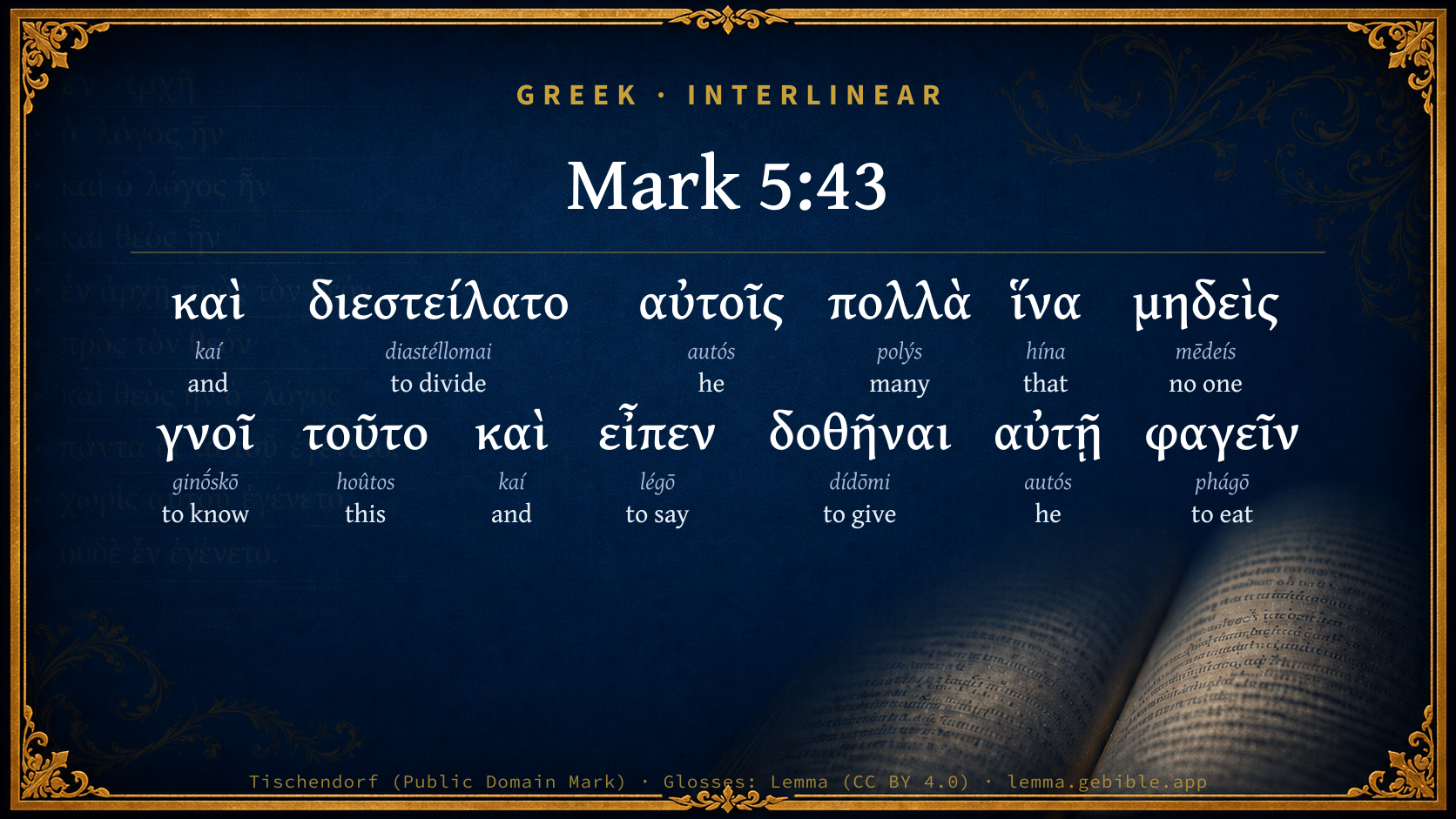
  1. καὶ kaí G2532 “and” Conjunction
  2. αὐτοῖς autós G846 “he” Personal pronoun, Dative, Plural, Masculine
  3. πολλὰ polýs G4183 “many” Adjective, Accusative, Plural, Neuter
  4. ἵνα hína G2443 “that” Conjunction
  5. μηδεὶς mēdeís G3367 “no one” Adjective, Nominative, Singular, Masculine, Negative
  6. γνοῖ ginṓskō G1097 “to know” Verb, Aorist, Active, Subjunctive, 3rd person, Singular
  7. τοῦτο hoûtos G3778 “this” Demonstrative pronoun, Accusative, Singular, Neuter
  8. καὶ kaí G2532 “and” Conjunction
  9. εἶπεν légō G3004 “to say” Verb, Aorist, Active, Indicative, 3rd person, Singular
  10. δοθῆναι dídōmi G1325 “to give” Verb, Aorist, Passive, Infinitive
  11. αὐτῇ autós G846 “he” Personal pronoun, Dative, Singular, Feminine
  12. φαγεῖν phágō G5315 “to eat” Verb, Aorist, Active, Infinitive

About this verse

These counts appear in no published source. They are computed here, from the morphology-tagged text and Lemma’s own curated glosses. What Lemma adds →

13
words
11
distinct lemmas
Gospels
section

Notable vocabulary

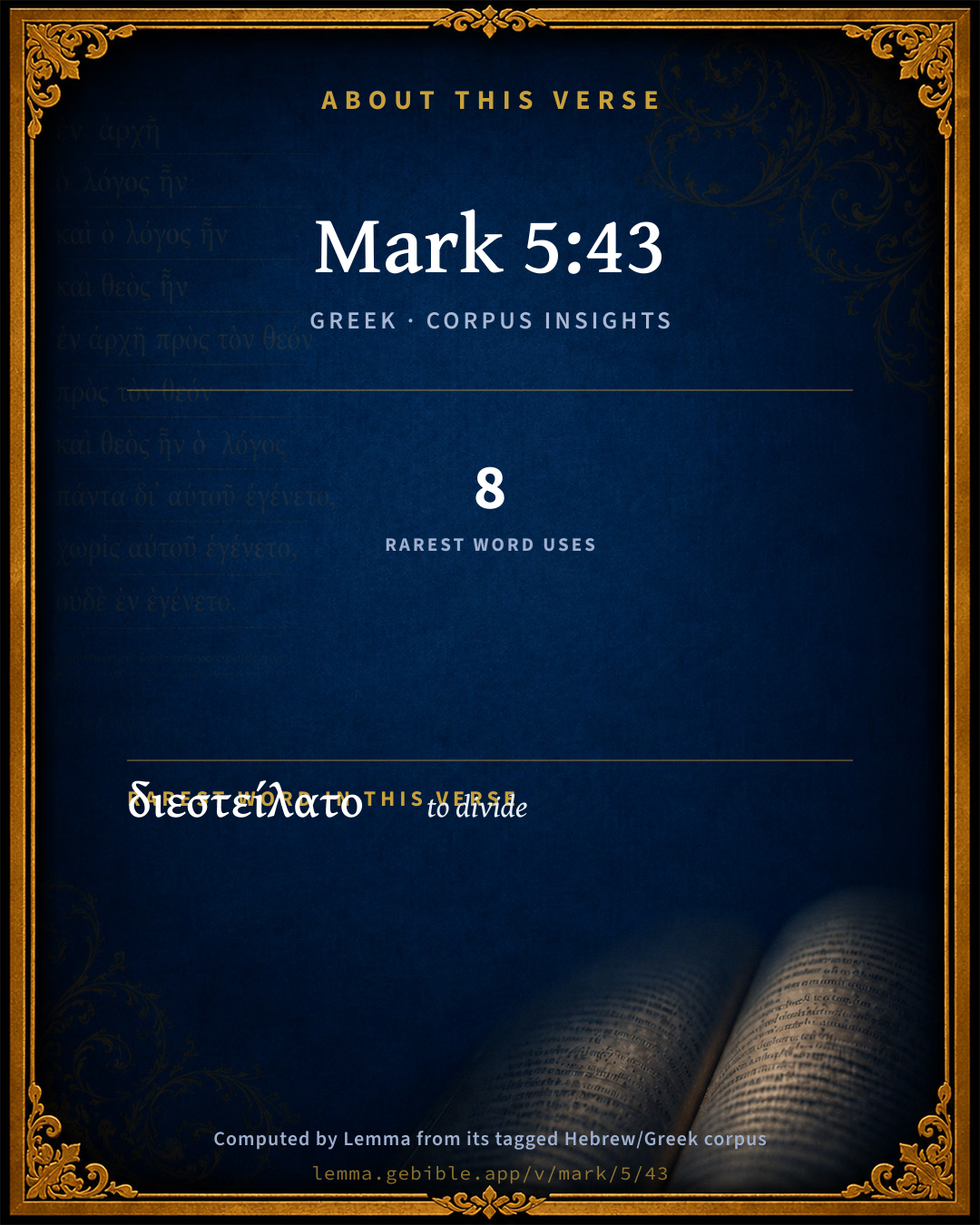
The rarest word here is διεστείλατο to divide G1291 — appearing just 8 times in the whole Greek New Testament.

Shared distinctive vocabulary

διεστείλατο to divide G1291 occurs in 7 verses of the Greek New Testament. Also found in:

Repetition

Words recur within this verse:

  • καὶ and G2532 ×2
  • αὐτοῖς he G846 ×2

Cross-references

13

Topical passages linked to Mark 5:43 in the Treasury of Scripture Knowledge — connected by theme and wording, ordered by reader-vote popularity; previews shown in the World English Bible.

  • Matthew 8:4 Jesus said to him, "See that you tell nobody, but go, show yourself to the priest, and offer the gift that Moses commanded, as a testimony to them."
  • Mark 7:36 He commanded them that they should tell no one, but the more he commanded them, so much the more widely they proclaimed it.
  • Matthew 9:30 Their eyes were opened. Jesus strictly charged them, saying, "See that no one knows about this."
  • Mark 1:43 He strictly warned him, and immediately sent him out,
  • Matthew 12:16–18 and charged them that they should not make him known:
  • Matthew 17:9 As they were coming down from the mountain, Jesus commanded them, saying, "Don't tell anyone what you saw, until the Son of Man has risen from the dead."
  • Mark 3:12 He sternly warned them that they should not make him known.
  • Luke 5:14 He charged him to tell no one, "But go your way, and show yourself to the priest, and offer for your cleansing according to what Moses commanded, for a testimony to them."
  • Luke 8:56 Her parents were amazed, but he charged them to tell no one what had been done.
  • John 5:41 I don't receive glory from men.
  • Luke 24:30 It happened, that when he had sat down at the table with them, he took the bread and gave thanks. Breaking it, he gave to them.
  • Luke 24:42–43 They gave him a piece of a broiled fish and some honeycomb.
  • Acts 10:41 not to all the people, but to witnesses who were chosen before by God, to us, who ate and drank with him after he rose from the dead.

Cross-references courtesy of OpenBible.info (CC BY 4.0).

Commentary

Notes on Mark 5:43 from classic Christian and Jewish commentators (each source and its license shown beneath its notes). The classic Christian expositions comment on the surrounding passage and are grouped to its opening verse, so a note may address several verses; the Jewish commentaries on the Tanakh (Rashi and others) are per-verse, so they appear only where the commentator wrote on this verse.

Lemma curates 59 commentaries, every one of them public domain or Creative Commons licensed, each selected and text-cleaned for this edition rather than reprinted as found. About our sources →

The Biblical Illustrator

Joseph S. Exell

Mar_5:21; Mar_5:23; Mar_5:35; Mar_5:43

Jairus by name.

-

A proper prayer

Better prayers, perhaps, had been offered. He would have shown more faith if he had prayed like the centurion (Luk_7:7). But, though he does not show such strong faith, yet it is a good prayer. For it is

(1) humble: he falls at Christs feet;

(2) believing: he feels Christ is omnipotent to heal;

(3) bold: he offers it in face of all the people, many of whom would be shocked that a ruler of the synagogue should acknowledge Jesus;

(4) loving, springing from a pure affection. Distress is a great schoolmaster. It teaches men many things; among the rest the greatest of all attainments-the power to pray. (R. Glover.)

A revived flower

And that bright flower bloomed in the vase of that happy home, more beautiful because the look of Jesus had given it new tints and the breath of Jesus had given it new fragrance. (J. Cumming, D. D.)

Jairus daughter

Jairus was a good man. His light was small, but real. It was feeble, but from heaven.

I. He had much to try his faith. One seems to see all the father in the tenderness of his words. Hope was over,-his daughter was dead. Thus is it with the believer. Instead of the relief he hoped for, all seems as death. Thus does the Lord try the faith He gives. Thus by causing us to wait for the blessing does He endear it.

II. The effect of this trial of faith. He did not distrust the power or willingness of the compassionate Saviour. His faith takes no denial, he still continues with Jesus. Faith hopes against hope. True faith partakes of his nature who exercises it, therefore in all, it is weak at times. But it partakes also of His nature who gives it, and therefore evinces its strength in the very midst of that weakness.

III. But wherever found, it is graciously rewarded. The scorners are without; but believing Jairus and the believing mother (Mar_5:40) are admitted. They see the mighty power of God put forth on behalf of their daughter. What an encouragement here to some anxious parent to put the case of their dear child in the hands of that same Jesus. How often has domestic affliction been the means of bringing the soul to the feet of Jesus. Mark the extreme tenderness of Jesus, Fear not, only believe. Be not afraid convicted sinner. My blood is sufficient, My grace and love are sufficient. (J. H. Evans, M. A.)

The Humane Society

I. The particular form of the Redeemers work.

1. Restoration from a special form of death.

2. Here was the recognition of the value of life-She shall live. It is not mere life on which Christianity has shed a richer value. It is by ennobling the purpose to which life is to be dedicated that it has made life more precious.

3. We consider the Saviours direction respecting the means of effecting a complete recovery. He commanded that something should be given her to eat. His reverential submission to the laws of nature.

II. The spirit of the Redeemers work.

1. It was love. He did good because it was good.

2. It was a spirit of retiring modesty. He did not wish it to be known.

3. It was a spirit of perseverance. Calm perseverance amidst ridicule. (F. W. Robertson.)

Not dead, but sleeping

Nature puts on a shroud at seasons, and seems to glide into the grave of winter. Autumnal blasts come sobbing through the trees, and leaf after leaf, shrivelling its fibres at the killing contact, comes drifting to the ground. The hedgerows where the May flowers and the dog rose mixed their scents are stripped and bare, and lift their thorny fingers up to heaven. The field where fat and wealthy-looking crops a while ago promised their golden sheaves, is now spread over with a coarse fringe of stubble, and seems a sort of hospital of vegetation. The garden shows no more its beauties, nor sheds forth its scent, but where the coloured petal and the painted cup of the gay flower were seen, there stands a blighted stem, or a drooping tuft of refuse herbs. The birds which carolled to the summer sky have fled away, and their note no longer greets the ear. The very daisies on the meadow are buried in the snow wreath, and the raw blast howls a sad requiem at the funeral of nature. But those trees, whose leafless branches seem to wrestle with the rough winds that toss them, are not dead. Anon, and they shall again be wreathed in verdure and bedecked with blossom. The softened breath of spring shall whisper to the snowdrop to dart forth its modest head, and shall broider the garden path again with flowers; the fragrance of the hawthorn bloom ere long shall gush from those naked hedge rows, and the returning lark shall wake the morning with a new and willing song. No, nature is not dead! There is a resurrection coming on. Spring with its touch of wizardry shall wake her from her slumbers, and sound again the keynote of the suspended music of the spheres. So also shall there arise out of the raging conflagration, in whose fevered heat the elements shall melt and shrivel like a scroll-even out of the very ashes which betoken its consumption-a new heaven and a new earth-an earth as ethereal and pure as heaven itself-and a heaven as substantial and as living as the earth. And consentaneously with the arising of these new worlds; the tombs shall open, and send forth the shrouded tenants, to enter on the inheritance which, in that new economy, shall be theirs. Can you believe that faded flowers shall revive at the blithe beckoning of the spring, that little leaves will quietly unfold at the mandate of the morning, and yet there shall be no spring to beckon the mortal back to life, and no morning to command the clay to clothe itself with the garments of a quickening spirit? Can you believe that the great temple shall arise with all its shrines rebuilded, and its altars purified after the final burning, but that there shall be neither voice nor trumpet to call forth the high priest from his slumber to worship at those shrines, and to lay a more enduring offering upon those waiting altars? Is the fuel to be ever laid, and none to kindle the burnt offering? Is the sanctuary to be prepared, and none to pay the service? Is the bridegroom to stand alone before the altar, and no bride to meet him at the nuptials? God forbid! The high priest is not dead-the bride has not perished-they are not dead, but sleep. Sound forth the trumpet, and say that all is ready, and then the corruptible will put on incorruption, and the mortal will put on immortality. Thus, when we lay our kindred in the earth, and follow to their final resting place the last remains of those who occupied a cherished chamber in our hearts-while nature finds it hard to dry the tear and quench the sigh-faith ever lifts the spirit from its sad despondency, by assuring us of a reunion beyond the grave-and robs the monster of one half his terrors-weakening his stroke and taking away his sting, by changing the mystic trance into which he throws his victims into a transient sleep, and speaking of a waking time of happiness and icy. Nature will look on death as an assassin who murders those we love; but Faith regards him as a nurse who hushes them to sleep, and sings a lullaby and not a requiem beside their bed. To faith it is a sleeping draught and not a poison which the visitor holds to the drinkers lips; for it hails the time when the lethargy of the sepulchre shall be cast off, and the spirit shall arise like a tired slumberer refreshed by sleep, to spend an endless morning in the energy of an endless youth. (A. Mursell.)

The death of the young encourages a spirit of dependence on God in the home life of this world

It brings the unseen Hand to bear very directly and potently on the souls deepest and most hidden springs. Let us suppose for a moment that there was a revealed ordinance of heaven that every, human being born into this world should live to three-score years and ten, and then quietly lie down to rest, and awake in eternity. Would it enrich or impoverish the life of the human world? I venture to think that it would impoverish it unspeakably. The passage of these little ones through the veil, of infants and children, of young men and maidens, of men and women in their prime, brings Gods hand very near, and keeps its pressure on the most powerful springs of our nature, our warmest affection, and our most constant and active care. It is not the uncertainty which is the strongest element of the influence, though no doubt that keeps us vigilant and anxious, and helps to maintain the full strain of our power. It is rather the constant contact with a Higher Will, which keeps us in humble, hopeful dependence, which gives and withholds, lends and recalls, by a wisdom which we cannot fathom, but which demands our trust on the basis of a transcendent manifestation of all-suffering and all-sacrificing love. (J. B. Brown, B. A.)

The death of the young imparts a consecrating influence to the home life

It brings heaven all round us when we know that at any moment the veil may be lifted, and a dear life may vanish from our sight, not, blessed be Christ, into the shades, but into the brightness which is beyond. And when the life has vanished it leaves a holy and consecrating memory in the home. Something is in the home on earth which also belongs to the home on high. Never does the home life and all its relations seem so beautiful, so profound, so sacred, as when Death has laid his touch on a little one, and gathered it as a starry flower for the fields of light on high. It makes the life of the home more anxious, more burdened by care and pain, but more blessed. The nearness at any moment of resistless Death makes us find a dearer meaning in the word, the whole family in heaven and on earth-a thought which saturates the whole New Testament, and is not dependent on one text for its revelation. We know then how precious is its meaning, and earth gains by its loss as well as heaven. (J. B. Brown, B. A.)

The death of the young lends a tender, home life interest to the life of the unseen world

The home, remember, is where the children are. There are those of us who never found the deeper meaning of the Fathers love and the everlasting home till a dear child had gone on before. The death of the little ones, while it ought to make the earthly life heaven-like on the one hand, is meant to make heaven home-like on the other. The Lord dethroned and discrowned Death by bearing the human form, living, through His realm of terror. The living Lord abolished death by living on through death, and flashing the splendours of heaven through the shades. The children, as they follow Christ through the gloom, make Death seem beautiful as an angel. Thenceforth we, too, have, not our citizenship only, but our home life in the two worlds. (J. B. Brown, B. A.)

Jesus stronger than death

And just remember, that when Jesus allows death to knock at your door, and to come in, it is not because death is stronger than He. It is because He has a good reason for permitting it. He is so completely the Master of death that He makes it His messenger to do His bidding; and when death comes to our dwelling and takes away one we love, let us bear in mind that death is not Jesus enemy but His messenger. He is like an angel; he takes away our friend in his bosom. He has no power at all over us without Jesus. (Anon.)

The healing of Jairus daughter

I. The ease brought before Jesus. A bodily disease as usual. No spiritual cases, though more important.

II. The persons who brought it. A ruler, etc. He had heard Christs teaching. He had seen His miracles. No mention made, etc., till distress.

III. The character in which he came-a parent.

IV. The manner in which he came. Reverently. Earnestly. Believingly.

V. At the request of Jairus, Christ arose and accompanied him. Christ encouraged such applications-He does so still (Expository Discourses.)

I. Christs restorative power transcends the ordinary expectations of mankind.

II. Christs restorative power is exerted on certain conditions.

1. Earnest entreaty.

2. A reverential spirit.

III. Christs restorative power accomplishes its object with the greatest ease.

IV. Christs restorative power confounds the scoffing sceptic with its result. Scoffing infidelity is destined to be confounded. There were scoffers in the days of Noah and they were confounded when the deluge came. There were scoffers in the days of Lot, and they were confounded when the showers of fire fell. There are scoffers now, and when they shall see Him coming in His glory with all His holy angels, these atheists, deists, and materialists, will be utterly confounded. (David Thomas, D. D.)

Death a sleep

Homer fittingly calls sleep the brother of death; they are so much alike. On the lips of Jesus, however, the word sleep acquires a richer and mightier import than it ever possessed before. Amply has His use of the term been justified in the last hour of tens of thousands of his devout followers. They laid themselves down to die, not as those who dread the night because of the remembrance of hours when, like Job, they were scared with dreams and terrified through visions, but like tired labourers, to whom night is indeed a season of peaceful refreshment. And how imperceptibly they sank into their last slumber! Their transition was so mild and gradual, that it was impossible for those who stood round their dying pillow to say exactly when it took place. There was no struggle, no convulsion. The angel of death spread his wide, white wings meekly over them, and then, with a smile upon their pallid countenance, serene and lovely as heaven itself, they closed their eyes on all terrestrial objects, and fell asleep in Jesus. And that sleep is as profound throughout as it was tranquil at the beginning. The happy fireside and the busy exchange-the halls of science and the houses of legislation-the oft-frequented walk and the holy temple-are nothing to them now. Suns rise and set, stars travel and glisten; but they see them not; tempests howl, thunders roll and crash; but they hear them not. Nothing can disturb those slumbers, till the day dawn and the shadows flee away. Then will the voice of the archangel sweep over Gods acre, and awake them all. Oh, wondrous awaking! what momentous consequences hang on thee! (Edwin Davies.)

Death a sleep

I. Sleep is rest, or gives rest to the body: so death.

1. Rest from labour and travail.

2. Rest from trouble and opposition.

3. Rest from passion and grief.

4. Rest from sin, temptation, Satan, and the law.

II. Sleep is not perpetual; we sleep and wake again; so, though the body lie in the grave, yet death is but a sleep; we shall wake again.

III. The sleep of some men differs very much from that of others: So the death of saints differs from that of the wicked.

1. Some men sleep before their work is done; so some die before their salvation is secured.

2. Some fall asleep in business and great distraction, others in peace.

3. Some dread the thought of dying, because of the dangers that lie beyond. But saints have no fear.

4. Some fall asleep in dangerous places, and in the midst of their enemies-on the brink of hell, surrounded by the spirits of perdition. But saints die in the view of Jesus; in the love and covenant of Jesus.

IV. A man that sleeps is generally easily awakened: So the body in death shall be much more easily awakened at the last day than the soul can now be aroused from its sleep of sin. (B. Keach.)

Why death of the godly is called sleep

The reason why the death of the godly is called a sleep in Scripture is this: because there is a fit resemblance between it and natural sleep; which resemblance consists chiefly in these things.

1. In bodily sleep men rest from the labours of mind and body. So the faithful, dying in the Lord, are said to rest from their labours (Rev_14:13).

2. After natural sleep men are accustomed to awake again; so, after death, the bodies of the saints shall be awaked, i.e., raised up again to life out of their graves at the last flay. And as it is easy to awake one out of a natural sleep, so is it much more easy with God, by His almighty power, to raise the dead at the last day.

3. As after natural sleep the body and outward senses are more fresh and lively than before; so likewise after that the bodies of the saints, being dead, have for a time slept in their graves as in beds, they shall awake and rise again at the last day in a far more excellent state than they died in, being changed from corruption to incorruption, from dishonour to glory, from weakness to power, from natural to spiritual bodies (1Co_15:42).

4. As in natural sleep the body only is said properly to sleep, not the soul (the powers whereof work even in sleep in some sort, though not so perfectly as when we are waking): so in death, only the bodies of the saints do die and lie down in the graves, but their souls return to God who gave them (Ecc_12:7), and they live with God even in death and alter death.

5. As sleep is sweet to those who are wearied with labour and travail (Ecc_5:12), so also death is sweet and comfortable to the faithful, being wearied and turmoiled with sin, and with the manifold miseries of this life. (G. Petter.)

Death of children

God cultivates many flowers, seemingly only for their exquisite beauty and fragrance. For when, bathed in soft sunshine, they have burst into blossom, then the Divine hand gathers them from the earthly fields to be kept in crystal vases in the deathless mansions above. Thus little children die-some in the sweet bud, some in the fallen blossom; but never too early to make heaven fairer and sweeter with their immortal bloom. (Wadsworth.)

Goeth in where the child was: Christ in the chamber of death

I. A good child is at home in either world, not sorry to go to the other world to get joy, and not sorry to come back to this world to give it.

II. We know not where the other world is, but it is evidently within range of the Saviours voice. Our dear dead are therefore safe and all their conditions ordered by the Saviours mercy.

III. Life is indestructible by death.

IV. On a universal scale Christ will be found to be the Resurrection and the Life to all who love Him.

V. He inflicts bereavement, but sympathises with its sorrow. He relieves these mourners here, to show that He pities all mourners. (R. Glover.)

Talitha cumi

He uses what were, perhaps, the words used every morning by her mother on waking her-Little one, get up. (R. Glover.)

The raising of Jairus daughter

I. The application which Jesus received.

1. By whom it was made.

2. The favour he implied.

3. The feeling which this ruler displayed.

(1) His reverence.

(2) His importunity.

(3) His faith.

II. The ready compliance of our Lord with the request made to Him. But as He went we are called upon-

1. To witness a strange interruption.

2. To listen to what seemed very discouraging information-Thy daughter is dead.

III. The wonderful result with which this visit was attended.

1. What our Lord saw.

2. What He said.

3. What He did. (Expository Outlines.)

Mar_5:43

Something should be given her to eat.

Feeding upon Christ

A great thing never made Christ forget a little thing. This is real greatness. Always as you go up to the highest, you find it more and more that the little things take a larger place. The disclosures of the microscope are quite as wonderful as the discoveries of the telescope. And if any thoughtful, religious man had to tell what had given him his highest idea of God, and made the deepest impression of His love, he would probably single out some very small event of life. It warn so wonderful, and so good, that the great God should care to notice, and superintend, and answer prayer, about such a little thing, which might have appeared so very insignificant. And, correspondingly, that is the greatest faith which is occupied about minutiae. There is many a man who believes that he is saved; but yet finds it very hard to trust God for the details of common life. God always feeds the life He gives. I see it in creation. The light and air created before vegetable life; the vegetable life before animal life; animal life before human life. To an observant eye, the whole earth is a table laid out, and amply spread for the sustenance of everything which Gods hand has made. But it is not only concerning your bodily life, that you may rest secure that God will maintain the being He has made: there is the life of your intellect; and a mans mind needs food as much as his body. And has not God secured it? Are not subjects for thought, and for the exercise of our rational faculties, in every place? Gods great lesson book around him, and beneath him, and above him, every moment, in all the beauties of earth, and sky, and air, and sea, teeming with their suggestive wonders and their great teaching facts? And now the great question is, What is it which He gives us to eat, and which is the vitality of a soul? and how is it communicated? In its strictest and truest sense, the answer to that question is only one-Christ is the food of the soul. Never think that your Bible will be feeding of itself. Neither its words, nor its histories, nor its doctrines, nor its promises. You must find the Christ that is in it, before it feeds you. And the more Christ you find in the word, the more that word will feed your soul. Secondly, all spiritual acts between the soul and God feed. Meditation-adoration-prayer-secret converse. For the Holy Ghost flows through means. And he carries Christ into the very currents of your being, till Christ mingles with your very life blood. And each time that happens, it renews, it restores, it strengthens, it expands some part of the inner life; and by continual applications you have life, and you have it more abundantly. Thirdly, that habit formed, and that communication opened to the heart, there is nothing which may not convey nutriment to a believers soul. Everything that is beautiful-everything that is loving-everything that is wise-everything that is true-in nature, in art, in science, in history, and in Providence-everything may be an element of nutrition. It may all turn to spiritual nerve, and power, and growth. And fourthly, to a very great extent, Christian intercourse and fellowship feed. And you must remark that our Lord did not say to the damsel, Eat, but to those before her, Give you to her to eat. We are bound to feed one another. Whatever knowledge, or grace, or peace, or comfort, God has given you, He says, Feed, with this, one of My lambs. But fifthly, and especially, the Holy Communion. This was ordained for this very end. It is essentially feeding. It is the feast where there is spread the richest, the sweetest, and the best! How can some of you expect your souls to live, if you neglect this great sustentation of all spiritual life? (J. Vaughan, M. A.)

.

The Biblical Illustrator, edited by Joseph S. Exell (c. 1880s–1900s) — public domain. Text from a community e-Sword module.

Joseph Benson's Commentary

Mar 5:43. He charged them that no man should know it — That he might avoid every appearance of vain-glory, might prevent too great a concourse of people, and might not further enrage the scribes and Pharisees against him; the time for his death, and for the full manifestation of his glory, not being yet come. He commanded that something should be given her to eat — So that when either natural or spiritual life is restored, even by immediate miracle, all proper means are to be used in order to preserve it.

Joseph Benson's Commentary on the Old and New Testaments (1811–1818) — public domain. Text from a community e-Sword module.

Tyndale Open Study Notes

Tyndale Open Resources

5:43 The miracle is followed by a command not to tell anyone what had happened (see 3:11-12). • give her something to eat: The Lord of nature, demons, illness, and death is also concerned with the daily needs of his creatures.

Tyndale Open Study Notes — © Tyndale Open Resources, licensed CC BY-SA 4.0. Text via the HelloAO Bible API.

Bengel's Gnomon

Johann Albrecht Bengel

Mar 5:43. Διεστείλατο, He prohibited strictly) [The crowd, no doubt, who were not unacquainted with the fact of the girl’s death, might have both known the miracle, and published it for the glory of GOD.—V. g.—φαγεῖν, to eat) She was by this time alive and well, and not needing any medicine.—V. g.]

Bengel's Gnomon of the New Testament — English translation (T&T Clark, Edinburgh, 1860) — public domain. Text from a community e-Sword module.

Expositor's Greek Testament

ed. W. Robertson Nicoll

Mar 5:43 . διεστείλατο : that the girl had recovered could not be hid, but that she had been brought back from death might be. Jesus wished this, not desiring that expectations of such acts should be awakened. δοθῆναι φαγεῖν : she could walk and eat ; not only alive, but well: “graviter aegroti vix solent cibum sumere,” Grotius. εἶπεν here takes the infinitive after it, not, as often, ἵνα with subjunctive.

The Expositor's Greek Testament, edited by W. Robertson Nicoll (1897–1910) — public domain. Text from a community e-Sword module.

Adam Clarke's Commentary

Verse 43. Something should be given her to eat.] For though he had employed an extraordinary power to bring her to life, he wills that she should be continued in existence by the use of ordinary means. The advice of the heathen is a good one: -

Nec Deus intersit, nisi dignus vindice nodus Inciderit.

HORAT.

"When the miraculous power of God is necessary, let it be resorted to: when it is not necessary, let the ordinary means be used." - To act otherwise would be to tempt God.

While Christ teaches men the knowledge of the true God, and the way of salvation, he at the same time teaches them lessons of prudence, economy, and common sense. And it is worthy of remark, that all who are taught of him are not only saved, but their understandings are much improved. True religion, civilization, mental improvement, common sense, and orderly behaviour, go hand in hand.

Adam Clarke's Commentary on the Bible (1810–1826) — public domain. Text from a community e-Sword/MySword module.

Ellicott's Commentary for English Readers

(43) That something should be given her to eat.—This, again, is common to St. Mark and St. Luke, but is not given by St. Matthew. It suggests the thought that the fuller report must have come from one who had been present in the chamber where the miracle was wrought.

A Bible Commentary for English Readers, edited by Charles John Ellicott (1878–1897) — public domain. Text from a community e-Sword module.

The Cambridge Bible for Schools and Colleges

gen. ed. J. J. S. Perowne

43. something should be given her to eat] At once to strengthen the life thus wonderfully restored, and to prove that she was no spirit, but had really returned to the realities of a mortal existence.

The Cambridge Bible for Schools and Colleges (gen. ed. J. J. S. Perowne; Cambridge University Press, 1878–1918) — public domain. Text from a community e-Sword module.

John Gill's Exposition

And he charged them straitly that no man should know it,.... From them, immediately, and whilst he was upon the spot; for that the thing could be long concealed, it was not reasonable to suppose: this charge he gave, to show his dislike of ostentation and popular applause, and to avoid the envy of the Scribes and Pharisees, and prevent the people from making any attempts to proclaim him king; his time not being yet come to die, he having some other work to do; and a more full manifestation of him being reserved for another time, and to be done in another way.

And commanded that something should be given her to eat; which would be an evidence not only that she was really alive, but that she was restored to perfect health: she was both raised from the dead, and entirely freed from the distemper she laboured under before her death; death had cured her of that, as it does of all distempers: she did not rise with it, but was free from it; and was now like one that had been asleep for a while, and was hungry upon it; as children of such an age generally are upon rising from sleep.

Next: Mark Chapter 6

John Gill's Exposition of the Whole Bible (1746–1763) — public domain (CC PDM 1.0). Text via the HelloAO Bible API.

Trapp's Complete Commentary

John Trapp

43 And he charged them straitly that no man should know it; and commanded that something should be given her to eat.

Ver. 43. That no man should know it] Lest he should be too soon known and acknowledged by the people. But when he knew that he was shortly to die, he openly restored to life Lazarus, and the widow’s son. Everything is beautiful in its season.

John Trapp, A Commentary or Exposition upon All the Books of the Old and New Testament (1647–1656) — public domain. Text from a community e-Sword module.

Whedon's Commentary on the Bible

Daniel D. Whedon

43. Given her to eat — So that when natural or spiritual life is restored, (Mr. Wesley well remarks,) even by immediate miracle, all proper means are to be used to preserve it.

Daniel D. Whedon (gen. ed.), Commentary on the Old and New Testaments (1874–1909) — public domain. Text from a community e-Sword module.

John Wesley's Explanatory Notes

He charged them that no man should know it - That he might avoid every appearance of vain glory, might prevent too great a concourse of people, and might not further enrage the scribes and Pharisees against him; the time for his death, and for the full manifestation of his glory, being not yet come. He commanded something should be given her to eat - So that when either natural or spiritual life is restored, even by immediate miracle, all proper means are to be used in order to preserve it.

John Wesley, Explanatory Notes Upon the Whole Bible (1754–1765) — public domain. Text via the GEBible commentary corpus.

The People's New Testament

B. W. Johnson

43. That no man should know it. That is, that it should not be published abroad. It was often needful for Jesus to restrain the fame of his miracles for various reasons, one of which was the wrath they excited in the Jewish authorities. It was needful for him to delay exciting them to the point of putting him to death till his time had come.

There are three cases, besides his own resurrection, of Christ raising the dead. This case is immediately after death; another, that of the son of the widow of Nain (Luke 7:11–15), at least twenty-four hours after death; the third, that of Lazarus (John, chapter 11), several days after death, when corruption would naturally have begun; in one case privately; in the second, publicly; in the third, before bitter enemies.

B. W. Johnson's The People's New Testament with Notes (1889–1891) — public domain. Electronic text from the Christian Classics Ethereal Library (CCEL) ThML edition.

Cambridge Greek Testament for Schools and Colleges

43. γνοῖ ([1056][1057][1058][1059] rather than γνῷ ([1060][1061][1062][1063][1064]).

[1056] Codex Alexandrinus. 5th cent. Brought by Cyril Lucar, Patriarch of Constantinople, from Alexandria, and afterwards presented by him to King Charles I. in 1628. In the British Museum. The whole Gospel. Photographic facsimile, 1879.

[1057] Codex Vaticanus. 4th cent., but perhaps a little later than א. In the Vatican Library almost since its foundation by Pope Nicolas V., and one of its greatest treasures. The whole Gospel, ending at Mar 16:8. Photographic facsimile, 1889.

[1058] Codex Bezae. 6th cent. Has a Latin translation (d) side by side with the Greek text, and the two do not quite always agree. Presented by Beza to the University Library of Cambridge in 1581. Remarkable for its frequent divergences from other texts. Contains Mark, except Mar 16:15-20, which has been added by a later hand. Photographic facsimile, 1899.

[1059] Codex Regius. 8th cent. An important witness. At Paris. Contains Mar 1:1 to Mar 10:15; Mar 10:30 to Mar 15:1; Mar 15:20 to Mar 16:20, but the shorter ending is inserted between Mar 16:8 and Mar 16:9, showing that the scribe preferred it to the longer one.

[1060] Codex Sinaiticus. 4th cent. Discovered by Tischendorf in 1859 at the Monastery of St Katharine on Mount Sinai. Now at St Petersburg. The whole Gospel, ending at Mar 16:8. Photographic facsimile, 1911.

[1061] Codex Ephraemi. 5th cent. A palimpsest: the original writing has been partially rubbed out, and the works of Ephraem the Syrian have been written over it; but a great deal of the original writing has been recovered; of Mark we have Mar 1:17 to Mar 6:31, Mar 8:5 to Mar 12:29, Mar 13:19 to Mar 16:20. In the National Library at Paris.

[1062] Codex Purpureus. 6th cent. Full text in Texts and Studies v. No. 4, 1899. Contains Mar 5:20 to Mar 7:4; Mar 7:20 to Mar 8:32; Mar 9:1 to Mar 10:43; Mar 11:7 to Mar 12:19; Mar 14:25 to Mar 15:23; Mar 15:33-42. See below on Ψ.

[1063] Codex Sangallensis. 9th or 10th cent. Contains the Gospels nearly complete, with an interlinear Latin translation. The text of Mark is specially good, agreeing often with CL. At St Gall.

[1064] Codex Petropolitanus. 9th cent. Gospels almost complete. Mar 16:18-20 is in a later hand.

43. διεστείλατο. One of Mk’s words; he has it five times; elsewhere in N.T. thrice.

ἵνα μηδεὶς γνοῖ τοῦτο. See crit. note. The charge is perplexing, for it would be impossible to keep such a miracle secret, and perhaps for this reason Mt. omits it; but his narrative throughout is greatly abbreviated. The object would be to let no one know till He had time to leave the place and avoid the unspiritual admiration of the crowd. Christ seems to have wished to minimize the miracle (Mar 5:39), certainly not to astound them with it. When the child arose and walked, they would say, “He was right after all; she was only asleep” (Lagrange). And it was best for the recipients of this great benefit that they should not talk, but be thankful. Cf. Mar 7:36, Mar 9:9, where διαστέλλομαι is again used. For γνοῖ see on παραδοῖ, Mar 4:29.

δοθῆναι αὐτῇ φαγεῖν. In the joy of recovering their child the parents might have forgotten this. “Life restored by miracle must be supported by ordinary means; miracle has no place where human care will suffice” (Swete). Christ does not employ supernatural means of knowing where information can be gained by asking (see on Mar 5:30). The stone that closed the tomb of Lazarus was removed by human labour (Joh 11:39; Joh 11:41). The gate which Rhoda could unfasten did not open of its own accord (Act 12:10; Act 12:16). Some Fathers regard this command as given to prove the reality of the restoration to life, because Christ ate in order to prove the reality of His Resurrection (Luk 24:43); but the idea is out of place here. For εἶπεν, told = bade, cf. Mar 8:7.

Cambridge Greek Testament for Schools and Colleges (Cambridge University Press, 1896; 21 vols, various authors incl. Carr, Maclear, Plummer, Farrar, Lumby, Moule, M. R. James, Simcox) — public domain. Text from a community e-Sword module.

International Critical Commentary

43. διεστείλατο—he commanded.3 ἵνα μηδεὶς γνοῖ—that no one know.

γνοῖ, instead of γνῷ, Tisch. Treg. WH. א BDL.

Weiss contends that the words of Jesus, maiden, arise, do not mean that she is to awake from the sleep of death, but that the maiden already raised from the dead by the power of God, is to rise from her couch. But this is pure assumption, there being nothing in common linguistic usage to justify this distinction. And it leaves out of sight the plain fact that the words of Jesus on such occasions are the signal for the performance of the miracle. Weiss is theory-bound in his treatment of the miracles.

1 See Thompson, Land and Book, Bib. Dic.

Tisch. Tischendorf.

Treg. Tregelles.

אԠCodex Sinaiticus.

B Codex Vaticanus.

D Codex Ephraemi.

Latt. Latin Versions.

marg. Revided Version marg.

WH. Westcott and Hort.

RV. Revised Version.

L Codex Regius.

U Codex Nanianus.

Δ̠Codex Sangallensis

1 .Codex Basiliensis

28 Codex Regius.

33 Codex Regius.

209 An unnamed, valuable manuscript.

Memph. Memphitic.

Harcl. Harclean.

C Codex Bezae.

13 Codex Regius.

69 Codex Leicestrensis.

346 Codex Ambrosianus.

Lat. Vet. Vetus Latina.

Syrr. Syriac Versions.

G Codex Wolfi A.

1 See on 3:22, 1:24.

A Codex Alexandrinus.

Π̠Codex Petropolitianus

Vulg. Vulgate.

2 On this use of διὰ with the inf. and art., see Win. 44, 6.

3 See Win. 44, 7.

1 μακρόθεν. The prep. expresses the same relation as the termination of the adv. On this redundancy, belonging to later Greek, see Win. 65, 2. The adv. itself belongs to the same period.

2 This use of the dat. is peculiar to later authors, the regular construction being the acc. See Win. 4, 31, 1 k.

K Codex Cyprius.

M Codex Campianus.

1 On the use of the nom., instead of the voc., see Win. 29, 2.

2 On the omission of the art, with ὄνομα, see Win. 19, 2b.

1 On the use of ἔξω as a prep., see Win. 54, 6.

2 On the use of πρός with dat., see Win. 48 e. The art, denotes the mountain in the vicinity.

3 See Schürer, N. Zg. II. 1, 121.

4 The meaning beseech belongs to παρακαλεῖν only in later Greek.

Pesh. Peshito.

1 See on v. 1.

2 See Thay.-Grm. Lex. Synonyms of θεωρεῖν.

1 See Burton, N. T. Moods and Tenses, 123.

2 See on τὸν δαιμονιζόμενον, v. 15.

3 On the use of ἵνα with subj. after a verb of asking, see Win. 44, 8. Clearly, the clause with ἵνα expresses the contents of the petition, not its purpose.

1 The translation gives just the slight irregularity of the Greek; “how much” is the object of the first verb; and an adverb modifying the second, which is precisely the double use of ὅσα. So Meyer, who calls it zeugmatisch. On the conjunction of the perf. and aor., see Win. 40. 4. The perf, suggests the present condition as well as the past act, while the aor. denotes only the past action.

1 ἀρχισυνάγωγος is found in profane writings only in Inscriptions.

102 Codex Bibliothecae Mediceae.

2 ἐσχάτως, is found in the N.T. only here. Its use to denote at the point of death, in extremis, is condemned by Atticists. See Thay.-Grm. Lex.

1 This is explained by Win. as a weakened form of imp. 43, 5 a. My prayer is, that you may come. On the laying on of hands, see on 1:41.

2 συνέθλιβον is found in the N.T. only in this passage. The change from the sing. ἠκολούθει to the plur. is due to the crowding being thought of, not as the act of the crowd collectively, but individually.

3 The prep. denotes the state of the woman. The pres. part. οὖσα is used here of a past state continuing into the present, a temporal relation properly expressed by the perf. Burton, N. T. Moods and Tenses, 131 (c).

1 ὑπὸ differs from ἀπὸ in such cases as denoting under, or at the hands of, an efficient cause, while ἀπὸ means merely from, an occasional cause. Win. 47b. p. 364, 368, Thayer’s Translation.

2 παρʼ ἑαυτῆς is a case of attraction, the prep. taking the gen. after it, instead of the dat., as if it were connected with δαπανήσασα. See Win. 47 b. 66, 6.

3 On the absurd medical treatment of such cases, see Geikie, Life of Christ, chap. 42.

Win. Winer’s Grammar of N. T. Greek.

4 Literally, if I touch if even his garments. It is a case of condensed structure, with ἅψωμαι repeated after κἂν, understood. ὅτι introduces a direct quotation. In translating the clause, only or even belongs with garments, not with touch.—If I touch his garments only.

5 See Lev 15:25-27.

1 ἴαται is a perfect pass. of the deponent verb ἰάομαι, which has a passive signification in the perf., aor. pass., and 1 fut.

1 σκύλλεις means properly to flay, and is used in the weakened sense, to trouble, only in the Biblical and still later Greek. In the N.T. it is a rare word, and its use here and in the parallel passage, Luk 8:49, is one of the strong indications that the Synoptical Gospels are interdependent.

2 See Win. 43, 3 b.

F Codex Borelli.

1 In the earlier writers, this word is used disparagingly, belonging, as it does, only to colloquial speech. It is a rare word in the N.T., and its use here and in the parallel account, Mat 9:24, points in the same direction as the use of σκύλλεις, v. 35.

2 This is a weakened sense of both noun and verb, which denote the actual putting one out of his senses, beside himself, and it belongs to later Greek. On the use of the dat. akin to the acc. of kindred signification, see Win. 32, 2, at end.

3 The nearest approach to this meaning in earlier Greek is to decide or determine. This meaning belongs in the main to Biblical Greek.

International Critical Commentary — older volumes (1896–1929), various authors — public domain. Text from a community e-Sword module.

Lesson kit

Teaching starters — assembled from the data on this page, not authored interpretation. Every prompt links to the verse data it draws on. Edit before teaching.

Mark, in the Gospels, opens this verse with 13 words (11 distinct Greek lemmas). Its most distinctive word is diastéllomai (“to divide”). A historical commentator’s framing appears above. Read the whole chapter for the surrounding context.

Discussion questions

  1. The word diastéllomai carries the sense “to divide.” How does it shape the verse?
  2. How does Matthew 16:20, which shares the word «to divide», read alongside this verse?
  3. What does the repetition of “and” (2× in this one verse) do in this verse?
  4. The translations on this page render this verse differently — a whole-verse word diff, not a word-by-word alignment. What might account for the different wordings?
  5. Compare how The Biblical Illustrator and Joseph Benson's Commentary read this verse. Where do they agree or differ?

Things to notice

Reading settings

Reading text

Shown beneath each verse's original-language words.

Old Testament
Old Testament edition

Read the OT as the Masoretic Hebrew (MT) or the Greek Septuagint (LXX).

English shown for the Greek Septuagint (in the Hebrew ↔ Greek comparison).

Comparing translations? Open the Compare panel on any verse page to stack up to four side by side.