Mark 11:8

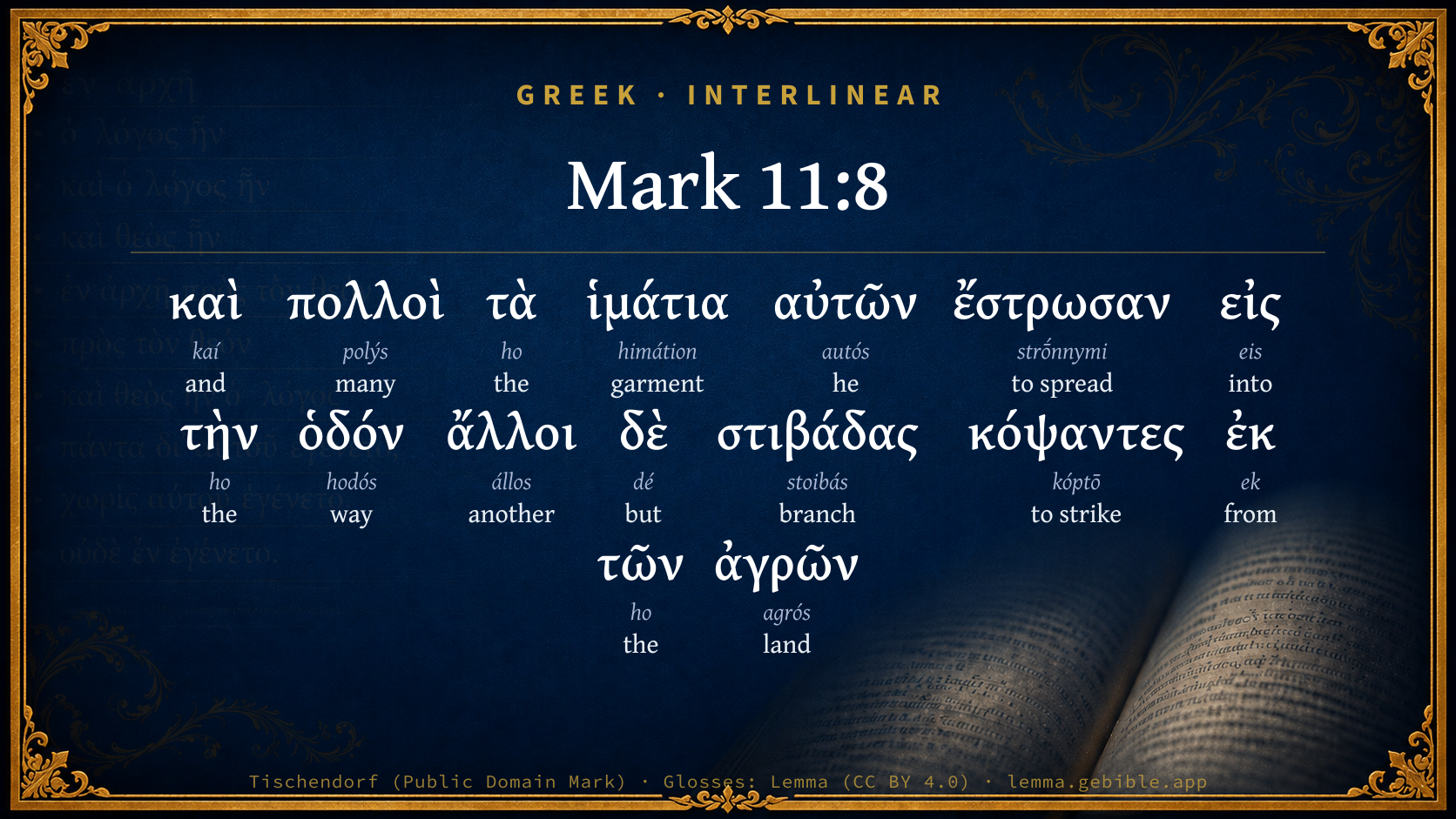
Greek (Tischendorf 8th ed.) Mark 11:8 appears in the Greek New Testament. The text above is from the Tischendorf 8th edition. Each word links to its Strong’s number and a concise gloss. Click any word for its full Thayer’s Greek Lexicon entry.
Download image
Cite this verse

Mark 11:8 (World English Bible). Public Domain. Lemma interlinear Bible study tool, https://lemma.gebible.app/v/mark/11/8.

Show BibTeX & RIS
BibTeX
RIS
English Translation
Many spread their garments on the way, and others were cutting down branches from the trees, and spreading them on the road.
World English Bible · Public Domain
Highlights
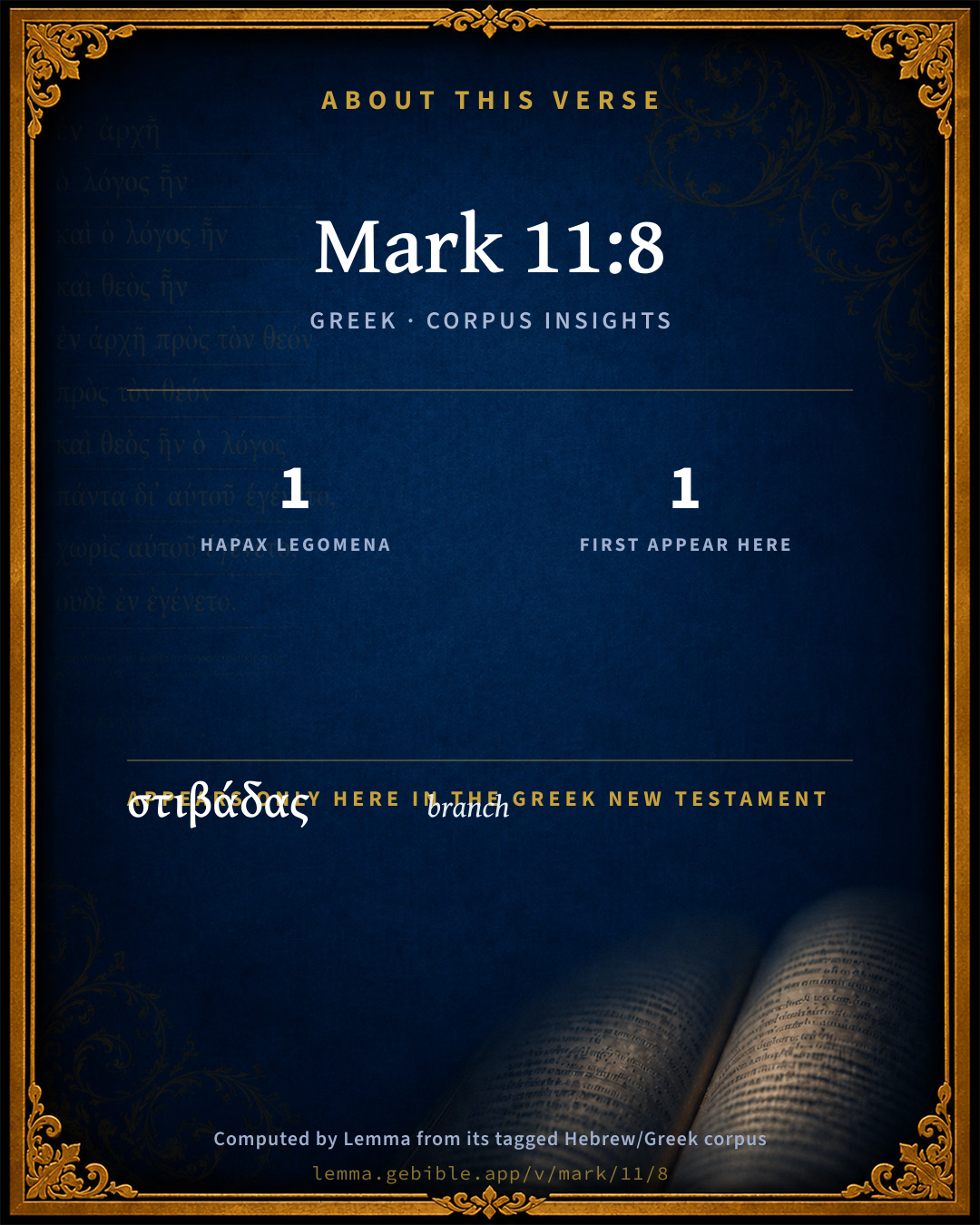
  • 1 hapax legomenon — only here in the Greek New Testament
  • 1 first appearance in the Greek New Testament
Full analysis ↓
Download a study sheet

One document with this verse’s original text, its word-by-word gloss line, the meaning frame, cross-references with their text, attributed commentary, and full source and license credits — printable, and it pastes into notes with its structure intact.

This verse Autodidact and up

Study sheet (.html) Plain text (.txt)

A passage Seminary Student

Up to 50 verses in one chapter. A passage sheet keeps up to 6 commentary sources and 12 cross-references per verse, in the order this page ranks them, and says so on the sheet whenever that leaves anything out. Ask for a single verse and you get the Autodidact verse sheet above.

Everything on this page stays free to read, with no account — the sheet is a download of what is already on screen, not access to it.

Want to remove ads? Support Godless Engineer
Compare translations 3

The same verse in 3 English versions, stacked beneath the original-language interlinear above. Click any original word for its lexicon entry.

Each is an independent rendering of the whole verse — the interlinear is not word-aligned to these translations.

Highlighted words mark where these versions differ — a whole-verse word diff, not a word-by-word alignment.

  • World English Bible Public Domain
    Many spread their garments on the way, and others were cutting down branches from the trees, and spreading them on the road.
  • King James Version Public Domain
    And many spread their garments in the way: and others cut down branches off the trees, and strawed them in the way.
  • unfoldingWord Literal Text CC BY-SA 4.0
    And many spread their cloaks on the road, and others, branches, having cut from the fields.

unfoldingWord Literal Text — © unfoldingWord, licensed CC BY-SA 4.0. Word-aligned USFM3 via Door43 (git.door43.org/unfoldingWord/en_ult).

Versions to compare (up to 4)

3 of 4 selected

Show all 19 translations

Every available English version of this verse, each an independent rendering of the whole verse.

  • World English Bible Public Domain
    Many spread their garments on the way, and others were cutting down branches from the trees, and spreading them on the road.
  • Berean Standard Bible Public Domain
    Many in the crowd spread their cloaks on the road, while others spread branches they had cut from the fields.
  • Majority Standard Bible Public Domain
    Many in the crowd spread their cloaks on the road, while others cut branches from the trees and spread them on the road.
  • King James Version Public Domain
    And many spread their garments in the way: and others cut down branches off the trees, and strawed them in the way.
  • American Standard Version (1901) Public Domain
    And many spread their garments upon the way; and others branches, which they had cut from the fields.
  • Revised Version (1885) Public Domain
    And many spread their garments upon the way; and others branches, which they had cut from the fields.
  • Geneva Bible (1599) Public Domain
    And many spred their garments in the way: other cut downe branches off the trees, and strawed them in the way.
  • Douay-Rheims (1899) Public Domain
    And many spread their garments in the way: and others cut down boughs from the trees, and strewed them in the way.
  • Young's Literal Translation Public Domain
    and many did spread their garments in the way, and others were cutting down branches from the trees, and were strewing in the way.
  • Literal Standard Version CC BY-SA 4.0
    and many spread their garments in the way, and others were cutting down branches from the trees, and were strewing in the way.
  • Unlocked Literal Bible CC BY-SA 4.0
    Many people spread their garments on the road, and others spread branches they had cut from the fields.
  • unfoldingWord Literal Text CC BY-SA 4.0
    And many spread their cloaks on the road, and others, branches, having cut from the fields.
  • Darby Bible Public Domain
    and many strewed their clothes on the way, and others cut down branches from the trees [and went on strewing them on the way].
  • World Messianic Bible Public Domain
    Many spread their garments on the way, and others were cutting down branches from the trees and spreading them on the road.
  • Webster's Bible Public Domain
    And many spread their garments in the way: and others cut down branches off trees, and strewed them in the way.
  • Free Bible Version CC BY-SA 4.0
    Many people spread their cloaks on the road, while others laid down leafy branches that they'd cut in the fields.
  • Bible in Basic English Public Domain
    And a great number put down their clothing in the way; and others put down branches which they had taken from the fields.
  • Text-Critical English NT CC BY 4.0
    Many people spread their garments on the road, and others cut down leafy branches from the trees and also spread them on the road.
  • Tyndale New Testament (1534) Public Domain
    And many sprede there garmetes in the waye. Other cut doune brauches of the trees and strawed them in the waye.

Literal Standard Version (2020), Covenant Press — licensed CC BY-SA 4.0. Text via the HelloAO Bible API (eBible.org). Unlocked Literal Bible (unfoldingWord) — licensed CC BY-SA 4.0. Text via the HelloAO Bible API (eBible.org). unfoldingWord Literal Text — © unfoldingWord, licensed CC BY-SA 4.0. Word-aligned USFM3 via Door43 (git.door43.org/unfoldingWord/en_ult). Free Bible Version, Dr. Jonathan Gallagher — licensed CC BY-SA 4.0. Text via the HelloAO Bible API (eBible.org).

Word by word

More ways to search: Search by grammar → Find every occurrence → Compare this word →

Practice this passage: Drill this verse → Learn its vocabulary →

στιβάδας
stoibás
G4746
“branch”
Noun, Accusative, Plural, Feminine
Part of Speech
Noun
Case
Accusative
Number
Plural
Gender
Feminine
Full Thayer's Definition

Origin: "from a primary steibo (to "step" or "stamp")"

TDNT: None

1. branch, leafy limb
  1. καὶ kaí G2532 “and” Conjunction
  2. πολλοὶ polýs G4183 “many” Adjective, Nominative, Plural, Masculine
  3. τὰ ho G3588 “the” Article, Accusative, Plural, Neuter
  4. ἱμάτια himátion G2440 “garment” Noun, Accusative, Plural, Neuter
  5. αὐτῶν autós G846 “he” Personal pronoun, Genitive, Plural, Masculine
  6. ἔστρωσαν strṓnnymi G4766 “to spread” Verb, Aorist, Active, Indicative, 3rd person, Plural
  7. εἰς eis G1519 “into” Preposition
  8. τὴν ho G3588 “the” Article, Accusative, Singular, Feminine
  9. ὁδόν hodós G3598 “way” Noun, Accusative, Singular, Feminine
  10. ἄλλοι állos G243 “another” Adjective, Nominative, Plural, Masculine
  11. δὲ dé G1161 “but” Conjunction
  12. κόψαντες kóptō G2875 “to strike” Verb, Aorist, Active, Participle, Nominative, Plural, Masculine
  13. ἐκ ek G1537 “from” Preposition
  14. τῶν ho G3588 “the” Article, Genitive, Plural, Masculine
  15. ἀγρῶν agrós G68 “land” Noun, Genitive, Plural, Masculine

About this verse

These counts appear in no published source. They are computed here, from the morphology-tagged text and Lemma’s own curated glosses. What Lemma adds →

16
words
14
distinct lemmas
Gospels
section

Notable vocabulary

1 hapax legomenon — a word that appears only here in the entire Greek New Testament:

  • στιβάδας branch G4746

First appearance in Scripture

This word makes its first canonical appearance in the Greek New Testament here:

  • στιβάδας branch G4746

Shared distinctive vocabulary

ἔστρωσαν to spread G4766 occurs in 5 verses of the Greek New Testament. Also found in:

Repetition

A word recurs within this verse:

Cross-references

1

Topical passages linked to Mark 11:8 in the Treasury of Scripture Knowledge — connected by theme and wording, ordered by reader-vote popularity; previews shown in the World English Bible.

  • Leviticus 23:40 You shall take on the first day the fruit of goodly trees, branches of palm trees, and boughs of thick trees, and willows of the brook; and you shall rejoice before Yahweh your God seven days.

Cross-references courtesy of OpenBible.info (CC BY 4.0).

Where the printed editions differ

2 variants

Places in this verse where the major printed Greek editions disagree on the wording in a way that affects the translation — a comparison of editions, not a manuscript-by-manuscript collation. The editions are the modern critical texts (Nestlé-Aland 28/27, SBL, Westcott-Hort, Tregelles, Tyndale House) and the traditional texts behind the KJV (the Textus Receptus and the Byzantine/Majority text). It is not a claim about which reading is original.

  1. Different wording
    ἀγρῶν

    “fields”

    In NA28NA27TynSBLWHTreg Not in TRByz

    δένδρων (dendrōn) 'trees' occurs in traditional manuscripts (TR+Byz) instead of ἀγρῶν (agrōn) 'fields' in older manuscripts (NA28+NA27+Tyn+SBL+WH+Treg)

  2. Extra text
    καὶ ἐστρώννυον εἰς τὴν ὁδόν.

    “and were spreading into <the> way.”

    In TRByz Not in NA28NA27TynSBLWHTreg

    καὶ ἐστρώννυον εἰς τὴν ὁδόν. (kai estrōnnuon eis tēn hodon) 'and were spreading into way.' is only in traditional manuscripts (TR+Byz)

Textual data: Translators Amalgamated Greek New Testament (STEPBible TAGNT) · CC BY 4.0.

Commentary

Notes on Mark 11:8 from classic Christian and Jewish commentators (each source and its license shown beneath its notes). The classic Christian expositions comment on the surrounding passage and are grouped to its opening verse, so a note may address several verses; the Jewish commentaries on the Tanakh (Rashi and others) are per-verse, so they appear only where the commentator wrote on this verse.

Lemma curates 59 commentaries, every one of them public domain or Creative Commons licensed, each selected and text-cleaned for this edition rather than reprinted as found. About our sources →

The Biblical Illustrator

Joseph S. Exell

Mar_11:8-10

And they spread their garments in the way.

Religious excitement

How are we to deal with religious emotions when they are awakened in a more than ordinary degree?

1. We should make them subservient to the promotion of the rectitude of our nature and of our life. With the kindling of our religious emotions there comes strength for action, and our care should be to use that strength for right action.

2. It is not always safe to act under the impulse of strong feelings; therefore we need, at such seasons, to be more than ordinarily prayerful; and at such times conscience ought to be more than ever consulted.

3. If a man, under the influence of religious excitement, does not do what conscience and Gods law clearly require of him, there is little reason to expect that he will do so when the excitement shall have passed away. There are certain lessons taught us by this subject.

(1) That religious excitement has its sphere of usefulness in the development of religious life;

(2) but it is a grievous mistake to regard emotional excitement as the very essence and substance of religion. (F. Wagstaff.)

The Biblical Illustrator, edited by Joseph S. Exell (c. 1880s–1900s) — public domain. Text from a community e-Sword module.

Expositor's Greek Testament

ed. W. Robertson Nicoll

Mar 11:8 . στιβάδας ( στιβάς from στείβω , to tread, hence anything trodden, such as straw, reeds, leaves, etc.; here only in N. T.); “layers of leaves,” R. V [103] , margin; or layers of branches ( κλάδους , Mt.) obtained, as Mk. explains, by cutting from the fields ( κόψαντες ἐκ τ . ἀγρῶν ). στοιβάς ( στοιβάδας , T. R.) is probably a corrupt form of στιβάς . Hesychius defines στιβάς as a bed of rods and green grass and leaves ( ἀπὸ ῥάβδων καὶ χλωρῶν χόρτων στρῶσις , καὶ φύλλων ).

[103] Revised Version.

The Expositor's Greek Testament, edited by W. Robertson Nicoll (1897–1910) — public domain. Text from a community e-Sword module.

Ellicott's Commentary for English Readers

(8) Branches off the trees.—The Greek word for “branches” is used by St. Mark only. It describes the leafy boughs forming, as they were thrown down, a kind of litter or matting, rather than the woody branches.

Off the trees.—The better MSS. give “from the fields,” a reading which, perhaps, agrees better with the account of the “branches” given in the preceding Note.

And strawed them in the way.—Omitted in the better MSS.

A Bible Commentary for English Readers, edited by Charles John Ellicott (1878–1897) — public domain. Text from a community e-Sword module.

The Cambridge Bible for Schools and Colleges

gen. ed. J. J. S. Perowne

8. spread their garments in the way] i. e. their “abbas” or “hykes,” the loose blanket or cloak worn over the tunic or shirt. So myrtle-twigs and robes had been strewn by their ancestors before Mordecai, when he came forth from the palace of Ahasuerus (Targ. Est_8:15), so the Persian army had honoured Xerxes when about to cross the Hellespont (Herod. VII. 54), and so Robinson tells us the inhabitants of Bethlehem threw their garments under the feet of the horses of the English consul at Damascus, whose aid they were imploring (Biblical Researches, II. 162).

branches] “soþeli oþere men kittiden bowis, or branches, fro trees,” Wyclif. These were not the “branches” (kladoi) cut from the trees as they went along, mentioned in Mat_21:8, but “mattings” (stoibades) which they twisted out of the palm-branches as they passed. The original word denotes (1) a bed of straw, rushes, or leaves, whether strawed loose or stuffed into a mattress; (2) a mattress, especially of soldiers; (3) the nest or lair of mice or fish.

off the trees] The reading of some MSS. here is from the gardens, and the verse would run, And many strewed their garments in the way, and others twisted branches, cutting them from the gardens. Eastern gardens are not flower gardens, nor private gardens, but the orchards, vineyards and fig-enclosures round a town. The road from Bethany to Jerusalem wound through rich plantations of palm trees, and fruit- and olive-gardens.

The Cambridge Bible for Schools and Colleges (gen. ed. J. J. S. Perowne; Cambridge University Press, 1878–1918) — public domain. Text from a community e-Sword module.

John Gill's Exposition

And many spread their garments in the way,.... Instead of carpets to ride on, and in honour to him as a king:

and others cut down branches off the trees, and strawed them in the way; in token of joy, as at the feast of tabernacles; See Gill on Mat 21:8.

John Gill's Exposition of the Whole Bible (1746–1763) — public domain (CC PDM 1.0). Text via the HelloAO Bible API.

Trapp's Complete Commentary

John Trapp

8 And many spread their garments in the way: and others cut down branches off the trees, and strawed them in the way.

Ver. 8. {See Trapp on "Mat 21:8"} {See Trapp on "Luk 19:36"}

John Trapp, A Commentary or Exposition upon All the Books of the Old and New Testament (1647–1656) — public domain. Text from a community e-Sword module.

Haydock's Catholic Bible Commentary

The martyrs strewed garments in the way by putting off the garments of the flesh, and thus preparing a way by their blood for the servants of God. Many strew their garments in the way, by subduing their bodies in fasting and abstinence, and thus affording good example to those that follow them. Those cut down branches from the trees, who in their instructions take their seeds from the discourses of the Fathers, and, by an unassuming and humble delivery, spread them in the way of God. (Ven. Bede) --- Let us strew the way of life, and cut branches from the trees, by imitating the example of the saints. For the saints are the trees, from which we cut down branches, when we imitate their virtues. (Theophylactus) --- The just shall flourish like the palm-tree, (Psalm xci.) confirmed in their roots, and extensive in their fruit and flowers, being the sweet odour of Christ. (2 Corinthians ii. 15.)

George Leo Haydock (1774–1849), Haydock's Catholic Family Bible and Commentary, 1859 edition — public domain. Excludes Psalms (Douay-Rheims chapter numbering differs from Protestant) and Deuterocanonical books (Catholic canon only).

The Pulpit Commentary

Others cut down branches off the trees, etc. According to the best authorities, the words should be rendered, and others branches (or, leaves, for strewing), which thy had cut from the fields ( alloi de stoibadav koqantev ek twn agrwn). The branches were cut in the fields; and the smaller, leafy portions of them, suitable for their purpose, were carried out.

Vers. 8-10Palm Sunday.

We sometimes wonder that the greatest Teacher, the divinest Master the world ever saw, was so little recognized during his ministry. Our surprise would be lessened if we fairly put ourselves in the position of his contemporaries. Suppose news came to our metropolis that in a distant hamlet, among working people, a child had been born, and that rumors of portents accompanying his birth found favor in that country-side. Suppose that, as years rolled on, it was reported that this child, now a man, had done some marvellous works; and that, after several visits to the city, he came into it accompanied by his followers, chiefly peasants, neither learned nor wealthy. The probabilities are that although some might know him to be a great teacher, a man of unquestioned holiness and of astonishing pretensions, the hum of business would not be hushed for a moment, and few would turn aside to see his festal procession.

I THE WELCOME GIVEN TO JESUS.

1. His welcome would have been more speedy and general had he come differently. All through his ministry we find evidence of that. There was eagerness for a Messiah of a certain type. A promise to restore the theocracy, and overthrow the Roman tyranny, would have been hailed with a unanimous shout of delight. But our Lord would not be content, and never is, with a worldly homage, such as a Christian nation, for example, offers when it calls itself by his Name, and violates his principles. Unless he rules human hearts, he has no joy and the ruled no bliss. Even an earthly king desires real loyalty; but he cannot read men"s thoughts nor see how in heart his flatterers despise him. If he could, how thankfully would he turn from the adulation of courtiers to the unsophisticated love of his children! So our Lord turned from priests and Pharisees to the humble peasants of Galilee and the loving children in Jerusalem. In order to avoid false homage, Christ came, and still comes, quietly. He comes not with peals of thunder and visions of angels, nor even as a national leader appealing to popular passion and armed force; but, in quiet thoughts and in happy Christian homes, he reveals" himself to those seeking the truth, or burdened with sin.

2. Even such a welcome as this given on Palm Sunday was unusual. His motto seemed to be, "He shall not strive, nor cry, nor cause his voice to be heard in the streets." Popular applause was suppressed, and even natural enthusiasm was cooled. If people would take him by force to make him a king, he departed and did hide himself from them. If the disciples saw a glimpse of his glory on the Mount of Transfiguration, he said, "See that ye tell no man." His miracles were quietly wrought, generally with but few witnesses, and those blessed were often told not to publish it. But on this first day of the last week he wished to have an unwonted procession. In the crowds who had come together for the Passover all the elements of it were ready, if he only gave a sign of his willingness to receive it. And this he did. He arranged for it. He sent to the village for the young colt, and when it was brought he sat upon it, and allowed a simple procession to be formed, which increased in numbers and enthusiasm as they drew nearer to Jerusalem.

3. This exceptional scene was wisely ordered.

(1) The memory of it would help the disciples in the dark days which ended that eventful week; for they would reflect that it was not want of power, but want of will, which did not allow him to rouse the people in his defense. "The Good Shepherd giveth his life for the sheep.

(2) Besides, it would give an opportunity to the people to see him as the King he claimed to be, and it was possible that some who had resisted other influences might yield to this, and pay him homage now, lie had come as a babe to Jerusalem, and few had loved him; he had come as a child, only to be wondered at when he sat among the doctors; he had come to the feasts, and scarcely any had recognized him. He had come" unto his own, and his own received him not." Once more, in a new way, he would draw near. He would try one more avenue to the closed heart before uttering the pathetic lament, "O Jerusalem, Jerusalem, how often would I have gathered thy children... and ye would not!

(3) Further, there was something prophetic and typical in this procession. The triumphal entry was a symbol of the resurrection on that day week, and of his later ascension to heaven amidst the hosannas of the angels. It was a prophecy also of his kingly progress through history, and of his second coming in glory, when all in heaven and all on earth will cry, "Blessed is he that cometh in the Name of the Lord!

II THE CROWN SURROUNDING JESUS. In some of those there we may see, perhaps, representatives of ourselves.

1. Enthusiasts were there. They had seen his miracles, and with loud hosannas spread their garments in his way. He foresaw with sadness the change that would come over them. They applauded on Olivet, but they were absent from Calvary. Beware of spasmodic enthusiasm, and ask for grace to stand by Christ"s cause in times of trouble as well as in times of triumph.

2. Foes were there. They kept quiet while the crowd of his followers surrounded them; but soon they would raise the cry, "Crucify him! crucify him!" It is possible to "crucify the Son of God afresh, and put him to an open shame.

3. Disciples were there. The blind who had been restored, demoniacs who had been delivered, learners who had sat reverently at his feet. In the procession which still is following the Lord, may we find our place! A.R.

The Pulpit Commentary (1880–1919), ed. H.D.M. Spence-Jones & Joseph S. Exell — public domain. Text from a community e-Sword module.

Kretzmann's Popular Commentary

Paul E. Kretzmann

The reception of Christ:

v. 8. And many spread their garments in the way; and others cut down branches off the trees, and strewed them in the way.

v. 9. And they that went before, and they that followed, cried, saying, Hosanna! Blessed is He that cometh in the name of the Lord.

v. 10. Blessed be the kingdom of our father David, that cometh in the name of the Lord. Hosanna in the highest!

v. 11. And Jesus entered into Jerusalem and into the Temple; and when He had looked round about upon all things, and now the eventide was come, He went out unto Bethany with the Twelve.

Meanwhile the news that the Prophet of Galilee, Jesus of Nazareth, was coming to the city had spread in Jerusalem. Not only were the pilgrims from Galilee anxious to see Him, but those also from other parts of Palestine where He had been active in His ministry, or where His fame had spread. A peculiar kind of excitement, a form of exultation, took hold of the multitude. In large numbers they flocked forth from the city to meet Him. Those that came early fell in behind Him; those that came later turned around and marched ahead of Him along the road over the brow of the Mount of Olive; Many of these took their mantles, their holiday dresses, and spread them on the way, as at the reception of a great king. Others took the branches of trees, with the first young leaves, and the palm-branches which they bore in their hands, and strewed them on the way. Still others cut off branches from trees in the fields along the road. And when the excitement reached its height, the people broke forth into snatches of antiphonal singing from the great Hallel, Psa 117:1-2; Psa 118:25-26. Many of the customs of one great festival were transferred to the other festivals. Thus here the carrying of the palm-branches and other green foliage, the loud exultation, the public singing of the Hosanna, all were features and customs of the Feast of Tabernacles. The people here confessed Jesus as the Son of David, as the Messiah of Israel, whose kingdom was about to be established. The Spirit of the Lord had here, for a few moments, taken hold of the masses. God wanted to give His Son this open testimony concerning His mission, and incidentally point forward to the day, when all tongues will be obliged to confess that Jesus is the Lord. to the glory of God the Father. The entire incident of the entry of Christ into Jerusalem, as it is related in the gospels, is a type of the merciful advent of Jesus into the hearts of His believers, which continues throughout the time of the New Testament. Christ is now exalted at the right hand of God, but He still comes by His Spirit, through His means of grace. He still reigns and lives in His Church and brings to all His subjects mercy, salvation, and peace, all the great benefits which He has earned through His suffering and death.

When Jesus reached Jerusalem, He went up to the Temple. He spent the rest of the afternoon in looking around carefully, with a keenly observant eye. He noted carefully the manner in which the entire worship was done; He marked the traffic which was being carried on in the Court of the Gentiles. But the hour was getting late, and so He went out with the Twelve to Bethany, where He lodged.

Paul E. Kretzmann, Popular Commentary of the Bible (1921–1924) — public domain. Text from a community e-Sword module.

Cambridge Greek Testament for Schools and Colleges

8. καὶ πολλοί ([2511][2512][2513][2514][2515]) rather than πολλοὶ δέ ([2516][2517][2518] See on Mar 1:14. κόψαντες ἐκ τῶν ἀγρῶν ([2519][2520][2521][2522][2523]) rather than ἔκοπτον ἐκ τῶν δένδρων καὶ ἐστρώννυον εἰς τὴν ὁδόν or ἐν τῇ ὁδῷ ([2524][2525][2526][2527][2528][2529]).

[2511] Codex Sinaiticus. 4th cent. Discovered by Tischendorf in 1859 at the Monastery of St Katharine on Mount Sinai. Now at St Petersburg. The whole Gospel, ending at Mar 16:8. Photographic facsimile, 1911.

[2512] Codex Vaticanus. 4th cent., but perhaps a little later than א. In the Vatican Library almost since its foundation by Pope Nicolas V., and one of its greatest treasures. The whole Gospel, ending at Mar 16:8. Photographic facsimile, 1889.

[2513] Codex Ephraemi. 5th cent. A palimpsest: the original writing has been partially rubbed out, and the works of Ephraem the Syrian have been written over it; but a great deal of the original writing has been recovered; of Mark we have Mar 1:17 to Mar 6:31, Mar 8:5 to Mar 12:29, Mar 13:19 to Mar 16:20. In the National Library at Paris.

[2514] Codex Regius. 8th cent. An important witness. At Paris. Contains Mar 1:1 to Mar 10:15; Mar 10:30 to Mar 15:1; Mar 15:20 to Mar 16:20, but the shorter ending is inserted between Mar 16:8 and Mar 16:9, showing that the scribe preferred it to the longer one.

[2515] Codex Sangallensis. 9th or 10th cent. Contains the Gospels nearly complete, with an interlinear Latin translation. The text of Mark is specially good, agreeing often with CL. At St Gall.

[2516] Codex Alexandrinus. 5th cent. Brought by Cyril Lucar, Patriarch of Constantinople, from Alexandria, and afterwards presented by him to King Charles I. in 1628. In the British Museum. The whole Gospel. Photographic facsimile, 1879.

[2517] Codex Bezae. 6th cent. Has a Latin translation (d) side by side with the Greek text, and the two do not quite always agree. Presented by Beza to the University Library of Cambridge in 1581. Remarkable for its frequent divergences from other texts. Contains Mark, except Mar 16:15-20, which has been added by a later hand. Photographic facsimile, 1899.

[2518] odex Purpureus. 6th cent. Full text in Texts and Studies v. No. 4, 1899. Contains Mar 5:20 to Mar 7:4; Mar 7:20 to Mar 8:32; Mar 9:1 to Mar 10:43; Mar 11:7 to Mar 12:19; Mar 14:25 to Mar 15:23; Mar 15:33-42. See below on Ψ.

[2519] Codex Sinaiticus. 4th cent. Discovered by Tischendorf in 1859 at the Monastery of St Katharine on Mount Sinai. Now at St Petersburg. The whole Gospel, ending at Mar 16:8. Photographic facsimile, 1911.

[2520] Codex Vaticanus. 4th cent., but perhaps a little later than א. In the Vatican Library almost since its foundation by Pope Nicolas V., and one of its greatest treasures. The whole Gospel, ending at Mar 16:8. Photographic facsimile, 1889.

[2521] Codex Regius. 8th cent. An important witness. At Paris. Contains Mar 1:1 to Mar 10:15; Mar 10:30 to Mar 15:1; Mar 15:20 to Mar 16:20, but the shorter ending is inserted between Mar 16:8 and Mar 16:9, showing that the scribe preferred it to the longer one.

[2522] Codex Sangallensis. 9th or 10th cent. Contains the Gospels nearly complete, with an interlinear Latin translation. The text of Mark is specially good, agreeing often with CL. At St Gall.

[2523] Codex Athous Laurae. 8th cent. Like N and Σ, it is written in silver letters on purple vellum. Contains Mar 9:5 to Mar 16:20, and, as in L, the shorter ending is inserted between Mar 16:8 and Mar 16:9. As in Δ, the text of Mark is specially good.

[2524] Codex Alexandrinus. 5th cent. Brought by Cyril Lucar, Patriarch of Constantinople, from Alexandria, and afterwards presented by him to King Charles I. in 1628. In the British Museum. The whole Gospel. Photographic facsimile, 1879.

[2525] Codex Bezae. 6th cent. Has a Latin translation (d) side by side with the Greek text, and the two do not quite always agree. Presented by Beza to the University Library of Cambridge in 1581. Remarkable for its frequent divergences from other texts. Contains Mark, except Mar 16:15-20, which has been added by a later hand. Photographic facsimile, 1899.

[2526] Codex Purpureus. 6th cent. Full text in Texts and Studies v. No. 4, 1899. Contains Mar 5:20 to Mar 7:4; Mar 7:20 to Mar 8:32; Mar 9:1 to Mar 10:43; Mar 11:7 to Mar 12:19; Mar 14:25 to Mar 15:23; Mar 15:33-42. See below on Ψ.

[2527] Codex Monacensis. 10th cent. Contains Mar 6:47 to Mar 16:20. Many verses in 14, 15, 16 are defective.

[2528] Codex Oxoniensis. 9th cent. Contains Mark, except Mar 3:35 to Mar 6:20.

[2529] Codex Petropolitanus. 9th cent. Gospels almost complete. Mar 16:18-20 is in a later hand.

8. πολλοὶ τὰ ἱμάτια κ.τ.λ. The enthusiasm spreads to the multitude. The disciples had taken off their chief garments to form a seat; the multitude take off theirs to form a carpet. There are many examples of this impulse; e.g. the story of Raleigh and Queen Elizabeth at Greenwich in Dec. 1581. A close parallel is found in the solemn entry of Buddha Dîpankara (Buddhavamsa ii.); “The people swept the pathway, the gods strewed flowers on the pathway and branches of the coral-tree, the men bore branches of all manner of trees, and the Bodhisatta Sumedha spread his garments in the mire, men and gods shouted, All hail!” The similarity, as Clemen remarks, is due to “identity of Oriental customs.”

στιβάδας. So the best MSS. It means greenery of any kind, esp. when used as litter (στείβω); “branches” is too definite. R.V. marg. has “layers of leaves.”

ἐκ τῶν ἀγρῶν. “Fields” with us suggests “meadows,” whereas Mk uses the word of farms or cultivated land, and near to towns most of it would be cultivated (Mar 5:14, Mar 6:36). See crit. note. Mk alone has this detail, and Syr-Sin. omits it here. All three are silent about the crowd coming with palm branches from Jerusalem (Joh 12:13; Joh 12:18).

Cambridge Greek Testament for Schools and Colleges (Cambridge University Press, 1896; 21 vols, various authors incl. Carr, Maclear, Plummer, Farrar, Lumby, Moule, M. R. James, Simcox) — public domain. Text from a community e-Sword module.

International Critical Commentary

8. ἄλλοι δὲ στιβάδας κόψαντες ἐκ τῶν ἀγρῶν—and others layers of leaves, having cut them out of the fields. στιβάδας is the object of the preceding ἔστρωσαν.

στιβάδας, instead of στοιβάδας,2 Tisch. Treg. WH. RV. אBDEGHKL MU ΔΠ. κόψαντες, instead of ἔκοπτον, Tisch. Treg. WH. RV. א B(C) L Δ, Theb. ἀγρῶν, instead of δένδρων, trees, Tisch. Treg. WH. RV. א B (C) L Δ Theb. Omit last clause of v., same authorities.

στιβάς is any layer of leaves, twigs, rushes, and the like, used for bedding, or to make a road easy of travel. This throwing their garments on the horse, and strewing the road with garments and layers of leaves, is all in the way of smoothing the road as a part of the homage rendered.

International Critical Commentary — older volumes (1896–1929), various authors — public domain. Text from a community e-Sword module.

Vincent's Word Studies in the New Testament

Marvin R. Vincent

In the way. Both Matthew and Luke have ejn, in; but Mark, eijv, into. They threw their garments into the way and spread them there. Branches. Matthew, Mark, and John use each a different word for branches. Matthew, kladouv, from klaw, to break; hence a young slip or shoot, such as is broken off for grafting - a twig, as related to a branch. Mark, stibadav, from steibw, to tread or beat down; hence a mass of straw, rushes, or leaves beaten together or strewed loose, so as to form a bed or a carpeted way. A litter of branches and leaves cut from the fields (only Mark) near by. John, baia, strictly palm - branches, the feathery fronds forming the tufted crown of the tree. Hosanna. Meaning, O save !

Marvin R. Vincent, Word Studies in the New Testament (1887–1900) — public domain. Text from a community e-Sword/MySword module.

Lesson kit

Teaching starters — assembled from the data on this page, not authored interpretation. Every prompt links to the verse data it draws on. Edit before teaching.

Mark, in the Gospels, opens this verse with 16 words (14 distinct Greek lemmas). Its most distinctive word is stoibás (“branch”). A historical commentator’s framing appears above. Read the whole chapter for the surrounding context.

Discussion questions

  1. The word stoibás carries the sense “branch.” How does it shape the verse?
  2. 1 word here appears nowhere else in the Greek New Testament. Why might the author reach for such rare wording?
  3. This is the first place “branch” appears in Scripture (first appears here). What does its debut here establish?
  4. How does Matthew 21:8, which shares the word «to spread», read alongside this verse?
  5. What does the repetition of “the” (3× in this one verse) do in this verse?
  6. The translations on this page render this verse differently — a whole-verse word diff, not a word-by-word alignment. What might account for the different wordings?
  7. Compare how The Biblical Illustrator and Expositor's Greek Testament read this verse. Where do they agree or differ?

Things to notice

  • 1 word in this verse appears nowhere else in the Greek New Testament.
  • 1 word makes its first canonical appearance in Scripture here.
  • These translations choose different wording for 13 words in this verse.
  • “the” occurs 3× in this single verse.
  • 14 distinct Greek lemmas span 16 words in this verse.

Reading settings

Reading text

Shown beneath each verse's original-language words.

Old Testament
Old Testament edition

Read the OT as the Masoretic Hebrew (MT) or the Greek Septuagint (LXX).

English shown for the Greek Septuagint (in the Hebrew ↔ Greek comparison).

Comparing translations? Open the Compare panel on any verse page to stack up to four side by side.