
Matthew 8:30

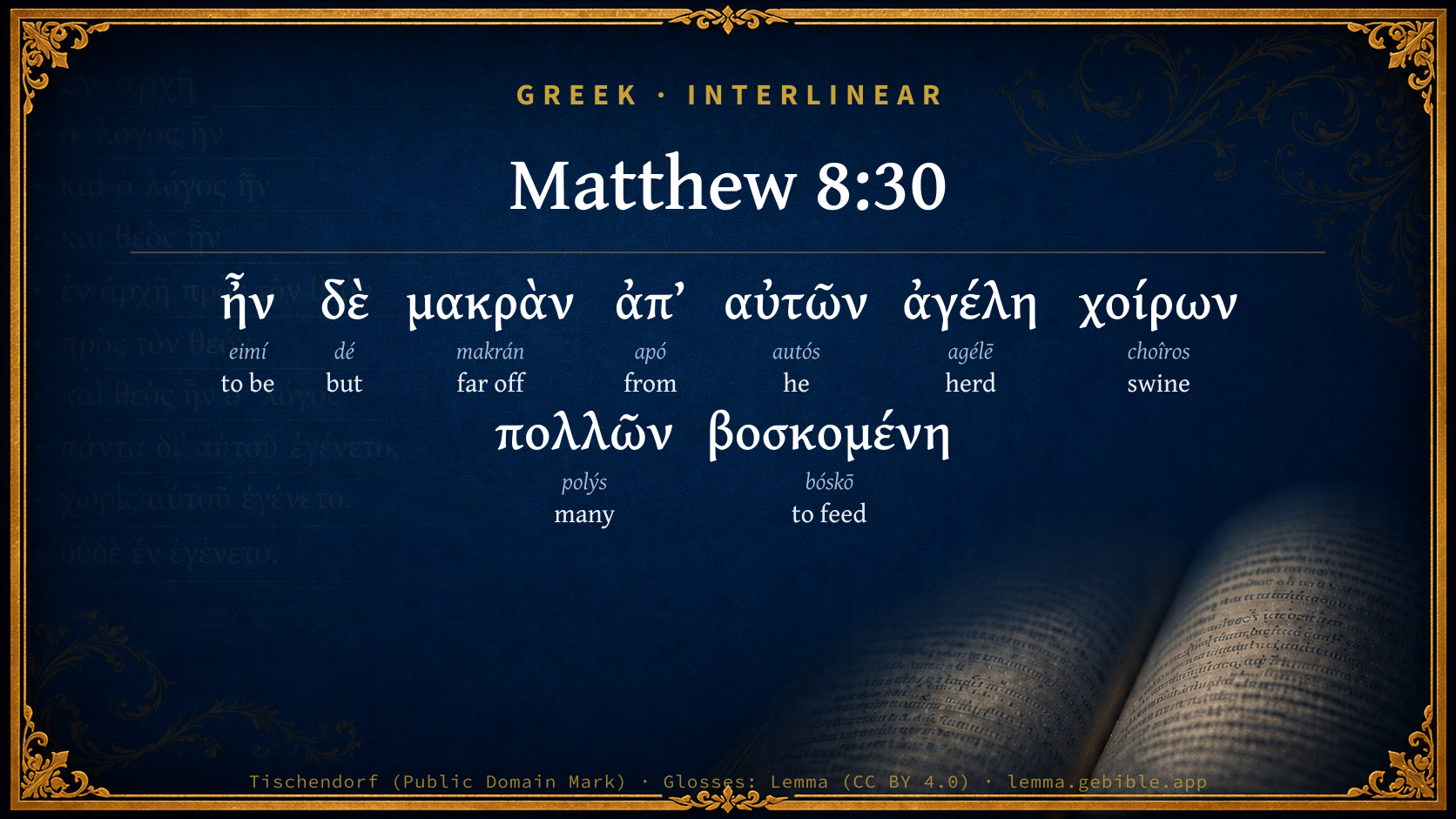
Greek (Tischendorf 8th ed.) Matthew 8:30 appears in the Greek New Testament. The text above is from the Tischendorf 8th edition. Each word links to its Strong’s number and a concise gloss. Click any word for its full Thayer’s Greek Lexicon entry.
Download image
Cite this verse

Matthew 8:30 (World English Bible). Public Domain. Lemma interlinear Bible study tool, https://lemma.gebible.app/v/matthew/8/30.

Show BibTeX & RIS
BibTeX
RIS
English Translation
Now there was a herd of many pigs feeding far away from them.
World English Bible · Public Domain
Highlights
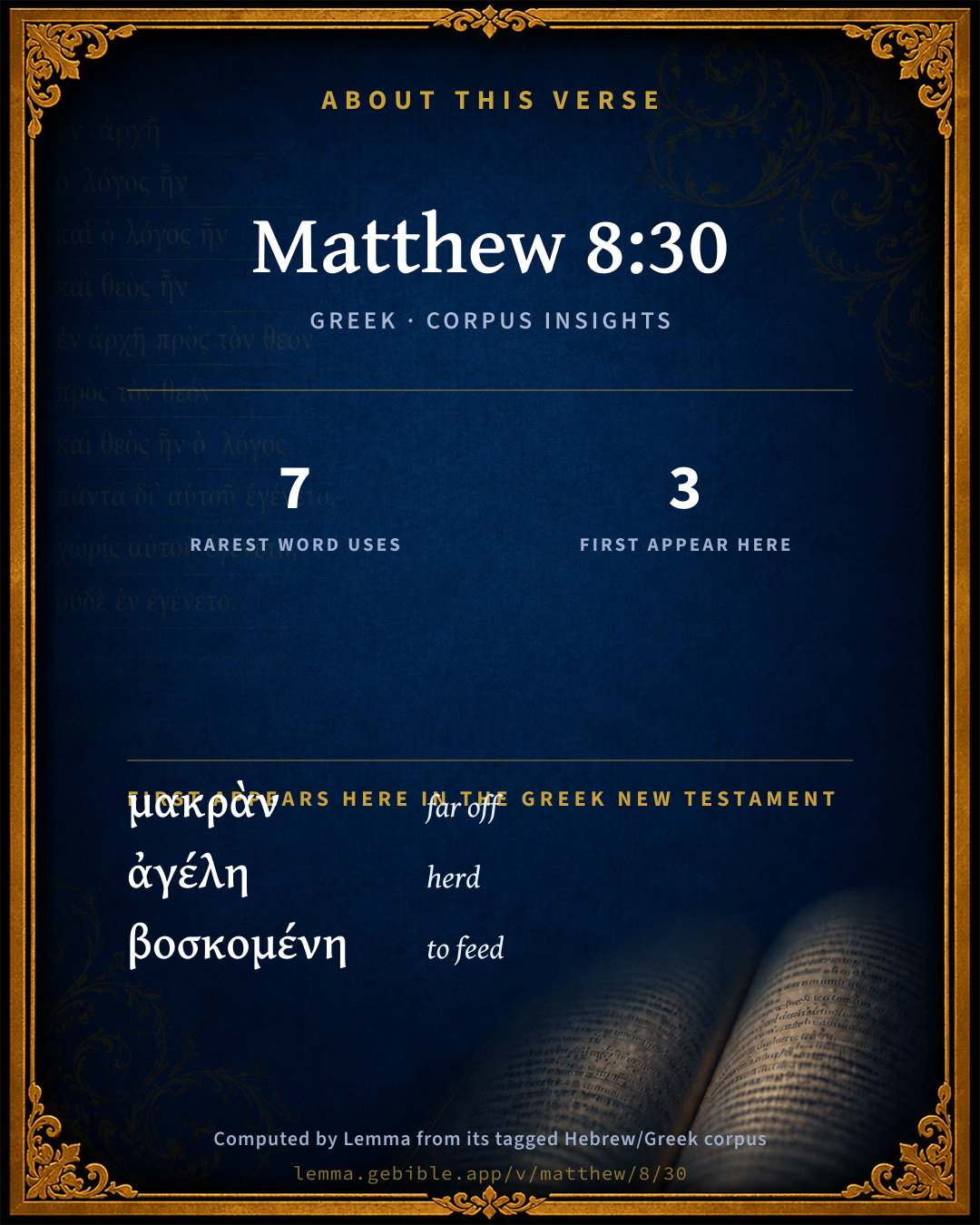
  • 3 first appearances in the Greek New Testament
Full analysis ↓
Download a study sheet

One document with this verse’s original text, its word-by-word gloss line, the meaning frame, cross-references with their text, attributed commentary, and full source and license credits — printable, and it pastes into notes with its structure intact.

This verse Autodidact and up

Study sheet (.html) Plain text (.txt)

A passage Seminary Student

Up to 50 verses in one chapter. A passage sheet keeps up to 6 commentary sources and 12 cross-references per verse, in the order this page ranks them, and says so on the sheet whenever that leaves anything out. Ask for a single verse and you get the Autodidact verse sheet above.

Everything on this page stays free to read, with no account — the sheet is a download of what is already on screen, not access to it.

Want to remove ads? Support Godless Engineer
Compare translations 3

The same verse in 3 English versions, stacked beneath the original-language interlinear above. Click any original word for its lexicon entry.

Each is an independent rendering of the whole verse — the interlinear is not word-aligned to these translations.

Highlighted words mark where these versions differ — a whole-verse word diff, not a word-by-word alignment.

  • World English Bible Public Domain
    Now there was a herd of many pigs feeding far away from them.
  • King James Version Public Domain
    And there was a good way off from them an herd of many swine feeding.
  • unfoldingWord Literal Text CC BY-SA 4.0
    Now a herd of many pigs was feeding at a distance from them.

unfoldingWord Literal Text — © unfoldingWord, licensed CC BY-SA 4.0. Word-aligned USFM3 via Door43 (git.door43.org/unfoldingWord/en_ult).

Versions to compare (up to 4)

3 of 4 selected

Show all 19 translations

Every available English version of this verse, each an independent rendering of the whole verse.

  • World English Bible Public Domain
    Now there was a herd of many pigs feeding far away from them.
  • Berean Standard Bible Public Domain
    In the distance a large herd of pigs was feeding.
  • Majority Standard Bible Public Domain
    In the distance a large herd of pigs was feeding.
  • King James Version Public Domain
    And there was a good way off from them an herd of many swine feeding.
  • American Standard Version (1901) Public Domain
    Now there was afar off from them a herd of many swine feeding.
  • Revised Version (1885) Public Domain
    Now there was afar off from them a herd of many swine feeding.
  • Geneva Bible (1599) Public Domain
    Nowe there was, afarre off from them, a great heard of swine feeding.
  • Douay-Rheims (1899) Public Domain
    And there was, not far from them, an herd of many swine feeding.
  • Young's Literal Translation Public Domain
    And there was far off from them a herd of many swine feeding,
  • Literal Standard Version CC BY-SA 4.0
    And there was a herd of many pigs feeding far off from them,
  • Unlocked Literal Bible CC BY-SA 4.0
    Now a herd of many pigs was there feeding, not too far away from them.
  • unfoldingWord Literal Text CC BY-SA 4.0
    Now a herd of many pigs was feeding at a distance from them.
  • Darby Bible Public Domain
    Now there was, a great way off from them, a herd of many swine feeding;
  • World Messianic Bible Public Domain
    Now there was a herd of many pigs feeding far away from them.
  • Webster's Bible Public Domain
    And there was a good way off from them a herd of many swine, feeding.
  • Free Bible Version CC BY-SA 4.0
    In the distance a large herd of pigs was feeding.
  • Bible in Basic English Public Domain
    Now there was, some distance away, a great herd of pigs taking their food.
  • Text-Critical English NT CC BY 4.0
    Now at a distance from them there was a herd of many pigs feeding.
  • Tyndale New Testament (1534) Public Domain
    And ther was a good waye of from them a greate heerd of swyne fedinge.

Literal Standard Version (2020), Covenant Press — licensed CC BY-SA 4.0. Text via the HelloAO Bible API (eBible.org). Unlocked Literal Bible (unfoldingWord) — licensed CC BY-SA 4.0. Text via the HelloAO Bible API (eBible.org). unfoldingWord Literal Text — © unfoldingWord, licensed CC BY-SA 4.0. Word-aligned USFM3 via Door43 (git.door43.org/unfoldingWord/en_ult). Free Bible Version, Dr. Jonathan Gallagher — licensed CC BY-SA 4.0. Text via the HelloAO Bible API (eBible.org).

Word by word

More ways to search: Search by grammar → Find every occurrence → Compare this word →

Practice this passage: Drill this verse → Learn its vocabulary →

About this verse

These counts appear in no published source. They are computed here, from the morphology-tagged text and Lemma’s own curated glosses. What Lemma adds →

9
words
9
distinct lemmas
Gospels
section

Notable vocabulary

The rarest word here is ἀγέλη herd G34 — appearing just 7 times in the whole Greek New Testament.

First appearance in Scripture

These words make their first canonical appearance in the Greek New Testament here:

  • μακρὰν far off G3112
  • ἀγέλη herd G34
  • βοσκομένη to feed G1006

Shared distinctive vocabulary

ἀγέλη herd G34 occurs in 7 verses of the Greek New Testament. Also found in:
Cross-references

7

Topical passages linked to Matthew 8:30 in the Treasury of Scripture Knowledge — connected by theme and wording, ordered by reader-vote popularity; previews shown in the World English Bible.

  • Leviticus 11:7 The pig, because he has a split hoof, and is cloven-footed, but doesn't chew the cud, he is unclean to you.
  • Deuteronomy 14:8 The pig, because it has a split hoof but doesn't chew the cud, is unclean to you: of their flesh you shall not eat, and their carcasses you shall not touch.
  • Isaiah 65:3–4 a people who provoke me to my face continually, sacrificing in gardens, and burning incense on bricks;
  • Mark 5:11 Now there was on the mountainside a great herd of pigs feeding.
  • Isaiah 66:3 He who kills an ox is as he who kills a man; he who sacrifices a lamb, as he who breaks a dog's neck; he who offers an offering, [as he who offers] pig's blood; he who burns frankincense, as he who blesses an idol. Yes, they have chosen their own ways, and their soul delights in their abominations:
  • Luke 8:32 Now there was there a herd of many pigs feeding on the mountain, and they begged him that he would allow them to enter into those. He allowed them.
  • Luke 15:15–16 He went and joined himself to one of the citizens of that country, and he sent him into his fields to feed pigs.

Cross-references courtesy of OpenBible.info (CC BY 4.0).

Commentary

Notes on Matthew 8:30 from classic Christian and Jewish commentators (each source and its license shown beneath its notes). The classic Christian expositions comment on the surrounding passage and are grouped to its opening verse, so a note may address several verses; the Jewish commentaries on the Tanakh (Rashi and others) are per-verse, so they appear only where the commentator wrote on this verse.

Lemma curates 59 commentaries, every one of them public domain or Creative Commons licensed, each selected and text-cleaned for this edition rather than reprinted as found. About our sources →

Matthew Poole's English Annotations

Both Mark and Luke interpose here something more. Mark saith, And He asked him, What is thy name? And he answered, saying, My name is Legion; for we are many. Luke saith, And Jesus asked him, saying, What is thy name? And he said, Legion: because many devils were entered into him. A Roman legion consisted of twelve thousand five hundred soldiers. Not that there were precisely so many evil spirits which had a power over this poor man, but many had. A certain number is named for one uncertain. Christ knew his case well enough, but probably asked him the question for the further glorifying of his Divine power in casting them out. Luke adds, Luk 8:31, And they besought him that he would not command them to go out into the deep. I cannot think that the meaning of that is, into the sea, for surely the devil did not fear drowning: the word is αβυσσον, into the abyss, that is, into hell, into the bottomless pit, where he could do no more mischief. Mark says, Mar 5:10, the devil besought him that he would not send them out of the country. Still, upon the same grounds, the devil hath an insatiable thirst to do mischief, and would gladly be where he may do it. In the mean time he knoweth it is in the power of Christ to send him whither he pleaseth. Now comes in Mat 8:30,31. They saw

an herd of many swine feeding. Mark saith, Mar 5:11, nigh unto the mountains. Luke saith, on the mountain. They beseech Christ to give them leave to enter into the swine, and the text saith, he suffered them. The devil cannot so much as trouble a swine without leave from God. The next verse tells us the consequent of it.

Matthew Poole's English Annotations on the Holy Bible (1683–1685) — public domain. Text from a community e-Sword/MySword module.

Joseph Benson's Commentary

Mat 8:30-32. And there was a good way off from them — That is, at a considerable distance, although, it seems, within their view; a herd of many swine — Which it was not lawful for the Jews to keeps much less to eat: yet great numbers of them were bred up in that extreme part of the country, out of regard to the gain of such merchandise, for they sold them to the Roman soldiers, and other Gentiles, who were very numerous in these parts. So the devils besought him — For they were entirely in his power, and under his control; saying, if thou castest us out — Which they suspected he would do; suffer us to go into the herd of swine — By making this request the devils acknowledged that it was not in the power even of a legion of them to do any mischief to so contemptible a creature as a swine without Christ’s permission, far less could they destroy the man in whom they lodged. Indeed the whole of this history teaches us to rely on the providence of God, and not to live in fear of evil spirits. They are under the strictest restraint, and cannot hurt us without the divine permission. Mark says that they first besought him much, that he would not send them out of the country; and Luke, that he would not command them to go into the deep, εις αβυσσον, into the abyss, meaning, doubtless, the place where wicked spirits are punished. By requesting to be permitted to enter into the swine, “they doubtless proposed to prevent any good effect which the miracle of delivering the men from their power might have had on the Gadarenes, and to render Christ odious to that wicked people.” Their design could not be hid from Jesus, nevertheless he granted their request, “not only because he knew it would render the miracle more public, but because it would prove the reality of the possession, and make men understand both how great the power of evil spirits is, and how terrible the effects of their malice would be, if they were not restrained. For no sooner was the permission granted, than the keepers, who were with the swine, and the disciples, who were at a distance, beheld, to their great astonishment, the whole herd running furiously down the mountains, and leaping from the tops of the rocks into the sea, where they were drowned, to the number of two thousand; while the possessed furious madmen became all of a sudden meek and composed, having recovered the entire use of their reason, the first exercise of which doubtless would lead them to a high admiration of his goodness, who had delivered them from the oppression of the devil. Jesus might permit the devils thus to fall on the herd as a punishment also to the Gadarenes for keeping swine, which were a snare to the Jews, and to make trial of their disposition, whether they would be more affected with the loss of their cattle, than with the recovery of the men, and the doctrine of the kingdom. Whatever were the reasons, it is certain that, though he might rightfully have used all men’s properties as he pleased, yet this, and the withering of the barren fig-tree, are the only instances wherein man suffered the least damage by any thing our Lord ever did. However, neither the owners of the herd nor of the fig-tree could justly complain of their loss, since the good of mankind, not in that period and corner only, but in every succeeding age, through all countries, has been so highly promoted at such a trifling expense to them.” “No miracles are more suspicious than pretended dispossessions, as there is so much room for collusion in them; but it was self-evident that a herd of swine could not be confederates in any fraud: their death, therefore, in this instructive and convincing circumstance, was ten thousand times a greater blessing to mankind than if they had been slain for food, as was intended.” — See Macknight and Doddridge.

Joseph Benson's Commentary on the Old and New Testaments (1811–1818) — public domain. Text from a community e-Sword module.

Bengel's Gnomon

Johann Albrecht Bengel

Mat 8:30. Χοίρων, of swine) The owners of the swine were either heathens dwelling among the Jews, or Jews greedy of gain.

Bengel's Gnomon of the New Testament — English translation (T&T Clark, Edinburgh, 1860) — public domain. Text from a community e-Sword module.

Meyer's Critical & Exegetical Commentary

Heinrich August Wilhelm Meyer

Mat_8:30. Μακράν] relative idea, therefore not incompatible with ἐκεῖ in Mar_5:11; Luk_8:32 (Wilke, Holtzmann).

Seeing the Jews were forbidden (Lightfoot) to keep swine, as being unclean animals, the herd must either have been the property of Gentile owners, or been the subject of Jewish trade.

βοσκομένη] not to be connected with ἦν, but with ἀγέλη.

Meyer — Critical and Exegetical Commentary on the New Testament — English translation by Peter Christie, edited by Frederick Crombie (T&T Clark, 1880) — public domain. Text from a community e-Sword module.

Expositor's Greek Testament

ed. W. Robertson Nicoll

Mat 8:30 . μακρὰν : the Vulgate renders non longe , as if οὐ had stood in the Greek before μακ . But there are no variants here. Mark and Luke have ἐκεῖ , which gives rise to an apparent discrepancy. Only apparent, many contend, because both expressions are relative and elastic: at a distance , yet within view; there , in that neighbourhood, but not quite at hand. Elsner refers to Luk 15:20 : μακρὰν , “et tamen in conspectu, ut, Luk 15:20 : Ἔτι δὲ αὐτοῦ μακρὰν ἀπέχοντος , εἶδεν αὐτὸν ὁ πατήρ ”. On ἐκεῖ he remarks: “docet in ea regione et vicinia fuisse, nec distantiam describit”. Weiss against Meyer denies the relativity of μακρὰν , and takes it as meaning “a long way off,” while visible. βοσκομένη : far removed from ἦν , and not to be joined with it as if the feeding were the main point, and not rather the existence of the herd there. The ill attested reading βοσκομένων brings out the meaning better: a herd of swine which were feeding in the hill pastures. The swine, doubtless, belonged to Gentiles, who abounded in Peræa.

The Expositor's Greek Testament, edited by W. Robertson Nicoll (1897–1910) — public domain. Text from a community e-Sword module.

Geneva Bible (1599)

Geneva Bible translators

Of an hill, as Mark and Luke witness: Now Gadara as Josephus recordeth, book 17 chapter 13, lived after the order of the Grecians, and therefore we may not marvel if there were swine there.

Geneva Bible (1599) marginal notes — public domain. Text via Bolls.life.

Adam Clarke's Commentary

Verse 30. A herd of many swine] These were in all probability Jewish property, and kept and used in express violation of the law of God; and therefore their destruction, in the next verse, was no more than a proper manifestation of the justice of God.

Adam Clarke's Commentary on the Bible (1810–1826) — public domain. Text from a community e-Sword/MySword module.

Ellicott's Commentary for English Readers

(30) An herd of many swine.—We are surprised at first to find swine kept in a country where their flesh could not be an article of food. But though the Jews did not eat pork, Roman soldiers did, and the swine may have been kept to supply the wants of the legion with which the man was familiar. The pun of Augustus as to Herod’s swine and son (see Note on Mat_2:16) seems to imply that the king kept them on his estates for some such purpose.

A Bible Commentary for English Readers, edited by Charles John Ellicott (1878–1897) — public domain. Text from a community e-Sword module.

John Gill's Exposition

So the devils besought him, saying,.... All the devils, the whole legion of them, who perceiving that they must be obliged to go out of these men, and after they had earnestly entreated they might not be sent out of the country where they had long been, and had made themselves masters of the tempers, dispositions, and circumstances of the inhabitants, and so capable of doing the more mischief, begged hard,

if thou cast us out of these men, or "from hence", as the Vulgate Latin, the Ethiopic, and Munster's Hebrew Gospel read, or "out of our place", as the Persic; since we must depart, and cannot be allowed to enter into other men,

suffer us to go away into the herd of swine. This request shows the weakness of the infernal spirits, they are not able to do anything without leave, and the superior power of Christ over them, and their acknowledgment of it; as well as the wretched malignity of their nature, who must be doing mischief, if not to the bodies and souls of men, yet to their property and goods; and if they cannot vent their malice on rational creatures, are desirous of doing it on irrational ones. Many reasons have been thought of, why the devils should desire to go into the herd of swine; as because of the filthiness of these creatures, these impure spirits delighting in what is impure; or out of pure hatred to the inhabitants of this country, who, because they could no longer hurt their persons, would destroy their goods; or that by so doing, they might set the people against Christ, and so prevent his usefulness among them; which last seems to be the truest reason, and which end was answered.

John Gill's Exposition of the Whole Bible (1746–1763) — public domain (CC PDM 1.0). Text via the HelloAO Bible API.

Trapp's Complete Commentary

John Trapp

30 And there was a good way off from them an herd of many swine feeding.

Ver. 30. A herd of many swine feeding] Suillo pecori anima pro sale data, saith Varro. Swinish epicures also have their souls but for salt to keep their bodies from putrifying. That was a rotten speech of Epicurus, that life eternal was nothing else but an eternal gormandizing, and swilling, and swallowing of nectar and ambrosia. {a} The kingdom of God is another manner of thing than meat and drink, Rom 14:17. The devil desired to enter into the swine, because of their greediness. Eat not greedily, for this is os porci habere, to have the mouth of a pig, as that pope is said to have. Drink not to drunkenness; for this sin robs a man of himself, and lays a swine in his room. No creature, besides man, will be drunk, but swine: and not swine either, but as they are conversant about men; for wild swine will not, they say.

{a} Epicuri de grege, porci, κραιπαλην και μεθην αιωνιον ωστε απαντα χρονον διαγειν μεθυοντας.

John Trapp, A Commentary or Exposition upon All the Books of the Old and New Testament (1647–1656) — public domain. Text from a community e-Sword module.

Haydock's Catholic Bible Commentary

And not far from them.[1] In all Greek copies at present we read, There was afar off. Beza himself here owns, that the Latin Vulgate is to be preferred before all Greek copies and manuscripts. (Witham) --- The Greco-Latin manuscript of Cambridge has not the word non in the Latin; but in the Latin of the ancient Vulgate it occurs. (Bible de Vence)

===============================

[BIBLIOGRAPHY]

Erat non longe, but now in all Greek copies, erat longe, Greek: en de makran. Beza says the reading in the Latin is to be followed, repugnante fide omnium Græcorum Codicum, sed rectius.

====================

George Leo Haydock (1774–1849), Haydock's Catholic Family Bible and Commentary, 1859 edition — public domain. Excludes Psalms (Douay-Rheims chapter numbering differs from Protestant) and Deuterocanonical books (Catholic canon only).

The Pulpit Commentary

Vers. 30, 31. And there was a good way off from them a herd of many swine feeding. So (and, Revised Version) the devils besought him, saying, If thou cast us out (Matthew only), suffer us to go away ( send us away, Revised Version). This is distinguished from ver. 29 as expressly the utterance of the evil spirits. In the true text there is no thought of permission, but only of command (aposteilon). They recognize his mastery. Into the herd of swine; and not into the place of torment abyss" of the parallel passage, Luk_8:31. If he did not send them there, they might hope for a long respite, and one perhaps spent in various tenements. Further notice:

(1) The unclean chose the unclean

(2) Though we cannot attribute to the evil spirits absolute foreknowledge of what would happen in this case, their past experience may have enabled them to feel sure that they would have their love of destroying fully gratified.

(3) it is also not impossible that they may have considered that their entering the swine would be likely to prejudice the Gerasenes against Jesus.

The Pulpit Commentary (1880–1919), ed. H.D.M. Spence-Jones & Joseph S. Exell — public domain. Text from a community e-Sword module.

John Wesley's Explanatory Notes

There was a herd of many swine - Which it was not lawful for the Jews to keep. Therefore our Lord both justly and mercifully permitted them to be destroyed.

John Wesley, Explanatory Notes Upon the Whole Bible (1754–1765) — public domain. Text via the GEBible commentary corpus.

Kretzmann's Popular Commentary

Paul E. Kretzmann

The expulsion of the evil spirits:

v. 30. And there was a good way off from them an herd of many swine feeding.

v. 31. So the devils besought Him, saying, If Thou cast us out, suffer us to go away into the herd of swine.

v. 32. And He said unto them, Go. And when they were come out, they went into the herd of swine; and, behold, the whole herd of swine ran violently down a steep place into the sea, and perished in the waters.

In the same neighborhood, at some distance from the place where Jesus was standing, and yet within sight. A great herd of swine, animals that were unclean to the Jewish people, by the Old Testament Law. It was a neighborhood in which the heathen element of the population predominated, where the strictness of the Law was no longer recognized. Knowing that their power over these two men was at an end, the evil spirits begged to be permitted to wreak their fiendishness on the swine, always with the purpose of destruction in mind. And having obtained the permission, their advent into the herd deprived the animals of even the instinct of self-preservation. Rushing down the declivity, they were drowned in the sea. The devil is a murderer from the beginning. If God hinders his work of destruction against human beings, he kills dumb animals. But he can do nothing without the permission of God. And this permission is granted sometimes in order to carry out some punishment of God.

Paul E. Kretzmann, Popular Commentary of the Bible (1921–1924) — public domain. Text from a community e-Sword module.

Burkitt's Expository Notes on the New Testament

William Burkitt

Observe here, 1. A notable evidence of Satan’s limited power, that a whole legion of devils had not power to destroy one man, nor were able to hurt the meanest creatures without permission.

Observe, 2. The devil’s acknowledgement of their own impotency, and Christ’s power; their asking leave of Christ to go into the swine shews that they could not go of themselves.

Learn hence, 1. The restlessness of Satan’s malice; he will hurt the swine rather than not hurt at all.

2. That though Satan’s malice be infinite, yet his power is limited and bounded; as he cannot do all the mischief he would, so he shall not do all he can.

William Burkitt's Expository Notes on the New Testament (1700–1703) — public domain. Text from a community e-Sword module.

The People's New Testament

B. W. Johnson

30. A herd of many swine. According to Mark, 2,000. They were an unclean animal, kept probably by Jews in violation of the spirit of the Mosaic law; or, if by Gentiles, kept in violation of God's law for the land of Israel.

B. W. Johnson's The People's New Testament with Notes (1889–1891) — public domain. Electronic text from the Christian Classics Ethereal Library (CCEL) ThML edition.

unfoldingWord translationNotes

Door43 World Missions Community

Now

This word is used here to mark a break in the main story line. Here Matthew tells background information about a herd of pigs that had been there before Jesus arrived. (See: Background Information)

If you cast us out

It is implied that the demons knew that Jesus was going to cast them out. AT: "Because you are going to cast us out" (See: Assumed Knowledge and Implicit Information)

us

This is exclusive, meaning the demons only. (See: Exclusive and Inclusive "We")

to them

This refers to the demons inside the men.

The demons came out and went into the pigs

"The demons left the man and entered the pigs"

behold

This alerts us to pay attention to the surprising information that follows.

rushed down the steep hill

"ran quickly down the steep slope"

they died in the water

"they fell into the water and drowned"

translationWords

flocks

pig

demon

cast out

unfoldingWord translationNotes — © Distant Shores Media and the Door43 World Missions Community, licensed CC BY-SA 4.0. Source: git.door43.org/Door43/en_tn.

Alford’s Greek Testament

Henry Alford

30. μακράν] The Vulgate rendering, ‘non longe,’ does not seem accordant with the other accounts, both of which imply distance: ἦν δὲ ἐκεῖ πρὸς τῷ ὄρει, Mar 5:11; ἦν δὲ ἐκεῖ.… ἐν τῷ ὄρει, Luk 8:32. These, especially the first, would seem to imply that the swine were on the hills, and the scene of the miracle at some little distance, on the plain.

Henry Alford, The Greek Testament (1849–1861) — public domain. Text from a community e-Sword module.

International Critical Commentary

30. And there was far from them a herd of many swine feeding.] Mk. has: “And there was there at the mountain a great herd of swine feeding.” For μακρὰν ἀπʼ αὐτῶν, see note on v. 28, and cf. Mk v. 6.

(M)

International Critical Commentary — older volumes (1896–1929), various authors — public domain. Text from a community e-Sword module.

Lesson kit

Teaching starters — assembled from the data on this page, not authored interpretation. Every prompt links to the verse data it draws on. Edit before teaching.

Matthew, in the Gospels, opens this verse with 9 words (9 distinct Greek lemmas). Its most distinctive word is agélē (“herd”). A historical commentator’s framing appears above. Read the whole chapter for the surrounding context.

Discussion questions

  1. What does “herd” (agélē) contribute to the verse as a whole?
  2. 3 words make their first appearance in Scripture here. What does this debut establish?
  3. How does Matthew 8:31, which shares the word «herd», read alongside this verse?
  4. These translations render this verse differently; the difference is in the English rendering, not the original. What questions does that raise?
  5. Compare how Matthew Poole's English Annotations and Joseph Benson's Commentary read this verse. Where do they agree or differ?

Things to notice

  • 3 words make their first canonical appearance in Scripture here.
  • These translations choose different wording for 10 words in this verse.
  • 9 distinct Greek lemmas span 9 words in this verse.

Reading settings

Reading text

Shown beneath each verse's original-language words.

Old Testament
Old Testament edition

Read the OT as the Masoretic Hebrew (MT) or the Greek Septuagint (LXX).

English shown for the Greek Septuagint (in the Hebrew ↔ Greek comparison).

Comparing translations? Open the Compare panel on any verse page to stack up to four side by side.