
Mark 1:45

Greek (Tischendorf 8th ed.) Mark 1:45 appears in the Greek New Testament. The text above is from the Tischendorf 8th edition. Each word links to its Strong’s number and a concise gloss. Click any word for its full Thayer’s Greek Lexicon entry.
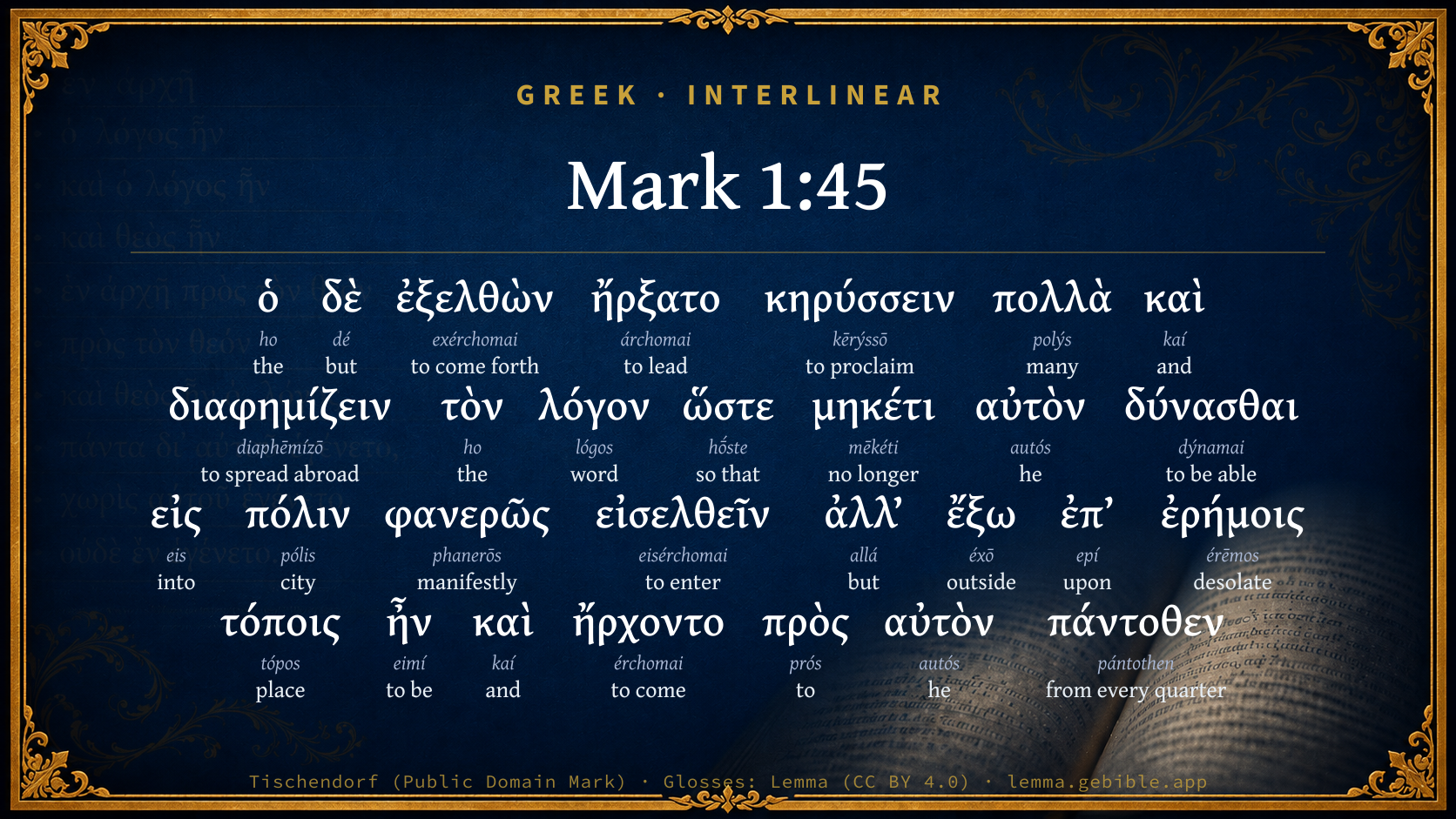
Download image
Cite this verse

Mark 1:45 (World English Bible). Public Domain. Lemma interlinear Bible study tool, https://lemma.gebible.app/v/mark/1/45.

Show BibTeX & RIS
BibTeX
RIS
English Translation
But he went out, and began to proclaim it much, and to spread about the matter, so that Jesus could no more openly enter into a city, but was outside in desert places: and they came to him from everywhere.
World English Bible · Public Domain
Highlights
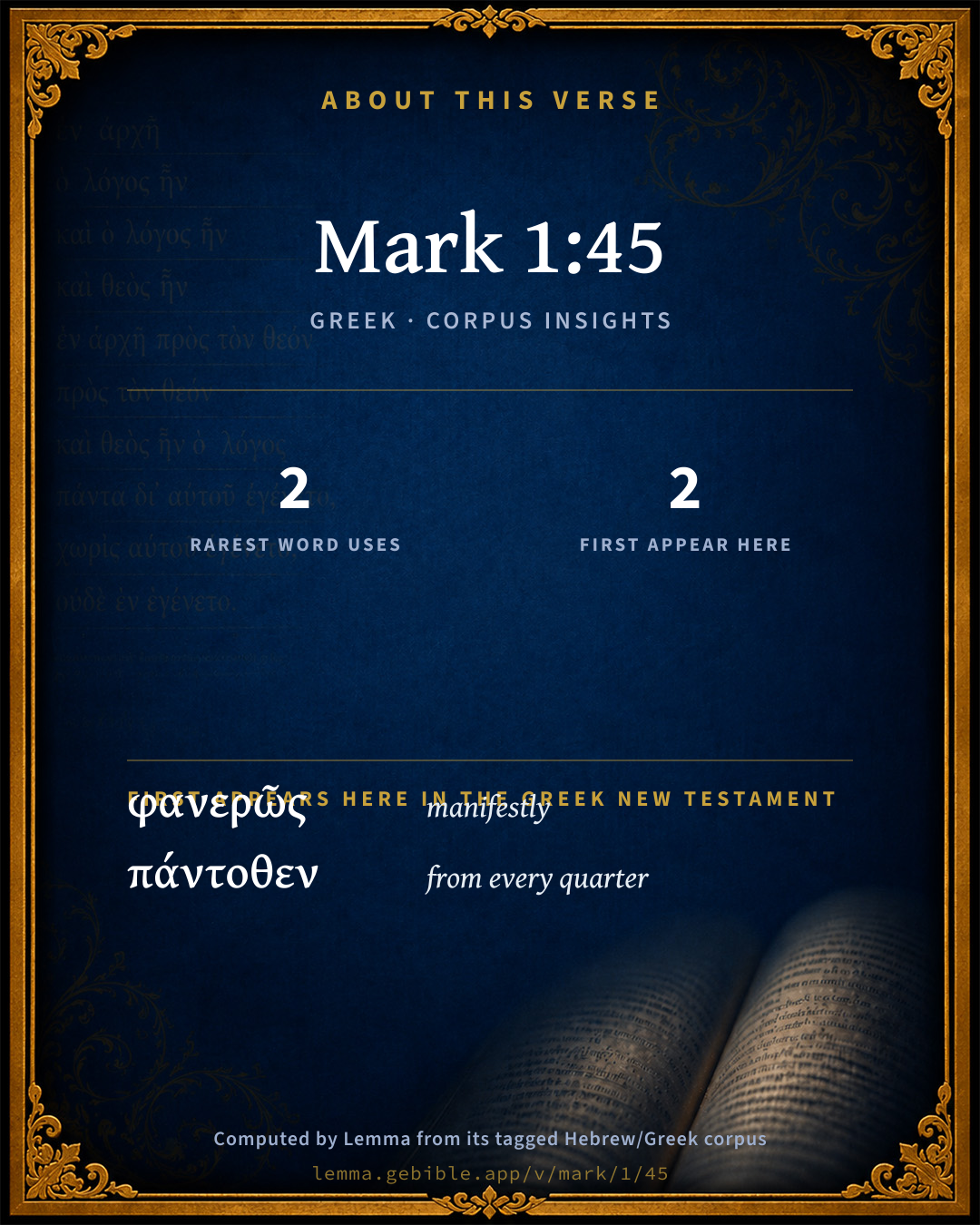
  • 2 first appearances in the Greek New Testament
Full analysis ↓
Download a study sheet

One document with this verse’s original text, its word-by-word gloss line, the meaning frame, cross-references with their text, attributed commentary, and full source and license credits — printable, and it pastes into notes with its structure intact.

This verse Autodidact and up

Study sheet (.html) Plain text (.txt)

A passage Seminary Student

Up to 50 verses in one chapter. A passage sheet keeps up to 6 commentary sources and 12 cross-references per verse, in the order this page ranks them, and says so on the sheet whenever that leaves anything out. Ask for a single verse and you get the Autodidact verse sheet above.

Everything on this page stays free to read, with no account — the sheet is a download of what is already on screen, not access to it.

Want to remove ads? Support Godless Engineer
Compare translations 3

The same verse in 3 English versions, stacked beneath the original-language interlinear above. Click any original word for its lexicon entry.

Each is an independent rendering of the whole verse — the interlinear is not word-aligned to these translations.

Highlighted words mark where these versions differ — a whole-verse word diff, not a word-by-word alignment.

  • World English Bible Public Domain
    But he went out, and began to proclaim it much, and to spread about the matter, so that Jesus could no more openly enter into a city, but was outside in desert places: and they came to him from everywhere.
  • King James Version Public Domain
    But he went out, and began to publish it much, and to blaze abroad the matter, insomuch that Jesus could no more openly enter into the city, but was without in desert places: and they came to him from every quarter.
  • unfoldingWord Literal Text CC BY-SA 4.0
    But he, having gone out, began to proclaim much and to report the word, so that he was able no longer to enter into a town openly, but he was out in desolate places, and they were coming to him from all sides.

unfoldingWord Literal Text — © unfoldingWord, licensed CC BY-SA 4.0. Word-aligned USFM3 via Door43 (git.door43.org/unfoldingWord/en_ult).

Versions to compare (up to 4)

3 of 4 selected

Show all 19 translations

Every available English version of this verse, each an independent rendering of the whole verse.

  • World English Bible Public Domain
    But he went out, and began to proclaim it much, and to spread about the matter, so that Jesus could no more openly enter into a city, but was outside in desert places: and they came to him from everywhere.
  • Berean Standard Bible Public Domain
    But the man went out and openly began to proclaim and spread the news. Consequently, Jesus could no longer enter a town in plain view, but He stayed out in solitary places. Yet people came to Him from every quarter.
  • Majority Standard Bible Public Domain
    But the man went out and openly began to proclaim and spread the news. Consequently, Jesus could no longer enter a town in plain view, but He stayed out in solitary places. Yet people came to Him from every quarter.
  • King James Version Public Domain
    But he went out, and began to publish it much, and to blaze abroad the matter, insomuch that Jesus could no more openly enter into the city, but was without in desert places: and they came to him from every quarter.
  • American Standard Version (1901) Public Domain
    But he went out, and began to publish it much, and to spread abroad the matter, insomuch that Jesus could no more openly enter into a city, but was without in desert places: and they came to him from every quarter.
  • Revised Version (1885) Public Domain
    But he went out, and began to publish it much, and to spread abroad the matter, insomuch that Jesus could no more openly enter into a city, but was without in desert places: and they came to him from every quarter.
  • Geneva Bible (1599) Public Domain
    But when he was departed, hee began to tel many things, and to publish the matter: so that Iesus could no more openly enter into the citie, but was without in desert places: and they came to him from euery quarter.
  • Douay-Rheims (1899) Public Domain
    But he being gone out, began to publish and to blaze abroad the word: so that he could not openly go into the city, but was without in desert places: and they flocked to him from all sides.
  • Young's Literal Translation Public Domain
    And he, having gone forth, began to proclaim much, and to spread abroad the thing, so that no more he was able openly to enter into the city, but he was without in desert places, and they were coming unto him from every quarter.
  • Literal Standard Version CC BY-SA 4.0
    And he, having gone forth, began to proclaim much, and to spread the thing abroad, so that He was no longer able to openly enter into the city, but He was outside in desolate places, and they were coming to Him from every quarter.
  • Unlocked Literal Bible CC BY-SA 4.0
    But he went out and began to spread the news widely, so much that Jesus could no longer enter a town openly but he stayed out in remote places. Yet people were still coming to him from everywhere.
  • unfoldingWord Literal Text CC BY-SA 4.0
    But he, having gone out, began to proclaim much and to report the word, so that he was able no longer to enter into a town openly, but he was out in desolate places, and they were coming to him from all sides.
  • Darby Bible Public Domain
    But he, having gone forth, began to proclaim [it] much, and to spread the matter abroad, so that he could no longer enter openly into the city, but was without in desert places, and they came to him from every side.
  • World Messianic Bible Public Domain
    But he went out, and began to proclaim it much, and to spread about the matter, so that Yeshua could no more openly enter into a city, but was outside in desert places. People came to him from everywhere.
  • Webster's Bible Public Domain
    But he went out, and began to publish it much, and to blaze abroad the matter, so that Jesus could no more openly enter into the city, but was without in desert places: and they came to him from every quarter.
  • Free Bible Version CC BY-SA 4.0
    But the healed leper went out and told everyone what had happened. As a result Jesus could not openly go into the cities anymore, but had to stay out in the country where people came to him from everywhere around.
  • Bible in Basic English Public Domain
    But he went out, and made it public, giving an account of it everywhere, so that Jesus was no longer able to go openly into a town, but was outside in the waste land; and they came to him from every part.
  • Text-Critical English NT CC BY 4.0
    But the man went out and began to proclaim it widely and to spread the news, so that Jesus could no longer openly enter a town, but was out in desolate places. Yet people were coming to him from everywhere.
  • Tyndale New Testament (1534) Public Domain
    But he (assone as he was departed) beganne to tell many thinges and to publyshe the dede: in so moche that Iesus coulde no more opely entre in to the cite but was with out in desert places. And they came to him from every quarter.

Literal Standard Version (2020), Covenant Press — licensed CC BY-SA 4.0. Text via the HelloAO Bible API (eBible.org). Unlocked Literal Bible (unfoldingWord) — licensed CC BY-SA 4.0. Text via the HelloAO Bible API (eBible.org). unfoldingWord Literal Text — © unfoldingWord, licensed CC BY-SA 4.0. Word-aligned USFM3 via Door43 (git.door43.org/unfoldingWord/en_ult). Free Bible Version, Dr. Jonathan Gallagher — licensed CC BY-SA 4.0. Text via the HelloAO Bible API (eBible.org).

Word by word

More ways to search: Search by grammar → Find every occurrence → Compare this word →

Practice this passage: Drill this verse → Learn its vocabulary →

διαφημίζειν
diaphēmízō
G1310
“to spread abroad”
Verb, Present, Active, Infinitive
Part of Speech
Verb
Tense
Present
Voice
Active
Mood
Infinitive
Full Thayer's Definition

Origin: from G1223 and a derivative of G5345

TDNT: None

1. to spread abroad, blaze abroad 2. to spread abroad his fame or renown
  1. ὁ ho G3588 “the” Article, Nominative, Singular, Masculine
  2. δὲ dé G1161 “but” Conjunction
  3. ἐξελθὼν exérchomai G1831 “to come forth” Verb, Aorist, Active, Participle, Nominative, Singular, Masculine
  4. ἤρξατο árchomai G756 “to lead” Verb, Aorist, Middle deponent, Indicative, 3rd person, Singular
  5. κηρύσσειν kērýssō G2784 “to proclaim” Verb, Present, Active, Infinitive
  6. πολλὰ polýs G4183 “many” Adjective, Accusative, Plural, Neuter
  7. καὶ kaí G2532 “and” Conjunction
  8. τὸν ho G3588 “the” Article, Accusative, Singular, Masculine
  9. λόγον lógos G3056 “word” Noun, Accusative, Singular, Masculine
  10. ὥστε hṓste G5620 “so that” Conjunction
  11. μηκέτι mēkéti G3371 “no longer” Adverb, Negative
  12. αὐτὸν autós G846 “he” Personal pronoun, Accusative, Singular, Masculine
  13. δύνασθαι dýnamai G1410 “to be able” Verb, Present, Middle or Passive deponent, Infinitive
  14. εἰς eis G1519 “into” Preposition
  15. πόλιν pólis G4172 “city” Noun, Accusative, Singular, Feminine
  16. φανερῶς phanerōs G5320 “manifestly” Adverb
  17. εἰσελθεῖν eisérchomai G1525 “to enter” Verb, Aorist, Active, Infinitive
  18. ἀλλ’ allá G235 “but” Conjunction
  19. ἔξω éxō G1854 “outside” Adverb
  20. ἐπ’ epí G1909 “upon” Preposition
  21. ἐρήμοις érēmos G2048 “desolate” Adjective, Dative, Plural, Masculine
  22. τόποις tópos G5117 “place” Noun, Dative, Plural, Masculine
  23. ἦν eimí G1510 “to be” Verb, Imperfect, Active, Indicative, 3rd person, Singular
  24. καὶ kaí G2532 “and” Conjunction
  25. ἤρχοντο érchomai G2064 “to come” Verb, Imperfect, Middle or Passive deponent, Indicative, 3rd person, Plural
  26. πρὸς prós G4314 “to” Preposition
  27. αὐτὸν autós G846 “he” Personal pronoun, Accusative, Singular, Masculine
  28. πάντοθεν pántothen G3840 “from every quarter” Adverb

About this verse

These counts appear in no published source. They are computed here, from the morphology-tagged text and Lemma’s own curated glosses. What Lemma adds →

29
words
26
distinct lemmas
Gospels
section

Notable vocabulary

The rarest word here is διαφημίζειν to spread abroad G1310 — appearing just 2 times in the whole Greek New Testament.

First appearance in Scripture

These words make their first canonical appearance in the Greek New Testament here:

  • φανερῶς manifestly G5320
  • πάντοθεν from every quarter G3840

Shared distinctive vocabulary

διαφημίζειν to spread abroad G1310 occurs in 2 verses of the Greek New Testament. Also found in:
Repetition

Words recur within this verse:

Cross-references

9

Topical passages linked to Mark 1:45 in the Treasury of Scripture Knowledge — connected by theme and wording, ordered by reader-vote popularity; previews shown in the World English Bible.

  • Matthew 9:31 But they went out and spread abroad his fame in all that land.
  • Mark 2:13 He went out again by the seaside. All the multitude came to him, and he taught them.
  • Psalms 77:11 I will remember Yah's deeds; For I will remember your wonders of old.
  • Luke 5:15–17 But the report concerning him spread much more, and great multitudes came together to hear, and to be healed by him of their infirmities.
  • John 6:2 A great multitude followed him, because they saw his signs which he did on those who were sick.
  • Matthew 28:15 So they took the money and did as they were told. This saying was spread abroad among the Jews, and continues until this day.
  • Mark 2:1–2 When he entered again into Capernaum after some days, it was heard that he was in the house.
  • Mark 3:7 Jesus withdrew to the sea with his disciples, and a great multitude followed him from Galilee, from Judea,
  • Titus 1:10 For there are also many unruly men, vain talkers and deceivers, especially those of the circumcision,

Cross-references courtesy of OpenBible.info (CC BY 4.0).

Commentary

Notes on Mark 1:45 from classic Christian and Jewish commentators (each source and its license shown beneath its notes). The classic Christian expositions comment on the surrounding passage and are grouped to its opening verse, so a note may address several verses; the Jewish commentaries on the Tanakh (Rashi and others) are per-verse, so they appear only where the commentator wrote on this verse.

Lemma curates 59 commentaries, every one of them public domain or Creative Commons licensed, each selected and text-cleaned for this edition rather than reprinted as found. About our sources →

The Biblical Illustrator

Joseph S. Exell

Mar_1:45

And they came to Him from every quarter.

Gathering to the centre

I. Of the open or professional coming to Christ. The gospel when it is preached draws many to itself who are not saved by it. Many come to Christ from the lowest motives; to receive benefits; some out of transient enthusiasm. Out of the best haul a fisherman ever makes, there is something to throw away.

II. Of the first real spiritual coming to Christ by faith. Let us try to help those who are coming to Christ. All who come to Christ from every quarter never one was disappointed with Him yet.

III. The daily coming of saved souls to Jesus. They come from every quarter as to mental pursuits; from all points of theological thought; from every quarter of spiritual experience.

IV. That great gathering which is approaching nearer every moment. Saints come to Jesus in glory from every quarter. (C. H. Spurgeon.)

Coming to Christ by various roads

Seeking rest and health last week, I seated myself for a little while near a very rustic church which stands embowered in a wood, and as I sat there I moralized upon the various paths which led up to the church porch. Each trackway through the grass came from a different quarter, but they all led to one point. As I stood there this reflection crossed me: even thus men come to Christ from all quarters of the compass, but if indeed saved, they all come to Him. There is a path yonder which rises from a little valley. The little church stands on the hillside, there is a brook at the bottom, and worshippers who come from the public road must cross the rustic bridge and then ascend the hill. Such comers rise at every step they take. Full many burdened ones come to Christ from the deep places of self-abasement; they know their sinfulness and feel it; their self-consciousness has almost driven them to despair; they are down very low, and every step they take to Christ is a step upwards. They have a little hope as they look to Him, and then a little more, till it comes to a humble trust; then from a feeble, trembling trust it rises to a simple faith, and so they advance till when they stand near to Jesus they even reach to the full assurance of faith. Thus from soul distress and self-despair they come to the Lord Jesus, and He receives them graciously. Through the churchyard there was another path, and it ran uphill from where I stood, and therefore everyone who came that way descended to the church door. These may represent the people who think much of themselves; they have been brought up in morality and lived in respectability in the town of Legality; they have never turned aside to the greaser vices, but are among the models of behaviour. Every step these good people take towards Christ is downward; they think less of themselves and still less; regret leads to repentance, repentance to bitter grief, and grief leads to self abhorrence, till they come down to the level where Jesus meets with sinners, by owning that they are nothing, and that Christ is all. The two paths which I have mentioned were supplemented by a third, which led through a thick and tangled wood: a narrow way wound between the oak trees and the dense underwood, and I noticed that it led over a boggy place, through which stepping stones had been carefully placed for the traveller, that he might not sink in the mire. Many a seeker has found his way to Jesus by a similar path. Dark with ignorance, and briary with evil questionings, the path winds and twists about, and leads through the Slough of Despond, wherein a man had need pick his steps very carefully, or he may sink in despair. Those whom grace leads arrive at rest in Christ, but it is through the wood and through the slough. Once more, I remarked another path, which came in from the farmers fields, through lands where the plough and the sickle are busy, each in its season; so that those who come from that quarter to worship come across the place of toil, and may fitly represent those who are full of earnestness and effort, but have as much need of Jesus as any. They do not know yet the way of salvation, but they follow after righteousness by the law, and strive to enter in at the strait gate in their own strength. But if they ever come to Christ they will have to leave those fields and the plough and sickle of their own strength, and submit to receive Jesus as their all. (C. H. Spurgeon.)

.

The Biblical Illustrator, edited by Joseph S. Exell (c. 1880s–1900s) — public domain. Text from a community e-Sword module.

Joseph Benson's Commentary

Mar 1:45. But he went out, and began to publish it much, &c. — But the man, instead of concealing the cure, was so overjoyed at the suddenness and greatness of the blessing, and of the divine mercy manifested toward him in so miraculous a deliverance, that he could not forbear publishing it everywhere; insomuch that Jesus could no more openly enter into the city — Namely, of Capernaum: to prevent which inconvenience, as well as for the other reasons mentioned in the note on Mat 8:4, our Lord had enjoined him silence: but was without, in desert places — Was obliged to retire into a neighbouring wilderness, to refresh his body with rest, and his spirit with meditation and prayer. And they came to him from every quarter — Even into the wilderness, remote as it was from the habitations of many of them.

Joseph Benson's Commentary on the Old and New Testaments (1811–1818) — public domain. Text from a community e-Sword module.

Bengel's Gnomon

Johann Albrecht Bengel

Mar 1:45.[16] Μηκέτι, no longer) Christ therefore was ready to teach rather in the cities, than in the place to which the men were going out.

[16] κηρύσσειν, to publish) This public and spontaneous proclaiming of facts served to give speedy publicity to facts worthy of remembrance: see ch. Mar 5:20. Yet, in this place, it would have been better for the man to have obeyed Christ’s inhibition.—V. g.

Bengel's Gnomon of the New Testament — English translation (T&T Clark, Edinburgh, 1860) — public domain. Text from a community e-Sword module.

Expositor's Greek Testament

ed. W. Robertson Nicoll

Mar 1:45 . What Jesus feared seems to have happened. The man went about telling of his cure, and neglecting the means necessary to obtain social recognition as cured. τὸν λόγον : “the matter,” A. V [3] Perhaps we should translate strictly the word, i.e. , the word Jesus spoke: “I will, be thou clean”. So Holtz. after Fritzsche. So also Euthy. Zig. ( διεφημίζε τὸν λόγον , ὃν εἴρηκεν αὐτῷ ὁ χριστὸς , δηλαδὴ τὸ θέλω , καθαρίσθητι , ὡς μετʼ ἐξουσίας γενόμενον ). εἰς πόλιν : the result was that Jesus could not enter openly into a city , a populous place, but was obliged to remain in retired spots. This cure and the popularity it caused may have co-operated to bring Christ’s synagogue ministry to an abrupt termination by stirring up envy. Jesus was between two fires, and His order to the leper, “Go, show thyself,” had a double reference: to the man’s good and to the conciliation of the scribes and synagogue rulers. καὶ ἤρχοντο , etc.: and (still) they kept coming from all quarters. Popularity at its height. There is nothing corresponding to Mar 1:45 in Mt.

[3] Authorised Version.

The Expositor's Greek Testament, edited by W. Robertson Nicoll (1897–1910) — public domain. Text from a community e-Sword module.

Adam Clarke's Commentary

Verse 45. Began to publish it much] Began to publish πολλα, many things; probably all that he had heard about our Lord's miraculous works.

And to blaze abroad the matter] That is, his own healing; thinking he could never speak too much, nor too well, of him who had thus mercifully and miraculously cleansed him.

Jesus could no more openly enter into the city] A city of Galilee, probably Chorazin or Bethsaida, in which he did not appear, for fear of exciting the jealousy of the secular government, or the envy and malice of the Jewish rulers.

And they came to him from every quarter.] So generally had the poor man, who was cleansed of his leprosy, spread abroad his fame. And can we suppose that, of all these people who came to him from all parts, and to whom he preached the glad tidings of the kingdom, by the power and authority of God, few or none were saved? This is a common opinion; but every person who seriously considers it must see that it is unfounded. Without doubt, Christ had thousands that were brought to God by his ministry; though, in general, only those are mentioned who were constant attendants on his person. It would be strange, if, while God manifested in the flesh was preacher, there should be few brought to the knowledge of themselves, and of the truth! In this respect he does not permit his faithful ministers to labour in vain. The Son of man sowed the seed of the kingdom; and it afterwards produced a plentiful harvest. Multitudes of Jews were converted by the preaching of the Gospel; and the first Christian Church was founded at Jerusalem.

Adam Clarke's Commentary on the Bible (1810–1826) — public domain. Text from a community e-Sword/MySword module.

Ellicott's Commentary for English Readers

(45) But he went out.—St. Mark alone describes the man himself as the agent in spreading the report of the miracle, and gives in more vivid terms than St. Luke the consequent pressure of the multitude, and the necessity for retirement into “desert places.”

A Bible Commentary for English Readers, edited by Charles John Ellicott (1878–1897) — public domain. Text from a community e-Sword module.

The Cambridge Bible for Schools and Colleges

gen. ed. J. J. S. Perowne

45. began to publish it much] even as others in similar circumstances found it impossible to keep silence; comp. (1) the blind man, Mat_9:30-31; (2) the man with an impediment of speech, Mar_7:36.

could no more openly enter into the city] In these words we have perhaps one of the reasons why the Lord enjoined silence on the leper. A certain degree of secrecy and reserve was plainly necessary in respect to the Lord’s miracles, or it would have been impossible for Him to have moved from place to place.

The Cambridge Bible for Schools and Colleges (gen. ed. J. J. S. Perowne; Cambridge University Press, 1878–1918) — public domain. Text from a community e-Sword module.

John Gill's Exposition

But he went out,.... Either out of the synagogue; for in Mar 1:39, it is said, that Christ preached in their synagogues, &c. and in Mar 1:40, "there came a leper to him"; and Luke very, plainly suggests, that he was in the city, Luk 5:12, and he might be in the synagogue: and this was allowed a leper, according to the Jewish canons, provided some rules were observed; which were these (x):

"if a leper enters into a synagogue, they make for him a partition ten hands high, and four cubits broad; he enters in first, and goes out last:''

or, it may be, he went out of the house where he was, into the city, and parts adjacent; for it seems as if the cure was done privately: and yet a leper was not allowed to enter into a house (y);

"if he did, all the vessels which were there, i.e. all the goods in the house were defiled, even to the very beams. R. Simeon says, as far as four cubits. R. Judah says, if he stayed so long as the lighting of a lamp.''

And began to publish it much, and to blaze abroad the matter; contrary to the charge Christ gave him; though this might be done by him, not out of disobedience to Christ, but out of a transport of joy for the mercy received; and perhaps with a good intention to spread the fame and glory of his Saviour:

insomuch that Jesus could no more openly enter into the city; of Capernaum, or whatever city it was, where this cure was wrought, without a crowd of people about him, and danger from them, at least from his enemies, who envied his applause and glory.

But was without in desert places; devoid of inhabitants, where he spent his time in prayer:

and they came to him from every quarter; whenever the people could learn where he was: so agreeable was his doctrine to some; and so useful his miraculous work of healing to others.

(x) Misn. Negaim, c. 13. sect. 12. (y) lb. sect. 11.

Next: Mark Chapter 2

John Gill's Exposition of the Whole Bible (1746–1763) — public domain (CC PDM 1.0). Text via the HelloAO Bible API.

Trapp's Complete Commentary

John Trapp

45 But he went out, and began to publish it much, and to blaze abroad the matter, insomuch that Jesus could no more openly enter into the city, but was without in desert places: and they came to him from every quarter.

Ver. 45. Could no more openly enter] For press of people, he was so frequented that he was forced to withdraw.

John Trapp, A Commentary or Exposition upon All the Books of the Old and New Testament (1647–1656) — public domain. Text from a community e-Sword module.

Whedon's Commentary on the Bible

Daniel D. Whedon

45. To blaze abroad — This shows the full wisdom of Jesus in forbidding him to tell any man. The rumour raised a tumult and a crowd and an excitement wholly unlike the gentle and spiritual movement it was the purpose of Jesus to create. Could no more openly enter — The tumult was getting too great for the good of the people, or for the quiet of government. Our Lord and the crowd were in danger of attracting the suspicious notice of the authorities. From every quarter — Even his sacred retirement was haunted with their visits.

Daniel D. Whedon (gen. ed.), Commentary on the Old and New Testaments (1874–1909) — public domain. Text from a community e-Sword module.

The Pulpit Commentary

But he went out, and began to publish it much, and to spread abroad the matter. It seems difficult to blame the man for doing what he thought must tend to the honor of his Healer; though, no doubt, it would have been better if he had humbly obeyed. And yet it was to be expected that the knowledge of our Lord"s mighty works would be published by others. In this particular instance the effect of this man"s conduct was probably unexpected by himself; for it led to the withdrawal of Christ from Capernaum. The crowds who were attracted to him by the fame of his miracles would have hampered him, so that he could not have exercised his ministry; for even in the desert places they sought him out, and came to him from every quarter.

It should be noticed here that this first chapter of St. Mark embraces, in very condensed form, about twelve months of our Lord"s public ministry, from his baptism by John. And it is a record of uninterrupted progress. The time had not then come for the opposition of the scribes and Pharisees and Herodians to show itself. It was, no doubt, wisely ordained that his gospel should take root and lay hold of the hearts and consciences of men, as it must have done in the minds of the Galilaeans more especially, before it had to encounter the envy and malice of those who ultimately would bring him to his cross.

The Pulpit Commentary (1880–1919), ed. H.D.M. Spence-Jones & Joseph S. Exell — public domain. Text from a community e-Sword module.

John Wesley's Explanatory Notes

So that Jesus could no more openly enter into the city - It was also to prevent this inconvenience that our Lord had enjoined him silence.

John Wesley, Explanatory Notes Upon the Whole Bible (1754–1765) — public domain. Text via the GEBible commentary corpus.

The People's New Testament

B. W. Johnson

45. Came to him from every quarter. Not only to see and hear, but to be healed.

B. W. Johnson's The People's New Testament with Notes (1889–1891) — public domain. Electronic text from the Christian Classics Ethereal Library (CCEL) ThML edition.

unfoldingWord translationNotes

Door43 World Missions Community

But he went out

The word "he" refers to the man Jesus healed.

began to spread the news widely

Here "spread the news widely" is a metaphor for telling people in many places about what had happened. AT: "began to tell people in many places about what Jesus had done" (See: and Metaphor)

so much that

The man spread the news so much that

that Jesus could no longer enter a town openly

This was the result of the man spreading the news so much. Here "openly" is a metaphor for "publicly." Jesus could not enter the towns because many people would crowd around him. AT: "that Jesus could no longer enter a town publicly" or "that Jesus could no longer enter the towns in a way that many people would see him" (See: Assumed Knowledge and Implicit Information)

remote places

"lonely places" or "places where no one lived"

from everywhere

The word "everywhere" is a hyperbole used to emphasize how very many places the people came from. AT: "from all over the region" (See: Hyperbole and Generalization)

translationWords

Jesus

unfoldingWord translationNotes — © Distant Shores Media and the Door43 World Missions Community, licensed CC BY-SA 4.0. Source: git.door43.org/Door43/en_tn.

Cambridge Greek Testament for Schools and Colleges

45. ἐξελθών. “From the place” or “from the crowd.” The man, of necessity, yields to the ἐξέβαλεν, but he forthwith disregards the μηδενὶ μηδὲν εἴπῃς. Cf. Mar 7:36; Mat 9:30-31.

ἤρξατο. Very freq. in Mk and Lk., but only once in Jn. Cf. Joh 5:17; Joh 6:7. Such fulness of expression is Hebraistic. Blass, § 69. 4.

κηρύσσειν πολλά. To publish much, i.e. “at great length” or “often” (Mar 3:12, Mar 5:10; Mar 5:23; Mar 5:38; Mar 5:43, Mar 9:26); it (R.V.) should be in italics, or omitted. Probably τὸν λόγον goes with both infinitives, πολλά being adverbial. [221] Latt. omit πολλά. Cf. Mar 7:36; Mat 9:30-31.

[221] Codex Bezae. 6th cent. Has a Latin translation (d) side by side with the Greek text, and the two do not quite always agree. Presented by Beza to the University Library of Cambridge in 1581. Remarkable for its frequent divergences from other texts. Contains Mark, except Mar 16:15-20, which has been added by a later hand. Photographic facsimile, 1899.

διαφημίζειν τὸν λόγον. Vulg. has diffamare sermonem, whereas διεφημίσθη ὁ λόγος (Mat 28:15) is rendered divulgatum est verbum. Spread abroad the matter (R.V.) is right; ὁ λόγος does not mean Christ’s healing word, or His teaching, but the whole story of his marvellous cure. Luther has die Geschichte. Bede thinks that our Lord submitted to be disobeyed that many might profit by what the cleansed leper had to tell, and unius perfecta salvatio multas ad Dominum cogit turbas. This explanation ignores the disastrous result which Christ tried to prevent. Mt. again omits the impeding crowd; he does not like to say that Christ was unable to do what He wished. See on Mar 1:33, Mar 6:48, Mar 7:24.

ὥστε μηκέτι αὐτὸν δύνασθαι. His public work in towns (φανερῶς is emphatic), and therefore His teaching in synagogues, had to be suspended. Instead of seeking the lost in their own homes, He had to go into the wilderness and wait for them to seek Him. This was a serious drawback, although His Ministry still went on.

ἐρήμοις τόποις. Places in which there were no houses or cultivated lands.

ἤρχοντο. Graphic imperf. There was a continual stream of visitors; cf. Mar 2:13; Joh 4:30.

πάντοθεν. Cf. Luk 19:43. The hyperbole is similar to that in Mar 1:5; Mar 1:28; Mar 1:32. In Heb 9:4, πάντοθεν may mean “inside and out.” The classical πανταχόθεν is not found in N.T., though a few inferior MSS. have it here ([222][223][224][225] etc.); in popular language the shorter form would prevail.

[222] Codex Basiliensis. 8th cent. At Basle.

[223] Codex Seidelianus I. 9th or 10th cent. Contains Mar 1:13 to Mar 14:18; Mar 14:25 to Mar 16:20.

[224] Codex Nanianus. 9th or 10th cent. Gospels complete.

[225] Codex Mosquensis. 9th cent.

Cambridge Greek Testament for Schools and Colleges (Cambridge University Press, 1896; 21 vols, various authors incl. Carr, Maclear, Plummer, Farrar, Lumby, Moule, M. R. James, Simcox) — public domain. Text from a community e-Sword module.

Alford’s Greek Testament

Henry Alford

45.] ἤρξατο, he lost no time in doing it.

τὸν λόγον] not, ‘what Jesus had said to him,’ but the account, of his healing.

ἤρχοντο tells us more than ἦλθον would have done. Our Lord did not wish to put a stop to the multitudes seeking Him, but only to avoid that kind of concourse which would have beset Him in the towns: the seeking to Him for teaching and healing still went or and that from all parts.

Henry Alford, The Greek Testament (1849–1861) — public domain. Text from a community e-Sword module.

International Critical Commentary

45. ἤρξατο κηρύσσειν πολλὰ καὶ διαφημίζειν τὸν λόγον—began to publish much (extensively) and to spread abroad the event. τὸν λόγον—is the object of both verbs. ἤρξατο—calls attention to the beginning of this action. He no sooner went out than he began to publish the affair. ὥστε μηκέτι αὐτὸν δύνασθαι—so that he was no longer able. An inability arising from the condition and principles of Jesus’ work. εἰς πόλιν—into a city. Jesus was on a tour, going about from place to place, and εἰς πόλιν has therefore the proper meaning of the anarthrous noun. ἐπʼ ἐπήμοις τόποις—in solitary, uninhabited places. πάντοθεν—from all sides.

πάντοθεν, instead of πανταχόθεν, Tisch. Treg. WH. RV. א ABCDL, etc. 1, 33, etc. ἐπʼ ἐρήμοις Tisch. Treg. WH. א BL Δ 28, 124.

The command not to tell the story of the cure was not confined to this case, but was so frequent as to justify us in saying that it was the custom of Jesus. And this account gives the result of disobedience to it in an extreme case. It made a turning-point in the history of this mission, producing a change in our Lord’s plans, which is apparently the reason for introducing it here.

But why should Jesus try to preserve this secrecy about his miracles? Evidently, his thought about them was different from the ordinary thought of the Church, as it was different from that of his own time. But the reason is very simple. The miracles were sure to be treated as external signs, whereas Jesus relied on internal signs. As external, moreover, exhibitions of a supernatural power, they confirmed the people in their expectation of a national, worldly Messiah, and raised in them just the false hopes which Jesus was seeking to allay. And finally, by the excitement which they created, they interfered with the quiet methods of Jesus’ spiritual work.

THE MIRACLES OF JESUS

Holtzmann rationalizes this miracle by explaining καθαρίσαι, the cleansing of the leper, as a removal of his ceremonial uncleanness by Jesus. The man was cured already before he came to our Lord, and he wishes Jesus to pronounce him clean, in order to save him the journey to Jerusalem. He admits that the evangelists do not mean this, but intend to tell the story of a miraculous cure. But he contends that this simply shows how the story of natural events grew into supernatural form in their hands. Unfortunately for his hypothesis, he accepts the theory of the Synoptical Gospels which traces them to apostolic sources, and especially makes Mk. the rehearser of Peter’s story. This does not give the required time for myths to grow. This first-hand testimony is the starting-point in establishing the credibility of the miracles. Then, they stand or fall with the historicity of the whole account of Jesus, which is not generally denied. One of the first principles of a true criticism is, that any attempt to patch out a story with unreal details will betray itself by the incongruities of the addition. But you cannot separate the miracles from the rest of the story in this way. They are part of the texture of the story. Especially, they have a uniqueness which belongs to the character of Jesus, and to the principles of his action, and which makes invention an impossibility. A scheme of miracles which rigorously excludes everything but works of beneficence—all miracles of personal preservation, of punishment, of mere thaumaturgy, never occurred to any one but Jesus. The moment we go forward or back from him in Jewish history we find all these. And yet, the same generation tells us the story of Ananias and Sapphira, and of Elymas the Sorcerer, and, with entire unconsciousness of the difference, the story of Jesus’ miracles. His miracles are signs, not because of their power, but because of this divine uniqueness of their spirit. Jesus’ reticence about them, his endeavor to push them into the background, is another feature of this uniqueness. It is a revelation in action of his deep spirituality, the story of which is told by his contemporaries with evident unconsciousness of its significance. In fact, the grounds of Jesus’ solitary greatness are to be found in the miracles, as in the rest of the life, and in the teaching, and they are of the same kind.

THE PERIOD OF CONFLICT

With the second chapter begins the period of conflict in the life of our Lord. It is apparent in the preceding chapter that Jesus is not at all satisfied with the situation created by his sudden popularity, regarding it as a serious hindrance to his work. But now, instead of the superficial enthusiasm of the people, he has to encounter the growing opposition of their leaders. At first, this is aroused by his extraordinary claims, then by his revolutionary act in calling Levi, the tax-gatherer, to become his personal disciple, and finally by his revolutionary teaching in regard to fasting and Sabbath observance. Mk. produces this impression as plainly by his selection of events as if he had given this section the title Period of Conflict. Lk. gives the same grouping, while Mt. distributes these events.

1 Hence the absence of the article before Ἀρχὴ. Win. 19. 1. a.

1 In Homer, it means a reward given to the bearer of good news; in Attic Greek, a thank-offering for the same. The LXX form of the word seems to be εὐαγγελία, Thay.-Grm. Lex.

2 Ἰησοῦς is the Greek form of the Heb. יְהוֹשֻּׁעַ, יֵשׁוּעַ, or according to a still later form, יְשוּעָח. The first two mean Whose help is Jehovah. The last means simply help, or deliverer, and it is probably this later form to which this use is to be referred.

3 On this book, see Schürer, N. Zg. Div. II., Vol. III. § 32, V. 2. On the Messianic hope of the people in the time immediately preceding the life of Jesus, see Schürer II. II. § 29; and on the name Messiah, see II. II. 29, 3. The Heb. form is מָשִׁיחַ, Chald. משִׁיחָא, Messiah.

RV. Revised Version.

A Codex Alexandrinus.

E Codex Basiliensis.

F Codex Borelli.

G Codex Wolfi A.

H Codex Wolfi B.

K Codex Cyprius.

M Codex Campianus.

Treg. Tregelles.

WH. Westcott and Hort.

marg. Revided Version marg.

אԠCodex Sinaiticus.

B Codex Vaticanus.

D Codex Ephraemi.

L Codex Regius.

102 Codex Bibliothecae Mediceae.

Tisch. Tischendorf.

28 Codex Regius.

Orig. Origen.

Δ̠Codex Sangallensis

33 Codex Regius.

Latt. Latin Versions.

Memph. Memphitic.

Pesh. Peshito.

Hier. Jerusalem Lectionary.

Harcl. Harclean.

1 αὐτοῦ is substituted for τοῦ Θεοῦ ἡμῶν after τρίβους.

2 See Isa 41:25, 43:14, 44:Isa 41:26-4, 46:1, Isa 41:2, 47:Isa 41:1-15, 48:20.

P Codex Guelpherbytanus.

1 This word is one of several, such as καταγγέλλω, εὐαγγελίζεσθαι, having different shades of meaning, but all translated preach in the EV., whenever sacred matters are spoken of.

2 The question of the outward form of this rite has been discussed so thoroughly that it is unnecessary to go over it again in this place. In this passage, the indications corresponding to the common usage of the word itself are the river, the immersion into the river, the going up out of the water, but especially, the entireness and completeness of μετάνοια, which is expressed by the rite.

1 On the relation of repentance to forgiveness, see Isa 1:16-18, Eze 33:14-20, Hos_14, Amo 5:10-15, Jon 3:4-10. In fact, the whole burden of prophecy is, that the nation is afflicted because of its sins, but that it needs only to repent.

2 In its compound form, this is a Biblical word. The later language, Win. says, loves compound verbs which bring out something implied in the principal verb, 16. 4. B. b. The preposition here denotes that what is hidden comes out in confession.

1 ἐσθ(ί)ων is in the same construction as ἐνδεδυμένος, was clothed … and was eating. ἔσθων is a poetic form of the participle.

2 See Meyer’s Note.

3 The art. indicates the definite person had in mind.

1 On the use of the adverb as a preposition, see Thay.-Grm. Lex. Win. 54. 6.

69 Codex Leicestrensis.

Lat. Vet. Vetus Latina.

Vulg. Vulgate.

Win. Winer’s Grammar of N. T. Greek.

1 This circumlocution for the simple verb is a translation of the Heb. וַיְהִי וְ, and is foreign to the Greek idiom. The absence of a conj. between the two verbs is also a solecism.

2 See Bib. Dic. On the form of the Greek name, see Thay.-Grm. Lex.

3 This adverb is one of the marks of the style of this Gospel. It is used by Mk. nearly twice as often as by Mt. and Lk. together. εὐθύς is substituted for εὐθέως in the critical texts in most of these passages in Mk. See Thay.-Grm. Lex.

13 Codex Regius.

4 See Burton, N.T. Moods and Tenses, 125.

5 On this office of the Spirit, cf. Isa 11:2.

1 On this use of the aor., see Win. 40, 2; Burton, N. T. Moods and Tenses, 55.

1 .Codex Basiliensis

1 A Heb. word, meaning the Adversary.

2 The impf. describes the act as taking place during his stay in the wilderness.

1 Moses was in the mount forty days and forty nights (Exo 24:18, Exo 34:28), Elijah was in the wilderness forty days and forty nights (1 K. 19:8), and the Christophanies after the resurrection covered a period of forty days (Act 1:3).

209 An unnamed, valuable manuscript.

1 The regular construction after πιστεύειν is the simple dat. In the N.T. we find this, but also εἰς with acc. and ἐπὶ with acc. or dat. This construction with ἐν is found only here, and in Joh 3:15.

2 The common construction after παράγων is the simple dat. This repetition of παρά is not found elsewhere.

346 Codex Ambrosianus.

S Codex Vaticanus.

U Codex Nanianus.

V Codex Mosquensis.

1 Thay.-Grm. Lex. explains the word as meaning to throw about, first in one place, and then in another.

2 Δεῦτε is a plural imperative, formed from the adv. δεῦρο. The use of the adv. as a prep., ὀπίσω μου, is a sign of the Hellenistic Greek of the N.T. (Win. 54, 6).

C Codex Bezae.

3 Cf. Mat 27:56 with Mar 15:40.

4 Καταρτίζειν means in general to put in complete order, and may be applied either to the original fitting out, or to repairs.

1 See v. 39, 6:7; cf. Mat 10:1, Luk 9:1.

1 Heb. שַׁבָּת, a rest-day. This dat. plur. of the third declension is frequent in the N.T., not in the Sept. The plural is used frequently in the N.T. for a single Sabbath, a use either corresponding to the plur. of festivals, τὰ ἐγκαίνια etc., or coming from the emphatic Chald. form שַׁבָּתָא.

2 This use of συναγωγή to denote an assembly, or the place of assemblage, belongs to the N.T. In the Gr., it denotes the act of assembling.

Thay.-Grm. Thayer’s Grimm.

AV. Authorised Version.

1 In the Gr., γραμματεύς denotes a clerk or recorder, and is applied to an official class whose general function corresponds to that of the clerks of judicial and representative bodies. Among the Jews, it meant a lettered man, one acquainted with the sacred writings. They are called also νομικοί, lawyers, or men versed in the law; νομοδιδάσκαλοι, teachers of the law; ἱερογραμματεῖς, because they dealt with the sacred writings; and Rabbis, great ones.

1 This use of πνεῦμα belongs to Biblical Greek.

2 The first aor. is “rare and late.” Sec. aor. ἀνέκραγον common.

3 The only other place in which this term is applied to Jesus is Joh 6:69 (Tisch. Treg. WH. RV.).

4 For other examples of this meaning of ἐπιτιμᾷν, see Mar 8:30, Mar 3:12, Mat 12:16.

1 For instances of the literal meaning, see 1Co 9:9, 1Ti 5:18.

2 This is a Biblical meaning. In Greek, it is restricted to its proper sense, to search together. The N.T. meaning is a legitimate derivation from that.

3 The proper ending of adv. of place with verbs of motion is οι, not ου. The N.T. Greek does not observe this distinction, but invariably uses the ending ου. Our confusion of where and whither. The use of ἡ περίχωρος with γῆ understood is Biblical.

Γ̠Codex Tischendorfianus

Π̠Codex Petropolitianus

1 The vb. in Greek means to rouse, not to raise.

1 See Luk 13:14.

2 RV. text retains devils, marg. demons. American Revisers substitute demons in text in all passages where δαίμων, δαιμόνιον, or δαιμονίζομαι occurs.

3 The double compound ἐπισυνηγμένη is not found in classical Greek, though the simple compound συνάγειν is common. ἐπι adds to the word the idea of gathering upon or towards some point.

1 ἤφιε is a rare form of the impf. of αφίημι, from ἀφίω, with the augment on the prep. See Win. 14. 3. b.

2 Thay.-Grm. Lex. explains this as equivalent to περὶ τούτου ὅτι, concerning this, that. But it supposes a difficulty requiring an explanation, whereas the causal sense of ὅτι leaves nothing to explain.

1 ἕννυχος is properly an adj. meaning nocturnal. This is the only place where it occurs in the N.T., and its adverbial use is quite late.

1 σε, thee, turns this into direct discourse. An incongruous blending of direct and indirect discourse, more or less common in N.T., as in other Greek.

2 On this termination, ου instead of οι, see footnote on πανταχοῦ v. 28. This word does not occur elsewhere in N.T.

3 κωμόπολις does not occur elsewhere in N.T. It belongs to the later Greek.

1 See 3:11, 15, 22, 6:7, 13.

2 γονυπετῶν belongs to later Greek.

3 See Lev 13:45, Lev 13:46.

4 The meaning and form of σπλαγχνίζομαι are late. σπλαγχνεύω is the proper form, and its meaning is to eat the inwards of a victim after sacrifice, or to obtain auguries from them. The meaning compassionate comes from the Heb., which regarded the σπλάγχνα, the inwards, as the seat of pity and tenderness.

5 See 10:16, Act 8:18, Act 8:9:17, Act 8:13:3, 1Ti 4:14, 2Ti 1:6.

1 See 1:31, 44, 2:12, Mat 12:13, Mar 5:29, Mat 9:32, Mat 9:33, Mar 7:35.

2 See Mat 9:30, Mar 14:5, J. 11:33, 38 for the other instances of N.T. use of word. Of these, Mat 9:30 shares the ambiguity of this passage. The original meaning is to snort, which certainly makes room for it to denote an expression of feeling, as well as the feeling itself.

1 See Win. 56, 2, b, β. On the double negative, nothing to nobody, see Win. 55, 9, b.

2 The prescribed ceremonial and offerings for the cleansing of a leper are found in Lev_14.

3 Life of Jesus, 2Ch_11.

International Critical Commentary — older volumes (1896–1929), various authors — public domain. Text from a community e-Sword module.

Vincent's Word Studies in the New Testament

Marvin R. Vincent

The city

Properly, as Rev., a city; any city.

Marvin R. Vincent, Word Studies in the New Testament (1887–1900) — public domain. Text from a community e-Sword/MySword module.

Lesson kit

Teaching starters — assembled from the data on this page, not authored interpretation. Every prompt links to the verse data it draws on. Edit before teaching.

Mark, in the Gospels, opens this verse with 29 words (26 distinct Greek lemmas). Its most distinctive word is diaphēmízō (“to spread abroad”). A historical commentator’s framing appears above. Read the whole chapter for the surrounding context.

Discussion questions

  1. What does “to spread abroad” (diaphēmízō) contribute to the verse as a whole?
  2. 2 words make their first appearance in Scripture here. What does this debut establish?
  3. How does Matthew 9:31, which shares the word «to spread abroad», read alongside this verse?
  4. What does the repetition of “the” (2× in this one verse) do in this verse?
  5. These translations render this verse differently; the difference is in the English rendering, not the original. What questions does that raise?
  6. Compare how The Biblical Illustrator and Joseph Benson's Commentary read this verse. Where do they agree or differ?

Things to notice

  • 2 words make their first canonical appearance in Scripture here.
  • These translations choose different wording for 31 words in this verse.
  • “the” occurs 2× in this single verse.
  • 26 distinct Greek lemmas span 29 words in this verse.

Reading settings

Reading text

Shown beneath each verse's original-language words.

Old Testament
Old Testament edition

Read the OT as the Masoretic Hebrew (MT) or the Greek Septuagint (LXX).

English shown for the Greek Septuagint (in the Hebrew ↔ Greek comparison).

Comparing translations? Open the Compare panel on any verse page to stack up to four side by side.