Luke 1:14

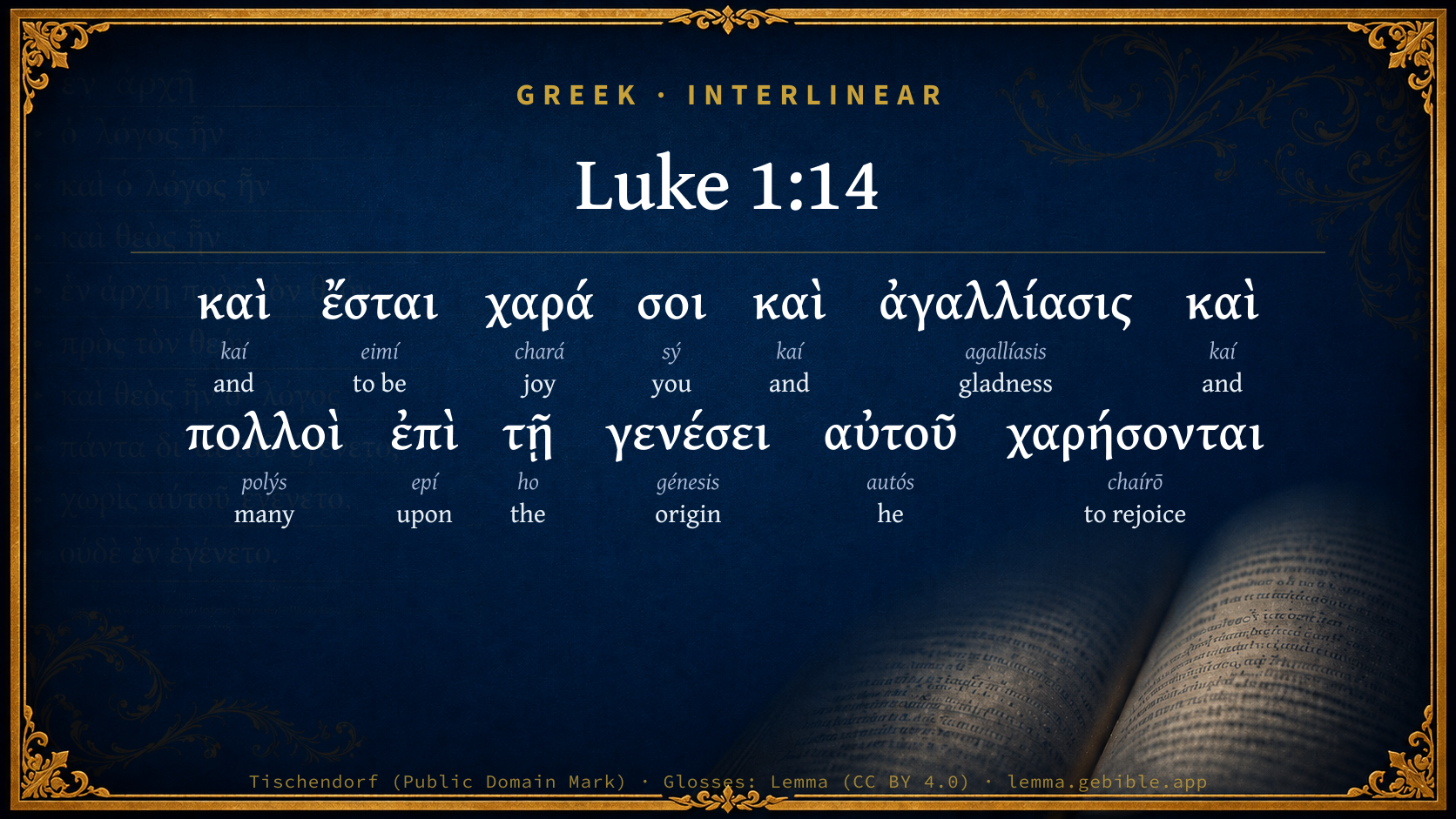
Greek (Tischendorf 8th ed.) Luke 1:14 appears in the Greek New Testament. The text above is from the Tischendorf 8th edition. Each word links to its Strong’s number and a concise gloss. Click any word for its full Thayer’s Greek Lexicon entry.
Download image
Cite this verse

Luke 1:14 (World English Bible). Public Domain. Lemma interlinear Bible study tool, https://lemma.gebible.app/v/luke/1/14.

Show BibTeX & RIS
BibTeX
RIS
English Translation
You will have joy and gladness; and many will rejoice at his birth.
World English Bible · Public Domain
Highlights
  • 1 first appearance in the Greek New Testament
Full analysis ↓
Download a study sheet

One document with this verse’s original text, its word-by-word gloss line, the meaning frame, cross-references with their text, attributed commentary, and full source and license credits — printable, and it pastes into notes with its structure intact.

This verse Autodidact and up

Study sheet (.html) Plain text (.txt)

A passage Seminary Student

Up to 50 verses in one chapter. A passage sheet keeps up to 6 commentary sources and 12 cross-references per verse, in the order this page ranks them, and says so on the sheet whenever that leaves anything out. Ask for a single verse and you get the Autodidact verse sheet above.

Everything on this page stays free to read, with no account — the sheet is a download of what is already on screen, not access to it.

Want to remove ads? Support Godless Engineer
Compare translations 3

The same verse in 3 English versions, stacked beneath the original-language interlinear above. Click any original word for its lexicon entry.

Each is an independent rendering of the whole verse — the interlinear is not word-aligned to these translations.

Highlighted words mark where these versions differ — a whole-verse word diff, not a word-by-word alignment.

  • World English Bible Public Domain
    You will have joy and gladness; and many will rejoice at his birth.
  • King James Version Public Domain
    And thou shalt have joy and gladness; and many shall rejoice at his birth.
  • unfoldingWord Literal Text CC BY-SA 4.0
    And there will be joy and gladness to you, and many will rejoice at his birth.

unfoldingWord Literal Text — © unfoldingWord, licensed CC BY-SA 4.0. Word-aligned USFM3 via Door43 (git.door43.org/unfoldingWord/en_ult).

Versions to compare (up to 4)

3 of 4 selected

Show all 19 translations

Every available English version of this verse, each an independent rendering of the whole verse.

  • World English Bible Public Domain
    You will have joy and gladness; and many will rejoice at his birth.
  • Berean Standard Bible Public Domain
    He will be a joy and delight to you, and many will rejoice at his birth,
  • Majority Standard Bible Public Domain
    He will be a joy and delight to you, and many will rejoice at his birth,
  • King James Version Public Domain
    And thou shalt have joy and gladness; and many shall rejoice at his birth.
  • American Standard Version (1901) Public Domain
    And thou shalt have joy and gladness; and many shall rejoice at his birth.
  • Revised Version (1885) Public Domain
    And thou shalt have joy and gladness; and many shall rejoice at his birth.
  • Geneva Bible (1599) Public Domain
    And thou shalt haue ioy and gladnes, and many shall reioyce at his birth.
  • Douay-Rheims (1899) Public Domain
    And thou shalt have joy and gladness, and many shall rejoice in his nativity.
  • Young's Literal Translation Public Domain
    and there shall be joy to thee, and gladness, and many at his birth shall joy,
  • Literal Standard Version CC BY-SA 4.0
    and there will be joy to you, and gladness, and many will rejoice at his birth,
  • Unlocked Literal Bible CC BY-SA 4.0
    You will have joy and gladness, and many will rejoice at his birth.
  • unfoldingWord Literal Text CC BY-SA 4.0
    And there will be joy and gladness to you, and many will rejoice at his birth.
  • Darby Bible Public Domain
    And he shall be to thee joy and rejoicing, and many shall rejoice at his birth.
  • World Messianic Bible Public Domain
    You will have joy and gladness, and many will rejoice at his birth.
  • Webster's Bible Public Domain
    And thou shalt have joy and gladness, and many shall rejoice at his birth.
  • Free Bible Version CC BY-SA 4.0
    He will bring you joy and gladness, and many will celebrate his birth.
  • Bible in Basic English Public Domain
    And you will be glad and have great delight; and numbers of people will have joy at his birth.
  • Text-Critical English NT CC BY 4.0
    Yoʋ will have joy and gladness, and many will rejoice at his birth,
  • Tyndale New Testament (1534) Public Domain
    and thou shalt have ioye and gladnes and many shall reioyce at his birth.

Literal Standard Version (2020), Covenant Press — licensed CC BY-SA 4.0. Text via the HelloAO Bible API (eBible.org). Unlocked Literal Bible (unfoldingWord) — licensed CC BY-SA 4.0. Text via the HelloAO Bible API (eBible.org). unfoldingWord Literal Text — © unfoldingWord, licensed CC BY-SA 4.0. Word-aligned USFM3 via Door43 (git.door43.org/unfoldingWord/en_ult). Free Bible Version, Dr. Jonathan Gallagher — licensed CC BY-SA 4.0. Text via the HelloAO Bible API (eBible.org).

Word by word

More ways to search: Search by grammar → Find every occurrence → Compare this word →

Practice this passage: Drill this verse → Learn its vocabulary →

About this verse

These counts appear in no published source. They are computed here, from the morphology-tagged text and Lemma’s own curated glosses. What Lemma adds →

13
words
11
distinct lemmas
Gospels
section

Notable vocabulary

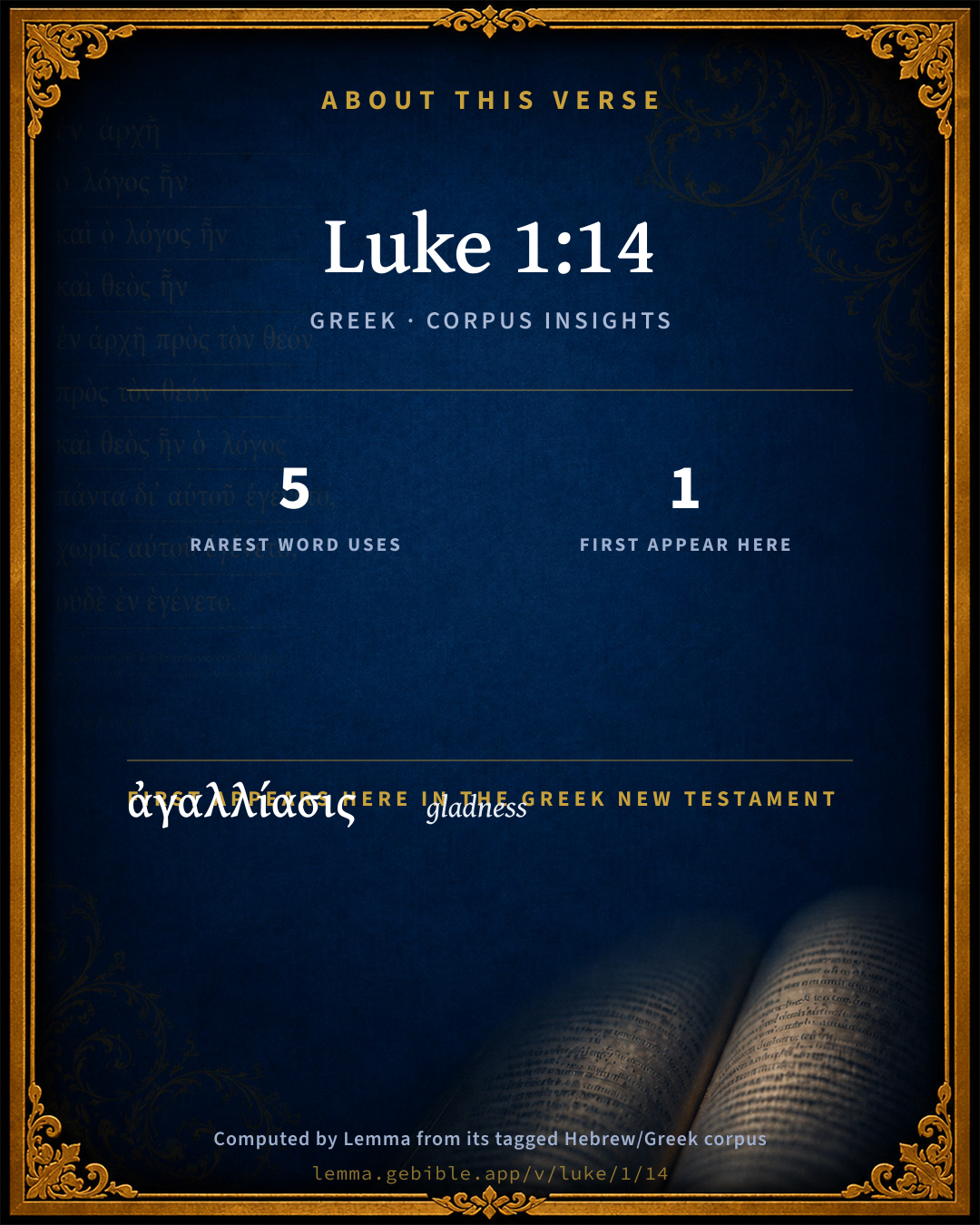
The rarest word here is ἀγαλλίασις gladness G20 — appearing just 5 times in the whole Greek New Testament.

First appearance in Scripture

This word makes its first canonical appearance in the Greek New Testament here:

  • ἀγαλλίασις gladness G20

Shared distinctive vocabulary

ἀγαλλίασις gladness G20 occurs in 5 verses of the Greek New Testament. Also found in:

Repetition

A word recurs within this verse:

Cross-references

5

Topical passages linked to Luke 1:14 in the Treasury of Scripture Knowledge — connected by theme and wording, ordered by reader-vote popularity; previews shown in the World English Bible.

  • Luke 1:58 Her neighbors and her relatives heard that the Lord had magnified his mercy towards her, and they rejoiced with her.
  • Proverbs 23:24 The father of the righteous has great joy. Whoever fathers a wise child delights in him.
  • Genesis 21:6 Sarah said, "God has made me laugh. Everyone who hears will laugh with me."
  • Proverbs 15:20 A wise son makes a father glad, But a foolish man despises his mother.
  • Proverbs 23:15 My son, if your heart is wise, Then my heart will be glad, even mine:

Cross-references courtesy of OpenBible.info (CC BY 4.0).

Commentary

Notes on Luke 1:14 from classic Christian and Jewish commentators (each source and its license shown beneath its notes). The classic Christian expositions comment on the surrounding passage and are grouped to its opening verse, so a note may address several verses; the Jewish commentaries on the Tanakh (Rashi and others) are per-verse, so they appear only where the commentator wrote on this verse.

Lemma curates 59 commentaries, every one of them public domain or Creative Commons licensed, each selected and text-cleaned for this edition rather than reprinted as found. About our sources →

The Biblical Illustrator

Joseph S. Exell

Luk_1:14

Many shall rejoice at his birth

An ideal child

Could some parents foresee how wicked some of their children would become, instead of rejoicing, they would grieve at their birth; they would wish they had never been born.

John, however, was to be a great comfort and honour to his parents. And many besides of their acquaintances, and of the people at large, were to rejoice when they should see that the circumstance of his birth, and of his early life, prognosticated that he was to become a public blessing. Four leading particulars are mentioned, on account of which men should rejoice.

1. His eminence in wisdom and piety. Great in the sight of the Lord. A holy and devoted servant of God, and preacher of righteousness.

2. His unworldliness. A Nazarite (Num_6:1-27.). Not only the ministers, but all the people of God, should abstain from sin, be temperate in all things, superior to earthly pleasures and cares, and a peculiar people in all respects, distinguished from men of the world.

3. His spiritual-mindedness. Conceived in sin like others, yet filled with the Holy Ghost, even from his mothers womb. Argument in favour of infant baptism: born in sin, and capable of regeneration, why should they not be admitted to the sacrament? Happy they who are indeed filled with the Holy Ghost and sanctified from infancy! They never know what it is to have a mind altogether dark, or a heart altogether depraved. They cannot remember the time when there was not in them a prevalent tendency to what is good.

4. His usefulness. Resembling Elijah

(a) in the bent of his mind;

(b) in the success of his ministry. (James Foote, M. A.)

Prophetic description of the Baptist

Here the angel declares to Zachary, what kind of son should be born unto him, even one of eminent endowments, and designed for extraordinary services. The proof of children makes them either the blessings or crosses of their parents. What greater comfort could Zachary desire in a child, than is here promised to him?

1. He hears of a son that should bring joy, to himself and many others; even to all who expected the coming of the Messiah, whose forerunner the Baptist was.

2. That he should be great in the sight of the Lord: that is, a person of great eminence and great usefulness in the Church. A person of great riches and reputation is great in the sight of men; but the man of great ability and usefulness, integrity and serviceableness, is truly great in the sight of the Lord. They are little men in the sight of the Lord, who live in the world to little purpose; who do little service to God, and bring little honour and glory to Him.

3. It is foretold that he should drink neither wine nor strong drink; that is, he should be a very temperate and abstemious person, living after the manner of the Nazarites, though he was not separated by any vow of his own, or his parents, but by the special designation and appointment of God only. It was forbidden the priests under the law to drink either wine or strong drink, upon pain of death, during the time of their ministration Lev_10:9). And the ministers of Christ under the gospel are forbidden to be lovers of wine (1Ti_3:3).

4. He shall be filled with the Holy Ghost from his mothers womb; that is, he shall be furnished abundantly with the extraordinary gifts of the Holy Spirit, which shall very early appear to be in him, and upon him.

5. His high and honourable office is declared; that he should go before the Messiah, as His harbinger and forerunner, with the same spirit and zeal and courage against sin, which was found in the old prophet Elias, whom he so nearly resembled.

6. The great success of his ministry is foretold; that he should turn the hearts of the fathers, &c. (W. Burkitt, M. A.)

Social joys

There is a joy which overflows the domestic goblet, and goes out to make strangers glad. Every life ought to be a social bless-rag. The religious man always is so--necessarily, because he does not live unto himself. (Dr. Parker.)

Useful lives

How many I could quote to whose labours we owe the precious discoveries which daily add to our welfare and our comfort! Who has not rejoiced at the birth of him who discovered the art, at once so wonderful, and so easy, of printing. What an agent of progress that man has been, and what treasures of knowledge he has helped to spread all over the world. And which of us, when hurried along at full speed over some of our railways towards those we love, or on a pleasant trip to some beautiful country, has not blessed the memory of Papin, the unlucky inventor of the steam engine, who suffered so much for the sake of science. (A. Decoppel.)

The Biblical Illustrator, edited by Joseph S. Exell (c. 1880s–1900s) — public domain. Text from a community e-Sword module.

Joseph Benson's Commentary

Luk 1:14-16. Thou shalt have joy and gladness — He shall be such a son as thou shalt have reason to rejoice in. As if he had said, Many parents, if they could foresee what their children will prove, instead of rejoicing at their birth, would wish they had never been. But I will tell thee what thy son will be; and then thou wilt not need to rejoice with trembling, as the best must do at the birth of their children, but thou mayest rejoice with triumph. And many shall rejoice with thee — All the relations of the family will rejoice on the occasion, and all its well-wishers; yea, and all good people, that are made acquainted with the circumstances of the case, and with the character and office the child shall bear. The word αγαλλιασις, rendered gladness, properly answers to the word exultation, or leaping for joy — See 1Pe 1:8; 1Pe 4:13; Mat 5:12. For he shall be great — A person of extraordinary eminence and usefulness, and that not only in the opinion of men, but in the sight of the Lord — The sovereign and infallible Judge. Those are great indeed, that are so in God’s sight, not those that are so in the eye of a vain and carnal world. John was to be great in respect of his character, his office, his inspiration, and the success of his ministry, as the angel here explains the expression. And shall drink neither wine nor strong drink — As he is to preach repentance, and the crucifixion of all sinful lusts, affections, and dispositions, in order to the remission of sins, he shall show mankind a pattern of that self-denial which he enjoins; wholly avoiding a delicate and self-indulging way of living, and being remarkable for his continued abstinence and mortification. By the word σικερα, here rendered strong drink, fermented liquor of every kind seems to be intended. Some would confine the term to a liquor made of dates, the fruit of the palm-tree, a drink much used in the East: but there does not appear to be any sufficient reason for such a limitation of its meaning. The word is originally Hebrew, שּׁכר, shecher, and is rendered by Buxtorf, inebrians potus, inebriating drink. All fermented liquors, therefore, as being capable of producing this effect, must be understood as implied in it. It is distinguished from wine, Lev 10:9; Num 6:3; and elsewhere. He shall be filled with the Holy Ghost from his mother’s womb — Shall be influenced by the Spirit of God, even from the instant of his birth, sanctifying his nature, and communicating into him wisdom and piety in an extraordinary measure, to qualify him for the high and important office to which he is designated. “In Scripture, to be filled with the Holy Ghost, commonly signifies, that degree of inspiration by which the prophets anciently spake. Accordingly in this chapter it is applied to Elisabeth, to Mary, and to Zacharias, in cases where they all spake by a particular afflatus. When the angel, therefore, told Zacharias that his son should be filled with the Holy Ghost even from his mother’s womb, his meaning (at least in part) was, that he should be very early inspired to teach the doctrines and precepts, of true religion. Nor will this seem strange, when it is remembered, that at the age of twelve years our Lord exercised his prophetical gifts among the doctors in the temple.” — Macknight. Many of the children of Israel shall he turn — By true repentance and unfeigned faith, productive of new obedience; to the Lord their God — Whose ways they have so generally forsaken, even while they are professing themselves to be his peculiar people, and boasting in such an extraordinary relation to him. In this way John was to prove his divine mission.

Joseph Benson's Commentary on the Old and New Testaments (1811–1818) — public domain. Text from a community e-Sword module.

Bengel's Gnomon

Johann Albrecht Bengel

Luk 1:14. Χαρήσονται, shall rejoice) Luk 1:58; Luk 1:66.

Bengel's Gnomon of the New Testament — English translation (T&T Clark, Edinburgh, 1860) — public domain. Text from a community e-Sword module.

Expositor's Greek Testament

ed. W. Robertson Nicoll

Luk 1:14 . χαρά , ἀγαλλίασις , a joy, an exultation; joy in higher, highest degree: joy over a son late born, and such a son as he will turn out to be. πολλοὶ : a joy not merely to parents as a child, but to many as a man.

The Expositor's Greek Testament, edited by W. Robertson Nicoll (1897–1910) — public domain. Text from a community e-Sword module.

Jamieson, Fausset & Brown

Robert Jamieson, A. R. Fausset & David Brown

shall rejoice--so they did (Luk 1:58, Luk 1:66); but the meaning rather is, "shall have cause to rejoice"--it would prove to many a joyful event.

Jamieson, Fausset & Brown — Commentary Critical and Explanatory on the Whole Bible (1871) — public domain (CC PDM 1.0). Text via the HelloAO Bible API.

Adam Clarke's Commentary

Verse 14. Thou shalt have joy, c.] εσται χαρα σοι, He will be joy and gladness to thee. A child of prayer and faith is likely to be a source of comfort to his parents. Were proper attention paid to this point, there would be fewer disobedient children in the world and the number of broken-hearted parents would be lessened. But what can be expected from the majority of matrimonial connections, connections begun without the fear of God, and carried on without his love.

Many shall rejoice at his birth.] He shall be the minister of God for good to multitudes, who shall, through his preaching, be turned from the error of their ways, and converted to God their Saviour.

Adam Clarke's Commentary on the Bible (1810–1826) — public domain. Text from a community e-Sword/MySword module.

Ellicott's Commentary for English Readers

(14) Many shall rejoice.—The words point to what had been the priest’s prayer. He had been seeking the joy of many rather than his own, and now the one was to be fruitful in the other.

A Bible Commentary for English Readers, edited by Charles John Ellicott (1878–1897) — public domain. Text from a community e-Sword module.

The Cambridge Bible for Schools and Colleges

gen. ed. J. J. S. Perowne

14. gladness] Rather, exultation, Luk_1:44; Act_2:46; Heb_1:9.

many] The Pharisees and leading Jews did not accept John’s baptism (Luk_7:30; Mat_21:27), and his influence, except among a few, seems to have been shortlived.

“There burst he forth: ‘All ye whose hopes rely

On God, with me amid these deserts mourn,

Repent, repent, and from old errors turn!’

Who listened to his voice, obeyed his cry?—

Only the echoes which he made relent

Rang from their flinty caves Repent! repent!”

Drummond.

The Cambridge Bible for Schools and Colleges (gen. ed. J. J. S. Perowne; Cambridge University Press, 1878–1918) — public domain. Text from a community e-Sword module.

John Gill's Exposition

And thou shalt have joy and gladness,.... Not only because of his having a son; but because this his son would be the prophet of the Highest; would go before the Lord, and prepare his ways; give knowledge of salvation to many, and light to them that were in darkness, and guide their feet in the way of peace: all which, and more, he afterwards expresses in his song, whereby this part of the angel's prediction had its accomplishment:

and many shall rejoice at his birth; as the neighbours and cousins of his parents did; see Luk 1:58 and not only they, but all others, who, afterwards had knowledge of him as prophet, and as the forerunner of the Messiah.

John Gill's Exposition of the Whole Bible (1746–1763) — public domain (CC PDM 1.0). Text via the HelloAO Bible API.

Trapp's Complete Commentary

John Trapp

14 And thou shalt have joy and gladness; and many shall rejoice at his birth.

Ver. 14. Thou shalt have joy] This is not every father’s happiness. Many fathers are forced through grief for their untoward children to wish to die, as Elijah did when he sat under the juniper, and as Moses did when wearied out by the people, Num 11:15.

John Trapp, A Commentary or Exposition upon All the Books of the Old and New Testament (1647–1656) — public domain. Text from a community e-Sword module.

Albert Barnes' Notes on the Bible

Many shall rejoice at his birth - This does not refer so much to the time of his birth as to the subsequent rejoicing. Such will be his “character,” that he will be an honor to the family, and many will rejoice that he lived: or, in other words, he will be a blessing to mankind.

Albert Barnes' Notes on the Bible (1834–1885) — public domain. Text from a community e-Sword/MySword module.

Haydock's Catholic Bible Commentary

This was fulfilled not only at his birth, but ever after by the Catholic Church, celebrating his nativity. (Haydock)

George Leo Haydock (1774–1849), Haydock's Catholic Family Bible and Commentary, 1859 edition — public domain. Excludes Psalms (Douay-Rheims chapter numbering differs from Protestant) and Deuterocanonical books (Catholic canon only).

Matthew Poole's English Annotations

None ought to have so mean thoughts of these words of the angel, as to think that they are only expressive of that affection which commonly discovereth itself in us when God giveth us sons, especially after a long barrenness, but of a further joy and gladness his parents should have upon a spiritual account, afterwards expressed.

Many shall rejoice at his birth: they rejoiced in his light, Joh 5:36, the glad tidings of the Messiah being come into the world, which he brought. The papists think they have a ground here for their holy day they keep to his honour, and their apish, carnal rejoicing, which certainly was not so valuable a thing as for an angel to foretell. The angel speaks of the great acceptation with the people (many of them) which John’s doctrine should have, so that, as our Saviour saith, from his days the kingdom of heaven suffered violence, and the violent did take it by force. But he further openeth his meaning in the following verses.

Matthew Poole's English Annotations on the Holy Bible (1683–1685) — public domain. Text from a community e-Sword/MySword module.

The Pulpit Commentary

Many shall rejoice at his birth. The gladness which his boy"s birth was to bring with it was to be no mere private family rejoicing. The child of his old age, who was to be born, would be the occasion of a true national joy.

The Pulpit Commentary (1880–1919), ed. H.D.M. Spence-Jones & Joseph S. Exell — public domain. Text from a community e-Sword module.

Burkitt's Expository Notes on the New Testament

William Burkitt

Here the angel declares to Zacharias, what kind of son should be born unto him, even one of eminent endowments, and designed for extraordinary services. The proof of children makes them either the blessings or crosses of their parents. What greater comfort could Zacharias desire in a child, than is here promised to him?

1. He hears of a son that should bring joy to himself, and many others; even to all that did expect the coming of the Messias, whose forerunner the Baptist was.

2. That he should be great in the sight of the Lord; that is, a person of great eminency, and great usefulness, in the church.

A person of great riches and reputatuion is great in the sight of men; but the man of great ability and usefulness, the man of great integrity and serviceableness, he is truly great in the sight of the Lord. They are little men in the sight of the Lord, that live in the world to little purposes; who do little service to God, and bring little honour and glory to him. But the man that does all the possible service he can for God, and the utmost good he is capable of doing to all mankind; he is a person great in the sight of the Lord; and such was the holy Baptist.

3. It is foretold, that he should neither drink wine nor strong drink, that is, that he should be a very temperate and abstemious person, living after the manner of the Nazarites, though he was not separated by any vow of his own or his parents; but by the special designation and appointment of God only, it was forbidden the priest, under the law, to drink either wine or strong drink, upon pain of death, during the time of their ministration, Lev 10:9 and the ministers of Christ under the gospel, are forbidden to be lovers of wine. 1Ti 3:3.

4. He shall be filled witt he Holy Ghost from his mother’s womb; that is, he shall be furnished abundantly with the extraordinary gifts and sanctifying graces of the Holy Spirit, which shall very early appear to be in him, and upon him.

5. His high and honourable office is declared, that he shall go before the Messias, as his harbinger and fore-runner, with the same spirit of zeal and courage against sin, which was found in the old prophet Elias, whom he did so nearly resemble.

6. The great success of his ministry is foretold, namely, That he should turn the hearts of the fathers to the children, and the disobedient to the wisdom of the just; that is, the hearts of the Jews to the Gentiles, say some; that he should bring men say others, even the most disobedient and rebellious Pharisees and Sadducees, Publicans and sinners, unto repentance, unto the minding of justice and righteousness, and all moral duties; and thus he made ready a people for the Lord, by fitting men to receive Christ upon his own terms and conditions; namely, faith and repentance.

From the whole, note, that those whom Almighty God designs for eminent usefulness in his church, he furnishes with endowments suitable to their employemnt; and when he calls to extraordinary service, comes in with more than ordinary assistance. Here was the holy Baptist extraordinarily called, and as extraordinarily furnished, for his office and ministry.

William Burkitt's Expository Notes on the New Testament (1700–1703) — public domain. Text from a community e-Sword module.

unfoldingWord translationNotes

Door43 World Missions Community

For he will be great

"This is because. he will be great" Zechariah and the "many" will rejoice because John will be "great in the sight of the Lord." The rest of verse 15 tells how God wants John to live.

You will have joy and gladness

The words "joy" and "gladness" mean the same thing and are used to emphasize how great the joy will be. AT: "you will have great joy" or "you will be very glad" (See: Doublet)

at his birth

"because of his birth"

he will be great in the sight of the Lord

"he will be a very important person for the Lord" or "God will consider him to be very important"

he will be filled with the Holy Spirit

This can be stated in active form. AT: "the Holy Spirit will empower him" or "the Holy Spirit will guide him" Make sure it does not sound similar to what an evil spirit might do to a person. (See: Active or Passive)

from his mother's womb

"even while he is in his mother's womb" or "even before he is born"

translationWords

joy

wine

strong drink

filled with the Holy Spirit

womb

unfoldingWord translationNotes — © Distant Shores Media and the Door43 World Missions Community, licensed CC BY-SA 4.0. Source: git.door43.org/Door43/en_tn.

Cambridge Greek Testament for Schools and Colleges

14. ἀγαλλίασις. ‘Exultation,’ Luk 1:44; Act 2:46; Heb 1:9.

πολλοί. The Pharisees and leading Jews did not accept John’s baptism (Luk 7:30; Mat 21:27), and his influence, except among a few, seems to have been shortlived.

“There burst he forth: ‘All ye whose hopes rely

On God, with me amid these deserts mourn,

Repent, repent, and from old errors turn!’

Who listened to his voice, obeyed his cry?—

Only the echoes which he made relent

Rang from their flinty caves Repent! repent!”

DRUMMOND.

Cambridge Greek Testament for Schools and Colleges (Cambridge University Press, 1896; 21 vols, various authors incl. Carr, Maclear, Plummer, Farrar, Lumby, Moule, M. R. James, Simcox) — public domain. Text from a community e-Sword module.

International Critical Commentary

14. πολλοὶ ἐπὶ τῇ γενέσει αὐτοῦ χαρήσονται. With the πολλοί here contrast παντὶ τῷ λαῷ in 2:10. The joy at the appearance of a Prophet after centuries of need was immense, although not universal. The Pharisees did not dare to say that John was not a Prophet (Mat 21:26); and Herod, until driven to it, did not dare to put him to death (Mat 14:5). The word ἀγαλλίασις means “extreme joy, exultation.” It is not class., but is freq. in LXX. Elsewhere in N.T. only ver. 44; Act 2:46; Jud 1:24; Heb 1:9 (from Psa 44:8).

In class. Grk. χαίρειν more often has the simple dat., but ἐπί is usual in N.T. (13:17; Act 15:31; Mat 18:13, etc.). It marks the basis of the joy. The reading γεννήσει (G C G) for γενέσει (א A B C D) probably comes from γεννήσει in ver. 13.

International Critical Commentary — older volumes (1896–1929), various authors — public domain. Text from a community e-Sword module.

Vincent's Word Studies in the New Testament

Marvin R. Vincent

Joy and gladness [χαρα και αγαλλιασις] . The latter word exprsses exultant joy. See on 1Pe 1:6.

Marvin R. Vincent, Word Studies in the New Testament (1887–1900) — public domain. Text from a community e-Sword/MySword module.

Lesson kit

Teaching starters — assembled from the data on this page, not authored interpretation. Every prompt links to the verse data it draws on. Edit before teaching.

Luke, in the Gospels, opens this verse with 13 words (11 distinct Greek lemmas). Its most distinctive word is agallíasis (“gladness”). A historical commentator’s framing appears above. Read the whole chapter for the surrounding context.

Discussion questions

  1. The word agallíasis carries the sense “gladness.” How does it shape the verse?
  2. This is the first place “gladness” appears in Scripture (first appears here). What does its debut here establish?
  3. How does Luke 1:44, which shares the word «gladness», read alongside this verse?
  4. What does the repetition of “and” (3× in this one verse) do in this verse?
  5. These translations render this verse differently; the difference is in the English rendering, not the original. What questions does that raise?
  6. Compare how The Biblical Illustrator and Joseph Benson's Commentary read this verse. Where do they agree or differ?

Things to notice

  • 1 word makes its first canonical appearance in Scripture here.
  • These translations choose different wording for 5 words in this verse.
  • “and” occurs 3× in this single verse.
  • 11 distinct Greek lemmas span 13 words in this verse.

Reading settings

Reading text

Shown beneath each verse's original-language words.

Old Testament
Old Testament edition

Read the OT as the Masoretic Hebrew (MT) or the Greek Septuagint (LXX).

English shown for the Greek Septuagint (in the Hebrew ↔ Greek comparison).

Comparing translations? Open the Compare panel on any verse page to stack up to four side by side.