
Matthew 27:19

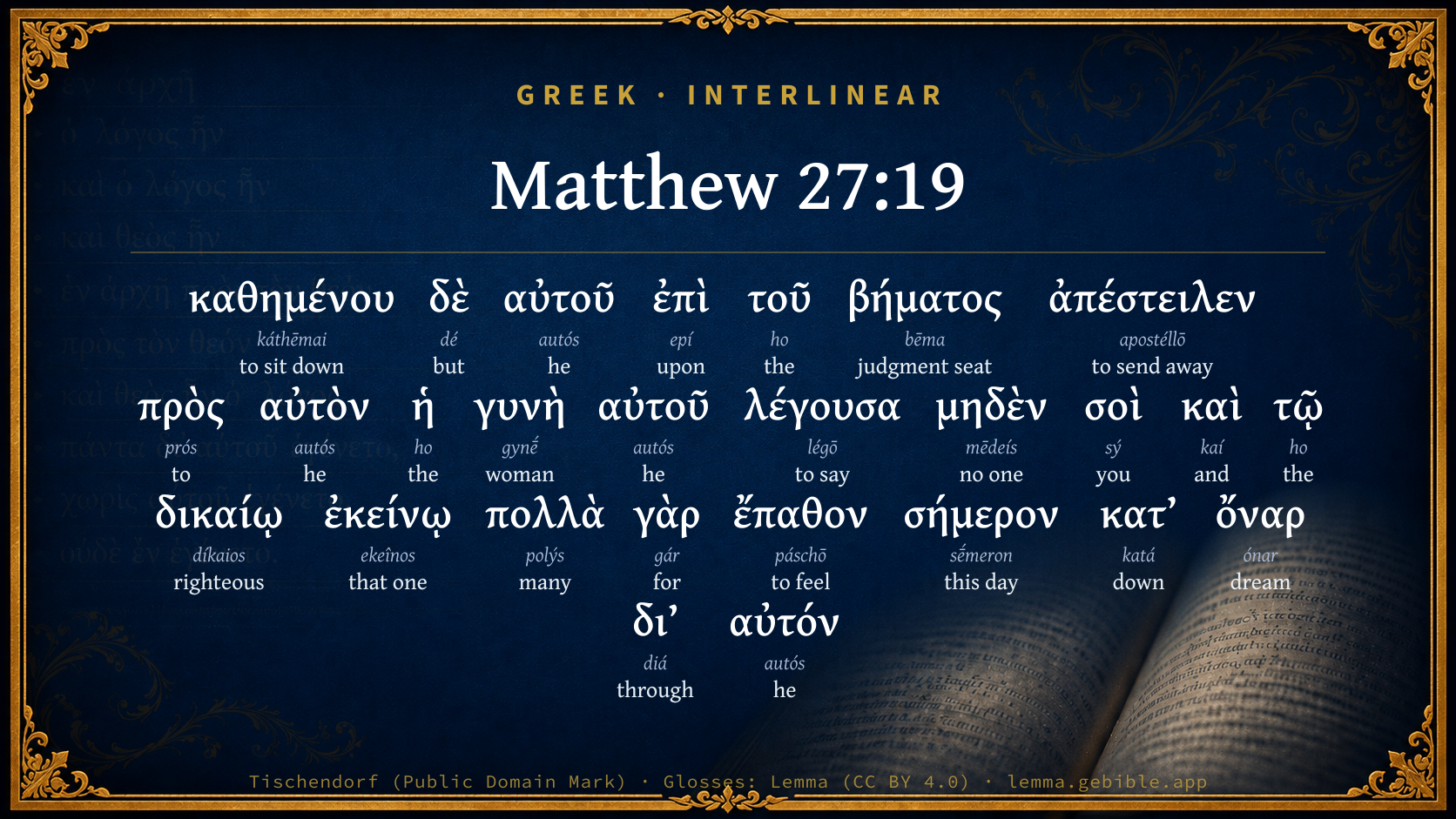
Greek (Tischendorf 8th ed.) Matthew 27:19 appears in the Greek New Testament. The text above is from the Tischendorf 8th edition. Each word links to its Strong’s number and a concise gloss. Click any word for its full Thayer’s Greek Lexicon entry.
Download image
Cite this verse

Matthew 27:19 (World English Bible). Public Domain. Lemma interlinear Bible study tool, https://lemma.gebible.app/v/matthew/27/19.

Show BibTeX & RIS
BibTeX
RIS
English Translation
While he was sitting on the judgment seat, his wife sent to him, saying, "Have nothing to do with that righteous man, for I have suffered many things this day in a dream because of him."
World English Bible · Public Domain
Highlights
  • 1 first appearance in the Greek New Testament
Full analysis ↓
Download a study sheet

One document with this verse’s original text, its word-by-word gloss line, the meaning frame, cross-references with their text, attributed commentary, and full source and license credits — printable, and it pastes into notes with its structure intact.

This verse Autodidact and up

Study sheet (.html) Plain text (.txt)

A passage Seminary Student

Up to 50 verses in one chapter. A passage sheet keeps up to 6 commentary sources and 12 cross-references per verse, in the order this page ranks them, and says so on the sheet whenever that leaves anything out. Ask for a single verse and you get the Autodidact verse sheet above.

Everything on this page stays free to read, with no account — the sheet is a download of what is already on screen, not access to it.

Want to remove ads? Support Godless Engineer
Compare translations 3

The same verse in 3 English versions, stacked beneath the original-language interlinear above. Click any original word for its lexicon entry.

Each is an independent rendering of the whole verse — the interlinear is not word-aligned to these translations.

Highlighted words mark where these versions differ — a whole-verse word diff, not a word-by-word alignment.

  • World English Bible Public Domain
    While he was sitting on the judgment seat, his wife sent to him, saying, "Have nothing to do with that righteous man, for I have suffered many things this day in a dream because of him."
  • King James Version Public Domain
    When he was set down on the judgment seat, his wife sent unto him, saying, Have thou nothing to do with that just man: for I have suffered many things this day in a dream because of him.
  • unfoldingWord Literal Text CC BY-SA 4.0
    Now, he sitting on the judgment seat, his wife sent to him, saying, “Nothing to you and to that righteous one, for I suffered many today because of him by means of a dream.”

unfoldingWord Literal Text — © unfoldingWord, licensed CC BY-SA 4.0. Word-aligned USFM3 via Door43 (git.door43.org/unfoldingWord/en_ult).

Versions to compare (up to 4)

3 of 4 selected

Show all 19 translations

Every available English version of this verse, each an independent rendering of the whole verse.

  • World English Bible Public Domain
    While he was sitting on the judgment seat, his wife sent to him, saying, "Have nothing to do with that righteous man, for I have suffered many things this day in a dream because of him."
  • Berean Standard Bible Public Domain
    While Pilate was sitting on the judgment seat, his wife sent him this message: “Have nothing to do with that innocent man, for I have suffered terribly in a dream today because of Him.”
  • Majority Standard Bible Public Domain
    While Pilate was sitting on the judgment seat, his wife sent him this message: “Have nothing to do with that innocent man, for I have suffered terribly in a dream today because of Him.”
  • King James Version Public Domain
    When he was set down on the judgment seat, his wife sent unto him, saying, Have thou nothing to do with that just man: for I have suffered many things this day in a dream because of him.
  • American Standard Version (1901) Public Domain
    And while he was sitting on the judgment-seat, his wife sent unto him, saying, Have thou nothing to do with that righteous man; for I have suffered many things this day in a dream because of him.
  • Revised Version (1885) Public Domain
    And while he was sitting on the judgment-seat, his wife sent unto him, saying, Have thou nothing to do with that righteous man: for I have suffered many things this day in a dream because of him.
  • Geneva Bible (1599) Public Domain
    Also when he was set downe vpon the iudgement seate, his wife sent to him, saying, Haue thou nothing to do with that iust man: for I haue suffered many things this day in a dreame by reason of him.)
  • Douay-Rheims (1899) Public Domain
    And as he was sitting in the place of judgment, his wife sent to him, saying: Have thou nothing to do with that just man; for I have suffered many things this day in a dream because of him.
  • Young's Literal Translation Public Domain
    And as he is sitting on the tribunal, his wife sent unto him, saying, `Nothing -- to thee and to that righteous one, for many things did I suffer to-day in a dream because of him.'
  • Literal Standard Version CC BY-SA 4.0
    And as he is sitting on the judgment seat, his wife sent to him, saying, “Nothing—to you and to that Righteous One, for I suffered many things today in a dream because of Him.”
  • Unlocked Literal Bible CC BY-SA 4.0
    While he was sitting on the judgment seat, his wife sent word to him and said, “Have nothing to do with that innocent man. For I have suffered much today because of a dream I had about him.”
  • unfoldingWord Literal Text CC BY-SA 4.0
    Now, he sitting on the judgment seat, his wife sent to him, saying, “Nothing to you and to that righteous one, for I suffered many today because of him by means of a dream.”
  • Darby Bible Public Domain
    But, as he was sitting on the judgment-seat, his wife sent to him, saying, Have thou nothing to do with that righteous [man]; for I have suffered to-day many things in a dream because of him.
  • World Messianic Bible Public Domain
    While he was sitting on the judgment seat, his wife sent to him, saying, “Have nothing to do with that righteous man, for I have suffered many things today in a dream because of him.”
  • Webster's Bible Public Domain
    When he was sitting on the judgment-seat, his wife sent to him, saying, Have thou nothing to do with that just man: for I have suffered many things this day in a dream, because of him.
  • Free Bible Version CC BY-SA 4.0
    While he was sitting on the judge's seat, his wife sent a message to him that said, “Don't do anything to this innocent man, for I've suffered terribly today as a result of a dream about him.”
  • Bible in Basic English Public Domain
    And while he was on the judge's seat, his wife sent to him, saying, Have nothing to do with that upright man, for I have had much trouble this day in a dream because of him.
  • Text-Critical English NT CC BY 4.0
    While Pilate was sitting on the judgment seat, his wife sent him this message: “Have nothing to do with that righteous man, for I have suffered a great deal today in a dream because of him.”
  • Tyndale New Testament (1534) Public Domain
    When he was set doune to geve iudgement his wyfe sent to him sayinge: have thou nothinge to do with that iuste man. For I have suffered many thinges this daye in a dreame about him.

Literal Standard Version (2020), Covenant Press — licensed CC BY-SA 4.0. Text via the HelloAO Bible API (eBible.org). Unlocked Literal Bible (unfoldingWord) — licensed CC BY-SA 4.0. Text via the HelloAO Bible API (eBible.org). unfoldingWord Literal Text — © unfoldingWord, licensed CC BY-SA 4.0. Word-aligned USFM3 via Door43 (git.door43.org/unfoldingWord/en_ult). Free Bible Version, Dr. Jonathan Gallagher — licensed CC BY-SA 4.0. Text via the HelloAO Bible API (eBible.org).

Word by word

More ways to search: Search by grammar → Find every occurrence → Compare this word →

Practice this passage: Drill this verse → Learn its vocabulary →

ὄναρ
ónar
G3677
“dream”
Noun, Indeclinable
Part of Speech
Noun · Indeclinable
Full Thayer's Definition

Origin: of uncertain derivation

TDNT: 08:40,7

1. a dream
  1. καθημένου káthēmai G2521 “to sit down” Verb, Present, Middle or Passive deponent, Participle, Genitive, Singular, Masculine
  2. δὲ dé G1161 “but” Conjunction
  3. αὐτοῦ autós G846 “he” Personal pronoun, Genitive, Singular, Masculine
  4. ἐπὶ epí G1909 “upon” Preposition
  5. τοῦ ho G3588 “the” Article, Genitive, Singular, Neuter
  6. βήματος bēma G968 “judgment seat” Noun, Genitive, Singular, Neuter
  7. ἀπέστειλεν apostéllō G649 “to send away” Verb, Aorist, Active, Indicative, 3rd person, Singular
  8. πρὸς prós G4314 “to” Preposition
  9. αὐτὸν autós G846 “he” Personal pronoun, Accusative, Singular, Masculine
  10. ἡ ho G3588 “the” Article, Nominative, Singular, Feminine
  11. γυνὴ gynḗ G1135 “woman” Noun, Nominative, Singular, Feminine
  12. αὐτοῦ autós G846 “he” Personal pronoun, Genitive, Singular, Masculine
  13. λέγουσα légō G3004 “to say” Verb, Present, Active, Participle, Nominative, Singular, Feminine
  14. μηδὲν mēdeís G3367 “no one” Adjective, Nominative, Singular, Neuter, Negative
  15. σοὶ sý G4771 “you” Personal pronoun, 2nd person, Dative, Singular
  16. καὶ kaí G2532 “and” Conjunction
  17. τῷ ho G3588 “the” Article, Dative, Singular, Masculine
  18. δικαίῳ díkaios G1342 “righteous” Adjective, Dative, Singular, Masculine
  19. ἐκείνῳ ekeînos G1565 “that one” Demonstrative pronoun, Dative, Singular, Masculine
  20. πολλὰ polýs G4183 “many” Adjective, Accusative, Plural, Neuter
  21. γὰρ gár G1063 “for” Conjunction
  22. ἔπαθον páschō G3958 “to feel” Verb, Aorist, Active, Indicative, 1st person, Singular
  23. σήμερον sḗmeron G4594 “this day” Adverb
  24. κατ’ katá G2596 “down” Preposition
  25. δι’ diá G1223 “through” Preposition
  26. αὐτόν autós G846 “he” Personal pronoun, Accusative, Singular, Masculine

About this verse

These counts appear in no published source. They are computed here, from the morphology-tagged text and Lemma’s own curated glosses. What Lemma adds →

27
words
22
distinct lemmas
Gospels
section

Notable vocabulary

The rarest word here is ὄναρ dream G3677 — appearing just 6 times in the whole Greek New Testament.

First appearance in Scripture

This word makes its first canonical appearance in the Greek New Testament here:

  • βήματος judgment seat G968

Shared distinctive vocabulary

ὄναρ dream G3677 occurs in 6 verses of the Greek New Testament. Also found in:
Repetition

Words recur within this verse:

  • αὐτοῦ he G846 ×4
  • τοῦ the G3588 ×3

Cross-references

19

Topical passages linked to Matthew 27:19 in the Treasury of Scripture Knowledge — connected by theme and wording, ordered by reader-vote popularity; previews shown in the World English Bible.

  • Zechariah 9:9 Rejoice greatly, daughter of Zion! Shout, daughter of Jerusalem! Behold, your king comes to you! He is righteous, and having salvation; Lowly, and riding on a donkey, Even on a colt, the foal of a donkey.
  • Proverbs 29:1 He who is often rebuked and stiffens his neck Will be destroyed suddenly, with no remedy.
  • 1 Peter 2:22 who did not sin, "neither was deceit found in his mouth."
  • Matthew 27:24 So when Pilate saw that nothing was being gained, but rather that a disturbance was starting, he took water, and washed his hands before the multitude, saying, "I am innocent of the blood of this righteous person. You see to it."
  • Genesis 20:3–6 But God came to Abimelech in a dream of the night, and said to him, "Behold, you are a dead man, because of the woman whom you have taken. For she is a man's wife."
  • Genesis 31:24 God came to Laban, the Syrian, in a dream of the night, and said to him, "Take heed to yourself that you don't speak to Jacob either good or bad."
  • Genesis 31:29 It is in the power of my hand to hurt you, but the God of your father spoke to me last night, saying, 'Take heed to yourself that you don't speak to Jacob either good or bad.'
  • Numbers 12:6 He said, Hear now my words: if there be a prophet among you, I Yahweh will make myself known to him in a vision, I will speak with him in a dream.
  • Job 33:14–17 For God speaks once, Yes twice, though man pays no attention.
  • Isaiah 53:11 He shall see of the travail of his soul, [and] shall be satisfied: by the knowledge of himself shall my righteous servant justify many; and he shall bear their iniquities.
  • Matthew 1:20 But when he thought about these things, behold, an angel of the Lord appeared to him in a dream, saying, "Joseph, son of David, don't be afraid to take to yourself Mary, your wife, for that which is conceived in her is of the Holy Spirit.
  • Matthew 2:12–13 Being warned in a dream that they shouldn't return to Herod, they went back to their own country another way.
  • Matthew 2:19 But when Herod was dead, behold, an angel of the Lord appeared in a dream to Joseph in Egypt, saying,
  • Matthew 2:22 But when he heard that Archelaus was reigning over Judea in the place of his father, Herod, he was afraid to go there. Being warned in a dream, he withdrew into the region of Galilee,
  • Matthew 27:4 saying, "I have sinned in that I betrayed innocent blood." But they said, "What is that to us? You see to it."
  • Luke 23:47 When the centurion saw what was done, he glorified God, saying, "Certainly this was a righteous man."
  • John 19:13 When Pilate therefore heard these words, he brought Jesus out, and sat down on the judgment seat at a place called "The Pavement," but in Hebrew, "Gabbatha."
  • 1 John 2:1 My little children, I write these things to you so that you may not sin. If anyone sins, we have a Counselor with the Father, Jesus Christ, the righteous.
  • Luke 23:41 And we indeed justly, for we receive the due reward for our deeds, but this man has done nothing wrong."

Cross-references courtesy of OpenBible.info (CC BY 4.0).

Commentary

Notes on Matthew 27:19 from classic Christian and Jewish commentators (each source and its license shown beneath its notes). The classic Christian expositions comment on the surrounding passage and are grouped to its opening verse, so a note may address several verses; the Jewish commentaries on the Tanakh (Rashi and others) are per-verse, so they appear only where the commentator wrote on this verse.

Lemma curates 59 commentaries, every one of them public domain or Creative Commons licensed, each selected and text-cleaned for this edition rather than reprinted as found. About our sources →

The Biblical Illustrator

Joseph S. Exell

Mat_27:19

His wife sent unto him saying, Have thou nothing to de with that just man.

Pilates wife

I. The testimony of women to Christ.

II. The testimony of dreams to Christ.

III. The testimony of suffering to Christ-Have thou nothing to do with that just man: for I have suffered many things, etc. The wife failed; but it was well to have tried. (G. T. Coster.)

The dream of Pilates wife

I. Let us observe her dream as a sign that various obstacles are placed in the way of completing sin.

II. Let us observe the dream as a sign that continuance in sin depends upon injustice done to Jesus Christ. (D. G. Watt, M. A.)

It is easier to do right than wrong

Is there one of you who would seriously maintain that it is easier to drive a horse and cart over a steep embankment than it is to drive along the road on the top of the embankment? Oh yes, you say, the former is easier! It is but a plunge, and you have done it. But then, you must consider how many obstacles you have to overcome before you can take the plunge, and- these obstacles make it a harder thing to go over than to go along the road. The beaten road says: I am the way; you must not leave me. You will have to overcome the obstacle which that clear statement raises. There is certain damager to limb and life-you will have to overcome the obstacle which respect for your own safety raises. The horse, if it has been properly driven, will back off from sharp descent. You will have to overcome the obstacle which the animal raises. Putting together the forces which are exerted by such matters, you will acknowledge that it is not fair to say that it is easier to drive over a precipice than it is to drive along the road which skirts its summit. Just so is it with us in life. Right and wrong solicit us. It may appear more easy to submit to the representations of evil impulses than to those of good; but, however it may appear, remember that before you can yield to the former you must have cast off the restraint of a law of God; you must have stifled your desires to be truly happy; you must have broken away from the influences which proceed from those of your friends who stand in awe of the Christ of God. (D. G. Watt, M. A.)

The warning word to be welcomed

Put not this word from you. If-to use one of Dr. Paysons illustrations-you should see at this moment a very fine, an almost invisible thread coming down from heaven and attaching itself to you, and knew it came from God, what would you do? Would you dare to thrust it away? Now, this word of appeal is like such a thread. It is weak and frail, and you can easily brush it away. But will you? No! Welcome it, and it will enlarge and strengthen itself until it becomes a golden thread to bind you to that just Man-the Saviour-and to bind you for ever. (G. T. Coster.)

Pilates wife

The wickedness of Pilate forced him to assume all the appearance of weakness. How striking the testimony given by enemies to our Lord; He is to die as a malefactor with the judges verdict in His favour.

I. The great principle of conscience was not dormant in Pilate, but on the contrary acted with faithfulness and vigour. Whatever the sensuality and tyranny of this Roman he had not succeeded in silencing conscience. The enormity of his sin is also enhanced by the warning he received through his wife.

II. We consider God as acting upon Pilate to deter him from committing a great crime, and therefore to leave him without excuse in the commission. God has nothing to do with causing the wicked actions he overrules. No man can take refuge in Gods foreknowledge of his sins, as having made them unavoidable. It left Pilate as free as if there had been no foreknowledge.

III. How the method used by God was eminently fitted to prevail with Pilate, and how it cut off all excuse when he gave up Jesus to the multitude. It may seem singular that the vision was to Pilates wife, and net to Pilate himself. Would not the admonition have been more likely to prevail if directly conveyed to him? But to please his wife may have been a motive in addition to obedience to the vision. God took this course because the Roman governor was probably most accessible through his affections. It is far from an unfrequent thing that God causes His warnings to be conveyed through the channel of the affections. One member of the family is saved in order to impress another. If this does not succeed, there remains no more likely method. Let not men think it would be better if they were acted upon directly by the gospel.

IV. How greatly it increased the criminality of Pilate that the message of his wife reached him at the very moment of his taking his place on the judgment seat. It was precisely when his convictions were urging him to release Christ, that there came to him a testimony to His innocence. When men are tempted God sends seasonable aids and disposes events for their strength and victory. The whole judicature of conscience is constructed on the principle of counsel being given at the precise moment when temptation is urgent. It remonstrates at the moment the bait allures. What a scene will it be when this Roman stands forth to answer for himself at the tribunal of Christ. How changed their condition. Christ will then be in glory and power. (H. Melvill, B. D.)

The Biblical Illustrator, edited by Joseph S. Exell (c. 1880s–1900s) — public domain. Text from a community e-Sword module.

Joseph Benson's Commentary

Mat 27:19-20. When he was set down, &c. — While Pilate was labouring to effect his purpose, he was confirmed in his unwillingness to condemn Jesus, by a message sent from his wife by way of caution; which message was probably delivered to him publicly, in the hearing of all present, for it was intended to be a warning, not to him only, but to the prosecutors: saying, Have thou nothing to do with that just man — Gr. τω δικαιω, that righteous man; an honourable testimony this, not only to our Lord’s innocence, but to his virtue and universal goodness, given even at a time when he was persecuted as the worst of malefactors. And, when his friends were afraid to appear in his defence, God made even those that were strangers and enemies to speak in his favour: when Peter denied him, Judas confessed him; when the chief priests pronounced him guilty of death, Pilate declared he found no fault in him; when the women that loved him stood afar off, Pilate’s wife, that knew little of him, showed a concern for him! Observe, reader, God will not leave himself without witnesses to the truth and equity of his cause, even when it seems to be most spitefully run down by its enemies, and most shamefully deserted by its friends. I have suffered many things this day in a dream because of him — Whether she dreamed of the cruel usage of an innocent person, or of the judgments that were about to fall upon those that had any hand in his death, or both, her dream, it seems, was very frightful and distressing, and made such an impression on her mind, that she could not be easy till she had sent an account of it to her husband, who was sitting on the tribunal in the pavement. And the special providence of God must be acknowledged in sending this remarkable dream at this time; for it is not likely that she had heard any thing before concerning Christ, at least not so as to occasion her dreaming of him, but that the dream was immediately from God. She might, indeed, be one of those termed devout and honourable women, and might have some sense of religion; yet God sometimes revealed himself to some that had not, as to Pharaoh and Nebuchadnezzar. Be this as it may, her message was a fair warning to Pilate, and by it and similar instances we learn, that, as the Father of spirits has many ways of access to the spirits of men, and can give them instruction even in a dream, or vision of the night; so he has many ways of giving checks to sinners in their sinful pursuits; and it is a great mercy to have such checks, whether from the word of God, or from his providence, or from faithful friends, or from our own consciences, or in any other way. The people had not yet said whether they would have Jesus or Barabbas released to them. Therefore, when Pilate received his wife’s message, he called the chief priests and rulers together, and in the hearing of the multitude made a speech to them, wherein he gave an account of the examination which Jesus had undergone at his tribunal and at Herod’s, and declared that in both courts the trial had turned out honourably for his character. Wherefore he proposed to them that he should be the object of the people’s favour. See Luk 23:13-17. But the chief priests, &c., persuaded the multitude, both by themselves and their emissaries, whom they sent abroad among them, that they should ask Barabbas, and destroy Jesus — Suggesting, doubtless, that he was an impostor in league with Satan; an enemy to their church and temple; that if he were let alone, the Romans would come and take away their place and nation; that Barabbas, though an ill man, yet, not having the interest that Jesus had, could not do so much mischief. Thus they managed the mob, who otherwise were well affected to Jesus, and, if they had not been so much at the beck of their priests, would never have done such a preposterous thing as to prefer Barabbas before Jesus. Here, 1st, We cannot but look upon these wicked priests with indignation. By the law, in certain matters of controversy, the people were to be guided by the priests, and to do as they directed them, Deu 17:8. This great power, put into their hands, they wretchedly abused, and the leaders of the people caused them to err. 2d, We cannot but look upon the deluded people with pity, to see them hurried on thus violently to such great wickedness, and failing into the ditch with their blind leaders!

Joseph Benson's Commentary on the Old and New Testaments (1811–1818) — public domain. Text from a community e-Sword module.

Tyndale Open Study Notes

Tyndale Open Resources

27:19 through a terrible nightmare (cp. 1:20): It is ironic that a pagan recognizes and takes a stand for Jesus’ innocence, while the Jewish crowd does not.

Tyndale Open Study Notes — © Tyndale Open Resources, licensed CC BY-SA 4.0. Text via the HelloAO Bible API.

Bengel's Gnomon

Johann Albrecht Bengel

Mat 27:19. Καθημένου δὲ αὐτοῦ, κ.τ.λ., but when he was set down, etc.) In the very moment of urgent business and impending decision. Warnings of a strange and marvellous character ought not to be neglected in times of noisy excitement.—ἐπὶ τοῦ βήματος, on the judgment-seat) Great was the influence of the dream, the purport of which, however, the woman understood better after the matter had begun to come to pass. Perhaps she had the dream when Pilate was already engaged in the business.—λέγουσα, κ.τ.λ., saying, etc.) A great benefit was offered by this warning to the governor, in contradistinction to the Jews, who had been sufficiently warned from other sources.[1186]—τῷ δικαίῳ ἐκείνῳ, to that righteous man) Thus Pilate also calls Him in Mat 27:24, with a feeble reference to these words of his wife.

[1186] μηδὲν, nothing) saith she, in one word. So Pilate, in the business itself, ought to have taken the conscientious course without delay.—V. g. [Vacillation and hesitancy between conscience and love of popularity were his temptation in this case.—ED.]

Bengel's Gnomon of the New Testament — English translation (T&T Clark, Edinburgh, 1860) — public domain. Text from a community e-Sword module.

Meyer's Critical & Exegetical Commentary

Heinrich August Wilhelm Meyer

Mat_27:19 Before, Pilate had submitted the question of Mat_27:17 to the consideration of the people by way of sounding them. Now, he seats himself upon the tribunal (upon the λιθόστρωτον, Joh_19:13) for the purpose of hearing the decision of the multitude, and of thereafter pronouncing sentence. But while he is sitting on the tribunal, and before he had time again to address his question to the multitude, his wife sends, etc. This particular is peculiar to Matthew; whereas the sending to Herod, and that before the proposal about the release, occurs only in Luke (Mat_23:6 ff.); and as for John, he omits both those circumstances altogether, though, on the whole, his account of the trial before Pilate is much more detailed than the concise narrative of Matthew, and that without any want of harmony being found between the two evangelists.

ἡ γυνὴ αὐτοῦ] for since the time of Augustus it was customary for Roman governors to take their wives with them into the provinces Tacit. Ann. iii. 33 f. According to tradition, the name of Pilates wife was Procla, or Claudia Procula (see Evang. Nicod. ii., and thereon Thilo, p. 522 ff.). In the Greek church she has been canonised.

λέγουσα] through her messengers, Mat_22:16, Mat_11:2.

μηδέν σοι κ. τ. δικ. ἐκ.] comp. Mat_8:29; Joh_2:4. She was afraid that a judgment from the gods would be the consequence if he had anything to do with the death of Jesu.

πολλὰ γὰρ ἔπαθον, κ.τ.λ.] This alarming dream is to be accounted for on the understanding that the governors wife, who in the Evang. Nicod. is described, and it may be correctly, as θεοσεβής and ἰουδαΐζουσα (see Tischendorf, Pilati circa Christum judic. etc. ex actis Pilat. 1855, p. 16 f.), may have heard of Jesus, may even have seen Him and felt a lively interest in Him, and may have been informed of His arrest as well as of the jeopardy in which His life was placed. There is nothing to show that Matthew intended us to regard this incident as a special divine interposition. There is the less reason for relegating it to the domain of legend (Strauss, Ewald, Scholten, Volkmar, Keim).

σήμερον] during the part of the night belonging to the current day.

κατʼ ὄναρ] see on Mat_1:20. It was a terrible morning-dream.

Meyer — Critical and Exegetical Commentary on the New Testament — English translation by Peter Christie, edited by Frederick Crombie (T&T Clark, 1880) — public domain. Text from a community e-Sword module.

Expositor's Greek Testament

ed. W. Robertson Nicoll

Mat 27:19-20 . Interlude of Pilate’s wife , in Mt. alone, probably introduced to explain the bias of Pilate in favour of Jesus apparent in the sequel (Weiss-Meyer).

Mat 27:19 . μηδὲν , etc., nothing to thee and that just one = have nothing to do with proceedings against Him. πολλὰ γὰρ : reason for the advice, an unpleasant dream in the morning ( σήμερον , to-day, early). The historicity of this incident is of course doubted, the use made of it, with embellishments, in apocryphal writings (Acta Pilati) being pressed into the service. But it is quite credible nevertheless. First, the wife of Pilate might be there, for it had become customary for wives to accompany provincial governors. Tacitus, Ann. iii. 33, 34, mentions an unsuccessful attempt in the senate to put down the practice. Second, she had a husband that much needed good advice, and would often get it from a good wife. Third, it was a womanly act.

The Expositor's Greek Testament, edited by W. Robertson Nicoll (1897–1910) — public domain. Text from a community e-Sword module.

Adam Clarke's Commentary

Verse 19. I have suffered many things - in a dream] There is no doubt that God had appeared unto this woman, testifying the innocence of Christ, and showing the evils which should pursue Pilate if this innocent blood should be shed by his authority. See Mt 27:2.

Adam Clarke's Commentary on the Bible (1810–1826) — public domain. Text from a community e-Sword/MySword module.

Ellicott's Commentary for English Readers

(19) The judgment seat.—The chair of judgment was placed upon a Mosaic pavement, and was indispensable to the official action of any provincial ruler. (Comp. Note on Joh_19:13.)

His wife sent unto him.—Under the old regime of the Republic provincial governors were not allowed to take their wives with them; but the rule had been relaxed under the Empire, and Tacitus records (Ann. iii. 33, 34) a vain attempt to revive its strictness. Nothing more is known of the woman thus mentioned; but the Apocryphal Gospel of Nicodemus (ii. 1) gives her name as Procula, and states that she was a proselyte to Judaism. The latter fact is probable enough. About this time, both at Rome and in other cities, such, e.g., as Thessalonica and Berœa (Act_17:4; Act_17:12), Jews had gained considerable influence over women of the higher classes, and carried on an active work of proselytism.

With that just man.—The word is striking, as showing the impression which had been made on Pilate’s wife by all she had seen or heard. As contrasted with priests and scribes, He was emphatically the “just,” the “righteous “One.

In a dream because of him.—Questions rise in our minds as to the nature of the dream. Was it, as some have thought, a divine warning intended to save her husband from the guilt into which he was on the point of plunging? Did it come from the Evil Spirit, as designed to hinder the completion of the atoning work? Was it simply the reflection of the day-thoughts of a sensitive and devout woman? We have no data for answering such questions, but the very absence of data makes it safer and more reverential to adopt the last view, as involving less of presumptuous conjecture in a region where we have not been called to enter. What the dream was like may be a subject for a poet’s or—as in a well-known picture by a living artist—for a painter’s imagination, but does not fall within the province of the interpreter.

A Bible Commentary for English Readers, edited by Charles John Ellicott (1878–1897) — public domain. Text from a community e-Sword module.

The Cambridge Bible for Schools and Colleges

gen. ed. J. J. S. Perowne

19. the judgment seat] = “the tribunal,” generally a raised platform in the Basilica or court where the judges sat; here a portable tribunal, from which the sentence was pronounced; it was placed on a tesselated pavement called Gabbatha (Joh_19:13).

his wife] Claudia Procula or Procla: traditions state that she was a proselyte of the gate, which is by no means unlikely, as many of the Jewish proselytes were women. By an imperial regulation provincial governors had been prohibited from taking their wives with them. But the rule gradually fell into disuse, and an attempt made in the Senate (a. d. 21) to revive it completely failed. Tac. Ann. iii. 33, 34. The dream of Pilate’s wife is recorded by St Matthew only.

The Cambridge Bible for Schools and Colleges (gen. ed. J. J. S. Perowne; Cambridge University Press, 1878–1918) — public domain. Text from a community e-Sword module.

John Gill's Exposition

But the chief priests and elders persuaded the multitude,.... Among whom the choice lay who should be released. This they did not by haranguing them, or making a public oration to them; but by sending their servants, or proper persons among them, telling them that Jesus had been examined before the sanhedrim that morning, and was found to be a blasphemer; and that the whole court had unanimously condemned him to death, and therefore it became them to act according to their decree: and besides, should this man be set free, they might suggest to them, since he has given out that he is the king Messiah, the Romans hearing of it, will be jealous of such a person, and come and take away both our place and nation, or deprive us of the privileges we have remaining: with such sort of arguments as these, it may be supposed they worked upon the common people. The Persic version reads, "commanded", instead of "persuaded",

that they should ask Barabbas to be released to them,

and destroy Jesus; for nothing short of that would satisfy them: they thirsted after his blood, and were bent upon his death: to release Barabbas, if Jesus was not destroyed, would not answer their end: they desired Barabbas's liberty for no other reason, but for the sake of the destruction of Jesus.

John Gill's Exposition of the Whole Bible (1746–1763) — public domain (CC PDM 1.0). Text via the HelloAO Bible API.

Trapp's Complete Commentary

John Trapp

19 When he was set down on the judgment seat, his wife sent unto him, saying, Have thou nothing to do with that just man: for I have suffered many things this day in a dream because of him.

Ver. 19. His wife sent unto him] There are those who think that this woman’s dream was of the devil; thereby to have hindered the work of redemption by this composition. Satan and his agents, when they cannot conquer, would fain compound. Others will have it to be a divine dream, because it was sent, say they, for the better clearing of Christ’s innocence, even while he stood at the bar; yea, for the salvation of this woman’s soul, as Theophylact is of the opinion. Opus providentiae Dei; non ut solveretur Christus, sed ut servaretur uxor.

John Trapp, A Commentary or Exposition upon All the Books of the Old and New Testament (1647–1656) — public domain. Text from a community e-Sword module.

Haydock's Catholic Bible Commentary

In a dream. We must remark, that these kind of dreams were not unusual among the Gentiles, being sent by God for some just and necessary reason; as on this occasion, that there might be a public testimony from the Gentiles, of the justice and innocence of Christ. (St. Jerome)

George Leo Haydock (1774–1849), Haydock's Catholic Family Bible and Commentary, 1859 edition — public domain. Excludes Psalms (Douay-Rheims chapter numbering differs from Protestant) and Deuterocanonical books (Catholic canon only).

Matthew Poole's English Annotations

Matthew only mentions this passage of Pilate’s wife; whether it was when Pilate sat upon the judgment seat the second time, (the story of which we have heard), or afterward, is uncertain; nor is it material. She doubtless refers to some late dream, which possibly she might have after her husband was gone from her, for he was called early. Whether this dream was caused by God for a further testimony of Christ’s innocency, or were merely natural, cannot be determined. But still the cry holdeth, Not him, but Barabbas. So much influence had the wicked priests upon the people.

Matthew Poole's English Annotations on the Holy Bible (1683–1685) — public domain. Text from a community e-Sword/MySword module.

Whedon's Commentary on the Bible

Daniel D. Whedon

19. The judgment seat — He seats himself in order to pronounce the amnesty or release of Jesus or some other person. He makes every effort in his power to induce the Jews to demand the release of Jesus, but they prefer the outlaw to the just and holy one. Judgment seat — Or tribunal erected in the open court or area before the palace, with the people before it. His wife — Her name Claudia Procula, and tradition says she was converted to Christianity by this dream. It is one of those minute coincidences which mark the accurate knowledge of the author of this Gospel, that it was only just at this time that Roman governors were allowed to have their wives with them. That just man — That innocent man. This day — Perhaps it was a morning dream, occurring to her after Pilate had gone forth upon the business which now occupied him. Morning dreams were held as specially prophetic. Stern as was the character of Pilate, it is clearly evident, as our comment on John will more fully show, that he was not a little affected by the circumstances of the trial and death of Jesus. Nor is the thought to be of course rejected that the same divine power that warned Joseph of Jesus’s birth by a dream, may have warned Pilate by the same means to beware of a share in his death.

Daniel D. Whedon (gen. ed.), Commentary on the Old and New Testaments (1874–1909) — public domain. Text from a community e-Sword module.

The Pulpit Commentary

When he was set down (was sitting) on the judgment seat. This was a curule chair placed on a raised stone platform in front of the Praetorium, where the Roman governors sat to give judgment in cases brought before them. (see Joh_19:13) It was while he was waiting to hear the decision of the multitude with respect to the selection of the prisoners that the episode that follows (mentioned alone by St. Matthew) occurs. His wife. Her name, according to ecclesiastical tradition, was Claudia, the addition of Procula being probably a mistake. In the apocryphal Gospel of Nicodemus (Mt 2) she is said to have been a convert to Judaism. Other accounts affirm that she ultimately became a Christian; and the Greek Church has canonized her, and inserted her in the Menology on October 27. It is probable that she was well acquainted with, and favourably disposed towards, the claims of Christ; and if she had impressed her husband in some degree with her own views, this fact may have influenced him to make some effort to save Jesus. Doubtless she had thought much upon the subject, and talked it over with Pilate; hence her dream was the natural sequence of that with which her mind had been filled in her waking moments, though providentially ordered. It speaks for the accuracy of the evangelist"s account, that lately the governors had been allowed to take their wives with them into their official districts, a law previously having forbidden this indulgence (see Tacitus, "Annul.," 3:33, 34). Have thou nothing to do with that just Man. Wordsworth well remarks, "In the whole history of the Passion of Christ no one pleads for him but a woman, the wife of a heathen governor, the deputy of the emperor of the world." This was another wanting given to Pilate to arrest him in his criminal cowardice. The expression used means literally, "Let there be nothing to thee and that Righteous One," which is equivalent to "Do nothing to him for which you will be hereafter sorry." I have suffered (epayon , I suffered) many things this day in a dream because of him.

It is useless to inquire the nature of her dream. From the way in which it is here introduced, and from what we know of God"s employment of dreams in other cases to communicate his will to men, we may reasonably conclude that this was divinely sent to convey a lesson to Pilate through his wife, who alone, perhaps, was able to arouse the better feelings of his heart. The mention of her suffering shows that she had some dreadful experiences to relate in connection with the fate of the righteous Jesus. As at the beginning of Christ"s life, so at its close, such communications were addressed to strangers. Pilate"s superstitious fears would be excited by this mysterious dream, but they were not able to overpower counteracting influences.

The Pulpit Commentary (1880–1919), ed. H.D.M. Spence-Jones & Joseph S. Exell — public domain. Text from a community e-Sword module.

Kretzmann's Popular Commentary

Paul E. Kretzmann

The dream of Pilate’s wife:

v. 19. When he was set down on the judgment-seat, his wife sent unto him, saying, Have thou nothing to do with that just man; for I have suffered many things this day in a dream because of Him.

Here was an interlude. The first force of the attack against Jesus had spent itself, and there was a lull in the storm. The question of Pilate was before the people. And therefore the governor, who had spent some time in the inner room with Jesus in the effort to get at the bottom of the matter, took the opportunity to sit down on the official judgment-chair, which stood elevated upon a stone pavement. He awaited the decision of the people in order to render judgment accordingly. Here he received a warning from an unexpected quarter, for his wife, terrified by a dream she had had the night before, sent to him, beseeching him to have nothing to do with the proceedings against Jesus. She calls Him a just man and wants justice for Him. But apparently this did not influence Pilate in any way. In the apocryphal Acts of Pilate, this incident is carried out very extensively and embellished strongly.

Paul E. Kretzmann, Popular Commentary of the Bible (1921–1924) — public domain. Text from a community e-Sword module.

Burkitt's Expository Notes on the New Testament

William Burkitt

There are several sorts or kinds of dreams, natural, moral, diabolical, and divine. The question is, what kind of dream this was? Not natural, all agree; some think it was diabolical, and that Satan hoped thereby to prevent the work of man’s redemption by the death of Christ. But if so, why had not Pilate the dream rather than his wife? Probably this dream was from God, for even our very dreams are ordered by God; our sleeping, as well as our waking times, are in God’s hand.

Learn hence, How wonderfully the wisdom and power of God is seen in this woman’s testimony, which she gave to the innocence of our Saviour. When all his disciples were fled from him, when none of his friends durst speak a word for him, God raises up a woman, a stranger, a pagan, to give evidence of his innocency.

And it is observable, That at our Saviour’s trial, not one mouth was opened to plead or speak a word for him, in defence of innocency itself, but only Pilate’s and his wife’s; they both pronounce him righteous, though they were Gentiles and Pagans, whilst his own kindred and countrymen, the Jews, thirst after his righteous and innocent blood.

William Burkitt's Expository Notes on the New Testament (1700–1703) — public domain. Text from a community e-Sword module.

The People's New Testament

B. W. Johnson

19. While he was sitting on the judgment seat. Probably while the people were deciding for which one to ask. The judgment seat was a kind of lofty official throne, placed on the pavement (John 19:13). His wife sent to him. On this sad day the voice of a Gentile woman was the only one that interceded for Christ. That she should speak of Jesus as a “righteous man,” shows that she knew much of him and that he had already made a wide and deep impression. A dream. It may have been entirely natural. She was probably already deeply interested in Jesus and knew that he was to be seized in the night. Her waking thoughts would be reflected in her sleep.

B. W. Johnson's The People's New Testament with Notes (1889–1891) — public domain. Electronic text from the Christian Classics Ethereal Library (CCEL) ThML edition.

Cambridge Greek Testament for Schools and Colleges

19. ἐπὶ τοῦ βήματος. The βῆμα, or tribunal, was generally a raised platform in the Basilica or court where the judges sat; here a portable tribunal, from which the sentence was pronounced; it was placed on a tesselated pavement called Gabbatha (Joh 19:13).

ἡ γυνὴ αὐτοῦ. Claudia Procula or Procla: traditions state that she was a proselyte of the gate, which is by no means unlikely, as many of the Jewish proselytes were women. By an imperial regulation provincial governors had been prohibited from taking their wives with them. But the rule gradually fell into disuse, and an attempt made in the Senate (A.D. 21) to revive it completely failed. ‘Severus Cæcina censuit ne quem magistratum cui provincia obvenisset uxor comitaretur … paucorum hæc assensu audita plures obturbabant, neque relatum de negotio neque Cæcinam dignum tantæ rei censorem.’ Tac. Ann. III. 33, 34. The dream of Pilate’s wife is recorded by St Matthew only.

πολλὰ ἔπαθον. Not ‘suffered many things’ in the sense of suffering pain, but ‘experienced many sensations,’ i.e. ‘felt much.’

Cambridge Greek Testament for Schools and Colleges (Cambridge University Press, 1896; 21 vols, various authors incl. Carr, Maclear, Plummer, Farrar, Lumby, Moule, M. R. James, Simcox) — public domain. Text from a community e-Sword module.

Alford’s Greek Testament

Henry Alford

19.] The βῆμα was in a place called in Hebrew Gabbatha, the Pavement—Joh 19:13—where however Pilate is not related to have gone thither, till after the scourging and mocking of the soldiers. But he may have sat there when he came out in some of his previous interviews with the Jews.

ἡ γυνὴ αὐτ.] It had become the custom in Augustus’s time for the governors of provinces to take their wives with them abroad; Cæcina attempted to pass a law forbidding it (Tacit. Ann. iii. 33 ff.), but was vehemently opposed (by Drusus among others) and put down. We know nothing more of this woman than is here related. Tradition gives her the name of Procla or Claudia Procula. In the Gospel of Nicodemus, c. 2, we read that Pilate called the Jews and said to them, οἴδατε ὅτι ἡ γυνή μου θεοσεβής ἐστιν, καὶ μᾶλλον ἰουδαίζει σὺν ὑμῖν. λέγουσιν αὐτῷ Ναί, οἴδαμεν.

On the question raised by the words καθημένου δὲ αὐτοῦ ἐπὶ τοῦ βήματος as to the place which this incident holds in the trial, see Tischendorf, Pilati circa Christum judicio, &c., pp. 13 ff.

ὁ δίκαιος ἐκεῖνος is a term which shews that she knew the character for purity and sanctity which Jesus had. In the Gospel of Nicodemus, the Jews are made to reply, μὴ οὐκ εἴπαμέν σοι ὅτι γόης ἐστίν; ἰδοὺ ὀνειροπόλημα ἔπεμψε πρὸς τὴν γυναῖκά σου.

Henry Alford, The Greek Testament (1849–1861) — public domain. Text from a community e-Sword module.

International Critical Commentary

19. Mt. adds here:

(P) And as he was sitting upon the judgement-seat, his wife sent to him, saying, Have thou nothing to do with that righteous man: for I suffered much in a dream to-day on account of Him.]—κατʼ ὄναρ] only besides five times in chs. 1. 2. See on 1:20.—πολλά] this adverbial πολλά, which is common in Mk., occurs elsewhere in Mt. only twice, 13:3, 16:21, both from Mk.

International Critical Commentary — older volumes (1896–1929), various authors — public domain. Text from a community e-Sword module.

Lesson kit

Teaching starters — assembled from the data on this page, not authored interpretation. Every prompt links to the verse data it draws on. Edit before teaching.

Matthew, in the Gospels, opens this verse with 27 words (22 distinct Greek lemmas). Its most distinctive word is ónar (“dream”). A historical commentator’s framing appears above. Read the whole chapter for the surrounding context.

Discussion questions

  1. How does “dream” (ónar) shape what this verse is saying?
  2. This is the first place “judgment seat” appears in Scripture (first appears here). What does its debut here establish?
  3. How does Matthew 1:20, which shares the word «dream», read alongside this verse?
  4. What does the repetition of “he” (4× in this one verse) do in this verse?
  5. These translations render this verse differently; the difference is in the English rendering, not the original. What questions does that raise?
  6. Compare how The Biblical Illustrator and Joseph Benson's Commentary read this verse. Where do they agree or differ?

Things to notice

  • 1 word makes its first canonical appearance in Scripture here.
  • These translations choose different wording for 17 words in this verse.
  • “he” occurs 4× in this single verse.
  • 22 distinct Greek lemmas span 27 words in this verse.

Reading settings

Reading text

Shown beneath each verse's original-language words.

Old Testament
Old Testament edition

Read the OT as the Masoretic Hebrew (MT) or the Greek Septuagint (LXX).

English shown for the Greek Septuagint (in the Hebrew ↔ Greek comparison).

Comparing translations? Open the Compare panel on any verse page to stack up to four side by side.