

Luke 12:19
Greek (Tischendorf 8th ed.) Luke 12:19 appears in the Greek New Testament. The text above is from the Tischendorf 8th edition. Each word links to its Strong’s number and a concise gloss. Click any word for its full Thayer’s Greek Lexicon entry.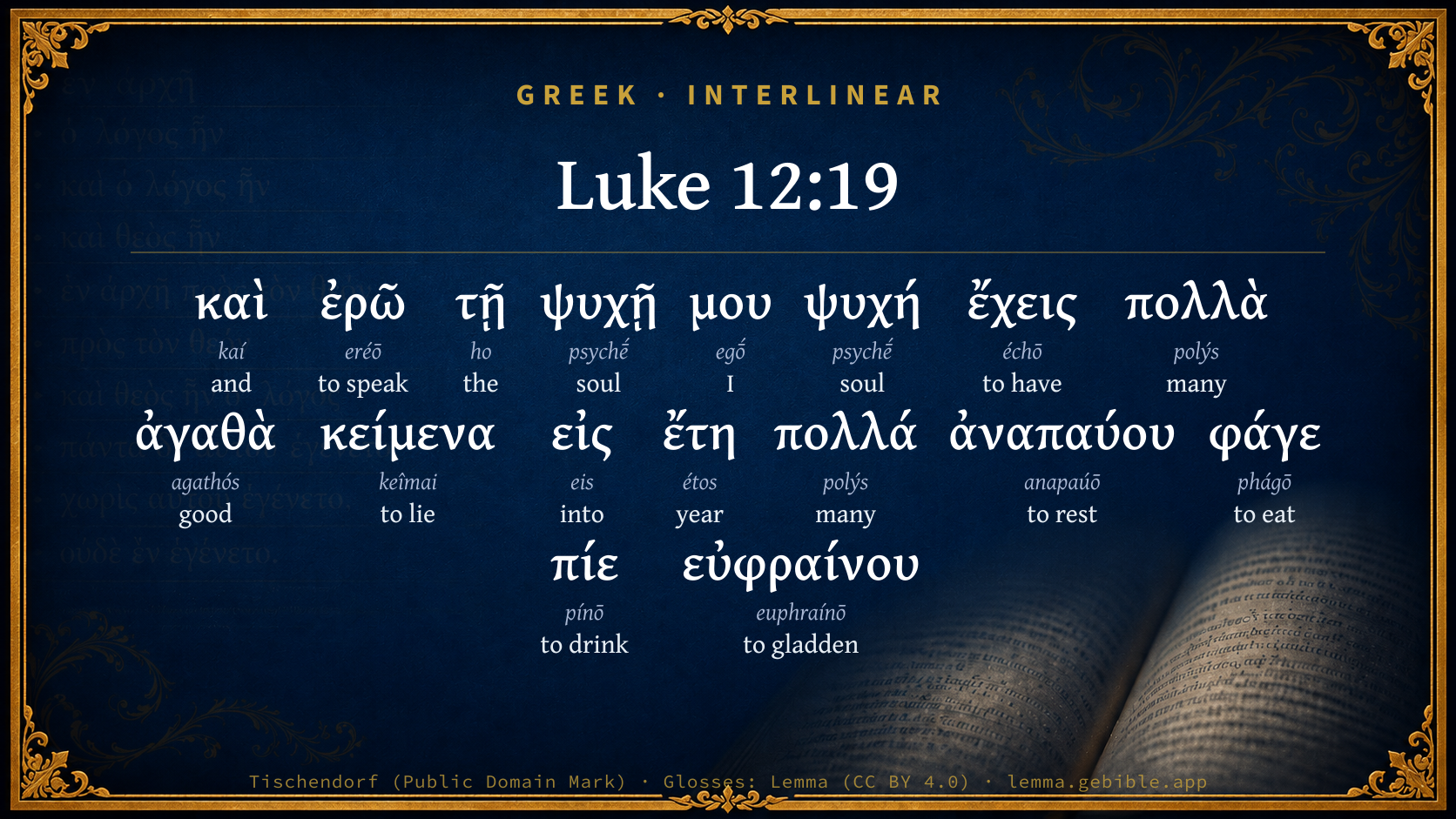
I will tell my soul, "Soul, you have many goods laid up for many years. Take your ease, eat, drink, be merry."'
Download a study sheet
One document with this verse’s original text, its word-by-word gloss line, the meaning frame, cross-references with their text, attributed commentary, and full source and license credits — printable, and it pastes into notes with its structure intact.
This verse Autodidact and up
A passage Seminary Student
Up to 50 verses in one chapter. A passage sheet keeps up to 6 commentary sources and 12 cross-references per verse, in the order this page ranks them, and says so on the sheet whenever that leaves anything out. Ask for a single verse and you get the Autodidact verse sheet above.
Everything on this page stays free to read, with no account — the sheet is a download of what is already on screen, not access to it.
Compare translations 3
The same verse in 3 English versions, stacked beneath the original-language interlinear above. Click any original word for its lexicon entry.
Each is an independent rendering of the whole verse — the interlinear is not word-aligned to these translations.
Highlighted words mark where these versions differ — a whole-verse word diff, not a word-by-word alignment.
-
World English Bible Public Domain
I will tell my soul, "Soul, you have many goods laid up for many years. Take your ease, eat, drink, be merry."'
-
King James Version Public Domain
And I will say to my soul, Soul, thou hast much goods laid up for many years; take thine ease, eat, drink, and be merry.
-
unfoldingWord Literal Text CC BY-SA 4.0
And I will say to my soul, “Soul, you have many good things lying in store for many years. Relax, eat, drink, be merry.”’
unfoldingWord Literal Text — © unfoldingWord, licensed CC BY-SA 4.0. Word-aligned USFM3 via Door43 (git.door43.org/unfoldingWord/en_ult).
Show all 19 translations
Every available English version of this verse, each an independent rendering of the whole verse.
-
World English Bible Public Domain
I will tell my soul, "Soul, you have many goods laid up for many years. Take your ease, eat, drink, be merry."'
-
Berean Standard Bible Public Domain
Then I will say to myself, “You have plenty of good things laid up for many years. Take it easy. Eat, drink, and be merry!”’
-
Majority Standard Bible Public Domain
Then I will say to myself, “You have plenty of good things laid up for many years. Take it easy. Eat, drink, and be merry!”’
-
King James Version Public Domain
And I will say to my soul, Soul, thou hast much goods laid up for many years; take thine ease, eat, drink, and be merry.
-
American Standard Version (1901) Public Domain
And I will say to my soul, Soul, thou hast much goods laid up for many years; take thine ease, eat, drink, be merry.
-
Revised Version (1885) Public Domain
And I will say to my soul, Soul, thou hast much goods laid up for many years; take thine ease, eat, drink, be merry.
-
Geneva Bible (1599) Public Domain
And I wil say to my soule, Soule, thou hast much goods laide vp for many yeeres: liue at ease, eate, drinke and take thy pastime.
-
Douay-Rheims (1899) Public Domain
And I will say to my soul: Soul, thou hast much goods laid up for many years take thy rest; eat, drink, make good cheer.
-
Young's Literal Translation Public Domain
and I will say to my soul, Soul, thou hast many good things laid up for many years, be resting, eat, drink, be merry.
-
Literal Standard Version CC BY-SA 4.0
and I will say to my soul, Soul, you have many good things laid up for many years, be resting, eat, drink, be merry.
-
Unlocked Literal Bible CC BY-SA 4.0
I will say to my soul, “Soul, you have many goods stored up for many years. Rest easy, eat, drink, be merry.”'
-
unfoldingWord Literal Text CC BY-SA 4.0
And I will say to my soul, “Soul, you have many good things lying in store for many years. Relax, eat, drink, be merry.”’
-
Darby Bible Public Domain
and I will say to my soul, Soul, thou hast much good things laid by for many years; repose thyself, eat, drink, be merry.
-
World Messianic Bible Public Domain
I will tell my soul, “Soul, you have many goods laid up for many years. Take your ease, eat, drink, and be merry.”’
-
Webster's Bible Public Domain
And I will say to my soul, Soul, thou hast abundance of goods laid up for many years; take thy ease, eat, drink, and be merry.
-
Free Bible Version CC BY-SA 4.0
Then I'll tell myself: You have enough to live on for many years, so take life easy: eat, drink, and enjoy yourself!’
-
Bible in Basic English Public Domain
And I will say to my soul, Soul, you have a great amount of goods in store, enough for a number of years; be at rest, take food and wine and be happy.
-
Text-Critical English NT CC BY 4.0
And I will say to my soul, “Soul, yoʋ have many goods laid up for many years; relax, eat, drink, and be merry.” ’
-
Tyndale New Testament (1534) Public Domain
and I will saye to my soule: Soule thou hast moch goodes layde vp in stoore for many yeares take thyne ease: eate drinke and be mery.
Literal Standard Version (2020), Covenant Press — licensed CC BY-SA 4.0. Text via the HelloAO Bible API (eBible.org). Unlocked Literal Bible (unfoldingWord) — licensed CC BY-SA 4.0. Text via the HelloAO Bible API (eBible.org). unfoldingWord Literal Text — © unfoldingWord, licensed CC BY-SA 4.0. Word-aligned USFM3 via Door43 (git.door43.org/unfoldingWord/en_ult). Free Bible Version, Dr. Jonathan Gallagher — licensed CC BY-SA 4.0. Text via the HelloAO Bible API (eBible.org).
Word by word
More ways to search: Search by grammar → Find every occurrence → Compare this word →
Practice this passage: Drill this verse → Learn its vocabulary →
- Appears 12× in the Greek New Testament
- First appears at Matthew 11:28
- Part of Speech
- Verb
- Tense
- Present
- Voice
- Middle
- Mood
- Imperative
- Person
- 2nd person
- Number
- Singular
Full Thayer's Definition
- καὶ kaí G2532 “and” Conjunction
- ἐρῶ eréō G2046 “to speak” Verb, Future, Active, Indicative, 1st person, Singular
- τῇ ho G3588 “the” Article, Dative, Singular, Feminine
- ψυχῇ psychḗ G5590 “soul” Noun, Dative, Singular, Feminine
- μου egṓ G1473 “I” Personal pronoun, 1st person, Genitive, Singular
- ψυχή psychḗ G5590 “soul” Noun, Vocative, Singular, Feminine
- ἔχεις échō G2192 “to have” Verb, Present, Active, Indicative, 2nd person, Singular
- πολλὰ polýs G4183 “many” Adjective, Accusative, Plural, Neuter
- ἀγαθὰ agathós G18 “good” Adjective, Accusative, Plural, Neuter
- κείμενα keîmai G2749 “to lie” Verb, Present, Middle or Passive deponent, Participle, Accusative, Plural, Neuter
- εἰς eis G1519 “into” Preposition
- ἔτη étos G2094 “year” Noun, Accusative, Plural, Neuter
- πολλά polýs G4183 “many” Adjective, Accusative, Plural, Neuter
- ἀναπαύου anapaúō G373 “to rest” Verb, Present, Middle, Imperative, 2nd person, Singular
- φάγε phágō G5315 “to eat” Verb, Aorist, Active, Imperative, 2nd person, Singular
- πίε pínō G4095 “to drink” Verb, Aorist, Active, Imperative, 2nd person, Singular
- εὐφραίνου euphraínō G2165 “to gladden” Verb, Present, Passive, Imperative, 2nd person, Singular
About this verse
These counts appear in no published source. They are computed here, from the morphology-tagged text and Lemma’s own curated glosses. What Lemma adds →
- 17
- words
- 15
- distinct lemmas
- Gospels
- section
Notable vocabulary
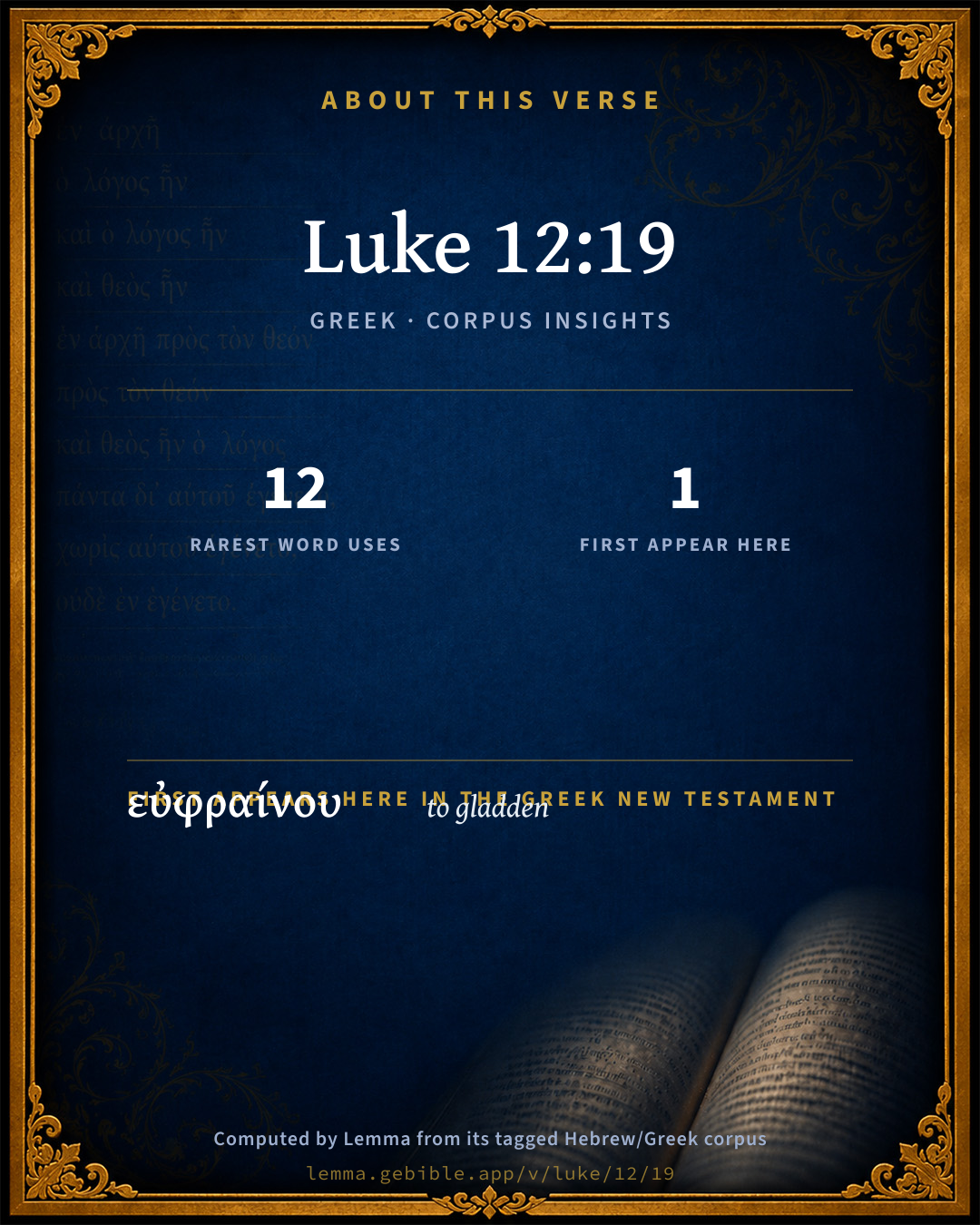
The rarest word here is ἀναπαύου to rest G373 — appearing just 12 times in the whole Greek New Testament.
First appearance in Scripture
This word makes its first canonical appearance in the Greek New Testament here:
- εὐφραίνου to gladden G2165
Shared distinctive vocabulary
ἀναπαύου to rest G373 occurs in 12 verses of the Greek New Testament. Also found in:
Cross-references
32Topical passages linked to Luke 12:19 in the Treasury of Scripture Knowledge — connected by theme and wording, ordered by reader-vote popularity; previews shown in the World English Bible.
- Proverbs 27:1 Don't boast about tomorrow; For you don't know what a day may bring forth.
- James 4:13–15 Come now, you who say, "Today or tomorrow let's go into this city, and spend a year there, trade, and make a profit."
- Matthew 6:19–21 "Don't lay up treasures for yourselves on the earth, where moth and rust consume, and where thieves break through and steal;
- 1 Corinthians 15:32 If I fought with animals at Ephesus for human purposes, what does it profit me? If the dead are not raised, then "let us eat and drink, for tomorrow we die."
- Ecclesiastes 11:9 Rejoice, young man, in your youth, And let your heart cheer you in the days of your youth, And walk in the ways of your heart, And in the sight of your eyes; But know that for all these things God will bring you into judgment.
- Isaiah 5:11 Woe to those who rise up early in the morning, that they may follow strong drink; Who stay late into the night, until wine inflames them!
- Philippians 3:19 whose end is destruction, whose god is the belly, and whose glory is in their shame, who think about earthly things.
- James 5:5 You have lived delicately on the earth, and taken your pleasure. You have nourished your hearts as in a day of slaughter.
- Psalms 62:10 Don't trust in oppression. Don't become vain in robbery. If riches increase, Don't set your heart on them.
- Proverbs 18:11 The rich man's wealth is his strong city, Like an unscalable wall in his own imagination.
- Job 31:24–25 "If I have made gold my hope, And have said to the fine gold, 'You are my confidence;'
- Isaiah 22:13 and behold, joy and gladness, killing oxen and killing sheep, eating flesh and drinking wine: let us eat and drink, for tomorrow we shall die.
- 2 Timothy 3:4 traitors, headstrong, conceited, lovers of pleasure rather than lovers of God;
- Revelation 18:7 However much she glorified herself, and grew wanton, so much give her of torment and mourning. For she says in her heart, 'I sit a queen, and am no widow, and will in no way see mourning.'
- Deuteronomy 6:11–12 and houses full of all good things, which you didn't fill, and cisterns dug out, which you didn't dig, vineyards and olive trees, which you didn't plant, and you shall eat and be full;
- Deuteronomy 8:12–14 lest, when you have eaten and are full, and have built goodly houses, and lived therein;
- Job 14:1 "Man, who is born of a woman, Is of few days, and full of trouble.
- Proverbs 23:5 Why do you set your eyes on that which is not? For it certainly sprouts wings like an eagle and flies in the sky.
- Isaiah 5:8 Woe to those who join house to house, Who lay field to field, until there is no room, And you are made to dwell alone in the midst of the land!
- Hosea 12:8 Ephraim said, "Surely I have become rich, I have found myself wealth. In all my wealth they won't find in me any iniquity that is sin."
- James 5:1–3 Come now, you rich, weep and howl for your miseries that are coming on you.
- 1 Peter 4:3 For we have spent enough of our past time doing the desire of the Gentiles, and having walked in lewdness, lusts, drunken binges, orgies, carousings, and abominable idolatries.
- Psalms 49:18 Though while he lived he blessed his soul-- And men praise you when you do well for yourself--
- Psalms 52:5–7 God will likewise destroy you forever. He will take you up, and pluck you out of your tent, And root you out of the land of the living. Selah.
- Amos 6:3–6 Those who put far away the evil day, And cause the seat of violence to come near;
- Habakkuk 1:16 Therefore he sacrifices to his net, and burns incense to his dragnet, because by them his life is luxurious, and his food is good.
- Luke 16:19 "Now there was a certain rich man, and he was clothed in purple and fine linen, living in luxury every day.
- Luke 21:34 "So be careful, or your hearts will be loaded down with carousing, drunkenness, and cares of this life, and that day will come on you suddenly.
- 1 Timothy 5:6 But she who gives herself to pleasure is dead while she lives.
- 1 Timothy 6:17 Charge those who are rich in this present world that they not be haughty, nor have their hope set on the uncertainty of riches, but on the living God, who richly provides us with everything to enjoy;
- Job 21:11–13 They send forth their little ones like a flock. Their children dance.
- Psalms 49:5–13 Why should I fear in the days of evil, When iniquity at my heels surrounds me?
Cross-references courtesy of OpenBible.info (CC BY 4.0).
Lesson kit
Teaching starters — assembled from the data on this page, not authored interpretation. Every prompt links to the verse data it draws on. Edit before teaching.
Luke, in the Gospels, opens this verse with 17 words (15 distinct Greek lemmas). Its most distinctive word is anapaúō (“to rest”). A historical commentator’s framing appears above. Read the whole chapter for the surrounding context.
Discussion questions
- What does “to rest” (anapaúō) contribute to the verse as a whole?
- The word “to gladden” first appears here in Scripture. What is being introduced at this debut?
- Matthew 11:28 shares the word «to rest» with this verse. How do the two illuminate each other?
- “soul” occurs 2× in this one verse. What is the effect of the repetition?
- The translations on this page render this verse differently — a whole-verse word diff, not a word-by-word alignment. What might account for the different wordings?
- Reading how Tyndale Open Study Notes and Bengel's Gnomon read this verse, where do the two commentators agree and where do they part?
Things to notice
- 1 word makes its first canonical appearance in Scripture here.
- These translations choose different wording for 15 words in this verse.
- “soul” occurs 2× in this single verse.
- 15 distinct Greek lemmas span 17 words in this verse.
Commentary
Notes on Luke 12:19 from classic Christian and Jewish commentators (each source and its license shown beneath its notes). The classic Christian expositions comment on the surrounding passage and are grouped to its opening verse, so a note may address several verses; the Jewish commentaries on the Tanakh (Rashi and others) are per-verse, so they appear only where the commentator wrote on this verse.
Lemma curates 59 commentaries, every one of them public domain or Creative Commons licensed, each selected and text-cleaned for this edition rather than reprinted as found. About our sources →
Tyndale Open Study Notes
Tyndale Open Resources
Tyndale Open Study Notes — © Tyndale Open Resources, licensed CC BY-SA 4.0. Text via the HelloAO Bible API.
Bengel's Gnomon
Johann Albrecht Bengel
Bengel's Gnomon of the New Testament — English translation (T&T Clark, Edinburgh, 1860) — public domain. Text from a community e-Sword module.
Expositor's Greek Testament
ed. W. Robertson Nicoll
The Expositor's Greek Testament, edited by W. Robertson Nicoll (1897–1910) — public domain. Text from a community e-Sword module.
Geneva Bible (1599)
Geneva Bible translators
Geneva Bible (1599) marginal notes — public domain. Text via Bolls.life.
Adam Clarke's Commentary
Adam Clarke's Commentary on the Bible (1810–1826) — public domain. Text from a community e-Sword/MySword module.
Ellicott's Commentary for English Readers
A Bible Commentary for English Readers, edited by Charles John Ellicott (1878–1897) — public domain. Text from a community e-Sword module.
The Cambridge Bible for Schools and Colleges
gen. ed. J. J. S. Perowne
The Cambridge Bible for Schools and Colleges (gen. ed. J. J. S. Perowne; Cambridge University Press, 1878–1918) — public domain. Text from a community e-Sword module.
John Gill's Exposition
John Gill's Exposition of the Whole Bible (1746–1763) — public domain (CC PDM 1.0). Text via the HelloAO Bible API.
Trapp's Complete Commentary
John Trapp
John Trapp, A Commentary or Exposition upon All the Books of the Old and New Testament (1647–1656) — public domain. Text from a community e-Sword module.
Albert Barnes' Notes on the Bible
Albert Barnes' Notes on the Bible (1834–1885) — public domain. Text from a community e-Sword/MySword module.
Haydock's Catholic Bible Commentary
George Leo Haydock (1774–1849), Haydock's Catholic Family Bible and Commentary, 1859 edition — public domain. Excludes Psalms (Douay-Rheims chapter numbering differs from Protestant) and Deuterocanonical books (Catholic canon only).
Whedon's Commentary on the Bible
Daniel D. Whedon
Daniel D. Whedon (gen. ed.), Commentary on the Old and New Testaments (1874–1909) — public domain. Text from a community e-Sword module.
The Pulpit Commentary
The Pulpit Commentary (1880–1919), ed. H.D.M. Spence-Jones & Joseph S. Exell — public domain. Text from a community e-Sword module.
Cambridge Greek Testament for Schools and Colleges
Cambridge Greek Testament for Schools and Colleges (Cambridge University Press, 1896; 21 vols, various authors incl. Carr, Maclear, Plummer, Farrar, Lumby, Moule, M. R. James, Simcox) — public domain. Text from a community e-Sword module.
Alford’s Greek Testament
Henry Alford
Henry Alford, The Greek Testament (1849–1861) — public domain. Text from a community e-Sword module.
International Critical Commentary
International Critical Commentary — older volumes (1896–1929), various authors — public domain. Text from a community e-Sword module.
Vincent's Word Studies in the New Testament
Marvin R. Vincent
Marvin R. Vincent, Word Studies in the New Testament (1887–1900) — public domain. Text from a community e-Sword/MySword module.