Luke 10:2

Greek (Tischendorf 8th ed.) Luke 10:2 appears in the Greek New Testament. The text above is from the Tischendorf 8th edition. Each word links to its Strong’s number and a concise gloss. Click any word for its full Thayer’s Greek Lexicon entry.
Download image
Cite this verse

Luke 10:2 (World English Bible). Public Domain. Lemma interlinear Bible study tool, https://lemma.gebible.app/v/luke/10/2.

Show BibTeX & RIS
BibTeX
RIS
English Translation
Then he said to them, "The harvest is indeed plentiful, but the laborers are few. Pray therefore to the Lord of the harvest, that he may send out laborers into his harvest.
World English Bible · Public Domain
Download a study sheet

One document with this verse’s original text, its word-by-word gloss line, the meaning frame, cross-references with their text, attributed commentary, and full source and license credits — printable, and it pastes into notes with its structure intact.

This verse Autodidact and up

Study sheet (.html) Plain text (.txt)

A passage Seminary Student

Up to 50 verses in one chapter. A passage sheet keeps up to 6 commentary sources and 12 cross-references per verse, in the order this page ranks them, and says so on the sheet whenever that leaves anything out. Ask for a single verse and you get the Autodidact verse sheet above.

Everything on this page stays free to read, with no account — the sheet is a download of what is already on screen, not access to it.

Want to remove ads? Support Godless Engineer
Compare translations 3

The same verse in 3 English versions, stacked beneath the original-language interlinear above. Click any original word for its lexicon entry.

Each is an independent rendering of the whole verse — the interlinear is not word-aligned to these translations.

Highlighted words mark where these versions differ — a whole-verse word diff, not a word-by-word alignment.

  • World English Bible Public Domain
    Then he said to them, "The harvest is indeed plentiful, but the laborers are few. Pray therefore to the Lord of the harvest, that he may send out laborers into his harvest.
  • King James Version Public Domain
    Therefore said he unto them, The harvest truly is great, but the labourers are few: pray ye therefore the Lord of the harvest, that he would send forth labourers into his harvest.
  • unfoldingWord Literal Text CC BY-SA 4.0
    And he said to them, “Indeed the harvest plentiful, but the laborers few. Therefore, earnestly ask the Lord of the harvest, so that he would send out laborers into his harvest.

unfoldingWord Literal Text — © unfoldingWord, licensed CC BY-SA 4.0. Word-aligned USFM3 via Door43 (git.door43.org/unfoldingWord/en_ult).

Versions to compare (up to 4)

3 of 4 selected

Show all 19 translations

Every available English version of this verse, each an independent rendering of the whole verse.

  • World English Bible Public Domain
    Then he said to them, "The harvest is indeed plentiful, but the laborers are few. Pray therefore to the Lord of the harvest, that he may send out laborers into his harvest.
  • Berean Standard Bible Public Domain
    And He told them, “The harvest is plentiful, but the workers are few. Ask the Lord of the harvest, therefore, to send out workers into His harvest.
  • Majority Standard Bible Public Domain
    Therefore He told them, “The harvest is plentiful, but the workers are few. Ask the Lord of the harvest, therefore, to send out workers into His harvest.
  • King James Version Public Domain
    Therefore said he unto them, The harvest truly is great, but the labourers are few: pray ye therefore the Lord of the harvest, that he would send forth labourers into his harvest.
  • American Standard Version (1901) Public Domain
    And he said unto them, The harvest indeed is plenteous, but the laborers are few: pray ye therefore the Lord of the harvest, that he send forth laborers into his harvest.
  • Revised Version (1885) Public Domain
    And he said unto them, The harvest is plenteous, but the labourers are few: pray ye therefore the Lord of the harvest, that he send forth labourers into his harvest.
  • Geneva Bible (1599) Public Domain
    And he said vnto them, The haruest is great, but the labourers are fewe: pray therefore the Lord of the haruest to sende foorth labourers into his haruest.
  • Douay-Rheims (1899) Public Domain
    And he said to them: The harvest indeed is great, but the labourers are few. Pray ye therefore the Lord of the harvest, that he send labourers into his harvest.
  • Young's Literal Translation Public Domain
    then said he unto them, `The harvest indeed `is' abundant, but the workmen few; beseech ye then the Lord of the harvest, that He may put forth workmen to His harvest.
  • Literal Standard Version CC BY-SA 4.0
    then He said to them, “The harvest [is] indeed abundant, but the workmen few; implore then the Lord of the harvest, that He may put forth workmen to His harvest.
  • Unlocked Literal Bible CC BY-SA 4.0
    He said to them, “The harvest is plentiful, but the laborers are few. Therefore ask the Lord of the harvest to send out laborers into his harvest.
  • unfoldingWord Literal Text CC BY-SA 4.0
    And he said to them, “Indeed the harvest plentiful, but the laborers few. Therefore, earnestly ask the Lord of the harvest, so that he would send out laborers into his harvest.
  • Darby Bible Public Domain
    And he said to them, The harvest indeed [is] great, but the workmen few; supplicate therefore the Lord of the harvest that he may send out workmen into his harvest.
  • World Messianic Bible Public Domain
    Then he said to them, “The harvest is indeed plentiful, but the laborers are few. Pray therefore to the Lord of the harvest, that he may send out laborers into his harvest.
  • Webster's Bible Public Domain
    Therefore said he to them, The harvest truly is great, but the laborers are few: pray ye therefore the Lord of the harvest, that he would send forth laborers into his harvest.
  • Free Bible Version CC BY-SA 4.0
    “The harvest is large, but the number of workers is small,” he told them. “Pray to the Lord of the harvest to send workers to his harvest fields.
  • Bible in Basic English Public Domain
    And he said to them, There is much grain ready to be cut, but not enough workers: so make prayer to the Lord of the grain-fields that he will send workers to get in the grain.
  • Text-Critical English NT CC BY 4.0
    He said to them, “The harvest is plentiful, but the workers are few. Therefore ask the Lord of the harvest to send out workers into his harvest.
  • Tyndale New Testament (1534) Public Domain
    And he sayde vnto them the harvest is greate: but the laborers are feawe. Praye therfore the Lorde of the harvest to send forth laborers into his hervest.

Literal Standard Version (2020), Covenant Press — licensed CC BY-SA 4.0. Text via the HelloAO Bible API (eBible.org). Unlocked Literal Bible (unfoldingWord) — licensed CC BY-SA 4.0. Text via the HelloAO Bible API (eBible.org). unfoldingWord Literal Text — © unfoldingWord, licensed CC BY-SA 4.0. Word-aligned USFM3 via Door43 (git.door43.org/unfoldingWord/en_ult). Free Bible Version, Dr. Jonathan Gallagher — licensed CC BY-SA 4.0. Text via the HelloAO Bible API (eBible.org).

Word by word

More ways to search: Search by grammar → Find every occurrence → Compare this word →

Practice this passage: Drill this verse → Learn its vocabulary →

θερισμὸς
therismós
G2326
“harvest”
Noun, Nominative, Singular, Masculine
Part of Speech
Noun
Case
Nominative
Number
Singular
Gender
Masculine
Full Thayer's Definition

Origin: from G2325

TDNT: 05:13,3

1. harvest, the act of reaping a. fig. of the gathering of men into the kingdom of God b. referring to time of reaping, the final judgment, when the righteous are gathered into the kingdom of God and the wicked are cast into hell for ever
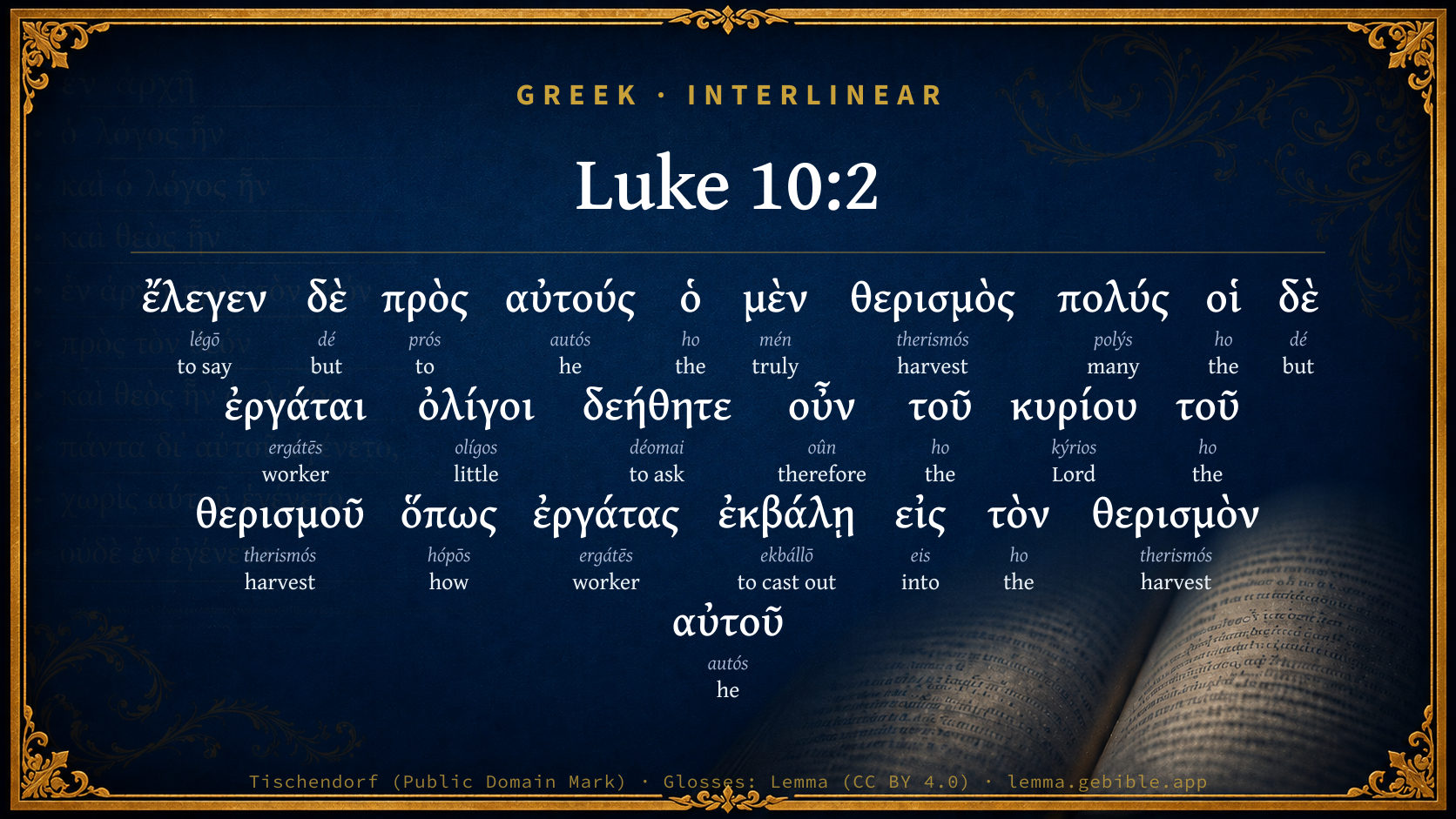
  1. ἔλεγεν légō G3004 “to say” Verb, Imperfect, Active, Indicative, 3rd person, Singular
  2. δὲ dé G1161 “but” Conjunction
  3. πρὸς prós G4314 “to” Preposition
  4. αὐτούς autós G846 “he” Personal pronoun, Accusative, Plural, Masculine
  5. ὁ ho G3588 “the” Article, Nominative, Singular, Masculine
  6. μὲν mén G3303 “truly” Particle
  7. πολύς polýs G4183 “many” Adjective, Nominative, Singular, Masculine
  8. οἱ ho G3588 “the” Article, Nominative, Plural, Masculine
  9. δὲ dé G1161 “but” Conjunction
  10. ἐργάται ergátēs G2040 “worker” Noun, Nominative, Plural, Masculine
  11. ὀλίγοι olígos G3641 “little” Adjective, Nominative, Plural, Masculine
  12. δεήθητε déomai G1189 “to ask” Verb, Aorist, Passive deponent, Imperative, 2nd person, Plural
  13. οὖν oûn G3767 “therefore” Conjunction
  14. τοῦ ho G3588 “the” Article, Genitive, Singular, Masculine
  15. κυρίου kýrios G2962 “Lord” Noun, Genitive, Singular, Masculine
  16. τοῦ ho G3588 “the” Article, Genitive, Singular, Masculine
  17. θερισμοῦ therismós G2326 “harvest” Noun, Genitive, Singular, Masculine
  18. ὅπως hópōs G3704 “how” Adverb
  19. ἐργάτας ergátēs G2040 “worker” Noun, Accusative, Plural, Masculine
  20. ἐκβάλῃ ekbállō G1544 “to cast out” Verb, Aorist, Active, Subjunctive, 3rd person, Singular
  21. εἰς eis G1519 “into” Preposition
  22. τὸν ho G3588 “the” Article, Accusative, Singular, Masculine
  23. θερισμὸν therismós G2326 “harvest” Noun, Accusative, Singular, Masculine
  24. αὐτοῦ autós G846 “he” Personal pronoun, Genitive, Singular, Masculine

About this verse

These counts appear in no published source. They are computed here, from the morphology-tagged text and Lemma’s own curated glosses. What Lemma adds →

25
words
16
distinct lemmas
Gospels
section

Notable vocabulary

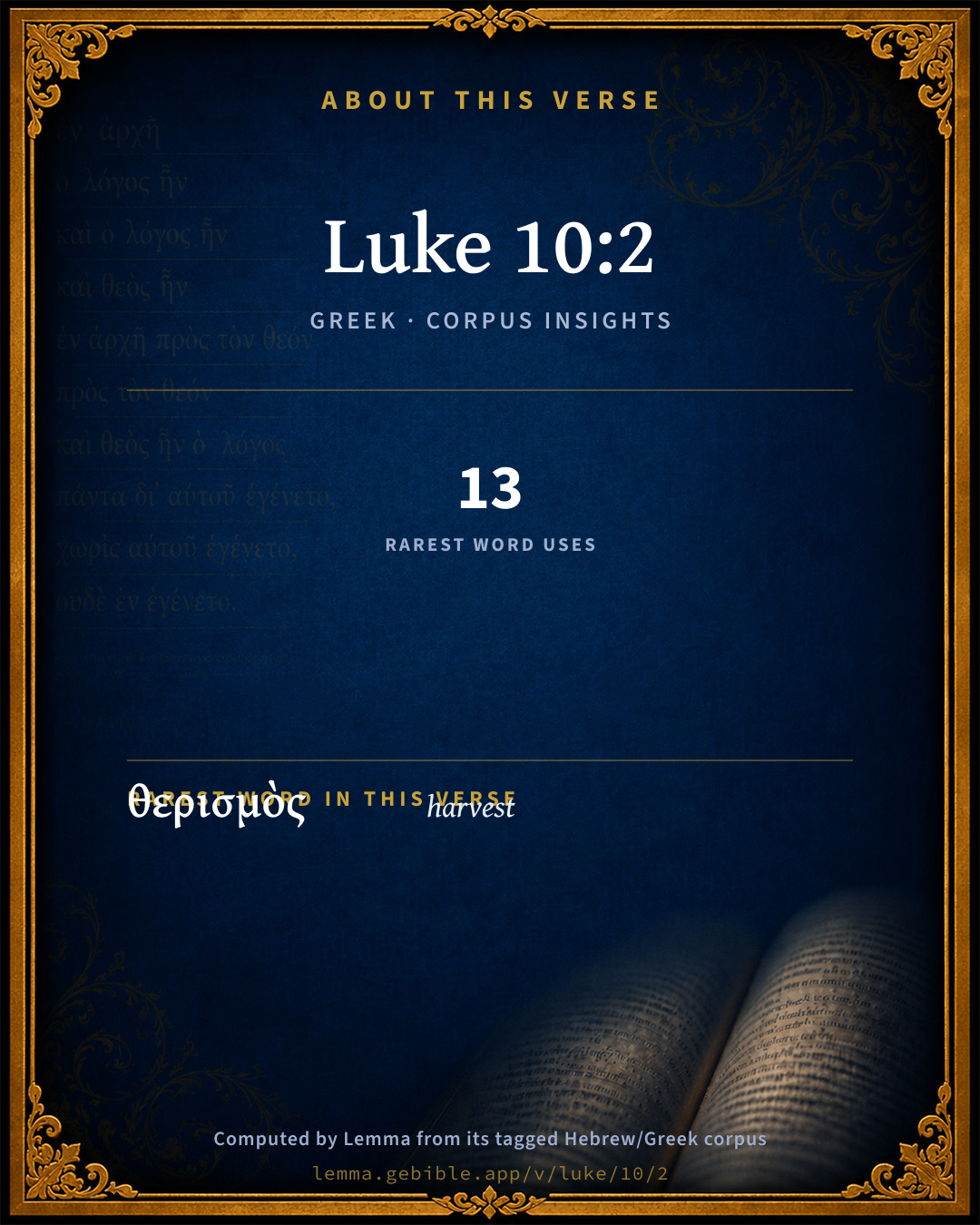
The rarest word here is θερισμὸς harvest G2326 — appearing just 13 times in the whole Greek New Testament.

Shared distinctive vocabulary

θερισμὸς harvest G2326 occurs in 8 verses of the Greek New Testament. Also found in:

Repetition

Words recur within this verse:

  • θερισμὸς harvest G2326 ×3
  • ἐργάται worker G2040 ×2
  • ὁ the G3588 ×5
  • δὲ but G1161 ×2
  • αὐτούς he G846 ×2

Cross-references

47

Topical passages linked to Luke 10:2 in the Treasury of Scripture Knowledge — connected by theme and wording, ordered by reader-vote popularity; previews shown in the World English Bible.

  • Matthew 9:36–38 But when he saw the multitudes, he was moved with compassion for them, because they were harassed and scattered, like sheep without a shepherd.
  • John 4:35–38 Don't you say, 'There are yet four months until the harvest?' Behold, I tell you, lift up your eyes, and look at the fields, that they are white for harvest already.
  • 1 Corinthians 3:6–9 I planted. Apollos watered. But God gave the increase.
  • Mark 16:15 He said to them, "Go into all the world, and preach the Gospel to the whole creation.
  • 1 Thessalonians 5:12 But we beg you, brothers, to know those who labor among you, and are over you in the Lord, and admonish you,
  • 2 Thessalonians 3:1 Finally, brothers, pray for us, that the word of the Lord may spread rapidly and be glorified, even as also with you;
  • Matthew 20:1 "For the Kingdom of Heaven is like a man who was the master of a household, who went out early in the morning to hire laborers for his vineyard.
  • Acts 22:21 "He said to me, 'Depart, for I will send you out far from here to the Gentiles.'"
  • 2 Timothy 4:5 But you be sober in all things, suffer hardship, do the work of an evangelist, and fulfill your ministry.
  • Jeremiah 3:15 and I will give you shepherds according to my heart, who shall feed you with knowledge and understanding.
  • Mark 13:34 "It is like a man, traveling to another country, having left his house, and given authority to his servants, and to each one his work, and also commanded the doorkeeper to keep watch.
  • Mark 16:20 They went out, and preached everywhere, the Lord working with them, and confirming the word by the signs that followed. Amen.
  • Luke 9:1 He called the twelve together, and gave them power and authority over all demons, and to cure diseases.
  • Acts 20:28 Take heed, therefore, to yourselves, and to all the flock, in which the Holy Spirit has made you overseers, to shepherd the assembly of the Lord and God which he purchased with his own blood.
  • Zechariah 11:17 Woe to the worthless shepherd who leaves the flock! The sword will be on his arm, and on his right eye. His arm will be completely withered, and his right eye will be totally blinded!"
  • Acts 8:4 Therefore those who were scattered abroad went around preaching the word.
  • Acts 11:19 They therefore who were scattered abroad by the oppression that arose about Stephen traveled as far as Phoenicia, Cyprus, and Antioch, speaking the word to no one except to Jews only.
  • Acts 13:2 As they served the Lord and fasted, the Holy Spirit said, "Separate Barnabas and Saul for me, for the work to which I have called them."
  • Acts 13:4 So, being sent out by the Holy Spirit, they went down to Seleucia. From there they sailed to Cyprus.
  • Acts 16:9–10 A vision appeared to Paul in the night. There was a man of Macedonia standing, begging him, and saying, "Come over into Macedonia and help us."
  • Acts 26:15–18 "I said, 'Who are you, Lord?' "He said, 'I am Jesus, whom you are persecuting.
  • 1 Corinthians 12:28 God has set some in the assembly: first apostles, second prophets, third teachers, then miracle workers, then gifts of healings, helps, governments, and various kinds of languages.
  • Philippians 2:25 But I counted it necessary to send to you Epaphroditus, my brother, fellow worker, fellow soldier, and your apostle and minister to my need;
  • 1 Timothy 4:10 For to this end we both labor and suffer reproach, because we have set our trust in the living God, who is the Savior of all men, especially of those who believe.
  • 1 Timothy 4:15–16 Be diligent in these things. Give yourself wholly to them, that your progress may be revealed to all.
  • Numbers 11:17 I will come down and talk with you there: and I will take of the Spirit which is on you, and will put it on them; and they shall bear the burden of the people with you, that you not bear it yourself alone.
  • Numbers 11:29 Moses said to him, Are you jealous for my sake? would that all Yahweh's people were prophets, that Yahweh would put his Spirit on them!
  • 1 Kings 22:6–8 Then the king of Israel gathered the prophets together, about four hundred men, and said to them, Shall I go against Ramoth-gilead to battle, or shall I forbear? They said, Go up; for the Lord will deliver it into the hand of the king.
  • Isaiah 56:9–12 All you animals of the field, come to devour, [yes], all you animals in the forest.
  • Ezekiel 34:2–6 Son of man, prophesy against the shepherds of Israel, prophesy, and tell them, even to the shepherds, Thus says the Lord Yahweh: Woe to the shepherds of Israel who feed themselves! Shouldn't the shepherds feed the sheep?
  • 1 Corinthians 15:10 But by the grace of God I am what I am. His grace which was bestowed on me was not futile, but I worked more than all of them; yet not I, but the grace of God which was with me.
  • Philippians 2:21 For they all seek their own, not the things of Jesus Christ.
  • Colossians 1:29 for which I also labor, striving according to his working, which works in me mightily.
  • Colossians 4:12 Epaphras, who is one of you, a servant of Christ, salutes you, always striving for you in his prayers, that you may stand perfect and complete in all the will of God.
  • 1 Kings 18:22 Then Elijah said to the people, "I, even I only, am left a prophet of Yahweh; but Baal's prophets are four hundred fifty men.
  • Zechariah 11:5 Their buyers slaughter them, and go unpunished. Those who sell them say, 'Blessed be Yahweh, for I am rich;' and their own shepherds don't pity them.
  • 2 Corinthians 6:1 Working together, we entreat also that you not receive the grace of God in vain,
  • Ephesians 4:7–12 But to each one of us was the grace given according to the measure of the gift of Christ.
  • Philippians 2:30 because for the work of Christ he came near to death, risking his life to supply that which was lacking in your service toward me.
  • 1 Thessalonians 2:9 For you remember, brothers, our labor and travail; for working night and day, that we might not burden any of you, we preached to you the Gospel of God.
  • 1 Timothy 1:12–14 And I thank him who enabled me, Christ Jesus our Lord, because he counted me faithful, appointing me to service;
  • 2 Timothy 2:3–6 You therefore must endure hardship, as a good soldier of Christ Jesus.
  • Hebrews 3:6 but Christ is faithful as a Son over his house; whose house we are, if we hold fast our confidence and the glorying of our hope firm to the end.
  • Revelation 11:2–3 Leave out the court which is outside of the temple, and don't measure it, for it has been given to the gentiles. They will tread the holy city under foot for forty-two months.
  • Psalms 68:11 The Lord announced the word. The ones who proclaim it are a great company.
  • 1 Timothy 5:17–18 Let the elders who rule well be counted worthy of double honor, especially those who labor in the word and in teaching.
  • Philemon 1:1 Paul, a prisoner of Christ Jesus, and Timothy our brother, to Philemon, our beloved fellow worker,

Cross-references courtesy of OpenBible.info (CC BY 4.0).

Where the printed editions differ

1 variant

Places in this verse where the major printed Greek editions disagree on the wording in a way that affects the translation — a comparison of editions, not a manuscript-by-manuscript collation. The editions are the modern critical texts (Nestlé-Aland 28/27, SBL, Westcott-Hort, Tregelles, Tyndale House) and the traditional texts behind the KJV (the Textus Receptus and the Byzantine/Majority text). It is not a claim about which reading is original.

  1. Different wording
    δὲ

    “then”

    In NA28NA27TynSBLWHTreg Not in TRByz

    οὖν (oun) 'therefore' occurs in traditional manuscripts (TR+Byz) instead of δὲ (de) 'then' in older manuscripts (NA28+NA27+Tyn+SBL+WH+Treg)

Textual data: Translators Amalgamated Greek New Testament (STEPBible TAGNT) · CC BY 4.0.

Commentary

Notes on Luke 10:2 from classic Christian and Jewish commentators (each source and its license shown beneath its notes). The classic Christian expositions comment on the surrounding passage and are grouped to its opening verse, so a note may address several verses; the Jewish commentaries on the Tanakh (Rashi and others) are per-verse, so they appear only where the commentator wrote on this verse.

Lemma curates 59 commentaries, every one of them public domain or Creative Commons licensed, each selected and text-cleaned for this edition rather than reprinted as found. About our sources →

The Biblical Illustrator

Joseph S. Exell

Luk_10:2

The harvest truly is great

The gospel harvest

I.

THE STATE OF THINGS WHICH OUR LORD DESCRIBES.

1. A plenteous harvest.

(1) A great number of souls.

(2) Great diversity in souls.

2. This vast and varied crop is ready for the sickle. This is proved--

(1) By the moral and spiritual necessities of the world. A genuine philanthropist wants no other demand upon his efforts than the misery of His fellow men; and a genuine Christian requires no other proof that men are ready for the gospel than the fact that they need it. Here lay one of the great mistakes of the Church of a former age. She did not think of sending the gospel, because men did not clamour for it.

(2) But if our duty be plain in the presence of silent and uncomplaining woe, how much more when misery is suppliant and clamorous at our feet I The world is now conscious of its maladies; and knows full well what can heal them.

3. The labourers are few. They toil on, willing rather to die than to abandon their work. One and another drops and dies, exclaiming, as did the immortal Waterhouse, more missionaries! more missionaries! and the very heathen repeat and prolong the cry!

II. THE INJUNCTION FOUNDED ON THE ABOVE DESCRIPTION.

1. To whom are our prayers to be addressed? To the Lord of the harvest.

(1) He is the owner and proprietor of the harvest. They are bought with a price. The enemy had usurped possession of the great Creators claim.

(2) And must He not, therefore, take a deep, an unspeakable interest in them? Think you that He can be indifferent whether this harvest is reaped or not?

(3) And it is Gods absolute and inalienable right to choose and employ His labourers.

2. We are called, then, to pray that God would graciously exert His prerogative in the appointment of His own labourers to reap His own fields. What does this prayer imply?

(1) He exerts this prerogative, in part, by the inward operation of His Holy Spirit.

(2) We are to pray, not only that God would call and qualify, but also send out labourers into His harvest. And here we must bare regard to His mode of administration. He does for man what man cannot do for himself, but requires him to do all that is in his power. We cannot give the piety; and the intellectual and spiritual gifts; but it is our duty and privilege to furnish the means for sending the men whom God has raised up.

3. Does any one ask, Why, if God is the Lord of the harvest, having such exclusive prerogatives, and so deeply interested in the matter, He should be entreated to do that which it so nearly concerns His honour not to leave undone? We answer, Such sceptical inquiries become not the position of finite and mortal creatures. The objection would apply to all prayer for any blessing; and call in question the whole administration of heaven. (J. H. James.)

The abundance of the harvest, and the scarcity of the labourers

I. Let us first look at THE HARVEST. It is too vast to be taken within the verge of one short sermon. China, India, Burmah, and Japan, Africa, the West Indies, South America, Russian Tartary, Persia, and the islands of the South Sea--all this is too vast for our consideration at the present opportunity.

II. THE LABOURERS. The labourers are few. Let us consider--

III. THE SAVIOURS PLAN FOR INCREASING THE NUMBER OF THE LABOURERS.

1. We observe in the first place, that where persons offer this prayer in sincerity, they make a solemn acknowledgment that God must do all the work.

2. In the second place, when a minister and a congregation offer up this prayer and solemnly enter into its spirit, they mean that, when God raises up such men, they will furnish the means to convey them to the heathen, and support them when they get there.

3. In the third place, when young men utter this prayer, they mean that, if it is the will of God, they are ready to become labourers.

4. Observe, in the last place, that when Christian parents offer up this prayer, they express their willingness that their children should go. (R. Knill.)

Harvest ripeness

It is just to go and gather in Christs sheep that are scattered abroad all over the world. In the notion of a harvest we cannot rid ourselves of the idea of ripeness--and I shall take a twofold view of this. There are some of the Lords family, and it falls to my lot not unfrequently to meet with such in whom we cannot fail to discern the presence of life; their knowledge of themselves as sinners is manifest, their view of Christ as a Saviour is encouraging, and even their reliance upon Him--but there is a want of ripeness, there is a rawness, a greenness, a defectiveness, a youthfulness. The harvest is craning on, beloved; let us look to our ripeness, the ripeness of all our faculties, as exercised in the things of God, the ripeness of all the graces called into full exercise, so that faith shall no longer be like a grain of mustard seed, but like the ripe ear, waving and bending with its weight--so that love shall no longer be faint and glimmering, as if it were but a spark, but fanned to a flame, rising high, and soaring to its native source; so that humility shall no longer be a piece of mockery, something openly expressed but never felt, but that which debases the soul in its own esteem, and keeps it in the dust at the feet of Jesus; so that hope shall not be merely the hope of the hypocrite, but a sure and steadfast thing as the ripeness we speak of--Entering into that within the veil. Moreover, there is a ripeness in grace, and there is a ripeness in sin. The sickle is coming, beloved, and therefore examine which state of ripeness you are in. When God was about to destroy the seven nations of Canaan, and told Moses of His deferring it for a time, while the children of Israel travelled forty years in the wilderness, He gave this as the reason, that the iniquity of the Amorites was not quite full--their sin was not yet completely ripe. Moreover, I saw in some fields some fine heavy corn, which was sadly laid, as they call it, bent down to the ground, and not exposed to the sun, so that it will be a long time before it gets ripe. What a picture of a great number of real Christians! They are so earthbound, so fond of this world, so laid low in their grovelling desires after it, that they cannot be expected to get ripe very fast. That corn gets ripe the fastest that lifts its head the highest, and gets away from the ground and the weeds. Beloved, if you would be ripe Christians, I tell you that you must get it by being lifted above the world and its vanities, enjoying intimacy with God, fellowship with the Most High, aspiring to heaven, and enjoying communications from above. (J. Irons.)

The labourers and the field

Note here--

1. That Gods Church is a harvest field.

2. That the ministers of God are labourers in His harvest, under God, the Lord of the harvest.

3. That to God alone doth it belong to send forth labourers into His harvest, and none must thrust themselves in till God sends them forth.

4. That the number of faithful labourers is comparatively small and few.

5. That it is the Churchs duty to pray, and that earnestly and incessantly, to God the Lord of the harvest, to increase the number of faithful labourers, and to send forth more labourers into His harvest. (W. Burkitt.)

The husbandry of God

1. Great is the harvest.

2. Few are the labourers.

3. God alone can restore the just relation between harvest and labourers. (Van Oosterzee.)

God the Lord of the harvest

1. God determines the time of the harvest.

2. God appoints the labourers for the harvest.

3. God guards the success of the harvest.

4. God deserves the thank-offering of the harvest. (Van Oosterzee.)

The need of immediate workers

Captain Allen Gardiner, on the inhospitable coast of South America, where he slowly perished with hunger, in the hope of attracting the notice of some passing vessel, wrote on the cliff in large letters DELAY NOT, WE ARE STARVING. Years after, the words were seen; but it was too late, the bleached bones of the brave hero of the cross strewed the beach. Help had been delayed, and he had perished. The like cry of a dying world for the Bread of Life, ringing in the ears of the people of God who have enough and to spare, will surely not be much longer unheeded. A few have responded already, but what are these among so many? Oh that we would each one arise and do our utmost daily, expecting to see mighty results now! (J. C. Fullerton.)

A prayer for more labourers

Leonard Keyser, a friend and disciple of Luther, having been condemned by the bishop, had his head shaved, and being dressed in a smock-frock, was placed on horseback. As the executioners were cursing and swearing because they could not disentangle the ropes with which his limbs were to be tied, he said to them mildly, Dear friends, your bonds are not necessary; my Lord Christ has already bound me. When he drew near the stake, Keyser looked at the crowd and exclaimed, Behold the harvest! O Master, send forth Thy labourers! And then ascending the scaffold, he cried, O Jesus, save me! These were his last words. What am I, a wordy preacher, said Luther, when he received the news of his death, in comparison with this great doer of the Word? (J. H. M. DAubigne.)

Christs harvest and Christs reapers

I. CHRIST MEANT HIS SEVENTY DISCIPLES TO GO FORTH AND GATHER THAT WHICH HAD ALREADY GROWN AND RIPENED.

1. He saw a harvest of piety, for instance, waiting for Himself, and the proofs of His Messiahship.

2. I think He saw also another sort of harvest, or another element in that harvest--the moral element. There were many highly moral people living in the world who had become disgusted with religion and its priests.

II. THE CHARACTER OF THE HARVEST-MEN HE EMPLOYED. It is at once painful and disheartening to perceive that He did not select, either as individuals or as a class, the professed teachers of religion, He employed no class of men as such. He dealt only with persons and their individual consciences, and so acting, it is easy to discover the sort of people He could call and use as His harvest-men.

III. AS THESE WERE PEOPLE MORALLY AND SPIRITUALLY LIKE HIMSELF (TO SOME REAL EXTENT AT LEAST), HE WAS RESTRICTED GREATLY IN THE NUMBER OF GATHERERS, AS HE WAS RESTRICTED IN THE METHOD OF INGATHERING TO BE EMPLOYED.

IV. I REMARK UPON THE MODE IN WHICH THE HARVEST WAS TO BE GATHERED. HOW were the pious and the moral to be brought in? I might properly answer, on a principle of natural selection. They were to preach the gospel of Christ, and illustrate, enforce, and commend that gospel by the beauty and perfectness of their own holy lives. They would thus become witnesses for God, as He was a witness for God.

V. TAKE NOW THE PRACTICAL LESSON. Piety in you and me, who profess to be Christs real friends, is to attract whatever piety we come in contact with. There is plenty of unattached piety waiting to be attracted by you and me. The Lord sent out twelve, then seventy. That great world-clasping system we call Christianity had once so few supporters and missionaries.

Do you ask how many it wants now? I will tell you. It wants every man, woman, and child, into whose soul the grace of God has come, that every other life found in the vast field of human activity may be brought with a throb of love and a song of joy, s gathered ear all ripe and golden to the great Lord of the harvest of souls. (J. McDougall.)

The Biblical Illustrator, edited by Joseph S. Exell (c. 1880s–1900s) — public domain. Text from a community e-Sword module.

Tyndale Open Study Notes

Tyndale Open Resources

10:2 The harvest refers to people who need to hear the Good News and be gathered to God’s presence (cp. Isa 27:12). There was urgency to the task, just as crops have to be brought in at the exact time when they are ripe. More workers were needed.

Tyndale Open Study Notes — © Tyndale Open Resources, licensed CC BY-SA 4.0. Text via the HelloAO Bible API.

Meyer's Critical & Exegetical Commentary

Heinrich August Wilhelm Meyer

Luk_10:2. Comp. Mat_9:37 f. First of all, Christ makes them apprehend the greatness of their task, and (Luk_10:3) their risk, and then gives them (Luk_10:4 ff.) rules of conduct.[128]

ὀλίγοι] notwithstanding your numbers, ye are still far from sufficient[129] ΠΡῸς ΤῸ ΠΛῆΘΟς ΤῶΝ ΜΕΛΛΌΝΤΩΝ ΠΙΣΤΕΎΕΙΝ (Euthymius Zigabenus)!

ἘΚΒΆΛῌ] In this is contained the importance, the urgency of the mission: should drive forth (comp. on Mar_1:12; 1Ma_12:27).

[128] But the prohibition against going to the heathens and the Samaritans, Mat_5:5, He does not give to the Seventy, and that for the simple reason that they had precisely to make the journey only as it was definitely marked out to them in ver. 1 (through Galilee). For this that prohibition would not have been at all appropriate.

[129] According to Weiss, Jesus, in respect of ὀλίγοι, must have thought originally of Himself, while Luke thought of the Twelve. The former view contradicts the words of the passage, the latter the context. But that the discourse was originally addressed to the Twelve does not follow from Luk_22:35, for the passage there alluded to is to be sought in Luk_9:3 (although with certain coincidences from Luk_10:4).

Meyer — Critical and Exegetical Commentary on the New Testament — English translation by Peter Christie, edited by Frederick Crombie (T&T Clark, 1880) — public domain. Text from a community e-Sword module.

Expositor's Greek Testament

ed. W. Robertson Nicoll

Luk 10:2-12 . The instructions .

Luk 10:2 . ὁ μὲν θερισμὸς : preliminary statement as to the need of men fit to take part in the work of preaching the kingdom, as in Mat 9:38 , vide notes there; a true logion of Jesus, whensoever spoken.

The Expositor's Greek Testament, edited by W. Robertson Nicoll (1897–1910) — public domain. Text from a community e-Sword module.

Godet's Commentaries

Frédéric Louis Godet

Vers. 2-16. The Discourse.

It falls into two parts: Instructions for the mission (Luk 10:2-12), and warnings to the cities of Galilee (Luk 10:13-16).

The instructions first explain the reason of this mission (Luk 10:2); then the conduct to be observed on setting out and during the journey (Luk 10:3-4), at the time of arrival (Luk 10:5-6); during their sojourn in the case of a favourable reception (Luk 10:7-9); finally, on their departure in the case of rejection (Luk 10:10-12).

Ver. 2.—“Therefore said He unto them, The harvest truly is great, but the labourers are few; pray ye therefore the Lord of the harvest, that He would send forth labourers into His harvest.” Matthew has this utterance in chap. 9, in presence of the Galilean multitudes, and as an introduction to the sending of the Twelve. Bleek himself acknowledges that it is better placed by Luke. “The field is the world,” Jesus had said in the parable of the sower. It is to this vast domain that the very strong words of this verse naturally apply, recalling the similar words, Joh 4:35: “Look on the fields, for they are white already to harvest,” uttered in Samaria, and on the threshold, as it were, of the Gentile world. The sending of the new labourers is the fruit of the prayers of their predecessors. The prep. ἐκ in ἐκβάλλειν, thrust forth, may signify, forth from the Father’s house, from heaven, whence real callings issue; or, forth from the Holy Land, whence the evangelization of the Gentiles was to proceed. Following on the idea of prayer, the first meaning is the more natural.

Frédéric Louis Godet — Commentaries on Luke, John, Romans, and 1 Corinthians — English translation (T&T Clark, Edinburgh, 1870s–1890s) — public domain. Text from a community e-Sword module.

Jamieson, Fausset & Brown

Robert Jamieson, A. R. Fausset & David Brown

The harvest, &c.--(See on Mat 9:37).

pray ye therefore the Lord of the harvest, that he would send forth labourers into his harvest--(See on Mat 9:38).

Jamieson, Fausset & Brown — Commentary Critical and Explanatory on the Whole Bible (1871) — public domain (CC PDM 1.0). Text via the HelloAO Bible API.

Adam Clarke's Commentary

Verse 2. That he would send forth] εκβαλη. There seems to be an allusion here to the case of reapers, who, though the harvest was perfectly ripe, yet were in no hurry to cut it down. News of this is brought to the Lord of the harvest the farmer, and he is entreated to exert his authority, and hurry them out; and this he does because the harvest is spoiling for want of being reaped and gathered in. See the notes on Mt 9:37-38.

Adam Clarke's Commentary on the Bible (1810–1826) — public domain. Text from a community e-Sword/MySword module.

Ellicott's Commentary for English Readers

(2) The harvest truly is great.—See Note on Mat_9:37. The verses that follow contain, as might have been expected from the analogous circumstances, much in common with those spoken on the mission of the Twelve. We have here, as in the sermons on the Mount and on the Plain, an example of our Lord’s repeating the expression of the same thoughts in nearly the same language.

A Bible Commentary for English Readers, edited by Charles John Ellicott (1878–1897) — public domain. Text from a community e-Sword module.

The Cambridge Bible for Schools and Colleges

gen. ed. J. J. S. Perowne

2. The harvest truly is great] Compare Mat_9:37; Joh_4:35.

sendforth] The word literally means ‘drive forth,’ and though it has lost its full force implies urgency and haste. See similar uses of the word in Joh_10:4, Mat_9:38, Mar_1:12.

The Cambridge Bible for Schools and Colleges (gen. ed. J. J. S. Perowne; Cambridge University Press, 1878–1918) — public domain. Text from a community e-Sword module.

John Gill's Exposition

Therefore said he unto them,.... That is, the "Lord Jesus", as the Ethiopic version expresses it; he said to the seventy disciples, what he had before said to the twelve apostles in Mat 9:37 where are the same words as here:

the harvest truly is great, but the labourers are few, pray ye therefore the Lord of the harvest that he would send forth labourers into his harvest; for though there was such a number of disciples called to the ministerial work, and sent out, there was still need of more; so great was the harvest of souls, or number of hearers, that the labourers were yet but few; and therefore the Lord of the harvest and whose all souls are, was to be prayed unto to send forth more laborious preachers; See Gill on Mat 9:37. See Gill on Mat 9:38.

John Gill's Exposition of the Whole Bible (1746–1763) — public domain (CC PDM 1.0). Text via the HelloAO Bible API.

Trapp's Complete Commentary

John Trapp

2 Therefore said he unto them, The harvest truly is great, but the labourers are few: pray ye therefore the Lord of the harvest, that he would send forth labourers into his harvest.

Ver. 2. See Mat 9:37.

John Trapp, A Commentary or Exposition upon All the Books of the Old and New Testament (1647–1656) — public domain. Text from a community e-Sword module.

Albert Barnes' Notes on the Bible

See the notes at Mat 9:36-37.

Albert Barnes' Notes on the Bible (1834–1885) — public domain. Text from a community e-Sword/MySword module.

Matthew Poole's English Annotations

See Poole on "Mat 9:37" and See Poole on "Mat 9:38", where these words are put immediately before the sending out of the twelve. Both the twelve and the seventy, all that Christ ever sent out, were to be labourers in the Lord’s harvest.

Matthew Poole's English Annotations on the Holy Bible (1683–1685) — public domain. Text from a community e-Sword/MySword module.

The Pulpit Commentary

Therefore said he unto them, The harvest truly is great, but the labourers are few: pray ye therefore the Lord of the harvest, that he would send forth labourers into his harvest. This and many of the sayings reported on this occasion had been said apparently before, when the twelve had been sent out on a similar mission. It seems almost certain that, on several occasions, the Lord repeated the same expressions containing great truths, with scarcely any variation in language. The harvest simile was evidently a favourite one of the Master. "The field is the world" he told them in the parable of the sower. It is reproduced by St. John. (Rev_14:14-19)

HOMILIES BY W. CLARKSON Ver. 2. Spiritual husbandry.

I THE LARGENESS OF THE FIELD. "The harvest truly is great." It is not a few human families, or a few small populations; it is not one large nation; it is not even one great continent; it is the entire human race, which Jesus Christ proposed and which he still purposes to redeem this great human race, with all its nationalities, with all its creeds and all its doubts and denials, with all its pride and all its degradation, with all its profound estrangement from Divine truth and the living God. The harvest is great indeed; the task is tremendous; the victory, if it be gained, will make all other victories sink into utter insignificance; they will be but the small dust in the balance, There is encouragement in the thought of

II THE CHARACTER OF THE SEED WHICH IS SOWN. That seed was in course of preparation as Jesus Christ was speaking and working and suffering. It was his whole life; it was, indeed, himself in all his relations with men, in all the aspects in which he could be regarded, whether as Teacher, or Friend, or Exemplar, or Divine Sufferer. This was the seed which should be sown, the fruits of which would be the great harvest of God. "I, if I be lifted up," etc. But, on the other hand, there has to be taken into account

III THE CHARACTER OF THE AGENTS at work in the broad field of the world.

1. Their infirmity. They are men; good men, but "the best of men are but men at the best;" all (they should be) renewed by the Spirit of God and fired with the love of Christ and of human souls; but all (they are) "compassed about with infirmity," all bound with limitations of understanding, of character, of wisdom.

2. Their paucity. "The laborers are few few in comparison with the agents of evil and the sources of error; few, regarded in their proportion to the multitude on whom they are to act. in this light they are lamentably insufficient. There are great breadths of the field scarcely worked and other vast districts positively untouched. What, then, is

IV THE HOPE OF THE FAITHFUL? When we survey the greatness of the harvest and the fewness of the laborers in the field, where does our hope lie? In the providing power of the great Lord of the harvest. He who moves the stars in their spheres can create human souls, can endow them with noble faculties, can inspire them with generous aims, can send them forth on glorious and triumphant missions. We cannot tell the possibilities which are hidden in one great human soul whose heart God has touched, whose hand God has strengthened. One such man may be instrumental in turning a whole tract of barrenness into fertility: what, then, may not a number of such souls accomplish? When the Lord of the harvest speaks the word, great will be the company of the preachers, the number of the laborers. Wherefore let us pray the Father of spirits to put forth his creative power and send mighty workers into his waiting fields. C.

The Pulpit Commentary (1880–1919), ed. H.D.M. Spence-Jones & Joseph S. Exell — public domain. Text from a community e-Sword module.

John Wesley's Explanatory Notes

Pray ye the Lord of the harvest, that he would thrust forth labourers - For God alone can do this: he alone can qualify and commission men for this work. Matt. ix, 37.

John Wesley, Explanatory Notes Upon the Whole Bible (1754–1765) — public domain. Text via the GEBible commentary corpus.

Burkitt's Expository Notes on the New Testament

William Burkitt

Note here,

1. That God’s church is an harvest field.

2. That the ministers of God are laborers in his harvest, under God the Lord of the harvest.

3. That to God alone it does belong to send forth laborers into his harvest, and none must thrust themselves in, until God sends them forth: Pray ye the Lord of the harvest, that he would send forth laborers.

4. That the number of faithful laborers is comparatively small and few: the scribes and Pharisees in the Jewish harvest field are many; yet, says Christ, The laborers are few.

5. That it is the church’s duty to pray, and that earnestly and incessantly, to God the Lord of the harvest, to increase the number of faithful laborers; and to send forth more laborers into his harvest.

William Burkitt's Expository Notes on the New Testament (1700–1703) — public domain. Text from a community e-Sword module.

The People's New Testament

B. W. Johnson

2. The harvest truly is great. See notes on Matt. 9:37, where the same language is used, not on the same, but a similar occasion.

B. W. Johnson's The People's New Testament with Notes (1889–1891) — public domain. Electronic text from the Christian Classics Ethereal Library (CCEL) ThML edition.

Cambridge Greek Testament for Schools and Colleges

2. ὁ μὲν θερισμὸς πολύς. Compare Mat 9:37; Joh 4:35.

ἐκβάλῃ. The word literally means ‘drive forth,’ and though it has lost its full force implies urgency and haste. See similar uses of the word in Joh 10:4, Mat 9:38, Mar 1:12.

Cambridge Greek Testament for Schools and Colleges (Cambridge University Press, 1896; 21 vols, various authors incl. Carr, Maclear, Plummer, Farrar, Lumby, Moule, M. R. James, Simcox) — public domain. Text from a community e-Sword module.

Alford’s Greek Testament

Henry Alford

2.] See Mat 9:37 and notes.

If ἐκβάλλῃ were read, the pres., as usual, would have the force of the continually repeated act: as it is, the aor. (as in Matt.) indicates the whole mission, considered as one great act.

3,

Henry Alford, The Greek Testament (1849–1861) — public domain. Text from a community e-Sword module.

International Critical Commentary

2. Ὁ μὲν θερισμὸς πολύς, … εἰς τὸν θερισμὸν αὐτοῦ. This saying is verbatim the same as that which Mat 9:37, Mat 9:38 records as addressed to the disciples just before the mission of the Twelve. The Twelve and the Seventy were answers to the prayer thus prescribed; and both had the warning of the fewness of the labourers and the greatness of the work. The ὀλίγοι has no reference to the Seventy as being too few: the supply is always inadequate. We cannot conclude anything as to the time of year when the words were spoken from the mention of harvest. So common a metaphor might be used at any season. Corn. Joh 4:35.

Why does RV. retain the “truly” of AV. in Mat 9:37 while abolishing it here? It has no authority in either place, and apparently comes from the quidem of Vulg., which represents μέν.

δεήθητε. The verb does not occur in Mk. or Jn., nor in Mt. excepting in this saying (9:38). It is a favourite with Lk. (5:12, 8:28, 38, 9:38, 40, 21:36, 22:32; Act 4:31, Act 8:22, etc.). Elsewhere rare in N.T., but very freq. in LXX. For the constr. see Burton., § 200.

ὅπως ἐργάτας ἐκβάλῃ. “Send forth with haste and urgency.” The verb expresses either pressing need, or the directness with which they are sent to their destination. Comp. Mar 1:12; Mat 12:20; Jas 2:25. There is always human unwillingness to be overcome: comp. Exo 4:10, Exo 4:13; Jdg 4:8; Jon 1:3. For ἐργάτας of agricultural labourers comp. Mat 20:1, Mat 20:8; Jas 5:4; Ecclus. 19:1; and of labourers in the cause of religion, 2Co 11:13; Php 3:2; 2Ti 2:15.

International Critical Commentary — older volumes (1896–1929), various authors — public domain. Text from a community e-Sword module.

Vincent's Word Studies in the New Testament

Marvin R. Vincent

The harvest [θερισμος] . From qerov, summer (compare qeromai, to become warm). Harvest, that which is gathered in summer. Wyc., much ripe corn is, but few workmen.

Pray. See on ch. Luk 8:38.

Send forth [εκβαλη] . Lit., drive or thrust forth, implying the urgency of the mission. See on Mr 1:12.

Marvin R. Vincent, Word Studies in the New Testament (1887–1900) — public domain. Text from a community e-Sword/MySword module.

Lesson kit

Teaching starters — assembled from the data on this page, not authored interpretation. Every prompt links to the verse data it draws on. Edit before teaching.

Luke, in the Gospels, opens this verse with 25 words (16 distinct Greek lemmas). Its most distinctive word is therismós (“harvest”). A historical commentator’s framing appears above. Read the whole chapter for the surrounding context.

Discussion questions

  1. How does “harvest” (therismós) shape what this verse is saying?
  2. Matthew 9:37 shares the word «harvest» with this verse. How do the two illuminate each other?
  3. “harvest” occurs 3× in this one verse. What is the effect of the repetition?
  4. These translations render this verse differently. What is at stake in choosing one wording over another?
  5. Reading how The Biblical Illustrator and Tyndale Open Study Notes read this verse, where do the two commentators agree and where do they part?

Things to notice

Reading settings

Reading text

Shown beneath each verse's original-language words.

Old Testament
Old Testament edition

Read the OT as the Masoretic Hebrew (MT) or the Greek Septuagint (LXX).

English shown for the Greek Septuagint (in the Hebrew ↔ Greek comparison).

Comparing translations? Open the Compare panel on any verse page to stack up to four side by side.