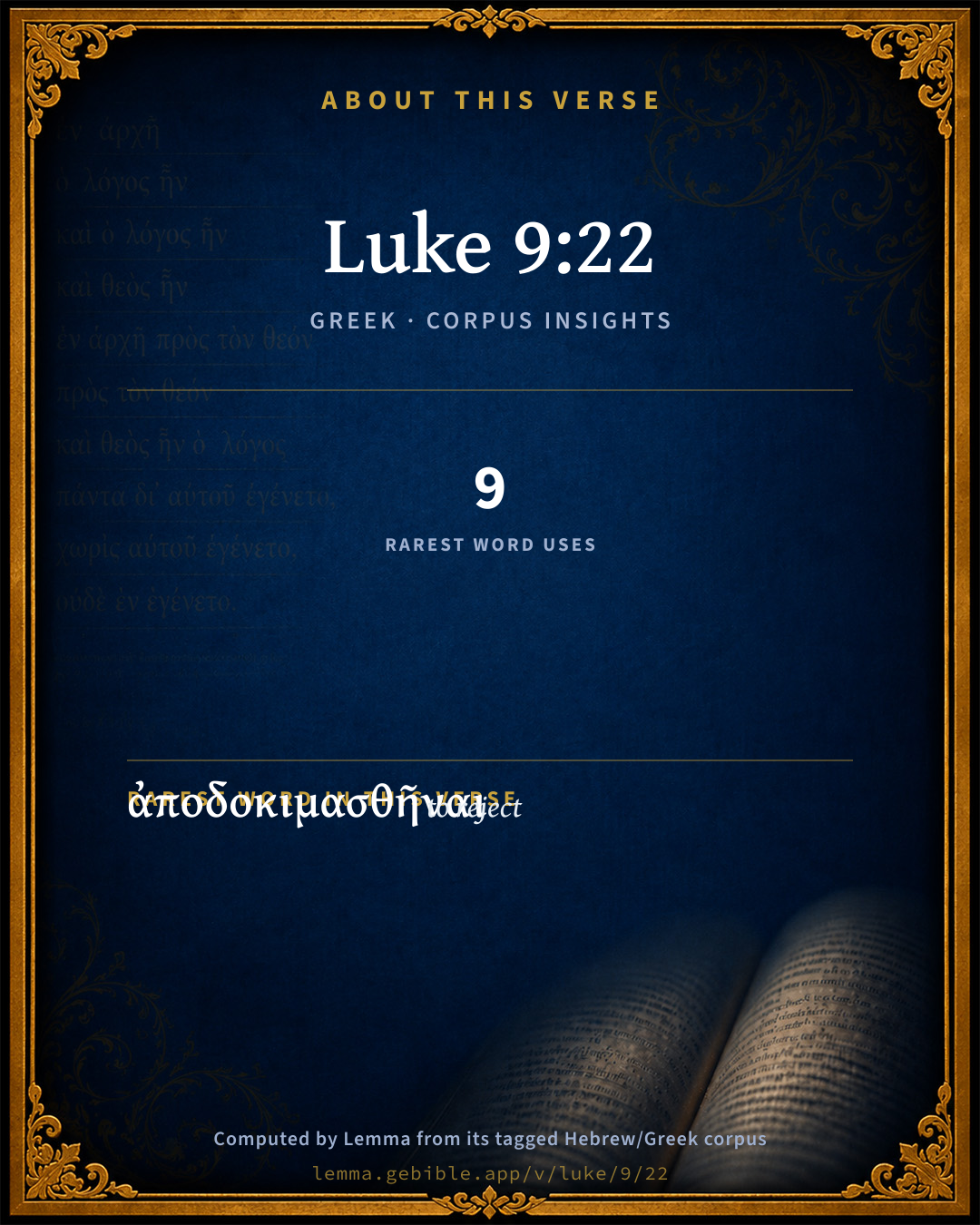
Luke 9:22

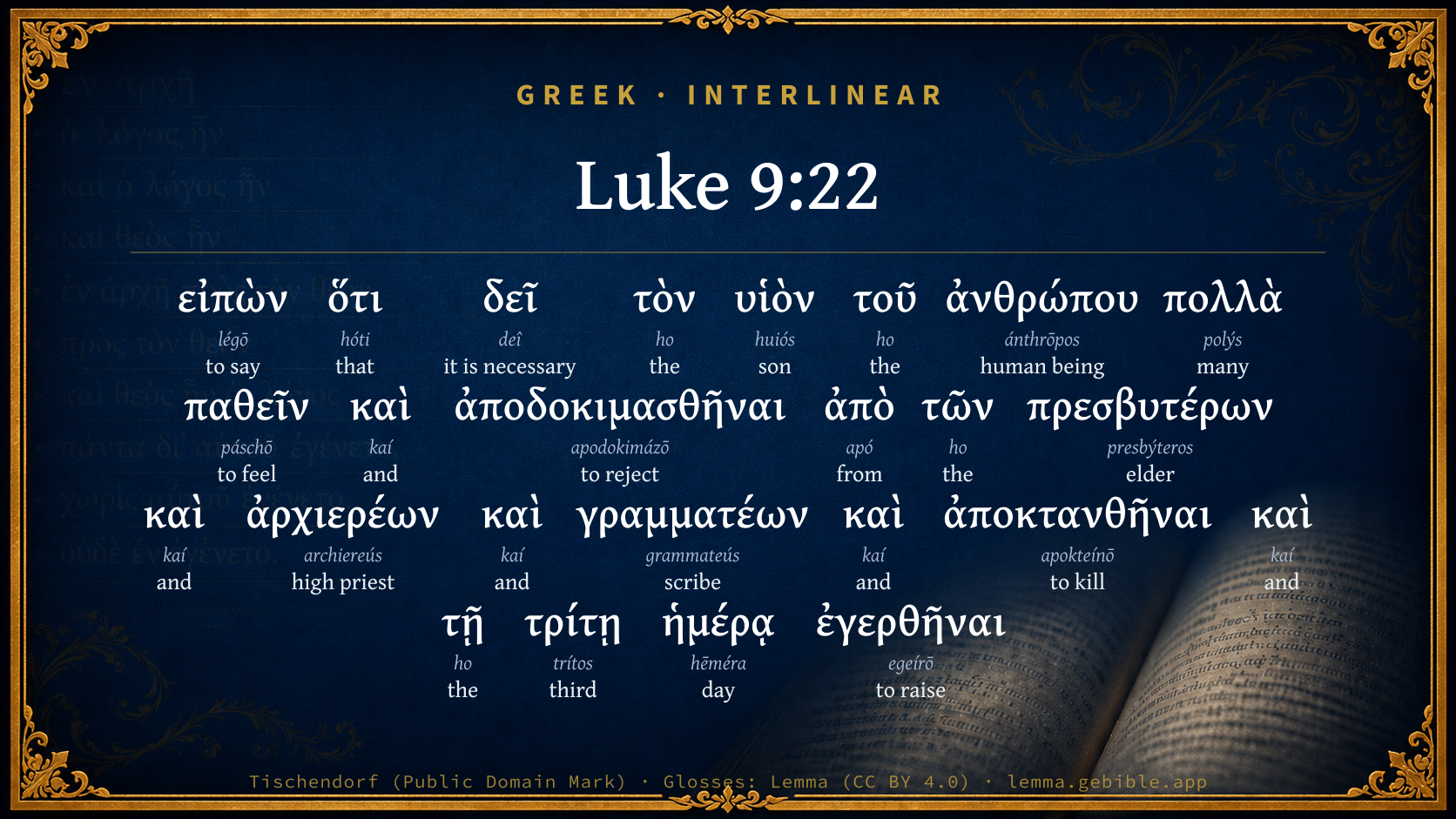
Greek (Tischendorf 8th ed.) Luke 9:22 appears in the Greek New Testament. The text above is from the Tischendorf 8th edition. Each word links to its Strong’s number and a concise gloss. Click any word for its full Thayer’s Greek Lexicon entry.
Download image
Cite this verse

Luke 9:22 (World English Bible). Public Domain. Lemma interlinear Bible study tool, https://lemma.gebible.app/v/luke/9/22.

Show BibTeX & RIS
BibTeX
RIS
English Translation
saying, "The Son of Man must suffer many things, and be rejected by the elders, chief priests, and scribes, and be killed, and the third day be raised up."
World English Bible · Public Domain
Download a study sheet

One document with this verse’s original text, its word-by-word gloss line, the meaning frame, cross-references with their text, attributed commentary, and full source and license credits — printable, and it pastes into notes with its structure intact.

This verse Autodidact and up

Study sheet (.html) Plain text (.txt)

A passage Seminary Student

Up to 50 verses in one chapter. A passage sheet keeps up to 6 commentary sources and 12 cross-references per verse, in the order this page ranks them, and says so on the sheet whenever that leaves anything out. Ask for a single verse and you get the Autodidact verse sheet above.

Everything on this page stays free to read, with no account — the sheet is a download of what is already on screen, not access to it.

Want to remove ads? Support Godless Engineer
Compare translations 3

The same verse in 3 English versions, stacked beneath the original-language interlinear above. Click any original word for its lexicon entry.

Each is an independent rendering of the whole verse — the interlinear is not word-aligned to these translations.

Highlighted words mark where these versions differ — a whole-verse word diff, not a word-by-word alignment.

  • World English Bible Public Domain
    saying, "The Son of Man must suffer many things, and be rejected by the elders, chief priests, and scribes, and be killed, and the third day be raised up."
  • King James Version Public Domain
    Saying, The Son of man must suffer many things, and be rejected of the elders and chief priests and scribes, and be slain, and be raised the third day.
  • unfoldingWord Literal Text CC BY-SA 4.0
    saying, “It is necessary for the Son of Man to suffer many things and to be rejected by the elders and chief priests and scribes, and to be killed, and to be raised on the third day.”

unfoldingWord Literal Text — © unfoldingWord, licensed CC BY-SA 4.0. Word-aligned USFM3 via Door43 (git.door43.org/unfoldingWord/en_ult).

Versions to compare (up to 4)

3 of 4 selected

Show all 19 translations

Every available English version of this verse, each an independent rendering of the whole verse.

  • World English Bible Public Domain
    saying, "The Son of Man must suffer many things, and be rejected by the elders, chief priests, and scribes, and be killed, and the third day be raised up."
  • Berean Standard Bible Public Domain
    “The Son of Man must suffer many things,” He said. “He must be rejected by the elders, chief priests, and scribes, and He must be killed and on the third day be raised to life.”
  • Majority Standard Bible Public Domain
    “The Son of Man must suffer many things,” He said. “He must be rejected by the elders, chief priests, and scribes, and He must be killed and on the third day rise again.”
  • King James Version Public Domain
    Saying, The Son of man must suffer many things, and be rejected of the elders and chief priests and scribes, and be slain, and be raised the third day.
  • American Standard Version (1901) Public Domain
    saying, The Son of man must suffer many things, and be rejected of the elders and chief priests and scribes, and be killed, and the third day be raised up.
  • Revised Version (1885) Public Domain
    saying, The Son of man must suffer many things, and be rejected of the elders and chief priests and scribes, and be killed, and the third day be raised up.
  • Geneva Bible (1599) Public Domain
    Saying, The Sonne of man must suffer many things and be reproued of the Elders, and of the hie Priests and Scribes, and be slaine, and the third day rise againe.
  • Douay-Rheims (1899) Public Domain
    Saying: The Son of man must suffer many things, and be rejected by the ancients and chief priests and scribes, and be killed, and the third day rise again.
  • Young's Literal Translation Public Domain
    saying -- `It behoveth the Son of Man to suffer many things, and to be rejected by the elders, and chief priests, and scribes, and to be killed, and the third day to be raised.'
  • Literal Standard Version CC BY-SA 4.0
    saying, “It is necessary for the Son of Man to suffer many things, and to be rejected by the elders, and chief priests, and scribes, and to be killed, and to be raised the third day.”
  • Unlocked Literal Bible CC BY-SA 4.0
    saying, “The Son of Man must suffer many things and be rejected by the elders and chief priests and scribes, and he will be killed and on the third day be raised.”
  • unfoldingWord Literal Text CC BY-SA 4.0
    saying, “It is necessary for the Son of Man to suffer many things and to be rejected by the elders and chief priests and scribes, and to be killed, and to be raised on the third day.”
  • Darby Bible Public Domain
    saying, The Son of man must suffer many things, and be rejected of the elders and chief priests and scribes, and be killed, and the third day be raised up.
  • World Messianic Bible Public Domain
    saying, “The Son of Man must suffer many things, and be rejected by the elders, chief priests, and scribes, and be killed, and the third day be raised up.”
  • Webster's Bible Public Domain
    Saying, The Son of man must suffer many things, and be rejected by the elders, and chief priests, and scribes, and be put to death, and be raised the third day.
  • Free Bible Version CC BY-SA 4.0
    “The Son of man must experience terrible sufferings,” he said. “He will be rejected by the elders, the chief priests, and the religious teachers. He will be killed, but on the third day he will rise again.”
  • Bible in Basic English Public Domain
    Saying, The Son of man will undergo much and be put on one side by the rulers and the chief priests and the teachers of the law, and be put to death, and on the third day he will come back to life.
  • Text-Critical English NT CC BY 4.0
    saying, “The Son of Man must suffer many things and be rejected by the elders, chief priests, and scribes, and he must be killed and on the third day rise again.”
  • Tyndale New Testament (1534) Public Domain
    sayinge: that the sonne of man must suffre many thinges and be reproved of the elders and of the hye prestes and scribes and be slayne and the thirde daye ryse agayne.

Literal Standard Version (2020), Covenant Press — licensed CC BY-SA 4.0. Text via the HelloAO Bible API (eBible.org). Unlocked Literal Bible (unfoldingWord) — licensed CC BY-SA 4.0. Text via the HelloAO Bible API (eBible.org). unfoldingWord Literal Text — © unfoldingWord, licensed CC BY-SA 4.0. Word-aligned USFM3 via Door43 (git.door43.org/unfoldingWord/en_ult). Free Bible Version, Dr. Jonathan Gallagher — licensed CC BY-SA 4.0. Text via the HelloAO Bible API (eBible.org).

Word by word

More ways to search: Search by grammar → Find every occurrence → Compare this word →

Practice this passage: Drill this verse → Learn its vocabulary →

ἀποδοκιμασθῆναι
apodokimázō
G593
“to reject”
Verb, Aorist, Passive, Infinitive
Part of Speech
Verb
Tense
Aorist
Voice
Passive
Mood
Infinitive
Full Thayer's Definition

Origin: from G575 and G1381

TDNT: 06:15,2

1. to disapprove, reject, repudiate
  1. εἰπὼν légō G3004 “to say” Verb, Aorist, Active, Participle, Nominative, Singular, Masculine
  2. ὅτι hóti G3754 “that” Conjunction
  3. δεῖ deî G1163 “it is necessary” Verb, Present, Active, Indicative, 3rd person, Singular
  4. τὸν ho G3588 “the” Article, Accusative, Singular, Masculine
  5. υἱὸν huiós G5207 “son” Noun, Accusative, Singular, Masculine
  6. τοῦ ho G3588 “the” Article, Genitive, Singular, Masculine
  7. ἀνθρώπου ánthrōpos G444 “human being” Noun, Genitive, Singular, Masculine
  8. πολλὰ polýs G4183 “many” Adjective, Accusative, Plural, Neuter
  9. παθεῖν páschō G3958 “to feel” Verb, Aorist, Active, Infinitive
  10. καὶ kaí G2532 “and” Conjunction
  11. ἀπὸ apó G575 “from” Preposition
  12. τῶν ho G3588 “the” Article, Genitive, Plural, Masculine
  13. πρεσβυτέρων presbýteros G4245 “elder” Adjective, Genitive, Plural, Masculine, Comparative
  14. καὶ kaí G2532 “and” Conjunction
  15. ἀρχιερέων archiereús G749 “high priest” Noun, Genitive, Plural, Masculine
  16. καὶ kaí G2532 “and” Conjunction
  17. γραμματέων grammateús G1122 “scribe” Noun, Genitive, Plural, Masculine
  18. καὶ kaí G2532 “and” Conjunction
  19. ἀποκτανθῆναι apokteínō G615 “to kill” Verb, Aorist, Passive, Infinitive
  20. καὶ kaí G2532 “and” Conjunction
  21. τῇ ho G3588 “the” Article, Dative, Singular, Feminine
  22. τρίτῃ trítos G5154 “third” Adjective, Dative, Singular, Feminine
  23. ἡμέρᾳ hēméra G2250 “day” Noun, Dative, Singular, Feminine
  24. ἐγερθῆναι egeírō G1453 “to raise” Verb, Aorist, Passive, Infinitive

About this verse

These counts appear in no published source. They are computed here, from the morphology-tagged text and Lemma’s own curated glosses. What Lemma adds →

25
words
18
distinct lemmas
Gospels
section

Notable vocabulary

The rarest word here is ἀποδοκιμασθῆναι to reject G593 — appearing just 9 times in the whole Greek New Testament.

Shared distinctive vocabulary

ἀποδοκιμασθῆναι to reject G593 occurs in 9 verses of the Greek New Testament. Also found in:

Repetition

Words recur within this verse:

Cross-references

20

Topical passages linked to Luke 9:22 in the Treasury of Scripture Knowledge — connected by theme and wording, ordered by reader-vote popularity; previews shown in the World English Bible.

  • Isaiah 53:1–12 Who has believed our message? and to whom has the arm of Yahweh been revealed?
  • Luke 24:7 saying that the Son of Man must be delivered up into the hands of sinful men, and be crucified, and the third day rise again?"
  • Luke 18:31–34 He took the twelve aside, and said to them, "Behold, we are going up to Jerusalem, and all the things that are written through the prophets concerning the Son of Man will be completed.
  • Luke 9:44 "Let these words sink into your ears, for the Son of Man will be delivered up into the hands of men."
  • Mark 9:31 For he was teaching his disciples, and said to them, "The Son of Man is being handed over to the hands of men, and they will kill him; and when he is killed, on the third day he will rise again."
  • Mark 10:33–34 "Behold, we are going up to Jerusalem. The Son of Man will be delivered to the chief priests and the scribes. They will condemn him to death, and will deliver him to the Gentiles.
  • Acts 4:25–28 who by the mouth of your servant, David, said, 'Why do the nations rage, And the peoples plot a vain thing?
  • 1 Peter 1:11 searching for who or what kind of time the Spirit of Christ, which was in them, pointed to, when he predicted the sufferings of Christ, and the glories that would follow them.
  • Genesis 3:15 I will put enmity between you and the woman, and between your offspring and her offspring. He will bruise your head, and you will bruise his heel."
  • Psalms 22:1–31 My God, my God, why have you forsaken me? Why are you so far from helping me, and from the words of my groaning?
  • Psalms 69:1–36 Save me, God, For the waters have come up to my neck!
  • Daniel 9:26 After the sixty-two weeks the Anointed One shall be cut off, and shall have nothing: and the people of the prince who shall come shall destroy the city and the sanctuary; and the end of it shall be with a flood, and even to the end shall be war; desolations are determined.
  • Zechariah 13:7 "Awake, sword, against my shepherd, And against the man who is close to me," says Yahweh of Hosts. Strike the shepherd, and the sheep will be scattered; And I will turn my hand against the little ones.
  • Matthew 16:21–28 From that time, Jesus began to show his disciples that he must go to Jerusalem and suffer many things from the elders, chief priests, and scribes, and be killed, and the third day be raised up.
  • Matthew 17:12 but I tell you that Elijah has come already, and they didn't recognize him, but did to him whatever they wanted to. Even so the Son of Man will also suffer by them."
  • Mark 8:31–9:1 He began to teach them that the Son of Man must suffer many things, and be rejected by the elders, the chief priests, and the scribes, and be killed, and after three days rise again.
  • Acts 13:27–29 For those who dwell in Jerusalem, and their rulers, because they didn't know him, nor the voices of the prophets which are read every Sabbath, fulfilled them by condemning him.
  • 1 Corinthians 15:4 that he was buried, that he was raised on the third day according to the Scriptures,
  • Matthew 17:22 While they were staying in Galilee, Jesus said to them, "The Son of Man is about to be delivered up into the hands of men,
  • Luke 24:26 Didn't the Christ have to suffer these things and to enter into his glory?"

Cross-references courtesy of OpenBible.info (CC BY 4.0).

Commentary

Notes on Luke 9:22 from classic Christian and Jewish commentators (each source and its license shown beneath its notes). The classic Christian expositions comment on the surrounding passage and are grouped to its opening verse, so a note may address several verses; the Jewish commentaries on the Tanakh (Rashi and others) are per-verse, so they appear only where the commentator wrote on this verse.

Lemma curates 59 commentaries, every one of them public domain or Creative Commons licensed, each selected and text-cleaned for this edition rather than reprinted as found. About our sources →

The Biblical Illustrator

Joseph S. Exell

Luk_9:22

The Son of Man must suffer many things

Christ foreseeing the Cross

I.

We have here set forth in the first place our LORDS ANTICIPATION OF THE CROSS. Mark the tone of the language, the minuteness of the detail, the absolute certainty of the prevision. That is not the language of a man who simply is calculating that the course which he is pursuing is likely to end in his martyrdom; but the thing lies there before Him, a definite, fixed certainty; every detail known, the scene, the instruments, the non-participation of these in the final act of His death, His resurrection, and its date--all manifested and mapped out in His sight, and all absolutely certain.

II. OUR LORDS RECOGNITION OF THE NECESSITY OF HIS SUFFERING. He does not say shall, but must. His suffering was necessary on the ground of filial obedience. The Fathers will is the Sons law. But yet that necessity grounded on filial obedience, was no mere external necessity determined solely by the Divine will. God so willed it, because it must be so, and not it must be because God so willed it. That is to say, the work to which Christ had set His hand was a work that demanded the Cross, nor could it be accomplished without it. For it was the work of redeeming the world, and required more than a beautiful life, more than a Divine gentleness of heart, more than the homely and yet deep wisdom of His teachings, it required the sacrifice that He offered on the Cross.

III. Now, note further, HOW WE HAVE HERE ALSO, OUR LORDS WILLING ACCEPTANCE OF THE NECESSITY. It is one thing to recognize, and another thing to accept, a needs-be. This must was no unwelcome obligation laid upon Him against His will, but one to which His whole nature responded, and which He accepted. No doubt there was in Him the innocent instinctive physical shrinking from death. No doubt the Cross, in so far, was pain and suffering. But that shrinking might be a shrinking of nature, but it was not a recoil of will. The ship may toss in dreadful billows, but the needle points to the pole. The train may rock upon the line, but it never leaves the rails. Christ felt that the Cross was an evil, but that never made Him falter in His determination to hear it, His willing acceptance of the necessity was owing to His full resolve to save the world. He must die because He would redeem, and He would redeem because He could not but love. So the must was not an iron chain that fastened Him to His Cross. Like some of the heroic martyrs of old, who refused to be bound to the funeral pile, He stood there chained to it by nothing but His own will and loving purpose to save the world. And oh I brethren; in that loving purpose, each of us may be sure that we had an individual and a personal share. He must die, because He loved me, and gave Himself for me.

IV. Lastly, notice here our LORDS TEACHING THE NECESSITY OF HIS DEATH. This announcement was preceded by that conversation which led to the crystalizing of the half-formed convictions of the apostles in a definite creed--Thou art the Christ, the Son of the living God. But that was not all that they needed to know, and believe and trust to. That was the first volume of their lesson-book. The second volume was this, that Christ must suffer. And so let us learn the central place which the Cross holds in Christs teaching. (A. Maclaren, D. D.)

On the humiliation and sufferings of Christ

Why does the Saviour say He must suffer?

I. It was at that time, and in the sense our Saviour then spake it, necessary for this reason, because otherwise the prophecies that went before concerning Him could not have been fulfilled. This reason our Saviour Himself gives (Mat_26:53; Mar_14:48; Luk_24:26; Luk_24:44). The same reason is alleged also by the apostles in their preaching (Acts 1Pe_1:10).

II. The death of Christ was necessary to make the pardon of sin. But the death of Christ was necessary, at least in this respect, to make the pardon of sin consistent with the wisdom of God in His good government of the world, and to be a proper attestation of His irreconcilable hatred against all unrighteousness.

III. The practical inferences from what has been said are as follows.

1. This doctrine concerning Christs dying for our sins is a strong argument for the indispensable necessity of our own repentance and reformation of life.

2. The consideration of Christs giving Himself a sacrifice for our sins is, to them who truly repent, an encouragement to approach with confidence to the throne of grace in our prayers to God through Him (Rom_8:32).

3. The death of Christ is a great example to us of patient suffering at any time in well-doing, when the providence of God shall call us to bear testimony in that manner to His truth (1Pe_3:17). (S. Clarke, D. D.)

The Biblical Illustrator, edited by Joseph S. Exell (c. 1880s–1900s) — public domain. Text from a community e-Sword module.

Whedon's Commentary on the Bible

Daniel D. Whedon

PERIOD SIXTH.

TRANSFIGURATION, AND MINISTRY OF SORROW AND STRUGGLE.

From Luk_9:22 to Luk_10:42.

Historical Synopsis (vol. 1.) §74—§101.

§ 74.—JESUS FORETELLS HIS DEATH AND EXHORTS TO SELF-DENIAL, Luk_9:22-27.

(Mat_16:21-28; Mar_8:31-38.)

Daniel D. Whedon (gen. ed.), Commentary on the Old and New Testaments (1874–1909) — public domain. Text from a community e-Sword module.

Godbey's Commentary on the New Testament

William B. Godbey

HIS DEATH & RESURRECTION

Mat 16:21-23; Mar 8:31-33; Luk 9:22. Matthew: “From that time Jesus began to show to His disciples that it behooved Him to depart to Jerusalem, and to suffer many things from The elders, the chief priests, and scribes, and to be put to death, and to rise the third day. And Peter, taking Him to him, began to rebuke Him, saying, Be it far from Thee, Lord; this shall not be to Thee. And turning, He said to Peter, Get behind Me, adversary; thou art My stumblingblock, because thou dost not have in mind the things of God, but the things of men.” Our Lord is still up at Caesarea-Philippi, with His disciples, teaching and revealing the deeper things of His kingdom, not only to their edification, but their astonishment. It was the misfortune of the Jews so to mix up the prophecies appertaining to the first and second coming of Christ, that they ran into much bewilderment for the want of the necessary discrimination and division of God’s Word; while Isaiah and others had vividly revealed His humiliation, as a “Man of sorrows and acquainted with grief;” as a “Root out of dry ground, without form or comeliness, and none desiring Him;” “Led as a lamb to the slaughter, as a sheep dumb before His shearers, opened not His mouth;” “In His humiliation, His judgment was taken away” — i.e., He had no fair trial, but was mobbed, contrary to both Jewish and Roman law. These gloomy prophecies, descriptive of His humiliation in His first advent, were by no means enjoyable themes with the Jews, who leaned the more to those grand and glorious cognomens portraying Him as “the Prince of peace,” “the government on His shoulders;” and Dan 7:14, not only describing Him as a triumphant and glorious King, but certifying positively that “to His kingdom there shall be no end, but He shall reign King of kings and Lord of lords forever.” Now, for the first time, He comes out and positively reveals to His disciples His coming arrest, condemnation, crucifixion, and resurrection. Peter, robust, stout, and naturally brave as a lion, immediately conceiving the view that His enemies are going to combine against Him, take Him, and kill Him, leaps to the conclusion, That is a game at which two can play. We will fight in His defense till we die, and the thousands and myriads who have been blessed with bodily healing, demoniacal ejectruents, and the multitudes endeared to Him on account of their friends thus wonderfully saved, soul and body, will rally and help us and will make it hot for them. Consequently, both Peter takes Him by the arm, or His vesture, and pulls Him up to Him; looking Him in the face, says, “They can’t do that; we will be on hand, rally Your multitude of friends, and protect You to the last moment.” “Satan,” in the E.V., is too strong, the word not appearing here as a proper name, when it is applied to the devil, but simply in its original meaning, “adversary” or “opposer,” as Peter was innocently antagonizing the Divine economy relative to His death and resurrection, which he did not understand; and Jesus said, “Thou art My stumbling-block;” i.e., “You are throwing yourself in the way of the very work I came to do” — i.e., to suffer, die, and redeem the world from sin, death, and hell. “Thou dost not have in mind the things of God, but the things of men;” i.e., “You are not thinking on the Divine side of this great transaction, you have not yet received light and entered into it understandingly, but you are considering My Messiahship from a human standpoint.”

William B. Godbey, Commentary on the New Testament (1896–1900) — public domain. Text from a community e-Sword module.

Tyndale Open Study Notes

Tyndale Open Resources

9:22 must suffer many terrible things: This was the first of Jesus’ prophecies concerning his coming death in Jerusalem (see 9:44; 17:25; 18:31-34). Jesus would fulfill Isa 52:13–53:12, in which the servant of the Lord (the Messiah) became a saving sacrifice for God’s people. These events were part of God’s purpose and plan. Despite opposition from human beings and from the spiritual forces of Satan, God works through the actions of human beings to accomplish his purposes. Though wicked men plotted against Jesus and put him to death, God accomplished salvation by raising Jesus from the dead (Luke 24:7, 26-27, 44-47; Acts 2:23-24; 3:18; 4:28). • leading priests: Though Israel had only one high priest, the upper-class priests were the aristocracy; they served on the Sanhedrin and held positions of power in Jerusalem.

Tyndale Open Study Notes — © Tyndale Open Resources, licensed CC BY-SA 4.0. Text via the HelloAO Bible API.

Expositor's Greek Testament

ed. W. Robertson Nicoll

Luk 9:22 . εἰπὼν introduces reference to the coming sufferings of Jesus in a quite incidental way as a reason why the disciples should keep silence as to the Messiahship of their Master, just confessed. The truth is that the conversation as to the Christ was a mere prelude to a very formal, solemn, and plain-spoken announcement on a painful theme, to which hitherto Jesus had alluded only in veiled mystic language. Cf. the accounts in Mt. and Mk. (Mat 16:21 , Mar 8:31 ). ὅτι δεῖ , etc., the announcement is given in much the same words as in Mk.

The Expositor's Greek Testament, edited by W. Robertson Nicoll (1897–1910) — public domain. Text from a community e-Sword module.

Geneva Bible (1599)

Geneva Bible translators

Christ himself attained to the heavenly glory by the cross and invincible patience.

Geneva Bible (1599) marginal notes — public domain. Text via Bolls.life.

The Cambridge Bible for Schools and Colleges

gen. ed. J. J. S. Perowne

22. The Son of man must suffer many things] It was necessary at once to dissipate the crude Messianic conceptions of earthly splendour and victory in which they had been brought up, and to substitute the truth of a suffering for that of a triumphant Messiah.

be rejected of the elders and chief priests and scribes] i.e. by each of the three great sections which formed the Jewish Sanhedrin; by all who up to that time had been looked upon as religious authorities in the nation.

and be slain] The mode of death, and the delivery to the Gentiles, were culminating horrors which He mercifully kept back till the last journey to Jerusalem, Mat_20:19. Hitherto He had only spoken of His death in dim and distant intimations, Joh_2:19; Joh_3:14; Joh_6:51. His revelation of it was progressive, as they were able to bear it. Mat_9:15; Mat_10:38; Joh_3:14; Mat_16:4; Mat_16:21; Mat_17:22; Mat_20:18; Mat_26:2.

be raised the third day] In Luk_9:45 St Luke shews us (as events proved)

The Cambridge Bible for Schools and Colleges (gen. ed. J. J. S. Perowne; Cambridge University Press, 1878–1918) — public domain. Text from a community e-Sword module.

John Gill's Exposition

And he said to them all,.... Not only to all the disciples, but "to the multitude", as the Arabic version renders it, who were now called unto him, with his disciples, as is clear from Mar 8:34,

any man will come after me, let him deny himself, and take up his cross daily, and follow me; the same is said here, as in Mat 16:24; see Gill on Mat 16:24, Mar 8:34, only here the word, "daily", is added; and which, though as Beza observes, is not in the Complutensian edition, nor in five ancient copies; yet is in others, and in the Vulgate Latin, and in all the Oriental versions; and to be retained, as having a very considerable emphasis in it; showing that afflictions, trials, and persecutions of one sort or another, are to be expected every day by the people of God, and to be continually submitted to, and borne with cheerfulness.

John Gill's Exposition of the Whole Bible (1746–1763) — public domain (CC PDM 1.0). Text via the HelloAO Bible API.

Trapp's Complete Commentary

John Trapp

21 And he straitly charged them, and commanded them to tell no man that thing;

22 Saying, The Son of man must suffer many things, and be rejected of the elders and chief priests and scribes, and be slain, and be raised the third day.

Ver. 22. See Mat 17:22.

John Trapp, A Commentary or Exposition upon All the Books of the Old and New Testament (1647–1656) — public domain. Text from a community e-Sword module.

The Pulpit Commentary

Saying, The Son of man must suffer many things, and be rejected of the elders and chief priests and scribes, and be slain, and be raised the third day. "See how," as Riggenbach, quoted by Godet, says ("Vie de Jesus," p. 318), "Jesus was obliged, in the very moment of self-revelation, to veil himself, when he had lighted the fire to cover it again." This dark and terrible prediction came upon the disciples evidently as something new. It was their Master"s reply to their confession of faith in him. It said in other words, "You are right in your conception of me and my work. I am the promised King Messiah; but this part of my reign will be made up of affliction and mourning and woe. The great council of the people will reject me, and I shall only enter into my grand Messianic kingdom through the gate of suffering and of death. But do you, my own, be of good cheer. Three days after that death I shall rise again." The enumeration of "elders, chief priests, and scribes" is simply a popular way of describing the great council of the Jewish nation, the Sanhedrin, which was composed of these three important and influential sections of the people.

The Pulpit Commentary (1880–1919), ed. H.D.M. Spence-Jones & Joseph S. Exell — public domain. Text from a community e-Sword module.

John Wesley's Explanatory Notes

Saying - Ye must prepare for a scene far different from this.

John Wesley, Explanatory Notes Upon the Whole Bible (1754–1765) — public domain. Text via the GEBible commentary corpus.

McGarvey & Pendleton's Commentaries

J. W. McGarvey

J. W. McGarvey's The Fourfold Gospel [LXX. C. Passion Foretold].

LXX. THIRD WITHDRAWAL FROM HEROD'S TERRITORY. Subdivision C. PASSION FORETOLD. PETER REBUKED. aMATT. XVI. 21-28; bMARK VIII. 31-38; IX. 1; cLUKE IX. 22-27.

a21 From that time [i. e., from the time of Peter's confession, and about three-quarters of a year before the crucifixion] began Jesus to show unto his disciples, b31 And to teach them, that the Son of man must suffer many things [Since the apostles, by the mouth of Peter, had just confessed Jesus as Christ, it was necessary that their crude Messianic conceptions should be corrected and that the true Christhood--the Christhood of the atonement and the resurrection--should be revealed to them. In discourse and parable Jesus had explained the principles and the nature of the kingdom, and now, from this time forth, he taught the [414] apostles about himself, the priestly King], athat he must go up to Jerusalem, band be rejected by aand suffer many things of the elders, and bthe chief priests, and the scribes [The Jewish Sanhedrin was generally designated by thus naming the three constituent parts. See Joh_2:19-22, Joh_3:14, Mat_12:38-40), but these had not been understood by either friend or foe. Now that he thus spoke plainly, we may see by Peter's conduct that they comprehended and were deeply moved by the dark and more sorrowful portion of his revelation, and failed to grasp the accompanying promise of a resurrection.] a22 And Peter took him, and began to rebuke him, saying, Be it far from thee, Lord: this shall never be unto thee. [Evidently Peter regarded Jesus as overcome by a fit of despondency, and felt that such talk would utterly dishearten the disciples if it were persisted in. His love, therefore, prompted him to lead Jesus to one side and deal plainly with him. In so doing, Peter overstepped the laws of discipleship and assumed that he knew better than the Master what course to pursue. In his feelings he was the forerunner of those modern wiseacres who confess themselves constrained to reject the doctrine of a suffering Messiah.] b33 But he turning about, and seeing his disciples. aturned, brebuked Peter, and saith, asaid unto Peter, Get thee behind me, Satan: thou art a stumbling-block unto me: for thou mindest not the things of God, but the things that be of men. [Jesus withdrew from Peter and turned back to his disciples. By the confession of the truth Simon had just won his promised name of Peter, which allied him to Christ, the [415] foundation. But when he now turned aside to speak the language of the tempter, Peter receives the name Satan, as if he were the very devil himself. Peter presented the same temptation with which the devil once called forth a similar rebuke from Christ ( Mat_4:10). He was unconsciously trying to dissuade Jesus from the death on which the salvation of the world depended, and this was working into Satan's hand. Peter did not mind or think about the Messiah's kingdom as divinely conceived and revealed in the Scriptures.] b34 And he called unto him the multitude with his disciples, a24 Then said Jesus unto his disciples, c23 And he said unto all [despite the efforts of Jesus to seek privacy, the people were still near enough at hand to be called and addressed], If any man would come after me, let him deny himself, and take up his cross daily [comp. Rom_8:36, 1Co_15:31] and follow me [For comment, see Luk_12:9, 2Ti_1:8, 2Ti_1:12, 2Ti_2:12] in this adulterous and sinful generation [see pp. 305, 306], the Son of man also shall be ashamed of him cwhen he cometh in his own glory, and the glory of the bhis cFather, and of bwith the holy angels. [Peter had just been ashamed of the words in which Christ pictured himself as undergoing his humiliation. Jesus warns him and all others of the dangers of such shame.] a27 For the Son of man shall come in the glory of his Father, with his angels; and then he shall render unto every man according to his deed. [The Father's glory, the angels, and the rendering of universal judgment form a threefold indication that Jesus here speaks of his final coming to judge the world.] b1 And he said unto them, Verily I say unto you, c27 But I tell you of a truth, aThere are some of them that stand here, who shall in no wise taste of death, till they see the Son of man coming in his kingdom. ctill they see the kingdom of God. bcome with power. [The mention of his final coming suggested one nearer at hand which was to be accomplished during the life of most of those present, since none but Jesus himself and Judas were to die previous to that time. The kingdom was to come and likewise the King. The former coming was literal, the latter spiritual. Those who refer this expression to the transfiguration certainly err, for no visible kingdom was established at that time. The expression refers to the kingdom which was organized and set in motion on the Pentecost which followed the resurrection of Jesus. It was set up with power, because three thousand souls were converted the first day, and many other gospel triumphs speedily followed.] [417]

[FFG 414-417]

J. W. McGarvey (with Philip Y. Pendleton), Commentaries on the New Testament (The Fourfold Gospel, 1914; Acts; and the epistles) — public domain. Text from a community e-Sword/MySword module.

The People's New Testament

B. W. Johnson

22–27. For the first announcement to his disciples of his death, and the discourse, see notes on Matt. 16:21–28 and Mark 8:31 to 9:1.

B. W. Johnson's The People's New Testament with Notes (1889–1891) — public domain. Electronic text from the Christian Classics Ethereal Library (CCEL) ThML edition.

Cambridge Greek Testament for Schools and Colleges

22. πολλὰ παθεῖν. It was necessary at once to dissipate the crude Messianic conceptions of earthly splendour and victory in which they had been brought up, and to substitute the truth of a suffering for that of a triumphant Messiah.

ἀπό. ‘At the hand of,’ Luk 17:25; Winer, p. 464. The word ἀποδοκιμασθῆναι implies deliberate examination and rejection. Ἀπὸ in later Greek tends to displace ὑπό.

πρεσβυτέρων … ἀρχιερέων … γραμματέων. i.e. by each of the three great sections which formed the Jewish Sanhedrin; by all who up to that time had been looked upon as religious authorities in the nation.

ἀποκτανθῆναι. The Epic aorist ἐκτάθην becomes ἐκτάνθην in late Greek. The mode of death, and the delivery to the Gentiles, were culminating horrors which He mercifully kept back till the last journey to Jerusalem, Mat 20:19. Hitherto He had only spoken of His death in dim and distant intimations, Joh 2:19; Joh 3:14; Joh 6:51. His revelation of it was progressive, as they were able to bear it. Mat 9:15; Mat 10:38; Joh 3:14; Mat 16:4; Mat 16:21; Mat 17:22; Mat 20:18; Mat 26:2.

ἐγερθῆναι. In Luk 9:45 St Luke shews us (as events proved) how entirely they failed to attach any distinct meaning to these words, Mar 9:10.

Cambridge Greek Testament for Schools and Colleges (Cambridge University Press, 1896; 21 vols, various authors incl. Carr, Maclear, Plummer, Farrar, Lumby, Moule, M. R. James, Simcox) — public domain. Text from a community e-Sword module.

International Critical Commentary

22. Lk. does not tell us, as Mk. does, and still more plainly Mt., that this was the beginning of Christ’s predictions respecting His Passion: ἤρξατο διδάσκειν αὐτοὺς ὅτι Δεῖ, κ.τ.λ. (Mar 8:31); ἀπὸ τότε ἤρξατο δεικνύειν, κ.τ.λ. (Mat 16:21). The first announcement of such things must have seemed overwhelming. Peter’s protest perhaps expressed the feeling of most of them.

εἰπὼν ὅτι Δεῖ. The ὅτι is recitative, not argumentative. The Δεῖ is here in all three; but elsewhere Lk. uses it much more often than any other Evangelist. It expresses logical necessity rather than moral obligation (ὤφειλεν, Heb 2:17) or natural fitness (ἔπρεπενχ, Heb 2:10). It is a Divine decree, a law of the Divine nature, that the Son of Man must suffer. Prophecy had repeatedly intimated this decree. Comp. 13:33, 17:25, 22:37, 24:7, 26, 44; Joh 3:14, etc. For τὸν ὐ̔ὸν τοῦ ἀνθρώπου, the title which suggested, while it veiled, His Messiahship, see on 5:24.

ἀποδοκιμασθῆναι ἀπὸ τῶν, κ.τ.λ. “Be rejected after investigation at the hands of the,” etc. The δοκιμασία was the scrutiny which an elected magistrate had to undergo at Athens, to see whether he was legally qualified to hold office. The hierarchy held such a scrutiny respecting the claims of Jesus to be the Christ, and rejected Him: 17:25, 20:17; 1Pe 2:4, 1Pe 2:7. For the ἀπό, “at the hands of,” comp. Ecclus. 20:20; Luk 7:35; Act 2:22; Jas 1:13; Rev 12:6.

τῶν πρεσβυτέρων καὶ ἀρχιερέων καὶ γραμματέων. The three nouns, as forming one body, have one article. So also in 16:21. In Mar 14:43, Mar 14:53, where the Sanhedrin is spoken of with similar fulness, all three nouns have the article. The ἀρχιερεῖς are rarely placed second: comp. 20:19; Mat 16:21; Mar 8:31. The common formulæ are ἀρχ., γραμ., πρεσβ. or ἀρχ., πρεσβ., γραμ. and ἀρχ. πρεσβ. or ἀρχ., γραμ.

ἀποκτανθῆναι. The pass. of ἀποκτείνω is late Grk. Classical writers use θνήσκω or ἀποθνήσκω. For τῇ τρίῃ ἡμέρᾳ Mk. has the less accurate μετὰ τρεῖς ἡμέρας. He also has ἀναστῆναι, while Mt. has ἐγερθῆναι, which is probably right here; but ἀναστῆναι (A C D, Just. Orig.) is well supported.

Lk. omits Peter’s protest against the declaration that Christ must suffer, and the severe rebuke which he received. His omission of “Get thee behind Me, Satan,” is sufficient answer to those who assert that it is out of ill-will to Peter that Lk. omits “Blessed art thou, Simon Bar-Jonah.” See on 5:10 and 22:54-62.

International Critical Commentary — older volumes (1896–1929), various authors — public domain. Text from a community e-Sword module.

Vincent's Word Studies in the New Testament

Marvin R. Vincent

Be rejected [αποδοκιμασθηναι] . The verb means to reject on scrutiny or trial, and therefore implies deliberate rejection.

Of the elders [απο] . Lit., from the side of; on the part of.

Marvin R. Vincent, Word Studies in the New Testament (1887–1900) — public domain. Text from a community e-Sword/MySword module.

Lesson kit

Teaching starters — assembled from the data on this page, not authored interpretation. Every prompt links to the verse data it draws on. Edit before teaching.

Luke, in the Gospels, opens this verse with 25 words (18 distinct Greek lemmas). Its most distinctive word is apodokimázō (“to reject”). A historical commentator’s framing appears above. Read the whole chapter for the surrounding context.

Discussion questions

  1. How does “to reject” (apodokimázō) shape what this verse is saying?
  2. Matthew 21:42 shares the word «to reject» with this verse. How do the two illuminate each other?
  3. “and” occurs 5× in this one verse. What is the effect of the repetition?
  4. These translations render this verse differently; the difference is in the English rendering, not the original. What questions does that raise?
  5. Reading how The Biblical Illustrator and Whedon's Commentary on the Bible read this verse, where do the two commentators agree and where do they part?

Things to notice

Reading settings

Reading text

Shown beneath each verse's original-language words.

Old Testament
Old Testament edition

Read the OT as the Masoretic Hebrew (MT) or the Greek Septuagint (LXX).

English shown for the Greek Septuagint (in the Hebrew ↔ Greek comparison).

Comparing translations? Open the Compare panel on any verse page to stack up to four side by side.