
Luke 10:40

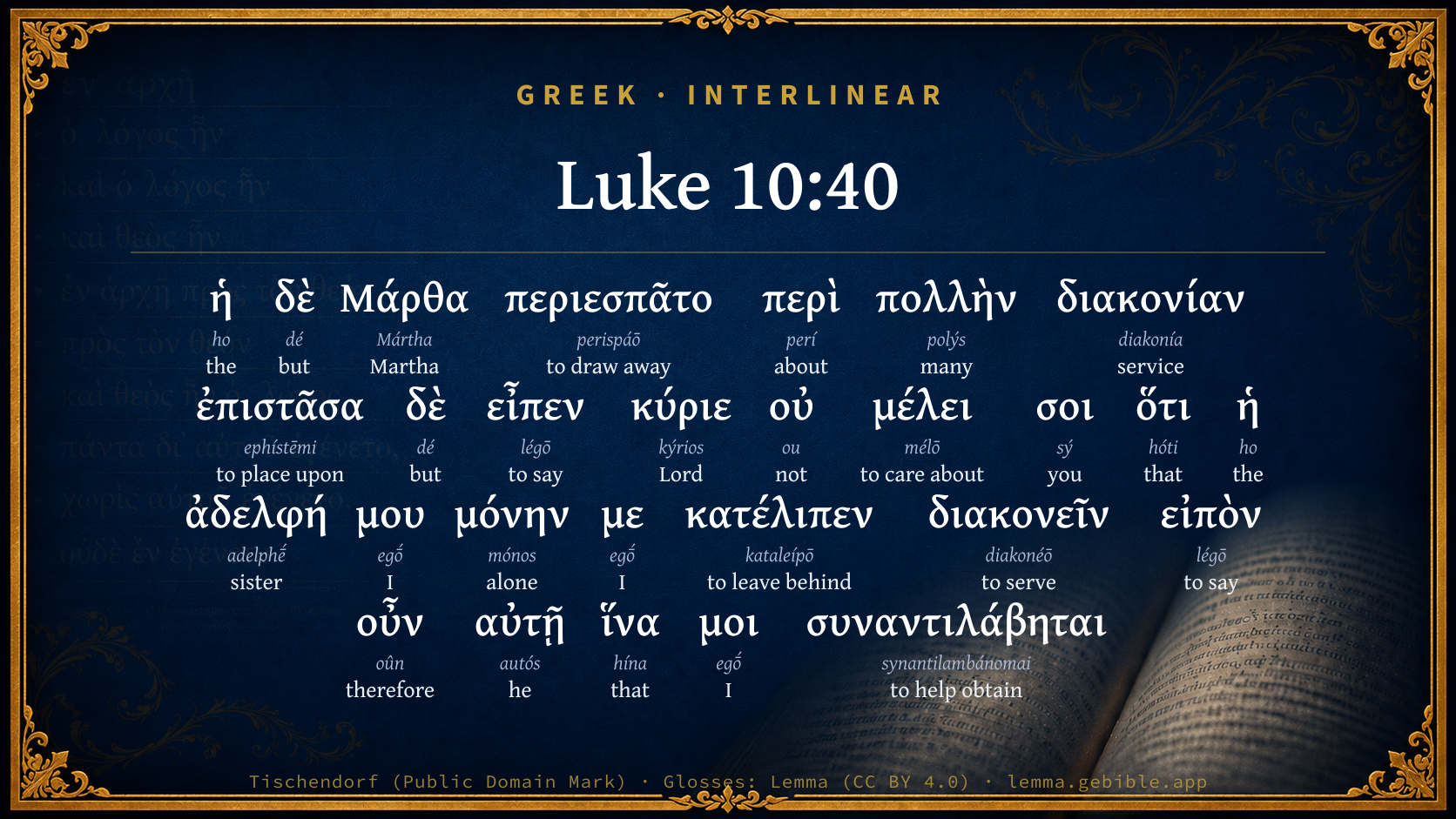
Greek (Tischendorf 8th ed.) Luke 10:40 appears in the Greek New Testament. The text above is from the Tischendorf 8th edition. Each word links to its Strong’s number and a concise gloss. Click any word for its full Thayer’s Greek Lexicon entry.
Download image
Cite this verse

Luke 10:40 (World English Bible). Public Domain. Lemma interlinear Bible study tool, https://lemma.gebible.app/v/luke/10/40.

Show BibTeX & RIS
BibTeX
RIS
English Translation
But Martha was distracted with much serving, and she came up to him, and said, "Lord, don't you care that my sister left me to serve alone? Ask her therefore to help me."
World English Bible · Public Domain
Highlights
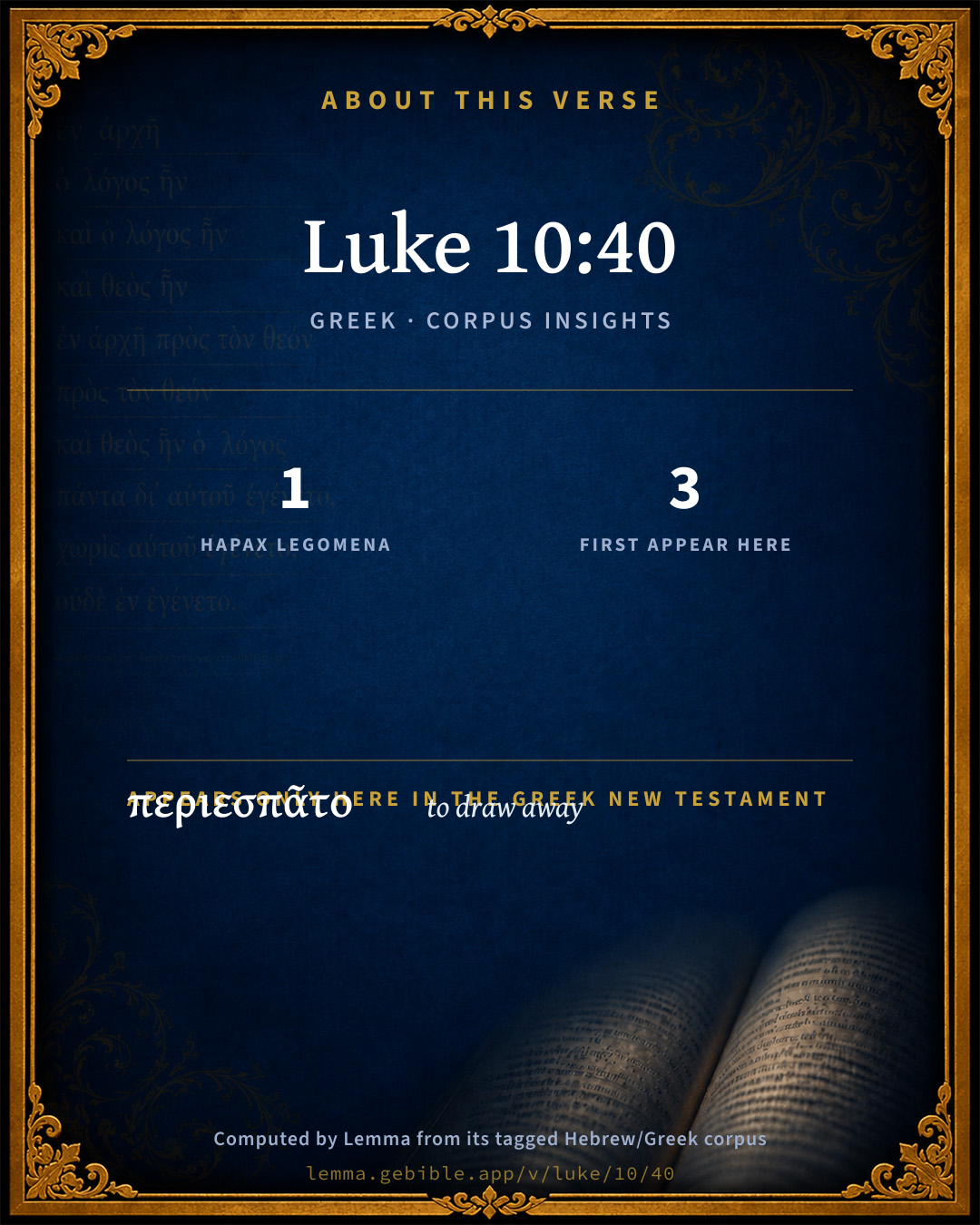
  • 1 hapax legomenon — only here in the Greek New Testament
  • 3 first appearances in the Greek New Testament
Full analysis ↓
Download a study sheet

One document with this verse’s original text, its word-by-word gloss line, the meaning frame, cross-references with their text, attributed commentary, and full source and license credits — printable, and it pastes into notes with its structure intact.

This verse Autodidact and up

Study sheet (.html) Plain text (.txt)

A passage Seminary Student

Up to 50 verses in one chapter. A passage sheet keeps up to 6 commentary sources and 12 cross-references per verse, in the order this page ranks them, and says so on the sheet whenever that leaves anything out. Ask for a single verse and you get the Autodidact verse sheet above.

Everything on this page stays free to read, with no account — the sheet is a download of what is already on screen, not access to it.

Want to remove ads? Support Godless Engineer
Compare translations 3

The same verse in 3 English versions, stacked beneath the original-language interlinear above. Click any original word for its lexicon entry.

Each is an independent rendering of the whole verse — the interlinear is not word-aligned to these translations.

Highlighted words mark where these versions differ — a whole-verse word diff, not a word-by-word alignment.

  • World English Bible Public Domain
    But Martha was distracted with much serving, and she came up to him, and said, "Lord, don't you care that my sister left me to serve alone? Ask her therefore to help me."
  • King James Version Public Domain
    But Martha was cumbered about much serving, and came to him, and said, Lord, dost thou not care that my sister hath left me to serve alone? bid her therefore that she help me.
  • unfoldingWord Literal Text CC BY-SA 4.0
    But Martha was distracted with much service, and coming up, she said, “Lord, are you not concerned that my sister has left me alone to serve? Therefore, speak to her so that she might help me.”

unfoldingWord Literal Text — © unfoldingWord, licensed CC BY-SA 4.0. Word-aligned USFM3 via Door43 (git.door43.org/unfoldingWord/en_ult).

Versions to compare (up to 4)

3 of 4 selected

Show all 19 translations

Every available English version of this verse, each an independent rendering of the whole verse.

  • World English Bible Public Domain
    But Martha was distracted with much serving, and she came up to him, and said, "Lord, don't you care that my sister left me to serve alone? Ask her therefore to help me."
  • Berean Standard Bible Public Domain
    But Martha was distracted by all the preparations to be made. She came to Jesus and said, “Lord, do You not care that my sister has left me to serve alone? Tell her to help me!”
  • Majority Standard Bible Public Domain
    But Martha was distracted by all the preparations to be made. She came to Jesus and said, “Lord, do You not care that my sister has left me to serve alone? Tell her to help me!”
  • King James Version Public Domain
    But Martha was cumbered about much serving, and came to him, and said, Lord, dost thou not care that my sister hath left me to serve alone? bid her therefore that she help me.
  • American Standard Version (1901) Public Domain
    But Martha was cumbered about much serving; and she came up to him, and said, Lord, dost thou not care that my sister did leave me to serve alone? bid her therefore that she help me.
  • Revised Version (1885) Public Domain
    But Martha was cumbered about much serving; and she came up to him, and said, Lord, dost thou not care that my sister did leave me to serve alone? bid her therefore that she help me.
  • Geneva Bible (1599) Public Domain
    But Martha was combred about much seruing, and came to him, and saide, Master, doest thou not care that my sister hath left me to serue alone? bid her therefore, that she helpe me.
  • Douay-Rheims (1899) Public Domain
    But Martha was busy about much serving. Who stood and said: Lord, hast thou no care that my sister hath left me alone to serve? speak to her therefore, that she help me.
  • Young's Literal Translation Public Domain
    and Martha was distracted about much serving, and having stood by him, she said, `Sir, dost thou not care that my sister left me alone to serve? say then to her, that she may partake along with me.'
  • Literal Standard Version CC BY-SA 4.0
    and Martha was distracted about much serving, and having stood by Him, she said, “Lord, do You not care that my sister left me alone to serve? Say then to her that she may partake along with me.”
  • Unlocked Literal Bible CC BY-SA 4.0
    But Martha was overly busy with preparing to serve a meal. She came up to Jesus, and said, “Lord, do you not care that my sister left me to serve alone? Therefore tell her to help me.”
  • unfoldingWord Literal Text CC BY-SA 4.0
    But Martha was distracted with much service, and coming up, she said, “Lord, are you not concerned that my sister has left me alone to serve? Therefore, speak to her so that she might help me.”
  • Darby Bible Public Domain
    Now Martha was distracted with much serving, and coming up she said, Lord, dost thou not care that my sister has left me to serve alone? Speak to her therefore that she may help me.
  • World Messianic Bible Public Domain
    But Martha was distracted with much serving, and she came up to him, and said, “Lord, don’t you care that my sister left me to serve alone? Ask her therefore to help me.”
  • Webster's Bible Public Domain
    But Martha was cumbered about much serving, and came to him, and said, Lord, dost thou not care that my sister hath left me to serve alone? bid her therefore that she help me.
  • Free Bible Version CC BY-SA 4.0
    Martha was concerned about all that needed to be done to prepare the meal, so she came to Jesus and said, “Master, don't you care that my sister has left me to do all the work by myself? Tell her to come and help me!”
  • Bible in Basic English Public Domain
    But Martha had her hands full of the work of the house, and she came to him and said, Lord, is it nothing to you that my sister has let me do all the work? Say to her that she is to give me some help.
  • Text-Critical English NT CC BY 4.0
    But Martha was distracted by the many preparations that had to be made. So she came up to Jesus and said, “Lord, do yoʋ not care that my sister has left me to make all the preparations by myself? Tell her then to assist me.”
  • Tyndale New Testament (1534) Public Domain
    And Martha was combred about moche servinge and stode and sayde: Master doest thou not care that my sister hath leeft me to minister alone? Byd her therfore that she helpe me.

Literal Standard Version (2020), Covenant Press — licensed CC BY-SA 4.0. Text via the HelloAO Bible API (eBible.org). Unlocked Literal Bible (unfoldingWord) — licensed CC BY-SA 4.0. Text via the HelloAO Bible API (eBible.org). unfoldingWord Literal Text — © unfoldingWord, licensed CC BY-SA 4.0. Word-aligned USFM3 via Door43 (git.door43.org/unfoldingWord/en_ult). Free Bible Version, Dr. Jonathan Gallagher — licensed CC BY-SA 4.0. Text via the HelloAO Bible API (eBible.org).

Word by word

More ways to search: Search by grammar → Find every occurrence → Compare this word →

Practice this passage: Drill this verse → Learn its vocabulary →

περιεσπᾶτο
perispáō
G4049
“to draw away”
Verb, Imperfect, Passive, Indicative, 3rd person, Singular
Part of Speech
Verb
Tense
Imperfect
Voice
Passive
Mood
Indicative
Person
3rd person
Number
Singular
Full Thayer's Definition

Origin: from G4012 and G4685

TDNT: None

1. to draw around, to draw away, distract 2. metaph. a. to be driven about mentally, to be distracted b. to be over-occupied, too busy, about a thing
  1. ἡ ho G3588 “the” Article, Nominative, Singular, Feminine
  2. δὲ dé G1161 “but” Conjunction
  3. Μάρθα Mártha G3136 “Martha” Noun, Nominative, Singular, Feminine
  4. περὶ perí G4012 “about” Preposition
  5. πολλὴν polýs G4183 “many” Adjective, Accusative, Singular, Feminine
  6. διακονίαν diakonía G1248 “service” Noun, Accusative, Singular, Feminine
  7. ἐπιστᾶσα ephístēmi G2186 “to place upon” Verb, Aorist, Active, Participle, Nominative, Singular, Feminine
  8. δὲ dé G1161 “but” Conjunction
  9. εἶπεν légō G3004 “to say” Verb, Aorist, Active, Indicative, 3rd person, Singular
  10. κύριε kýrios G2962 “Lord” Noun, Vocative, Singular, Masculine
  11. οὐ ou G3756 “not” Particle, Negative
  12. μέλει mélō G3199 “to care about” Verb, Present, Active, Indicative, 3rd person, Singular
  13. σοι sý G4771 “you” Personal pronoun, 2nd person, Dative, Singular
  14. ὅτι hóti G3754 “that” Conjunction
  15. ἡ ho G3588 “the” Article, Nominative, Singular, Feminine
  16. ἀδελφή adelphḗ G79 “sister” Noun, Nominative, Singular, Feminine
  17. μου egṓ G1473 “I” Personal pronoun, 1st person, Genitive, Singular
  18. μόνην mónos G3441 “alone” Adjective, Accusative, Singular, Feminine
  19. με egṓ G1473 “I” Personal pronoun, 1st person, Accusative, Singular
  20. κατέλιπεν kataleípō G2641 “to leave behind” Verb, Aorist, Active, Indicative, 3rd person, Singular
  21. διακονεῖν diakonéō G1247 “to serve” Verb, Present, Active, Infinitive
  22. εἰπὸν légō G3004 “to say” Verb, Aorist, Active, Imperative, 2nd person, Singular
  23. οὖν oûn G3767 “therefore” Conjunction
  24. αὐτῇ autós G846 “he” Personal pronoun, Dative, Singular, Feminine
  25. ἵνα hína G2443 “that” Conjunction
  26. μοι egṓ G1473 “I” Personal pronoun, 1st person, Dative, Singular
  27. συναντιλάβηται synantilambánomai G4878 “to help obtain” Verb, Aorist, Middle deponent, Subjunctive, 3rd person, Singular

About this verse

These counts appear in no published source. They are computed here, from the morphology-tagged text and Lemma’s own curated glosses. What Lemma adds →

28
words
23
distinct lemmas
Gospels
section

Notable vocabulary

1 hapax legomenon — a word that appears only here in the entire Greek New Testament:

  • περιεσπᾶτο to draw away G4049

First appearance in Scripture

These words make their first canonical appearance in the Greek New Testament here:

  • περιεσπᾶτο to draw away G4049
  • διακονίαν service G1248
  • συναντιλάβηται to help obtain G4878

Shared distinctive vocabulary

συναντιλάβηται to help obtain G4878 occurs in 2 verses of the Greek New Testament. Also found in:
Repetition

Words recur within this verse:

Cross-references

7

Topical passages linked to Luke 10:40 in the Treasury of Scripture Knowledge — connected by theme and wording, ordered by reader-vote popularity; previews shown in the World English Bible.

  • John 6:27 Don't work for the food which perishes, but for the food which remains to eternal life, which the Son of Man will give to you. For God the Father has sealed him."
  • Luke 12:29 Don't seek what you will eat or what you will drink; neither be anxious.
  • Matthew 14:15 When evening had come, his disciples came to him, saying, "This place is deserted, and the hour is already late. Send the multitudes away, that they may go into the villages, and buy themselves food."
  • Matthew 16:22 Peter took him aside, and began to rebuke him, saying, "Far be it from you, Lord! This will never be done to you."
  • Jonah 4:1–4 But it displeased Jonah exceedingly, and he was angry.
  • Mark 3:21 When his friends heard it, they went out to seize him: for they said, "He is insane."
  • Luke 9:55 But he turned and rebuked them, "You don't know of what kind of spirit you are.

Cross-references courtesy of OpenBible.info (CC BY 4.0).

Commentary

Notes on Luke 10:40 from classic Christian and Jewish commentators (each source and its license shown beneath its notes). The classic Christian expositions comment on the surrounding passage and are grouped to its opening verse, so a note may address several verses; the Jewish commentaries on the Tanakh (Rashi and others) are per-verse, so they appear only where the commentator wrote on this verse.

Lemma curates 59 commentaries, every one of them public domain or Creative Commons licensed, each selected and text-cleaned for this edition rather than reprinted as found. About our sources →

Tyndale Open Study Notes

Tyndale Open Resources

10:40 Martha was distracted by the big dinner she was preparing: Hospitality was valued highly, and Martha was fulfilling the expected role of a woman. She was frustrated that Mary was not.

Tyndale Open Study Notes — © Tyndale Open Resources, licensed CC BY-SA 4.0. Text via the HelloAO Bible API.

Bengel's Gnomon

Johann Albrecht Bengel

Luk 10:40. Περιεσπᾶτο) The Greek LXX. have often in Eccl. περισπασμὸς for ענין.—οὐ μέλει σοι, hast Thou no care?) What then? Something better is an object of care to Him. Martha herself acknowledged some degree of unhappiness as existing on her part.—ἡ ἀδελφή μου, my sister) An argument as it were drawn from an injustice done to her.—κατέλιπε) She does not say, suffers me, but, has left me. Hence it may be inferred that Mary had done something in the way of διακονία, or external service, perhaps before the arrival of the Master: but presently after betook herself to devoting her whole attention to the Master.—εἰπὲ, bid her) Martha did not dare herself to order Mary.

Bengel's Gnomon of the New Testament — English translation (T&T Clark, Edinburgh, 1860) — public domain. Text from a community e-Sword module.

Expositor's Greek Testament

ed. W. Robertson Nicoll

Luk 10:40 . ἡ δὲ Μάρ ., but Martha, δὲ as if μὲν had gone before where καὶ is = Mary on the one hand sat, etc., Martha on the other, etc. περιεσπᾶτο , was distracted, over-occupied, as if the visit had been unexpected, and the guests numerous. In use from Xenophon down. In Polybius with τῇ διανοίᾳ added. Holtzmann (H. C.) points out the correspondence between the contrasted picture of the two sisters and the antithesis between the married and unmarried woman in 1Co 7:34-35 . The married woman caring for the world like Martha ( μεριμνᾷς , Luk 10:41 ); the unmarried virgin: εὐπάρεδρον τ . κυρίῳ ἀπερισπάστως . ἐπιστᾶσα , coming up to and placing herself beside Jesus and Mary: in no placid mood, looking on her sister as simply an idle woman. A bustled worthy housewife will speak her mind in such a case, even though a Jesus be present and come in for a share of the blame. συναντιλάβηται , bid her take a hand along with me in the work ( cf. Rom 8:26 ).

The Expositor's Greek Testament, edited by W. Robertson Nicoll (1897–1910) — public domain. Text from a community e-Sword module.

Jamieson, Fausset & Brown

Robert Jamieson, A. R. Fausset & David Brown

cumbered--"distracted."

came to him--"presented herself before Him," as from another apartment, in which her sister had "left her to serve (or make preparation) alone."

carest thou not . . . my sister, &c.--"Lord, here am I with everything to do, and this sister of mine will not lay a hand to anything; thus I miss something from Thy lips, and Thou from our hands."

bid her, &c.--She presumes not to stop Christ's teaching by calling her sister away, and thus leaving Him without His one auditor, nor did she hope perhaps to succeed if she had tried.

Jamieson, Fausset & Brown — Commentary Critical and Explanatory on the Whole Bible (1871) — public domain (CC PDM 1.0). Text via the HelloAO Bible API.

Adam Clarke's Commentary

Verse 40. Martha was cumbered] περιεσπατο, perplexed, from περι, about, and σπαω, I draw. She was harassed with different cares and employments at the same time; one drawing one way, and another, another: a proper description of a worldly mind. But in Martha's favour it may be justly said, that all her anxiety was to provide suitable and timely entertainment for our Lord and his disciples; for this is the sense in which the word διακοςιας, serving, should be taken. And we should not, on the merest supposition, attribute earthly-mindedness to a woman whose character stands unimpeachable in the Gospel; and who, by entertaining Christ and his disciples, and providing liberally for them, gave the highest proof that she was influenced by liberality and benevolence, and not by parsimony or covetousness.

Dost thou not care] Dost thou not think it wrong, that my sister thus leaves me to provide and prepare this supper, alone?

Help me.] συναντιλαβηται, from συν, together, and αντιλαμβανομαι, to support. The idea is taken from two pillars meeting together at the top, exactly over the centre of the distance between their bases, and thus mutually supporting each other. Order her to unite her skill and strength with mine, that the present business may be done with that speed and in that order which the necessity and importance of the case demand.

Adam Clarke's Commentary on the Bible (1810–1826) — public domain. Text from a community e-Sword/MySword module.

Ellicott's Commentary for English Readers

(40) Martha was cumbered.—Literally, was distracted; drawn hither and thither by conflicting cares.

About much serving.—We may probably infer from this that our Lord had been invited as an honoured guest, and that Mary had been asked to meet Him; and, so far, the narrative agrees with what is suggested by the narrative of John 11 as to the social position of the household at Bethany. The use of a like word in Luk_12:42 suggests that this also may have passed from the abstract to the concrete sense, and have been used for a household of many servants as well as for the act of serving.

Came to him.—The Greek word implies something like a hasty movement to interrupt the calm tenor of the Lord’s discourse. The hasty vehement complaint that follows is quite in keeping with this.

That she help me.—More literally, that she join in helping.

A Bible Commentary for English Readers, edited by Charles John Ellicott (1878–1897) — public domain. Text from a community e-Sword module.

The Cambridge Bible for Schools and Colleges

gen. ed. J. J. S. Perowne

40. cumbered about much serving] The word for “cumbered” literally means ‘was being dragged in different directions,’ i.e. was distracted (1Co_7:35). She was anxious to give her Lord a most hospitable reception, and was vexed at the contemplative humility which she regarded as slothfulness.

came to him] Rather, but suddenly coming up (Luk_20:1; Act_23:27). We see in this inimitable touch the little petulant outburst of jealousy in the loving, busy matron, as she hurried in with the words, “Why is Mary sitting there doing nothing?”

left me] The Greek word means ‘left me alone in the middle of my work’ to come and listen to you.

bid her therefore that she help me] We almost seem to hear the undertone of ‘It is no use for me to tell her.’ Doubtless, had she been less ‘fretted’ (θορυβάζῃ), she would have felt that to leave her. alone and withdraw into the background while this eager hospitality was going on was the kindest and most unselfish thing which Mary could do.

The Cambridge Bible for Schools and Colleges (gen. ed. J. J. S. Perowne; Cambridge University Press, 1878–1918) — public domain. Text from a community e-Sword module.

John Gill's Exposition

And Jesus answered and said unto her,.... Calling her by her name, and repeating it, Martha, Martha, which expresses great intimacy and friendship, and much earnestness, and, as it were, pitying her present situation and circumstances:

thou art careful and troubled about many things; intimating, that she was over anxious, and too solicitous, and more thoughtful and careful than she need be: he did not require such preparations for him, and so much attendance; she gave herself an unnecessary trouble in providing so many things for his entertainment, when less would have sufficed; so that instead of joining with her in her request, he reproves her for her over anxious care and solicitude, to have a nice and plentiful feast. The Persic version gives a sense quite contrary to the design of the text, rendering the words thus, "thou art adorned in all things, and hast the preference above many women".

John Gill's Exposition of the Whole Bible (1746–1763) — public domain (CC PDM 1.0). Text via the HelloAO Bible API.

Trapp's Complete Commentary

John Trapp

40 But Martha was cumbered about much serving, and came to him, and said, Lord, dost thou not care that my sister hath left me to serve alone? bid her therefore that she help me.

Ver. 40. Martha was cumbered] Diversely distracted, περιεσπατο. In multitude of worldly business, the soul is like a mill, where one cannot hear another, the noise is such as taketh away all intercourse. We should look at the world but only cut at the eye’s end, as it were.

John Trapp, A Commentary or Exposition upon All the Books of the Old and New Testament (1647–1656) — public domain. Text from a community e-Sword module.

Albert Barnes' Notes on the Bible

Martha was cumbered about much serving - Was much distracted with the cares of the family, and providing suitably to entertain the Saviour. It should be said here that there is no evidence that Martha had a worldly or covetous disposition. Her anxiety was to provide suitable entertainment for the Lord Jesus. As mistress of the family, this care properly devolved on her; and the only fault which can be charged on her was too earnest a desire to make such entertainment, when she might have sat with Mary at his feet, and, perhaps, too much haste and fretfulness in speaking to Jesus about Mary.

Dost thou not care ... - This was an improper reproof of our Lord, as if “he” encouraged Mary in neglecting her duty. Or perhaps Martha supposed that Mary was sitting there to show him the proper expressions of courtesy and kindness, and that she would not think it proper to leave him without his direction and permission. She therefore “hinted” to Jesus her busy employments, her need of the aid of her sister, and requested that he would signify his wish that Mary should assist her.

Albert Barnes' Notes on the Bible (1834–1885) — public domain. Text from a community e-Sword/MySword module.

Haydock's Catholic Bible Commentary

Calvin here ridicules the professors of evangelical poverty, because they gather from this place that there are two states of life, viz. the active and the contemplative, figured by Martha and Mary. But what will he answer, when he is informed, that this is the opinion not merely of monks, but even of a St. Augustine, (Serm. xxvii. De verbis Domini,) of a St. Jerome, (Com. 3 cap. of Jeremiah,) of a St. Gregory, and many others? Not that they were ignorant that there was another more natural explanation; but they were of opinion that nothing could be found more proper for the illustration of these different states of life. (Maldonatus)

George Leo Haydock (1774–1849), Haydock's Catholic Family Bible and Commentary, 1859 edition — public domain. Excludes Psalms (Douay-Rheims chapter numbering differs from Protestant) and Deuterocanonical books (Catholic canon only).

Matthew Poole's English Annotations

Two things are blameable in Martha:

1. That she made too much ado about the entertainment of our Saviour. That she entertained our Saviour she did well; but herein she erred, that she made her entertainment of him so troublesome, as it would not give her leave to take that advantage, which she might, or ought to have done, from the entertainment of a prophet.

2. That she is displeased with her sister because she would not lend her hand, but chose rather to sit at Christ’s feet and hear his word, and desireth Christ to send her away to her assistance.

Matthew Poole's English Annotations on the Holy Bible (1683–1685) — public domain. Text from a community e-Sword/MySword module.

Whedon's Commentary on the Bible

Daniel D. Whedon

40. Cumbered—Her mind was not only occupied, but disturbed and

distracted. Much serving—The preparations of the apartments for her guest; furnishings, and feastings, and lodging. This was to honour him, but in a very physical way. To provide amply for her Lord was her duty, and practical proof of her love and faith, (as attested in Joh_11:20-28;) but there was a way more truly to honour him than by considering him as an epicure who had come for a banquet. Mary better understood that the Son of God sojourned but briefly upon earth, and that he devoted these few hours to their quiet home for higher purposes than the appetites of the table. Lord,

dost thou not care?—Now, this is a nervous lady; and hers is a sharp, nay, a two-edged speech. It cuts Mary, and it cuts our Lord. Dost thou not care? This seems to mean that lazy Mary shirks, while Jesus, who ought to prevent, is indulging her.

Hath left me—That is, she aided Martha for a while, until, perhaps, a sense of divine propriety said, “Enough; to provide more were an overdoing which he would blame;” and then she left, satisfied that she honoured the Lord more, and that she fulfilled the purpose of his visit better, by listening to the truths of the great Teacher than by providing a luxurious banquet or superabundant furnishings.

Daniel D. Whedon (gen. ed.), Commentary on the Old and New Testaments (1874–1909) — public domain. Text from a community e-Sword module.

The Pulpit Commentary

Came to him. Dr. Farrar very happily seizes the tone and temper of Martha. He renders the Greek words here, "but suddenly coming up." We see in this inimitable touch the little petulant outburst of jealousy in the loving, busy matron, as she hurried in with the words, "Why is Mary sitting there doing nothing?" Bid her therefore that she help me. "We almost seem to hear the undertone of "It is no use for me to tell her." Doubtless, had she been less" fretted," she would have felt that to leave her (Martha) alone and withdraw into the background while this eager hospitality was going on, was the kindest and most unselfish thing which Mary could do."

The Pulpit Commentary (1880–1919), ed. H.D.M. Spence-Jones & Joseph S. Exell — public domain. Text from a community e-Sword module.

John Wesley's Explanatory Notes

Martha was encumbered - The Greek word properly signifies to be drawn different ways at the same time, and admirably expresses the situation of a mind, surrounded (as Martha's then was) with so many objects of care, that it hardly knows which to attend to first.

John Wesley, Explanatory Notes Upon the Whole Bible (1754–1765) — public domain. Text via the GEBible commentary corpus.

Burkitt's Expository Notes on the New Testament

William Burkitt

Observe here, 1. Martha’s behavior: She was cumbered about much serving; that is, much taken up with providing for the entertainment of Christ and his friends; all which considered in itself was no miscarriage, but a token of Martha’s endeared respect to her best Friend.

A person that sincerely loves Christ as Martha did, thinks he can never show enough of respect unto him. Martha having such a guest to honor her house, puts forth herself all she can, yea, more than she was able, to give him entertainment: She was cumbered about much serving.

Observe, 2. Martha’s complaint to Christ concerning her sister’s not joining with her in the work that lay so hard upon her: Lord, dost thou not care that my sister hath left me to serve alone? Bid her therefore that she help me: as if Martha had said, is it a fit thing that both thyself, and all this company, should be unprovided for? Or is it reasonable that the whole burden should lie upon me, while Mary sits still, and does not touch the least household business with one of her fingers?

Lord, what infirmity and weakness intermixes and mingles with the virtues and graces of the best of thy servants, especially when they give way to their distempered passions!

This good woman at this time did not attend upon Christ’s preaching herself, but interrupts him with a frivolous complaint about her sister: Bid her that she help me.

But why did not Martha speak to her sister herself, and whisper in her ear, and acquaint her how she wanted her help, but makes her moan to Christ?

Answer, it is like she thought her sister was so tied by the ear with those adamantine chains of Christ’s heavenly doctrine, that until Christ was silent she had no power to stir; doubtless she believed that Mary would not move unless Christ spoke to her so to do.

Observe, 3. That all this while Mary speaks not one word for herself: no doubt it troubled her, good woman, to hear her sister complain of her to Christ, and find herself blamed for her piety, and implicitly condemned for laying hold upon such a sweet opportunity of hearing the beloved of her soul whose lips dropped as the honey-comb; however, she speaks not a word in her own vindication, but leaves her answer to her Saviour.

Learn thence, that when we are complained of for well doing, it is our duty, and may it be our prudence, to seal up our lips in silence, and to expect our vindication from above. Mary says nothing, but Christ speaks for her in the next verses.

William Burkitt's Expository Notes on the New Testament (1700–1703) — public domain. Text from a community e-Sword module.

The People's New Testament

B. W. Johnson

40. Dost thou not care? Her sister seemed to her negligent and selfish, when her apparent neglect was do to the absorption in the truth.

B. W. Johnson's The People's New Testament with Notes (1889–1891) — public domain. Electronic text from the Christian Classics Ethereal Library (CCEL) ThML edition.

unfoldingWord translationNotes

Door43 World Missions Community

overly busy

"very busy" or "too busy"

do you not care ... alone?

Martha is complaining that the Lord is allowing Mary to sit listening to him when there is so much work to do. She respects the Lord, so she uses a rhetorical question to make her complaint more polite. AT: "it seems like you do not care ... alone." (See: Rhetorical Question)

Martha, Martha

Jesus repeats Martha's name for emphasis. AT: "Dear Martha" or "You, Martha"

only one thing is necessary

Jesus is contrasting what Mary is doing with what Martha is doing. It may be helpful to make this explicit. AT: "the only thing that is really necessary is to listen to my teaching" or "listening to my teaching is more necessary than preparing a meal" (See: Assumed Knowledge and Implicit Information)

which will not be taken away from her

Possible meanings are 1) "I will not take this opportunity away from her" or 2) "she will not lose what she has gained as she was listening to me" (See: Active or Passive)

translationWords

servant

lord

unfoldingWord translationNotes — © Distant Shores Media and the Door43 World Missions Community, licensed CC BY-SA 4.0. Source: git.door43.org/Door43/en_tn.

Cambridge Greek Testament for Schools and Colleges

40. περιεσπᾶτο περὶ πολλὴν διακονίαν. The word for “cumbered” literally means ‘was being dragged in different directions,’ i.e. was distracted (1Co 7:35). She was anxious to give her Lord a most hospitable reception, and was vexed at the contemplative humility which she regarded as slothfulness. The occurrence of ἀπερισπάστως, μεριμνᾷ, εὐπρόσεδρον in 1Co 7:34-35 seems to shew that St Paul had orally heard this narrative.

ἐπιστᾶσα. ‘But suddenly coming up’ (Luk 20:1; Act 23:27). We see in this inimitable touch the little petulant outburst of jealousy in the loving, busy matron, as she hurried in with the words, “Why is Mary sitting there doing nothing?”

με κατέλιπεν. The word means ‘left me alone in the middle of my work’ to come and listen to you.

εἰπὸν οὖν αὐτῇ ἵνα μοι συναντιλάβηται. We almost seem to hear the undertone of ‘It is no use for me to tell her.’ Doubtless, had she been less ‘fretted’ (θορυβάζῃ), she would have felt that to leave her alone and withdraw into the background while this eager hospitality was going on was the kindest and most unselfish thing which Mary could do.

Cambridge Greek Testament for Schools and Colleges (Cambridge University Press, 1896; 21 vols, various authors incl. Carr, Maclear, Plummer, Farrar, Lumby, Moule, M. R. James, Simcox) — public domain. Text from a community e-Sword module.

Alford’s Greek Testament

Henry Alford

40.] περιεσπ. (as also the form παρακαθεσθεῖσα above) is a word of later Greek. We have in Dion. Hal. ix. 43, περισπᾷ περὶ τὰς ἔξω στρατείας τὸν δῆμον: and in Jos. Antt. v. 1. 4, πρὸς τοσαύτας ὑπηρεσίας διασπώμενος. See also Diod. Sic. i. 74: Polyb. xv. 3. 4. It exactly answers to the Latin ‘torqueor’ used in the same connexion by Horace, Sat. ii. 8. 67, and to a midland provincial expression ‘to be put about,’ meaning to be ‘distracted with officious care.’ See Phryn. ed. Lobeck, p. 415, who gives ἄσχολος εἶναι for the corresponding classical expression.

ἐπιστ., generally, but not always, used by Luke of a sudden coming into presence. It looks here as if our Lord were teaching in another apartment from that where the διακονία was going on:—this appears also in the κατέλειπεν.

41,

Henry Alford, The Greek Testament (1849–1861) — public domain. Text from a community e-Sword module.

International Critical Commentary

40. περιεσπᾶτο. “Was drawn about in different directions, distracted.” The word forms a marked contrast to παρακαθεσθεῖσα. Comp. Ecc 1:13, Ecc 1:3:10, Ecc 1:5:19; Ecclus. 41:4.

ἐπιστᾶσα δὲ εἶπεν, Κύριε. “And she came up and said”: see on 2:38, Cov, has “steple unto Him.” Other Versions previous to AV. have “stood.” The word perhaps indicates an impatient movement. Her temper is shown in her addressing the rebuke to Him rather than to her sister. Her saying ἡ ἀδελφή μου instead of Μαριάμ is argumentum quasi ab iniquo (Beng.), and μόνην is placed first for emphasis. The imperf, κατέλειπεν expresses the continuance of the neglect. The word does not imply that Mary began to help and then left off, but that she ought to have helped, and from the first abstained. D.C.G. art. “Martha.”

For εἰπὸν … ἵνα comp. Mar 3:9, and for ἀντιλαμβάνω see on 1:54. Here the meaning of συναντ. is “take hold along with me, help me.” Comp Rom 8:26; Exo 18:22; Psa 89:22. See Field, Otium Norvic. iii. p. 44.

International Critical Commentary — older volumes (1896–1929), various authors — public domain. Text from a community e-Sword module.

Vincent's Word Studies in the New Testament

Marvin R. Vincent

Was cumbered [περιεσπατο] . Only here in New Testament. The Rev. might better have inserted in the text the marginal rendering, was distracted. The verb means, literally, to draw from around [περι] .

Martha 's attention, instead of centering round Jesus, was drawn hither and thither. The peri, around, in composition with the verb, is followed immediately by another peri, "about much serving."

Came to him [επιστασα] . Came up to him, as Rev., suddenly stopping in her hurry.

Hath left [κατελιπεν] . The aorist, as Rev., did leave, indicating that she had been assisting before she was drawn off by Jesus ' presence. Some read kateleipen, the imperfect, was leaving.

Help [συναντιλαβηται] . The verb consists of three elements : lambanw, to take hold; sun, together with; ajnti, reciprocally - doing her part as Martha does hers. It might be paraphrased, therefore, take hold and do her part along with me. It occurs only here and Rom 8:26, of the Spirit helping our infirmities, where all the elements of the verb are strikingly exemplified.

Marvin R. Vincent, Word Studies in the New Testament (1887–1900) — public domain. Text from a community e-Sword/MySword module.

Lesson kit

Teaching starters — assembled from the data on this page, not authored interpretation. Every prompt links to the verse data it draws on. Edit before teaching.

Luke, in the Gospels, opens this verse with 28 words (23 distinct Greek lemmas). Its most distinctive word is perispáō (“to draw away”). A historical commentator’s framing appears above. Read the whole chapter for the surrounding context.

Discussion questions

  1. The word perispáō carries the sense “to draw away.” How does it shape the verse?
  2. This verse holds 1 word here found nowhere else in the Greek New Testament. What might the rare word draw attention to?
  3. 3 words here appear for the first time in Scripture. What is being introduced at this debut?
  4. Romans 8:26 shares the word «to help obtain» with this verse. How do the two illuminate each other?
  5. “to say” occurs 2× in this one verse. What is the effect of the repetition?
  6. The translations on this page render this verse differently — a whole-verse word diff, not a word-by-word alignment. What might account for the different wordings?
  7. Reading how Tyndale Open Study Notes and Bengel's Gnomon read this verse, where do the two commentators agree and where do they part?

Things to notice

  • 1 word in this verse appears nowhere else in the Greek New Testament.
  • 3 words make their first canonical appearance in Scripture here.
  • These translations choose different wording for 18 words in this verse.
  • “to say” occurs 2× in this single verse.
  • 23 distinct Greek lemmas span 28 words in this verse.

Reading settings

Reading text

Shown beneath each verse's original-language words.

Old Testament
Old Testament edition

Read the OT as the Masoretic Hebrew (MT) or the Greek Septuagint (LXX).

English shown for the Greek Septuagint (in the Hebrew ↔ Greek comparison).

Comparing translations? Open the Compare panel on any verse page to stack up to four side by side.