Mark 6:2

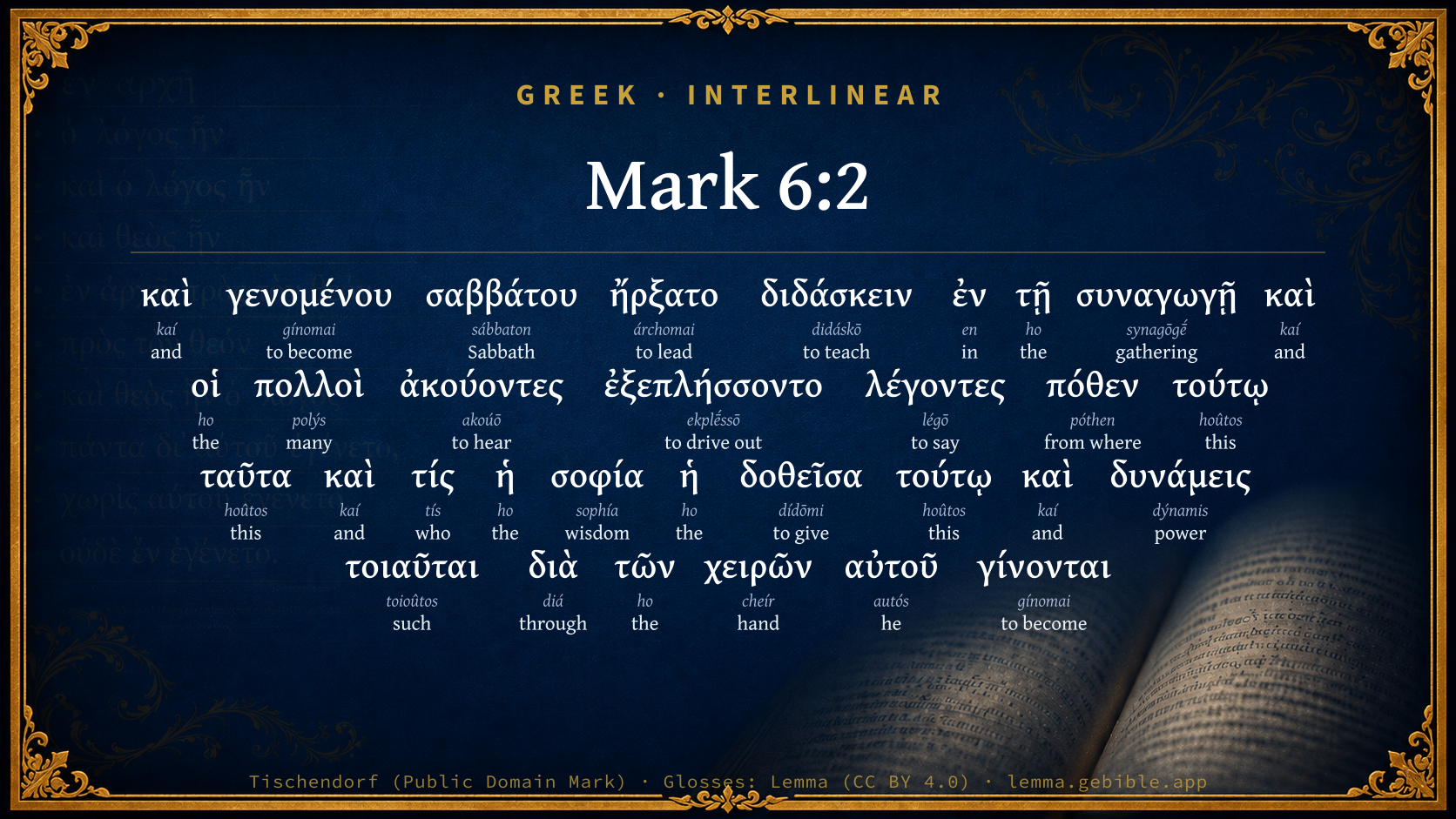
Greek (Tischendorf 8th ed.) Mark 6:2 appears in the Greek New Testament. The text above is from the Tischendorf 8th edition. Each word links to its Strong’s number and a concise gloss. Click any word for its full Thayer’s Greek Lexicon entry.
Download image
Cite this verse

Mark 6:2 (World English Bible). Public Domain. Lemma interlinear Bible study tool, https://lemma.gebible.app/v/mark/6/2.

Show BibTeX & RIS
BibTeX
RIS
English Translation
When the Sabbath had come, he began to teach in the synagogue, and many hearing him were astonished, saying, "Where did this man get these things?" and, "What is the wisdom that is given to this man, that such mighty works come about by his hands?
World English Bible · Public Domain
Download a study sheet

One document with this verse’s original text, its word-by-word gloss line, the meaning frame, cross-references with their text, attributed commentary, and full source and license credits — printable, and it pastes into notes with its structure intact.

This verse Autodidact and up

Study sheet (.html) Plain text (.txt)

A passage Seminary Student

Up to 50 verses in one chapter. A passage sheet keeps up to 6 commentary sources and 12 cross-references per verse, in the order this page ranks them, and says so on the sheet whenever that leaves anything out. Ask for a single verse and you get the Autodidact verse sheet above.

Everything on this page stays free to read, with no account — the sheet is a download of what is already on screen, not access to it.

Want to remove ads? Support Godless Engineer
Compare translations 3

The same verse in 3 English versions, stacked beneath the original-language interlinear above. Click any original word for its lexicon entry.

Each is an independent rendering of the whole verse — the interlinear is not word-aligned to these translations.

Highlighted words mark where these versions differ — a whole-verse word diff, not a word-by-word alignment.

  • World English Bible Public Domain
    When the Sabbath had come, he began to teach in the synagogue, and many hearing him were astonished, saying, "Where did this man get these things?" and, "What is the wisdom that is given to this man, that such mighty works come about by his hands?
  • King James Version Public Domain
    And when the sabbath day was come, he began to teach in the synagogue: and many hearing him were astonished, saying, From whence hath this man these things? and what wisdom is this which is given unto him, that even such mighty works are wrought by his hands?
  • unfoldingWord Literal Text CC BY-SA 4.0
    And a Sabbath having come, he began to teach in the synagogue. And the many ones hearing him were astonished, saying, “From where to this one these things, and what the wisdom that has been given to this one, and such miracles happening by his hands?

unfoldingWord Literal Text — © unfoldingWord, licensed CC BY-SA 4.0. Word-aligned USFM3 via Door43 (git.door43.org/unfoldingWord/en_ult).

Versions to compare (up to 4)

3 of 4 selected

Show all 19 translations

Every available English version of this verse, each an independent rendering of the whole verse.

  • World English Bible Public Domain
    When the Sabbath had come, he began to teach in the synagogue, and many hearing him were astonished, saying, "Where did this man get these things?" and, "What is the wisdom that is given to this man, that such mighty works come about by his hands?
  • Berean Standard Bible Public Domain
    When the Sabbath came, He began to teach in the synagogue, and many who heard Him were astonished. “Where did this man get these ideas?” they asked. “What is this wisdom He has been given? And how can He perform such miracles?
  • Majority Standard Bible Public Domain
    When the Sabbath came, He began to teach in the synagogue, and many who heard Him were astonished. “Where did this man get these ideas?” they asked. “What is this wisdom He has been given? And how can He perform such miracles?
  • King James Version Public Domain
    And when the sabbath day was come, he began to teach in the synagogue: and many hearing him were astonished, saying, From whence hath this man these things? and what wisdom is this which is given unto him, that even such mighty works are wrought by his hands?
  • American Standard Version (1901) Public Domain
    And when the sabbath was come, he began to teach in the synagogue: and many hearing him were astonished, saying, Whence hath this man these things? and, What is the wisdom that is given unto this man, and `what mean' such mighty works wrought by his hands?
  • Revised Version (1885) Public Domain
    And when the sabbath was come, he began to teach in the synagogue: and many hearing him were astonished, saying, Whence hath this man these things? and, What is the wisdom that is given unto this man, and what mean such mighty works wrought by his hands?
  • Geneva Bible (1599) Public Domain
    And when the Sabbath was come, he began to teach in the Synagogue, and many that heard him, were astonied, and sayd, From whence hath this man these things? and what wisdome is this that is giuen vnto him, that euen such great workes are done by his hands?
  • Douay-Rheims (1899) Public Domain
    And when the sabbath was come, he began to teach in the synagogue: and many hearing him were in admiration at his doctrine, saying: How came this man by all these things? and what wisdom is this that is given to him, and such mighty works as are wrought by his hands?
  • Young's Literal Translation Public Domain
    and sabbath having come, he began in the synagogue to teach, and many hearing were astonished, saying, `Whence hath this one these things? and what the wisdom that was given to him, that also such mighty works through his hands are done?
  • Literal Standard Version CC BY-SA 4.0
    and Sabbath having come, He began to teach in the synagogue, and many hearing were astonished, saying, “From where [did] this One [hear] these things? And what [is] the wisdom that was given to Him, that also such mighty works are done through His hands?
  • Unlocked Literal Bible CC BY-SA 4.0
    When the Sabbath came, he taught in the synagogue. Many people heard him and they were amazed. They said, “Where did he get these teachings?” “What is this wisdom that has been given to him?” “What are these miracles that he does with his hands?”
  • unfoldingWord Literal Text CC BY-SA 4.0
    And a Sabbath having come, he began to teach in the synagogue. And the many ones hearing him were astonished, saying, “From where to this one these things, and what the wisdom that has been given to this one, and such miracles happening by his hands?
  • Darby Bible Public Domain
    And when sabbath was come he began to teach in the synagogue, and many hearing were amazed, saying, Whence [has] this [man] these things? and what [is] the wisdom that is given to him, and such works of power are done by his hands?
  • World Messianic Bible Public Domain
    When the Sabbath had come, he began to teach in the synagogue, and many hearing him were astonished, saying, “Where did this man get these things?” and, “What is the wisdom that is given to this man, that such mighty works come about by his hands?
  • Webster's Bible Public Domain
    And when the sabbath was come, he began to teach in the synagogue: and many hearing him were astonished, saying, From whence hath this man these things? and what wisdom is this which is given to him, that even such mighty works are wrought by his hands?
  • Free Bible Version CC BY-SA 4.0
    On Sabbath he began teaching in the synagogue, and many of those who were listening were surprised. “Where does he get these ideas?” they asked. “What's this wisdom he's been given? Where does he get the power to do miracles?
  • Bible in Basic English Public Domain
    And when the Sabbath day had come, he was teaching in the Synagogue; and a number of people hearing him were surprised, saying, From where did this man get these things? and, What is the wisdom given to this man, and what are these works of power done by his hands?
  • Text-Critical English NT CC BY 4.0
    When the Sabbath came, he began to teach in the synagogue, and many who heard him were astonished, saying, “Where did this man get these things? And what is this wisdom that has been given to him, that such miracles are done by his hands?
  • Tyndale New Testament (1534) Public Domain
    And when the saboth daye was come he beganne to teache in the synagoge. And many that hearde him were astonyed and sayde: From whens hath he these thinges? and what wysdo is this that is geve vnto him? and suche vertues that are wrought by his hondes?

Literal Standard Version (2020), Covenant Press — licensed CC BY-SA 4.0. Text via the HelloAO Bible API (eBible.org). Unlocked Literal Bible (unfoldingWord) — licensed CC BY-SA 4.0. Text via the HelloAO Bible API (eBible.org). unfoldingWord Literal Text — © unfoldingWord, licensed CC BY-SA 4.0. Word-aligned USFM3 via Door43 (git.door43.org/unfoldingWord/en_ult). Free Bible Version, Dr. Jonathan Gallagher — licensed CC BY-SA 4.0. Text via the HelloAO Bible API (eBible.org).

Word by word

More ways to search: Search by grammar → Find every occurrence → Compare this word →

Practice this passage: Drill this verse → Learn its vocabulary →

ἐξεπλήσσοντο
ekplḗssō
G1605
“to drive out”
Verb, Imperfect, Passive, Indicative, 3rd person, Plural
Part of Speech
Verb
Tense
Imperfect
Voice
Passive
Mood
Indicative
Person
3rd person
Number
Plural
Full Thayer's Definition

Origin: from G1537 and G4141

TDNT: None

1. to strike out, expel by a blow, drive out or away 2. to cast off by a blow, to drive out a. commonly, to strike one out of self-possession, to strike with panic, shock, astonish 3. to be struck with amazement, astonished, amazed
  1. καὶ kaí G2532 “and” Conjunction
  2. γενομένου gínomai G1096 “to become” Verb, Aorist, Middle deponent, Participle, Genitive, Singular, Neuter
  3. σαββάτου sábbaton G4521 “Sabbath” Noun, Genitive, Singular, Neuter
  4. ἤρξατο árchomai G756 “to lead” Verb, Aorist, Middle deponent, Indicative, 3rd person, Singular
  5. διδάσκειν didáskō G1321 “to teach” Verb, Present, Active, Infinitive
  6. ἐν en G1722 “in” Preposition
  7. τῇ ho G3588 “the” Article, Dative, Singular, Feminine
  8. συναγωγῇ synagōgḗ G4864 “gathering” Noun, Dative, Singular, Feminine
  9. καὶ kaí G2532 “and” Conjunction
  10. οἱ ho G3588 “the” Article, Nominative, Plural, Masculine
  11. πολλοὶ polýs G4183 “many” Adjective, Nominative, Plural, Masculine
  12. ἀκούοντες akoúō G191 “to hear” Verb, Present, Active, Participle, Nominative, Plural, Masculine
  13. λέγοντες légō G3004 “to say” Verb, Present, Active, Participle, Nominative, Plural, Masculine
  14. πόθεν póthen G4159 “from where” Adverb, Interrogative
  15. τούτῳ hoûtos G3778 “this” Demonstrative pronoun, Dative, Singular, Masculine
  16. ταῦτα hoûtos G3778 “this” Demonstrative pronoun, Nominative, Plural, Neuter
  17. καὶ kaí G2532 “and” Conjunction
  18. τίς tís G5101 “who” Interrogative pronoun, Nominative, Singular, Feminine
  19. ἡ ho G3588 “the” Article, Nominative, Singular, Feminine
  20. σοφία sophía G4678 “wisdom” Noun, Nominative, Singular, Feminine
  21. ἡ ho G3588 “the” Article, Nominative, Singular, Feminine
  22. δοθεῖσα dídōmi G1325 “to give” Verb, Aorist, Passive, Participle, Nominative, Singular, Feminine
  23. τούτῳ hoûtos G3778 “this” Demonstrative pronoun, Dative, Singular, Masculine
  24. καὶ kaí G2532 “and” Conjunction
  25. δυνάμεις dýnamis G1411 “power” Noun, Nominative, Plural, Feminine
  26. τοιαῦται toioûtos G5108 “such” Demonstrative pronoun, Nominative, Plural, Feminine
  27. διὰ diá G1223 “through” Preposition
  28. τῶν ho G3588 “the” Article, Genitive, Plural, Feminine
  29. χειρῶν cheír G5495 “hand” Noun, Genitive, Plural, Feminine
  30. αὐτοῦ autós G846 “he” Personal pronoun, Genitive, Singular, Masculine
  31. γίνονται gínomai G1096 “to become” Verb, Present, Middle or Passive deponent, Indicative, 3rd person, Plural

About this verse

These counts appear in no published source. They are computed here, from the morphology-tagged text and Lemma’s own curated glosses. What Lemma adds →

32
words
22
distinct lemmas
Gospels
section

Notable vocabulary

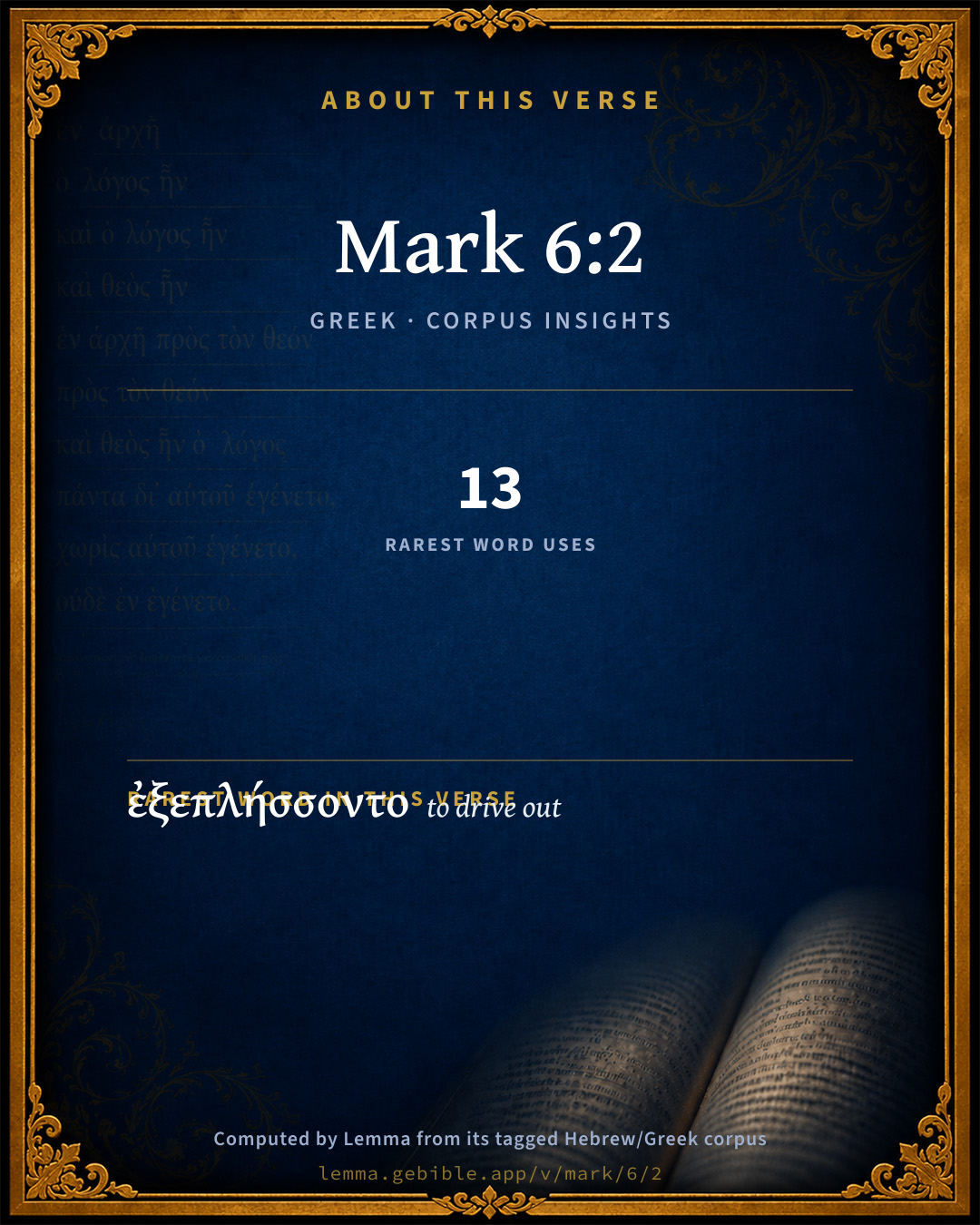
The rarest word here is ἐξεπλήσσοντο to drive out G1605 — appearing just 13 times in the whole Greek New Testament.

Shared distinctive vocabulary

ἐξεπλήσσοντο to drive out G1605 occurs in 13 verses of the Greek New Testament. Also found in:

Repetition

Words recur within this verse:

  • γενομένου to become G1096 ×2
  • τῇ the G3588 ×5
  • καὶ and G2532 ×4
  • τούτῳ this G3778 ×3

Cross-references

9

Topical passages linked to Mark 6:2 in the Treasury of Scripture Knowledge — connected by theme and wording, ordered by reader-vote popularity; previews shown in the World English Bible.

  • John 6:42 They said, "Isn't this Jesus, the son of Joseph, whose father and mother we know? How then does he say, 'I have come down out of heaven?'"
  • John 7:15 The Jews therefore marveled, saying, "How does this man know letters, having never been educated?"
  • Matthew 4:23 Jesus went about in all Galilee, teaching in their synagogues, preaching the Gospel of the Kingdom, and healing every disease and every sickness among the people.
  • Mark 1:21–22 They went into Capernaum, and immediately on the Sabbath day he entered into the synagogue and taught.
  • Acts 4:13–14 Now when they saw the boldness of Peter and John, and had perceived that they were unlearned and ignorant men, they marveled. They recognized that they had been with Jesus.
  • Luke 4:31–32 He came down to Capernaum, a city of Galilee. He was teaching them on the Sabbath day,
  • Matthew 7:28 It happened, when Jesus had finished saying these things, that the multitudes were astonished at his teaching,
  • Luke 4:15 He taught in their synagogues, being glorified by all.
  • Mark 1:39 He went into their synagogues throughout all Galilee, preaching and casting out demons.

Cross-references courtesy of OpenBible.info (CC BY 4.0).

Commentary

Notes on Mark 6:2 from classic Christian and Jewish commentators (each source and its license shown beneath its notes). The classic Christian expositions comment on the surrounding passage and are grouped to its opening verse, so a note may address several verses; the Jewish commentaries on the Tanakh (Rashi and others) are per-verse, so they appear only where the commentator wrote on this verse.

Lemma curates 59 commentaries, every one of them public domain or Creative Commons licensed, each selected and text-cleaned for this edition rather than reprinted as found. About our sources →

The Cambridge Bible for Schools and Colleges

gen. ed. J. J. S. Perowne

2. he began to teach in the synagogue] For his former visit here see Luk_4:6 sq. The conduct of His hearers on this occasion did not betray the frantic violence exhibited at His first visit.

mighty works] Rather, powers. This is one of the four names given by the Evangelists to the miracles which the Lord was pleased to work while incarnate here on earth. They are called:

(α) “Wonders,” a term never used alone, but always in conjunction with other names. They are continually styled “signs and wonders,” or “signs” or “powers” alone, but never “wonders” alone. By this word the effect of astonishment, which the work produces on the beholder, is transferred to the work itself. The word only occurs once in St Mark, in Mar_13:22, and there it is in conjunction with “signs.”

(β) “Signs,” as being tokens and indications of something beyond themselves, of the near presence and working of God, the seals and credentials of a higher power. The word is an especial favourite with St John, though in our Version “sign” too often gives place to the vaguer “miracle,” to the great detriment of the true meaning and force of the word. It occurs three times in St John, twice in St Mar_16:17; Mar_16:20 alone, and once in conjunction with “wonders,” Mar_13:22.

(γ) “Powers,” that is of God, coming into and working in this world of ours. As in the “wonder” the effect is transferred and gives a name to the cause, so here the cause gives its name to the effect. The word occurs four times in St Mark: Mar_5:30 (A. V. virtue), Mar_6:2; Mar_6:14; Mar_9:39. In our Version it is rendered sometimes “wonderful works” (Mat_7:22), sometimes “mighty works” (Mat_11:20; Mar_6:14; Luk_10:13), and still more frequently “miracles” (Act_2:22; Act_19:11; Gal_3:5), thus doing away with a portion of its force.

(δ) “Works.” This is a significant term very frequently used by St John. With him miracles are the natural form of working for Him, whose Name is Wonderful (Isa_9:6), and Who therefore doeth “works of wonder.” Comp. Joh_6:28; Joh_7:21; Joh_10:25; Joh_10:32; Joh_10:38; Joh_14:11, &c. See Abp. Trench on the Parables, Introd.

The Cambridge Bible for Schools and Colleges (gen. ed. J. J. S. Perowne; Cambridge University Press, 1878–1918) — public domain. Text from a community e-Sword module.

Bengel's Gnomon

Johann Albrecht Bengel

Mar 6:2. Γενομένου, having come) When the arrival of Jesus had taken place not very long before.—πόθεν—δοθεῖσα, whence—given) But indeed He is Wisdom itself.—καὶ δυνάμεις) Understand τι, what [are also these mighty works]? how [has He been enabled to do them]?

Bengel's Gnomon of the New Testament — English translation (T&T Clark, Edinburgh, 1860) — public domain. Text from a community e-Sword module.

Expositor's Greek Testament

ed. W. Robertson Nicoll

Mar 6:2 . ἤρξατο διδάσκειν , etc.: Jesus did not go to Nazareth for the purpose of preaching, rather for rest; but that He should preach was inevitable; therefore, the Sabbath coming round, He appeared in the synagogue, and spoke. πόθεν τούτῳ ταῦτα : laconic; comprehensive, vague question, covering the discourse just heard and all that had been reported to them about their townsman, with the one word ταῦτα : such speech, such wisdom ( τίς ἡ σοφία ), such powers ( δυνάμεις , not wrought there), in such a well-known person ( τούτῳ ).

The Expositor's Greek Testament, edited by W. Robertson Nicoll (1897–1910) — public domain. Text from a community e-Sword module.

Geneva Bible (1599)

Geneva Bible translators

The word signifieth powers, or virtues, whereby are meant those wonderful works that Christ did, which showed and set forth the virtue and power of his Godhead to all the world, Matt. 7:22.

Geneva Bible (1599) marginal notes — public domain. Text via Bolls.life.

Adam Clarke's Commentary

Verse 2. Were astonished] επι τῃ διδαχῃ αυτου, at his doctrine, or teaching. This is added by the Codex Bezae and eight others, later Syriac, Armenian, Vulgate, and all the Itala.

Adam Clarke's Commentary on the Bible (1810–1826) — public domain. Text from a community e-Sword/MySword module.

Ellicott's Commentary for English Readers

(2) Many hearing him.—The better MSS. give, “the many,” i.e., the majority of those who were present.

Such mighty works.—As the Evangelist notes in Mar_6:5 that no mighty work had been done in Nazareth, these must refer to what had been reported there.

A Bible Commentary for English Readers, edited by Charles John Ellicott (1878–1897) — public domain. Text from a community e-Sword module.

John Gill's Exposition

And when the sabbath day was come,.... For it seems that it was on a weekday, or on one of the common days of the week, that he entered into the city, where he remained without making himself known, till the sabbath day came: and then

he began to teach in the synagogue; that is, at Nazareth; where he expounded the law and the prophets, and preached the Gospel:

and many hearing him were astonished. The Vulgate Latin adds, "at his doctrine"; and so it is read in Beza's most ancient copy:

saying, from whence hath this man these things? This skill of explaining Scripture, this doctrine which he teaches, and these miracles he is said to work? This question they the rather put, because they had known him from the beginning: he had lived long among them, and they knew he had not learnt of men, and therefore wondered how he came by such things as these:

and what wisdom is this which is given to him, that even such mighty works are wrought by his hands? which were but the other day employed in servile work, and mechanical operations.

John Gill's Exposition of the Whole Bible (1746–1763) — public domain (CC PDM 1.0). Text via the HelloAO Bible API.

Trapp's Complete Commentary

John Trapp

2 And when the sabbath day was come, he began to teach in the synagogue: and many hearing him were astonished, saying, From whence hath this man these things? and what wisdom is this which is given unto him, that even such mighty works are wrought by his hands?

Ver. 2. {See Trapp on "Mat 13:54"}

John Trapp, A Commentary or Exposition upon All the Books of the Old and New Testament (1647–1656) — public domain. Text from a community e-Sword module.

The Pulpit Commentary

As usual, he made the sabbath the special time for his teaching. And many hearing him were astonished. They were astonished at the ability, the sublimity, the holiness of his teaching, as well as at the signs and wonders by which he confirmed it. "Many" hearing him; not all. Some listened with faith; but "the many" (there is some authority for oi polloi) were envious of him. Whence hath this man these things? The expression, "this man," is repeated, according to the best authorities, in the next clause, What is the wisdom that is given (not "unto him," but) unto this man? There is a contemptuous tone about the expression.

Vers. 2, 6. The twofold wonder awakened by the gospel.

I IN MEN.

1. Because of contrast between the apparent origin and the Divine pretensions of Christ.

2. Because of the seeming disproportion between the results actually produced and the instruments. A curious phase this of human incredulity, as if the works did not speak for themselves! Failing the discovery of an evidently great cause, the results themselves are not credited with being what they seem to be. This is characteristic of human nature in all ages.

II IN CHRIST. The unbelief itself, of which the human astonishment at his words and works was but the sign, was a still greater marvel to our Saviour. The believing, ingenuous soul cannot understand unbelief. And truly there is something unnatural and not to be looked for in the incredulity exhibited by men towards truth and goodness, and the proffered mercy of God. M.

Vers. 2, 3. Detracting from the Divine greatness of Christ.

I How THIS IS DONE.

1. By attributing to secondary causes Divine effects.

2. Absence of faith and spiritual sympathy.

3. By being offended at the mystery of his humiliation, either in himself or his followers.

II WHAT IT PRODUCES.

1. Unsatisfied indecision. Perpetual questioning.

2. Hardening of heart.

3. The doubters own loss. Not only the works of mercy he might have wrought, but the Merciful One himself, are thus forfeited. M.

HOMILIES BY A. ROWLAND Vers. 2, 3. Jesus, the rejected Teacher.

When the evangelist states, in the preceding verse, that Jesus "went out from thence," he is referring not so much to the house of Jairus as to the town of Capernaum. Thence he went forth to the village of Nazareth, in whose fields he had often played as a child, and in whose houses and streets he had laboured as a man. In the world, yet not of it. On a certain sabbath day he preached in the synagogue (for Nazareth possessed but one), where he had worshipped in his childhood with Mary, and which he had afterwards attended as a village artisan. St. Luke records the address he delivered, in which he proclaimed himself to be the Messenger of comfort of whom Isaiah had spoken. This only led to his rejection and to a brutal attempt upon his life, so that the Nazarenes unconsciously justified Nathanael"s question, "Can any good thing come out of Nazareth?" In a true and lofty sense, the Lord was the Representative of his brethren, the Ideal to which they are to be conformed. From what he was and from what he experienced, we may constantly learn something respecting ourselves. We are reminded by this scene of the following truths:

I THAT WE DO NOT ALWAYS FIND ENCOURAGEMENT WHERE WE MOST NATURALLY LOOK FOR IT, If there was a place in Palestine where the Lord might have fairly anticipated a welcome, it was Nazareth. Other cities might suspect him, when he came to them as a stranger, but in Nazareth he had been known for years. There had never been an act of unkindness done by him, or a word of evil uttered by his stainless lips. With gentleness greater than a woman"s, with bravery loftier than a hero"s, he had walked uprightly and lovingly amongst this people. Cast out elsewhere, he ought to find shelter and be surrounded by love and loyalty here. He came as King Alfred came among his Saxons: when overwhelmed by superior forces, he yet refused to bate one jot of heart and hope. He came, as we come sometimes from places where we have been suspected or wronged, to the home where we believe the best will be made of us. But even Nazareth cast him out. Truly, he was "despised and rejected of men." It is enough for the servant that he be as his Master. Sometimes. like him, we may suffer from want of sympathy where we confidently expected it. Possibly, for example, you are brought to serious thought; you feel that the world passes away, and the lust thereof; you are conscious that there is around you a spiritual world, for which you are utterly unprepared. Filled with anxiety and distress, you venture to open your heart to those at home; but, although it is nominally a Christian home, you are laughed at for your pains, or are recommended change and cheerful society. But you feel that it is not this you want, when your "heart and flesh cry out for the living God." Whenever, under such circumstances, you are tempted to anger or discouragement, lift up your thoughts to him who was tempted even as you are, and yet was without sin.

II THAT MAN IS NOT THE MERE CREATURE OF CIRCUMSTANCES. The Son of God was in one sense infinitely removed from us, yet in his human relations he was "made like unto his brethren." And he, in all his purity and devoutness, came forth from a town notorious for its ignorance and degradation. He grew up there as a sweet flower does upon a heap of refuse, drawing nourishment to itself from the reeking soil, and transmuting it into beauty and fragrance by the power of its own life. So has it been with many of his followers. No man is absolutely dependent upon the place in which he is born or educated for what he is. He has a God-given individuality. Besides the external training, there is also an inward education, which is more productive of result. Examples of this are seen in social life. There are some who are envied now for their circumstances of abundance, who were not born in them. They have had many an effort and many a failure, but have been faithful and hopeful throughout. They started with few advantages, were sent early to business, had but slight education; yet, with a sense of independence of man, linked with a consciousness of dependence upon God, they have risen above their former mean surroundings. Thus is it in the moral and religious sphere. You must not suppose that, because you have not a Christian home, you are committed to do" some abominations; or that, because you live out of sight of the worse forms of degradation and irreligion, you are discharged of all responsibility in regard to these. Circumstances are not to mould you, but you are to rule and triumph over them; and, by the grace of God, may come forth from a despised and degraded condition as one of the kingly sons of God.

III THAT NO MAN IS DEGRADED BY COMMON WORK. "Is not this the carpenter?" What right has he to assume the position of a teacher? Yet these Jews were for the most part more sensible in their views of manual work than many Englishmen. It was the custom amongst them even for rabbis to learn some handicraft. But then, as now, it was one thing to be a learned man with power to turn to manual occupations for amusement, and quite another thing to earn bread by it, and in the intervals of labour to teach others. This is what Jesus did." Whether, as Justin Martyr reports, he made ploughs for the husbandmen or not, at least it is certain that the Builder of the heavens and the earth humbled himself to so lowly a condition that his neighbors could say of him. "Is not this the carpenter?" or, as Matthew puts it, "Is not this the carpenterson?" He had fallen in with Joseph"s condition, and had recognized his own as being marked out for him by his reputed father"s choice. Often our work is so settled for us, and our plans and preferences are thus altered by others, or rather through them by him who appoints for every man the bounds of his habitation. Sometimes, for example, a young fellow has entered on the study of the law; but his father dies, and leaves a business on the continuance of which the livelihood of the widow and younger children depends. All the cherished prospects of life are then rightly sacrificed upon the altar of love and duty, It would not be right to dissipate the work of another"s life, especially if it were that of one"s own father; and if the business be one in which you could serve others and serve God, let it be undertaken heartily and gladly. let there be no department of life-work in which you would be unwilling to bend your back fro" the heaviest burden. All such occupations Christ has touched and sanctified and honored, so that in them "whatsoever you do, you may do it heartily, as unto the Lord. A.R.

The Pulpit Commentary (1880–1919), ed. H.D.M. Spence-Jones & Joseph S. Exell — public domain. Text from a community e-Sword module.

The People's New Testament

B. W. Johnson

2. When the sabbath day was come. For notes on his reception at Nazareth, see Matt. 13:53–58. This was the second time he was rejected here (Luke 4:14–29).

B. W. Johnson's The People's New Testament with Notes (1889–1891) — public domain. Electronic text from the Christian Classics Ethereal Library (CCEL) ThML edition.

Cambridge Greek Testament for Schools and Colleges

2. δοθεῖσα τούτῳ ([1101][1102][1103][1104][1105]) rather than δοθ. αὐτῷ ([1106][1107][1108]). After these words omit ὄτι, which has little authority. γινόμεναι ([1109][1110][1111][1112] 33) rather than γίνονται ([1113][1114]2[1115] etc.).

[1101] Codex Sinaiticus. 4th cent. Discovered by Tischendorf in 1859 at the Monastery of St Katharine on Mount Sinai. Now at St Petersburg. The whole Gospel, ending at Mar 16:8. Photographic facsimile, 1911.

[1102] Codex Vaticanus. 4th cent., but perhaps a little later than א. In the Vatican Library almost since its foundation by Pope Nicolas V., and one of its greatest treasures. The whole Gospel, ending at Mar 16:8. Photographic facsimile, 1889.

[1103] Codex Ephraemi. 5th cent. A palimpsest: the original writing has been partially rubbed out, and the works of Ephraem the Syrian have been written over it; but a great deal of the original writing has been recovered; of Mark we have Mar 1:17 to Mar 6:31, Mar 8:5 to Mar 12:29, Mar 13:19 to Mar 16:20. In the National Library at Paris.

[1104] Codex Regius. 8th cent. An important witness. At Paris. Contains Mar 1:1 to Mar 10:15; Mar 10:30 to Mar 15:1; Mar 15:20 to Mar 16:20, but the shorter ending is inserted between Mar 16:8 and Mar 16:9, showing that the scribe preferred it to the longer one.

[1105] Codex Sangallensis. 9th or 10th cent. Contains the Gospels nearly complete, with an interlinear Latin translation. The text of Mark is specially good, agreeing often with CL. At St Gall.

[1106] Codex Alexandrinus. 5th cent. Brought by Cyril Lucar, Patriarch of Constantinople, from Alexandria, and afterwards presented by him to King Charles I. in 1628. In the British Museum. The whole Gospel. Photographic facsimile, 1879.

[1107] Codex Bezae. 6th cent. Has a Latin translation (d) side by side with the Greek text, and the two do not quite always agree. Presented by Beza to the University Library of Cambridge in 1581. Remarkable for its frequent divergences from other texts. Contains Mark, except Mar 16:15-20, which has been added by a later hand. Photographic facsimile, 1899.

[1108] Codex Petropolitanus. 9th cent. Gospels almost complete. Mar 16:18-20 is in a later hand.

[1109] Codex Sinaiticus. 4th cent. Discovered by Tischendorf in 1859 at the Monastery of St Katharine on Mount Sinai. Now at St Petersburg. The whole Gospel, ending at Mar 16:8. Photographic facsimile, 1911.

[1110] Codex Vaticanus. 4th cent., but perhaps a little later than א. In the Vatican Library almost since its foundation by Pope Nicolas V., and one of its greatest treasures. The whole Gospel, ending at Mar 16:8. Photographic facsimile, 1889.

[1111] Codex Regius. 8th cent. An important witness. At Paris. Contains Mar 1:1 to Mar 10:15; Mar 10:30 to Mar 15:1; Mar 15:20 to Mar 16:20, but the shorter ending is inserted between Mar 16:8 and Mar 16:9, showing that the scribe preferred it to the longer one.

[1112] Codex Sangallensis. 9th or 10th cent. Contains the Gospels nearly complete, with an interlinear Latin translation. The text of Mark is specially good, agreeing often with CL. At St Gall.

[1113] Codex Alexandrinus. 5th cent. Brought by Cyril Lucar, Patriarch of Constantinople, from Alexandria, and afterwards presented by him to King Charles I. in 1628. In the British Museum. The whole Gospel. Photographic facsimile, 1879.

[1114] Codex Ephraemi. 5th cent. A palimpsest: the original writing has been partially rubbed out, and the works of Ephraem the Syrian have been written over it; but a great deal of the original writing has been recovered; of Mark we have Mar 1:17 to Mar 6:31, Mar 8:5 to Mar 12:29, Mar 13:19 to Mar 16:20. In the National Library at Paris.

[1115] Codex Basiliensis. 8th cent. At Basle.

2. ἤρξατο διδάσκειν. Apparently this was the first time that He taught publicly at Nazareth, and He was not encouraged to continue doing so.

οἱ πολλοὶ ἀκ. ἐξεπλήσσοντο. Most of them (Mar 9:26) were astounded at His preaching, as Mar 1:22 and Mar 11:18, where the same verb is used. But they could not bear that one whom they had known as an equal should exhibit such superiority, and they make little of it. [1319][1320][1321][1322][1323][1324] omit οἱ. In Mar 9:26, [1325][1326][1327][1328][1329][1330][1331] omit τούς.

[1319] Codex Sinaiticus. 4th cent. Discovered by Tischendorf in 1859 at the Monastery of St Katharine on Mount Sinai. Now at St Petersburg. The whole Gospel, ending at Mar 16:8. Photographic facsimile, 1911.

[1320] Codex Alexandrinus. 5th cent. Brought by Cyril Lucar, Patriarch of Constantinople, from Alexandria, and afterwards presented by him to King Charles I. in 1628. In the British Museum. The whole Gospel. Photographic facsimile, 1879.

[1321] Codex Ephraemi. 5th cent. A palimpsest: the original writing has been partially rubbed out, and the works of Ephraem the Syrian have been written over it; but a great deal of the original writing has been recovered; of Mark we have Mar 1:17 to Mar 6:31, Mar 8:5 to Mar 12:29, Mar 13:19 to Mar 16:20. In the National Library at Paris.

[1322] Codex Bezae. 6th cent. Has a Latin translation (d) side by side with the Greek text, and the two do not quite always agree. Presented by Beza to the University Library of Cambridge in 1581. Remarkable for its frequent divergences from other texts. Contains Mark, except Mar 16:15-20, which has been added by a later hand. Photographic facsimile, 1899.

[1323] Codex Sangallensis. 9th or 10th cent. Contains the Gospels nearly complete, with an interlinear Latin translation. The text of Mark is specially good, agreeing often with CL. At St Gall.

[1324] Codex Petropolitanus. 9th cent. Gospels almost complete. Mar 16:18-20 is in a later hand.

[1325] Codex Ephraemi. 5th cent. A palimpsest: the original writing has been partially rubbed out, and the works of Ephraem the Syrian have been written over it; but a great deal of the original writing has been recovered; of Mark we have Mar 1:17 to Mar 6:31, Mar 8:5 to Mar 12:29, Mar 13:19 to Mar 16:20. In the National Library at Paris.

[1326] Codex Bezae. 6th cent. Has a Latin translation (d) side by side with the Greek text, and the two do not quite always agree. Presented by Beza to the University Library of Cambridge in 1581. Remarkable for its frequent divergences from other texts. Contains Mark, except Mar 16:15-20, which has been added by a later hand. Photographic facsimile, 1899.

[1327] Codex Purpureus. 6th cent. Full text in Texts and Studies v. No. 4, 1899. Contains Mar 5:20 to Mar 7:4; Mar 7:20 to Mar 8:32; Mar 9:1 to Mar 10:43; Mar 11:7 to Mar 12:19; Mar 14:25 to Mar 15:23; Mar 15:33-42. See below on Ψ.

[1328] Codex Monacensis. 10th cent. Contains Mar 6:47 to Mar 16:20. Many verses in 14, 15, 16 are defective.

[1329] Codex Oxoniensis. 9th cent. Contains Mark, except Mar 3:35 to Mar 6:20.

[1330] Codex Petropolitanus. 9th cent. Gospels almost complete. Mar 16:18-20 is in a later hand.

[1331] Codex Beratinus. 6th cent. Contains Mar 1:1 to Mar 14:62.

Πόθεν τούτῳ ταῦτα. “What right has this man to all this?” No other person had ever left the village as a carpenter and come back a Rabbi working miracles. As often, τούτῳ is contemptuous; “this man whom we have known for years.” They cannot deny His powers; but they know all about Him and His family, and therefore He cannot have any mission from Heaven. Cf. Joh 7:15.

τίς ἡ σοφία; “What sort of wisdom is it? whence comes it?” Cf. Mar 4:41. Nowhere else does Mk mention σοφία.

δυνάμεις. Cf. Mar 6:5; Mar 6:14, Mar 9:39. A.V. varies between “mighty works,” “wonderful works” and “miracles.” In Mar 13:22 Mk uses σημεῖα καὶ τέρατα of the wonders wrought by false Christs, but nowhere of the signs wrought by Christ and the disciples. The people of Nazareth do not question His mighty works, but they are jealous of His power to do them.

Cambridge Greek Testament for Schools and Colleges (Cambridge University Press, 1896; 21 vols, various authors incl. Carr, Maclear, Plummer, Farrar, Lumby, Moule, M. R. James, Simcox) — public domain. Text from a community e-Sword module.

Alford’s Greek Testament

Henry Alford

2.] Before δυνάμεις we must understand another πόθεν, to make the construction complete.

Henry Alford, The Greek Testament (1849–1861) — public domain. Text from a community e-Sword module.

International Critical Commentary

2. ἤρξατο διδάσκειν ἐν τῇ συναγωγῇ. There was no regularly appointed person to perform this office in the synagogue, but the ἀρχισυνάγωγος might select any one to read the lessons and to preach.1 If any Rabbi was present, they would avail themselves of him for the purpose. Jesus used this opportunity as long as it was open to him, but he seems to have been denied the synagogue after a time.

καὶ οἱ πολλοὶ ἀκούοντες—and the many hearing him.

Insert οἱ before πολλοὶ, Tisch. (Treg. marg.) WH. RV.marg. BL 13, 28, 69.

The many means here the multitude, all except a few.2

Πόθεν τούτῳ ταῦτα;—Whence to this man these things? The demonstratives bring into sharp contrast the man and the things done by him; this man of whom we know everything and nothing great, and these wonderful things. The same thing is repeated in the next clause, where τούτῳ replaces αὐτῷ in the Crit. text. They imply by their question, which is evidently contemptuous in its tone, that these things are unaccountable, and their inference is not creditable to him, as it might easily be, from such facts. They reason that anything legitimate of this kind would have shown itself in his early life. καὶ δυνάμεις τοιαῦται … γινόμεναι. With this reading, the question in this v. resolves itself into three, or rather two questions and an exclamation. The substitution of the participle γινόμεναι for the verb in the last part makes it an exclamation. The picture is of several groups of objectors, of which one throws out the sneer, “Whence to this one these things?” another takes it up in the same tone, “And what is the wisdom given to this one?” and a third exclaims, “And such miracles done through his hands!”

τούτῳ, instead of αὐτῷ, after δοθεῖσα, Tisch. Treg. WH. RV. א BCL Δ Memph. (most mss. Lat. Vet. Vulg. illi). Omit ὅτι before καὶ δυνάμεις א*et c ABC2 EFGHLMSUV Δ 1, 13, 28, 33, 69, mss. Lat. Vet. Vulg. Memph. γινόμεναι, instead of γίνονται, Treg. WH. RV. א*et c BL Δ 33, mss. Lat. Vet. Memph.

International Critical Commentary — older volumes (1896–1929), various authors — public domain. Text from a community e-Sword module.

Vincent's Word Studies in the New Testament

Marvin R. Vincent

Astonished. See on Mt 8:28.

Mighty works [δυναμεις] . Lit., powers. See on Mt 11:20. Tynd., virtues. Outcomings of God 's power : "powers of the world to come" (Heb 6:5), at work upon the earth.

Marvin R. Vincent, Word Studies in the New Testament (1887–1900) — public domain. Text from a community e-Sword/MySword module.

Lesson kit

Teaching starters — assembled from the data on this page, not authored interpretation. Every prompt links to the verse data it draws on. Edit before teaching.

Mark, in the Gospels, opens this verse with 32 words (22 distinct Greek lemmas). Its most distinctive word is ekplḗssō (“to drive out”). A historical commentator’s framing appears above. Read the whole chapter for the surrounding context.

Discussion questions

  1. The word ekplḗssō carries the sense “to drive out.” How does it shape the verse?
  2. How does Matthew 7:28, which shares the word «to drive out», read alongside this verse?
  3. What does the repetition of “to become” (2× in this one verse) do in this verse?
  4. The translations on this page render this verse differently — a whole-verse word diff, not a word-by-word alignment. What might account for the different wordings?
  5. Compare how The Cambridge Bible for Schools and Colleges and Bengel's Gnomon read this verse. Where do they agree or differ?

Things to notice

  • These translations choose different wording for 21 words in this verse.
  • “to become” occurs 2× in this single verse.
  • 22 distinct Greek lemmas span 32 words in this verse.

Reading settings

Reading text

Shown beneath each verse's original-language words.

Old Testament
Old Testament edition

Read the OT as the Masoretic Hebrew (MT) or the Greek Septuagint (LXX).

English shown for the Greek Septuagint (in the Hebrew ↔ Greek comparison).

Comparing translations? Open the Compare panel on any verse page to stack up to four side by side.