
Mark 13:6

Greek (Tischendorf 8th ed.) Mark 13:6 appears in the Greek New Testament. The text above is from the Tischendorf 8th edition. Each word links to its Strong’s number and a concise gloss. Click any word for its full Thayer’s Greek Lexicon entry.
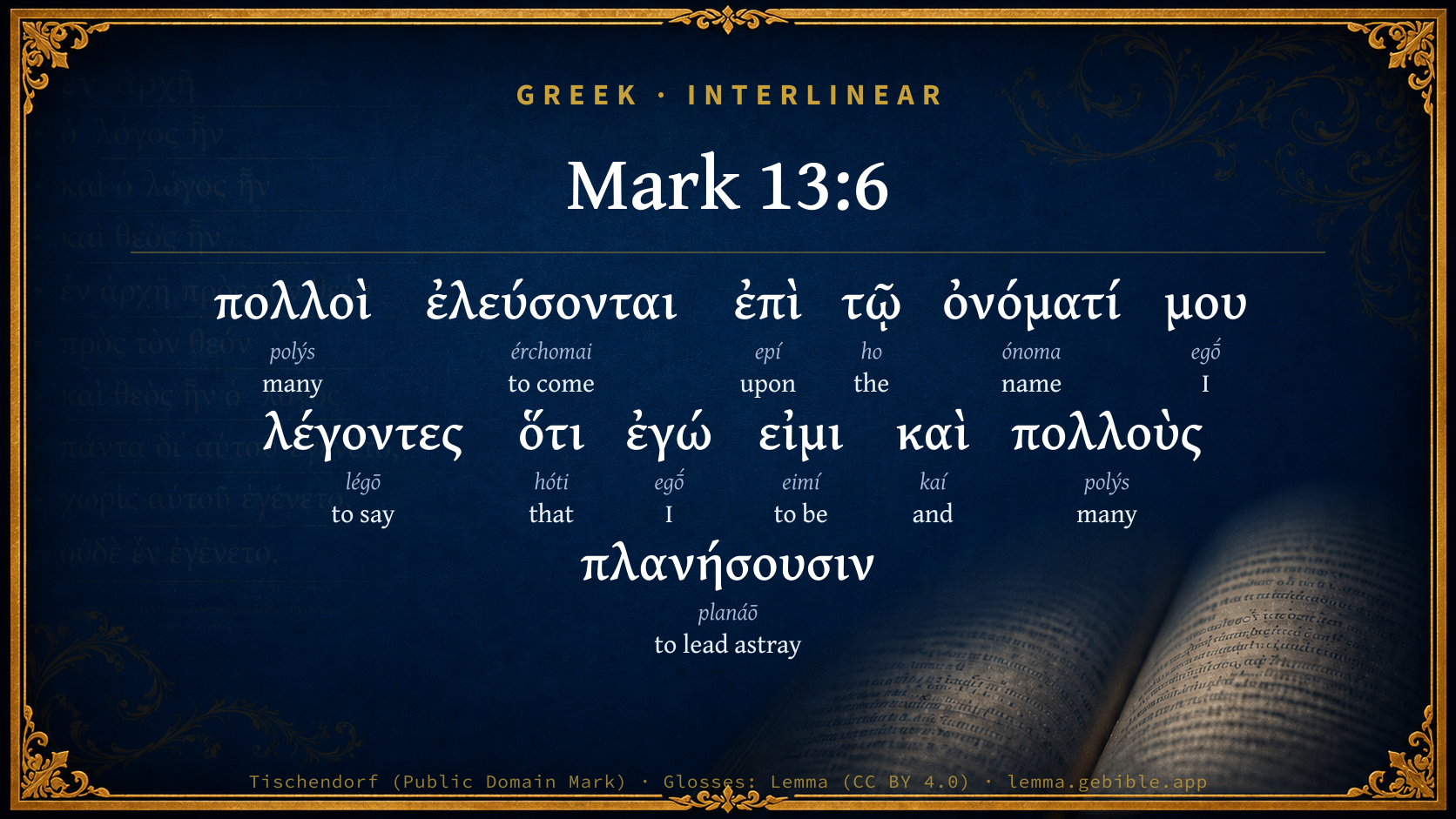
Download image
Cite this verse

Mark 13:6 (World English Bible). Public Domain. Lemma interlinear Bible study tool, https://lemma.gebible.app/v/mark/13/6.

Show BibTeX & RIS
BibTeX
RIS
English Translation
For many will come in my name, saying, 'I am he!' and will lead many astray.
World English Bible · Public Domain
Download a study sheet

One document with this verse’s original text, its word-by-word gloss line, the meaning frame, cross-references with their text, attributed commentary, and full source and license credits — printable, and it pastes into notes with its structure intact.

This verse Autodidact and up

Study sheet (.html) Plain text (.txt)

A passage Seminary Student

Up to 50 verses in one chapter. A passage sheet keeps up to 6 commentary sources and 12 cross-references per verse, in the order this page ranks them, and says so on the sheet whenever that leaves anything out. Ask for a single verse and you get the Autodidact verse sheet above.

Everything on this page stays free to read, with no account — the sheet is a download of what is already on screen, not access to it.

Want to remove ads? Support Godless Engineer
Compare translations 3

The same verse in 3 English versions, stacked beneath the original-language interlinear above. Click any original word for its lexicon entry.

Each is an independent rendering of the whole verse — the interlinear is not word-aligned to these translations.

Highlighted words mark where these versions differ — a whole-verse word diff, not a word-by-word alignment.

  • World English Bible Public Domain
    For many will come in my name, saying, 'I am he!' and will lead many astray.
  • King James Version Public Domain
    For many shall come in my name, saying, I am Christ; and shall deceive many.
  • unfoldingWord Literal Text CC BY-SA 4.0
    Many will come in my name, saying, ‘I am he!’ and they will lead many astray.

unfoldingWord Literal Text — © unfoldingWord, licensed CC BY-SA 4.0. Word-aligned USFM3 via Door43 (git.door43.org/unfoldingWord/en_ult).

Versions to compare (up to 4)

3 of 4 selected

Show all 19 translations

Every available English version of this verse, each an independent rendering of the whole verse.

  • World English Bible Public Domain
    For many will come in my name, saying, 'I am he!' and will lead many astray.
  • Berean Standard Bible Public Domain
    Many will come in My name, claiming, ‘I am He,’ and will deceive many.
  • Majority Standard Bible Public Domain
    For many will come in My name, claiming, ‘I am He,’ and will deceive many.
  • King James Version Public Domain
    For many shall come in my name, saying, I am Christ; and shall deceive many.
  • American Standard Version (1901) Public Domain
    Many shall come in my name, saying, I am `he'; and shall lead many astray.
  • Revised Version (1885) Public Domain
    Many shall come in my name, saying, I am he; and shall lead many astray.
  • Geneva Bible (1599) Public Domain
    For many shall come in my Name, saying, I am Christ, and shall deceiue many.
  • Douay-Rheims (1899) Public Domain
    For many shall come in my name, saying, I am he; and they shall deceive many.
  • Young's Literal Translation Public Domain
    for many shall come in my name, saying -- I am `he', and many they shall lead astray;
  • Literal Standard Version CC BY-SA 4.0
    for many will come in My Name, saying, I am [He], and many they will lead astray;
  • Unlocked Literal Bible CC BY-SA 4.0
    Many will come in my name and say, 'I am he,' and they will lead many astray.
  • unfoldingWord Literal Text CC BY-SA 4.0
    Many will come in my name, saying, ‘I am he!’ and they will lead many astray.
  • Darby Bible Public Domain
    For many shall come in my name, saying, It is *I*, and shall mislead many.
  • World Messianic Bible Public Domain
    For many will come in my name, saying, ‘I am he!’ and will lead many astray.
  • Webster's Bible Public Domain
    For many will come in my name, saying, I am Christ; and will deceive many.
  • Free Bible Version CC BY-SA 4.0
    Many will come in my name claiming, ‘I am the Christ.’ They will deceive many people.
  • Bible in Basic English Public Domain
    People will come in my name, saying, I am he; and a number will be turned from the true way.
  • Text-Critical English NT CC BY 4.0
    For many will come in my name, saying, ‘I am he,’ and will lead many astray.
  • Tyndale New Testament (1534) Public Domain
    For many shall come in my name sayinge: I am Christ and shall deceave many.

Literal Standard Version (2020), Covenant Press — licensed CC BY-SA 4.0. Text via the HelloAO Bible API (eBible.org). Unlocked Literal Bible (unfoldingWord) — licensed CC BY-SA 4.0. Text via the HelloAO Bible API (eBible.org). unfoldingWord Literal Text — © unfoldingWord, licensed CC BY-SA 4.0. Word-aligned USFM3 via Door43 (git.door43.org/unfoldingWord/en_ult). Free Bible Version, Dr. Jonathan Gallagher — licensed CC BY-SA 4.0. Text via the HelloAO Bible API (eBible.org).

Word by word

More ways to search: Search by grammar → Find every occurrence → Compare this word →

Practice this passage: Drill this verse → Learn its vocabulary →

πλανήσουσιν
planáō
G4105
“to lead astray”
Verb, Future, Active, Indicative, 3rd person, Plural
Part of Speech
Verb
Tense
Future
Voice
Active
Mood
Indicative
Person
3rd person
Number
Plural
Full Thayer's Definition

Origin: from G4106

TDNT: 09:48,9

1. to cause to stray, to lead astray, lead aside from the right way a. to go astray, wander, roam about 2. metaph. a. to lead away from the truth, to lead into error, to deceive b. to be led into error c. to be led aside from the path of virtue, to go astray, sin d. to sever or fall away from the truth 1. of heretics e. to be led away into error and sin
  1. πολλοὶ polýs G4183 “many” Adjective, Nominative, Plural, Masculine
  2. ἐλεύσονται érchomai G2064 “to come” Verb, Future, Middle deponent, Indicative, 3rd person, Plural
  3. ἐπὶ epí G1909 “upon” Preposition
  4. τῷ ho G3588 “the” Article, Dative, Singular, Neuter
  5. ὀνόματί ónoma G3686 “name” Noun, Dative, Singular, Neuter
  6. μου egṓ G1473 “I” Personal pronoun, 1st person, Genitive, Singular
  7. λέγοντες légō G3004 “to say” Verb, Present, Active, Participle, Nominative, Plural, Masculine
  8. ὅτι hóti G3754 “that” Conjunction
  9. ἐγώ egṓ G1473 “I” Personal pronoun, 1st person, Nominative, Singular
  10. εἰμι eimí G1510 “to be” Verb, Present, Active, Indicative, 1st person, Singular
  11. καὶ kaí G2532 “and” Conjunction
  12. πολλοὺς polýs G4183 “many” Adjective, Accusative, Plural, Masculine

About this verse

These counts appear in no published source. They are computed here, from the morphology-tagged text and Lemma’s own curated glosses. What Lemma adds →

13
words
11
distinct lemmas
Gospels
section

Shared distinctive vocabulary

πλανήσουσιν to lead astray G4105 occurs in 37 verses of the Greek New Testament. Also found in:
Repetition

Words recur within this verse:

Cross-references

10

Topical passages linked to Mark 13:6 in the Treasury of Scripture Knowledge — connected by theme and wording, ordered by reader-vote popularity; previews shown in the World English Bible.

  • Mark 13:22 For there will arise false christs and false prophets, and will show signs and wonders, that they may lead astray, if possible, even the chosen ones.
  • John 5:43 I have come in my Father's name, and you don't receive me. If another comes in his own name, you will receive him.
  • 1 John 4:1 Beloved, don't believe every spirit, but test the spirits, whether they are of God, because many false prophets have gone out into the world.
  • Jeremiah 14:14 Then Yahweh said to me, The prophets prophesy lies in my name; I didn't send them, neither have I commanded them, neither spoke I to them: they prophesy to you a lying vision, and divination, and a thing of nothing, and the deceit of their own heart.
  • Jeremiah 23:21–25 I sent not these prophets, yet they ran: I didn't speak to them, yet they prophesied.
  • Matthew 24:5 For many will come in my name, saying, 'I am the Christ,' and will lead many astray.
  • Matthew 24:11 Many false prophets will arise, and will lead many astray.
  • Matthew 24:23–24 "Then if any man tells you, 'Behold, here is the Christ,' or, 'There,' don't believe it.
  • John 8:24 I said therefore to you that you will die in your sins; for unless you believe that I am he, you will die in your sins."
  • Acts 5:36–39 For before these days Theudas rose up, making himself out to be somebody; to whom a number of men, about four hundred, joined themselves: who was slain; and all, as many as obeyed him, were dispersed, and came to nothing.

Cross-references courtesy of OpenBible.info (CC BY 4.0).

Commentary

Notes on Mark 13:6 from classic Christian and Jewish commentators (each source and its license shown beneath its notes). The classic Christian expositions comment on the surrounding passage and are grouped to its opening verse, so a note may address several verses; the Jewish commentaries on the Tanakh (Rashi and others) are per-verse, so they appear only where the commentator wrote on this verse.

Lemma curates 59 commentaries, every one of them public domain or Creative Commons licensed, each selected and text-cleaned for this edition rather than reprinted as found. About our sources →

MacLaren's Expositions of Holy Scripture

Alexander MacLaren

Mark

THE CREDULITY OF UNBELIEF

Mar 13:6. - Luk 18:8.

It was the same generation that is represented in these two texts as void of faith in the Son of Man, and as credulously giving heed to impostors. Unbelief and superstition are closely allied. Religion is so vital a necessity, that if the true form of it be cast aside, some false form will be eagerly seized in order to fill the aching void. Men cannot permanently live without some sort of a faith in the Unseen, but they can determine whether it shall be a worthy recognition of a worthy conception of that Unseen, or a debasing superstition. An epoch of materialism in philosophic thought has always been followed by violent reaction, in which quacks and fanatics have reaped rich harvests. If the dark is not peopled with one loved Face, our busy imagination will fill it with a crowd of horrible ones.

Just as a sailor, looking out into the night over a solitary, islandless sea, sees shapes; intolerant of the islandless expanse, makes land out of fogbanks; and, sick of silence, hears ‘airy tongues’ in the moanings of the wind and the slow roll of the waves, so men shudderingly look into the dark unknown, and if they see not their Father there, will either shut their eyes or strain them in gazing it into shape. The sight of Him is religion, the closed eye is infidelity, the strained gaze is superstition. The second and the third are each so unsatisfying that they perpetually pass over into one another and destroy one another, as when I shut my eyes, I see slowly shaping itself a coloured image of my eye, which soon flickers and fluctuates into black nothingness again, and then rises once more, once more to fade. Men, if they believe not in God, then do service to ‘them which by nature are no gods.’

But let us come to more immediately Christian thoughts. Christ does what men so urgently require to be done, that if they do not believe in Him they will be forced to shape out for themselves some fancied ways of doing it. The emotions which men cherish towards Him so irrepressibly need an object to rest on, that if not He, then some far less worthy one, will be chosen to receive them.

It is just to the illustration of these thoughts that I seek to turn now, and in such alternatives as these-

I. Reception of Christ as the Revealer is the only escape from unmanly submission to unworthy pretenders.

That function is one which the instincts of men teach them that they need.

Christ comes to satisfy the need as the visible true embodiment of the Father’s love, of the Father’s wisdom.

If He be rejected-what then? Why, not that the men who reject will contentedly continue in darkness-that is never possible; but that some manner or other of satisfying the clamant need will be had recourse to, and then that to it will be transferred the submission and credence that should have been His. If we have Him for our Teacher and Guide, then all other teachers and guides will take their right places. We shall not angrily repel their power, nor talk loudly about ‘the right of private judgment,’ and our independence of all men’s thoughts. We are not so independent. We shall thankfully accept all help from all men wiser, better, more manly than ourselves, whether they give us uttered words of wisdom and beauty, having ‘grace poured into their lips,’ or whether they give us lives ennobled by strenuous effort, or whether they give us greater treasure than all these-the sight once more of a loving heart. All is good, all is helpful, all we shall receive; but in proportion to the felt obligations we are laid under to them will be the felt authority of that saying, ‘Call no man your master on earth, for One is your Master, even Christ.’ That command forbids our slavishly accepting any human domination over our faith, but it no less emphatically forbids our contemptuously rejecting any human helper of our joy, for it closes with ‘and all ye are brethren’-bound then to mutual observance, mutual helpfulness, mutual respect for each other’s individuality, mutual avoidance of needless division. To have Him for his Guide makes the human guide gentle and tender among his disciples ‘as a nurse among her children,’ for he remembers ‘the gentleness of Christ,’ and he dare not be other than an imitator of Him. A Christian teacher’s spirit will always be, ‘not for that we have dominion over your faith, but we are helpers of your joy’; his most earnest word, ‘I beseech you, therefore, brethren’; his constant desire, ‘He must increase. I must decrease.’ And to have Christ for our Guide makes the taught lovingly submissive to all who by largeness of gifts and graces are set by Him above them, and yet lovingly recalcitrant at any attempt to compel adhesion or force dogmas. The one freedom from undue dependence on men and men’s opinions lies in this submission to Jesus. Then we can say, when need is, ‘I have a Master. To Him I submit; if you seek to be master, I demur: of them who seemed to be somewhat, whatsoever they were, it maketh no matter to me.’

But the greatest danger is not that our guides shall insist on our submission, but that we shall insist on giving it. It is for all of us such a burden to have the management of our own fate, the forming of our own opinions, the fearful responsibility of our own destiny, that we are all only too ready to say to some man or other, from love or from laziness, ‘Where thou goest, I will go; thy people shall be my people, and thy God my God.’

Few things are more strange and tragic than the eagerness with which people who are a great deal too enlightened to render allegiance to Jesus Christ will install some teacher of their own choosing as their authoritative master, will swallow his dicta, swear by him, and glory in being called by his name. What they think it derogatory to their mental independence to give to the Teacher of Nazareth, they freely give to their chosen oracle. It is not in ‘the last times’ only that men who will not endure sound teaching ‘heap to themselves teachers after their own lusts,’ and have ‘the ears’ which are fast closed to ‘the Truth’ wide open ‘to fables.’

On the small scale we see this melancholy perversity of conduct exemplified in every little coterie and school of unbelievers.

On the great scale Mohammedanism and Buddhism, with their millions of adherents, write the same tragic truth large in the history of the world.

II. Faith in the reconciling Christ is the only sure deliverance from debasing reliance on false means of reconciliation.

In a very profound sense ignorance and sin are the same fact regarded under two different aspects. And in the depths of their natures men have the longing for some Power who shall put away sin, as they have the longing for one that will dispel ignorance. The consciousness of alienation from God lies in the human heart, dormant indeed for the most part, but like a coiled, hibernating snake, ready to wake and strike its poison into the veins. Christ by His great work, and specially by His sacrificial death, meets that universal need.

But closely as His work fits men’s needs, it sharply opposes some of their wishes, and of their interpretations of their needs. The Jew ‘demands a sign,’ the Greek craves a reasoned system of ‘wisdom,’ and both concur in finding the Cross an ‘offence.’

But the rejection of Jesus as the Reconciler does not quiet the cravings, which make themselves heard at some time or other in most consciences, for deliverance from the dominion and from the guilt of sin. And men are driven to adopt other expedients to fill up the void which their turning away from Jesus has left. Sometimes they fall back on a vague reliance on a vague assertion that ‘God is merciful’; sometimes they reason themselves into a belief-or, at any rate, an assertion-that the conception of sin is an error, and that men are not guilty. Sometimes they manage to silence the inward voice that accuses and condemns, by dint of not listening to it or drowning it by other noises.

But these expedients fail them some time or other, and then, if they have not cast the burden of their sin and their sins on the great Reconciler, they either have to weary themselves with painful and vain efforts to be their own redeemers, or they fall under the domination of a priest.

Hence the hideous penances of heathenism; and hence, too, the power of sacramentarian and sacerdotal perversions of evangelical truth.

III. Faith in Christ as the Regenerator is the only deliverance from baseless hopes for the world.

The world is today full of moaning voices crying, ‘Art thou He that should come, or do we look for another?’ and it is full of confident voices proclaiming other means of its regeneration than letting Christ ‘make all things new.’

The conviction that society needs to be reconstituted on other principles is spread everywhere, and is often associated with intense disbelief in Christ the Regenerator.

Has not the past proved that all schemes for the regeneration of society which do not grapple with the fact of sin, and which do not provide a means of infusing into human nature a new impulse and direction, will end in failure, and are only too likely to end in blood? These two requirements are met by Jesus, and by Him only, and whoever rejects Him and His gift of pardon and cleansing, and His inbreathing of a new life into the individual, will fail in his effort, however earnest and noble in many aspects, to redeem society and bring about a fair new world.

It is pitiable to see the waste of high aspiration and eager effort in so many quarters today. But that waste is sure to attend every scheme which does not start from the recognition of Christ’s work as the basis of the world’s transformation, and does not crown Him as the King, because He is the Saviour, of mankind.

Alexander MacLaren, Expositions of Holy Scripture (1904–1910) — public domain. Text from a community e-Sword module.

Bengel's Gnomon

Johann Albrecht Bengel

Mar 13:6. Ἐγὼ εἰμι, I am) The Predicate is to be supplied, viz. the Christ; Mat 24:5. Hebrew אני הוא, Isa 43:10.

Bengel's Gnomon of the New Testament — English translation (T&T Clark, Edinburgh, 1860) — public domain. Text from a community e-Sword module.

Expositor's Greek Testament

ed. W. Robertson Nicoll

Mar 13:6 . ἐγώ εἰμι , I am (He, the Christ). In what sense to be understood vide on Mt. The Messianic hope misconceived was the ruin of the Jewish people.

The Expositor's Greek Testament, edited by W. Robertson Nicoll (1897–1910) — public domain. Text from a community e-Sword module.

Adam Clarke's Commentary

Verse 6. Saying, I am] The Christ, is added by eight MSS., Coptic, Armenian, Saxon, and four of the Itala.

Adam Clarke's Commentary on the Bible (1810–1826) — public domain. Text from a community e-Sword/MySword module.

Ellicott's Commentary for English Readers

(6) I am Christ.—Literally, I am He. The word Christ being a necessary inference from the context.

A Bible Commentary for English Readers, edited by Charles John Ellicott (1878–1897) — public domain. Text from a community e-Sword module.

The Cambridge Bible for Schools and Colleges

gen. ed. J. J. S. Perowne

6. many shall come] Five tokens are here given, to which the Lord directs the attention of His disciples: (i) the rise of false prophets; (ii) wars and rumours of wars; (iii) the rising of nation against nation; (iv) earthquakes; (v) famines (some MSS. omit troubles); but the Apostles were not to be terrified, these things were

The Cambridge Bible for Schools and Colleges (gen. ed. J. J. S. Perowne; Cambridge University Press, 1878–1918) — public domain. Text from a community e-Sword module.

John Gill's Exposition

For many shall come in my name,.... Taking upon them the name of the Messiah: saying,

I am Christ; the word "Christ", is rightly supplied from Mat 24:5; otherwise in the original it is only, "I am"; which the Persic version doubles, reading it, "I am indeed, I am": he that was promised and expected, the true Messiah; he that was to come:

and shall deceive many; See Gill on Mat 24:5.

John Gill's Exposition of the Whole Bible (1746–1763) — public domain (CC PDM 1.0). Text via the HelloAO Bible API.

Haydock's Catholic Bible Commentary

At the destruction of Jerusalem there appeared many impostors, many who professed themselves to be the Christ, and assured the populace that their delivery was at hand. And in the Church many heresiarchs started up, and many came in the name of Christ; the first of these was Simon Magus, mentioned in the Acts of the Apostles, whom the people of Samaria received as the power and virtue of God. But it is remarkable from the time of our Saviour’s passion, when they preferred the robber Barabbas to Jesus Christ, the Lamb of God, they had no peace or quiet in the city, but constant tumult and dissension succeeded, to the very time of its destruction. (Ven. Bede) --- So shall many seducers come towards the end of the world, who shall make themselves authors of sects, and shall gain many disciples: as followeth in plain words, ver. 22. of this chapter. (Bristow)

George Leo Haydock (1774–1849), Haydock's Catholic Family Bible and Commentary, 1859 edition — public domain. Excludes Psalms (Douay-Rheims chapter numbering differs from Protestant) and Deuterocanonical books (Catholic canon only).

Whedon's Commentary on the Bible

Daniel D. Whedon

6. Saying, I am Christ — The FIRST SIGN of approaching downfall should be the numerous false deliverers and spurious messiahs, (the Hebrew word for Christs,) which should deceive many. At that period the acknowledged prophetic chronology demanded the appearance of the true Messiah so clearly that a general expectation of his advent was even then prevalent. Of this expectation impostors plentifully availed themselves; thus punishing the nation who had rejected the true one, and at the same time furnishing a SIGN of the decline of the Jewish state. Such was the false Egyptian prophet at the head of thirty thousand men, (Act_21:38,) about twelve years after our Lord’s death; and Theudas, a false deliverer, who, Josephus says, almost in our Lord’s words, deceived many. Under the procuratorship of Felix, in the reign of Nero, such impostors were so numerous that some were taken and slain almost daily. Among false Christs, distinctively, were Dositheus appearing as the Christ foretold by Moses, and Simon Magus as son of God. Josephus says, Many affirmed the time of the advent to have arrived; and Hegesippus says, Many false Christs came.

Daniel D. Whedon (gen. ed.), Commentary on the Old and New Testaments (1874–1909) — public domain. Text from a community e-Sword module.

Cambridge Greek Testament for Schools and Colleges

6. [2884][2885][2886][2887] omit γάρ here and in Mar 13:7. See on Mar 3:35.

[2884] Codex Sinaiticus. 4th cent. Discovered by Tischendorf in 1859 at the Monastery of St Katharine on Mount Sinai. Now at St Petersburg. The whole Gospel, ending at Mar 16:8. Photographic facsimile, 1911.

[2885] Codex Vaticanus. 4th cent., but perhaps a little later than א. In the Vatican Library almost since its foundation by Pope Nicolas V., and one of its greatest treasures. The whole Gospel, ending at Mar 16:8. Photographic facsimile, 1889.

[2886] Codex Regius. 8th cent. An important witness. At Paris. Contains Mar 1:1 to Mar 10:15; Mar 10:30 to Mar 15:1; Mar 15:20 to Mar 16:20, but the shorter ending is inserted between Mar 16:8 and Mar 16:9, showing that the scribe preferred it to the longer one.

[2887] Codex Athous Laurae. 8th cent. Like N and Σ, it is written in silver letters on purple vellum. Contains Mar 9:5 to Mar 16:20, and, as in L, the shorter ending is inserted between Mar 16:8 and Mar 16:9. As in Δ, the text of Mark is specially good.

6. ἐπὶ τῷ ὀνόματί μου λέγοντες ὅτι Ἐγώ εἰμι. It is obvious that ἐπὶ τῷ ὀν. μου cannot here mean “for My sake” or “with My authority” (Mar 9:37-39); it means “usurping My title.” Impostors will claim to be the Messiah, as Mt. turns it. And here at once we have some indication that Christ’s predictions about the future have become somewhat confused in tradition, words respecting the end of the world becoming mixed with words respecting the destruction of the Temple. None of the seducing leaders who arose between A.D. 30 and 70, e.g. Theudas and the Egyptian (Act 5:36; Act 21:38), seem to have professed to be the Messiah. Simon Magus (Act 8:9) may be regarded as an ἀντίχριστος (1Jn 2:18) but not as a ψευδόχριστος (Mar 13:22). Thus far Mk has told us nothing of Christ’s prediction of His return; yet here He speaks of it as an event with which the disciples were familiar. The idea that the end of the world will be preceded by a great intensification of evil occurs in various places of the N.T.; 2Th 2:3; 2Ti 3:1; 1Jn 2:18; 2Pe 3:3; Jud 1:18.

Cambridge Greek Testament for Schools and Colleges (Cambridge University Press, 1896; 21 vols, various authors incl. Carr, Maclear, Plummer, Farrar, Lumby, Moule, M. R. James, Simcox) — public domain. Text from a community e-Sword module.

International Critical Commentary

6. πολλοὶ ἐλεύσονται ἐπὶ τῷ ὀνόματί μου—Many will come in my name.

Omit γὰρ, for, Tisch. (Treg. marg.) WH. RV. א* B Egyptt.

This warning against false Messiahs coming in his name is occasioned apparently by a part of their question, given by Mt. alone, who states their inquiry thus—what is the sign of thy coming, and of the end of the age? Nothing has been said by Mk. to lead up to this warning. The prophecy has been the destruction of the Temple, and the question of the apostles has been when that is to take place. But nothing has been said of his coming. The account of the previous conversation in Mt. would seem necessary therefore to supplement the account of Mk. But see note on ταῦτα, v. 4. Moreover, the παρουσία, the coming, of Mt. has no antecedents, and yet it is introduced as something well understood by the disciples, of which they inquired only the time. Before this, the Gospels have taken us only as far as the resurrection of Jesus predicted by himself. And even that prediction they tell us that the disciples did not understand. And yet, here they are talking of his coming again as an understood fact. If it was, then their dismay at his death, and their unbelief of his resurrection, are unaccountable. ἐπὶ τῷ ὀνόματί μου, in my name. Not his personal name, but his official title. They would not assume to be Jesus returned to the earth, but they would claim his title of Messiah.

International Critical Commentary — older volumes (1896–1929), various authors — public domain. Text from a community e-Sword module.

Vincent's Word Studies in the New Testament

Marvin R. Vincent

In my name [επι] . Lit., upon. Basing their claims on the use of my name.

Marvin R. Vincent, Word Studies in the New Testament (1887–1900) — public domain. Text from a community e-Sword/MySword module.

Lesson kit

Teaching starters — assembled from the data on this page, not authored interpretation. Every prompt links to the verse data it draws on. Edit before teaching.

Mark, in the Gospels, opens this verse with 13 words (11 distinct Greek lemmas). Its most distinctive word is planáō (“to lead astray”). A historical commentator’s framing appears above. Read the whole chapter for the surrounding context.

Discussion questions

  1. What does “to lead astray” (planáō) contribute to the verse as a whole?
  2. How does Matthew 18:12, which shares the word «to lead astray», read alongside this verse?
  3. What does the repetition of “many” (2× in this one verse) do in this verse?
  4. The translations on this page render this verse differently — a whole-verse word diff, not a word-by-word alignment. What might account for the different wordings?
  5. Compare how MacLaren's Expositions of Holy Scripture and Bengel's Gnomon read this verse. Where do they agree or differ?

Things to notice

  • These translations choose different wording for 6 words in this verse.
  • “many” occurs 2× in this single verse.
  • 11 distinct Greek lemmas span 13 words in this verse.

Reading settings

Reading text

Shown beneath each verse's original-language words.

Old Testament
Old Testament edition

Read the OT as the Masoretic Hebrew (MT) or the Greek Septuagint (LXX).

English shown for the Greek Septuagint (in the Hebrew ↔ Greek comparison).

Comparing translations? Open the Compare panel on any verse page to stack up to four side by side.