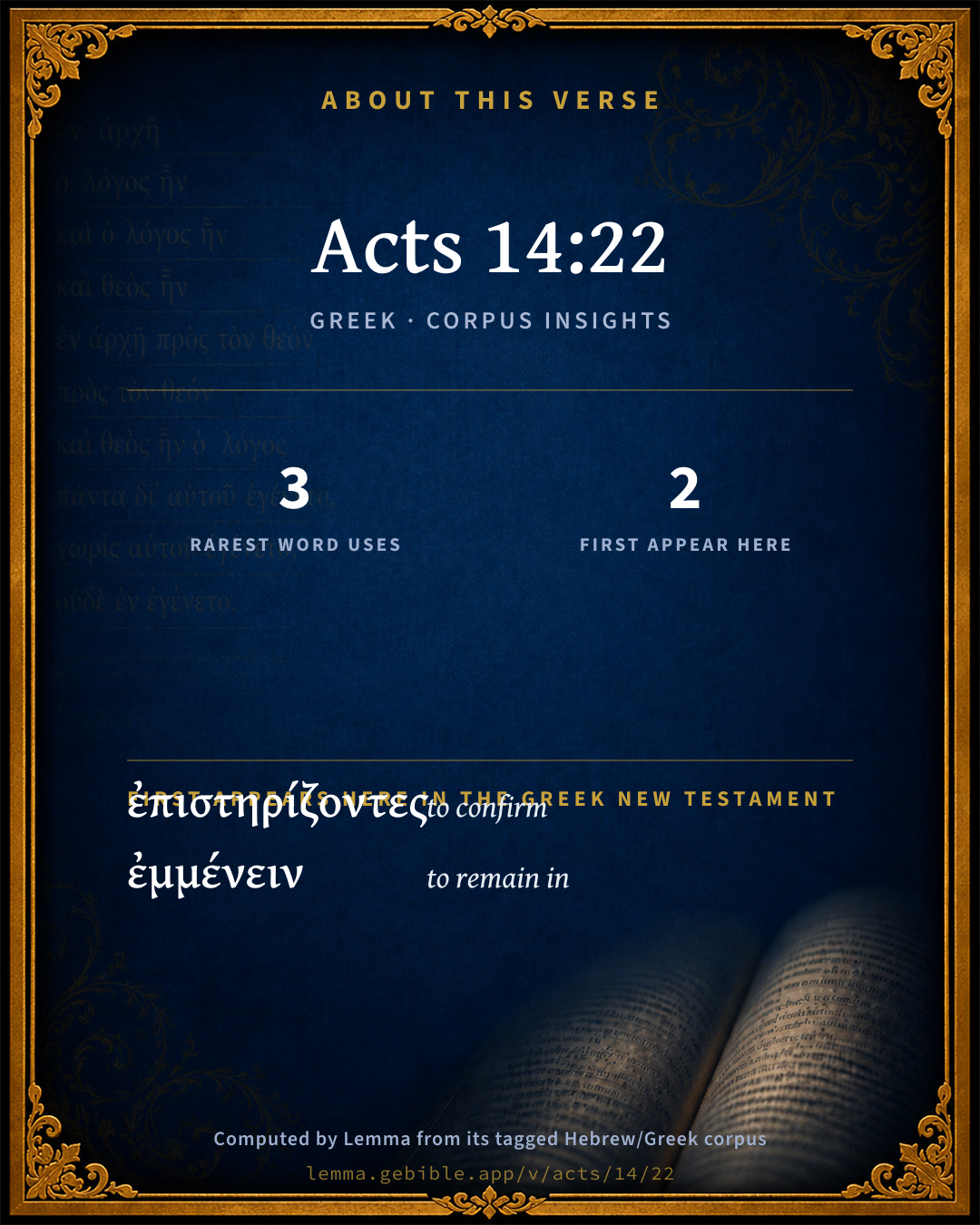
Acts 14:22

Greek (Tischendorf 8th ed.) Acts 14:22 appears in the Greek New Testament. The text above is from the Tischendorf 8th edition. Each word links to its Strong’s number and a concise gloss. Click any word for its full Thayer’s Greek Lexicon entry.
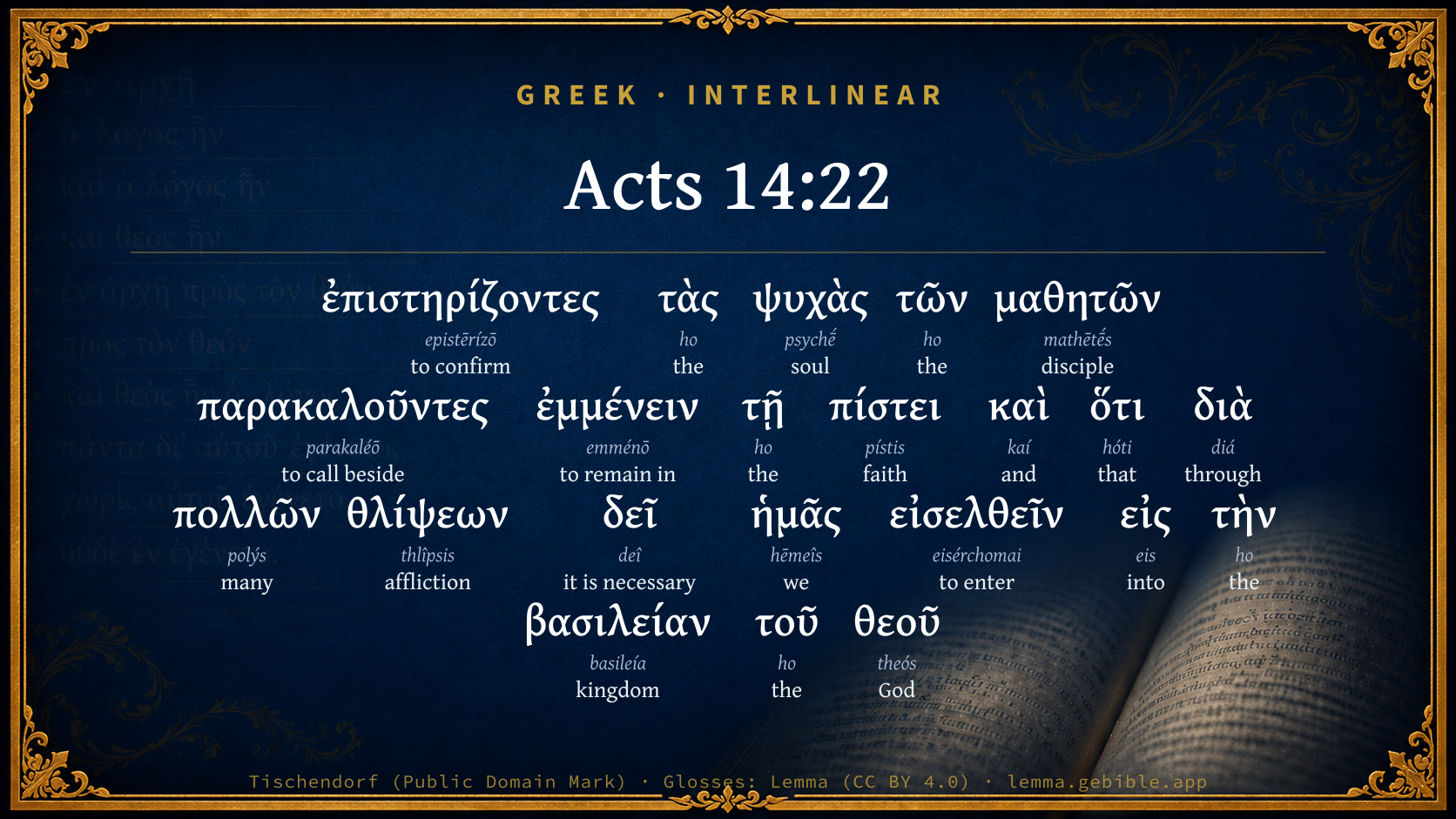
Download image
Cite this verse

Acts 14:22 (World English Bible). Public Domain. Lemma interlinear Bible study tool, https://lemma.gebible.app/v/acts/14/22.

Show BibTeX & RIS
BibTeX
RIS
English Translation
confirming the souls of the disciples, exhorting them to continue in the faith, and that through many afflictions we must enter into the Kingdom of God.
World English Bible · Public Domain
Highlights
  • 2 first appearances in the Greek New Testament
Full analysis ↓
Download a study sheet

One document with this verse’s original text, its word-by-word gloss line, the meaning frame, cross-references with their text, attributed commentary, and full source and license credits — printable, and it pastes into notes with its structure intact.

This verse Autodidact and up

Study sheet (.html) Plain text (.txt)

A passage Seminary Student

Up to 50 verses in one chapter. A passage sheet keeps up to 6 commentary sources and 12 cross-references per verse, in the order this page ranks them, and says so on the sheet whenever that leaves anything out. Ask for a single verse and you get the Autodidact verse sheet above.

Everything on this page stays free to read, with no account — the sheet is a download of what is already on screen, not access to it.

Want to remove ads? Support Godless Engineer
Compare translations 3

The same verse in 3 English versions, stacked beneath the original-language interlinear above. Click any original word for its lexicon entry.

Each is an independent rendering of the whole verse — the interlinear is not word-aligned to these translations.

Highlighted words mark where these versions differ — a whole-verse word diff, not a word-by-word alignment.

  • World English Bible Public Domain
    confirming the souls of the disciples, exhorting them to continue in the faith, and that through many afflictions we must enter into the Kingdom of God.
  • King James Version Public Domain
    Confirming the souls of the disciples, and exhorting them to continue in the faith, and that we must through much tribulation enter into the kingdom of God.
  • unfoldingWord Literal Text CC BY-SA 4.0
    strengthening the souls of the disciples, encouraging them to continue in the faith, and, “It is necessary for us to enter into the kingdom of God through many afflictions.”

unfoldingWord Literal Text — © unfoldingWord, licensed CC BY-SA 4.0. Word-aligned USFM3 via Door43 (git.door43.org/unfoldingWord/en_ult).

Versions to compare (up to 4)

3 of 4 selected

Show all 19 translations

Every available English version of this verse, each an independent rendering of the whole verse.

  • World English Bible Public Domain
    confirming the souls of the disciples, exhorting them to continue in the faith, and that through many afflictions we must enter into the Kingdom of God.
  • Berean Standard Bible Public Domain
    strengthening the souls of the disciples and encouraging them to continue in the faith. “We must endure many hardships to enter the kingdom of God,” they said.
  • Majority Standard Bible Public Domain
    strengthening the souls of the disciples and encouraging them to continue in the faith. “We must endure many hardships to enter the kingdom of God,” they said.
  • King James Version Public Domain
    Confirming the souls of the disciples, and exhorting them to continue in the faith, and that we must through much tribulation enter into the kingdom of God.
  • American Standard Version (1901) Public Domain
    confirming the souls of the disciples, exhorting them to continue in the faith, and that through many tribulations we must enter into the kingdom of God.
  • Revised Version (1885) Public Domain
    confirming the souls of the disciples, exhorting them to continue in the faith, and that through many tribulations we must enter into the kingdom of God.
  • Geneva Bible (1599) Public Domain
    Confirming the disciples hearts, and exhorting them to continue in the faith, affirming that we must through many afflictions enter into the kingdome of God.
  • Douay-Rheims (1899) Public Domain
    And when they had ordained to them priests in every church, and had prayed with fasting, they commended them to the Lord, in whom they believed.
  • Young's Literal Translation Public Domain
    confirming the souls of the disciples, exhorting to remain in the faith, and that through many tribulations it behoveth us to enter into the reign of God,
  • Literal Standard Version CC BY-SA 4.0
    confirming the souls of the disciples, exhorting to remain in the faith, and that it is required of us to enter into the Kingdom of God through many tribulations,
  • Unlocked Literal Bible CC BY-SA 4.0
    They kept strengthening the souls of the disciples and encouraging them to continue in the faith, saying, “We must enter into the kingdom of God through many sufferings.”
  • unfoldingWord Literal Text CC BY-SA 4.0
    strengthening the souls of the disciples, encouraging them to continue in the faith, and, “It is necessary for us to enter into the kingdom of God through many afflictions.”
  • Darby Bible Public Domain
    establishing the souls of the disciples, exhorting them to abide in the faith, and that through many tribulations we must enter into the kingdom of God.
  • World Messianic Bible Public Domain
    strengthening the souls of the disciples, exhorting them to continue in the faith, and that through many afflictions we must enter into God’s Kingdom.
  • Webster's Bible Public Domain
    Confirming the souls of the disciples, exhorting them to continue in the faith, and that we must through much tribulation enter into the kingdom of God.
  • Free Bible Version CC BY-SA 4.0
    They encouraged the believers to remain firm and to continue to trust in Jesus. “We have to go through many trials to enter God's kingdom,” they said.
  • Bible in Basic English Public Domain
    Making strong the souls of the disciples, saying to them that they were to keep the faith, and that we have to go through troubles of all sorts to come into the kingdom of God.
  • Text-Critical English NT CC BY 4.0
    strengthening the souls of the disciples, exhorting them to continue in the faith, and telling them that through many tribulations we must enter the kingdom of God.
  • Tyndale New Testament (1534) Public Domain
    and strengthed the disciples soules exhortinge them to continue in the faith affyrminge that we must thorowe moche tribulacion entre into the kyngdome of God.

Literal Standard Version (2020), Covenant Press — licensed CC BY-SA 4.0. Text via the HelloAO Bible API (eBible.org). Unlocked Literal Bible (unfoldingWord) — licensed CC BY-SA 4.0. Text via the HelloAO Bible API (eBible.org). unfoldingWord Literal Text — © unfoldingWord, licensed CC BY-SA 4.0. Word-aligned USFM3 via Door43 (git.door43.org/unfoldingWord/en_ult). Free Bible Version, Dr. Jonathan Gallagher — licensed CC BY-SA 4.0. Text via the HelloAO Bible API (eBible.org).

Word by word

More ways to search: Search by grammar → Find every occurrence → Compare this word →

Practice this passage: Drill this verse → Learn its vocabulary →

ἐπιστηρίζοντες
epistērízō
G1991
“to confirm”
Verb, Present, Active, Participle, Nominative, Plural, Masculine
Part of Speech
Verb
Tense
Present
Voice
Active
Mood
Participle
Case
Nominative
Number
Plural
Gender
Masculine
Full Thayer's Definition

Origin: from G1909 and G4741

TDNT: 17:53,1

1. to establish besides, strengthen more 2. to render more firm, confirm
  1. τὰς ho G3588 “the” Article, Accusative, Plural, Feminine
  2. ψυχὰς psychḗ G5590 “soul” Noun, Accusative, Plural, Feminine
  3. τῶν ho G3588 “the” Article, Genitive, Plural, Masculine
  4. μαθητῶν mathētḗs G3101 “disciple” Noun, Genitive, Plural, Masculine
  5. παρακαλοῦντες parakaléō G3870 “to call beside” Verb, Present, Active, Participle, Nominative, Plural, Masculine
  6. ἐμμένειν emménō G1696 “to remain in” Verb, Present, Active, Infinitive
  7. τῇ ho G3588 “the” Article, Dative, Singular, Feminine
  8. πίστει pístis G4102 “faith” Noun, Dative, Singular, Feminine
  9. καὶ kaí G2532 “and” Conjunction
  10. ὅτι hóti G3754 “that” Conjunction
  11. διὰ diá G1223 “through” Preposition
  12. πολλῶν polýs G4183 “many” Adjective, Genitive, Plural, Feminine
  13. θλίψεων thlîpsis G2347 “affliction” Noun, Genitive, Plural, Feminine
  14. δεῖ deî G1163 “it is necessary” Verb, Present, Active, Indicative, 3rd person, Singular
  15. ἡμᾶς hēmeîs G2249 “we” Personal pronoun, 1st person, Accusative, Plural
  16. εἰσελθεῖν eisérchomai G1525 “to enter” Verb, Aorist, Active, Infinitive
  17. εἰς eis G1519 “into” Preposition
  18. τὴν ho G3588 “the” Article, Accusative, Singular, Feminine
  19. βασιλείαν basileía G932 “kingdom” Noun, Accusative, Singular, Feminine
  20. τοῦ ho G3588 “the” Article, Genitive, Singular, Masculine
  21. θεοῦ theós G2316 “God” Noun, Genitive, Singular, Masculine

About this verse

These counts appear in no published source. They are computed here, from the morphology-tagged text and Lemma’s own curated glosses. What Lemma adds →

22
words
18
distinct lemmas
Acts
section

Notable vocabulary

The rarest word here is ἐπιστηρίζοντες to confirm G1991 — appearing just 3 times in the whole Greek New Testament.

First appearance in Scripture

These words make their first canonical appearance in the Greek New Testament here:

  • ἐπιστηρίζοντες to confirm G1991
  • ἐμμένειν to remain in G1696

Shared distinctive vocabulary

ἐπιστηρίζοντες to confirm G1991 occurs in 3 verses of the Greek New Testament. Also found in:

Repetition

A word recurs within this verse:

Cross-references

41

Topical passages linked to Acts 14:22 in the Treasury of Scripture Knowledge — connected by theme and wording, ordered by reader-vote popularity; previews shown in the World English Bible.

  • 1 Peter 5:10 But may the God of all grace, who called you to his eternal glory by Christ Jesus, after you have suffered a little while, perfect, establish, strengthen, and settle you.
  • 2 Timothy 3:12 Yes, and all who desire to live godly in Christ Jesus will suffer persecution.
  • John 16:33 I have told you these things, that in me you may have peace. In the world you have oppression; but cheer up! I have overcome the world."
  • Romans 8:17 and if children, then heirs; heirs of God, and joint-heirs with Christ; if indeed we suffer with him, that we may also be glorified with him.
  • 1 Thessalonians 3:2–4 and sent Timothy, our brother and God's servant in the Gospel of Christ, to establish you, and to comfort you concerning your faith;
  • Revelation 2:10 Don't be afraid of the things which you are about to suffer. Behold, the devil is about to throw some of you into prison, that you may be tested; and you will have oppression for ten days. Be faithful to death, and I will give you the crown of life.
  • 2 Timothy 1:8 Therefore don't be ashamed of the testimony of our Lord, nor of me his prisoner; but endure hardship for the Gospel according to the power of God,
  • Colossians 1:23 if it is so that you continue in the faith, grounded and steadfast, and not moved away from the hope of the Gospel which you heard, which is being proclaimed in all creation under heaven; of which I, Paul, was made a servant.
  • Luke 22:28–29 But you are those who have continued with me in my trials.
  • Acts 18:23 Having spent some time there, he departed, and went through the region of Galatia, and Phrygia, in order, establishing all the disciples.
  • Matthew 10:38 He who doesn't take his cross and follow after me, isn't worthy of me.
  • 2 Timothy 2:11–12 This saying is faithful: For if we died with him, We will also live with him.
  • Revelation 7:14 I told him, "My lord, you know." He said to me, "These are those who came out of the great tribulation. They washed their robes, and made them white in the Lamb's blood.
  • 2 Peter 1:11 For thus will be richly supplied to you the entrance into the eternal Kingdom of our Lord and Savior, Jesus Christ.
  • Isaiah 35:3 Strengthen you the weak hands, and confirm the feeble knees.
  • Matthew 10:21–22 "Brother will deliver up brother to death, and the father his child. Children will rise up against parents, and cause them to be put to death.
  • Matthew 16:24 Then Jesus said to his disciples, "If anyone desires to come after me, let him deny himself, and take up his cross, and follow me.
  • Luke 24:26 Didn't the Christ have to suffer these things and to enter into his glory?"
  • John 15:4–6 Remain in me, and I in you. As the branch can't bear fruit by itself, unless it remains in the vine, so neither can you, unless you remain in me.
  • John 15:20 Remember the word that I said to you: 'A servant is not greater than his lord.' If they persecuted me, they will also persecute you. If they kept my word, they will keep yours also.
  • Acts 9:16 For I will show him how many things he must suffer for my name's sake."
  • Acts 11:23 who, when he had come, and had seen the grace of God, was glad. He exhorted them all, that with purpose of heart they should remain near to the Lord.
  • Acts 15:32 Judas and Silas, also being prophets themselves, encouraged the brothers with many words, and strengthened them.
  • Acts 15:41 He went through Syria and Cilicia, strengthening the assemblies.
  • 1 Corinthians 1:8 who will also confirm you until the end, blameless in the day of our Lord Jesus Christ.
  • Mark 10:24–25 The disciples were amazed at his words. But Jesus answered again, "Children, how hard is it for those who trust in riches to enter into the Kingdom of God!
  • John 8:31–32 Jesus therefore said to those Jews who had believed him, "If you remain in my word, then you are truly my disciples.
  • John 12:25–26 He who loves his life will lose it. He who hates his life in this world will keep it to eternal life.
  • John 16:1–2 "These things have I spoken to you, so that you wouldn't be caused to stumble.
  • 1 Thessalonians 3:13 to the end he may establish your hearts blameless in holiness before our God and Father, at the coming of our Lord Jesus with all his saints.
  • 1 Peter 4:12–16 Beloved, don't be astonished at the fiery trial which has come upon you, to test you, as though a strange thing happened to you.
  • Jude 1:3 Beloved, while I was very eager to write to you about our common salvation, I was constrained to write to you exhorting you to contend earnestly for the faith which was once for all delivered to the saints.
  • Acts 6:7 The word of God increased and the number of the disciples multiplied in Jerusalem exceedingly. A great company of the priests were obedient to the faith.
  • Acts 13:43 Now when the synagogue broke up, many of the Jews and of the devout proselytes followed Paul and Barnabas; who, speaking to them, urged them to continue in the grace of God.
  • Jude 1:20–21 But you, beloved, keep building up yourselves on your most holy faith, praying in the Holy Spirit.
  • Revelation 1:9 I John, your brother and partner with you in oppression, Kingdom, and perseverance in Christ Jesus, was on the isle that is called Patmos because of God's Word and the testimony of Jesus Christ.
  • Mark 9:47 If your eye causes you to stumble, cast it out. It is better for you to enter into the Kingdom of God with one eye, rather than having two eyes to be cast into the Gehenna of fire,
  • Mark 10:30 but he will receive one hundred times more now in this time, houses, brothers, sisters, mothers, children, and land, with persecutions; and in the age to come eternal life.
  • John 3:5 Jesus answered, "Most assuredly I tell you, unless one is born of water and spirit, he can't enter into the Kingdom of God!
  • John 15:9–10 Even as the Father has loved me, I also have loved you. Remain in my love.
  • Matthew 19:24 Again I tell you, it is easier for a camel to go through a needle's eye, than for a rich man to enter into the Kingdom of God."

Cross-references courtesy of OpenBible.info (CC BY 4.0).

Commentary

Notes on Acts 14:22 from classic Christian and Jewish commentators (each source and its license shown beneath its notes). The classic Christian expositions comment on the surrounding passage and are grouped to its opening verse, so a note may address several verses; the Jewish commentaries on the Tanakh (Rashi and others) are per-verse, so they appear only where the commentator wrote on this verse.

Lemma curates 59 commentaries, every one of them public domain or Creative Commons licensed, each selected and text-cleaned for this edition rather than reprinted as found. About our sources →

The Biblical Illustrator

Joseph S. Exell

Act_14:22

We must through much tribulation enter the kingdom of God.

Continuance in the faith

I. The disciples had been but newly converted to the faith, and they required to be established through grace. They were very likely to have been discouraged by the sufferings of the apostles, their instructors in the faith. They may have begun to fear that they had not counted the cost of religion: they had looked on the bright side of their profession; they had glowed with the zeal of new converts to Christ. But they might now have begun, for the first time, to discover that religion has its dark side. It is altogether probable that they had found it easier to make resolutions than to keep them; and to be exalted in hope more practicable than to be weaned from the world. We see, then, at once the bent and the need of the soul; its bent, to fall back, after the fairest professions of religion; its need, to be daily strengthened and advanced in the saving gifts of Divine grace. The seed may be withered by the early blight--the slender flame may be extinguished by the rising blast. Watchfulness must be added to knowledge, and prayer to watchfulness; and the seat of religion must be not in the imagination nor the affections merely--not in the understanding even, as separate from the heart, but in the soul.

II. The apostle, in the text, exhorted them to continue in the faith. The source of all final perseverance in religion is doubtless the grace of God. The means by which that grace operates on the heart is by a continuance in the faith. The apostles Barnabas and Paul, we must suppose, on this occasion opened to their new converts the whole foundation of Christian belief--the whole body of Christian motives, and a corresponding practice. To the Jews amongst them they appealed from their own Scriptures, and showed the prophecies that had gone before: respecting Jesus and His great salvation. To the Gentiles they preached, no doubt in kindred strains, Jesus and the resurrection, Christ and Him crucified. Here was, no doubt, a faith, which both admitted and required, and would reward, inquiry. The more they reflected upon the great truths of the gospel, the more they observed the state of the world around them, the more they would hail the glad tidings of the gospel. It was a revelation of truth, a communication of strength, from God to men. It embraced that which was most suitable to their wants, and most agreeable to their hopes. It promised, on the most sure grounds, pardon of sin, peace with God, renovation of the heart. This is, then, the faith in which still we exhort you to continue. It is that which we invite you to gain, and then to hold fast even to the end. It is no single effort of the understanding embracing these Divine truths, no words of confession. It must be a deliberate consideration of the grounds on which your faith is built, and all your hopes depend. It must be a comparison of the feelings of the heart with the standard of Divine truth. It must be an application of the great truths of Scripture to all the circumstances and relations of life. It must be a daily viewing of things through the glass of Gods Word, and a reference of all events to the future and eternal world.

III. We are warned that the walk of faith will not be altogether a thornless path--the triumph of faith not a bloodless victory; and that we must through much tribulation enter into the kingdom of God. The words are introduced in the text with an abruptness in the language, which shows the strong impression on the mind of the apostle delivering them, of their nature and truth. Each apostle was ever anxious assuredly to impress on the minds of his converts, no less than on his own, the costs, as well as the gains, of religion. It may be doubtless necessary that outward afflictions should first bring home the wandering sinner to God. His past life may have been conversant with companions who must be forsaken, and habits to be renounced. He will, at all events, find himself placed in a world that will little understand the principles on which he is acting, and that may deride the faith which he professes, or the purity which he exhibits. Nor can he feel otherwise than painfully affected at the sight of wickedness around him. (C. J. Hoare, M. A.)

The necessity of tribulation

In some of the most delicate manufactures of the country, the web in a rude and unsightly state enters a vessel filled with a certain liquid, passes slowly through, and emerges continuously at the opposite side. As it enters the cloth seems all of one colour, and that dim; as it emerges it glitters in a variety of brilliant hues arranged in cunning figures. The liquid is composed of biting acids; and the reason why the fabric is strained through it is that all the deforming and defiling things which have adhered to it in preceding processes may be discharged, and the figures already secretly imprinted may shine out in their beauty. If it were allowed to remain one minute too long in the bath the fabric would be destroyed; but the manufacturer has so tempered the ingredients and timed the passage that while the impurities are thoroughly discharged the fabric comes out uninjured. In wisdom and love the Lord has mingled the ingredients of our tribulation, and determined its duration, so that none of his should be lost, and so that every grace of the Spirit should be brought out in all its beauty. (W. Arnot, D. D.)

The necessity of tribulation

It would seem to be a great hardship to a lump of iron ore, if it were conscious, that it should have to be melted, separated from its accretions, beaten together into a bar of pure metal, then heated again and cooled suddenly, exposed in this way in quick succession to the most rapid and intense changes of temperature, and hammered furiously while these terrible processes are going on. Why can not I be left in peace, it might say, in my condition as ore? I am contented with that form of life. Yet it is only by such processes that it can be promoted in quality from the sluggish state of raw metal, compounded with alloy, to steel. (T. Starr King.)

The condition of tribulation

The expression is used in the sense of travelling through: as if they lay about our road. And this is an encouraging similitude. It sets us forth as superior to the tribulations: and sets them forth as our appointed way, not to have the mastery over us, but to be faced and left behind, just as the traveller faces and leaves behind the dangers or rough places of his road. Tribulation, a term implying crushing or fretting; that outward galling which narrow and intricate ways, or long borne burdens, produce on the traveller. It is a word joined by St. Paul to another signifying narrowness of space to move in, and which we render anguish, as representing the Latin angustiae, narrowness of space. It is then through many of these gallings, these narrow inlets, or pressing burdens, that our way must be made to the land of rest. Let us trace the fact--

I. In its rise. First of all, strait is the gate itself that leadeth unto life. Through one mental process in the main do men enter into the life of the Spirit. And though that life issues in the best expansion of the whole man, yet this introductory process is eminently a contracting one. When a man for the first time opens his eyes on Gods true state, and his own; when he first sees what God demands of him, and what he has to render to God, the sight is one which shrinks up whatever he may before have thought of anything that is his own; it is a tribulation, a passing through a strait, too narrow for any of those encumbrances which lay about and almost constituted his unrenewed and worldly being. This lies at the very head of his course, and cannot be avoided. Many endeavour to avoid it; and no doubt it is easy enough: but in doing so, they miss the way to the kingdom of God. They stand with the strait gate before them, looking up the narrow path. Between it and the broad way are several tracks, not so difficult, and better frequented; decoys which the enemy has constructed--the ways which seem right unto a man, but the end thereof is the way of death.

1. There is the comely track of formalism--spanning the valleys of humiliation with its perfect arches, piercing the toilsome steeps with its readier and smoother approaches. There, is no tribulation; daily, conscience is set to sleep with choicest music; daily, the satisfied eyes gaze on the fair pictures of self-denial and piety.

2. Then there is the wide and smooth path of worldly profession, where all that is rough and unpleasing in religion is avoided and cast aside. Tribulation enough there is indeed in such a course, but not of the right sort for our purpose; forever and anon the rough unmannerly protest of Gods inward witness breaks through, and in laughter the heart is sorrowful. And tribulation enough to come: for the hope of such an one shall perish.

II. In its nature, it is two fold, essential and incidental; that which every Christian must feel, and that into which he is liable, from varying circumstances, to be thrown.

1. He is guilty; unworthy; grieves Gods Holy Spirit; does the evil thing he has resolved against, and the good which he has determined to do falls unwrought from his hands. And from this springs grief and trouble continually. Nor does such necessary trouble come from self-contemplation only. Rivers of water, said the psalmist, run down mine eyes, because men keep not Thy law. And then everyone that will live godly in Christ Jesus must suffer persecution. The world will not endure tranquilly one who lives above the world. If they have hated Me, they will hate you.

2. This last-mentioned tribulation seems, from its varying aspect, to form our transition to those which are incidental: not necessary to every child of God, but sent to some in full measure, to some in less degree, and to others perhaps hardly at all; providential chastenings of our heavenly Father, the sicknesses, dejections, and bereavements of the people of God. These troubles are in fact our highest privileges. To be allowed to enter into the fellowship of Christs sufferings--do we not ever feel this to be our truest exaltation in life?

III. Its progress. Tribulation worketh patience. Oh blessed advance! from suffering, to Father, if it be Thy will; from patience to approval--the passing through and coming out of the fire tested and fit for the Masters use. Would you have a counsellor in the things of God? Take a Christian who has known sorrow. Would you have a comforter and a Christian friend? Consort with one who has known sorrow. Wouldst thou thyself become mature in Christ, a ripened and ready Christian, glorifying Him largely, and bearing witness to Him with power? Oh refuse not, pass not by, the cup of tribulation; learn obedience from the things which thou hast suffered; be thou, as He was, made perfect through sufferings. But this is not all. And now in the end, let us look onward and upward. Let us stand with the beloved apostle, and behold that great multitude. These are they which came out of great tribulation! (Dean Alford.)

Tribulation: its necessity and issue

I. Tribulation. You may think something more consolatory might have been looked for from Barnabas than much tribulation, but we recognise the voice of the son of consolation, when those sorrows are represented as preparing us for heaven. But we must take care not to misapply his words.

1. Though the kingdom is to be entered through much tribulation, there may be much tribulation which does not lead to the kingdom. Admitting that all suffering is the consequence of sin, yet what man endures now is at most but a temporal punishment. There is no expiatory power in our sufferings. You are not to think that because many are the troubles of the righteous, that everyone who has many troubles must therefore be righteous.

2. There is, however, a different, though equally erroneous inference, which may be drawn from our text. When a man, whose course of life on the whole is one of evenness, reads of entering the kingdom through much tribulation, there is great likelihood of his suspecting that he is destitute of the chief evidence of being a child of God. If the greatness of trouble distress and harass one Christian, the very want of trouble may be a trial to another. But--

(1) Life is not finished yet; there may remain time enough for many calamities. It does not take long to darken the brightest sky, when God has once commanded the clouds from above.

(2) May it not be that the want of trial is thy trial; unbroken sunshine may be a trial as well as continued strife.

(3) The much tribulation is not made up exclusively of what the world counts distress. It consists generally in conflicts with our own evil hearts; in the grief occasioned by our sin; in the sorrow of finding the Divine image so faintly traced--the power of corruption still so strong--the will so biassed--the effections so depraved. And have you nothing of this?

(4) And then the tribulation of the text arose mainly from persecution. But has the trial of the Cross ceased? Is there no longer any persecution for righteousness sake? The world must dislike genuine piety as that by which it is condemned; and it ought to make us doubt whether our piety be genuine if it do not cause a clash between the world and ourselves. Have you been faithful in reproving sin? Have you drawn a line with due breadth and distinctness between the world and yourself? No wonder that the world does not persecute you, when you do not openly separate from the world!

II. Its necessity and issue. The text describes affliction as the ordinary instrument through which God fits His people for their glorious inheritance. God thereby disciplines His people; detaches them from earthly things; refines their affections. It is in the furnace of trial that He burns out of us the impurities of indwelling corruption. For whatever tends to increase present holiness, tends equally to increase future happiness. Not, indeed, that the tribulation is indispensable. God, if He pleased, could make us ready for the kingdom through some other process; but the much tribulation is His ordinary course. I understand from this what St. Paul means when he says, We glory in tribulations. He found tribulation grievous in itself, but he gloried in it as a preparation for heaven. Of what avail would it be, that the palace should be prepared for the inhabitant, unless the inhabitant be prepared for the palace. (H. Melvill, B. D.)

Tribulation and its uses

I. The declaration that the people of God must through tribulation enter the kingdom of God.

1. That they are an afflicted people there can be no doubt. And not only so, but those whom God blesses the most He afflicts the most. Take, e.g., Abraham, Jacob, Job, Moses, Paul, etc. But not only these, all the saints must expect it. The Word tells us not, we may but we must. Sometimes we forget that it is Gods appointment, that it cannot be otherwise.

2. Many reasons might be given for this.

(1) That we may know and feel what that body of sin and death is that is within us; and it is no small blessing to have a thief that is in the heart detected.

(2) That we may know the value of Christ, as the brother born for adversity. We are most of us like children on board a vessel when a storm comes, we think of nothing but the storm. The life of faith looks to Him who is the pilot.

(3) The great secret of all this living in much tribulation is, that we may live out of ourselves and to God. The Word of God is full of promises; and we never find their worth but as we are placed in circumstances that make them needful. We need not ask a hungry man to eat if the bread is placed before him.

II. The exhortation. Exhorting them to continue in the faith. The great remedy for this much affliction is, not to be looking at the affliction; it is to continue in the faith. Whether we regard faith as the doctrine of Christ, or as continuing in faith, living not to ourselves, but to God--in either point of view it comes to the same truth; it is the life of faith. Happy is the man who, the more the waters come upon him, the higher he rises. We can honour Christ in nothing more than in the life of faith.

III. The prospect. We sometimes read of a Chinese taking a traveller through a wilderness, and then bringing him at once into a beautiful garden. He passes over craggy rocks, through brambles and nettles, and everything offensive; and then in one moment his guide brings him into the most lovely exhibition of the powers of nature and art. Just so is it with God: He takes us through a world of brambles into a garden of Eden, and if we have more foretaste of it we should think of it more. If a man eats grapes, he cannot avoid being reminded that there is a place where grapes come from. The way to be living above the troubles of life is to be much in the anticipation of glory: for as surely as the earnest is given, so surely shall the eternal reality be enjoyed. The great principle is to be looking forward to future glory. But we want more than this; we want a present Christ and if we are living by faith we shall possess this. God wants our hearts for Himself. (J. H. Evans, M. A.)

The path of tribulation

I. The road to the kingdom of God. The text does not mean that all who are the subjects of suffering shall be the inheritors of glory. So far is the one from securing the other, that unless suffering is improved, the trials of this life will only add to the guilt and misery of eternity. What is meant is that tribulation is found a means of sanctifying the family of God, and that it is a means so extensively employed and blessed for that purpose that it may with propriety be represented as the road to the kingdom of God.

II. The travellers--The disciples. There are many who walk in the paths of suffering who are not Christs disciples; but the path now in view is the path of holy suffering: Jesus Christ Himself travelled this road. The best friends of God, in every age of time, have travelled it. The prophets (Jam_5:10). The apostles (1Co_4:9-13). Let, then, the traveller on this road know, not only that Gods best friends have preceded him, and that many will follow Him; but let him also know that he forms a part of a large and goodly fellowship (1Pe_5:9).

III. The necessity for their travelling by this road. As men we are fallen sinful creatures, and therefore we must meet with punishment, and as Christians we are imperfect creatures, and therefore we must meet with discipline.

IV. Its termination. It conducts to Gods heavenly kingdom. The world receives a very different treatment from the master it serves, from that which Christians receive at the hands of Jesus Christ. The prince of this world promises his servants a happiness in this life, which he can never afford; but is either altogether silent about the end of their course, or deceives them with the expectation of a felicity which they will never attain. Christ predicts tribulation; but then He more than counterbalances the tribulation by the present joys of religion; while He promises glory at the end of their course. In the kingdom of God there will be no more tribulation. Sin, which is the grand scourge of man, will obtain no admittance there; consequently sorrow, which is the inseparable companion of sin, shall be equally excluded (Rev_21:4; Psa_16:11). In the kingdom of God the tribulations of this life will increase the happiness of the former sufferer (Heb_12:10-11; Rev_7:14-17). (Essex Congregational Remembrancer.)

The way of tribulation

I. Its travellers: all true Christians; we; therefore do not wonder at it.

II. Its necessity. We must; therefore do not shun it.

III. Its nature: rugged and long; through much tribulation, therefore prepare for it.

IV. Its end: blessedness; the kingdom of God; therefore do not neglect it. (K. Gerok.)

The way to the kingdom

This verse exhibits the ordinary Christian curriculum. Paul and Barnabas pass through a whole district expressly to teach this. The instruction is the same in every city.

1. The kingdom of God, in its widest sense, denotes the Church, under all its forms and dispensations. In New Testament usage, the reference of the phrase is to Messiahs kingdom. Either in its initial and visible state here, or in its perfected condition in a future life. The latter is its meaning here. We who are in the kingdom in its incipiency here, must through much tribulation enter into the perfection of the same kingdom hereafter.

2. In this way heaven and earth do not lie far asunder. The one grows out of the other. Heaven is the summer of the year of which we have in this world the wintry beginning. And from the first there is a looking springwards, and even a touch of summer in the soul that is panting towards it. Even physically there is no vacuum between this lower and the higher world, while, morally, there stretches between them a new and living way, by which all the faithful are going up to heaven, yet carrying something of heaven with them as they go. The toilsome journey through this world of peril and sin is not merely the passing of so much time until the dawning of the day; it is an express progress by the right way to the city of habitation.

3. Entertain the thought that going through earthly tribulations is entering in. It is not that we must pass through all the straits and pressures of this life, and then the entrance will be given according to the dictate of an arbitrary will. If we continue in the faith, the entrance is accomplished: death then is but a servitor to open the gate: the grave is but a side room where we leave a vestment which will not be needed for a while, and which meantime will be changed into a glorious robe fit for immortal wear.

4. Think for a little of this unalterable, yet very gracious necessity of this lifelong must. For this is not a truth that comes to us naturally. Look, for instance, at a palace or a gentlemans estate. They are talked of far and near for their beauty. Suppose one sets out for the purpose of seeing them, what will he expect to see when he comes near? Rough roads, neglected fields, thorns and briars up to the very gate and doors? No. That being the focus and centre of all, it must have meet setting. Well, God is taking His children to a kingdom! to a house with many mansions, and our natural thought would be that as soon as they turn face heavenwards, there will be, not only a great inward, but also a great outward change. There will, now, be something of the bloom of the garden on everything; and as they go on, the way will become more pleasant, obstructions in it fewer, and more easily over come. But against that theory of life lies this text. Of course there are many exceptions. Multitudes of infants go to the perfect kingdom of God almost as soon as they are born. Also, there are great varieties of experience among those who live. The principle is not one of mechanical exactness. Nor are we to conclude that tribulation is measured out according to character--much of it to the sinful, and less to the pure. In some instances the reverse of this is the truth--the finest gold sometimes lies molten in the hottest fires. We must--

I. For probation. A man must be proved before he can be approved. A thing--or still more, a man--may look fair, and be useless. In mercantile and public life, men are advanced from lower to higher place only after successful probation. God tries and trains men, before, and for, advancement. The advancement is to be very great: the trial must be very true. And in order to be true it must be severe and searching.

II. For purification Gods fires are hot, but they are purifying. He Himself is a consuming fire only to what is evil: He is a purifying and preserving fire to all that is good. But is not all tribulation punitive? No. It is not possible to trace all suffering up to sin in the suffering person. Broken laws bring down their penalties; and is so far as tribulation consists of penalty, of course it is punitive. But many a sufferer, in his little human measure, bears the sins of others. If in the sufferer there be faith, all that is punitive is yet so assuaged and filled with grace that it is purifying far more than punitive. Thus proving, and purifying, run on together to the very end, when the death fire will burn out the last dregs of corruption, and perfect the life-process of conformity to the image of Christ.

III. In order to the attainment of a real and deep fellowship with Christ. Christian fellowship is life in Christ. All that life is, or contains of good, of growth by grace to glory, is in Him. We have joy in Him; That My joy might remain in you. We have peace in Him; My peace I give unto you. And strength, the strength that is made perfect in weakness. And should, then, the trouble of life be excluded? No. It is the unchanging law that we bear about with us in the body the dying of the Lord Jesus. This is the fellowship of His sufferings from which in due time fellowship in glory will arise.

IV. For the sake of others. God often uses the suffering of one for the sanctifying of another. Here is a house through which a spirit of worldliness would soon flow; but up in the top room is a little sufferer from whose bed every day flows out another spirit which keeps the house in dewy softness. Or, one in maturer life, and, in so far as man can judge, ripe for the better state, is kept lingering here, a living lesson of patience and gentleness, a living proof to many of the all-sufficiency of the grace of Christ. As no man liveth, as no man dieth, so no man suffereth to himself. (A. Raleigh, D. D.)

Consolations on the way to the kingdom

1. Have I lost my goods, and foregone a fair estate? Had all the earth been mine, what is it to heaven? Had I been the lord of all the world, what were this to a kingdom of glory?

2. Have I parted with a dear consort--the sweet companion of my youth; the tender nurse of my age; the partner of my sorrows for many years? She is but stepped a little before me to that happy rest, which I am punting towards, and wherein I shall speedily overtake her. In the meantime and ever, my soul is espoused to that glorious and immortal husband, from whom it shall never be parted.

3. Am I bereaved of some of my dear children, the sweet pledges of our matrimonial love, whose parts and hopes promised me comfort in my declined age? Why am I not rather thankful it hath pleased my God out of my loins to furnish heaven with some happy guests? Why do I not, instead of mourning for their loss, sing praises to God for preferring them to that eternal blessedness?

4. Am I afflicted with bodily pain and sickness, which banishes all sleep from my eyes, and exercises me with lingering torture? Ere long this momentary distemper shall end in an everlasting rest.

5. Am I threatened by the sword of an enemy? Suppose that man to be one of the guardians of paradise, and that sword as flaming as it is sharp, that one stroke should let me into that place of inconceivable pleasure, and admit me to feed on the tree of life forever. Cheer up, then, oh my soul: and upon thy fixed apprehension of the glory to be revealed, even in the midnight of thy sorrows, and in the deepest darkness of death itself, sing then to thy God songs of confidence, of joy, of praise and thanksgiving. (Bp. Hall.)

Difficulties in the way

The old proverb tells us that the way to the stars lay through difficulties. To reach high ground we must expect hard climbing. It is so in the life of the world. Look at the great soldier: the country honours him, crowds shout his praises. But to gain his position, he has endured hardness. Look at a famous painter at his work, How easily he seems to cover his canvas with almost living forms. But you forget the years of patient toil, and study, and self-denial.

I. If we are to gain the high places of heaven we must expect obstacles in our way.

1. But the true Christian will not be driven back by difficulties. Diogenes wished to become the pupil of a famous cynic philosopher, and was refused. Still Diogenes persisted, and the philosopher raised his staff to smite him. Strike, said Diogenes, you will not find a staff hard enough to conquer my perseverance. And so he had his wish. Let no blows be hard enough to drive us back from the kingdom of heaven.

2. For us all there is the Hill Difficulty to be climbed, and the Valley of Humiliation to be entered. We are proud of our schemes, and God sweeps them all away like a cobweb. We trust to our own righteousness, and God allows us to fall into a terrible temptation, like David. We thought, like St. Peter, that we could stand, and, behold, we have fallen. We trusted in our own strength, like Samson, and the Philistines, our sins, have bound us hand and foot in the prison.

3. Sometimes the difficulty lies right across our path like a rock, or like a baud of armed men. Once in battle an Austrian general was surrounded on all sides by the enemy. He sent a message to his commander asking whither he should retreat. And the answer came back in one word--Forward! That is the watchword of every true Christian man.

II. The greatest obstacles in our path to heaven are--

1. The world which hinders us on our heavenly journey in the form of bad company. Many a pilgrim has lost his way by forming godless or careless acquaintances.

2. The flesh. Who has not the desire to go forward in the path of duty, and yet suffered himself to listen to the whisper, A little slumber, a little folding of the hands to sleep? Who has not found the bad thought, hated and unwelcome, yet forcing itself upon him at the holiest seasons? Well, if we are to continue our journey to heaven we must be masters of our flesh. It is better for us to enter into life maimed or blind, than to have two eyes, all that we desire or wish for, at the cost of our own soul.

3. The devil. Sometimes he comes as a roaring lion, openly attacking us; sometimes he comes as an angel of light, whispering soft, tempting promises in our ears.

III. The way to meet these difficulties.

1. Do not think too much of them beforehand; meet them bravely when they come, but do not meet them half way. When a man builds a house he does not stay to think what a long task it is; he just goes on day by day adding brick to brick, till the whole is finished. Let us day by day try to do our duty, to build up a little bit of a holy life, and the difficulties and obstacles will be overcome.

2. Then we must trust ourselves to our Guide. If you were to try to climb some of the Swiss mountains you would come to places where it would be impossible for you to proceed alone. Then your guide would bid you to trust entirely to him, to allow yourself to be bound to him, and to have no fear. In all the difficulties and dangers of our pilgrimage we must trust ourselves entirely to the Lord Jesus Christ. (H. J. Wilmot Buxton, M. A.)

The process of purification

I. The universality of tribulation. No one who has thoroughly observed the conditions of life can avoid coming to this conclusion, that suffering forms a large portion of human history. Youth encounters troubles; then, as life advances, there are deeper sorrows. And as we get older still, life assumes the character of a struggle, and ofttimes in the very midst of it, man goeth to his long home. Not that this constitutes the whole of life; but we do live in a world whose Creator appears to have consulted something else besides the happiness of His creatures.

II. The reason for this.

1. If we were to discover, say some plant, so widely distributed that we could not go into any one region of the globe without beholding it, our reason would at once compel us to the conclusion, that its universal existence proves some universal purpose, and that its secret must sooner or later be discoverable. Sorrow is universal, and there must therefore be a reason for its being universal. Paul says in our text, we must; it is the order of things, that through much tribulation we enter the kingdom of God. Wherever he went he found trouble; and he found everywhere necessity for the same line of argument; he had to confirm, that is, to strengthen the souls of the disciples; to exhort them to continue steadfast in the belief of Christianity as a message of glad tidings, notwithstanding all their present trials.

2. But does the kingdom of God here mean heaven? Not exclusively. It means the government of God. The kingdom of God means the government of God; and tribulation is derived from the Latin tribulum, the threshing instrument or roller by which the Romans separated the corn from the husks.

3. Tribulation looked at in this light is capable of the most extended application. We may apply it to youth, at its very entrance upon the real discipline of life; to some thoughtful mind, harassed with doubts; to the active, hearty, energetic man of business, who may in this day of unnatural competition be tempted to practical falsehoods, to neglect the soul for the body; to the man of fixed income, whose family cares are a perpetual embarrassment.

III. What is meant by the kingdom of God and how does tribulation facilitate our entrance into it? The kingdom of God is not meat and drink, but--

1. Righteousness, and righteousness is only attainable by tribulation. It is not easy to be good.

2. Peace: and this is another happy result of tribulation. By nature we do not love peace. You have seen the horse broken in for mans use. Now peace, the very opposite of all this discontent, only comes through the discipline of tribulation.

3. Joy in the Holy Ghost. But this in the present life only comes through the tribulation of penitence; and the happy throng above have come out of great tribulation. (W. G. Barrett.)

Through tribulation to glory

We have here--

I. The designation of heaven--the kingdom of God. A kingdom has its king, its laws, its social relationships. It conveys the idea of locality and grandeur. It is both a place and a state.

II. The particular characteristic of heaven. It is the kingdom of God. It will therefore be inconceivably great, inconceivably holy, inconceivably blessed and happy.

III. The difficulty of admission. To get there we must pass through much tribulation. No man gained heaven without difficulty. He must be tried and purified as in a furnace. He must endure the assaults of Satan. He must overcome his natural evil nature. He must struggle with unbelief, persecution, pain. But he shall enter in and obtain joy and gladness, Sorrow and sighing shall flee away. (Homilist.)

We grow best under weights

We learn that it is out of struggles that we must get the nobleness and beauty of character after which we are striving. One of the old Scotch martyrs had on his crest the motto, Sub pondere cresco (I grow under a weight). On the crest was a palm tree, with weights depending from its fronds. In spite of the weights the tree was straight as an arrow, lifting its crown of graceful foliage high up in the serene air. It is well known that the palm grows best loaded down with weights. Thus this martyr testified that he, like the beautiful tree of the Orient, grew best in his spiritual life under weights. This is the universal law of spiritual growth. There must be resistance, struggle, conflict, or there can be no development of strength. We are inclined to pity those whose lives are scenes of toil and hardship, but Gods angels do not pity them if only they are victorious; for in their overcoming they are climbing daily upward towards the holy heights of sainthood. The beatitudes in the Apocalypse are all for overcomers. Heavens rewards and crowns lie beyond battle plains. Spiritual life always need opposition. It flourishes most luxuriantly in adverse circumstances. We grow best under weights. We find our richest blessings in the burdens we dread to take up. (J. R. Miller, D. D.)

Tribulation, its necessity

Many Christians are dull, and stupid, and useless, because they have not had disaster enough to wake them up. The brightest scarf that heaven makes is thrown over the shoulders of the storm. You cannot make a thorough Christian life out of sunshine alone. There are some very dark hues in the ribbon of the rainbow; you must have in life the blue as well as the orange. Mingling all the colours of the former makes a white light; and it takes all the shades, and sadnesses, and vicissitudes of life to make the white lustre of a pure Christian life.

The Biblical Illustrator, edited by Joseph S. Exell (c. 1880s–1900s) — public domain. Text from a community e-Sword module.

Tyndale Open Study Notes

Tyndale Open Resources

14:22-23 The apostles were diligent in following up with those who had made a Christian profession of faith. These new disciples needed to be nurtured, supported, and encouraged (15:32, 41; 16:40; 18:23; see 1 Thes 3:2; 4:18; 5:14). • Paul and Barnabas . . . appointed elders: See “Church Leaders” Theme Note.

Tyndale Open Study Notes — © Tyndale Open Resources, licensed CC BY-SA 4.0. Text via the HelloAO Bible API.

Bengel's Gnomon

Johann Albrecht Bengel

Act 14:22. Καὶ ὅτι) The same particle occurs in Act 14:27.—ὃτι, that) This has the effect of both consoling and exhorting.—διὰ, through) This is a sale road.

Bengel's Gnomon of the New Testament — English translation (T&T Clark, Edinburgh, 1860) — public domain. Text from a community e-Sword module.

Expositor's Greek Testament

ed. W. Robertson Nicoll

Act 14:22 . ἐπιστηρίζοντες : only in Acts, cf. Act 15:32 ; Act 15:41 ; for the simple verb see Act 18:23 (W.H [272] , R.V.), and Luk 22:32 , and six times in St. Paul’s Epistles, frequent in LXX, but not in any similar sense, although for the simple verb cf. Psa 51:12 (Psa 50:12 ἐμμένειν , Gal 3:10 , Heb 8:9 , two quotations: in the former, with the simple dative; in the latter, with ἐν ; several times in LXX, and with both constructions, cf. Xen., Mem. , iv., 4. τῇ πίστει : subjective or objective, as a feeling of trust, or a belief, a creed? That it was used in the latter sense by St. Paul we cannot doubt, in such passages as Col 1:23 , 1Ti 5:8 ( cf. 1Pe 5:9 , Jud 1:3 ; Jud 1:20 ), and St. Luke may have used the word in this latter sense in recording the incident. But cf. also Act 6:7 , Act 13:8 , where the word may be used, as perhaps here, in a kind of intermediate stage. ὅτι , cf. Act 11:3 , Act 15:1 , we have the language of the preachers themselves, but it is precarious to conclude that ἡμᾶς includes the presence of the author of the book, St. Luke himself. The ἡμᾶς may simply mean that the speakers thus associated themselves with their hearers, and drew a general lesson similar to that drawn by St. Paul in 2Ti 3:12 , as he looked back upon these same sufferings at the close of his life. The teaching thus expressed may have struck deep root in the heart of one of St. Paul’s hearers why not Timothy? and have been repeated by him to St. Luke as the Apostle had uttered it; see further in its bearing on the date, Ramsay, St. Paul , p. 123. Alford’s note strongly maintains that Luke himself was present, see in loco and also Proleg., pp. 6, 7. On the possibility that the words contain an Agraphon of the Lord see Resch, Agrapha , pp. 148, 278, and cf. Epist. Barn. , vii., 11. θλίψεων , cf. Act 20:23 , quite a Pauline word, not used by Luke at all in his Gospel (five times in Acts), cf. 1Th 3:3 ; 1Th 2:12 , and Epist. Barn., u. s. On St. Paul’s reference to “the kingdom of God,” sometimes as future, sometimes as actually present, see Witness of the Epistles , p. 311, note (1892).

[272] Westcott and Hort’s The New Testament in Greek: Critical Text and Notes.

The Expositor's Greek Testament, edited by W. Robertson Nicoll (1897–1910) — public domain. Text from a community e-Sword module.

Geneva Bible (1599)

Geneva Bible translators

It is the office of the ministers, not only to teach, but also to confirm them that are taught, and prepare them to the cross.

Geneva Bible (1599) marginal notes — public domain. Text via Bolls.life.

Adam Clarke's Commentary

Verse 22. Confirming the souls of the disciples] The word disciple signifies literally a scholar. The Church of Christ was a school, in which Christ himself was chief Master; and his apostles subordinate teachers. All the converts were disciples or scholars, who came to this school to be instructed in the knowledge of themselves and of their GOD: of their duty to Him, to the Church, to society, and to themselves. After having been initiated in the principles of the heavenly doctrine, they needed line upon line, and precept upon precept, in order that they might be confirmed and established in the truth. Though it was a great and important thing to have their heads, their understanding, properly informed, yet, if the heart was not disciplined, information in the understanding would be of little avail; therefore they confirmed the SOULS of the disciples. As there must be some particular standard of truth, to which they might continually resort, that their faith might stand in the power of God, it was necessary that they should have such a system of doctrine as they knew came from God. These doctrines were those which contained all the essential principles of Christianity, and this was called THE FAITH; and, as they must have sound principles, in order that they might have righteous practices, so it was necessary that they should continue in that faith, that it might produce that obedience, without which even faith itself, however excellent, must be useless and dead.

Again, as the spirit of the world would be ever opposed to the spirit of Christ, so they must make up their minds to expect persecution and tribulation in various forms, and therefore had need of confirmed souls and strong faith, that, when trials came, they might meet them with becoming fortitude, and stand unmoved in the cloudy and dark day. And as the mind must faint under trouble that sees no prospect of its termination, and no conviction of its use, it was necessary that they should keep in view the kingdom of God, of which they were subjects, and to which, through their adoption into the heavenly family, they had a Divine right. Hence, from the apostles teaching, they not only learned that they should meet with tribulation, much tribulation, but, for their encouragement, they were also informed that these were the very means which God would use to bring them into his own kingdom; so that, if they had tribulation in the way, they had a heaven of eternal glory as the end to which they were continually to direct their views.

Adam Clarke's Commentary on the Bible (1810–1826) — public domain. Text from a community e-Sword/MySword module.

John Calvin's Commentaries

22. And exhorting them. This was the principal way to confirm, in that they provoke the disciples who had before embraced the Gospel and did profess it, to go forward by exhorting them; for we are far from being so ready and stout as we ought. Therefore our laziness needeth pricks, and our coldness must be warmed. But because God will have his exercised with diverse combats, Paul and Barnabas admonish the disciples to be ready to suffer tribulation. A very necessary admonition, that we must go on warfare in this world, that we may live well and godly. If the flesh should not molest us, if Satan should attempt nothing, if the wicked should not trouble us with some stumbling-blocks, it were no such troublesome thing to persevere; because that were a sweet walk through a soft and pleasant way; but because there arise on every side, and every minute of an hour, [moment,] infinite assaults, which provoke us to fall away, there ariseth the hardness, and therefore is it that the virtue of constancy is so rare. Therefore, to the end we may persist even unto the end, we must be prepared for war.

But Luke speaketh not in this place only of the persecutions which the adversaries raise against us with drawn swords and flaming fires; but he comprehendeth under the word tribulations, all sorrows and miseries whereunto the life of the godly is subject; not because the faithful alone are miserable; because this is the common state both of the good and bad. Whence also cometh that famous proverb, It is the best not to be born; and the next to die very quickly. But when as God doth oftentimes spare the wicked, and doth fat them with prosperity, he is more sharp and hard, toward his children. For besides common molestations, they are oppressed peculiarly with many discommodities, and the Lord doth humble them with such exercises, keeping their flesh under correction lest it wax wanton; he awaketh them, lest they lie sleeping upon earth. Unto these are added the reproaches and slanders of the wicked; for they must be, as it were, the offscourings of the world. Their simpleness is laughed at; but they use wicked mocks and scoffs, principally against God. Last of all, the lust of the wicked breaketh out into open violence; so that they have need to strive with many tribulations, and it cannot be but that all their life shall be envied and unquiet amidst so many enemies. But this is the best comfort, and which is sufficient enough to confirm their minds, that this way (though it be hard and sharp) leadeth unto the kingdom of heaven. For we gather by this that the miseries of the godly are more happy than be all the doting dainties and delights of the world.

Therefore, let us remember, first, that this condition is set down for us, that we suffer many tribulations; yet let us also remember to add this, to mitigate the bitterness thereof, that by them we be brought unto the kingdom of God. Furthermore, their babbling is frivolous, who gather hereby that patience is a work which deserveth eternal salvation, seeing that the cause of salvation is not in this place handled, but after what sort God useth to handle his in this world; and the comfort is added, not to extol the dignity and merit of works, but only to encourage the godly, that they faint not under the burden of the cross. All mankind, as we have said before, as well one as other, is subject to many miseries; but the afflictions of the reprobate are no thing else to them but the very entry of hell; but these turn to the saints to an happy and joyful end, and for them they fall out well; and so, consequently, they be helps for salvation, because they take part with Christ. We must note that Paul and Barnabas being not content with the plural number, do plainly set down many tribulations, lest any man, after he hath suffered one or two, or a few, do at length sink down. Therefore, let the faithful think that they must pass through continual miseries; that done, let them prepare themselves not for one kind of persecution only, but for diverse kinds. For though God handle some men more courteously and gently, yet doth he pamper none of his so daintily that he is free from all tribulations.

John Calvin's Commentaries (1540-1563) — public domain. Text from the Calvin Translation Society English edition (1840s-50s) via the Christian Classics Ethereal Library (ccel.org). Calvin's coverage is partial (roughly two-thirds of the Bible); uncommented books and verses are honest gaps, never fabricated. The 19th-century editor's footnotes and remarks are omitted so the notes are faithfully Calvin's own voice.

Ellicott's Commentary for English Readers

(22) Confirming the souls of the disciples.—Better, perhaps, strengthening, so as to avoid the more definite associations connected with the other term. In Act_18:23, the word is so rendered. It is not the same as that used by later writers for the ecclesiastical rite of Confirmation.

Exhorting them to continue in the faith.—The question meets us whether “faith” is used in its subjective sense, the “feeling of trust,” or objectively, as including the main substance of what was believed and taught—“a belief or creed.” That the latter meaning had become established a few years after St. Luke wrote, we see in 1Ti_5:8; Jude Act_14:3; Act_14:20; and on the whole it seems probable that it is so used here.

And that we must through much tribulation.—More accurately, through many tribulations. The use of the first personal pronoun is suggestive. Is St. Luke generalising what he heard from those who had listened to St. Paul, and giving it in their very words? Was he himself one of those listeners? The two had clearly met before we find them both at Troas; and on the supposition suggested in the last question, the apparently casual use of the pronoun would be analogous to what we find afterwards. (See Note on Act_16:10.) In St. Paul’s latest Epistle to the chosen disciple of Lystra we have a touching reproduction of this teaching. He speaks of the afflictions which came on him at Antioch, at Iconium, at Lystra, and adds the general truth that “all that will live godly in Christ Jesus shall suffer persecutions” (2Ti_3:12).

The kingdom of God.—We may pause to note the occurrence of the familiar phrase and thought of the Gospels in the earliest recorded teaching of St. Paul. In his Epistles it recurs frequently (Rom_14:17; 1Co_4:20; 1Co_6:9; Col_4:11; 2Th_1:5). For him, too, that which was proclaimed was not a theory or an opinion, but an actual kingdom, of which Jesus the Christ was king.

A Bible Commentary for English Readers, edited by Charles John Ellicott (1878–1897) — public domain. Text from a community e-Sword module.

The Cambridge Bible for Schools and Colleges

gen. ed. J. J. S. Perowne

22. confirming the souls of the disciples] The strengthening indicated by this word is that which Peter was charged to afford to his fellow-disciples. “When thou art converted strengthen thy brethren,” i.e. by warnings and exhortations drawn from thy own trials and thy deliverance from them. We see that this was the purport of St Paul’s charge to the Churches.

and that we must through much tribulation enter into the kingdom of God] From the use of the pronoun “we” in this sentence some have thought that, although unmentioned, the writer of the Acts was present with Paul and Barnabas in this first missionary journey as well as in the others. St Luke only indicates his presence at Troas and elsewhere in the same manner (Act_16:10-12, &c.), though in those passages the mention is more conclusive than in the verse before us.

The Cambridge Bible for Schools and Colleges (gen. ed. J. J. S. Perowne; Cambridge University Press, 1878–1918) — public domain. Text from a community e-Sword module.

John Gill's Exposition

Confirming the souls of the disciples,.... Not wicked men in their wickedness, nor self-righteous persons in an opinion of their own righteousness, as sufficient for justification, both being contrary to the nature and tendency of the ministry of the word; the Gospel being a doctrine according to godliness, and a revelation of the righteousness of Christ; but the disciples and followers of Jesus, whom they had already made in those places, these they confirmed in the doctrines of the Gospel, and fortified them against the contradictions and blasphemies of the Jews, and the reproaches, afflictions, and persecutions they met with, by which they might be staggered: they did not confirm the bodies of these disciples, and the health of them, which is the business of the physician to confirm; nor their estates and civil property, to secure and defend which belongs to the civil magistrate; but their souls, their more noble and valuable part, their hearts, which are apt to be unstable; the frames of their hearts, which are precarious, and so as not to be too much depressed when disagreeable, or be too much elated when agreeable, placing too much trust and confidence in them; and also the graces of the Spirit in their hearts, as to act and exercise, as faith, hope, and love; and likewise their judgments and understandings in the truths of the Gospel, in what relates to the love of God; the covenant of grace, the person of Christ, and their interest in them:

and exhorting them to continue in the faith: in the exercise of the grace of faith, and in the doctrine of faith, and in the profession of both, whatever they might meet with on the account thereof, and which they were to expect:

and that we must through much tribulation enter into the kingdom of God either into a Gospel church state, which is sometimes so called, there being much trouble often attending an entrance into it, both from within, from the corruption and unbelief of the heart, and from without, from the temptations of Satan, and from the revilings and insults of men, and even from friends and relations; or into the heavenly glory, the way to that lying through many tribulations; and which, though a rough, is a right way: so it "must" be, there is a necessity of it, partly on account of the decrees of God, who has appointed afflictions for his people, and them to afflictions; and partly on account of the predictions of Christ, who foretold his disciples, that in the world they should have tribulation; as also, that there might be a conformity to him, that as he the head must, and did suffer many things, and enter into his glory, so must they his members: as well as likewise for the trial and exercise of the several graces of the Spirit, and to make the saints meet for heaven, and to make that the sweeter to them.

John Gill's Exposition of the Whole Bible (1746–1763) — public domain (CC PDM 1.0). Text via the HelloAO Bible API.

Trapp's Complete Commentary

John Trapp

22 Confirming the souls of the disciples, and exhorting them to continue in the faith, and that we must through much tribulation enter into the kingdom of God.

Ver. 22. We must through much tribulation] Plana via ad patriam coelestem est crux, saith Malcolm. If there be any way on horseback to heaven, surely this is the way, said another martyr (Bradford.) If any think to go to heaven without tribulation, he must (as the emperor Constantine told the heretic Acesias) Erigito scalam et solus ascendito, erect a ladder, and go up alone. Some there are that take up a delicate profession; they would divide between Christ and his cross, but they are fairly mistaken. Some think to go to heaven in a whirlwind, or as the passengers at sea, be brought to the haven sleeping. But what saith Zanchy, Non decet ut sub capite spinis coronate vivant membra in deliciis. Neque frumenta in horreum reponuntur, nisi flabellis bene a paleis, aristis, et glumis repurgata. Neque lapides in temple Solomonis collocantur, nisi scalpellis et malleis bene coesi. If the head were crowned with thorns, the members must not dream of a delicacy. The stones were not set into Solomon’s temple till hewn, neither is the corn brought into the garner till winnowed.

John Trapp, A Commentary or Exposition upon All the Books of the Old and New Testament (1647–1656) — public domain. Text from a community e-Sword module.

Albert Barnes' Notes on the Bible

Confirming - “strengthening” ἐπιστηρίζοντες epistērizontes. The expression “to confirm” as in some churches a technical signification, denoting “to admit to the full privileges of a Christian by the imposition of hands” (Johnson). It is scarcely necessary to say that the word here refers to no such rite. It has no relation to an imposition of hands, or to the thing which is usually supposed to be denoted by the rite of “confirmation.” It means simply that they established, strengthened, made firm, or encouraged by the presentation of truth and by the motives of the gospel. Whether the rite of confirmation, as practiced by some churches, be founded on the authority of the New Testament or not, it is certain that it can receive no support from this passage. The truth was, that these were young converts; that they were surrounded by enemies, and exposed to temptations and to dangers; that they had as yet but a slight acquaintance with the truths of the gospel, and that it was therefore important that they should be further instructed in the truth, and established in the faith of the gospel. This was what Paul and Barnabas returned to accomplish. There is not the slightest evidence that they had not been admitted to the full privileges of the church before; or that any ceremony was now performed in confirming or strengthening them.

The souls - The minds, the hearts, or the disciples themselves.

Disciples - They were as yet scholars, or learners, and the apostles returned to instruct them further in the doctrines of Christ.

And exhorting them ... - Act 13:43.

In the faith - In the belief of the gospel.

And that we must - καὶ ὅτι δεῖ kai hoti dei. That it is fit or proper that we should. Not that it is fixed by any fatal necessity, but that we are not to expect that it will be otherwise. We are to calculate on it when we become Christians. Why it is proper, or fit, the apostle did not state. But we may remark that it is proper:

(1) Because such is the opposition of the world to pure religion that it cannot be avoided. Of this they had had striking demonstration in Lystra and Iconium.

(2) It is necessary to reclaim us from wandering, and to keep us in the path of duty, Psa 119:67, Psa 119:71.

(3) It is necessary to wean us from the world; to keep before our minds the great truth that we have here “no continuing city and no abiding place.” Trial here makes us pant for a world of rest. The opposition of sinners makes us desire that world where “the wicked shall cease from troubling,” and where there shall be eternal friendship and peace.

(4) When we are persecuted and afflicted, we may remember that it has been the lot of Christians from the beginning. We tread a path that has been watered by the tears of the saints, and rendered sacred by the shedding of the best blood on the earth. The Saviour trod that path; and it is enough that the “disciple be as his master, and the servant as his lord,” Mat 10:24-25.

Through much tribulation - Through many afflictions.

Enter into the kingdom of God - Be saved. Enter into heaven. See the notes on Mat 3:2.

Albert Barnes' Notes on the Bible (1834–1885) — public domain. Text from a community e-Sword/MySword module.

Haydock's Catholic Bible Commentary

When they had ordained for them priests.[1] The Protestant translation, following the grammatical etymology of the Greek word presbyter, always puts elders. Yet they of the Church of England allow, and maintain, that by this Greek word in this, and many other places, are signified the ministers of God, known by the name of bishops or priests, according to the ecclesiastical use of the same word. It is evident that here are not meant elders, as to age and years. Nay, though we adhere to the grammatical signification, we should rather translate priests, since the English word priest, as well as the French word pretre, come from presbyter. But of this word more hereafter. We may also take notice, that the Calvinists here translate, ordained by election, pretending by the derivation of the Greek word, that church ministers were only chosen, and deputed by the votes and suffrages of people; and not by any ordination, or consecration by a bishop; nor by any character or sacrament of order. But their argument from this Greek word is frivolous, and groundless, as hath been shewn by Mr. Bois on this verse, by Mr. Legh in his Critica Sacra, &c. (Witham) --- We see from this text, 1st, that Sts. Paul and Barnabas were bishops, having authority to confer holy orders: 2nd. that there was even then a difference betwixt bishops and priests, though the name in the primitive Church was often used indifferently; 3rd. that fasting and praying were constant preparatives for holy orders. (Bristow)

===============================

[BIBLIOGRAPHY]

Cum constituissent presbyteros, Greek: cheirotonesantes presbuterous. Mr. Bois on this verse: Si usum loquendi potius quam syllabas ipsas, quibus inhærere sæpe parum tutum est, respicias, Greek: cheirotonein, nihil aliud declarat, quam constituere, creare, ordinare. See Mr. Legh, in thesauro linguæ græcæ.

====================

George Leo Haydock (1774–1849), Haydock's Catholic Family Bible and Commentary, 1859 edition — public domain. Excludes Psalms (Douay-Rheims chapter numbering differs from Protestant) and Deuterocanonical books (Catholic canon only).

Matthew Poole's English Annotations

It is not enough to sow the seed of the word, but it must be watered also, frequent endeavours must be used that it may be fruitful. Thus the apostles return to visit such as they had preached unto; the persecution they had endured, increasing their resolution for God, and their strength from him. Lest they should be offended at what they saw St. Paul had endured, or themselves might be called to endure, they preach unto them the doctrine of the cross, not hiding from them the miseries which in this world the profession of Christ and his truths might bring upon them. God hath indeed dealt all along thus with his people. The troubles which the Israelites met with in the wilderness, in their journey towards an earthly Canaan, did typify the calamities which God’s people will meet with in this world, as they journey towards the heavenly Canaan, or Jerusalem which is above.

Matthew Poole's English Annotations on the Holy Bible (1683–1685) — public domain. Text from a community e-Sword/MySword module.

Whedon's Commentary on the Bible

Daniel D. Whedon

22. And that—The that depends upon exhorting; or we may supply saying, after and understood.

Much tribulation—This is true especially of ages of persecution; it is true, in a less degree, even in Christian lands, and in the ordinary state of a world unconverted. Nay, it is even true internally of every Christian, since the depravities of the heart itself are ever prone, unless kept in firm subjection, to rise up in insurrection against the grace of God. But this text cannot be so overstrained as to prove that there shall never come an age in which all shall know the Lord from the greatest even unto the least, and when external persecution shall have dwindled to a minimum, perhaps to nothing.

Daniel D. Whedon (gen. ed.), Commentary on the Old and New Testaments (1874–1909) — public domain. Text from a community e-Sword module.

The Pulpit Commentary

Exhorting for and exhorting, A.V.; through many tribulations we must for we must through much tribulation, A.V. St. Paul spoke from his own experience: "In labors more abundant, in stripes above measure, in prisons more frequent, in deaths oft," etc. (2Co_11:23-27; see 2Ti_3:10-12) It is very touching to see the tender care of the apostles for the young converts, lest they should fall away in time of persecution. (see Act_15:36; 1Th_1:5, 1Th_1:8; 1Pe_5:8-10)

Spiritual confirmation.

the souls of the disciples." Connect with the narrative, showing that spiritual aggressiveness at Antioch was the sign of a deep and true spiritual life. The haste and superficiality of the teaching from place to place. Confirmation not a ceremony, but a process.

I CONFIRMATION OF FAITH. Continue in the faith both objective and subjective; not a creed alone, if that was given at all, but the real root or spiritual life. Faith was discipleship.

II CONFIRMATION IN THE FELLOWSHIP OF THE CHURCH. "Ordained or, "appointed" them elders in every Church." A settled ministry; an orderly maintenance of worship. Preparation for work in the neighborhood.

III CONFIRMATION OF HOPE. The kingdom in view. Work towards the future. Tribulation prepares for higher life. R.

Through tribulation to the kingdom.

The force of a man"s preaching must, to a great extent, come out of his personal experiences, and new experiences will give his preaching new force. This is illustrated in the associations of our text. The apostle was in measure fitted, by all he had borne and suffered, for exhorting the disciples and comforting and confirming the Churches; but he had just passed through a new and almost overwhelming experience. Excited by Jews from Antioch and Iconium, the people at Lystra had violently stoned Paul, and, thinking they had killed him, had dragged his body outside their city gates.

liable at all times to the swoons which accompany nervous organizations, had been stunned, but not killed; and while the disciples stood in an agonized group around what they thought to be his corpse, he recovered his consciousness, and raised himself from the ground." But he must have been terribly bruised and suffering, and it would seem that he never fully recovered the effects of this scene. This new experience had put a new tone of tenderness upon his ministrations; and, when visiting again the Churches, he could add this new assurance, "that we must through much tribulation enter into the kingdom of God." His thought has been familiarized to the Christian mind by the verse

The path of sorrow, and that path alone, Leads to that land where sorrow is unknown.

I TRIBULATION AS PART OF OUR HUMAN LOT. "Man is born to trouble as the sparks fly upward." It is often said that a world of sinners must be, and indeed had better be, a world of sufferers. Troubles take a variety of forms, but they come into every individual life and into every form of associated life. They are necessary results of:

1. The disorder which man"s sin has produced in God"s world.

2. The lost self-control which sin has occasioned to each man.

3. The willfulness which persists in adjusting human relations to man"s idea and pleasure, rather than according to God"s order.

4. The hereditary evils left from the past of men"s iniquity.

II TRIBULATION AS TAKEN UP INTO THE DIVINE MINISTRY. This is at once sealed and explained by the word tribulation," as the Christian synonym for earthly troubles. The Latin origin of the word, as taken from tribulum, the threshing-roller, should be explained. The SORROWS of life may seem but as the crushing of a great roller; they are but the separating of the chaff from the wheat, and the gracious means by which the sufferer is sanctified. The Christian system proposes no less a thing than the full recovery of a man from sin and his full confirmation in holiness, and it uses a variety of agencies for the perfecting of its work; but it should ever be a wonder and a joy to us that it should propose to take over the whole burden of human sorrow and trouble, and use even it for effecting its blessed design. So, though no affliction can, even to the Christian, seem other than grievous, not joyous, yet we may be sure that God"s hand God"s good hand is upon it all, and that "afterward it will yield the peaceable fruits of righteousness, if only we are duly exercised thereby." And at last it even comes to be the glory of the Christian that he is under God"s tribulum; and the glory of the Christians by-and-by that "they have come out of great tribulation, and have washed their robes, and made them white in the blood of the Lamb.

III TRIBULATION AS RELATED TO THE KINGDOM WE HOPE TO ENTER. Whether we conceive the kingdom as entered now or as to be entered when we pass from earthly spheres, the one essential feature of it is holiness, full deliverance from sin. That kingdom "nothing entereth that defileth or that maketh a lie." As a matter of actual experience, it may be urged and illustrated that the "meetness for the inheritance of the saints in light" can only be wrought out of trouble. Trials, testings, discoveries of secret sins, even the humiliations of affliction, bear directly on the fitness for the kingdom. When we feel what heaven is, we find out what a great work is to be done to meeten us for it. R.T.

The Pulpit Commentary (1880–1919), ed. H.D.M. Spence-Jones & Joseph S. Exell — public domain. Text from a community e-Sword module.

Godbey's Commentary on the New Testament

William B. Godbey

22. “Establishing the souls of the disciples, and exhorting them to abide in the faith, and that through many tribulations it behooveth us to enter into the kingdom of God.” Many of Paul’s meetings were entirely on the sanctification line, making no converts, but establishing the saints. “Kingdom of God” here has its final sense of the heavenly state.

William B. Godbey, Commentary on the New Testament (1896–1900) — public domain. Text from a community e-Sword module.

McGarvey & Pendleton's Commentaries

J. W. McGarvey

See notes on verse 21

J. W. McGarvey (with Philip Y. Pendleton), Commentaries on the New Testament (The Fourfold Gospel, 1914; Acts; and the epistles) — public domain. Text from a community e-Sword/MySword module.

Cambridge Greek Testament for Schools and Colleges

22. ἐπιστηρίζοντες τὰς ψυχὰς τῶν μαθητῶν, confirming the souls of the disciples. The strengthening indicated by ἐπιστηρίζειν is of that kind which St Peter was charged to afford to his fellow disciples. ‘When thou art converted strengthen (στήρισον) thy brethren,’ i.e. by warnings and exhortations drawn from thy own trials and thy deliverance from them. We see that this was the purport of St Paul’s charge to the Churches.

τῇ πίστει, in the faith. This expression seems to point to the existence of a definite creed. ἡ πίστις is certainly so used in later books of the N.T. Cf. Col 1:23; 1Pe 5:9, &c.

καὶ ὅτι διὰ πολλῶν θλίψεων δεῖ ἡμᾶς κ.τ.λ., and that we must through many tribulations enter into the kingdom of God. From the use of the pronoun ‘we’ in this sentence some have thought that, although unmentioned, the writer of the Acts was present with Paul and Barnabas in this first missionary journey as well as in the others. St Luke only indicates his presence at Troas and elsewhere in the same manner (Act 16:10-12, &c.), though in those passages the mention is more conclusive than in the verse before us.

Cambridge Greek Testament for Schools and Colleges (Cambridge University Press, 1896; 21 vols, various authors incl. Carr, Maclear, Plummer, Farrar, Lumby, Moule, M. R. James, Simcox) — public domain. Text from a community e-Sword module.

Alford’s Greek Testament

Henry Alford

22. ἡμᾶς] Is not this a token of the presence of the narrator again? My own conjecture would be, that he remained in Antioch during the journey to Iconium, &c., and back. The events between those two limits are much more summarily related than those before or after. In an art. in the Journal of classical and sacred philology, Camb., March, 1856, where the justice of the above conjecture is called in question, the writer says, ‘here δεῖ ἡμᾶς εἰσελθ. &c. is the language of the preachers themselves, as the word ὅτι shews:’ and proceeds to remark justly on the transition from the oblique to the direct narrative, as especially characteristic of St. Luke’s style, and corroborative of the unity of authorship between different parts of the Acts, and between the Acts and the Gospel.

But if so, should we not rather look for ὑμᾶς than ἡμᾶς? The writer, I am glad to see, joins with me in rejecting the ‘common’ explanation (see Prolegg. § i. 13) that ἡμᾶς is used by the writer ‘as a Christian, and of all Christians:’ to what then would he have it referred? I would rather, regarding the ὅτι as marking a transition to the direct narrative, take ἡμᾶς as an insensible translation into the first person on the part of the narrator, speaking of an exhortation which he heard and felt.

Henry Alford, The Greek Testament (1849–1861) — public domain. Text from a community e-Sword module.

Vincent's Word Studies in the New Testament

Marvin R. Vincent

Confirming. See on stablish, 1Pe 5:10.

Marvin R. Vincent, Word Studies in the New Testament (1887–1900) — public domain. Text from a community e-Sword/MySword module.

Lesson kit

Teaching starters — assembled from the data on this page, not authored interpretation. Every prompt links to the verse data it draws on. Edit before teaching.

Acts, in the Acts, opens this verse with 22 words (18 distinct Greek lemmas). Its most distinctive word is epistērízō (“to confirm”). A historical commentator’s framing appears above. Read the whole chapter for the surrounding context.

Discussion questions

  1. What does “to confirm” (epistērízō) contribute to the verse as a whole?
  2. 2 words here appear for the first time in Scripture. What is being introduced at this debut?
  3. Acts 15:32 shares the word «to confirm» with this verse. How do the two illuminate each other?
  4. “the” occurs 5× in this one verse. What is the effect of the repetition?
  5. The translations on this page render this verse differently — a whole-verse word diff, not a word-by-word alignment. What might account for the different wordings?
  6. Reading how The Biblical Illustrator and Tyndale Open Study Notes read this verse, where do the two commentators agree and where do they part?

Things to notice

  • 2 words make their first canonical appearance in Scripture here.
  • These translations choose different wording for 12 words in this verse.
  • “the” occurs 5× in this single verse.
  • 18 distinct Greek lemmas span 22 words in this verse.

Reading settings

Reading text

Shown beneath each verse's original-language words.

Old Testament
Old Testament edition

Read the OT as the Masoretic Hebrew (MT) or the Greek Septuagint (LXX).

English shown for the Greek Septuagint (in the Hebrew ↔ Greek comparison).

Comparing translations? Open the Compare panel on any verse page to stack up to four side by side.