Acts 6:7

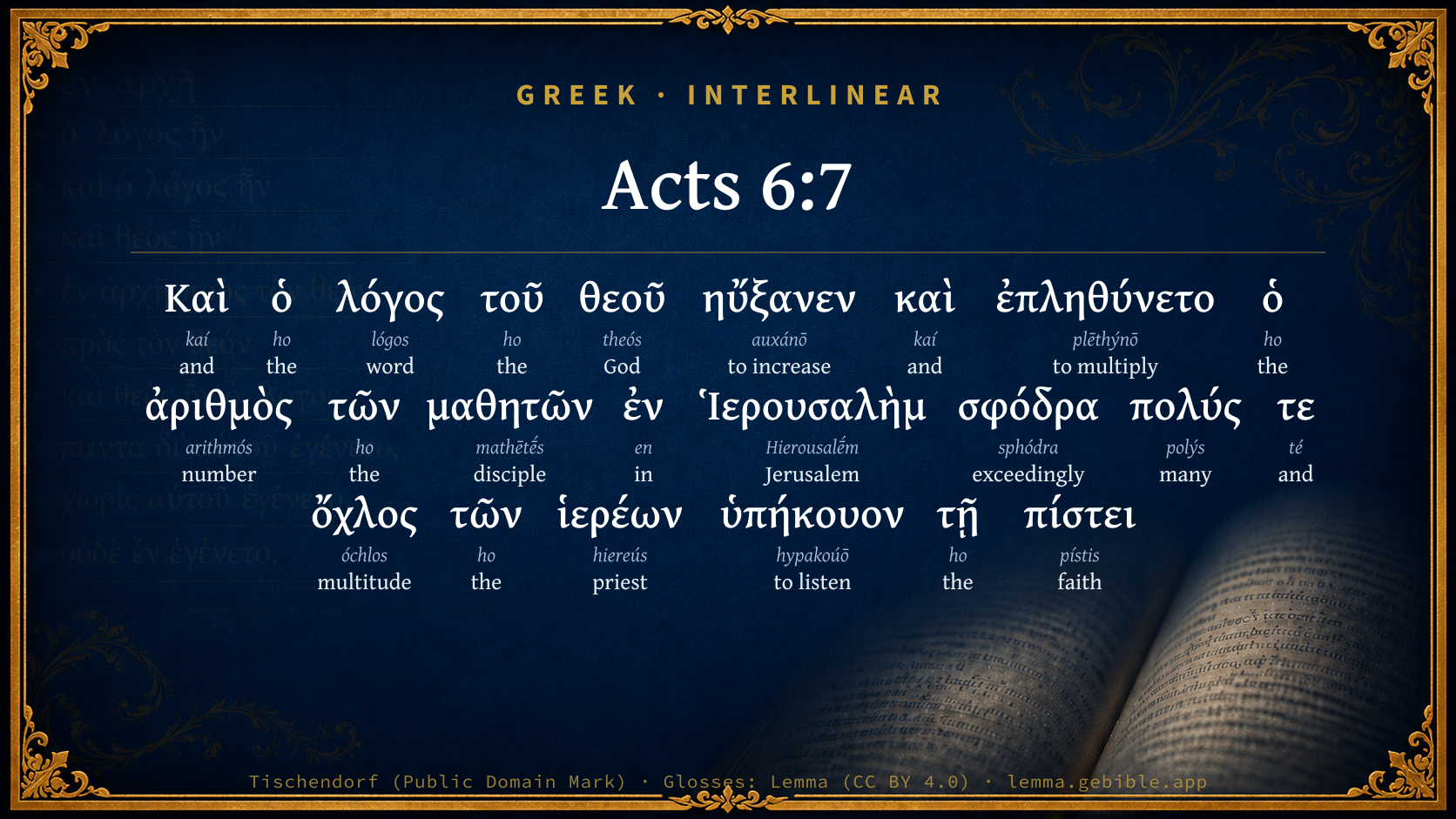
Greek (Tischendorf 8th ed.) Acts 6:7 appears in the Greek New Testament. The text above is from the Tischendorf 8th edition. Each word links to its Strong’s number and a concise gloss. Click any word for its full Thayer’s Greek Lexicon entry.
Download image
Cite this verse

Acts 6:7 (World English Bible). Public Domain. Lemma interlinear Bible study tool, https://lemma.gebible.app/v/acts/6/7.

Show BibTeX & RIS
BibTeX
RIS
English Translation
The word of God increased and the number of the disciples multiplied in Jerusalem exceedingly. A great company of the priests were obedient to the faith.
World English Bible · Public Domain
Download a study sheet

One document with this verse’s original text, its word-by-word gloss line, the meaning frame, cross-references with their text, attributed commentary, and full source and license credits — printable, and it pastes into notes with its structure intact.

This verse Autodidact and up

Study sheet (.html) Plain text (.txt)

A passage Seminary Student

Up to 50 verses in one chapter. A passage sheet keeps up to 6 commentary sources and 12 cross-references per verse, in the order this page ranks them, and says so on the sheet whenever that leaves anything out. Ask for a single verse and you get the Autodidact verse sheet above.

Everything on this page stays free to read, with no account — the sheet is a download of what is already on screen, not access to it.

Want to remove ads? Support Godless Engineer
Compare translations 3

The same verse in 3 English versions, stacked beneath the original-language interlinear above. Click any original word for its lexicon entry.

Each is an independent rendering of the whole verse — the interlinear is not word-aligned to these translations.

Highlighted words mark where these versions differ — a whole-verse word diff, not a word-by-word alignment.

  • World English Bible Public Domain
    The word of God increased and the number of the disciples multiplied in Jerusalem exceedingly. A great company of the priests were obedient to the faith.
  • King James Version Public Domain
    And the word of God increased; and the number of the disciples multiplied in Jerusalem greatly; and a great company of the priests were obedient to the faith.
  • unfoldingWord Literal Text CC BY-SA 4.0
    So the word of God kept spreading, and the number of disciples in Jerusalem increased greatly, and a large crowd of the priests became obedient to the faith.

unfoldingWord Literal Text — © unfoldingWord, licensed CC BY-SA 4.0. Word-aligned USFM3 via Door43 (git.door43.org/unfoldingWord/en_ult).

Versions to compare (up to 4)

3 of 4 selected

Show all 19 translations

Every available English version of this verse, each an independent rendering of the whole verse.

  • World English Bible Public Domain
    The word of God increased and the number of the disciples multiplied in Jerusalem exceedingly. A great company of the priests were obedient to the faith.
  • Berean Standard Bible Public Domain
    So the word of God continued to spread. The number of disciples in Jerusalem grew rapidly, and a great number of priests became obedient to the faith.
  • Majority Standard Bible Public Domain
    So the word of God continued to spread. The number of disciples in Jerusalem grew rapidly, and a great number of priests became obedient to the faith.
  • King James Version Public Domain
    And the word of God increased; and the number of the disciples multiplied in Jerusalem greatly; and a great company of the priests were obedient to the faith.
  • American Standard Version (1901) Public Domain
    And the word of God increased; and the number of the disciples multiplied in Jerusalem exceedingly; and a great company of the priests were obedient to the faith.
  • Revised Version (1885) Public Domain
    And the word of God increased; and the number of the disciples multiplied in Jerusalem exceedingly; and a great company of the priests were obedient to the faith.
  • Geneva Bible (1599) Public Domain
    And the worde of God increased, and the nomber of the disciples was multipled in Hierusalem greatly, and a great company of the Priests were obedient to the faith.
  • Douay-Rheims (1899) Public Domain
    And the word of the Lord increased; and the number of the disciples was multiplied in Jerusalem exceedingly: a great multitude also of the priests obeyed the faith.
  • Young's Literal Translation Public Domain
    And the word of God did increase, and the number of the disciples did multiply in Jerusalem exceedingly; a great multitude also of the priests were obedient to the faith.
  • Literal Standard Version CC BY-SA 4.0
    And the word of God increased, and the number of the disciples multiplied in Jerusalem exceedingly; a great multitude of the priests were also obedient to the faith.
  • Unlocked Literal Bible CC BY-SA 4.0
    So the word of God continued to spread, and the number of disciples in Jerusalem increased greatly, and a large number of the priests became obedient to the faith.
  • unfoldingWord Literal Text CC BY-SA 4.0
    So the word of God kept spreading, and the number of disciples in Jerusalem increased greatly, and a large crowd of the priests became obedient to the faith.
  • Darby Bible Public Domain
    And the word of God increased; and the number of the disciples in Jerusalem was very greatly multiplied, and a great crowd of the priests obeyed the faith.
  • World Messianic Bible Public Domain
    The word of God increased and the number of the disciples greatly multiplied in Jerusalem. A great company of the priests were obedient to the faith.
  • Webster's Bible Public Domain
    And the word of God increased; and the number of the disciples multiplied in Jerusalem greatly; and a great company of the priests were obedient to the faith.
  • Free Bible Version CC BY-SA 4.0
    The word of God continued to spread, and the number of disciples in Jerusalem greatly increased, with a large number of priests committing themselves to trusting in Jesus.
  • Bible in Basic English Public Domain
    And the word of God was increasing in power; and the number of the disciples in Jerusalem became very great, and a great number of priests were in agreement with the faith.
  • Text-Critical English NT CC BY 4.0
    So the word of God continued to increase, and the number of disciples continued to multiply greatly in Jerusalem, and a large number of priests became obedient to the faith.
  • Tyndale New Testament (1534) Public Domain
    And the worde of God encreased and the noubre of the disciples multiplied in Ierusalem greatly and a great company of the prestes were obedient to the faythe.

Literal Standard Version (2020), Covenant Press — licensed CC BY-SA 4.0. Text via the HelloAO Bible API (eBible.org). Unlocked Literal Bible (unfoldingWord) — licensed CC BY-SA 4.0. Text via the HelloAO Bible API (eBible.org). unfoldingWord Literal Text — © unfoldingWord, licensed CC BY-SA 4.0. Word-aligned USFM3 via Door43 (git.door43.org/unfoldingWord/en_ult). Free Bible Version, Dr. Jonathan Gallagher — licensed CC BY-SA 4.0. Text via the HelloAO Bible API (eBible.org).

Word by word

More ways to search: Search by grammar → Find every occurrence → Compare this word →

Practice this passage: Drill this verse → Learn its vocabulary →

σφόδρα
sphódra
G4970
“exceedingly”
Adverb
Part of Speech
Adverb
Full Thayer's Definition

Origin: neuter plural of sphodros (violent, of uncertain derivation) as adverb

TDNT: None

1. exceedingly, greatly
  1. Καὶ kaí G2532 “and” Conjunction
  2. ὁ ho G3588 “the” Article, Nominative, Singular, Masculine
  3. λόγος lógos G3056 “word” Noun, Nominative, Singular, Masculine
  4. τοῦ ho G3588 “the” Article, Genitive, Singular, Masculine
  5. θεοῦ theós G2316 “God” Noun, Genitive, Singular, Masculine
  6. ηὔξανεν auxánō G837 “to increase” Verb, Imperfect, Active, Indicative, 3rd person, Singular
  7. καὶ kaí G2532 “and” Conjunction
  8. ἐπληθύνετο plēthýnō G4129 “to multiply” Verb, Imperfect, Passive, Indicative, 3rd person, Singular
  9. ὁ ho G3588 “the” Article, Nominative, Singular, Masculine
  10. ἀριθμὸς arithmós G706 “number” Noun, Nominative, Singular, Masculine
  11. τῶν ho G3588 “the” Article, Genitive, Plural, Masculine
  12. μαθητῶν mathētḗs G3101 “disciple” Noun, Genitive, Plural, Masculine
  13. ἐν en G1722 “in” Preposition
  14. Ἱερουσαλὴμ Hierousalḗm G2419 “Jerusalem” Noun, Proper, indeclinable
  15. πολύς polýs G4183 “many” Adjective, Nominative, Singular, Masculine
  16. τε té G5037 “and” Particle
  17. ὄχλος óchlos G3793 “multitude” Noun, Nominative, Singular, Masculine
  18. τῶν ho G3588 “the” Article, Genitive, Plural, Masculine
  19. ἱερέων hiereús G2409 “priest” Noun, Genitive, Plural, Masculine
  20. ὑπήκουον hypakoúō G5219 “to listen” Verb, Imperfect, Active, Indicative, 3rd person, Plural
  21. τῇ ho G3588 “the” Article, Dative, Singular, Feminine
  22. πίστει pístis G4102 “faith” Noun, Dative, Singular, Feminine

About this verse

These counts appear in no published source. They are computed here, from the morphology-tagged text and Lemma’s own curated glosses. What Lemma adds →

23
words
17
distinct lemmas
Acts
section

Notable vocabulary

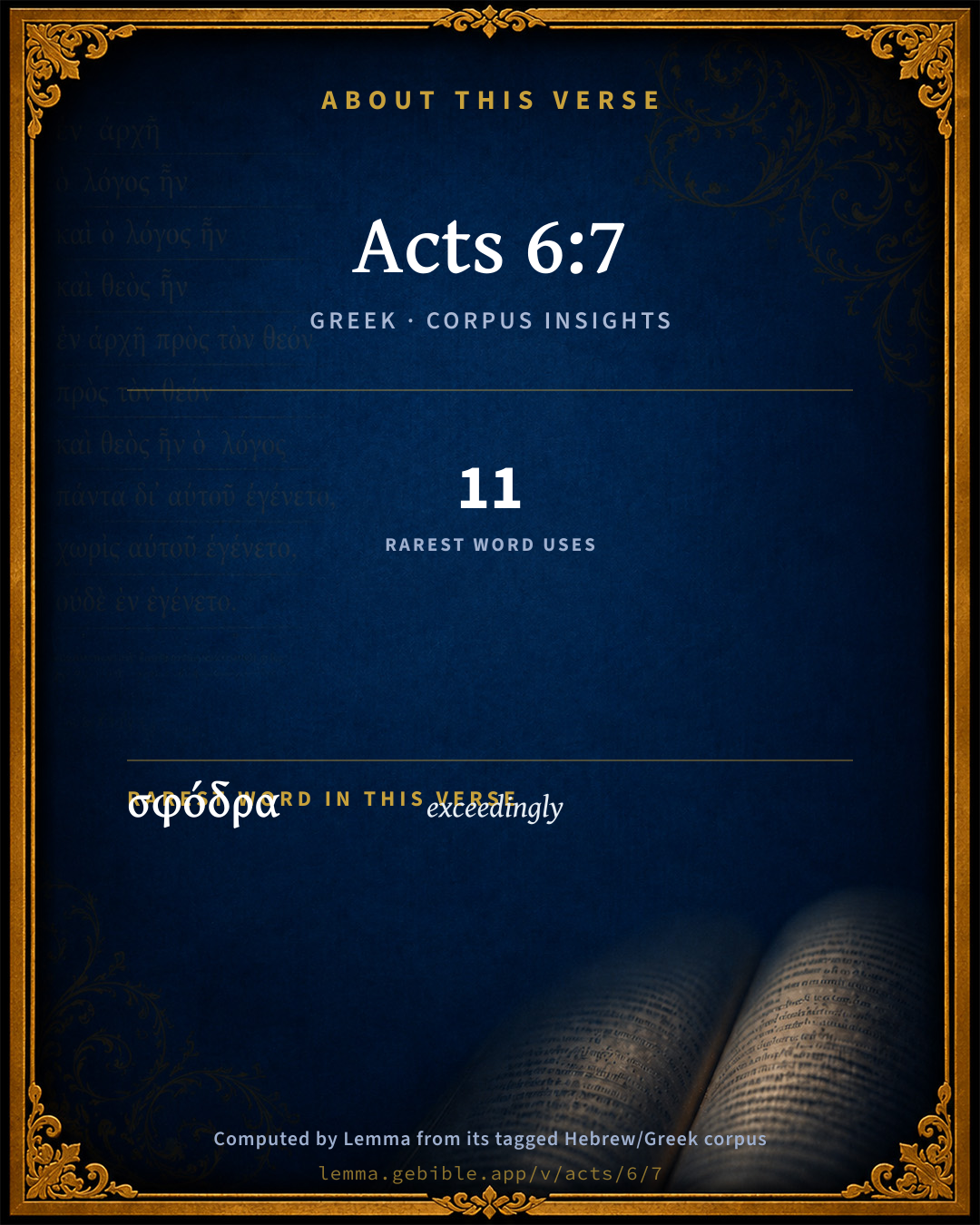
The rarest word here is σφόδρα exceedingly G4970 — appearing just 11 times in the whole Greek New Testament.

Shared distinctive vocabulary

σφόδρα exceedingly G4970 occurs in 11 verses of the Greek New Testament. Also found in:

Repetition

Words recur within this verse:

Cross-references

19

Topical passages linked to Acts 6:7 in the Treasury of Scripture Knowledge — connected by theme and wording, ordered by reader-vote popularity; previews shown in the World English Bible.

  • Acts 19:20 So the word of the Lord was growing and becoming mighty.
  • Acts 12:24 But the word of God grew and multiplied.
  • Colossians 1:6 which has come to you; even as it is in all the world and is bearing fruit and growing, as it does in you also, since the day you heard and knew the grace of God in truth;
  • Hebrews 5:9 Having been made perfect, he became to all of those who obey him the author of eternal salvation,
  • Romans 16:26
  • John 12:42 Nevertheless even of the rulers many believed in him, but because of the Pharisees they didn't confess it, so that they wouldn't be put out of the synagogue,
  • Acts 14:22 confirming the souls of the disciples, exhorting them to continue in the faith, and that through many afflictions we must enter into the Kingdom of God.
  • Romans 1:5 through whom we received grace and apostleship, for obedience of faith among all the nations, for his name's sake;
  • Psalms 132:16 Her priests I will also clothe with salvation. Her saints will shout aloud for joy.
  • Matthew 19:30 But many will be last who are first; and first who are last.
  • Luke 2:34 and Simeon blessed them, and said to Mary, his mother, "Behold, this child is set for the falling and the rising of many in Israel, and for a sign which is spoken against.
  • Acts 13:8 But Elymas the sorcerer (for so is his name by interpretation) withstood them, seeking to turn aside the proconsul from the faith.
  • Acts 21:20 They, when they heard it, glorified God. They said to him, "You see, brother, how many thousands there are among the Jews of those who have believed, and they are all zealous for the law.
  • Hebrews 11:8 By faith, Abraham, when he was called, obeyed to go out to the place which he was to receive for an inheritance. He went out, not knowing where he went.
  • 2 Chronicles 29:34 But the priests were too few, so that they could not flay all the burnt offerings: therefore their brothers the Levites helped them, until the work was ended, and until the priests had sanctified themselves; for the Levites were more upright in heart to sanctify themselves than the priests.
  • 2 Chronicles 30:24 For Hezekiah king of Judah did give to the assembly for offerings one thousand bulls and seven thousand sheep; and the princes gave to the assembly a thousand bulls and ten thousand sheep: and a great number of priests sanctified themselves.
  • Psalms 132:9 Let your priest be clothed with righteousness. Let your saints shout for joy!"
  • 2 Thessalonians 1:8 giving vengeance to those who don't know God, and to those who don't obey the Gospel of our Lord Jesus,
  • 2 Timothy 2:9 in which I suffer hardship to the point of chains as a criminal. But God's word isn't chained.

Cross-references courtesy of OpenBible.info (CC BY 4.0).

Commentary

Notes on Acts 6:7 from classic Christian and Jewish commentators (each source and its license shown beneath its notes). The classic Christian expositions comment on the surrounding passage and are grouped to its opening verse, so a note may address several verses; the Jewish commentaries on the Tanakh (Rashi and others) are per-verse, so they appear only where the commentator wrote on this verse.

Lemma curates 59 commentaries, every one of them public domain or Creative Commons licensed, each selected and text-cleaned for this edition rather than reprinted as found. About our sources →

The Biblical Illustrator

Joseph S. Exell

Act_6:7

And the Word of God increased.

Good earnests of great success

I. The means by which this prosperity may be procured. Nothing can avail without--

1. The operation of the Holy Spirit and the smile from heaven. Paul planteth, Apollos watereth, and God giveth the increase.

2. The plain preaching of the gospel of Jesus Christ. I have been struck with the downrightness of the testimony of the Reformers. It was so with Farren, Luther, Calvin, etc. They did not aim at lofty periods and flowing eloquence; but they just dashed right on with this one truth, Believe on the Lord Jesus Christ, and thou shalt be saved. And if we are to see the Church of God really restored to her pristine glory, we must have back this plain, simple, gospel-preaching. Sunday-school teachers, you must teach this same gospel.

3. Much holy living to back it all up. After we have done the sermon, people say, How about the people that attend there? Are they such people as you can trust? What about their homes? Do they make good husbands, good servants, kind masters? And if the report of our character be bad it is all over with our testimony. The doctor may advertise, but if the patients are not cured, he is not likely to establish himself as being well skilled in his art; and the preacher may preach, but if his people do not live the gospel, they kick down with their feet what he builds up with his hands. The early Reformers were distinguished by the sanctity of their lives. When they were about to hunt out the Waldenses, the French king sent a priest to see what they were like, and be, honest man as he was, came back and said, They seem to be much better Christians than we are. I am afraid they are heretics, but I would that all Catholics were as good as they are. This was what made the gospel victorious in those days.

4. Individual, personal exertion. No Church can have prosperity if only a part of the members are active. It was thought among Christians that we ministers were to do all the work, and that you were to sit still and enjoy the sermon, and perhaps pull it to pieces. Let me give you a parable. A certain band had been victorious in all their conflicts. But on a sudden they said in the council-chamber, We have at our head a most valiant warrior, one whose arm is stout enough to smite down fifty of his adversaries; would it not be better if, with a few such as he to go out to the fight, the mere men-at-arms, who make up the ordinary ranks, were to stop at home? Now, the foremost champions, with fear and trembling, undertook the task and went to the conflict, and they fought well, and did great exploits. But still no city was taken, no province was conquered, and they met together and said, How is this? Our former prestige is forgotten; our ranks are broken; our pennons are trailed in the dust; what is the cause of it? When out spoke the champion, and said, Of course it is so! How did you think that some twelve or fifteen of us could do the work of all the thousands? When every man took his share, we dashed upon the foe like an avalanche; but now that you stay at home and put us, but a handful, to do all the work, how can you expect that great things should be done? So each man resolved to put on his helmet and his armour once again, and go to the battle, and so victory returned. And if we are to have the victory you must be every one of you in the fight.

5. Much earnest prayer. Nothing is impossible to the man who knows how to overcome heaven by wrestling intercession. According to your faith shall it be done unto you.

6. More intense glowing spiritual life.

II. The results which flow from this prosperity.

1. Souls are saved. John Owen said that if you bad to preach to a whole nation for a twelvemonth, in order to win one soul, it would be good wages. Richard Knill once said, that if there were only one unconverted person in the wilds of Siberia, and that God had ordained that every Christian in the world must go and talk to that one person before he would be converted, it would be an exceedingly little thing for us all to do.

2. The name of our Lord Jesus Christ is glorified.

3. The Church is edified. As those who promote sanitary measures for the benefit of the neighbourhood are thereby favouring the conditions of their own health, so the promulgation of saving knowledge throughout the world is augmenting the peace and the welfare of our own hearts, and of all who are already saved.

III. The alternative. Either we must get a high state of prosperity, or else we shall lack what is to be dreaded to the very uttermost. I have seen congregations broken to pieces, and churches split up, and the bottom of it all has been because vital godliness has been drained out of the system. (C. H. Spurgeon.)

Missionary hindrances and encouragements

I. The hindrances.

1. The apostles had to preach to them as sinners, who, because of their ungodliness and pride, necessarily hated the gospel, which opposes itself to these evils.

2. Besides these elements of opposition, which they possessed in common with their fellow-creatures throughout the world, there were national hindrances, formalism, self-righteousness, and exclusiveness.

3. The class that was most especially opposed to the gospel from their position in society were the priests. These were first pledged to their own system, as its teachers. Their pride as teachers would rise up against the idea of renouncing this system, to which they had been so long and so warmly attached. And then their interests, as priests, were likely to be altogether subverted by the substitution of the gospel for Judaism. Their power and their wealth were both at stake.

II. Encouragements. The apostles were aided--

1. By having to address to those whom they endeavoured to convert, the testimony respecting undeniable and signal facts. The Jews might oppose their various theoretical objections to the gospel, and doubtless did; but to all these the apostles could adduce in answer, plain great facts which they did not adduce from hearsay, but of which they were themselves the witnesses.

2. By the moral force of the doctrine which they had to convey.

3. By their personal character.

4. B the Divine assistance which was guaranteed. Conclusion: Our hindrances are just those which prevailed at the first preaching of the gospel, which were overborne and mastered by the first disciples of Jesus Christ, and therefore may be by His disciples now, for the very means which they possessed for wrestling with these difficulties are possessed by ourselves. (Baptist Noel.)

Prosperous times

I. The Word of God increased.

1. The number of its preachers increased. Stephen and Philip certainly, and the other deacons probably, were added to the company of preachers. Times of revival are always times for recruiting the ranks of the ministry.

2. The preachers declared it with augmented industry and power, encouraged by signs of Divine approval, and by the favour of the people.

3. The people received it in constantly increasing numbers, and passed it on.

II. The disciples multiplied.

1. Converts were made. There is no surer sign of spiritual adversity than few or no conversions. For this architecture, music, wealth, etc., are no compensation. But a Church worshipping in some upper room where money is scarce, and ecclesiastical aesthetics non-existent, but where disciples are multiplied, is in a prosperous state.

2. They were made in the least likely place. In Jerusalem, the stronghold of Jewish bigotry, where that spirit was in the ascendant which had crucified the Master. Had this been in Galilee, where the prejudice was not so intense, it would not have called for so much remark. So it is a blessed thing when those predisposed in favour of the gospel--the children of pious parents, etc., are brought to Christ; but it is still more glorious when the Word of God is received by heathen, either abroad or at home.

3. They were made in great numbers. Not in ones and twos, but in multitudes. It is sad when a Church has to congratulate itself that it holds its own, and that the additions fill the gaps made by removals or deaths. No Church is prosperous which does not keep pace with the growth of the population. The same power which converted multitudes in Jerusalem can do the same in London.

III. A great company of priests were obedient to the faith.

1. They had everything to lose and nothing to gain, and so their conversion and adhesion to the Church was a great argument in favour of the truth of the gospel. And so it is in any age when notorious opponents are converted.

2. All their learning and prestige were now consecrated to the cause of Christ. Frequently the conversion of one man or woman in an influential position or of great ability is of more value than the conversion of scores of others, because of the higher vantage ground they occupy.

3. These, too, were converted in great numbers. There is nothing unreasonable in this. The power that can convert one can convert multitudes.

4. Their conversion was thorough, obedient unto the faith. (J. W. Burn.)

A great company of the priests were obedient to the faith.--

The conversion of the priests an evidence of the truth of the Christian religion

The Jewish priesthood was of great dignity and influence. The office was hereditary, and its members constituted a national aristocracy. Every priest could trace back his pedigree to Aaron, and no matter to what straits of poverty he might be brought his social position was unchanged. He was exempt from taxation and military service. The number of priests during the period of our Lords life, Josephus estimated at twenty thousand. For reasons plainly to be seen, the Jewish authorities arrayed themselves in bitter hostility against the Prophet of Nazareth, and the most blood-thirsty of His enemies were Gods anointed priests. The political condition of Palestine was then strange and anomalous. Davids throne was occupied by a creature of the Emperor of Rome, and foreign soldiers kept the Jewish people in subjection. The Church outrivalled the state in degeneracy. Her priesthood, greedy, dissolute, and infidel, demanded unlawful fees for every temple service, disgraced the religion they professed, by the inhumanity and profligacy of their lives. With such a condition of things, no wonder that the Son of God met with the cruelty that He did: no wonder that even the chief priests were loudest in their clamours that He should die. When the Saviour rose from the dead, His scattered followers forthwith flocked about His standard, and began their great work of the conversion of the world. The first martyr, Stephen, laid down his life for the truth. On the very eve of his ordination to the office of deacon we are told that the Word of God increased, and a great company of the priests were obedient to the faith. It is no longer merely a company of ignorant fishermen and soft-hearted women who are found to take sides with the crucified Jesus, but the very class of men who could have been least expected to make such a sacrifice. Surely, among all the evidences afforded of the truth of the Christian religion, this is one of wonderful force and significance. Had one or two priests yielded to the overwhelming proofs vouchsafed, that Jesus was the Messiah, it would have been a testimony of no little value; but how the weight of testimony is increased when we read that a great company of those who occupied this high social position abandoned everything, and exposed themselves to opposition, ridicule, contempt, persecution, and death, that they might carry out their convictions of duty, and prove, as no men have ever done more clearly, that the religion of our Lord Jesus Christ is worthy of all acceptation. Once, the contemptuous question had been asked: Have any of the rulers or of the Pharisees believed on Him? (Joh_7:48). And yet, even then, many among the chief rulers already believed in Jesus, but because of the Pharisees they did not confess Him, lest they should be put out of the synagogue (Joh_12:42; Joh_19:38). The day was at hand when a great company of the priests would acknowledge Jesus to be the Saviour of the world. Faith is here put for the Christian religion, and we are assured in this brief statement that they not only embraced the truths of the gospel as an act of the understanding, but that they pledged themselves to obey its requirements. Surely, then, they who, in our own day, claim to be unbelievers, ought to have very substantial ground to go upon before they rush to the conclusion that the multitudes who have embraced the Christian faith, and who have passed into another world, cheered and comforted by its promises, have all believed a lie! (J. N. Norton, D. D.)

The Biblical Illustrator, edited by Joseph S. Exell (c. 1880s–1900s) — public domain. Text from a community e-Sword module.

Joseph Benson's Commentary

Act 6:7. And the word of God increased — The matter of the complaint, and other hinderances being thus removed, and the apostles more entirely at leisure to attend to the great and peculiar duties of their office, the success of the word increased, and the number of the disciples in Jerusalem was, σφοδρα, very much augmented; and a great company — Greek, πολυς οχλος, a great crowd, or multitude, of the priests were obedient to the faith — That is, they embraced the doctrine of the gospel, and evinced the sincerity of their faith in it, by a cheerful compliance with all its rules and precepts.

Joseph Benson's Commentary on the Old and New Testaments (1811–1818) — public domain. Text from a community e-Sword module.

Tyndale Open Study Notes

Tyndale Open Resources

6:7 The result of the apostles’ wise handling of the issue was growth and increase in the number of believers, including many of the Jewish priests. • This is the first of three places in Acts where Luke notes that God’s message continued to spread (see also 12:24; 19:20). When real difficulties arose, God’s message could overcome the challenges posed by internal strife, idolatry, and paganism, and the result was growth in the community. Acts is the story of the unhindered message of Good News (see 28:31).

Tyndale Open Study Notes — © Tyndale Open Resources, licensed CC BY-SA 4.0. Text via the HelloAO Bible API.

Bengel's Gnomon

Johann Albrecht Bengel

Act 6:7. Ηὔξανε, increased) Whilst harmony was maintained, and assiduity in the word of GOD.—ὄχλος, the multitude) The expression ὄχλος is applied even to a not very large number; ch. Act 1:15; Luk 5:29; Luk 6:17; Joh 12:17. Wherefore there is nothing improbable in this passage. As to the priests, there might have been less hope: now, as it is, others are influenced in the greater numbers, owing to their example. The rest of the people are alluded to in the next clause.—[ὑπήκουον τῇ πίστει, were obedient to the faith) Faith here denotes the testimony of the Gospel, which is most worthy of belief: wherefore in other passages the expression is used, to obey the Gospel, Rom 10:16; 2Th 1:8; and thence, obedience to the faith, Rom 1:5; Rom 16:26. GOD exhibits to us His testimony; which he who receives as true, submissively lends his ears, and so renders obedience.—V. g.]

Bengel's Gnomon of the New Testament — English translation (T&T Clark, Edinburgh, 1860) — public domain. Text from a community e-Sword module.

Meyer's Critical & Exegetical Commentary

Heinrich August Wilhelm Meyer

Act_6:7, attaching the train of thought by the simple καί, now describes how, after the installing of the Seven, the cause of the gospel continued to prosper. The word of God grewit increased in diffusion (Act_12:24, Act_19:20), etc. Comp. the parable of the mustard-seed, Mat_13:31-32. How could the re-established and elevated love and harmony, sustained, in addition to the apostles, by upright men who were full of the Holy Spirit and of wisdom (Act_6:3), fail to serve as the greatest recommendation of the new doctrine and church to the inhabitants of the capital, who had always before their eyes, in the case of their hierarchs, the curse of party spirit and sectarian hatred? Thereforeand what a significant step towards victory therein took place!a great multitude of the priests became obedient to the faith, that is, they submitted themselves to the faith in Jesus as the Messiah, they became believers; comp. as to ὑπακοὴ πίστεως, on Rom_1:5. The better portion of the so numerous (Ezr_2:36 ff.) priestly class could not but, in the light of the Christian theocratic fellowship which was developing itself, recognise and feel all the more vividly the decay of the old hierarchy. Accordingly, both the weakly attested reading Ἰουδαίων, and the conjecture of Casaubon, approved by Beza: καὶ τῶν ἱερέων, sc. τινὲς, are to be entirely rejected; nor is even Elsners view (which Heinsius anticipated, and Wolf and Kuinoel followed) to be adopted, viz. that by the ὄχλος τῶν ἱερ. the sacerdotes ex plebe, plebeii sacerdotes, כהנים עם חארץ, are meant in contradistinction to the theologically learned priests, תלמידי חכמים. The text itself is against this view; for it must at least have run: πολλοί τε ἱερεῖς τοῦ ὄχλου. Besides, such a distinction of priests is nowhere indicated in the N. T., and could not be presumed as known. Compare, as analogous to the statement of our passage, Joh_12:42.

Meyer — Critical and Exegetical Commentary on the New Testament — English translation by Peter Christie, edited by Frederick Crombie (T&T Clark, 1880) — public domain. Text from a community e-Sword module.

Expositor's Greek Testament

ed. W. Robertson Nicoll

Act 6:7 . τῶν ἱερέων : the reading Ἰουδαίων is advocated by Klostermann, Probleme in Aposteltexte , pp. 13, 14, but not only is the weight of critical evidence overwhelmingly against it, but we can scarcely doubt that St. Luke would have laid more stress upon the first penetration of the Christian faith into districts outside Jerusalem this is represented as the result of the persecution about Stephen, Act 8:4 ; cf. Joh 12:42 (see also Wendt, 1899, p. 145, note). The whole verse shows that the γογγυσμός had not interfered with the growth of the Church. The conjecture that in the word ὄχλος reference is made to the priests of the plebs in contrast to the learned priests is in no way satisfactory; if this had been the meaning, the words would have been πολλοί τε ἱερεῖς τοῦ ὄχλου , and no such distinction of priests is anywhere noticed in the N.T., see further below. ἐν Ἱερουσαλὴμ : Hilgenfeld (so Weiss) considers that, as this notice implies that there were disciples outside Jerusalem, such a remark is inconsistent with the statements of the after-spread of the Church in this chapter and in 8, and that therefore the words ἐν Ἱ . are to be referred to the “author to Theophilus”. But so far from the words bearing the interpretation of Hilgenfeld, the historian may have introduced them to mark the fact that the growth of the Church continued in Jerusalem, in the capital where the hierarchical power was felt, and that the growth included the accession of priests no less than of laymen. ὑπήκουον τῇ πίστει : the imperfect may denote repetition the priests kept joining the new community, Blass, in loco; cf. Rom 1:5 ; Rom 1:16-17 ; Rom 10:16 , 2Th 1:8 the verb (very frequent in LXX) is only used in Acts in this place in the sense given, but often in St. Paul’s Epistles. No doubt when the number of Jewish priests was so large (according to Josephus, twenty thousand) both poor and wealthy would have been included in the statement, and we cannot limit it to the Sadducees. It must be borne in mind that the obedience of these priests to the Christian faith need not of necessity have interfered with the continuance of their duties in the Temple (so Felten), especially when we remember the attitude of Peter and John; but the words certainly seem to mark their complete obedience to the faith (see Grimm-Thayer, sub v . πίστις , i. b , [197] ), and in face of the opposition of the Sadducees and the more wealthy priestly families, an open adherence to the disciples of Jesus may well have involved a break with their former profession (Hort, Judaistic Christianity , p. 49, and Ecclesia , p. 52). May there not have been many among the priests waiting for the consolation of Israel, men righteous and devout like the Pharisee priest or priests, to whom perhaps we owe that expression of the hopes of the pious Jew in the Psalms of Solomon , which approach so nearly in style and character to the Hymns of the priest Zacharias and the devout Symeon in the early chapters of St. Luke’s Gospel? see Ryle and James’s edition, Psalms of Solomon , Introd., lix., lx. Spitta refers the whole verse to his source , as a break in the narrative, without any connection with what follows or precedes. Clemen assigns Act 6:1-6 to his special source, H ( istoria ) H ( ellenistarum ); Act 6:7 to his H ( istoria ) Pe ( tri ). Jüngst assigns Act 6:1 to Act 6:7 b, c , to his source , 7 a to his R(edactor). The comment of Hilgenfeld on Act 6:7 is suggestive (although he himself agrees with Spitta, and regards the verse as an interpretation), “Clemen und Jüngst nicht einmal dieses Verstein ungeteilt”.

[197] A(ntiochena), in Blass, a fair rough copy of St. Luke.

The Expositor's Greek Testament, edited by W. Robertson Nicoll (1897–1910) — public domain. Text from a community e-Sword module.

Geneva Bible (1599)

Geneva Bible translators

An happy end of temptation.

This is the figure Metonymy, meaning by faith, the doctrine of the Gospel which engendereth faith.

Geneva Bible (1599) marginal notes — public domain. Text via Bolls.life.

Jamieson, Fausset & Brown

Robert Jamieson, A. R. Fausset & David Brown

word of God increased . . . disciples multiplied in Jerusalem greatly--prosperity crowning the beautiful spirit which reigned in this mother community.

a great company of the priests were obedient, &c.--This was the crowning triumph of the Gospel, whose peaceful prosperity was now at its greatest height. After Stephen's teaching and trial made it clear that sacerdotal interests could not stand with the Gospel, such priestly accessions became rare indeed. Note (1) how easily misunderstandings may arise among the most loving and devoted followers of the Lord Jesus: but (2) How quickly and effectually such misunderstandings may be healed, where honest intentions, love, and wisdom reign: (3) What a beautiful model for imitation is furnished by the class here complained of, who, though themselves the majority, chose the new office-bearers from amongst the complaining minority! (4) How superior to the lust of power do the apostles here show themselves to be, in not only divesting themselves of the immediate superintendence of temporal affairs in the Christian community, but giving the choice of those who were to be entrusted with it to the disciples at large! (5) How little of formal organization did the apostles give to the Church at first, and when an emergency arose which demanded something more, how entirely was the remedy suggested by the reason of the thing! (6) Though the new office-bearers are not expressly called Deacons here, it is universally admitted that this was the first institution of that order in the Church; the success of the expedient securing its permanency, and the qualifications for "the office of a Deacon" being laid down in one of the apostolical Epistles immediately after those of "a Bishop" (Ti1 3:8-13).

Jamieson, Fausset & Brown — Commentary Critical and Explanatory on the Whole Bible (1871) — public domain (CC PDM 1.0). Text via the HelloAO Bible API.

Adam Clarke's Commentary

Verse 7. The word of God increased] By such preachers as the apostles and these deacons, no wonder the doctrine of God increased-became widely diffused and generally known; in consequence of which, the number of the disciples must be greatly multiplied: for God will ever bless his own word, when ministered by those whom he has qualified to proclaim it.

A great company of the priests were obedient to the faith.] This was one of the greatest miracles wrought by the grace of Christ: that persons so intent on the destruction of Christ, his apostles, and his doctrine, should at last espouse that doctrine, is astonishing; and that they who had withstood the evidence of the miracles of Christ should have yielded to the doctrine of his death and resurrection, is worthy of note. And from this we may learn that it is not by miracles that sinners are to be converted unto God, but by the preaching of Christ dying for their offenses, and rising again for their justification.

Instead of λερεων, priests, a few MSS., and the Syriac, read ιουδαιων, Jews; for the copyists seem to be struck here with two difficulties:

1. That such persons as these priests could be converted.

2. That the word οξλος, company, or multitude, could with propriety be applied to this class, which must have been inconsiderable in their numbers, when compared with the rest of the Jews.

To preserve the ancient reading, which is undoubtedly genuine, some have altered the text by conjecture; and, by putting a comma after οχλος, and a και before των ιερεων, make the text read thus: And a great multitude, and some of the priests, were obedient to the faith. This conjecture is unnecessary, as there is no such difficulty here as to require so desperate an expedient, which is not recommended by the evidence of a single MS. or version.

1. The grace of Christ Jesus can save even a murderous Jewish priest: his death is a grand atonement for all crimes and for the worst of sinners.

2. In the twenty-four courses of priests, there was not a multitude merely, but multitudes: indeed the number of ecclesiastics at Jerusalem was enormous. A great company out of these might be converted, and yet multitudes be left behind.

Adam Clarke's Commentary on the Bible (1810–1826) — public domain. Text from a community e-Sword/MySword module.

John Calvin's Commentaries

Luke setteth forth again the increasing of the Church, to the end he may the better declare the power of God and his grace in the continual going forward thereof. This was an excellent work of God that the Church should suddenly, and, as it were, in a moment, be raised up; but this is worthy no less admiration, in that he furthereth that work which he had begun amidst so many lets, in that the number of these is increased, whom to diminish, and so, consequently, to destroy the whole stock, the world doth so greatly labor. In that he saith that the Word of God did grow, his meaning is, that it was spread further abroad. The Word of God is said to grow two manner of ways; either when new disciples are brought to obey the same, or as every one of us profiteth and goeth forward therein Luke speaketh in this place of the former sort of increasing, for he expoundeth himself by and by, when he speaketh of the number of the disciples. Notwithstanding, he restraineth this so great an increasing of faith unto one city. For although it be to be thought that the disciples were scattered abroad elsewhere, yet was there no certain body save only at Jerusalem.

And a great company. Seeing that (in speaking properly) our faith doth obey the doctrine of the gospel, it is a figurative speech, uttered by metonymia, when Luke saith. That they obeyed the faith; for the word faith is taken by him for the Word of God, and the very profession of Christianity. And he reckoneth up the priests by name, because they were for the most part enemies; for which cause it was a wonderful work of God that some should be converted, and much more wonderful that many. For at the first they raged against Christ with this brag, “Hath any of the rulers believed in him? But this multitude, which knoweth not the law, are accursed.”

John Calvin's Commentaries (1540-1563) — public domain. Text from the Calvin Translation Society English edition (1840s-50s) via the Christian Classics Ethereal Library (ccel.org). Calvin's coverage is partial (roughly two-thirds of the Bible); uncommented books and verses are honest gaps, never fabricated. The 19th-century editor's footnotes and remarks are omitted so the notes are faithfully Calvin's own voice.

Ellicott's Commentary for English Readers

(7) The word of God increased.—The tense indicates gradual and continuous growth. The fact stated implies more than the increase of numbers specified in the next clause. The “word of God” is here the whole doctrine of Christ as preached by the Apostles, and, we must now add, by the Seven who are commonly known as Deacons, and there was, as the sequel shows, at this stage, what we have learnt to call an expansion and development of doctrine.

A great company of the priests were obedient to the faith.—The fact is every way significant. No priest is named as a follower of our Lord’s. None, up to this time, had been converted by the Apostles. The new fact may fairly be connected with the new teaching of Stephen. And the main feature of that teaching was, as we shall see, an anticipation of what was afterwards proclaimed more clearly by St. Paul and (if we assign the Epistle to the Hebrews to its probable author) by Apollos: that the time for sacrifices had passed away, and that the Law, as a whole, and the ritual of the Temple in particular, were decaying and waxing old, and ready to vanish away (Heb_8:13). We might have thought this likely to repel the priests, and to rouse them to a fanatic frenzy. We find that it attracts them as nothing else had attracted. To them, it may well have been, that daily round of a ritual of slaughtered victims and clouds of incense, the cutting-up of the carcases and the carriage of the offal, had become unspeakably wearisome. They felt how profitless it was to their own spiritual life, how little power there was in the blood of bulls and goats to take away sin (Heb_10:4). Their profession of the new faith did not necessarily involve the immediate abandonment of their official function; but they were drifting to it as to a not far-off result, and were prepared to meet it without misgiving, perhaps with thankfulness, when it became inevitable.

A Bible Commentary for English Readers, edited by Charles John Ellicott (1878–1897) — public domain. Text from a community e-Sword module.

The Cambridge Bible for Schools and Colleges

gen. ed. J. J. S. Perowne

7. And the word of God increased] i.e. was more widely spread now that the Apostles were freed from secular cares, and left to give themselves unto the ministry of the word. (Cp. for the expression Act_12:24, Act_19:20.)

a great company of the priests] To these men the sacrifice would be greater than to the ordinary Israelite, for they would experience the fullest weight of the hatred against the Christians, and would lose their status and support, as well as their friends. This is no doubt the reason why such special mention is made of them.

were obedient to the faith] As faith in Christ was the first demand made from those who desired to enter the new communion, it is easy to understand how the Christian religion gained from the earliest times the name of “the Faith.” Cf. Act_13:8, Act_14:22, Act_16:5, Act_24:24.

The Cambridge Bible for Schools and Colleges (gen. ed. J. J. S. Perowne; Cambridge University Press, 1878–1918) — public domain. Text from a community e-Sword module.

John Gill's Exposition

And the word of God increased,.... This stratagem of Satan did not succeed to divide the church, but issued in the better decorum and discipline of it, and in the spread and success of the Gospel; God thus making all things to work together for good;

and the number of the disciples multiplied in Jerusalem greatly; where Christ was crucified, the apostles were scourged, and treated with the utmost contempt, the sanhedrim and rulers of the Jews dwelt, who used all their power and craft to crush the Gospel, and hinder the progress of it, but in vain, there the word increased; which it may be said to do, when saints are edified by it, and sinners are converted under it; and in this last sense it is chiefly to be understood here: the instances of conversion were very numerous; how large must this church now be!

and a great company of the priests were obedient to the faith; that is, to the Gospel, which contains things to be believed, articles of faith; proposes Christ the great object of faith; and is the means of producing faith, and which is of no profit, unless it is mixed with faith: and to obey this is cordially to embrace the doctrines of the Gospel, and cheerfully to submit to the ordinances of it. And that the priests, and a large number of them, should do this, is very marvellous; since they were the most inveterate enemies of the Gospel, and persecutors of the saints; but what is it that efficacious grace cannot do? the Syriac version instead of "priests" reads "Jews", but unsupported by any copy.

John Gill's Exposition of the Whole Bible (1746–1763) — public domain (CC PDM 1.0). Text via the HelloAO Bible API.

Trapp's Complete Commentary

John Trapp

7 And the word of God increased; and the number of the disciples multiplied in Jerusalem greatly; and a great company of the priests were obedient to the faith.

Ver. 7. A great company of the priests] Despair not therefore of the worst; God hath his time to call them. Wycliffe was a great enemy to the swarms of begging friars, with whom it was harder to make war than with the pope himself; whom he pronounced Antichrist, and made him lose in England his tenths and Peter’s pence. {a} Howbeit, sundry of the frairs fell to him, and embraced his opinions; among whom, one that was the pope’s chaplain, professing that he came out of his order and out of the devil’s nest. (Speed.)

{a} An annual tax or tribute of a penny from each householder having land of a certain value, paid before the Reformation to the papal see at Rome; also, a similar tribute paid by several northern lands. The institution of Peter’s pence has been attributed to Ine king of Wessex, 688-728, and to Offa king of Mercia, 755-94. It is mentioned as due by ancient law in a (Latin) letter of Canute in 1031. It was discontinued by statute in 1534. ŒD

John Trapp, A Commentary or Exposition upon All the Books of the Old and New Testament (1647–1656) — public domain. Text from a community e-Sword module.

Albert Barnes' Notes on the Bible

And the word of God increased - That is, the gospel was more and more successful, or became more mighty and extensive in its influence. An instance of this success is immediately added.

And a great company of the priests - A great “multitude.” This is recorded justly as a remarkable instance of the power of the gospel. How great this company was is not mentioned, but the number of the priests in Jerusalem was very great; and their conversion was a striking proof of the power of truth. It is probable that they had been opposed to the gospel with quite as much hostility as any other class of the Jews. And it is now mentioned, as worthy of special record, that the gospel was sufficiently mighty to humble even the proud, and haughty, and selfish, and envious priests to the foot of the cross. One design of the gospel is to evince the power of truth in subduing all classes of people; and hence, in the New Testament we have the record of its having actually subdued every class to the obedience of faith. Some mss., however, here instead of “priests” read Jews. This reading is followed in the Syriac version.

Were obedient to the faith - The word “faith” here is evidently put for the “Christian religion.” Faith is one of the main requirements of the gospel Mar 16:16, and by a figure of speech is put for the gospel itself. To become “obedient to the faith,” therefore, is to obey the requirements of the gospel, particularly what requires us to “believe.” Compare Rom 10:16. By the accession of the “priests” also no small part of the reproach would be taken away from the gospel, that it made converts only among the lower classes of the people. Compare Joh 7:48.

Albert Barnes' Notes on the Bible (1834–1885) — public domain. Text from a community e-Sword/MySword module.

Matthew Poole's English Annotations

A great company of the priests; none so violent opposers of the gospel as these were (their interest in all likelihood, heightening their opposition); yet great is truth, especially the Spirit of truth, and did prevail; and though in itself the number might not be so great as to be called a great multitude, yet, considering who they were that were converted, it was very wonderful, and the few might pass for many.

Were obedient to the faith; Christianity is not a bare speculation, but a practical religion; and we believe no more than we practise: Fac quod dicis et fides est, Aug.

Matthew Poole's English Annotations on the Holy Bible (1683–1685) — public domain. Text from a community e-Sword/MySword module.

Whedon's Commentary on the Bible

Daniel D. Whedon

7. Increased… multiplied—In consequence of this wise action of the apostles, peace and increased prosperity returned to the Church. And this is a clear indication that the complaints of the Grecians (Hellenists) (Act_6:1) were originally just.

Priests—The number of priests in Jerusalem even at the return of Ezra from Babylon was more than four thousand, and must have been much larger in the time of Stephen. It was a great evangelic triumph to reach this class, the hierarchy; and then the ingathering seems to have been suddenly great. A sanguine spirit might now begin to anticipate that all the priesthood, and thence all Jerusalem, and finally all Judaism, were about to accept the faith, and so Christianity about to triumph in the capital and the nation. This was the zenith of the Pentecostal Church—its moment of highest popularity just previous to its downfall. That downfall is the next event of this history.

What was the theology of the Pentecostal Church? Special interest in this question arises from the fact that Rationalists have maintained that it was Ebionitic; that is, that this first Church maintained the cessation of property, and denied the divinity and vicarious atonement of Christ. With regard to the first of these points, enough has been already said in our foregoing notes. In regard to the latter, 1. If we confine our investigation simply to Luke’s history, we shall find that Jesus was held to be enthroned at the right hand of God, (Act_2:33-36;) the hearer of prayer, (Act_1:24;) the sender of the Spirit, (Act_2:33;) the receiver of the spirits of the dying, (Act_7:59;) and the final Judge of the human race, (Act_2:25.) Salvation is possible only through his name, (Act_4:12.) All these things are affirmed incidentally, without any formal purpose of laying down a complete system of doctrine, and they imply, if they do not fully express, the full theology of the evangelical Church of the present day. But, 2. We are not rightfully limited to Luke’s brief history, written with no purpose of framing a doctrinal programme. We have a right to say that there is no reason to doubt that this most primitive Church held the entire doctrine taught in the entire New Testament. We must not forget that the formers of this holy canon were members of that holy Church. Matthew and Mark, and John, and probably Luke, the four Evangelists, were all there. Peter, the author of two epistles, and James, of one, were also there. And Paul, if not there in person, was well represented by Luke, whose theology the epistles of Paul, and especially that to the Romans, may be safely held to have embodied. The Hebrew edition of the Gospel of Matthew was published, we believe, not much later than this, and that Gospel, in its baptismal formula, (xxviii, 19,) contains the fundamental trinitarian dogma. The exact relations of Christianity to the Church of the Circumcision, and the real era of the coming of Christ, inspiration itself professedly withheld from the infant Church. (See sup. note to Matthew 25.) There is no just ground to doubt, with these two exceptions, that the doctrines found by our present Evangelical Church in the New Testament were the doctrines of Pentecostal Christianity. Early in the second century, Hegesippus, having ascertained by extensive travel, declared that one Gospel doctrine was unitedly held by all the apostolic Churches.

Daniel D. Whedon (gen. ed.), Commentary on the Old and New Testaments (1874–1909) — public domain. Text from a community e-Sword module.

The Pulpit Commentary

Exceedingly for greatly, A.V. Were obedient to the faith. Compare the phrase, obedience of froth or "to the faith". (Rom_1:5 Rom_16:25) The addition of a great multitude of priests was an important incident in the Church"s history, both as they were a higher order of men, and a class very liable to be prejudiced against the faith which would rob them of their importance.

The fruits of faith.

the Word of God increased," etc. Connect with the preceding description of a prayerful, obedient, spiritually minded Church. How different the result might have been had the murmuring gone on to increase and become a strife which would have broken up fellowship, dishonored the Name of Jesus, and stopped the mouths of the preachers!

I THE FIELD in which such fruits were gathered Jerusalem and neighborhood.

1. In some measure prepared for the new seed. God works by a deeply laid method of orderly progress The gospel the beginning of the new world because it was the end of the old; taking up into itself all that was really Divine m Judaism.

2. Broken up by the new ministry, so different from that of scribes and Pharisees.

3. A continuation of Christ"s own work, upon the basis of the great facts of his history.

II THE LABOURERS.

1. Apostles. Their spirit and method adapted to achieve spiritual success; informal; earnest; devout; inspired. Accompanied with miraculous attestation.

2. The multitude of believers. All spoke more or less. Their fellowship was an eloquent fact. Their order and self-denial and separation from the world.

III THE HARVEST.

1. Large. Immense population of Jerusalem; continually changing.

2. Representative of the future. The center of religious life, sending streams of light over the world; devout men of all nations. Special adaptation of the Jewish mind to preaching. Knowledge of the Old Testament. Connection with Greek through Alexandria, with Latin through Rome.

3. Wonderful. Overcoming Jewish prejudice; winning many of the priests, notwithstanding opposition and persecution; foretelling the downfall of Judaism. Multiplication of disciples a spiritual fruit. Let God add to the Church. Preserve the distinction between the Church and the world. R.

Convincing testimonies to the force of the new faith.

a great company of the priests were obedient to the faith." The obedience of "a great company of the priests to the faith" was beyond a doubt, in the nature of things, a commanding witness to the force of that faith. When that faith made its successful assault upon the serried ranks of such "a company," and persuaded the throwing away of weapons so peculiarly their own, and endeared to them by an almost inveterate attachment, a great victory was won. The glory and especially the moral impressiveness of victory will often be proportioned in the directest manner, not to the strength only, but to the very nature of the opposing forces. Special mention is made of the triumph of the gospel over this "great company of priests," not without good reason. In addition to the usual causes of the enmity of the human heart to the "faith" of Jesus Christ, and which must in all cases be triumphed over, others were present here, and such as asked a strong hand to overmaster them. Notice, therefore, that "the obedience to the faith" of those here spoken of was

I A TRIUMPH OVER THE DIFFICULT FOE THAT GOES BY THE NAME OF PREJUDICE. It is very clear that, let alone any of the forms of class prejudice, prejudice itself, pure and simple, was at the root of a very large preponderance of the enmity shown to Christ and his "faith" on the part of all those who would make any assumption of superior knowledge or position. Settled on the lees of self, they had no relish for anything that tended to disturb their opinion of self. And this bred more of prejudice toward Christ and his truth than of anything else, while the mischief of prejudice answers to no name more appropriately than the name Legion. The assumption of knowledge, of goodness, of superiority, was the native element of the priest in the days of Christ"s flesh and of his apostles. Against assumption of this kind any one or anything that dared self-assertion dared at the same time the prompt encounter of prejudice the most unreasoning.

II A TRIUMPH OVER THE JEALOUS FOE OF PROFESSIONALISM.

1. The simplicity alike of the life and of the doctrine of Christ would sin, from a priest"s point of view, against his own faith in professionalism.

2. The unmistakable language of Christ, in reference to the overthrow or the superseding of an order of religious officers, forms, ceremonies, and sacrifices, would clearly sin against the same.

3. The very genius of the character of Christ would be felt to militate unerringly against it, however feebly that genius might be appreciated.

III A TRIUMPH OVER THE BIGOTED AND MALIGN FOE OF PRIESTISM, The love of the priest"s office was one of the devoutest feelings with the true priest. As the office lay with an appointed class in the constitution of the Jewish people, we cannot say that individual preference or bent of disposition decided who should bear it. While no constitutional predilection determined the Jew"s choice of the ecclesiastic profession, it makes perhaps more distinctly visible the effect of the office upon him and his character. And very visible for had was this effect in the time of our Savior, when an earnest and devout priest was the exception. The love and simplicity and devoutness of the true priest was indeed "precious in those days." And certain it is, for whatever reason, that "chief priests and elders "led the opposition to Jesus, created it, and for the most part utterly constituted it. The same parts they sustained towards the apostles now from day to day. Moral blindness and moral insensitiveness are the con-stunt avengers of the temper. Two things go far to explain why it should be so.

1. The confident and familiar tampering with unseen realities is one. The conventional temper will dogmatically pronounce upon the things which ask for the more reverent touch in that they are unseen and must be largely unknown.

2. Its pride is to intrude into that most sacred domain, the domain of the innermost life of others. The saying might have been made for it that it "rushes in where angels would fear to tread." And for a bold challenge like this, no one who has at all observed the phenomena of man"s moral nature can for a moment doubt that the recoil must be perilously dangerous. "Have any of the rulers or the Pharisees believed on him?" was a question that came, in point of fact, from the lips of a Pharisee, (Joh_7:48) but for all that was the unwitting tell-tale of saddest and surest facts, deep down in the moral nature of himself and of his most intimately related associates, the priests. And they amounted to self-blight"s confession the self-blight that came of profane presumptuousness towards Heaven and arrogant assumption towards the spiritual life of their fellow-men, and that consisted of ingrained inveteracy of prejudice, infolded affections, and shriveled sympathies. To throw life and a healthy beat into the hearts of such men has ever been beyond human resources. They have been hopeless of the hopeless, and despair has been most familiar with their face. The sovereign touch alone can reach their case. Great, then, was the victory of the faith on this occasion, for they were "priests," and they were "a great company of priests" over whom it prevailed. The force of Jesus prevails betimes over every worst form and every worst degree of evil in human nature. Why it does not always is a question to which man knows not the answer, or at all events not the explanation of the answer. But that force did prevail now, and it made a great day and great joy. Greatest of all, however, was the mercy that sped not by, but now rested on the wing and alighted with the gift of salvation for this unlikeliest company. Let it be the light of hope and the encouragement of effort for those who work, amid the darkest, blankest, hardest material. Not less should this touch of history warn with most ominous suggestion all those whose native bias, whose solemn profession, whose self-undertaken series of duties, charge them with the dreadest responsibility, not in its bearing on others only, but chiefly" and "first" on themselves. B.

The Pulpit Commentary (1880–1919), ed. H.D.M. Spence-Jones & Joseph S. Exell — public domain. Text from a community e-Sword module.

John Wesley's Explanatory Notes

And the word of God grew - The hindrances being removed.

John Wesley, Explanatory Notes Upon the Whole Bible (1754–1765) — public domain. Text via the GEBible commentary corpus.

Godbey's Commentary on the New Testament

William B. Godbey

7. “And a great multitude of the priests were obedient to the faith.” Here we find, much to our encouragement, that amid the sweeping victories of the Pentecostal revival, a large number of the regular preachers got religion. Good Lord, save us from the Satanic humbuggery that would recognize preachers as Christians simply because they are preachers. I wish it were true in case of half of them, and the other half, too. But, working in the clear light of God’s Word, Spirit and providence, we are forced to the concession of many unconverted preachers. Of this number, not a few have been truly converted, but grieving the Holy Spirit, rebelling against sanctification, becoming secular and popular, have sunk into a grievous antinomian spiritual death. Lord, make us useful in the conversion of preachers, as well as other people. God forbid that at the devil should get the dear preachers.

William B. Godbey, Commentary on the New Testament (1896–1900) — public domain. Text from a community e-Sword module.

McGarvey & Pendleton's Commentaries

J. W. McGarvey

7. The appointment of the seven over the business of daily ministration to the poor was intended to supply an existing deficiency in the organization of the Church. The more efficient organization gave greater efficiency to the labors of all. (7) " And the word of God increased, and the number of disciples in Jerusalem was greatly multiplied, and a great multitude of the priests became obedient to the faith. " This is the first intimation of the accession of any of the priests to the new faith. It was the most signal triumph yet achieved by the gospel, for the priests of the old religion were more interested in maintaining it than were any other class among the Jews. The peculiar relation which the priesthood sustain to any system of religion must always render them the chief conservators of obsolete forms, and the most formidable opponents to the introduction of new truth. When the priests of an opposing system begin to give way, it is ready to fall. No fact yet recorded by Luke shows so strikingly the effect of the gospel upon the popular mind in Jerusalem.

The expression used concerning these priests, that they became "obedient to the faith," is worthy of notice as implying that there is something in the faith to be obeyed. This obedience is not rendered in the act of believing; for that is to exercise the faith, not to obey it. But faith in Jesus as the Messiah requires obedience to him as Lord; hence obedience rendered to him is styled obedience to the faith. It begins with immersion, and continues with the duties of a religious life. Paul declares that the grand object of the favor and apostleship conferred upon him was "for obedience to the faith among all nations." Without it, faith itself is of no avail, for all who " obey not the gospel," whatever may be their faith, will be "destroyed from the presence of the Lord and the glory of his power."

There is another expression in this verse worthy of notice, because of its singular contrast with modern phraseology in such connections. It is said, "The word of God increased," and the specifications are, that the number of disciples was greatly multiplied, and that a great multitude of the priests became obedient. At the present day such incidents are often introduced by remarks of this kind: "There was a precious season of grace;" "The Lord was present in his saving power;" "A gracious outpouring of the Holy Spirit," etc. So great a departure from Scripture phraseology clearly indicates a departure from scriptural ideas. When men are engrossed with the conception that conversion is an abstract work of the Holy Spirit in the soul, they are likely to express themselves in this unauthorized manner. But Luke, who had no such conception, saw in the increase of the disciples an increase of the word of God; by which he means not an increase in the quantity of revelation, but in its effect. The more favorable circumstances which now existed within the Church, by the cessation of recent murmuring, and the introduction of a better organization, gave greater weight to the word that was preached, and greater success was the consequence.

J. W. McGarvey (with Philip Y. Pendleton), Commentaries on the New Testament (The Fourfold Gospel, 1914; Acts; and the epistles) — public domain. Text from a community e-Sword/MySword module.

The People's New Testament

B. W. Johnson

7. A great company of the priests were obedient. There was harmony and progress after the trouble was adjusted. The seven became preachers and greatly aided. Not only vast multitudes of the people, but even many of the priesthood obeyed. The priests were very numerous. Ezra 2:36 says that 4,289 priests returned from Babylon, and they must have been much more numerous at this time. The faith. The Gospel, which is faith in and obedience to Christ.

B. W. Johnson's The People's New Testament with Notes (1889–1891) — public domain. Electronic text from the Christian Classics Ethereal Library (CCEL) ThML edition.

unfoldingWord translationNotes

Door43 World Missions Community

General Information:

This verse gives an update on the church's growth.

word of God continued to spread

The writer speaks of the growing number of people who believed the word as if the word of God itself were covering a larger area. AT: "the number of people who believed the word of God increased" or "the number of people who believed the message from God increased"

became obedient to the faith

"followed the teaching of the new belief"

the faith

Possible meanings are 1) the gospel message of trust in Jesus or 2) the teaching of the church or 3) the Christian teaching.

translationWords

word of God

disciple

multiply

Jerusalem

priest

obey

faith

unfoldingWord translationNotes — © Distant Shores Media and the Door43 World Missions Community, licensed CC BY-SA 4.0. Source: git.door43.org/Door43/en_tn.

Cambridge Greek Testament for Schools and Colleges

7. ηὔξανεν, increased, i.e. the word of God was more widely published now that the Apostles were freed from secular cares, and left to give themselves unto the ministry of the word. (Cf. for the expression Act 12:24, Act 19:20.)

πολύς τε ὄχλος τῶν ἱερέων, a great company of the priests. To these men the sacrifice would be greater than to the ordinary Israelite, for they would experience the fullest weight of the hatred against the Christians, and would lose their status and support, as well as their friends. This is no doubt the reason why such special mention is made of them.

ὑπήκουον τῇ πίστει, became obedient to the faith. As faith in Christ was the first demand made on those who desired to enter the new communion, it is easy to understand how the Christian religion gained from the first the name of ‘the Faith.’ Cf. Act 13:8, Act 14:22, Act 16:5, Act 24:24.

Cambridge Greek Testament for Schools and Colleges (Cambridge University Press, 1896; 21 vols, various authors incl. Carr, Maclear, Plummer, Farrar, Lumby, Moule, M. R. James, Simcox) — public domain. Text from a community e-Sword module.

Alford’s Greek Testament

Henry Alford

7.] καί (not ‘therefore,’ as Kuin.), and, i.e., on this measure being completed; as would be the case, seeing that these seven were not only servants of tables, but men full of the Holy Ghost and of wisdom:—and we soon hear of the part which Stephen bore in the work.

πολὺς ὄχλ. τ. ἱερέων] The number of priests who returned from Babylon, Ezr 2:36-39, was 4289: and the number would probably have much increased since then. No evasion of the historian’s assertion is to be attempted. Casaubon, approved by Beza and Valcknaer, would read, πολύς τε ὄχλος, καὶ τῶν ἱερέων (sc. τινὲς) ὑπ.; and Heinsius, Wolf, Kuinoel, and Eisner attempt a distinction between ὄχλος τῶν ἱερ., ‘sacerdotes ex plebe,’ and the ‘sacerdotes docti.’ But, besides that the words will not bear this meaning, the distinction is one wholly unknown in the N. T.

At this time was probably the culminating point of popularity of the church at Jerusalem. As yet, all seemed going on prosperously for the conversion of Israel. The multitude honoured the Apostles: the advice of Gamaliel had moderated the opposition of the Sanhedrim: the priests were gradually being won over. But God’s designs were far different. At this period another great element in the testimony of the church is brought out, in the person of Stephen,—its protest against Pharisaism. This arrays against it that powerful and zealous sect, and henceforward it finds neither favour nor tolerance with either of the parties among the Jews, but increasing and bitter enmity from them both.

8—Ch.

Henry Alford, The Greek Testament (1849–1861) — public domain. Text from a community e-Sword module.

Vincent's Word Studies in the New Testament

Marvin R. Vincent

To the faith [τη πιστει] . Opinions differ greatly as to whether this is to be taken as meaning faith in Jesus Christ, or faith considered as Christian doctrine - the Gospel; the faith in the ecclesiastical sense. This passage and Gal 1:23 are the strong passages in favor of the latter view; but the general usage of the New Testament, added to the fact that in both these passages the former meaning gives a good, intelligible, and perfectly consistent sense, go to confirm the former interpretation.

1. In the great majority of New Testament passages faith is clearly used in the sense of faith in Jesus Christ : "the conviction and confidence regarding Jesus Christ as the only and perfect mediator of the divine grace and of eternal life, through his work of atonement" (Meyer).

2. This interpretation is according to the analogy of such expressions as obedience of Christ (2Co 10:5), where the meaning is, clearly, obedience to Christ : obedience of the truth (1Pe 1:22). Accordingly, faith, though it becomes in man the subjective moral power of the new life, regenerated through the power of the Spirit, is regarded objectively as a power - the authority which commands submission.

3. This interpretation is according to the analogy of the expression hearing of faith (Gal 3:2), which is to be rendered, not as equivalent to the reception of the Gospel, but as the report or message of faith; i e., which treats of faith, ajkoh, hearing being always used in the New Testament in a passive sense, and often rendered fame, rumor, report (see Mt 4:24; Mt 14:1; Mr 1:28; Joh 12:38; Rom 10:16). Compare, also, obedience of faith (Rom 1:5; Rom 16:26), where faith is to be taken as the object, and not as the source, of the obedience; and hence is not to be explained as the obedience which springs from faith, but as the obedience rendered to faith as the authoritative impulse of the new life in Christ.

The great majority of the best modern commentators hold that faith is to be taken as the subjective principle of Christian life (though often regarded objectively as a spiritual power), and not as Christian doctrine.

Marvin R. Vincent, Word Studies in the New Testament (1887–1900) — public domain. Text from a community e-Sword/MySword module.

Lesson kit

Teaching starters — assembled from the data on this page, not authored interpretation. Every prompt links to the verse data it draws on. Edit before teaching.

Acts, in the Acts, opens this verse with 23 words (17 distinct Greek lemmas). Its most distinctive word is sphódra (“exceedingly”). A historical commentator’s framing appears above. Read the whole chapter for the surrounding context.

Discussion questions

  1. What does “exceedingly” (sphódra) contribute to the verse as a whole?
  2. Matthew 2:10 shares the word «exceedingly» with this verse. How do the two illuminate each other?
  3. “the” occurs 6× in this one verse. What is the effect of the repetition?
  4. The translations on this page render this verse differently — a whole-verse word diff, not a word-by-word alignment. What might account for the different wordings?
  5. Reading how The Biblical Illustrator and Joseph Benson's Commentary read this verse, where do the two commentators agree and where do they part?

Things to notice

Reading settings

Reading text

Shown beneath each verse's original-language words.

Old Testament
Old Testament edition

Read the OT as the Masoretic Hebrew (MT) or the Greek Septuagint (LXX).

English shown for the Greek Septuagint (in the Hebrew ↔ Greek comparison).

Comparing translations? Open the Compare panel on any verse page to stack up to four side by side.