

Acts 13:43
Greek (Tischendorf 8th ed.) Acts 13:43 appears in the Greek New Testament. The text above is from the Tischendorf 8th edition. Each word links to its Strong’s number and a concise gloss. Click any word for its full Thayer’s Greek Lexicon entry.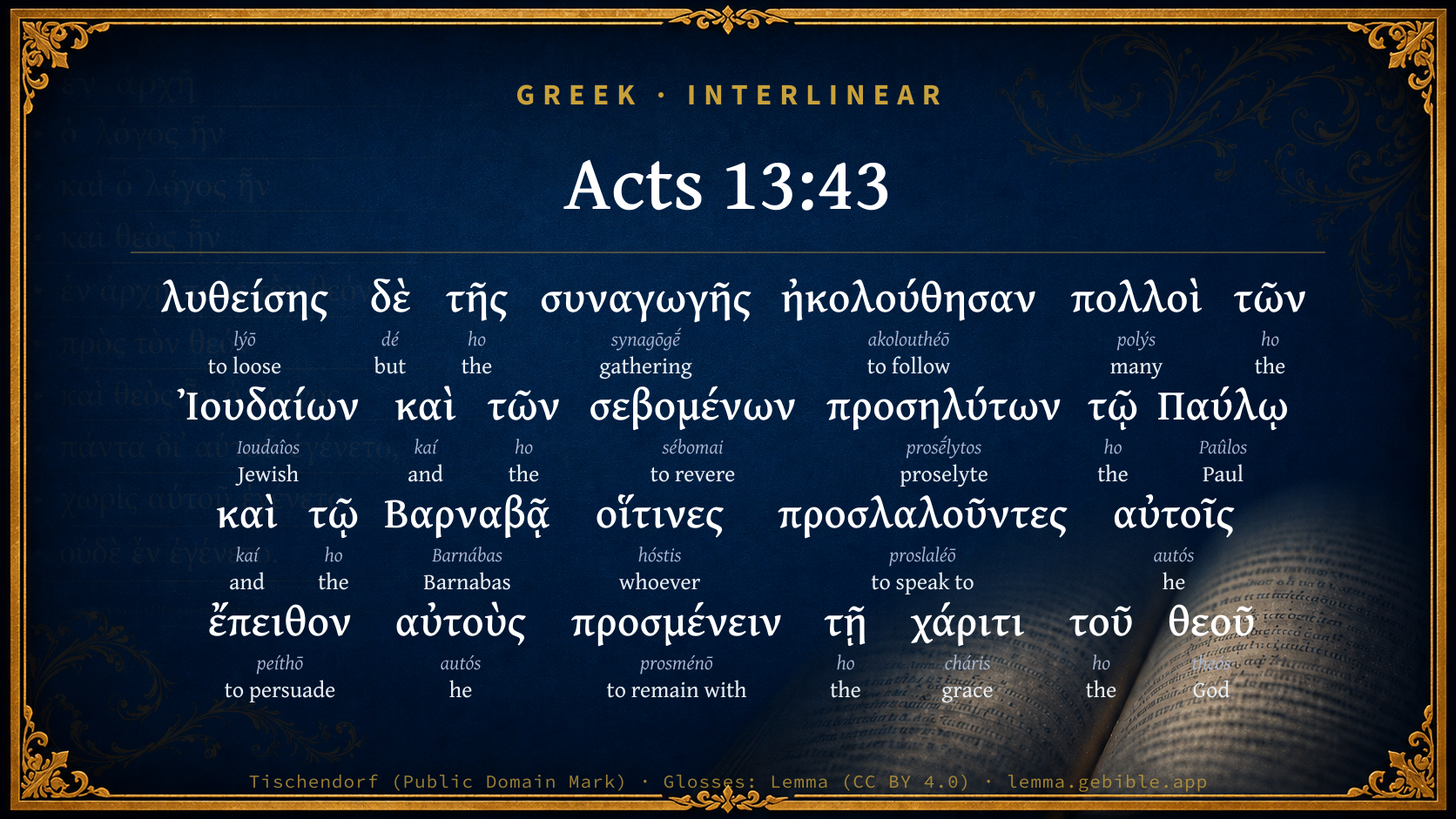
Now when the synagogue broke up, many of the Jews and of the devout proselytes followed Paul and Barnabas; who, speaking to them, urged them to continue in the grace of God.
Download a study sheet
One document with this verse’s original text, its word-by-word gloss line, the meaning frame, cross-references with their text, attributed commentary, and full source and license credits — printable, and it pastes into notes with its structure intact.
This verse Autodidact and up
A passage Seminary Student
Up to 50 verses in one chapter. A passage sheet keeps up to 6 commentary sources and 12 cross-references per verse, in the order this page ranks them, and says so on the sheet whenever that leaves anything out. Ask for a single verse and you get the Autodidact verse sheet above.
Everything on this page stays free to read, with no account — the sheet is a download of what is already on screen, not access to it.
Compare translations 3
The same verse in 3 English versions, stacked beneath the original-language interlinear above. Click any original word for its lexicon entry.
Each is an independent rendering of the whole verse — the interlinear is not word-aligned to these translations.
Highlighted words mark where these versions differ — a whole-verse word diff, not a word-by-word alignment.
-
World English Bible Public Domain
Now when the synagogue broke up, many of the Jews and of the devout proselytes followed Paul and Barnabas; who, speaking to them, urged them to continue in the grace of God.
-
King James Version Public Domain
Now when the congregation was broken up, many of the Jews and religious proselytes followed Paul and Barnabas: who, speaking to them, persuaded them to continue in the grace of God.
-
unfoldingWord Literal Text CC BY-SA 4.0
And when the synagogue meeting was ended, many of the Jews and the worshiping proselytes followed Paul and Barnabas, who, speaking to them, urged them to continue in the grace of God.
unfoldingWord Literal Text — © unfoldingWord, licensed CC BY-SA 4.0. Word-aligned USFM3 via Door43 (git.door43.org/unfoldingWord/en_ult).
Show all 19 translations
Every available English version of this verse, each an independent rendering of the whole verse.
-
World English Bible Public Domain
Now when the synagogue broke up, many of the Jews and of the devout proselytes followed Paul and Barnabas; who, speaking to them, urged them to continue in the grace of God.
-
Berean Standard Bible Public Domain
After the synagogue was dismissed, many of the Jews and devout converts to Judaism followed Paul and Barnabas, who spoke to them and urged them to continue in the grace of God.
-
Majority Standard Bible Public Domain
After the synagogue was dismissed, many of the Jews and devout converts to Judaism followed Paul and Barnabas, who spoke to them and urged them to continue in the grace of God.
-
King James Version Public Domain
Now when the congregation was broken up, many of the Jews and religious proselytes followed Paul and Barnabas: who, speaking to them, persuaded them to continue in the grace of God.
-
American Standard Version (1901) Public Domain
Now when the synagogue broke up, many of the Jews and of the devout proselytes followed Paul and Barnabas; who, speaking to them, urged them to continue in the grace of God.
-
Revised Version (1885) Public Domain
Now when the synagogue broke up, many of the Jews and of the devout proselytes followed Paul and Barnabas: who, speaking to them, urged them to continue in the grace of God.
-
Geneva Bible (1599) Public Domain
Nowe when the congregation was dissolued, many of the Iewes and Proselytes that feared God, followed Paul and Barnabas, which spake to them, and exhorted them to continue in the grace of God.
-
Douay-Rheims (1899) Public Domain
And when the synagogue was broken up, many of the Jews, and of the strangers who served God, followed Paul and Barnabas: who speaking to them, persuaded them to continue in the grace of God.
-
Young's Literal Translation Public Domain
and the synagogue having been dismissed, many of the Jews and of the devout proselytes did follow Paul and Barnabas, who, speaking to them, were persuading them to remain in the grace of God.
-
Literal Standard Version CC BY-SA 4.0
and the synagogue having been dismissed, many of the Jews and of the devout proselytes followed Paul and Barnabas, who, speaking to them, were persuading them to remain in the grace of God.
-
Unlocked Literal Bible CC BY-SA 4.0
When the synagogue meeting ended, many of the Jews and devout proselytes followed Paul and Barnabas, who spoke to them and urged them to continue in the grace of God.
-
unfoldingWord Literal Text CC BY-SA 4.0
And when the synagogue meeting was ended, many of the Jews and the worshiping proselytes followed Paul and Barnabas, who, speaking to them, urged them to continue in the grace of God.
-
Darby Bible Public Domain
And the congregation of the synagogue having broken up, many of the Jews and of the worshipping proselytes followed Paul and Barnabas, who speaking to them, persuaded them to continue in the grace of God.
-
World Messianic Bible Public Domain
Now when the synagogue broke up, many of the Jews and of the devout proselytes followed Paul and Barnabas; who, speaking to them, urged them to continue in the grace of God.
-
Webster's Bible Public Domain
Now when the congregation was broken up, many of the Jews and religious proselytes followed Paul and Barnabas; who speaking to them, persuaded them to continue in the grace of God.
-
Free Bible Version CC BY-SA 4.0
After the meeting in the synagogue, many of the Jews and the converts to Judaism followed Paul and Barnabas who spoke with them, encouraging them to continue to hold on to the grace of God.
-
Bible in Basic English Public Domain
Now when the meeting was ended, a number of the Jews and of the God-fearing Gentiles who had become Jews, went after Paul and Barnabas: who put before them how important it was to keep on in the grace of God.
-
Text-Critical English NT CC BY 4.0
And when the meeting of the synagogue was dispersed, many of the Jews and the devout converts to Judaism followed Paul and Barnabas, who spoke to them and persuaded them to continue in the grace of God.
-
Tyndale New Testament (1534) Public Domain
When the congregacion was broken vp many of the Iewes and verteous covertes folowed Paul and Barnabas which spake to them and exhorted them to cotinue in the grace of God.
Literal Standard Version (2020), Covenant Press — licensed CC BY-SA 4.0. Text via the HelloAO Bible API (eBible.org). Unlocked Literal Bible (unfoldingWord) — licensed CC BY-SA 4.0. Text via the HelloAO Bible API (eBible.org). unfoldingWord Literal Text — © unfoldingWord, licensed CC BY-SA 4.0. Word-aligned USFM3 via Door43 (git.door43.org/unfoldingWord/en_ult). Free Bible Version, Dr. Jonathan Gallagher — licensed CC BY-SA 4.0. Text via the HelloAO Bible API (eBible.org).
Word by word
More ways to search: Search by grammar → Find every occurrence → Compare this word →
Practice this passage: Drill this verse → Learn its vocabulary →
- Appears 2× in the Greek New Testament
- First appears here
- Part of Speech
- Verb
- Tense
- Present
- Voice
- Active
- Mood
- Participle
- Case
- Nominative
- Number
- Plural
- Gender
- Masculine
Full Thayer's Definition
- λυθείσης lýō G3089 “to loose” Verb, Aorist, Passive, Participle, Genitive, Singular, Feminine
- δὲ dé G1161 “but” Conjunction
- τῆς ho G3588 “the” Article, Genitive, Singular, Feminine
- συναγωγῆς synagōgḗ G4864 “gathering” Noun, Genitive, Singular, Feminine
- ἠκολούθησαν akolouthéō G190 “to follow” Verb, Aorist, Active, Indicative, 3rd person, Plural
- πολλοὶ polýs G4183 “many” Adjective, Nominative, Plural, Masculine
- τῶν ho G3588 “the” Article, Genitive, Plural, Masculine
- Ἰουδαίων Ioudaîos G2453 “Jewish” Adjective, Genitive, Plural, Masculine
- καὶ kaí G2532 “and” Conjunction
- τῶν ho G3588 “the” Article, Genitive, Plural, Masculine
- σεβομένων sébomai G4576 “to revere” Verb, Present, Middle or Passive deponent, Participle, Genitive, Plural, Masculine
- προσηλύτων prosḗlytos G4339 “proselyte” Noun, Genitive, Plural, Masculine
- τῷ ho G3588 “the” Article, Dative, Singular, Masculine
- Παύλῳ Paûlos G3972 “Paul” Noun, Dative, Singular, Masculine
- καὶ kaí G2532 “and” Conjunction
- τῷ ho G3588 “the” Article, Dative, Singular, Masculine
- Βαρναβᾷ Barnábas G921 “Barnabas” Noun, Dative, Singular, Masculine
- οἵτινες hóstis G3748 “whoever” Relative pronoun, Nominative, Plural, Masculine
- προσλαλοῦντες proslaléō G4354 “to speak to” Verb, Present, Active, Participle, Nominative, Plural, Masculine
- αὐτοῖς autós G846 “he” Personal pronoun, Dative, Plural, Masculine
- ἔπειθον peíthō G3982 “to persuade” Verb, Imperfect, Active, Indicative, 3rd person, Plural
- αὐτοὺς autós G846 “he” Personal pronoun, Accusative, Plural, Masculine
- προσμένειν prosménō G4357 “to remain with” Verb, Present, Active, Infinitive
- τῇ ho G3588 “the” Article, Dative, Singular, Feminine
- χάριτι cháris G5485 “grace” Noun, Dative, Singular, Feminine
- τοῦ ho G3588 “the” Article, Genitive, Singular, Masculine
- θεοῦ theós G2316 “God” Noun, Genitive, Singular, Masculine
About this verse
These counts appear in no published source. They are computed here, from the morphology-tagged text and Lemma’s own curated glosses. What Lemma adds →
- 27
- words
- 19
- distinct lemmas
- Acts
- section
Notable vocabulary
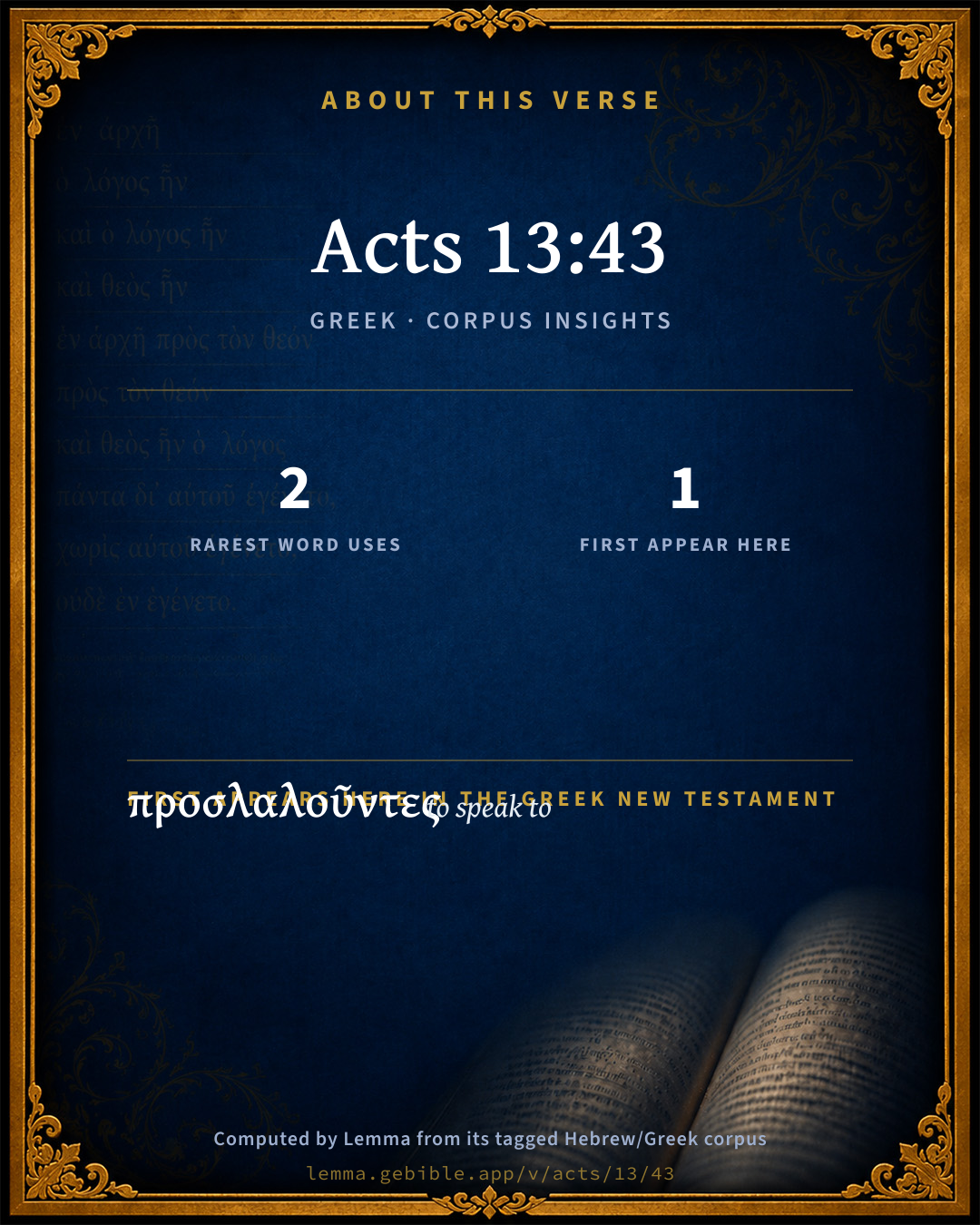
The rarest word here is προσλαλοῦντες to speak to G4354 — appearing just 2 times in the whole Greek New Testament.
First appearance in Scripture
This word makes its first canonical appearance in the Greek New Testament here:
- προσλαλοῦντες to speak to G4354
Shared distinctive vocabulary
προσλαλοῦντες to speak to G4354 occurs in 2 verses of the Greek New Testament. Also found in:
Cross-references
38Topical passages linked to Acts 13:43 in the Treasury of Scripture Knowledge — connected by theme and wording, ordered by reader-vote popularity; previews shown in the World English Bible.
- Acts 11:23 who, when he had come, and had seen the grace of God, was glad. He exhorted them all, that with purpose of heart they should remain near to the Lord.
- Acts 14:22 confirming the souls of the disciples, exhorting them to continue in the faith, and that through many afflictions we must enter into the Kingdom of God.
- Hebrews 12:15 looking carefully lest there be any man who falls short of the grace of God; lest any root of bitterness springing up trouble you, and thereby the many be defiled;
- Hebrews 13:9 Don't be carried away by various and strange teachings, for it is good that the heart be established by grace, not by food, through which those who were so occupied were not benefited.
- Acts 14:3 Therefore they stayed there a long time, speaking boldly in the Lord, who testified to the word of his grace, granting signs and wonders to be done by their hands.
- Acts 16:14 A certain woman named Lydia, a seller of purple, of the city of Thyatira, one who worshiped God, heard us; whose heart the Lord opened to listen to the things which were spoken by Paul.
- Acts 17:4 Some of them were persuaded, and joined Paul and Silas, of the devout Greeks a great multitude, and not a few of the chief women.
- Acts 17:34 But certain men joined with him, and believed, among whom also was Dionysius the Areopagite, and a woman named Damaris, and others with them.
- Romans 3:24 being justified freely by his grace through the redemption that is in Christ Jesus;
- Romans 5:2 through whom we also have our access by faith into this grace in which we stand. We rejoice in hope of the glory of God.
- Romans 5:21 that as sin reigned in death, even so might grace reign through righteousness to eternal life through Jesus Christ our Lord.
- Romans 11:6 And if by grace, then it is no longer of works; otherwise grace is no longer grace. But if it is of works, it is no longer grace; otherwise work is no longer work.
- 2 Corinthians 5:11 Knowing therefore the fear of the Lord, we persuade men, but we are revealed to God; and I hope that we are revealed also in your consciences.
- 2 Corinthians 6:1 Working together, we entreat also that you not receive the grace of God in vain,
- Galatians 5:1 Stand firm therefore in the liberty by which Christ has made us free, and don't be entangled again with a yoke of bondage.
- Ephesians 2:8 for by grace you have been saved through faith, and that not of yourselves; it is the gift of God,
- Philippians 3:16 Nevertheless, to the extent that we have already attained, let us walk by the same rule. Let us be of the same mind.
- Philippians 4:1 Therefore, my brothers, beloved and longed for, my joy and crown, so stand firm in the Lord, my beloved.
- Colossians 1:23 if it is so that you continue in the faith, grounded and steadfast, and not moved away from the hope of the Gospel which you heard, which is being proclaimed in all creation under heaven; of which I, Paul, was made a servant.
- Colossians 1:28 whom we proclaim, admonishing every man and teaching every man in all wisdom, that we may present every man perfect in Christ Jesus;
- 2 Peter 3:17–18 You therefore, beloved, knowing these things beforehand, beware lest, being carried away with the error of the wicked, you fall from your own steadfastness.
- 2 John 1:9 Whoever transgresses and doesn't remain in the teaching of Christ, doesn't have God. He who remains in the teaching, the same has both the Father and the Son.
- Matthew 23:15 Woe to you, scribes and Pharisees, hypocrites! For you travel around by sea and land to make one proselyte; and when he becomes one, you make him twice as much of a son of Gehenna as yourselves.
- John 8:31–32 Jesus therefore said to those Jews who had believed him, "If you remain in my word, then you are truly my disciples.
- John 15:5–10 I am the vine. You are the branches. He who remains in me, and I in him, the same bears much fruit, for apart from me you can do nothing.
- Acts 2:10 Phrygia, Pamphylia, Egypt, the parts of Libya around Cyrene, visitors from Rome, both Jews and proselytes,
- Acts 6:5 These words pleased the whole multitude. They chose Stephen, a man full of faith and of the Holy Spirit, Philip, Prochorus, Nicanor, Timon, Parmenas, and Nicolaus, a proselyte of Antioch;
- Acts 13:50 But the Jews stirred up the devout and prominent women and the chief men of the city, and stirred up a persecution against Paul and Barnabas, and threw them out of their borders.
- Acts 17:17 So he reasoned in the synagogue with the Jews and the devout persons, and in the marketplace every day with those who met him.
- Acts 19:8–9 He entered into the synagogue, and spoke boldly for a period of three months, reasoning and persuading about the things concerning the Kingdom of God.
- Acts 28:23 When they had appointed him a day, many people came to him at his lodging. He explained to them, testifying about the Kingdom of God, and persuading them concerning Jesus, both from the law of Moses and from the prophets, from morning until evening.
- Galatians 5:4 You are alienated from Christ, you who desire to be justified by the law. You have fallen away from grace.
- 1 Thessalonians 3:3–5 that no one be moved by these afflictions. For you know that we are appointed to this task.
- Hebrews 6:11–12 We desire that each one of you may show the same diligence to the fullness of hope even to the end,
- 1 Peter 5:12 Through Silvanus, our faithful brother, as I consider him, I have written to you briefly, exhorting, and testifying that this is the true grace of God in which you stand.
- 2 Peter 3:14 Therefore, beloved, seeing that you look for these things, be diligent to be found in peace, without blemish and blameless in his sight.
- Titus 2:11 For the grace of God has appeared, bringing salvation to all men,
- 1 John 2:28 Now, little children, remain in him, that when he appears, we may have boldness, and not be ashamed before him at his coming.
Cross-references courtesy of OpenBible.info (CC BY 4.0).
Lesson kit
Teaching starters — assembled from the data on this page, not authored interpretation. Every prompt links to the verse data it draws on. Edit before teaching.
Acts, in the Acts, opens this verse with 27 words (19 distinct Greek lemmas). Its most distinctive word is proslaléō (“to speak to”). A historical commentator’s framing appears above. Read the whole chapter for the surrounding context.
Discussion questions
- What does “to speak to” (proslaléō) contribute to the verse as a whole?
- The word “to speak to” first appears here in Scripture. What is being introduced at this debut?
- Acts 28:20 shares the word «to speak to» with this verse. How do the two illuminate each other?
- “the” occurs 7× in this one verse. What is the effect of the repetition?
- These translations render this verse differently; the difference is in the English rendering, not the original. What questions does that raise?
- Reading how Tyndale Open Study Notes and Bengel's Gnomon read this verse, where do the two commentators agree and where do they part?
Things to notice
- 1 word makes its first canonical appearance in Scripture here.
- These translations choose different wording for 13 words in this verse.
- “the” occurs 7× in this single verse.
- 19 distinct Greek lemmas span 27 words in this verse.
Commentary
Notes on Acts 13:43 from classic Christian and Jewish commentators (each source and its license shown beneath its notes). The classic Christian expositions comment on the surrounding passage and are grouped to its opening verse, so a note may address several verses; the Jewish commentaries on the Tanakh (Rashi and others) are per-verse, so they appear only where the commentator wrote on this verse.
Lemma curates 59 commentaries, every one of them public domain or Creative Commons licensed, each selected and text-cleaned for this edition rather than reprinted as found. About our sources →
Tyndale Open Study Notes
Tyndale Open Resources
Tyndale Open Study Notes — © Tyndale Open Resources, licensed CC BY-SA 4.0. Text via the HelloAO Bible API.
Bengel's Gnomon
Johann Albrecht Bengel
Bengel's Gnomon of the New Testament — English translation (T&T Clark, Edinburgh, 1860) — public domain. Text from a community e-Sword module.
Expositor's Greek Testament
ed. W. Robertson Nicoll
The Expositor's Greek Testament, edited by W. Robertson Nicoll (1897–1910) — public domain. Text from a community e-Sword module.
Geneva Bible (1599)
Geneva Bible translators
Geneva Bible (1599) marginal notes — public domain. Text via Bolls.life.
Jamieson, Fausset & Brown
Robert Jamieson, A. R. Fausset & David Brown
Jamieson, Fausset & Brown — Commentary Critical and Explanatory on the Whole Bible (1871) — public domain (CC PDM 1.0). Text via the HelloAO Bible API.
Adam Clarke's Commentary
Adam Clarke's Commentary on the Bible (1810–1826) — public domain. Text from a community e-Sword/MySword module.
John Calvin's Commentaries
John Calvin's Commentaries (1540-1563) — public domain. Text from the Calvin Translation Society English edition (1840s-50s) via the Christian Classics Ethereal Library (ccel.org). Calvin's coverage is partial (roughly two-thirds of the Bible); uncommented books and verses are honest gaps, never fabricated. The 19th-century editor's footnotes and remarks are omitted so the notes are faithfully Calvin's own voice.
Ellicott's Commentary for English Readers
A Bible Commentary for English Readers, edited by Charles John Ellicott (1878–1897) — public domain. Text from a community e-Sword module.
The Cambridge Bible for Schools and Colleges
gen. ed. J. J. S. Perowne
The Cambridge Bible for Schools and Colleges (gen. ed. J. J. S. Perowne; Cambridge University Press, 1878–1918) — public domain. Text from a community e-Sword module.
John Gill's Exposition
John Gill's Exposition of the Whole Bible (1746–1763) — public domain (CC PDM 1.0). Text via the HelloAO Bible API.
Trapp's Complete Commentary
John Trapp
John Trapp, A Commentary or Exposition upon All the Books of the Old and New Testament (1647–1656) — public domain. Text from a community e-Sword module.
Albert Barnes' Notes on the Bible
Albert Barnes' Notes on the Bible (1834–1885) — public domain. Text from a community e-Sword/MySword module.
Matthew Poole's English Annotations
Matthew Poole's English Annotations on the Holy Bible (1683–1685) — public domain. Text from a community e-Sword/MySword module.
Whedon's Commentary on the Bible
Daniel D. Whedon
Daniel D. Whedon (gen. ed.), Commentary on the Old and New Testaments (1874–1909) — public domain. Text from a community e-Sword module.
The Pulpit Commentary
The Pulpit Commentary (1880–1919), ed. H.D.M. Spence-Jones & Joseph S. Exell — public domain. Text from a community e-Sword module.
John Wesley's Explanatory Notes
John Wesley, Explanatory Notes Upon the Whole Bible (1754–1765) — public domain. Text via the GEBible commentary corpus.
McGarvey & Pendleton's Commentaries
J. W. McGarvey
J. W. McGarvey (with Philip Y. Pendleton), Commentaries on the New Testament (The Fourfold Gospel, 1914; Acts; and the epistles) — public domain. Text from a community e-Sword/MySword module.
Cambridge Greek Testament for Schools and Colleges
Cambridge Greek Testament for Schools and Colleges (Cambridge University Press, 1896; 21 vols, various authors incl. Carr, Maclear, Plummer, Farrar, Lumby, Moule, M. R. James, Simcox) — public domain. Text from a community e-Sword module.
Alford’s Greek Testament
Henry Alford
Henry Alford, The Greek Testament (1849–1861) — public domain. Text from a community e-Sword module.
Vincent's Word Studies in the New Testament
Marvin R. Vincent
Marvin R. Vincent, Word Studies in the New Testament (1887–1900) — public domain. Text from a community e-Sword/MySword module.