Matthew 24:10

Greek (Tischendorf 8th ed.) Matthew 24:10 appears in the Greek New Testament. The text above is from the Tischendorf 8th edition. Each word links to its Strong’s number and a concise gloss. Click any word for its full Thayer’s Greek Lexicon entry.
Download image
Cite this verse

Matthew 24:10 (World English Bible). Public Domain. Lemma interlinear Bible study tool, https://lemma.gebible.app/v/matthew/24/10.

Show BibTeX & RIS
BibTeX
RIS
English Translation
Then many will stumble, and will deliver up one another, and will hate one another.
World English Bible · Public Domain
Highlights
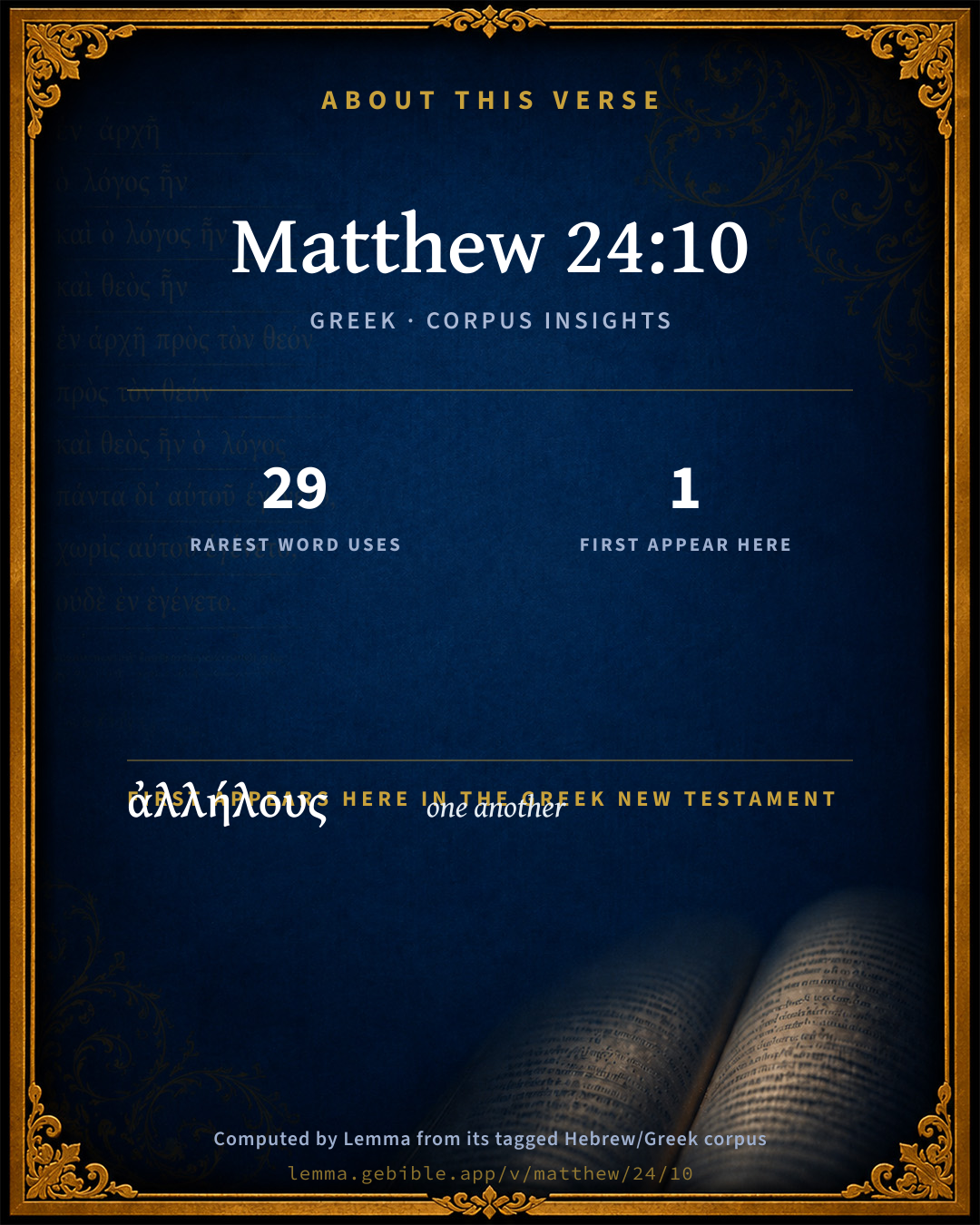
  • 1 first appearance in the Greek New Testament
Full analysis ↓
Download a study sheet

One document with this verse’s original text, its word-by-word gloss line, the meaning frame, cross-references with their text, attributed commentary, and full source and license credits — printable, and it pastes into notes with its structure intact.

This verse Autodidact and up

Study sheet (.html) Plain text (.txt)

A passage Seminary Student

Up to 50 verses in one chapter. A passage sheet keeps up to 6 commentary sources and 12 cross-references per verse, in the order this page ranks them, and says so on the sheet whenever that leaves anything out. Ask for a single verse and you get the Autodidact verse sheet above.

Everything on this page stays free to read, with no account — the sheet is a download of what is already on screen, not access to it.

Want to remove ads? Support Godless Engineer
Compare translations 3

The same verse in 3 English versions, stacked beneath the original-language interlinear above. Click any original word for its lexicon entry.

Each is an independent rendering of the whole verse — the interlinear is not word-aligned to these translations.

Highlighted words mark where these versions differ — a whole-verse word diff, not a word-by-word alignment.

  • World English Bible Public Domain
    Then many will stumble, and will deliver up one another, and will hate one another.
  • King James Version Public Domain
    And then shall many be offended, and shall betray one another, and shall hate one another.
  • unfoldingWord Literal Text CC BY-SA 4.0
    And then many will be caused to stumble and will hand one another over and will hate one another.

unfoldingWord Literal Text — © unfoldingWord, licensed CC BY-SA 4.0. Word-aligned USFM3 via Door43 (git.door43.org/unfoldingWord/en_ult).

Versions to compare (up to 4)

3 of 4 selected

Show all 19 translations

Every available English version of this verse, each an independent rendering of the whole verse.

  • World English Bible Public Domain
    Then many will stumble, and will deliver up one another, and will hate one another.
  • Berean Standard Bible Public Domain
    At that time many will fall away and will betray and hate one another,
  • Majority Standard Bible Public Domain
    At that time many will fall away and will betray and hate one another,
  • King James Version Public Domain
    And then shall many be offended, and shall betray one another, and shall hate one another.
  • American Standard Version (1901) Public Domain
    And then shall many stumble, and shall deliver up one another, and shall hate one another.
  • Revised Version (1885) Public Domain
    And then shall many stumble, and shall deliver up one another, and shall hate one another.
  • Geneva Bible (1599) Public Domain
    And then shall many be offended, and shall betray one another, and shall hate one another.
  • Douay-Rheims (1899) Public Domain
    And then shall many be scandalized: and shall betray one another: and shall hate one another.
  • Young's Literal Translation Public Domain
    and then shall many be stumbled, and they shall deliver up one another, and shall hate one another.
  • Literal Standard Version CC BY-SA 4.0
    and then will many be stumbled, and they will deliver up one another, and will hate one another.
  • Unlocked Literal Bible CC BY-SA 4.0
    Then many will stumble, and betray one another and hate one another.
  • unfoldingWord Literal Text CC BY-SA 4.0
    And then many will be caused to stumble and will hand one another over and will hate one another.
  • Darby Bible Public Domain
    And then will many be offended, and will deliver one another up, and hate one another;
  • World Messianic Bible Public Domain
    Then many will stumble, and will deliver up one another, and will hate one another.
  • Webster's Bible Public Domain
    And then will many be offended, and will betray one another, and will hate one another.
  • Free Bible Version CC BY-SA 4.0
    At that time many believers will give up believing. They will betray one another and hate one another.
  • Bible in Basic English Public Domain
    And numbers of people will be turned from the right way, and will give one another up and have hate for one another.
  • Text-Critical English NT CC BY 4.0
    Many will fall away and will betray one another and hate one another.
  • Tyndale New Testament (1534) Public Domain
    And then shall many be offended and shall betraye one another and shall hate one the other.

Literal Standard Version (2020), Covenant Press — licensed CC BY-SA 4.0. Text via the HelloAO Bible API (eBible.org). Unlocked Literal Bible (unfoldingWord) — licensed CC BY-SA 4.0. Text via the HelloAO Bible API (eBible.org). unfoldingWord Literal Text — © unfoldingWord, licensed CC BY-SA 4.0. Word-aligned USFM3 via Door43 (git.door43.org/unfoldingWord/en_ult). Free Bible Version, Dr. Jonathan Gallagher — licensed CC BY-SA 4.0. Text via the HelloAO Bible API (eBible.org).

Word by word

More ways to search: Search by grammar → Find every occurrence → Compare this word →

Practice this passage: Drill this verse → Learn its vocabulary →

σκανδαλισθήσονται
skandalízō
G4624
“to stumble”
Verb, Future, Passive, Indicative, 3rd person, Plural
Part of Speech
Verb
Tense
Future
Voice
Passive
Mood
Indicative
Person
3rd person
Number
Plural
Full Thayer's Definition

Origin: from G4625

TDNT: 12:39,1

1. to put a stumbling block or impediment in the way, upon which another may trip and fall, metaph. to offend a. to entice to sin b. to cause a person to begin to distrust and desert one whom he ought to trust and obey 1. to cause to fall away 2. to be offended in one, i.e. to see in another what I disapprove of and what hinders me from acknowledging his authority 3. to cause one to judge unfavourably or unjustly of another c. since one who stumbles or whose foot gets entangled feels annoyed 1. to cause one displeasure at a thing 2. to make indignant 3. to be displeased, indignant
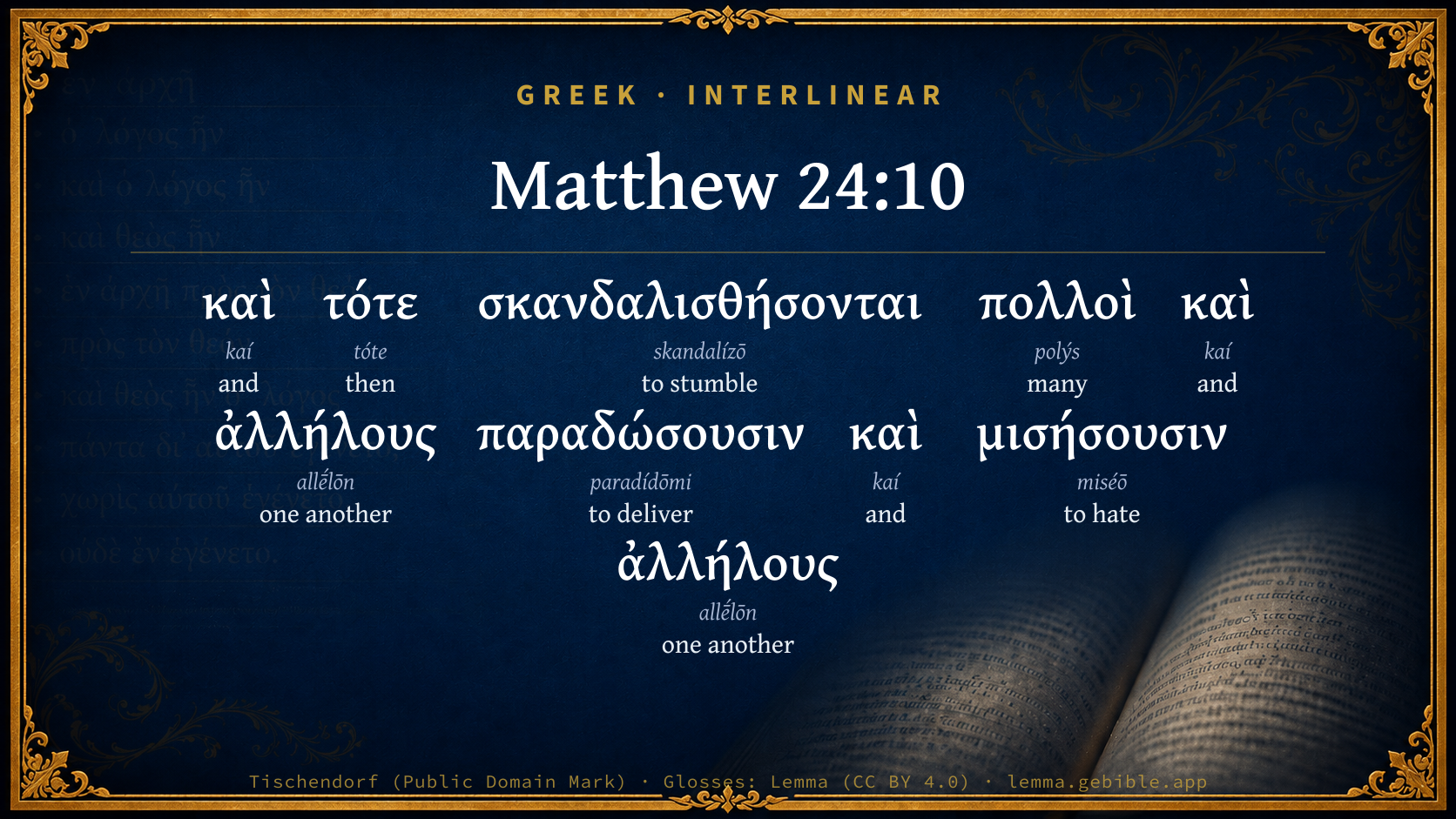
  1. καὶ kaí G2532 “and” Conjunction
  2. τότε tóte G5119 “then” Adverb
  3. πολλοὶ polýs G4183 “many” Adjective, Nominative, Plural, Masculine
  4. καὶ kaí G2532 “and” Conjunction
  5. ἀλλήλους allḗlōn G240 “one another” Reciprocal pronoun, Accusative, Plural, Masculine
  6. παραδώσουσιν paradídōmi G3860 “to deliver” Verb, Future, Active, Indicative, 3rd person, Plural
  7. καὶ kaí G2532 “and” Conjunction
  8. μισήσουσιν miséō G3404 “to hate” Verb, Future, Active, Indicative, 3rd person, Plural
  9. ἀλλήλους allḗlōn G240 “one another” Reciprocal pronoun, Accusative, Plural, Masculine

About this verse

These counts appear in no published source. They are computed here, from the morphology-tagged text and Lemma’s own curated glosses. What Lemma adds →

10
words
7
distinct lemmas
Gospels
section

First appearance in Scripture

This word makes its first canonical appearance in the Greek New Testament here:

  • ἀλλήλους one another G240

Shared distinctive vocabulary

σκανδαλισθήσονται to stumble G4624 occurs in 27 verses of the Greek New Testament. Also found in:

Repetition

Words recur within this verse:

  • ἀλλήλους one another G240 ×2
  • καὶ and G2532 ×3

Cross-references

16

Topical passages linked to Matthew 24:10 in the Treasury of Scripture Knowledge — connected by theme and wording, ordered by reader-vote popularity; previews shown in the World English Bible.

  • Micah 7:5–6 Don't trust in a neighbor. Don't put confidence in a friend. With the woman lying in your embrace, Be careful of the words of your mouth!
  • Matthew 11:6 Blessed is he who finds no occasion for stumbling in me."
  • Mark 13:12 "Brother will deliver up brother to death, and the father his child. Children will rise up against parents, and cause them to be put to death.
  • Luke 21:16 You will be handed over even by parents, brothers, relatives, and friends. Some of you they will cause to be put to death.
  • Mark 4:17 They have no root in themselves, but are short-lived. When oppression or persecution arises because of the word, immediately they stumble.
  • Matthew 10:21 "Brother will deliver up brother to death, and the father his child. Children will rise up against parents, and cause them to be put to death.
  • Matthew 10:35–36 For I came to set a man at odds against his father, and a daughter against her mother, and a daughter-in-law against her mother-in-law.
  • Matthew 13:21 yet he has no root in himself, but endures for a while. When oppression or persecution arises because of the word, immediately he stumbles.
  • John 6:66–67 At this, many of his disciples went back, and walked no more with him.
  • 2 Timothy 4:16 At my first defense, no one came to help me, but all left me. May it not be held against them.
  • Matthew 26:31–34 Then Jesus said to them, "All of you will be made to stumble because of me tonight, for it is written, 'I will strike the shepherd, and the sheep of the flock will be scattered.'
  • 2 Timothy 4:10 for Demas left me, having loved this present world, and went to Thessalonica; Crescens to Galatia, and Titus to Dalmatia.
  • Matthew 13:57 They were offended by him. But Jesus said to them, "A prophet is not without honor, except in his own country, and in his own house."
  • John 6:60–61 Therefore many of his disciples, when they heard this, said, "This is a hard saying! Who can listen to it?"
  • 2 Timothy 1:15 This you know, that all who are in Asia turned away from me; of whom are Phygelus and Hermogenes.
  • Matthew 26:21–24 As they were eating, he said, "Most assuredly I tell you that one of you will betray me."

Cross-references courtesy of OpenBible.info (CC BY 4.0).

Commentary

Notes on Matthew 24:10 from classic Christian and Jewish commentators (each source and its license shown beneath its notes). The classic Christian expositions comment on the surrounding passage and are grouped to its opening verse, so a note may address several verses; the Jewish commentaries on the Tanakh (Rashi and others) are per-verse, so they appear only where the commentator wrote on this verse.

Lemma curates 59 commentaries, every one of them public domain or Creative Commons licensed, each selected and text-cleaned for this edition rather than reprinted as found. About our sources →

Joseph Benson's Commentary

Mat 24:10-13. Then shall many be offended — That is, shall stumble and fall, or shall be turned out of the right way. By reason of persecution, many apostatized from the faith, particularly those mentioned by Paul, 2Ti 1:15; and 2Ti 4:10. And shall betray one another — To illustrate this, it is sufficient to cite one sentence out of Tacitus. Speaking of the persecution under Nero, he says, “At first several were seized, who confessed, and then by their discovery a great multitude of others were convicted and barbarously executed.” And many false prophets shall rise — Or false teachers, namely, in the Christian Church. Such were Simon Magus, and his followers, the Gnostics, who were very numerous. Such also were the Judaizing teachers, termed by Paul, 2Co 11:13, false apostles, deceitful workers, transforming themselves into the apostles of Christ. Such likewise were Hymeneus and Philetus, 2Ti 2:17-18. And the love of many shall wax cold — Because of these trials and persecutions from without, and these apostacies and false teachers from within the church, the love of many to Christ and his doctrine, and to one another, shall wax cold. Some shall openly desert the faith, as Mat 24:10; others corrupt it, as Mat 24:11; and others grow indifferent about it, as Mat 24:12. But he that shall endure unto the end — He who shall not be terrified by these trials and persecutions; who shall neither apostatize from the faith himself, nor seduce nor be seduced by others; he who shall not be ashamed to profess his faith in Christ, and his love to the brethren, nor be deterred therefrom: the same shall be saved — Both here and hereafter. It is very remarkable, and was certainly a most signal act of Providence, that none of the Christians perished in the destruction of Jerusalem. See on Mat 24:16. So true and prophetic also was that assertion of St. Peter upon this same occasion, The Lord knoweth how to deliver the godly out of temptation, 2Pe 2:9.

Joseph Benson's Commentary on the Old and New Testaments (1811–1818) — public domain. Text from a community e-Sword module.

Tyndale Open Study Notes

Tyndale Open Resources

24:10 Persecution will lead some to abandon loyalty to Jesus (10:25; 13:21; 16:24-28; 26:33).

Tyndale Open Study Notes — © Tyndale Open Resources, licensed CC BY-SA 4.0. Text via the HelloAO Bible API.

Bengel's Gnomon

Johann Albrecht Bengel

Mat 24:10. Σκανδαλισθήσονται, shall be offended) sc. shall make shipwreck of their faith.[1036]—ἈΛΛΉΛΟΥς, one another) This is the saddest of all.

[1036] As of love, Mat 24:12.—V. g.

Bengel's Gnomon of the New Testament — English translation (T&T Clark, Edinburgh, 1860) — public domain. Text from a community e-Sword module.

Meyer's Critical & Exegetical Commentary

Heinrich August Wilhelm Meyer

Mat_24:10. Καὶ τότε] and then, when those persecutions will have broken out against you.

σκανδαλισθήσονται πολλοί] many will receive a shock, i.e. many Christians will be tempted to relapse into unbelief, see on Mat_13:21. For the converse of offendentur in this sense, see Mat_24:13. Consequence of this falling away: καὶ ἀλλήλους παραδώς.] one another, i.e. the Christian who has turned apostate, him who has continued faithful. What a climax the troubles have reached, seeing that they are now springing up in the very heart of the Christian community itself!

Meyer — Critical and Exegetical Commentary on the New Testament — English translation by Peter Christie, edited by Frederick Crombie (T&T Clark, 1880) — public domain. Text from a community e-Sword module.

Expositor's Greek Testament

ed. W. Robertson Nicoll

Mat 24:10 . σκανδαλισθήσονται : natural sequel of apostolic tribulation, many weak Christians made to stumble ( vide Mat 13:21 ); this followed in turn by mutual treachery and hatred ( καὶ ἀλλήλους , etc.).

The Expositor's Greek Testament, edited by W. Robertson Nicoll (1897–1910) — public domain. Text from a community e-Sword module.

Adam Clarke's Commentary

Verse 10. Then shall many be offended, and shall betray one another] To illustrate this point, one sentence out of Tacitus (Annal. l. xv.) will be sufficient, who, speaking of the persecution under Nero, says, At first several were seized, who confessed, and then by THEIR DISCOVERY a great multitude of others were convicted and executed.

Adam Clarke's Commentary on the Bible (1810–1826) — public domain. Text from a community e-Sword/MySword module.

Ellicott's Commentary for English Readers

(10) Shall many be offended.—The words point primarily to those who were believers in Christ, and found, a stumbling-block either in the new aspects of truth from time to time presented, or in the slowness of its victory, or in the delayed coming of the Lord. (Comp. 2Pe_3:4.)

Shall hate one another.—The words received a terrible fulfilment in the faction-fights of the Zealots and Sicarii at Jerusalem (Jos. Wars, iv. 3), in the disputes in every city between believing and unbelieving Jews (Act_13:50; Act_14:19; Act_17:5; Act_18:6; Act_19:9), in the bitter hatred of the Judaisers against St. Paul (Act_23:12).

A Bible Commentary for English Readers, edited by Charles John Ellicott (1878–1897) — public domain. Text from a community e-Sword module.

The Cambridge Bible for Schools and Colleges

gen. ed. J. J. S. Perowne

10. offended] Disappointed hopes will bring about a disruption of Christian unity and love.

The Cambridge Bible for Schools and Colleges (gen. ed. J. J. S. Perowne; Cambridge University Press, 1878–1918) — public domain. Text from a community e-Sword module.

John Gill's Exposition

And then shall many be offended,.... That is, many who had been hearers of the apostles, and professors of the Christian religion; who were highly pleased with it, and were strenuous advocates for it, whilst things were tolerably quiet and easy; but when they saw the apostles, some of them beaten, and imprisoned; others put to death, and others forced to fly from place to place; and persecutions and affliction, because of Christ and his Gospel, likely to befall themselves, would be discouraged hereby, and stumble at the cross; and fall off from the faith of the Gospel, and the profession of it:

and shall betray one another; meaning, that the apostates, who would fall off from the Christian religion, would prove treacherous to true believers, and give in their names to the persecutors, or inform them where they were, that they might take them, or deliver them into their hands themselves: these are the false brethren, the Apostle Paul was in perils among:

and shall hate one another; not that the true Christians should hate these false brethren, any more than betray them; for they are taught to love all men, even their enemies; but these apostates should hate them, in whose communion they before were, and to whom they belonged; and even to a very great degree of hatred, as it often is seen, that such who turn their backs on Christ, and his Gospel, prove the most bitter enemies, and most violent persecutors of its preachers and followers.

John Gill's Exposition of the Whole Bible (1746–1763) — public domain (CC PDM 1.0). Text via the HelloAO Bible API.

Trapp's Complete Commentary

John Trapp

10 And then shall many be offended, and shall betray one another, and shall hate one another.

Ver. 10. And then shall many be offended] As not willing to suffer. How many revolted for fear in the primitive times, were abjured here in Queen Mary’s reign, fell to Popery in the Palatinate, and other places in Germany, since the troubles there, as fast as leaves fall in autumn! Somewhat men will do for Christ, but suffer nothing.

John Trapp, A Commentary or Exposition upon All the Books of the Old and New Testament (1647–1656) — public domain. Text from a community e-Sword module.

Albert Barnes' Notes on the Bible

Many shall be offended - See the notes at Mat 5:29. Many shall stumble, fall, apostatize from a profession of religion. Many who “professed” to love me will then show that they had no “real” attachment to me; and in those trying times it will be seen that they knew nothing of genuine Christian love. See 1Jo 2:19.

Shall betray one another - Those who thus apostatize from professed attachment to me will betray others who really love me. This they would do to secure their own safety, by revealing the names, habitations, or places of concealment of others.

Shall hate one another - Not that real Christians would do this, but those who had professed to be such would then show that they were not his true followers, and would hate one another. Luke adds that they should be betrayed “by parents, and brethren, and kinsfolks, and friends,” Luk 21:16. They would break over the most tender ties to surrender Christians to punishment. So great would be their hatred of Christianity, that it would overcome all the natural endearments of kindred and home. This, in the persecutions of Christians, has often occurred, and nothing shows more fully the deep and deadly hatred of the human heart to the gospel. Compare the notes at Mat 10:21.

Albert Barnes' Notes on the Bible (1834–1885) — public domain. Text from a community e-Sword/MySword module.

Matthew Poole's English Annotations

Mark saith, Mar 13:12,13, The brother shall betray the brother to death, and the father the son; and children shall rise up against their parents, and cause them to be put to death. And ye shall be hated of all men for my name’s sake. Luke saith, Luk 21:16,17, And ye shall be betrayed both by parents, and brethren, and kinsfolks, and friends; and some of you shall they cause to be put to death. And ye shall be hated of all men for my name’s sake. Many shall be offended; the meaning is, shall turn apostates, stumbling at these great afflictions and persecutions for the gospel.

And shall betray one another. We read of several apostates in holy writ, such as Phigellus, Hermogenes, Demas, Hymeneus, Philetus, and others; but all things not being written that were done, we have no particular record of such treachery as is here mentioned. But it is no other than we may reasonably presume was done, though we had not been assured of it, to justify our Saviour’s prediction. There is no time of great persecution but proves a time of great apostasy and some treachery. It hath been a constant observation, that no hatred flames to that degree with hatred upon the account of religion. Nor is what our Saviour here predicted more than the history of all ages of the church have justified.

Matthew Poole's English Annotations on the Holy Bible (1683–1685) — public domain. Text from a community e-Sword/MySword module.

Whedon's Commentary on the Bible

Daniel D. Whedon

10. Many — Many professing Christians. There shall be apostacies and scandals in the Church.

Daniel D. Whedon (gen. ed.), Commentary on the Old and New Testaments (1874–1909) — public domain. Text from a community e-Sword module.

The Pulpit Commentary

Shall many be offended. The persecutions directed against the disciples in general shall in many cases result in overcoming their steadfastness and sapping their faith. Shall betray one another. To curry favour with enemies and to secure their own safety in troublous times, Christians were found to inform against friends, and to deliver them up to the civil authorities. Tacitus notes instances of this degrading cowardice. "First those were seized who confessed that they were Christians; and then on their information a vast multitude was convicted" ("Ann.," 15:44). Shall hate one another. Dissensions in religion cause the most bitter hatred, the very opposite of that love which is the essence of Christianity. (Joh_15:17) Where one of a pagan family embraced Christianity, the convert was regarded as an outcast, and cut adrift from the nearest domestic ties. The same treatment obtains even now in India. The reference in the text chiefly concerns contentions among professing Christians; we see such effects every day; they appear in every page of ecclesiastical history; they have stained the annals of our own and every nation.

The Pulpit Commentary (1880–1919), ed. H.D.M. Spence-Jones & Joseph S. Exell — public domain. Text from a community e-Sword module.

John Wesley's Explanatory Notes

Then shall many be offended - So as utterly to make shipwreck of faith and a pure conscience. But hold ye fast faith, ver. 11. in spite of false prophets: love, even when iniquity and offenses abound, ver. 12. And hope, unto the end, ver. 13. He that does so, shall be snatched out of the burning. The love of many will wax cold - The generality of those who love God will (like the Church at Ephesus, Rev. ii, 4, ) leave their first love.

John Wesley, Explanatory Notes Upon the Whole Bible (1754–1765) — public domain. Text via the GEBible commentary corpus.

The People's New Testament

B. W. Johnson

10. Then shall many be offended. Shall stumble and fall, rather than suffer for Christ. The half-hearted always do.

B. W. Johnson's The People's New Testament with Notes (1889–1891) — public domain. Electronic text from the Christian Classics Ethereal Library (CCEL) ThML edition.

Cambridge Greek Testament for Schools and Colleges

10. σκανδαλισθήσονται. Shall fall, fail in loyalty, be tempted to forsake the faith.

μισήσουσιν ἀλλήλους. Disappointed hopes will bring about a disruption of Christian unity and love.

Cambridge Greek Testament for Schools and Colleges (Cambridge University Press, 1896; 21 vols, various authors incl. Carr, Maclear, Plummer, Farrar, Lumby, Moule, M. R. James, Simcox) — public domain. Text from a community e-Sword module.

Alford’s Greek Testament

Henry Alford

10.] See 2Ti 4:16, and the repeated warnings against apostasy in the Epistle to the Hebrews. The persons spoken of in this verse are Christians. ‘Primo conrepti qui fatebantur, deinde indicio eorum multitude ingens.’ Tac. Ann. xv. 44. On μισ. ἀλλ., compare the deadly hatred borne to Paul and his work by the Judaizers. In the Apocryphal works called the Clementines, which follow teaching similar to that of the factions adverse to Paul in the Corinthian Church, he is hinted at under the name ὁ ἐχθρὸς ἄνθρωπος (Ep. Pet. to Jam_2, and Recognitions, i. 70, cited by Stanley, Essays on Apostolic Age, p. 377). These Judaizing teachers, among others, are meant by the ψευδοπροφῆται, as also that plentiful crop of heretical teachers which sprang up every where with the good seed of the Gospel when first sown. See especially Act 20:30: Gal 1:7-9: Rom 16:17, Rom 16:18: Col 2:17-end: 1Ti 1:6, 1Ti 1:7, 1Ti 1:20; 1Ti 6:3-5, 1Ti 6:20, 1Ti 6:21: 2Ti 2:18; 2Ti 3:6-8; 2Pe_2 (and Jude): 1Jn 2:18, 1Jn 2:22, 1Jn 2:23, 1Jn 2:26; 1Jn 4:1, 1Jn 4:3: 2Jn 1:7; ψευδαπόστολοι, 2Co 11:13. Even De Wette, who attempts to deny the historical fulfilment of the former signs (ver. 7), confesses that this was historically fulfilled (Exeget. Handbuch in loc.).

Henry Alford, The Greek Testament (1849–1861) — public domain. Text from a community e-Sword module.

International Critical Commentary

(L) 10. And then shall many be caused to stumble, and shall deliver one another up, and shall hate one another.]

10-12. These verses are not in Mk. For the apostasy of the righteous in the last days, see the references in Volz, Jüd. Eschat. p. 179.—πληθυνθῆναι τὴν ἀνομίαν] Cf. 2 Est 5:2 “iniquity shall be increased,” 10 “unrighteousness shall be multiplied,” Enoch 91:7.

International Critical Commentary — older volumes (1896–1929), various authors — public domain. Text from a community e-Sword module.

Lesson kit

Teaching starters — assembled from the data on this page, not authored interpretation. Every prompt links to the verse data it draws on. Edit before teaching.

Matthew, in the Gospels, opens this verse with 10 words (7 distinct Greek lemmas). Its most distinctive word is skandalízō (“to stumble”). A historical commentator’s framing appears above. Read the whole chapter for the surrounding context.

Discussion questions

  1. How does “to stumble” (skandalízō) shape what this verse is saying?
  2. This is the first place “one another” appears in Scripture (first appears here). What does its debut here establish?
  3. How does Matthew 5:29, which shares the word «to stumble», read alongside this verse?
  4. What does the repetition of “one another” (2× in this one verse) do in this verse?
  5. These translations render this verse differently; the difference is in the English rendering, not the original. What questions does that raise?
  6. Compare how Joseph Benson's Commentary and Tyndale Open Study Notes read this verse. Where do they agree or differ?

Things to notice

  • 1 word makes its first canonical appearance in Scripture here.
  • These translations choose different wording for 10 words in this verse.
  • “one another” occurs 2× in this single verse.
  • 7 distinct Greek lemmas span 10 words in this verse.

Reading settings

Reading text

Shown beneath each verse's original-language words.

Old Testament
Old Testament edition

Read the OT as the Masoretic Hebrew (MT) or the Greek Septuagint (LXX).

English shown for the Greek Septuagint (in the Hebrew ↔ Greek comparison).

Comparing translations? Open the Compare panel on any verse page to stack up to four side by side.