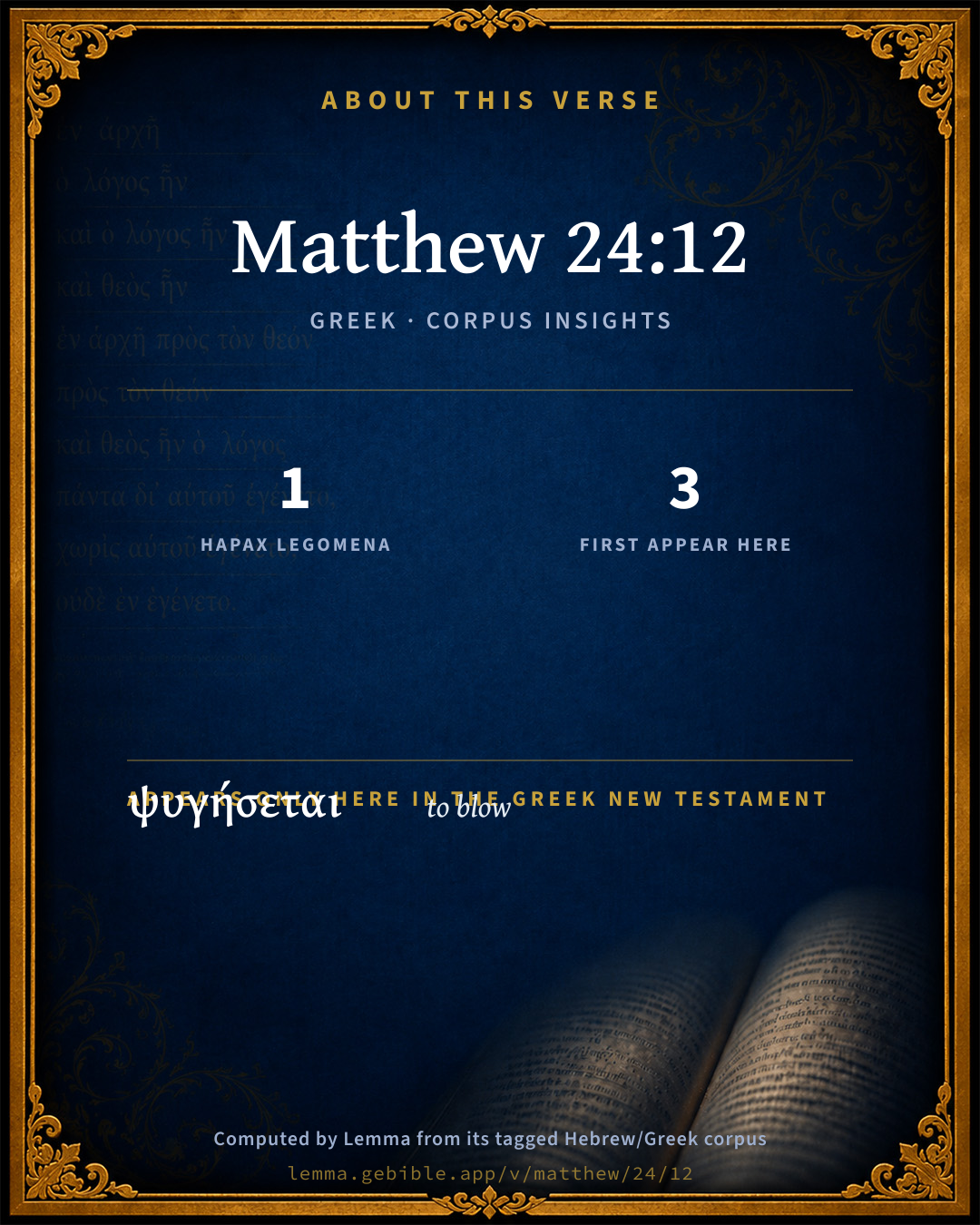
Matthew 24:12

Greek (Tischendorf 8th ed.) Matthew 24:12 appears in the Greek New Testament. The text above is from the Tischendorf 8th edition. Each word links to its Strong’s number and a concise gloss. Click any word for its full Thayer’s Greek Lexicon entry.

Download image
Cite this verse

Matthew 24:12 (World English Bible). Public Domain. Lemma interlinear Bible study tool, https://lemma.gebible.app/v/matthew/24/12.

Show BibTeX & RIS
BibTeX
RIS
English Translation
Because iniquity will be multiplied, the love of many will grow cold.
World English Bible · Public Domain
Highlights
  • 1 hapax legomenon — only here in the Greek New Testament
  • 3 first appearances in the Greek New Testament
Full analysis ↓
Download a study sheet

One document with this verse’s original text, its word-by-word gloss line, the meaning frame, cross-references with their text, attributed commentary, and full source and license credits — printable, and it pastes into notes with its structure intact.

This verse Autodidact and up

Study sheet (.html) Plain text (.txt)

A passage Seminary Student

Up to 50 verses in one chapter. A passage sheet keeps up to 6 commentary sources and 12 cross-references per verse, in the order this page ranks them, and says so on the sheet whenever that leaves anything out. Ask for a single verse and you get the Autodidact verse sheet above.

Everything on this page stays free to read, with no account — the sheet is a download of what is already on screen, not access to it.

Want to remove ads? Support Godless Engineer
Compare translations 3

The same verse in 3 English versions, stacked beneath the original-language interlinear above. Click any original word for its lexicon entry.

Each is an independent rendering of the whole verse — the interlinear is not word-aligned to these translations.

Highlighted words mark where these versions differ — a whole-verse word diff, not a word-by-word alignment.

  • World English Bible Public Domain
    Because iniquity will be multiplied, the love of many will grow cold.
  • King James Version Public Domain
    And because iniquity shall abound, the love of many shall wax cold.
  • unfoldingWord Literal Text CC BY-SA 4.0
    And because lawlessness will be increased, the love of many will grow cold.

unfoldingWord Literal Text — © unfoldingWord, licensed CC BY-SA 4.0. Word-aligned USFM3 via Door43 (git.door43.org/unfoldingWord/en_ult).

Versions to compare (up to 4)

3 of 4 selected

Show all 19 translations

Every available English version of this verse, each an independent rendering of the whole verse.

  • World English Bible Public Domain
    Because iniquity will be multiplied, the love of many will grow cold.
  • Berean Standard Bible Public Domain
    Because of the multiplication of wickedness, the love of most will grow cold.
  • Majority Standard Bible Public Domain
    Because of the multiplication of wickedness, the love of most will grow cold.
  • King James Version Public Domain
    And because iniquity shall abound, the love of many shall wax cold.
  • American Standard Version (1901) Public Domain
    And because iniquity shall be multiplied, the love of the many shall wax cold.
  • Revised Version (1885) Public Domain
    And because iniquity shall be multiplied, the love of the many shall wax cold.
  • Geneva Bible (1599) Public Domain
    And because iniquitie shalbe increased, the loue of many shalbe colde.
  • Douay-Rheims (1899) Public Domain
    And because iniquity hath abounded, the charity of many shall grow cold.
  • Young's Literal Translation Public Domain
    and because of the abounding of the lawlessness, the love of the many shall become cold;
  • Literal Standard Version CC BY-SA 4.0
    and because of the abounding of the lawlessness, the love of the many will become cold;
  • Unlocked Literal Bible CC BY-SA 4.0
    Because lawlessness will increase, the love of many will grow cold.
  • unfoldingWord Literal Text CC BY-SA 4.0
    And because lawlessness will be increased, the love of many will grow cold.
  • Darby Bible Public Domain
    and because lawlessness shall prevail, the love of the most shall grow cold;
  • World Messianic Bible Public Domain
    Because iniquity will be multiplied, the love of many will grow cold.
  • Webster's Bible Public Domain
    And because iniquity will abound, the love of many will become cold.
  • Free Bible Version CC BY-SA 4.0
    The increasing evil will lead the love of many to grow cold,
  • Bible in Basic English Public Domain
    And because wrongdoing will be increased, the love of most people will become cold.
  • Text-Critical English NT CC BY 4.0
    Because lawlessness will be increased, the love of many will grow cold,
  • Tyndale New Testament (1534) Public Domain
    And because iniquite shall have the vpper hande the love of many shall abate.

Literal Standard Version (2020), Covenant Press — licensed CC BY-SA 4.0. Text via the HelloAO Bible API (eBible.org). Unlocked Literal Bible (unfoldingWord) — licensed CC BY-SA 4.0. Text via the HelloAO Bible API (eBible.org). unfoldingWord Literal Text — © unfoldingWord, licensed CC BY-SA 4.0. Word-aligned USFM3 via Door43 (git.door43.org/unfoldingWord/en_ult). Free Bible Version, Dr. Jonathan Gallagher — licensed CC BY-SA 4.0. Text via the HelloAO Bible API (eBible.org).

Word by word

More ways to search: Search by grammar → Find every occurrence → Compare this word →

Practice this passage: Drill this verse → Learn its vocabulary →

About this verse

These counts appear in no published source. They are computed here, from the morphology-tagged text and Lemma’s own curated glosses. What Lemma adds →

11
words
8
distinct lemmas
Gospels
section

Notable vocabulary

1 hapax legomenon — a word that appears only here in the entire Greek New Testament:

  • ψυγήσεται to blow G5594

First appearance in Scripture

These words make their first canonical appearance in the Greek New Testament here:

  • πληθυνθῆναι to multiply G4129
  • ψυγήσεται to blow G5594
  • ἀγάπη brotherly love G26

Shared distinctive vocabulary

πληθυνθῆναι to multiply G4129 occurs in 11 verses of the Greek New Testament. Also found in:

Repetition

A word recurs within this verse:

Cross-references

5

Topical passages linked to Matthew 24:12 in the Treasury of Scripture Knowledge — connected by theme and wording, ordered by reader-vote popularity; previews shown in the World English Bible.

  • Revelation 2:4–5 But I have this against you, that you left your first love.
  • James 4:1–4 Where do wars and fightings among you come from? Don't they come from your pleasures that war in your members?
  • Revelation 3:15 "I know your works, that you are neither cold nor hot. I wish you were cold or hot.
  • Revelation 2:10 Don't be afraid of the things which you are about to suffer. Behold, the devil is about to throw some of you into prison, that you may be tested; and you will have oppression for ten days. Be faithful to death, and I will give you the crown of life.
  • James 5:1–6 Come now, you rich, weep and howl for your miseries that are coming on you.

Cross-references courtesy of OpenBible.info (CC BY 4.0).

Commentary

Notes on Matthew 24:12 from classic Christian and Jewish commentators (each source and its license shown beneath its notes). The classic Christian expositions comment on the surrounding passage and are grouped to its opening verse, so a note may address several verses; the Jewish commentaries on the Tanakh (Rashi and others) are per-verse, so they appear only where the commentator wrote on this verse.

Lemma curates 59 commentaries, every one of them public domain or Creative Commons licensed, each selected and text-cleaned for this edition rather than reprinted as found. About our sources →

Adam Clarke's Commentary

Verse 12. The love of many shall wax cold.] By reason of these trials and persecutions from without, and those apostasies and false prophets from within, the love of many to Christ and his doctrine, and to one another, shall grow cold. Some openly deserting the faith, as Mt 24:10; others corrupting it, as Mt 24:11; and others growing indifferent about it, Mt 24:12. Even at this early period there seems to have been a very considerable defection in several Christian Churches; see Ga 3:1-4; 2Th 3:1, c. 2Ti 1:15.

Adam Clarke's Commentary on the Bible (1810–1826) — public domain. Text from a community e-Sword/MySword module.

The Biblical Illustrator

Joseph S. Exell

Mat_24:12

The love of many shall wax cold.

The love of the saints destroyed by the abounding of iniquity

I. When iniquity be said to abound.

1. When those who are set for the defence of the gospel can see its doctrines corrupted without emotion.

2. When those who live in total disregard of practical religion increase.

3. When all classes give each other countenance in crime, and provoke each other to it by example, by solicitation, and by menaces (Gen_6:5-7; Gen_19:12-13).

II. The abounding of iniquity operates to cool the blood of Christians. (Sketches.)

Declension and backsliding in the Church

I. The external position of the church. Abounding iniquity in the forms of speculative error, obvious and shameful sin, direct opposition to the gospel, etc.

II. The internal state of the church The same circumstances which cause gross wickedness to abound in the world, produce coldness of love in the Church. Antediluvians, Jewish history, etc. The wickedness which abounds in the world is often the fruit of coldness in the love of the Church, and then the reaction, etc. That you may sustain no harm by the abounding of iniquity, guard your attention, affections, etc. Cherish ardent, enthusiastic love to Christ. (A. Tucker.)

Evil example contagious

Conversation with cold ones will cast a damp, and will make one cold, as Christ here intimates; there is no small danger of defection, if not of infection by such; they are notable quench-coals. This both David and Isaiah found, and therefore cried out each for himself, Woe is me (Psa_120:5; Isa_6:5). There is a compulsive power in company to do as they do (Gal_2:14). It behoveth us, therefore, upon whom the ends of the world are come, to beware lest we suffer a decay; lest, leaving our first love, and led away with the error of the wicked, we fall from our former steadfastness (Rev_2:5; 2Pe_3:17). The world, says Ludolfus, has been once destroyed with water for the heat of lust, and shall be again with fire for the coldness of love. Latimer saw so much lack of love to God and goodness in his time that he thought verily Doomsday was then just at hand. What would he have thought had he lived in our age, wherein it were far easier to write a book of apostates than a book of martyrs? (John Trapp.)

Temptations of the early Christians to apostasy

There was always, in the converts of Jerusalem, a strong temptation towards a relapse into Judaism; and in those disturbed times which preceded the fall, any man with Jewish blood in his veins, with the traditional Jewish temper, the ancestral beliefs, the intense love for his nation and people, must have been hard beset. Why should he, too, not choose the heroic part, and cast in his lot with the defenders of the sacred walls? Why not with his dying body make a rampart against the on-pressing Roman, rather than slip away in cowardly desertion like a traitor, leaving the glorious city to perish as it might? All patriotic instincts, all that the Jew most cherished, must have drawn the convert in that direction: it was a sore trial to have to make this choice between the Old Testament and the New. It was such a crisis as rarely happens to a man, to a society, to a nation. It broke up the old Church, the old national life. By destroying the centralized worship of the temple, and staying the immemorial sacrifices, it taught Christians to look far afield, it bade them bow down in no single shrine to worship the Father, and it sent them forth to evangelize a world lying in darkness. They learnt, by the fall of the Holy City, that the Christian faith was to be not national but cosmopolitan, and that out of the ruins of a narrower polity a larger and wider world would grow … It was by endurance and self-denial of no ordinary kind that these early Jewish Christians succeeded in overcoming the danger besetting them at every turn. They endured to the end; they learned by patience to get a broader and wiser view of the true position and relation of the faith of their adoption. The sneers of the unconverted Jews, the sense that they had lost their patriotic standing-ground, the oppression and sword of their Roman masters-these were the bitter draughts which refreshed their souls, and nerved them for independence in a larger sphere of life. By these they not only saved their souls, but ennobled their views and aims, till they were able to enter fully into the new conditions of the faith of Christ, and thereby take an active part in the outward movements of a missionary church. (Dean Kitchen.)

Iniquity the cause of unbelief

We are not to expect that apostates will own that iniquity is the cause of their apostasy. They have always assigned other causes of it, which in their opinion clears them from all suspicion of unjust prejudice or prevention. And these are

(1) the immoral and unexemplary lives of the clergy; and

(2) the irrational system of Christianity. (Bishop Warburton.)

Rarity of steadfastness

It is but a he, a single man, that holdeth out, when many lose their love and therewith their reward. Eeebolus, AEneas, Sylvius, Baldwin, Pendleton, Shaxton, and many others, set forth gallantly, but tired ere they came to their journeys end. Like the Galli Insubres, they showed all their valour in the first encounter. Like Charles VIII. of France, of whom Guicciarden notes, that in his expedition to Naples he came into the field like thunder and lightning but went out like a snuff. Like Mandrobulus in Lucian, who, the first year offered gold to his gods, the second year silver, the third nothing. Or, lastly, like the lions of Syria which, as Aristotle reports, bring forth five whelps, next time four, next three, and so on, till at length they become barren. So apostates come at last to nothing, and therefore must look for nothing better than to be cast off for ever; when they that hold out and hold on their way, passing from strength to strength, from faith to faith, etc., shall be as the sun when he goeth forth in his strength; yea, they shall shine forth as the sun in the kingdom of their Father. Caleb was not discouraged by the giants, and therefore had Hebron, the place of the giants: so those that hold out in the way of heaven shall be sure to have heaven. Thomas San Paulius, at Paris, a young man of eighteen years, being in the fire, was plucked up again upon the gibbet, and asked whether he would turn. To whom he said, That he was in his way towards God, and therefore desired them to let him go. That merchant of Paris, his case was nothing so comfortable, who, for jesting at the friars, was by them condemned to be hanged; but he, to save his life, was content to recant, and so he did. The friars, hearing of his recantation, commended him, saying, If he continued so he should be saved; and so, calling upon the officers, caused them to make haste to the gallows to hang him up, while he was yet in a good way, said they, lest he fall again. (John Trapp.)

The honour of endurance

There lies a ship in the stream. It is beautiful in all its lines. It has swung out from the pier and is lying at anchor yonder; and men, as they cross the river on the ferry-boats, stand and look at it and admire it; and it deserves admiration. But it has never been out of port: there it stands, green, new, untried; and yet everybody thinks it is beautiful. It is like childhood, which everybody thinks is beautiful, or ought to be. There comes up the bay, and is making towards the navy-yard, another ship. It is an old man-of-war. It has been in both oceans, and has been round the world many times. It has given and taken thunder-blows under the flag of its country. It is the old Constitution we will suppose. She anchors at the navy-yard. See how men throng the cars and go to the navy-yard to get a sight of her! See how the sailors stand upon the deck and gaze upon her! Some of them, perchance, have been in her, and to them she is thrice handsomer than any new vessel. This old war-beaten ship, that carries the memory of many memorable campaigns, lies there; and they look at its breached bow, its shattered rigging, its coarse and rude lines, its dingy sides, which seem long since to have parted company with paint; and every one of them feels, if he is a true patriot, God bless you, old thing! God bless you! (H. W. Beecher.)

Not to fail at the end of the Christian life

When Diogenes had spent the greater part of his life in observing the most extreme and scrupulous self-denial, and was now verging on ninety years of age, one of his friends recommended him to indulge himself a little. What! said he, would you have me quit the race close by the goal?

The Biblical Illustrator, edited by Joseph S. Exell (c. 1880s–1900s) — public domain. Text from a community e-Sword module.

Tyndale Open Study Notes

Tyndale Open Resources

24:12 the love of many will grow cold (see Rev 2:4): If the love within the community of Jesus’ disciples diminishes to the point of extinction, then the community ceases to be what God has designed it to be.

Tyndale Open Study Notes — © Tyndale Open Resources, licensed CC BY-SA 4.0. Text via the HelloAO Bible API.

Bengel's Gnomon

Johann Albrecht Bengel

Mat 24:12. Τήν ἀνομίαν, unrighteousness) Unrighteousness and love are opposites; for love is the fulfilling of the law. Unrighteousness involves compulsion, love, as it were, something natural.—ψυγήσεται, shall wax cold) It is the character of love to burn.—ἡ ἀγάπη, love) sc. towards God, mankind, our neighbour, and ourself; of a spiritual and also natural kind; love, which is the sum of the law.—στοργὴ (natural affection) makes parents rejoice in the birth of their offspring: when iniquity has made times hard, they rejoice in losing their offspring or having none. Love is the ornament and very life of Christians, and of their whole condition and conduct, Php 1:9; 2Pe 1:7; Rev 2:4. It is also the foundation of that ὑπομονὴ, patience or endurance, mentioned in the next verse.—τῶν πολλῶν, of the many) i.e. of the majority, sc. of those who do not excel in love. Unrighteousness is especially practised by those who are exceedingly powerful or excessively poor: whence also the love of the rest waxes cold.[1037] That justice which is called particular, being violated, that which is called universal, languishes.[1038]

[1037] Since their power and means of doing good are taken violently from them by unrighteousness or injustice.—V. g.

[1038] Universal justice comprehends the whole of our duty to our neighbour; particular justice is that strictly so called. See Aristotle’s Nicomachæan Ethics, Book V. passim.—(I. B.)

Bengel's Gnomon of the New Testament — English translation (T&T Clark, Edinburgh, 1860) — public domain. Text from a community e-Sword module.

Meyer's Critical & Exegetical Commentary

Heinrich August Wilhelm Meyer

Mat_24:12. And in consequence of the growing prevalence of wickedness (as the result of what is mentioned in Mat_24:10-11), the love of the greater number will become cold; that predominance of evil within the Christian community will have the effect of cooling the brotherly love of the majority of its members. The moral degeneracy within the pale of that community will bring about as its special result a prevailing want of charity, that specific contrast to the true characteristic of the Christian life (Gal_5:6; 1Co_13:1 ff.; 1Jn_4:20). For ἀνομία, the opposite of moral compliance with the law of God (= ἁμαρτία, 1Jn_3:4), comp. Mat_7:23, Mat_13:41, Mat_23:28; 2Co_6:14; 2Th_2:7. For ψύγειν with γ, comp. Lobeck, ad Phryn. p. 318.

τῶν πολλῶν] are not the πολλοί mentioned in Mat_24:10 (Fritzsche), whose love, as that verse informs us, is already changed into hatred, but the multitude, the mass, the great body (Kühner, II. l, p. 548; Ast, Lex. Plat. III. p. 148) of Christians. In the case of those who were distinguished above the ordinary run of Christians, no such cooling was to take place; but yet, as compared with the latter, they were only to be regarded as ὀλίγοι. According to Dorner, Mat_24:11-12 apply not to the apostolic age, but to a subsequent stage in the history of the church. But such a view is inconsistent with the numerous testimonies to be met with in the Epistles, with the apprehensions and expectations regarding impending events to which they give expression. Comp. on Gal_1:4.

Meyer — Critical and Exegetical Commentary on the New Testament — English translation by Peter Christie, edited by Frederick Crombie (T&T Clark, 1880) — public domain. Text from a community e-Sword module.

Expositor's Greek Testament

ed. W. Robertson Nicoll

Mat 24:12 . ἀνομίαν . Weiss and Holtzmann (H. C.) take this in the specific sense of antinomianism, a libertine type of Christianity preached by the false prophets or apostles, the word in that sense of course to be credited to the evangelist. The word as used by Christ would naturally bear the general sense of godlessness or iniquity. We may wonder at the use of such a word in connection with nascent Christianity. It would require a considerable time to make room for such degeneracy. But the very point Jesus wishes to impress is that there will be room for that before the final crisis of Israel comes. ψυγήσεται , etc., will cool the love of many. ψ . is an hapax leg. 2nd future passive of ψύχω , to breathe. One of the sad features of a degenerate time is that even the good loose their fervour. ἀγάπη , love of the brotherhood, here only in this sense in Synoptical Gospels, the distinctive virtue of the Christian, with a new name for a new thing.

The Expositor's Greek Testament, edited by W. Robertson Nicoll (1897–1910) — public domain. Text from a community e-Sword module.

Ellicott's Commentary for English Readers

(12) Because iniquity shall abound . . .—Better, lawlessness. No word could more fitly represent the condition of Judæa in the time just referred to: brigandage, massacres, extortion, assassination, came to be common things.

The love of many . . .—Better, of the many; the greater part of the true Israel who would be found in the Church of Christ; perhaps, also, the greater part of the nation as such. This was the natural result of the condition of things implied in the “lawlessness.” The tendency of all such times, as seen in the histories of famines, and pestilences, and revolutions, is to intensify selfishness, both in the more excusable form of self-preservation, and in the darker form of self-aggrandisement. In the tendency to “forsake the assembling of themselves together” among the Hebrew Christians, we have, perhaps, one instance of the love waxing cold (Heb_10:25).

A Bible Commentary for English Readers, edited by Charles John Ellicott (1878–1897) — public domain. Text from a community e-Sword module.

The Cambridge Bible for Schools and Colleges

gen. ed. J. J. S. Perowne

12. iniquity] Literally, lawlessness.

shall abound] Translate, hath abounded.

the love of many] Rather, of the many, i. e. of “the majority.” Love or agapé became the leading virtue and grace of the Christian life, yet this is the only instance of the word in the Synoptic Gospels, except Luk_11:42, “the love of God.” The noun itself is not classical, and therefore lent itself the more readily to Christian use. But the thought connected with the word, “family affection,” was beautiful before it was spiritualised by Christianity. The E. V. has two renderings, “love” and “charity,” (see especially 1 Corinthians 13). The first seems to be too wide, the second too restricted, denoting a principal tendency or function of agapé rather than agapé itself. The use of the word by our Lord to express Christian unity is itself prophetic. St Paul experienced this “coldness of love:” “at my first answer no man stood with me,” 2Ti_4:16.

The Cambridge Bible for Schools and Colleges (gen. ed. J. J. S. Perowne; Cambridge University Press, 1878–1918) — public domain. Text from a community e-Sword module.

John Gill's Exposition

And because iniquity shall abound,.... Meaning, either the malice and wickedness of outrageous persecutors, which should greatly increase; or the treachery and hatred of the apostates; or the errors and heresies of false teachers; or the wickedness that prevailed in the lives and conversations of some, that were called Christians: for each of these seem to be hinted at in the context, and may be all included, as making up the abounding iniquity here spoken of; the consequence of which would be,

the love of many shall wax cold. This would be the case of many, but not of all; for in the midst of this abounding iniquity, there were some, the ardour of whose love to Christ, to his Gospel, and to the saints, did not abate: but then there were many, whose zeal for Christ, through the violence of persecution, was greatly damped; and through the treachery of false brethren, were shy of the saints themselves, not knowing who to trust; and through the principles of the false teachers, the power of godliness, and the vital heat of religion, were almost lost; and through a love of the world, and of carnal ease and pleasure, love to the saints was grown very chill, and greatly left; as the instances of Demas, and those that forsook the Apostle Paul, at his first answer before Nero, show. This might be true of such, who were real believers in Christ; who might fall under great decays, through the prevalence of iniquity; since it does not say their love shall be lost, but wax cold.

John Gill's Exposition of the Whole Bible (1746–1763) — public domain (CC PDM 1.0). Text via the HelloAO Bible API.

Trapp's Complete Commentary

John Trapp

12 And because iniquity shall abound, the love of many shall wax cold.

Ver. 12. And because iniquity shall abound] In these last and worst times, as Bernard yoketh them, and as the Scripture often describeth them. There was never but one Noah, that with two faces saw both before and behind him. But, lo, that ancient of days, to whom all times are present, hath told us that the last shall be the loosest, the dregs of time, the sink of sins of all former ages.

The love of many shall wax cold] Conversation with cold ones will cast a dampness, and will make one cold, as our Saviour here intimates; there is no small danger of defection, if not of infection by such; they are notable quench coals. This both David and Isaiah found, and therefore cried out each for himself, "Woe is me," Psa 120:5; Isa 6:5. There is a compulsive power in company to do as they do, Gal 2:14; "Why compellest thou," &c. It behoveth us therefore to beware upon whom the ends of the world are come, lest we suffer a decay, lest leaving our first love, and led away with the error of the wicked, we fall from our former steadfastness, Rev 2:5; 2Pe 3:17. The world, saith Ludolfus ( De Vita Christi, ii. 87), hath been once destroyed with water for the heat of lust, and shall be again with fire for the coldness of love. Latimer saw so much lack of love to God and goodness in his time, that he thought verily doomsday was then just at hand. What would he have thought had he lived in our age, wherein it were far easier to write a book of apostates than a book of martyrs?

John Trapp, A Commentary or Exposition upon All the Books of the Old and New Testament (1647–1656) — public domain. Text from a community e-Sword module.

Albert Barnes' Notes on the Bible

And because iniquity ... - The word “iniquity” here seems to include the cruelty of the Jews and Romans in their persecutions; the betraying of Christians by those who professed to be such; and the pernicious errors of false prophets arid others. The effect of all this would be, that the ardor of feeling of many Christians would be lessened. The word “wax” means to “become.” It is an old Saxon word, not used now in this sense except in the Bible. The fear of death, and the deluding influence of false teachers, would lessen the zeal of many timid and weak professors; perhaps, also, of many real but feeble Christians.

Albert Barnes' Notes on the Bible (1834–1885) — public domain. Text from a community e-Sword/MySword module.

Haydock's Catholic Bible Commentary

And because iniquity hath (literally, shall) abounded, shall arrive at its height, the charity of many, carried away by the force of bad example, will grow cold; and scarcely, even among Christians, will a person be found willing to assist Christians, lest he may be known for a Christian. Of this we have an example, 2 Timothy iv. 16, At my first answer, no man stood with me, but all forsook me: may it not be laid to their charge; but the Lord stood by me, and strengthened me. (Maldonatus)

George Leo Haydock (1774–1849), Haydock's Catholic Family Bible and Commentary, 1859 edition — public domain. Excludes Psalms (Douay-Rheims chapter numbering differs from Protestant) and Deuterocanonical books (Catholic canon only).

The Pulpit Commentary

Because iniquity shall abound (plhyunyhnai , is multiplied). The word rendered "iniquity" is anomia , "lawlessness," general immorality and licence. Impatience of rule and discipline, connivance at and imitation of heathen practices, reacted upon the faith of believers, undermined steadfast adherence to principle. Then was the power of "that wicked one" (o anomov , 2Th_2:8) exercised and seen in the lapse of the unstable. The love of many (twn pollwn , the many, the majority) shall wax cold. "Love" (agaph) here is used in its general and comprehensive sense, as having God as its chief object and man in subordination thereto. The troubles and persecutions that shall beset believers, the spirit of worldliness and self-seeking that a timid faith encourages, will issue in loosening dependence upon God and trust in his providential care; and internal dissensions will destroy that brotherly love which ought to be characteristic of Christians. Of this lack of energetic love the Lord speaks in his warnings to the Church of Laodicea, (Rev_3:16) "Because thou art lukewarm, and neither cold nor hot, I will spue thee out of my mouth.

Vers. 12, 13. The difficulty of keeping on.

"Because iniquity shall abound, the love of many shall wax cold." These verses are connected with Christ"s prophecy of the history of his Church. There may be difficulty in fixing the precise references of his language, but he describes general features which are seen in every passing age. There is always a disposition to exaggerate or overestimate the evils of the age in which we happen to live, because they are specially prominent to us. But we may certainly say this much we live in an age when outside wickedness and semi-wickedness are telling very directly and very injuriously on the Christian spirit. It cannot be said that there is general failing from the Christian profession; but there is a strange, sad "chilling of the Christian love," a "leaving of the first love." In some ages the separation of the Church from the world is more marked, and so the influence of the world on the Church is less felt. Illustrate by Slapton Sands in Devonshire. A freshwater lake well stocked with fish is divided from the sea only by a road and a narrow belt of sand. Usually the two are well kept apart. But when wind and tide unite, the sea rises, floods the sand and the road, and pours the defiling and destructive salt waters into the sweet lake.

I EFFECT OF GROWING INIQUITY ON THE CHRISTIAN SPIRIT. "Love waxes cold." The true idea of Christian life is the sanctifying and ennobling power of a personal love to Christ. Iniquity, self-willedness, and self-willed ways chill this love

(1) by presenting to us other and rival claims to our love (preacher must be left to select illustrations of such claims);

(2) by undervaluing and putting slights on Christ. Show how human friendships are spoiled when our friends are satirized and scorned. Show how jealously, in these criticizing days, we need to watch over our high, adoring, admiring thoughts of Christ.

II THE MASTERY OF SURROUNDING INIQUITY IS THE TRIUMPH OF CHRISTIAN STEADFASTNESS. "He that shall endure to the end." It will cost persistent and persevering effort if we are to keep loving Christ supremely. True endurance is not possible unless we have a strong grip of Christ. We must have and cherish warm feeling toward Christ. We must keep on

(1) trusting,

(2) obeying,

(3) following,

(4) honouring,

(5) working for Christ.

And if ever faint, it must be "taint, yet pursuing. R.T.

The Pulpit Commentary (1880–1919), ed. H.D.M. Spence-Jones & Joseph S. Exell — public domain. Text from a community e-Sword module.

Scofield Reference Notes

C. I. Scofield

iniquity

i.e. lawlessness, sin. (See Scofield "Rom 3:23").

The Scofield Reference Bible (1917 edition), notes by C. I. Scofield — public domain. Text from a community e-Sword module.

The People's New Testament

B. W. Johnson

12. Because iniquity shall abound, etc. Immorality eats out the heart of religion.

B. W. Johnson's The People's New Testament with Notes (1889–1891) — public domain. Electronic text from the Christian Classics Ethereal Library (CCEL) ThML edition.

unfoldingWord translationNotes

Door43 World Missions Community

lawlessness will increase

The abstract noun "lawlessness" can be translated with the phrase "disobeying the law." AT: "disobeying the law will increase" or "people will disobey God's law more and more" (See: Abstract Nouns)

the love of many will grow cold

Possible meanings are 1) "many people will no longer love other people" or 2) "many people will no longer love God." (See: Idiom)

the one who endures to the end will be saved

This can be stated in active form. AT: "God will save the person who endures to the end" (See: Active or Passive)

the one who endures

"the person who stays faithful"

to the end

It is not clear whether the word "end" refers to when a person dies or when the persecution ends or the end of the age when God shows himself to be king. The main point is that they endure as long as necessary.

This gospel of the kingdom will be preached

Here "kingdom" refers to God's rule as king. This can be stated in active form. AT: "People will speak this message about God's rule" (See: Metonymy and Active or Passive)

all the nations

Here, "nations" stands for people. AT: "all people in all places" (See: Metonymy)

the end

"the end of the world" or "the end of the age"

translationWords

lawful

love

endure

save

good news

kingdom

preach

testimony

nation

unfoldingWord translationNotes — © Distant Shores Media and the Door43 World Missions Community, licensed CC BY-SA 4.0. Source: git.door43.org/Door43/en_tn.

Cambridge Greek Testament for Schools and Colleges

12. ψυγήσεται ἡ ἀγάπη τῶν πολλῶν. ‘The love of the majority shall grow cold.’ The use by our Lord in this passage of a word which expressed the highest and most enduring (1Co 13:8; 1Co 13:13) of Christian graces, and which was the bond of the future Christian society is in itself prophetic. ἀγάπη in this sense occurs here only in the Synoptic gospels (τὴν ἀγάπην τοῦ θεοῦ, Luk 11:42, is not an exception). Yet from the fourth gospel we learn that this word or its Aramaic equivalent was very frequently on the Lord’s lips. In the Epistles no word meets us more often, though the occurrence of ἀγάπη in the LXX. seems to imply that it was a vernacular word before it took its place in literature; its absence from classical Greek enabled it to enter Christian thought and literature unstained (ἔρως has no place in the vocabulary of the N.T.). To the Greek, however (though Christianity raised ἀγάπη far above the range of pagan thought), it would recall the purest and highest conceptions of Greek poets—the pure love of brother and sister—the devotion of a child to her father—duty to the living—respect for the dead. The drama of Antigone is the story of ἀγάπη triumphant: οὔτοι συνέχθειν ἀλλὰ συμφιλεῖν ἔφυν (Soph. Ant. 523) breathes the spirit of Christianity. As a Christian word ἀγάπη meant the love of the Christian brotherhood to one another and to God, and the outward symbols of that love in the Eucharist (ἀγάπην ποιεῖν ‘to celebrate the “love-feast’ ”) in ‘charity’ or ‘alms’ (see note on δικαιοσύνη, ch. Mat 6:1) in the salutation or holy kiss (see Sophocles’ Lex., sub voc.).

Cambridge Greek Testament for Schools and Colleges (Cambridge University Press, 1896; 21 vols, various authors incl. Carr, Maclear, Plummer, Farrar, Lumby, Moule, M. R. James, Simcox) — public domain. Text from a community e-Sword module.

Alford’s Greek Testament

Henry Alford

12.] It is against this ἀνομία especially that James, in his Epistle, and Jude, in more than the outward sense the brother of James, were called on to protest,—the mixture of heathen licentiousness with the profession of Christianity. But perhaps we ought to have regard to the past tense of πληθυνθῆναι, and interpret, ‘because the iniquity is filled up,’ on account of the horrible state of morality (parallel to that described by Thucydides, iii. 82-84, as prevailing in Greece, which had destroyed all mutual confidence), the love and mutual trust of the generality of Christians shall grow cold.

τῶν πολλῶν,—thus we have ch. 25:5, ἐνύσταξαν πᾶσαι καὶ ἐκάθευδον. Even the Church itself is leavened by the distrust of the evil days. See 2Th 2:3.

Henry Alford, The Greek Testament (1849–1861) — public domain. Text from a community e-Sword module.

International Critical Commentary

(L) 12. And because that lawlessness is multiplied, the love1 of many shall wax cold.]

International Critical Commentary — older volumes (1896–1929), various authors — public domain. Text from a community e-Sword module.

Vincent's Word Studies in the New Testament

Marvin R. Vincent

Shall abound [πληθυνθηναι] . Lit., shall be multiplied. See Act 6:1, 7; Act 7:17; Act 9:31; Heb 6:14.

Of many [των πολλων] . The A. V. in omitting the definite article, misses the force of Christ 's saying. It is not the love of many people only that shall be chilled, but of the many, the majority, the great body. Wax cold [ψυγησεται] . The verb means originally to breathe or blow; and the picture is that of spiritual energy blighted or chilled by a malign or poisonous wind.

Marvin R. Vincent, Word Studies in the New Testament (1887–1900) — public domain. Text from a community e-Sword/MySword module.

Lesson kit

Teaching starters — assembled from the data on this page, not authored interpretation. Every prompt links to the verse data it draws on. Edit before teaching.

Matthew, in the Gospels, opens this verse with 11 words (8 distinct Greek lemmas). Its most distinctive word is psýchō (“to blow”). A historical commentator’s framing appears above. Read the whole chapter for the surrounding context.

Discussion questions

  1. How does “to blow” (psýchō) shape what this verse is saying?
  2. 1 word here appears nowhere else in the Greek New Testament. Why might the author reach for such rare wording?
  3. 3 words make their first appearance in Scripture here. What does this debut establish?
  4. How does Acts 6:1, which shares the word «to multiply», read alongside this verse?
  5. What does the repetition of “the” (4× in this one verse) do in this verse?
  6. The translations on this page render this verse differently — a whole-verse word diff, not a word-by-word alignment. What might account for the different wordings?
  7. Compare how Adam Clarke's Commentary and The Biblical Illustrator read this verse. Where do they agree or differ?

Things to notice

  • 1 word in this verse appears nowhere else in the Greek New Testament.
  • 3 words make their first canonical appearance in Scripture here.
  • These translations choose different wording for 9 words in this verse.
  • “the” occurs 4× in this single verse.
  • 8 distinct Greek lemmas span 11 words in this verse.

Reading settings

Reading text

Shown beneath each verse's original-language words.

Old Testament
Old Testament edition

Read the OT as the Masoretic Hebrew (MT) or the Greek Septuagint (LXX).

English shown for the Greek Septuagint (in the Hebrew ↔ Greek comparison).

Comparing translations? Open the Compare panel on any verse page to stack up to four side by side.