
Mark 4:33

Greek (Tischendorf 8th ed.) Mark 4:33 appears in the Greek New Testament. The text above is from the Tischendorf 8th edition. Each word links to its Strong’s number and a concise gloss. Click any word for its full Thayer’s Greek Lexicon entry.
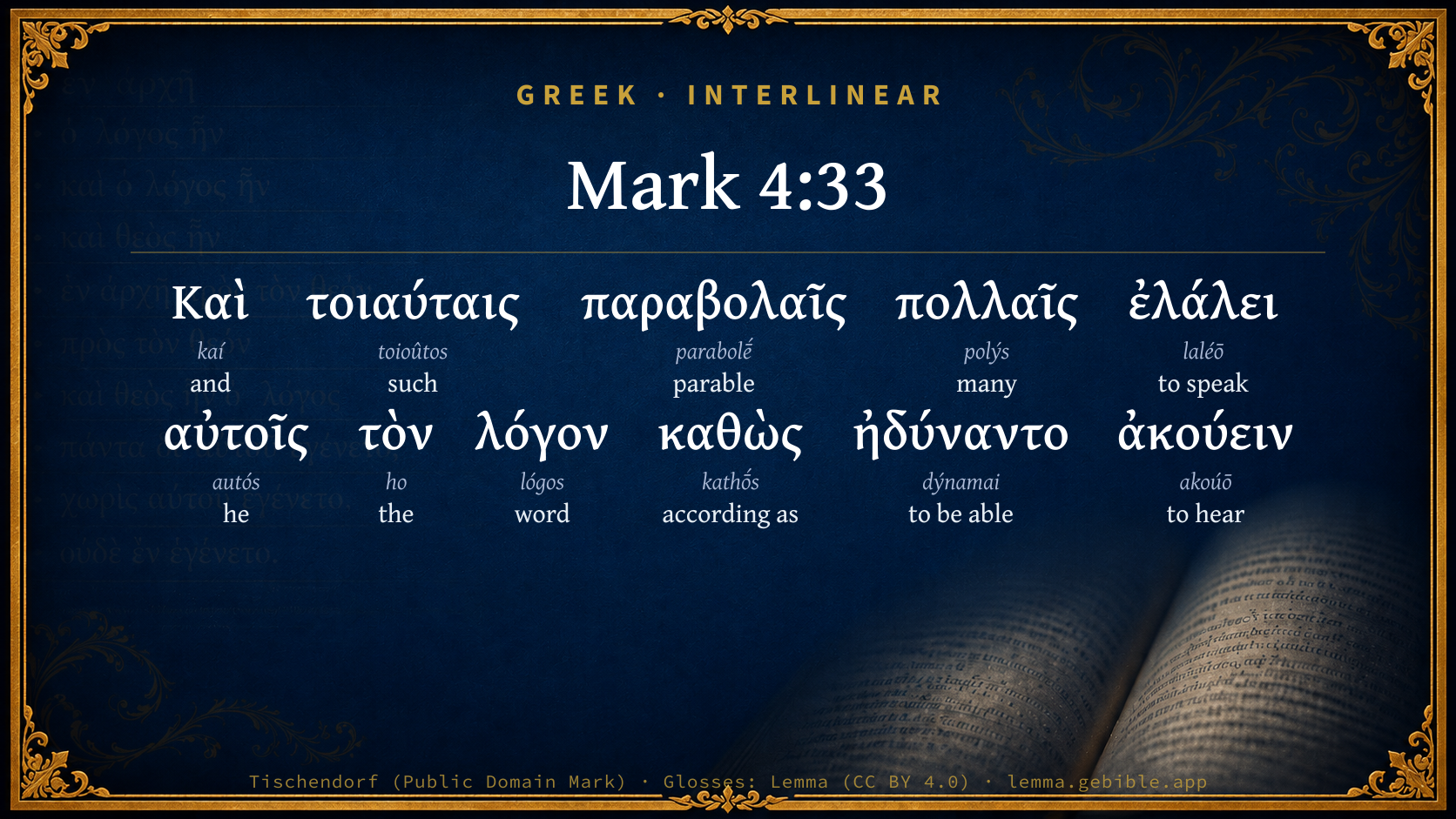
Download image
Cite this verse

Mark 4:33 (World English Bible). Public Domain. Lemma interlinear Bible study tool, https://lemma.gebible.app/v/mark/4/33.

Show BibTeX & RIS
BibTeX
RIS
English Translation
With many such parables he spoke the word to them, as they were able to hear it.
World English Bible · Public Domain
Download a study sheet

One document with this verse’s original text, its word-by-word gloss line, the meaning frame, cross-references with their text, attributed commentary, and full source and license credits — printable, and it pastes into notes with its structure intact.

This verse Autodidact and up

Study sheet (.html) Plain text (.txt)

A passage Seminary Student

Up to 50 verses in one chapter. A passage sheet keeps up to 6 commentary sources and 12 cross-references per verse, in the order this page ranks them, and says so on the sheet whenever that leaves anything out. Ask for a single verse and you get the Autodidact verse sheet above.

Everything on this page stays free to read, with no account — the sheet is a download of what is already on screen, not access to it.

Want to remove ads? Support Godless Engineer
Compare translations 3

The same verse in 3 English versions, stacked beneath the original-language interlinear above. Click any original word for its lexicon entry.

Each is an independent rendering of the whole verse — the interlinear is not word-aligned to these translations.

Highlighted words mark where these versions differ — a whole-verse word diff, not a word-by-word alignment.

  • World English Bible Public Domain
    With many such parables he spoke the word to them, as they were able to hear it.
  • King James Version Public Domain
    And with many such parables spake he the word unto them, as they were able to hear it.
  • unfoldingWord Literal Text CC BY-SA 4.0
    And with many such parables he was speaking the word to them, just as they were able to hear;

unfoldingWord Literal Text — © unfoldingWord, licensed CC BY-SA 4.0. Word-aligned USFM3 via Door43 (git.door43.org/unfoldingWord/en_ult).

Versions to compare (up to 4)

3 of 4 selected

Show all 19 translations

Every available English version of this verse, each an independent rendering of the whole verse.

  • World English Bible Public Domain
    With many such parables he spoke the word to them, as they were able to hear it.
  • Berean Standard Bible Public Domain
    With many such parables Jesus spoke the word to them, to the extent that they could understand.
  • Majority Standard Bible Public Domain
    With many such parables Jesus spoke the word to them, to the extent that they could understand.
  • King James Version Public Domain
    And with many such parables spake he the word unto them, as they were able to hear it.
  • American Standard Version (1901) Public Domain
    And with many such parables spake he the word unto them, as they were able to hear it;
  • Revised Version (1885) Public Domain
    And with many such parables spake he the word unto them, as they were able to hear it:
  • Geneva Bible (1599) Public Domain
    And with many such parables he preached the word vnto them, as they were able to heare it.
  • Douay-Rheims (1899) Public Domain
    And with many such parables, he spoke to them the word, according as they were able to hear.
  • Young's Literal Translation Public Domain
    And with many such similes he was speaking to them the word, as they were able to hear,
  • Literal Standard Version CC BY-SA 4.0
    And with many such allegories He was speaking to them the word, as they were able to hear,
  • Unlocked Literal Bible CC BY-SA 4.0
    With many parables like this he spoke the word to them, as much as they were able to understand,
  • unfoldingWord Literal Text CC BY-SA 4.0
    And with many such parables he was speaking the word to them, just as they were able to hear;
  • Darby Bible Public Domain
    And with many such parables he spoke the word to them, as they were able to hear,
  • World Messianic Bible Public Domain
    With many such parables he spoke the word to them, as they were able to hear it.
  • Webster's Bible Public Domain
    And with many such parables he spoke the word to them, as they were able to hear it.
  • Free Bible Version CC BY-SA 4.0
    Jesus used many of these illustrated stories when he spoke to the people so they would understand as much as they could.
  • Bible in Basic English Public Domain
    And with a number of such stories he gave them his teaching, as they were able to take it:
  • Text-Critical English NT CC BY 4.0
    With many similar parables he spoke the word to them, to the extent that they were able to understand it.
  • Tyndale New Testament (1534) Public Domain
    And with many soche similitudes he preached the worde vnto the after as they myght heare it.

Literal Standard Version (2020), Covenant Press — licensed CC BY-SA 4.0. Text via the HelloAO Bible API (eBible.org). Unlocked Literal Bible (unfoldingWord) — licensed CC BY-SA 4.0. Text via the HelloAO Bible API (eBible.org). unfoldingWord Literal Text — © unfoldingWord, licensed CC BY-SA 4.0. Word-aligned USFM3 via Door43 (git.door43.org/unfoldingWord/en_ult). Free Bible Version, Dr. Jonathan Gallagher — licensed CC BY-SA 4.0. Text via the HelloAO Bible API (eBible.org).

Word by word

More ways to search: Search by grammar → Find every occurrence → Compare this word →

Practice this passage: Drill this verse → Learn its vocabulary →

παραβολαῖς
parabolḗ
G3850
“parable”
Noun, Dative, Plural, Feminine
Part of Speech
Noun
Case
Dative
Number
Plural
Gender
Feminine
Full Thayer's Definition

Origin: from G3846

TDNT: 17:24,8

1. a placing of one thing by the side of another, juxtaposition, as of ships in battle 2. metaph. a. a comparing, comparison of one thing with another, likeness, similitude b. an example by which a doctrine or precept is illustrated c. a narrative, fictitious but agreeable to the laws and usages of human life, by which either the duties of men or the things of God, particularly the nature and history of God's kingdom are figuratively portrayed d. a parable: an earthly story with a heavenly meaning 3. a pithy and instructive saying, involving some likeness or comparison and having preceptive or admonitory force a. an aphorism, a maxim 4. a proverb 5. an act by which one exposes himself or his possessions to danger, a venture, a risk
  1. Καὶ kaí G2532 “and” Conjunction
  2. τοιαύταις toioûtos G5108 “such” Demonstrative pronoun, Dative, Plural, Feminine
  3. πολλαῖς polýs G4183 “many” Adjective, Dative, Plural, Feminine
  4. ἐλάλει laléō G2980 “to speak” Verb, Imperfect, Active, Indicative, 3rd person, Singular
  5. αὐτοῖς autós G846 “he” Personal pronoun, Dative, Plural, Masculine
  6. τὸν ho G3588 “the” Article, Accusative, Singular, Masculine
  7. λόγον lógos G3056 “word” Noun, Accusative, Singular, Masculine
  8. καθὼς kathṓs G2531 “according as” Adverb
  9. ἠδύναντο dýnamai G1410 “to be able” Verb, Imperfect, Middle or Passive deponent, Indicative, 3rd person, Plural, Attic form
  10. ἀκούειν akoúō G191 “to hear” Verb, Present, Active, Infinitive

About this verse

These counts appear in no published source. They are computed here, from the morphology-tagged text and Lemma’s own curated glosses. What Lemma adds →

11
words
11
distinct lemmas
Gospels
section

Shared distinctive vocabulary

παραβολαῖς parable G3850 occurs in 48 verses of the Greek New Testament. Also found in:
Cross-references

4

Topical passages linked to Mark 4:33 in the Treasury of Scripture Knowledge — connected by theme and wording, ordered by reader-vote popularity; previews shown in the World English Bible.

  • Matthew 13:34–35 Jesus spoke all these things in parables to the multitudes; and without a parable, he didn't speak to them,
  • John 16:12 "I have yet many things to tell you, but you can't bear them now.
  • 1 Corinthians 3:1–2 Brothers, I couldn't speak to you as to spiritual, but as to fleshly, as to babies in Christ.
  • Hebrews 5:11–14 About him we have many words to say, and hard to interpret, seeing you have become dull of hearing.

Cross-references courtesy of OpenBible.info (CC BY 4.0).

Commentary

Notes on Mark 4:33 from classic Christian and Jewish commentators (each source and its license shown beneath its notes). The classic Christian expositions comment on the surrounding passage and are grouped to its opening verse, so a note may address several verses; the Jewish commentaries on the Tanakh (Rashi and others) are per-verse, so they appear only where the commentator wrote on this verse.

Lemma curates 59 commentaries, every one of them public domain or Creative Commons licensed, each selected and text-cleaned for this edition rather than reprinted as found. About our sources →

The Biblical Illustrator

Joseph S. Exell

Mar_4:33-34

But without a parable spake He not unto them.

Christs economy of teaching

Not as He was able to have spoken; He could have expressed Himself at a higher rate than any mortal can; He could have soared to the clouds; He could have knit such knots they could never untie. But He would not. He delighted to speak to His hearers shallow capacities (Joh_16:12). (T. Brooks.)

Christs method of teaching

With matter Divine and manner human, our Lord descended to the level of the humblest of the crowd, lowering Himself to their understandings, and winning His way into their hearts by borrowing His topics from familiar circumstances and the scenes around Him. Be it a boat, a plank, a rope, a beggars rags, an imperial robe, we would seize on anything to save a drowning man; and in His anxiety to save poor sinners, to rouse their fears, their love, their interest, to make them understand and feel the truth, our Lord pressed everything-art and nature, earth and heaven-into His service. Creatures of habit, the servants if not the slaves of form, we invariably select our text from some book of the Sacred Scriptures, He took a wider, freer range; and, instead of keeping to the unvarying routine of text and sermon with formal divisions, it were well, perhaps, that we sometimes ventured to follow His example; for may it not be that to the naturalness of their addresses and their striking out from the beaten paths of texts and sermons, to their plain speaking and home thrusts, to their direct appeals and homespun arguments, our street and lay preachers owe perhaps not a little of their power? Our Lord found many a topic of discourse in the scenes around Him; even the humblest objects shone in His hands, as I have seen a fragment of broken glass or earthenware, as it caught the sunbeam, light up, flashing like a diamond. With the stone of Jacobs Well for a pulpit, and its water for a text, He preached salvation to the Samaritan woman. A little child, which He takes from its mothers side, and holds up blushing in His arms before the astonished audience, is His text for a sermon on humility. A husbandman on a neighbouring height between Him and the sky, who strides with long and measured steps over the field he sows, supplies a text from which he discourses on the gospel and its effects on different classes of hearers. In a woman baking; in two women who sit by some cottage door grinding at the mill; in an old, strong fortalice perched on a rock, whence it looks across the brawling torrent to the ruined and roofless gable of a house swept away by mountain floods-Jesus found texts. From the birds that sung above His head, and the lilies that blossomed at His feet, He discoursed on the care of God-these His text, and Providence His theme. (T. Guthrie, D. D.)

Illustrating

I have generally found that the most intellectual auditors prefer to hear a simple scriptural and spiritual preaching. The late Judge McLean, of the United States Supreme Court once said to me, I was glad to hear you give that solemn personal incident in, your discourse last night Ministers now-a-days are getting above telling a story in a sermon; but I like it. (T. L. Cuyler.)

Likes in a sermon

You have no likes in your sermons, said Robert Hall to a brother minister; Christ taught that the kingdom of heaven was like leaven, etc. You tell us what things are, but never what they are like. Parables are more ancient than arguments. (Lord Bacon.)

And when they were alone.-

Christ alone with His disciples; or, the parable expounded

I. The parables a puzzle. It is very striking that the very means of instruction should have hid the truth, and even from His followers. The parables of Christ were sometimes obscure and confounding to His foes; that is not strange. Where there is no taste or desire for instruction, the clearest and simplest lessons may be vain. It was a judgment, but not an arbitrary and cruel one. It was a punishment which the blinded deserved, and it was one which they inflicted upon themselves. Parables were among the easiest and most interesting methods of instruction. They addressed a variety of powers; and thus were suited to a variety of minds, and a variety of faculties in the same mind. But if the eye was at fault, and could not see, or could not see aright, then the windows had no use; and the means of light conveyed no image, or a false one. There is often, and especially in moral matters, more in the learner than the lessons. Parables would have been no judgment, if there had been no obtuseness and perverseness in the hearers. It is harder to understand how the disciples, who had some insight and sympathy, should have been perplexed. But why did Christ employ a method which had the effect of concealing what, if stated without a parable, they must have seen and appreciated at once? We are here, my brethren, right upon a great and blessed truth. The parable taught minds by taxing them. It made truth plain to the thoughtful; but required sometimes more, sometimes less thought for its comprehension. It was a way of teaching, but by calling out the desire and effort to learn. If a man only heard it, the truth was hidden; if he were bent on getting at its sense, the truth became more plain and powerful by its means. To look at it was to see nothing; to look through it was to behold most beautiful and glorious things. When it fell upon a passive nature, it left no impression; when it fell on one quick and active, and in quest of truth, it realized a blessed end. As soon as the disciples, failing to apprehend Christs sense, came to the prayer, Declare unto us the parable, they had reached the highest end of teaching: they not only were in the way to know, they were exercising the powers of knowledge. All things He does as well as says, in this sense, are parables: they are intended to teach, but they teach in the way of training; they have in them an element of difficulty mercifully fitted to make easy, an element of obscurity mercifully fitted to make clear. He wishes to excite, to awaken the dormant and stimulate the sluggish; to call out our powers; not only to bless us, but to bless us by quickening us; not only to impart knowledge, but make us knowing; not only to enrich us with goodness and happiness, but to enlarge our capacity for both. And a heaven on lighter terms would be a heaven of smaller joy.

II. The different ways in which the parables were treated. Some gaze upon the mystery scornfully or listlessly, others seek with deep anxiety to have it solved. Difficulty offends or disheartens these, but stirs up those to activity and zeal. Truth is often difficult. What is needful to salvation is within the reach of all, for an inaccessible boon cannot be an indispensable blessing. But truth of most sorts, as well as religious, is not unavoidable, and frequently it is hard to get. And if we pass from what is to be known to what is to be done, from the difficulty of apprehension to the difficulty of the performance, the same kind of remark applies, Is there not a warfare to man upon the earth? Is any promise of good in other than the apocalyptic form, To him that overcometh will I give?

III. The private solution of the parables. When the multitude were sent away, Matthew says that the disciples came to Jesus, requesting an explanation of His teaching. This is not the only occasion mentioned (Mat_15:15), and we may be sure there were many. They had the right, and availed themselves of it. And there are now those who have access, so to speak, to the solitude of the Saviour. Many only know Him in the world, and the face of day; in His written word, in His general providence; as the Teacher of crowds, as the Worker of wonders. They might know Him otherwise. Had this multitude cared for His intimacy, they might have had it. We, like the disciples, may be alone, and alone with Jesus. It is not necessary, in order to this, that we should be absent from men. There is a solitude of the flesh, and a solitude of the spirit. Christ is the best revelation of spiritual truth, its strongest evidence, and its only quickening force; and we may say of Him and Christianity, what Cowper says of God and Providence-

He is His own interpreter, and He will make it plain.

Perhaps your parable is evil, the evil in the world, in yourselves. Christ has this explanation. And the same remark applies to duties. More faith in Him will lighten the burden and ease the yoke, however hard and heavy. I can do all things through Christ which strengtheneth me. He is model, motive, might of all obedience; and the life we live is His life, and we follow Him, and all we do is from His love constraining us. There is a lesson for all. Some are painfully exercised with doubts and difficulties great upon them. They walk in darkness, a darkness that may be felt. Let me entreat such to come to Jesus in the house; to seek the secret Saviour. (A. J. Morris.)

The Biblical Illustrator, edited by Joseph S. Exell (c. 1880s–1900s) — public domain. Text from a community e-Sword module.

Kretzmann's Popular Commentary

Paul E. Kretzmann

The end of the parables:

v. 33. And with many such parables spake He the Word unto them, as they were able to hear it.

v. 34. But without a parable spake He not unto them; and when they were alone, He expounded all things to His disciples.

The parables here related by Mark were by no means all that the Lord spoke on that day, whether in the boat or at home. The ones given here are only a few of many. He tried to fit the instruction to the understanding of His hearers, especially that of His disciples, who were strongly in need of teaching. His subject was always the same: He spoke to them the Word, the Gospel of their salvation, He wanted to impress upon them the necessity of entering into the kingdom of God, of accepting the Redeemer, of having faith planted into their hearts. This verse, then, in no way disagrees with v. 12. "Mark says, chapter 4:33, Christ had spoken in parables to the people that they might understand it, everyone according to his ability; how does this agree with what Matthew says, chapter 13:13-14: He spoke through parables that they might not understand? This is to be explained thus, that Mark wishes to say: The parables serve this purpose, that unlearned people comprehend the story though they do not get its meaning, and yet may afterwards be taught and then understand them. For the parables naturally please the simple folk, and they remember them easily, since they are taken from the common things, with which they are familiar. But Matthew wants to say that these parables are of a nature that no one can understand them, no matter how often he hears and comprehends the story, unless the Spirit makes them evident and revivals them. Not that they should be preached for the purpose of not being understood; but that it naturally follows, where the Spirit does not reveal, that no one understands them. And yet Christ has taken these words from Isa 6:9-10, where the high understanding of divine foreknowledge is touched upon, that He conceals and reveals to whom He will and has had in mind from eternity. " That was the reason why this form of preaching was the usual form employed by Jesus. He was not wont to speak without a parable to the people, neither then, nor at any other time. But He also had the habit of interpreting or explaining everything, parables and all teaching, to His disciples in private. He literally unloosened the difficulties, which might offer the same baffling task as a hard knot. By constant repetition of the most important doctrines and their application He intended to impress the Gospel-truths upon their minds. This method is thoroughly approved and to be recommended in the study of all the words of Christ; it will not remain without blessing.

Paul E. Kretzmann, Popular Commentary of the Bible (1921–1924) — public domain. Text from a community e-Sword module.

Tyndale Open Study Notes

Tyndale Open Resources

4:33-34 Mark’s summary of this section indicates that 4:3-32 is a collection of parables, not a chronological description of Jesus’ teaching on a specific day. • Jesus’ private explanation of the parables to the disciples shows that they were not outsiders, even though they sometimes lacked understanding (cp. 4:13).

Tyndale Open Study Notes — © Tyndale Open Resources, licensed CC BY-SA 4.0. Text via the HelloAO Bible API.

Bengel's Gnomon

Johann Albrecht Bengel

Mar 4:33. Καθὼς ἠδύναντο ἀκούειν, according as they were able to hear) They did not admit in their then state to have the truth more openly spoken to them.

Bengel's Gnomon of the New Testament — English translation (T&T Clark, Edinburgh, 1860) — public domain. Text from a community e-Sword module.

Meyer's Critical & Exegetical Commentary

Heinrich August Wilhelm Meyer

Mar_4:33 f. Comp. Mat_13:34.

From τοιαύταις it follows that Mark knew yet more parables that were spoken at that time.

καθὼς ἠδύναντο ἀκούειν] As they were able (in virtue of their capacity) to take in the teaching. Not as though they could have apprehended the inner doctrinal contents of the parables (Mar_4:11), but they were capable of apprehending the narrative form, the parabolic narrative in itself, in which the teaching was veiled, so that they were thus qualified only in this form (καθώς) to hear the doctrine. Accordingly, ἀκούειν here is neither: to understand, nor equivalent to βαστάζειν, Joh_16:12 (Bengel, Kuinoel, and others), but the simple to hear, to perceive.

οὐκ ἐλάλει] at that time. See on Mat_13:34. Baur indeed (see Markusevang. p. 24 f.) will not allow a limitation to the teaching at that time, but would draw the conclusion that Mark has perhaps not even regarded the Sermon on the Mount, such as Matthew has it, as being historical, and has given the foregoing parables as a substitute for it. But Mark himself certainly has doctrinal utterances of Jesus enough, which are not parabolical.

Meyer — Critical and Exegetical Commentary on the New Testament — English translation by Peter Christie, edited by Frederick Crombie (T&T Clark, 1880) — public domain. Text from a community e-Sword module.

Expositor's Greek Testament

ed. W. Robertson Nicoll

Mar 4:33-34 . Conclusion of the parable collection (Mat 13:34-35 ).

Mar 4:33 . τοιαύταις π . π ., with such parables, many of them, He was speaking to them the word, implying that the three sower; blade, ear and full corn; mustard seed are given as samples of the utterances from the boat, all of one type, about seed representing the word, and expressing Christ’s feelings of disappointment yet of hope regarding His ministry. Many is to be taken cum grano . καθὼς ἠδύναντο ἀκούειν = as they were able to understand, as in 1Co 14:2 , implying that parables were employed to make truth plain (De Wette).

The Expositor's Greek Testament, edited by W. Robertson Nicoll (1897–1910) — public domain. Text from a community e-Sword module.

Geneva Bible (1599)

Geneva Bible translators

According to the capacity of the hearers.

Geneva Bible (1599) marginal notes — public domain. Text via Bolls.life.

Adam Clarke's Commentary

Verse 33. With many such parables] πολλαις, many, is omitted by L, sixteen others; the Syriac, both the Persic, one Arabic, Coptic, Armenian, AEthiopic, and two of the Itala. Mill approves of the omission, and Griesbach leaves it doubtful. It is probably an interpolation: the text reads better without it.

As they were able to hear] ακουειν, or to understand always suiting his teaching to the capacities of his hearers. I have always found that preacher most useful, who could adapt his phrase to that of the people to whom he preached. Studying different dialects, and forms of speech, among the common people, is a more difficult and a more useful work than the study of dead languages. The one a man should do, and the other he need not leave undone.

Adam Clarke's Commentary on the Bible (1810–1826) — public domain. Text from a community e-Sword/MySword module.

Ellicott's Commentary for English Readers

(33-34) And with many such parables.—See Notes on Mat_13:34-35. St. Mark’s omission of the reference to Psa_78:2, and his addition of “as they were able to hear it,” are, each of them, characteristic. It may be noted that the “many such parables” of St. Mark imply something like the series which we find in St. Matthew.

A Bible Commentary for English Readers, edited by Charles John Ellicott (1878–1897) — public domain. Text from a community e-Sword module.

John Gill's Exposition

And he was in the hinder part of the ship,.... That is, Christ was in the stern of the ship: the Persic version renders it, "he was in the bottom of the ship, in a corner", but very wrongly; here he was

asleep on a pillow, which some say was a wooden one, framed at the stern: however, he was fast asleep on it, being greatly fatigued with the work of the day; See Gill on Mat 8:24.

And they awake him, and say unto him, Master, carest thou not that we perish? The disciples came to him and jogged him, and awoke him out of sleep; saying, Master, arise, and save us, or we are lost: hast thou no concern for us? how canst thou lie sleeping here, when we are in such danger? are our lives of no account with thee? is it a matter of no moment with thee, whether we are saved or lost? They seem to say this, not so much praying and interrogating, as complaining and reproving.

John Gill's Exposition of the Whole Bible (1746–1763) — public domain (CC PDM 1.0). Text via the HelloAO Bible API.

Trapp's Complete Commentary

John Trapp

33 And with many such parables spake he the word unto them, as they were able to hear it.

Ver. 33. As they were able to hear] Not as he was able to have spoken: a minister must masticate his matter as nurses do their children’s meat, and speak to his hearers’ shallow capacities: or else he shall be a barbarian to them, and they to him. He is the best preacher, saith Luther, that preacheth commonly, trivially.

John Trapp, A Commentary or Exposition upon All the Books of the Old and New Testament (1647–1656) — public domain. Text from a community e-Sword module.

Albert Barnes' Notes on the Bible

Spake he the word - The word of God. The doctrines of his gospel.

As they were able to hear it - As they could comprehend it. They were like children; and he was obliged to lead them along cautiously and by degrees to a full understanding of the plan of salvation.

Albert Barnes' Notes on the Bible (1834–1885) — public domain. Text from a community e-Sword/MySword module.

Haydock's Catholic Bible Commentary

This seems to contradict what was said [in] ver. 12, that seeing they may not see, &c.; but we must observe, that parables have more explanations than one, some more easy, whilst others are more difficult to be understood. In parables, the multitude understood the more literal interpretation, whilst Christ explains the more abstruse and hidden sense to his apostles. Hence there is no contradiction in these texts. (Nicholas of Lyra)

George Leo Haydock (1774–1849), Haydock's Catholic Family Bible and Commentary, 1859 edition — public domain. Excludes Psalms (Douay-Rheims chapter numbering differs from Protestant) and Deuterocanonical books (Catholic canon only).

Matthew Poole's English Annotations

From hence we may gather that all the parables by which our Saviour instructed his hearers are not recorded by the evangelists, though many be, and some mentioned by one, some by two of them, which are not recorded by the other.

As they were able to hear it. Christ disdained not to accommodate his style and method of preaching to his hearers’ capacity, neither will any faithful minister of Christ do it: he preacheth in the best style, language, and method, that preacheth best to the capacity, understanding, and profit of his hearers. Other preachers do indeed but trifle with the greatest work under heaven, and please themselves with their own noises. That he did not speak without a parable unto them, was:

1. That he might speak with the best advantage for their understandings and their memories, and have the greater influence upon their affections; for similitudes have these three advantages.

2. That he might discern who came to hear him with a desire to learn, and be instructed by him, by their coming to him to inquire of his parables.

For although some of his parables were plain, and easy to be understood, yet others of them were dark sayings, because the doctrine taught by them was more mysterious; conscientious hearers would therefore come to have the parables expounded to them; these, were those disciples mentioned Mar 4:34, to whom be was wont to expound the parables in or by which he taught the multitude. For other common hearers, their contenting themselves with a mere hearing a sound of words, which they did not understand, was a sufficient indication that they made no conscience of their duty, but were such to whom it was not given to know the mysteries of the kingdom of God, but such upon whom the prophecy of the prophet Isaiah was to be fulfilled, Mar 6:9,10.

Matthew Poole's English Annotations on the Holy Bible (1683–1685) — public domain. Text from a community e-Sword/MySword module.

The Pulpit Commentary

Vers. 33, 34. With many such parables; such, that is, as he had just been delivering plain and simple illustrations which all might understand; not abstruse and difficult similitudes, but sufficiently plain for them to perceive that there was heavenly and Divine truth lying hidden beneath them, so that they might be drawn onwards through that which they did understand, to search into something hidden beneath it, which at present they did not know. But privately to his own disciples he expounded (epelue) all things. This word (epiluw) occurs nowhere else in the Gospels. But it does occur in St. Peter"s second Epistle, (2Pe_1:20) "No Scripture is of any private (epilusewv) exposition, or interpretation." This suggests a connection between St. Mark"s Gospel and that Epistle, and may be accepted as an auxiliary evidence, however small, as to the genuineness of the Epistle.

Vers. 33, 34. The parable an instrument of mercy and judgment.

I AN INSTRUMENT OF JUDGMENT.

1. As concealing more than it revealed to the popular mind.

2. As convicting men of sinful ignorance and spiritual incapacity.

II AN INSTRUMENT OF MERCY.

1. The Word of God was not wholly withdrawn.

2. This, the only practicable form of teaching that remained to Christ, was used with constant regard to the benefit of the hearers.

3. The desire for Divine knowledge was thereby stimulated.

4. Further instruction was ever attainable by sincere inquirers. M.

The Pulpit Commentary (1880–1919), ed. H.D.M. Spence-Jones & Joseph S. Exell — public domain. Text from a community e-Sword module.

John Wesley's Explanatory Notes

He spake the word as they were able to hear it - Adapting it to the capacity of his hearers; and speaking as plain as he could without offending them. A rule never to be forgotten by those who instruct others.

John Wesley, Explanatory Notes Upon the Whole Bible (1754–1765) — public domain. Text via the GEBible commentary corpus.

unfoldingWord translationNotes

Door43 World Missions Community

he spoke the word to them

"Word" here is a synecdoche for "the message of God." The word "them" refers to the crowds. AT: "he taught the message of God to them" (See: Synecdoche)

as much as they were able to understand

"and if they were able to understand some, he kept telling them more"

when he was alone

This means that he was away from the crowds, but his disciples were still with him.

he explained everything

Here "everything" is an exaggeration. He explained all his parables. AT: "he explained all his parables" (See: Hyperbole and Generalization)

translationWords

parable

word of God

understand

disciple

unfoldingWord translationNotes — © Distant Shores Media and the Door43 World Missions Community, licensed CC BY-SA 4.0. Source: git.door43.org/Door43/en_tn.

Cambridge Greek Testament for Schools and Colleges

33, 34. THE PRINCIPLE OF CHRIST’S PARABOLIC TEACHING

Mat 13:34

33. ἐλάλει … ἠδύναντο. The imperfects are again accurate (cf. Mar 4:2; Mar 4:10), yet Mt. has ἐλάλησεν. Αὐτοῖς refers to hearers who have not been mentioned; τὸν λόγον as in Mar 2:2.

καθώς. Just as (Mar 1:2, Mar 11:6, Mar 14:16); the correspondence between His teaching and their capacity was exact. Here, Mar 14:16, and Mar 15:7, R.V. has “as” for καθώς, as if ὡς were used. This seems to imply that Christ’s parables were not elaborated beforehand. On each occasion He fitted them to His audience, whose hearts He read. Cf. Mar 4:11-12; Joh 16:12. In Mar 4:36 R.V. treats ὡς as καθώς.

Cambridge Greek Testament for Schools and Colleges (Cambridge University Press, 1896; 21 vols, various authors incl. Carr, Maclear, Plummer, Farrar, Lumby, Moule, M. R. James, Simcox) — public domain. Text from a community e-Sword module.

Alford’s Greek Testament

Henry Alford

33. καθὼς ἠδ. ἀκ.] according to their capacity of receiving:—see note on Mat 13:12.

Henry Alford, The Greek Testament (1849–1861) — public domain. Text from a community e-Sword module.

International Critical Commentary

33. καὶ τοιαύταις παραβολαῖς πολλαῖς ἐλάλει αὐτοῖς τ. λόγον—and with many such parables he spoke to them the word. That is, the mystery of the kingdom which he was teaching them on this occasion. He did not confine himself to parables on other subjects and occasions.

καθὼς ἠδύναντο ἀκούειν1—as they were able to hear. This modification of the statement that he spoke to them in parables, does not mean that he spoke to them in such parables as they were able to hear, not going beyond that limit; but that he spoke to them in parables, as being the form of speech to which they were able to listen. He was not restricted by their only partial ability to hear to some parables, instead of others, but to parables in general, instead of some other mode of address. The mystery of the kingdom itself they were not able to hear, except in this veiled form.

International Critical Commentary — older volumes (1896–1929), various authors — public domain. Text from a community e-Sword module.

Vincent's Word Studies in the New Testament

Marvin R. Vincent

Such. Implying that Mark knew yet more parables that were spoken at that time.

As they were able to hear it. Peculiar to Mark.

Marvin R. Vincent, Word Studies in the New Testament (1887–1900) — public domain. Text from a community e-Sword/MySword module.

Lesson kit

Teaching starters — assembled from the data on this page, not authored interpretation. Every prompt links to the verse data it draws on. Edit before teaching.

Mark, in the Gospels, opens this verse with 11 words (11 distinct Greek lemmas). Its most distinctive word is parabolḗ (“parable”). A historical commentator’s framing appears above. Read the whole chapter for the surrounding context.

Discussion questions

  1. The word parabolḗ carries the sense “parable.” How does it shape the verse?
  2. How does Matthew 13:3, which shares the word «parable», read alongside this verse?
  3. The translations on this page render this verse differently — a whole-verse word diff, not a word-by-word alignment. What might account for the different wordings?
  4. Compare how The Biblical Illustrator and Kretzmann's Popular Commentary read this verse. Where do they agree or differ?

Things to notice

Reading settings

Reading text

Shown beneath each verse's original-language words.

Old Testament
Old Testament edition

Read the OT as the Masoretic Hebrew (MT) or the Greek Septuagint (LXX).

English shown for the Greek Septuagint (in the Hebrew ↔ Greek comparison).

Comparing translations? Open the Compare panel on any verse page to stack up to four side by side.