Matthew 25:19

Greek (Tischendorf 8th ed.) Matthew 25:19 appears in the Greek New Testament. The text above is from the Tischendorf 8th edition. Each word links to its Strong’s number and a concise gloss. Click any word for its full Thayer’s Greek Lexicon entry.
Download image
Cite this verse

Matthew 25:19 (World English Bible). Public Domain. Lemma interlinear Bible study tool, https://lemma.gebible.app/v/matthew/25/19.

Show BibTeX & RIS
BibTeX
RIS
English Translation
"Now after a long time the lord of those servants came, and reconciled accounts with them.
World English Bible · Public Domain
Download a study sheet

One document with this verse’s original text, its word-by-word gloss line, the meaning frame, cross-references with their text, attributed commentary, and full source and license credits — printable, and it pastes into notes with its structure intact.

This verse Autodidact and up

Study sheet (.html) Plain text (.txt)

A passage Seminary Student

Up to 50 verses in one chapter. A passage sheet keeps up to 6 commentary sources and 12 cross-references per verse, in the order this page ranks them, and says so on the sheet whenever that leaves anything out. Ask for a single verse and you get the Autodidact verse sheet above.

Everything on this page stays free to read, with no account — the sheet is a download of what is already on screen, not access to it.

Want to remove ads? Support Godless Engineer
Compare translations 3

The same verse in 3 English versions, stacked beneath the original-language interlinear above. Click any original word for its lexicon entry.

Each is an independent rendering of the whole verse — the interlinear is not word-aligned to these translations.

Highlighted words mark where these versions differ — a whole-verse word diff, not a word-by-word alignment.

  • World English Bible Public Domain
    "Now after a long time the lord of those servants came, and reconciled accounts with them.
  • King James Version Public Domain
    After a long time the lord of those servants cometh, and reckoneth with them.
  • unfoldingWord Literal Text CC BY-SA 4.0
    Now after a long time, the master of those slaves comes and takes up a word together with them.

unfoldingWord Literal Text — © unfoldingWord, licensed CC BY-SA 4.0. Word-aligned USFM3 via Door43 (git.door43.org/unfoldingWord/en_ult).

Versions to compare (up to 4)

3 of 4 selected

Show all 19 translations

Every available English version of this verse, each an independent rendering of the whole verse.

  • World English Bible Public Domain
    "Now after a long time the lord of those servants came, and reconciled accounts with them.
  • Berean Standard Bible Public Domain
    After a long time the master of those servants returned to settle accounts with them.
  • Majority Standard Bible Public Domain
    After a long time the master of those servants returned and settled accounts with them.
  • King James Version Public Domain
    After a long time the lord of those servants cometh, and reckoneth with them.
  • American Standard Version (1901) Public Domain
    Now after a long time the lord of those servants cometh, and maketh a reckoning with them.
  • Revised Version (1885) Public Domain
    Now after a long time the lord of those servants cometh, and maketh a reckoning with them.
  • Geneva Bible (1599) Public Domain
    But after a long season, the master of those seruants came, and reckoned with them.
  • Douay-Rheims (1899) Public Domain
    But after a long time the lord of those servants came, and reckoned with them.
  • Young's Literal Translation Public Domain
    `And after a long time cometh the lord of those servants, and taketh reckoning with them;
  • Literal Standard Version CC BY-SA 4.0
    And after a long time comes the lord of those servants, and takes reckoning with them;
  • Unlocked Literal Bible CC BY-SA 4.0
    Now after a long time the master of those servants came back and settled accounts with them.
  • unfoldingWord Literal Text CC BY-SA 4.0
    Now after a long time, the master of those slaves comes and takes up a word together with them.
  • Darby Bible Public Domain
    And after a long time the lord of those bondmen comes and reckons with them.
  • World Messianic Bible Public Domain
    “Now after a long time the lord of those servants came, and settled accounts with them.
  • Webster's Bible Public Domain
    After a long time the lord of those servants cometh, and reckoneth with them.
  • Free Bible Version CC BY-SA 4.0
    A long time later the master of those servants returned, and settled accounts with them.
  • Bible in Basic English Public Domain
    Now after a long time the lord of those servants comes, and makes up his account with them.
  • Text-Critical English NT CC BY 4.0
    “After a long time the master of those servants came and settled accounts with them.
  • Tyndale New Testament (1534) Public Domain
    After a longe season the lorde of those servauntes came and rekened with them.

Literal Standard Version (2020), Covenant Press — licensed CC BY-SA 4.0. Text via the HelloAO Bible API (eBible.org). Unlocked Literal Bible (unfoldingWord) — licensed CC BY-SA 4.0. Text via the HelloAO Bible API (eBible.org). unfoldingWord Literal Text — © unfoldingWord, licensed CC BY-SA 4.0. Word-aligned USFM3 via Door43 (git.door43.org/unfoldingWord/en_ult). Free Bible Version, Dr. Jonathan Gallagher — licensed CC BY-SA 4.0. Text via the HelloAO Bible API (eBible.org).

Word by word

More ways to search: Search by grammar → Find every occurrence → Compare this word →

Practice this passage: Drill this verse → Learn its vocabulary →

συναίρει
synaírō
G4868
“to bring together”
Verb, Present, Active, Indicative, 3rd person, Singular
Part of Speech
Verb
Tense
Present
Voice
Active
Mood
Indicative
Person
3rd person
Number
Singular
Full Thayer's Definition

Origin: from G4862 and G142

TDNT: None

1. to take up together with another or others 2. to bring together with others a. to cast up or settle accounts b. to make a reckoning with
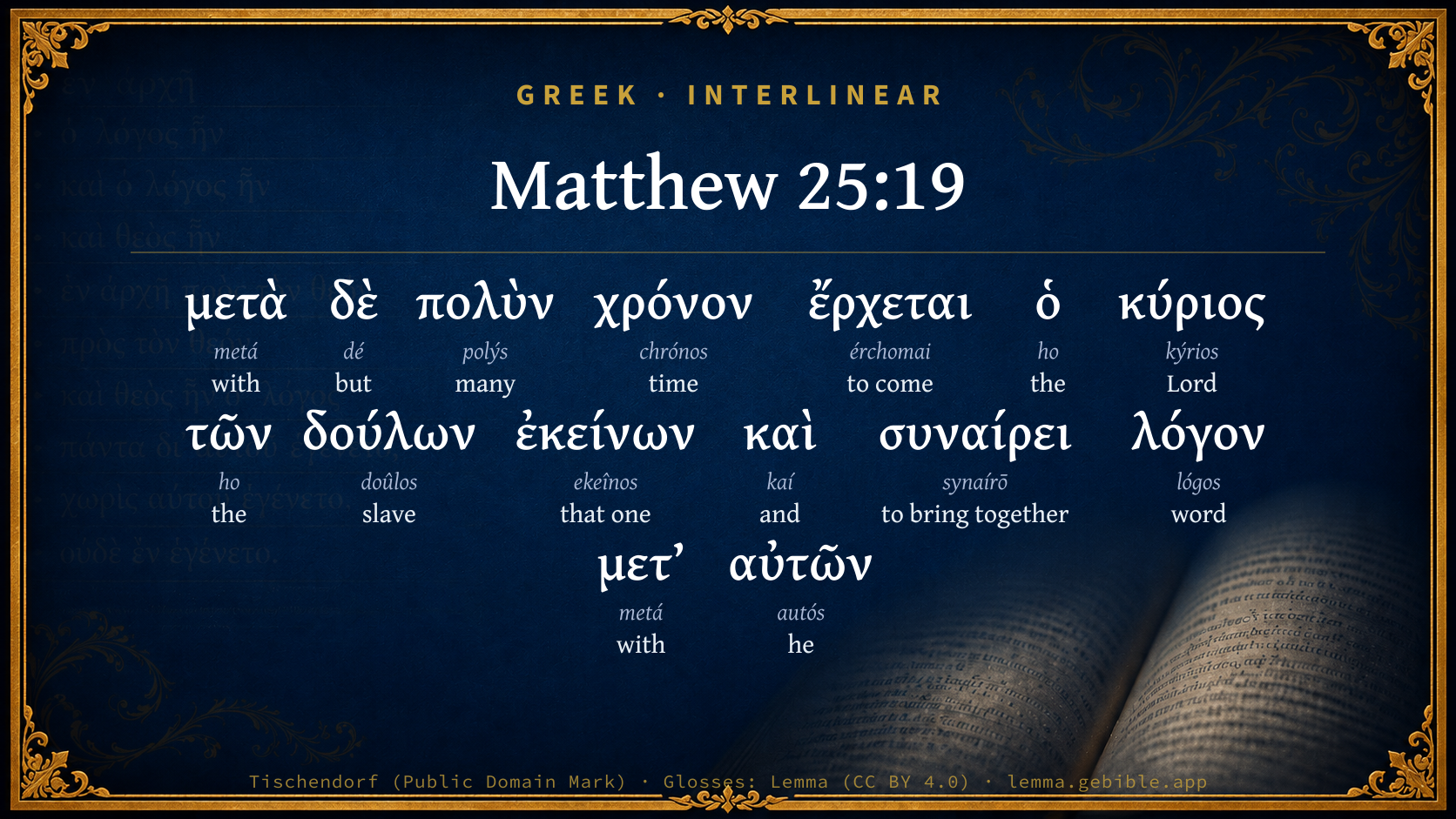
  1. μετὰ metá G3326 “with” Preposition
  2. δὲ dé G1161 “but” Conjunction
  3. πολὺν polýs G4183 “many” Adjective, Accusative, Singular, Masculine
  4. χρόνον chrónos G5550 “time” Noun, Accusative, Singular, Masculine
  5. ἔρχεται érchomai G2064 “to come” Verb, Present, Middle or Passive deponent, Indicative, 3rd person, Singular
  6. ὁ ho G3588 “the” Article, Nominative, Singular, Masculine
  7. κύριος kýrios G2962 “Lord” Noun, Nominative, Singular, Masculine
  8. τῶν ho G3588 “the” Article, Genitive, Plural, Masculine
  9. δούλων doûlos G1401 “slave” Noun, Genitive, Plural, Masculine
  10. ἐκείνων ekeînos G1565 “that one” Demonstrative pronoun, Genitive, Plural, Masculine
  11. καὶ kaí G2532 “and” Conjunction
  12. λόγον lógos G3056 “word” Noun, Accusative, Singular, Masculine
  13. μετ’ metá G3326 “with” Preposition
  14. αὐτῶν autós G846 “he” Personal pronoun, Genitive, Plural, Masculine

About this verse

These counts appear in no published source. They are computed here, from the morphology-tagged text and Lemma’s own curated glosses. What Lemma adds →

15
words
13
distinct lemmas
Gospels
section

Notable vocabulary

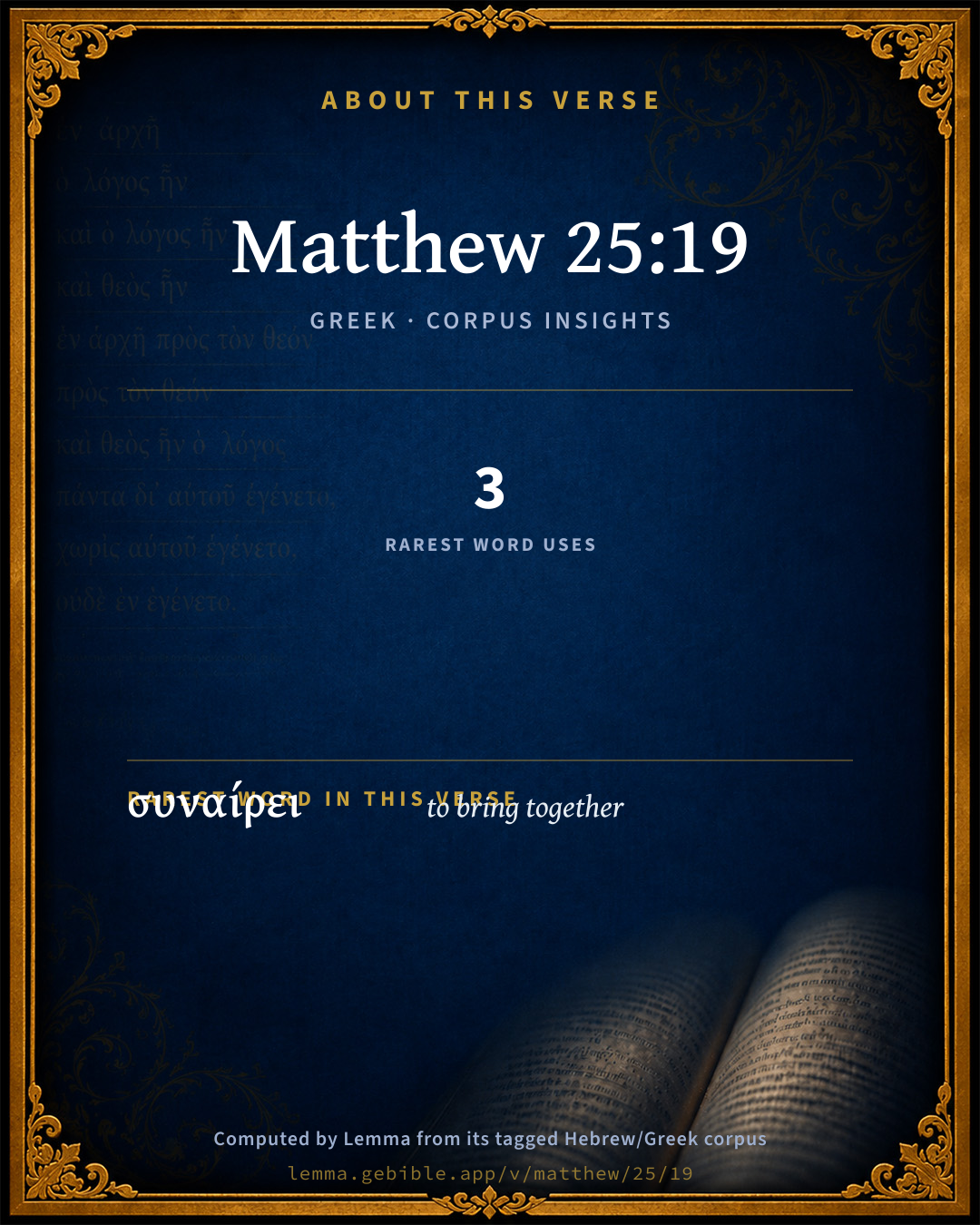
The rarest word here is συναίρει to bring together G4868 — appearing just 3 times in the whole Greek New Testament.

Shared distinctive vocabulary

συναίρει to bring together G4868 occurs in 3 verses of the Greek New Testament. Also found in:

Repetition

Words recur within this verse:

Cross-references

9

Topical passages linked to Matthew 25:19 in the Treasury of Scripture Knowledge — connected by theme and wording, ordered by reader-vote popularity; previews shown in the World English Bible.

  • 1 Corinthians 3:12–15 But if anyone builds on the foundation with gold, silver, costly stones, wood, hay, or stubble;
  • 2 Corinthians 5:10 For we must all be revealed before the judgment seat of Christ; that each one may receive the things in the body, according to what he has done, whether good or bad.
  • Romans 14:7–12 For none of us lives to himself, and none dies to himself.
  • Matthew 18:23–24 Therefore the Kingdom of Heaven is like a certain king, who wanted to reconcile accounts with his servants.
  • Luke 16:1–2 He also said to his disciples, "There was a certain rich man who had a manager. An accusation was made to him that this man was wasting his possessions.
  • Matthew 24:48 But if that evil servant should say in his heart, 'My lord is delaying his coming,'
  • Matthew 25:5 Now while the bridegroom delayed, they all slumbered and slept.
  • Luke 16:19–31 "Now there was a certain rich man, and he was clothed in purple and fine linen, living in luxury every day.
  • James 3:1 Let not many of you be teachers, my brothers, knowing that we will receive heavier judgment.

Cross-references courtesy of OpenBible.info (CC BY 4.0).

Commentary

Notes on Matthew 25:19 from classic Christian and Jewish commentators (each source and its license shown beneath its notes). The classic Christian expositions comment on the surrounding passage and are grouped to its opening verse, so a note may address several verses; the Jewish commentaries on the Tanakh (Rashi and others) are per-verse, so they appear only where the commentator wrote on this verse.

Lemma curates 59 commentaries, every one of them public domain or Creative Commons licensed, each selected and text-cleaned for this edition rather than reprinted as found. About our sources →

Joseph Benson's Commentary

Mat 25:19-20. After a long time — Namely, of trial and long-suffering, and at an hour when they thought not of it; the lord of those servants cometh — Returned and summoned them to give an account of their several trusts. Thus, though the heavens have received the Lord Jesus till the time of the restitution of all things, he will surely come and reckon with his servants, and require of them a strict account of the use which they have made of their privileges and advantages, gifts and endowments; and will say to each of them, Give an account of thy stewardship, for thou mayest be no longer steward. So he that had received five talents — brought other five — Having doubled his blessings and gifts by the proper use of them; saying, Lord, thou deliveredst unto me, &c. — He acknowledges, (as did also the second, to whom two talents had been delivered,) that from the Lord only had proceeded his blessings and advantages; that they were the Lord’s talents; and that, of consequence, he was accountable to the Lord for his use of them, and for all their increase, and was to depend on the Lord’s bounty for all his reward. Observe, reader, this is the main thing on which the fidelity of us all depends: for if we do not acknowledge God’s property in us and whatever we have or are; — if we think we have an independent right to dispose of ourselves or talents just as we see fit, without reference to the great Lord of all, we do as much as we can toward divesting him of his absolute sovereignty and supremacy; we disclaim his service, and set up for ourselves; presume, impudently presume, to trade upon our own bottoms, even with the very privileges and talents with which our Lord himself hath intrusted us for his own glory. This is a much greater evil than it may be at first suspected, and far more common than we in general apprehend. Behold, I have gained five other talents — Thy gifts have been wonderfully increased by being used according to thy direction and for thy glory. Here we have a second mark of fidelity in a true servant of Christ. As he acknowledges the Lord’s absolute propriety in him, so he diligently improves the talents intrusted to him. And this he perseveres to do, notwithstanding all the inconveniences, difficulties, and impediments he meets with, or even the long absence of his Lord. Still he keeps his eye intent upon his business, and still applies himself diligently to his work, never weary of this well doing, for he knows in due season he shall reap if he faint not; and that he must be faithful unto death if he would receive the crown of life. But these proofs of fidelity will always be attended with a third, namely, a readiness to give up his account. When a man is assured that he has acted with a single eye to his master’s advantage, it is with satisfaction that he submits his account to his master’s inspection, as thereby his honesty is proved, and fidelity clearly manifested. And so it is with the sincere Christian: it is with joy that he goes to meet his Master, and to give up his account, as having the testimony of his conscience that it has been his desire and endeavour to be faithful to his trust in the use and improvement of his talents, and that with simplicity and godly sincerity he has had his conversation in the world. Then with delight he hears of his lord’s return, and, not doubting of his approbation, goes forth with joy to meet him.

Joseph Benson's Commentary on the Old and New Testaments (1811–1818) — public domain. Text from a community e-Sword module.

Tyndale Open Study Notes

Tyndale Open Resources

25:19 After a long time: This highlights the long delay of Christ’s return (24:45-51).

Tyndale Open Study Notes — © Tyndale Open Resources, licensed CC BY-SA 4.0. Text via the HelloAO Bible API.

Bengel's Gnomon

Johann Albrecht Bengel

Mat 25:19. Μετὰ δὲ χρόνον πολὺν, but after a long time) So that there had been time enough to double the capital entrusted. The quickness of the Lord’s Advent is not absolute.

Bengel's Gnomon of the New Testament — English translation (T&T Clark, Edinburgh, 1860) — public domain. Text from a community e-Sword module.

Expositor's Greek Testament

ed. W. Robertson Nicoll

Mat 25:19-23 .

Mat 25:19 . πολὺν χρόνον : the master returns after a long time , an important expression in a parable relating to the Parusia , as implying long delay. συναίρει λόγον , maketh a reckoning, as in Mat 18:23 .

The Expositor's Greek Testament, edited by W. Robertson Nicoll (1897–1910) — public domain. Text from a community e-Sword module.

Ellicott's Commentary for English Readers

(19) After a long time.—Here, as in the previous parable, there is a faint suggestion, as it were, of a longer delay than men looked for in the Coming which is the counterpart to this.

A Bible Commentary for English Readers, edited by Charles John Ellicott (1878–1897) — public domain. Text from a community e-Sword module.

The Cambridge Bible for Schools and Colleges

gen. ed. J. J. S. Perowne

19. After a long time] Another hint that the second coming of Christ would be long deferred.

reckoneth with them] In order to have his stipulated share of the profits.

The Cambridge Bible for Schools and Colleges (gen. ed. J. J. S. Perowne; Cambridge University Press, 1878–1918) — public domain. Text from a community e-Sword module.

John Gill's Exposition

After a long time, the Lord of these servants cometh,.... Either in a providential way, by a fit of illness, or in a time of persecution, and awakens the conscience, and calls them to give an account of their stewardship; or by death, when their trading or working time is over, and they become accountable for their whole conduct, throughout their ministrations; or rather, at the last judgment, when all must appear before the judge of quick and dead, ministers as well as others, and give an account of their gifts, and the use of them, to their Lord, from whom they have received them, and whose servants they profess to be. Which coming of his is after a long time; for seventeen hundred years are now past, and he is not yet come; which is a long time in man's account, though not in God's account, with whom a thousand years are as one day; and in the apprehension of the saints, who love long for, and hasten to, the coming of Christ, are desirous of it, and impatient for it. But though it may seem long, he will certainly come: he stays long, to give time to his laborious ministers to exercise all those gifts he has bestowed upon them, and to leave slothful ones without excuse. It is not to be inferred from his delay, that he will not come: he is not unmindful of his promise, or slack concerning it; though he tarries long, he will not tarry beyond the appointed time; at the end he will come, though it is long first:

and reckoneth with them; what talents they received from him, what they had done with them, and what they had gained by them. The things that ministers of the word are intrusted with, are things of value; the Gospel is a pearl of great price, or rich treasure, that is put into their earthen vessels; it is the unsearchable riches of Christ; gifts to preach it are spiritual, and preferable to gifts of nature, and providence; and the souls of men committed to their care, are of great worth and esteem with Christ; nor are any of these their own, but Christ's, and therefore must give an account of them: this shows both the awfulness and usefulness of the Gospel ministry.

John Gill's Exposition of the Whole Bible (1746–1763) — public domain (CC PDM 1.0). Text via the HelloAO Bible API.

Trapp's Complete Commentary

John Trapp

19 After a long time the lord of those servants cometh, and reckoneth with them.

Ver. 19. And reckoneth with them] This is that which we must also come to, 2Co 5:10. Christ will one day say, Redde rationem, Give an account of thy stewardship. Cicero could say, Let us so frame our course, as that we reckon upon our last reckoning, and make account we must all come to an account. And because often reckonings keep long friends, Villicus rationem cum Domino crebro putet, saith Cato, Let us be often dealing with ourselves, and setting things to rights between God and our own souls; so shall we have the less to do at last cast. Sparing a little pains at first, doubleth it in the end; as he who will not cast up his books, his books will cast up him at length.

John Trapp, A Commentary or Exposition upon All the Books of the Old and New Testament (1647–1656) — public domain. Text from a community e-Sword module.

Albert Barnes' Notes on the Bible

After a long time ... - By the return of the lord of those servants to reckon with them is denoted the return of Christ to call people to an account for the manner in which they have improved their talents. See Rom 14:12; 2Co 5:10; 1Th 4:16; Act 1:11; Act 17:31.

Reckon with them - To reckon is to settle accounts. Here it means to inquire into their faithfulness, and to reward or punish them accordingly.

Albert Barnes' Notes on the Bible (1834–1885) — public domain. Text from a community e-Sword/MySword module.

Haydock's Catholic Bible Commentary

After a long time. This represents the time that is to intervene between our Saviour’s ascension and his last coming. For, as he is the Master, who went into a far country, i.e. to heaven, after he had inculcated the relative duties of each man in his respective state of life; so shall he come at the last day, and reckon with all men, commending those who have employed their talents well, and punishing such as have made a bad use of them. (St. Jerome)

George Leo Haydock (1774–1849), Haydock's Catholic Family Bible and Commentary, 1859 edition — public domain. Excludes Psalms (Douay-Rheims chapter numbering differs from Protestant) and Deuterocanonical books (Catholic canon only).

Matthew Poole's English Annotations

God, in the day of judgment, will call all men to account for those gifts which he hath given them, how they have used the days of life, the measures of health, their knowledge, wit, memory, understanding, their wealth, estate, honours, dignities, relations, all their natural or acquired habits, all their enjoyments, &c., for the honour of his name, and the advantage of their own souls.

Matthew Poole's English Annotations on the Holy Bible (1683–1685) — public domain. Text from a community e-Sword/MySword module.

Whedon's Commentary on the Bible

Daniel D. Whedon

19. After a long time — We have here an intimation that the judgment day was very probably far distant. Cometh — The Son of man coming to judgment.

Daniel D. Whedon (gen. ed.), Commentary on the Old and New Testaments (1874–1909) — public domain. Text from a community e-Sword module.

The Pulpit Commentary

After a long time. The interval between Christ"s ascension and his second advent (ver. 5) is long in men"s view, though Christ can say, "Lo, I come quickly". (Rev_3:11, etc.) And reckoneth with them. (Mat_18:23) The opportunity of labouring for Christ in the earthly life is ended at death; but the reckoning is reserved for the parousia the coming of the Lord. The matter in the parable is concerned with the past actions of the servants of Christ (ver. 14); about the final judgment of the rest of the world nothing is here expressly said, though certain inferences must be drawn from analogous proceedings.

The Pulpit Commentary (1880–1919), ed. H.D.M. Spence-Jones & Joseph S. Exell — public domain. Text from a community e-Sword module.

Kretzmann's Popular Commentary

Paul E. Kretzmann

The accounting of the good servants;

v. 19. After a long time the lord of those servants cometh, and reckoneth with them.

v. 20. And so he that had received five talents came and brought other five talents, saying, Lord, thou deliveredst unto me five talents; behold, I have gained beside them five talents more.

v. 21. His lord said unto him, Well done, thou. good and faithful servant; thou hast been faithful over a few things, I will make thee ruler over many things; enter thou into the joy of thy lord.

v. 22. He also that had received two talents came and said, Lord, thou deliveredst unto me two talents; behold, I have gained two other talents beside them.

v. 23. His lord said unto him, Well done, good and faithful servant; thou hast been faithful over a few things, I will make thee ruler over many things; enter thou into the joy of thy lord.

When a long time had elapsed, during which they might easily find or make opportunity to make safe and judicious, but well-paying investments, the lord came. He at once holds a conference with his servants and broaches the question of business in his absence. Proudly the first servant came forward and carried with him not only the original sum of money, but also the money he had gained by his hard work and careful business enterprise. He presents the money and holds it out for verification. The master was highly pleased, not so much at the sum of money gained as at the faithful work of the servant. He assures him that he has done excellently well; he calls him a devoted and faithful servant. And his reward would be that he would have a far greater sphere of activity in the service of his master, since such business ability, coupled with such energy, enthusiasm, and trustworthiness, was worthy of a larger field. And he was to share in the returns of his labors by becoming, in a way, the partner of the master, and enjoying the fruits of wider usefulness. In exactly the same way the second servant now stepped forward, and in the same modest, unassuming, but effective way made his report concerning the investments he had made with the master’s money. And he also was praised in the same way, commended highly for the course he had pursued, and rewarded in the identical terms as the other man, since his devotion and fidelity in his own sphere had been just as great as that of his fellow-servant with greater financial genius.

Paul E. Kretzmann, Popular Commentary of the Bible (1921–1924) — public domain. Text from a community e-Sword module.

Burkitt's Expository Notes on the New Testament

William Burkitt

Note here, 1. That the wisdom of God dispenses his gifts and graces variously, as so many talents to his servants, to be employed and improved for his own glory, and his church’s good.

2. That all such servants as have received any talents, must look to reckon and account for them: that this account must be particular, personal, exact, and impartial.

3. That all such servants as have been faithful in improving their talents, at Christ’s coming shall be both commended and rewarded also. Well done, good and faithful servant; enter thou into the joy of thy Lord.

Where observe, 1. That the state of the blessed is a state of joy.

2. That the joy which the blessed partake of, is the joy of their Lord; that is, the joy which he provides, and which he possesses.

3. That the way after which the saints partake of this joy, is by entering into it, which denotes the highest and the fullest participation of it. The joy is too great to enter into them, they must enter into that: Enter thou into the joy of thy Lord.

William Burkitt's Expository Notes on the New Testament (1700–1703) — public domain. Text from a community e-Sword module.

The People's New Testament

B. W. Johnson

19. After a long time the lord of those servants cometh. There is certainly a hint here that a long period would pass before the Lord's return. And reckoneth with them. When our race meets the Lord, every mortal, saint, and sinner, good and bad, will be called on for a reckoning. Every one's opportunities, as well as the character of his life and works, will be considered.

B. W. Johnson's The People's New Testament with Notes (1889–1891) — public domain. Electronic text from the Christian Classics Ethereal Library (CCEL) ThML edition.

unfoldingWord translationNotes

Door43 World Missions Community

Connecting Statement:

Jesus continues telling the parable about the servants and the talents. (See: Parables and Biblical Money)

Now

This word is used here to mark a break in the main story line. Here Jesus starts to tell a new part of the story.

I have made five talents more

"I have earned five more talents"

talents

A "talent" was worth twenty years' wages. Avoid translating this into modern money. See how you translated this in Matthew 25:15. (See: Biblical Money)

Well done

"You have done well" or "You have done right." Your culture might have an expression that a master (or someone in authority) would use to show that he approves of what his servant (or someone under him) has done.

Enter into the joy of your master

The phrase "Enter into the joy" is an idiom. Also, the master is speaking about himself in the third person. AT: "Come and be happy with me" (See: Idiom and First, Second, or Third Person)

translationWords

lord

faithful

joy

unfoldingWord translationNotes — © Distant Shores Media and the Door43 World Missions Community, licensed CC BY-SA 4.0. Source: git.door43.org/Door43/en_tn.

Cambridge Greek Testament for Schools and Colleges

19. μετὰ πολὺν χρόνον. Another hint that the second coming of Christ would be long deferred.

συναίρει λόγον. ‘Reckoneth with them,’ in order to have his stipulated share of the profits. συναίρ. λόγ. Not a classical expression; it appears in this Gospel only, and may have been a business phrase familiar to Matthew the publican.

Cambridge Greek Testament for Schools and Colleges (Cambridge University Press, 1896; 21 vols, various authors incl. Carr, Maclear, Plummer, Farrar, Lumby, Moule, M. R. James, Simcox) — public domain. Text from a community e-Sword module.

Alford’s Greek Testament

Henry Alford

19-23. μετὰ πολὺν χρόνον] Here again, as well as in the χρονίζ. of ver. 5 and ch. 24:48, we have an intimation that the interval would be no short one.

This proceeding is not, strictly speaking, the last judgment, but still the same as that in the former parable; the beginning of judgment at the house of God—the judgment of the millennial advent. This, to the servants of Christ (τοὺς ἰδίους δούλους, ver. 14), is their final judgment—but not that of the rest of the world. We may observe that this great account differs from the coming of the bridegroom, inasmuch as this is altogether concerned with a course of action past—that with a present state of preparation. This holds, in the individual application, of the account after the resurrection: that, at the utmost (and not in the direct sense of the parable even so much), of being ready for his summons at death.

Henry Alford, The Greek Testament (1849–1861) — public domain. Text from a community e-Sword module.

International Critical Commentary

19. And after a long time cometh the master of those servants, and taketh account with them.]—συναίρειν—λόγον] cf. on 18:23.

(L)

International Critical Commentary — older volumes (1896–1929), various authors — public domain. Text from a community e-Sword module.

Lesson kit

Teaching starters — assembled from the data on this page, not authored interpretation. Every prompt links to the verse data it draws on. Edit before teaching.

Matthew, in the Gospels, opens this verse with 15 words (13 distinct Greek lemmas). Its most distinctive word is synaírō (“to bring together”). A historical commentator’s framing appears above. Read the whole chapter for the surrounding context.

Discussion questions

  1. The word synaírō carries the sense “to bring together.” How does it shape the verse?
  2. How does Matthew 18:23, which shares the word «to bring together», read alongside this verse?
  3. What does the repetition of “with” (2× in this one verse) do in this verse?
  4. These translations render this verse differently; the difference is in the English rendering, not the original. What questions does that raise?
  5. Compare how Joseph Benson's Commentary and Tyndale Open Study Notes read this verse. Where do they agree or differ?

Things to notice

Reading settings

Reading text

Shown beneath each verse's original-language words.

Old Testament
Old Testament edition

Read the OT as the Masoretic Hebrew (MT) or the Greek Septuagint (LXX).

English shown for the Greek Septuagint (in the Hebrew ↔ Greek comparison).

Comparing translations? Open the Compare panel on any verse page to stack up to four side by side.