Revelation 19:12

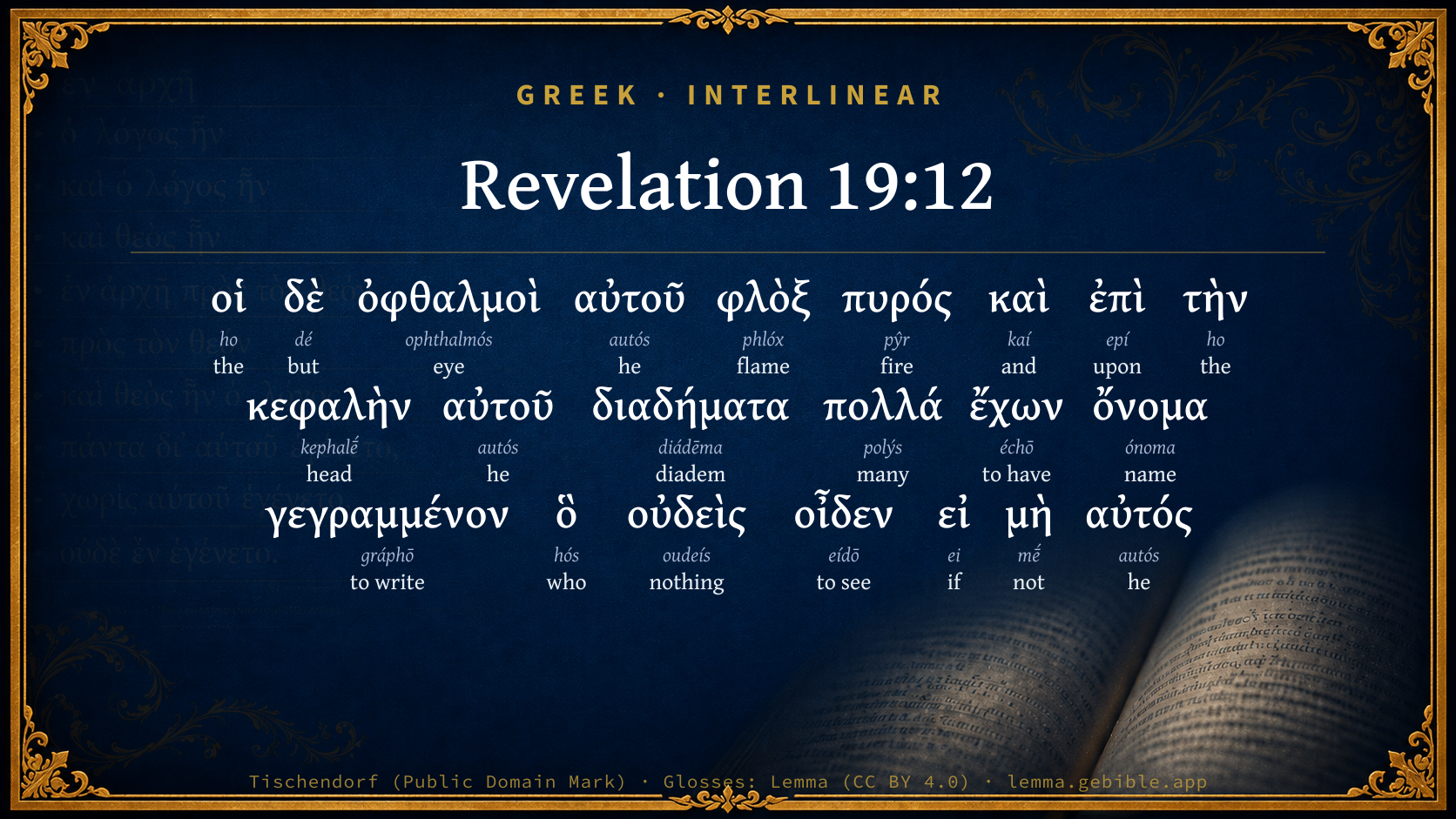
Greek (Tischendorf 8th ed.) Revelation 19:12 appears in the Greek New Testament. The text above is from the Tischendorf 8th edition. Each word links to its Strong’s number and a concise gloss. Click any word for its full Thayer’s Greek Lexicon entry.
Download image
Cite this verse

Revelation 19:12 (World English Bible). Public Domain. Lemma interlinear Bible study tool, https://lemma.gebible.app/v/revelation/19/12.

Show BibTeX & RIS
BibTeX
RIS
English Translation
His eyes are a flame of fire, and on his head are many crowns. He has names written and a name written which no one knows but he himself.
World English Bible · Public Domain
Download a study sheet

One document with this verse’s original text, its word-by-word gloss line, the meaning frame, cross-references with their text, attributed commentary, and full source and license credits — printable, and it pastes into notes with its structure intact.

This verse Autodidact and up

Study sheet (.html) Plain text (.txt)

A passage Seminary Student

Up to 50 verses in one chapter. A passage sheet keeps up to 6 commentary sources and 12 cross-references per verse, in the order this page ranks them, and says so on the sheet whenever that leaves anything out. Ask for a single verse and you get the Autodidact verse sheet above.

Everything on this page stays free to read, with no account — the sheet is a download of what is already on screen, not access to it.

Want to remove ads? Support Godless Engineer
Compare translations 3

The same verse in 3 English versions, stacked beneath the original-language interlinear above. Click any original word for its lexicon entry.

Each is an independent rendering of the whole verse — the interlinear is not word-aligned to these translations.

Highlighted words mark where these versions differ — a whole-verse word diff, not a word-by-word alignment.

  • World English Bible Public Domain
    His eyes are a flame of fire, and on his head are many crowns. He has names written and a name written which no one knows but he himself.
  • King James Version Public Domain
    His eyes were as a flame of fire, and on his head were many crowns; and he had a name written, that no man knew, but he himself.
  • unfoldingWord Literal Text CC BY-SA 4.0
    his eyes also a flame of fire, and many crowns on his head, having a name written that no one knows except himself,

unfoldingWord Literal Text — © unfoldingWord, licensed CC BY-SA 4.0. Word-aligned USFM3 via Door43 (git.door43.org/unfoldingWord/en_ult).

Versions to compare (up to 4)

3 of 4 selected

Show all 19 translations

Every available English version of this verse, each an independent rendering of the whole verse.

  • World English Bible Public Domain
    His eyes are a flame of fire, and on his head are many crowns. He has names written and a name written which no one knows but he himself.
  • Berean Standard Bible Public Domain
    He has eyes like blazing fire, and many royal crowns on His head. He has a name written on Him that only He Himself knows.
  • Majority Standard Bible Public Domain
    He has eyes like blazing fire, and many royal crowns on His head. He has names written on Him, and a name written that only He Himself knows.
  • King James Version Public Domain
    His eyes were as a flame of fire, and on his head were many crowns; and he had a name written, that no man knew, but he himself.
  • American Standard Version (1901) Public Domain
    And his eyes `are' a flame of fire, and upon his head `are' many diadems; and he hath a name written which no one knoweth but he himself.
  • Revised Version (1885) Public Domain
    And his eyes are a flame of fire, and upon his head are many diadems; and he hath a name written, which no one knoweth but he himself.
  • Geneva Bible (1599) Public Domain
    And his eyes were as a flame of fire, and on his head were many crownes: and he had a name written, that no man knewe but himselfe.
  • Douay-Rheims (1899) Public Domain
    And his eyes were as a flame of fire, and on his head were many diadems, and he had a name written, which no man knoweth but himself.
  • Young's Literal Translation Public Domain
    and his eyes `are' as a flame of fire, and upon his head `are' many diadems -- having a name written that no one hath known, except himself,
  • Literal Standard Version CC BY-SA 4.0
    and His eyes [are] as a flame of fire, and on His head [are] many crowns—having a Name written that no one has known, except Himself,
  • Unlocked Literal Bible CC BY-SA 4.0
    His eyes are like a fiery flame, and on his head are many crowns. He has a name written on him that no one knows but himself.
  • unfoldingWord Literal Text CC BY-SA 4.0
    his eyes also a flame of fire, and many crowns on his head, having a name written that no one knows except himself,
  • Darby Bible Public Domain
    And his eyes are a flame of fire, and upon his head many diadems, having a name written which no one knows but himself;
  • World Messianic Bible Public Domain
    His eyes are a flame of fire, and on his head are many crowns. He has names written and a name written which no one knows but he himself.
  • Webster's Bible Public Domain
    His eyes were as a flame of fire, and on his head were many crowns; and he had a name written, that no man knew, but he himself.
  • Free Bible Version CC BY-SA 4.0
    His eyes were like flaming fire. On his head were many crowns. He had a name written on him which no one but he himself knows.
  • Bible in Basic English Public Domain
    And his eyes are a flame of fire, and crowns are on his head; and he has a name in writing, of which no man has knowledge but himself.
  • Text-Critical English NT CC BY 4.0
    His eyes are a flame of fire, and on his head are many crowns. Names were written on him, including a name that no one knows but he himself.
  • Tyndale New Testament (1534) Public Domain
    His eyes were as a flame of fyre: and on his heed were many crounes: and he had a name written that noman knewe but him sylfe.

Literal Standard Version (2020), Covenant Press — licensed CC BY-SA 4.0. Text via the HelloAO Bible API (eBible.org). Unlocked Literal Bible (unfoldingWord) — licensed CC BY-SA 4.0. Text via the HelloAO Bible API (eBible.org). unfoldingWord Literal Text — © unfoldingWord, licensed CC BY-SA 4.0. Word-aligned USFM3 via Door43 (git.door43.org/unfoldingWord/en_ult). Free Bible Version, Dr. Jonathan Gallagher — licensed CC BY-SA 4.0. Text via the HelloAO Bible API (eBible.org).

Word by word

More ways to search: Search by grammar → Find every occurrence → Compare this word →

Practice this passage: Drill this verse → Learn its vocabulary →

διαδήματα
diádēma
G1238
“diadem”
Noun, Nominative, Plural, Neuter
Part of Speech
Noun
Case
Nominative
Number
Plural
Gender
Neuter
Full Thayer's Definition

Origin: from a compound of G1223 and G1210

TDNT: None

1. a diadem a. a blue band marked with white which Persian kings used to bind on the turban or tiara b. the kingly ornament for the head, the crown
  1. οἱ ho G3588 “the” Article, Nominative, Plural, Masculine
  2. δὲ dé G1161 “but” Conjunction
  3. ὀφθαλμοὶ ophthalmós G3788 “eye” Noun, Nominative, Plural, Masculine
  4. αὐτοῦ autós G846 “he” Personal pronoun, Genitive, Singular, Masculine
  5. φλὸξ phlóx G5395 “flame” Noun, Nominative, Singular, Feminine
  6. πυρός pŷr G4442 “fire” Noun, Genitive, Singular, Neuter
  7. καὶ kaí G2532 “and” Conjunction
  8. ἐπὶ epí G1909 “upon” Preposition
  9. τὴν ho G3588 “the” Article, Accusative, Singular, Feminine
  10. κεφαλὴν kephalḗ G2776 “head” Noun, Accusative, Singular, Feminine
  11. αὐτοῦ autós G846 “he” Personal pronoun, Genitive, Singular, Masculine
  12. πολλά polýs G4183 “many” Adjective, Nominative, Plural, Neuter
  13. ἔχων échō G2192 “to have” Verb, Present, Active, Participle, Nominative, Singular, Masculine
  14. ὄνομα ónoma G3686 “name” Noun, Accusative, Singular, Neuter
  15. γεγραμμένον gráphō G1125 “to write” Verb, Perfect, Passive, Participle, Accusative, Singular, Neuter
  16. ὃ hós G3739 “who” Relative pronoun, Accusative, Singular, Neuter
  17. οὐδεὶς oudeís G3762 “nothing” Adjective, Nominative, Singular, Masculine, Negative
  18. οἶδεν eídō G1492 “to see” Verb, Perfect, Active, Indicative, 3rd person, Singular
  19. εἰ ei G1487 “if” Conditional
  20. μὴ mḗ G3361 “not” Particle, Negative
  21. αὐτός autós G846 “he” Personal pronoun, Nominative, Singular, Masculine

About this verse

These counts appear in no published source. They are computed here, from the morphology-tagged text and Lemma’s own curated glosses. What Lemma adds →

22
words
19
distinct lemmas
Revelation
section

Notable vocabulary

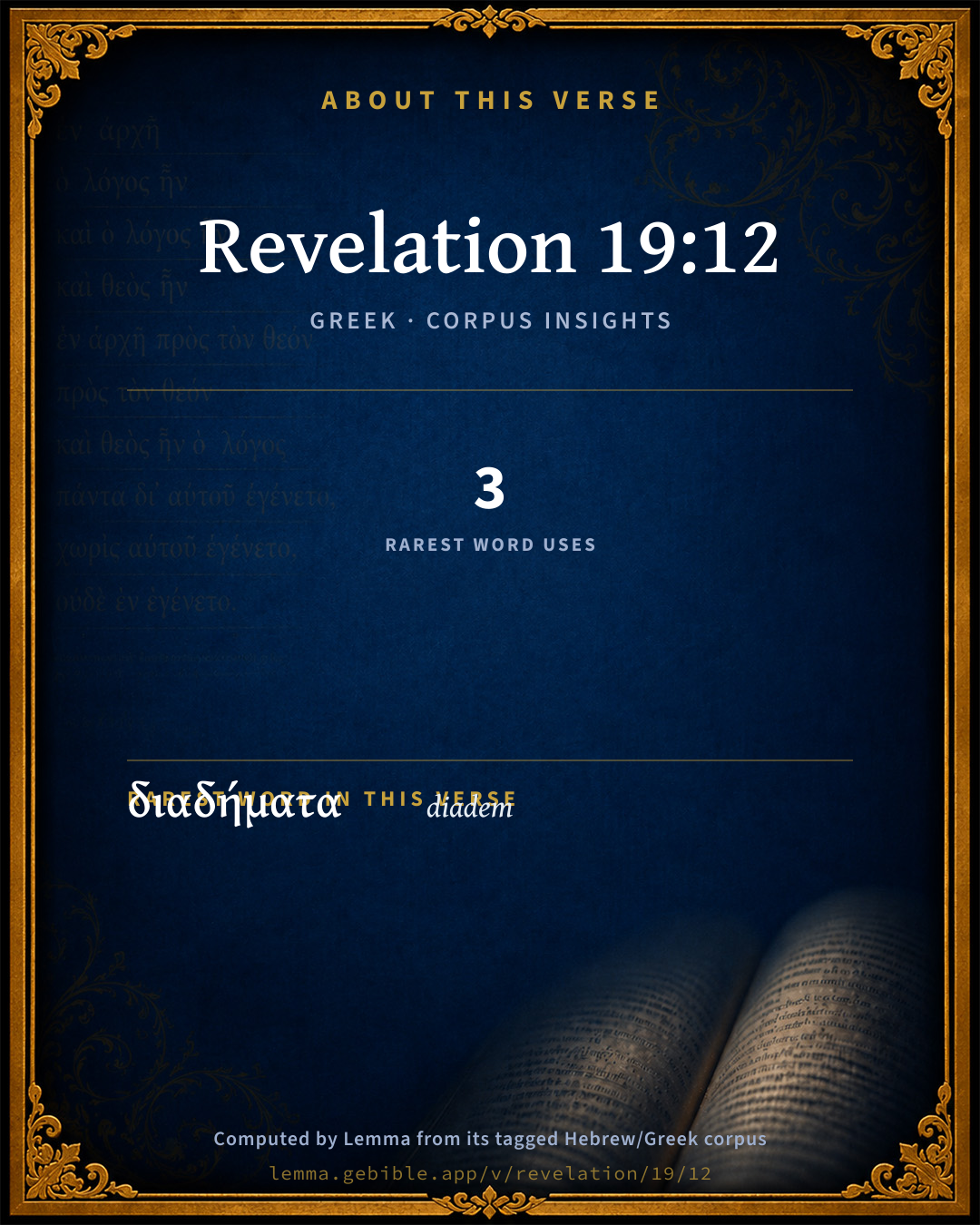
The rarest word here is διαδήματα diadem G1238 — appearing just 3 times in the whole Greek New Testament.

Shared distinctive vocabulary

διαδήματα diadem G1238 occurs in 3 verses of the Greek New Testament. Also found in:

Repetition

Words recur within this verse:

  • αὐτοῦ he G846 ×3
  • οἱ the G3588 ×2

Cross-references

20

Topical passages linked to Revelation 19:12 in the Treasury of Scripture Knowledge — connected by theme and wording, ordered by reader-vote popularity; previews shown in the World English Bible.

  • Revelation 19:16 He has on his garment and on his thigh a name written, "KING OF KINGS, AND LORD OF LORDS."
  • Luke 10:22 Turning to the disciples, he said, "All things have been delivered to me by my Father. No one knows who the Son is, except the Father, and who the Father is, except the Son, and he to whomever the Son desires to reveal him."
  • Matthew 11:27 All things have been delivered to me by my Father. No one knows the Son, except the Father; neither does anyone know the Father, except the Son, and he to whom the Son desires to reveal him.
  • Revelation 1:14 His head and his hair were white as white wool, like snow. His eyes were like a flame of fire.
  • Revelation 2:17–18 He who has an ear, let him hear what the Spirit says to the assemblies. To him who overcomes, to him I will give of the hidden manna, and I will give him a white stone, and on the stone a new name written, which no one knows but he who receives it.
  • Matthew 28:18 Jesus came to them and spoke to them, saying, "All authority has been given to me in heaven and on earth.
  • Psalms 8:5 For you have made him a little lower than God, And crowned him with glory and honor.
  • Isaiah 9:6 For to us a child is born, to us a son is given; and the government shall be on his shoulder: and his name shall be called Wonderful, Counselor, Mighty God, Everlasting Father, Prince of Peace.
  • Hebrews 2:9 But we see him who has been made a little lower than the angels, Jesus, because of the suffering of death crowned with glory and honor, that by the grace of God he should taste of death for everyone.
  • Revelation 3:12 He who overcomes, I will make him a pillar in the temple of my God, and he will go out from there no more. I will write on him the name of my God, and the name of the city of my God, the new Jerusalem, which comes down out of heaven from my God, and my own new name.
  • Zechariah 9:16 Yahweh their God will save them in that day as the flock of his people; For they are like the jewels of a crown, Lifted on high over his land.
  • Revelation 12:3 Another sign was seen in heaven. Behold, a great red dragon, having seven heads and ten horns, and on his heads seven crowns.
  • Genesis 32:29 Jacob asked him, "Please tell me your name." He said, "Why is it that you ask what my name is?" He blessed him there.
  • Exodus 23:21 Pay attention to him, and listen to his voice. Don't provoke him, for he will not pardon your disobedience, for my name is in him.
  • Judges 13:18 The angel of Yahweh said to him, Why do you ask after my name, seeing it is wonderful?
  • Isaiah 62:3 You shall also be a crown of beauty in the hand of Yahweh, and a royal diadem in the hand of your God.
  • Revelation 6:2 And behold, a white horse, and he who sat on it had a bow. A crown was given to him, and he came forth conquering, and to conquer.
  • Song of Solomon 3:11 Go forth, you daughters of Zion, and see king Solomon, With the crown with which his mother has crowned him, In the day of his weddings, In the day of the gladness of his heart. Lover
  • Matthew 21:5 "Tell the daughter of Zion, Behold, your King comes to you, Humble, and riding on a donkey, On a colt, the foal of a donkey."
  • Revelation 13:1 Then I stood on the sand of the sea. I saw a beast coming up out of the sea, having ten horns and seven heads. On his horns were ten crowns, and on his heads, blasphemous names.

Cross-references courtesy of OpenBible.info (CC BY 4.0).

Where the printed editions differ

1 variant

Places in this verse where the major printed Greek editions disagree on the wording in a way that affects the translation — a comparison of editions, not a manuscript-by-manuscript collation. The editions are the modern critical texts (Nestlé-Aland 28/27, SBL, Westcott-Hort, Tregelles, Tyndale House) and the traditional texts behind the KJV (the Textus Receptus and the Byzantine/Majority text). It is not a claim about which reading is original.

  1. Extra text
    ὀνόματα γεγραμμένα καὶ

    “names written and”

    In Byz Not in NA28NA27TynSBLWHTregTR

    ὀνόματα γεγραμμένα καὶ (onomata gegrammena kai) 'names written and' is only in a few manuscripts (Byz)

Textual data: Translators Amalgamated Greek New Testament (STEPBible TAGNT) · CC BY 4.0.

Commentary

Notes on Revelation 19:12 from classic Christian and Jewish commentators (each source and its license shown beneath its notes). The classic Christian expositions comment on the surrounding passage and are grouped to its opening verse, so a note may address several verses; the Jewish commentaries on the Tanakh (Rashi and others) are per-verse, so they appear only where the commentator wrote on this verse.

Lemma curates 59 commentaries, every one of them public domain or Creative Commons licensed, each selected and text-cleaned for this edition rather than reprinted as found. About our sources →

Ellicott's Commentary for English Readers

(12, 13) His eyes were as a flame . . .—Or, rather, And His eyes are (as) a flame of fire, and upon His head many diadems—(He) having names written, and a name written which no one knows but He Himself—and clothed in a vesture dipped in blood, and His name is called The Word of God. On the description here and in Rev_19:5, comp. Notes on Rev_1:14-16. There is no doubt who is before us in this vision. These flame-like eyes have been fixed upon the moving scenes of human life, and have been reading the hearts of men, and the true meaning of all events and actions. All things have been naked and open to the eyes of Him with Whom we have to do” (Heb_4:13). He wears many crowns—diadems—crowns rather of royalty than of victory. Some have thought that the crowns He wears are crowns taken from the heads of the kings who have made war with Him (Rev_19:12-13, and Rev_19:19). It is needless to suppose this; their crowns were His before they were discrowned. The diadems He wears proclaim that not only over a worldwide empire He is king, but of all nations He is truly king. He is not as an emperor among kings, the head of a federation of princedoms; but He is truly King—King of history, King of life, King of human hearts, King everywhere, over each realm and over all realms, King of kings, and Lord of lords. He has names written, and a name. The clause having “names written” is omitted in the English version. The authority for its insertion is not entirely satisfactory; but perhaps the balance of evidence is in its favour. He has many names which may be understood, besides a name which no one knows. This is fitting in One who is known to men as Shepherd, Redeemer, Saviour, Prince of Life, but the fulness of Whose love and power none can exhaust, and the depth of Whose wisdom none can fathom. “He knows our names. Thanks be to God, we cannot fathom the depths of His.” There is more yet to be known of Him in the world to which we go. His vesture is dipped in blood. The prophet Isaiah (Isa_63:2) probably supplied the foundation of this description. (Comp. Rev_19:15.) The blood-red vesture is a fit token of the work. He comes to destroy those that destroy the earth—to tread the winepress of the wrath of God; but we cannot forget that He who comes for this came first to shed His own blood. He is, too, “The Word of God.” Again we hear this name; it is a name which is, besides other things, significant of Christ’s mediating work. He is the Word who was with God, who was God, and who declares God to man. (Comp. Joh_1:1-4; Joh_3:13; Joh_14:9.) The title the Word, the Word of God—used here and in the Gospel of St. John (Rev_1:2; Joh_1:1; 1Jn_1:1)—is a token of their common authorship. (See Introduction and Excursus A: The Doctrine of the Word, in Commentary on the Gospel.)

A Bible Commentary for English Readers, edited by Charles John Ellicott (1878–1897) — public domain. Text from a community e-Sword module.

Tyndale Open Study Notes

Tyndale Open Resources

19:12 His eyes were like flames of fire: See 1:14-16; Dan 10:6. • Christ, wearing many crowns, is contrasted with the dragon, whose seven heads were each crowned (see Rev 12:3).

Tyndale Open Study Notes — © Tyndale Open Resources, licensed CC BY-SA 4.0. Text via the HelloAO Bible API.

Expositor's Greek Testament

ed. W. Robertson Nicoll

Rev 19:12 . διαδήματα πολλά , bec. he is king of kings (Ptolemy on entering Antioch put two diadems on his head, that of Egypt and that of Asia ( 1Ma 11:13 ); cf. the ten golden diadems of royalty in ancient Egypt). Once crowned with thorns, Jesus is now invested with more than royal rank ( cf. Barn. vii. 9, where Jesus, once accursed, is shown crowned). Eastern monarchs wore such royal insignia when they went into battle ( e.g. , 2Sa 1:10 ). Jesus has far more than the four (of a good name, of the law, of the high priesthood, of the divine kingdom, Targ. Jerus, on Deu 34 ) 5 or three (omitting the first) which Jewish tradition assigned to Moses (see Pirke Aboth, iv. 13, vi. 5; Joseph. Bell . i. 2, 8, prophetic, priestly, and royal honours). ὄνομα κ . τ . λ ., cf. Ep. Lugd., “when Attalus was placed on the iron seat and the fumes rose from his burning body, he was asked, ‘What name has God?’ ‘God,’ he answered, ‘has not a name as man has.” Contrast ὃ οὐδεὶς κ . τ . λ ., with Mat 11:27 . The earlier words, πιστ . κ . ἀληθ ., are a description of the messiah’s character and function, rather than a title. At this debût, which is the only event in the Apocalypse at all corresponding to the second advent (Rev 1:7 ), the messiah’s judicial power is practically restricted to the external work of crushing the last pagan opposition to God’s cause on earth; it becomes therefore almost military. The divine commandant of the saints is “faithful and true,” as he loyally executes the divine purpose and thus exhibits fidelity to the interests of the faithful. The sense remains unchanged, whether the two adjectives are taken as synonyms, or ἀληθ . assigned its occasional meaning of “real”. Even in the latter case, to be real would mean to be trustworthy.

The Expositor's Greek Testament, edited by W. Robertson Nicoll (1897–1910) — public domain. Text from a community e-Sword module.

Jamieson, Fausset & Brown

Robert Jamieson, A. R. Fausset & David Brown

Identifying Him with the Son of man similarly described, Rev 1:14.

many crowns--Greek, "diadems": not merely (Greek, "stephanoi") garlands of victory, but royal crowns, as KING OF KINGS. Christ's diadem comprises all the diadems of the earth and of heavenly powers too. Contrast the papal tiara composed of three diadems. Compare also the little horn (Antichrist) that overcomes the three horns or kingdoms, Dan 7:8, Dan 7:24 (Quære, the Papacy? or some three kingdoms that succeed the papacy, which itself, as a temporal kingdom, was made up at first of three kingdoms, the exarchate of Ravenna, the kingdom of the Lombards, and the state of Rome, obtained by Pope Zachary and Stephen II from Pepin, the usurper of the French dominion). Also, the seven crowns (diadems) on the seven heads of the dragon (Rev 12:3), and ten diadems on the ten heads of the beast. These usurpers claim the diadems which belong to Christ alone.

he had a name written--B and Syriac insert, "He had names written, and a name written," &c., meaning that the names of the dominion which each diadem indicated were written on them severally. But A, Vulgate, ORIGEN, and CYPRIAN omits the words, as English Version.

name . . . that no man knew but . . . himself-- (Jdg 13:18; Co1 2:9, Co1 2:11; Jo1 3:2). The same is said of the "new name" of believers. In this, as in all other respects, the disciple is made like his Lord. The Lord's own "new name" is to be theirs, and to be "in their foreheads"; whence we may infer that His as yet unknown name also is written on His forehead; as the high priest had "Holiness to the Lord" inscribed on the miter on his brow. John saw it as "written," but knew not its meaning. It is, therefore, a name which in all its glorious significancy can be only understood when the union of His saints with Him, and His and their joint triumph and reign, shall be perfectly manifested at the final consummation.

Jamieson, Fausset & Brown — Commentary Critical and Explanatory on the Whole Bible (1871) — public domain (CC PDM 1.0). Text via the HelloAO Bible API.

Adam Clarke's Commentary

Verse 12. His eyes were as a flame of fire] To denote the piercing and all-penetrating nature of his wisdom.

On his head were many crowns] To denote the multitude of his conquests, and the extent of his dominion.

A name written, that no man knew] This is a reference to what the rabbins call the shem hammephorash, or tetragrammaton, יהוה YHVH; or what we call Jehovah. This name the Jews never attempt to pronounce: when they meet with it in the Bible, they read אדני Adonai for it; but, to a man, they all declare that no man can pronounce it; and that the true pronunciation has been lost, at least since the Babylonish captivity; and that God alone knows its true interpretation and pronunciation. This, therefore, is the name which no man knew but he himself.

Adam Clarke's Commentary on the Bible (1810–1826) — public domain. Text from a community e-Sword/MySword module.

The Cambridge Bible for Schools and Colleges

gen. ed. J. J. S. Perowne

12. His eyes, &c.] Rev_1:14.

many crowns] These are distinctively kingly crowns, see on Rev_4:4, Rev_6:2. Their number marks Him as King of kings, Rev_19:16 : perhaps also as both King and Priest, as in Zec_6:11 sqq., and in the use of the triple crown by modern popes.

a name written] Probably on the forehead, as Rev_14:1. There is some authority for the remarkable reading, “names written, and a name written which,” &c.

that no man knew, &c.] Rev_2:17 : for the Lord having such a name, see Rev_3:12, and notes on both places.

The Cambridge Bible for Schools and Colleges (gen. ed. J. J. S. Perowne; Cambridge University Press, 1878–1918) — public domain. Text from a community e-Sword module.

John Gill's Exposition

His eyes were as a flame of fire,.... Which denotes the perspicuity and penetration of them, the omniscience of Christ to look into and discover the secret machinations, schemes, and devices of his enemies against his people, and his exercise of it in favour of them, his eyes, like a flame of fire, running to and fro on their behalf; and also this may signify the fierceness of his anger against the enemies of his people, the eyes of his glory being provoked by their cruelty and wickedness; and likewise the suddenness of their destruction, and the inevitableness of it.

And on his head were many crowns; for he has not only a crown, as the Creator and Governor of the universe, in right of nature, but he has one which his Father has put upon his head, when he set him as King over his holy hill of Zion, Psa 21:3 and there is another which his mother, the church, crowned him with in the day of his espousals, Sol 3:11 and besides these, every believer puts a crown on his head, gives him the glory of their salvation, and all of them cast their crowns at his feet: to which may be added, that the crowns of all the kings of the earth are his; they reign by him, and are accountable to him. This part of the description may be expressive of that all power in heaven and earth, given to Christ at his resurrection, and exercised by him ever since; and particularly of the extensiveness of his kingdom at the time this vision refers to, when the kingdoms of this world shall be his, Rev 11:15 for this vision, and the seventh trumpet, are contemporary; and it may be a symbol of the many victories obtained by him, and of the last and closing one that should now be obtained by him.

And he had a name written that no man knew but he himself; which seems to be his name, the Son of God, as the unknown name of the overcomer, in Rev 2:17 is a child of God; and the sense is, that his divine nature, in which he is the Son of God, is incomprehensible, and that the begetting or generation of him, as such, is ineffable, Pro 30:4 and that without a divine revelation the name itself could not be known; or it could not be known that God had a Son, and that Christ is he, and bears that name, Mat 11:27 or else his name Immanuel. The incarnate God may be intended, which is a secret and wonderful name, and contains in it, without controversy, a great mystery, which cannot be comprehended by finite minds; or his name, "wonderful, secret", Isa 9:6. This name is said to be "written"; that is, in the Scriptures of truth, in which it is revealed that Christ is the Son of God, and Immanuel. In Rev 19:16 the name of King of kings, &c. is said to be written on his vesture, and on his thigh; and the Ethiopic version makes this to be written on his crown or diadem, reading the words thus; "and upon his head a crown, and there was written in his diadem a name, and no man knew it, but he himself only"; as the high priest had "holiness to the Lord" written on his mitre. The Syriac version inserts a clause between the two last, "having names written", and then follows, "and a name written", &c. and so the Complutensian edition.

John Gill's Exposition of the Whole Bible (1746–1763) — public domain (CC PDM 1.0). Text via the HelloAO Bible API.

Trapp's Complete Commentary

John Trapp

12 His eyes were as a flame of fire, and on his head were many crowns; and he had a name written, that no man knew, but he himself.

Ver. 12. His eyes were as a flame of fire] A quick sighted Judge, an intelligent warrior. "Counsel and strength are for the war," 2Ki 18:20.

And on his head were many crowns] Let the triple crowned pope look to himself; Christ outcrowns him by far.

And he had a name written] His holy and reverend name Jehovah, importing his Godhead; for he is "Jehovah, our righteousness," Jer 23:6. And as thus, no man knows the Son but the Father, Mat 11:27; for as God he is incomprehensible, Jdg 13:18; "What is his name, or what is his Son’s name, if thou canst tell?" Pro 30:4; "Who shall declare his generation?" Isa 53:8. Or by this unknown name may be meant his dignity of being Head of his Church; which is incommunicable to any other, Php 2:9.

John Trapp, A Commentary or Exposition upon All the Books of the Old and New Testament (1647–1656) — public domain. Text from a community e-Sword module.

Albert Barnes' Notes on the Bible

His eyes were as a flame of fire - See the notes on Rev 1:14.

And on his head were many crowns - Many diadems, indicative of his universal reign. It is not said how these were worn or arranged on his head - perhaps the various diadems worn by kings were in some way wreathed into one.

And he had a name written - That is, probably on the frontlet of this compound diadem. Compare the notes on Rev 13:1; Rev 14:1.

That no man knew but he himself - See the notes on Rev 2:17. This cannot here mean that no one could read the name, but the idea is, that no one but himself could fully understand its import. It involved a depth of meaning, and a degree of sacredness, and a relation to the Father, which he alone could apprehend in its true import. This is true of the name here designated - “the Word of God” - the “Logos” - Λόγος Logos; and it is true of all the names which he bears. See Mat 11:27. Compare a quotation from Dr. Buchanan in the Asiatic Researches, vol. 1, vi. p. 264, as quoted by Rosenmuller, Morgenland, in loco.

Albert Barnes' Notes on the Bible (1834–1885) — public domain. Text from a community e-Sword/MySword module.

Haydock's Catholic Bible Commentary

Flame, &c. Which shews his indignation. --- Diadems; the mark of power. So Ptolemy, the king of Egypt, after he had entered Antiochia, took two crowns, to signify that he was king of two countries, Syria and Egypt. (Pastorini) --- Which (name) no man knoweth but himself. Some interpreters think St. John alludes to an ancient custom which still obtains among the Orientals, of having a secret name, which they discover to no one. (Calmet) --- Pastorini understands this to be the name of the word of God, as mentioned in the subsequent verse; which is so comprehensive in its meaning, that human reason cannot fathom it, and no man knoweth but himself.

George Leo Haydock (1774–1849), Haydock's Catholic Family Bible and Commentary, 1859 edition — public domain. Excludes Psalms (Douay-Rheims chapter numbering differs from Protestant) and Deuterocanonical books (Catholic canon only).

Matthew Poole's English Annotations

His eyes were as a flame of fire: see Rev 1:14; 2:18. This denoted either his piercing knowledge, or his infinite wisdom and understanding.

And on his head were many crowns; and there needs must be so; for, Rev 19:16, he is said to be the King of kings, and Lord of lords.

And he had a name written, that no man knew, but he himself; this denoted the incomprehensibleness of his Divine essence and perfections.

Matthew Poole's English Annotations on the Holy Bible (1683–1685) — public domain. Text from a community e-Sword/MySword module.

Whedon's Commentary on the Bible

Daniel D. Whedon

12. Eyes… fire—Note on Rev_1:14. Dazzling to the view, searching and omniscient in their glance. No enemy can deceive him, no secret lurk from him, no fugitive escape him.

Many crowns—In correspondence with his being (Rev_19:16) king of kings and Lord of lords.

Name… no man knew—So the Jewish high priest wore on his forehead the name of Jehovah, which none but the high priest might utter. Perhaps the present words mean that Christ is Jehovah. Otherwise the meaning may be, that there are depths—there is a secret—in the nature of Christ, which none can fathom save his self-conscious self.

Daniel D. Whedon (gen. ed.), Commentary on the Old and New Testaments (1874–1909) — public domain. Text from a community e-Sword module.

The Pulpit Commentary

His eyes were as a flame of fire; and his eyes are a flame of fire. Again as in Rev_1:13. "Fire" is the type of purity and judgment. (see Psa_97:3 Isa_47:14 Isa_66:15 Amo_5:6 1Co_3:13, etc.; Rev_3:18) And on his head were many crowns; and upon his head are many diadems. Diadhmata , "kingly crowns, (cf. Rev_12:3 Rev_13:1) because he now comes as a King to judgment. The plurality of "crowns" points to his character as King of kings. (see Rev_17:14; cf. Rev_13:1) And he had a name written, that no man knew, but he himself; hath a name... no, one knoweth. Evidently the "new name" of Rev_3:12, the significance of which St. John is unable to comprehend. (see on Rev_2:7 Rev_3:12) From the connection with the preceding clause, we naturally infer that this name was written upon his forehead; (cf. Rev_7:3 Rev_16:1) but the writer does not explicitly state this. In B, twenty-five cursives, and Syriac, the words, "names written and," are inserted before "name.

The coronation of the Saviour.

"On his head were many crowns." We know whose head is meant. It was "the head that once was crowned with thorns;" the head that was once pillowed on a human mother"s breast; the head that "had not where," during the days of his earthly ministry, "to lay" itself down to rest; the head that once and again was a fountain of tears because of man"s sorrow and man"s sin; the head that was beaten and spit upon by his enemies; the head that was bound about by the linen wrappings of the tomb; the head that was "bowed" when on the cross "he gave up the ghost; on that head St. John saw in vision "many crowns." To see desert rewarded, especially when the deserving has been conspicuous, marked by great toil, great self sacrifice, great suffering, great purity, great love, and great good gained for those for whom all this was borne to see such deserving duly recompensed is ever a real joy. What, then, must be the believer"s joy to see on his Lord"s head the many crowns which tell of his reward! The figure is taken from the ancient diadem, which consisted of many circlets, or bands, the whole forming one crown, though consisting of many diadems, Now, it is given to us not only to rejoice in, but to add to, these many crowns; and that we may be roused to a holy ambition thus to minister to our Saviour"s glory, let us consider these "many crowns." And

I THOSE THAT ARE NOT OF EARTH.

1. The heavenly crown. What glorious scenes does this book present to us of the palace and court of heaven, and of him who is the Centre and Sovereign of it, "Lord of lords, and King of kings"! Have we not had shown to us the adoration of the Lamb? All these, love, worship, and obey.

2. He is Sovereign of death. "I," said he, "have the keys of hell and of death." By this is meant that all that unseen world where the departed are owns him as its King. He "openeth, and no man shutteth; he shutteth, and no man openeth." Blessed thought! they who have left us went only at his bidding, and they have gone where he is Lord.

3. Hell is beneath his feet. It did its best and worst to defeat and to destroy him, but in vain. When he was but a Babe, hell put it into the heart of Herod to seek to kill him. When he went forth to his ministry, he was forty days and forty nights tempted of the devil. During that ministry hell assailed him, now with blandishments, now with terror. At last the powers of hell had their way, and Jesus was hung up and crucified. And he entered the shades of death. But it was "not possible that he should be holden" of the grave. He broke through its power, and overcame its sharpness, and opened the kingdom of heaven, which hell would have shut, to all believers. And by virtue of his great atonement Satan has received a "deadly wound," is fallen, is doomed, is "reserved unto the judgment of the great day." And the lien, the hold, that hell had on humanity, Christ has destroyed by his death, which, though not a ransom paid to Satan as the ancient Church long thought was, nevertheless, effectual as a ransom, opening the prison doors and setting at liberty them that were bound. Yes, Christ has this crown also iron crown though it be amid his many crowns.

II THOSE OF HEAVEN AND EARTH COMBINED. By these we mean his mediatorial crown, by which he becomes the King of grace. For he united heaven and earth. He was the true Ladder set upon earth, but whose top reached to the heaven, and upon which the angels of God ascend and descend. So he himself explained the vision of Jacob at Bethel. And in his nature he was Son of man and Son of God; born of Mary, and yet" in the beginning was with God, and was God." "The Word was made flesh." Thus has he become the "one Mediator between God and man." In his hand, there-lore, is the bestowal of all grace. Whatever I need I can turn to him to give to me. Pardon, peace, holiness, heaven all are in him for his people. He is my very Brother as well as my Lord, Friend as well as Sovereign. His is the mediatorial crown.

III THOSE OF EARTH.

1. The material earth owns him her Sovereign. By him "the worlds were made." He sustains them in all their orderly course. "By him all things consist." He directs and governs by his unerring laws all their movements. His miracles showed his sovereignty over nature. "What manner of Man is this, that even the winds and the sea obey him!

2. But especially does he wear the crown of sovereignty in regard to man.

(1) Even those who say, "We will not have this Man to reign over us," though they may be suffered for a while to slight his authority, yet will one day own that "his are all their ways;" that it is "in him they live, and move, and have their being." "To him every knee shall bow, and every tongue confess." God has placed that crown upon his head.

(2) But especially is he the crowned King of his Church. Redeemed, saved, men delight to "crown him Lord of all." All they who know his love and what an ever growing multitude they are! men and maidens, young men and children," all ages, ranks, and conditions of men, for that they each and all have some special knowledge of his grace, are eager to crown him with their love. Myriads of children transplanted in infancy from this drear, desert world to the fair garden of heaven; sufferers so sustained that they could rejoice even in tribulation; great workers for him who could do all things, and did all they did, through his strength; hoary age, to whom he gave light at eventide; but what a throng is there of those whose love would add yet another to the many crowns of their Lord! Have we none to lay at his feet, to place on his head? None, though forgiven; none, though his Spirit dwells within us; none, though his home waits for us? Enthrone him in thy heart, crown him there, for that is his desire. S. C.

The dignities of Christ.

"On his head were many crowns." It is suggested

I THAT THESE DIGNITIES ARE OF PRICELESS VALUE. What on earth does man regard as more valuable than a "crown"? Poor fool! He has waded through seas of blood, wrecked thrones, ruined empires, risked all he possessed, even life itself, in order to win a "crown." But what are all the crowns of the world compared to the diadems that encircled the Being of Christ?

II THAT THESE DIGNITIES ARE MANIFOLD. "Many crowns." There is the dignity of an all knowing intellect, the dignity of an immaculate conscience, the dignity of an absolutely unselfish love, the dignity of a will free from all. the warping influences of sin, error, and prejudice. These diadems of priceless worth, though manifold, are as yet undiscovered by the multitude.

III THAT THESE DIGNITIES ARE SELF PRODUCED. The honours which unregenerate men possess, such as they are, are conferred by others, and the giver and the receiver of them are alike morally dishonoured in their acts of bestowment and acceptance. But the dignities of Christ, like the majestic branches of a tree, or the splendid pinions of a bird, grow out of himself. All his dignities are but the brilliant evolutions of his own great soul.

IV THAT THESE DIGNITIES ARE IMPENETRABLE. How soon the "crowns" worn by men grow dim and rot into dust! But Christ"s diadems are incorruptible; they will sparkle on forever, and fill all the heavens of immensity with their brilliant lustre. D.T.

The manifoldness of Christ"s dominion.

"On his head were many crowns." Crowns are man"s emblems of the highest dignities and powers; and, in accommodation of our poor thoughts, Christ is here spoken of as having "many crowns." And truly he has many dominions.

I THE DOMINION OF MATTER IS HIS.

1. Inorganic matter is under his control. Atoms, mountains, rivers, oceans, planets, suns, and systems. He controls the atoms; he heaves the ocean; he rolls the heavenly orbs along; he is the Master of all chemical and mechanical forces.

2. Organic matter is under his control.

(1) All vegetable life. The tiniest blade, up to the hugest monarchs of the forest, are under him. He quickens, sustains, and develops them.

(2) All animal life. All that teem in earth and air and sea; he is the Master of all life forces.

II THE DOMINION OF MIND IS HIS.

1. All mind in heaven. He inspires and directs all the hierarchies of celestial worlds.

2. All mind on earth. The thoughts, impulses, passions, and purposes of mankind are under his masterhood. He originates the good and controls the bad. How impious, how futile, how monstrously foolish, is it for man to oppose the great Redeemer! He does reign, he must reign, and will reign forever. He will reign over you, with your will or against your will. D.T.

The Pulpit Commentary (1880–1919), ed. H.D.M. Spence-Jones & Joseph S. Exell — public domain. Text from a community e-Sword module.

John Wesley's Explanatory Notes

And his eyes are a flame of fire - They were said to be as or like a flame of fire, before, chap. i, 14; an emblem of his omniscience. And upon his head are many diadems - For he is king of all nations. And he hath a name written, which none knoweth but himself - As God he is incomprehensible to every creature.

John Wesley, Explanatory Notes Upon the Whole Bible (1754–1765) — public domain. Text via the GEBible commentary corpus.

The People's New Testament

B. W. Johnson

12. His eyes were as a flame of fire. See note on 1:14. Upon his head were many crowns. Diadems. All kingly authority is concentrated in his hands. He is King of kings. A name written that no man knew. Probably the new name of chap. 2:17, a name which will be disclosed to those invited to the marriage supper of the Lamb (3:12).

B. W. Johnson's The People's New Testament with Notes (1889–1891) — public domain. Electronic text from the Christian Classics Ethereal Library (CCEL) ThML edition.

Cambridge Greek Testament for Schools and Colleges

12. φλὸξ. Text. Rec[724] and Lach[725] prefix ὡς with A latt.

[724] Rec. Textus Receptus as printed by Scrivener.

[725] Lachmann’s larger edition.

ὄνομα γεγραμμένον. אc substitutes and B2 prefixes ὀνόματα γεγραμμένα (B2 adding καὶ). Primas[726] has nomen magnum scriptum, i.q. ὄνομα μέγα which implies some corruption founded on ὀνόματα.

[726] Primasius, edited by Haussleiter.

12. οἱ δὲ ὀφθαλμοί. Rev 1:14.

διαδήματα πολλά. These are distinctively kingly crowns, see on Rev 4:4, Rev 6:2. Their number marks Him as King of kings, Rev 19:16: perhaps also as both King and Priest, as in Zec 6:11 sqq., and in the use of the triple crown by modern popes. Tyconius thinks of the “multitudo coronatorum”: their glory is His.

ἔχων, like πλήρης, St Joh 1:14. This nominative is connected in sense with the preceding parenthetical clause, while the only possible construction for it is to be found in a forced connexion with the finite verbs before the parenthesis.

ὄνομα γεγραμμένον. See crit. note. The name is probably on the forehead (as Rev 14:1).

ὃ οὐδεὶς οἶδεν, Rev 2:17; for the Lord having such a name, see Rev 3:12, and notes on both places.

Cambridge Greek Testament for Schools and Colleges (Cambridge University Press, 1896; 21 vols, various authors incl. Carr, Maclear, Plummer, Farrar, Lumby, Moule, M. R. James, Simcox) — public domain. Text from a community e-Sword module.

Vincent's Word Studies in the New Testament

Marvin R. Vincent

Crowns [διαδηματα] . See on 1Pe 5:4; Jas 1:12.

Marvin R. Vincent, Word Studies in the New Testament (1887–1900) — public domain. Text from a community e-Sword/MySword module.

Lesson kit

Teaching starters — assembled from the data on this page, not authored interpretation. Every prompt links to the verse data it draws on. Edit before teaching.

Revelation, in the Revelation, opens this verse with 22 words (19 distinct Greek lemmas). Its most distinctive word is diádēma (“diadem”). A historical commentator’s framing appears above. Read the whole chapter for the surrounding context.

Discussion questions

  1. What does “diadem” (diádēma) contribute to the verse as a whole?
  2. Revelation 12:3 shares the word «diadem» with this verse. How do the two illuminate each other?
  3. “he” occurs 3× in this one verse. What is the effect of the repetition?
  4. These translations render this verse differently. What is at stake in choosing one wording over another?
  5. Reading how Ellicott's Commentary for English Readers and Tyndale Open Study Notes read this verse, where do the two commentators agree and where do they part?

Things to notice

Reading settings

Reading text

Shown beneath each verse's original-language words.

Old Testament
Old Testament edition

Read the OT as the Masoretic Hebrew (MT) or the Greek Septuagint (LXX).

English shown for the Greek Septuagint (in the Hebrew ↔ Greek comparison).

Comparing translations? Open the Compare panel on any verse page to stack up to four side by side.