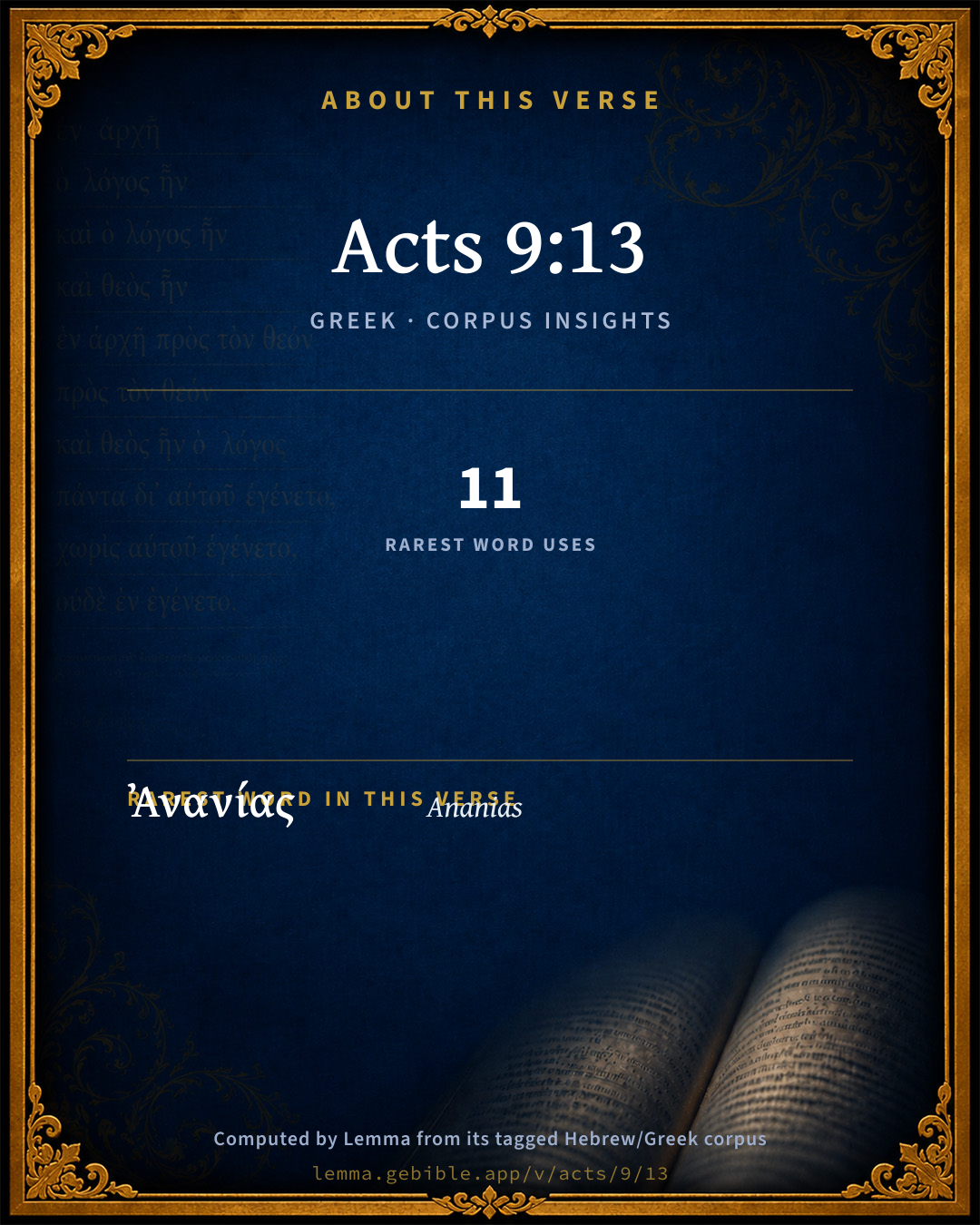
Acts 9:13

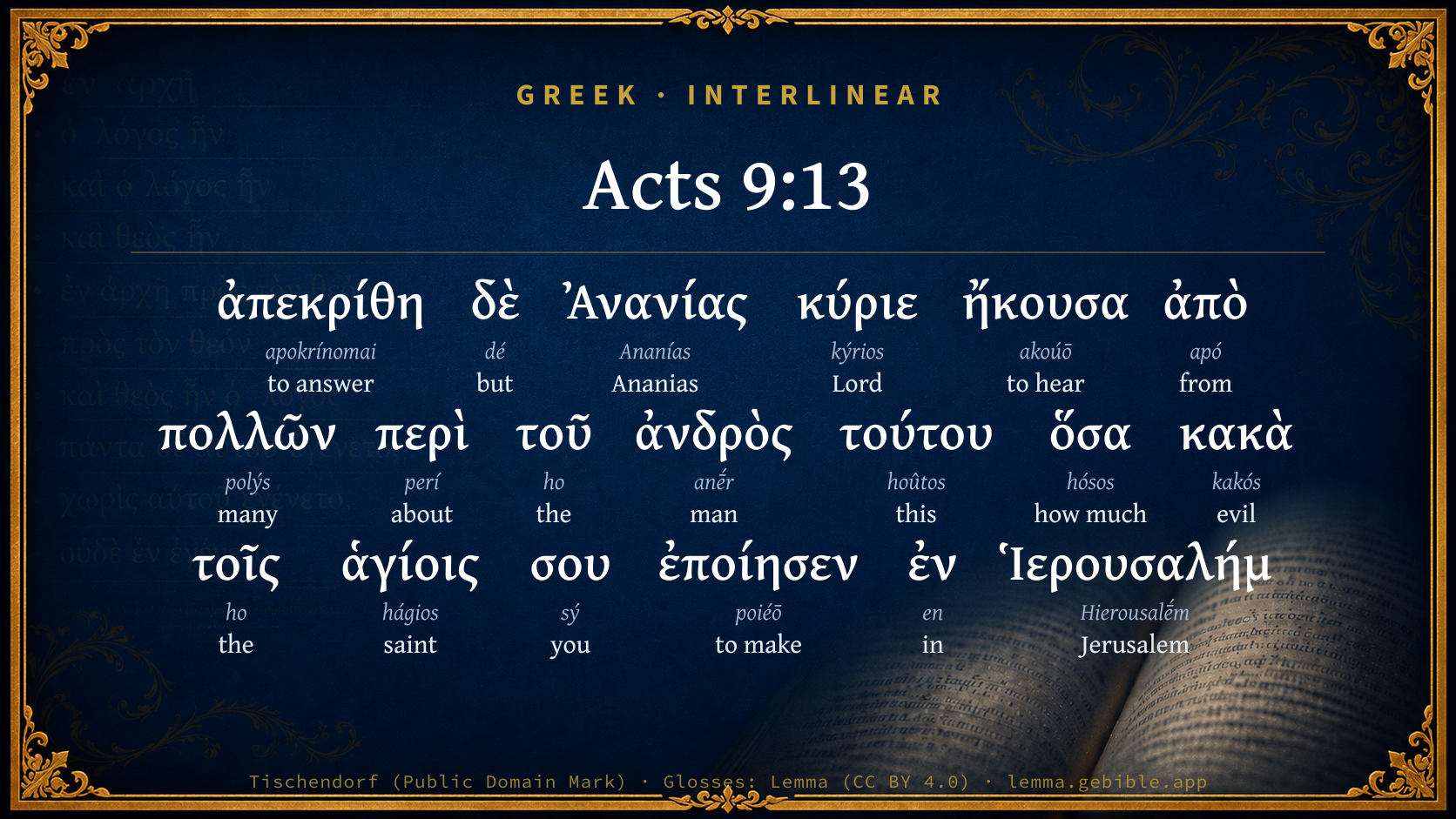
Greek (Tischendorf 8th ed.) Acts 9:13 appears in the Greek New Testament. The text above is from the Tischendorf 8th edition. Each word links to its Strong’s number and a concise gloss. Click any word for its full Thayer’s Greek Lexicon entry.
Download image
Cite this verse

Acts 9:13 (World English Bible). Public Domain. Lemma interlinear Bible study tool, https://lemma.gebible.app/v/acts/9/13.

Show BibTeX & RIS
BibTeX
RIS
English Translation
But Ananias answered, "Lord, I have heard from many about this man, how much evil he did to your saints at Jerusalem.
World English Bible · Public Domain
Download a study sheet

One document with this verse’s original text, its word-by-word gloss line, the meaning frame, cross-references with their text, attributed commentary, and full source and license credits — printable, and it pastes into notes with its structure intact.

This verse Autodidact and up

Study sheet (.html) Plain text (.txt)

A passage Seminary Student

Up to 50 verses in one chapter. A passage sheet keeps up to 6 commentary sources and 12 cross-references per verse, in the order this page ranks them, and says so on the sheet whenever that leaves anything out. Ask for a single verse and you get the Autodidact verse sheet above.

Everything on this page stays free to read, with no account — the sheet is a download of what is already on screen, not access to it.

Want to remove ads? Support Godless Engineer
Compare translations 3

The same verse in 3 English versions, stacked beneath the original-language interlinear above. Click any original word for its lexicon entry.

Each is an independent rendering of the whole verse — the interlinear is not word-aligned to these translations.

Highlighted words mark where these versions differ — a whole-verse word diff, not a word-by-word alignment.

  • World English Bible Public Domain
    But Ananias answered, "Lord, I have heard from many about this man, how much evil he did to your saints at Jerusalem.
  • King James Version Public Domain
    Then Ananias answered, Lord, I have heard by many of this man, how much evil he hath done to thy saints at Jerusalem:
  • unfoldingWord Literal Text CC BY-SA 4.0
    But Ananias answered, “Lord, I have heard from many about this man, how many evils he has done to your saints in Jerusalem.

unfoldingWord Literal Text — © unfoldingWord, licensed CC BY-SA 4.0. Word-aligned USFM3 via Door43 (git.door43.org/unfoldingWord/en_ult).

Versions to compare (up to 4)

3 of 4 selected

Show all 19 translations

Every available English version of this verse, each an independent rendering of the whole verse.

  • World English Bible Public Domain
    But Ananias answered, "Lord, I have heard from many about this man, how much evil he did to your saints at Jerusalem.
  • Berean Standard Bible Public Domain
    But Ananias answered, “Lord, many people have told me about this man and all the harm he has done to Your saints in Jerusalem.
  • Majority Standard Bible Public Domain
    But Ananias answered, “Lord, many people have told me about this man and all the harm he has done to Your saints in Jerusalem.
  • King James Version Public Domain
    Then Ananias answered, Lord, I have heard by many of this man, how much evil he hath done to thy saints at Jerusalem:
  • American Standard Version (1901) Public Domain
    But Ananias answered, Lord, I have heard from many of this man, how much evil he did to thy saints at Jerusalem:
  • Revised Version (1885) Public Domain
    But Ananias answered, Lord, I have heard from many of this man, how much evil he did to thy saints at Jerusalem:
  • Geneva Bible (1599) Public Domain
    Then Ananias answered, Lord, I haue heard by many of this man, howe much euill hee hath done to thy saints at Hierusalem.
  • Douay-Rheims (1899) Public Domain
    But Ananias answered: Lord, I have heard by many of this man, how much evil he hath done to thy saints in Jerusalem.
  • Young's Literal Translation Public Domain
    And Ananias answered, `Lord, I have heard from many about this man, how many evils he did to Thy saints in Jerusalem,
  • Literal Standard Version CC BY-SA 4.0
    And Ananias answered, “LORD, I have heard from many about this man, how many evils he did to Your holy ones in Jerusalem,
  • Unlocked Literal Bible CC BY-SA 4.0
    But Ananias answered, “Lord, I have heard from many about this man, how much harm he has done to your holy people in Jerusalem.
  • unfoldingWord Literal Text CC BY-SA 4.0
    But Ananias answered, “Lord, I have heard from many about this man, how many evils he has done to your saints in Jerusalem.
  • Darby Bible Public Domain
    And Ananias answered, Lord, I have heard from many concerning this man how much evil he has done to thy saints at Jerusalem;
  • World Messianic Bible Public Domain
    But Hananiah answered, “Lord, I have heard from many about this man, how much evil he did to your holy ones at Jerusalem.
  • Webster's Bible Public Domain
    Then Ananias answered, Lord, I have heard by many of this man, how much evil he hath done to thy saints at Jerusalem:
  • Free Bible Version CC BY-SA 4.0
    “But Lord,” Ananias replied, “I've heard a lot about this man—about all the evil things he did to the believers in Jerusalem.
  • Bible in Basic English Public Domain
    But Ananias said, Lord, I have had accounts of this man from a number of people, how much evil he has done to your saints at Jerusalem:
  • Text-Critical English NT CC BY 4.0
    But Ananias answered, “Lord, I have heard from many about how much evil this man has done to yoʋr saints in Jerusalem.
  • Tyndale New Testament (1534) Public Domain
    Then Ananias answered: Lorde I have hearde by many of this man how moche evell he hath done to thy sainctes at Ierusalem

Literal Standard Version (2020), Covenant Press — licensed CC BY-SA 4.0. Text via the HelloAO Bible API (eBible.org). Unlocked Literal Bible (unfoldingWord) — licensed CC BY-SA 4.0. Text via the HelloAO Bible API (eBible.org). unfoldingWord Literal Text — © unfoldingWord, licensed CC BY-SA 4.0. Word-aligned USFM3 via Door43 (git.door43.org/unfoldingWord/en_ult). Free Bible Version, Dr. Jonathan Gallagher — licensed CC BY-SA 4.0. Text via the HelloAO Bible API (eBible.org).

Word by word

More ways to search: Search by grammar → Find every occurrence → Compare this word →

Practice this passage: Drill this verse → Learn its vocabulary →

Ἀνανίας
Ananías
G367
“Ananias”
Noun, Nominative, Singular, Masculine
Part of Speech
Noun
Case
Nominative
Number
Singular
Gender
Masculine
Full Thayer's Definition

Origin: of hebrew origin H2608

TDNT: None

Ananias = "whom Jehovah has graciously given" 1. a certain Christian at Jerusalem, the husband of Sapphira Acts 5:1 2. a Christian at Damascus Acts 9:10 3. a son of Nedebaeus, and high priest of the Jews c. A.D. 47-59. In the year 66, he was slain by the Sacarii. Acts 23:2
  1. ἀπεκρίθη apokrínomai G611 “to answer” Verb, Aorist, Middle deponent, Indicative, 3rd person, Singular
  2. δὲ dé G1161 “but” Conjunction
  3. κύριε kýrios G2962 “Lord” Noun, Vocative, Singular, Masculine
  4. ἤκουσα akoúō G191 “to hear” Verb, Aorist, Active, Indicative, 1st person, Singular
  5. ἀπὸ apó G575 “from” Preposition
  6. πολλῶν polýs G4183 “many” Adjective, Genitive, Plural, Masculine
  7. περὶ perí G4012 “about” Preposition
  8. τοῦ ho G3588 “the” Article, Genitive, Singular, Masculine
  9. ἀνδρὸς anḗr G435 “man” Noun, Genitive, Singular, Masculine
  10. τούτου hoûtos G3778 “this” Demonstrative pronoun, Genitive, Singular, Masculine
  11. ὅσα hósos G3745 “how much” Correlative pronoun, Accusative, Plural, Neuter
  12. κακὰ kakós G2556 “evil” Adjective, Accusative, Plural, Neuter
  13. τοῖς ho G3588 “the” Article, Dative, Plural, Masculine
  14. ἁγίοις hágios G40 “saint” Adjective, Dative, Plural, Masculine
  15. σου sý G4771 “you” Personal pronoun, 2nd person, Genitive, Singular
  16. ἐποίησεν poiéō G4160 “to make” Verb, Aorist, Active, Indicative, 3rd person, Singular
  17. ἐν en G1722 “in” Preposition
  18. Ἱερουσαλήμ Hierousalḗm G2419 “Jerusalem” Noun, Proper, indeclinable

About this verse

These counts appear in no published source. They are computed here, from the morphology-tagged text and Lemma’s own curated glosses. What Lemma adds →

19
words
18
distinct lemmas
Acts
section

Notable vocabulary

The rarest word here is Ἀνανίας Ananias G367 — appearing just 11 times in the whole Greek New Testament.

Shared distinctive vocabulary

Ἀνανίας Ananias G367 occurs in 10 verses of the Greek New Testament. Also found in:

Repetition

A word recurs within this verse:

Cross-references

19

Topical passages linked to Acts 9:13 in the Treasury of Scripture Knowledge — connected by theme and wording, ordered by reader-vote popularity; previews shown in the World English Bible.

  • 1 Timothy 1:13–15 although I was before a blasphemer, a persecutor, and insolent. However, I obtained mercy, because I did it ignorantly in unbelief.
  • Acts 8:3 But Saul ravaged the assembly, entering into every house, and dragged both men and women off to prison.
  • Ezekiel 3:14 So the Spirit lifted me up, and took me away; and I went in bitterness, in the heat of my spirit; and the hand of Yahweh was strong on me.
  • Acts 22:19–20 I said, 'Lord, they themselves know that I imprisoned and beat in every synagogue those who believed in you.
  • Acts 9:1 But Saul, still breathing threats and slaughter against the disciples of the Lord, went to the high priest,
  • Exodus 4:13–19 He said, "Oh, Lord, please send someone else."
  • 1 Samuel 16:2 Samuel said, How can I go? if Saul hear it, he will kill me. Yahweh said, Take a heifer with you, and say, I am come to sacrifice to Yahweh.
  • 1 Kings 18:9–14 He said, Wherein have I sinned, that you would deliver your servant into the hand of Ahab, to kill me?
  • Jeremiah 20:9–10 If I say, I will not make mention of him, nor speak any more in his name, then there is in my heart as it were a burning fire shut up in my bones, and I am weary with forbearing, and I can't [contain].
  • Jonah 1:2–3 "Arise, go to Nineveh, that great city, and preach against it, for their wickedness has come up before me."
  • Matthew 10:16 "Behold, I send you out as sheep in the midst of wolves. Therefore be wise as serpents, and harmless as doves.
  • Acts 9:32 It happened, as Peter went throughout all those parts, he came down also to the saints who lived at Lydda.
  • Acts 22:4 I persecuted this Way to the death, binding and delivering into prisons both men and women.
  • Acts 26:10–11 This I also did in Jerusalem. I both shut up many of the saints in prisons, having received authority from the chief priests, and when they were put to death I gave my vote against them.
  • Romans 1:7 to all who are in Rome, beloved of God, called to be saints: Grace to you and peace from God our Father and the Lord Jesus Christ.
  • Romans 15:25–26 But now, I say, I am going to Jerusalem, serving the saints.
  • Romans 15:31 that I may be delivered from those who are disobedient in Judea, and that my service which I have for Jerusalem may be acceptable to the saints;
  • Romans 16:2 that you receive her in the Lord, in a way worthy of the saints, and that you assist her in whatever matter she may need from you, for she herself also has been a helper of many, and of my own self.
  • Romans 16:15 Greet Philologus and Julia, Nereus and his sister, and Olympas, and all the saints who are with them.

Cross-references courtesy of OpenBible.info (CC BY 4.0).

Commentary

Notes on Acts 9:13 from classic Christian and Jewish commentators (each source and its license shown beneath its notes). The classic Christian expositions comment on the surrounding passage and are grouped to its opening verse, so a note may address several verses; the Jewish commentaries on the Tanakh (Rashi and others) are per-verse, so they appear only where the commentator wrote on this verse.

Lemma curates 59 commentaries, every one of them public domain or Creative Commons licensed, each selected and text-cleaned for this edition rather than reprinted as found. About our sources →

The Biblical Illustrator

Joseph S. Exell

Act_9:13-16

Then Ananias answered, Lord, I have heard by many of this man.

An encouraging lesson from Pauls conversion

The conversion of Saul was one of the most remarkable facts in Christian history. It was important as a testimony to the power and truth of the gospel; as securing for the Church its ablest advocate, as giving a mighty impetus to Christian missions, and as securing for Christianity the master mind who formulated its theology and shaped its mode of thought and action. The Pauline mark will never be erased from the page of Church history. That, however, is not my business at present. I would rather remind you of the conversion of Paul as teaching the fact of the Divine interposition in the Church. God has been pleased by the foolishness of preaching to save them that believe; and it is by the communication of one earnest heart to another that men are usually converted. Such, however, was not the way by which Paul was converted. The Church has reason to believe that while she uses all the power committed to her, there will be interpositions of a power far higher than her own, which will work for her great successes. While Barak fights below, the stars in heaven shall also fight against Sisera.

I. There are other productive forces at work for the Church besides her teaching.

1. The work of the Spirit. All the success of the Church comes through Him, but have we not reason to expect that the Holy Ghost will occasionally display His power, by working apart from the ordinary agencies of the Church? We have heard of persons who have not been accustomed to attend the house of God, who have not been reading religious books, and yet in the middle of their work they have been filled with penitent and devout thoughts, and have known cases of persons intending to perpetrate vice, who have, nevertheless, been struck with certain reflections which they had never recognised before, and have been led to become men of holy lives. Why should not the Holy Spirit do so still?

2. The intercession of our Lord. Our Lord prays for those we never thought of praying for: and shall there not come to them grace in due season?

3. The incessant intercession of the faithful. Of course, this brings success to instrumentality, but there are prayers which are offered in connection with no particular agency. They are like the clouds which ascend from the sea, as the sun shines on the waves; they fall on the fields which have been sown by man, but they also drop upon the pastures of the wilderness, and the little hills rejoice on every side. Who shall say that Sauls conversion was not traceable to the prayer of Stephen? Yet there was no distinct connection such as could be defined. Who shall say that the gatherings in Jerusalem for prayer, may not have had about them power with God for the conversion of the persecutors? Yet we do not see the same connecting link as between the prayer meeting in the house of John Marks mother, and the escape of Peter from prison. Pray on, for though there should seem to be no connection between your prayers and the salvation of the sons of men, yet this shall be one of the forces in operation which shall not spend itself in vain.

4. The aroma of the truth in the world. The truth is mainly spread by plain earnest statements of it, but there is also a savour in truth, whereby even in our silence it spreads itself. Where the gospel of Jesus Christ comes, it impregnates the social atmosphere, it permeates society, it has an effect far beyond its local habitation. Many men who have not yet bowed before the deity of Christ, have unconsciously learnt much from Him, and what they think to be their own is but a blessed plagiarism from Jesus. Even the philosophies of men have been all the soberer, and the laws of men all the gentler, because of the existence of the gospel. Men cannot live in the midst of Christians, and yet altogether shut out the influence of Christianity.

5. The influence of Christian life and of Christian death. Wherever the Christian acts up to his profession, those who observe him take knowledge of him that he has been with Jesus; and as example speaks more loudly than precept, we may look for very marked results. The eloquence of Christian holiness is more potent for conversion than all the speaking of Christian orators. So, too, when the ungodly sees a Christian die, that happy death will be a potent agency to arouse, to win the heart for Christ.

6. All the work of God in providence. I might truly say of the Church that the stones of the field are in league with her, and the beasts of the field are at peace with her, for all things work her good. Sickness, when it stalketh through the land, is a powerful preacher to the unthinking masses. When death has come into the house, it has frequently happened that hearts were impressed that were hard as iron before. As God sent the hornet before His conquering Israel to overthrow the Canaanites, so doth He send providences to work together, for our help, that the truth may prevail.

7. Conscience, which though sadly impaired leans to the right side.

II. From these sources we may expect remarkable conversions.

1. Those who were formerly violently opposed to the truth through prejudice. Paul was opposed to Christ not because he was opposed to truth, but because he thought that Jesus was not the Messiah. Once convinced that he was wrong, he followed the right at once; and we may hope that interpositions will occur in which the Holy Spirit will enlighten the darkness of men who are honest in their darkness, and that they, seeing the light, will embrace the gospel.

2. Those who have been doing much mischief to the good cause, and who are resolved to do still more (verses 13, 14). Do not despair of a man because he is industriously opposed. Anything is better than indifference.

3. Those who are beyond the reach of ordinary ministries. We sometimes regret that the voice of a thoroughly faithful ministry is seldom heard in the courts of kings; but for all that the Lord can reach those whom we cannot reach; He can, in life or in the dying hour, come to the hearts of men whose ears were never reached by any testifier to the truth. Paul would not have heard a preacher of Christ; but the Lord hath a way where we have none.

4. Those who will be most earnest. A man who feels that God has had singular mercy upon him, feels that being much loved, and having had much forgiven, he must render much service.

5. Those who will become profoundly evangelical. I trace Pauls evangelism to the fact that he was so remarkably converted. He saw in himself the boundless power, the infinite mercy, the absolute sovereignty, of God; and therefore he bare witness more clearly than any other to these Divine attributes. Courage, then, the noblest minds will yet he engaged in the service of our Master. The leaders on the enemys side shall yet be champions in our Masters army.

III. This occasional sinking of instrumentality answers admirable ends. This might be thought to be a dangerous thing for the industry of the Church, for some are always ready enough to clutch at excuses for leaving Gods work alone. But there are admirable reasons for the Lords sole working; for these interpositions--

1. Disclose the presence of the living Christ. We too often forget this, and yet the power of the Church lies in Christ. In the Romish church its power over devout minds lies in no small degree in the fact that the person of Christ is much loved and reverenced; but you seldom see Christ in any but two attitudes--as a babe in His mothers arms, or else dead; scarcely ever is He set forth as the living Lord. That Church which, not forgetting His birth, nor His sacrifice, yet most clearly recognises that He still liveth, is the Church that shall win the day.

2. Remind us of the supernatural agency of the Holy Spirit. The tendency nowadays is to expunge the supernatural; but for all that there is a Holy Spirit. In proportion as that truth is made clear to the Church by her personal experience, the Church will be girt with power from on high.

3. Unveils many of the Divine attributes. Men so remarkably converted are sure to display the sovereignty, power, grace, and long-suffering of God.

4. Aids very much the faith of the Church. When she is beginning to droop and to sink, then it is that these remarkable conversions come in and inspirit the whole band.

5. Startles and impresses the world. What knows the world of the conversion of those who have sat in these pews ever since they were children? But let some gross blasphemer or persecutor preach the faith which once he sought to destroy, and the whole land is astonished.

IV. All this by no means lowers the value of instrumentality. For--

1. Such cases are rare. One Saul is struck to the earth; but Peter preaches at Pentecost, and three thousand are pricked in their hearts. One Colonel Gardner, on the night he was about to commit a great sin, saw, or fancied he saw, the appearance of our Lord, and heard the words, I have done all this for thee, what hast thou done for Me? but there were fifty thousand perhaps in Scotland and in England at that time who were brought to a knowledge of the truth by the ordinary methods of mercy.

2. These cases involve human agency somewhere. Saul struck down, but how does he get comfort? Does that come by another voice from heaven? It might have done; but the Lord takes care that the very instrumentality which is put aside in one place shall be honoured in another, and so Ananias must be sent forth to bless the penitent. Conviction may be wrought by the Holy Spirit without means, but in the full decision somewhere or other Go& will use you.

3. These conversions are a provision of a most remarkable instrumentality. I have called him--not to be a singular article for exhibition--but to be a chosen vessel unto Me to bear My name among the Gentiles. Remarkable converts become themselves the most indefatigable servants of God. (C. H. Spurgeon.)

Undue alarm at evils

I. We live in a day of bold, aggressive wickedness, as personal, public, palpable as that of Saul, e.g., Sabbath breaking, licentiousness, intemperance, infidelity, gambling, corrupt literature, etc.

II. The civil authorities sanction and uphold or fail to suppress these curses, as in the case of Saul.

III. Like Ananias, Christians and moral reformers are unduly alarmed at the power and civil authority of these evils. Right is mighty and will prevail (Eph_6:10-20).

IV. Like Ananias we should lay aside our fears and timidity, and, seeing the right, go out and meet these foes face to face.

V. How shall we do this great work.

1. By earnest personal effort rebuking sin.

2. By combined and consecrated Christian effort.

3. By invoking civil as well as Divine power. Prohibition of wrong is Gods law, and professedly mans also. Politicians cannot or will not save us. (T. S. Love.)

The Biblical Illustrator, edited by Joseph S. Exell (c. 1880s–1900s) — public domain. Text from a community e-Sword module.

Joseph Benson's Commentary

Act 9:13-14. Then Ananias — Astonished to hear such a name mentioned in such a connection; answered, Lord, I have heard by many of this man — What a malicious enemy he is to thy gospel: all those who were scattered upon the late persecution, many of whom are come to Damascus, tell how much evil he hath done to thy saints at Jerusalem — That he was the most virulent, violent persecutor of all the rest; what havoc he has made of the church: nay, and his errand to Damascus at this time is to persecute us Christians; for here he has authority from the chief priests to bind all that call on thy name — To treat thy disciples as the worst of criminals. Now, why doth Ananias thus object? Does he say, Therefore I do not owe him so much service? Why should I do him a kindness, who has designed and done us so much unkindness? No, Christ had taught him another lesson, namely, to render good for evil, blessing for cursing, and to pray for persecutors. But if he be such a persecutor of Christians, 1st, Will it be safe for Ananias to go to him? Will he not by so doing throw himself like a lamb into the mouth of a lion? And if he thus bring himself into trouble, will he not be justly blamed for his indiscretion?

2d, Will it be to any purpose to go to him? Can such a hard heart be ever softened? or such an Ethiopian ever change his skin?

Joseph Benson's Commentary on the Old and New Testaments (1811–1818) — public domain. Text from a community e-Sword module.

Bengel's Gnomon

Johann Albrecht Bengel

Act 9:13. Ἀπὸ πολλῶν, from many) Saul had been a notable persecutor.—τοῖς ἁγίοις σου, to Thy saints) Christians are even already saints. Christ regards the saints as His own: therefore He is GOD.

Bengel's Gnomon of the New Testament — English translation (T&T Clark, Edinburgh, 1860) — public domain. Text from a community e-Sword module.

Meyer's Critical & Exegetical Commentary

Heinrich August Wilhelm Meyer

Act_9:13-16. Ananias, in ingenuous simplicity of heart, expresses his scruples as to conferring the benefit in question on a man who, according to information received from many (ἀπὸ πολλ.), had hitherto shown himself entirely unworthy of it (Act_9:13), and from whom even now only evil to the cause of Christ was to be dreaded after his contemplated restoration to sight (Act_9:14). Whether Ananias had obtained the knowledge of the inquisitorial ἐξουσία which Saul had at Damascus by letters from Jerusalem (Wolf, Rosenmüller), or from the companions of Saul (Kuinoel), or in some other way, remains undetermined.

τοῖς ἁγίοις σου] to the saints belonging to Thee, i.e. to the Christians: for they, through the atonement appropriated by means of faith (comp. on Rom_1:7), having been separated from the κόσμος and dedicated to God, belong to Christ, who has purchased them by His blood (Act_20:28).

ἐν Ἱερουσ. belongs to κακὰ ἐποίησε.

Act_9:14. As to the ἐπικαλεῖσθαι of Christ, see on Act_7:59. It is the distinctive characteristic of Christianity, Act_9:21; 1Co_1:2; Rom_10:10 ff.

Act_9:15. σκεῦος ἐκλογῆς] a chosen vessel (instrument). In this vessel Christ will bear, etc. The genitive of quality emphatically stands in place of the adjective, Herm. ad Vig. p. 890 f.; Winer, p. 222 [E. T. 297]. Comp. σκεῦος ἀνάγκης, Anthol. xi. 27. 6.

τοῦ βαστάσαι κ.τ.λ.] contains the definition of σκ. ἐκλ. μοι ἐστὶν οὗτος: to bear my (Messianic) name (by the preaching of the same) before Gentiles, and kings, and Israelites. Observe how the future work of converting the Gentiles (comp. Gal_1:16) is presented as the principal work (ἐθνῶν κ. βασιλ.), to which that of converting the Jews is related as a supplemental accessory;[242] hence υἱῶν Ἰσρ. is added with τέ (see Herm. ad Eur. Med. 4 f.; Klotz, ad Devar. p. 743 f.; Winer, p. 404 [E. T. 542].

The γάρ, Act_9:16, introduces the reason why He has rightly called him σκεῦος ἐκλογῆς κ.τ.λ.; for I shall show him how much he must suffer for my name (for its glorification, see on Act_5:41). The ἐγώ placed first has the force of the power of disposal in reference to σκεῦος ἐκλ. μοι ἐστίν: I am He, who will place it always before his eyes. On this Bengel rightly remarks: re ipsa, in toto ejus cursu,even to his death. According to de Wette, the reference is to revelation: the apostle will suffer with prophetic foresight (comp. Act_20:23; Act_20:25, Act_21:11). But such revelations are only known from his later ministry, whereas the experimental ὑπόδειξις commenced immediately, and brought practically to the consciousness of the apostle that he was to be that σκεῦος ἐκλογῆς amidst much suffering.

[242] The apostles practice of always attempting, first of all, the work of conversion among the Jews is not contrary to this, as his destination to the conversion of the Gentiles is expressly designated without excluding the Jews, and accordingly was to be followed out without abandoning the historical course of salvation: Ἰουδαίῳ τε πρῶτον καὶ Ἕλληνι, Rom_1:16. And what Paul was to attain in this way, entirely corresponds to the expression in our passage.

Meyer — Critical and Exegetical Commentary on the New Testament — English translation by Peter Christie, edited by Frederick Crombie (T&T Clark, 1880) — public domain. Text from a community e-Sword module.

Expositor's Greek Testament

ed. W. Robertson Nicoll

Act 9:13 . Ananias naturally hesitates to go to a man who had undoubtedly inflicted harm upon the Christians, and had come to Damascus with the same intent. But there is nothing inconsistent in the fact that Ananias should not be acquainted with Saul personally, whilst he knew of his persecuting zeal. τοῖς ἁγίοις σου : used here for the first time as a name for the Christians; cf. Act 9:32 ; Act 9:41 , Act 26:10 . Every Israelite was ἅγιος by the mere fact of his membership in the holy Ecclesia of Israel, and Ananias, himself a Jew, does not hesitate to employ the same term of the members of the Christian Ecclesia (see Hort, Ecclesia , pp. 56, 57, and Grimm, sub v. , 2). Its use has therefore a deep significance: “Christus habet sanctos, ut suos: ergo est Deus,” says Bengel. The force of the words can be more fully appreciated in connection with the significance of the phrase in Act 9:14 , τοῖς ἐπικ . τὸ ὄνομά σου . In Act 26:10 it is noticeable that the word occurs on St. Paul’s own lips as he stood before Agrippa “in the bitterness of his self-accusation for his acts of persecution, probably in intentional repetition of Ananias’s language respecting those same acts of his. It was a phrase that was likely to burn itself into his memory on that occasion.” And so we find St. Paul addressing at least six of his Epistles to those who were “called to be Saints,” indicating that every Christian as such had this high calling. If Christians individually had realised it, the prophetic vision of the Psalms of Solomon (17:36) would have been fulfilled in the early Church of Christ: ὅτι πάντες ἅγιοι , καὶ βασιλεὺς ἀυτῶν Χριστὸς Κύριος (see Ryle and James’ edition, p. 141). ἐν Ἱερ . belongs to ἐποίησε , and so points back to Act 8:3 , and to Saul as the soul of the persecution which broke out in Jerusalem, cf. Paul’s own language before Agrippa, Act 26:10 .

The Expositor's Greek Testament, edited by W. Robertson Nicoll (1897–1910) — public domain. Text from a community e-Sword module.

Jamieson, Fausset & Brown

Robert Jamieson, A. R. Fausset & David Brown

Ananias answered, Lord, I have heard by many of this man, &c.--"The objections of Ananias, and the removal of them by the Lord, display in a very touching manner the childlike relation of the believing soul to its Redeemer. The Saviour speaks with Ananias as a man does with his friend" [OLSHAUSEN].

how much evil he hath done to thy saints--"Thy saints," says Ananias to Christ; therefore Christ is God [BENGEL]. So, in Act 9:14, Ananias describes the disciples as "those that called on Christ's name." See on Act 7:59-60; and compare Co1 1:2.

Jamieson, Fausset & Brown — Commentary Critical and Explanatory on the Whole Bible (1871) — public domain (CC PDM 1.0). Text via the HelloAO Bible API.

Adam Clarke's Commentary

Verse 13. Lord, I have heard by many of this man] This was all done in a dream, else this sort of reasoning with his Maker would have been intolerable in Ananias. Saul had been a notorious persecutor; many could testify of his outrageous acts against the poor followers of Christ.

Thy saints] That is, the Christians, or followers of Christ. αγιοι signifies not only holy persons, but also consecrated persons; from α, negative, and γη, the earth; persons who are separated from all earthly uses, and consecrated to the service of God alone.

Adam Clarke's Commentary on the Bible (1810–1826) — public domain. Text from a community e-Sword/MySword module.

John Calvin's Commentaries

13. Lord, I have heard. In that Ananias objecteth the danger to the Lord, he betrayeth his weakness of faith therein. Therefore we see that the saints and servants of God are afraid of death, which thing keepeth them back from doing their duty; yea, it causeth them sometimes to stagger. Ananias would gladly go to some other place; but this is a point of a good man, that he yieldeth not so much to fear that he withdraweth himself from Christ’s obedience. And, therefore, this is a sign of rare obedience, that although through fear of death he were somewhat slack at the first, yet having forgotten himself by and by, he maketh great haste to go whither Christ called him. And yet, notwithstanding, he refuseth not flatly in these words to do that which he is commanded to do, but useth an excuse very modestly, Lord, what meaneth this, that thou sendest me to the hangman? Therefore we may see a desire to obey mixed with fear.

John Calvin's Commentaries (1540-1563) — public domain. Text from the Calvin Translation Society English edition (1840s-50s) via the Christian Classics Ethereal Library (ccel.org). Calvin's coverage is partial (roughly two-thirds of the Bible); uncommented books and verses are honest gaps, never fabricated. The 19th-century editor's footnotes and remarks are omitted so the notes are faithfully Calvin's own voice.

Ellicott's Commentary for English Readers

(13) Lord, I have heard by many of this man.—The words are of interest as showing both the duration and the character of the persecution in which Saul had been the leader. The report of it had spread far and wide. The refugees at Damascus told of the sufferings of the brethren at Jerusalem.

Thy saints at Jerusalem.—This is noticeable as the first application of the term “saints” to the disciples. The primary idea of the word was that of men who consecrated themselves, and led, in the strictest sense of the word, a devout life. A term of like import had been taken by the more religious Jews in the time of the Maccabeans. The Chasidim, or Saints (the word occurs in Psa_16:3), were those who banded themselves together to resist the inroads of heathenism under Autiochus Epiphanes. They appear in the books of Maccabees under the title of Assideans (1Ma_2:42; 1Ma_7:13; 2Ma_14:6). The more distinctive name of Pharisees (Separatists), which came to be attached to the more zealous Chasidim, practically superseded this; and either by the disciples themselves, or by friendly outsiders, the Greek equivalent of the old Hebrew word—and probably, therefore, in Palestine, the Aramaic form of the word itself—was revived to describe the devout members of the new society. The fact that their Master had been conspicuously “the Holy One of God” (the same adjective is used of Him in the quotations from Psa_16:10, in Act_2:27; Act_13:35), made it natural that the term should be extended to His followers, just as He had been spoken of as the “Just One” (Act_3:14; Act_7:52); and yet that name was applied, in its Greek form, to James the brother of the Lord, and, in its Latin form of Justus, to the three so named in Act_1:23; Act_18:7; Col_4:11. It is significant that its first appearance in the New Testament should be as used by the man who was sent to be St. Paul’s instructor, and that it should afterwards have been employed so frequently by the Apostle himself (Rom_1:7; Rom_15:25; 1Co_1:2; 1Co_6:1-2; 2Co_1:1; Eph_1:1; Php_1:1, et al.). The “devout man according to the Law,” may well have been among the Chasidim even prior to his conversion to the faith of Christ. The term appears in inscriptions from the Catacombs in the Museum of the Collegio Romano at Rome—“N. or M. resteth here with the Saints”; but probably in the later sense, as attached to martyrs and others of distinguished holiness.

A Bible Commentary for English Readers, edited by Charles John Ellicott (1878–1897) — public domain. Text from a community e-Sword module.

The Cambridge Bible for Schools and Colleges

gen. ed. J. J. S. Perowne

13. I have heard by [from] many, &c.] These words seem to point to a longer residence of Ananias in Damascus than he could have made if he had only left Jerusalem after the death of Stephen; and so do the words (Act_22:12) which speak of his good report among all the Jews that dwelt at Damascus.

how much evil he hath done to thy saints, &c.] The Christian converts were probably called “saints,” i.e. “holy persons,” at a very early period after the death of Christ because of the marvellous outpourings of the Holy Spirit upon the first converts, cp. 1Pe_1:15. The word is of frequent occurrence in the greetings of St Paul’s Epistles.

The Cambridge Bible for Schools and Colleges (gen. ed. J. J. S. Perowne; Cambridge University Press, 1878–1918) — public domain. Text from a community e-Sword module.

John Gill's Exposition

Then Ananias answered, Lord,.... Though Ananias knew that it was the Lord that spoke, and acknowledged his power and dominion, and expressed his readiness to obey his commands; yet there was a timidity in him, and which was the more inexcusable, that it should appear after the Lord had told him of the vision which Saul had had of him; and yet still he was fearful of putting himself into his hands, who had been so violent a persecutor; and therefore obliquely excuses himself, by observing what Saul had done at Jerusalem, and the powers he came with to Damascus:

I have heard by many of this man; which shows that Ananias had been at Damascus some time, and was not an eyewitness of the havoc Saul made of the church, only had the account of it from others; and these many who fled to Damascus upon the persecution, which Saul was at the head of; and being so, was particularly spoken of, and his name was well known, and was become infamous for his cruelty and barbarity;

how much evil he hath done to thy saints at Jerusalem; by entering into their houses with violence, haling men and women from thence, committing them to prison, and persecuting them unto death. Believers in Christ are called his "saints", because separated by his grace for his service, and sanctified by his Spirit, and to whom he is made sanctification; and because they live holy lives and conversations; all which is an aggravation of the evil done them, and which will be avenged by Christ in his own time.

John Gill's Exposition of the Whole Bible (1746–1763) — public domain (CC PDM 1.0). Text via the HelloAO Bible API.

Trapp's Complete Commentary

John Trapp

13 Then Ananias answered, Lord, I have heard by many of this man, how much evil he hath done to thy saints at Jerusalem:

Ver. 13. Then Ananias answered] The best have their unnecessary fears, and think they have reason on their side; but convinced, they soon subscribe to God. Veniat, veniat verbum Domini, said one, et submittemus ei sexcenta si nobis essent colla.

How much evil he hath done] And is therefore not lightly to be trusted. It is a rule in the Civil Law, Semel malus semper praesumitur esse malus: but God can soon alter a man’s mind and manners, as he did Saul’s.

John Trapp, A Commentary or Exposition upon All the Books of the Old and New Testament (1647–1656) — public domain. Text from a community e-Sword module.

Albert Barnes' Notes on the Bible

I have heard by many ... - This was in the vision, Act 9:10. The passage of such a train of thoughts through the mind was perfectly natural at the command to go and search out Saul. There would instantly occur all that had been heard of his fury in persecution; and the expression here may indicate the state of a mind amazed that such a one should need his counsel, and afraid, perhaps, of entrusting himself to one thus bent on persecution. All this evidently passed in the dream or vision of Ananias, and perhaps cannot be considered as any deliberate unwillingness to go to him. It is clear, however, that such thoughts should have been banished, and that he should have gone at once to the praying Saul. When Christ commands, we should suffer no suggestion of our own thoughts, and no apprehension of our own danger, to interfere.

By many - Probably many who had fled from persecution, and had taken refuge in Damascus. It is also evident Act 9:14 that Ananias had been apprised, perhaps by letters from the Christians at Jerusalem, of the purpose which Saul had in view in now going to Damascus.

To thy saints - Christians; called saints ἅγιοι hagioi because they are holy, or consecrated to God.

Albert Barnes' Notes on the Bible (1834–1885) — public domain. Text from a community e-Sword/MySword module.

Matthew Poole's English Annotations

I have heard by many of this man; his design and commission could not but be noised abroad.

Thy saints: the disciples of Christ are called saints, because:

1. They are dedicated unto the Lord in their baptism.

2. They are called unto holiness.

3. They did then live holily and exemplarily.

4. And so must all that hope for any benefit by their being disciples of Christ, &c.

Matthew Poole's English Annotations on the Holy Bible (1683–1685) — public domain. Text from a community e-Sword/MySword module.

The Pulpit Commentary

But for then, A.V.; from many for by many, A.V.; did for hath done, A.V. Ananias"s answer shows his profound astonishment, mixed with doubt and misgiving, at the commission given to him. It shows, too, how the news of Saul"s commission had preceded him, and caused terror among the disciples at Damascus. Little did Ananias suspect that this dreaded enemy would be the channel of God"s richest blessings to his Church throughout all ages until the coming of Christ. How empty our fears often are l how ignorant are we where our chief good lies hid! But God knows. Let us trust him.

The Pulpit Commentary (1880–1919), ed. H.D.M. Spence-Jones & Joseph S. Exell — public domain. Text from a community e-Sword module.

John Wesley's Explanatory Notes

But he answered - How natural it is to reason against God.

John Wesley, Explanatory Notes Upon the Whole Bible (1754–1765) — public domain. Text via the GEBible commentary corpus.

Kretzmann's Popular Commentary

Paul E. Kretzmann

The objection of Ananias answered:

v. 13. Then Ananias answered, Lord, I have heard by many of this man how much evil he hath done to Thy saints at Jerusalem;

v. 14. and here he hath authority from the chief priests to bind all that call on Thy name.

v. 15. But the Lord said unto him, Go thy way; for he is a chosen vessel unto Me to bear My name before the Gentiles and kings and the children of Israel;

v. 16. for I will show him how great things he must suffer for My name’s sake.

The obedience of Ananias was put to a severe test by the Lord’s commission, when he heard the name Saul of Tarsus. He had heard from many people concerning this man, what and how many and how various evil things he had done to the Lord’s saints in Jerusalem. Note the honoring name "saints," which is here given to the Christians for the first time, as such that have been cleansed and sanctified by the blood of Jesus. They are His saints, purchased and won by Him for His own; He is their Redeemer and their God. Ananias also had the definite knowledge that Saul here in Damascus had authority and power from the high priest at Jerusalem to bind and thus to arrest all those that called upon the name of Jesus as their Lord and Savior. Here is another honoring description of the believers which also characterizes them exactly. They place their full and complete trust in their Savior, a fact which they show by their calling upon Him. But the Lord quickly silenced the objection of His servant by repeating His command: Go! And He took away all the apprehensive fears of Ananias by telling him that Saul was to be a vessel of His choosing, a vessel in which, as it were, the riches of God’s mercy would be preserved for the use of many. For in this chosen vessel, Saul of Tarsus, God had determined that His name should be carried before Gentiles and before kings and before the children of Israel. The name of the Lord Jesus Christ is like a precious jewel, for whose bearing He had selected and prepared a fitting casket. The special mission of the man who became the Lord’s apostle afterwards was here already indicated. His chief work was to be among the Gentiles, to those not belonging to the children of Abraham according to the flesh. But he was to testify also before kings and rulers, as the governors of Cyprus, of Achaia, of Judea. And lastly, his work was to include his brethren according to the flesh. The Lord here opened the door of the future wide before the eyes of Ananias, in order to work in him the proper willingness to execute the commission. But not only in witnessing for the Lord would this man Saul be found a fitting, choice vessel of the Lord, but Jesus intended also to let him experience suffering for His name’s sake. These sufferings would come upon him as a part of the obligation of the Lord’s vessel. No longer will he bring sufferings to others, but he would bend his back willingly to the load which the Lord knew to be the measure of his strength. That is the privilege of believers to this day, both to confess the name of the Lord and to endure the reproach of Christ.

Paul E. Kretzmann, Popular Commentary of the Bible (1921–1924) — public domain. Text from a community e-Sword module.

Burkitt's Expository Notes on the New Testament

William Burkitt

Observe here, 1. Ananias’s reluctancy and fear to go to Saul, because of his former violent persecution, and present commission: Lord, I have heard of this man &c.

Learn, That such as are very ready and forward for Christ’s service, may, upon appearing difficulties, hang back, till they be helped over those difficulties by the helping hand of Christ. Thus it was with Ananias; Behold, says he, here I am, Lord, Act 9:10 to shew his readiness to run on any errand that Christ would send him: But when he came to understand his message, he was affrighted, and began to draw back; Therefore the Lord graciously condescends to remove the stumbling block that lay in the way of the servant’s obedience. Fear not; as if Christ had said, "Go thy way, he is not what he was, he is another man; yea, he is a new man."

Observe, 2. The honourable title which Christ puts upon Saul, He is a chosen vessel, to bear my name before the Gentiles and kings.

Where, note, 1. The term of usefulness; he is a vessel. Now a vessel is not a natural but an artificial instrument. No man is born, but made a minister of the gospel.

Vessels are not of equal capacity, some are greater, others less; all ministers have not like endowments, nor are they equally fitted for the sacred employment.

Again, vessels are receptive instruments; they must take in before they can give out. What the ministers of the gospel have received of the Lord, that they deliver to their people; they give out what God gives in.

Finally, vessels are for effusion, as well as for reception: they let out as well as take in; yea, therefore take in, that they may let out; therefore have the ministers of Christ a treasure of divine knowledge in themselves, that they may communicate and impart it to others. And it is not impaired by imparting, but, like the oil in the widow’s vessel, increased by pouring out. A minister, by communicating the treasure of his knowledge, enriches others without impoverishing himself.

Note, 2. The term of excellency, He is a chosen vessel, chosen to preach Christ, chosen to suffer for Christ: a vessel chosen to bear the divine treasure of the gospel both to Jews and Gentiles.

Lord! what honour dost thou put upon thy ministers in making them vessels of honour fit for the master’s use and the family’s service!

If I may not be a vessel of gold or silver, let me be a vessel of wood or stone, so I may be a vessel unto honour, a successful instrument in thy hand, for thy glory, and the church’s good.

William Burkitt's Expository Notes on the New Testament (1700–1703) — public domain. Text from a community e-Sword module.

McGarvey & Pendleton's Commentaries

J. W. McGarvey

13-16. Ananias had already heard of Saul, doubtless through fugitive brethren from Jerusalem, and such was the horror which his name inspired, that he was reluctant to approach him, even when commanded by the Lord to do so. (13) " Then Ananias answered, Lord, I have heard from many concerning this man, how much evil he has done to thy saints who are in Jerusalem, (14) and here he has authority from the high priests to bind all who call on thy name. (15) But the Lord said to him, Go; for he is to me a chosen vessel, to bear my name before the Gentiles, and kings, and the children of Israel. (16) For I will show to him how great things he must suffer on account of my name. " Here we have a statement that the Lord had made a special choice of Saul for a certain work, and a prediction that he would suffer in the execution of it. The latter demonstrates the foreknowledge of God concerning human conduct, and the former shows that he makes choice beforehand of suitable individuals to execute his purposes.

J. W. McGarvey (with Philip Y. Pendleton), Commentaries on the New Testament (The Fourfold Gospel, 1914; Acts; and the epistles) — public domain. Text from a community e-Sword/MySword module.

The People's New Testament

B. W. Johnson

13, 14. Ananias answered. In view of the terrible record of Saul the fears of Ananias were not unreasonable.

B. W. Johnson's The People's New Testament with Notes (1889–1891) — public domain. Electronic text from the Christian Classics Ethereal Library (CCEL) ThML edition.

unfoldingWord translationNotes

Door43 World Missions Community

your holy people

Here "holy people" refers to Christians. AT: "the people in Jerusalem who believe in you"

authority ... to arrest everyone here

It is implied that the extent of the power and authority granted Saul was limited to the Jewish people at this point in time. (See: Assumed Knowledge and Implicit Information)

calls upon your name

Here "your name" refers to Jesus. (See: Metonymy)

he is a chosen instrument of mine

"chosen instrument" refers to something that is set apart for service. AT: "I have chosen him to serve me" (See: Metonymy)

to carry my name

This is an expression for identifying or speaking out for Jesus. AT: "in order that he might speak about me" (See: Metonymy)

for the cause of my name

This is an expression meaning "for telling people about me." (See: Metonymy)

translationWords

holy

Jerusalem

authority

chief priests

call

Gentile

Israel

suffer

unfoldingWord translationNotes — © Distant Shores Media and the Door43 World Missions Community, licensed CC BY-SA 4.0. Source: git.door43.org/Door43/en_tn.

Cambridge Greek Testament for Schools and Colleges

13. ἤκουσα ἀπὸ πολλῶν, I have heard from many. These words seem to indicate a longer residence of Ananias in Damascus than he could have made if he had only left Jerusalem after the death of Stephen; and so do the words (Act 22:12) which speak of his good report among all the Jews that dwelt at Damascus. And what a tale they tell us of Saul’s zeal against the Church.

τοῖς ἁγίολς σου, to Thy saints. The Christian converts were probably called faints,’ i.e. ‘holy persons,’ at a very early period after the death of Christ because of the marvellous outpourings of the Holy Spirit upon the first converts, cf. 1Pe 1:15. The word is of frequent occurrence in the greetings of St Paul’s Epistles.

Cambridge Greek Testament for Schools and Colleges (Cambridge University Press, 1896; 21 vols, various authors incl. Carr, Maclear, Plummer, Farrar, Lumby, Moule, M. R. James, Simcox) — public domain. Text from a community e-Sword module.

Alford’s Greek Testament

Henry Alford

13. τοῖς ἁγίοις σου] This is the first time that this afterwards well-known appellation occurs as applied to the believers in Christ.

Henry Alford, The Greek Testament (1849–1861) — public domain. Text from a community e-Sword module.

Lesson kit

Teaching starters — assembled from the data on this page, not authored interpretation. Every prompt links to the verse data it draws on. Edit before teaching.

Acts, in the Acts, opens this verse with 19 words (18 distinct Greek lemmas). Its most distinctive word is Ananías (“Ananias”). A historical commentator’s framing appears above. Read the whole chapter for the surrounding context.

Discussion questions

  1. The word Ananías carries the sense “Ananias.” How does it shape the verse?
  2. Acts 5:1 shares the word «Ananias» with this verse. How do the two illuminate each other?
  3. “the” occurs 2× in this one verse. What is the effect of the repetition?
  4. The translations on this page render this verse differently — a whole-verse word diff, not a word-by-word alignment. What might account for the different wordings?
  5. Reading how The Biblical Illustrator and Joseph Benson's Commentary read this verse, where do the two commentators agree and where do they part?

Things to notice

Reading settings

Reading text

Shown beneath each verse's original-language words.

Old Testament
Old Testament edition

Read the OT as the Masoretic Hebrew (MT) or the Greek Septuagint (LXX).

English shown for the Greek Septuagint (in the Hebrew ↔ Greek comparison).

Comparing translations? Open the Compare panel on any verse page to stack up to four side by side.