
Luke 8:3

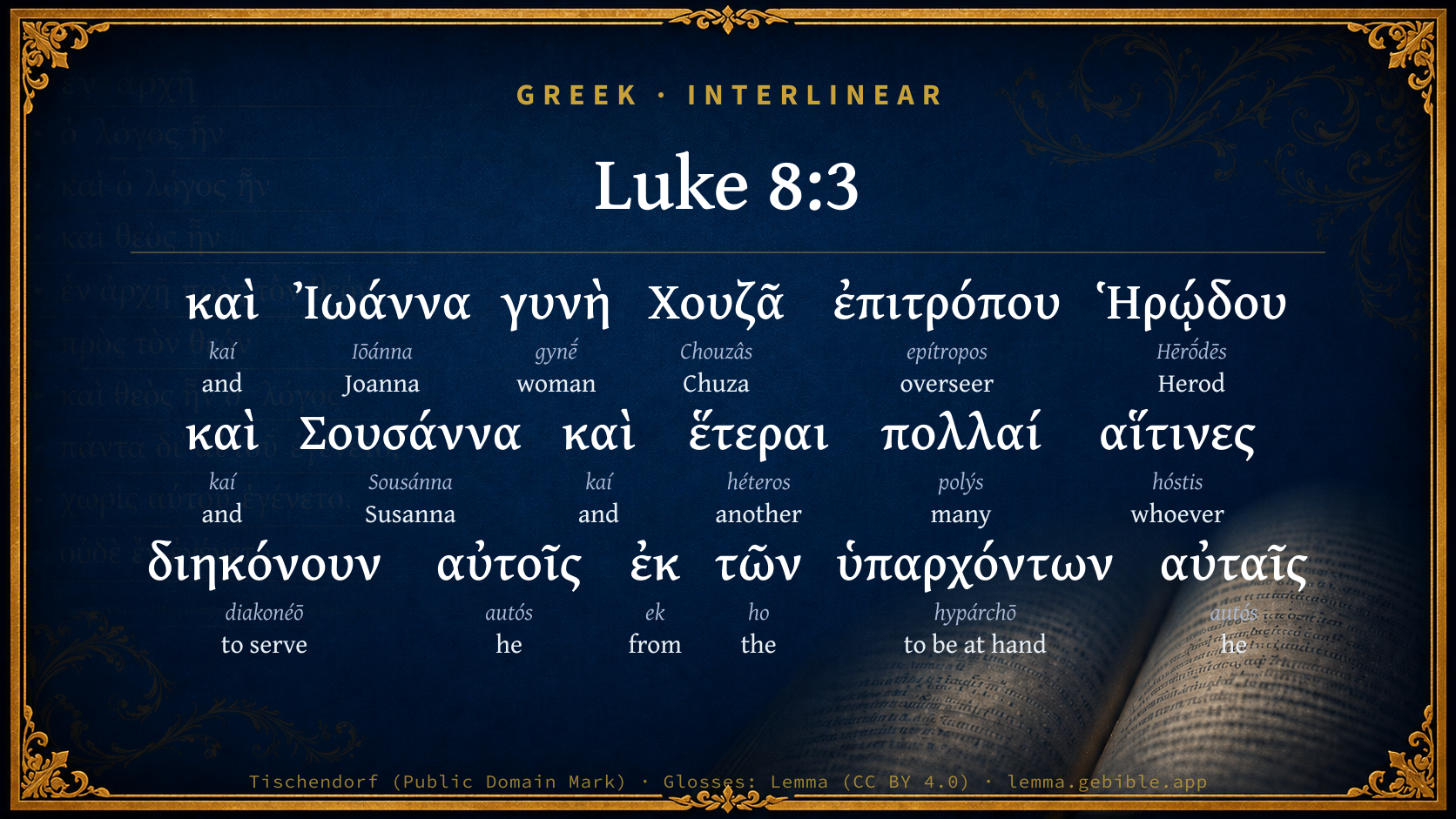
Greek (Tischendorf 8th ed.) Luke 8:3 appears in the Greek New Testament. The text above is from the Tischendorf 8th edition. Each word links to its Strong’s number and a concise gloss. Click any word for its full Thayer’s Greek Lexicon entry.
Download image
Cite this verse

Luke 8:3 (World English Bible). Public Domain. Lemma interlinear Bible study tool, https://lemma.gebible.app/v/luke/8/3.

Show BibTeX & RIS
BibTeX
RIS
English Translation
and Joanna, the wife of Chuzas, Herod's steward; Susanna; and many others; who ministered to them from their possessions.
World English Bible · Public Domain
Highlights
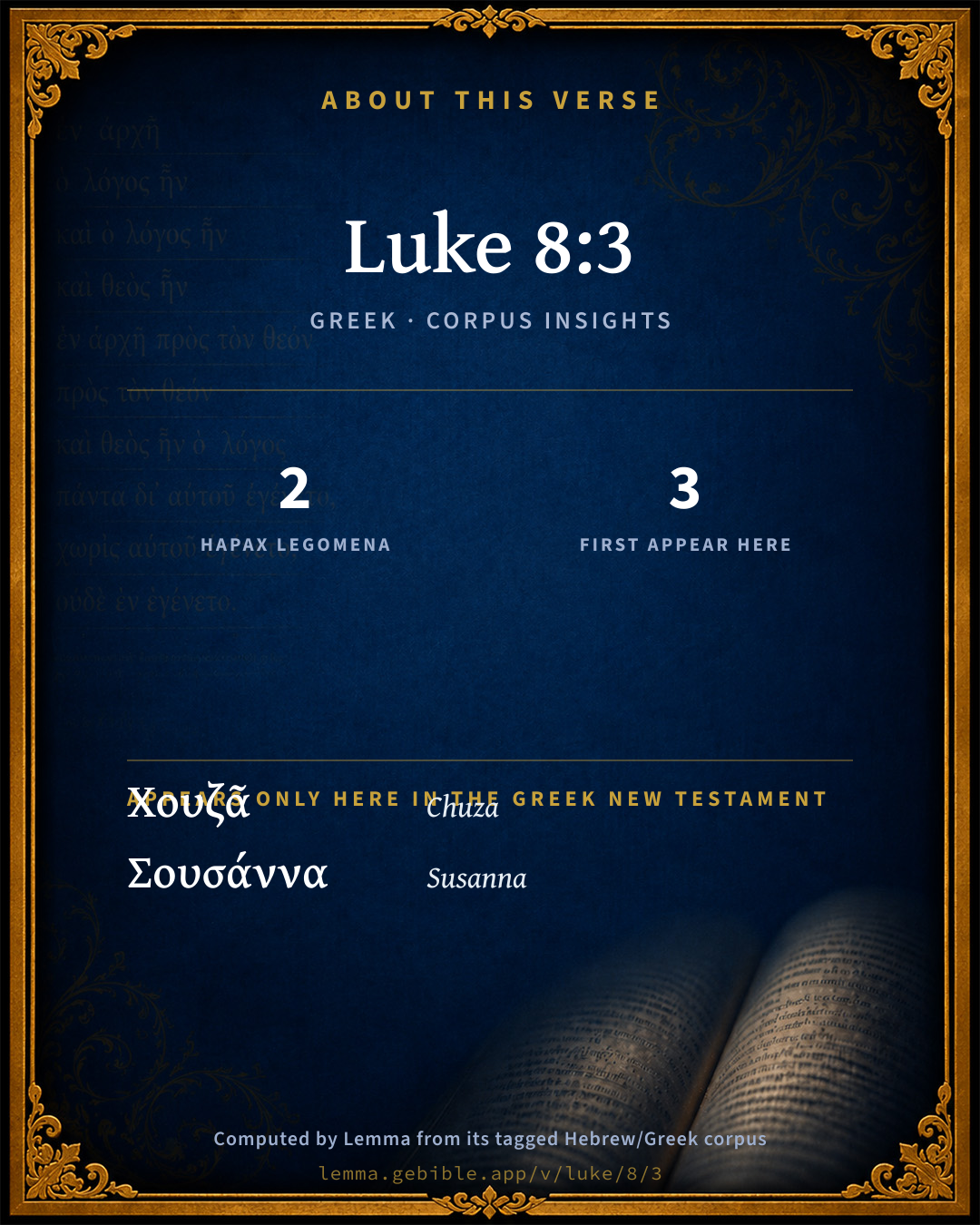
  • 2 hapax legomena — only here in the Greek New Testament
  • 3 first appearances in the Greek New Testament
Full analysis ↓
Download a study sheet

One document with this verse’s original text, its word-by-word gloss line, the meaning frame, cross-references with their text, attributed commentary, and full source and license credits — printable, and it pastes into notes with its structure intact.

This verse Autodidact and up

Study sheet (.html) Plain text (.txt)

A passage Seminary Student

Up to 50 verses in one chapter. A passage sheet keeps up to 6 commentary sources and 12 cross-references per verse, in the order this page ranks them, and says so on the sheet whenever that leaves anything out. Ask for a single verse and you get the Autodidact verse sheet above.

Everything on this page stays free to read, with no account — the sheet is a download of what is already on screen, not access to it.

Want to remove ads? Support Godless Engineer
Compare translations 3

The same verse in 3 English versions, stacked beneath the original-language interlinear above. Click any original word for its lexicon entry.

Each is an independent rendering of the whole verse — the interlinear is not word-aligned to these translations.

Highlighted words mark where these versions differ — a whole-verse word diff, not a word-by-word alignment.

  • World English Bible Public Domain
    and Joanna, the wife of Chuzas, Herod's steward; Susanna; and many others; who ministered to them from their possessions.
  • King James Version Public Domain
    And Joanna the wife of Chuza Herod's steward, and Susanna, and many others, which ministered unto him of their substance.
  • unfoldingWord Literal Text CC BY-SA 4.0
    and Joanna, the wife of Chuza, Herod’s manager; and Susanna; and many others; who were ministering to them out of their possessions.

unfoldingWord Literal Text — © unfoldingWord, licensed CC BY-SA 4.0. Word-aligned USFM3 via Door43 (git.door43.org/unfoldingWord/en_ult).

Versions to compare (up to 4)

3 of 4 selected

Show all 19 translations

Every available English version of this verse, each an independent rendering of the whole verse.

  • World English Bible Public Domain
    and Joanna, the wife of Chuzas, Herod's steward; Susanna; and many others; who ministered to them from their possessions.
  • Berean Standard Bible Public Domain
    Joanna the wife of Herod’s household manager Chuza, Susanna, and many others. These women were ministering to them out of their own means.
  • Majority Standard Bible Public Domain
    Joanna the wife of Herod’s household manager Chuza, Susanna, and many others. These women were ministering to them out of their own means.
  • King James Version Public Domain
    And Joanna the wife of Chuza Herod's steward, and Susanna, and many others, which ministered unto him of their substance.
  • American Standard Version (1901) Public Domain
    and Joanna the wife of Chuzas Herod's steward, and Susanna, and many others, who ministered unto them of their substance.
  • Revised Version (1885) Public Domain
    and Joanna the wife of Chuza Herod’s steward, and Susanna, and many others, which ministered unto them of their substance.
  • Geneva Bible (1599) Public Domain
    And Ioanna the wife of Chuza Herods steward, and Susanna, and many other which ministred vnto him of their substance.
  • Douay-Rheims (1899) Public Domain
    And Joanna the wife of Chusa, Herod's steward, and Susanna, and many others who ministered unto him of their substance.
  • Young's Literal Translation Public Domain
    and Joanna wife of Chuza, steward of Herod, and Susanna, and many others, who were ministering to him from their substance.
  • Literal Standard Version CC BY-SA 4.0
    and Joanna wife of Chuza, steward of Herod, and Susanna, and many others, who were ministering to Him from their substance.
  • Unlocked Literal Bible CC BY-SA 4.0
    Joanna, the wife of Chuza, Herod's manager; Susanna; and many others, who, out of their possessions, provided for their needs.
  • unfoldingWord Literal Text CC BY-SA 4.0
    and Joanna, the wife of Chuza, Herod’s manager; and Susanna; and many others; who were ministering to them out of their possessions.
  • Darby Bible Public Domain
    and Joanna, wife of Chuza, Herod's steward, and Susanna, and many others, who ministered to him of their substance.
  • World Messianic Bible Public Domain
    and Yochanah, the wife of Kuza, Herod’s steward; Shoshanah; and many others who served them from their possessions.
  • Webster's Bible Public Domain
    And Joanna the wife of Chuza Herod's steward, and Susanna, and many others, who ministered to him of their substance.
  • Free Bible Version CC BY-SA 4.0
    Joanna, the wife of Herod's manager Chuza; Susanna; and many more who provided support from their personal resources.
  • Bible in Basic English Public Domain
    And Joanna, the wife of Chuza, Herod's chief house-servant, and Susanna and a number of others, who gave him of their wealth for his needs.
  • Text-Critical English NT CC BY 4.0
    Joanna the wife of Chuza (Herod's steward), Susanna, and many others. These women provided for Jesus and his disciples out of their own resources.
  • Tyndale New Testament (1534) Public Domain
    and Ioanna the wyfe of Chusa Herodees stewarde and Susanna and many other: which ministred vnto the of their substaunce.

Literal Standard Version (2020), Covenant Press — licensed CC BY-SA 4.0. Text via the HelloAO Bible API (eBible.org). Unlocked Literal Bible (unfoldingWord) — licensed CC BY-SA 4.0. Text via the HelloAO Bible API (eBible.org). unfoldingWord Literal Text — © unfoldingWord, licensed CC BY-SA 4.0. Word-aligned USFM3 via Door43 (git.door43.org/unfoldingWord/en_ult). Free Bible Version, Dr. Jonathan Gallagher — licensed CC BY-SA 4.0. Text via the HelloAO Bible API (eBible.org).

Word by word

More ways to search: Search by grammar → Find every occurrence → Compare this word →

Practice this passage: Drill this verse → Learn its vocabulary →

Χουζᾶ
Chouzâs
G5529
“Chuza”
Noun, Genitive, Singular, Masculine
Part of Speech
Noun
Case
Genitive
Number
Singular
Gender
Masculine
Full Thayer's Definition

Origin: of uncertain origin

TDNT: None

Chuza = "the seer" 1. the house steward of Herod Antipas
  1. καὶ kaí G2532 “and” Conjunction
  2. Ἰωάννα Iōánna G2489 “Joanna” Noun, Genitive, Singular, Feminine
  3. γυνὴ gynḗ G1135 “woman” Noun, Nominative, Singular, Feminine
  4. ἐπιτρόπου epítropos G2012 “overseer” Noun, Genitive, Singular, Masculine
  5. Ἡρῴδου Hērṓdēs G2264 “Herod” Noun, Genitive, Singular, Masculine
  6. καὶ kaí G2532 “and” Conjunction
  7. Σουσάννα Sousánna G4677 “Susanna” Noun, Nominative, Singular, Feminine
  8. καὶ kaí G2532 “and” Conjunction
  9. ἕτεραι héteros G2087 “another” Adjective, Nominative, Plural, Feminine
  10. πολλαί polýs G4183 “many” Adjective, Nominative, Plural, Feminine
  11. αἵτινες hóstis G3748 “whoever” Relative pronoun, Nominative, Plural, Feminine
  12. διηκόνουν diakonéō G1247 “to serve” Verb, Imperfect, Active, Indicative, 3rd person, Plural
  13. αὐτοῖς autós G846 “he” Personal pronoun, Dative, Plural, Masculine
  14. ἐκ ek G1537 “from” Preposition
  15. τῶν ho G3588 “the” Article, Genitive, Plural, Neuter
  16. ὑπαρχόντων hypárchō G5225 “to be at hand” Verb, Present, Active, Participle, Genitive, Plural, Neuter
  17. αὐταῖς autós G846 “he” Personal pronoun, Dative, Plural, Feminine

About this verse

These counts appear in no published source. They are computed here, from the morphology-tagged text and Lemma’s own curated glosses. What Lemma adds →

18
words
15
distinct lemmas
Gospels
section

Notable vocabulary

2 hapax legomena — words that appear only here in the entire Greek New Testament:

  • Χουζᾶ Chuza G5529
  • Σουσάννα Susanna G4677

First appearance in Scripture

These words make their first canonical appearance in the Greek New Testament here:

  • Ἰωάννα Joanna G2489
  • Χουζᾶ Chuza G5529
  • Σουσάννα Susanna G4677

Shared distinctive vocabulary

Ἰωάννα Joanna G2489 occurs in 2 verses of the Greek New Testament. Also found in:
Repetition

Words recur within this verse:

  • καὶ and G2532 ×3
  • αὐτοῖς he G846 ×2

Cross-references

14

Topical passages linked to Luke 8:3 in the Treasury of Scripture Knowledge — connected by theme and wording, ordered by reader-vote popularity; previews shown in the World English Bible.

  • John 4:46–53 Jesus came therefore again to Cana of Galilee, where he made the water into wine. There was a certain nobleman whose son was sick at Capernaum.
  • Acts 9:36–39 Now there was at Joppa a certain disciple named Tabitha, which when translated, means Dorcas. This woman was full of good works and acts of mercy which she did.
  • 2 Corinthians 8:9 For you know the grace of our Lord Jesus Christ, that, though he was rich, yet for your sakes he became poor, that you through his poverty might become rich.
  • Philippians 4:22 All the saints greet you, especially those who are of Caesar's household.
  • 1 Timothy 5:10 being approved by good works, if she has brought up children, if she has been hospitable to strangers, if she has washed the saints' feet, if she has relieved the afflicted, and if she has diligently followed every good work.
  • 1 Chronicles 29:14 But who am I, and what is my people, that we should be able to offer so willingly as this? For all things come of you, and of your own have we given you.
  • Isaiah 23:18 Her merchandise and her hire shall be holiness to Yahweh: it shall not be treasured nor laid up; for her merchandise shall be for those who dwell before Yahweh, to eat sufficiently, and for durable clothing.
  • Matthew 2:11 They came into the house and saw the young child with Mary, his mother, and they fell down and worshiped him. Opening their treasures, they offered to him gifts: gold, frankincense, and myrrh.
  • Matthew 25:40 "The King will answer them, 'Most assuredly I tell you, inasmuch as you did it to one of the least of these my brothers, you did it to me.'
  • Matthew 26:11 For you always have the poor with you; but you don't always have me.
  • Luke 24:10 Now they were Mary Magdalene, Joanna, and Mary the mother of James. The other women with them told these things to the apostles.
  • Matthew 14:1 At that time, Herod the tetrarch heard the report concerning Jesus,
  • Luke 9:7–9 Now Herod the tetrarch heard of all that was done by him; and he was very perplexed, because it was said by some that John had risen from the dead,
  • Acts 13:1 Now in the assembly that was at Antioch there were some prophets and teachers: Barnabas, Simeon who was called Niger, Lucius of Cyrene, Manaen the foster-brother of Herod the tetrarch, and Saul.

Cross-references courtesy of OpenBible.info (CC BY 4.0).

Where the printed editions differ

1 variant

Places in this verse where the major printed Greek editions disagree on the wording in a way that affects the translation — a comparison of editions, not a manuscript-by-manuscript collation. The editions are the modern critical texts (Nestlé-Aland 28/27, SBL, Westcott-Hort, Tregelles, Tyndale House) and the traditional texts behind the KJV (the Textus Receptus and the Byzantine/Majority text). It is not a claim about which reading is original.

  1. Different wording
    αὐτοῖς

    “to them”

    In NA28NA27TynSBLWHTregByz Not in TR

    αὐτῷ (autō) 'to him' occurs in traditional manuscripts (TR) instead of αὐτοῖς (autois) 'to them' in older manuscripts (NA28+NA27+Tyn+SBL+WH+Treg+Byz)

Textual data: Translators Amalgamated Greek New Testament (STEPBible TAGNT) · CC BY 4.0.

Commentary

Notes on Luke 8:3 from classic Christian and Jewish commentators (each source and its license shown beneath its notes). The classic Christian expositions comment on the surrounding passage and are grouped to its opening verse, so a note may address several verses; the Jewish commentaries on the Tanakh (Rashi and others) are per-verse, so they appear only where the commentator wrote on this verse.

Lemma curates 59 commentaries, every one of them public domain or Creative Commons licensed, each selected and text-cleaned for this edition rather than reprinted as found. About our sources →

Bengel's Gnomon

Johann Albrecht Bengel

Luk 8:3. Ἰωάννα, Joanna) the wife of a husband of high standing in the world. [Her public attendance on the Saviour does not seem to have been without effect, in bringing it about that Herod came to know something concerning Jesus, ch. Luk 9:7.—V. g.]: yet in the household of Jesus Mary Magdalene takes precedency of her.—ἐπιτρόπου, steward).—διηκόνουν, ministered) The record of their ministry to the Lord is an ample reward of their liberality. But at that time, no doubt, many supposed them to be silly women.

Bengel's Gnomon of the New Testament — English translation (T&T Clark, Edinburgh, 1860) — public domain. Text from a community e-Sword module.

Jamieson, Fausset & Brown

Robert Jamieson, A. R. Fausset & David Brown

Joanna, wife of Chuza, Herod's steward--If the steward of such a godless, cruel, and licentious wretch as Herod Antipas (see on Mar 6:14, &c.) differed greatly from himself, his post would be no easy or enviable one. That he was a disciple of Christ is very improbable, though he might be favorably disposed towards Him. But what we know not of him, and may fear he lacked, we are sure his wife possessed. Healed either of "evil spirits" or of some one of the "infirmities" here referred to--the ordinary diseases of humanity--she joins in the Saviour's train of grateful, clinging followers. Of "Susanna," next mentioned, we know nothing but the name, and that here only. But her services on this memorable occasion have immortalized her name. "Wheresoever this gospel shall be preached throughout the whole world, this also that she hath done," in ministering to the Lord of her substance on His Galilean tour, "shall be spoken of as a memorial of her" (Mar 14:9).

many others--that is, many other healed women. What a train! and all ministering unto Him of their substance, and He allowing them to do it and subsisting upon it! "He who was the support of the spiritual life of His people disdained not to be supported by them in the body. He was not ashamed to penetrate so far into the depths of poverty as to live upon the alms of love. He only fed others miraculously; for Himself, He lived upon the love of His people. He gave all things to men, His brethren, and received all things from them, enjoying thereby the pure blessing of love: which is then only perfect when it is at the same time both giving and receiving. Who could invent such things as these? It was necessary to live in this manner that it might be so recorded" [OLSHAUSEN].

Jamieson, Fausset & Brown — Commentary Critical and Explanatory on the Whole Bible (1871) — public domain (CC PDM 1.0). Text via the HelloAO Bible API.

Adam Clarke's Commentary

Verse 3. Herod's steward] Though the original word, επιτροπος, signifies sometimes the inspector or overseer of a province, and sometimes a tutor of children, yet here it seems to signify the overseer of Herod's domestic affairs: the steward of his household. Steward of the household was an office in the king's palace by s. 24, of Hen. VIII. The person is now entitled lord steward of the king's household, and the office is, I believe, more honourable and of more importance than when it was first created. Junius derives the word from the Islandic stivardur, which is compounded of stia, work, and vardur, a keeper, or overseer: hence our words, warder, warden, ward, guard, guardian, &c. The Greek word in Hebrew letters is frequent in the rabbinical writings, אפיטדופום, and signifies among them the deputy ruler of a province. See Clarke on Lu 16:1. In the Islandic version, it is forsionarmanns.

Unto him] Instead of αυτω, to him, meaning Christ, many of the best MSS. and versions have αυτοις, to them, meaning both our Lord and the twelve apostles, see Lu 8:1. This is unquestionably the true meaning. Christ receives these assistances and ministrations, says pious Quesnel,-

1. To honour poverty by subjecting himself to it.

2. To humble himself in receiving from his creatures.

3. That he may teach the ministers of the Gospel to depend on the providence of their heavenly Father.

4. To make way for the gratitude of those he had healed. And,

5. That he might not be burthensome to the poor to whom he went to preach.

Adam Clarke's Commentary on the Bible (1810–1826) — public domain. Text from a community e-Sword/MySword module.

Ellicott's Commentary for English Readers

(3) Joanna, the wife of Chuza.—Here again we have a convert of the upper class. The name was the feminine form of Joannes, and appears in modern languages abbreviated into Joanne, Joan, or Jane. Nothing further is known of Chuza—but the “steward” (the same word as in Mat_20:8, and the “tutor” or “guardian” of Gal_4:2) of the Tetrarch, the manager of his income and expenditure, must have been a man of some mark. We may think of him and his wife as having probably come under the influence of the Baptist or of Manaen, the foster-brother of the Tetrarch, probably also of one of the “servants” to whom Antipas imparted his belief that John the Baptist was risen from the dead. Joanna appears again in the history of the Resurrection (Luk_24:10). It is possible, as suggested in the Note on Joh_4:46, that he may have been identical with the “nobleman” or “member of the royal household” at Capernaum. On this supposition her ministration may have been the result of overflowing gratitude for the restored life of her son.

Susanna.—The name, which meant a “lily” (comp. Rhoda, “a rose,” in Act_12:13, and Tamar, “a palm,” in Gen_38:6, 2Sa_13:2, as parallel instances of feminine names derived from flowers or trees), meets us in the well-known Apocryphal addition to the Book of Daniel known as Susanna and the Elders. Nothing further is known of the person thus named.

Many others.—It seems clear that St. Luke must have come into personal contact with some, at least, of those whom he describes so fully. They were, we may well believe, among the “eye-witnesses and ministers of the word” (Luk_1:2) from whom he derived much of his information. (See Introduction.)

A Bible Commentary for English Readers, edited by Charles John Ellicott (1878–1897) — public domain. Text from a community e-Sword module.

The Cambridge Bible for Schools and Colleges

gen. ed. J. J. S. Perowne

3. Joanna] She is mentioned only in Luk_24:10, but had apparently been healed of some infirmity.

the wife of Chuza Herod’s steward] The court of Antipas was well aware of the ministry and claims of Jesus. Not only had John the Baptist been a familiar figure there, but Manaen, Herod’s fosterbrother, early became a Christian (Act_13:1), and whether Chuzas be the courtier (basilikos, E. V. ‘nobleman’) of Joh_4:46 or not, that courtier could only have been in the retinue of Antipas, and must have made known the healing of his son by Jesus. The word epitropos, ‘administrator,’ conveys the impression of a higher rank than steward (oikonomos). The Rabbis adopted the word in Hebrew letters, and said that Obadiah was Ahab’s epitropos. Manaen at Antioch was perhaps the source of St Luke’s special knowledge about the Herodian family.

Susanna] The name means ‘Lily.’

many others] See Mat_27:55.

which ministered unto him of their substance] or ‘to them,’ B, D, F, G, H, &c. This notice is deeply interesting as throwing light on the otherwise unsolved problem of the means of livelihood possessed by Jesus and His Apostles. They had a common purse which sufficed not only for their own needs but for those of the poor (Joh_13:29). The Apostles had absolutely forsaken their daily callings, but we may suppose that some of them (like Matthew and the sons of the wealthier fisherman Zebedee) had some small resources of their own, and here we see that these women, some of whom (as tradition says of Mary of Magdala) were rich, helped to maintain them. It must also be borne in mind (1) that the needs of an Oriental are very small. A few dates, a little parched corn, a draught of water, a few figs or grapes plucked from the roadside trees, suffice him; and in that climate he can sleep during most of the year in the open air wrapped up in the same outer garment which serves him for the day. Hence the maintenance of a poor man in Palestine is wholly different from the standard of maintenance required in such countries as ours with their many artificial needs. And yet (2) in spite of this our Lord was so poor as to be homeless (Luk_9:58) and without the means of even paying the small Temple-tribute of a didrachm (about Isaiah 6 d.), which was demanded from every adult Jew. Mat_17:24; 2Co_8:9.

The Cambridge Bible for Schools and Colleges (gen. ed. J. J. S. Perowne; Cambridge University Press, 1878–1918) — public domain. Text from a community e-Sword module.

John Gill's Exposition

And Joanna, the wife of Chuza, Herod's steward,.... Joanna, or Juchan, as the Syriac version calls her, was a name, among the Jews, for a woman, as Jochanan, or John, was for a man. In the Talmud (e) we read of one Jochani, or Joanni, the daughter of Retibi, the same name with this. Her husband's name was Chuza. Dr. Lightfoot observes, from a Talmudic treatise (f), such a name in the genealogy of Haman, who is called the son of Chuza; and Haman being an Edomite, and this man being in the family of Herod, who was of that race, suggests it to be an Idumean name. But in my edition of that treatise, Haman is not called the son of Chuza, but , "the son of Ciza"; and besides, Chuza is a Jewish name, and the name of a family of note among the Jews: hence we read (g) of R. Broka the Chuzite; where the gloss is, "for he was", , "of the family of Chuzai". And elsewhere (h) mention is made of two sons of Chuzai; and both the gloss, and Piske Harosh upon the place, say, "they were Jews": so Abimi is said to be of the family of Chuzai, or the Chuzites (i); and the same is said of R. Acha (k). This man, here mentioned, was Herod's steward; a steward of Herod the "tetrarch", of Galilee. The Arabic version calls him his "treasurer"; and the Vulgate Latin, and the Ethiopic versions, his "procurator"; and some have thought him to be a deputy governor of the province under him; but he seems rather to be a governor, or "chief of his house", as the Syriac version renders it: he was one that presided in his family, and managed his domestic affairs; was an overseer of them, as Joseph was in Potiphar's house; and the same Greek word that is here used, is adopted by the Jews into their language, and used of Joseph (l): and who moreover say (m),

"let not a man appoint a steward in his house; for if Potiphar had not appointed Joseph, "a steward" in his house, he had not come into that matter,''

of calumny and reproach. It was common for kings, princes, and great men, to have such an officer in their families. We read (n) of a steward of king Agrippa's, who was of this same family. The Persic version is very foreign to the purpose, making Chuza to be "of the family of Herod". This man might be either dead, as some have conjectured; or, if living, might be secretly a friend of Christ, and so willing that his wife should follow him; or, if an enemy, such was her zeal for Christ, that she cheerfully exposed herself to all his resentments; and chose rather meanness, contempt, and persecution with Christ, and for his sake, than to enjoy all the pleasures of Herod's court without him.

And Susannah; this also was a name for a woman with the, Jews, as appears from the history of one of this name with them, which stands among the apocryphal writings. She, as well as Joanna, and perhaps also Mary Magdalene, were rich, and persons of substance, as well as note, as should seem by what follows: "and many others"; that is, many other women; for the words, are of the feminine gender:

which ministered unto him of their substance; four ancient copies of Beza's, and five of Stephens's, and the Syriac version read, "which ministered unto them"; that is, to Christ, and his disciples, as the Persic version expresses it. This shows the gratitude of these women, who having received favours from Christ, both for their souls and bodies, make returns to him out of their worldly substance, in a way of thankfulness; and also the low estate of Christ, and his disciples, who stood in need of such ministrations; and may be an instruction to the churches of Christ to take care of their ministers, and to communicate in all good things to them, of whose spiritual things they partake; and may be a direction to them to minister to them of what is their own substance, and not another's; and to minister a proper part, and not the whole, as these women ministered to Christ, and his apostles, of substance which was their own, and that not all of it, but out of it.

(e) T. Bab. Sota, fol. 22. 1. (f) Massechet Sopherim, c. 13. sect. 6. (g) T. Bab. Tasnith, fol. 22. 1. (h) T. Bab. Nedarim, fol. 22. 1. (i) Juchasin, fol. 75. 1. (k) Juchasin, fol. 78. 1. (l) Targum Jon. & Jerus. in Gen. xxxix. 4. (m) T. Bab. Beracot, fol 63. 1. & Maimon lssure Bia, c. 22. sect. 15. & Maggid Misn. in ib. (n) T. Bab. Sacca, fol. 27. 1.

John Gill's Exposition of the Whole Bible (1746–1763) — public domain (CC PDM 1.0). Text via the HelloAO Bible API.

Trapp's Complete Commentary

John Trapp

3 And Joanna the wife of Chuza Herod’s steward, and Susanna, and many others, which ministered unto him of their substance.

Ver. 3. Joanna, the wife of Chuza, Herod’s steward] Or treasurer, as the Arabic calleth him, his vicar-general, or protetrarch. This court lady followeth Christ: so did Serena the empress, who was therefore martyred by her husband Diocletian. So Elizabeth, Queen of Denmark; of whom Luther testifieth (in Epist. ad Jo. Agrieol.) that she died a faithful professor of the reformed religion; and addeth, Scilicet Christus etiam aliquando voluit Reginam in coelum vehere. Christ would once save a queen: which he doth not often.

John Trapp, A Commentary or Exposition upon All the Books of the Old and New Testament (1647–1656) — public domain. Text from a community e-Sword module.

Albert Barnes' Notes on the Bible

Herod’s steward - Herod Antipas, who reigned in Galilee. He was a son of Herod the Great. The word “steward” means one who has charge of the domestic affairs of a family, to provide for it. This office was generally held by a “slave” who was esteemed the most faithful, and was often conferred as a reward of fidelity.

Ministered - Gave for his support.

Of their substance - Their property; their possessions. Christians then believed, when they professed to follow Christ, that it was proper to give “all” up to him - their property as well as their hearts; and the same thing is still required that is, to commit all that we have to his disposal; to be willing to part with it for the promotion of his glory, and to leave it when he calls us away from it.

Albert Barnes' Notes on the Bible (1834–1885) — public domain. Text from a community e-Sword/MySword module.

Haydock's Catholic Bible Commentary

The wife of Chusa, Herod’s steward. Literally, his procurator, as in the Rheims translation. The Greek signifies one that provides for another, or manages his concerns. The same word is used, Matthew xx. 8. and Galatians iv. 2. (Witham) --- the Greek word is epitropou. It was the custom of the Jews, says St. Jerome, that pious women should minister of their substance, meat, drink, and clothing, to their teachers going about with them. But as this might have given cause of scandal among the Gentiles, St. Paul mentions that he allowed it not. (1 Corinthians ix. 5. 12.) They thus ministered to our Lord and his apostles of their worldly substance, from whom they received spiritual riches.

George Leo Haydock (1774–1849), Haydock's Catholic Family Bible and Commentary, 1859 edition — public domain. Excludes Psalms (Douay-Rheims chapter numbering differs from Protestant) and Deuterocanonical books (Catholic canon only).

Whedon's Commentary on the Bible

Daniel D. Whedon

3. Joanna—The feminine of John, (see note on Luk_1:13,) and the same as Jane.

Chuza… Herod’s steward—The manager of his property concerns and his household affairs. The royal residence of Herod Antipas, Sepphoris, which was the Roman capital of Galilee, stood near the centre of that province, on an elevated table-land but a small distance from Capernaum. From the mountain which separated it from the broad plain Nazareth was plainly visible. Hence Herod, the actual sovereign, and Jesus, the rightful sovereign by birth, were in close proximity. And hence the wife of Herod’s steward might easily hear of such miracles as the healing the centurion’s servant and the raising of the widow’s son at Nain. There were saints, perhaps, in Herod’s house, as there afterwards were in Caesar’s.

See note on Mat_14:2.

Of their substance—These seem to be mentioned by Luke, including Mary Magdalene, as women of rank, wealth, and character. In a very incidental way he gives us to understand how the Son of man was as a man supported. He did not live by miracle. He commanded no stones to be made bread. The kingdom of God is to be built up, society is to be improved and renovated, not by miracle, but by the natural process of human agency.

Daniel D. Whedon (gen. ed.), Commentary on the Old and New Testaments (1874–1909) — public domain. Text from a community e-Sword module.

The Pulpit Commentary

Joanna the wife of Chuza Herod"s steward. She must have been a person of wealth and high rank at the court of Herod Antipas. There were evidently not a few believers in that wicked and dissolute centre. Some years later we read of Manaen, the foster-brother of Herod, as a notable Christian. (Act_13:1) Even Herod himself, we know, at first heard John the Baptist gladly. and, after the terrible judicial murder, we find that unhappy prince fancying that his victim had risen from the dead. It has been suggested that this Chuza was the nobleman of Capernaum whose dying son was healed by Jesus. (Joh_4:46) If this be the case, therewould be a special reason for the loving devotion of this Joanna to the Master. She reappears among the faithful women in the history of the Resurrection. (Luk_24:10) Susanna. The name signifies "lily." The Jews were fond of giving the names of flowers and trees to their girls; thus Rhoda, a rose, (Act_12:13) Tamar, a palm, (2Sa_13:2) among many instances. Of this Susanna nothing further is known.

The Pulpit Commentary (1880–1919), ed. H.D.M. Spence-Jones & Joseph S. Exell — public domain. Text from a community e-Sword module.

Scofield Reference Notes

C. I. Scofield

Herod

See margin ref., (See Scofield "Mat 14:1").

The Scofield Reference Bible (1917 edition), notes by C. I. Scofield — public domain. Text from a community e-Sword module.

The People's New Testament

B. W. Johnson

3. Joanna the wife of Chuza. Nothing more is known of her. As her husband held a very responsible position, she must have been a woman of wealth and influence. Herod. Herod Antipas. See notes on Matt. 2:1. Susanna. Not named elsewhere. Ministered unto him. Contributed to his support. They used their means to support Jesus and the apostles while preaching.

B. W. Johnson's The People's New Testament with Notes (1889–1891) — public domain. Electronic text from the Christian Classics Ethereal Library (CCEL) ThML edition.

Cambridge Greek Testament for Schools and Colleges

3. αὐτοῖς BD and most edd. αὐτῷ אAL, La[169]

[169] La. Lachmann.

3. Ἰωάννα. She is mentioned only in Luk 24:10, but had apparently been healed of some infirmity.

γυνὴ Χουζᾶ ἐπιτρόπου Ἡρώδου. She was probably a widow of Chuzas. See Luk 24:10. On ἐπιτρόπου without the article see note on Luk 2:36. The courtiers of Antipas were well aware of the ministry and claims of Jesus. Not only had John the Baptist been a familiar figure among them, but Manaen, Herod’s foster-brother, early became a Christian (Act 13:1), and whether Chuzas be the courtier (βασιλικος, E. V. “nobleman”) of Joh 4:46 or not, that courtier could only have been in the retinue of Antipas, and must have made known the healing of his son by Jesus. The word ἐπίτροπος, ‘administrator,’ conveys the impression of a higher rank than “steward” (οἰκονομος). The Rabbis adopted the word in Hebrew letters, and said that Obadiah was Ahab’s ἐπίτροπος. Manaen at Antioch was perhaps the source of St Luke’s special knowledge about the Herodian family.

Σουσάννα. The name means ‘Lily.’

ἕτεραι πολλαί. See Mat 27:55.

αἵτινες διηκόνουν αὐτοῖς ἐκ τῶν ὑπαρχόντων αὐταῖς. The verb διακονεῖν in the sense of pecuniary help is found also in Rom 15:25. This notice is deeply interesting as throwing light on the otherwise unsolved problem of the means of livelihood possessed by Jesus and His Apostles. They had a common purse which sufficed not only for their own needs but for those of the poor (Joh 13:29). The Apostles had absolutely forsaken their daily callings, but we may suppose that some of them (like Matthew and the sons of the wealthier fisherman Zebedee) had some small resources of their own, and here we see that these women, some of whom (as tradition says of Mary of Magdala) were rich, helped to maintain them. It must also be borne in mind (1) that the needs of an Oriental are very small. A few dates, a little parched corn, a draught of water, a few figs or grapes plucked from the roadside trees, suffice him; and in that climate he can sleep during most of the year in the open air wrapped up in the same outer garment which serves him for the day. Hence the standard of maintenance for a poor man in Palestine is wholly different from that required in such countries as ours with their many artificial needs. And yet (2) in spite of this our Lord was so poor as to be homeless (Luk 9:58), and without the means of even paying the small Temple-tribute of a didrachm (about 1 Samuel 6 d.), which was demanded from every adult Jew. Mat 17:24; 2Co 8:9.

Cambridge Greek Testament for Schools and Colleges (Cambridge University Press, 1896; 21 vols, various authors incl. Carr, Maclear, Plummer, Farrar, Lumby, Moule, M. R. James, Simcox) — public domain. Text from a community e-Sword module.

Alford’s Greek Testament

Henry Alford

3.] Prof. Blunt has observed in his Coincidences, that we find a reason here why Herod should say to his servants (Mat 14:2), ‘This is John the Baptist,’ &c., viz.—because his steward’s wife was a disciple of Jesus, and so there would be frequent mention of Him among the servants in Herod’s court.

This is Herod Antipas.

Johanna is mentioned again ch. 24:10, and again in company with Mary Magdalene and others. Susanna is not again mentioned.

διηκ., providing food, and giving other necessary attentions.

Henry Alford, The Greek Testament (1849–1861) — public domain. Text from a community e-Sword module.

International Critical Commentary

3. Ἰωάνα. She is mentioned with Mary Magdalen again 24:10: all that we know about her is contained in these two passages. Godet conjectures that Chuza is the βασιλικός, who “believed and his whole house” (Joh 4:46-53). In that case her husband would be likely to let her go and minister to Christ The Herod meant is probably Antipas, and his ἐπίτροπος would be the manager of his household and estates: comp. Mat 20:8. Blunt finds here a coincidence with Mat 14:2 ; Herod “said to his servants, This is John the Baptist.” If Herod’s steward’s wife was Christ’s disciple, He would often bespoken of among the servants at the court; and Herod addresses them, because they were familiar with the subject. Comp. the case of Manaen (Act 13:1), Herod’s σύτροφος (Undesigned Coincidences, Pt. IV. xi. p. 263, 8th ed.). Of Susanna nothing else is known, nor of the other women, unless Mary, the mother of James and Joses, and Salome (Mar 15:40) may be assumed to be among them.

αἵτινες διηκόνουν αὐτοῖς. “Who Were of such a character as to minister to them”; i.e. they were persons of substance. For ἥτις see on 7:37, and for διακονεῖν comp. Rom 15:25. The αὐτοῖς means Jesus and the Twelve, the reading αὐτῷ (A L M X) being probably a correction from Mat 26:55 ; Mar 15:41. But αὐτοῖς has special point. It was precisely because Jesus now had twelve disciples who always accompanied Him, that there was need of much support from other disciples.

ἐκ τῶν ὑπαρχότων αὐταῖς. It is this which distinguishes this passage from Mat 27:55 and Mar 15:41. There the διακονεῖν might refer to mere attendance on Him. We learn from this that neither Jesus nor the Twelve wrought miracles for their own support.

Here, as in 12:15 and Act 4:32, τὰ ὐπάρχοντα has the dat. Everywhere else in Lk. (11:21, 12:33, 44, 14:33, 16:1, 19:8) and elsewhere in N.T. (five times) it has the gen. So also in LXX the gen. is the rule, the dat. the exception, if it is the true reading anywhere. Both τὰ ὑπάρχοντα and ὑπάρχειν are favourite expressions with Lk. See on ver. 41.

International Critical Commentary — older volumes (1896–1929), various authors — public domain. Text from a community e-Sword module.

Vincent's Word Studies in the New Testament

Marvin R. Vincent

Steward [επιτροπου] . From ejpitrepw, to turn toward; thence to turn over to, transfer, and so commit or intrust to. The word thus literally means, one to whom the management of affairs is turned over.

4 - 18. Compare Mt 13:1 - 23; Mr 4:1 - 25.

Marvin R. Vincent, Word Studies in the New Testament (1887–1900) — public domain. Text from a community e-Sword/MySword module.

Lesson kit

Teaching starters — assembled from the data on this page, not authored interpretation. Every prompt links to the verse data it draws on. Edit before teaching.

Luke, in the Gospels, opens this verse with 18 words (15 distinct Greek lemmas). Its most distinctive word is Chouzâs (“Chuza”). A historical commentator’s framing appears above. Read the whole chapter for the surrounding context.

Discussion questions

  1. What does “Chuza” (Chouzâs) contribute to the verse as a whole?
  2. This verse holds 2 words here found nowhere else in the Greek New Testament. What might the rare words draw attention to?
  3. 3 words here appear for the first time in Scripture. What is being introduced at this debut?
  4. Luke 24:10 shares the word «Joanna» with this verse. How do the two illuminate each other?
  5. “and” occurs 3× in this one verse. What is the effect of the repetition?
  6. The translations on this page render this verse differently — a whole-verse word diff, not a word-by-word alignment. What might account for the different wordings?
  7. Reading how Bengel's Gnomon and Jamieson, Fausset & Brown read this verse, where do the two commentators agree and where do they part?

Things to notice

  • 2 words in this verse appear nowhere else in the Greek New Testament.
  • 3 words make their first canonical appearance in Scripture here.
  • These translations choose different wording for 14 words in this verse.
  • “and” occurs 3× in this single verse.
  • 15 distinct Greek lemmas span 18 words in this verse.

Reading settings

Reading text

Shown beneath each verse's original-language words.

Old Testament
Old Testament edition

Read the OT as the Masoretic Hebrew (MT) or the Greek Septuagint (LXX).

English shown for the Greek Septuagint (in the Hebrew ↔ Greek comparison).

Comparing translations? Open the Compare panel on any verse page to stack up to four side by side.