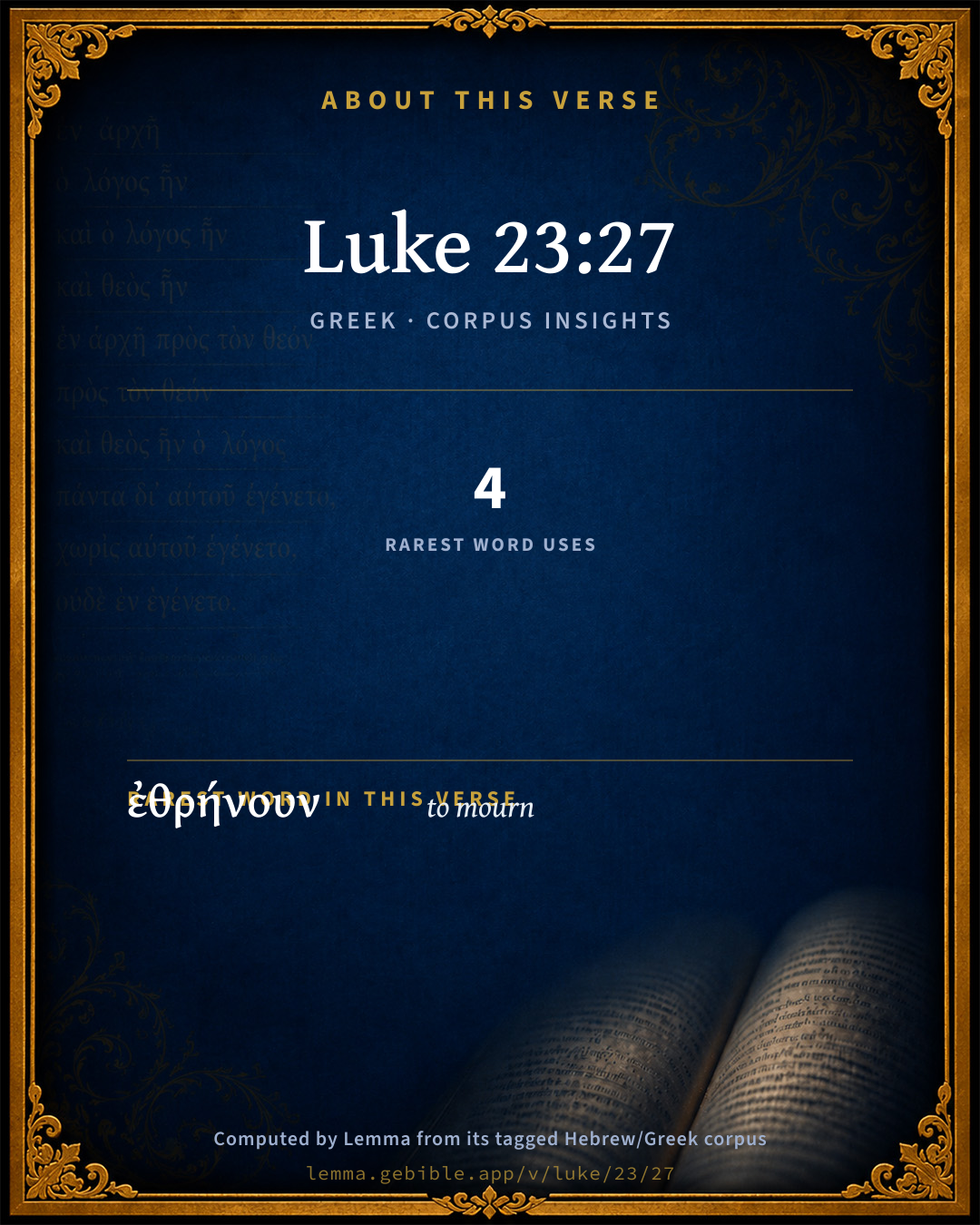
Luke 23:27

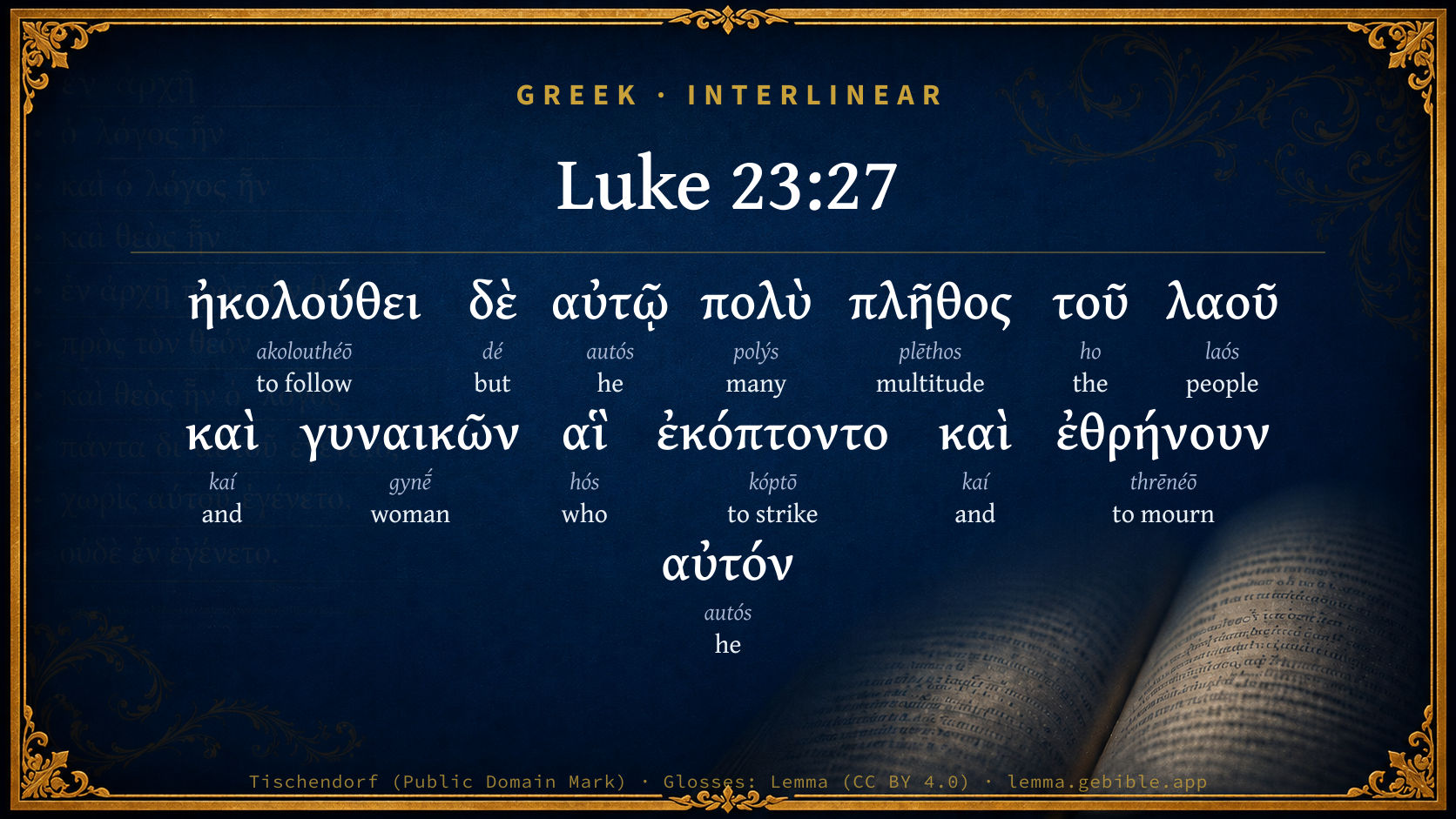
Greek (Tischendorf 8th ed.) Luke 23:27 appears in the Greek New Testament. The text above is from the Tischendorf 8th edition. Each word links to its Strong’s number and a concise gloss. Click any word for its full Thayer’s Greek Lexicon entry.
Download image
Cite this verse

Luke 23:27 (World English Bible). Public Domain. Lemma interlinear Bible study tool, https://lemma.gebible.app/v/luke/23/27.

Show BibTeX & RIS
BibTeX
RIS
English Translation
A great multitude of the people followed him, including women who also mourned and lamented him.
World English Bible · Public Domain
Download a study sheet

One document with this verse’s original text, its word-by-word gloss line, the meaning frame, cross-references with their text, attributed commentary, and full source and license credits — printable, and it pastes into notes with its structure intact.

This verse Autodidact and up

Study sheet (.html) Plain text (.txt)

A passage Seminary Student

Up to 50 verses in one chapter. A passage sheet keeps up to 6 commentary sources and 12 cross-references per verse, in the order this page ranks them, and says so on the sheet whenever that leaves anything out. Ask for a single verse and you get the Autodidact verse sheet above.

Everything on this page stays free to read, with no account — the sheet is a download of what is already on screen, not access to it.

Want to remove ads? Support Godless Engineer
Compare translations 3

The same verse in 3 English versions, stacked beneath the original-language interlinear above. Click any original word for its lexicon entry.

Each is an independent rendering of the whole verse — the interlinear is not word-aligned to these translations.

Highlighted words mark where these versions differ — a whole-verse word diff, not a word-by-word alignment.

  • World English Bible Public Domain
    A great multitude of the people followed him, including women who also mourned and lamented him.
  • King James Version Public Domain
    And there followed him a great company of people, and of women, which also bewailed and lamented him.
  • unfoldingWord Literal Text CC BY-SA 4.0
    And a great crowd of the people was following him, and of women mourning and wailing for him.

unfoldingWord Literal Text — © unfoldingWord, licensed CC BY-SA 4.0. Word-aligned USFM3 via Door43 (git.door43.org/unfoldingWord/en_ult).

Versions to compare (up to 4)

3 of 4 selected

Show all 19 translations

Every available English version of this verse, each an independent rendering of the whole verse.

  • World English Bible Public Domain
    A great multitude of the people followed him, including women who also mourned and lamented him.
  • Berean Standard Bible Public Domain
    A great number of people followed Him, including women who kept mourning and wailing for Him.
  • Majority Standard Bible Public Domain
    A great number of people followed Him, including women who kept mourning and wailing for Him.
  • King James Version Public Domain
    And there followed him a great company of people, and of women, which also bewailed and lamented him.
  • American Standard Version (1901) Public Domain
    And there followed him a great multitude of the people, and of women who bewailed and lamented him.
  • Revised Version (1885) Public Domain
    And there followed him a great multitude of the people, and of women who bewailed and lamented him.
  • Geneva Bible (1599) Public Domain
    And there followed him a great multitude of people, and of women, which women bewailed and lamented him.
  • Douay-Rheims (1899) Public Domain
    And there followed him a great multitude of people, and of women, who bewailed and lamented him.
  • Young's Literal Translation Public Domain
    And there was following him a great multitude of the people, and of women, who also were beating themselves and lamenting him,
  • Literal Standard Version CC BY-SA 4.0
    And a great multitude of the people were following Him, and of women, who also were beating themselves and lamenting Him,
  • Unlocked Literal Bible CC BY-SA 4.0
    A great crowd of the people, and of women who grieved and mourned for him, were following him.
  • unfoldingWord Literal Text CC BY-SA 4.0
    And a great crowd of the people was following him, and of women mourning and wailing for him.
  • Darby Bible Public Domain
    And a great multitude of the people, and of women who wailed and lamented him, followed him.
  • World Messianic Bible Public Domain
    A great multitude of the people followed him, including women who also mourned and lamented him.
  • Webster's Bible Public Domain
    And there followed him a great company of people, and of women, who also bewailed and lamented him.
  • Free Bible Version CC BY-SA 4.0
    A large crowd followed him, along with women who were mourning and lamenting him.
  • Bible in Basic English Public Domain
    And a great band of people went after him, and of women making signs of grief and weeping for him.
  • Text-Critical English NT CC BY 4.0
    A great multitude of people followed along behind, including women who were mourning and lamenting for Jesus.
  • Tyndale New Testament (1534) Public Domain
    And ther folowed him a greate company of people and of wemen which weme bewayled and lamented him.

Literal Standard Version (2020), Covenant Press — licensed CC BY-SA 4.0. Text via the HelloAO Bible API (eBible.org). Unlocked Literal Bible (unfoldingWord) — licensed CC BY-SA 4.0. Text via the HelloAO Bible API (eBible.org). unfoldingWord Literal Text — © unfoldingWord, licensed CC BY-SA 4.0. Word-aligned USFM3 via Door43 (git.door43.org/unfoldingWord/en_ult). Free Bible Version, Dr. Jonathan Gallagher — licensed CC BY-SA 4.0. Text via the HelloAO Bible API (eBible.org).

Word by word

More ways to search: Search by grammar → Find every occurrence → Compare this word →

Practice this passage: Drill this verse → Learn its vocabulary →

ἐθρήνουν
thrēnéō
G2354
“to mourn”
Verb, Imperfect, Active, Indicative, 3rd person, Plural
Part of Speech
Verb
Tense
Imperfect
Voice
Active
Mood
Indicative
Person
3rd person
Number
Plural
Full Thayer's Definition

Origin: from G2355

TDNT: 05:28,3

1. to mourn, to lament a. of singers of dirges, [to wail] 2. to bewail, deplore
  1. ἠκολούθει akolouthéō G190 “to follow” Verb, Imperfect, Active, Indicative, 3rd person, Singular
  2. δὲ dé G1161 “but” Conjunction
  3. αὐτῷ autós G846 “he” Personal pronoun, Dative, Singular, Masculine
  4. πολὺ polýs G4183 “many” Adjective, Nominative, Singular, Neuter
  5. πλῆθος plēthos G4128 “multitude” Noun, Nominative, Singular, Neuter
  6. τοῦ ho G3588 “the” Article, Genitive, Singular, Masculine
  7. λαοῦ laós G2992 “people” Noun, Genitive, Singular, Masculine
  8. καὶ kaí G2532 “and” Conjunction
  9. γυναικῶν gynḗ G1135 “woman” Noun, Genitive, Plural, Feminine
  10. αἳ hós G3739 “who” Relative pronoun, Nominative, Plural, Feminine
  11. ἐκόπτοντο kóptō G2875 “to strike” Verb, Imperfect, Middle, Indicative, 3rd person, Plural
  12. καὶ kaí G2532 “and” Conjunction
  13. αὐτόν autós G846 “he” Personal pronoun, Accusative, Singular, Masculine

About this verse

These counts appear in no published source. They are computed here, from the morphology-tagged text and Lemma’s own curated glosses. What Lemma adds →

14
words
12
distinct lemmas
Gospels
section

Notable vocabulary

The rarest word here is ἐθρήνουν to mourn G2354 — appearing just 4 times in the whole Greek New Testament.

Shared distinctive vocabulary

ἐθρήνουν to mourn G2354 occurs in 4 verses of the Greek New Testament. Also found in:

Repetition

Words recur within this verse:

  • αὐτῷ he G846 ×2
  • καὶ and G2532 ×2

Cross-references

5

Topical passages linked to Luke 23:27 in the Treasury of Scripture Knowledge — connected by theme and wording, ordered by reader-vote popularity; previews shown in the World English Bible.

  • Luke 8:52 All were weeping and mourning her, but he said, "Don't weep. She isn't dead, but sleeping."
  • Luke 8:2 and certain women who had been healed of evil spirits and infirmities: Mary who was called Magdalene, from whom seven demons had gone out;
  • Mark 15:40 There were also women watching from afar, among whom were both Mary Magdalene, and Mary the mother of James the less and of Joses, and Salome;
  • Luke 23:55 The women, who had come with him out of Galilee, followed after, and saw the tomb, and how his body was laid.
  • Matthew 27:55 Many women were there watching from afar, who had followed Jesus from Galilee, serving him.

Cross-references courtesy of OpenBible.info (CC BY 4.0).

Commentary

Notes on Luke 23:27 from classic Christian and Jewish commentators (each source and its license shown beneath its notes). The classic Christian expositions comment on the surrounding passage and are grouped to its opening verse, so a note may address several verses; the Jewish commentaries on the Tanakh (Rashi and others) are per-verse, so they appear only where the commentator wrote on this verse.

Lemma curates 59 commentaries, every one of them public domain or Creative Commons licensed, each selected and text-cleaned for this edition rather than reprinted as found. About our sources →

The Biblical Illustrator

Joseph S. Exell

Luk_23:27-31

Daughters of Jerusalem

The daughters of Jerusalem

I.

WHY DID THE DAUGHTERS OF JERUSALEM WEEP?

1. He was innocent. All they had heard about Him was favourable.

2. He was benevolent. His gifts were uncommon and priceless. Wherever He went, He left behind Him the footprint of mercy.

3. He was the hope of the people. The glory had departed; the land was under a curse, and the people groaned under the Roman yoke. But Jesus, although opposed to every public demonstration in His favour, had, by His teaching and example, aroused the public aspiration.

II. WHY DID JESUS REFUSE THEIR SYMPATHY?--Weep not for Me.

1. Weep not, My death is a necessity. It is not an accident, or the effect of unrestrained animosity, but the fulfilment of an old covenant, older than the earth or the heaven. Justice demands it before the prisoners of hope can come forth.

2. Weep not, I can bear it all. Hard as it may seem to bear the reproach as an evil-doer, and to suffer the enmity of those whom I have not offended, yet, my hearts desire is to suffer in the sinners room.

3. Weep not, tears will avail nothing now. The plea of the tear is the most effective. Had the appeal of the tear been made before Pilate, humanly speaking, the evidence might have been taken, and the prisoner acquitted, but then it was too late. Weeping did not make the cross lighter, or the pains of death any the less.

4. Weep not, the course I am to take will ultimately wipe away all tears. The sorrow of to-day will be exchanged for peace and joy hereafter. The death on the cross will remove sorrow from the heart of the penitent, and tears will cease to flow.

III. WHICH, THEN, IS THE RIGHT CHANNEL OF TEARS? Weep for yourselves and for your children. Sin is the cause of sorrow. (The Weekly Pulpit.)

Weep not for Me

I. Let us consider them as addressed to that part of the multitude WHO HAD BELIEVED IN HIS DIVINE MISSION, and submitted to His authority. Their sorrow for our Lord did not spring from the proper source. His truest disciples partook of the common misapprehensions of their countrymen about the nature of Messiahs kingdom. Yet sorrow was their proper mood of feeling. And why, my friends, should they have wept for themselves and their children, in looking upon the sufferings of their Lord?

1. We reply, because their sins occasioned Christs sufferings. It were well for us oftener to weep thus for ourselves.

2. They should have wept for themselves and their children, because they should no more hear Christs instructions.

II. ANOTHER CLASS, BESIDES TRUE BELIEVERS, MINGLED IN THE CROWD, WHICH ATTENDED CHRIST TOWARDS CALVARY. Let us consider the application of our text to them. It was the natural feelings, which prompt us to take part in any circumstances with the distressed, and which are pained, when innocence, or, at least, benevolence is oppressed, that caused their tears to pour down. Bight and worthy were these emotions, so far as they went; but they had deeper cause for sorrow than anything they thought of when they wept. They should have wept for themselves and for their children.

1. Because away from them were about to be taken the word of salvation, the admonitions and warnings of the Lord.

2. They should have wept for themselves and for their children, because this act by which Christ was taken away would speedily bring judgment upon their nation. To this our Lord had most express reference, as He showed by the language which follows the text. (S. Martin.)

Wherefore should I weep?

These words are especially noteworthy, because they constitute the last connected discourse of the Saviour before He died. All that He said afterwards was fragmentary and mainly of the nature of prayer. A sentence to John, and to His mother, and to the dying thief: just a word or two looking downward, but for the most part He uttered broken sentences, which flew upwards on the wings of strong desire.

I. He said to the weeping women, WEEP NOT. There are some cold, calculating expositors who make it out that our Lord reproved these women for weeping, and that there was something wrong in their sorrow--I think they call it the sentimental sympathy of these kind souls.Blame these women! No, bless them again and again. It was the one redeeming trait in the dread march along the Via Dolorosa; let it not be dreamed that Jesus could have censured those who wept for Him. These gentle women appear in a happy contrast to the chief priests, with their savage malice, and to the thoughtless multitude with their fierce cry of Crucify Him, crucify Him! They seem to me to have shown a noble courage in daring to express their sympathy with one whom everybody else hunted to death.

1. There can be nothing ill about the weeping of these women, and therefore let us proceed to say, first, that their sorrow was legitimate and well founded. It is little marvel that they should weep and bewail when they saw the innocent one about to die.

2. I think, too, that this weeping on the part of the women was a very hopeful emotion. It showed some tenderness of heart, and tenderness of heart, though it be but natural, may often serve as a groundwork upon which better and holier and more spiritual feelings may be placed.

3. Having said this much, we now add that on our Lords part such sorrow was fitly repressed; because after all, though naturally good, it is not more than natural, and falls short of spiritual excellence. It is no proof that you are truly saved, because you are moved to great emotions whenever you hear the details of the crucifixion, for the Bulgarian atrocities excited you equally as much. I think it good that you should be moved, as I have said before, but it is only naturally and not spiritually good. This feeling, too, may stand in the way of something a great deal better. Jesus would not have these women weep for one thing, because they were to weep for another thing which far more seriously demanded their weeping. Ye need not weep because Christ died one-tenth so much as because your sins rendered it necessary that He should die. To weep over a dying Saviour is to lament the remedy; it were wiser to bewail the disease.

II. Now we pass on from Weep not to WEEP. Though Jesus stops one channel for tears, He opens another and a wider one. Let us look to it.

1. First, when He said, Weep for yourselves He meant that they were to lament and bewail the sin which had brought Him where He was, seeing He had come to suffer for it; and He would have them weep because that sin would bring them and their children into yet deeper woe.

2. I beg you now to look again into the reason why our Lord bade them weep. It was, first, for their sin, but it was next for the impending punishment of their sins. (C. H. Spurgeon.)

Weep for yourselves

One who knew Whitefield well, and attended his preaching more frequently, perhaps, than any other person, said he hardly ever knew him go through a sermon without weeping: his voice was often interrupted by his tears, which sometimes were so excessive as to stop him from proceeding for a few moments. You blame me for weeping, he would say; but how can I help it when you will not weep for yourselves, though your immortal souls are on the verge of destruction, and for aught you know, you are hearing your last sermon, and may never more have an opportunity to have Christ offered to you? (J. R. Andrews.)

The grace of tears

When Christ was bearing His cross, He saw some women with their children in their arms, and He said to them, Weep not for Me, weep for yourselves. Am I wrong in saying He is looking down at this congregation now and saying, Weep for yourselves? Yes, we will and must compassionate ourselves. The further from the heart religion is for some of you the better; and I dont wonder at it. I can apologize for you, for I know something of the disenchantment, humiliation, and bewildering experience which comes to a man when he is sent to pity himself. Let our prayer, believing brothers and sisters, be the prayer of St. Agustine: Lord Jesus give me the grace of tears. Those are the tears God will one day wipe away from our eyes--£1,000 for one of them! (W. Whyte.)

What shall be done in the dry?

The green tree and the dry

A word in explanation. The green tree is Christ; the dry tree in the first judgment is the Jewish nation; and the dry tree in the last judgment is the unconverted world. By a green tree Christ does not mean a young and tender tree, but rather one full grown and flourishing. By the dry, He means a tree withered, worthless, and dead. With respect to the first judgment He may mean this: If the Romans so treat the innocent Jesus, how will they treat the guilty Jerusalem? or He may mean, If the Jews so punish Me, how will God punish them? With respect to the second judgment, He surely means--If God so bruise the innocent for the transgressions of others, how will He punish the guilty for their own iniquities? I will now, with Gods help, try to open up to you this solemn text. We bare here two trees: one green--the other dry. I will show you, first, the glory and destruction of the green tree; and then, the shame and end of the dry.

I. THE GLORY AND DESTRUCTION OF THE GREEN TREE. In meditating upon the glory of the green tree, we had better keep the substance of it and the shadow of it apart from each other. To do so, we will look first at the natural tree, and next at the Saviour, who is represented by it. In the midst of yonder wilderness, overrun with all manner of weeds and poisonous plants, there lies an humble patch of dry, bare ground. From the midst of the dry, barren ground, where nothing ever grew before, there rises up a young tree, tall and fair to look upon. Higher and higher it grows, until its shadow falls upon the tops of the loftiest trees around it; higher and higher, until all the trees in the wilderness are but weeds when compared with it. Now turn to the reality. Christ is that tree of God. In his birth, He grew out of ground that was barren. As a man, He grew in stature, and wisdom, and favour, and glory, until there was none such upon the face of the earth; until tie stood alone as the great tree of life in the midst of the perishing; until He bid fair to stretch forth His branches to the uttermost ends of the world. Look back to the green tree. How beautiful it is! It has no crooked boughs, or twisted branches. There are no worm eaten or withered leaves: every leaf is as fresh as when first unfolded from the bud. There are no weather-beaten, time-stained flowers: every flower is perfect. There are no bitter or rotten fruits: all its fruits are ripe and uninjured. From the lowest root to the highest leaf, it is without a fault. Behold in this some faint picture of Jesus. His birth was as pure as the creation of an angel. His childhood was as spotless as sunshine. His thoughts were as clear as the river of God. His heart was a well of love. His soul was a great deep of light. His life was unstained by the shadow of evil. He was the admiration of angels. He was the joy of God! Look back again to the green tree. Mark its promise. Leave that tree untouched, and what will it become? Will it not reach up to heaven, and spread till it overshadows the world? Who will it leave without a shelter? What diseases will it not cure? What hunger will it not satisfy? Will it not grow into a universal blessing? Behold in this the shadow of Jesus! Had He dwelt upon earth until now, what would He not have done for mankind! If in three years He healed such crowds of diseased persons, what multitudes would He have cured in eighteen centuries! Oh, when we think of it, the glory of that green tree of God! Wonderful, wonderful Jesus! how can we now turn from the brightness of Thy glory, to the gloom of Thy sorrow? Oh! who shall tell the tale of destruction? The axe and the flame from beneath, and the glittering arrows from above, stripped and rent, and levelled all Thy glory. Thou wast slain and buried off the face of the earth!

II. And now I pause; and turn from Christs cross to CHRISTS QUESTION--What shall be done in the dry? We have looked for a few moments atthe glory and destruction of the green tree. We turn to the shame and end of the dry. Look then, O unconverted man or woman, at that dry tree. It is springtime: thousands of plants around are putting forth green leaves; but not a leaf appears upon it. It is summer: the gardens are white, and many-coloured with flowers; but it stands as bare as it stood in spring. It is autumn: the orchards are golden and red with fruit; but it remains black and dead. Sinner I thou art that dry tree. Thousands around you are fruitful trees in the garden of God; they bring forth ripe faith, and tender love, and sweet hope, and mellow peace, and the fruits of joy and humility. God gathers their fruit in its season, and rewards them an hundredfold. But you are barren, without faith, without love, without hope, without peace, without joy, without humility; you stand unmindful alike of Gods commands, of Gods warnings, and of Gods forbearance--a withered cumberer of the ground. But the evil is still worse. You are taking up the room which others might occupy with advantage to the world, were you but removed. Look again, O unconverted man or woman, at that dry tree. The showers that soften the folded buds, and spread open the tender leaves of living trees in springtime, rain down upon it in abundance; but, alas; it only rots the more. The sunshine that ripens many a flower into fruit, and sweetens many a fruit into maturity, beams down upon it from day to day; but, alas! it only decays the faster. Sinner! thou art that dry tree. The gospel, which has softened many hard hearts, has made yours more callous. Gods mercies help to make you worse. Like the cross, the chief of all His gifts to you, they are the savour of death unto death. Before I conclude, I would give you all a word of warning, and a word of encouragement. Remember, O unconverted man or woman, that this fearful question, What shall be done in the dry? remains still unanswered. As certain as I see the sufferings of Jesus, I see the sufferings of the lost. I can doubt no more. Penitent, a word to thee. In my bitter text there is some sweetness for thee. Penitent, if they have done these things in the green tree, why should you die? If Jesus died, why should net you live? What if He died for you! (H. G. Guinness.)

The miseries of lost souls exceed those of Christ

I suppose He meant, If I, who am no rebel against Caesar, suffer so, how will those suffer whom the Romans take in actual rebellion at the siege of Jerusalem? And He meant next to say, If I who am perfectly innocent, must nevertheless be put to such a death as this, what will become of the guilty? If when fires are raging in the forest, the green trees full of sap and moisture crackle like stubble in the flame, how will the old dry trees burn, which are already rotten to the core and turned to touch-wood, and so prepared as fuel for the furnace. If Jesus suffers who hath no sin, but is full of the life of innocence, and the sap of holiness, how will they suffer who have long been dead in sin, and are rotten with iniquity? As Peter puts it in another place, For the time is come that judgment must begin at the house of God: and if it first begin at us, what shall the end be of them that obey not the gospel of God? And if the righteous scarcely be sayed, where shall the ungodly and the sinner appear? Note well that the sufferings of our Lord, though in some respects far beyond all conceivable woes, have yet some points about them in which they differ with advantage from the miseries of lost souls. For, first, our Lord knew that He was innocent, and therefore His righteousness upheld Him. Whatever He suffered He knew that He deserved none of it: He had no stings of conscience, nor agonies of remorse. Now, the sting of future punishment will lie in the indisputable conviction that it is well deserved. The finally impenitent will be tormented by their own passions, which will rage within them like an inward hell; but our Lord had none of this. There was no evil in Him, no lusting after evil, no self-seeking, no rebellion of heart, no anger, or discontent. Pride, ambition, greed, malice, revenge, these are the fuel of hells fire. Mens selves, not devils, are their tormentors; their inward lusts are worms that never die, and fires that never can be quenched: there could be none of this in our Divine Lord. Again, lost souls hate God and love sin, but Christ ever loved God and hated sin. Now, to love evil is misery; when undisguised and rightly understood sin is hell. Our Lord Jesus knew that every pang He suffered was for the good of others: He endured cheerfully, because He saw that He was redeeming a multitude that no man can number from going down to the pit: but there is no redeeming power about the sufferings of the lost, they are not helping any one, nor achieving a benevolent design. The great God has good designs in their punishment, but they are strangers to any such a purpose. Our Lord had a reward before Him, because of which He endured the cross, despising the shame; but the finally condemned have no prospect of reward nor hope of rising from their doom. How can they expect either? He was full of hope, they are full of despair. It is finished was for Him, but there is no It is finished for them. Their sufferings, moreover, are self-caused, their sin was their own tie endured agonies because others had transgressed, and He willed to save them. They torment themselves with sin, to which they cleave, but it pleased the Father to bruise the Son, and the necessity for His bruising lay not in Himself, but in others. (C. H. Spurgeon.)

The Biblical Illustrator, edited by Joseph S. Exell (c. 1880s–1900s) — public domain. Text from a community e-Sword module.

Bengel's Gnomon

Johann Albrecht Bengel

Luk 23:27. Ἐκόπτοντο, bewailed) either jointly under the emotion of the one common feeling, or even under the influence of peculiar affection. Κόπτεσθαι properly applies to the gestures:[256] θρηνεῖν refers to the lamentation, and weeping tone of voice.

[256] To smite one’s self on the breast on account of some one, is the strict meaning; as the Latin, plangere.—E. and T.

Bengel's Gnomon of the New Testament — English translation (T&T Clark, Edinburgh, 1860) — public domain. Text from a community e-Sword module.

Geneva Bible (1599)

Geneva Bible translators

The triumph of the wicked hath a most horrible end.

Geneva Bible (1599) marginal notes — public domain. Text via Bolls.life.

Jamieson, Fausset & Brown

Robert Jamieson, A. R. Fausset & David Brown

women--not the precious Galilean women (Luk 23:49), but part of the crowd.

Jamieson, Fausset & Brown — Commentary Critical and Explanatory on the Whole Bible (1871) — public domain (CC PDM 1.0). Text via the HelloAO Bible API.

Adam Clarke's Commentary

Verse 27. Bewailed and lamented him.] εκοπτοντο, Beat their breasts. See Clarke on Mt 11:17.

Adam Clarke's Commentary on the Bible (1810–1826) — public domain. Text from a community e-Sword/MySword module.

Ellicott's Commentary for English Readers

(27) A great company of people, and of women.—Here, again, we come across a characteristic incident peculiar to St. Luke, and obviously derived from the devout women to whom we have traced so many facts which he alone records. (See Introduction.) “Daughters of Jerusalem” were there, as our Lord’s words show—perhaps one of the sisterhoods which were formed in that city for mitigating the sufferings of condemned criminals by narcotic drinks (Deutsch. Remains, p. 38)—and among these may have been Mary and Martha, but Luk_23:49 implies the presence of women from Galilee also. The wailing was loud and bitter, for they, we may believe, had cherished, even more fondly than the disciples, the thought that “the kingdom of God should immediately appear” (Luk_19:11).

A Bible Commentary for English Readers, edited by Charles John Ellicott (1878–1897) — public domain. Text from a community e-Sword module.

The Cambridge Bible for Schools and Colleges

gen. ed. J. J. S. Perowne

27. of women] Some of them may have come to offer the anodynes which were supposed to be demanded by the Rabbinic interpretation of Pro_31:6. This is the only other recorded incident of the procession to Calvary, and it is mentioned by St Luke alone. It is a sad fact that no man—not even His Apostles—seems to have come forward to support these His last hours.

bewailed] Rather, were beating their breasts for Him. Comp. Luk_8:52, Luk_18:13.

The Cambridge Bible for Schools and Colleges (gen. ed. J. J. S. Perowne; Cambridge University Press, 1878–1918) — public domain. Text from a community e-Sword module.

John Gill's Exposition

But Jesus turning unto them,.... These women being behind Christ, at the back of him; and he knowing who they were, and what they were doing, turns himself to them, and addressed them in the following manner: and said,

daughters of Jerusalem; or ye Jerusalem women; just as the inhabitants of Jerusalem are called daughters of Zion in Isa 3:16

weep not for me; signifying, that they need not be under any concern on his account, for he was very willing to die; he desired nothing more; this was that he came into the world about; nor was he afraid to die; death was no king of terrors to him; he went to the cross with the greatest courage and intrepidity: besides, his sufferings, though he knew they would be very great and painful, yet that they would be soon over; nor could he be long held in the power of death, but would be raised again, and go to his Father, and be exalted at his right hand, and which should be matter of joy: to which might be added, that hereby his Father's counsels and covenant, purposes and promises, would have their accomplishment, the law would be fulfilled, justice satisfied, and all the perfections of God glorified, and the salvation of his chosen people effected; which, as it was the joy set before him, is a ground of rejoicing to believers: not that weeping on account of his sufferings and death was sinful; for he had offered prayers to God with cries and tears himself on this head; nor that it was altogether unreasonable, stupid, and preposterous; but Christ's meaning is, that when things were rightly considered, there would be great reason to assuage their grief, on this account, and rather express it on another;

but weep for yourselves, and for your children; not themselves personally, but their nation and posterity; and either for sin, their own, and others; the sins of professors, and of the profane; particularly the sin of crucifying him, which would be more injurious to that people than to him, and do them more hurt than him, since they had imprecated his blood upon them, and their children; or rather, and chiefly on account of those distresses and calamities, that would come upon them, in a short time, for their rejection and crucifixion of him; on account of which he himself had wept over Jerusalem, and its inhabitants, Luk 19:41.

John Gill's Exposition of the Whole Bible (1746–1763) — public domain (CC PDM 1.0). Text via the HelloAO Bible API.

Trapp's Complete Commentary

John Trapp

27 And there followed him a great company of people, and of women, which also bewailed and lamented him.

Ver. 27. Which also bewailed] This was all they could do, and it was much they dared do it in so evil a time. In the reign of Tiberius, one Vitia was punished with death for that she had lamented Geminus her son, executed as friend to Sejanus. And because they could not accuse women for attempting against the State, their tears were criminal, saith Tacitus.

John Trapp, A Commentary or Exposition upon All the Books of the Old and New Testament (1647–1656) — public domain. Text from a community e-Sword module.

Matthew Poole's English Annotations

What is in these verses is only found in this evangelist; but being part of what happened in the way, while our Saviour was leading to his cross, we have before opened what is here in Mat 27:32-34. They are another prophecy of the dreadful calamities which happened about forty years after this, at the destruction of Jerusalem.

Matthew Poole's English Annotations on the Holy Bible (1683–1685) — public domain. Text from a community e-Sword/MySword module.

Whedon's Commentary on the Bible

Daniel D. Whedon

§ 140.—LEADING FORTH OF JESUS TO THE CRUCIFIXION, Luk_23:26-33.

See notes on Mat_27:32-34; Mar_15:21-23; Joh_19:17.

27-31. The touching incident here given is furnished by Luke alone.

27. Company of… women—From the strong terms of sorrow used by Luke, bewailed and lamented him, it is evident that there was in this company much more than the vagabond sympathy of a crowd at an ordinary execution. They wept deeply for the sorrowful fate of the Just One. When Jesus made his triumphal entry a few days before, large crowds joined to form the honouring procession. During the subsequent trial at Jerusalem great had been the excitement in regard to him. The authorities, Jewish, Roman, and Galilean—the Sanhedrim, Pilate, and Herod—had been engaged in deciding his fate. Jesus, therefore, could have been no obscure character, and his crucifixion no obscure event. And there is reason to suppose that this company was largely composed of his true friends, many of whom may have shared in his triumphal entrance.

Daniel D. Whedon (gen. ed.), Commentary on the Old and New Testaments (1874–1909) — public domain. Text from a community e-Sword module.

The Pulpit Commentary

And there followed him a great company of people, and of women, which also bewailed and lamented him. The great company was made up of the usual concourse of curious lookers-on, of disciples, and others who had heard him in past days, and now came, with much horror, to see the end. The women specially noticed consisted mostly, no doubt, of holy women of his own company, such as the "Maries," together with some of those kindly Jerusalem ladies who were in the habit of soothing the last hours of these condemned ones unhappily in those sad days so numerous with narcotics and anodynes. These kindly offices were apparently not forbidden by the Roman authorities. This recital respecting the women is peculiar to St. Luke.

Vers. 27-31. Sympathy and solicitude.

Before reaching Calvary an interesting and instructive incident occurred. Among the tumultuous crowd that surged round the soldiers and their victims were many women. These were better away, we are disposed to think, from a scene so brutal and so harrowing as this. But we will believe that something better than curiosity, that gratitude, that affection, that womanly pity, drew them, spite of their natural shrinking, to this last sad ending. By whatever motives impelled, they were certainly moved to strong compassion as they saw the Prophet of Nazareth, the great Healer and Teacher, led forth to die. Their loud laments did not fall on the ear of One too occupied with his own impending doom to hear and heed them. Our Lord made to these weeping women the reply which is here recorded, longer and fuller than we should have supposed the circumstances would allow. It suggests to us

I THAT HUMAN DISTRESS NEVER FAILS TO REACH AND TOUCH HIM. If there were any moments in his life when he might have been preoccupied, and might not have noticed the sounds of sorrow, it was this hour of his agony, this hour when the weight of the world"s sin rested on his soul, when the great sacrifice was in the very act of being offered. Yet even then he heard and stopped to console the troubled. An appeal to Jesus Christ in circumstances of sorrow is never ill-timed.

II THAT SUCH SYMPATHY WITH JESUS CHRIST IS ENTIRELY OUT OF PLACE. "Weep not for me." Some men speak and act as if it were appropriate to express sympathy with the Savior on account of his sufferings. It is, indeed, impossible to read the story of his last hours, and realize what it all meant, without having our sympathetic feeling very keenly quickened; but Jesus Christ does not ask that we should express to him, or to one another, our sympathy with him as One that then suffered. These sufferings are past; they have placed him upon the throne of the world; they have made brighter than ever his celestial crown, deeper than ever his heavenly joy. So far as we are concerned, and so far as they speak of our sin, they may well humble us; in so far as he is concerned, we rejoice with him that he "was perfected through suffering.

III THAT A HOLY SOLICITUDE FOR OURSELVES AND OURS IS OFTEN THE MOST APPROPRIATE SENTIMENT. "Weep for yourselves, and for your children." We know well what reason these Jewish women had, both as patriots and as mothers, to be concerned for the fate that threatened their country and their homes. Our Lord certainly would not condemn, would not disparage, an unselfish sympathy. He who wept at Bethany, and whose law of love was the law that covered and inspired a gracious burden-bearing, (Gal_6:2) could not possibly do that. Indeed, we seldom stand nearer to his side than when we "weep with them that weep." But there are many times when we are tempted to be troubled by our brother"s smaller difficulty instead of being concerned about our own much greater one. Do not be blind to the bodily pains or the circumstantial struggles of your neighbor; but look eagerly and earnestly to the rent which is opening in your own reputation, to the gap that is increasingly visible in your own consistency, to the fact that you are palpably descending the slope which leads down to spiritual ruin.

IV THAT THERE ARE SAD EXTREMITIES OF EVIL WHEN NOTHING IS LEFT BUT A HOPELESS CRY. (Ver. 30)

V THAT SIN AND PUNISHMENT BECOME DEEPER AND NEARER AS TIME GOES ON. The green tree is exposed to the consuming fire; but the green tree in time becomes the dry, and how much more certain and more fierce then will be the devouring flame! The nation goes from bad to worse, from the worse to the worst; from dark to darker guilt, from condemnation to calamity. So does a human soul, unguided by heavenly truth and unguarded by holy principle. At any and every time in danger, its peril becomes continually greater as its guilt becomes constantly deeper. Go not one step further in the course of sin, in the way of worldliness, into the "far country" of forgetfullness. Each step is an approach to a precipice. Return on thy way without a moment"s lingering. C.

The Pulpit Commentary (1880–1919), ed. H.D.M. Spence-Jones & Joseph S. Exell — public domain. Text from a community e-Sword module.

Burkitt's Expository Notes on the New Testament

William Burkitt

There were four sorts of persons which attended our Saviour at his crucifixion; the executioners that tormented him, the Jews that mocked him, the spectators and lookers on, that marked him, and sympathizing friends which lamented him: these last Christ bespoke, Weep not for me, but for yourselves; that is, "Weep rather upon your own account than mine: reserve your sorrows for the calamities coming upon yourselves and your children." It is very probable, that the tears and lamentations of many of these mourners were but the fruits of tender nature, not the effects of faith, and flowing from a principle of grace.

Learn thence, that melting affections and sorrows, even from the sense of Christ’s sufferings, are not infalible marks of grace. The history of Christ’s sufferings are very tragical and pathetical, and may melt ingenuous nature, where there is no renewed principle of grace. These motions of the affections may rather be a fit and mood, than the very frame and temper of the soul.

There are times and seasons when the roughest and most obdurate heart may be pensive and tender; but that is not is temper and frame, but only a fit, a pang, a transient passion. There is no inferring or concluding then a work of grace upon the heart, simply and barely from the movings or meltings of the affections. Nature will have its good moods, but grace is steady: Daughters of Jerusalem, weep not for me, says Christ.

William Burkitt's Expository Notes on the New Testament (1700–1703) — public domain. Text from a community e-Sword module.

unfoldingWord translationNotes

Door43 World Missions Community

A great crowd

"A large crowd"

great crowd of the people, and of women

The woman were part of the large crowd, and not a separate crowd.

mourned for him

"mourned for Jesus"

were following him

This does not mean that they were Jesus' disciples. It simply means they were walking along behind him.

turning to them

This indicates that Jesus turned to face the women and address them directly.

Daughters of Jerusalem

The "daughter" of a city means the women of the city. This was not rude. It was a normal form of address to a group of women from one location. AT: "You women who are from Jerusalem"

do not weep for me, but weep for yourselves and for your children

The person is a metonym for what happens to the person. AT: "do not weep about the bad things that will happen to me. Instead, weep because worse things will happen to you and to your children" or "you are weeping because bad things are happening to me, but you will weep even more when worse things happen to you and your children" (See: Metonymy)

translationWords

mourn

Jerusalem

unfoldingWord translationNotes — © Distant Shores Media and the Door43 World Missions Community, licensed CC BY-SA 4.0. Source: git.door43.org/Door43/en_tn.

Cambridge Greek Testament for Schools and Colleges

27. γυναικῶν. Some of them may have come to offer the anodynes which were supposed to be demanded by the Rabbinic interpretation of Pro 31:6. This is the only other recorded incident of the procession to Calvary, and it is mentioned by St Luke alone. It is a sad fact that no man—even of His Apostles—seems to have come forward to support these His last hours.

ἐκόπτοντο … αὐτόν. ‘Were beating their breasts for Him.’ Comp. Luk 8:52, Luk 18:13.

Cambridge Greek Testament for Schools and Colleges (Cambridge University Press, 1896; 21 vols, various authors incl. Carr, Maclear, Plummer, Farrar, Lumby, Moule, M. R. James, Simcox) — public domain. Text from a community e-Sword module.

Alford’s Greek Testament

Henry Alford

27.] These were not the women who had followed Him from Galilee, but the ordinary crowd collected in the streets on such occasions, and consisting, as is usually the case (and especially at an execution), principally of women. Their weeping appears to have been of that kind of well-meant sympathy which is excited by any affecting sight, such as that of an innocent person delivered to so cruel a death. This description need not of course exclude many who may have wept from deeper and more personal motives, as having heard Him teach, or received some benefit of healing from Him, or the like.

Henry Alford, The Greek Testament (1849–1861) — public domain. Text from a community e-Sword module.

International Critical Commentary

27. γυναικῶν αἳ ἐκόπτοντο. This incident is in place in the “Gospel of Womanhood” (1:39-56, 2:36-38, 7:11-15, 37-50, 8:1-3, 10:38-42, 11:27, 13:11-16). These are probably not the women who had ministered to Him previously (8:1-3), but sympathizers from the city. Comp. Zec 12:10-14. In the Gospels there is no instance of a woman being hostile to Christ. For ἐκόπτοντο comp. 8:52 and Mat 11:17.

The καί after αἳ—“which also bewailed” (AV.)—must be omitted upon decisive evidence: A B C * D L L X. Boh. Sah. Vulg. etc.

International Critical Commentary — older volumes (1896–1929), various authors — public domain. Text from a community e-Sword module.

Lesson kit

Teaching starters — assembled from the data on this page, not authored interpretation. Every prompt links to the verse data it draws on. Edit before teaching.

Luke, in the Gospels, opens this verse with 14 words (12 distinct Greek lemmas). Its most distinctive word is thrēnéō (“to mourn”). A historical commentator’s framing appears above. Read the whole chapter for the surrounding context.

Discussion questions

  1. The word thrēnéō carries the sense “to mourn.” How does it shape the verse?
  2. How does Matthew 11:17, which shares the word «to mourn», read alongside this verse?
  3. What does the repetition of “he” (2× in this one verse) do in this verse?
  4. These translations render this verse differently; the difference is in the English rendering, not the original. What questions does that raise?
  5. Compare how The Biblical Illustrator and Bengel's Gnomon read this verse. Where do they agree or differ?

Things to notice

Reading settings

Reading text

Shown beneath each verse's original-language words.

Old Testament
Old Testament edition

Read the OT as the Masoretic Hebrew (MT) or the Greek Septuagint (LXX).

English shown for the Greek Septuagint (in the Hebrew ↔ Greek comparison).

Comparing translations? Open the Compare panel on any verse page to stack up to four side by side.