Mark 5:9

Greek (Tischendorf 8th ed.) Mark 5:9 appears in the Greek New Testament. The text above is from the Tischendorf 8th edition. Each word links to its Strong’s number and a concise gloss. Click any word for its full Thayer’s Greek Lexicon entry.
Download image
Cite this verse

Mark 5:9 (World English Bible). Public Domain. Lemma interlinear Bible study tool, https://lemma.gebible.app/v/mark/5/9.

Show BibTeX & RIS
BibTeX
RIS
English Translation
He asked him, "What is your name?" He said to him, "My name is Legion, for we are many."
World English Bible · Public Domain
Download a study sheet

One document with this verse’s original text, its word-by-word gloss line, the meaning frame, cross-references with their text, attributed commentary, and full source and license credits — printable, and it pastes into notes with its structure intact.

This verse Autodidact and up

Study sheet (.html) Plain text (.txt)

A passage Seminary Student

Up to 50 verses in one chapter. A passage sheet keeps up to 6 commentary sources and 12 cross-references per verse, in the order this page ranks them, and says so on the sheet whenever that leaves anything out. Ask for a single verse and you get the Autodidact verse sheet above.

Everything on this page stays free to read, with no account — the sheet is a download of what is already on screen, not access to it.

Want to remove ads? Support Godless Engineer
Compare translations 3

The same verse in 3 English versions, stacked beneath the original-language interlinear above. Click any original word for its lexicon entry.

Each is an independent rendering of the whole verse — the interlinear is not word-aligned to these translations.

Highlighted words mark where these versions differ — a whole-verse word diff, not a word-by-word alignment.

  • World English Bible Public Domain
    He asked him, "What is your name?" He said to him, "My name is Legion, for we are many."
  • King James Version Public Domain
    And he asked him, What is thy name? And he answered, saying, My name is Legion: for we are many.
  • unfoldingWord Literal Text CC BY-SA 4.0
    And he was asking him, “What your name?” And he says to him, “My name Legion, for we are many.”

unfoldingWord Literal Text — © unfoldingWord, licensed CC BY-SA 4.0. Word-aligned USFM3 via Door43 (git.door43.org/unfoldingWord/en_ult).

Versions to compare (up to 4)

3 of 4 selected

Show all 19 translations

Every available English version of this verse, each an independent rendering of the whole verse.

  • World English Bible Public Domain
    He asked him, "What is your name?" He said to him, "My name is Legion, for we are many."
  • Berean Standard Bible Public Domain
    “What is your name?” Jesus asked. “My name is Legion,” he replied, “for we are many.”
  • Majority Standard Bible Public Domain
    “What is your name?” Jesus asked. “My name is Legion,” he replied, “for we are many.”
  • King James Version Public Domain
    And he asked him, What is thy name? And he answered, saying, My name is Legion: for we are many.
  • American Standard Version (1901) Public Domain
    And he asked him, What is thy name? And he saith unto him, My name is Legion; for we are many.
  • Revised Version (1885) Public Domain
    And he asked him, What is thy name? And he saith unto him, My name is Legion; for we are many.
  • Geneva Bible (1599) Public Domain
    And he asked him, What is thy name? and hee answered, saying, My name is Legion: for we are many.
  • Douay-Rheims (1899) Public Domain
    And he asked him: What is thy name And he saith to him: My name is Legion, for we are many.
  • Young's Literal Translation Public Domain
    and he was questioning him, `What `is' thy name?' and he answered, saying, `Legion `is' my name, because we are many;'
  • Literal Standard Version CC BY-SA 4.0
    And He was questioning him, “What [is] your name?” And he answered, saying, “Legion [is] my name, because we are many”;
  • Unlocked Literal Bible CC BY-SA 4.0
    He asked him, “What is your name?” He answered him, “My name is Legion, for we are many.”
  • unfoldingWord Literal Text CC BY-SA 4.0
    And he was asking him, “What your name?” And he says to him, “My name Legion, for we are many.”
  • Darby Bible Public Domain
    And he asked him, What is thy name? And he says to him, Legion is my name, because we are many.
  • World Messianic Bible Public Domain
    He asked him, “What is your name?” He said to him, “My name is Legion, for we are many.”
  • Webster's Bible Public Domain
    And he asked him, What is thy name? And he answered, saying, My name is Legion: for we are many.
  • Free Bible Version CC BY-SA 4.0
    Then Jesus asked him, “What is your name?” “My name is Legion, because we are many!” he replied.
  • Bible in Basic English Public Domain
    And Jesus said, What is your name? And he made answer, My name is Legion, because there are a great number of us.
  • Text-Critical English NT CC BY 4.0
    Then Jesus asked him, “What is yoʋr name?” He answered, “My name is Legion, for we are many.”
  • Tyndale New Testament (1534) Public Domain
    And he axed him: what is thy name? And he answered sayinge: my name is Legion for we are many.

Literal Standard Version (2020), Covenant Press — licensed CC BY-SA 4.0. Text via the HelloAO Bible API (eBible.org). Unlocked Literal Bible (unfoldingWord) — licensed CC BY-SA 4.0. Text via the HelloAO Bible API (eBible.org). unfoldingWord Literal Text — © unfoldingWord, licensed CC BY-SA 4.0. Word-aligned USFM3 via Door43 (git.door43.org/unfoldingWord/en_ult). Free Bible Version, Dr. Jonathan Gallagher — licensed CC BY-SA 4.0. Text via the HelloAO Bible API (eBible.org).

Word by word

More ways to search: Search by grammar → Find every occurrence → Compare this word →

Practice this passage: Drill this verse → Learn its vocabulary →

λεγιὼν
legeṓn
G3003
“legion”
Noun, Nominative, Singular, Masculine
Part of Speech
Noun
Case
Nominative
Number
Singular
Gender
Masculine
Full Thayer's Definition

Origin: of Latin origin

TDNT: 05:08,5

1. a legion, a body of soldiers whose number differed at different times, and in the time of Augustus seems to have consisted of 6826 men (i.e. 6100 foot soldiers, and 726 horsemen)
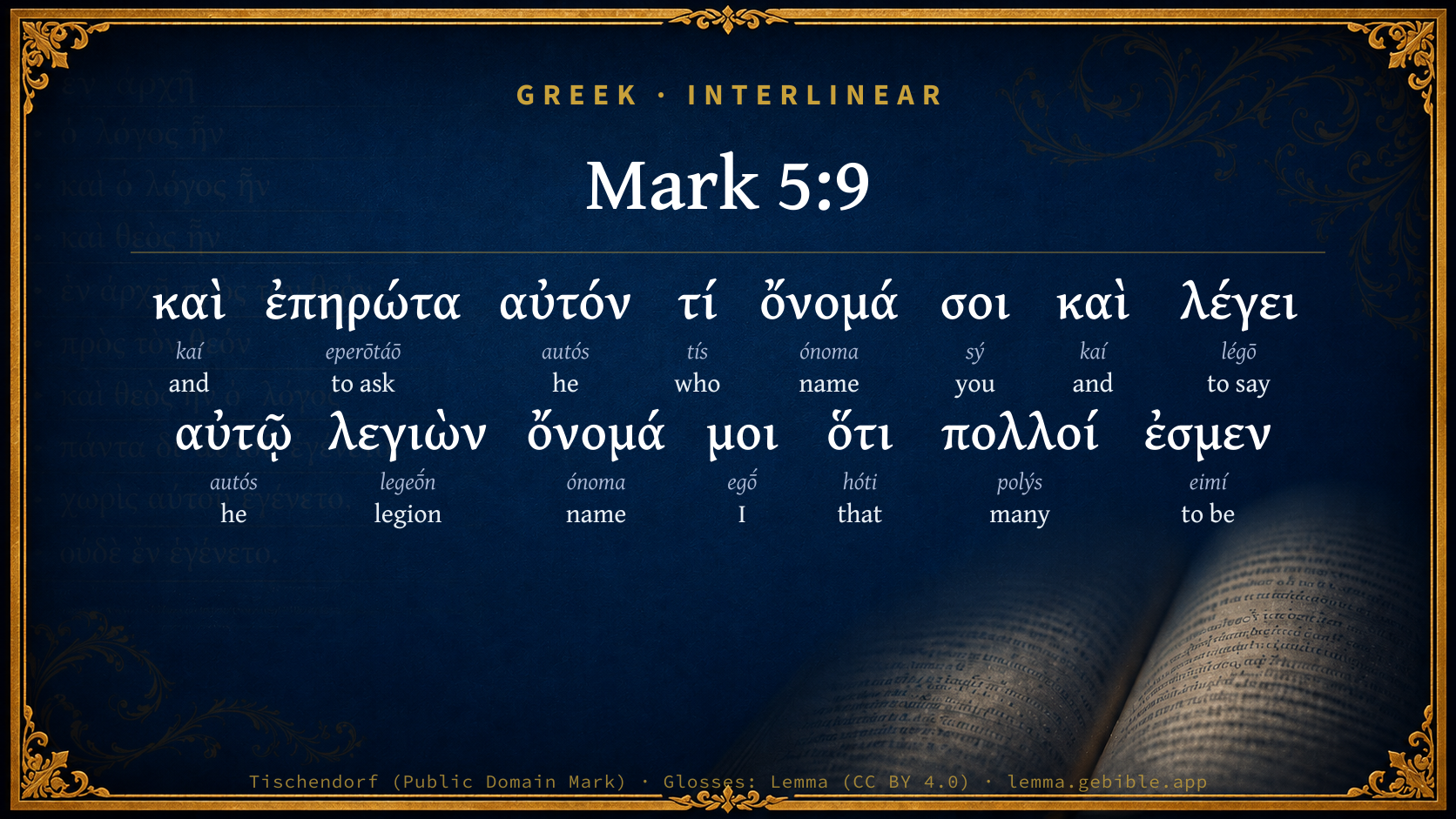
  1. καὶ kaí G2532 “and” Conjunction
  2. ἐπηρώτα eperōtáō G1905 “to ask” Verb, Imperfect, Active, Indicative, 3rd person, Singular
  3. αὐτόν autós G846 “he” Personal pronoun, Accusative, Singular, Masculine
  4. τί tís G5101 “who” Interrogative pronoun, Nominative, Singular, Neuter
  5. ὄνομά ónoma G3686 “name” Noun, Nominative, Singular, Neuter
  6. σοι sý G4771 “you” Personal pronoun, 2nd person, Dative, Singular
  7. καὶ kaí G2532 “and” Conjunction
  8. λέγει légō G3004 “to say” Verb, Present, Active, Indicative, 3rd person, Singular
  9. αὐτῷ autós G846 “he” Personal pronoun, Dative, Singular, Masculine
  10. ὄνομά ónoma G3686 “name” Noun, Nominative, Singular, Neuter
  11. μοι egṓ G1473 “I” Personal pronoun, 1st person, Dative, Singular
  12. ὅτι hóti G3754 “that” Conjunction
  13. πολλοί polýs G4183 “many” Adjective, Nominative, Plural, Masculine
  14. ἐσμεν eimí G1510 “to be” Verb, Present, Active, Indicative, 1st person, Plural

About this verse

These counts appear in no published source. They are computed here, from the morphology-tagged text and Lemma’s own curated glosses. What Lemma adds →

15
words
12
distinct lemmas
Gospels
section

Notable vocabulary

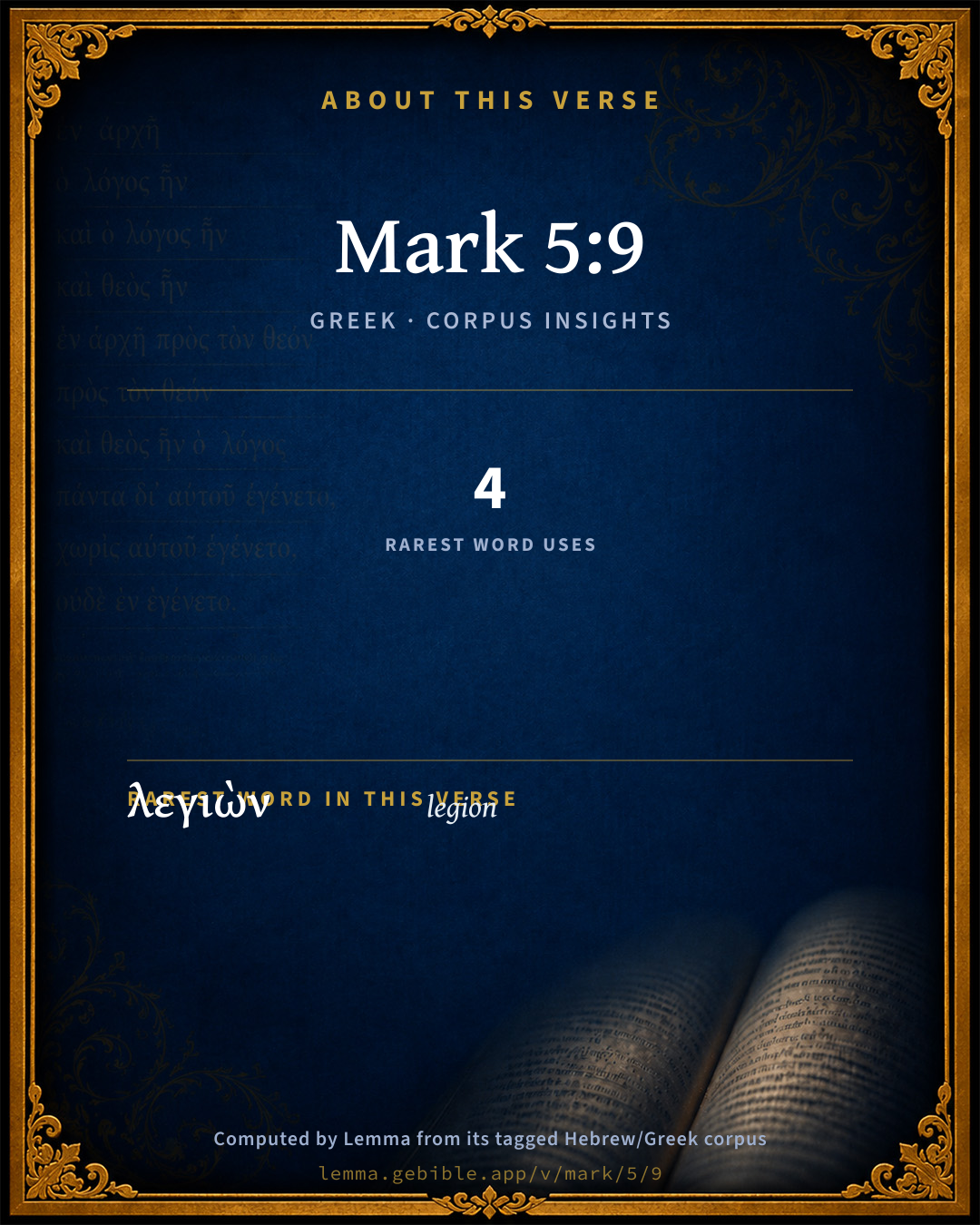
The rarest word here is λεγιὼν legion G3003 — appearing just 4 times in the whole Greek New Testament.

Shared distinctive vocabulary

λεγιὼν legion G3003 occurs in 4 verses of the Greek New Testament. Also found in:

Repetition

Words recur within this verse:

  • ὄνομά name G3686 ×2
  • καὶ and G2532 ×2
  • αὐτόν he G846 ×2

Cross-references

5

Topical passages linked to Mark 5:9 in the Treasury of Scripture Knowledge — connected by theme and wording, ordered by reader-vote popularity; previews shown in the World English Bible.

  • Luke 8:30 Jesus asked him, "What is your name?" He said, "Legion," for many demons had entered into him.
  • Mark 5:15 They came to Jesus, and saw him who had been possessed by demons sitting, clothed, and in his right mind, even him who had the legion; and they were afraid.
  • Matthew 26:53 Or do you think that I couldn't ask my Father, and he would even now send me more than twelve legions of angels?
  • Matthew 12:45 Then he goes, and takes with himself seven other spirits more evil than he is, and they enter in and dwell there. The last state of that man becomes worse than the first. Even so will it be also to this evil generation."
  • Luke 11:21–26 "When the strong man, fully armed, guards his own dwelling, his goods are safe.

Cross-references courtesy of OpenBible.info (CC BY 4.0).

Commentary

Notes on Mark 5:9 from classic Christian and Jewish commentators (each source and its license shown beneath its notes). The classic Christian expositions comment on the surrounding passage and are grouped to its opening verse, so a note may address several verses; the Jewish commentaries on the Tanakh (Rashi and others) are per-verse, so they appear only where the commentator wrote on this verse.

Lemma curates 59 commentaries, every one of them public domain or Creative Commons licensed, each selected and text-cleaned for this edition rather than reprinted as found. About our sources →

The Biblical Illustrator

Joseph S. Exell

Mar_5:9

My name is Legion.

The legion of sin

Truly the name of sin is Legion. It is anger, malice, intemperance, murder, impurity, unfaithfulness, dishonesty, equivocation, dissimulation, falsehood, hypocrisy, ingratitude, disobedience, impatience, discontentment, envy, covetousness; it is profanity, formality, superstition, idolatry, blasphemy, and atheism. It is a repudiation of the authority, a defiance of the power, a slight to the wisdom, a contempt of the holiness, and unthankfulness for the goodness of God. It is the cause of all the error, conflict, cruelty, suffering, weeping, and woe that exist in this world. Like a foul demon, it has poisoned and polluted, blighted and cursed everything it has touched. It has caused man, the noblest work of God, to become the destroyer of his own soul, the murderer of his brother, the enemy of his God. (Arthur Thompson.)

The Biblical Illustrator, edited by Joseph S. Exell (c. 1880s–1900s) — public domain. Text from a community e-Sword module.

Tyndale Open Study Notes

Tyndale Open Resources

5:9 A legion was a Roman military unit of 5,000–6,000 men. Here it describes the presence of many evil spirits.

Tyndale Open Study Notes — © Tyndale Open Resources, licensed CC BY-SA 4.0. Text via the HelloAO Bible API.

Bengel's Gnomon

Johann Albrecht Bengel

Mar 5:9. Λεγεὼν, Legion) An appellation by Synecdoche [see Append., the genus for the species]. There was one principal leader among them, and the rest were conjoined with him, constituting thus the legion: and this, whether he had previously borne this Latin name, before that he entered this man, or then first assumed it.—πολλοί ἐσμεν, we are many) Luke affirms this in his own words [not in the man’s or the demon’s], ch. Mar 8:30. If in one nest [dwelling] there can be so many, how many there must be in the whole aggregate throughout the World! [Mere number in itself does not produce protection (patronage).—V. g.]

Bengel's Gnomon of the New Testament — English translation (T&T Clark, Edinburgh, 1860) — public domain. Text from a community e-Sword module.

Expositor's Greek Testament

ed. W. Robertson Nicoll

Mar 5:9 . τί σοι ὄνομα ; instead of saying at once what He had meant to say, Jesus adopts a roundabout method of dealing with the case, and asks the demoniac his name, as if to bring him into composure. Λεγιὼν : from the Roman legion not a rare sight in that region, emblem of irresistible power and of a multitude organised into unity; the name already naturalised into Greek and Aramaean. The use of it by the demoniac, like the immediate recognition of Jesus as a God-like person, reveals a sensitive, fine-strung mind wrecked by insanity.

The Expositor's Greek Testament, edited by W. Robertson Nicoll (1897–1910) — public domain. Text from a community e-Sword module.

Adam Clarke's Commentary

Verse 9. Legion: for we are many.] Could a disease have spoken so? "No, there was no devil in the case; the man spoke according to the prejudice of his countrymen." And do you think that the Spirit of God could employ himself in retailing such ridiculous and nonsensical prejudices? "But the evangelist gives these as this madman's words, and it was necessary that, as a faithful historian, he should mention these circumstances." But this objection is destroyed by the parallel place in Luke, Lu 8:30, where the inspired writer himself observes, that the demoniac was called Legion, because many demons had entered into him.

Adam Clarke's Commentary on the Bible (1810–1826) — public domain. Text from a community e-Sword/MySword module.

The Cambridge Bible for Schools and Colleges

gen. ed. J. J. S. Perowne

9. My name is Legion] “He had seen the thick and serried ranks of a Roman legion, that fearful instrument of oppression, that sign of terror and fear to the conquered nations.” Even such, terrible in their strength, inexorable in their hostility, were the “lords many,” which had dominion over him. Compare (i) the “seven demons,” by whom Mary Magdalene was possessed (Luk_8:2), (ii) the “seven other spirits” “worse than the first,” which our Lord describes as taking up their abode in a man (Mat_12:45).

The Cambridge Bible for Schools and Colleges (gen. ed. J. J. S. Perowne; Cambridge University Press, 1878–1918) — public domain. Text from a community e-Sword module.

John Gill's Exposition

And he asked him, what is thy name?.... Which question Christ put, not for his own sake; for he was not ignorant of his name, nor of the number of the unclean spirits which were in the man; but partly, that it might be known what a miserable condition this poor man was in, being infested, and vexed with such a large company of devils; and partly, that his own pity and power in delivering him, might be more manifest;

and he answered, saying, my name is Legion: the Syriac version renders it, "our name is Legion"; the reason of which name is given,

for we are many: as a Roman legion did consist of many, though its number was not always alike: in the time of Romulus, a legion consisted of three thousand foot, and three hundred horse; afterwards, when the city was, increased, of six thousand foot, and six hundred horse; sometimes it was six thousand and two hundred foot, and three hundred horse; sometimes four thousand foot, and three hundred horse; sometimes five thousand foot, and three hundred horse (x). Some make a legion to consist of six thousand six hundred sixty six; and others make it much larger, even twelve thousand five hundred: however, the number in a legion was many; hence the word is retained among the Jews, and is used for a large number, either of persons or things; as, , "a legion of olives" (y): that is, a large number of them; though sometimes it is used of a single person, who has others under him, as the general of an army: thus it is said (z) that one man should say to another,

"from whence art thou? he replies, from such a "legion" am I;--the man went to the legion--the legion heard, and was afraid--the man said, woe unto me! now will the legion slay me--the legion heard, &c.''

And again (a),

"a certain legion asked R. Abba, is it not written, &c.''

Once more (b),

"Lo! such a legion shall go with thee, to keep thee, &c.''

Upon which the gloss is, , "the general of an army"; so called, because he had a legion, or a large number of soldiers under his command: and just so this unclean spirit is called by this name, because he had a great many more with him, and under him, in that man; sometimes it is only used of a single person himself, as of a king's servant sent into a foreign country, to collect his (c) tax: a legion was reckoned by the Jews unclean and defiled, whatsoever place they entered into (d); how much more unclean must this man be, that had a legion of unclean spirits in him! From hence it appears, that the devils are very numerous; for if there was a legion of them in one man, how many must there be in all the children of disobedience, to maintain their ground, and support their interest among them? As there is an innumerable company of holy angels to encamp about the saints, and do them all the service they can, and axe appointed to; so there is undoubtedly an innumerable company of devils, who do all the hurt they can, or are permitted to do, unto the sons of men: hence they are expressed by words, which signify number as well as power; as principalities and powers, the rulers of the darkness of this world, spiritual wickedness in high places, the power or posse of the air, the angels of Satan, the angels that sinned and left their habitations, &c. As also that they are in a body, and in the form of an army; with a general at the head of them, the prince of devils, and king of the bottomless pit: there are whole squadrons and regiments of them, yea, even legions; which are formed in battle array, and make war against Christ, the seed of the woman; as they did when he was in the garden, and hung upon the cross, which was the hour and power of darkness; and against his members; as they did in Rome pagan against the Christian church, and in Rome papal, against the same, Rev 12:7, and what a mercy it is for the saints, that besides twelve legions of good angels and more, which are ready to assist and protect them, they have God on their side, and therefore it signifies not who is against them; and they have Christ with them, who has spoiled principalities and powers; and greater is the Holy Spirit that is in them, than he that is in the world.

(x) Alexander ab Alex. Genial. Dier. l. 1. c. 5. Liv. Hist. l. 8. c. 8. (y) Bereshit Rabba, sect. 20. fol. 17. 4. (z) Zohar in Gen. fol. 96. 4. & Ivare Binah in ib. (a) Ib. in Exod. fol. 50. 2. (b) Zohar in Exod. fol. 51. 4. (c) Vajikra Rabba, sect. 30. fol. 170. 4. & Mattanot Cehuna in ib. (d) T. Bab. Cholin, fol. 123. 1.

John Gill's Exposition of the Whole Bible (1746–1763) — public domain (CC PDM 1.0). Text via the HelloAO Bible API.

Trapp's Complete Commentary

John Trapp

9 And he asked him, What is thy name? And he answered, saying, My name is Legion: for we are many.

Ver. 9. My name is Legion] That is, a multitude. A legion was commonly among the Romans, saith Isidore, 6000 armed soldiers: 6666, saith Hesychius. So many devils were gotten in one poor man. Let us in him see what the best of us have deserved; and, since we have escaped, offer a passover each for himself.

John Trapp, A Commentary or Exposition upon All the Books of the Old and New Testament (1647–1656) — public domain. Text from a community e-Sword module.

Haydock's Catholic Bible Commentary

My name is Legion. Spirits have no names, only with respect to our language. These devils say their name is Legion, because they are many. (Witham)

George Leo Haydock (1774–1849), Haydock's Catholic Family Bible and Commentary, 1859 edition — public domain. Excludes Psalms (Douay-Rheims chapter numbering differs from Protestant) and Deuterocanonical books (Catholic canon only).

Whedon's Commentary on the Bible

Daniel D. Whedon

9. Asked… What is thy name? — Christ asked the man (not the demon) his name, in order to call out his personal consciousness, and aid in restoring him to himself. My name is Legion — The demon snatches the man’s organs and answers the question for himself, giving his own name. He is a host by nature and by name. A Legion in the Roman army was a division embracing six thousand men. The demon, perhaps, assumes that name for this whole number, as being their leader. That Legion is a name for a commander of a legion among the Jews, appears from the Talmudical writings. It is not indeed to be supposed that either angels or devils wear in the invisible world the names that men give to their visible manifestations; and hence the same dark personality may enact the oracular Python or Apollo among the Greeks, the Belial, perhaps, among the Hebrews, and the Beelzebub among the Canaanites.

Daniel D. Whedon (gen. ed.), Commentary on the Old and New Testaments (1874–1909) — public domain. Text from a community e-Sword module.

The Pulpit Commentary

Vers. 9, 10. Satanic possession a destruction of personal identity.

I INSTANCES AND ILLUSTRATIONS.

II IMPORTANCE OF PERSONALITY FOR TRUE RELIGIOUS AND MORAL LIFE.

III THE RESTORATION OF THIS THE GREAT WORK OF CHRIST. M.

The Pulpit Commentary (1880–1919), ed. H.D.M. Spence-Jones & Joseph S. Exell — public domain. Text from a community e-Sword module.

John Wesley's Explanatory Notes

My name is Legion! for we are many - But all these seem to have been under one commander, who accordingly speaks all along, both for them and himself.

John Wesley, Explanatory Notes Upon the Whole Bible (1754–1765) — public domain. Text via the GEBible commentary corpus.

Scofield Reference Notes

C. I. Scofield

many

See, Mar 16:9; Mat 7:22 (See Scofield "Mat 7:22")

The Scofield Reference Bible (1917 edition), notes by C. I. Scofield — public domain. Text from a community e-Sword module.

unfoldingWord translationNotes

Door43 World Missions Community

He asked him

"And Jesus asked the unclean spirit"

He answered him, "My name is Legion, for we are many."

One spirit was speaking for many here. He spoke of them as if they were a legion, a Roman army unit of about 6,000 soldiers. AT: "And the spirit said to him, 'Call us an army, for many of us are inside the man.'" (See: Metaphor)

unfoldingWord translationNotes — © Distant Shores Media and the Door43 World Missions Community, licensed CC BY-SA 4.0. Source: git.door43.org/Door43/en_tn.

Cambridge Greek Testament for Schools and Colleges

9. λέγει αὐτῷ ([919][920][921][922][923][924][925][926]) rather than ἀπεκρίθη λέγεν ([927][928][929] etc.). Scribes often insert ἀπεκρίθη or ἀποκριθείς, cf. Mar 7:6, Mar 9:12, Mar 10:5; Mar 10:20, Mar 11:29-30, Mar 12:17.

[919] Codex Sinaiticus. 4th cent. Discovered by Tischendorf in 1859 at the Monastery of St Katharine on Mount Sinai. Now at St Petersburg. The whole Gospel, ending at Mar 16:8. Photographic facsimile, 1911.

[920] Codex Alexandrinus. 5th cent. Brought by Cyril Lucar, Patriarch of Constantinople, from Alexandria, and afterwards presented by him to King Charles I. in 1628. In the British Museum. The whole Gospel. Photographic facsimile, 1879.

[921] Codex Vaticanus. 4th cent., but perhaps a little later than א. In the Vatican Library almost since its foundation by Pope Nicolas V., and one of its greatest treasures. The whole Gospel, ending at Mar 16:8. Photographic facsimile, 1889.

[922] Codex Ephraemi. 5th cent. A palimpsest: the original writing has been partially rubbed out, and the works of Ephraem the Syrian have been written over it; but a great deal of the original writing has been recovered; of Mark we have Mar 1:17 to Mar 6:31, Mar 8:5 to Mar 12:29, Mar 13:19 to Mar 16:20. In the National Library at Paris.

[923] Codex Cyprius. 9th cent. One of the seven uncials which have the Gospels complete, the others being אBMSUΩ. At Paris.

[924] Codex Regius. 8th cent. An important witness. At Paris. Contains Mar 1:1 to Mar 10:15; Mar 10:30 to Mar 15:1; Mar 15:20 to Mar 16:20, but the shorter ending is inserted between Mar 16:8 and Mar 16:9, showing that the scribe preferred it to the longer one.

[925] Codex Sangallensis. 9th or 10th cent. Contains the Gospels nearly complete, with an interlinear Latin translation. The text of Mark is specially good, agreeing often with CL. At St Gall.

[926] Codex Petropolitanus. 9th cent. Gospels almost complete. Mar 16:18-20 is in a later hand.

[927] Codex Basiliensis. 8th cent. At Basle.

[928] Codex Boreelianus. Once in the possession of John Boreel. 9th cent. At Utrecht. Contains Mk 1–41; Mar 2:8-23; Mar 3:5 to Mar 11:6; Mar 11:27 to Mar 14:54; Mar 15:6-39; Mar 16:19-20.

[929] Codex Seidelianus I. 9th or 10th cent. Contains Mar 1:13 to Mar 14:18; Mar 14:25 to Mar 16:20.

9. ἐπηρώτα. Mk, who regards conversation as a process, nearly always puts ἐπερωτάω in the imperf. (Mar 7:5; Mar 7:17, Mar 8:23; Mar 8:27; Mar 8:29, Mar 9:11; Mar 9:28; Mar 9:33, Mar 10:2; Mar 10:10; Mar 10:17, etc.); so that we cannot infer that the question had to be repeated, although it may have been. Asking for the name excited suspicion; it might be used for βασανισμός. It was a common belief that, in order to exorcize a demon, you must address it by name. Deissmann, Light from the Ancient East, pp. 252, 257. But the purpose of the question was rather to get the man to distinguish his own personality. This it fails to do; the obsession is still too strong. Mt., as usual, omits a question which seems to imply that Christ was ignorant and needed information. On the reply see crit. note.

Λεγιών. This introduction of a Latin word is a mark of authenticity; it is in place, but it would not be likely to be invented. In conquered Palestine, “legion” would suggest numbers, strength, and relentless oppression. Cf. Luk 8:2; Luk 11:26. Legio non pro finito numero, sed tantum pro magna turba accipitur (Calvin). The man felt as if he were possessed by a legion of demons. Syr-Sin. has “Our name is Legion.” Cf. the “seven demons” in Mary Magdalen (Luk 8:2).

Cambridge Greek Testament for Schools and Colleges (Cambridge University Press, 1896; 21 vols, various authors incl. Carr, Maclear, Plummer, Farrar, Lumby, Moule, M. R. James, Simcox) — public domain. Text from a community e-Sword module.

Alford’s Greek Testament

Henry Alford

9.] ὅτι πολλοί ἐς. has perhaps given rise to the report of two dæmoniacs in Matt. I cannot see in the above supposition any thing which should invalidate the testimony of the Evangelists. Rather are all such tracings of discrepancies to their source, most interesting and valuable. Nor can I consent for a moment to accept here the very lame solution (repeated by Bp. Wordsw.), which supposes one of the dæmoniacs not to be mentioned by Mark and Luke: in other words, that the least circumstantial account is in possession of an additional particular which gives a new aspect to the whole: for the plural, used here and in Luke of the many dæmons in one man, is there used of the two men, and their separate dæmons.

On λεγιών see note, Luke, ver. 30.

Henry Alford, The Greek Testament (1849–1861) — public domain. Text from a community e-Sword module.

International Critical Commentary

9. Τί ὄνομά σοι;—What is thy name?2 It is a curious question, why Jesus asked this question of the demoniac, and it has been curiously answered; e.g. that Jesus saw the state of the case, and wished to bring it out in order to impress on the witnesses the greatness of the miracle. This ostentation we know to be far from the spirit of Jesus, who performed his miracles for beneficent purposes alone, and with secrecy, instead of ostentation. We are in the region of conjecture here, but we can guess at it somewhat after this fashion. May it not be, that the purpose of Jesus was hindered by this identification of the man with the demons, leading him to resist the cure? In that case, Jesus might ask the question in order to bring before the man the nature of the power holding him in thrall, so as to make some break in the terrible sympathy and alliance of the two. But it is all mixed up with the question as to the nature of this possession, and how far the account of the cure has been modified by the view of it taken by the narrators. It is comparatively useless to discuss details where the main facts are so much in doubt.

καὶ λέγει αὐτῷ Λεγιὼν—And he says to him, Legion.

λέγει αὐτῷ, instead of ἀπεκρίθη, λέγων, Tisch. Treg. WH. RV. א ABCKLM ΔΠ text, two mss. Lat. Vet. Vulg. Memph. Syrr.

Λεγιὼν, instead of Λεγεὼν, Tisch. Treg. WH. RV. א* B* CDLL Δ Lat. Vet. Vulg. Memph. Syrr.

Legion is the Roman name for a body of soldiers numbering, when full, 6000 men. Of course, it is a rhetorical and exaggerated statement by the man of his state, as if he had said, I feel as if I were possessed by a thousand devils.

ὅτι πολλοί ἐσμεν—because we are many. Lk. puts this statement into the mouth of the Evangelist, saying himself that it was because many demons entered into the man. But it seems that Mk. is more correct, as he is certainly more effective, in making the demoniac say this; for it traces back to the man himself the hallucination which gives shape to the story. In Lk. the plurality, which formed a part of the man’s delusion, is transferred to the statement of facts.

International Critical Commentary — older volumes (1896–1929), various authors — public domain. Text from a community e-Sword module.

Lesson kit

Teaching starters — assembled from the data on this page, not authored interpretation. Every prompt links to the verse data it draws on. Edit before teaching.

Mark, in the Gospels, opens this verse with 15 words (12 distinct Greek lemmas). Its most distinctive word is legeṓn (“legion”). A historical commentator’s framing appears above. Read the whole chapter for the surrounding context.

Discussion questions

  1. How does “legion” (legeṓn) shape what this verse is saying?
  2. How does Matthew 26:53, which shares the word «legion», read alongside this verse?
  3. What does the repetition of “name” (2× in this one verse) do in this verse?
  4. These translations render this verse differently; the difference is in the English rendering, not the original. What questions does that raise?
  5. Compare how The Biblical Illustrator and Tyndale Open Study Notes read this verse. Where do they agree or differ?

Things to notice

  • These translations choose different wording for 6 words in this verse.
  • “name” occurs 2× in this single verse.
  • 12 distinct Greek lemmas span 15 words in this verse.

Reading settings

Reading text

Shown beneath each verse's original-language words.

Old Testament
Old Testament edition

Read the OT as the Masoretic Hebrew (MT) or the Greek Septuagint (LXX).

English shown for the Greek Septuagint (in the Hebrew ↔ Greek comparison).

Comparing translations? Open the Compare panel on any verse page to stack up to four side by side.