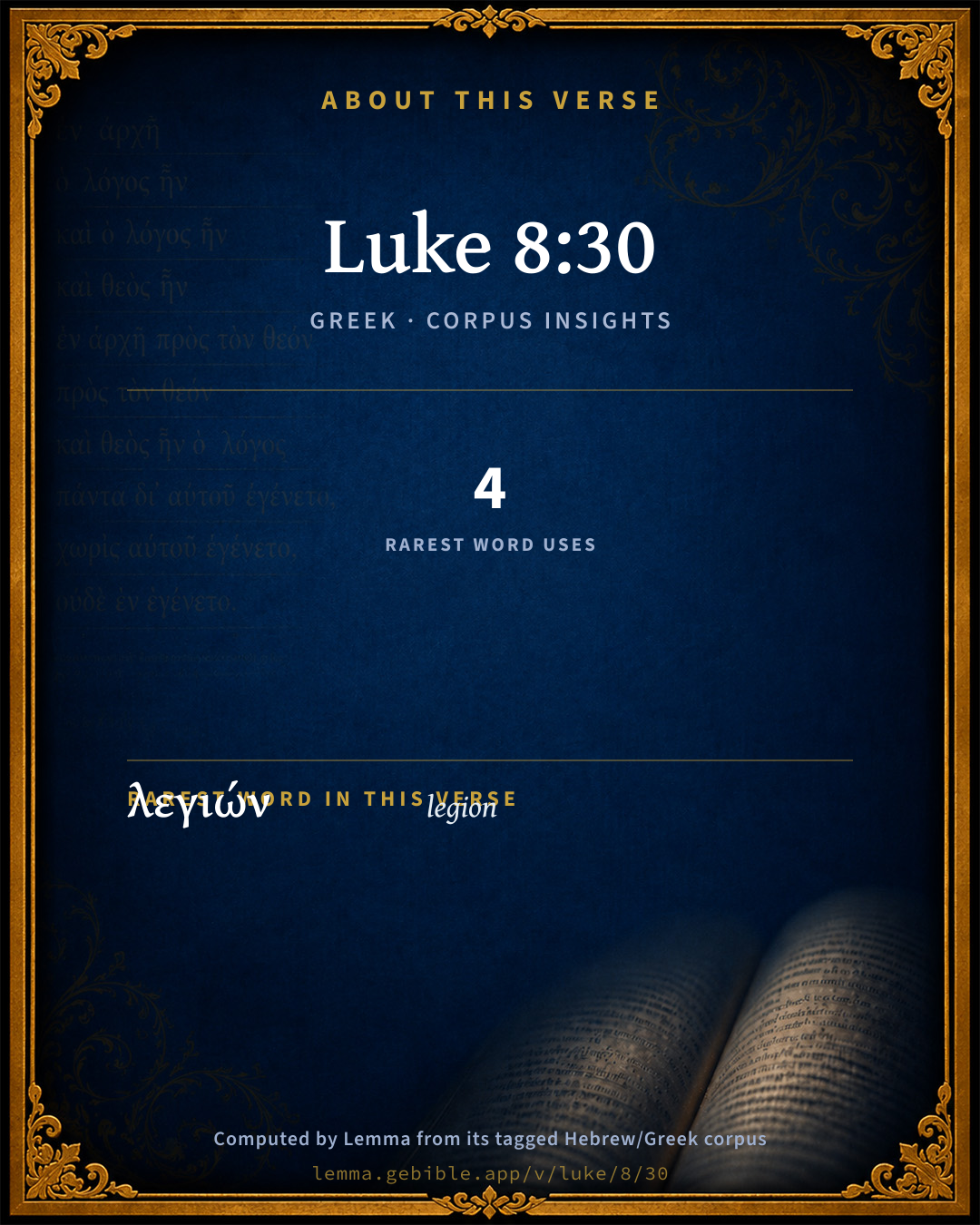
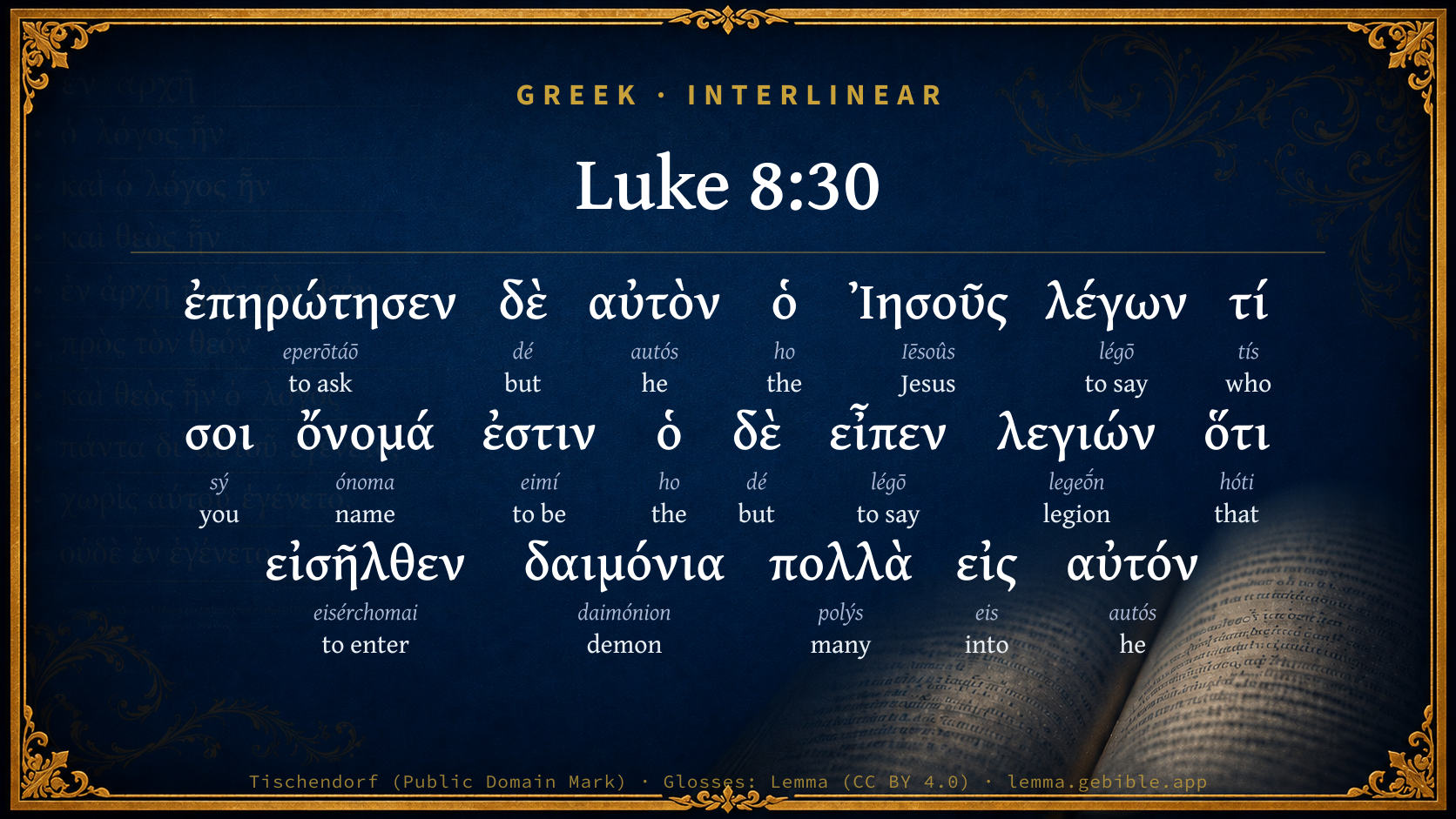
Luke 8:30

Greek (Tischendorf 8th ed.) Luke 8:30 appears in the Greek New Testament. The text above is from the Tischendorf 8th edition. Each word links to its Strong’s number and a concise gloss. Click any word for its full Thayer’s Greek Lexicon entry.
Download image
Cite this verse

Luke 8:30 (World English Bible). Public Domain. Lemma interlinear Bible study tool, https://lemma.gebible.app/v/luke/8/30.

Show BibTeX & RIS
BibTeX
RIS
English Translation
Jesus asked him, "What is your name?" He said, "Legion," for many demons had entered into him.
World English Bible · Public Domain
Download a study sheet

One document with this verse’s original text, its word-by-word gloss line, the meaning frame, cross-references with their text, attributed commentary, and full source and license credits — printable, and it pastes into notes with its structure intact.

This verse Autodidact and up

Study sheet (.html) Plain text (.txt)

A passage Seminary Student

Up to 50 verses in one chapter. A passage sheet keeps up to 6 commentary sources and 12 cross-references per verse, in the order this page ranks them, and says so on the sheet whenever that leaves anything out. Ask for a single verse and you get the Autodidact verse sheet above.

Everything on this page stays free to read, with no account — the sheet is a download of what is already on screen, not access to it.

Want to remove ads? Support Godless Engineer
Compare translations 3

The same verse in 3 English versions, stacked beneath the original-language interlinear above. Click any original word for its lexicon entry.

Each is an independent rendering of the whole verse — the interlinear is not word-aligned to these translations.

Highlighted words mark where these versions differ — a whole-verse word diff, not a word-by-word alignment.

  • World English Bible Public Domain
    Jesus asked him, "What is your name?" He said, "Legion," for many demons had entered into him.
  • King James Version Public Domain
    And Jesus asked him, saying, What is thy name? And he said, Legion: because many devils were entered into him.
  • unfoldingWord Literal Text CC BY-SA 4.0
    Then Jesus questioned him, “What is your name?” and he said, “Legion,” for many demons had entered into him.

unfoldingWord Literal Text — © unfoldingWord, licensed CC BY-SA 4.0. Word-aligned USFM3 via Door43 (git.door43.org/unfoldingWord/en_ult).

Versions to compare (up to 4)

3 of 4 selected

Show all 19 translations

Every available English version of this verse, each an independent rendering of the whole verse.

  • World English Bible Public Domain
    Jesus asked him, "What is your name?" He said, "Legion," for many demons had entered into him.
  • Berean Standard Bible Public Domain
    “What is your name?” Jesus asked. “Legion,” he replied, because many demons had gone into him.
  • Majority Standard Bible Public Domain
    “What is your name?” Jesus asked. “Legion,” he replied, because many demons had gone into him.
  • King James Version Public Domain
    And Jesus asked him, saying, What is thy name? And he said, Legion: because many devils were entered into him.
  • American Standard Version (1901) Public Domain
    And Jesus asked him, What is thy name? And he said, Legion; for many demons were entered into him.
  • Revised Version (1885) Public Domain
    And Jesus asked him, What is thy name? And he said, Legion; for many devils were entered into him.
  • Geneva Bible (1599) Public Domain
    Then Iesus asked him, saying, What is thy name? and he sayd, Legion, because many deuils were entred into him.
  • Douay-Rheims (1899) Public Domain
    And Jesus asked him, saying: What is thy name But he said: Legion; because many devils were entered into him.
  • Young's Literal Translation Public Domain
    And Jesus questioned him, saying, `What is thy name?' and he said, `Legion,' (because many demons were entered into him,)
  • Literal Standard Version CC BY-SA 4.0
    And Jesus questioned him, saying, “What is your name?” And he said, “Legion,” because many demons were entered into him,
  • Unlocked Literal Bible CC BY-SA 4.0
    Then Jesus asked him, “What is your name?” and he said, “Legion,” for many demons had entered into him.
  • unfoldingWord Literal Text CC BY-SA 4.0
    Then Jesus questioned him, “What is your name?” and he said, “Legion,” for many demons had entered into him.
  • Darby Bible Public Domain
    And Jesus asked him saying, What is thy name? And he said, Legion: for many demons had entered into him.
  • World Messianic Bible Public Domain
    Yeshua asked him, “What is your name?” He said, “Legion,” for many demons had entered into him.
  • Webster's Bible Public Domain
    And Jesus asked him, saying, What is thy name? And he said, Legion: because many demons had entered into him.
  • Free Bible Version CC BY-SA 4.0
    “What is your name?” Jesus asked him. “Legion,” he replied, for many demons had entered him.
  • Bible in Basic English Public Domain
    And Jesus said to him, What is your name? And he said, Legion; for a number of spirits had gone into him.
  • Text-Critical English NT CC BY 4.0
    Jesus then asked him, “What is yoʋr name?” He said, “Legion,” for many demons had entered him.
  • Tyndale New Testament (1534) Public Domain
    And Iesus axed him sayinge: what is thy name? And he sayde: Legion because many devyls were entred into him.

Literal Standard Version (2020), Covenant Press — licensed CC BY-SA 4.0. Text via the HelloAO Bible API (eBible.org). Unlocked Literal Bible (unfoldingWord) — licensed CC BY-SA 4.0. Text via the HelloAO Bible API (eBible.org). unfoldingWord Literal Text — © unfoldingWord, licensed CC BY-SA 4.0. Word-aligned USFM3 via Door43 (git.door43.org/unfoldingWord/en_ult). Free Bible Version, Dr. Jonathan Gallagher — licensed CC BY-SA 4.0. Text via the HelloAO Bible API (eBible.org).

Word by word

More ways to search: Search by grammar → Find every occurrence → Compare this word →

Practice this passage: Drill this verse → Learn its vocabulary →

λεγιών
legeṓn
G3003
“legion”
Noun, Nominative, Singular, Masculine
Part of Speech
Noun
Case
Nominative
Number
Singular
Gender
Masculine
Full Thayer's Definition

Origin: of Latin origin

TDNT: 05:08,5

1. a legion, a body of soldiers whose number differed at different times, and in the time of Augustus seems to have consisted of 6826 men (i.e. 6100 foot soldiers, and 726 horsemen)
  1. ἐπηρώτησεν eperōtáō G1905 “to ask” Verb, Aorist, Active, Indicative, 3rd person, Singular
  2. δὲ dé G1161 “but” Conjunction
  3. αὐτὸν autós G846 “he” Personal pronoun, Accusative, Singular, Masculine
  4. ὁ ho G3588 “the” Article, Nominative, Singular, Masculine
  5. Ἰησοῦς Iēsoûs G2424 “Jesus” Noun, Nominative, Singular, Masculine
  6. λέγων légō G3004 “to say” Verb, Present, Active, Participle, Nominative, Singular, Masculine
  7. τί tís G5101 “who” Interrogative pronoun, Nominative, Singular, Neuter
  8. σοι sý G4771 “you” Personal pronoun, 2nd person, Dative, Singular
  9. ὄνομά ónoma G3686 “name” Noun, Nominative, Singular, Neuter
  10. ἐστιν eimí G1510 “to be” Verb, Present, Active, Indicative, 3rd person, Singular
  11. ὁ ho G3588 “the” Article, Nominative, Singular, Masculine
  12. δὲ dé G1161 “but” Conjunction
  13. εἶπεν légō G3004 “to say” Verb, Aorist, Active, Indicative, 3rd person, Singular
  14. ὅτι hóti G3754 “that” Conjunction
  15. εἰσῆλθεν eisérchomai G1525 “to enter” Verb, Aorist, Active, Indicative, 3rd person, Singular
  16. δαιμόνια daimónion G1140 “demon” Noun, Nominative, Plural, Neuter
  17. πολλὰ polýs G4183 “many” Adjective, Nominative, Plural, Neuter
  18. εἰς eis G1519 “into” Preposition
  19. αὐτόν autós G846 “he” Personal pronoun, Accusative, Singular, Masculine

About this verse

These counts appear in no published source. They are computed here, from the morphology-tagged text and Lemma’s own curated glosses. What Lemma adds →

20
words
16
distinct lemmas
Gospels
section

Notable vocabulary

The rarest word here is λεγιών legion G3003 — appearing just 4 times in the whole Greek New Testament.

Shared distinctive vocabulary

λεγιών legion G3003 occurs in 4 verses of the Greek New Testament. Also found in:

Repetition

Words recur within this verse:

Cross-references

5

Topical passages linked to Luke 8:30 in the Treasury of Scripture Knowledge — connected by theme and wording, ordered by reader-vote popularity; previews shown in the World English Bible.

  • Matthew 26:53 Or do you think that I couldn't ask my Father, and he would even now send me more than twelve legions of angels?
  • Luke 8:2 and certain women who had been healed of evil spirits and infirmities: Mary who was called Magdalene, from whom seven demons had gone out;
  • Matthew 8:29 Behold, they cried out, saying, "What do we have to do with you, Jesus, Son of God? Have you come here to torment us before the time?"
  • Mark 16:9 Now when he had risen early on the first day of the week, he appeared first to Mary Magdalene, from whom he had cast out seven demons.
  • Mark 5:9 He asked him, "What is your name?" He said to him, "My name is Legion, for we are many."

Cross-references courtesy of OpenBible.info (CC BY 4.0).

Commentary

Notes on Luke 8:30 from classic Christian and Jewish commentators (each source and its license shown beneath its notes). The classic Christian expositions comment on the surrounding passage and are grouped to its opening verse, so a note may address several verses; the Jewish commentaries on the Tanakh (Rashi and others) are per-verse, so they appear only where the commentator wrote on this verse.

Lemma curates 59 commentaries, every one of them public domain or Creative Commons licensed, each selected and text-cleaned for this edition rather than reprinted as found. About our sources →

Tyndale Open Study Notes

Tyndale Open Resources

8:30 A Roman legion had about 6,000 soldiers, so this man had a great many demons.

Tyndale Open Study Notes — © Tyndale Open Resources, licensed CC BY-SA 4.0. Text via the HelloAO Bible API.

Expositor's Greek Testament

ed. W. Robertson Nicoll

Luk 8:30 . ὅτι εἰσῆλθεν , etc.: Lk. gives this explanation of the name Legion ; in Mk. the demoniac gives it.

The Expositor's Greek Testament, edited by W. Robertson Nicoll (1897–1910) — public domain. Text from a community e-Sword module.

Godet's Commentaries

Frédéric Louis Godet

Vers. 30-33. The Cure.

To this prayer, in which the victim became involuntarily the advocate of his tormentor, Jesus replies by putting a question: He asks the afflicted man his name. For what purpose? There is nothing so suitable as a calm and simple question to bring a madman to himself. Above all, there is no more natural way of awakening in a man who is beside himself the consciousness of his own personality, than to make him tell his own name. A man’s name becomes the expression of his character, and a summary of the history of his life. Now, the first condition of any cure of this afflicted man was a return to the distinct feeling of his own personality.

There was at this time a word which, more than any other, called up the idea of the resistless might of the conqueror under whom Israel was then suffering oppression. This was the word Legion. The sound of this word called up the thought of those victorious armies before which the whole world bowed down. So it is by this term that this afflicted man describes the power which oppresses him, and with which he still confounds himself. The expression, many demons, is explained by the multiplicity and diversity of the symptoms (Luk 8:29).

To this answer the demoniac adds, in the name of his tyrant, a fresh request. The demon understands that he must release his prey; but he does not want to enter forthwith into a condition in which contact with terrestrial realities would be no longer possible to him.

In Mark there is here found the strange expression: “not to send them out of the country,” which may mean, to the desert, where unclean but not captive spirits were thought to dwell, or into the abyss, whence they went forth to find a temporary abode upon the earth. The sequel shows that the second meaning must be preferred. Jesus makes no answer to this request. His silence is ordinarily regarded as signifying consent. But the silence of Jesus simply means that He insists on the command which He has just given. When He wishes to reply in the affirmative,—as, for instance, at the end of Luk 8:32,—he does so distinctly. This explanation is confirmed by Matthew, “If thou cast us out...” Their request to enter into the swine only refers, therefore, to the way by which they were suffered to go into the abyss. What is the explanation of this request, and of the permission which Jesus accorded to it? As to these evil spirits, we can understand that it might be pleasant to them, before losing all power of action, to find one more opportunity of doing an injury. Jesus, on his part, has in view a twofold result. The Jewish exorcists, in order to assure their patients that they were cured, were accustomed to set a pitcher of water or some other object in the apartment where the expulsion took place, which the demon took care to upset in going out. What they were accustomed to do as charlatans, Jesus sees it good to do as a physician. The identification of the sick man with his demon had been a long-existing fact of consciousness (Luk 8:27; Luk 8:29). A decisive sign of the reality of the departure of the evil power was needed to give the possessed perfect assurance of his deliverance. Besides this reason, there was probably another. The theocratic feeling of Jesus had been wounded by the sight of these immense herds of animals which the law declared unclean. Such an occupation as this showed how completely the line of demarcation between Judaism and paganism was obliterated in this country. Jesus desired, by a sensible judgment, to reclaim the people, and prevent their being still more unjudaized.

The influence exerted by the demons on the herd was in no sense a possession. None but a moral being can be morally possessed. But we know that several species of animals are accessible to collective influences,—that swine, in particular, readily yield to panics of terror. The idea that it was the demoniac himself who frightened them, by throwing himself into the herd, is incompatible with the text.

Mark, whose narrative is always distinguished by the exactness of its details, says that the number of the swine was about two thousand. An item of his own invention, says De Wette; an appendix of later tradition, according to Bleek: here we see the necessary consequence of the critical system, according to which Mark is supposed to have made use of the text of the other two, or of a document common to them all.

The number 2000 cannot serve to prove the individual possession of the swine by the demons (legion, Luk 8:30), for a legion comprised 4000 men.

The question has been asked, Had Jesus the right to dispose in this way of other people’s property? One might as well ask whether Peter had the right to dispose of the lives of Ananias and Sapphira! It is one of those cases in which the power, by its very nature, guarantees the right.

Frédéric Louis Godet — Commentaries on Luke, John, Romans, and 1 Corinthians — English translation (T&T Clark, Edinburgh, 1870s–1890s) — public domain. Text from a community e-Sword module.

Ellicott's Commentary for English Readers

(30) Legion.—Here again St. Mark and St. Luke agree.

A Bible Commentary for English Readers, edited by Charles John Ellicott (1878–1897) — public domain. Text from a community e-Sword module.

The Cambridge Bible for Schools and Colleges

gen. ed. J. J. S. Perowne

30. What is thy name?] The question was no doubt asked in mercy. Gently to ask a person’s name is often an effectual way to calm the agitations and fix the wavering thoughts of these sufferers.

And he said, Legion] A legion consisted of 6000 soldiers, and this man (who was probably a Jew) would have become familiar with the name since the Roman conquest of Palestine. The ancient Megiddo was now called Legio, still Ledjun. The answer shewed how wildly perturbed was the man’s spirit, and how complete was the duality of his consciousness. He could not distinguish between himself and the multitudes of demons by whom he believed himself to be possessed. His individuality was lost in demoniac hallucinations.

The Cambridge Bible for Schools and Colleges (gen. ed. J. J. S. Perowne; Cambridge University Press, 1878–1918) — public domain. Text from a community e-Sword module.

John Gill's Exposition

And they besought him,.... That is, all the devils, the whole legion of them, entreated Jesus, under whose power, and at whose dispose they were:

that he would not command them to go out into the deep; meaning, not the deep waters of the sea, for thither they ran the swine at their own request; but the bottomless pit of hell, where others of these spirits lay in chains of darkness; and so the Ethiopic version renders it, "into hell": they desired, that when they went out of this man, they might not be ordered thither, or remanded to their former prison; for they knew that if he gave the word of command, they must obey; but that they might be suffered to continue in that country, and range about on earth, or be any where, rather than in hell.

John Gill's Exposition of the Whole Bible (1746–1763) — public domain (CC PDM 1.0). Text via the HelloAO Bible API.

Trapp's Complete Commentary

John Trapp

30 And Jesus asked him, saying, What is thy name? And he said, Legion: because many devils were entered into him.

Ver. 30. And he said, Legion] We must be ready and well-appointed to resist; for the devil sets upon us not without military discipline and singular skill. Cataphractus incedit Satan, saith Luther. The devil marcheth well armed and in good array.

John Trapp, A Commentary or Exposition upon All the Books of the Old and New Testament (1647–1656) — public domain. Text from a community e-Sword module.

Haydock's Catholic Bible Commentary

He did not put the question through ignorance of his name, but that his answer might shew forth the divine power in a more glorious manner; as also for our instruction, that knowing the great number of our invisible enemies, we might work out our salvation with fear and trembling, placing all our confidence in God. (Denis the Carthusian)

George Leo Haydock (1774–1849), Haydock's Catholic Family Bible and Commentary, 1859 edition — public domain. Excludes Psalms (Douay-Rheims chapter numbering differs from Protestant) and Deuterocanonical books (Catholic canon only).

The Pulpit Commentary

And Jesus asked him; saying, What is thy name? And he said, Legion: because many devils were entered into him The Master vouchsafed no reply to the demons" prayer, but puts a quiet suggestive question to their unhappy victim. The Lord"s words, as Dean Plumptre suggests, would serve "to recall to the man"s mind that he had once a human name, with all its memories of human fellowship. It was a stage, even in spite of the paroxysm that followed, in the process of recovery, in so far as it helped to disentangle him from the confusion between himself and the demons which caused his misery. But, at first, the question seems only to increase the evil. "My name is Legion, for we are many." The irresistible might, the full array of the Roman legion, with its six thousand soldiers, seemed to the demoniac the one adequate symbol of the wild, uncontrollable impulses of passion and of dread that were sweeping through his soul."

The Pulpit Commentary (1880–1919), ed. H.D.M. Spence-Jones & Joseph S. Exell — public domain. Text from a community e-Sword module.

Kretzmann's Popular Commentary

Paul E. Kretzmann

The healing:

v. 30. And Jesus asked him, saying, What is thy name? And he said, Legion; because many devils were entered into him.

v. 31. And they besought Him that He would not command them to go out into the deep.

v. 32. And there was there an herd of many swine feeding on the mountain; and they besought Him that He would suffer them to enter into them. And He suffered them

v. 33. Then went the devils out of the man, and entered into the swine; and the herd ran violently down a steep place into the lake, and were choked.

Since the man appeared to have a rational interval, Jesus asked him his name. The poor man being the victim, not only of one or of a few devils, answered accordingly that his name was Legion, thousands of demons having taken possession of him. But the devils were growing restive, knowing that their time for torturing this man was over. And so they pleaded with Christ not to commit them to the abyss, to the pit of hell. But there was a herd of many swine feeding on the side of the mountain, within easy distance of the place where Jesus had landed, and the devils eagerly begged Christ to permit them to enter into the dumb brutes. And when Jesus had given permission, the devils took possession of the swine. And the brutes, taken with a sudden spasm of fright, bolted down the precipice overhanging the lake, leaped down into the waves below, and were drowned, suffocation taking place in the water. Note: The devil is a murderer from the beginning. If he cannot destroy the souls of men, he tries to harm their bodies, and when this is denied him, he takes out his spite on the dumb animals. His one desire is to ruin the works of God. But he can do this only with God’s permission. It is indeed a secret of God why He gives this permission. But it may be said, in general, that even such visitations, by which the devil works harm against us, are fatherly visitations of God, by means of which He wants to chastise us and call us to repentance.

Paul E. Kretzmann, Popular Commentary of the Bible (1921–1924) — public domain. Text from a community e-Sword module.

unfoldingWord translationNotes

Door43 World Missions Community

Legion

Translate this with a word that refers to a large number of soldiers or people. Some other translations say "Army." AT: "Battalion" or "Brigade"

kept begging him

"kept begging Jesus"

translationWords

Jesus

demon

abyss

unfoldingWord translationNotes — © Distant Shores Media and the Door43 World Missions Community, licensed CC BY-SA 4.0. Source: git.door43.org/Door43/en_tn.

Cambridge Greek Testament for Schools and Colleges

30. τί σοι ὄνομά ἐστιν; The question was no doubt asked in mercy. Gently to ask a person’s name is often an effectual way to calm the agitations and fix the wavering thoughts of these sufferers.

Λεγιών. A legion consisted of 6,000 soldiers, and this man (who was probably a Jew) would have become familiar with the name since the Roman conquest of Palestine. The ancient Megiddo was now called Legio, still Ledjûn. The answer shewed how wildly perturbed was the man’s spirit, and how complete was the duality of his consciousness. He could not distinguish between himself and the multitudes of demons by whom he believed himself to be possessed. His individuality was lost in demoniac hallucinations. For multitudinous possession comp. Luk 8:2, Mat 12:45.

Cambridge Greek Testament for Schools and Colleges (Cambridge University Press, 1896; 21 vols, various authors incl. Carr, Maclear, Plummer, Farrar, Lumby, Moule, M. R. James, Simcox) — public domain. Text from a community e-Sword module.

Alford’s Greek Testament

Henry Alford

30.] Lightfoot (on Mar 5:9) quotes instances of the use of ל̇גיון, for a great number, in the Rabbinical writings. The fact of many dœmons having entered into this wretched man, sets before us terribly the utter break-up of his personal and rational being. The words will not bear any figurative rendering, but must be taken literally (see ver. 2 of this chap., and ch. 11:24 ff.); viz. that in the same sense in which other poor creatures were possessed by one evil spirit (see note on Matt.), this man, and Mary Magdalene, were possessed by many.

Henry Alford, The Greek Testament (1849–1861) — public domain. Text from a community e-Sword module.

International Critical Commentary

30. Τί σοι ὄνομά ἐστιν; In order to recall the man to a sense of his own independent personality, Jesus asks him his name. It was a primary condition of his cure that he should realize that he is not identical with the evil powers which control his actions. Perhaps also Christ wished the disciples to know the magnitude of the evil, that the cure might increase their faith (ver. 25): and this purpose may have influenced Him in allowing the destruction of the swine. The peculiar word Λεγιών1, which is preserved in Mar 5:9 also, is a mark of authenticity. As Sanday points out, it is more probable that this strange introduction of a Latin word should represent something which really took place, than that it should be pure invention (Contemp. Rev. Sept. 1892, p. 349). The words ὄτι εἰσῆλθεν δαιμόνια πολλὰ εἰς αὐτόν are the remark of the Evangelist: comp. 2:50, 3:15, 23:12.

International Critical Commentary — older volumes (1896–1929), various authors — public domain. Text from a community e-Sword module.

Vincent's Word Studies in the New Testament

Marvin R. Vincent

Many devils were, etc. Compare Mr 5:9.

Marvin R. Vincent, Word Studies in the New Testament (1887–1900) — public domain. Text from a community e-Sword/MySword module.

Lesson kit

Teaching starters — assembled from the data on this page, not authored interpretation. Every prompt links to the verse data it draws on. Edit before teaching.

Luke, in the Gospels, opens this verse with 20 words (16 distinct Greek lemmas). Its most distinctive word is legeṓn (“legion”). A historical commentator’s framing appears above. Read the whole chapter for the surrounding context.

Discussion questions

  1. The word legeṓn carries the sense “legion.” How does it shape the verse?
  2. Matthew 26:53 shares the word «legion» with this verse. How do the two illuminate each other?
  3. “to say” occurs 2× in this one verse. What is the effect of the repetition?
  4. The translations on this page render this verse differently — a whole-verse word diff, not a word-by-word alignment. What might account for the different wordings?
  5. Reading how Tyndale Open Study Notes and Expositor's Greek Testament read this verse, where do the two commentators agree and where do they part?

Things to notice

  • These translations choose different wording for 7 words in this verse.
  • “to say” occurs 2× in this single verse.
  • 16 distinct Greek lemmas span 20 words in this verse.

Reading settings

Reading text

Shown beneath each verse's original-language words.

Old Testament
Old Testament edition

Read the OT as the Masoretic Hebrew (MT) or the Greek Septuagint (LXX).

English shown for the Greek Septuagint (in the Hebrew ↔ Greek comparison).

Comparing translations? Open the Compare panel on any verse page to stack up to four side by side.