
Luke 2:36

Greek (Tischendorf 8th ed.) Luke 2:36 appears in the Greek New Testament. The text above is from the Tischendorf 8th edition. Each word links to its Strong’s number and a concise gloss. Click any word for its full Thayer’s Greek Lexicon entry.
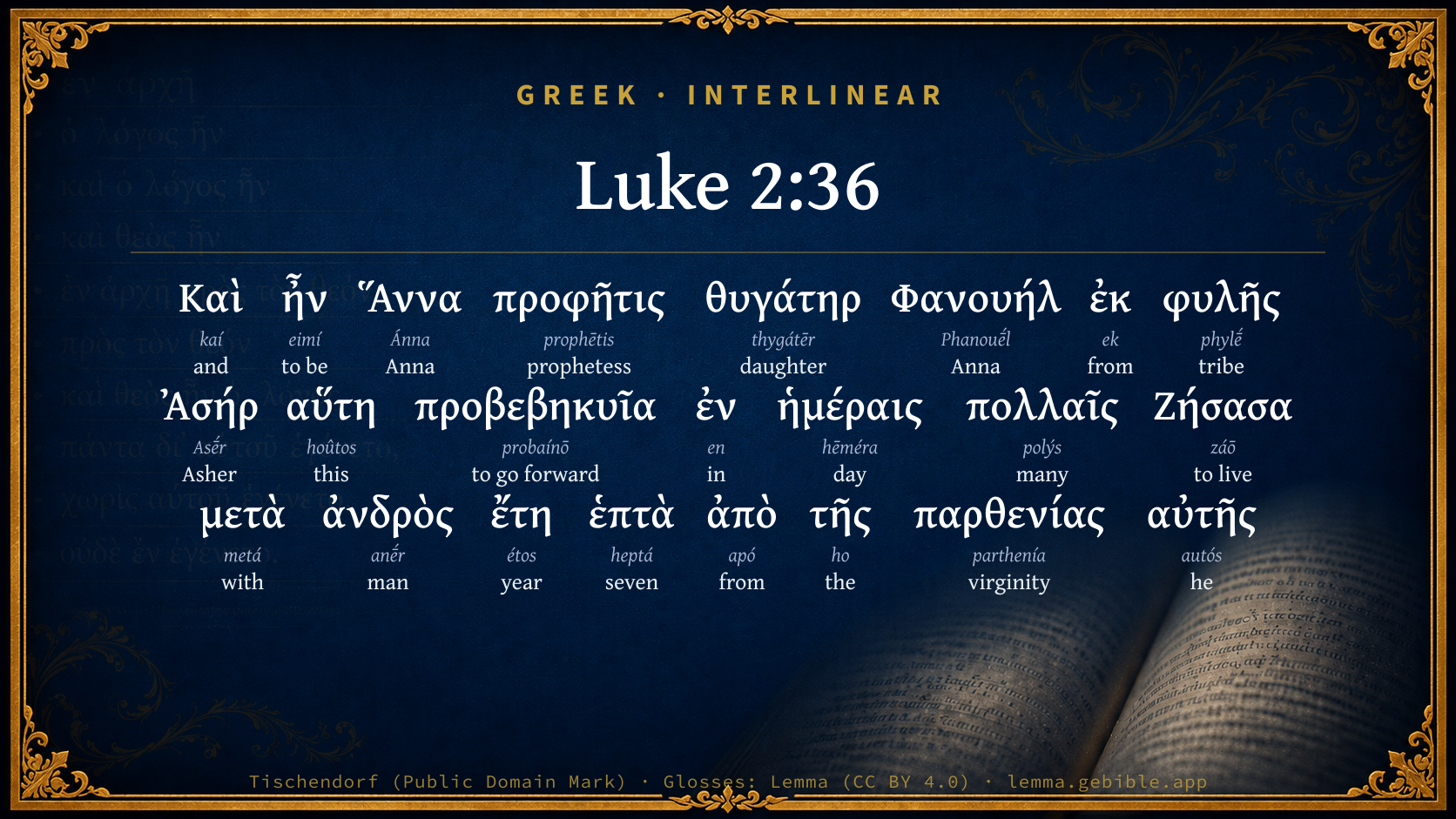
Download image
Cite this verse

Luke 2:36 (World English Bible). Public Domain. Lemma interlinear Bible study tool, https://lemma.gebible.app/v/luke/2/36.

Show BibTeX & RIS
BibTeX
RIS
English Translation
There was one Anna, a prophetess, the daughter of Phanuel, of the tribe of Asher (she was of a great age, having lived with a husband seven years from her virginity,
World English Bible · Public Domain
Highlights
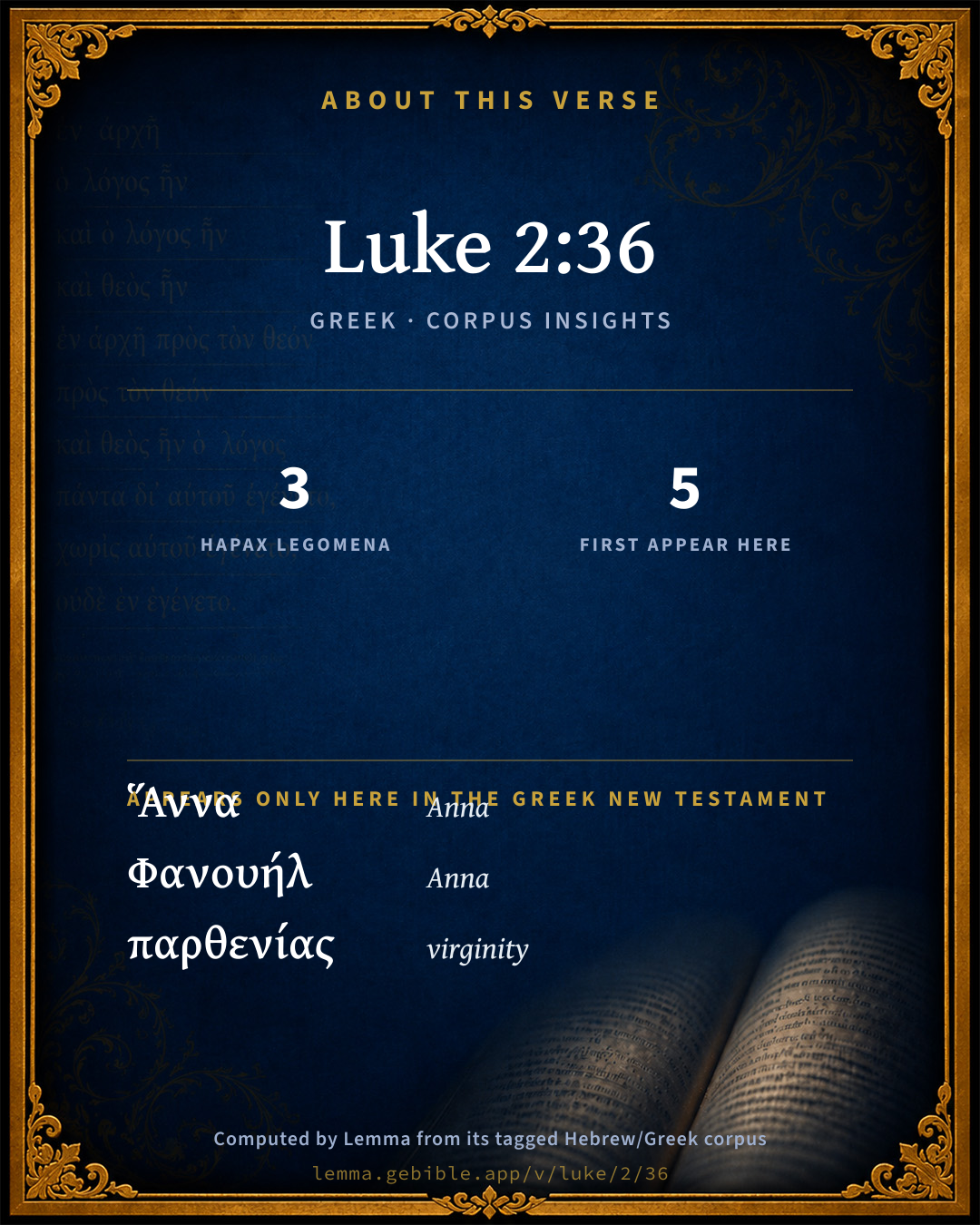
  • 3 hapax legomena — only here in the Greek New Testament
  • 5 first appearances in the Greek New Testament
Full analysis ↓
Download a study sheet

One document with this verse’s original text, its word-by-word gloss line, the meaning frame, cross-references with their text, attributed commentary, and full source and license credits — printable, and it pastes into notes with its structure intact.

This verse Autodidact and up

Study sheet (.html) Plain text (.txt)

A passage Seminary Student

Up to 50 verses in one chapter. A passage sheet keeps up to 6 commentary sources and 12 cross-references per verse, in the order this page ranks them, and says so on the sheet whenever that leaves anything out. Ask for a single verse and you get the Autodidact verse sheet above.

Everything on this page stays free to read, with no account — the sheet is a download of what is already on screen, not access to it.

Want to remove ads? Support Godless Engineer
Compare translations 3

The same verse in 3 English versions, stacked beneath the original-language interlinear above. Click any original word for its lexicon entry.

Each is an independent rendering of the whole verse — the interlinear is not word-aligned to these translations.

Highlighted words mark where these versions differ — a whole-verse word diff, not a word-by-word alignment.

  • World English Bible Public Domain
    There was one Anna, a prophetess, the daughter of Phanuel, of the tribe of Asher (she was of a great age, having lived with a husband seven years from her virginity,
  • King James Version Public Domain
    And there was one Anna, a prophetess, the daughter of Phanuel, of the tribe of Aser: she was of a great age, and had lived with an husband seven years from her virginity;
  • unfoldingWord Literal Text CC BY-SA 4.0
    And Anna was there, a prophetess, a daughter of Phanuel from the tribe of Asher. She had advanced much in days, having lived with her husband for seven years after her virginity,

unfoldingWord Literal Text — © unfoldingWord, licensed CC BY-SA 4.0. Word-aligned USFM3 via Door43 (git.door43.org/unfoldingWord/en_ult).

Versions to compare (up to 4)

3 of 4 selected

Show all 19 translations

Every available English version of this verse, each an independent rendering of the whole verse.

  • World English Bible Public Domain
    There was one Anna, a prophetess, the daughter of Phanuel, of the tribe of Asher (she was of a great age, having lived with a husband seven years from her virginity,
  • Berean Standard Bible Public Domain
    There was also a prophetess named Anna, the daughter of Phanuel, of the tribe of Asher, who was well along in years. She had been married for seven years,
  • Majority Standard Bible Public Domain
    There was also a prophetess named Anna, the daughter of Phanuel, of the tribe of Asher, who was well along in years. She had been married for seven years,
  • King James Version Public Domain
    And there was one Anna, a prophetess, the daughter of Phanuel, of the tribe of Aser: she was of a great age, and had lived with an husband seven years from her virginity;
  • American Standard Version (1901) Public Domain
    And there was one Anna, a prophetess, the daughter of Phanuel, of the tribe of Asher (she was of a great age, having lived with a husband seven years from her virginity,
  • Revised Version (1885) Public Domain
    And there was one Anna, a prophetess, the daughter of Phanuel, of the tribe of Asher (she was of a great age, having lived with a husband seven years from her virginity,
  • Geneva Bible (1599) Public Domain
    And there was a Prophetesse, one Anna the daughter of Phanuel, of the tribe of Aser, which was of a great age, after she had liued with an husband seuen yeeres from her virginitie:
  • Douay-Rheims (1899) Public Domain
    And there was one Anna, a prophetess, the daughter of Phanuel, of the tribe of Aser; she was far advanced in years, and had lived with her husband seven years from her virginity.
  • Young's Literal Translation Public Domain
    And there was Anna, a prophetess, daughter of Phanuel, of the tribe of Asher, she was much advanced in days, having lived with an husband seven years from her virginity,
  • Literal Standard Version CC BY-SA 4.0
    And there was Anna, a prophetess, daughter of Phanuel, of the tribe of Asher, she was much advanced in days, having lived with a husband seven years from her virginity,
  • Unlocked Literal Bible CC BY-SA 4.0
    A prophetess named Anna was there. She was the daughter of Phanuel from the tribe of Asher. She was very old. She had lived with her husband for seven years after her virginity,
  • unfoldingWord Literal Text CC BY-SA 4.0
    And Anna was there, a prophetess, a daughter of Phanuel from the tribe of Asher. She had advanced much in days, having lived with her husband for seven years after her virginity,
  • Darby Bible Public Domain
    And there was a prophetess, Anna, daughter of Phanuel, of [the] tribe of Asher, who was far advanced in years, having lived with [her] husband seven years from her virginity,
  • World Messianic Bible Public Domain
    There was one Hannah, a prophetess, the daughter of Penuel, of the tribe of Asher (she was of a great age, having lived with a husband seven years from her virginity,
  • Webster's Bible Public Domain
    And there was one Anna, a prophetess, the daughter of Phanuel, of the tribe of Asher: she was of a great age, and had lived with a husband seven years from her virginity;
  • Free Bible Version CC BY-SA 4.0
    Anna the prophetess also lived in Jerusalem. She was the daughter of Phanuel of the tribe of Asher, and she was very old. She had been married for seven years,
  • Bible in Basic English Public Domain
    And there was one, Anna, a woman prophet, the daughter of Phanuel, of the family of Asher (she was very old, and after seven years of married life
  • Text-Critical English NT CC BY 4.0
    There was also a prophetess, Anna the daughter of Phanuel, of the tribe of Asher. She was far advanced in days. Her husband had died seven years after they were married,
  • Tyndale New Testament (1534) Public Domain
    And ther was a Prophetesse one Anna the doughter of Phanuel of the tribe of Aser: which was of a greate age and had lyved with an husbande. vii. yeres from her virginite.

Literal Standard Version (2020), Covenant Press — licensed CC BY-SA 4.0. Text via the HelloAO Bible API (eBible.org). Unlocked Literal Bible (unfoldingWord) — licensed CC BY-SA 4.0. Text via the HelloAO Bible API (eBible.org). unfoldingWord Literal Text — © unfoldingWord, licensed CC BY-SA 4.0. Word-aligned USFM3 via Door43 (git.door43.org/unfoldingWord/en_ult). Free Bible Version, Dr. Jonathan Gallagher — licensed CC BY-SA 4.0. Text via the HelloAO Bible API (eBible.org).

Word by word

More ways to search: Search by grammar → Find every occurrence → Compare this word →

Practice this passage: Drill this verse → Learn its vocabulary →

Ἅννα
Ánna
G451
“Anna”
Noun, Nominative, Singular, Feminine
Part of Speech
Noun
Case
Nominative
Number
Singular
Gender
Feminine
Full Thayer's Definition

Origin: of hebrew origin H2584

TDNT: None

Anna = "grace" 1. A prophetess in Jerusalem at the time of the Lord's presentation in the Temple. She was of the tribe of Asher.
  1. Καὶ kaí G2532 “and” Conjunction
  2. ἦν eimí G1510 “to be” Verb, Imperfect, Active, Indicative, 3rd person, Singular
  3. προφῆτις prophētis G4398 “prophetess” Noun, Nominative, Singular, Feminine
  4. θυγάτηρ thygátēr G2364 “daughter” Noun, Nominative, Singular, Feminine
  5. Φανουήλ Phanouḗl G5323 “Anna” Noun, Proper, indeclinable
  6. ἐκ ek G1537 “from” Preposition
  7. φυλῆς phylḗ G5443 “tribe” Noun, Genitive, Singular, Feminine
  8. Ἀσήρ Asḗr G768 “Asher” Noun, Proper, indeclinable
  9. αὕτη hoûtos G3778 “this” Demonstrative pronoun, Nominative, Singular, Feminine
  10. προβεβηκυῖα probaínō G4260 “to go forward” Verb, Perfect, Active, Participle, Nominative, Singular, Feminine
  11. ἐν en G1722 “in” Preposition
  12. ἡμέραις hēméra G2250 “day” Noun, Dative, Plural, Feminine
  13. πολλαῖς polýs G4183 “many” Adjective, Dative, Plural, Feminine
  14. Ζήσασα záō G2198 “to live” Verb, Aorist, Active, Participle, Nominative, Singular, Feminine
  15. μετὰ metá G3326 “with” Preposition
  16. ἀνδρὸς anḗr G435 “man” Noun, Genitive, Singular, Masculine
  17. ἔτη étos G2094 “year” Noun, Accusative, Plural, Neuter
  18. ἑπτὰ heptá G2033 “seven” Adjective, Numeral (indeclinable)
  19. ἀπὸ apó G575 “from” Preposition
  20. τῆς ho G3588 “the” Article, Genitive, Singular, Feminine
  21. παρθενίας parthenía G3932 “virginity” Noun, Genitive, Singular, Feminine
  22. αὐτῆς autós G846 “he” Personal pronoun, Genitive, Singular, Feminine

About this verse

These counts appear in no published source. They are computed here, from the morphology-tagged text and Lemma’s own curated glosses. What Lemma adds →

23
words
23
distinct lemmas
Gospels
section

Notable vocabulary

3 hapax legomena — words that appear only here in the entire Greek New Testament:

  • Ἅννα Anna G451
  • Φανουήλ Anna G5323
  • παρθενίας virginity G3932

First appearance in Scripture

These words make their first canonical appearance in the Greek New Testament here:

  • Ἅννα Anna G451
  • προφῆτις prophetess G4398
  • Φανουήλ Anna G5323
  • Ἀσήρ Asher G768
  • παρθενίας virginity G3932

Shared distinctive vocabulary

προφῆτις prophetess G4398 occurs in 2 verses of the Greek New Testament. Also found in:
Cross-references

10

Topical passages linked to Luke 2:36 in the Treasury of Scripture Knowledge — connected by theme and wording, ordered by reader-vote popularity; previews shown in the World English Bible.

  • Psalms 92:14 They will still bring forth fruit in old age. They will be full of sap and green,
  • Genesis 30:13 Leah said, "Happy am I, for the daughters will call me happy." She named him Asher.
  • Exodus 15:20 Miriam the prophetess, the sister of Aaron, took a tambourine in her hand; and all the women went out after her with tambourines and with dances.
  • Judges 4:4 Now Deborah, a prophetess, the wife of Lappidoth, she judged Israel at that time.
  • Acts 2:18 Yes, and on my servants and on my handmaidens in those days, I will pour out my Spirit, and they will prophesy.
  • Acts 21:9 Now this man had four virgin daughters who prophesied.
  • 2 Kings 22:14 So Hilkiah the priest, and Ahikam, and Achbor, and Shaphan, and Asaiah, went to Huldah the prophetess, the wife of Shallum the son of Tikvah, the son of Harhas, keeper of the wardrobe (now she lived in Jerusalem in the second quarter); and they talked with her.
  • Job 5:26 You shall come to your grave in a full age, Like a shock of grain comes in its season.
  • 1 Corinthians 12:1 Now concerning spiritual things, brothers, I don't want you to be ignorant.
  • Revelation 7:6 Of the tribe of Asher twelve thousand, Of the tribe of Naphtali twelve thousand, Of the tribe of Manasseh twelve thousand,

Cross-references courtesy of OpenBible.info (CC BY 4.0).

Commentary

Notes on Luke 2:36 from classic Christian and Jewish commentators (each source and its license shown beneath its notes). The classic Christian expositions comment on the surrounding passage and are grouped to its opening verse, so a note may address several verses; the Jewish commentaries on the Tanakh (Rashi and others) are per-verse, so they appear only where the commentator wrote on this verse.

Lemma curates 59 commentaries, every one of them public domain or Creative Commons licensed, each selected and text-cleaned for this edition rather than reprinted as found. About our sources →

Jamieson, Fausset & Brown

Robert Jamieson, A. R. Fausset & David Brown

Anna--or, Hannah.

a prophetess--another evidence that "the last times" in which God was to "pour out His Spirit upon all flesh" were at hand.

of the tribe of Aser--one of the ten tribes, of whom many were not carried captive, and not a few reunited themselves to Judah after the return from Babylon. The distinction of tribes, though practically destroyed by the captivity, was well enough known up to their final dispersion (Rom 11:1; Heb 7:14); nor is it now entirely lost.

lived, &c.--she had lived seven years with her husband (Luk 2:36), and been a widow eighty-four years; so that if she married at the earliest marriageable age, twelve years, she could not at this time be less than a hundred three years old.

Jamieson, Fausset & Brown — Commentary Critical and Explanatory on the Whole Bible (1871) — public domain (CC PDM 1.0). Text via the HelloAO Bible API.

The Biblical Illustrator

Joseph S. Exell

Luk_2:36-38

And there was one Anna, a prophetess

First female testimony to Christ

1.

Excited by long expectations.

2. Based on personal sight.

3. Given with full candour.

4. Sealed by holy walk.

5. Crowned by a happy old age. (Van Doren.)

Anna an example to the aged

Let me recommend to all persons advanced in life her spirit of holy abstraction--an abstraction, not from duty, but from the sins, and cares, and vanities of the world. It is difficult to conceive a more unbecoming, or more pitiable object, than a person, whether male or female, far advanced in years, but still engrossed with the trifles of time. It will not be supposed that it is meant to say that aged believers should not be truly happy and cheerful; but very different is the joy of God from the gaiety of the world; very different is the rational and devout placidity from the unreflecting and ill-timed mirth. The vain attempt to go on as formerly, in defiance of the ravages of time, and the failing of nature; the affectation of the dress, manners, and enjoyments of youth, in the midst of the infirmities of age; the haunt of giddy amusement resorted to with feeble and tottering steps; the wreathy garland on the withered brow; the world still predominant at threescore and ten, or fourscore; the heart barricaded against the admission of serious thoughts, and full of the things of sense, when a very short space of time must shut the scene, and dispel every dream, and fix the destiny for ever;--alas! alas! let who will admire this and call it pleasant, every wise man must feel disposed to exclaim, How incongruous, how absurd, how melancholy, how sinful! But an aged Christian, justly estimating the circumstances in which he is placed, contented, thankful, grave, pious, and consistent--how becoming, how engaging, and how venerable! A very little reflection, too, must suffice to show the impropriety of the aged spending the small remainder of their time in unprofitable amusements, and also the impropriety of others encouraging them to do so. If it be so that some who are far advanced into the vale of tears, spend some hours of almost every lawful clay in any such manner as merely kills the time, it is truly to be much lamented. If indeed their mind be in such a state of dotage as to unfit them for anything useful, there may be some excuse for the habit; but it must be criminal and very hurtful, as long as they are in possession of ability to distinguish right from wrong, and to make any preparation for the unseen world on which they are verging. Far other employments ought to engage them. It was not thus that aged Anna sought her amusement and solace. Let the aged get interested, deeply interested, about the things of God, and they will not then stand in need of any expedients which are, to say the least, of doubtful propriety. Let them, like Anna, as far as strength permits, regularly and devoutly frequent the temple of God. Let them be much in religious exercises at home. Let them speak to others on the subject of religion. Let their lips, which must soon be closed, speak for Christ while they can. Advices from persons of their experience may be well taken, when those from persons of less standing may be despised. Let them study in all things to adorn the doctrine of God their Saviour, that their hoary heads may be crowns of glory, being found in the way of righteousness. Thus, that God who hath taught, guided, and blessed them from their youth, will not forsake them when they are old; they shall safely and happily come to their grave in their full age, like a shock of corn in its season. (James Foote, M. A.)

Piety in the aged

I. PIETY IN THE AGED CONFIRMS AND ILLUSTRATES THE PROMISE WHICH GOD HAS MADE OF LONG LIFE TO THOSE WHO FEAR HIS NAME.

II. PIETY IN THE AGED CROWNS THOSE WHO POSSESS IT WITH ESPECIAL HONOUR.

III. PIETY IN THE AGED COMMENDS RELIGION TO OTHERS.

IV. PIETY IN THE AGED FURNISHES A BEAUTIFUL ILLUSTRATION OF THE MATURITY AND RIPENESS OF CHRISTIAN CHARACTER. Concluding inferences:

1. We should imitate the pious aged.

2. How thankful should the children of pious and aged parents be.

3. The departure of aged Christians from our midst reminds us who remain that the ranks before us are thinning out, and that we are pressing up to the forefront of the line. We should see to it, then, that we have their piety, and can honour their place. (Preachers Treasury.)

The prophetess Anna

A very beautiful completion of a very beautiful picture. Simeon standing there alone as the representative of humanity is isolated; is there nowhere a companion who may share the riches of this new joy? The other side of human nature must be represented, and that deficiency is made up by the presence of the venerable prophetess. There they stand as father and mother of the whole race, giving hospitality and welcome to Him who came to save the world. They stood, as it were, at the front door of the worlds house, and spake to the young King in the name of the captives He came to deliver. There are some womanly characteristics in this passage which should be noted.

1. Anna departed not from the Temple--persistent, faithful, constant, and thus a woman pre-eminently.

2. She served God with lastings and prayers night and day--self-denial, profound devotion, continual watching.

3. Where Simeon prayed, Anna gave thanks. It would seem as if there was just the faintest touch of self-consideration in the prayer of Simeon, as he wished to be gone from scenes that wearied him; but the prophetess, eighty and four years old, constant through all changes, hopeful through all fears, was willing to linger longer, for she spoke nothing of her own release, but thanked God for His mercy, and comforted many that looked for redemption in Jerusalem. Blessed are they who can sing in their old age, and turn all their own experience into comfort for those who mourn. (J. Parker, D. D.)

The story of a lonely womans work

Our text presents us with the picture of a lonely woman, old, and a widow. Could a less attractive subject be chosen? There is something interesting in a young widow; but who cares to look at an old one, whose charms have long since faded, whose eyes are dim, whose hair is white, whose face is wrinkled, and whose hands are tremulous? But there is a beauty that does not depend upon youth, a loveliness that wears well, and cannot be washed out even by tears, a charm that comes in answer to the prayer, Let the beauty of the Lord our God be upon us, Of this beauty Anna, the prophetess, had a full share; and the story of her life, briefly as it is told, is not devoid of interest. Anna, the gracious, as her name signifies, was the daughter of Phanuel, evidently a man who lived as one who saw the face of God. While still very young the maiden was wedded, and for seven happy years youth and love filled her heart with gladness. But at the end of that time the shadow of death passed over the Jewish home and hid the light, and stilled the song, and filled the house with mourning. What was she to do, that young widow with her life before her? She had surely some excuse for joining that innumerable company of disappointed women who talk of blighted lives, and are themselves a blight upon everything that Comes near them. But she let the useful trouble of her life soften and sanctify her. She put her trust in the God of Israel, and received with meekness the chastening of His hand. She took herself and her sorrow to the Temple. And there a new longing and a new love took possession of her;. for were they not all looking for the Messiah, and might not the time of His coming be near? She would consecrate herself to God and to His service in the Temple. Other women could not do it; the sweet clamour of the children, and the wishes of their husbands kept them at home; but she would have her pleasures too, and the joy of the Lord should be her strength. And so the young widow took her place, and day by day, and year by year, returned to it. The sun touched Olivet with golden beams and left it again in shadow more times than she could count. The fig trees blossomed and shed their fruit, the valleys drank up the early and the latter rain, the tender grapes became ripe and were gathered, the corn showed first the green blade, and then the full ears; the feasts came round with their joyous assemblings; and, year after year, Anna was in the Temple, neither wretched nor useless. God gave to her the gift of prophecy. She saw what some eyes could not see, and she had power to utter the Divine revelations which were made to her. Complacently and tranquilly she saw the years pass away until eighty-four had seamed her face, and bent her form. But He whom she had served with such fidelity and devotion had a wonderful joy in reserve for her yet. Coming into the Temple one day, as usual, she heard an unusual sound. Simeon, with tremulous voice, was singing that new song, which has been continued by the Church ever since. In his arms he held the Child Jesus; and, seeing Him, what could Anna do but take up the strain of thanksgiving, and pour out her soul in praise? And then she found that, after all, her work was not over. She had known what it was to wait long, and others were waiting still. She could not keep the good news to herself. She became the first evangelist of His advent in the city of her King, and spake of Him to all them, &e. We are taught at least three things by the brief biography which Luke has written of Anna.

1. What is the best cure for loneliness?--Something to do, and the determination to do it.

2. What is womans work in the Church, and who are the women to do it? More and more every year it is coming to be understood that there are departments which women can excellently fill. There are thousands of devoted women scattered about in different parts of our country who, in quiet places, and by womanly methods, are doing an immense amount of good. More Annas to spend their days in Gods Temple, and speak a kindly word to those who are in darkness: women who have a ready hand to take up any duty which would not otherwise be done--these are the women that are needed. But it is lonely women especially who are called to Christs work.

3. God will most richly reward the services of the faithful. No one knows exactly what the reward will be, for He delights to give us surprises of joy. (Marianne Farningham.)

Occupation of Anna

Anna was of the tribe of Asher, and therefore a Galilean. She was eighty-four years of age, and had thus lived through the long sad period of war, conquest, and oppression which had intensified, in every Jewish heart, the yearning for national deliverance by the promised Messiah. Her long life had been spent in pious acts and services. She had never married again a fact, mentioned by St. Luke, in accordance with the feeling of the day, to her honour, but had been, in the words of St. Paul, a widow indeed, trusting in God, and continuing in supplications and prayers night and day. She might in truth be said to have lived in the Temple; having very likely come from Galilee to be near the holy place, and thus able to give herself up to religious exercises, on the spot, where, in the eyes of a Jew, they were most sacred. Such a woman must have been well known in a place like Jerusalem. Catching the burden of Simeons words as she passed, she too, like him, forthwith thanks God that the promise of the Messiah is now, at last, fulfilled. There could have been few, however, to whom the glad tidings of such a Saviour were welcome, for, though the heart of the nation was burning with Messianic hopes of a political kind, we are told that Anna was able to tell them to all in Jerusalem who looked for a redemption of a higher type. (Dr. Geikie.)

Beautiful old age

Sometimes the sun seems to hang for a half-hour in the horizon, only just to show how glorious it can be. The day is done; the fervour of the shining is over, and the sun hangs golden--nay, redder than gold--in the west, making everything look unspeakably beautiful, with the rich effulgence which it sheds on every side. So God seems to let some people, when their duty in this world is done, hang in the west, that men may look on them, and see how beautiful they are. There are some hanging in the west now. (H. W. Beecher.)

The Biblical Illustrator, edited by Joseph S. Exell (c. 1880s–1900s) — public domain. Text from a community e-Sword module.

Joseph Benson's Commentary

Luk 2:36-38. And there was one Anna, a prophetess — A person of some note; she was a widow of about fourscore and four years — These were the years of her life, and not of her widowhood only; who departed not from the temple — The meaning is, not that she abode continually in the temple: for none lived there save the priests and Levites; but she attended there constantly at all the stated hours of prayer. But served God with fastings and prayers — Even at that advanced age; night and day — That is, spending therein a considerable part of the night, as well as of the day. She coming in at that instant — The providence of God so ordering it, that another important testimony might be borne to the child Jesus; gave thanks likewise unto the Lord — Praised the Lord, as Simeon had done, for sending the long-expected Messiah: or, in her turn confessed to the Lord, as ανθωμολογειτο τω Κυριω, properly signifies. The expression seems to have a reference to Simeon’s speech, and might be intended to intimate that this of Anna was a kind of response, or counterpart to his. And spake of him to all that looked for redemption in Jerusalem — She spake afterward of the child, under the character of the Messiah, to all her acquaintance at Jerusalem, that had any sense of religion, or faith in its promises. The sceptre now appeared to be departing from Judah, though it was not actually gone: Daniel’s weeks were plainly near their period. And the revival of the spirit of prophecy, together with the memorable occurrences relating to the birth of John the Baptist, and of Jesus, could not but encourage and quicken the expectation of pious persons at this time. Ought not the example of these aged saints to impress and animate those, whose hoary heads, like theirs, are a crown of glory, being found in the way of righteousness? Should not those venerable lips, so soon to be silent in the grave, be employed in the praises of their Redeemer, that they may have the pleasure to see, through their pious attempts, the rising generation improve in true religion? and that they may quit the world with the greater tranquillity, in the view of leaving those behind them, to whom Christ will be as precious as he hath been to them, and who will be waiting for God’s salvation when they are gone to enjoy it?

Joseph Benson's Commentary on the Old and New Testaments (1811–1818) — public domain. Text from a community e-Sword module.

Tyndale Open Study Notes

Tyndale Open Resources

2:36-38 Anna is the Greek equivalent of the Hebrew name Hannah, Samuel’s mother (1 Sam 1–2). Jewish tradition identified seven Old Testament women as prophets: Sarah, Miriam, Deborah, Hannah, Abigail, Huldah, and Esther. Anna was another prophetic witness to Jesus’ identity as the Messiah. • The tribe of Asher, one of the ten northern tribes of Israel, was named after Jacob’s eighth son (Gen 30:12-13). Most of those who returned from Babylonian exile were from the tribe of Judah; other Israelites also knew their tribal ancestry in Jesus’ day. For instance, the apostle Paul was from the tribe of Benjamin (Phil 3:5).

Tyndale Open Study Notes — © Tyndale Open Resources, licensed CC BY-SA 4.0. Text via the HelloAO Bible API.

Bengel's Gnomon

Johann Albrecht Bengel

Luk 2:36. Φανουὴλ, Phanuel) The father of Anna is named, rather than her husband. He was as yet known as one who looked for redemption: Luk 2:38.—Ἀσὴρ, Aser) See 2Ch 30:11.

Bengel's Gnomon of the New Testament — English translation (T&T Clark, Edinburgh, 1860) — public domain. Text from a community e-Sword module.

Meyer's Critical & Exegetical Commentary

Heinrich August Wilhelm Meyer

Luk_2:36 ff. Ἠν] aderat, as at Mar_8:1; Mar_15:40; also 1Co_14:38.

After αὕτη, Luk_2:36, the copula ἦν is not unnecessarily to be supplied, in which case (so usually, as also by Lachmann and Tischendorf) a point is placed after Luk_2:37; but this αὕτη is the subject to which ἀνθωμολογεῖτο belongs as verb, so that all that intervenes contains accompanying definitions of the subject, namely thus: This one, being advanced in great age, after she had lived with a husband seven years from her virginity, she too a widow up to eighty-four years, who departed not from the temple, with fastings and prayers rendering service to God night and day and having come forward at that same hour, offered praise to the Lord, etc. Observe as to this(1) that ζήσασα … αὐτῆς, Luk_2:36, is subordinate to the προβεβηκ. ἐν ἡμ. πολλ.; (2) that at Luk_2:37 there is to be written, with Tischendorf and Ewald, καὶ αὐτή (not as usually, καὶ αὕτη), so that the definition καὶ αὐτὴ χήρα … ἐπιστᾶσα, Luk_2:37-38, contains a further description of the woman co-ordinated with the προβεβηκ. ἐν ἡμ. πολλ.; (3) that καὶ αὐτῇ τῇ ὥρᾳ ἐπιστᾶσα (see the critical remarks) without any separation links itself on continuously to the preceding participial definition; finally, (4) that καὶ αὐτή, Luk_2:37, she too, places Anna on a parallel with Simeon; as the latter had come forward a pious aged man, so she also a pious aged woman.

προφῆτις] Plat. Phaedr. p. 244 A; Eur. Ion. 42, 321; LXX. Exo_15:20; Isa_8:3, al. Hebrew נְבִיאָה, an interpretress of God, a woman with the gift of apocalyptic discourse, Rev_2:20; Act_21:9; Act_2:17. She makes use of this gift, Luk_2:38.

ἑπτά] consequently a brief and (ἀπὸ τ. παρθεν. αὐτ.) her only marriage, after which she remained in widowhood, which among the ancients was accounted very honourable. See Grotius and Wetstein on 1Ti_3:2; 1Ti_5:9.

Meyer — Critical and Exegetical Commentary on the New Testament — English translation by Peter Christie, edited by Frederick Crombie (T&T Clark, 1880) — public domain. Text from a community e-Sword module.

Expositor's Greek Testament

ed. W. Robertson Nicoll

Luk 2:36-38 . Anna. Another aged saint of the O. T. type comes on the stage speaking thankful prophetic words concerning the Holy Child.

Luk 2:36 . ἦν : either there was there , aderat (Meyer, Godet, Weizsäcker), or there was , there lived (De Wette, J. Weiss, Schanz, Hahn). Ἅννα = חַנָּה , 1Sa 1:20 ( Ἄννα in Sept [31] ) = grace. Of this woman some particulars are given, e.g. , her father and her tribe, which makes the absence of such details in Simeon’s case more noteworthy. The two placed side by side give an aspect of historicity to the narrative. αὕτη (or αὐτή , the sense much the same) introduces some further details in a loosely constructed sentence, which looks like biographic notes, with verbs left out = she advanced in years, having lived with a husband, seven years from virginity, the same a widow till eighty-four years all which may be regarded, if we will, as a parenthesis, followed by a relative clause containing a statement of more importance, describing her way of life = who departed not from the temple, serving (God) by fasts and prayers, night and day.

[31] Septuagint.

The Expositor's Greek Testament, edited by W. Robertson Nicoll (1897–1910) — public domain. Text from a community e-Sword module.

Geneva Bible (1599)

Geneva Bible translators

Another witness besides Simeon, against whom no exception may be brought, inviting all men to the receiving of the Messiah.

Geneva Bible (1599) marginal notes — public domain. Text via Bolls.life.

Adam Clarke's Commentary

Verse 36. Anna, a prophetess] It does not appear that this person was a prophetess in the strict sense of the word, i.e. one who could foretell future events; but rather a holy woman; who, from her extensive knowledge and deep experience in Divine things, was capable of instructing others; according to the use of the word προφητευω, 1Co 14:3: He that prophesieth, speaketh unto men to edification, and to exhortation, and to comfort. So we find this holy widow proclaiming Jesus to all who looked for redemption in Jerusalem, Lu 2:38.

The tribe of Asher] This was one of the ten tribes of the kingdom of Israel, several families of which had returned from their idolatry unto God, in the time that Hezekiah proclaimed the passover in Jerusalem, which is mentioned 2Ch 30:1-11. Though her family might have been a distinguished one in Jerusalem, yet we find that it was her very exemplary piety that entitled her to be thus honourably mentioned in the sacred history. It is an honourable thing indeed to have one's name written in the sacred records; but to be written in the book of life is of infinitely greater moment.

Seven years] She was a pure virgin when married, was favoured with her husband but seven years, and was now in all, taking in the time of her virginity, marriage, and widowhood, eighty-four years of age. At such an age, it might be supposed she was reasonably exempted from performing the severer duties of religion; but her spirit of piety continued still to burn with a steady and undiminished fame.

Adam Clarke's Commentary on the Bible (1810–1826) — public domain. Text from a community e-Sword/MySword module.

Ellicott's Commentary for English Readers

(36) One Anna, a prophetess.—The fact is in many ways remarkable. We find a woman recognised as a prophetess at a time when no man is recognised as a prophet. She bears the name of the mother of the founder of the School of the Prophets, identical with that which the legends of Apocryphal Gospels assign to the mother of the Virgin. She is named, as if it were a well-known fact, as having been the wife of Phanuel, and she is not of the tribe of Judah, but of Aser. That tribe, then, though belonging to the Ten that had been carried into exile by Shalmaneser (2Ki_17:6), had not been altogether lost. Some, at least, of its members survived and cherished the genealogies of their descent, as one family of the neighbouring tribe of Naphthali are said to have done at Nineveh (Tob_1:2). In that family also we find the name of Anna (Tob_1:9).

Seven years from her virginity.—The words are emphasised (1) as expressing chastity prior to marriage, and (2) as excluding the thought of a second marriage.

A Bible Commentary for English Readers, edited by Charles John Ellicott (1878–1897) — public domain. Text from a community e-Sword module.

The Cambridge Bible for Schools and Colleges

gen. ed. J. J. S. Perowne

36–40. Anna the Prophetess. The Return to Nazareth

36. Anna] The same name as Hannah (1Sa_1:20), from the root Chânan, ‘he was gracious.’

a prophetess] like Miriam, Deborah, Huldah (2Ch_34:22).

Phanuel] ‘The Face of God;’ the same word as Peniel, Gen_32:30.

Aser] Though the Ten Tribes were lost, individual Jews who belonged to them had preserved their genealogies. Thus Tobit was of the tribe of Naphthali (Tob_1:1). Comp. “our twelve tribes,” Act_26:7; Jas_1:1.

from her virginity] I.e. she had been married only seven years, and was now 84 years old. א, A, B, L read ἔως (for ὡς) which is best taken with “of great age,” the intervening words being parenthetic, a widow even unto fourscore years.

The Cambridge Bible for Schools and Colleges (gen. ed. J. J. S. Perowne; Cambridge University Press, 1878–1918) — public domain. Text from a community e-Sword module.

John Gill's Exposition

And she was a widow of about fourscore and four years,.... Which is not the date of her whole age, as some have thought, but of her widowhood state, as distinct from her marriage state, and the time of her virginity. And this sense all the versions favour,

Which departed not from the temple that is, she was constant in her devotion there, at the time of divine service, whether by night or day; not that she was in it, for she had been out of it now; otherwise it could not with propriety be said of her, that

she coming in that instant, as in the next verse; but that she always was there when there was any worship performed, in which women might be concerned, and which is pointed out in the next clause:

but served God with fastings and prayers, night and day: she attended to the usual fasts of twice a week, and to such as were enjoined the whole congregation, and to the several set times of prayer, and to every act of devotion, private or public, by night or day. In Exo 38:8 we read of women that assembled at the door of the tabernacle of the congregation: both the Targums of Onkelos and Ben Uzziel render it, "who came to pray"; and the Septuagint version, "that fasted": Anna did both.

John Gill's Exposition of the Whole Bible (1746–1763) — public domain (CC PDM 1.0). Text via the HelloAO Bible API.

Trapp's Complete Commentary

John Trapp

36 And there was one Anna, a prophetess, the daughter of Phanuel, of the tribe of Aser: she was of a great age, and had lived with an husband seven years from her virginity;

Ver. 36. From her virginity] i.e. She was a pure virgin when married to her husband. All are not virgins that pass for such; some have their secret conveyances; They can eat stolen bread, and afterwards so wipe their lips that not the least crumb shall be seen, Pro 30:19-20.

John Trapp, A Commentary or Exposition upon All the Books of the Old and New Testament (1647–1656) — public domain. Text from a community e-Sword module.

Albert Barnes' Notes on the Bible

Of the tribe of Aser - The tribe of Aser, or Asher, dwelt in the northern part of the land of Canaan. Why Anna was called a prophetess is not known. It might be because she had been the wife of a prophet, or because she was employed in celebrating the praises of God (compare 1Ch 25:1-2, 1Ch 25:4; 1Sa 10:5), or because she herself had foretold future events, being inspired.

Albert Barnes' Notes on the Bible (1834–1885) — public domain. Text from a community e-Sword/MySword module.

Haydock's Catholic Bible Commentary

Anna, a prophetess. She was another witness that Jesus was the Messias, venerable for age, and more for her piety. --- And had lived with her husband seven years from her virginity; i.e. had been seven years a wife: and from the death of her husband, had remained always a widow: now 84 years of age: who departed not from the temple, but was constantly there at the times of prayer, with fastings and prayers, serving God day and night. (Witham)

George Leo Haydock (1774–1849), Haydock's Catholic Family Bible and Commentary, 1859 edition — public domain. Excludes Psalms (Douay-Rheims chapter numbering differs from Protestant) and Deuterocanonical books (Catholic canon only).

Matthew Poole's English Annotations

God took care that our Saviour’s nativity should be fully attested. To the testimony of the angels, the wise men, the shepherds, Simeon, here is added another. It is that of Anna, who is described here by her tribe and by her father. She was

of the tribe of Aser, one of the meanest tribes, and of those ten tribes that were carried into the captivity of Assyria, having before made a defection (under the conduct of Jeroboam) both from the house of David and from the true worship of God. But though the generality did so, yet many particular persons removed, to enjoy the true worship of God, and joined themselves to Judith. Jer 1:4, it was prophesied, that the children of Israel should come, they and the children of Judah together, going and weeping, to seek the Lord their God. What her father

Phanuel was we read not. She is also further said to be

a prophetess. Such there were amongst the Jews; we read of Deborah, and Miriam, and Huldah, to whom king Josiah sent. They were called prophets and prophetesses who revealed the will of God unto the people; but in the Old Testament it most generally signified, such as God enabled to foretell things which were to come. The spirit of prophecy had much failed amongst the Jews for four hundred years before Christ; about Christ’s coming it began to revive. This woman seems to have been upwards of a hundred years old, if we account the eighty-four years here mentioned from her widowhood; not so, if we count them from her birth. She was but seven years married, all the rest of her life she had spent in widowhood. She

departed not from the temple night or day; that is, she was frequently there, giving up herself wholly to religious exercises, prayer, and fasting, that she might be more fit for prayer. This woman

coming in at that instant where Simeon took up Christ in his arms, &c.,

gave thanks likewise unto the Lord, and spake of him to such as she knew in Jerusalem,

who looked for the redemption of Israel. There is no place where God hath had a name, but, however it be corrupted and debauched, hath a number that keep close to God. God in Ahab’s time had seven thousand in Israel; and in this most corrupt time there was a Simeon and an Anna, and also others, who had a true notion and expectation of the Messiah; and these the Holy Ghost taketh more notice of than of all the Jewish doctors, all the scribes and Pharisees, whose names are enrolled, while what these persons said and did shall remain for a memorial of them wherever the gospel shall be preached to the end of the world.

Matthew Poole's English Annotations on the Holy Bible (1683–1685) — public domain. Text from a community e-Sword/MySword module.

Whedon's Commentary on the Bible

Daniel D. Whedon

36-38. Anna the Prophetess.

36. Anna (whose name is the same with the Old Testament Hannah) was of the tribe of Asher. Her native province stretched its whole eastern side along the margin of the Mediterranean, and included those among the most ancient cities of the earth, Tyre and Sidon. Northward it bordered on Syria. Its pure and healthful climate should have been the abode of piety. When in the deepest stage of Israel’s apostacy Hezekiah sent his messengers to call them to attend the passover, most of the northern tribes laughed them to scorn; but a few families in Asher, Manasseh, and Zebulon humbled themselves and went to the holy feast, 2 Chronicles 30. One is tempted to believe that we have here one of the descendants of some family of that faithful few, whose piety was all the deeper because maintained amid surrounding apostacy.

Daniel D. Whedon (gen. ed.), Commentary on the Old and New Testaments (1874–1909) — public domain. Text from a community e-Sword module.

The Pulpit Commentary

Vers. 36-38. Greeting of Anna the prophetess.

There was one Anna, a prophetess. The name of this holy woman is the same as that of the mother of Samuel. It is not necessary to assume that this Anna had the gift of foretelling future events. She was, at all events, a preacher. These saintly, gifted women, though never numerous, were not unknown in the story of the chosen people. We read of the doings in some cases the very words are preserved of Miriam, Hannah, Deborah, Huldah, and others. Of the tribe of Aser. It is true that at this period the ten tribes had been long lost, the "Jews" being made up of the two tribes of Judah and Benjamin; but yet certain families preserved their genealogies, tracing their descent to one or other of the lost divisions of the people. Thus Anna belonged to Asher.

Vers. 36-38. The testimony of womanhood.

From this interesting episode, without which the beautiful story of the infant Savior in the temple would hardly be complete, we learn

I THAT THERE IS ROOM IN THE KINGDOM OF CHRIST FOR THE SERVICE OF WOMAN-HOOD. It was well that the aged Simeon should bear his testimony to the birth of the Savior; it was also well that this aged and honorable prophetess should "likewise give thanks." Woman as well as man was to utter reverent joy on this supreme occasion. Woman, in the person of Anna, might well rejoice; for in the kingdom of Christ there is "neither male nor female;" all distinction of sex is unknown. Woman is as free to enter that kingdom as man; she may reach as high a position, by personal excellency, in it; she is as welcome to render holy service and fruitful testimony; is as certain to reap the reward of fidelity in the kingdom of heaven to which it leads. Women were the most faithful attendants on our Lord during his earthly ministry; they have been, since then, the most regular worshippers and the most devoted workers in his Church (see homily on Luk_8:2, Luk_8:3).

II THAT LONG LONELINESS MAY WELL BRING US INTO CLOSE COMMUNION WITH GOD. Anna had a very long widowhood (ver. 36), and in her loss of human fellowship she waited much on God. She "departed not from the temple, but served God... with prayers night and day." When denied one another"s society, what can we do better than seek fellowship with our heavenly Father, with our Divine Friend? What, indeed, can we do so well? Communion with the Father of our spirits will bring healing to the wounded soul, will be companionship for the lonely hour, will promote sanctity and submissiveness of will, will remind us of those other children of his who need our sympathy and succor, and will send us forth blessing and blest on the errands of love.

III THAT A VISION FROM GOD SHOULD RESULT IN PRAISE AND TESTIMONY. Anna "gave thanks unto the Lord, and spake of him the infant Christ to all," etc. Inspired of God, she recognized the long looked-for Messiah, and immediately she broke into praise, and forthwith began to communicate the joyful fact to all whom she could reach. This is the true order and the right procedure. When God reveals himself or his truth to us, we must first go to him in gratitude and praise, and must lose no time in passing on to others what he has entrusted to us.

IV THAT AGE HAS ITS OFFERING TO BRING, as well as youth and prime. It is pleasant to think of the aged Anna, some way past four score, bent and feeble with the weight of years, speaking to "all them that looked," etc., and telling them that he whom they had waited for so long had come at last. A fair sight it is in the eyes of man, and surely in his also who estimates our service according to our ability, (Luk_21:3) when those whose strength is well-nigh gone and who have earned their rest by long and faithful labor will not be persuaded to retire from the field, but labor on until the darkness of death arrests them.

V THAT HOLY EXPECTATION WILL MEET WITH ITS FULFILMENT. There were many looking ("all of them," etc.) for redemption (ver. 38); and as they waited for God and upon him, their hearts" desires were granted. God may delay his answer for a while, even for a long while, but in due time it will come. The seeker will find; the worker will reap. C.

The Pulpit Commentary (1880–1919), ed. H.D.M. Spence-Jones & Joseph S. Exell — public domain. Text from a community e-Sword module.

Kretzmann's Popular Commentary

Paul E. Kretzmann

The prophetess Anna:

v. 36 And there was one Anna, a prophetess, the daughter of Phanuel, of the tribe of Aser; she was of great age, and had lived with an husband seven years from her virginity;

v. 37. and she was a widow of about fourscore and four years, which departed not from the Temple, but served God with fastings and prayers night and day.

v. 38. And she, coming in that instant, gave thanks likewise unto the Lord, and spake of Him to all them that looked for redemption in Jerusalem.

v. 39. And when they had performed all things according to the Law of the Lord, they returned into Galilee, to their, own city Nazareth.

v. 40. And the Child grew, and waxed strong in spirit, filled with wisdom; and the grace of God was upon Him.

Simeon was not the only faithful soul in Jerusalem at that time. A prophetess, Anna, whose father and tribe are named, with Luke’s attention to detail wherever it is available, joined the group. She was very far advanced in years. She had been married early in life, but had lived in holy wedlock only seven years, remaining a widow after the death of her husband and spending her time in serving the Lord. Though she was now eighty-four years old, she was one of the first to enter the Temple in the morning after the opening of the gates, and all day long she was a devout worshiper, passing the hours in fasting and praying, and thus showing herself to be a true minister or servant of the Lord. She ’likewise gave thanks, she took up the strain which had been begun by the aged Simeon, praising God for having sent His Savior into the world, which was in such dire need of redemption. And she thus did not merely serve her own devotion and edification, but she spread the good news abroad. She made it a practice to mention the fact of the Messiah’s appearance to kindred spirits, as many as were still to be found in Jerusalem. For there were still some, if only a few, that were earnestly and prayerfully looking forward to the redemption of Jerusalem, through the work of the Savior from sins.

But Joseph and Mary, after they had performed all that law and custom required of them, left the city. And Luke here omits all reference to the flight into Egypt and the sojourn in that country, continuing his narrative at the point where the parents of Jesus definitely settled in Nazareth. Here, in the little hill town of Galilee, the childhood and youth of Jesus was spent. Here He grew up and incidentally developed in physical strength. But what is far more important: He grew in knowledge, He was filled with wisdom, and the grace of God was with Him, obviously rested upon Him.

Paul E. Kretzmann, Popular Commentary of the Bible (1921–1924) — public domain. Text from a community e-Sword module.

Burkitt's Expository Notes on the New Testament

William Burkitt

Simeon is seconded by Anna, a prophetess; she also declares that the child Jesus was the promised and expected Messiah: and thus Christ was proclaimed in the temple by two heralds of different sexes.

Concerning this aged woman, Anna, it is said, that she departed not from the temple night nor day; not that she lived and lodged there, but by her never departing from, understand her daily repairing to, the temple.

That which is often done, is said in scripture to be always done. We are said to do a thing continually when we do it seasonably: thus we pray continually, when we pray as often as duty requires us to pray.

Learn hence, that such duties as a Christian performs out of conscience, he will perform with constancy and perseverance; nature will have her good moods, but grace is steady. The devotions of a pious soul like Anna’s, are as constant, but more frequent, than the returns of day and night.

William Burkitt's Expository Notes on the New Testament (1700–1703) — public domain. Text from a community e-Sword module.

The People's New Testament

B. W. Johnson

36. One Anna, a prophetess. An aged saint who spoke by inspiration. Daughter of Phanuel. Evidently a man well known in that day. Of the tribe of Asher. One of the twelve tribes occupying the strip of sea-coast from Sidon to Carmel.

B. W. Johnson's The People's New Testament with Notes (1889–1891) — public domain. Electronic text from the Christian Classics Ethereal Library (CCEL) ThML edition.

unfoldingWord translationNotes

Door43 World Missions Community

A prophetess named Anna was there

This introduces a new participant into the story. (See: Introduction of New and Old Participants)

Phanuel

the name of a man. (See: How to Translate Names)

seven years

"7 years" (See: Numbers)

after her virginity

"after she married him"

a widow for eighty-four years

Possible meanings are 1) she had been a widow for 84 years or 2) she was a widow and was now 84 years old. (See: Numbers)

never left the temple

This is probably an exaggeration meaning that she spent so much time in the temple that it seemed as though she never left it. AT: "was always at the temple" or "was often at the temple" (See: Hyperbole and Generalization)

with fastings and prayers

"by abstaining from food on many occasions and by offering many prayers"

came near to them

"approached them" or "went to Mary and Joseph"

the redemption of Jerusalem

Here the word "redemption" is used to refer to the person who would do it. AT: "the one who would redeem Jerusalem" or "the person who would bring God's blessings and favor back to Jerusalem" (See: Metonymy)

translationWords

prophet

tribe

Asher

temple

fast

pray

redeem

Jerusalem

unfoldingWord translationNotes — © Distant Shores Media and the Door43 World Missions Community, licensed CC BY-SA 4.0. Source: git.door43.org/Door43/en_tn.

Cambridge Greek Testament for Schools and Colleges

36–40. ANNA THE PROPHETESS. THE RETURN TO NAZARETH

36. Ἄννα. The same name as Hannah (1Sa 1:20), from the root Chânan, ‘he was gracious.’

προφῆτις. The predicate in apposition usually has the article, as in Ἰωάννην τὸν βαπτιστήν, Ἄγριππα ὁ βασιλεύς. But it is sometimes omitted where there is no desire to distinguish a person from others, as in Σίμων βυρσεύς, Act 10:32. Comp. Luk 8:3. Anna was ‘a prophetess’ like Miriam, Deborah, Huldah (2Ch 34:22).

Φανουήλ. ‘The Face of God;’ the same word as Peniel, Gen 32:30.

Ἀσήρ. Though the Ten Tribes were lost, individual Jews who belonged to them had preserved their genealogies. Thus Tobit was of the tribe of Naphtali (Tob 1:1). Comp. “our twelve tribes,” Act 26:7; Jas 1:1.

ζήσασα. This 1. aor. of ζάω is only found in Hippocrates, and later writers, and in Hellenistic Greek.

ἀπὸ τῆς παρθενίας αὐτῆς. I.e. she had been married only seven years, and was now 84 years old. אABL read ἔως (for ὡς) which is best taken with “of great age,” the intervening words being parenthetic.

Cambridge Greek Testament for Schools and Colleges (Cambridge University Press, 1896; 21 vols, various authors incl. Carr, Maclear, Plummer, Farrar, Lumby, Moule, M. R. James, Simcox) — public domain. Text from a community e-Sword module.

International Critical Commentary

36-38. Anna the Prophetess. That the Evangelist obtained this narrative “directly or indirectly from the lips of this Anna who is so accurately described,” is less probable than that the source for all this chapter is one and the same, viz. some member of the Holy Family, and probably Mary herself.

36. ἦν. Either “was present,” as in Mar 15:40, in which case ἦν in the sense of “was” has to be understood with what follows; or simply “there was,” which is better. Thus all runs in logical order. First the existence of Anna is stated, then her life and character, and finally her presence on this occasion. Symeon comes to the temple under the influence of the Spirit; Anna (Hannah) dwells there continually. The sight of the Messiah makes him at once long for death; it seems to give her renewed vigour of life. Is this subtle distinction of character the creation of a writer of fiction? We find fiction at work in the tradition that Mary had been brought up in the temple under the tutelage of Anna. There is nothing here to indicate that Anna had ever seen Mary previously. D.C.G. i. p. 70.

Neither in ver. 36 (καὶ ἠν) nor in ver. 37 (καὶ αὐτή) does καί = “also” in ref. to ver. 25. The meaning is not “There was Symeon, the holy and aged man; also Anna, the holy and aged woman.” Throughout the section καί = “and.”

προφῆτις She was known as such before this occasion. Like Miriam, Deborah, Huldah, and the daughters of Philip, Anna was a woman divinely inspired to make known God’s will to others. That her genealogy is given because prophetesses are rare, is doubtful. But Lk.’s accuracy appears in such details, which a forger would have avoided for fear of mistakes. Although the ten tribes were lost, some families possessed private genealogies. For the word προφῆτις comp. Rev 2:20; Exo 15:20; Jdg 4:4; 2Ch 34:22; Isa 8:3.

For the omission of the art. after θυγάτηρ see on 1:5.—φανουήλ = “Face of God,” Peniel or Penuel (Gen 32:31, Gen 32:32); in LXX εἰδος Θεοῦ.—Ἀσήρ, 2Ch 30:11.

αὕτη προβεβηκυῖα, κ.τ.λ. “She was advanced in many days, having lived with a husband seven years from her virginity, and herself a widow even for eighty-four years.” From αὕτη προβεβ. to τεσσάρων is a parenthesis in which ἦν is to be understood: ζήσασα explains προβεβηκυῖα, and αὐτή balances μετὰ ἀνδρός. She was of great age, because she had lived1 seven years as a wife and eighty-four years by herself (Rom 7:25) as a widow. The ἕως draws attention to the great length of her widowhood; “up to as much as” (Mat 18:21, Mat 18:22). That she should be considerably over a hundred years old is not incredible. But the eighty-four may be intended to include the seven years and the time before her marriage. In any case the clumsy arrangement of taking all three verses (36-38) as one sentence, and making αὕτη the nom. to ἀνθωμολογεῖτο, should be avoided. That she had never, in spite of her early widowhood, married again, was held to be very honourable to her: comp. 1Ti 5:3, 1Ti 5:5. Monogamia apud ethnicos in summo honore est (Tertul. de. Exh. Cast. xiii.: comp. de Monog. 16.; ad Uxor. 1.7). See quotations in Wetst. on 1Ti 3:2, and Whiston’s note on Jos. Ant. xvii. 6, 6. Syr-Sin. has “seven days.”

International Critical Commentary — older volumes (1896–1929), various authors — public domain. Text from a community e-Sword module.

Vincent's Word Studies in the New Testament

Marvin R. Vincent

A prophetess [προφητις] . Only here and Rev 2:20. Asher. That tribe was celebrated in tradition for the beauty of its women, and their fitness to be wedded to high priests or kings.

Of great age [προβεβηκυια εν ημεραις πολλαις] . Lit., advanced in many days.

Marvin R. Vincent, Word Studies in the New Testament (1887–1900) — public domain. Text from a community e-Sword/MySword module.

Godet's Commentaries

Frédéric Louis Godet

Vers. 36-38. Anna presents, in several respects, a contrast to Simeon. The latter came into the temple impelled by the Spirit; Anna lives there. Simeon has no desire but to die; Anna seems to recover the vigour of youth to celebrate the Messiah. The words ἣ οὐκ ἀφίστατο (Luk 2:37) might be made the predicate of ἦν, and the two αυτη which separate them, two appositions of ῎Αννα. But it is simpler to understand ἦν in the sense of there was, or there was there, and to regard ἣ οὐκ ἀφιστατο as an appendix intended to bring back the narrative from the description of Anna’s person to the actual fact. Meyer, who understands ἦν in the same way, begins a fresh proposition with the αὕτη which immediately follows, and assigns to it ἀνθωμολογεῖτο for its verb (Luk 2:38). This construction is less natural, especially on account of the intermediate clauses (Luk 2:37). Προβεβηκυῖα ἐν is a Hebraism (especially with πολλαῖς), Luk 1:7. The moral purity of Anna is expressed by the term παρθενία, virginity, and by the long duration of her widowhood. Do the 84 years date from her birth, or from the death of her husband? In the latter case, supposing that she was married at 15, she would have been 106 years old. This sense is not impossible, and it more easily accounts perhaps for such a precise reckoning. Instead of ὡς, about, the Alex. read ἕως, until, a reading which appears preferable; for the restriction about would only be admissible with a round number—80, for example. Did Anna go into the temple in the morning, to spend the whole day there? or did she remain there during the night, spreading her poor pallet somewhere in the court? Luke’s expression is compatible with either supposition. What he means is, that she was dead to the outer world, and only lived for the service of God.

We could not, with Tischendorf, following the Alex., erase one of the two αυτη (Luk 2:38). Both can be perfectly accounted for, and the omission is easily explained by the repetition of the word.—᾿Αντί, in the compound ἀνθωμολογεῖτο, might refer to a kind of antiphony between Anna and Simeon. But in the LXX. this compound verb corresponds simply to הוֹדָה(Psa 79:13); ἀντί only expresses, therefore, the idea of payment in acknowledgment which is inherent in an act of thanksgiving (as in the French word reconnaissance). The Alex. reading τῷ Θεῷ, to God, is probably a correction, arising from the fact that in the O. T. the verb ἀνθωμολογεῖσθαι never governs anything but God. It is less natural to regard the received reading as resulting from the pronoun αὐτοῦ, Him, which follows.

We need not refer the imperf., she spake, merely to the time then present; she was doing it continually. The reading of some Alex., “those who were looking for the deliverance of Jerusalem,” is evidently a mistaken imitation of the expression, the consolation of Israel (Luk 2:25). The words, in Jerusalem, naturally depend on the participle, that looked for. The people were divided into three parties. The Pharisees expected an outward triumph from the Messiah; the Sadducees expected nothing; between them were the true faithful, who expected the consolation, that is, deliverance. It was these last, who, according to Ezekiel’s expression (chap. 9), cried for all the abominations of Jerusalem, that were represented by Anna and Simeon; and it was amongst these that Anna devoted herself to the ministry of an evangelist. If Luke had sought, as is supposed, occasions for practising his muse, by inventing personages for his hymns, and hymns for his personages, how came he to omit here to put a song into the mouth of Anna, as a counterpart to Simeon’s?

3. Historical conclusion: Luk 2:39-40.

It is a characteristic feature of Luke’s narrative, and one which is preserved throughout, that he exhibits the various actors in the evangelical drama as observing a scrupulous fidelity to the law (Luk 1:6, Luk 2:22-24, Luk 23:56). It is easy also to understand why Marcion, the opponent of the law, felt obliged to mutilate this writing in order to adapt it to his system. But what is less conceivable is, that several critics should find in such a Gospel the monument of a tendency systematically opposed to Jewish Christianity. The fact is, that in it the law always holds the place which according to history it ought to occupy. It is under its safeguard that the transition from the old covenant to the new is gradually effected. It is easy to perceive that Luk 2:39 has a religious rather than a chronological reference. “They returned to Nazareth only after having fulfilled every prescription of the law.” Luk 2:40 contains a short sketch of the childhood of Jesus, answering to the similar sketc, Luk 1:66, of that of John the Baptist. It is probably from this analogous passage that the gloss πνεύματι, in spirit, has been derived. It is wanting in the principal Alex. and Graeco-Latin documents. The expression He grew refers to His physical development. The next words, He waxed strong, are defined by the words being filled, or more literally, filling Himself with wisdom; they refer to His spiritual, intellectual, and religious development. The wisdom which formed the leading feature of this development (in John the Baptist it was strength) comprises, on the one hand, the knowledge of God; on the other, a penetrating understanding of men and things from a divine point of view. The image (filling Himself) appears to be that of a vessel, which, while increasing in size, fills itself, and, by filling itself, enlarges so as to be continually holding more. It is plain that Luke regards the development, and consequently the humanity, of Jesus as a reality. Here we have the normal growth of man from a physical and moral point of view. It was accomplished for the first time on our earth. God therefore regarded this child with perfect satisfaction, because His creative idea was realized in Him. This is expressed by the last clause of the verse. Χάρις, the divine favour. This word contrasts with χεῖρ, the hand, Luk 1:66. The accus. ἐπ᾿ αὐτό marks the energy with which the grace of God rested on the child, penetrating His entire being. This government contrasts with that of Luk 1:66, μετ᾿ αὐτοῦ, which only expresses simple co-operation. This description is partly taken from that of the young Samuel (1Sa 2:26); only Luke omits here the idea of human favour, which he reserves for Luk 2:52, where he describes the young man.

Let any one compare this description, in its exquisite sobriety, with the narratives of the infancy of Jesus in the apocryphal writings, and he will feel how authentic the tradition must have been from which such a narrative as this was derived.

Frédéric Louis Godet — Commentaries on Luke, John, Romans, and 1 Corinthians — English translation (T&T Clark, Edinburgh, 1870s–1890s) — public domain. Text from a community e-Sword module.

Lesson kit

Teaching starters — assembled from the data on this page, not authored interpretation. Every prompt links to the verse data it draws on. Edit before teaching.

Luke, in the Gospels, opens this verse with 23 words (23 distinct Greek lemmas). Its most distinctive word is Ánna (“Anna”). A historical commentator’s framing appears above. Read the whole chapter for the surrounding context.

Discussion questions

  1. How does “Anna” (Ánna) shape what this verse is saying?
  2. This verse holds 3 words here found nowhere else in the Greek New Testament. What might the rare words draw attention to?
  3. 5 words here appear for the first time in Scripture. What is being introduced at this debut?
  4. Revelation 2:20 shares the word «prophetess» with this verse. How do the two illuminate each other?
  5. These translations render this verse differently; the difference is in the English rendering, not the original. What questions does that raise?
  6. Reading how Jamieson, Fausset & Brown and The Biblical Illustrator read this verse, where do the two commentators agree and where do they part?

Things to notice

  • 3 words in this verse appear nowhere else in the Greek New Testament.
  • 5 words make their first canonical appearance in Scripture here.
  • These translations choose different wording for 11 words in this verse.
  • 23 distinct Greek lemmas span 23 words in this verse.

Reading settings

Reading text

Shown beneath each verse's original-language words.

Old Testament
Old Testament edition

Read the OT as the Masoretic Hebrew (MT) or the Greek Septuagint (LXX).

English shown for the Greek Septuagint (in the Hebrew ↔ Greek comparison).

Comparing translations? Open the Compare panel on any verse page to stack up to four side by side.