
John 4:41

Greek (Tischendorf 8th ed.) John 4:41 appears in the Greek New Testament. The text above is from the Tischendorf 8th edition. Each word links to its Strong’s number and a concise gloss. Click any word for its full Thayer’s Greek Lexicon entry.
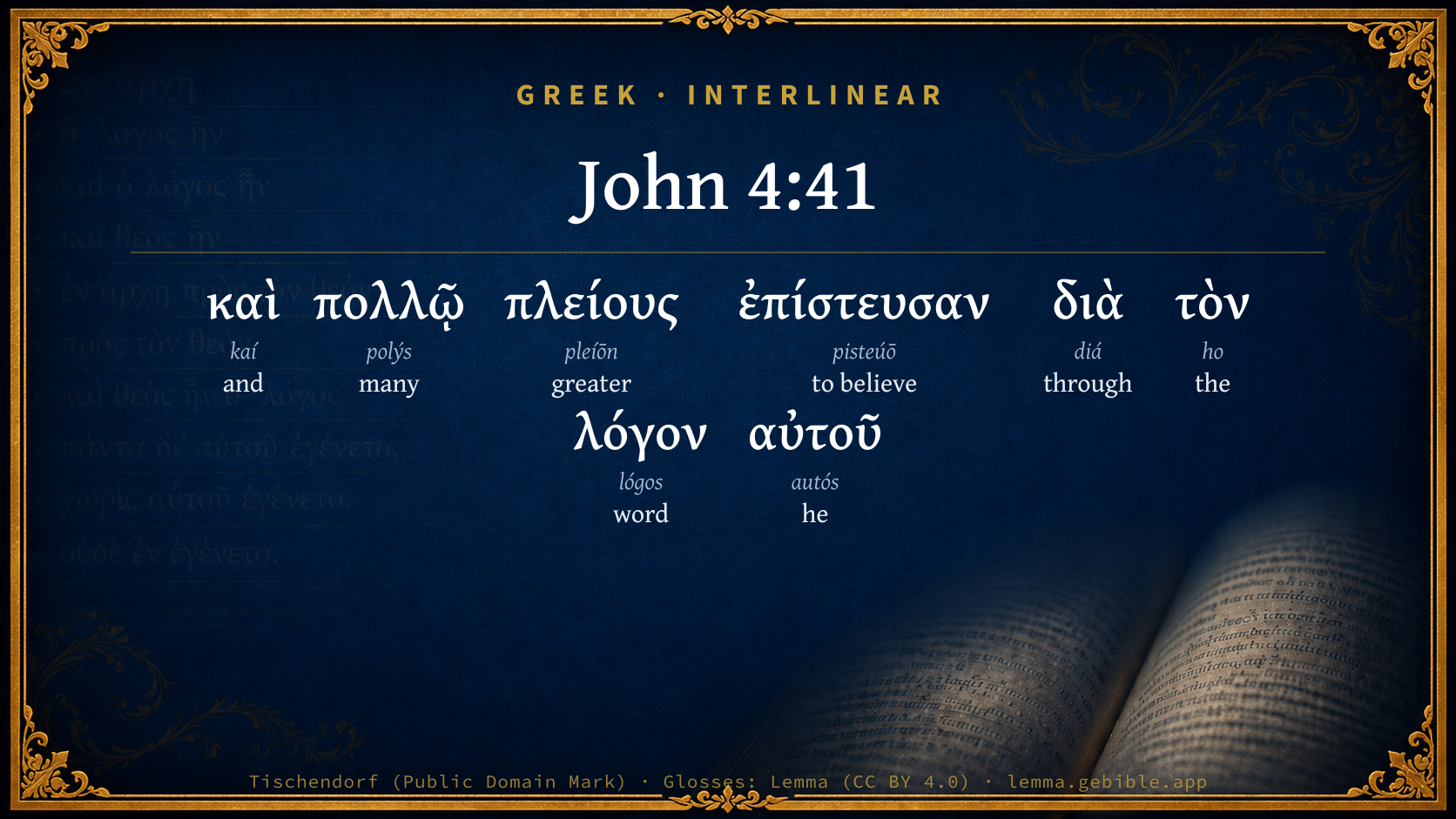
Download image
Cite this verse

John 4:41 (World English Bible). Public Domain. Lemma interlinear Bible study tool, https://lemma.gebible.app/v/john/4/41.

Show BibTeX & RIS
BibTeX
RIS
English Translation
Many more believed because of his word.
World English Bible · Public Domain
Download a study sheet

One document with this verse’s original text, its word-by-word gloss line, the meaning frame, cross-references with their text, attributed commentary, and full source and license credits — printable, and it pastes into notes with its structure intact.

This verse Autodidact and up

Study sheet (.html) Plain text (.txt)

A passage Seminary Student

Up to 50 verses in one chapter. A passage sheet keeps up to 6 commentary sources and 12 cross-references per verse, in the order this page ranks them, and says so on the sheet whenever that leaves anything out. Ask for a single verse and you get the Autodidact verse sheet above.

Everything on this page stays free to read, with no account — the sheet is a download of what is already on screen, not access to it.

Want to remove ads? Support Godless Engineer
Compare translations 3

The same verse in 3 English versions, stacked beneath the original-language interlinear above. Click any original word for its lexicon entry.

Each is an independent rendering of the whole verse — the interlinear is not word-aligned to these translations.

Highlighted words mark where these versions differ — a whole-verse word diff, not a word-by-word alignment.

  • World English Bible Public Domain
    Many more believed because of his word.
  • King James Version Public Domain
    And many more believed because of his own word;
  • unfoldingWord Literal Text CC BY-SA 4.0
    And many more believed because of his word.

unfoldingWord Literal Text — © unfoldingWord, licensed CC BY-SA 4.0. Word-aligned USFM3 via Door43 (git.door43.org/unfoldingWord/en_ult).

Versions to compare (up to 4)

3 of 4 selected

Show all 19 translations

Every available English version of this verse, each an independent rendering of the whole verse.

  • World English Bible Public Domain
    Many more believed because of his word.
  • Berean Standard Bible Public Domain
    And many more believed because of His message.
  • Majority Standard Bible Public Domain
    And many more believed because of His message.
  • King James Version Public Domain
    And many more believed because of his own word;
  • American Standard Version (1901) Public Domain
    And many more believed because of his word;
  • Revised Version (1885) Public Domain
    And many more believed because of his word;
  • Geneva Bible (1599) Public Domain
    And many moe beleeued because of his owne word.
  • Douay-Rheims (1899) Public Domain
    And many more believed in him because of his own word.
  • Young's Literal Translation Public Domain
    and many more did believe because of his word,
  • Literal Standard Version CC BY-SA 4.0
    and many more believed because of His word,
  • Unlocked Literal Bible CC BY-SA 4.0
    Many more believed because of his word.
  • unfoldingWord Literal Text CC BY-SA 4.0
    And many more believed because of his word.
  • Darby Bible Public Domain
    And more a great deal believed on account of his word;
  • World Messianic Bible Public Domain
    Many more believed because of his word.
  • Webster's Bible Public Domain
    And many more believed, because of his own word;
  • Free Bible Version CC BY-SA 4.0
    and because of what he told them many more trusted in him.
  • Bible in Basic English Public Domain
    And a great number more of them came to have faith in him because of what he himself said.
  • Text-Critical English NT CC BY 4.0
    And many more believed because of his word.
  • Tyndale New Testament (1534) Public Domain
    And many moo beleved because of his awne wordes

Literal Standard Version (2020), Covenant Press — licensed CC BY-SA 4.0. Text via the HelloAO Bible API (eBible.org). Unlocked Literal Bible (unfoldingWord) — licensed CC BY-SA 4.0. Text via the HelloAO Bible API (eBible.org). unfoldingWord Literal Text — © unfoldingWord, licensed CC BY-SA 4.0. Word-aligned USFM3 via Door43 (git.door43.org/unfoldingWord/en_ult). Free Bible Version, Dr. Jonathan Gallagher — licensed CC BY-SA 4.0. Text via the HelloAO Bible API (eBible.org).

Word by word

More ways to search: Search by grammar → Find every occurrence → Compare this word →

Practice this passage: Drill this verse → Learn its vocabulary →

About this verse

These counts appear in no published source. They are computed here, from the morphology-tagged text and Lemma’s own curated glosses. What Lemma adds →

8
words
8
distinct lemmas
Gospels
section

Shared distinctive vocabulary

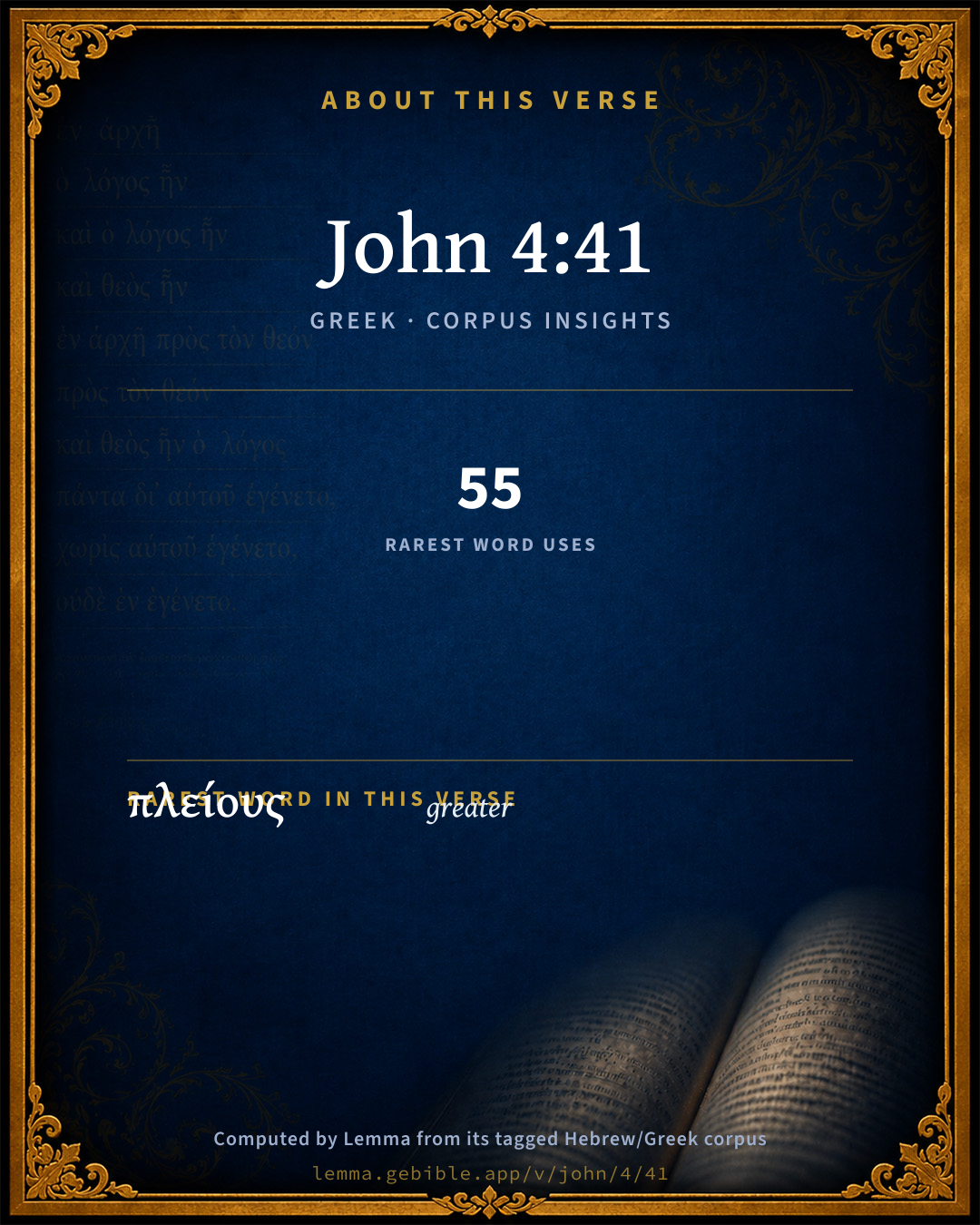
πλείους greater G4119 occurs in 54 verses of the Greek New Testament. Also found in:
Cross-references

11

Topical passages linked to John 4:41 in the Treasury of Scripture Knowledge — connected by theme and wording, ordered by reader-vote popularity; previews shown in the World English Bible.

  • Acts 1:8 But you will receive power when the Holy Spirit has come upon you. You will be witnesses to me in Jerusalem, in all Judea and Samaria, and to the uttermost parts of the earth."
  • 1 Corinthians 2:4–5 My speech and my preaching were not in persuasive words of human wisdom, but in demonstration of the Spirit and of power,
  • Matthew 7:28–29 It happened, when Jesus had finished saying these things, that the multitudes were astonished at his teaching,
  • Acts 8:12 But when they believed Philip preaching good news concerning the Kingdom of God and the name of Jesus Christ, they were baptized, both men and women.
  • Acts 8:25 They therefore, when they had testified and spoken the word of the Lord, returned to Jerusalem, and preached the Gospel to many villages of the Samaritans.
  • John 6:63 It is the spirit who gives life. The flesh profits nothing. The words that I speak to you are spirit, and are life.
  • Genesis 49:10 The scepter will not depart from Judah, Nor the ruler's staff from between his feet, Until he comes to whom it belongs. To him will the obedience of the peoples be.
  • Luke 4:32 and they were astonished at his teaching, for his word was with authority.
  • John 7:46 The officers answered, "No man ever spoke like this man!"
  • Acts 15:3 They, being sent on their way by the assembly, passed through both Phoenicia and Samaria, declaring the conversion of the Gentiles. They caused great joy to all the brothers.
  • Hebrews 4:13 There is no creature that is hidden from his sight, but all things are naked and laid open before the eyes of him with whom we have to do.

Cross-references courtesy of OpenBible.info (CC BY 4.0).

Commentary

Notes on John 4:41 from classic Christian and Jewish commentators (each source and its license shown beneath its notes). The classic Christian expositions comment on the surrounding passage and are grouped to its opening verse, so a note may address several verses; the Jewish commentaries on the Tanakh (Rashi and others) are per-verse, so they appear only where the commentator wrote on this verse.

Lemma curates 59 commentaries, every one of them public domain or Creative Commons licensed, each selected and text-cleaned for this edition rather than reprinted as found. About our sources →

The Biblical Illustrator

Joseph S. Exell

Joh_4:41-42

Many more believed, because of His word, and said … This is indeed the Christ.

Christianity adapted to mans moral constitution

The counterpart of this narrative at a missionary station may easily be imagined. The Missionary says, Come, learn the missionary doctrine which has made me happy. I know it to be Divine. The natives are induced to listen. As they grow familiar with evangelical doctrine it gains their heart. Although they cannot estimate the evidence, they believe because they have tasted and handled of the word of God.

I. UNLESS THE MISSIONARY CAN CONFINE IN THE INHERENT POWER OF THE GOSPEL HE IS HELPLESS.

1. The heathen can neither appreciate your facts, nor understand your mode of reasoning upon them. To the contemplative Brahmin, or cunning Chinese, your inductive reasoning is as unintelligible as is the subtle arguments of the Plantonic philosopher or the medieval schoolman to you.

2. But if you had crossed that chasm and learned to think as they think you would be destitute of the materials of demonstration. Upon the knowledge they possess to establish the authenticity and transmission of your sacred books appears a hopeless task.

3. And even if you had satisfied them of this the appeal must be made to miracles, and it would fail where they are, as the heathen suppose, so common; and the idea of a miracle authenticating a doctrine would be unintelligible to an Hindoo whose presumption is that the splendour of Deity shines more in good doctrine than in wonderful power.

4. Of the roll of prophecy we cannot read a word to a people whose history is confined to their own legendary tales.

5. As to the internal evidence this requires a more careful examination than you can expect, unless you can present an object of surpassing value which shall prepossess the mind in its favour.

6. The only serviceable instrument, therefore, is the Cross in its saving, all-conquering power.

7. We may be reminded of the virtues of Christians, but we cannot, alas! use that when crime has been perpetrated by professing Christians.

II. THE GOSPEL ITSELF IS SO APPROPRIATE TO THE MORAL CONSTITUTION OF MAN--APPEARS SO LIKE TRUTH--AS TO CONCILIATE A FAVOURABLE RECEPTION, AND PRODUCE CONVICTION, WHERE IT DOES NOT OFFER DEMONSTRATION. This is extremely probable on noticing the purpose it is intended to accomplish. It is intended for all men; it is an ample provision of mercy for our fallen world. It is intended only for man; angels are above, demons below its reach. But, leaving presumptive evidence, consider a few of the more important doctrines in their relation to the wants of men.

1. The Gospel is proposed as a revelation from God. Against the notion of a revelation there is no prejudice whatever; it is the favourite doctrine of mankind. Men have never been content with so much knowledge of God as may be derived from His works, but have always yearned for some more direct communication of His will. Hence, astrology, dreams, divination, sacred books. As the voice of God was the first he ever heard (in Eden) man still turns towards it a most attentive and listening ear. Revelation was the language of His infancy, and its tones after the lapse of ages and in the far country still come sweet as music to his heart. The prepos-sessions of these millions, therefore, are in your favour; they are anxiously seeking revelations, but alas! like Saul at Endor. And at Endor will you let them die? Say to these wretched devotees prostrate at the altar of an unknown God.--Him whom ye ignorantly worship, declare we unto you.

2. By the Gospel life and immortality are brought to light. There is no doctrine that the mind of man is so ready to receive. The search after God is a germ of it which only requires to be sanctified in order to its development. Virtue by its hope, and guilt by its terrors, attest it. Love of posthumous fame and the longing for immortality are its harbingers. Preach, then, this favourite doctrine, and as you tell the sinner he is immortal, you may hear a full, quick response from his heart.

3. If the doctrine of immortality flatter the complacency of man, the doctrine of his inherent corruption mortifies his pride, and unless the heart be girt closely round with self-righteousness, this doctrine is yet armed with the mighty power of conviction. Under the ministry of Jesus, publicans and sinners, rather than Pharisees, pressed into the kingdom. So now, the appeal to the moral law will suffice; it requires no demonstration. The inevitable consequence is the conviction of sin. Then, go speak with a friendly voice of sin, and they will understand every word; of pardon, and their voice will brighten at the prospect; as Jesus when He said, Come unto Me all ye that labour, etc.

4. Closely connected with this doctrine is that of the general judgment. It corresponds with many presentiments of the sinners heart. Unless the religious feeling be extirpated, in every mans bosom is a tribunal before which his thoughts and actions are arranged, and acquitted or condemned. What is this but a premonition of the final assize! These presentiments may not induce the sinner to accept the Christian doctrine, but they will ensure attention, prepare the mind, and the probability, or possibility of judgment may be quite as effective as the certainty.

5. We must now pass on to the doctrine of salvation by Christ. Man is disturbed and perplexed by sin and is afraid to approach a Holy God. Hence, in order to avert His displeasure, man has indulged in sacrifice. The stern maxim is deeply inscribed in the heart of man as expounded by his history, without the shedding of blood, etc. To such your missionaries preach Christ crucified. They address hearers prepossessed in favour of the doctrine of propitiation. To the guilty conscience there is in Behold the Lamb of God something more cheering and consolating than all the sanguinary rites of heathenism. Mans own religion makes exorbitant demands; yours offers an abundant supply; his god demands a sacrifice; yours presents one. Conclusion: Such, then, is Christianity; it rises in solitary grandeur above all the religions of the earth. It has no affinity with any local association or national peculiarity, but is equally adapted to man, civilized or savage, in the pole or the tropics. It speaks a language which all can understand, in tones which all must feel.

1. Confide in its powers. It cannot fail. It carries with it the Spirit of the living God.

2. Argue from its past achievement its future and final triumphs. (R. Halley, D. D.)

Three more saved

A few days after the wreck of the ill-fated steamer. Central America, which sent hundreds to a watery grave, and plunged the American nation in grief, a pilot-boat was seen, on a fair breezy morning, standing up the bay of New York. The very appearance of the vessel gave token that she was freighted with tidings of no common interest. With every sail set, and streamers flying, she leaped along the waters as if buoyant with some great joy, while the glad winds that swelled her canvas, and the sparkling waves that kissed her sides and urged her on her way, seemed to laugh with conscious delight As she drew nearer, an unusual excitement was visible on her deck, and her captain, running out to the extreme point of the bowsprit, and swing: ing his cap, appeared to be shouting something with intense earnestness and animation. At first the distance prevented his being distinctly understood. But soon, as the vessel came farther into the harbour, the words, Three more saved! Three more saved! reached the nearest listeners. They were caught up by the clews of the multitudinous ships that lay anchored around, and sailors sprang wildly into the rigging and shouted, Three more saved! They were heard on the wharfs, and the porter threw down his load, and the drayman stopped his noisy cart, and shouted, Three more saved! The tidings ran along the streets, and the news-boys left off crying the latest intelligence, and shouted, Three more saved! Busy salesmen dropped their goods, bookkeepers their pens, bankers their discounts, tellers their gold, and merchants, hurrying on the stroke of the last hour of grace to pay their notes, paused in their headlong haste, and shouted, Three more saved! (New Cyclopedia of Illustrated Anecdotes.)

The Biblical Illustrator, edited by Joseph S. Exell (c. 1880s–1900s) — public domain. Text from a community e-Sword module.

Joseph Benson's Commentary

Joh 4:41-42. And many more believed — “This was the more extraordinary, as they not only had a national prejudice against him as a Jew, but, living near mount Gerizim, had a particular interest in maintaining the usual worship there; which must have been very advantageous to the neighbourhood. Perhaps on this they would no longer worship there, which might irritate the rest of the Samaritans, and in part provoke the ill usage that Christ afterward met with in this country. Luk 9:52.” — Doddridge. Because of his own word — Which commended itself to their reason and consciences, as certainly true, and infinitely important. And said unto the woman, Now we believe, not because of thy saying — Not chiefly on account of it; for we have heard him ourselves — Have heard such excellent and divine truths from him, accompanied with such commanding power and evidence, that we are abundantly satisfied, that this is indeed the Christ, the expected Messiah; the Saviour of the world — And not of the Jewish nation only. The Samaritans might probably collect, from what was prophesied by Jacob of the Messiah, Gen 49:10, to him shall the gathering of the people be, that the Gentile nations were to receive some benefit by his coming, and one way or another to be subjected to him; and Christ’s discourse might confirm that apprehension. But there is no reason at all to believe they perfectly understood the doctrine of the calling of the idolatrous Gentiles, which was so long a mystery even to the apostles themselves. Thus was the seed of the gospel sown in Samaria. What effect there was of this afterward doth not appear; but we find that four or five years after, when Philip preached the gospel in Samaria, he found so much blessed remains of this good work now wrought, that the people, with one accord, gave heed to those things which Philip spoke, Act 8:5-8; but as some were easily influenced to good now, so were others to evil afterward, when Simon Magus bewitched many with his sorceries, Joh 4:9-10.

Joseph Benson's Commentary on the Old and New Testaments (1811–1818) — public domain. Text from a community e-Sword module.

Bengel's Gnomon

Johann Albrecht Bengel

Joh 4:41. Αὐτοῦ) Of Himself.

Bengel's Gnomon of the New Testament — English translation (T&T Clark, Edinburgh, 1860) — public domain. Text from a community e-Sword module.

Expositor's Greek Testament

ed. W. Robertson Nicoll

Joh 4:41 . The result was that πολλῷ πλείους , a far larger number than had believed owing to the woman’s report now believed διὰ τὸν λόγον αὐτοῦ , on account of what they heard from Jesus Himself. This is a faith approved by John, because based not on miracles but on the word of Christ. οὐκέτι … καὶ οἴδαμεν . No longer do we believe on account of your talk [ λαλιάν , not λόγον ], for we ourselves have heard and know. This could only be said by those who went out first from the city, not by those many more who afterwards believed. They felt that their faith was now firmer and stronger, more worthy to be called faith. This mature belief expressed itself in the confession οὗτός ἐστιν ἀληθῶς ὁ σωτὴρ τοῦ κόσμου ὁ Χριστός . The title “Saviour of the World” was of course prompted by the teaching of Jesus Himself during His two days’ residence. To suppose, with several interpreters, that it is put into the mouth of the Samaritans by the evangelist is to suppose that during these two days Jesus did not disclose to them that He was the Saviour of the World. [“It probably belongs not to the Samaritans but to the evangelist. At the same time it is possible that such an epithet might be employed by them merely as synonymous with ‘Messiah’ ” Sanday.]

Doubt has been cast on the historicity of this narrative by Baur, who thinks the woman is a type of susceptible heathendom; and by Strauss, who thinks it was invented for the purpose of showing that Jesus personally taught not only in Galilee, Judaea, and Perea, but also in Samaria. “How natural the tendency to perfect the agency of Jesus, by representing Him to have sown the heavenly seed in Samaria, thus extending His Ministry through all parts of Palestine; to limit the glory of the apostles and other teachers to that of being the mere reapers of the harvest in Samaria; and to put this distinction, on a suitable occasion, into the mouth of Jesus!” Holtzmann’s idea of this section of the Gospel is similar. The fictitious character of the narrative seems to be mainly based on its great significance for the life of Christ. As if the actual events of His life were not significant. Stress too is laid on the circumstance that among simple peoples all striking incidents, conversations, recognitions, take place at wells. In other words, wells are common meeting-places, therefore this meeting at a well cannot have taken place.

The Expositor's Greek Testament, edited by W. Robertson Nicoll (1897–1910) — public domain. Text from a community e-Sword module.

John Calvin's Commentaries

41. And many more believed. From what followed it is evident that Christ’s compliance with their wish was highly proper; for we see how much fruit was reaped from the two days which he granted to their request. By this example we are taught that we ought never to refrain from working, when we have it in our power to advance the kingdom of God; and if we are afraid that our readiness in complying may be liable to unfavorable reports, or may often prove to be useless, let us ask from Christ the Spirit of counsel to direct us. The word believe is now used in a different sense; for it means not only that they were prepared for faith, but that they actually had a proper faith

John Calvin's Commentaries (1540-1563) — public domain. Text from the Calvin Translation Society English edition (1840s-50s) via the Christian Classics Ethereal Library (ccel.org). Calvin's coverage is partial (roughly two-thirds of the Bible); uncommented books and verses are honest gaps, never fabricated. The 19th-century editor's footnotes and remarks are omitted so the notes are faithfully Calvin's own voice.

Ellicott's Commentary for English Readers

(41) And many more believed.—The veil is left upon those two days, as upon so many days in the life of Christ. We know how much was said at the well in a few minutes, and that many believed on Him in a few hours. What questions they must have asked! What truths He must have taught during this sojourn! How that central truth of the Fatherhood of God and the brotherhood of man must have burned in the hearts of this mixed and despised people! Salvation was of the Jews, and they were from Babylon, and from Cuthah, and from Ava, and from Hamath, and from Sepharvaim. But Fatherhood is a truth for every heart of man, and He who thus linked heaven and earth was the Saviour of the world. We know not what words passed from them to Him, from Him to them; but we know that the result was that many more believed, and that those who before believed on testimony passed to the higher faith of personal conviction.

A Bible Commentary for English Readers, edited by Charles John Ellicott (1878–1897) — public domain. Text from a community e-Sword module.

John Gill's Exposition

And many more believed,.... The Vulgate Latin, and all the Oriental versions add, "on him": when he was come into the city, and had preached to the inhabitants in general, a larger multitude than before believed in him as the Messiah, and professed him, and became followers of him.

Because of his own word; which came to them, not in word only, but in power, and was the power of God unto salvation to them; and was received by them, not as the word of man, but as the word of God; and it wrought effectually in them, and was an hammer to break their rocky hearts in pieces, and to bring them into subjection to himself, his Gospel and ordinances: whether his word or doctrine was accompanied with miracles is not certain; this shows, that their faith in him was founded on his own word, which fell with great weight upon them. It seems to have an emphasis laid upon it, his own word, in distinction from the woman's saying.

John Gill's Exposition of the Whole Bible (1746–1763) — public domain (CC PDM 1.0). Text via the HelloAO Bible API.

Trapp's Complete Commentary

John Trapp

41 And many more believed because of his own word;

Ver. 41. Because of his own word] This is it alone that is the foundation of faith, and converts the soul, Psa 19:7. That of good wives winning their husbands, 1Pe 3:1, is meant by way of preparation only in general. And that of winning a soul by private admonition, Jas 5:20, is meant of persuading them to some good duty, or to receive some truth, or to forsake some one evil or error.

John Trapp, A Commentary or Exposition upon All the Books of the Old and New Testament (1647–1656) — public domain. Text from a community e-Sword module.

Matthew Poole's English Annotations

Believing seemeth here to be taken in a different sense from what it was taken in Joh 4:39, from what followeth, Joh 4:42. There it seemeth only to signify a lower degree of assent, that he was a prophet, upon the woman’s saying that he had told her all she had done; here it signifieth a giving credit to him as the Christ, the Saviour of the world, of which they were convinced by what they heard from himself. Thus that of the apostle, Rom 10:17, is justified, that faith cometh by hearing; and the influence of Christ upon the souls of believers is also justified. We read of no miracles our Saviour wrought here; they believed not because of any signs they saw, but because of his word; wherein also they further showed themselves the first fruit of the Gentiles, the generality of which were afterward converted to the faith of the gospel, after that miracles were ceased, by hearing the gospel preached.

Matthew Poole's English Annotations on the Holy Bible (1683–1685) — public domain. Text from a community e-Sword/MySword module.

The Pulpit Commentary

Vers. 41, 42. And very many more believed, during that visit, by reason of his word Christ"s own word. We know not what the word was, but the specimens which John has recorded make us certain that torrents of living water flowed from his lips. He was moving in the full power of the Spirit. He was unveiling the nature of that "salvation" which was, as he said, "from the Jews;" but a salvation which affected and was adapted to the whole world. And they (repeatedly) said to the woman (the play of aorist and imperfect tenses throughout this passage is very noteworthy), No longer do we believe by reason of thy speaking. The word lalia does not generally connote so serious a meaning as logov . The first word is used for "utterance" pure and simple, (Mat_26:73) and for the inarticulate voices of lower creatures as well, while logov and legein never have the latter meaning; but still lalia is used in classical Greek for "discourse," and in Joh_8:43 is used by Christ of his own "utterance." Meyer says the term is purposely chosen from the standpoint of the speaker, while in ver. 39 logov is used of the same lalia by St. John as narrator. The above are the only times the term is found in the New Testament. For we have ourselves heard, and we know fully, by personal intuition (we might have expected egnwmen here)that this is indeed the Saviour of the world. This sublime description only occurs in one other place in the New Testament, (viz. 1Jn_4:14) and here it falls from the lips of a Samaritan. There is no improbability that it should have expressed the thought of Samaritans, for they entertained wider and less nationalized views than did the Jews. Baur"s notion, that the author wished to contrast heathen or Gentile susceptibility with Jewish narrowness and reserve, is out of keeping with the facts. A genuine heathen would have been as easy to invent as a susceptible Samaritan. "The Saviour of the world" is one of the noblest and most accurate terms in all the Bible to denote the work of Christ. It is the outcome of a discourse and of teaching which led men to the idea of spiritual and sincere worship of the Father, which searched for moral conditions rather than orthodox ritual, which demanded purity of life more than outward observance, and treated doing the will and work of the Father as more indispensable than necessary food. We need not be surprised (Ac 8) to find the outcome of this sojourn of the Divine Lord among the misunderstood and hated Samaritans. The effort of the Tubingen school to find in this narrative an idealization of the synoptic tradition of Christ"s special beneficence towards the Samaritans is very unfortunate, because, in Mat_10:5, the "twelve" were forbidden to enter into cities of the Samaritans, and advised to occupy all their energies in evangelizing the cities of Israel. The record of Acts 8. affords very slender basis for a corresponding enlargement. The narrative before us shows that, in answer to the receptivity of the Samaritans, the Lord made the richest and fullest and most explicit and immediate revelation of himself. The extension of the kingdom of grace to Samaritans, and their incorporation into the body of Christ, was arrested by the need of the visit of the apostles, by the magic and hypocrisy of Simon; of which there is not here the slightest trace.

The Pulpit Commentary (1880–1919), ed. H.D.M. Spence-Jones & Joseph S. Exell — public domain. Text from a community e-Sword module.

The People's New Testament

B. W. Johnson

41. Many more believed because of his own word. They saw and heard for themselves.

B. W. Johnson's The People's New Testament with Notes (1889–1891) — public domain. Electronic text from the Christian Classics Ethereal Library (CCEL) ThML edition.

unfoldingWord translationNotes

Door43 World Missions Community

his word

Here "word" is a metonym that stands for the message that Jesus proclaimed. AT: "his message" (See: Metonymy)

world

The "world" is a metonym for all the believers throughout the world. AT: "all the believers in the world" (See: Metonymy)

translationWords

believe

Savior

world

unfoldingWord translationNotes — © Distant Shores Media and the Door43 World Missions Community, licensed CC BY-SA 4.0. Source: git.door43.org/Door43/en_tn.

International Critical Commentary

41. πολλῷ πλείους ἐπίστευσαν …, “many more believed because of His word.” Cf. ταῦτα αὐτοῦ λαλοῦντος πολλοί ἐπίστευσαν εἰς αὐτόν (8:30).

NΘ fam. 13 add εἰς αὐτόν after ἐπίστευσαν (as at 8:30), but om. the greater uncials. πιστεύειν is here used in an absolute sense, “to believe,” as often in Jn. See on 1:7.

International Critical Commentary — older volumes (1896–1929), various authors — public domain. Text from a community e-Sword module.

Vincent's Word Studies in the New Testament

Marvin R. Vincent

Many more [πολλω πλει] . Literally, more by much; i e., far more, with reference to the simple polloi, many, in ver. 39.

Marvin R. Vincent, Word Studies in the New Testament (1887–1900) — public domain. Text from a community e-Sword/MySword module.

Godet's Commentaries

Frédéric Louis Godet

Vv. 41 marks a two-fold advance, one in the number of believers, the other in the nature of their faith. This latter advance is expressed in the words: Because of His word, contrasted with the words: Because of the woman’s story (Joh 4:39); it is reflectively formulated in the declaration of Joh 4:42. The Samaritans reserve the more grave term λόγος for the word of Jesus; they apply to the talk of the woman the term λαλία, which has in it, undoubtedly, nothing contemptuous (Joh 8:43, where Jesus applies it to His own discourses), but which denotes something more outward, a mere report, a piece of news. The verb ἀκηκόαμεν, we have heard, has in the Greek no object; the idea is concentrated in the subject αὐτοί : “We have ourselves become hearers;” whence follows: “And as such we know.” The reading of the Sinaitic MS.: “We have heard from him (from his mouth) and we know that...,” would give to the following profession the character of an external and slavish repetition, opposed to the spirit of the narrative. The expression: The Saviour of the world seems to indicate an advance in the notion of the Messiah in these Samaritans. The question is of salvation, and no longer merely of teaching as in Joh 4:25. This expression is, perhaps, connected with the word of Jesus to the woman (Joh 4:22), which Jesus must have developed to them: “Salvation is from the Jews.”

Tholuck and Lucke suspect the historical truth of this term Saviour of the world, as too universalistic in the mouth of these Samaritans. By what right? Did not these people possess in their Pentateuch the promise of God to Abraham: “All the families of the earth shall be blessed in thy seed,” to which Jesus might have called their attention? And had they not just been, during those two days, in direct contact with the love of the true Christ, so opposite to the particularistic arrogance of Jewish Pharisaism? The Alexandrian authorities reject the words ὁ χριστός, the Christ. Undoubtedly there might be seen in them the seal of the union announced by Jesus (Joh 4:23-24) between the Samaritans (the Saviour of the world) and the Jews (the Christ). But it is easier to understand how this term may have been added, than how it could have been rejected.

The eager welcome which Jesus found among the Samaritans is an example of the effect which the coming of Christ should have produced among His own. The faith of these strangers was the condemnation of Israel’s unbelief. It was, undoubtedly, under this impression that Jesus, after those two exceptional days in His earthly existence, resumed His journey to Galilee.

Frédéric Louis Godet — Commentaries on Luke, John, Romans, and 1 Corinthians — English translation (T&T Clark, Edinburgh, 1870s–1890s) — public domain. Text from a community e-Sword module.

Lesson kit

Teaching starters — assembled from the data on this page, not authored interpretation. Every prompt links to the verse data it draws on. Edit before teaching.

John, in the Gospels, opens this verse with 8 words (8 distinct Greek lemmas). Its most distinctive word is pleíōn (“greater”). A historical commentator’s framing appears above. Read the whole chapter for the surrounding context.

Discussion questions

  1. How does “greater” (pleíōn) shape what this verse is saying?
  2. Matthew 5:20 shares the word «greater» with this verse. How do the two illuminate each other?
  3. The translations on this page render this verse differently — a whole-verse word diff, not a word-by-word alignment. What might account for the different wordings?
  4. Reading how The Biblical Illustrator and Joseph Benson's Commentary read this verse, where do the two commentators agree and where do they part?

Things to notice

Reading settings

Reading text

Shown beneath each verse's original-language words.

Old Testament
Old Testament edition

Read the OT as the Masoretic Hebrew (MT) or the Greek Septuagint (LXX).

English shown for the Greek Septuagint (in the Hebrew ↔ Greek comparison).

Comparing translations? Open the Compare panel on any verse page to stack up to four side by side.