
John 7:31

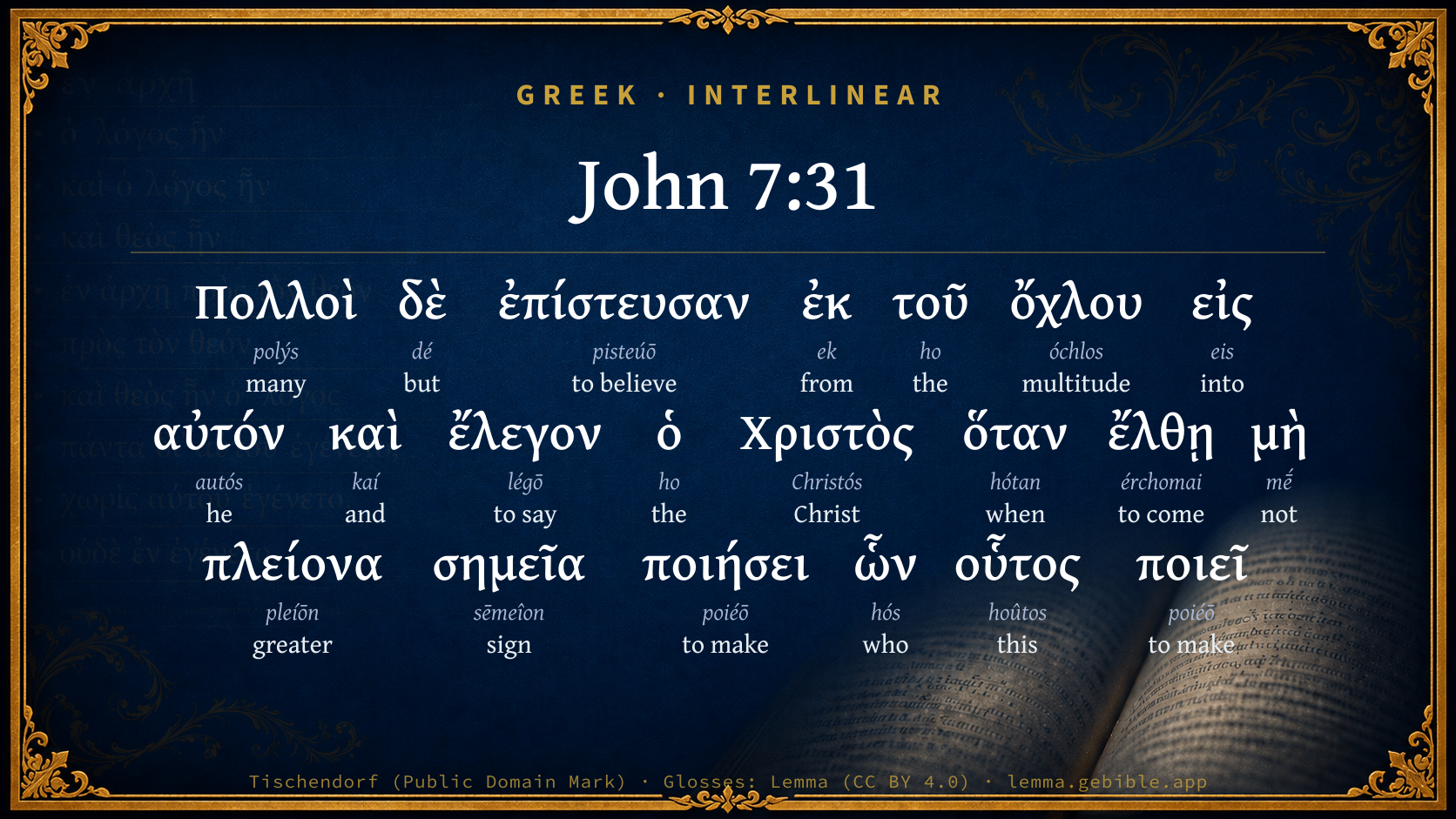
Greek (Tischendorf 8th ed.) John 7:31 appears in the Greek New Testament. The text above is from the Tischendorf 8th edition. Each word links to its Strong’s number and a concise gloss. Click any word for its full Thayer’s Greek Lexicon entry.
Download image
Cite this verse

John 7:31 (World English Bible). Public Domain. Lemma interlinear Bible study tool, https://lemma.gebible.app/v/john/7/31.

Show BibTeX & RIS
BibTeX
RIS
English Translation
But of the multitude, many believed in him. They said, "When the Christ comes, he won't do more signs than those which this man has done, will he?"
World English Bible · Public Domain
Download a study sheet

One document with this verse’s original text, its word-by-word gloss line, the meaning frame, cross-references with their text, attributed commentary, and full source and license credits — printable, and it pastes into notes with its structure intact.

This verse Autodidact and up

Study sheet (.html) Plain text (.txt)

A passage Seminary Student

Up to 50 verses in one chapter. A passage sheet keeps up to 6 commentary sources and 12 cross-references per verse, in the order this page ranks them, and says so on the sheet whenever that leaves anything out. Ask for a single verse and you get the Autodidact verse sheet above.

Everything on this page stays free to read, with no account — the sheet is a download of what is already on screen, not access to it.

Want to remove ads? Support Godless Engineer
Compare translations 3

The same verse in 3 English versions, stacked beneath the original-language interlinear above. Click any original word for its lexicon entry.

Each is an independent rendering of the whole verse — the interlinear is not word-aligned to these translations.

Highlighted words mark where these versions differ — a whole-verse word diff, not a word-by-word alignment.

  • World English Bible Public Domain
    But of the multitude, many believed in him. They said, "When the Christ comes, he won't do more signs than those which this man has done, will he?"
  • King James Version Public Domain
    And many of the people believed on him, and said, When Christ cometh, will he do more miracles than these which this man hath done?
  • unfoldingWord Literal Text CC BY-SA 4.0
    But many from among the crowd believed in him, and they were saying, “When the Christ may come, he will not do more signs than what this one has done, will he?”

unfoldingWord Literal Text — © unfoldingWord, licensed CC BY-SA 4.0. Word-aligned USFM3 via Door43 (git.door43.org/unfoldingWord/en_ult).

Versions to compare (up to 4)

3 of 4 selected

Show all 19 translations

Every available English version of this verse, each an independent rendering of the whole verse.

  • World English Bible Public Domain
    But of the multitude, many believed in him. They said, "When the Christ comes, he won't do more signs than those which this man has done, will he?"
  • Berean Standard Bible Public Domain
    Many in the crowd, however, believed in Him and said, “When the Christ comes, will He perform more signs than this man?”
  • Majority Standard Bible Public Domain
    Many in the crowd, however, believed in Him and said, “When the Christ comes, will He perform more signs than this man?”
  • King James Version Public Domain
    And many of the people believed on him, and said, When Christ cometh, will he do more miracles than these which this man hath done?
  • American Standard Version (1901) Public Domain
    But of the multitude many believed on him; and they said, When the Christ shall come, will he do more signs than those which this man hath done?
  • Revised Version (1885) Public Domain
    But of the multitude many believed on him; and they said, When the Christ shall come, will he do more signs than those which this man hath done?
  • Geneva Bible (1599) Public Domain
    Now many of the people beleeued in him, and said, When that Christ commeth, will he doe moe miracles then this man hath done?
  • Douay-Rheims (1899) Public Domain
    But of the people many believed in him, and said: When the Christ cometh, shall he do more miracles, than these which this man doth?
  • Young's Literal Translation Public Domain
    and many out of the multitude did believe in him, and said -- `The Christ -- when he may come -- will he do more signs than these that this one did?'
  • Literal Standard Version CC BY-SA 4.0
    and many out of the multitude believed in Him and said, “The Christ—when He may come—will He do more signs than these that this One did?”
  • Unlocked Literal Bible CC BY-SA 4.0
    But many in the crowd believed in him, and they said, “When the Christ comes, will he do more signs than what this one has done?”
  • unfoldingWord Literal Text CC BY-SA 4.0
    But many from among the crowd believed in him, and they were saying, “When the Christ may come, he will not do more signs than what this one has done, will he?”
  • Darby Bible Public Domain
    But many of the crowd believed on him, and said, Will the Christ, when he comes, do more signs than those which this [man] has done?
  • World Messianic Bible Public Domain
    But of the multitude, many believed in him. They said, “When the Messiah comes, he won’t do more signs than those which this man has done, will he?”
  • Webster's Bible Public Domain
    And many of the people believed on him, and said, When Christ cometh, will he do more miracles than these which this man hath done?
  • Free Bible Version CC BY-SA 4.0
    However, many of the crowd did put their trust in him. “When the Messiah appears, will he do more miraculous signs than this man has done?” they said.
  • Bible in Basic English Public Domain
    And numbers of the people had belief in him, and they said, When the Christ comes will he do more signs than this man has done?
  • Text-Critical English NT CC BY 4.0
    Still, many from among the crowd believed in him and said, “When the Christ comes, will he do more signs than this man has done?”
  • Tyndale New Testament (1534) Public Domain
    Many of the people beleved on him and sayde: when Christ cometh will he do moo miracles then this man hath done?

Literal Standard Version (2020), Covenant Press — licensed CC BY-SA 4.0. Text via the HelloAO Bible API (eBible.org). Unlocked Literal Bible (unfoldingWord) — licensed CC BY-SA 4.0. Text via the HelloAO Bible API (eBible.org). unfoldingWord Literal Text — © unfoldingWord, licensed CC BY-SA 4.0. Word-aligned USFM3 via Door43 (git.door43.org/unfoldingWord/en_ult). Free Bible Version, Dr. Jonathan Gallagher — licensed CC BY-SA 4.0. Text via the HelloAO Bible API (eBible.org).

Word by word

More ways to search: Search by grammar → Find every occurrence → Compare this word →

Practice this passage: Drill this verse → Learn its vocabulary →

πλείονα
pleíōn
G4119
“greater”
Adjective, Accusative, Plural, Neuter, Comparative
Part of Speech
Adjective
Case
Accusative
Number
Plural
Gender
Neuter
Degree
Comparative
Full Thayer's Definition

Origin: comparative of G4183

TDNT: None

1. greater in quantity a. the more part, very many 2. greater in quality, superior, more excellent
  1. Πολλοὶ polýs G4183 “many” Adjective, Nominative, Plural, Masculine
  2. δὲ dé G1161 “but” Conjunction
  3. ἐπίστευσαν pisteúō G4100 “to believe” Verb, Aorist, Active, Indicative, 3rd person, Plural
  4. ἐκ ek G1537 “from” Preposition
  5. τοῦ ho G3588 “the” Article, Genitive, Singular, Masculine
  6. ὄχλου óchlos G3793 “multitude” Noun, Genitive, Singular, Masculine
  7. εἰς eis G1519 “into” Preposition
  8. αὐτόν autós G846 “he” Personal pronoun, Accusative, Singular, Masculine
  9. καὶ kaí G2532 “and” Conjunction
  10. ἔλεγον légō G3004 “to say” Verb, Imperfect, Active, Indicative, 3rd person, Plural
  11. ὁ ho G3588 “the” Article, Nominative, Singular, Masculine
  12. Χριστὸς Christós G5547 “Christ” Noun, Nominative, Singular, Masculine
  13. ὅταν hótan G3752 “when” Conjunction
  14. ἔλθῃ érchomai G2064 “to come” Verb, Aorist, Active, Subjunctive, 3rd person, Singular
  15. μὴ mḗ G3361 “not” Particle, Negative
  16. σημεῖα sēmeîon G4592 “sign” Noun, Accusative, Plural, Neuter
  17. ποιήσει poiéō G4160 “to make” Verb, Future, Active, Indicative, 3rd person, Singular
  18. ὧν hós G3739 “who” Relative pronoun, Genitive, Plural, Neuter
  19. οὗτος hoûtos G3778 “this” Demonstrative pronoun, Nominative, Singular, Masculine
  20. ποιεῖ poiéō G4160 “to make” Verb, Present, Active, Indicative, 3rd person, Singular

About this verse

These counts appear in no published source. They are computed here, from the morphology-tagged text and Lemma’s own curated glosses. What Lemma adds →

21
words
19
distinct lemmas
Gospels
section

Shared distinctive vocabulary

πλείονα greater G4119 occurs in 54 verses of the Greek New Testament. Also found in:
Repetition

Words recur within this verse:

  • ποιήσει to make G4160 ×2
  • τοῦ the G3588 ×2

Cross-references

17

Topical passages linked to John 7:31 in the Treasury of Scripture Knowledge — connected by theme and wording, ordered by reader-vote popularity; previews shown in the World English Bible.

  • Matthew 12:23 All the multitudes were amazed, and said, "Can this be the son of David?"
  • John 12:42 Nevertheless even of the rulers many believed in him, but because of the Pharisees they didn't confess it, so that they wouldn't be put out of the synagogue,
  • John 8:30–32 As he spoke these things, many believed in him.
  • John 9:16 Some therefore of the Pharisees said, "This man is not from God, because he doesn't keep the Sabbath." Others said, "How can a man who is a sinner do such signs?" There was division among them.
  • John 10:41–42 Many came to him. They said, "John indeed did no sign, but everything that John said about this man is true."
  • John 11:45 Therefore many of the Jews, who came to Mary and saw what Jesus did, believed in him.
  • Acts 8:13 Simon himself also believed. Being baptized, he continued with Philip. Seeing signs and great miracles occuring, he was amazed.
  • James 2:26 For as the body apart from the spirit is dead, even so faith apart from works is dead.
  • Matthew 11:3–6 and said to him, "Are you he who comes, or should we look for another?"
  • Luke 8:13 Those on the rock are they who, when they hear, receive the word with joy; but these have no root, who believe for a while, then fall away in time of temptation.
  • John 2:11 This beginning of his signs Jesus did in Cana of Galilee, and revealed his glory; and his disciples believed in him.
  • John 2:23–24 Now when he was in Jerusalem at the Passover, during the feast, many believed in his name, observing his signs which he did.
  • John 3:2 The same came to him by night, and said to him, "Rabbi, we know that you are a teacher come from God, for no one can do these signs that you do, unless God is with him."
  • John 4:39 From that city many of the Samaritans believed in him because of the word of the woman, who testified, "He told me everything that I did."
  • John 6:2 A great multitude followed him, because they saw his signs which he did on those who were sick.
  • John 6:14–15 When therefore the people saw the sign which Jesus did, they said, "This is truly the prophet who comes into the world."
  • John 12:11 because on account of him many of the Jews went away and believed in Jesus.

Cross-references courtesy of OpenBible.info (CC BY 4.0).

Commentary

Notes on John 7:31 from classic Christian and Jewish commentators (each source and its license shown beneath its notes). The classic Christian expositions comment on the surrounding passage and are grouped to its opening verse, so a note may address several verses; the Jewish commentaries on the Tanakh (Rashi and others) are per-verse, so they appear only where the commentator wrote on this verse.

Lemma curates 59 commentaries, every one of them public domain or Creative Commons licensed, each selected and text-cleaned for this edition rather than reprinted as found. About our sources →

The Biblical Illustrator

Joseph S. Exell

Joh_7:31-36

And many of the people believed on Him.

The favourably disposed, and the malignantly opposed to Christ

I. THOSE WHO WERE FAVOURABLY DISPOSED (Joh_7:31). The commonalty, who were more or less unsophisticated and free from religious prejudices. These heard Christ gladly. This favourable disposition

1. Was founded on facts. There does not seem to be any question, even among His opponents, as to the reality of His miracles.

2. Intensified the opposition of His enemies (Joh_7:32). They felt that if the people believed in Him their influence, honour, etc., would vanish; and so they were inflamed. Through all Christendom there has always been a large class favourably disposed towards Christ; and this upon a basis of facts. This class still intensifies the opposition of enemies when the atheist, the worldling, etc., mark this disposition they, too, become the more anxious to banish Him from the world. But popular sentiment is our bulwark against infidelity.

II. THOSE WHO WERE MALIGNANTLY OPPOSED. Pharisees and chief priests.

1. They were to be deprived of the fellowship of Christ (verse 83). But six months after this Christ returned to the bosom of the Father. It was only a little while He was in their midst, it would have been well had they availed themselves of it. The period of redemptive mercy with all men is but a little while.

2. They would vainly seek the help of Christ (Joh_7:34). The hour was approaching for the fall of Jerusalem, and when the Romans were at the gates they would look for deliverance and not find it. There is a time to seek the Lord, while He may be found; and there is a time when He will be sought and not found. Many shall say to Me in that day, Lord, Lord! etc.

3. They misunderstood the meaning of Christ (verses 35-36).

(1) They started from His words an ungenerous conjecture, Will He go etc., i.e., amongst the Jews scattered among the Gentiles, or to the Gentiles. In either case He will go to a contemptible class, and leave our glorious country.

(2) They failed to attach to His words the true idea, What manner of saying is this. They were carnal and judged after the flesh. Thus is it ever with this class. They are deprived of His fellowship. By their corrupt natures they are excluded from the sublime region of purity and benevolence in which He lives. They must all seek His help when too late. They all misunderstand Him. They have ears but hear not.

Conclusion: To which class do you belong?

1. Probably to the former. But to be favourably disposed is not enough; there must be decision, consecration, vital affinity.

2. If to the latter, ponder your condition ere it be too late. (D. Thomas, D. D.)

The coming of the bailiffs

I. A HOSTILE EMBASSY.

1. Its occasion--the favourable impression made on the multitude.

2. Its promoters. The chief priests and the Pharisees, who resolved to take a forward step by dispatching their constables to the Temple (verse 82).

3. Its object. To mingle with the crowd, show as much favour as possible, so as to throw them and Christ off their guard, and then embrace the first opportunity of detaching them from Him, or Him from them, and took Him prisoner to the council chamber.

II. AN UNEXPECTED GREETING. Having observed the officers and their intention, our Lord replied to this forward movement by announcing His departure.

1. It,would be soon, a little while. The increasing hostility of the rulers, and the fickle character of the populace, made it apparent that tile final collision could not be long delayed.

2. It would be voluntary. The designs of the rulers would in the providence of God lead to His departure but would not be its cause (Joh_10:18). I go.

3. It would be a homegoing (Joh_7:33; Joh_6:62), like an ambassador to report about His mission, or like a Son to the presence of His Father Joh_14:2).

4. It would terminate their day of grace. His appearance had been a day of salvation (Luk_19:42), which at His departure would be over (verse 34; Luk_17:22).

5. It would place an impassable gulf between Him and them (verse 34). Without foreclosing heavens gate upon the crowd, many of whom were probably afterwards converted (Act_2:41), or upon individual members of the Sanhedrim (Joh_19:38-39; Act_6:7), the words announced that when Christ departed their day of grace as a nation would be over for impenitent individuals.

III. A MELANCHOLY RESULT.

1. Perplexity. They failed to understand the Saviours meaning, or pretended to do so (verse 36); as the apostles did an analogous expression Joh_16:17). Yet Christs language was plain. But they did not wish Christs words to have the sense they conveyed, and so pronounced them nonsensical.

2. Ridicule. They endeavoured to sport with Him and His words. Tomorrow they will ask Him if He purposes to commit suicide (chap. 8:12), to-day they inquire if He contemplates playing at Messiah among the Greeks (verse 35).

3. Rejection. The true reason why they could not understand Him was, that already in their hearts they had rejected Him and them.

Lessons:

1. The day of grace to all is of limited duration.

2. Those who improve that day so as to find Christ will ultimately be with Him.

3. To such as find Christ, death will be going home.

4. Those who reject Christ here will not be able to accept Him hereafter.

5. Christs sayings are enigmas to those who do not wish to understand Him.

6. Scoffing at good men marks the last stage of depravity. (T. Whitelaw, D. D.)

The boldness of Christ

The officers were after our Lord, and He knew it. He could spy them out in the crowd, but He was not therefore in the least afraid or disconcerted. He reminds me of that minister who, when he was about to preach, was stopped by a soldier, who held a pistol at his head, and threatened that if he spake he would kill him. Soldier, said he, do your duty; I shall do mine; and he went on with his preaching. (C. H.Spurgeon.)

Then said Jesus unto them, yet a little while am I with you

One saying with two meanings

(text and Joh_13:33)

1. No greater contrast can be conceived than between these two groups. The one consists of tile officers sent to seize Christ, but were restrained by an awe inexplicable even to themselves. The other consists of the little company of His faithful, though slow scholars. Hatred animated the one, love the other.

2. Christ speaks to them both nearly the same words, but with what a different tone, meaning, and application. To the officers they exhibit the triumphant confidence that their Maker is omnipotent. When He wills He will go, not be dragged, to a safe asylum, where foes cannot follow Him. The officers do not understand. They think, that bad Jew as they have always believed Him to be, He may consummate His apostasy by going over to the Gentiles altogether; but at any rate they feel that He is going to escape their hands. The disciples understand little more, and though the upper side of the saying seems to be full of separation, there is an underside that suggests reunion.

3. The words are nearly the same, but they are not quite identical.

I. THE TWO SEEKINGS.

1. The enemies are told they will never find Him.

(1) No man with hostile intent seeking for Christ can ever find Him. All the antagonism that has stormed against Him and His cause has been impotent and vain. The pursuers are like dogs chasing a bird which all the while carols in the sky. As in the days of His flesh His foes could not touch His person till He chose, so ever since no weapon that is formed against His cause or His friends shall prosper. All Christian service is a prolongation of Christs, and both are immortal and safe.

(2) But it is not only hostile seeking that is vain. When the dark days came over Israel, and amidst the agonies of that last seige, do you not think that many of these people said, Ah! if we had only Jesus back for a day or two. They sought Him not in anger any more, nor in penitence, or they would have found Him, but simply in distress, and wishing that they could have back again what they had cared so little for when they had it. And are there none to whom the words apply, He that will not when he may, when he will it shall be nay.

(3) There is another kind of vain seeking--intellectual, without the preparation of the heart. Many a man goes in quest for religious certainty and looks at, if not for Jesus, and is not capable of discerning Him when He sees Him because His eye is not single, or his heart is full of worldliness and indifference, or he begins with a foregone conclusion. He will never find Him.

2. The seeking that is not vain. Ye shall seek Me, to any heart that loves Christ is not a sentence of separation, but the blessed law of Christian life.

(1) That life is one great seeking after Christ. Love seeks the absent. If we care anything for Him at all our hearts will turn to Him as naturally as when the winter begins to pinch, the birds seek the sunny south. The same law which sends loving thoughts across the globe to seek husband, child, or friend, sets the Christian heart seeking for Christ.

(2) And if you do not seek Him you will lose Him, for there is no way of keeping a person who is not before our eyes near us except by diligent effort--thought meditating, love going out towards Him, will submitting. Unless there be this effort you will lose your Master like the child in a crowd loses his nurse if his hand slips from the protecting hand.

(3) And that seeking in this threefold form is neither a seeking which starts from a sense of non-possession, nor one which ends in disappointment. We seek Him because we possess Him, and that we may have Him more abundantly, and it is as impossible that such a search shall be vain as that lungs dilated shall not fill with air. A mother will sometimes hide that the childs delight may be the greater in searching and finding; and so Christ has gone away for one thing that He may stimulate our desires after Him.

II. THE TWO CANNOTS. Whither I go ye cannot come, says He to His enemies, with no limitation or condition. To His friends He only says, now, and thou shalt follow Me afterwards. So then Christ is somewhere, He has gone into a place as well as a state, and there friend and enemy alike cannot enter while compassed with the earthly house. But the incapacity goes deeper, no sinful man can pass within. Heaven is a prepared place for prepared people. Our power to enter there depends on our union with Christ by faith, and that will effect the preparation. (A. Maclaren, D. D.)

I go.

Three Greek words are thus translated in St. John, and two of them in similar connections. Each expresses a distinct aspect of departure, and its special force must be taken into account in the interpretation of the passage in which it is found.

1. ὑπάγω, which is used here, emphasizes the personal act of going in itself, as a withdrawal (Joh_8:14; Joh_8:21; Joh_13:3; Joh_13:33; Joh_13:36; Joh_14:4; Joh_14:28; Joh_16:5; Joh_16:10; Joh_16:16).

2. πορεύομαι marks the going as connected with a purpose, a mission, an end to be gained (Joh_7:35; Joh_14:3; Joh_14:12; Joh_14:28; Joh_16:7; Joh_16:28).

3. ἀπεοχομαι expresses simple separation, the point left (Joh_6:68; Joh_16:7, (go away). The differences are very clearly seen in a comparison of Joh_16:10 (ὑπάγω) with Joh_14:28 (πορεύομαι) and the succession of words in Joh_16:7-10. (Bp. Westcott.)

While Christ is near we must cry to Him for pardon

A few years ago, when Pennsylvania had a Christian governor, there was a young man down in one of the counties who was arrested for murder. He was brought before the Court, tried, found guilty, and sentenced to death. His friends thought there would be no trouble in getting a reprieve or pardon. Because the governor was a Christian man they thought he would not sign the death warrant. But he signed it. They called on the governor and begged of him to pardon the young man. But the governor said No; the law must take its course, and the man must die. I think the mother of the young man called on the governor and pleaded with him; but the governor stood firm and said, No; the man must die. A few days before the man was executed, the governor took the train to the county where the man was imprisoned. He went to the sheriff of the county and said to him, I wish you to take me to that mans cell, and leave me alone with him for a little while; and do not tell him who I am until I am gone. The governor went to the prison and talked to the young man about his soul, and told him that, although he was condemned by man to be executed, God would have mercy upon him and save him, if he would accept pardon from God. He preached Christ, and told him how Christ came to seek and to save sinners; and, having explained as he best knew how the plan of salvation, he got down and prayed, and after praying he shook hands with him and bade him farewell. Some time after the sheriff passed by the condemned mans cell, and he called him to the door of the cell and said, Who was that man who talked and prayed with me so kindly? The sheriff said, That was Governor Pollock. The man turned deathly pale, and he threw up both his hands and said, Was that Governor Pollock? was that kind-hearted man the governor? Oh, sheriff, why did not you tell me? If I had known that was the governor I would have fell at his feet and asked for pardon; I would have pleaded for pardon and for my life. Oh, sir, the governor has been here, and I did not know it. Sinner, I have got good news to tell you. There is one greater than the governor here to-night, and He wants to pardon every one. (Moody.)

Seeking in vain

A young policeman was in the Edinburgh infirmary with an injured leg. There was a man lying on the next bed to him exceedingly ill, and his life despaired of by the physicians, but who would not allow any one to speak to him on religious subjects, or pray either for his recovery, or for the salvation of his soul. At first he himself had no idea that death was so near him; but when its ghastly presence could no longer be denied, then this bold impenitent sinner became a victim of despair. Again and again did he cry out for the chaplain to pray for his soul. Of course there were many prayers offered for him, but his day of grace was over, and he continued to shriek aloud for mercy, until finally his voice became too weak for utterance, and full of dreadful apprehensions of the wrath to come, he expired. (T. Mahon.)

Resisting the light will prove our undoing

It is related of Jeine, the chief of one of the South Sea Islands, who had offered no small amount of opposition to the introduction of Christianity, that, during a sickness which terminated in his death, he manifested more mental distress than is usually seen in a heathen. He often expressed a wish that he had died ten years before. And why? The light of life and love had been shining around him, but he had opposed its entrance into his heart, and its power over his people. And now, having loved darkness, in darkness of soul, stung by an upbraiding of conscience, he must die. (Biblical Museum.)

Those who refuse Christ when offered may soon seek Him in vain

I was once called upon to visit a dying man in Bristol, under the following circumstances: He had not entered the church for many years. At last he made up his mind to go, and on the morning of the Sabbath he and his wife went. But the door was closed, the church being under repair. They returned home disappointed. In the evening they went to another church. But it was so crowded that they could get no farther than the doorway, and were unable to hear a word. On the following Sunday he resolved to make another effort; but while he was dressing he fell down in an apoplectic fit, and never spoke again I He knew me when I entered his chamber. I preached the gospel in his dying ear, but he was speechless, and I could not learn the state of his mind. This case illustrates some paris of the first chapter of Proverbs: Then shall they call upon Me, but I will not answer; they shall seek Me early, but they shall not find Me. The procrastinating sinner may say, I will serve God by and by. He shall have the services of my age: and God may say, No; thou shalt not have old age to offer Me. (J. East.)

The imperilled condition of the impenitent sinner

Two friends were in the Highlands recently, shooting, and one of them observed an animal on a jutting rock. He inquired, Is that a sheep? and looking through his field-glass he saw that it was. In search of herbage the sheep had descended from one grass-covered ledge to another, and found it impossible to return. No shepherd in Scotland dare risk his life by going down the declivity. The sheep must remain there till an eagle observed it, when in eddying circles it would hover over the poor animal, drawing nearer and nearer, until at last the affrighted sheep would take a dreadful leap into space, to be dashed to pieces on the rocks below, and then become the eagles prey. (W. HayAitken.)

The dispersed among the Gentiles, or simply the Dispersion was the general title applied to those Jews who remained settled in foreign countries after the return from Babylon, and during the period of the second Temple. The Hebrew word applied to these foreign settlers (see Jer_24:5; Jer_28:4; Ezr_6:16) conveys the notion of spoliation and bereavement, as of men removed from the Temple and home of their fathers; but in the LXX. the ideas of sojourning, and of a colony, were combined with that of a captivity, while the term dispersion Deu_28:25; cf. Jer_34:17), which finally prevailed, seemed to imply that the people thus scattered (Deu_30:4) in bondage (Macc. 1:27), and shut out from the privileges of the human race (text), should yet be as a seed sown for a future harvest (cf. Isa_49:6, Hebrews) in the strange lands where they found a temporary resting- 1Pe_1:1). The schism which had divided the first kingdom was forgotten in the results of the general calamity. The Dispersion was not limited to the exiles of Judah, but included the twelve tribes Jam_1:1), which expressed the completeness of the whole Jewish nation (Act_26:7). The Dispersion really dates from the Babylonish exile. Uncertain legends point to earlier settlements in Arabia, Ethiopia, and Abyssinia, but these must have been isolated and casual, while the Dispersion was the outward proof that a faith had succeeded to a kingdom. Apart from the necessary influence which Jewish communities, bound by common laws, ennobled by the possession of the same truths, and animated by kindred hopes must have exercised on the nations among whom they were scattered, the difficulties which set aside the literal observance of the Mosaic ritual led to a wider view of the scope of the law, and a stronger sense of its spiritual significance. Outwardly and inwardly, by its effects, both on the Gentiles and on Israel, the Dispersion was the clearest providential preparation for Christianity. But while the fact of a recognized Dispersion must have weakened the local and ceremonial influences which were essential to the first training of the people of God, the Dispersion was still bound together in itself and to its mother country by religious ties. The Temple was the acknowledged centre of Judaism, and the faithful Jew everywhere contributed the half-shekel towards its maintenance Mat_17:24; Jos. Ant. 16:6). The tribute was indeed the simplest and most striking outward proof of the religious unity of the nation. Treasuries were established to receive the payments of different districts, and the collected sums were forwarded to Jerusalem, as in later times the Mohammedan offerings were sent to Mecca. At the beginning of the Christian era the Dispersion was divided into three great sections, the Babylonian, the Syrian, and the Egyptian. Precedence was yielded to the first. The jealousy which had originally existed between the poor who remained in Jerusalem and their wealthier countrymen at Babylon had passed away. From Babylon the Jews spread throughout Persia, Media, and Parthia; but the settlements in China belong to a modern date. The Greek conquests in Asia extended the limits of the Dispersion. Selencus Nicator transplanted large bodies of Jewish colonists from Babylonia to the capitals of his western provinces. His policy was followed by his successor, Antiochus the Great, and the persecutions of Antiochus Epiphanes only served to push forward the Jewish emigration to the remoter districts of the empire. In Armenia the Jews arrived at the greatest dignities, and Nisibis became a new centre of colonization. The Jews of Cappadocia (1Pe_1:1) are mentioned in the Mishna; and a prince and princess of Adiabene adopted the Jewish faith only thirty years before the destruction of the Temple. Large settlements were established in Cyprus, in the islands of the AEgean, and on the western coast of Asia Minor. The Romans confirmed to them the privileges obtained from the Syrian kings; and though they were exposed to sudden outbursts of popular violence, the Jews of the Syrian provinces gradually formed a closer connection with their new homes, and, together with the Greek language, adopted in many respects Greek ideas. This Hellenizing tendency, however, found its most free development at Alexandria. The Jewish settlements established there by Alexander and Ptolemy I. became the source of the African Dispersion, which spread over the north coast of Africa, and perhaps inland to Abyssinia. At Cyrene and Berenice (Tripoli) the Jewish inhabitants formed a considerable portion of the population. But the distinction in language led to wider differences, which were averted in Babylon by the currency of an Aramaic dialect. The Scriptures were no longer read on the Sabbath, and no fire signals conveyed the dates of the new moons to Egypt. Still, the spirit of the African Jews was not destroyed. After the destruction of the Temple the zealots found a reception in Cyrene, and in A.D. 115 the Jewish population in Africa rose with terrible ferocity, and were put down by a war of extermination, and the remnant who escaped established themselves on the opposite coast of Europe, as the beginning of a new Dispersion. The Jewish settlements in Rome were consequent on the occupation of Jerusalem by Pompey B.C.

63. The captives and emigrants whom he brought with him were located inthe Trans-Tiberine quarter, and by degrees rose in station and importance. They were favoured by Augustus and Tiberius after the fall of Sejanus, and a Jewish school was founded at Rome. In the reign of Claudius the Jews became objects of suspicion from their immense numbers; and the internal disputes, consequent, perhaps, upon the preaching of Christianity, led to their banishment from the city (Act_18:2). But this was only temporary, for in a few years the Jews at Rome were numerous (Act_28:17), and continued to be sufficiently conspicuous to attract the attention of the satirists. The influence of the Dispersion on the rapid growth of Christianity can scarcely be overrated. The course of apostolic preaching followed in a regular progress the line of Jewish settlements. The mixed assembly from which the first converts were gathered on the day of Pentecost represented each division of the Dispersion, and these converts naturally prepared the way for the apostles. The names of the seven deacons are all Greek, and one was a proselyte. The Church at Antioch, by which St. Paul was entrusted with his great work among the heathen Act_13:1), included Barnabus of Cyprus, Lucius of Cyrene, and Simeon, surnamed Niger; and among his fellow labourers at a later time are found Apollos of Alexandria, Urbanus, and Clement, whose names, at least, are Roman. Antioch itself became a centre of the Christian Church, as it had been of the Jewish Dispersion; and throughout the apostolic journeys the Jews were the class to whom it was necessary that the Word of God should be first spoken (Act_13:46), and they in turn were united with the mass of the population by the intermediate body of the devout who had recognized in various degrees the faith of the God of Israel. (Bp. Westcott.)

The Biblical Illustrator, edited by Joseph S. Exell (c. 1880s–1900s) — public domain. Text from a community e-Sword module.

Meyer's Critical & Exegetical Commentary

Heinrich August Wilhelm Meyer

Joh_7:31. According to the reading ἐκ τοῦ ὄχλου δὲ πολλοί (see the critical notes), ὄχλος stands emphatically opposed to the subjects of ἐζήτουν in Joh_7:30. Δὲ after three words, on account of their close connection; see Klotz, ad Devar. p. 378; Ellendt, Lex. Soph. I. 397.

ἐπίστ. εἰς αὐτ.] not only as a prophet (Tholuck), or as one sent of God (Grotius), but conformably with the fixed sense of the absolute expression (comp. Joh_7:5), as the Messiah. What follows does not contradict this, but rather sustains their avowal that they see realized in Jesus their ideal-miracle of the promised Messiah; and, accordingly, ὁ Χριστὸς ὅταν ἔλθῃ does not imply any doubt on their part as to the Messiahship of Jesus, but refers to the doubt of the opposite party. Comp. Euthymius Zigabenus John 2 : θῶμεν, ἕτερον εἶναι τὸν Χριστὸν, ὡς οἱ ἄρχοντες λέγουσιν, etc.

ὅτι] might be regarded as giving the reason for their faith (Nonnus: μὴ γὰρ χριστὸς, κ.τ.λ.), but more simply as recitative.

μή] yet not more signs, etc.? To the one miracle wrought in Jerusalem (Joh_7:21) they added the numerous Galilaean miracles, which they, being in part perhaps pilgrims to the feast from Galilee, had seen and heard.

Meyer — Critical and Exegetical Commentary on the New Testament — English translation by Peter Christie, edited by Frederick Crombie (T&T Clark, 1880) — public domain. Text from a community e-Sword module.

Expositor's Greek Testament

ed. W. Robertson Nicoll

Joh 7:31 . For, πολλοὶ … Here as usual alongside of the hostility evoked by the deeds and words of Jesus faith also was evoked; faith which suggested covertly that He might be the Messiah. ὁ Χριστὸς ὅταν ἔλθῃ , “When the Christ comes will He do more signs than this man has done?”

The Expositor's Greek Testament, edited by W. Robertson Nicoll (1897–1910) — public domain. Text from a community e-Sword module.

Godet's Commentaries

Frédéric Louis Godet

Vv. 31, 32. “But of the multitude many believed on him, and they said, When the Christ shall come, will he do more miracles than those which this man has done? 32. The Pharisees heard this talk which was circulating among the multitude concerning him, and the chief priests and the Pharisees sent officers to take him.”

While the adversaries of Jesus were becoming fixed in their hostile designs, a great part of the multitude were strengthened in faith. Joh 7:31 marks a decided advance on Joh 7:12. The partisans of Jesus are more numerous, and their profession of faith is more explicit, notwithstanding the position of dependence in which they still were in relation to the rulers. If timidity had not arrested them, they would have gone forward to the point of proclaiming Jesus the Messiah. The reading ἐποίησεν, has done, is wrongly replaced in the Sinaitic MS. by ποιεῖ, he does. The question is of His earlier miracles in Galilee and in Judea itself: Joh 2:23; chap. 5; Joh 6:2.

This impression made on the multitude exasperates the rulers, especially those of the Pharisaic party. The place of the meetings of the Sanhedrim could not have been far from that where these scenes were passing (see on Joh 8:20). It is therefore possible that, in going thither, some of the rulers may have heard with their own ears this talk favorable to Jesus; or also spies may have brought it to them during their meeting; the term heard allows both meanings. This is the moment when the Sanhedrim suffers itself to be impelled to a step which may be regarded as the beginning of the judicial measures of which the crucifixion of Jesus was the end. It was certainly under the influence of the Pharisaic party, whose name appears twice in this verse. The second time, however, their name is preceded, according to the true reading, by that of the chief priests; the latter are mentioned separately, because they belonged at this epoch rather to the Sadducee party, and they are placed first because, if the impulse had been given by the Pharisees, the measures in the way of execution must have started from the chief priests, who, as members of the priestly families, formed the ruling part of the Sanhedrim. The officers who were sent undoubtedly did not have orders to seize Him immediately; otherwise they could not have failed to execute this commission. They were to mingle in the crowds and, taking advantage of a favorable moment when Jesus should give them some handle against Him, and when the wind of popular opinion should happen to turn, to get possession of Him and bring Him before the Sanhedrim. There are in this story shadings and an exactness of details which show an eye-witness.

Frédéric Louis Godet — Commentaries on Luke, John, Romans, and 1 Corinthians — English translation (T&T Clark, Edinburgh, 1870s–1890s) — public domain. Text from a community e-Sword module.

Jamieson, Fausset & Brown

Robert Jamieson, A. R. Fausset & David Brown

When Christ cometh, will he, &c.--that is, If this be not the Christ, what can the Christ do, when He does come, which has not been anticipated and eclipsed by this man? This was evidently the language of friendly persons, overborne by their spiteful superiors, but unable to keep quite silent.

Jamieson, Fausset & Brown — Commentary Critical and Explanatory on the Whole Bible (1871) — public domain (CC PDM 1.0). Text via the HelloAO Bible API.

Adam Clarke's Commentary

Verse 31. Will he do more miracles] It was the belief of the Jews, and they founded it upon Isa 35:5, that, when the Messiah came, he would do all kinds of miracles; and, in order that they might have the fullest proof of the Divine mission of Christ, it had pleased God to cause miracles to cease for between four and five hundred years, and that John the Baptist himself had not wrought any. His miracles, therefore, were a full proof of his Divine mission.

Adam Clarke's Commentary on the Bible (1810–1826) — public domain. Text from a community e-Sword/MySword module.

John Calvin's Commentaries

31. And many of the multitude believed in him. We might have thought that Christ preached to deaf and altogether obstinate persons; and yet the Evangelist says that some fruit followed. And, therefore, though some may murmur, and others scorn, and others slander, and though many differences of opinion may arise, still the preaching of the Gospel will not be without effect; so that we must sow the seed, and wait with patience until, in process of time, the fruit appear. The word believe is here used inaccurately, for they depended more on miracles than they relied on doctrine, and were not convinced that Jesus was the Christ; but as they were prepared to listen to him, and showed themselves willing to receive instruction from him as their Teacher, such a preparation for faith is called faith When the Holy Spirit bestows so honorable a designation on a small spark of good disposition, it ought to encourage us, so as not to doubt that faith, however small it may be, is acceptable to God.

John Calvin's Commentaries (1540-1563) — public domain. Text from the Calvin Translation Society English edition (1840s-50s) via the Christian Classics Ethereal Library (ccel.org). Calvin's coverage is partial (roughly two-thirds of the Bible); uncommented books and verses are honest gaps, never fabricated. The 19th-century editor's footnotes and remarks are omitted so the notes are faithfully Calvin's own voice.

Ellicott's Commentary for English Readers

(31) And many of the people believed on him.—This verse shows an advance in their faith. In Joh_7:12 we found “some” asserting that “He is a good man.” Now “many” accept Him as the Messiah, for this is the force of the words, “believed in Him.” (Comp. Joh_7:5, and Note there.)

When Christ cometh, will he do more miracles than these which this man hath done?—They believe that the Christ has come, but express the common thought of Messianic miracles in a question which must have a negative answer. The Messiah who is expected is not expected to do greater miracles than these. The Messianic idea is therefore fulfilled, and He who has fulfilled it must be the very Christ.

A Bible Commentary for English Readers, edited by Charles John Ellicott (1878–1897) — public domain. Text from a community e-Sword module.

The Cambridge Bible for Schools and Colleges

gen. ed. J. J. S. Perowne

31. And many of the people] Our version is somewhat perverse; in Joh_7:30 ‘and’ is arbitrarily turned into ‘but;’ here ‘but’ is turned into ‘and.’ But (on the other hand, i.e. in contrast to the rulers) of the multitude many believed on Him (as the Messiah) and kept saying (in answer to objectors), When the Christ (see on Joh_7:27 and Joh_1:20) cometh, will He do more signs than this man did? They express not their own doubts but those of objectors in saying ‘when the Christ cometh:’ they believe that He has come. Some of them perhaps had witnessed the numerous Galilean miracles; they have at any rate heard of them.

The Cambridge Bible for Schools and Colleges (gen. ed. J. J. S. Perowne; Cambridge University Press, 1878–1918) — public domain. Text from a community e-Sword module.

John Gill's Exposition

The Pharisees heard that the people murmured,.... Or whispered, privately talked among themselves:

such things concerning him; as that surely he must be the Messiah, since such wonderful things were done by him, and might also express some uneasiness and surprise, that the rulers did not receive him as such:

and the Pharisees, and the chief priests, sent officers to take him: and bring him before the sanhedrim, by them to be condemned, and so a stop be put to the people's receiving him, and believing in him as the Messiah; fearing, that should things go on at this rate, their principles and practices would be rejected, and their persons and authority be brought into contempt.

John Gill's Exposition of the Whole Bible (1746–1763) — public domain (CC PDM 1.0). Text via the HelloAO Bible API.

Trapp's Complete Commentary

John Trapp

31 And many of the people believed on him, and said, When Christ cometh, will he do more miracles than these which this man hath done?

Ver. 31. Many of the people believed on him] Some fruit followed his doctrine; these lesser fishes began to bite. They are said to believe that were not altogether averse, but began to be better affected. The very first stirrings in the womb of grace are accepted of God, Eph 2:1; he blesseth our buds, Isa 44:5.

John Trapp, A Commentary or Exposition upon All the Books of the Old and New Testament (1647–1656) — public domain. Text from a community e-Sword module.

Albert Barnes' Notes on the Bible

Will he do more miracles? - It was a common expectation that the Messiah would work many miracles. This opinion was founded on such passages as Isa 35:5-6, etc.: “Then the eyes of the blind shall be opened, and the ears of the deaf shall be unstopped; then shall the lame man leap as an hart,” etc. Jesus had given abundant evidence of his power to work such miracles, and they therefore believed that he was the Messiah.

Albert Barnes' Notes on the Bible (1834–1885) — public domain. Text from a community e-Sword/MySword module.

Haydock's Catholic Bible Commentary

The faith of these was not at all sound, as appears from the following words, which they spoke. (St. John Chrysostom, hom. xlix. in Joan.)

George Leo Haydock (1774–1849), Haydock's Catholic Family Bible and Commentary, 1859 edition — public domain. Excludes Psalms (Douay-Rheims chapter numbering differs from Protestant) and Deuterocanonical books (Catholic canon only).

Matthew Poole's English Annotations

And many of the people believed on him; not as the true Messias; for the next words let us know, they did not believe him to be the Christ, but looked for him to come; but they gave credit to him as a great prophet sent from God; and doubted whether the miracles which he wrought were not as many and as great as ever the Messiah would do when he came. For though John reports but a few miracles wrought by Christ, yet they were such as required a Divine power to produce; such as turning the water into wine, multiplying the loaves, raising Lazarus from the dead, &c. And John tells us, Joh 20:30; Joh 21:25, that he did many more works than he hath recorded in this book; and many more are recorded by the other three evangelists. From hence may be observed the falsehood of the later Jews, who deny that the Messiah is to work any miracles; for it is apparent from hence, that they had in our Saviour’s time a general expectation that great miracles should be done by the Messiah; and their expectation was truly founded upon Isa 35:5,6, as appeareth by Mat 11:5.

Matthew Poole's English Annotations on the Holy Bible (1683–1685) — public domain. Text from a community e-Sword/MySword module.

Whedon's Commentary on the Bible

Daniel D. Whedon

31. The people—See note on Joh_7:10.

Miracles—This many so far believed as to recognize that he possessed a supernatural commission authenticated by supernatural deeds. There was no reliable faith of the heart. Jesus could not commit himself to them as faithful followers.

Daniel D. Whedon (gen. ed.), Commentary on the Old and New Testaments (1874–1909) — public domain. Text from a community e-Sword module.

The Pulpit Commentary

The antagonism and the faith come into sharper expression. As the spirit-like words stir up malignant passion, they also excite new and deepening confidence. The flash of lightning, which reveals to many the glory of a landscape, may strike others blind or dead. While the authorities are harder, more unspiritual and blinder, than before, yet many of the multitudei.e. off the general crowd, whether belonging to Jerusalem or notbelieved on him, passed into the glorious illumination which falls on his own Person, and all things else. We cannot say that the whole was cleared up to them, but it was an acceptance by them to some extent of his Messianic claims. He was more than a mere Prophet to them, or Leader, as is obvious from the tone of the speech which follows: And they said (were saying to one another), while others, perhaps, so soon as they had taken his side, began to urge his claims on those that doubtedWhen the Christ shall come, will he do more signs than those which this Man hath done? The omission of toutwn makes the question refer to the entire group of signs which had been already performed, and not confine itself to the proceedings of Jesus in Jerusalem. They expected Messiah to give proof of his Divine commission. (cf. Mat_11:4, Mat_11:5, Mat_11:20-25) Has not Jesus satisfied all reasonable claims? The question was like fire in touchwood. A conflagration might at any moment burst from the excitable throng which no decision of the Sanhedrin could repress. Something must at once be done to allay the excitement. In the crowd which was pressing the claims of Jesus were many Pharisees, an immensely larger element in the population than the chief priests, and therefore more likely at once to bring such information to the central religious authority.

The Pulpit Commentary (1880–1919), ed. H.D.M. Spence-Jones & Joseph S. Exell — public domain. Text from a community e-Sword module.

Kretzmann's Popular Commentary

Paul E. Kretzmann

The anxiety of the Pharisees:

v. 31. And many of the people believed on Him and said, When Christ cometh, will He do more miracles than these which this man hath done?

v. 32. Pharisees heard that the people murmured such things concerning Him; and the Pharisees and the chief priests sent officers to take Him.

v. 33. Then said Jesus unto them, Yet a little while am I with you, and then I go unto Him that sent Me.

v. 34. Ye shall seek Me, and shall not find Me; and where I am, thither ye cannot come.

v. 35. Then said the Jews among themselves, Whither will He go that we shall not find Him? Will He go unto the dispersed among the Gentiles, and teach the Gentiles?

v. 36. What manner of saying is this that He said, Ye shall seek Me, and shall not find Me; and where I am, thither ye cannot come?

The immediate result of Christ’s testimony regarding Himself was that He gained believers, disciples, people who were sure that, should Christ come later, as the rulers were trying to make the Jews believe, He would not be able to do greater miracles than this man. The Word of God is never without fruit. There are always some that are converted by the power of its arguments, even if the majority of men in the world thrust their salvation from them. But now the word was passed to the Pharisees that many people were yielding to the persuasion of Christ’s preaching, that they were spreading their conviction in covert discussions and gaining new adherents. This state of affairs displeased them very highly, and they immediately brought the matter to the attention of the Sanhedrin for quick action. The result was that servants, very likely members of the Temple-guard, were dispatched to apprehend Jesus. The purpose of the Jewish rulers was actually to arrest Jesus and thus to put an end to His teaching. But Jesus, in the presence of these very men that came to arrest Him, continued His testimony. It would be only a short while, until His earthly work would be accomplished, until His work as Substitute for all mankind on earth would be finished. But when the salvation would have been gained, then He would return to His heavenly Father, who had sent and commissioned Him for His great work. It was an urgent invitation to all hearers to make use of the short time of grace still remaining. For the hour would come, as Jesus warningly calls out to them, that they would seek Him, incidentally reproaching themselves bitterly for their blindness. See Luk 23:29-30. In the midst of the terrors preceding the final destruction of Jerusalem the Jews clung with the hope of despair to the promise of their foolish leaders that the Messiah would yet come to liberate them. But it was a delusion and a false hope. It was too late. They had rejected the true Messiah and could expect no salvation from one that was false. Every person that neglects the time and opportunity when salvation and mercy is offered to him will receive his punishment in this way, that he will realize his folly when it is too late, when Christ has withdrawn from him and he vainly curses his rejection of the salvation earned for him also. The Lord tells the Jews that it will be impossible for them to come to the place where He would be at that time. They cannot follow Him, cannot enter into heaven to seek Him. No unbeliever can expect to enter into heaven, if he consistently rejects Jesus and His mercy; the place of eternal bliss and glory will be altogether inaccessible to him. The Jews again did not understand the Savior. Their minds were so steeped in their carnal understanding of the teaching which they usually heard that they had lost the ability to penetrate into spiritual matters. They foolishly conjectured that His going away meant that He intended to visit the Jews that lived in the so-called Diaspora, in other countries outside of Palestine, in Egypt, Asia Minor, and elsewhere, and that He probably would try to have the Gentiles accept His doctrine, since He had such little success with His own countrymen. Their entire talk was intended as mockery, but it proved to contain a grain of truth, and was in a manner of speaking prophetical. It actually did happen as the Jews here jeeringly intimated. Since they rejected the Word of salvation, the Lord turned to the Gentiles and issued to them the full and free call to redemption in His blood. And as for these scoffers, they soon found out, they and their children, that God is not mocked.

Paul E. Kretzmann, Popular Commentary of the Bible (1921–1924) — public domain. Text from a community e-Sword module.

The People's New Testament

B. W. Johnson

31. Many of the people believed. Not intelligently, but that he was a teacher sent from God, and possibly the Christ. Compare 3:1, 2.

B. W. Johnson's The People's New Testament with Notes (1889–1891) — public domain. Electronic text from the Christian Classics Ethereal Library (CCEL) ThML edition.

Cambridge Greek Testament for Schools and Colleges

31. ἐκ τ. ὀχλ. δὲ π. But (on the other hand, i.e. in contrast to the rulers) of the multitude many believed on Him (as the Messiah) and kept saying (in answer to objectors), When the Christ (see on Joh 7:27 and Joh 1:20) cometh, will He do more signs than those which this man did? They express, not their own doubts, but those of objectors in saying, ‘when the Christ cometh:’ they believe that He has come. Some of them perhaps had witnessed the numerous Galilean miracles; they have at any rate heard of them, and it is on them, not on His teaching and work, that their faith is based; hence its weakness. Winer, p. 641.

Cambridge Greek Testament for Schools and Colleges (Cambridge University Press, 1896; 21 vols, various authors incl. Carr, Maclear, Plummer, Farrar, Lumby, Moule, M. R. James, Simcox) — public domain. Text from a community e-Sword module.

Alford’s Greek Testament

Henry Alford

31.] The δέ here contrasts with what went before—nay, many &c.

The indefiniteness of ὅταν ἔλθῃ implies their belief that the Christ had come.

Henry Alford, The Greek Testament (1849–1861) — public domain. Text from a community e-Sword module.

International Critical Commentary

31. ἐκ τοῦ ὄχλου δὲ πολλοὶ ἐπίστευσαν εἰς αὐτόν. Those who “believed on Him” (see for the phrase on 4:39) were of the common people rather than of the upper classes (cf. vv. 48, 49). See 9:16.

καὶ ἔλεγον κτλ., “and they were saying, When the Christ shall come, will He do more signs than this man did?” (cf. Mat 12:23). Jesus had not yet told them plainly that He was Messiah (10:24).

After ἔλεγον the rec. ins. ὅτι recitantis, but om. אBDLWΘ. After ὅταν ἔλθῃ the rec. has μήτι, but the better reading is μή (אBDLTW). After σημεῖα the rec. has τούτων, but om. אBDLTNWΘ. For ἐποίησεν (אcBLTNW), א*DΘ and some vss. have ποιεῖ.

πλείονα σημεῖα. Jn. does not profess to tell of all the “signs” which Jesus wrought, but he alludes here (and at 2:23) to some which he has left undescribed.

πλείονα σημεῖα ποιήσει; Messiah was expected to be a miracle worker. The prophet had declared that in His kingdom “the eyes of the blind shall be opened and the ears of the deaf shall be unstopped. Then shall the lame man leap as an hart, and the tongue of the dumb shall sing” (Isa 35:5, Isa 35:6). A corresponding expectation of Messianic “signs” is found in the Synoptists as well as in Jn. Thus John the Baptist is stimulated to inquire further when he hears of “the works of the Christ” (Mat 11:2; cf. Luk 7:18); and one of the difficulties in the way of detecting “false Christs” is to be their power of showing “signs and wonders,” which were a note of the true Messiah (Mar 13:22). It was because Bartimæus recognised Jesus as “the Son of David” that he believed He could restore his sight (Mar 10:48).

It is therefore a mistake to speak1 of the Messianic significance of miracles as a Johannine peculiarity; it appears also in the Synoptists, although more conspicuously in Jn. (cf. 2:23 4:19). The evangelist is true to the historical situation when he notes that the Jews expected “signs” from Messiah, as indeed they did from any one claiming to be a prophet (2:18, 3:2, 6:14, 9:17; cf. 1Co 1:22). And the aim of the Fourth Gospel is to record selected “signs” of Jesus with the express purpose of proving Him to be the Christ (20:31).

International Critical Commentary — older volumes (1896–1929), various authors — public domain. Text from a community e-Sword module.

Vincent's Word Studies in the New Testament

Marvin R. Vincent

Will he do [μητι ποιησει] . Literally, surely he will not at all do.

Marvin R. Vincent, Word Studies in the New Testament (1887–1900) — public domain. Text from a community e-Sword/MySword module.

Lesson kit

Teaching starters — assembled from the data on this page, not authored interpretation. Every prompt links to the verse data it draws on. Edit before teaching.

John, in the Gospels, opens this verse with 21 words (19 distinct Greek lemmas). Its most distinctive word is pleíōn (“greater”). A historical commentator’s framing appears above. Read the whole chapter for the surrounding context.

Discussion questions

  1. The word pleíōn carries the sense “greater.” How does it shape the verse?
  2. Matthew 5:20 shares the word «greater» with this verse. How do the two illuminate each other?
  3. “to make” occurs 2× in this one verse. What is the effect of the repetition?
  4. These translations render this verse differently. What is at stake in choosing one wording over another?
  5. Reading how The Biblical Illustrator and Meyer's Critical & Exegetical Commentary read this verse, where do the two commentators agree and where do they part?

Things to notice

Reading settings

Reading text

Shown beneath each verse's original-language words.

Old Testament
Old Testament edition

Read the OT as the Masoretic Hebrew (MT) or the Greek Septuagint (LXX).

English shown for the Greek Septuagint (in the Hebrew ↔ Greek comparison).

Comparing translations? Open the Compare panel on any verse page to stack up to four side by side.