Mark 12:37

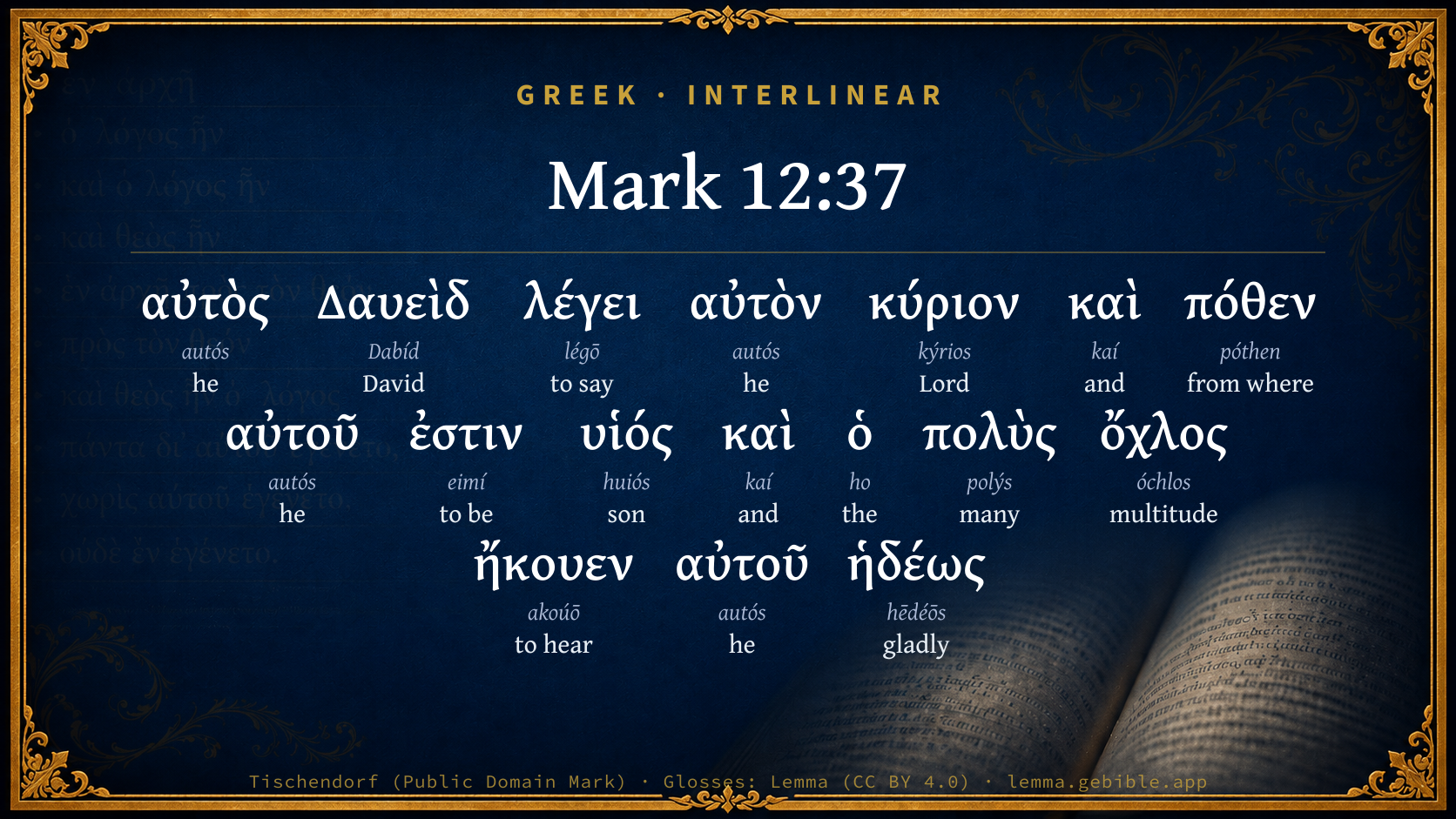
Greek (Tischendorf 8th ed.) Mark 12:37 appears in the Greek New Testament. The text above is from the Tischendorf 8th edition. Each word links to its Strong’s number and a concise gloss. Click any word for its full Thayer’s Greek Lexicon entry.
Download image
Cite this verse

Mark 12:37 (World English Bible). Public Domain. Lemma interlinear Bible study tool, https://lemma.gebible.app/v/mark/12/37.

Show BibTeX & RIS
BibTeX
RIS
English Translation
Therefore David himself calls him Lord, so how can he be his son?" The common people heard him gladly.
World English Bible · Public Domain
Download a study sheet

One document with this verse’s original text, its word-by-word gloss line, the meaning frame, cross-references with their text, attributed commentary, and full source and license credits — printable, and it pastes into notes with its structure intact.

This verse Autodidact and up

Study sheet (.html) Plain text (.txt)

A passage Seminary Student

Up to 50 verses in one chapter. A passage sheet keeps up to 6 commentary sources and 12 cross-references per verse, in the order this page ranks them, and says so on the sheet whenever that leaves anything out. Ask for a single verse and you get the Autodidact verse sheet above.

Everything on this page stays free to read, with no account — the sheet is a download of what is already on screen, not access to it.

Want to remove ads? Support Godless Engineer
Compare translations 3

The same verse in 3 English versions, stacked beneath the original-language interlinear above. Click any original word for its lexicon entry.

Each is an independent rendering of the whole verse — the interlinear is not word-aligned to these translations.

Highlighted words mark where these versions differ — a whole-verse word diff, not a word-by-word alignment.

  • World English Bible Public Domain
    Therefore David himself calls him Lord, so how can he be his son?" The common people heard him gladly.
  • King James Version Public Domain
    David therefore himself calleth him Lord; and whence is he then his son? And the common people heard him gladly.
  • unfoldingWord Literal Text CC BY-SA 4.0
    David himself calls him ‘Lord,’ and how is he his son?” And a large crowd was listening to him gladly.

unfoldingWord Literal Text — © unfoldingWord, licensed CC BY-SA 4.0. Word-aligned USFM3 via Door43 (git.door43.org/unfoldingWord/en_ult).

Versions to compare (up to 4)

3 of 4 selected

Show all 19 translations

Every available English version of this verse, each an independent rendering of the whole verse.

  • World English Bible Public Domain
    Therefore David himself calls him Lord, so how can he be his son?" The common people heard him gladly.
  • Berean Standard Bible Public Domain
    David himself calls Him ‘Lord.’ So how can He be David’s son?” And the large crowd listened to Him with delight.
  • Majority Standard Bible Public Domain
    Therefore David himself calls Him ‘Lord.’ So how can He be David’s son?” And the large crowd listened to Him with delight.
  • King James Version Public Domain
    David therefore himself calleth him Lord; and whence is he then his son? And the common people heard him gladly.
  • American Standard Version (1901) Public Domain
    David himself calleth him Lord; and whence is he his son? And the common people heard him gladly.
  • Revised Version (1885) Public Domain
    David himself calleth him Lord; and whence is he his son? And the common people heard him gladly.
  • Geneva Bible (1599) Public Domain
    Then Dauid himselfe calleth him Lord: by what meanes is he then his sonne? and much people heard him gladly.
  • Douay-Rheims (1899) Public Domain
    David therefore himself calleth him Lord, and whence is he then his son And a great multitude heard him gladly.
  • Young's Literal Translation Public Domain
    therefore David himself saith of him Lord, and whence is he his son?' And the great multitude were hearing him gladly,
  • Literal Standard Version CC BY-SA 4.0
    therefore David himself calls Him Lord, and from where is He his son?” And the great multitude were hearing Him gladly,
  • Unlocked Literal Bible CC BY-SA 4.0
    David himself calls him 'Lord,' so how can the Christ be David's son?” The large crowd gladly listened to him.
  • unfoldingWord Literal Text CC BY-SA 4.0
    David himself calls him ‘Lord,’ and how is he his son?” And a large crowd was listening to him gladly.
  • Darby Bible Public Domain
    David himself [therefore] calls him Lord, and whence is he his son? And the mass of the people heard him gladly.
  • World Messianic Bible Public Domain
    Therefore David himself calls him Lord, so how can he be his son?” The common people heard him gladly.
  • Webster's Bible Public Domain
    David therefore himself calleth him Lord, and whence is he then his son? and the common people heard him gladly.
  • Free Bible Version CC BY-SA 4.0
    Since David himself calls him Lord, how can he be David's son?” The large crowd listened to what Jesus said with great delight.
  • Bible in Basic English Public Domain
    David himself gives him the name of Lord; and how then is he his son? And the common people gave ear to him gladly.
  • Text-Critical English NT CC BY 4.0
    David himself calls him ‘Lord,’ so how is he his son?” And the large crowd was listening to him gladly.
  • Tyndale New Testament (1534) Public Domain
    Then David hym silfe calleth him Lorde: and by what meanes is he then his sonne? And moche people hearde him gladly.

Literal Standard Version (2020), Covenant Press — licensed CC BY-SA 4.0. Text via the HelloAO Bible API (eBible.org). Unlocked Literal Bible (unfoldingWord) — licensed CC BY-SA 4.0. Text via the HelloAO Bible API (eBible.org). unfoldingWord Literal Text — © unfoldingWord, licensed CC BY-SA 4.0. Word-aligned USFM3 via Door43 (git.door43.org/unfoldingWord/en_ult). Free Bible Version, Dr. Jonathan Gallagher — licensed CC BY-SA 4.0. Text via the HelloAO Bible API (eBible.org).

Word by word

More ways to search: Search by grammar → Find every occurrence → Compare this word →

Practice this passage: Drill this verse → Learn its vocabulary →

ἡδέως
hēdéōs
G2234
“gladly”
Adverb
Part of Speech
Adverb
Full Thayer's Definition

Origin: from a derivative of the base of G2237

TDNT: None

1. with pleasure, gladly
  1. αὐτὸς autós G846 “he” Personal pronoun, Nominative, Singular, Masculine
  2. Δαυεὶδ Dabíd G1138 “David” Noun, Proper, indeclinable
  3. λέγει légō G3004 “to say” Verb, Present, Active, Indicative, 3rd person, Singular
  4. αὐτὸν autós G846 “he” Personal pronoun, Accusative, Singular, Masculine
  5. κύριον kýrios G2962 “Lord” Noun, Accusative, Singular, Masculine
  6. καὶ kaí G2532 “and” Conjunction
  7. πόθεν póthen G4159 “from where” Adverb, Interrogative
  8. αὐτοῦ autós G846 “he” Personal pronoun, Genitive, Singular, Masculine
  9. ἐστιν eimí G1510 “to be” Verb, Present, Active, Indicative, 3rd person, Singular
  10. υἱός huiós G5207 “son” Noun, Nominative, Singular, Masculine
  11. καὶ kaí G2532 “and” Conjunction
  12. ὁ ho G3588 “the” Article, Nominative, Singular, Masculine
  13. πολὺς polýs G4183 “many” Adjective, Nominative, Singular, Masculine
  14. ὄχλος óchlos G3793 “multitude” Noun, Nominative, Singular, Masculine
  15. ἤκουεν akoúō G191 “to hear” Verb, Imperfect, Active, Indicative, 3rd person, Singular
  16. αὐτοῦ autós G846 “he” Personal pronoun, Genitive, Singular, Masculine

About this verse

These counts appear in no published source. They are computed here, from the morphology-tagged text and Lemma’s own curated glosses. What Lemma adds →

17
words
13
distinct lemmas
Gospels
section

Notable vocabulary

The rarest word here is ἡδέως gladly G2234 — appearing just 3 times in the whole Greek New Testament.

Shared distinctive vocabulary

ἡδέως gladly G2234 occurs in 3 verses of the Greek New Testament. Also found in:

Repetition

Words recur within this verse:

  • αὐτὸς he G846 ×4
  • καὶ and G2532 ×2

Cross-references

13

Topical passages linked to Mark 12:37 in the Treasury of Scripture Knowledge — connected by theme and wording, ordered by reader-vote popularity; previews shown in the World English Bible.

  • Romans 1:3–4 concerning his Son, who was born of the seed of David according to the flesh,
  • Matthew 1:23 "Behold, the virgin shall be with child, And shall bring forth a son. They shall call his name Immanuel;" Which is, being interpreted, "God with us."
  • Matthew 11:5 the blind receive their sight, the lame walk, the lepers are cleansed, the deaf hear, the dead are raised up, and the poor have good news preached to them.
  • Matthew 11:25 At that time, Jesus answered, "I thank you, Father, Lord of heaven and earth, that you hid these things from the wise and understanding, and revealed them to infants.
  • Matthew 21:46 When they sought to seize him, they feared the multitudes, because they considered him to be a prophet.
  • Luke 19:48 They couldn't find what they might do, for all the people hung on to every word that he said.
  • Luke 21:38 All the people came early in the morning to him in the temple to hear him.
  • John 7:46–49 The officers answered, "No man ever spoke like this man!"
  • John 12:9 A large crowd therefore of the Jews learned that he was there, and they came, not for Jesus' sake only, but that they might see Lazarus also, whom he had raised from the dead.
  • Romans 9:5 of whom are the fathers, and from whom is Christ as concerning the flesh, who is over all, God, blessed forever. Amen.
  • 1 Timothy 3:16 Without controversy, the mystery of godliness is great: God was revealed in the flesh, Justified in the spirit, Seen by angels, Preached among the nations, Believed on in the world, And received up in glory.
  • James 2:5 Listen, my beloved brothers. Didn't God choose those who are poor in this world to be rich in faith, and heirs of the Kingdom which he promised to those who love him?
  • Revelation 22:16 I, Jesus, have sent my angel to testify these things to you for the assemblies. I am the root and the offspring of David; the Bright and Morning Star."

Cross-references courtesy of OpenBible.info (CC BY 4.0).

Where the printed editions differ

1 variant

Places in this verse where the major printed Greek editions disagree on the wording in a way that affects the translation — a comparison of editions, not a manuscript-by-manuscript collation. The editions are the modern critical texts (Nestlé-Aland 28/27, SBL, Westcott-Hort, Tregelles, Tyndale House) and the traditional texts behind the KJV (the Textus Receptus and the Byzantine/Majority text). It is not a claim about which reading is original.

  1. Extra text
    οὖν

    “therefore”

    In TRByz Not in NA28NA27TynSBLWHTreg

    οὖν (oun) 'therefore' is only in traditional manuscripts (TR+Byz)

Textual data: Translators Amalgamated Greek New Testament (STEPBible TAGNT) · CC BY 4.0.

Commentary

Notes on Mark 12:37 from classic Christian and Jewish commentators (each source and its license shown beneath its notes). The classic Christian expositions comment on the surrounding passage and are grouped to its opening verse, so a note may address several verses; the Jewish commentaries on the Tanakh (Rashi and others) are per-verse, so they appear only where the commentator wrote on this verse.

Lemma curates 59 commentaries, every one of them public domain or Creative Commons licensed, each selected and text-cleaned for this edition rather than reprinted as found. About our sources →

The Biblical Illustrator

Joseph S. Exell

Mar_12:37

And the common people heard Him gladly.

The gospel and the masses

This passage refers to the reception given to the teachings of our Lord by the masses of the people.

I. The hearers of Christ referred to in the text are designated the common people. As the words in the original Greek mean, literally, the great multitude, it has been suggested that the better rendering of the passage would be the great multitude heard Him gladly. The revisers of the New Testament, however, have adhered to the rendering of the Authorized Version, and in the text of the Revised New Testament we have the long-familiar words, the common people heard Him gladly, while the alternative rendering, the great multitude, is relegated to the margin. A critic has remarked that in the words the great multitude there is no intended antithesis or opposition to the upper classes. This, to say the least, is questionable; but of this we are certain, that, whether any distinction of classes was intended or not, the great multitude necessarily includes the common people, By the common people is meant, in every country, the people without wealth, or power, or exalted rank, or intellectual culture, or refinement of manners. They are the vulgar, the uneducated, the lowly, the poor, the masses. The phrase the common people is suggestive of human inequality, and implies that the gradations of rank and class obtain amongst men. But why, and how, it may be asked, should there be these distinctions? Are not all men equal? To this I reply that in certain important senses all men are equal. All men are equal by natural descent, as the offspring of the same first parents. Then there is the base equality of natural depravity and guilt. Over the entire race is written the inspired description: There is none righteous; no, not one. And, thank God, there is the blessed equality of a common redemption, an equal connection with the second Adam as with the first. Notwithstanding the universal equality of man in the essential aspects to which I have referred, there are other important respects, some of them natural, and some of them artificial, in which men are not equal. There are differences in physique, in stature, and strength, which are obvious to all. There are still greater differences to be found amongst the minds of men. And whilst the native and constitutional varieties of human intellect are numerous and great, these differences are further increased in number and variety by education and culture. The social inequalities which exist in society, and which are not removed, but are aggravated, by civilization, comprise, with other classes, the common people. However class distinctions may be disliked, they appear to be inevitable, at least to some extent, and in some variety. In recognizing the distinctions of ranks, classes, and conditions of men, we, as Christian preachers, recognize existing facts-facts which exist now, and which have always existed. The mission of the gospel, however, is to all men without distinction; and if the most numerous class, the great multitude, give it a favourable reception, it is a matter of thankfulness now, as it doubtless was when the Author of the gospel was a preacher of the gospel, causing the evangelist to make, in the midst of Christs sayings, the abrupt record, and the common people heard Him gladly.

II. The reception given to the ministry of Jesus by the masses is worthy of thought and investigation. The question, Why did the common people hear Him gladly? is a very natural question, and is worthy of the best answer that can be given to it. The reasons for their gladness are not assigned, and must be gathered mainly from inference and from the hints of Scripture. No doubt the principal causes were connected with the character of the Great Teacher Himself; with the nature of the truths which He taught; with the style and methods of His teaching; and with the receptability of the hearers.

1. Jesus was no ordinary teacher, but in the singularity of His greatness stood out in marked contrast to the scribes and rabbis of His day, and even rose vastly superior to the ancient prophets of Israel, although grand to sublimity were the characters of these holy men of old. There is an impressiveness amounting to awe in the quiet self-assertion of His Messianic professions and Divine claims.

2. The favourable reception given by the masses to the ministry of Jesus may be further accounted for by the nature of the doctrines and precepts which He taught, and especially by the methods, style, spirit, and sympathetic feeling of His teachings. Not less striking was the system of morals which He set up and enforced. The common people heard Him gladly because of the tone of certainty with which He taught. This teaching, as beautiful as it was true, is intelligible to the humblest intellect. No wonder that at Jerusalem, when He taught in the temple, the common people heard Him gladly.

III. The text is suggestive of the relations of the gospel to the masses of men now, and to their attitude towards it. The gospel is for the masses, because the gospel is for all. It comes with good news to every man, without distinction of rank or condition. The gospel, like the Sabbath, was made for man-for universal man. The impartial manner in which the Bible treats of the different classes of society is to me an additional proof of its Divine origin. Nor does it, on the other hand, denounce the less favoured classes, and call them the swinish multitude, the great unwashed, the many-headed beast, the canaille, the dregs, the scum. Such offensive language is never employed in that Holy Book, which teaches us to honour all men; which declares God to be the common Parent; the Father of the spirits of all flesh; which says, The rich and the poor meet together; the Lord is the maker of them all. And then, in consequence of the saving grace of God, it places all upon the one platform of common privilege and blessing. It levels up by dignifying the lowly; it levels down by clothing the lofty with humility; and it says to both, Let the brother of low degree rejoice, in that he is exalted; but the rich in that he is made low. The masses should listen to the gospel now with delight, just as the common people in the days of our Lord heard with gladness the Author of the gospel Himself. To hear at all is a point gained, and is matter of thankfulness. The most deplorable characteristic of the masses of the wage-earning classes is their habitual absence from the house of God. They do not hear the gospel gladly, because they do not hear it at all. How to get the masses to hear the gospel is one of the great religious problems of the day. In order to success, the Christian ministry must enlarge upon the right theme. That theme is gospel truth, of which the atonement is the principal article, around which ethers are grouped. Hearing the gospel gladly is the duty and privilege of all alike-the rich man with his gold ring and goodly apparel and the poor man in vile raiment. (T. MCullagh.)

The gospel and the common people

The state of society in Palestine when Jesus appeared in one respect resembled that of our own age and country-the habit of going to the synagogue was for the most part restricted to the upper and middle classes, led by the scribes and Pharisees. The mass of the working people were scattered abroad as sheep having no shepherd. They had sunk into a state of general neglect of religion. To these common people Jesus Christ specially addressed Himself; for, while the learned men rejected Him, and sought only to entangle Him in His talk, these heard Him gladly, welcomed His discourses, recognized His Divine mission, and many of them repented at His reproof. We have an indication of this willingness on the part of the common people to hear Him, in the words of this text.

I. Leaving the context, however, we shall first make some remarks on the expression The common people-an English phrase, which, without being an exact translation of the original, sufficiently, well conveys its meaning. The common people: This is a description of the multitude of the population-comprising the whole of the working orders. The phrase implies that there are other sorts of people who are not so common, but fewer and scarcer, and distinguishable by certain eminent qualifications from the crowd around them. Well, there are everywhere such common people, and people less common. What makes the difference? Society is built up of three classes of men-those who have remarkable mind, those who have money and rank, and those who labour with their hands. The latter class are by far the most numerous. They are nearly a hundred to one of the others. These are the common people. The others are distinguished from the crowd by some personal qualification. Illustration:-There always will be a real difference between educated and uneducated men. A man may grow rich, and push his way up into the middle or higher classes; but, if his education has been neglected and his taste uncultivated, neither he nor his family will be able to establish themselves as the equals of their neighbours in a similar position of wealth. It is not an artificial-it is a real difference that separates the two. A cultivated rose really is a different flower from a dog rose that grows in a hedge; and not all the airs of the hedge flower will give it a place of equal rank with its betters. There is, and there ought to be, a difference in rank between educated and uneducated persons; and, so far as the differences in English society represent differences, not merely of wealth, but of mind and culture, you will never be able to break them down, except by converting the common people into uncommon. How very common many of the common people are-common in the sense of low and degraded in thought, in feeling, in habit, in speech, in character! It is sad to think how the wretched lives of the labouring multitude might be varied, and rendered infinitely more comfortable and respectable, if they would. The single particular of more cleanliness would itself double the comfort of life. The most sunken type of human life may be raised into a fellowship with saints and angels. The ladder Jacob saw was a glorious scale on which the lowest grade of humanity may rise to heaven and to God. This common people may all be clothed in glory, honour, and immortality, and put on forever the splendours of eternity. When, therefore, we look upon our own multitudes of common people, alienated from the redeeming influence, despising the ministers of Christianity, and abhorring the churches, we ask, Why is it that we have so sadly failed? When Jesus preached, the common people heard Him gladly; and, believing in Him, they were changed into the same image, and became the sons of God. What was it in His preaching that made them hear Him so gladly-that won their hearts, and drew them to Him and to God? Let us first mention two or three things that cannot be alleged as Christs means of influencing the multitude.

1. It was not a comical, a jocose mode of address.

2. Neither did He seek to propitiate the common people by flattering them with the promise of great temporal and social rewards for adhering to His cause.

1. Then, the common people heard Him gladly, because of the great and obvious sincerity and disinterestedness of His character. All the suspicions which attended the ministrations of the Pharisees were absent from Him.

2. They heard Him willingly because of the spiritual depth of His doctrine, and the suitableness of His teaching to the mind of the populace. He did not approach them with a long array of puzzling articles and creeds, which a man must believe, or pretend to believe, or without doubt perish everlasting. But He showed both His wisdom and His patience by teaching even His own apostles only as they were able to bear it. Love is still more powerful than argument; or, rather, it is the most powerful of arguments.

3. I think we should mention that one of the most characteristic traits of our Lords teaching was its perfect manliness and freedom from affectation.

4. Once more: Jesus commanded the attention of the common people because He spoke to them with a compassion which reached their hearts and won their affections. (E. White.)

On preaching to the common people

I. First, then, we have no quarrel with you because you are of the number of those who hear gladly. This is so far well. It is one of the deadliest symptoms of those who perish, that to them the preaching of the cross is foolishness. A very promising symptom most assuredly; and it may evidence the beginning of a good work which God may carry forward and bring to perfection.

II. But, secondly, though your hearing gladly be a promising symptom, it is not an infallible one. The common people of Jerusalem heard gladly; and we need not repeat the awful disaster and ruin which, in the course of a fear years, overtook the families of that common people.

III. But though to hear gladly be not an infallible symptom, yet to hear the whole truth gladly is a much more promising symptom than only to hear part of the truth gladly. We fear that it is this partial liking for the Word which forms the whole amount of their affection for it, with the great majority of professing Christians. They like one part; but they do not like another. Some like to hear of the privileges of the gospel; but they do not like to hear of the precepts of the gospel, and that the soul in whom Christ is formed the hope of glory, will purify itself even as Christ is pure.

IV. But lastly, if it do not follow that because a man is a delighted hearer of the word, he is therefore an obedient doer of it, how is he to become one? What is there which can bring relief to this melancholy helplessness? We assert that the glow of a warm and affecting impression is one thing, and the sturdiness of an enduring principle is another. We again, then, recur to the question, how shall we give the property of endurance to that which in time past has been so perishable and so momentary? The strength of your own natural purposes, it would appear, cannot do it. The power of argument cannot do it. The tongue of the minister, though he spake with the eloquence of an angel, cannot do it. (Dr. Chalmers.)

Common people heard him gladly

Luther when preaching to a mixed assembly, said: I perceive in the church Dr. Justus Jonas and Melancthon, and other learned doctors, Now, if I preach to their edification, what is to become of the rest? Therefore, by their leave, I shall forget that Dr. Jonas is here at all, and preach to the multitude. So must I do at this good hour, asking those of you who are advanced in the Divine life to unite your prayers with mine, that the word of the gospel may be blessed to the unconverted. (C. H. Spurgeon.)

Jesus and the common people

We are all common people as to the ground covered by His teachings. The duties incumbent on us to God and man have in their principles, their motives, their spirit, no diversity corresponding to the differences of condition and culture. You cannot specify a primal obligation that admits of any exceptions. You can name none that belong to the highly endowed and privileged, but not to the simple and unlettered-none that appertain to the lowly, and not to those who hold a superior position in the social scale. The Sermon on the Mount may be all lived out by the labourer, the poor widow, the person whose intelligence and sphere of action are of the very narrowest; and at the same time there is no life so large, so high, so extended in its relations and responsibilities, that it may not find here all that it is bound to be and to do. Still more, we can conceive of no broader, fuller, loftier law of duty for the redeemed in heaven, or for any created being in the universe. As regards our trials and our griefs, too, we are all common people. There is no resource for high or low, when the heart is overwhelmed, but trust in Almighty love-no prayer that can bring an answer of peace, but Father, Thy will, not mine, be done. In the presence of the mighty leveller Death we are all common people. (A. Peabody, LL. D.)

The Model Preacher

Why did the common people hear Him gladly?

I. Because Christ gave a new and broader meaning to religion. He proclaimed Gods love to all, Jew and Gentile. Christianity touches the great heart of humanity. Those who live at the bottom of society are, by nature, most open to conviction. They are governed largely by their feelings: but religion is a matter of feeling; it is love.

II. The affections of life have their largest scope and effect among the lowest. He said, Come unto Me, all ye weary, etc. Look at the manner of our Lords preaching.

1. He spoke as one having authority; He revealed truth.

2. Much of our Lords preaching was outside of synagogues, and in conversation with the people.

3. His ministry was in the demonstration of the Spirit and with power. (W. E. Griffith.)

Other gospels hidden from the common people

In Greece and Italy, while a few superior minds acknowledged a spiritual worship, the common people were kept in brutish ignorance by the celebrated philosophers of Greece and Rome. In Hindostan, though the doctrines of their complicated faith are freely revealed to the Brahmins and their pupils, it is a law never to be violated that the sacred books shall be locked up from the bulk of the people, and the Paris, or lowest caste, is not only excluded from the common assemblies of the people, but forbidden even to enter the temples to pray or to sacrifice. Nay, the Gentoo code even enacts that, should a priest read the sacred books to the inferior orders, heated oil, wax, and melted tin shall be poured into his ears; and that, should any member of these classes get passages by heart, he shall instantly be put to death. (Eastern Manners and Customs.)

Preaching so as to be understood by the common people

Archbishop Tillotson, who has left imperishable memorials of his excellence in his sermons, as well as in the traditional reports of his voice and delivery, regarded it as the highest compliment ever paid him, when, on descending from the pulpit, he overheard a countryman who came to London to hear him, ask his friend with evident surprise, Is that your great Archbishop? Why, he talks just like one of ourselves. And the greatest of all preachers, who spake as never man spake, must have been characterized by the same sublime simplicity; for it is written of Him, The common people heard Him gladly.

Study the people

Mr. Hill always wished to be considered the apostle of the common people, in resemblance of Him whom the common people heard gladly, and in whose teaching the poor had the Gospel preached unto them. But he who undertakes this work of faith and labour of love will find that he has not to address angels, and sometimes hardly men. He will need to learn the advice which the philosopher was wont to give his pupils, Study the people; or that which Cromwell gave to his soldiers, Fire low. Had his men fired high they would have done no more execution than some of our preachers, who shoot over their hearers heads. (Rowland Hill.)

The intuitions of the multitude

When an uninstructed multitude, says Nathaniel Hawthorne, attempts to see with its eyes, it is exceedingly apt to be deceived. When, however, it forms its judgment, as it usually does, on the intuitions of its great and warm heart, the conclusions thus attained are often so unerring as to possess the character of truths supernaturally revealed.

The Biblical Illustrator, edited by Joseph S. Exell (c. 1880s–1900s) — public domain. Text from a community e-Sword module.

Bengel's Gnomon

Johann Albrecht Bengel

Mar 12:37. Πολὺς) The people, who were many [But Engl. Vers., “The common people.”]

Bengel's Gnomon of the New Testament — English translation (T&T Clark, Edinburgh, 1860) — public domain. Text from a community e-Sword module.

Expositor's Greek Testament

ed. W. Robertson Nicoll

Mar 12:37 . καὶ ὁ πολὺς ὄχλος , etc.: this remark about the large crowd which had been witness to these encounters, as it stands in our N. T. at end of Mar 12:37 , seems to refer merely to the closing scene of the conflict. Probably the evangelist meant the reflection to apply to the whole = the masses enjoyed Christ’s victory over the classes, who one after the other measured their wits against His. The remark is true to the life. The people gladly hear one who speaks felicitously, refutes easily, and escapes dexterously from the hands of designing men. ( ὡς ἡδέως διαλεγομένου , καὶ εὐχερῶς αὐτοὺς ἀνατρέποντος , καὶ ὡς αὐτὸς ἀπηλλαγμένος τῆς βασκανίας Euthy. Zig.)

The Expositor's Greek Testament, edited by W. Robertson Nicoll (1897–1910) — public domain. Text from a community e-Sword module.

Adam Clarke's Commentary

Verse 37. The common people heard him gladly.] And were doubtless many of them brought to believe and receive the truth. By the comparatively poor the Gospel is still best received.

Adam Clarke's Commentary on the Bible (1810–1826) — public domain. Text from a community e-Sword/MySword module.

Ellicott's Commentary for English Readers

(37) And the common people.—Better, the great body of the people. Stress is laid on the multitude, not on the social condition, of those who thus heard gladly.

A Bible Commentary for English Readers, edited by Charles John Ellicott (1878–1897) — public domain. Text from a community e-Sword module.

The Cambridge Bible for Schools and Colleges

gen. ed. J. J. S. Perowne

37. whence is he then his son?] Abraham had never called Isaac or Jacob or any of his descendants his lord. Why then had David done so? There could be but one answer: “Because that Son would be David’s Son as regarded human birth, his Lord as regarded His Divine Nature.” This answer, however, the Pharisees declined to make, not through ignorance, but through unbelief in our Lord’s Messianic claims.

the common people] Rather, the great multitude. “And moche cumpany gladli herde him.” Wyclif. This fact is peculiar to St Mark, and implies that they listened to Him gladly, not merely in the general sense, but with special reference to His Divine dignity as the Messiah.

The Cambridge Bible for Schools and Colleges (gen. ed. J. J. S. Perowne; Cambridge University Press, 1878–1918) — public domain. Text from a community e-Sword module.

John Gill's Exposition

And the chief seats in the synagogues,.... Where the rulers of the synagogue, and the elders of the people sat; See Gill on Mat 23:6.

And the uppermost rooms at feasts; or the first and chief places where they sat, or rather lay along at public entertainment; See Gill on Mat 23:6.

John Gill's Exposition of the Whole Bible (1746–1763) — public domain (CC PDM 1.0). Text via the HelloAO Bible API.

Trapp's Complete Commentary

John Trapp

37 David therefore himself calleth him Lord; and whence is he then his son? And the common people heard him gladly.

Ver. 37. The common people] The lesser fishes commonly bite best.

John Trapp, A Commentary or Exposition upon All the Books of the Old and New Testament (1647–1656) — public domain. Text from a community e-Sword module.

Haydock's Catholic Bible Commentary

This interrogation of Jesus instructs us how to refute the adversaries of truth; for if any assert that Christ was but a simple and holy man, a mere descendant of the race of David, we will ask them, after the example of Jesus: If Christ be man only, and the Son of David, how does David, under the inspiration of the Holy Ghost, call him Lord? The Jews were not blamed for calling him the Son of David, but for denying him to be the Son of God. (Ven. Bede)

George Leo Haydock (1774–1849), Haydock's Catholic Family Bible and Commentary, 1859 edition — public domain. Excludes Psalms (Douay-Rheims chapter numbering differs from Protestant) and Deuterocanonical books (Catholic canon only).

The Pulpit Commentary

"The common people heard him gladly.

I THE PERSONS THUS AFFECTED The reference of the words common people misunderstood Literally the expression is, "the great multitude" It was in temple, and must have comprehended all classes, especially the middle and upper; the very lowest being but sparsely represented. It was also nationally homogeneous Jewish.

II REASONS FOR THEIR BEING SO. Not on account of eloquence, or So-called popularity" of address. That the highest qualities were exhibited "goes without saying." The full splendour and majesty of Messianic teaching were exhibited. The Man himself was more, and felt to be more, than his words. Two circumstances lent a passing interest to his teaching: he exposed and defeated the religious pretenders of the day, Pharisees, Sadducees, lawyers, whose true character the people"s instinct felt had been revealed; and he appealed to the national religious spirit, in setting forth the true doctrine of the Messiah.

III THE MORAL VALUE OF THIS RECEPTION OF CHRIST.

1. It showed that the deepest instincts of humanity are on the side of religion and Divine truth.

2. But it did not involve discipleship. Admiration, intellectual assent, even some wonder at what was truly Divine; but no moral conviction. There are many to whom the gospel is a thing gladly heard, but soon dismissed from the thoughts. It is in obedience and faith that the "glad tidings" are practically and permanently experienced by the human heart. M.

The Pulpit Commentary (1880–1919), ed. H.D.M. Spence-Jones & Joseph S. Exell — public domain. Text from a community e-Sword module.

Cambridge Greek Testament for Schools and Colleges

37. [2824][2825][2826][2827][2828][2829] omit οὖν. See on Mar 12:6.

[2824] Codex Sinaiticus. 4th cent. Discovered by Tischendorf in 1859 at the Monastery of St Katharine on Mount Sinai. Now at St Petersburg. The whole Gospel, ending at Mar 16:8. Photographic facsimile, 1911.

[2825] Codex Vaticanus. 4th cent., but perhaps a little later than א. In the Vatican Library almost since its foundation by Pope Nicolas V., and one of its greatest treasures. The whole Gospel, ending at Mar 16:8. Photographic facsimile, 1889.

[2826] Codex Bezae. 6th cent. Has a Latin translation (d) side by side with the Greek text, and the two do not quite always agree. Presented by Beza to the University Library of Cambridge in 1581. Remarkable for its frequent divergences from other texts. Contains Mark, except Mar 16:15-20, which has been added by a later hand. Photographic facsimile, 1899.

[2827] Codex Regius. 8th cent. An important witness. At Paris. Contains Mar 1:1 to Mar 10:15; Mar 10:30 to Mar 15:1; Mar 15:20 to Mar 16:20, but the shorter ending is inserted between Mar 16:8 and Mar 16:9, showing that the scribe preferred it to the longer one.

[2828] Codex Sangallensis. 9th or 10th cent. Contains the Gospels nearly complete, with an interlinear Latin translation. The text of Mark is specially good, agreeing often with CL. At St Gall.

[2829] Codex Athous Laurae. 8th cent. Like N and Σ, it is written in silver letters on purple vellum. Contains Mar 9:5 to Mar 16:20, and, as in L, the shorter ending is inserted between Mar 16:8 and Mar 16:9. As in Δ, the text of Mark is specially good.

37. λέγει αὐτὸν κύριον. Cf. Mar 10:18.

καὶ πόθεν; Mt. has καὶ πῶς; We have both in Plato, Phaedr. 269 D, πῶς καὶ πόθεν ἄν τις δύναιτο πορίσασθαι;

ὁ πολὺς ὄχλος. The great multitude, “the mass of the people,” is perhaps better than “the common people” (A.V., R.V.). Field prefers the latter and gives quotations, which, however, can hardly decide in such a case, for both renderings, as here, make good sense. At the end, as at the beginning, of His Ministry, His teaching attracted masses. But with many of them ἤκουεν ἥδεως was like the same fact in Antipas with regard to the Baptist (Mar 6:20). They liked the freshness of His method and the skill with which He answered questions; they perhaps enjoyed hearing the professional teachers routed; and some may have appreciated the spiritual strength of His instruction. But, like Antipas, nearly all of them, when pressed, were ready to consent to their Teacher’s death.

Cambridge Greek Testament for Schools and Colleges (Cambridge University Press, 1896; 21 vols, various authors incl. Carr, Maclear, Plummer, Farrar, Lumby, Moule, M. R. James, Simcox) — public domain. Text from a community e-Sword module.

Alford’s Greek Testament

Henry Alford

37.] πόθεν, from whence shall we seek an explanation for what follows: see reff.

κ. ὁ πολ. ὄχ. ἤκ. αὐτ. ἡδ. is peculiar to Mark.

Henry Alford, The Greek Testament (1849–1861) — public domain. Text from a community e-Sword module.

International Critical Commentary

37. Αὐτὸς Δαυεὶδ λέγει αὐτὸν Κύριον—David himself calls him Lord. This makes the difficulty of their position—how lordship and sonship go together.

Omit οὖν, therefore, Tisch. Treg. WH. RV. א BDLTd Δ 28, 106, 251, mss. Lat. Vet. Egyptt.

ὁ πολὺς ὄχλος—the great multitude present at the feast, the multitude being distinguished from the leaders. This statement is parallel to those which represent Jesus, all through this controversy, as carrying the people with him.

WARNING AGAINST THE SCRIBES

International Critical Commentary — older volumes (1896–1929), various authors — public domain. Text from a community e-Sword module.

Vincent's Word Studies in the New Testament

Marvin R. Vincent

The common people [ο πολυς οχλος] . Not indicating a social distinction, but the great mass of the people : the crowd at large.

Marvin R. Vincent, Word Studies in the New Testament (1887–1900) — public domain. Text from a community e-Sword/MySword module.

Lesson kit

Teaching starters — assembled from the data on this page, not authored interpretation. Every prompt links to the verse data it draws on. Edit before teaching.

Mark, in the Gospels, opens this verse with 17 words (13 distinct Greek lemmas). Its most distinctive word is hēdéōs (“gladly”). A historical commentator’s framing appears above. Read the whole chapter for the surrounding context.

Discussion questions

  1. How does “gladly” (hēdéōs) shape what this verse is saying?
  2. Mark 6:20 shares the word «gladly» with this verse. How do the two illuminate each other?
  3. “he” occurs 4× in this one verse. What is the effect of the repetition?
  4. These translations render this verse differently; the difference is in the English rendering, not the original. What questions does that raise?
  5. Reading how The Biblical Illustrator and Bengel's Gnomon read this verse, where do the two commentators agree and where do they part?

Things to notice

Reading settings

Reading text

Shown beneath each verse's original-language words.

Old Testament
Old Testament edition

Read the OT as the Masoretic Hebrew (MT) or the Greek Septuagint (LXX).

English shown for the Greek Septuagint (in the Hebrew ↔ Greek comparison).

Comparing translations? Open the Compare panel on any verse page to stack up to four side by side.