
Leviticus 25:16

Hebrew (Westminster Leningrad Codex) Leviticus 25:16 appears in the Hebrew Old Testament. The text above is from the Westminster Leningrad Codex. Each word links to its Strong’s number, a concise gloss, and parsing drawn from the Open Scriptures Hebrew Bible morphology. Click any word for its full Brown-Driver-Briggs (BDB) entry.
Download image
Cite this verse

Leviticus 25:16 (World English Bible). Public Domain. Lemma interlinear Bible study tool, https://lemma.gebible.app/v/leviticus/25/16.

Show BibTeX & RIS
BibTeX
RIS
English Translation
According to the length of the years you shall increase the price of it, and according to the shortness of the years you shall diminish the price of it; for he is selling the number of the crops to you.
World English Bible · Public Domain
Download a study sheet

One document with this verse’s original text, its word-by-word gloss line, the meaning frame, cross-references with their text, attributed commentary, and full source and license credits — printable, and it pastes into notes with its structure intact.

This verse Autodidact and up

Study sheet (.html) Plain text (.txt)

A passage Seminary Student

Up to 50 verses in one chapter. A passage sheet keeps up to 6 commentary sources and 12 cross-references per verse, in the order this page ranks them, and says so on the sheet whenever that leaves anything out. Ask for a single verse and you get the Autodidact verse sheet above.

Everything on this page stays free to read, with no account — the sheet is a download of what is already on screen, not access to it.

Want to remove ads? Support Godless Engineer
Compare translations 3

The same verse in 3 English versions, stacked beneath the original-language interlinear above. Click any original word for its lexicon entry.

Each is an independent rendering of the whole verse — the interlinear is not word-aligned to these translations.

Highlighted words mark where these versions differ — a whole-verse word diff, not a word-by-word alignment.

  • World English Bible Public Domain
    According to the length of the years you shall increase the price of it, and according to the shortness of the years you shall diminish the price of it; for he is selling the number of the crops to you.
  • King James Version Public Domain
    According to the multitude of years thou shalt increase the price thereof, and according to the fewness of years thou shalt diminish the price of it: for according to the number of the years of the fruits doth he sell unto thee.
  • unfoldingWord Literal Text CC BY-SA 4.0
    To the mouth of the multitude of the years you shall increase its price, and to the mouth of the fewness of the years you shall decrease its price, for he is selling to you the number of crops.

unfoldingWord Literal Text — © unfoldingWord, licensed CC BY-SA 4.0. Word-aligned USFM3 via Door43 (git.door43.org/unfoldingWord/en_ult).

Versions to compare (up to 4)

3 of 4 selected

Show all 18 translations

Every available English version of this verse, each an independent rendering of the whole verse.

  • World English Bible Public Domain
    According to the length of the years you shall increase the price of it, and according to the shortness of the years you shall diminish the price of it; for he is selling the number of the crops to you.
  • Berean Standard Bible Public Domain
    You shall increase the price in proportion to a greater number of years, or decrease it in proportion to a lesser number of years; for he is selling you a given number of harvests.
  • Majority Standard Bible Public Domain
    You shall increase the price in proportion to a greater number of years, or decrease it in proportion to a lesser number of years; for he is selling you a given number of harvests.
  • King James Version Public Domain
    According to the multitude of years thou shalt increase the price thereof, and according to the fewness of years thou shalt diminish the price of it: for according to the number of the years of the fruits doth he sell unto thee.
  • American Standard Version (1901) Public Domain
    According to the multitude of the years thou shalt increase the price thereof, and according to the fewness of the years thou shalt diminish the price of it; for the number of the crops doth he sell unto thee.
  • Revised Version (1885) Public Domain
    According to the multitude of the years thou shalt increase the price thereof, and according to the fewness of the years thou shalt diminish the price of it; for the number of the crops doth he sell unto thee.
  • Geneva Bible (1599) Public Domain
    According to the multitude of yeeres, thou shalt increase the price thereof, and according to the fewnesse of yeeres, thou shalt abate the price of it: for the nomber of fruites doeth he sell vnto thee.
  • Douay-Rheims (1899) Public Domain
    The more years remain after the jubilee, the more shall the price increase: and the less time is counted, so much the less shall the purchase cost. For he shall sell to thee the time of the fruits.
  • Young's Literal Translation Public Domain
    according to the multitude of the years thou dost multiply its price, and according to the fewness of the years thou dost diminish its price; for a number of increases he is selling to thee;
  • Literal Standard Version CC BY-SA 4.0
    you multiply its price according to the multitude of the years, and you diminish its price according to the fewness of the years; for [it is] a number of increases [that] he is selling to you;
  • Unlocked Literal Bible CC BY-SA 4.0
    A larger number of years until the next Jubilee will increase the value of land, and a smaller number of years until the next Jubilee will decrease the value, because the number of harvests the land will produce for the new owner is related to the number of years before the next Jubilee.
  • unfoldingWord Literal Text CC BY-SA 4.0
    To the mouth of the multitude of the years you shall increase its price, and to the mouth of the fewness of the years you shall decrease its price, for he is selling to you the number of crops.
  • Darby Bible Public Domain
    According to the greater number of the years, thou shalt increase the price thereof; and according to the fewness of years, thou shalt diminish the price of it; for it is the number of crops that he selleth unto thee.
  • World Messianic Bible Public Domain
    According to the length of the years you shall increase its price, and according to the shortness of the years you shall diminish its price; for he is selling the number of the crops to you.
  • Webster's Bible Public Domain
    According to the multitude of years thou shalt increase the price of it, and according to the fewness of years thou shalt diminish the price of it: for according to the number of the years of the fruits doth he sell to thee.
  • Free Bible Version CC BY-SA 4.0
    The more years that are left, the more you shall pay; the fewer years that are left, the less you shall pay, because he is actually selling you a specific number of harvests.
  • Bible in Basic English Public Domain
    If the number of years is great, the price will be increased, and if the number of years is small, the price will be less, for it is the produce of a certain number of years which the man is giving you.
  • JPS Tanakh (1917) Public Domain
    According to the multitude of the years thou shalt increase the price thereof, and according to the fewness of the years thou shalt diminish the price of it; for the number of crops doth he sell unto thee.

Literal Standard Version (2020), Covenant Press — licensed CC BY-SA 4.0. Text via the HelloAO Bible API (eBible.org). Unlocked Literal Bible (unfoldingWord) — licensed CC BY-SA 4.0. Text via the HelloAO Bible API (eBible.org). unfoldingWord Literal Text — © unfoldingWord, licensed CC BY-SA 4.0. Word-aligned USFM3 via Door43 (git.door43.org/unfoldingWord/en_ult). Free Bible Version, Dr. Jonathan Gallagher — licensed CC BY-SA 4.0. Text via the HelloAO Bible API (eBible.org).

Word by word

More ways to search: Search by grammar → Find every occurrence → Compare this word →

Practice this passage: Drill this verse → Learn its vocabulary →

מִקְנָת֔וֹ
miqnâh
H4736
“purchase · his”
Noun, Common, Feminine, Singular, Construct + Suffix, Personal, 3rd Person, Masculine, Singular
Part of Speech
Noun
Type
Common
Gender
Feminine
Number
Singular
State
Construct
Full BDB Definition

Origin: from H4735

TWOT: 2039c

purchase - purchase - purchase-price - possession (gained by purchase)
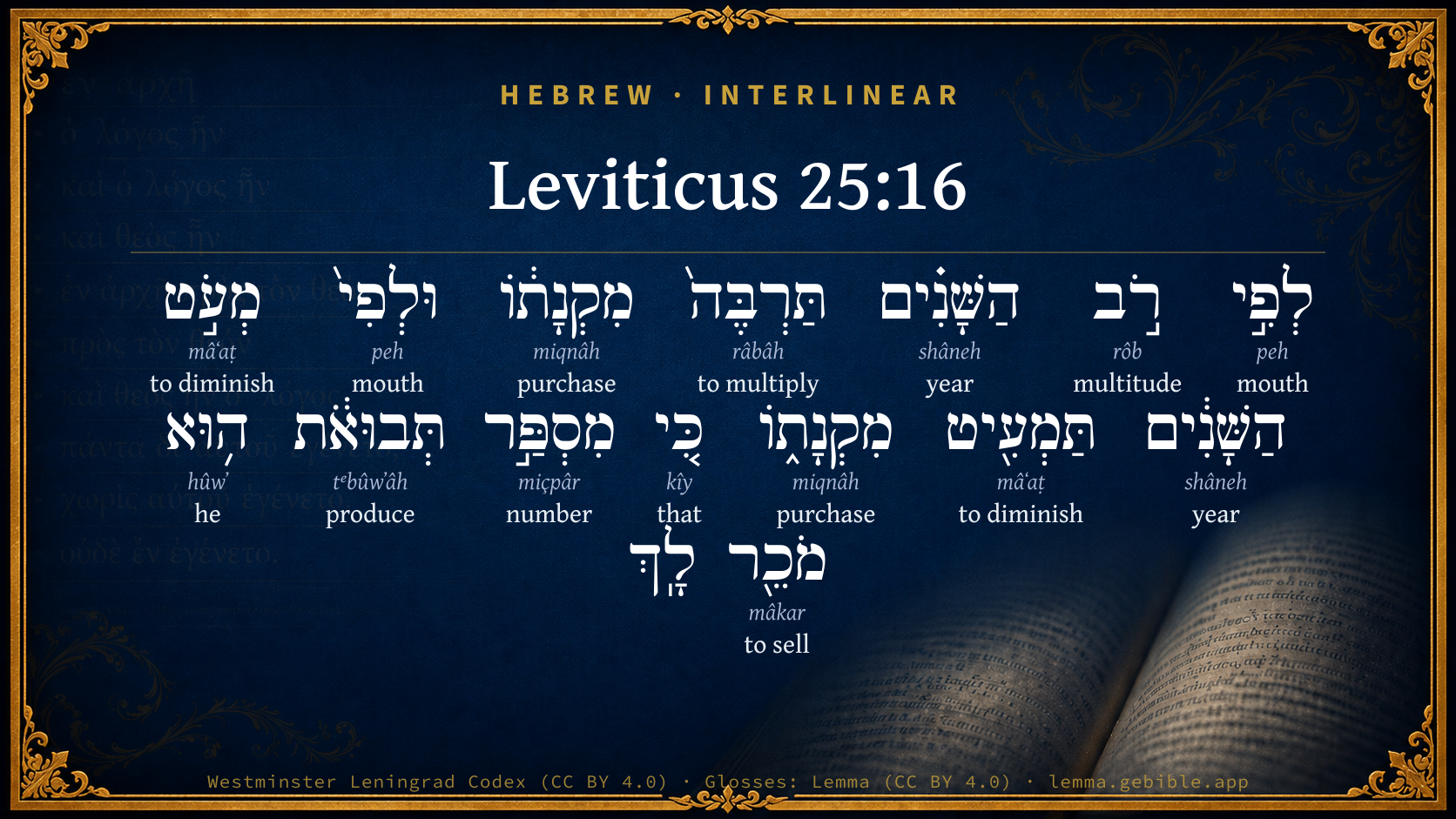
  1. לְפִ֣י peh H6310 “to/for · mouth of” Preposition + Noun, Common, Masculine, Singular, Construct
  2. רֹ֣ב rôb H7230 “multitude of” Noun, Common, Both, Singular, Construct
  3. הַשָּׁנִ֗ים shâneh H8141 “the · years” Particle, Definite Article + Noun, Common, Feminine, Plural, Absolute
  4. תַּרְבֶּה֙ râbâh H7235 “to multiply” Verb, Hiphil, Imperfect, 2nd Person, Masculine, Singular
  5. וּלְפִי֙ peh H6310 “and · to/for · mouth of” Conjunction + Preposition + Noun, Common, Masculine, Singular, Construct
  6. מְעֹ֣ט mâʻaṭ H4591 “to diminish” Verb, Qal, Infinitive Construct
  7. הַשָּׁנִ֔ים shâneh H8141 “the · years” Particle, Definite Article + Noun, Common, Feminine, Plural, Absolute
  8. תַּמְעִ֖יט mâʻaṭ H4591 “to diminish” Verb, Hiphil, Imperfect, 2nd Person, Masculine, Singular
  9. מִקְנָת֑וֹ miqnâh H4736 “purchase · his” Noun, Common, Feminine, Singular, Construct + Suffix, Personal, 3rd Person, Masculine, Singular
  10. כִּ֚י kîy H3588 “that” Conjunction
  11. מִסְפַּ֣ר miçpâr H4557 “number of” Noun, Common, Masculine, Singular, Construct
  12. תְּבוּאֹ֔ת tᵉbûwʼâh H8393 “produce” Noun, Common, Feminine, Plural, Absolute
  13. ה֥וּא hûwʼ H1931 “he” Pronoun, Personal, 3rd Person, Masculine, Singular
  14. מֹכֵ֖ר mâkar H4376 “selling” Verb, Qal, Participle Active, Masculine, Singular, Absolute

About this verse

These counts appear in no published source. They are computed here, from the morphology-tagged text and Lemma’s own curated glosses. What Lemma adds →

16
words
11
distinct lemmas
Pentateuch
section

Notable vocabulary

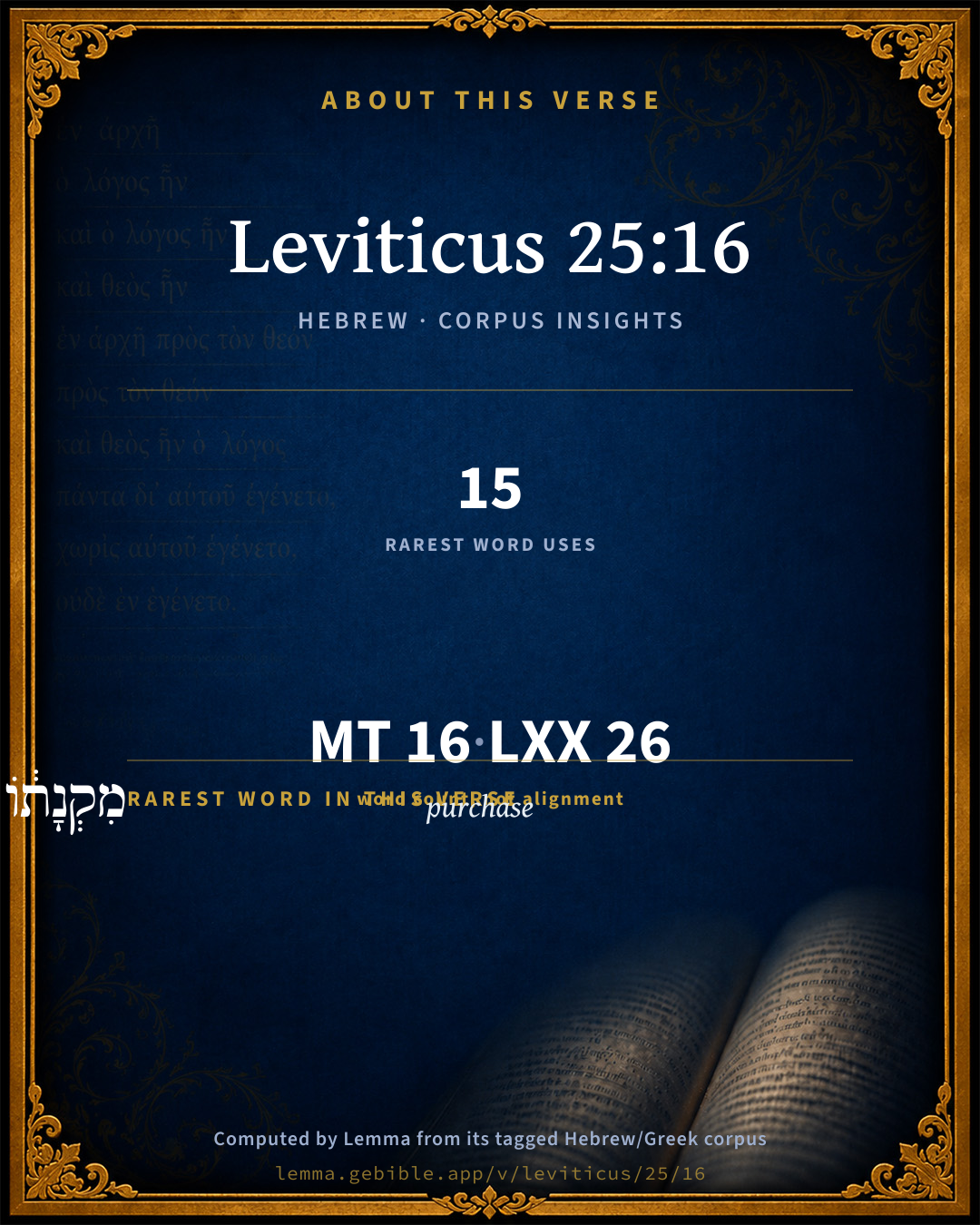
The rarest word here is מִקְנָת֔וֹ purchase H4736 — appearing just 15 times in the whole Hebrew Bible.

Shared distinctive vocabulary

מִקְנָת֔וֹ purchase H4736 occurs in 13 verses of the Hebrew Bible. Also found in:

Grammatical profile

  • 4 verbs
  • 9 nouns
  • 1 pronoun
  • 1 preposition
  • 1 conjunction

Verb forms

  • תַּרְבֶּה֙ Hiphil · Imperfect
  • מְעֹ֣ט Qal · Infinitive Construct
  • תַּמְעִ֖יט Hiphil · Imperfect
  • מֹכֵ֖ר Qal · Participle Active

Repetition

Words recur within this verse — often emphatic in Hebrew:

  • לְפִ֣י mouth H6310 ×2
  • הַשָּׁנִ֗ים year H8141 ×2
  • מִקְנָת֔וֹ purchase H4736 ×2
  • מְעֹ֣ט to diminish H4591 ×2

Hebrew & Septuagint length

In English translation the verse runs 40 words from the Hebrew and 51 from the Septuagint (LXX English) — closely comparable.

A rough comparison of the two English renderings, which tokenize alike — not a word-level alignment.

Word counts can differ between the Hebrew and the Greek without any difference in meaning — e.g. the Hebrew direct-object marker אֵת has no separate Greek word, and Greek often adds the article ὁ.

In the original languages it is 16 Hebrew tokens and 26 Greek tokens — but the two are counted differently (Hebrew bundles its prefixes and suffixes into one token; the Greek is in lemma form), so that isn’t a like-for-like length.

Cross-references

2

Topical passages linked to Leviticus 25:16 in the Treasury of Scripture Knowledge — connected by theme and wording, ordered by reader-vote popularity; previews shown in the World English Bible.

  • Leviticus 25:27 then let him reckon the years since the sale of it, and restore the surplus to the man to whom he sold it; and he shall return to his property.
  • Leviticus 25:51 If there are yet many years, according to them he shall give back the price of his redemption out of the money that he was bought for.

Cross-references courtesy of OpenBible.info (CC BY 4.0).

Hebrew and Greek witnesses Masoretic Hebrew ↔ Greek Septuagint

The same verse in the two great witnesses to the Old Testament, shown verse-for-verse.

These are two independent witnesses, not word-aligned to each other, and the Septuagint is shown in lemma (dictionary) form.

Hebrew Leviticus 25:16 Masoretic · Westminster Leningrad Codex

לְפִ֣י רֹ֣ב הַשָּׁנִ֗ים תַּרְבֶּה֙ מִקְנָת֔וֹ וּלְפִי֙ מְעֹ֣ט הַשָּׁנִ֔ים תַּמְעִ֖יט מִקְנָת֑וֹ כִּ֚י מִסְפַּ֣ר תְּבוּאֹ֔ת ה֥וּא מֹכֵ֖ר לָֽךְ

According to the length of the years you shall increase the price of it, and according to the shortness of the years you shall diminish the price of it; for he is selling the number of the crops to you.

World English Bible · Public Domain

Greek LXX Leviticus 25:16 Septuagint · lemma form

καθότι ἄν πολύς ὁ ἔτος πληθύνω ὁ ἔγκτησις αὐτός καί καθότι ἄν ἐλαχύς ὁ ἔτος ἐλαττονόω ὁ κτῆσις αὐτός ὅτι ἀριθμός γένημα αὐτός οὕτως ἀποδίδωμι σύ

According as there may be a greater number of years he shall increase the value of his possession, and according as there may be a less number of years he shall lessen the value of his possession; for according to the number of his crops, so shall he sell to you.

LXX2012 (modern English Septuagint) · Public Domain

Hebrew: Westminster Leningrad Codex (CC BY 4.0). Greek: Septuagint (public domain); English from LXX2012 (modern English Septuagint) (Public Domain). How the Septuagint differs from the Hebrew →

Targum (Aramaic paraphrase)

2

The Targum is the ancient Jewish Aramaic paraphrase of the Hebrew Scriptures — an interpretive translation, not the Hebrew text itself. Onkelos (literal) and Pseudo-Jonathan (expansive) render the Torah, and Jonathan the Prophets. Coverage is partial: where no permissively-licensed English translation exists for a verse, only the Aramaic is shown. This is verse-level text, not a word-by-word alignment to the Hebrew.

  1. Targum Onkelos Torah (Genesis–Deuteronomy)
    לְפוּם סְגִיאוּת שְׁנַיָא תַּסְגֵי זְבִינוֹהִי וּלְפוּם זְעֵרוּת שְׁנַיָא תַּזְעֵר זְבִינוֹהִי אֲרֵי מִנְיַן עֲלַלְתָּא הוּא מְזַבֵּן לָךְ

    (no public-domain English translation for this verse)

    Targum Onkelos — Aramaic: “Onkelos Genesis” (public domain); “Onkelos Exodus” (public domain); “Onkelos Leviticus” (public domain); “Onkelos Numbers” (public domain); “Onkelos Deuteronomy” (public domain). English: “Sefaria Community Translation” (CC0 1.0 (public-domain dedication)); “J.W. Etheridge. The Targums of Onkelos and Jonathan Ben Uzziel on the Pentateuch. London: Longmans, Green, 1862” (public domain). Text via Sefaria.

  2. Targum Pseudo-Jonathan Torah (Genesis–Deuteronomy)
    לְפוּם סְכוֹם סוֹגֵי שְׁנַיָיא תַּסְגֵי זַבִּינוֹי וּלְפוּם סְכוֹם זְעֵירוּת שְׁנַיָיא תַּזְעִיר זַבִּינוֹי אֲרוּם מִנְיַן כְּנִישַׁת עֲלַלְתָּא הוּא מְזַבֵּן לָךְ

    according to the greatness of the amount of the years shall the price be enlarged; and according to the smallness of the amount of the years the price shall be diminished, because he sells to thee the amount of the fruitage to be ingathered.

    Targum Pseudo-Jonathan — Aramaic: “Targum Jonathan on Genesis” (public domain); “Targum Jonathan on Exodus” (public domain); “Targum Jonathan on Leviticus” (public domain); “Targum Jonathan on Numbers” (public domain); “Targum Jonathan on Deuteronomy” (public domain). English: “The Targum of Jonathan ben Uzziel, trans. J. W. Etheridge, London, 1862” (public domain). Text via Sefaria.

Commentary

Notes on Leviticus 25:16 from classic Christian and Jewish commentators (each source and its license shown beneath its notes). The classic Christian expositions comment on the surrounding passage and are grouped to its opening verse, so a note may address several verses; the Jewish commentaries on the Tanakh (Rashi and others) are per-verse, so they appear only where the commentator wrote on this verse.

Lemma curates 59 commentaries, every one of them public domain or Creative Commons licensed, each selected and text-cleaned for this edition rather than reprinted as found. About our sources →

Joseph Benson's Commentary

Lev 25:16-17. The number of the years of fruits — The meaning is, he selleth not the land, but only the fruits thereof, and that but for a certain time. Ye shall not oppress one another — By seeking to turn each other out of the perpetual possession of his lands, as Ahab did Naboth; but thou shalt fear thy God — The best proof men can give of fearing God is to abstain from evil, and to comply with his will.

Joseph Benson's Commentary on the Old and New Testaments (1811–1818) — public domain. Text from a community e-Sword module.

Geneva Bible (1599)

Geneva Bible translators

And not the full possession of the land.

Geneva Bible (1599) marginal notes — public domain. Text via Bolls.life.

Ellicott's Commentary for English Readers

(16) According to the multitude of years . . . and according to.—Better, in proportion to the multitude of years . . . and in proportion to, as the words in the original here are not the same which are used in Lev_25:15 and at the end of this verse, which are translated “according” in the Authorised Version. Having laid down in the preceding verse the principles of equitable dealings both for the purchaser and vendor, the Lawgiver, in his anxiety lest the distressed seller should be taken advantage of, reverts again to the purchaser, who is enjoined strictly to regulate the purchase price in proportion to the number of years the lease of the field has still to run.

For according to the number of the years of the fruits doth he sell.—Better, for a number of crops he selleth, that is, the vendor does not sell the land but a certain number of harvests till the next jubile.

A Bible Commentary for English Readers, edited by Charles John Ellicott (1878–1897) — public domain. Text from a community e-Sword module.

John Gill's Exposition

According to the multitude of years thou shalt increase the price thereof,.... More was to be asked and required, and should be given for an estate, when, for instance, there were thirty years to the year of jubilee, than when there were but twenty:

and according to the fewness of years thou shalt diminish the price of it; if it wanted but five, or six, or ten years unto it, then, in proportion, less was to be insisted upon and given:

for according to the number of the years of the fruits doth he sell unto thee; which also must be considered, how many years of tillage of land, and cultivation of vineyards, &c. there were in the account, and how many sabbatical years to be deducted; for only according to the number of fruit years was the estate to be valued and sold.

John Gill's Exposition of the Whole Bible (1746–1763) — public domain (CC PDM 1.0). Text via the HelloAO Bible API.

Matthew Poole's English Annotations

Or, for the number of the fruits. The meaning is, he selleth not the land, but only the fruits thereof, and that for a certain time.

Matthew Poole's English Annotations on the Holy Bible (1683–1685) — public domain. Text from a community e-Sword/MySword module.

John Wesley's Explanatory Notes

Years of fruits - Or, For the number of the fruits. The meaning is, he selleth not the land, but only the fruits thereof, and that for a certain time.

John Wesley, Explanatory Notes Upon the Whole Bible (1754–1765) — public domain. Text via the GEBible commentary corpus.

Rashi

Rabbi Shlomo Yitzchaki (Rashi)

תרבה מקנתו THOU SHALT INCREASE THE PRICE THEREOF — i. e. you may sell it at a high price

תמעיט מקנתו — You shall offer a lower price.

Rashi on the Tanakh — English translations: “The Judaica Press complete Tanach with Rashi, translated by A. J. Rosenberg” (CC BY 4.0); “Pentateuch with Rashi's commentary by M. Rosenbaum and A.M. Silbermann, 1929-1934” (public domain); “The Metsudah Tanach series, Lakewood, N.J” (CC BY 4.0); and “The Book of Joshua, Metsudah Publications, 1997” (CC BY 4.0). Text via Sefaria.

Sforno

Rabbi Ovadia Sforno

You shall increase its purchase price. You should pay more to purchase the land than it would cost to rent it for those years, because when you buy it for many years until the jubilee you can make pens for your flock, dovecotes, and the like, besides the produce, for many years.

You shall decrease its purchase price. You should not purchase it for a small amount of years for the price of renting, and certainly not for [the price of] buying it. The reason is: “since it is the number of produce-seasons that he is selling to you” — when you buy for only a few years you may only use the field for produce but not for something that weakens the soil in a way that it will not be replenished by the time the field returns to the owner, as the Sages said: “One who receives a field from his fellow man for a small amount of years may not plant flax”.

Sforno on the Tanakh — English translation: “Yalkut, Sifsei Chachomim Chumash, Metsudah Publications, 2009” (CC BY 4.0). Text via Sefaria.

Lesson kit

Teaching starters — assembled from the data on this page, not authored interpretation. Every prompt links to the verse data it draws on. Edit before teaching.

Leviticus, in the Pentateuch, opens this verse with 16 words (11 distinct Hebrew lemmas). Its most distinctive word is miqnâh (“purchase”). A historical commentator’s framing appears above. Read the whole chapter for the surrounding context.

Discussion questions

  1. What does “purchase” (miqnâh) contribute to the verse as a whole?
  2. Genesis 17:12 shares the word «purchase» with this verse. How do the two illuminate each other?
  3. “mouth” occurs 2× in this one verse. What is the effect of the repetition?
  4. These translations render this verse differently; the difference is in the English rendering, not the original. What questions does that raise?
  5. The verb «תַּרְבֶּה֙» is Hiphil Imperfect. How does its form color the action?
  6. Reading how Joseph Benson's Commentary and Geneva Bible (1599) read this verse, where do the two commentators agree and where do they part?

Things to notice

Reading settings

Reading text

Shown beneath each verse's original-language words.

Old Testament
Old Testament edition

Read the OT as the Masoretic Hebrew (MT) or the Greek Septuagint (LXX).

English shown for the Greek Septuagint (in the Hebrew ↔ Greek comparison).

Comparing translations? Open the Compare panel on any verse page to stack up to four side by side.