
Luke 21:8

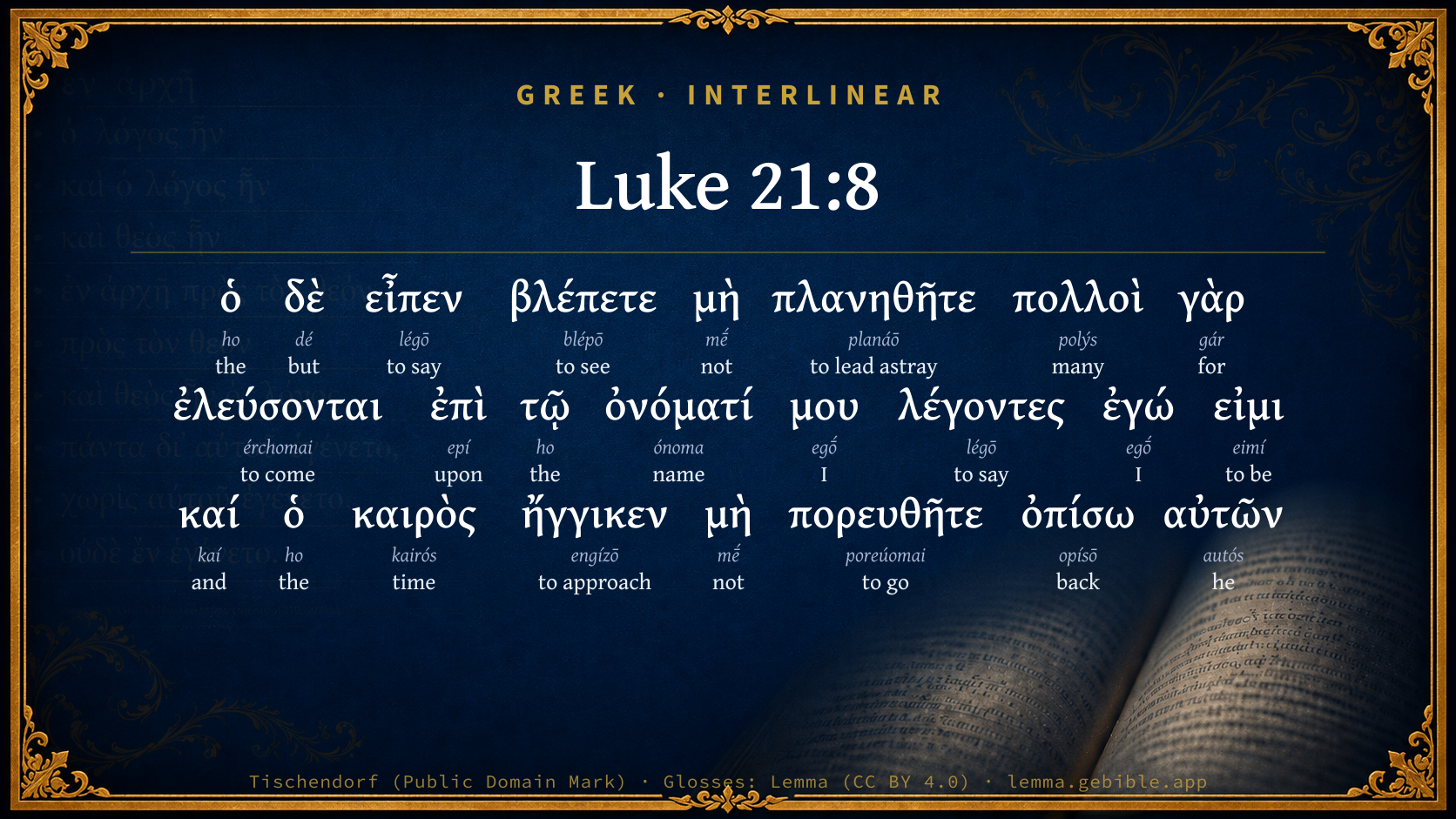
Greek (Tischendorf 8th ed.) Luke 21:8 appears in the Greek New Testament. The text above is from the Tischendorf 8th edition. Each word links to its Strong’s number and a concise gloss. Click any word for its full Thayer’s Greek Lexicon entry.
Download image
Cite this verse

Luke 21:8 (World English Bible). Public Domain. Lemma interlinear Bible study tool, https://lemma.gebible.app/v/luke/21/8.

Show BibTeX & RIS
BibTeX
RIS
English Translation
He said, "Watch out that you don't get led astray, for many will come in my name, saying, 'I AM,' and, 'The time is at hand.' Therefore don't follow them.
World English Bible · Public Domain
Download a study sheet

One document with this verse’s original text, its word-by-word gloss line, the meaning frame, cross-references with their text, attributed commentary, and full source and license credits — printable, and it pastes into notes with its structure intact.

This verse Autodidact and up

Study sheet (.html) Plain text (.txt)

A passage Seminary Student

Up to 50 verses in one chapter. A passage sheet keeps up to 6 commentary sources and 12 cross-references per verse, in the order this page ranks them, and says so on the sheet whenever that leaves anything out. Ask for a single verse and you get the Autodidact verse sheet above.

Everything on this page stays free to read, with no account — the sheet is a download of what is already on screen, not access to it.

Want to remove ads? Support Godless Engineer
Compare translations 3

The same verse in 3 English versions, stacked beneath the original-language interlinear above. Click any original word for its lexicon entry.

Each is an independent rendering of the whole verse — the interlinear is not word-aligned to these translations.

Highlighted words mark where these versions differ — a whole-verse word diff, not a word-by-word alignment.

  • World English Bible Public Domain
    He said, "Watch out that you don't get led astray, for many will come in my name, saying, 'I AM,' and, 'The time is at hand.' Therefore don't follow them.
  • King James Version Public Domain
    And he said, Take heed that ye be not deceived: for many shall come in my name, saying, I am Christ; and the time draweth near: go ye not therefore after them.
  • unfoldingWord Literal Text CC BY-SA 4.0
    Then he said, “Be careful that you are not led astray. For many will come in my name, saying, ‘I am he,’ and, ‘The time has come near.’ Do not go after them.

unfoldingWord Literal Text — © unfoldingWord, licensed CC BY-SA 4.0. Word-aligned USFM3 via Door43 (git.door43.org/unfoldingWord/en_ult).

Versions to compare (up to 4)

3 of 4 selected

Show all 19 translations

Every available English version of this verse, each an independent rendering of the whole verse.

  • World English Bible Public Domain
    He said, "Watch out that you don't get led astray, for many will come in my name, saying, 'I AM,' and, 'The time is at hand.' Therefore don't follow them.
  • Berean Standard Bible Public Domain
    Jesus answered, “See to it that you are not deceived. For many will come in My name, claiming, ‘I am He,’ and, ‘The time is near.’ Do not follow them.
  • Majority Standard Bible Public Domain
    Jesus answered, “See to it that you are not deceived. For many will come in My name, claiming, ‘I am He,’ and, ‘The time is near.’ Therefore do not follow them.
  • King James Version Public Domain
    And he said, Take heed that ye be not deceived: for many shall come in my name, saying, I am Christ; and the time draweth near: go ye not therefore after them.
  • American Standard Version (1901) Public Domain
    And he said, Take heed that ye be not led astray: for many shall come in my name, saying, I am `he'; and, The time is at hand: go ye not after them.
  • Revised Version (1885) Public Domain
    And he said, Take heed that ye be not led astray: for many shall come in my name, saying, I am he; and, The time is at hand: go ye not after them.
  • Geneva Bible (1599) Public Domain
    And he sayd, Take heede, that ye be not deceiued: for many will come in my Name, saying, I am Christ, and the time draweth neere: follow ye not them therefore.
  • Douay-Rheims (1899) Public Domain
    Who said: Take heed you be not seduced; for many will come in my name, saying, I am he; and the time is at hand: go ye not therefore after them.
  • Young's Literal Translation Public Domain
    And he said, `See -- ye may not be led astray, for many shall come in my name, saying -- I am `he', and the time hath come nigh; go not on then after them;
  • Literal Standard Version CC BY-SA 4.0
    And He said, “See—you may not be led astray, for many will come in My Name, saying, I am [He], and the time has come near; do not then go on after them;
  • Unlocked Literal Bible CC BY-SA 4.0
    Jesus answered, “Be careful that you are not deceived. For many will come in my name, saying, 'I am he,' and, 'The time is near.' Do not go after them.
  • unfoldingWord Literal Text CC BY-SA 4.0
    Then he said, “Be careful that you are not led astray. For many will come in my name, saying, ‘I am he,’ and, ‘The time has come near.’ Do not go after them.
  • Darby Bible Public Domain
    And he said, See that ye be not led astray, for many shall come in my name, saying, *I* am [he], and the time is drawn nigh: go ye not [therefore] after them.
  • World Messianic Bible Public Domain
    He said, “Watch out that you don’t get led astray, for many will come in my name, saying, ‘I am he,’ and, ‘The time is at hand.’ Therefore don’t follow them.
  • Webster's Bible Public Domain
    And he said, Take heed that ye be not deceived: for many will come in my name, saying, I am Christ; and the time draweth near: therefore go ye not after them.
  • Free Bible Version CC BY-SA 4.0
    “Make sure you're not deceived,” Jesus warned them. “Many people will come claiming to be me, saying, ‘Here I am!’ and, ‘The time has come!’ but don't follow them.
  • Bible in Basic English Public Domain
    And he said, Take care that you are not tricked: for a number of people will come in my name, saying, I am he; and, The time is near: do not go after them.
  • Text-Critical English NT CC BY 4.0
    He said, “Make sure you are not led astray. For many will come in my name, saying, ‘I am he,’ and, ‘The time has drawn near.’ Do not go after them.
  • Tyndale New Testament (1534) Public Domain
    And he sayd: take hede that ye be not deceaved. For many will come in my name saying: I am he: and the tyme draweth neare. Folowe ye not them therfore.

Literal Standard Version (2020), Covenant Press — licensed CC BY-SA 4.0. Text via the HelloAO Bible API (eBible.org). Unlocked Literal Bible (unfoldingWord) — licensed CC BY-SA 4.0. Text via the HelloAO Bible API (eBible.org). unfoldingWord Literal Text — © unfoldingWord, licensed CC BY-SA 4.0. Word-aligned USFM3 via Door43 (git.door43.org/unfoldingWord/en_ult). Free Bible Version, Dr. Jonathan Gallagher — licensed CC BY-SA 4.0. Text via the HelloAO Bible API (eBible.org).

Word by word

More ways to search: Search by grammar → Find every occurrence → Compare this word →

Practice this passage: Drill this verse → Learn its vocabulary →

ὀπίσω
opísō
G3694
“back”
Adverb
Part of Speech
Adverb
Full Thayer's Definition

Origin: from the same as G3693 with enclitic of direction

TDNT: 09:49,7

1. back, behind, after, afterwards a. of place: things that are behind b. of time: after
  1. ὁ ho G3588 “the” Article, Nominative, Singular, Masculine
  2. δὲ dé G1161 “but” Conjunction
  3. εἶπεν légō G3004 “to say” Verb, Aorist, Active, Indicative, 3rd person, Singular
  4. βλέπετε blépō G991 “to see” Verb, Present, Active, Imperative, 2nd person, Plural
  5. μὴ mḗ G3361 “not” Particle, Negative
  6. πλανηθῆτε planáō G4105 “to lead astray” Verb, Aorist, Passive, Subjunctive, 2nd person, Plural
  7. πολλοὶ polýs G4183 “many” Adjective, Nominative, Plural, Masculine
  8. γὰρ gár G1063 “for” Conjunction
  9. ἐλεύσονται érchomai G2064 “to come” Verb, Future, Middle deponent, Indicative, 3rd person, Plural
  10. ἐπὶ epí G1909 “upon” Preposition
  11. τῷ ho G3588 “the” Article, Dative, Singular, Neuter
  12. ὀνόματί ónoma G3686 “name” Noun, Dative, Singular, Neuter
  13. μου egṓ G1473 “I” Personal pronoun, 1st person, Genitive, Singular
  14. λέγοντες légō G3004 “to say” Verb, Present, Active, Participle, Nominative, Plural, Masculine
  15. ἐγώ egṓ G1473 “I” Personal pronoun, 1st person, Nominative, Singular
  16. εἰμι eimí G1510 “to be” Verb, Present, Active, Indicative, 1st person, Singular
  17. καί kaí G2532 “and” Conjunction
  18. ὁ ho G3588 “the” Article, Nominative, Singular, Masculine
  19. καιρὸς kairós G2540 “time” Noun, Nominative, Singular, Masculine
  20. ἤγγικεν engízō G1448 “to approach” Verb, Perfect, Active, Indicative, 3rd person, Singular
  21. μὴ mḗ G3361 “not” Particle, Negative
  22. πορευθῆτε poreúomai G4198 “to go” Verb, Aorist, Passive deponent, Subjunctive, 2nd person, Plural
  23. αὐτῶν autós G846 “he” Personal pronoun, Genitive, Plural, Masculine

About this verse

These counts appear in no published source. They are computed here, from the morphology-tagged text and Lemma’s own curated glosses. What Lemma adds →

24
words
19
distinct lemmas
Gospels
section

Shared distinctive vocabulary

ὀπίσω back G3694 occurs in 35 verses of the Greek New Testament. Also found in:
Repetition

Words recur within this verse:

Cross-references

17

Topical passages linked to Luke 21:8 in the Treasury of Scripture Knowledge — connected by theme and wording, ordered by reader-vote popularity; previews shown in the World English Bible.

  • 1 John 4:1 Beloved, don't believe every spirit, but test the spirits, whether they are of God, because many false prophets have gone out into the world.
  • Mark 13:5–6 Jesus, answering, began to tell them, "Be careful that no one leads you astray.
  • Ephesians 5:6 Let no one deceive you with empty words. For because of these things, the wrath of God comes on the children of disobedience.
  • 2 Thessalonians 2:3 Let no one deceive you in any way. For it will not be, unless the departure comes first, and the man of sin is revealed, the son of destruction,
  • Matthew 24:4–5 Jesus answered them, "Be careful that no one leads you astray.
  • Matthew 24:11 Many false prophets will arise, and will lead many astray.
  • Mark 13:21–23 Then if anyone tells you, 'Look, here is the Christ!' or, 'Look, there!' don't believe it.
  • Jeremiah 29:8 For thus says Yahweh of hosts, the God of Israel: Don't let your prophets who are in the midst of you, and your diviners, deceive you; neither listen you to your dreams which you cause to be dreamed.
  • 2 Timothy 3:13 But evil men and impostors will grow worse and worse, deceiving and being deceived.
  • Matthew 24:23–25 "Then if any man tells you, 'Behold, here is the Christ,' or, 'There,' don't believe it.
  • Luke 17:23 They will tell you, 'Look, here!' or 'Look, there!' Don't go away, nor follow after them,
  • Acts 5:36–37 For before these days Theudas rose up, making himself out to be somebody; to whom a number of men, about four hundred, joined themselves: who was slain; and all, as many as obeyed him, were dispersed, and came to nothing.
  • Acts 8:9–10 But there was a certain man, Simon by name, who used to practice sorcery in the city, and amazed the people of Samaria, making himself out to be some great one,
  • 2 Corinthians 11:13–15 For such men are false apostles, deceitful workers, masquerading as Christ's apostles.
  • 2 Thessalonians 2:9–11 even he whose coming is according to the working of Satan with all power and signs and lying wonders,
  • 2 John 1:7 For many deceivers have gone out into the world, those who don't confess that Jesus Christ came in the flesh. This is the deceiver and the Antichrist.
  • Revelation 12:9 The great dragon was thrown down, the old serpent, he who is called the devil and Satan, the deceiver of the whole world. He was thrown down to the earth, and his angels were thrown down with him.

Cross-references courtesy of OpenBible.info (CC BY 4.0).

Where the printed editions differ

1 variant

Places in this verse where the major printed Greek editions disagree on the wording in a way that affects the translation — a comparison of editions, not a manuscript-by-manuscript collation. The editions are the modern critical texts (Nestlé-Aland 28/27, SBL, Westcott-Hort, Tregelles, Tyndale House) and the traditional texts behind the KJV (the Textus Receptus and the Byzantine/Majority text). It is not a claim about which reading is original.

  1. Extra text
    οὖν

    “therefore”

    In TRByz Not in NA28NA27TynSBLWHTreg

    οὖν (oun) 'therefore' is only in traditional manuscripts (TR+Byz)

Textual data: Translators Amalgamated Greek New Testament (STEPBible TAGNT) · CC BY 4.0.

Commentary

Notes on Luke 21:8 from classic Christian and Jewish commentators (each source and its license shown beneath its notes). The classic Christian expositions comment on the surrounding passage and are grouped to its opening verse, so a note may address several verses; the Jewish commentaries on the Tanakh (Rashi and others) are per-verse, so they appear only where the commentator wrote on this verse.

Lemma curates 59 commentaries, every one of them public domain or Creative Commons licensed, each selected and text-cleaned for this edition rather than reprinted as found. About our sources →

Tyndale Open Study Notes

Tyndale Open Resources

21:8-11 Jesus foretold events that are often misinterpreted as signs of the end, such as the appearance of false messiahs, wars, earthquakes, famines, and severe persecution, but Jesus said that the end won’t follow immediately.

21:8 claiming, ‘I am the Messiah’: See study note on Mark 13:5-6.

Tyndale Open Study Notes — © Tyndale Open Resources, licensed CC BY-SA 4.0. Text via the HelloAO Bible API.

Bengel's Gnomon

Johann Albrecht Bengel

Luk 21:8. Ὁ καιρὸς ἤγγικε, the time draweth near [hath drawn near]) viz. the time of the Messiah. The thing itself in the thesis (the general proposition) is true. Mar 1:15 [“The time is fulfilled, and the kingdom of God is at hand”]. The true Messiah has many characteristic marks, one of which is, the true time, to wit of both Advents. But false Messiahs and impostors boastingly alleged a false time for Jerusalem being ennobled by the setting up of the kingdom of God, at the very time when destruction was about immediately to assail it: Luk 21:24.

Bengel's Gnomon of the New Testament — English translation (T&T Clark, Edinburgh, 1860) — public domain. Text from a community e-Sword module.

Expositor's Greek Testament

ed. W. Robertson Nicoll

Luk 21:8-11 . Signs prelusive of the end (Mat 24:4-8 , Mar 13:5-11 ). βλέπετε , etc., take heed that ye be not deceived . This the keynote not to tell when, but to protect disciples from delusions and terrors. ἐπὶ τῷ ὀνόματί μου , in my name, i.e. , calling themselves Christs. Vide at Mt. on these false Messiahs. ὁ καιρὸς ἤγγικε : the καιρὸς should naturally mean Jerusalem’s fatal day.

The Expositor's Greek Testament, edited by W. Robertson Nicoll (1897–1910) — public domain. Text from a community e-Sword module.

Godet's Commentaries

Frédéric Louis Godet

2. The Discourse: Luk 21:8-36.

The four points treated by Jesus are: 1 st. The apparent signs, which must not be mistaken for true signs (Luk 21:8-19); 2 d. The true sign, and the destruction of Jerusalem which will immediately follow it, with the time of the Gentiles which will be connected with it (Luk 21:20-24); 3 d. The Parousia, which will bring this period to an end (Luk 21:25-27); 4 th. The practical application (Luk 21:28-36).

Vers. 8-19. The Signs which are not such.—“But He said, Take heed that ye be not deceived; for many shall come in my name, saying, I am he, and the time draweth near. Go ye not therefore after them. 9. And when ye shall hear of wars and commotions, be not terrified; for these things must first come to pass; but the end cometh not so speedily. 10. Then said He unto them, Nation shall rise against nation, and kingdom against kingdom. 11. And great earthquakes shall be in divers places, and famines, and pestilences, as well as great and terrible signs from heaven. 12. But above all, they shall lay their hands on you, and persecute you, delivering you up to the synagogues, and into prisons, bringing you before kings and rulers for my name’s sake. 13. But it shall turn to you for a testimony. 14. Settle it, therefore, in your hearts, not to meditate before what ye shall answer. 15. For I will give you a mouth and wisdom, which all your adversaries shall not be able to gainsay nor resist. 16. And ye shall be betrayed even by parents, and brethren, and kinsfolks, and friends; and some of you shall they cause to be put to death; 17. And ye shall be hated of all for my name’s sake; 18. And there shall not an hair of your head perish. 19. In your patience save ye your lives.”

The sign to which the question of the apostle refers is not indicated till Luk 21:20. The signs Luk 21:8-19 are enumerated solely to put believers on their guard against the decisive value which they might be led to ascribe to them. The vulgar are inclined to look on certain extraordinary events in nature or society as the evidences of some approaching catastrophe. Many events of this kind will happen, Jesus means to say, but without your being warranted yet to conclude that the great event is near, and so to take measures precipitately. The seduction of which Matthew and Mark speak is that which shall be practised by the false Messiahs. The meaning is probably the same in Luke (γάρ). History, it is true, does not attest the presence of false Messiahs before the destruction of Jerusalem. And those who are most embarrassed by this fact are just our modern critics, who see in this discourse nothing but a prophecy ab eventu. They suppose that the author alludes to such men as Judas the Galilean, the Egyptian (Acts 21), Theudas, and others, prudently described by Josephus as mere heads of parties, but who really put forth Messianic pretensions. This assertion is hard to prove. For our part, who see in this discourse a real prophecy, we think that Jesus meant to put believers on their guard against false teachers, such as Simon the magician, of whom there may have been a great number at this period, though he is the only one of whom profane history speaks.

The μὴ πτοηθῆναι, not to let themselves be terrified (Luk 21:9), refers to the temptation to a premature emigration. Comp. the opposite Luk 21:21. Further, it must not be concluded from the political convulsions which shall shake the East that the destruction of Jerusalem is now near.

Jesus had uttered in substance His whole thought in those few words; and He might have passed immediately to the contrast ὅταν δέ, but when (Luk 21:20). Yet He developes the same idea more at length, Luk 21:10-19. Hence the words in which Luke expressly resumes his report: Then said He unto them (Luk 21:10). This passage, Luk 21:10-19, might therefore have been inserted here by Luke as a fragment borrowed from a separate document differing from the source whence he took the rest of the discourse.

We should not take the words ἔλεγεν αὐτοῖς as a parenthetical proposition, and connect τότε with ἐγερθήσεται: “Then said He unto them, One nation shall rise.” According to the analogy of Luke’s style, we should rather translate: “Then said He unto them, One nation...” When to great political commotions there are added certain physical phenomena, the imagination is carried away, and the people become prophets. Jesus puts the Church of Palestine on its guard against this tendency (Luk 21:11). It is well known that the times which preceded the destruction of Jerusalem were signalized in the East by many calamities, particularly by a dreadful famine which took place under Claudius, and by the earthquake which destroyed Laodicea, Hierapolis, etc., in 67 or 68. By the signs from heaven we are to understand meteors, auroras, eclipses, etc., phenomena to which the vulgar readily attach a prophetic significance.

One of those events which contribute most to inflame fanaticism in a religious community is persecution; thus are connected Luk 21:12-13. Those which are announced will arise either from the Jews (synagogues), like that marked by the martyrdoms of Stephen and James, or from the Gentiles (kings and rulers), like that to which Paul was exposed in Palestine, or that raised by Nero at Rome.

In the phrase, before all these, the πρό (before) refers to the importance of this sign, not to its time. Meyer denies that πρό can have this meaning; but Passow’s dictionary cites a host of examples for it. It is, besides, the only meaning which suits the context. If πρό here signified before, why not speak of the persecutions before the preceding signs? What Jesus means by this word is, that among all those signs, this is the one which might most easily throw His disciples out of the calm attitude in which they ought to persevere. We have translated the passive ἀγομένους by the active (bringing). It is hardly possible to render the passive form into English. Holtzmann thinks that Luke here traces after the event, though in the form of prophecy, the picture of those persecutions to which St. Paul was exposed. Can we suppose an evangelist, to whom Jesus is the object of faith, allowing himself deliberately thus to put words into His mouth after his fancy?

Bleek applies the word testimony (Luk 21:13) to that which will accrue to the apostles from this proof of their fidelity. It is more natural, having in view the connection with Luk 21:14-15 (therefore, Luk 21:14), to understand by it what they shall themselves render on occasion of their persecution. This idea falls back again into the Be not terrified: “All that will only end in giving you the opportunity of glorifying me!” It is the same with Luk 21:14-15, the object of which is to inspire them with the most entire tranquillity of soul in the carrying out of their mission. Jesus charges Himself with everything: ἐγὼ δώσω, I will give.

The mouth is here the emblem of the perfect ease with which they shall become the organs of the wisdom of Jesus, without the least preparation. The term ἀντειπεῖν, gainsay, refers to the fact that their adversaries shall find it impossible to make any valid reply to the defence of the disciples; the word resist, to the powerlessness to answer when the disciples, assuming the offensive, shall attack them with the sword of the gospel. In the Alex. reading, which places ἀντιστῆναι first, we must explain ἤ in the sense of or even.

To official persecution there shall be added the sufferings of domestic enmity. The name of Jesus will open up a gulf between them and their nearest. Luk 21:17 is almost identical with Joh 15:21. But even in that case there will be no ground for disquiet. The time will not yet have come for them to quit the accursed city and land. Luk 21:18: “There shall not an hair of your head perish,” seems to contradict the close of Luk 21:16: “some of you shall perish.” This contradiction is explained by the general point of view from which we explain this piece: There shall, indeed, be some individual believers who shall perish in the persecution, but the Christian community of Palestine as a whole shall escape the extermination which will overtake the Jewish people. Their condition is indicated in Luk 21:19, where this piece is resumed. It is one of patience, that is to say, peaceful waiting for the divine signal, without being drawn aside either by the appeals of a false patriotism or by persecution, or by false signs and anti-Christian seductions. The fut. κτήσεσθε in A. B. is probably a correction of the aor. κτήσασθε (T. R.). The imper. signifies: “Embrace the means which seem the way to lose everything..., and ye shall save yourselves.” Κτᾶσθαι does not mean to possess (Ostervald), but to acquire. The word suggests that of Jeremiah, I will give thee thy life for a prey. And now at length comes the contrast: the time when it will be necessary to leave the passive attitude for that of action (ὅταν δέ, but when, Luk 21:20).

Frédéric Louis Godet — Commentaries on Luke, John, Romans, and 1 Corinthians — English translation (T&T Clark, Edinburgh, 1870s–1890s) — public domain. Text from a community e-Sword module.

Geneva Bible (1599)

Geneva Bible translators

Using my Name.

Geneva Bible (1599) marginal notes — public domain. Text via Bolls.life.

Jamieson, Fausset & Brown

Robert Jamieson, A. R. Fausset & David Brown

the time--of the Kingdom, in its full glory.

go . . . not . . . after them--"I come not so very soon" (Th2 2:1-2) [STIER].

Jamieson, Fausset & Brown — Commentary Critical and Explanatory on the Whole Bible (1871) — public domain (CC PDM 1.0). Text via the HelloAO Bible API.

Adam Clarke's Commentary

Verse 8. Many shall come in my name] Usurping my name: calling themselves the Messiah. See Mt 24:5. Concerning this prediction of the destruction of Jerusalem, and its literal accomplishment, see the notes on Mt 24:1-42.

Adam Clarke's Commentary on the Bible (1810–1826) — public domain. Text from a community e-Sword/MySword module.

Ellicott's Commentary for English Readers

(8) Saying, I am Christ.—Literally, I am. The italics show that the word “Christ” is an interpolation. The sentence is better left in the vagueness of the original, or with only a pronoun as the predicate, I am He. The use of the words in Joh_1:21; Joh_8:58, may be referred to as showing that they had become significant even without a predicate.

The time draweth near.—Better, the season has come near.

Go ye not therefore . . .—The better MSS. omit the last words.

A Bible Commentary for English Readers, edited by Charles John Ellicott (1878–1897) — public domain. Text from a community e-Sword module.

The Cambridge Bible for Schools and Colleges

gen. ed. J. J. S. Perowne

8-27. Signs of the End.

8. Take heed that ye be not deceived] A danger incurred even by the elect. Mat_24:24. The moral key-notes of this great Discourse of the Last. Things (Eschatology) are Beware! Watch ! Endurel Pray!

for many shall come in my name] “Even now are there many antichrists,” 1Jn_2:18. the time draweth near] Rather, the crisis has approached.

The Cambridge Bible for Schools and Colleges (gen. ed. J. J. S. Perowne; Cambridge University Press, 1878–1918) — public domain. Text from a community e-Sword module.

John Gill's Exposition

And he said, take heed that ye be not deceived,.... With false Christs, and false prophets:

for many shall come in my name; making use of his name, taking it to them; not that they would pretend they were sent by him, but that they were he himself:

saying, I am Christ; so the Syriac and Persic versions supply as we do:

and the time draweth near; not that such will come, but when come, they will say, that the time of the deliverance of the Jewish nation from the Roman yoke is at hand:

go ye not therefore after them; do not be their disciples, or follow them where they would lead you; for nothing but destruction will be the consequence of it.

John Gill's Exposition of the Whole Bible (1746–1763) — public domain (CC PDM 1.0). Text via the HelloAO Bible API.

Trapp's Complete Commentary

John Trapp

8 And he said, Take heed that ye be not deceived: for many shall come in my name, saying, I am Christ; and the time draweth near: go ye not therefore after them.

Ver. 8. See Mat 24:4-5, &c.

John Trapp, A Commentary or Exposition upon All the Books of the Old and New Testament (1647–1656) — public domain. Text from a community e-Sword module.

Haydock's Catholic Bible Commentary

In my name. They shall not say that they belong to me, or that I sent them: but they shall take to themselves my name, viz. Christ, or Messias, which title is incommunicable to any but myself. In effect, in less than two centuries, there appeared many false Christs and impostors, who pretended to be the one that was to come, the desired of nations. (Calmet) --- Perhaps this prophecy is yet to be more expressly fulfilled before the dissolution of the world. Many pious and learned Christians suppose this passage to refer to the time of Antichrist. (Haydock)

George Leo Haydock (1774–1849), Haydock's Catholic Family Bible and Commentary, 1859 edition — public domain. Excludes Psalms (Douay-Rheims chapter numbering differs from Protestant) and Deuterocanonical books (Catholic canon only).

Matthew Poole's English Annotations

See Poole on "Mat 24:4-5", See Poole on "Mar 13:5-6". This happened, and was abundantly fulfilled, before the destruction of Jerusalem, and probably will receive a further fulfilling in the latter end of the world. But before the destruction of Jerusalem it was, as Josephus assures us, fulfilled in many, particularly:

1. In one Theudas, whether the same mentioned by Gamaliel, Act 5:36, or some other of that name, is uncertain.

2. An Egyptian sorcerer, mentioned Act 21:38.

3. One Dositheus, a Samaritan.

4. Another in the time of Festus’s government.

5. Simon Magus is also reckoned for one, Act 8:9. He boasted he was the great power of God. Others also reckon one Menander, a disciple of Simon Magus.

It is certain there were many who arrogated to themselves the name of the Messiah, to countenance their heading of a faction. There have also been many since the destruction of Jerusalem, and probably will be many more before the end of the world, 2Ti 4:3; 2Pe 2:1; 1Jo 2:18.

Matthew Poole's English Annotations on the Holy Bible (1683–1685) — public domain. Text from a community e-Sword/MySword module.

Whedon's Commentary on the Bible

Daniel D. Whedon

8. The time draweth near—It must not be understood that our Lord here prophesies that the false Christs would assume to be Messiah returned to judgment. They could only claim that the Messiah’s kingdom was alone to be set up on earth; and the time of that event was, indeed, drawing near.

Daniel D. Whedon (gen. ed.), Commentary on the Old and New Testaments (1874–1909) — public domain. Text from a community e-Sword module.

The Pulpit Commentary

Vers. 8-19. The apparent signs which (could show themselves, but which must not be mistaken for the true signs immediately preceding the catastrophe.

Many shall come in my name, saying, I am Christ. Many of these pretenders appeared in the lifetime of the apostles. Josephus mentions several of these impostors ("Ant.," 20:8 "Bell. Jud:," 2:13. Theudas, one of these pretenders, is referred to in Act_21:38 (see, too, Josephus, "Ant.," 20:5. Simon Magus announced that he was Messiah. His riyal Dositheus, his disciple Menander, advanced similar pretences. Mr. Greswell (quoted by Dean Manse, "Speaker"s Commentary," on Mat_24:5) has called attention to the remarkable fact that, while many of these false Messiahs appeared in the interval between the Lord"s ascension and the Jewish war, there is no evidence that any one arose claiming this title before the beginning of his ministry. It was necessary, he infers, that the true Christ should first appear and be rejected by the great body of the nation, before they were judicially given over to the delusions of the false Christs.

The Pulpit Commentary (1880–1919), ed. H.D.M. Spence-Jones & Joseph S. Exell — public domain. Text from a community e-Sword module.

John Wesley's Explanatory Notes

I am the Christ; and the time is near - When I will deliver you from all your enemies. They are the words of the seducers.

John Wesley, Explanatory Notes Upon the Whole Bible (1754–1765) — public domain. Text via the GEBible commentary corpus.

Scofield Reference Notes

C. I. Scofield

And he said

See note on the Olivet discourse. (See Scofield "Mat 24:3").

The Scofield Reference Bible (1917 edition), notes by C. I. Scofield — public domain. Text from a community e-Sword module.

Kretzmann's Popular Commentary

Paul E. Kretzmann

Tokens of the end:

v. 8. And He said, Take heed that ye be not deceived; for many shall come in My name, saying, I am Christ; and the time draweth near; go ye not therefore after them.

v. 9. But when ye shall hear of wars and commotions, be not terrified; for these things must first come to pass; but the end is not by and by.

v. 10. Then said He unto them, Nation shall rise against nation, and kingdom against kingdom;

v. 11. and great earthquakes shall be in divers places, and famines, and pestilences; and fearful sights and great signs shall there be from heaven.

It is a characteristic of prophecy that there is rarely an exact division of time according to human standards, for there is no time before the eternal, omniscient God. Whether things will happen a thousand years hence or within a few years does not influence the Lord’s time. For all things before Him are happening and taking place in the great present. And so in this case the Lord speaks of the two impending catastrophes, the destruction of Jerusalem and the end of the world, in almost the same breath, connecting them in such a way that the signs foretelling the one must be taken in a measure to refer to the other also. The Lord’s first warning is against deception. In the days before the calamity which wiped out Jerusalem, false Christs arose, and in the name of the true Christ, the Messiah, at that. Deceivers of that kind appeared often in the decades after Christ’s ascension, and always did they find people willing to listen to them and to cast their fortunes with that of the fraudulent impersonator. Even so the false Christs and false prophets of our days are multiplying with great rapidity; in Eddyism, in Russellism, in Dowieism, and in scores of minor sects they arise to deceive the people of God. Their call and promise invariably is: Here is Christ; here is the full truth; the time is near. They have even, repeatedly, fixed the date of Christ’s coming to Judgment. But the believers should pay no attention to them nor follow after them as their disciples, for they are deceivers. As in the days before the destruction of Jerusalem there were wars and uprisings throughout the Roman Empire, but especially in Palestine, so the terrible World War of these last days and the uprisings throughout the world are speaking a strong language to them that heed. As in those days people rose against people and kingdom against kingdom, making it necessary for the Roman legions to be on the move continually, so, while the world stands, neither the most rosy nor the most practical dreams of diplomats will succeed in eliminating war. At the very moment when they are shouting peace with a voice calculated to drown opposition, they are trying to hide the selfishness of their plans which will plunge the world into further wars. As there were great earthquakes in many parts of the world in those days, in Asia Minor, in Italy, in Syria, so the recent terrible catastrophes in Italy, in Alaska, in Java, in Central America have filled the world with horrified astonishment. As great famines and pestilences visited various countries, especially Palestine, in those days, so the pestilence which recently swept the world and even now baffles science in certain of its aspects, and so the famines that have been reported from large areas of Europe and Asia, are God’s reminders of the end. As there were terrifying phenomena and fearful portents from heaven in those days, some of which are told by Josephus, so the science of astronomy is unable to account for many things out in the universe today and will be utterly helpless before the manifestations of the last great day.

Paul E. Kretzmann, Popular Commentary of the Bible (1921–1924) — public domain. Text from a community e-Sword module.

Burkitt's Expository Notes on the New Testament

William Burkitt

Observe here, Christ does not gratify his disciples’ curiosity, but acquaints them with their present duty; namely, to watch against deceivers and seducers, who should have the impudence to affirm themselves to be Christs, saying, I am Christ: some Christs personal, or the Messiah; others Christs doctrinal, affirming their erroneous opinions to be Christ’s mind and doctrine: Take heed that ye be not deceived, for many shall come in my name, saying, I am Christ.

Observe farther, the signs which our Saviour gives of Jerusalem’s approaching destruction, namely, the many broils and commotions, the civil disorders and dissensions, that should be found among the Jews immediately before: Ye shall hear of wars and commotions, and see fearful sights, and great signs from heaven. Josephus declares, that there appeared in the air chariots and horsemen skirmishing, and that a blazing star in fashion of a sword hung over the city for a year together.

Hence learn, that war, pestilence, and famine, are judgments and calamities inflicted by God upon a sinful people for their contempt of Christ and gospel grace. Ye shall hear of war, famine, and pestilence.

William Burkitt's Expository Notes on the New Testament (1700–1703) — public domain. Text from a community e-Sword module.

Cambridge Greek Testament for Schools and Colleges

8–27. SIGNS OF THE END

8. οὗν is omitted by אBDLX La[355] Ti[356]

[355] La. Lachmann.

[356] Ti. Tischendorf.

8. μὴ πλανηθῆτε. A danger incurred even by the elect. Mat 24:24. The moral key-notes of this great Discourse of the Last Things (Eschatology) are Beware! Watch! Endure! Pray!

πολλοὶ γὰρ κ.τ.λ. “Even now are there many antichrists,” 1Jn 2:18.

ὁ καιρὸς ἤγγικεν. ‘The crisis has approached.’

Cambridge Greek Testament for Schools and Colleges (Cambridge University Press, 1896; 21 vols, various authors incl. Carr, Maclear, Plummer, Farrar, Lumby, Moule, M. R. James, Simcox) — public domain. Text from a community e-Sword module.

Alford’s Greek Testament

Henry Alford

8.] ὁ κ. ἤγγ., i.e. the time of the Kingdom.

They are the words, not of our Lord, but of the πολλοί: see on Matt. vv. 4, 5.

Henry Alford, The Greek Testament (1849–1861) — public domain. Text from a community e-Sword module.

International Critical Commentary

8-28. The Prophecy. The Troubles which will follow the Departure of Christ—False Christs, Wars, Persecutions (8-19), The Destruction of Jerusalem (20-24). The Signs of the Return of the Son of Man (25-28). The record of the prediction in Mt. and Mk. is similarly arranged. But in all three records the outlines of the two main events, with their signs, cannot always, be disentangled. Some of the utterances clearly point to the Destruction of Jerusalem; others equally clearly to the Return of the Christ. But there are some which might apply to either or both; and we, who stand between the two, cannot be sure which one, if only one, is intended. In its application to the lives of the hearers each event taught a similar truth, and conveyed a similar warning; and therefore a clearly cut distinction between them was as little needed as an exact statement of date. Some of the early commentators held that the whole of the prophecy refers to the end of the world without including the fall of Jerusalem.

8. πλανηθῆτε. “Be led astray?” The verb is used nowhere else in Lk. It implies no mere mistake, but fundamental departure from the truth: Joh 7:47; 1Jn 1:8, 1Jn 1:2:26, 1Jn 1:3:7; Rev 2:20, Rev 12:9, Rev 20:3-10, etc. “Deceive” (AV.) would rather be ἀπατᾷν (Jas 1:26: comp. 1Co 3:18; Gal 6:3).

ἐπὶ τῷ ὀνόματί μου. Christ’s name will be the basis of their claim. We know of no false Messiahs between the Ascension and the fall of Jerusalem. Theudas (Act 5:36), Simon Magus (Act 8:9), the Egyptian (Act 21:38) do not seem to have come forward as Messiahs. Dositheus, Simon Magus, and Menander might be counted among the “many antichrists” of 1Jn 2:18, but not as false Christs. We seem, therefore, at the outset to have a sign which refers rather to Christ’s return than to the destruction of Jerusalem.

International Critical Commentary — older volumes (1896–1929), various authors — public domain. Text from a community e-Sword module.

Vincent's Word Studies in the New Testament

Marvin R. Vincent

Deceived. Rev., rightly, led astray. See on Mt 24:4.

In my name. See on Mt 18:5.

Marvin R. Vincent, Word Studies in the New Testament (1887–1900) — public domain. Text from a community e-Sword/MySword module.

Lesson kit

Teaching starters — assembled from the data on this page, not authored interpretation. Every prompt links to the verse data it draws on. Edit before teaching.

Luke, in the Gospels, opens this verse with 24 words (19 distinct Greek lemmas). Its most distinctive word is opísō (“back”). A historical commentator’s framing appears above. Read the whole chapter for the surrounding context.

Discussion questions

  1. What does “back” (opísō) contribute to the verse as a whole?
  2. Matthew 3:11 shares the word «back» with this verse. How do the two illuminate each other?
  3. “to say” occurs 2× in this one verse. What is the effect of the repetition?
  4. These translations render this verse differently. What is at stake in choosing one wording over another?
  5. Reading how Tyndale Open Study Notes and Bengel's Gnomon read this verse, where do the two commentators agree and where do they part?

Things to notice

Reading settings

Reading text

Shown beneath each verse's original-language words.

Old Testament
Old Testament edition

Read the OT as the Masoretic Hebrew (MT) or the Greek Septuagint (LXX).

English shown for the Greek Septuagint (in the Hebrew ↔ Greek comparison).

Comparing translations? Open the Compare panel on any verse page to stack up to four side by side.