
Mark 3:8

Greek (Tischendorf 8th ed.) Mark 3:8 appears in the Greek New Testament. The text above is from the Tischendorf 8th edition. Each word links to its Strong’s number and a concise gloss. Click any word for its full Thayer’s Greek Lexicon entry.
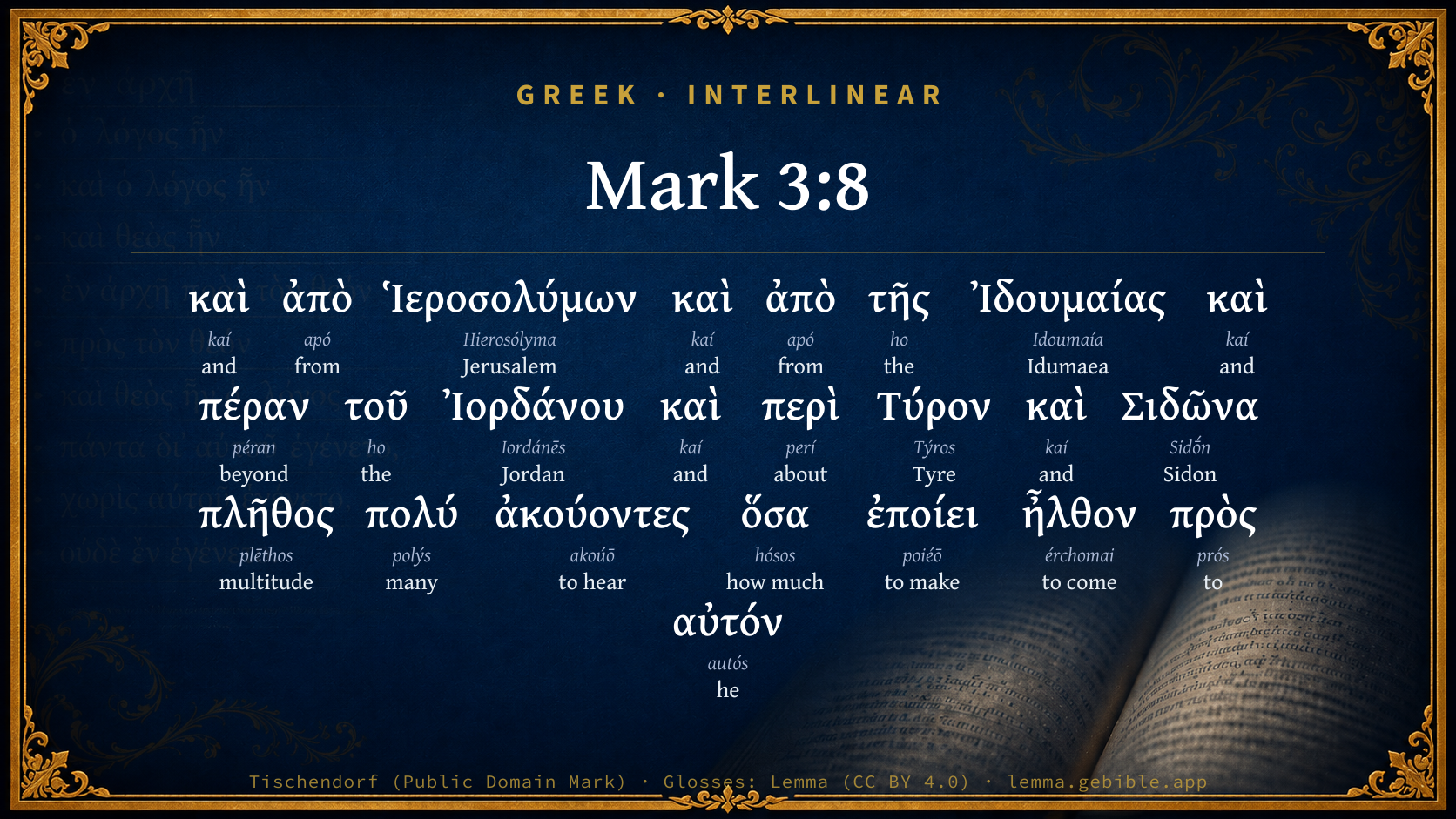
Download image
Cite this verse

Mark 3:8 (World English Bible). Public Domain. Lemma interlinear Bible study tool, https://lemma.gebible.app/v/mark/3/8.

Show BibTeX & RIS
BibTeX
RIS
English Translation
from Jerusalem, from Idumaea, beyond the Jordan, and those from around Tyre and Sidon. A great multitude, hearing what great things he did, came to him.
World English Bible · Public Domain
Highlights
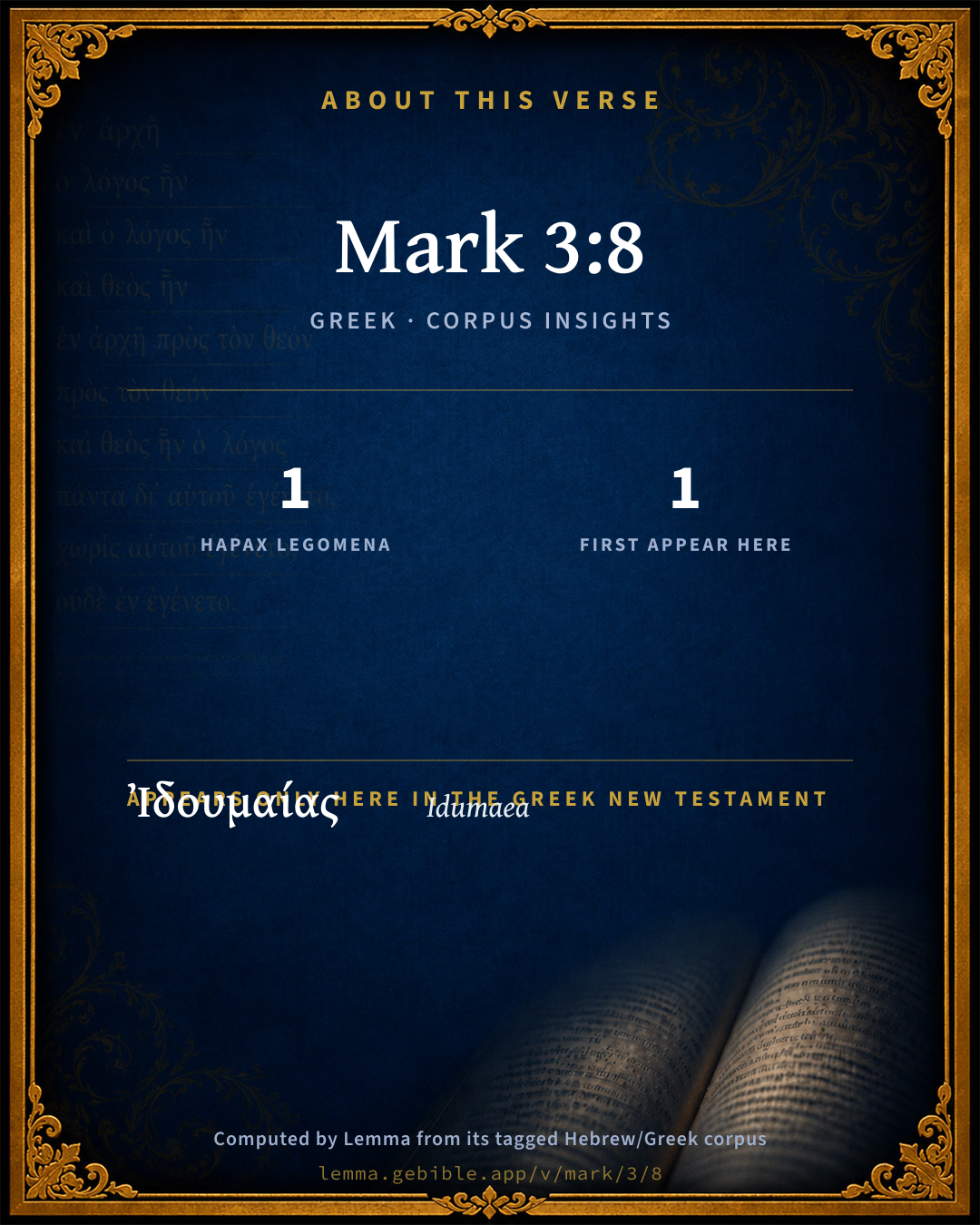
  • 1 hapax legomenon — only here in the Greek New Testament
  • 1 first appearance in the Greek New Testament
Full analysis ↓
Download a study sheet

One document with this verse’s original text, its word-by-word gloss line, the meaning frame, cross-references with their text, attributed commentary, and full source and license credits — printable, and it pastes into notes with its structure intact.

This verse Autodidact and up

Study sheet (.html) Plain text (.txt)

A passage Seminary Student

Up to 50 verses in one chapter. A passage sheet keeps up to 6 commentary sources and 12 cross-references per verse, in the order this page ranks them, and says so on the sheet whenever that leaves anything out. Ask for a single verse and you get the Autodidact verse sheet above.

Everything on this page stays free to read, with no account — the sheet is a download of what is already on screen, not access to it.

Want to remove ads? Support Godless Engineer
Compare translations 3

The same verse in 3 English versions, stacked beneath the original-language interlinear above. Click any original word for its lexicon entry.

Each is an independent rendering of the whole verse — the interlinear is not word-aligned to these translations.

Highlighted words mark where these versions differ — a whole-verse word diff, not a word-by-word alignment.

  • World English Bible Public Domain
    from Jerusalem, from Idumaea, beyond the Jordan, and those from around Tyre and Sidon. A great multitude, hearing what great things he did, came to him.
  • King James Version Public Domain
    And from Jerusalem, and from Idumaea, and from beyond Jordan; and they about Tyre and Sidon, a great multitude, when they had heard what great things he did, came unto him.
  • unfoldingWord Literal Text CC BY-SA 4.0
    and from Jerusalem and from Idumea and beyond the Jordan and around Tyre and Sidon a great multitude, hearing how much he was doing, came to him.

unfoldingWord Literal Text — © unfoldingWord, licensed CC BY-SA 4.0. Word-aligned USFM3 via Door43 (git.door43.org/unfoldingWord/en_ult).

Versions to compare (up to 4)

3 of 4 selected

Show all 19 translations

Every available English version of this verse, each an independent rendering of the whole verse.

  • World English Bible Public Domain
    from Jerusalem, from Idumaea, beyond the Jordan, and those from around Tyre and Sidon. A great multitude, hearing what great things he did, came to him.
  • Berean Standard Bible Public Domain
    Jerusalem, Idumea, the region beyond the Jordan, and the vicinity of Tyre and Sidon. The large crowd came to Him when they heard what great things He was doing.
  • Majority Standard Bible Public Domain
    Jerusalem, Idumea, the region beyond the Jordan, and the vicinity of Tyre and Sidon. The large crowd came to Him when they heard what great things He was doing.
  • King James Version Public Domain
    And from Jerusalem, and from Idumaea, and from beyond Jordan; and they about Tyre and Sidon, a great multitude, when they had heard what great things he did, came unto him.
  • American Standard Version (1901) Public Domain
    and from Jerusalem, and from Idumaea, and beyond the Jordan, and about Tyre and Sidon, a great multitude, hearing what great things he did, came unto him.
  • Revised Version (1885) Public Domain
    and from Jerusalem, and from Idumaea, and beyond Jordan, and about Tyre and Sidon, a great multitude, hearing what great things he did, came unto him.
  • Geneva Bible (1599) Public Domain
    And from Ierusalem, and from Idumea, and beyonde Iordan: and they that dwelled about Tyrus and Sidon, when they had heard what great things he did, came vnto him in great number.
  • Douay-Rheims (1899) Public Domain
    And from Jerusalem, and from Idumea, and from beyond the Jordan. And they about Tyre and Sidon, a great multitude, hearing the things which he did, came to him.
  • Young's Literal Translation Public Domain
    and from Jerusalem, and from Idumea and beyond the Jordan; and they about Tyre and Sidon -- a great multitude -- having heard how great things he was doing, came unto him.
  • Literal Standard Version CC BY-SA 4.0
    and from Jerusalem, and from Idumea and beyond the Jordan; and they around Tyre and Sidon—a great multitude—having heard how He was doing great things, came to Him.
  • Unlocked Literal Bible CC BY-SA 4.0
    and from Jerusalem and from Idumea and beyond the Jordan and around Tyre and Sidon. When they heard about the things he was doing, a great crowd came to him.
  • unfoldingWord Literal Text CC BY-SA 4.0
    and from Jerusalem and from Idumea and beyond the Jordan and around Tyre and Sidon a great multitude, hearing how much he was doing, came to him.
  • Darby Bible Public Domain
    and from Jerusalem, and from Idumaea and beyond the Jordan; and they of around Tyre and Sidon, a great multitude, having heard what things he did, came to him.
  • World Messianic Bible Public Domain
    from Jerusalem, from Idumaea, beyond the Jordan, and those from around Tyre and Sidon. A great multitude, hearing what great things he did, came to him.
  • Webster's Bible Public Domain
    And from Jerusalem, and from Idumea, and from beyond Jordan; and they about Tyre and Sidon, a great multitude, when they had heard what great things he did, came to him.
  • Free Bible Version CC BY-SA 4.0
    Jerusalem, Idumea, Transjordan, and from the regions of Tyre and Sidon. So many people came to see him because they'd heard about all he was doing.
  • Bible in Basic English Public Domain
    And from Jerusalem, and from Idumaea, and the other side of Jordan, and the country about Tyre and Sidon, a great number, hearing what great things he did, came to him.
  • Text-Critical English NT CC BY 4.0
    Jerusalem, Idumea, and beyond the Jordan. A great multitude of people from around Tyre and Sidon also came to him when they heard about everything he was doing.
  • Tyndale New Testament (1534) Public Domain
    and from Hierusalem and from Idumea and from beyonde Iordane: and they that dwelled about Tyre and Sidon a greate multitude: which when they had herde what thinges he dyd came vnto him.

Literal Standard Version (2020), Covenant Press — licensed CC BY-SA 4.0. Text via the HelloAO Bible API (eBible.org). Unlocked Literal Bible (unfoldingWord) — licensed CC BY-SA 4.0. Text via the HelloAO Bible API (eBible.org). unfoldingWord Literal Text — © unfoldingWord, licensed CC BY-SA 4.0. Word-aligned USFM3 via Door43 (git.door43.org/unfoldingWord/en_ult). Free Bible Version, Dr. Jonathan Gallagher — licensed CC BY-SA 4.0. Text via the HelloAO Bible API (eBible.org).

Word by word

More ways to search: Search by grammar → Find every occurrence → Compare this word →

Practice this passage: Drill this verse → Learn its vocabulary →

Ἰδουμαίας
Idoumaía
G2401
“Idumaea”
Noun, Genitive, Singular, Feminine
Part of Speech
Noun
Case
Genitive
Number
Singular
Gender
Feminine
Full Thayer's Definition

Origin: of hebrew origin H123

TDNT: None

1. Idumaea, the name of a region between southern Palestine and the Arabian Petraea inhabited by Edom or Esau and his posterity
  1. καὶ kaí G2532 “and” Conjunction
  2. ἀπὸ apó G575 “from” Preposition
  3. Ἱεροσολύμων Hierosólyma G2414 “Jerusalem” Noun, Genitive, Plural, Neuter
  4. καὶ kaí G2532 “and” Conjunction
  5. ἀπὸ apó G575 “from” Preposition
  6. τῆς ho G3588 “the” Article, Genitive, Singular, Feminine
  7. καὶ kaí G2532 “and” Conjunction
  8. πέραν péran G4008 “beyond” Adverb
  9. τοῦ ho G3588 “the” Article, Genitive, Singular, Masculine
  10. Ἰορδάνου Iordánēs G2446 “Jordan” Noun, Genitive, Singular, Masculine
  11. καὶ kaí G2532 “and” Conjunction
  12. περὶ perí G4012 “about” Preposition
  13. Τύρον Týros G5184 “Tyre” Noun, Accusative, Singular, Feminine
  14. καὶ kaí G2532 “and” Conjunction
  15. Σιδῶνα Sidṓn G4605 “Sidon” Noun, Accusative, Singular, Feminine
  16. πλῆθος plēthos G4128 “multitude” Noun, Nominative, Singular, Neuter
  17. πολύ polýs G4183 “many” Adjective, Nominative, Singular, Neuter
  18. ἀκούοντες akoúō G191 “to hear” Verb, Present, Active, Participle, Nominative, Plural, Masculine
  19. ὅσα hósos G3745 “how much” Correlative pronoun, Accusative, Plural, Neuter
  20. ἐποίει poiéō G4160 “to make” Verb, Imperfect, Active, Indicative, 3rd person, Singular
  21. ἦλθον érchomai G2064 “to come” Verb, Aorist, Active, Indicative, 3rd person, Plural
  22. πρὸς prós G4314 “to” Preposition
  23. αὐτόν autós G846 “he” Personal pronoun, Accusative, Singular, Masculine

About this verse

These counts appear in no published source. They are computed here, from the morphology-tagged text and Lemma’s own curated glosses. What Lemma adds →

24
words
18
distinct lemmas
Gospels
section

Notable vocabulary

1 hapax legomenon — a word that appears only here in the entire Greek New Testament:

  • Ἰδουμαίας Idumaea G2401

First appearance in Scripture

This word makes its first canonical appearance in the Greek New Testament here:

  • Ἰδουμαίας Idumaea G2401

Shared distinctive vocabulary

Σιδῶνα Sidon G4605 occurs in 9 verses of the Greek New Testament. Also found in:
Repetition

Words recur within this verse:

Cross-references

14

Topical passages linked to Mark 3:8 in the Treasury of Scripture Knowledge — connected by theme and wording, ordered by reader-vote popularity; previews shown in the World English Bible.

  • Ezekiel 35:15 As you did rejoice over the inheritance of the house of Israel, because it was desolate, so will I do to you: you shall be desolate, Mount Seir, and all Edom, even all of it; and they shall know that I am Yahweh.
  • Isaiah 34:5 For my sword has drunk its fill in the sky: behold, it shall come down on Edom, and on the people of my curse, to judgment.
  • Ezekiel 36:5 therefore thus says the Lord Yahweh: Surely in the fire of my jealousy have I spoken against the residue of the nations, and against all Edom, that have appointed my land to themselves for a possession with the joy of all their heart, with despite of soul, to cast it out for a prey.
  • Matthew 11:21 "Woe to you, Chorazin! Woe to you, Bethsaida! For if the mighty works had been done in Tyre and Sidon which were done in you, they would have repented long ago in sackcloth and ashes.
  • Numbers 32:33–38 Moses gave to them, even to the children of Gad, and to the children of Reuben, and to the half-tribe of Manasseh the son of Joseph, the kingdom of Sihon king of the Amorites, and the kingdom of Og king of Bashan, the land, according to the cities of it with [their] borders, even the cities of the land round about.
  • Joshua 13:8–14 With him the Reubenites and the Gadites received their inheritance, which Moses gave them, beyond the Jordan eastward, even as Moses the servant of Yahweh gave them:
  • Joshua 19:28–29 and Ebron, and Rehob, and Hammon, and Kanah, even to great Sidon;
  • Psalms 45:12 The daughter of Tyre comes with a gift. The rich among the people entreat your favor.
  • Psalms 87:4 I will record Rahab and Babylon among those who acknowledge me. Behold, Philistia, Tyre, and also Ethiopia: "This one was born there."
  • Isaiah 23:1–18 The burden of Tyre. Howl, you ships of Tarshish; for it is laid waste, so that there is no house, no entering in: from the land of Kittim it is revealed to them.
  • Ezekiel 26:1–21 It happened in the eleventh year, in the first [day] of the month, that the word of Yahweh came to me, saying,
  • Malachi 1:2–4 "I have loved you," says Yahweh. Yet you say, "How have you loved us?" "Wasn't Esau Jacob's brother?" says Yahweh, "Yet I loved Jacob;
  • Mark 7:24 From there he arose, and went away into the borders of Tyre and Sidon. He entered into a house, and didn't want anyone to know it, but he couldn't escape notice.
  • Mark 7:31 Again he departed from the borders of Tyre and Sidon, and came to the sea of Galilee, through the midst of the region of Decapolis.

Cross-references courtesy of OpenBible.info (CC BY 4.0).

Commentary

Notes on Mark 3:8 from classic Christian and Jewish commentators (each source and its license shown beneath its notes). The classic Christian expositions comment on the surrounding passage and are grouped to its opening verse, so a note may address several verses; the Jewish commentaries on the Tanakh (Rashi and others) are per-verse, so they appear only where the commentator wrote on this verse.

Lemma curates 59 commentaries, every one of them public domain or Creative Commons licensed, each selected and text-cleaned for this edition rather than reprinted as found. About our sources →

Bengel's Gnomon

Johann Albrecht Bengel

Mar 3:8. Ἰδυμάιας, Idumea) Therefore Esau was not altogether ‘hated’ [Mal 1:3; Rom 9:13].—οἱ περὶ) These were Israelites living near Tyre and Sidon.

Bengel's Gnomon of the New Testament — English translation (T&T Clark, Edinburgh, 1860) — public domain. Text from a community e-Sword module.

Geneva Bible (1599)

Geneva Bible translators

Which Josephus calleth stony or rocky.

Geneva Bible (1599) marginal notes — public domain. Text via Bolls.life.

Adam Clarke's Commentary

Verse 8. Tyre - Sidon, &c.] See Mt 11:21.

When they had heard what great things he did, came unto him.] So, if Christ be persecuted and abandoned by the wicked, there are a multitude of pious souls who earnestly seek and follow him. He who labours for God will always find more than he loses, in the midst of all his contradictions and persecutions.

Adam Clarke's Commentary on the Bible (1810–1826) — public domain. Text from a community e-Sword/MySword module.

Ellicott's Commentary for English Readers

(8) From Idumæa.—The only passage in the New Testament in which this country is named. It had acquired a considerably wider range than the Edom of the Old Testament, and included the whole country between the Arabah and the Mediterranean. It was at this time under the government of Aretas (2Co_11:32), the father of the wife whom Herod Antipas had divorced, and this had probably brought about a more frequent intercourse between its inhabitants and those of Galilee and Peræa.

They about Tyre and Sidon.—The fact is interesting in its connection with the history of the Syro-Phœnician woman (Mat_15:21; Mar_7:24) as showing how it was that our Lord’s appearance in that region was welcomed as that of one whose fame had travelled thither before Him.

A Bible Commentary for English Readers, edited by Charles John Ellicott (1878–1897) — public domain. Text from a community e-Sword module.

John Gill's Exposition

And from Jerusalem,.... The metropolis of the country of Judea;

and from Idumea, or Edom, as the Syriac version reads it; a country that lay on the south of Judea, formerly inhabited by the sons of Edom, but now by Jews; or at least the inhabitants of it were proselytes to the Jewish religion. Mention is made of the plains of Idumea, along with Gazera, Azotus, and Jamnia, as in 1 Maccabees:

"Howbeit all the hindmost of them were slain with the sword: for they pursued them unto Gazera, and unto the plains of Idumea, and Azotus, and Jamnia, so that there were slain of them upon a three thousand men.'' (1 Maccabees 4:15)

Pliny (t) speaks of Idumea and Judea together, as a part of Syria; and Ptolemy says (u), this country lies on the west of the river Jordan; and it is here added,

and from beyond Jordan; the country of Peraea, on the east of Jordan:

and they about Tyre and Sidon; either the inhabitants of these places, as the Syriac, Arabic, Persic, and Ethiopic versions favour, reading "a great company from Tyre and Sidon"; or those that lived near the borders, and upon the confines of these cities of Phoenicia:

a great multitude; when all met together, from these several parts; who

when they had heard what great things he did, came unto him: for his fame went through all the countries, for the miracles he wrought; which drew this vast concourse of people after him; and who, inquiring where he was, came to him at the sea of Galilee.

(t) Nat. Hist. l. 5. c. 12. (u) Geograph. l. 5. c. 16.

John Gill's Exposition of the Whole Bible (1746–1763) — public domain (CC PDM 1.0). Text via the HelloAO Bible API.

Trapp's Complete Commentary

John Trapp

8 And from Jerusalem, and from Idumaea, and from beyond Jordan; and they about Tyre and Sidon, a great multitude, when they had heard what great things he did, came unto him.

Ver. 8. From beyond Jordan] περαν του ιορδανου. This country by Josephus is called Peraea, as Ultrajectum in Germany.

John Trapp, A Commentary or Exposition upon All the Books of the Old and New Testament (1647–1656) — public domain. Text from a community e-Sword module.

Haydock's Catholic Bible Commentary

What is to be understood by Idumea, see Rutter’s Evangelical Harmony, Vol. i. p. 286.

George Leo Haydock (1774–1849), Haydock's Catholic Family Bible and Commentary, 1859 edition — public domain. Excludes Psalms (Douay-Rheims chapter numbering differs from Protestant) and Deuterocanonical books (Catholic canon only).

Whedon's Commentary on the Bible

Daniel D. Whedon

8. Idumea — This was the ancient Edom. It lay south of Palestine. Herod the Great was by descent an Idumean. Many Jews lived in the country, but it can hardly be inferred that these who now followed Jesus had heard of him and came from that distance. Jews from Idumea being in Galilee followed the Saviour on account of his great and merciful miracles.

Daniel D. Whedon (gen. ed.), Commentary on the Old and New Testaments (1874–1909) — public domain. Text from a community e-Sword module.

John Wesley's Explanatory Notes

From Idumea - The natives of which had now professed the Jewish religion above a hundred and fifty years. They about Tyre and Sidon - The Israelites who lived in those coasts.

John Wesley, Explanatory Notes Upon the Whole Bible (1754–1765) — public domain. Text via the GEBible commentary corpus.

McGarvey & Pendleton's Commentaries

J. W. McGarvey

J. W. McGarvey's The Fourfold Gospel [XL. Jesus Heals Multitudes].

XL. JESUS HEALS MULTITUDES BESIDE THE SEA OF GALILEE. aMATT. XII. 15-21; bMARK III. 7-12.

a15 And Jesus perceiving it withdrew bwith his disciples afrom thence: bto the sea [This was the first withdrawal of Jesus for the avowed purpose of self-preservation. After this we find Jesus constantly retiring to avoid the plots of his enemies. The Sea of Galilee, with its boats and its shores touching different jurisdictions, formed a convenient and fairly safe retreat]: aand many followed him; band a great multitude from Galilee followed; and from Judæa, 8 and from Jerusalem, and from Idumaea, and beyond the Jordan, and about Tyre and Sidon, a great multitude, hearing what great things he did, came unto him. [Idumæa was the land formerly inhabited by the Edomites. It is a Greek word from "Edom," which was another word for Esau ( Gen_25:30), and means red. This land was originally the narrow strip reaching from the Dead Sea to the Red Sea, lying between the Arabah on the west, and the desert on the east, being about one hundred miles long and fifteen or twenty broad. During the Babylonian captivity, however, the Edomites took possession of the southern portion of Judæa, and Strabo says that they encroached as far as to the city of Hebron. They were conquered by John Hyrcanus, one of the Asmonæan princes about 120 B. C., and were by him made subservient to the law and incorporated with the Jewish people. As before [217] noted, Herod the Great sprang from this people. Tyre and Sidon were Phoenician cities on the Mediterranean seacoast, westward from the Lake of Galilee.] aand he healed them all, 16 and charged them that they should not make him known: 17 that it might be fulfilled which was spoken through Isaiah the prophet [ Isa_42:1-4. Partly taken from the LXX and part an original translation], saying, 18 Behold, my servant whom I have chosen; My beloved, in whom my soul is well pleased: I will put my Spirit upon him, And he shall declare judgment to the Gentiles. [The word translated "servant," means also son, but it is rightly translated "servant" here, for the Father uses another word when he would designate Jesus as specifically his Son ( Mat_3:17, Mat_17:5). Jesus was a servant in form ( Phi_2:7), and in obedience ( Heb_10:9). The word "judgment," as used in the Old Testament, from which it is here translated, means rule, doctrine, truth. It is usually here understood as meaning that Jesus would reveal the gospel or the full truth of the new dispensation to the Gentiles.] 19 He shall not strive, nor cry aloud; Neither shall any one hear his voice in the streets. 20 A bruised reed shall he not break, and smoking flax shall he not quench, Till he send forth judgment unto victory. [These two verses find their fulfillment in the events of this paragraph. Jesus did not strive nor quarrel with the Pharisees, but having victoriously put them to silence, he meekly and quietly withdrew from their presence, and the healing of the multitudes which followed him as aptly fulfilled the prediction about the reed and the flax, for these two words, symbolic of weakness ( Isa_36:6) and patience-trying annoyance ( Pro_10:26), fitly represented the sick and lame and blind--sinners who, by affliction, had been made contrite and poor in spirit, remorseful and repentant, and who were brought to Jesus to be healed. If the hollow cylinder of the reed is bruised, its strength is gone, and it is no longer able to stand erect. Flax was then used where we now use cotton, as wicking for lamps. Imperfection in the fiber of it would cause it to smoke. A violent [218] man, irritated by the fumes of the smoking wick, would put it out, and cast it from him. But the Lord's servant would patiently fan it to flames. The statement that he would not break these bruised reeds, nor quench this smoking flax, was an emphatic declaration, by contrast, that he would heal their bruises and fan their dying energies and resolutions into a flame, until he sent forth judgment unto victory; i. e., until the gospel--the authoritative announcement of the divine purpose or will--shall be sent forth and advanced to its final triumph. Christ shall show patient mercy and forbearance until the gospel shall practically exclude the need of it, by triumphing over Jewish opposition and Gentile impiety so as to bring about universal righteousness.] 21 And in his name shall the Gentiles hope. [This verse sets forth the breadth of Christ's conquest over all nations. It reaches beyond our times into a future which is yet to be. But it was partially fulfilled by the presence of Idumæans and citizens of Tyre and Sidon in the multitudes which Jesus healed--unless we say that only Jews from these quarters are meant, which is not likely.] b9 And he spake to his disciples, that a little boat should wait on him because of the crowd, lest they should throng him: 10 for he had healed many; insomuch that as many as plagues pressed upon him that they might touch him. [Literally, they "fell upon him;" such was their eagerness to be healed by touching him.] 11 And unclean spirits, whensoever they beheld him, fell down before him, and cried, saying, Thou art the Son of God. 12 And he charged them much that they should not make him known. [Because this was not the right time, nor were they the right witnesses to make him known.] [219]

[FFG 217-219]

J. W. McGarvey (with Philip Y. Pendleton), Commentaries on the New Testament (The Fourfold Gospel, 1914; Acts; and the epistles) — public domain. Text from a community e-Sword/MySword module.

The People's New Testament

B. W. Johnson

8. Idumæa. More anciently called Edom. Southeast of the Jordan, and south of the Dead Sea. That country was occupied by the descendants of Esau. Herod the Great was, on his father's side, an Idumæan. Tyre and Sidon. See note on Matt. 11:21.

B. W. Johnson's The People's New Testament with Notes (1889–1891) — public domain. Electronic text from the Christian Classics Ethereal Library (CCEL) ThML edition.

Cambridge Greek Testament for Schools and Colleges

8. ἀκούοντες ([429][430][431] and versions) rather than ἀκούσαντες ([432][433][434][435] etc.). ποιεῖ ([436][437] Syrr.) rather than ἐποίει ([438][439][440][441] Latt.). Syr-Sin. omits πλῆθος πολύ.

[429] Codex Sinaiticus. 4th cent. Discovered by Tischendorf in 1859 at the Monastery of St Katharine on Mount Sinai. Now at St Petersburg. The whole Gospel, ending at Mar 16:8. Photographic facsimile, 1911.

[430] Codex Vaticanus. 4th cent., but perhaps a little later than א. In the Vatican Library almost since its foundation by Pope Nicolas V., and one of its greatest treasures. The whole Gospel, ending at Mar 16:8. Photographic facsimile, 1889.

[431] Codex Sangallensis. 9th or 10th cent. Contains the Gospels nearly complete, with an interlinear Latin translation. The text of Mark is specially good, agreeing often with CL. At St Gall.

[432] Codex Alexandrinus. 5th cent. Brought by Cyril Lucar, Patriarch of Constantinople, from Alexandria, and afterwards presented by him to King Charles I. in 1628. In the British Museum. The whole Gospel. Photographic facsimile, 1879.

[433] Codex Ephraemi. 5th cent. A palimpsest: the original writing has been partially rubbed out, and the works of Ephraem the Syrian have been written over it; but a great deal of the original writing has been recovered; of Mark we have Mar 1:17 to Mar 6:31, Mar 8:5 to Mar 12:29, Mar 13:19 to Mar 16:20. In the National Library at Paris.

[434] Codex Bezae. 6th cent. Has a Latin translation (d) side by side with the Greek text, and the two do not quite always agree. Presented by Beza to the University Library of Cambridge in 1581. Remarkable for its frequent divergences from other texts. Contains Mark, except Mar 16:15-20, which has been added by a later hand. Photographic facsimile, 1899.

[435] Codex Regius. 8th cent. An important witness. At Paris. Contains Mar 1:1 to Mar 10:15; Mar 10:30 to Mar 15:1; Mar 15:20 to Mar 16:20, but the shorter ending is inserted between Mar 16:8 and Mar 16:9, showing that the scribe preferred it to the longer one.

[436] Codex Vaticanus. 4th cent., but perhaps a little later than א. In the Vatican Library almost since its foundation by Pope Nicolas V., and one of its greatest treasures. The whole Gospel, ending at Mar 16:8. Photographic facsimile, 1889.

[437] Codex Regius. 8th cent. An important witness. At Paris. Contains Mar 1:1 to Mar 10:15; Mar 10:30 to Mar 15:1; Mar 15:20 to Mar 16:20, but the shorter ending is inserted between Mar 16:8 and Mar 16:9, showing that the scribe preferred it to the longer one.

[438] Codex Sinaiticus. 4th cent. Discovered by Tischendorf in 1859 at the Monastery of St Katharine on Mount Sinai. Now at St Petersburg. The whole Gospel, ending at Mar 16:8. Photographic facsimile, 1911.

[439] Codex Alexandrinus. 5th cent. Brought by Cyril Lucar, Patriarch of Constantinople, from Alexandria, and afterwards presented by him to King Charles I. in 1628. In the British Museum. The whole Gospel. Photographic facsimile, 1879.

[440] Codex Ephraemi. 5th cent. A palimpsest: the original writing has been partially rubbed out, and the works of Ephraem the Syrian have been written over it; but a great deal of the original writing has been recovered; of Mark we have Mar 1:17 to Mar 6:31, Mar 8:5 to Mar 12:29, Mar 13:19 to Mar 16:20. In the National Library at Paris.

[441] Codex Bezae. 6th cent. Has a Latin translation (d) side by side with the Greek text, and the two do not quite always agree. Presented by Beza to the University Library of Cambridge in 1581. Remarkable for its frequent divergences from other texts. Contains Mark, except Mar 16:15-20, which has been added by a later hand. Photographic facsimile, 1899.

Cambridge Greek Testament for Schools and Colleges (Cambridge University Press, 1896; 21 vols, various authors incl. Carr, Maclear, Plummer, Farrar, Lumby, Moule, M. R. James, Simcox) — public domain. Text from a community e-Sword module.

International Critical Commentary

8. The last clause of v. 7 should be included in this verse. As it stands in the T.R., the first statement, with ἠκολούθησεν as its verb, goes as far as πέραν τοῦ Ἰορδάνου; the second, with ἦλθον as its verb, begins with οἱ περὶ Τύρον. But with the omission of οἱ before περὶ Τύρον, we can make the break where we please. Tisch. makes it at the end of v. 7, transferring ἠκολούθησεν to the end of the verse. But this separates Judæa and Jerusalem in an unwarrantable way. Most probably, the first statement is about Galilee, the district near at hand, and the second includes all the remote districts beginning with Judæa. Those from the neighboring Galilee are represented as following him, and those from the remote districts as coming to him. Read, And a great multitude from Galilee followed. And from Judæa, and from Jerusalem, and from Idumœa, and beyond Jordan, and about Tyre and Sidon, a great multitude, hearing what things he is doing, came to him.

ἠκολούθησεν, instead of ἠκολούθησαν, Treg. WH. ABGL Γ etc. mss. of Lat. Vet. Vulg. ἠκολούθησαν Tisch. א CEFK etc. mss. of Lat. Vet. This verb is transferred to the end of v. 7 after τῆς Ἰουδαίας by Tisch. WH. marg. א C Δ 238 Lat. Vet. Vulg. Placed after τῆς Γαλιλαίας by Treg. ABL Γ etc. Memph. Syrr. After Ἱεροσολύμων by WH. 235, 271. The separation of Judæa and Jerusalem caused by the transfer is clearly against it. Omit αὐτῷ after ἠκολούθησεν Tisch. Treg. WH. RV. א BCL Memph. etc. Omit οἱ before περὶ Τύρον Tisch. Treg. WH. RV. א* and c BCL Δ mss. of Lat. Vet. Pesh. etc. ἀκούοντες instead of ἀκούσαντες Tisch. Treg. WH. RV. א B Δ 1, 13, 69, etc. mss. of Lat. Vet. Vulg. Memph. ποιεῖ, instead of ἐποίει, Treg. WH. BL. Internally probable.

Idumæa is the Greek name for Edom, a district situated E. of the Jordan, between Southern Palestine and Arabia. Tyre and Sidon were the two great cities of Syro-Phœnicia on the Mediterranean Sea, NW. of Galilee.

International Critical Commentary — older volumes (1896–1929), various authors — public domain. Text from a community e-Sword module.

Vincent's Word Studies in the New Testament

Marvin R. Vincent

He did [εποιει] . Imperfect tense. Others read poiei, he is doing. In either case the tense has a continuous force : what things he was doing or is doing. Note in verses 7, 8, Mark's accurate detail of places. See Introduction. The reasons for our Lord 's withdrawing into a boat, given with such minuteness of detail in verses 9 - 11, are also peculiar to Mark.

Marvin R. Vincent, Word Studies in the New Testament (1887–1900) — public domain. Text from a community e-Sword/MySword module.

Lesson kit

Teaching starters — assembled from the data on this page, not authored interpretation. Every prompt links to the verse data it draws on. Edit before teaching.

Mark, in the Gospels, opens this verse with 24 words (18 distinct Greek lemmas). Its most distinctive word is Idoumaía (“Idumaea”). A historical commentator’s framing appears above. Read the whole chapter for the surrounding context.

Discussion questions

  1. The word Idoumaía carries the sense “Idumaea.” How does it shape the verse?
  2. This verse holds 1 word here found nowhere else in the Greek New Testament. What might the rare word draw attention to?
  3. The word “Idumaea” first appears here in Scripture. What is being introduced at this debut?
  4. Matthew 11:21 shares the word «Sidon» with this verse. How do the two illuminate each other?
  5. “and” occurs 5× in this one verse. What is the effect of the repetition?
  6. These translations render this verse differently. What is at stake in choosing one wording over another?
  7. Reading how Bengel's Gnomon and Geneva Bible (1599) read this verse, where do the two commentators agree and where do they part?

Things to notice

  • 1 word in this verse appears nowhere else in the Greek New Testament.
  • 1 word makes its first canonical appearance in Scripture here.
  • These translations choose different wording for 14 words in this verse.
  • “and” occurs 5× in this single verse.
  • 18 distinct Greek lemmas span 24 words in this verse.

Reading settings

Reading text

Shown beneath each verse's original-language words.

Old Testament
Old Testament edition

Read the OT as the Masoretic Hebrew (MT) or the Greek Septuagint (LXX).

English shown for the Greek Septuagint (in the Hebrew ↔ Greek comparison).

Comparing translations? Open the Compare panel on any verse page to stack up to four side by side.